Slashdot Mirror
Domain: downside.com
Stories and comments across the archive that link to downside.com.
Comments · 118
-
Re:Army should be part of the solution
Declare lack of academic and physical fitness of young people a national security problem on par with terrorism.
That was done in the 1950s and 1960s. I give you the Youth Fitness Song, sent to every school in America in 1960.
-
Earnings reports are in XML now.
The SEC started requring companies to file their earnings reports in the Extensible Business Reporting Language a few years ago. At first, it was only for big companies; now it's everybody. The SEC displays this info in a standard format on line. Here are the latest earnings for DICE Holdings, Slashdot's parent. Here's the raw XML behind that data. Turning that into verbiage isn't that hard.
I've been doing this for years at Downside.com, extracting the raw data from the human-readable text. This is now obsolete, but it's still running. Here's the same DICE financial statement as processed by Downside. That's Perl code that's been running for 15 years now. When it started, nobody was doing that. Now that everybody in finance has that data, it's probably time to retire Downside's old extraction engine.
-
Facebook stock is going to tank
Facebook stock is going to tank.
They opened with a price/earnings ratio of 92. (Closed around 88, as the stock price dropped from 42 to 38). A normal P/E ratio for a successful large company is between 10 and 20. (Google is at 18, Microsoft at 10, IBM at 15, Apple 13, News Corp. 16).
What this means is that Facebook has to increase their revenue by a factor of 6. They can't increase their user base by that much; there aren't enough people on the planet.. Their Alexa traffic peaked in mid-2011, so they're no longer growing. Their revenue per ad is dropping. General Motors just dumped Facebook as an ad medium because it was ineffective. Facebook has lately been increasing the page space devoted to ads. Myspace tried that before they tanked.
We've probably seen the peak of ad-supported businesses. There's only so much ad spending in the world to compete for. That industry is not the future. It's the past. Like the "house prices can only go up" crowd.
It's important to look at key ratios, like P/E and median house price / median income. Those tend to stay in a narrow range over decades, and when they get too high, it's a bubble.
We warned you. You didn't listen. Now suffer. Downside
-
What's wroing with Bitcoin
Bitcon is a solution to the problem of irrevocable unidirectional decentralized remote money transfer between anonymous parties. This is the scammer's dream - there's no way the mark can even find the hustler. Sure enough, the Bitcoin world has been full of scams, such as "online wallet" operations that took the money and ran, "exchanges" that went out of business and kept the customer's money, and much hype from a promoter who turned out to have been running a mortgage scam in Chicago. Then there's "Global Standard Bank", the "Bitcoin bank" in Montreal, which isn't a bank, ran phony Photoshopped pictures of their bank building, and is still on eBay selling "Bitcoin cards".
A distributed currency might be possible, but Bitcoin isn't it.
The speculative side of Bitcoin is a straight pyramid scheme. The people behind the scheme, who got in early, win, and everybody else loses. I said this on Downside on June 11, 2011 right after the peak.
-
"Crowdsourcing", no; automation, yes.
"Crowdsourcing" - right. You give out a file of all ticker transactions for the last year. Now what? Anything useful in this area is going to be done by a small number of people crunching on the data. Individual items aren't significant; analysis is necessary.
The real issue here for the financial community is transparency of hedge funds. Hedge funds need to be registered with the SEC and regulated as mutual funds. It would also help if pension funds were not treated as "sophisticated investors" allowed to invest in hedge funds. That would quickly move the hedge fund industry into the regulated mutual fund category.
Crunching on publicly available data can be very effective, though. I called the dot-com crash that way, company by company, using a program which automatically ground through SEC filings and did a simple cash-flow calculation. ("Chart is not available for this symbol" means the company is long gone.)
-
Predicting bubbles is easy. Timing them is hard.
I'm on record as having called the dot-com bubble, the oil spike, and the mortgage crisis. It's not hard to predict bubbles. If you look at historical ratios, it's usually clear when assets are overpriced. Historically, the median house in the US sells for 2x to 2.5x the median income. That's about what people can pay for. That ratio hit 4 nationally, and 10 in some states. It was blindingly obvious that there was a housing bubble.
Dot-com predictions were easy. I had a program which read SEC filings for cash and burn rate, and simply projected when the money would run out. This was far more successful than one would expect. I used to get hate mail from CFOs for that.
The problem is figuring out when a bubble will pop. I expected the mortgage bubble to pop about two years earlier than it did. (Arguably, the Fed's cheap-money policy under Greenspan postponed the inevitable.)
Predictions on the debt side are harder than on the equity side. Public policy dominates the debt world. I don't make political predictions, so I can't say much about the current situation. I've been expecting an interest rate spike for years, but instead we've had a Federal deficit spike as money is pumped into the system. Eventually something will give there, as with Iceland, Greece, and other debtor countries. I'm not sure how that will unwind. We may get an interest rate spike and hyperinflation, which is what usually happens when a currency gets into trouble.
-
Predicting bubbles is easy. Timing them is hard.
I'm on record as having called the dot-com bubble, the oil spike, and the mortgage crisis. It's not hard to predict bubbles. If you look at historical ratios, it's usually clear when assets are overpriced. Historically, the median house in the US sells for 2x to 2.5x the median income. That's about what people can pay for. That ratio hit 4 nationally, and 10 in some states. It was blindingly obvious that there was a housing bubble.
Dot-com predictions were easy. I had a program which read SEC filings for cash and burn rate, and simply projected when the money would run out. This was far more successful than one would expect. I used to get hate mail from CFOs for that.
The problem is figuring out when a bubble will pop. I expected the mortgage bubble to pop about two years earlier than it did. (Arguably, the Fed's cheap-money policy under Greenspan postponed the inevitable.)
Predictions on the debt side are harder than on the equity side. Public policy dominates the debt world. I don't make political predictions, so I can't say much about the current situation. I've been expecting an interest rate spike for years, but instead we've had a Federal deficit spike as money is pumped into the system. Eventually something will give there, as with Iceland, Greece, and other debtor countries. I'm not sure how that will unwind. We may get an interest rate spike and hyperinflation, which is what usually happens when a currency gets into trouble.
-
Go, you Chicken Fat, Go!
Good for Santa Clara County! We need to crack down on obesity. "Fat Acceptance" is now recognized as having been a horrible public policy mistake. We have 300 pound oinkers blocking sidewalks, overloading aircraft, and running up medical costs. There's a shortage of qualified recruits for the Army. This has to stop. Fat kids used to be extremely rare. There's no excuse for being fat in your teens. Fat kids grow up to be huge adults. Anything we can do to cut down on childhood obesity is a step forward.
The Youth Fitness Song was distributed by the U.S. Government in the 1960s. No "fat acceptance" back then. "Nuts to the flabby guys".
Now drop and give me 20.
-
It's more like DRM.
What we're seeing with these "data platforms" is that you can do some restricted things with the data, but you can't just get the data and work on it yourself. Compare, say, Securities and Exchange Commission filings. The entire data set is downloadable for free. (I have an application downloading the updates every night.. So do many Wall Street services.) Don't expect that kind of access from Twitter.
Companies hate to make that data freely available. Even most WHOIS access is throttled, and that's supposed to be public data. It's not about data volume any more, now that terabyte drives are in the bargain bin at the computer store. It's about control.
"Data platforms" with such restrictive access are really just another form of "digital rights management".
-
Hostgator reasonably decent
HostGator is surprisingly good for modest sites. There are some undocumented headaches; for example, any MySQL transaction that runs more than a few seconds is killed. Somewhat to my surprise, they're willing to host Downside, which has a MySQL database of all SEC filings back to 2000, updated every night by a cron job. They lost the database once, and they reloaded it from their backups. It took a day, but it worked.
I dumped EZpublishing and Aplus for HostGator, and it seems to be working out OK.
-
And fail cheap.
Fail cheap. This might be derived from 'fail early' as time is money. But this is the third optional part you'll hear from investors and businessmen.
Right. This is something the better venture capitalists used to keep in mind. As a group, venture capitalists have lost money since 2000, because there's too much venture capital available and companies are running too long on VC money. (Much VC money is dumb money now. Too much money is desperately looking for decent yields in a period when no investment is doing well.)
Venture capital in Silicon Valley used to be about technology. Someone would propose building a thing, and would get VC funding to build a prototype. Either it worked, or it didn't. If it failed, the VCs were out the cost of building a prototype. If it worked, there was a potential business. The failure rate was about 9 out of 10, and a win meant a 10 to 100x profit.
As semiconductor, electronics, and software technology matured, startups tended to be business concepts rather than technology concepts. So they had to be brought to the point of having a sizable user base before it was clear whether they'd succeed or fail. This led to the first dot-com boom. In that boom, it was possible to take companies public early, and the VCs could often cash out before the business failed. (I used to track this; see Downside's Deathwatch, where "chart is not available for this symbol" isn't a bug; it means the company is gone and forgotten.)
In the second dot-com boom ("Web 2.0"), investors weren't willing to pay for untried companies. So Twitter, Facebook, and even Myspace are still running on VC money. Myspace could have gone public a few years ago, but it's too late now. Adult Friendfinder tried to go public last week, but just gave up.
Wales' business, Wikia, is in that category - VC-funded, losing money, and lacking an exit strategy. The problem is that VCs looked at Wales' success with Wikipedia, which is a nonprofit, and thought that would translate into business success. It didn't. They should have looked at his unbroken string of business failures.
VC-funded companies don't always succeed or fail. There's a third option, and it's the most common - the "zombie" company. The company makes enough money to cover its expenses, but not enough to pay back its investors. This is, in fact, the most common outcome. VCs usually have a stable of zombies they're trying to sell to somebody, anybody, just to get them off the books. They usually end up being sold to some big player in the same field at a huge discount.
-
"Eyeballs", not revenue - NOT
One of the big problems with Internet businesses is that there's a huge disconnect between what will attract users and what will make money. In 1999, there were companies saying that growth was about "eyeballs", and only "old economy" people worried about revenue. That didn't work out too well. For a recap of this, see Downside's Deathwatch, which I did back then. (Where it says "Chart is not available for this symbol", it means they're long gone.) So we've heard that particular line of bullshit before.
Similar claims have been heard for social networks, few of which have paid back their original investment. Myspace, in their best year, (2007) made only $10 million. News Corp paid $580 million for Myspace. They'll never see that back. Investors in other has-been social networks (AOL, GeoCities, Orkut, Tribe, Friendster, Classmates, Nerve, etc.) did even worse.
Andreessen has a point that YouTube would have had to find a way to become profitable by now if they weren't part of Google. Of course they would. No VC would continue to fund a money drain like YouTube. YouTube couldn't even survive as a zombie; they cost too much to run. ("zombie": VC term for companies which can't come close to paying their startup investment, but generate just enough revenue to cover their operating costs. They're the living dead of startups.)
Google still gets something like 97% of their revenue from AdWords. Everything else they've done loses money. Google had one great revenue product - AdWords. They've been frantically trying to find another, without success. Google has a great capability for deploying money-losing free services, but none of them, from Gmail to book-scanning, are generating serious revenue.
There are lots of things that are interesting to do technically, and even useful and popular, but don't make money. I've done a few myself. Andreessen probably has some good ideas like that, and I'm sure he can find more. But if he's going to run money as a VC, he'll have to do better.
Better than the average VC, in fact. There are currently too many venture capitalists. VCs as a group lose money, and have been losing money since 2003 or so. Venture capital as a business used to be highly profitable, but it no longer is. Too much dumb money came in during the first dot-com boom, and the VC business overexpanded. Silicon Valley venture capital used to be about funding a few engineers in a lab to do something great. Those startups often failed, but didn't cost more than a few million when they did. If one in 10 did something good, that was a win. During the dot-com boom, VCs started funding companies into the deployment and operating phase, which is when it starts to really cost. That's a way to lose hundreds of millions a pop.
So we'll see how Andreessen does. Remember, though, that it's not a win until long-term profitability is achieved and the original investment paid back.
-
It's a good thing if done right, like EDGAR.
This is a good thing, but it has to be done right. Like the SEC's EDGAR system.
EDGAR now has a user-friendly interface and a search engine, but underneath is a huge collection of raw SGML files accessible via FTP. These files stay up forever and their names and contents do not change. Many big services (Bloomberg, EDGAR Online, Google, etc.) grind through that data every day. One of my systems, Downside, does it too. There's no charge for access, bulk downloads are supported, and the raw filings are accessible. That's the way it should work.
What you don't want is something you can only access through a search engine, with some of the information on a pay site. A bad example is Delaware's corporate record system.
So the minimum standards for a public records system that replaces publication should be comparable to those maintained by EDGAR.
-
Great for financial data
If they can figure out how to get this thing to understand financial data, it would be quite useful. That whole area needs more theoretical work.
Machine understanding of financial data is tough. Partly because the data is willfully obfuscated. I once developed a system for turning SEC filings into XBRL (which is an XML representation for financial statements.) At one point, I had several hundred euphemisms for "Net Loss". The connection between financial reporting and reality is at times tenuous.
Accounting is fundamentally mis-designed. The problem is that some numbers are actual, some have tolerances, some are estimates whose actual value will be known at a future date, and some are estimates whose actual value will never be known. Numbers of all four categories are added, and the result is given as a number without a tolerance. That's just wrong. Accounting works that way for historical reasons; it was designed when arithmetic was expensive. Why it stays that way is more interesting, but beyond the scope of this posting. Because of these problems, machine understanding of traditional accounting data is very difficult.
(Back when I did Downside I was more into this, but when I started getting invited to accounting conferences, I realized I didn't want to get into accounting standardization as a field.)
-
Trying to keep off stock art sites.
I have an occasional problem with photo sites copying this image. It gets quite a few links, to which I don't object, but outright copies I have to bug people about. The worst case was a site which used it as a "smiley" in their forum system. It took them a while to untangle that. They were very unhappy about having to take it down, because removing it messed up old forum posts, but eventually they did. Right now, I'm getting Photobucket to take it down; someone uploaded a copy there.
(I used to have that animation of a man jumping off a building on my Downside.com site. But after September 11, 2001, when people really were jumping off the World Trade Center, I took it off the home page of Downside. It continues to pop up on the web, eight years later. It's a black and white animated GIF, made as a full 3D animation with Softimage|3D and the Animats physics engine, then processed into a simple silhouette and run through a GIF compressor. One had to do things like that back in the dialup era to put interesting motion on a web page.)
-
Re:"Called the housing bust"
I only credit anyone for calling exactly when it would completely implode. That took brains.
It was rather obvious to anyone who understands the fundamentals. I called it on Downside in 2004. I expected trouble sooner, around 2006. But the Fed cut rates, which merely postponed the inevitable and made it worse. Note that Baker also started predicting trouble in 2004.
This stuff isn't really that hard. There are certain ratios that are grounded in reality. A house is worth about 2.5x to 3x annual income. Stock in a stable company is worth about 10x to 20x earnings. Whenever prices get above those upper limits, they can be expected to go down, and when they get way above those limits, it's a speculative bubble. All speculative bubbles eventually burst, because the supply of "greater fools" who will buy overpriced assets in hopes of selling them for even more is finite
"The job of the Federal Reserve is to take away the punch bowl just as the party gets going. -- William McChesney Martin,, head of the Federal Reserve from 1951 to 1970.
"I still do not fully understand why it happened." Alan Greenspan, October 2008.
-
Most of those companies aren't in big trouble
Big companies with real products and a user base can hang on for a long time. Unisys is still around. NCR (National Cash Register), amazingly, is still around, and still selling cash registers (now "Point of Sale Workstations"). Most of the names on the list, like CA, Sun, VMware, and Novell, still have an installed base to service. They can shrink and remain profitable.
I'd look for collapses in advertising-funded companies. We'll probably see some of the social networks go bust. Companies that get most of their revenue from Google ads are at risk. Marchex (the people with "www.90210.com" and hundreds of thousands of similar junk domains) have had their stock drop from 25 to 5. Expect to see free hosting sites, free mail services, and free blog services shut down.
I did a list like this back in the dot-com area, based strictly on cash-flow analysis. That was quite accurate. It's easy to do this analysis for money-losing startups. The definition of "dead" used was "stock dropped 90%". From a stockholder perspective, that's "dead", even if some vestige of the company hangs on. That's was quite common with overfunded startups, by the way. Some of them succeeded, some of them went bust, but many of them become what VCs call "zombies"; they could generate enough revenue to cover their costs, but they couldn't pay back the money invested in them.
-
I have a better track record than he does.
I run Downside, where, in 2000, I called the dot-com crash before it happened and named names. Check my track record. Since then, I've occasionally pointed out the obvious before it became conventional wisdom:
-
2004-10-11 - The coming mortgage crunch
The next crash looks to be housing-related. Fannie Mae is in trouble. But not because of their accounting irregularities. The problem is more fundamental. They borrow short, lend long, and paper over the resulting interest rate risk with derivatives. In a credit crunch, the counterparties will be squeezed hard. The numbers are huge. And there's no public record of who those counterparties are.
Derivatives allow the creation of securities with a low probability of loss coupled with a very high but unlikely loss. When unlikely events are uncorrelated, as with domestic fire insurance, this is a viable model. When unlikely events are correlated, as with interest rate risk, everything breaks at once. Remember "portfolio insurance"? Same problem.
Mortgage financing is so tied to public policy that predictions based on fundamentals are not possible. All we can do is to point out that huge stresses are accumulating in that sector. At some point, as interest rates increase, something will break in a big way. The result may look like the 1980s S&L debacle. -
2006-01-01 - Predictions for 2006
- Saudi Arabia finally admits the Gawar field has peaked. Oil passes $70 per barrel.
- US interest rate spike. "Homeowners" with adjustable-rate interest-only loans default and are foreclosed. Housing prices crash as foreclosures glut market..
- Nobody wins in Iraq. Neither side can force a decision, so both sides keep bleeding.
- One of the big three US car manufacturers goes bankrupt.
- A major hurricane wipes out another southern US city.
The 2004 prediction describes exactly what happened in housing. No question about that.
The 2006 predictions took longer to happen than I'd expected. The Fed cut rates sharply in 2007, accelerating the economy when it should have been hitting the brakes. This deferred the collapse of the housing bubble, but not for long. When it did pop, it was worse than it had to be.
I expected one of the car manufacturers to go bust. Instead, they all almost went bust, and only a Government bailout saved them. The fundamentals indicated something had to give. The housing bubble and interest rate cuts resulted in something of a "car bubble", deferring the inevitable a few more more years.
The hurricane prediction was kind of off the wall, but Galveston was duly flattened.
It's nice to be right, but it isn't happy-making.
-
2004-10-11 - The coming mortgage crunch
-
Re:The model assumptions were ideological
Actually, Makay doesn't have a "model"; that 1841 book, which I've been recommending to investors since 2001, is simply a history of the classic early financial crises. Great book; anybody with money or interests in getting some should read it. It describes Version 1 of all the famous disastrous financial schemes, from Law's bank to the South Sea Bubble.
The "ideological assumptions" that were a problem involved deregulation, which got completely out of hand. We used to have a heavily regulated financial system designed during the last depression. Investment and banking were completely separate; banks couldn't speculate in stocks, and brokers couldn't take deposits. This kept stock market problems from taking down banks. That was the Glass-Stegall Act, repealed in 1999.
The US also used to have a savings and loan system that took deposits and sold mortgages, and didn't do much else. Mortgage securitization is quite new; it didn't become big until the mid-1990s. And mortgages used to require a 20% down payment and be limited to under 3x borrower annual income.
US banks used to be unable to lend for stock market speculation. Only brokers could do that, as "margin", and brokers couldn't create money in the way banks can.
With all those constraints in place, the financial system held together better during stock downturns. The dot-com collapse didn't take down banks. Now we have banks going down because they lent to hedge funds.
-
Re:welcome to the financial system
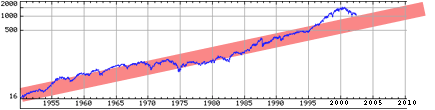
one could easily rotate that pink line counter clockwise just a couple of degrees, until the peak in 2000 just barely pokes out the top,
It doesn't work. If you rotate it anymore, you'll have entire decades falling out the bottom, UNDER that median line, and it look very OBVIOUSLY wrong. 75-90 is just barely staying on the bottom edge.
Of course you could fudge it, and widen that pink line, but that would be pretty obvious, and also wouldn't hide the bubble, which stands out far more than any other peak.
But, of course this is all hypothetical.
You can find a bit more about that chart here: http://www.downside.com/news.html See 2002-06-24
-
Re:welcome to the financial system
And I should also point out that this is all a brand new phenomenon. It's been less than 20 years that the stock market has gone so grotesquely out-of-whack, throwing us into several bubble and burst cycles. See: http://www.downside.com/charts/sp500asmall.gif [downside.com]
A friend of mine noticed this when he needed to do a project for an engineering course in applications of the Fourier and related transforms. He did some very simple work with the short time Fourier transform, and saw that the high frequency content of prices in more recent periods (last 5-10 years) is much higher than that of earlier periods. Presented graphically, it jumped right out at you!
-
Re:welcome to the financial system
to generate wealth out of thin air and making everyone dependent on everyone else's well-being is the entire foundation of our economic system
Uhh, no. It's just the foundation of the stock market. Our economy could get along just fine without any stock market at all. Private investment would do the job just fine, without being nearly as susceptible to fraud.
And I should also point out that this is all a brand new phenomenon. It's been less than 20 years that the stock market has gone so grotesquely out-of-whack, throwing us into several bubble and burst cycles. See: http://www.downside.com/charts/sp500asmall.gif
That's what happens when you change the tax code to eliminate dividends, and make all investors dependent on capitol gains, which requires a lot of finesse, and mostly luck (if not out and out fraud) to make sure you "getting out" at just the right time, when you can still find a bigger idiot with more money.
-
It's not going to work.
I have real doubts about the bailout "working". The underlying problems with the financial system are more fundamental. We have a sizable chunk of the financial system based on the assumption that real interest rates (after inflation) will remain negative.
Currently, US dollar inflation is around 5.4%. (9% to 11% if you use classical numbers, computed the way inflation was calculated prior to the 1980s.) Normally, the Fed funds rate is just above inflation, LIBOR and the prime rate run around 2% above inflation, and mortgages run about 6% above it. For the past year, the Fed has been flooding the financial system with cheap money, at 2%, in a failing attempt to avoid a recession. LIBOR is 3.88%. So we're currently in a situation where key real interest rates are well below inflation. LIBOR, in real terms, is about -1.5%. This is very unusual historically.
The problem is that 1) negative real interest rates can't last for long without producing runaway inflation; the money has to come from somewhere, and 2) there are sectors of the financial system that are addicted to those low, low rates. Last week, LIBOR briefly hit 6.88%, businesses were screaming "credit crunch", and AT&T and GE were having difficulties rolling over their commercial paper. (GE Credit borrowed short and lent long, which is a bet on low interest rates.)
The mortgage portion of the economy is heavily dependent on those low interest rates. A mortgage really should cost a good borrower about 11.5% right now; 6% as the cost of the mortgage, and 5.4% for inflation. The "bailout" is all about keeping those interest rates artificially low. For a while longer.
Probably not that much longer. Expect a "credit crunch" in 2009 as financial reality reasserts itself.
There's nothing wrong with a credit crunch. It just means that businesses have to finance more with equity and less with debt. (Because interest on debt is deductible by business borrowers, there's a systemic bias towards financing with debt.) Consumer credit rates, other than for autos, are already at credit-crunch levels. (Stop in at your local "payday loan" outlet and ask them what their APR is.) And besides, we might see worthwhile interest rates on savings accounts.
What's "normal?" 3% real interest on savings accounts, 6% on loans, and the median house costs 2.5 years median income. That multiplier got up to over 4 in the US nationally, and over 10 in some markets. That was two years ago; now those numbers are lower, but not low enough.
When bubbles burst, they burst all the way. Tokyo residential real estate dropped over 90% when their bubble burst in 1989, and never went that high again.
We told you this would happen. You didn't listen. Now suffer the consequences.
-
Just click and follow the directions
Just click here and follow the official U.S. Government approved directions.
-
Downside's Deathwatch, a decade later
Back in 2000-2001, our Downside site ran an automatic predictor for dot-com failure. It was amazingly simple and painfully accurate. The system read through SEC filings, extracted the numbers for cash on hand and rate of losses, and projected when the cash would run out. We called that the "death date". That was a good predictor of when the company would go bust. This is a surprisingly good predictor for companies financed via an IPO. You can only IPO once (yes, secondary offerings are possible, but not when you're failing), so there's a finite amount of cash, and when it's gone, so is the company.
For Deathwatch purposes, "dead" was defined as "investors lost essentially all (90% or worse) of their investment". Some of the companies, like Dr. Koop, hung on for years, but their investors did not. (This, by the way, is a common phenomenon to venture capitalists. Many failing companies hang on as overfinanced small companies, downsized until they are able to make just enough money to cover current operating costs but not to recover their startup costs. VC's call these "zombies".) By our standards, essentially all the companies on the Industry Standard list died.
-
Downside's Deathwatch, a decade later
Back in 2000-2001, our Downside site ran an automatic predictor for dot-com failure. It was amazingly simple and painfully accurate. The system read through SEC filings, extracted the numbers for cash on hand and rate of losses, and projected when the cash would run out. We called that the "death date". That was a good predictor of when the company would go bust. This is a surprisingly good predictor for companies financed via an IPO. You can only IPO once (yes, secondary offerings are possible, but not when you're failing), so there's a finite amount of cash, and when it's gone, so is the company.
For Deathwatch purposes, "dead" was defined as "investors lost essentially all (90% or worse) of their investment". Some of the companies, like Dr. Koop, hung on for years, but their investors did not. (This, by the way, is a common phenomenon to venture capitalists. Many failing companies hang on as overfinanced small companies, downsized until they are able to make just enough money to cover current operating costs but not to recover their startup costs. VC's call these "zombies".) By our standards, essentially all the companies on the Industry Standard list died.
-
Wow
Wow.
Facebook is tiny. It's this one little building on Hamilton in Palo Alto, next to the nail salon and the foam store. The servers are in some colo elsewhere.
"Web 2.0" is starting to look way overvalued. Companies are buying "clicks" and "eyeballs", not revenue. Remember what happened last time.
-
Moller, the scam
Moller has been claiming he'd have a flying car Real Soon Now since the 1960s. Here's his 1974 brochure. The schedule back then was "December 31, 1974 - Preliminary test flights complete - December 31, 1976 - Full-scale production begins". Thirty years later...
In the words of the Securities and Exchange Commission investigation (Moller had a bit of trouble about selling unregistered stock, making false and misleading claims, and other securities law violations), "As of late 2002, MI's approximately 40 years' of development has resulted in a prototype Skycar capable of hovering about fifteen feet above the ground."
What Moller is talking about now, the "M200G", is closer to a hovercraft than a flying car. This isn't the big red "flying car" prototype he's been touting for the last ten years; it's a new, simpler model. He does have a prototype flying, at least while tethered to a crane. Performance is worse than the AvroCar, circa 1960.
It's not that a flying car is impossible. It's that Moller isn't good enough to bring it off. If somebody like Burt Rutan was doing this, it would be flying in a year or two.
The basic problem with a flying car today is that nobody ever found a way to make a cheap, reliable, small jet engine. It's possible to make a small jet engine, but below bizjet size, they don't get much cheaper. That's why general aviation is still mostly piston-powered. Piston-powered VTOL, which is what Moller is trying, is a marginal idea. It was tried extensively in the 1950s, and the power to weight ratio just isn't good enough. Moller is using Wankel engines, which helps a little, but not enough.
-
With Moller...
I'll believe it when I can actually buy one. Much as I'd like a flying car, his always seem to be "Real Soon Now(TM)" AFAIK, Moller has never actually had anything for sale. Downside(R) lists his company as a scam because it has been a few years from production for 30 years. There have also been SEC complaints for "fraudulent, unregistered offering and the filing of a fraudulent Form 10-SB by Moller International, Inc. ("MI" or "the company"), a California company engaged in the development of a personal aircraft known as "the Skycar.""
I'd like to be wrong, but I sure won't be putting down any money just yet.
-
Re:Yes, there's a bubble, but it's not a big deal.
I think you need to update Verisign and Amazon. Did you automate your search for dying companies or do manual analysis when you picked them?
Verisign dropped from 250 in 2000 to around 5 in 2002. Based on Downside's definition, (investors lost 90% of their investment), that stock was "dead". They're around 29 today, and never came back to anywhere near their stock price of 1999-2000. Even today, they have a P/E of 167, which is way too high.
Amazon actually did come back; their stock price today, 77, is at least in the same ballpark as their peak around 107 back in 1999. But they bottomed out around 6, so they had a 90% drop from the peak. Their P/E today is 107, which very high, considering that they're in a low-margin business and aren't growing much.
As we said on the Deathwatch "about" page back in 2000, "If you owned any of them, you're not happy."
-
Yes, there's a bubble, but it's not a big deal.
Yes, the "Web 2.0" bubble will pop, but nobody will notice.
I did Downside, and I have a good track record predicting Web 1.0 failures. Last time around, we had way too much capital going into bad ideas. "Web 2.0" companies aren't that capital intensive, and most of them aren't publicly held early stage companies. If that sector collapses, it will be a blip.
That said, we're seeing some high P/E ratios. Google's is 44, and Yahoo's is 45. Those are high but not insane. Reasonable values for a big, successful company are in the 10-20 range. (Microsoft is 21, IBM is 17, Boeing is 23, AT&T is 20, News Corp is 21.) It's not like last time, when we were seeing P/E ratios above 100. Some of that history is at Downside's Deathwatch. ("Chart is not available for this symbol" means the company is so dead their ticker symbol is ancient history.)
As an investor, I'm much more worried about housing and energy issues. Oil is at $77/bbl today. That has much more impact than anything in the web area. The US housing bubble is deflating, foreclosures are way up, too many adjustable-rate borrowers are being squeezed by rising interest rates, and it's not clear who holds all the paper collateralized by mortgages. Parts of the financial services sector will be squeezed hard by that. Those issues are 2-3 orders of magnitude bigger than "Web 2.0".
-
Yes, there's a bubble, but it's not a big deal.
Yes, the "Web 2.0" bubble will pop, but nobody will notice.
I did Downside, and I have a good track record predicting Web 1.0 failures. Last time around, we had way too much capital going into bad ideas. "Web 2.0" companies aren't that capital intensive, and most of them aren't publicly held early stage companies. If that sector collapses, it will be a blip.
That said, we're seeing some high P/E ratios. Google's is 44, and Yahoo's is 45. Those are high but not insane. Reasonable values for a big, successful company are in the 10-20 range. (Microsoft is 21, IBM is 17, Boeing is 23, AT&T is 20, News Corp is 21.) It's not like last time, when we were seeing P/E ratios above 100. Some of that history is at Downside's Deathwatch. ("Chart is not available for this symbol" means the company is so dead their ticker symbol is ancient history.)
As an investor, I'm much more worried about housing and energy issues. Oil is at $77/bbl today. That has much more impact than anything in the web area. The US housing bubble is deflating, foreclosures are way up, too many adjustable-rate borrowers are being squeezed by rising interest rates, and it's not clear who holds all the paper collateralized by mortgages. Parts of the financial services sector will be squeezed hard by that. Those issues are 2-3 orders of magnitude bigger than "Web 2.0".
-
"Upside" went bust, too.
A few years ago, Upside magazine went bust. Since I own Downside, I looked into buying their domain, but the assets of Upside were eventually acquired by another tech publishing firm. The article didn't mention Upside, although they mentioned The Industry Standard and Business 2.0, which also tanked.
We also lost Silicon Valley's newspaper, the San Jose Mercury News. It's been purchased by an outfit that runs cheesy suburban throwaways, and is being brought down to that level. It's still published, but nobody cares.
And Murdoch is buying the Wall Street Journal. Soon, there will be very few information sources that actually go out and dig out news.
-
Re:Odd definition of dead
1) Since when does "dead" mean a company that is no longer feared? True, MS has lost it's fear factor, but that is nothing like being dead. "Dead" means dead, as in SCO.
Our definition of "dead", for Downside, was "stockholders have lost 90% of their investment." Microsoft hasn't reached that point. Although, of course, the company behind Slashdot, VA Systems, has.
-
I've seen them. Above urinals. Really.
I've seen those posters. Long, detailed small-type discussions of code coverage analysis mounted above urinals. Last week's poster: Google measures code coverage on a per-statement basis. Really.
Visiting Google HQ bothers me a bit. I'm the guy who did Downside, tracking failing dot-coms, and I see too many similarities between Google today and some of the more exuberant dot-coms. Google's business is basically AdWords and a search engine; on the side, they also operate a bunch of unprofitable dot-coms. YouTube, Gmail, and the web apps aren't profitable. If anything happens to force AdWords prices down, like an advertising price war with Microsoft or trouble with the pay-per-click model, Google may have problems.
Google has a lot of smart people, but somehow that's not translating into new, profitable product lines.
-
Now, more buzzword-friendly?"Active Record", I gather, is some kind of database wrapper. That's useful, but it's not a breakthrough. I've done similar things in Perl; one of them drives Downside's financial statement extractor. Admittedly, object-oriented Perl 5 is textually clunky, but adequate.
This "let's use all-new terminology and claim we have something new" stuff is annoying. Especially for what are, really, rather minor improvements.
-
Been there, done that, with DownsideI run Downside, which provides some financial information, mostly about failing and failed companies. For some years, I just routed all the mail for the domain to a default mailbox, regardless of username.
There's a "Downside School and Abbey" in England. I'd get misaddressed e-mail to and from students and teachers. Most of this was minor, although a few students signed up for things that generated spam, resulting in my getting junk mail about British teen idols. On one occasion, though, I got a misaddressed message headed "I am going to kill you tonight". This was after the Columbine massacre, when everyone was paranoid about school shootings, so I called the school, got someone up in the middle of the night their time, and read them the message. It turned out to be a 12 year old kid flaming in E-mail. But you never know.
Then there was "Downside", the band. They had "downside.net" for a while. That produced some amusing E-mail. I'd get some of their mail, even after filtering. I forwarded this to their lead singer, and we'd occasionally exchange messages. That was fine, but then they tried offering branded e-mail to their fans, using the "downside.net" domain. That led to too much junk, and I talked to them about that. Finally, they were signed by a label, and changed their name to "Strata" to avoid trademark problems, since I own "Downside" as a registered trademark. There are actually several other bands now calling themselves "Downside", but none of them seem to be very active. (The grunge band on Long Island broke up, another let their domain expire, and the third insists they haven't broken up, but don't play much.)
The worst problem was a "joe job", a company sending out spam to advertise their porno sites. At one point, 16,000 mail bounces per day were coming in, and the mail server was overloading. We put some effort into shutting them down. Since they were paying for ISP accounts with credit card numbers they'd collected from their customers, ISPs were very cooperative. And owning a registered trademark gives you extra legal leverage.We got them kicked off servers on three continents. We had their domains locked and their DNS turned off. It took a while to trace them to St. Petersburg, Russia, but after some long international phone calls, all their sites disappeared from the web and were never seen again.
-
Of course that information has to be correctIn most US states and in many countries, it's a criminal offense to operate a business anonymously. Most of the grumbling comes from slimeballs who operate marginal businesses and don't want their unhappy customers coming after them. I'd like to see every domain that can lead to a credit card transaction tied to a valid business, or the transaction isn't valid. At least for ".com" and ".net". That would force credit card merchant banks to validate Whois information.
If you want a domain as an individual, there's ".name".
I own five domains, and every one has a valid street address and phone number. I get very few annoying calls, and little paper mail, as a result. Two threats in the last eight years - one from a company which didn't like what I said about them on Downside (their stock dropped 98% from its peak), and a guy running a patent-broker scam (he's now out of business). It's just not a big problem if you're legitimate.
-
Overcomment everythingOf course you write comments. Usually more comments than code. Don't look for excuses not to comment.
Some comments I've written:
-
From a physics engine:
// the two closest points. The frictional force is in a plane
// perpendicular to that vector and through the midpoint of pnt0-pnt1,
// The frictional force vector is opposite the velocity vector
// component in the friction plane.
// All witness points must be on their polyhedron's side of the
// separating plane.Here the purpose of the comments is to explain the math.
-
From the control code for a DARPA Grand Challenge vehicle. Here's some code I wasn't happy with, so that's clearly noted.
// - the hard cases
//
// Called when we have to do some obstacle avoidance
//
// Path is an output only.
//
// First pass tries to find some path that will work within the turning limits.
// If that fails, we try "brake then steer" mode - look for the longest path
// in any direction, regardless of dynamics limits, and slam on the brakes
// while turning. The actual steering command will be limited later.
// ***MAKE SURE THAT CHECK IS MADE***
//
// ***NEEDS WORK***
// ***SEARCHING OUTSIDE LIMITS WILL ALWAYS FAIL***
// -
Finally, here's some Perl code, part of the code that runs Downside.
#
(We have to stop there; Slashdot's "lameness filter" rejects Perl code.)
# extractsecurityclass -- extract class of a NASDAQ security
#
# Foreign and bank securities aren't filed with the SEC, so
# we need to note this. There are also test and statistics items that
# aren't real securities.
#
# Note that the test for "bank" is rather poor. NASDAQ used to
# identify banks using a column in the table, but they no longer do so.
#
sub extractsecurityclass($)
{ my $vals = shift;
## Check for symbols that don't file with the SEC
if (${$vals}{'test_issue'} ne 'N') { return('test'); } ## is test
All code should have well-written comments. As Wirth pointed out years ago, people who can't express themselves well in their native language are generally poor programmers.
-
From a physics engine:
-
They're right. Most acquisitions lose moneyIt's well-known that most major corporate acquisitions are not, in the end, successful. So why do they happen?
First, it's something for the CEO to do. Really. Acquisitions are something the CEO can actually do. If the CEO has a financial or legal background, acquisitions are something they understand. On the operational side, the CEO of a large company mostly has to just pick people and give them general direction. There are exceptions to this, but they're rare. If you can't fix the company you're running, acquisition gives the illusion you're doing something.
Second, acquisitions are highly visible events for a CEO. They get you on the cover of Business Week. You can talk to other CEOs about them. You get better golf dates. Improving manufacturing productivity by 15% doesn't do this, even though it might triple profits.
Third, acquisitions usually result in increased CEO income. The company is bigger now, so the CEO should make more. Right? Don't underestimate this. Also, acquisitions tend to increase stock volatility, and if much of your pay is in options, volatility pays off, even if, on average, the trend is neutral or even down.
Now, it can actually make sense to acquire a company for its technology or its market share. In the first case, the acquired company is usually small, and you're buying technology, not a customer base or manufacturing capability. A successful example is Google buying Keyhole. Keyhole was small, had good technical assets, and wasn't too expensive. An unsuccessful example is SGI buying Cray. Cray had a large mainframe manufacturing operation and too many people, neither of which SGI needed. (SGI comes to mind because I was in a building yesterday I'd previously visited when SGI owned it. They don't own it any more.)
Buying market share makes sense if you buy something in the same business. You're reducing competition and can raise prices. You might even get economies of scale. Blockbuster, which bought out many other video store chains, is a successful example.
On the other hand, buying companies for "diversification" or to "expand into a new business area" usually doesn't work out too well. Buying for vertical integration, where you buy your supplier or customer, used to be popular half a century ago, but is now somewhat out of favor. It made sense to buy a coal mine when you had a steel mill. It make less sense to buy an ISP when you're a phone company.
I've watched these behaviors for years. See Downside's Deathwatch for the results. (When it says "Chart not available for this symbol, it's not because there's a bug. It's because the company died.)
-
For a real trip down memory lane...
... check out Downside's Internet Deathwatch and see how many "charts not available" there are.
-
These are the golden days.The "Internet thing" finally works. Web sites stay up and look reasonable in almost all browsers. Order processing over the Internet actually works. The catalogs work, the shopping cards that remain work reasonably well, and most sites have proper integration with credit card and shipping processing. Backbone bandwidth is plentiful, and last-mile bandwidth isn't too bad either. You can buy all the necessary parts off the shelf, and they're mature enough that you can find out if they'll work before buying.
Remember how crappy it used to be? Catalog pages didn't match the shopping cart, credit card processing involved ICVerify emulating a 1200 baud card swipe terminal, and half the time you had to call up to find out where your order went. On the merchant side, banks didn't have good online integration, half the transactions were bogus, and there was no way to get UPS and FedEx directly connected to your own systems. There were days when the Internet backbones would choke, and you'd go online to read the Internet weather report and see that MAE-WEST was dropping more than half its packets. And you needed an army of semi-competent people to glue it all together.
The on-line businesses that are still around have all this stuff working smoothly now. (Many of the ones that couldn't make it work are listed here.)
For most businesses, once you have all the basics working, you've achieved most of the benefits IT can provide. There's endless stuff you can waste money on. There's "data mining" and "profiling" and "customer relationship management" and "personalization", but it turns out that what works is telling existing customers of products related to stuff they already bought. Which isn't hard. Microsoft is pushing "synchronization", or "change the spreadsheet and your PowerPoint presentation changes to match", but most those bells and whistles don't really help productivity.
If you're a user of IT, this is great. If you're an "IT guru", this can be bad news.
Once I built a railroad, made it run,
made it race against time.
Once I built a railroad, now it's done.
Brother, can you spare a dime?
-
Possible problems?
The coolest looking one was the SkyCar, so I looked up more information.
No idea how reliable these are:
Paul Moller and his flying car
His 1974 flying car looked pretty cool, too, from a 1974 perspective. I could see wanting one of those as a teen-ager in the seventies.
Artful Dodger, with Eyes on the Prize
From the Popular Science article:
Buyer beware. In 2003 the U.S. Securities and Exchange Commission filed suit against Moller International in federal court for selling unregistered securities. The suit alleged that while Moller, who has been designing and building vertical-lift vehicles since the early 1960s, had touted the Skycar's promise to investors, "in reality, the Skycar was and still is a very early developmental-stage prototype that has no meaningful flight testing, proof of aeronautical feasibility, or proven commercial viability." The SEC also alleged that Moller misled investors about the firm's financial prospects. Moller paid $50,000 to settle the suit.
To their credit, Moller doesn't seem to be trying to hide that in their company history.
I'd love this to be legit, just thirty years late.
-
We're about to find out the dirt on DarlSCO can't file their 10-K because "it is examining matters related to stock issued as part of its compensation plans"? That's one of the lamer excuses sent to the SEC in a while.
The "10-K" is the backup data behind a company's annual report. It's the single most important disclosure of a company's financial status. The SEC allows 3 months after the close of the fiscal year for a 10-K filing. SCO's year closed at the end of October, and their 10-K was due at the end of January. Late filing of a 10-K or 10-Q (the quarterly report) is considered a major red flag for a stock. When I was following dying dot-coms, a late 10-K or 10-Q was a strong indicator of trouble. Nobody files late because they have unexpectedly good numbers.
SCO filed an NT-12K form with the SEC, asking for a 15-day extension. "The Company currently anticipates that the Form 10-K will be filed by no later than the fifteenth calendar day following the date on which the Form 10-K was due." They missed that date, too.
There has to be something really embarassing in the compensation plan. Really embarassing, if they're willing to risk delisting from the NASDAQ.
Delisting kicks a stock down to the pink sheets. That's where the penny stocks favored by spammers and scammers live.
-
Re:PrecognitionI'd forgotten that I wrote that.
I have a track record at predicting failures. I did Downside's Deathwatch.
As indoor oceans go, this CargoLifter one is unimpressive. It's just a big pool. Phoenix SeaGaia OceanDome is much better. They have surf, powered by really big pumps. And the roof opens.
-
Re:And Ken Lay is still free...Ken Lay was arrested and is out on bail. See him in handcuffs here.
First the prosecutors went after Ben Glisan, Enron's treasurer. He's now Federal inmate #20293-179 at FDC Houston and is scheduled for release in 2008.
Once Glisan talked, the prosecutors went after Andrew Fastow, Enron's CFO, and his wife, who helped with those "offshore entities". She's now inmate #20290-179 at FDC Houston and is scheduled for release in 2005. Andrew Fastow has pled guilty and is "cooperating with prosecutors", which will affect the length of his sentence. So he gave up Ken Lay. Andrew Fastow will still do quite a few years in prison; the original indictment specified over a thousand years.
Lay, Skilling, and Causey go on trial together in March 2005. We'll probably have a few more inmate numbers after that.
-
Bing Crosby said it best in 1932
-
They used to tell me
I was building a dream.
And so I followed the mob
When there was earth to plow
Or guns to bear
I was always there
Right on the job.
They used to tell me
I was building a dream
With peace and glory ahead.
Why should I be standing in line
Just waiting for bread?
Once I built a railroad
I made it run
Made it race against time.
Once I built a railroad
Now it's done
Brother, can you spare a dime?
Once I built a tower up to the sun
Brick and rivet and lime.
Once I built a tower,
Now it's done.
Brother, can you spare a dime?
I warned you. On 2000-04-14, I wrote "Today begins the Second Great Depression". Was I wrong?
-
They used to tell me
-
Enhanced product image gives it awayThe product image shown in the article is very dim. But if you bring it into Photoshop, do gamma correction, scale it up by about 150%, and filter the JPEG artifacts, it looks like this. Now you can see what it is.
That looks a lot like the DL-1 digital light projector, which is a video projector on a 2-axis tilt mount. "Using the motion control feature, project your imagery anywhere in a 3D space". It's used for nightclubs and stage shows.
It's a cute stage effect, but not a breakthrough.
-
Why this is a bad idea - it's a taxonomyThe big problem with the so-called "semantic web" is that trying to taxonomize ideas doesn't work very well. Full-text search works much better.
In the beginning, we had library card catalogs, with their painful attempts to index and cross-reference books. That works well in some areas, typically ones where names of people are significant. Attempts to apply the same approaches to technical papers worked less well.
There's a very elaborate classification system for patents. When you had to look through patents on paper or microfilm, it was essential. Now that we have full text search, it's used less and less.
A modern example of this approach is the ACM Taxonomy, a structure into which all computer science can be fitted. (As an exercise, try to put the current Slashdot stories into that taxonomy.) Nobody actually uses that taxonomy to find anything.
As to data interchangability, that's a separate issue, and more of a standards one. The big problem for publicly available data is that the cost of encoding the data is borne by different people than those who benefit from the encoding. Many companies don't like having all their product and pricing information easily searchable by price. (Froogle may change this, because Google has so much clout.)
I've spent some time dealing with public financial reporting. There's opposition to detailed disclosure in a standardized format. Many companies don't want their detailed information to be too easily analyzed. Embarassing results show up.
The future is better search engines, not user-created indexing data. As we've painfully learned, a search engine must look at the same data a human reader would, or it will be lied to. Lied to to the point of uselessness.
-
Downside statsFor Downside a site intended for the financial crowd, Netscape usage is only 3%.For my technically oriented sites, Netscape usage is 7 to 9%.
There's definitely a "geek factor" here.