Slashdot Mirror
Domain: economist.com
Stories and comments across the archive that link to economist.com.
Comments · 2,721
-
This?
What's wrong with China? Oh I don't know, maybe this? How about this? Or maybe you'd prefer more Economist?
Of course there are a few successful localized industries... but as with many other poor countries, there are a few developed areas, while the rest of the country is still in the stone age. -
Re:"smear message"?
GDP to Debt ratio in the US going down? I think you need to actually take a look at some statistics before making a claim like that.
A quick search finds data
here or
here readily contridicting your statement. We have gone from about 58% when Bush to office to about 64% now. Another thing to realize is that the projected government expenditures on medicare and social security are about to explode. Demographics are going to make the simple outgrow the deficit thesis very hard to support. -
Big Worry: End of Nuclear Non-Proliferation TreatyUntil 2006, the Western nations had an effective regimen for controlling the spread of nuclear weapons. That regimen is called the Nuclear Non-proliferation Treaty (NPT). The idea behind the NPT is that its signatories agree to 2 main points: (1) if a nation does not have nuclear weapons, then it will not develop them and (2) if a nation has already built such weapons, then it will not export them or their technology. In exchange for committing to these points, the existing nuclear powers will give (outright) nuclear technology to the signatories to help them to develop nuclear power for peaceful uses. A third, implied but very important, point about the NPT is that its signatories make no judgment about the "goodness" or "badness" of a government. In this way, even notorious governments would agree to commit to the NPT.
What happened in 2006? Washington agreed to bend the rules in order to cater to Indian ruthlessness. New Delhi gave an ultimatum to Washington. The Indians would support the strategic American objectives of promoting human rights and democracy if and only if Washington (1) gives nuclear technology to New Delhi (in violation of the NPT) and (2) significantly increases the number of Indian H-1B workers allowed to enter the USA.
Given the paucity of supporters (due to the Iraq fiasco), Washington was eager to buy new friends in order to deal effectively with Beijing. So, Washington agreed to all the Indian demands.
Note that the Indians have refused to sign the NPT. Moreover, New Delhi has agressively developed nuclear weapons and is willing to sell nuclear technology to anyone.
Unfortunately, catering to Indian ruthlessness significantly weakened the American position on stopping the proliferation of nuclear weapons. Seeing how Washington kowtowed to the Indians, both the Iranians and the North Koreans are refusing to end their nuclear-weapons programs. Many other nations (including current signatories of the NPT) are now seeking such weapons.
The NPT died in 2006, and Washington killed it.
During 1993 - 2000, American foreign policy was exemplary. During 2001 - 2006, American foreign policy has been a series of grave missteps, miscalculations, and outright stupidity. What happened?
-
Who is repressive?
Strange, but I thought that it was the other way around.
About Peace:
When I read the [1], I thought that the US is the repressive state. After invading in so many countries (3 in 5 years!) it seems to my that it is the most aggressive nation ever. Causing more than 650.000 fatalities in a war just for oil, it is something that even Hitler or Roman emperors haven't done. Iraq didn't have weapons of mass destruction, admitted Bush. Terrorism threat has increased, according to CIA. US had more fatalities in Iraq war rather in twin towers. For what? Did you really believe that Saddam could nuke the US? He couldn't even bomb troops sieging Baghdad. Were he able to create big terrorist acts like what Al Quaeda does? Oh, come on, he had no transactions with extremists and much much more terrorist activity is watched in Pakistan or Saudi Arabia than in any other country.
About Freedom of Speech:
Yeah, that's the most stupid thing I ever heard. Especially after 11/9 civil liberties are literally gone. No, it's not only what I've seen on "Fahrenheit 9/11".
About criminalization of bloggers:
I know that China runs after bloggers, but what happened here in Greece, it was unprecedent. A web directory maintainer was arrester [2] for LINKING to a blog bashing a nationalist tele-evangelist [3], who btw support that us greeks have come from space, were spread throughout the world, we made pyramids, and with the aid of Russia will conquer the world and restore the Bizantine Empire. Ah, also that centaurs have existed. Oh, I forgot that a bookstore owner has been arrested for selling a BANNED book of Mimis Androulakis that was considered offensive to church. Also books of hime were burned in public in Thessaloniki by local orthodox believers. Does this remind you of Medieval Times or to Nazi Germany? I also remember that US citizens referring through a link (but not by plain text) to mp3 sites were prosecuted, at a court win of RIAA.
In no other country a referrer to a censored book or site was arrested -- even in China (which btw, is far from being considered communist, time has passed sine Mao was in power), blogs are banned or even bloggers are arrested. But no site owner referring to them was punished. Are we really a democratic nation?
Microsoft just said that to blind people that accused it for cooperating with the Chinese Government for filtering the web. Try to be objective... I know that this is difficult. When you in US were watching your missiles hitting Belgrad and shouted out WOWs, we were seeing human parts of babies thrown apart. I personally cannot forget one video transmitted by the greek public channel NET showing a hand of a baby lying to the scene of bombardment of a train in Yugoslavia. Did you see such images or you just enjoy Rambo killing thousands of evil enemies defending freedom fighters (=afgans, ironically).
[1] http://www.economist.com/world/africa/displaystory .cfm?story_id=8038059
[2] http://www.theregister.co.uk/2006/10/30/greek_blog ger_arrested/
[3] http://en.wikipedia.org/wiki/Dimosthenis_Liakopoul os -
Re:British usage
OK, I checked the BBC's usage: http://news.bbc.co.uk/sport2/hi/football/gossip_a
n d_transfers/6095938.stm
Note how they say "Arsenal are" and "Charlton are" and "West Brom want" and "Portsmouth are" and "Portsmouth have", etc. You were saying?
By the way, I have known many Brits, all of whom have used that same way of referring to an entity as plural. In fact, this same subject came up during the World Cup in the summer, when the Brits I currently work with had to explain to some of the Americans why that was so.
Another poster mentioned this, but the *British* magazine The Economist has a good explanation for this issue: http://www.economist.com/research/styleGuide/index .cfm?page=805687 -
Re:missing S in headline.
In Britain companies can be plural or singular depending on context. You would use singular when the company is acting as one e.g. 'Zob corporation is in agreement with the ruling' but plural when the corporate entity is not acting as one e.g. 'Zob Corporation are internally in disagreement about the best way forward'. See the Economist style guide here.
http://www.economist.com/research/styleGuide/index .cfm?page=805687 -
Re:Ireland is not the happiest place on earth
Actually, Denmark is the happiest place to live with the happiest people so bollocks to Ireland at #11.
The Economist begs to differ...
Germans might not laugh very much, or smile very much at that, but it doesn't mean they don't have a sense of humour. They laugh at the fact that so many people in Ireland died of starvation during the "potato famine" of 1845-1849 when Ireland is completely surrounded by water. All they had to do was go fishing.
See what I mean? Not so much as a chicken crossing the road in there. Sigh. -
Best place to live? Easy.
Well right off I can give you my short list (in no particular order):
Finland
Norway
Switzerland
Netherlands
Sweden
Australia
Perhaps UK somewhere (England, Ireland, Scotland)
of course I live in Canada so I can't pick that (and no I would NOT move to the USA)
The main disadvantages that many might have with the scandinavian countries are A) the cold weather, B) the taxes, and C)relitive remoteness and smaller urbanized areas.
Well Canada is A) Cold, B) has high taxes also, and C) unless you live in Toronto, Vancouver can be somewhat remote and smaller urban areas. So not so different really, certainly not so much to cause distress.
I picked Australia pretty much because as far are warmer countries go it seems pretty nice. Also I hear girls down under dig the Canadian accent
Another great thing about Australia and the UK is I don't need to learn a new language (though I know that most of the Scandinavian contries seem to have an absurd rate of english speaking also like 80-90%, but I would feel bad living there without learning the native tounge). The other great thing about the UK is all the shared heritage between them and Canada. Lots of relations on both sides, shared culture. Being from Nova Scotia (New Scotland), there are a lot of shared traditions with the British Iles, more so than central, or western Canada.
Also just to illistrate how great my choices are, here are some links to stuff like UN polls etc...
http://www.economist.com/theworldin/international/ displayStory.cfm?story_id=3372495&d=2005
http://www.msnbc.msn.com/id/9085910/
I was looking for the actual UN list of top 50 or whatever, as I remember Canada used to be at #1 for many years, until Norway finally de-throned us Canadians. Though I suspect it had more to do with Norway's expansion of oil production in the North Sea, and the smart way they are using the funds for the future (Canada has oil as well, but it doesn't seemed to be handled in as intelligent way, too many competing interests).
http://www.cnn.com/2005/WORLD/europe/10/04/eui.sur vey/
http://www.citymayors.com/environment/eiu_bestciti es.html
apparently some of the best cities to live in are in Australia and Switzerland.
Also these countries have a robust Hockey culture as well. I have friends who love Soccer, but I am not one of them.
Finland
Norway
Switzerland
Sweden
So I think this is the difinitive choices of where to live!
Finland
Norway
Switzerland
Netherlands
Sweden
Australia
Ireland
And of course Canada, if you are not already there! -
Re:The Netherlands
There's a chance that it will improve again, but currently there's a (grassroots/astroturf?) fear campaign against foreigners, mostly focussed on islamic cultured or coloured people,
I expect you have no idea why there might be some concern, or what is being done?
but americans as well (your current president isn't helping your reputation!).
Oh, please! Back that up, will you? I think you've had a few too many "special" brownies.
Hmm...Interesting Dutch blog... -
Re:The Netherlands
There's a chance that it will improve again, but currently there's a (grassroots/astroturf?) fear campaign against foreigners, mostly focussed on islamic cultured or coloured people,
I expect you have no idea why there might be some concern, or what is being done?
but americans as well (your current president isn't helping your reputation!).
Oh, please! Back that up, will you? I think you've had a few too many "special" brownies.
Hmm...Interesting Dutch blog... -
Re:I somehow doubt it
Economics isn't about predicting anything. It's about understanding the behavior of people with regards to goods and services.
I suggest you read that sentence to yourself about at dozen times.
It's flat out wrong. People don't spend all this effort creating economic models just to explain past events. Economic models ARE used to predict the future. This is public knowedge. Your assertion otherwise is provably false.
The grandparent's assertion that economics cannot account for charity is utterly wrong.
You turning my argument into a strawman is utterly wrong. I cited specific, highly influential events. I asked for a model that predicted either. Try responding to that actual statements I made. -
Re:UghUnfortunately, it seems that the arabic world (and I would guess Iran too) is culturally very closed minded and creatively stunted:
"Another, no less grave, result is the dearth of creativity. The report comments sadly on the severe shortage of new writing, and, for instance, the decline in the film industry. Nor are foreign books much translated: in the 1,000 years since the reign of the Caliph Mamoun, say the authors, the Arabs have translated as many books as Spain translates in one year."
-
Re:Would this be with or without illegal aliens ..
I disagree. Many sociologists and economists (who should know what they're talking about) argue that poor people choose to have more children, consciously or not, because it increases the odds that at least one of them will become successful later in life, thus being able to support the siblings and parents in old age. An evolution-minded anthropologist would say that breeding like bunnies is the best strategy for genetic perpetuation if you're under material stress, while doting on a single child may make more sense for wealthier parents. Also, consider that rural farmers—who tend to be poorer than urbanites—want more children in order to help them take care of the land. Here's one recent article that touches on the subject. There may be some truth to your argument, as well, but the causation is probably stronger in the opposite direction.
This post contains rampant generalizations; please recognize as such and save your flaming for someone else. -
Re:Would this be with or without illegal aliens ..
Anyone know why the US is stilling growing significantly, as opposed to most European countries? Which demographics are producing most children? How much does the number of legal immigrants contribute to the growth?
Wider-spread religiosity and gender-equality are the factors according to this article.
-
Go Forth and Multiply
America is the only developed nation which is still robustly growing. Our own average fertility rate is just above 2 kids per woman, which is enough to sustain population. The substantial immigration provides grows.
Economist thinks, religion has something to do with the fenomenon...
-
Re:verb conjugation and pirates
This well-known and widely-read British publication disagrees with you:
A government, a party, a company (whether Tesco or Marks and Spencer) and a partnership (Skidmore, Owings & Merrill) are all it and take a singular verb.
-
Fox News: "Bush administration official confirmed"According to a news flash from Fox News, "North Korea successfully tested of a nuclear weapon late Sunday night, a senior Bush administration official confirmed to FOX News." Several news organizations are reporting that Washington has not yet confirmed the nuclear test, but apparently Fox News just received confirmation from a senior official in Washington.
We are entering dangerous times, and the Bush administration made a tragic mistake in its dealings with India. Washington has signed the NPT, and by the terms of the treaty, its signatories agree to ban the transfer of nuclear technology to any nation that refuses to sign the NPT. The NPT further stipulates that any signatory which has not yet developed nuclear weapons shall not pursue their development.
New Delhi has long refused to sign the Nuclear Non-Proliferation Treaty (NPT) and has aggressively pursued the development of nuclear weapons. Despite this fact and despite the fact that Washington is a signatory to the NPT, Washington has agreed to give nuclear technology to India. (New Delhi refused to support the strategic American objectives of promoting human rights and democracy unless Washington (1) gives nuclear technology to India and (2) greatly increases the number of Indian H-1B workers allowed to enter the USA.)
How can Washington demand that Pyongyang refrain from developing nuclear weapons when Washington enthusiastically ignores Indian nuclear ambitions? The point of the NPT is to stop the spread of nuclear weapons to any and all nations, irrespective of their form of government.
-
Re:Another grey area...Two words: Gujarat Massacre. 2000 minority Muslims killed by Hindu mobs in 2002, while police even helped in some cases. The trials and finger-pointing are still ongoing.
Babri mosque destroyed by Hindu mob in 1992, thousands die nationwide in resulting violence.
I'm kinda surprised you don't know about these, considering your name is Singh. -
1/3 of U.S. dollars are outside of the USA
I'd like to see all the loudmouths try to compete with cheap currency citizens on rentacoder.com with the Chinese buying dollars year after year.
http://economist.com/ talked against this practice (altho with some progress they wrote about the other side) for some time. -
Re:Worse
Do you have any idea how hard it is to start a new business in Sweden? "Obstacles to job creation are everywhere in Sweden. Although the country's big companies have long thrived, the regulatory and tax climate is chilly to newer and smaller companies. Only one of Sweden's 50 biggest companies was founded after 1970; and Sweden has the lowest rate of self-employment in the OECD. The much-vaunted trilateral partnership between government, employers and unions works if the employer is an established large company; for a new or smaller one, it simply adds to costs. High personal taxes and generous welfare benefits--which pay people who lose their jobs as much as 80% of previous incomes for three years--discourage work. The "tax wedge" (ie, the non-wage cost of employment) is too thick, especially for low earners." - The Economist, September 7th, 2006 http://www.economist.com/world/europe/displaystor
y .cfm?story_id=E1_SRRDTSP Swedes are pretty fed up with this kind of system. They Social Democrats, which have been in power for many decades, just lost out to the Moderate party in elections a couple of weeks ago. For all of the problems here in the US, it is still one of the easiest places to start your own business and make something of yourself. -
Re:DUH!
in other words the nominal price is dropping, but the nominal wage is dropping faster.. meaning real price is actually rising.. except of course for the wealthy
This is exactly the case -- the developing economies of the world - primarily China and India have brought an abundance of labor, nearly doubling the supply but they have brought very little new capital. So, the ratio of capital to labor has made capital effectively twice as scarce, thus driving up the value of capital while driving down the value of labor.
In other words, the rich are getting richer and the poor are getting poor.
And this isn't just half-baked bullshit slashdot-rhetoric. You can find one the world's strongest advocates for globalisation saying the exact same thing. -
Re:not much of an "economics" magazine despite nam
The Economist? Hard to take them seriously. They predicted $5 per barrel oil when price was $10.
What? They've been writing for 150 years and it's hard to take them seriously because in 1999 they once guessed wrong about the future? You ignore, of course, that they owned up to the mistake by the end of the year. They examined the reasons behind it, and looked at several other mistaken predictions as well in an article titled, "Goofs: We wuz wrong".
Personally, I think it's great that they're willing to be contrarian, to make clear predictions about the future, and to own up when they get it wrong. A lot of the value in The Economist comes from their willingness to think about the news that they're reporting. A magazine that speculates on future possibilities and gets it 100% right means that they're being far too conservative to be interesting or useful to me. I want them to challenge me to think and give me facts to do it with, not be magically right all the time.
Of course, their other big prediction that year that failed to pan out was that the tech bubble was overdue to burst, at a time when many business magazines were still in a "OMG Dow 40000!!! Free ponies for all!" frenzy. That one they nailed, so perhaps they should get a little credit there. -
not much of an "economics" magazine despite name
New Scientist is a good one, I second the economist as a teatime reader.
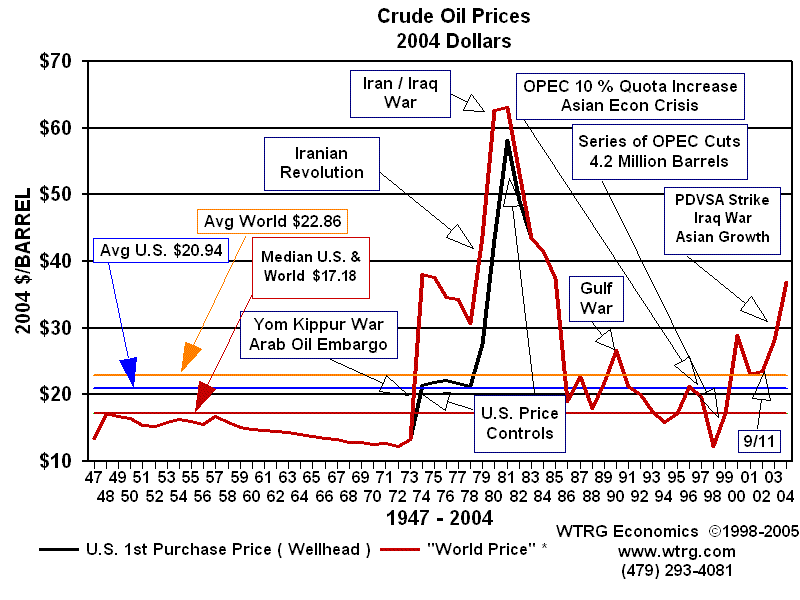
The Economist? Hard to take them seriously. They predicted $5 per barrel oil when price was $10. And now it's north of $60. And before anyone says "9/11", or "Iraq war", this chart shows that their article pretty much called the absolute bottom. Oil went from $10 to $30 between their article and 9/11. The Economist just overlooked the fact that India and China were growing and would need increased supplies of oil. Duh. -
Re:real magazine
New Scientist is a good one, I second the economist as a teatime reader.
Though I read "New Scientist" and "Nature" I prefer Sciam for science. Now, I also like "The Economist" and if I could justify the cost I'd subscribe to it as well.
Falcon -
Re:real magazine
New Scientist is a good one, I second the economist as a teatime reader. Their Tech/Science articles are in touch with reality, and a lot of their articles end up being quoted on Slashdot weeks later.
-
The trouble with YouTube
Business / Internet video
The trouble with YouTube
Aug 31st 2006 | SAN FRANCISCO
From The Economist print edition
It attracts a lot of viewers, but can “user-generated” video make money?
“STARBUCKS has comfy chairs, but they don’t charge people for sitting in them,” says Tom McInerney, the boss and co-founder of Guba, an internet-video company. Instead, he explains, Starbucks provides a comfortable environment, at considerable expense, so that people will buy overpriced coffee. That, in essence, is the business model being pursued by websites that host “user-generated content” such as personal blogs, photographs and today’s craze, amateur videos, which can be uploaded and watched on sites such as YouTube, Google Video, MySpace, Guba, Veoh and Metacafe. By offering a setting for free interaction, such sites provide the online equivalent of comfy chairs. The trouble is that, so far, there is no equivalent of the overpriced coffee that brings in the money and pays the bills.
IMAGE: Head and shoulders above the rest, for now (AP)
That is why people like Chad Hurley and Steven Chen (pictured), the co-founders of YouTube, the clear leader of the pack by audience size, are casting around for a business model. Aware that inserting advertisements at the beginning of video clips, as some sites do, is annoying and risks driving away YouTube’s users, Mr Hurley and Mr Chen have announced two experiments with advertising, with the promise of more to come. One idea is for “brand channels” in which corporate customers create pages for their own promotional clips. Warner Brothers Records, a music label, led the way, setting up a page to promote a new album by Paris Hilton. The second experiment is “participatory video ads”, whereby advertisements can be uploaded and then rated, shared and tagged just like amateur clips. This “encourages engagement and participation,” the company declares.
Even as advertisers evaluate these new ideas, however, YouTube and the other video-sharing sites face other difficulties. For one thing, they are in a no-man’s land of copyright law: they promise to pull pirated content from their sites when asked to do so, but it is only a matter of time before one of them is hit with a big lawsuit. Then there are the costs of running such a site—video requires a lot of bandwidth and storage. A rival estimates that YouTube is losing more than $500,000 a month.
Putting paid-for advertisements alongside amateur video clips, perhaps based on keywords or tags, poses another problem. “How do you know the guy in a video doesn’t make a racial slur?” asks Mr McInerney. Many firms will be cautious about letting an automatic system—such as, say, Google’s AdSense—place their ads next to user-generated clips of unknown provenance and with potentially embarrassing contents. (Even so, Guba is testing AdSense for Video, which has not yet been officially launched.)
For its part, Guba is betting on a combination of advertising plus the sale and rental of commercial video material. Its site offers both free amateur videos and paid-for content, including films from Sony and Warner Brothers. When Guba cut its prices last week, allowing new films to be downloaded for $9.99 and older ones for $4.99, its sales jumped tenfold. Google Video also allows content owners to charge for video. This suggests that internet-video sites are on a collision course with DVD-rental outfits, such as Netflix, which are moving towards the delivery of films via the -
The trouble with YouTube
Business / Internet video
The trouble with YouTube
Aug 31st 2006 | SAN FRANCISCO
From The Economist print edition
It attracts a lot of viewers, but can “user-generated” video make money?
“STARBUCKS has comfy chairs, but they don’t charge people for sitting in them,” says Tom McInerney, the boss and co-founder of Guba, an internet-video company. Instead, he explains, Starbucks provides a comfortable environment, at considerable expense, so that people will buy overpriced coffee. That, in essence, is the business model being pursued by websites that host “user-generated content” such as personal blogs, photographs and today’s craze, amateur videos, which can be uploaded and watched on sites such as YouTube, Google Video, MySpace, Guba, Veoh and Metacafe. By offering a setting for free interaction, such sites provide the online equivalent of comfy chairs. The trouble is that, so far, there is no equivalent of the overpriced coffee that brings in the money and pays the bills.
IMAGE: Head and shoulders above the rest, for now (AP)
That is why people like Chad Hurley and Steven Chen (pictured), the co-founders of YouTube, the clear leader of the pack by audience size, are casting around for a business model. Aware that inserting advertisements at the beginning of video clips, as some sites do, is annoying and risks driving away YouTube’s users, Mr Hurley and Mr Chen have announced two experiments with advertising, with the promise of more to come. One idea is for “brand channels” in which corporate customers create pages for their own promotional clips. Warner Brothers Records, a music label, led the way, setting up a page to promote a new album by Paris Hilton. The second experiment is “participatory video ads”, whereby advertisements can be uploaded and then rated, shared and tagged just like amateur clips. This “encourages engagement and participation,” the company declares.
Even as advertisers evaluate these new ideas, however, YouTube and the other video-sharing sites face other difficulties. For one thing, they are in a no-man’s land of copyright law: they promise to pull pirated content from their sites when asked to do so, but it is only a matter of time before one of them is hit with a big lawsuit. Then there are the costs of running such a site—video requires a lot of bandwidth and storage. A rival estimates that YouTube is losing more than $500,000 a month.
Putting paid-for advertisements alongside amateur video clips, perhaps based on keywords or tags, poses another problem. “How do you know the guy in a video doesn’t make a racial slur?” asks Mr McInerney. Many firms will be cautious about letting an automatic system—such as, say, Google’s AdSense—place their ads next to user-generated clips of unknown provenance and with potentially embarrassing contents. (Even so, Guba is testing AdSense for Video, which has not yet been officially launched.)
For its part, Guba is betting on a combination of advertising plus the sale and rental of commercial video material. Its site offers both free amateur videos and paid-for content, including films from Sony and Warner Brothers. When Guba cut its prices last week, allowing new films to be downloaded for $9.99 and older ones for $4.99, its sales jumped tenfold. Google Video also allows content owners to charge for video. This suggests that internet-video sites are on a collision course with DVD-rental outfits, such as Netflix, which are moving towards the delivery of films via the -
Japan’s humanoid robots
Special Report / Japan’s humanoid robots
Better than people
Dec 20th 2005 | TOKYO
From The Economist print edition
Why the Japanese want their robots to act more like humans
IMAGE (Getty Images)
HER name is MARIE, and her impressive set of skills comes in handy in a nursing home. MARIE can walk around under her own power. She can distinguish among similar-looking objects, such as different bottles of medicine, and has a delicate enough touch to work with frail patients. MARIE can interpret a range of facial expressions and gestures, and respond in ways that suggest compassion. Although her language skills are not ideal, she can recognise speech and respond clearly. Above all, she is inexpensive. Unfortunately for MARIE, however, she has one glaring trait that makes it hard for Japanese patients to accept her: she is a flesh-and-blood human being from the Philippines. If only she were a robot instead.
Robots, you see, are wonderful creatures, as many a Japanese will tell you. They are getting more adept all the time, and before too long will be able to do cheaply and easily many tasks that human workers do now. They will care for the sick, collect the rubbish, guard homes and offices, and give directions on the street.
This is great news in Japan, where the population has peaked, and may have begun shrinking in 2005. With too few young workers supporting an ageing population, somebody—or something—needs to fill the gap, especially since many of Japan’s young people will be needed in science, business and other creative or knowledge-intensive jobs.
Many workers from low-wage countries are eager to work in Japan. The Philippines, for example, has over 350,000 trained nurses, and has been pleading with Japan—which accepts only a token few—to let more in. Foreign pundits keep telling Japan to do itself a favour and make better use of cheap imported labour. But the consensus among Japanese is that visions of a future in which immigrant workers live harmoniously and unobtrusively in Japan are pure fancy. Making humanoid robots is clearly the simple and practical way to go.
Japan certainly has the technology. It is already the world leader in making industrial robots, which look nothing like pets or people but increasingly do much of the work in its factories. Japan is also racing far ahead of other countries in developing robots with more human features, or that can interact more easily with people. A government report released this May estimated that the market for “service robots” will reach ¥1.1 trillion ($10 billion) within a decade.
The country showed off its newest robots at a world exposition this summer in Aichi prefecture. More than 22m visitors came, 95% of them Japanese. The robots stole the show, from the nanny robot that babysits to a Toyota that plays a trumpet. And Japan’s robots do not confine their talents to controlled environments. As they gain skills and confidence, robots such as Sony’s QRIO (pronounced “curio”) and Honda’s ASIMO are venturing to unlikely places. They have attended factory openings, greeted foreign leaders, and rung the opening bell on the New York Stock Exchange. ASIMO can even take the stage to accept awards.
The friendly face of technology
So Japan will need workers, and it is learning how to make robots that can do many of their jobs. But the country’s keen interest in robots may also reflect something else: it seems that plenty of Japanese really like dealing with robots.
Few Japanese have the fear of robots that seems to haunt westerners in seminars and Hollywood films. In western popular culture, robots are often a threat, either because they are manipulated by sinister forces or because something goes horribly wrong with th -
Japan’s humanoid robots
Special Report / Japan’s humanoid robots
Better than people
Dec 20th 2005 | TOKYO
From The Economist print edition
Why the Japanese want their robots to act more like humans
IMAGE (Getty Images)
HER name is MARIE, and her impressive set of skills comes in handy in a nursing home. MARIE can walk around under her own power. She can distinguish among similar-looking objects, such as different bottles of medicine, and has a delicate enough touch to work with frail patients. MARIE can interpret a range of facial expressions and gestures, and respond in ways that suggest compassion. Although her language skills are not ideal, she can recognise speech and respond clearly. Above all, she is inexpensive. Unfortunately for MARIE, however, she has one glaring trait that makes it hard for Japanese patients to accept her: she is a flesh-and-blood human being from the Philippines. If only she were a robot instead.
Robots, you see, are wonderful creatures, as many a Japanese will tell you. They are getting more adept all the time, and before too long will be able to do cheaply and easily many tasks that human workers do now. They will care for the sick, collect the rubbish, guard homes and offices, and give directions on the street.
This is great news in Japan, where the population has peaked, and may have begun shrinking in 2005. With too few young workers supporting an ageing population, somebody—or something—needs to fill the gap, especially since many of Japan’s young people will be needed in science, business and other creative or knowledge-intensive jobs.
Many workers from low-wage countries are eager to work in Japan. The Philippines, for example, has over 350,000 trained nurses, and has been pleading with Japan—which accepts only a token few—to let more in. Foreign pundits keep telling Japan to do itself a favour and make better use of cheap imported labour. But the consensus among Japanese is that visions of a future in which immigrant workers live harmoniously and unobtrusively in Japan are pure fancy. Making humanoid robots is clearly the simple and practical way to go.
Japan certainly has the technology. It is already the world leader in making industrial robots, which look nothing like pets or people but increasingly do much of the work in its factories. Japan is also racing far ahead of other countries in developing robots with more human features, or that can interact more easily with people. A government report released this May estimated that the market for “service robots” will reach ¥1.1 trillion ($10 billion) within a decade.
The country showed off its newest robots at a world exposition this summer in Aichi prefecture. More than 22m visitors came, 95% of them Japanese. The robots stole the show, from the nanny robot that babysits to a Toyota that plays a trumpet. And Japan’s robots do not confine their talents to controlled environments. As they gain skills and confidence, robots such as Sony’s QRIO (pronounced “curio”) and Honda’s ASIMO are venturing to unlikely places. They have attended factory openings, greeted foreign leaders, and rung the opening bell on the New York Stock Exchange. ASIMO can even take the stage to accept awards.
The friendly face of technology
So Japan will need workers, and it is learning how to make robots that can do many of their jobs. But the country’s keen interest in robots may also reflect something else: it seems that plenty of Japanese really like dealing with robots.
Few Japanese have the fear of robots that seems to haunt westerners in seminars and Hollywood films. In western popular culture, robots are often a threat, either because they are manipulated by sinister forces or because something goes horribly wrong with th -
A meaty question
Technology Quarterly
A meaty question
Sep 21st 2006
From The Economist print edition
Biotechnology: Meat grown in vats, rather than in the form of animals, could soon be on the menu. It might even be healthier and better for you
IMAGE
IF YOU have ever longed for a meat substitute that smelt and tasted like the real thing, but did not involve killing an animal, then your order could be ready soon. Researchers believe it will soon be possible to grow cultured meat in quantities large enough to offer the meat industry an alternative source of supply.
Growing muscle cells (the main component of meat) in a nutrient broth is easy. The difficulty is persuading those cells to form something that resembles real meat. Paul Kosnik, the head of engineering at a firm called Tissue Genesis, is hoping to do it by stretching the cells with mechanical anchors. This encourages them to form small bundles surrounded by connective tissue, an arrangement similar to real muscle.
Robert Dennis, a biomedical engineer at the University of North Carolina, believes the secret of growing healthy muscle tissue in a laboratory is to understand how it interacts with its surroundings. In nature, tissues exist as elements in a larger system and they depend on other tissues for their survival. Without appropriate stimuli from their neighbours they degenerate. Dr Dennis and his team have been working on these neighbourly interactions for the past three years and report some success in engineering two of the most important—those between muscles and tendons, and muscles and nerves.
At the Touro College School of Health Sciences in New York, Morris Benjaminson and his team are working on removing living tissue from fish, and then growing it in culture. This approach has the advantage that the tissue has a functioning system of blood vessels to deliver nutrients, so it should be possible to grow tissue cultures more than a millimetre thick—the current limit.
Henk Haagsman, a meat scientist at the University of Utrecht in the Netherlands, is trying to make minced pork from cultured stem cells with the backing of Stegeman, a sausage company. It could be used in sausages, burgers and sauces.
But why would anyone want to eat cultured meat, rather than something freshly slaughtered and just off the bone? One answer, to mix metaphors, is that it would allow vegetarians to have their meatloaf and eat it too. But the sausage-meat project suggests another reason: hygiene. As Ingrid Newkirk of PETA, an animal-rights group, puts it, “no one who considers what’s in a meat hot dog could genuinely express any revulsion at eating a clean cloned meat product.”
Cultured meat could be grown in sterile conditions, avoiding Salmonella, E. coli, Campylobacter and other nasties. It could also be made healthier by adjusting its composition—introducing heart-friendly omega-3 fatty acids, for example. You could even take a cell from an endangered animal and, without threatening its extinction, make meat from it. Giant-panda steak, anyone?
-
A meaty question
Technology Quarterly
A meaty question
Sep 21st 2006
From The Economist print edition
Biotechnology: Meat grown in vats, rather than in the form of animals, could soon be on the menu. It might even be healthier and better for you
IMAGE
IF YOU have ever longed for a meat substitute that smelt and tasted like the real thing, but did not involve killing an animal, then your order could be ready soon. Researchers believe it will soon be possible to grow cultured meat in quantities large enough to offer the meat industry an alternative source of supply.
Growing muscle cells (the main component of meat) in a nutrient broth is easy. The difficulty is persuading those cells to form something that resembles real meat. Paul Kosnik, the head of engineering at a firm called Tissue Genesis, is hoping to do it by stretching the cells with mechanical anchors. This encourages them to form small bundles surrounded by connective tissue, an arrangement similar to real muscle.
Robert Dennis, a biomedical engineer at the University of North Carolina, believes the secret of growing healthy muscle tissue in a laboratory is to understand how it interacts with its surroundings. In nature, tissues exist as elements in a larger system and they depend on other tissues for their survival. Without appropriate stimuli from their neighbours they degenerate. Dr Dennis and his team have been working on these neighbourly interactions for the past three years and report some success in engineering two of the most important—those between muscles and tendons, and muscles and nerves.
At the Touro College School of Health Sciences in New York, Morris Benjaminson and his team are working on removing living tissue from fish, and then growing it in culture. This approach has the advantage that the tissue has a functioning system of blood vessels to deliver nutrients, so it should be possible to grow tissue cultures more than a millimetre thick—the current limit.
Henk Haagsman, a meat scientist at the University of Utrecht in the Netherlands, is trying to make minced pork from cultured stem cells with the backing of Stegeman, a sausage company. It could be used in sausages, burgers and sauces.
But why would anyone want to eat cultured meat, rather than something freshly slaughtered and just off the bone? One answer, to mix metaphors, is that it would allow vegetarians to have their meatloaf and eat it too. But the sausage-meat project suggests another reason: hygiene. As Ingrid Newkirk of PETA, an animal-rights group, puts it, “no one who considers what’s in a meat hot dog could genuinely express any revulsion at eating a clean cloned meat product.”
Cultured meat could be grown in sterile conditions, avoiding Salmonella, E. coli, Campylobacter and other nasties. It could also be made healthier by adjusting its composition—introducing heart-friendly omega-3 fatty acids, for example. You could even take a cell from an endangered animal and, without threatening its extinction, make meat from it. Giant-panda steak, anyone?
-
Re:Politicizing Science -- just think global warmi
My mistake -- while Nature did publish an article which criticizes Lomborg. Its was the editors of Scientific American that did the hit piece -- more here: http://www.economist.com/displayStory.cfm?Story_I
D =965718 -
Re:Different Country Different Costs
According to the 2005 Big Mac Index The New Zealand dollar is overvalued by 4%, this is the smallest absolute difference on the chart. Xbox 360 games can cost NZ$130 here, that traslates to about US$87.
-
Re:Language and assumption troubles
You're thinking _ANTARCTIC_ ice layers, not Arctic. Arctic ice is _sea ice_ and as sea ice, it melts and refreezes and it _moves_ all over the damn place.
You are right, I was thinking of Antarctic ice, sloppy of me. However, there are other ways. We can for instance find geological evidence from lake bed sediment cores.
And ice cores? The ice at the Arctic was 9 feet thick _at its thickest parts_ back in 1958. Just where are you going to get ice cores?
Greenland, for instance. I know they are not the same, but as an indicator of the climate of the area it is an indicator, right?
We can't prove that cracks that these haven't happened before, I agree, but we can prove with some pretty good evidence that the north pole hasn't gone through this amount of change recently (within a couple of hundred thousand years). Even before this latest evidence came, many scientists were warning that the north pole could disappear completely during northern hemisphere summertime before the end of this century. And this is something that hasn't happened for along time. See for instance polar bears who need sea ice to hunt for seals. They evolved probably around 200 000 years ago.
Even the Economist, who have been global warming deniers for years recently admitted that global warming was real and was going to have severe environemental and economic impact. You don't find this alarming? -
Re:Historical Temperatures are Inaccurate
When a right-winged magazine like The Economist starts talking about global warming, you can be pretty sure that the business community at large accepts global warming as a fact. Most business leaders aren't paying too much attention to groups like the one this article talks about. Business leaders and politicians aren't exactly idiots, no matter how dumb they're policies seem to you or me.
However, global warming is a red-herring. Its not what most people are debating. After Hurrican Katrina-Rita-Wilma most people see that the climate has changed -- the debate is now over what to do. I, for instance, think that rebuilding New Orleans makes about as much sense as everyone in California throwing up multi-million dollar houses on 123 San Adreas Fault Dr. Global warming has changed the nature of the world, and its time to adapt.
The Kyoto Protocol is often brought up here on Slashdot, and the US is often lambasted for not joining. It was a smart move, for the US and for the world, for a number of reasons. People ignore the fact that India and China are both non-signatories of the treaty. And a gallon of gas burned in the United States is far and away better than a gallon of gas burned in China. Reducing consumption locally will not reduce consumption globally. It may have the opposite affect. Artifically taking demand out of the market will cause the price to fall. A falling price stimulates demand, but not in those countries that are legally obligated to conserve. A gallon of gas that would have been burned under the EPA's guidlines now gets shipped to China where it might as well be burned in a pit of smoldering tires. Overall the oil still gets burned, but more inefficiently.
More importantly, conservation saps resources from long term investment in better technologies. The first wave of conservation to hit the United States was in response the oil crisis of the late 70's. Conservation was amazingly successful in that it help American energy consumption stay nearly level for years. 30 more years of techonological progress has allowed oil companies to drill in deeper waters, extract more oil from existing wells using new techonolgy, and open up huge new oil fields. Now, 30 years later, we have access to more oil and gas than we ever imagined -- all we have to do is burn it.
In other words, conservation played right into the oil industries hands. Instead of an unavoidable paradigm shift to newer and cleaner technologies, conservation has bought the oil industry time to keep oil economical.
Now, imagine if all the billions of dollars pumped into conservation had, instead, been invested in nuclear fusion research. Or hydrogen liberation via enzymes. Or improving solar cell efficiencies. Or any number of other clean energy technologies. Lets start thinking like engineers and solve the problem and not treat the symptoms. -
I call BSHere's a German study on International gas prices commissioned by the Federal Ministry for Economic Cooperation and Development. Specifically, look at the PDF on 2005 prices.
Page 64 shows the average cost of premium unleaded in various countries. "Normal sales price" (including cost of oil, processing, industry margin, and distribution) comes to just 44 cents per liter. The rest is taxes. Just eyballing the distribution, you can see the U.S. falls towards the lower end of the middle third. On the other hand, countries like Austria, Belgium, Sweden, the UK, and Netherlands are clearly at the extreme high end.
Page 78 lists fuel taxes as % of state revenue. The U.S. gets 12% of its revenue from fuel taxes. This is on par with the revenue of European states with high taxes (probably because their overall taxation rate is higher). U.S. tax revenue in 2005 was $2.15 trillion. 12% of that is $258 billion. This is on the order of the few federal figures I was able to find ($140 billion) plus state taxes. Greenpeace estimates the oil industry receives only $15-$35 billion in subsidies per year. In other words, the taxes are much more than the subsidies. Note that even the motor vehicle fuel taxes imposed by the states , not the federal government, exceeds the high end of Greenpeace's estimate.
$6/gal is not the normal or even market price for gasoline. You could argue the U.S. is slightly subsidizing gasoline prices (since it falls at the lower end of the middle third). But to argue that $6/gal is the "actual cost" is to argue that every country in the world is subsidizing gasoline except those in the EU with high fuel taxes.
Our dependence on oil is bad enough as it is. There's plenty to argue against it without makign stuff up. If you bring bogus figures to the table, it just makes it easier for the nay-sayers to discredit everyone advocating conservation and minimizing environmental impact.
-
Corporations are psychopathicThere is a basic conflict between the legal and financial mandate for a corporation (make a profit for the shareholders) and all type of "evil" behavior that facilitates the profit.
It is very admirable that Google is attempting to bridge this divide but the effort is ultimately futile. Google has shown that when it gets down to the bottom line, it must choose profit (i.e. China).
Hiring this lobby firm is just what is necessary for business as usual in the good old USA capitalist system. You buy youself whatever laws you need to maximize your profit. I love Google just as much as the next person but to expect a corporation to not be evil is unrealistic.
The Economist (a pro-capitalist magazine) has some more information on this: http://www.economist.com/business/displayStory.cf
m ?story_id=2647328 -
Re:Why not?
Crappier infrastrcuture??? At 300 million mobile phones, i wish to think different. GPRS/WAP/MMS/ ask and you will find ATLEAST 3 providers fighting to provide you service at terms that you would find juicy when compared to US.
India's infrastructure is mediocre.
"Infrastructure" doesn't refer just to cell phone providers. It refers to:
* Roadways
* Train systems
* Airline systems
* Electrical provision
* Clean water provision
and so forth. "Infrastructure" refers to all those basic goods and services which form the backbone of other goods/services -- they are goods/services which enable other goods/services to function.
In all of these areas, India sucks compared to the U.S. - or any 1st-world country for that matter. And a major reason why India is still not considered even a 2nd-world country is because India sucks in these regards. They are particularly bad at providing electrical service -- which, of course, IT relies-on as its lifeblood... -
Re:Why not?
Crappier infrastrcuture??? At 300 million mobile phones, i wish to think different. GPRS/WAP/MMS/ ask and you will find ATLEAST 3 providers fighting to provide you service at terms that you would find juicy when compared to US.
India's infrastructure is mediocre.
"Infrastructure" doesn't refer just to cell phone providers. It refers to:
* Roadways
* Train systems
* Airline systems
* Electrical provision
* Clean water provision
and so forth. "Infrastructure" refers to all those basic goods and services which form the backbone of other goods/services -- they are goods/services which enable other goods/services to function.
In all of these areas, India sucks compared to the U.S. - or any 1st-world country for that matter. And a major reason why India is still not considered even a 2nd-world country is because India sucks in these regards. They are particularly bad at providing electrical service -- which, of course, IT relies-on as its lifeblood... -
Netflix!
People fail to realize that Netflix is making money on what some would call an old-fashioned profit model: mail DVDs to people and they mail them back. They may spend millions and millions of dollars in postage (and impacted by postage hikes, but they do not have these limitations. People also do not realize that YouTube is losing loads of money every month. Online video has a place, but it is not in replacing DVDs with DRM.
-
Mobile phones get people out of poverty
There have been a series or articles in the last few years in the Economist about how having mobile phones helps to lift people out of poverty in the developing world. Their view, and I have to say I agree, is that its more important to get people a communication network (mobile phones) than it is to get them a computer.
Its a genuinely good thing that this is taking off in the developing world to help people create small businesses and to reduce barriers. -
Mobile phones and development
Leaders / Mobile phones and development
Less is more
Jul 7th 2005
From The Economist print edition
Mobile phones can boost development in poor countries—if governments let them
IMAGE (iAfrica)
IMAGINE a magical device that could boost entrepreneurship and economic activity, provide an alternative to bad roads and unreliable postal services, widen farmers’ access to markets, and allow swift and secure transfers of money. Now stop imagining: the device in question is the mobile phone. Not surprisingly, people in the developing world are clamouring for them, and subscriber growth is booming. The fastest growth rates are to be found in Africa, albeit from a low base. Already, 80% of the world’s population lives within range of a mobile network; but only about 25% have a mobile phone.
The primary obstacle to wider adoption is the cost of handsets. In the rich world, these typically cost around $200 (though most pay less than this thanks to subsidies from network operators), or less than 1% of the average income per person. In the developing world, in contrast, a $50 handset would account for 14% of the annual income of someone earning $1 a day. So the first step in promoting the adoption of mobile phones, say operators in developing countries, is to reduce the cost of the handsets. Several such schemes are under way: in particular, several operators in developing countries have joined together to aggregate their buying power, and Motorola, the world’s second-largest handset-maker, has agreed to supply up to 6m handsets for less than $40 each (see article). There is already talk of prices falling below $30 next year.
Industry observers believe cheaper handsets could expand the market by as many as 150m new subscribers a year. As well as boosting economic development in poor countries, this will help to close the “digital divide” between the communications-rich and communications-poor. Governments, you would have thought, would be doing everything in their power to promote the spread of mobile phones.
But rather than treating mobile phones as an important tool for development, many governments see them instead as an opportunity to impose hefty taxes and milk a fast-growing industry for all it is worth. In both Turkey and Bangladesh, for example, anyone buying a new mobile phone must pay a $15 connection tax. Many countries slap large import duties on handsets and impose special taxes on subscribers and operators. In many cases, these taxes double the cost of acquiring a mobile phone. As handset prices fall, such taxes will become an ever more prominent obstacle to wider adoption.
Governments should reduce these taxes at once. Indeed, by doing so, they can both speed adoption and increase revenues. High import tariffs discourage legal imports of phones and encourage people to buy them on the black market instead. Reducing such tariffs would boost revenues as legal imports increased. Lower taxes on phone calls would encourage adoption and increase the tax base. It can be done: both Mauritius and India have recently reduced their taxes and tariffs.
Mobile phones have created more entrepreneurs in Africa in the past five years than anything else, says the boss of one pan-African operator. Promoting their spread requires no aid payments or charity handouts: handset-makers, acting in their own interest, are ready to produce low-cost phones for what they now regard as a promising new market. Mobile operators across the developing world would love to sign up millions of new customers. But if developing countries are to realise the full social and economic benefits of mobile phones, governments must ensure that their policies help, rather than hinder, the wider adoption of this miraculous technology.
-
Mobile phones and development
Leaders / Mobile phones and development
Less is more
Jul 7th 2005
From The Economist print edition
Mobile phones can boost development in poor countries—if governments let them
IMAGE (iAfrica)
IMAGINE a magical device that could boost entrepreneurship and economic activity, provide an alternative to bad roads and unreliable postal services, widen farmers’ access to markets, and allow swift and secure transfers of money. Now stop imagining: the device in question is the mobile phone. Not surprisingly, people in the developing world are clamouring for them, and subscriber growth is booming. The fastest growth rates are to be found in Africa, albeit from a low base. Already, 80% of the world’s population lives within range of a mobile network; but only about 25% have a mobile phone.
The primary obstacle to wider adoption is the cost of handsets. In the rich world, these typically cost around $200 (though most pay less than this thanks to subsidies from network operators), or less than 1% of the average income per person. In the developing world, in contrast, a $50 handset would account for 14% of the annual income of someone earning $1 a day. So the first step in promoting the adoption of mobile phones, say operators in developing countries, is to reduce the cost of the handsets. Several such schemes are under way: in particular, several operators in developing countries have joined together to aggregate their buying power, and Motorola, the world’s second-largest handset-maker, has agreed to supply up to 6m handsets for less than $40 each (see article). There is already talk of prices falling below $30 next year.
Industry observers believe cheaper handsets could expand the market by as many as 150m new subscribers a year. As well as boosting economic development in poor countries, this will help to close the “digital divide” between the communications-rich and communications-poor. Governments, you would have thought, would be doing everything in their power to promote the spread of mobile phones.
But rather than treating mobile phones as an important tool for development, many governments see them instead as an opportunity to impose hefty taxes and milk a fast-growing industry for all it is worth. In both Turkey and Bangladesh, for example, anyone buying a new mobile phone must pay a $15 connection tax. Many countries slap large import duties on handsets and impose special taxes on subscribers and operators. In many cases, these taxes double the cost of acquiring a mobile phone. As handset prices fall, such taxes will become an ever more prominent obstacle to wider adoption.
Governments should reduce these taxes at once. Indeed, by doing so, they can both speed adoption and increase revenues. High import tariffs discourage legal imports of phones and encourage people to buy them on the black market instead. Reducing such tariffs would boost revenues as legal imports increased. Lower taxes on phone calls would encourage adoption and increase the tax base. It can be done: both Mauritius and India have recently reduced their taxes and tariffs.
Mobile phones have created more entrepreneurs in Africa in the past five years than anything else, says the boss of one pan-African operator. Promoting their spread requires no aid payments or charity handouts: handset-makers, acting in their own interest, are ready to produce low-cost phones for what they now regard as a promising new market. Mobile operators across the developing world would love to sign up millions of new customers. But if developing countries are to realise the full social and economic benefits of mobile phones, governments must ensure that their policies help, rather than hinder, the wider adoption of this miraculous technology.
-
Mobile phones and development
Leaders / Mobile phones and development
Less is more
Jul 7th 2005
From The Economist print edition
Mobile phones can boost development in poor countries—if governments let them
IMAGE (iAfrica)
IMAGINE a magical device that could boost entrepreneurship and economic activity, provide an alternative to bad roads and unreliable postal services, widen farmers’ access to markets, and allow swift and secure transfers of money. Now stop imagining: the device in question is the mobile phone. Not surprisingly, people in the developing world are clamouring for them, and subscriber growth is booming. The fastest growth rates are to be found in Africa, albeit from a low base. Already, 80% of the world’s population lives within range of a mobile network; but only about 25% have a mobile phone.
The primary obstacle to wider adoption is the cost of handsets. In the rich world, these typically cost around $200 (though most pay less than this thanks to subsidies from network operators), or less than 1% of the average income per person. In the developing world, in contrast, a $50 handset would account for 14% of the annual income of someone earning $1 a day. So the first step in promoting the adoption of mobile phones, say operators in developing countries, is to reduce the cost of the handsets. Several such schemes are under way: in particular, several operators in developing countries have joined together to aggregate their buying power, and Motorola, the world’s second-largest handset-maker, has agreed to supply up to 6m handsets for less than $40 each (see article). There is already talk of prices falling below $30 next year.
Industry observers believe cheaper handsets could expand the market by as many as 150m new subscribers a year. As well as boosting economic development in poor countries, this will help to close the “digital divide” between the communications-rich and communications-poor. Governments, you would have thought, would be doing everything in their power to promote the spread of mobile phones.
But rather than treating mobile phones as an important tool for development, many governments see them instead as an opportunity to impose hefty taxes and milk a fast-growing industry for all it is worth. In both Turkey and Bangladesh, for example, anyone buying a new mobile phone must pay a $15 connection tax. Many countries slap large import duties on handsets and impose special taxes on subscribers and operators. In many cases, these taxes double the cost of acquiring a mobile phone. As handset prices fall, such taxes will become an ever more prominent obstacle to wider adoption.
Governments should reduce these taxes at once. Indeed, by doing so, they can both speed adoption and increase revenues. High import tariffs discourage legal imports of phones and encourage people to buy them on the black market instead. Reducing such tariffs would boost revenues as legal imports increased. Lower taxes on phone calls would encourage adoption and increase the tax base. It can be done: both Mauritius and India have recently reduced their taxes and tariffs.
Mobile phones have created more entrepreneurs in Africa in the past five years than anything else, says the boss of one pan-African operator. Promoting their spread requires no aid payments or charity handouts: handset-makers, acting in their own interest, are ready to produce low-cost phones for what they now regard as a promising new market. Mobile operators across the developing world would love to sign up millions of new customers. But if developing countries are to realise the full social and economic benefits of mobile phones, governments must ensure that their policies help, rather than hinder, the wider adoption of this miraculous technology.
-
On a related note...
Check out this story over at Economist.com. For some reason they insist on calling it "synthetic biology" rather than just the more advanced forms of genetic engineering around, but the topics are amazing. One guy is putting together a set of standard genes to be inserted into anything, and with universal connectors at each end. Another group is making a "minimal bacterium" that has the absolute shortest genome possible to still survive in the lab. There are other projects mentioned too, but the potential of just those two is amazing.
-
Re:Weasel wordsWhat does it mean? Quality of life. Or rather: http://en.wikipedia.org/wiki/Quality_of_life. So it's a well established scale and not entirely arbitrary.
Particularly not when you look at http://www.economist.com/media/pdf/QUALITY_OF_LIF
E .pdf (PDF), and see that Norway is ranked 3 of all the countries on earth. I think that qualifies for "a high standard of living" on objective grounds. -
Re:Ackthpt's Theorem
That may be true, but Alaska (home of those rugged pioneers and individualists) is by far the worst of the Red welfare states. The Economist happened to have a article on it just his month: http://www.economist.com/displaystory.cfm?story_i
d =7830279 -
Deadliest Catch
Why is Alaska even considered a state? I'd rather have Puerto Rico. Also, please see http://www.economist.com/displaystory.cfm?story_i
d =7830279/ for more relavent information. -
List missing 'charity' influence
Interesting link, but it's missing MS' use of "charitable contributions", epsecially in the developing world.
- Democrats attack Gates' "charity"
- Gates gives $100m to fight HIV, $421m to fight Linux
- Virtual Philanthropy
- E-México favors windows over linux
There's more published, especially in local papers, but as you see in the Salon article, it's part of an combination investment/PR campaign and both MS reps and shills come down on any thing other than "Yay Bill!" So questions and/or critique stay low profile and is hard to find.
Also, the mention of tax breaks is a bit of an under statement. MS pays almost nothing: IT giants who don't pay tax part 2: how Microsoft does it. There's a bit of a stink about MS in Europe using foreign tax havens. And, by the way, MS seems to make more money buying and selling its own stock that in does even from sales of MS Windows. Bill hopped off as CEO the same year MS ran an $18,000,000,000 USD loss. Now he's stepped down completely. That could be interpreted to suggest that this summer's massive stock buyback could be an indication of real bad situation in Redmond.
-
Re:People...come on...
"This came from Ireland. Either the people reporting about it are drunk or the person claiming to have invented it is drunk himself and has no idea what they are talking about. Ireland == Alcohol. Ireland
Ya ignorant bolox! We didn't become the BEST country in the world did not get there by being drunk all the time!
http://www.economist.com/theworldin/international/ displayStory.cfm?story_id=3372495&d=2005/