Slashdot Mirror
Domain: eia.gov
Stories and comments across the archive that link to eia.gov.
Comments · 833
-
Re:Get rid of those things
You provide an interesting perspective.
I bought 96 bulbs for $75. a lifetime supply for me
Why is it preferable to store 96 bulbs and periodically replace them than to buy one that lasts forever?
I don't care about a trivial power cost.
The power cost of each individual bulb is trivial, but when you add up all the bulbs in the house it is not. According to The US Energy Information Adminsitration, 13% to 17% of household energy use is lighting.
I need the heat. Doesn't matter if it comes from a bulb or natural gas.
Electricity is an expensive way to get heat. That is why most houses are not heated by electricity.
You can pry my incandescents from my cold dead hands!
lol. This made me look at your comment history to make sure you weren't trolling. But you even claim to be a grumpy old man!
-
Re:Maybe this corn can be used for food again?
Try again. Cellulosic ethanol is made from cellulose(corn stalks, wood, etc.). Production of cellulosic ethanol in the US is very low compared to corn and other grains.
http://en.wikipedia.org/wiki/Cellulosic_ethanol_commercialization#Commercial_development
http://www.eia.gov/todayinenergy/detail.cfm?id=11551
http://www.afdc.energy.gov/fuels/ethanol_production.html -
Re:Higher prices = 80 years
Any argument that...
Please stop. I've now cited an official government source, and a reputable international source. Both of these analysis were done by a team of economists, nuclear engineers, and accounted for as many factors as reasonably can be taken into consideration. You have cited... absolutely nothing.
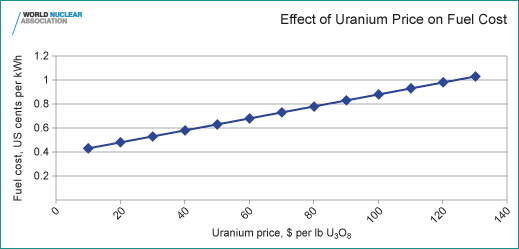
That the oceans contain enough uranium for 10,000 years of once-through energy production is well known and easily confirmed. The IEEE Spectrum article cites current research results that indicate the cost of seawater extraction can be performed at a cost of about $300/kg, a price point that the uranium spot market has already broken in the past, and the additional cost added to electricity by paying $300/kg vs current prices of around $100/kg is only about 0.6 cents per kwh still quite competitive with coal, gas and renewable energy sources.
Economists making government resource projections aren't permitted to consider emerging (aka unproven) technologies. Up until now there has been little incentive to try to develop seawater extraction (more expensive admittedly) as long as conventional mines were cranking out adequate supplies at low prices. This will change, and new technologies developed and exploited.
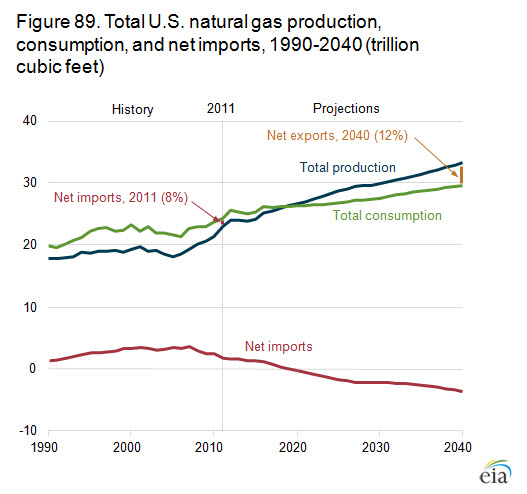
Just look at fracking. No production to speak of 10 years ago, now production is climbing steadily, soon to create a large gas surplus. Or renewable energy, with double digit increases in wind and solar power year after year. New technology and production processes with lower costs aren't limited to gas, solar and wind - uranium extraction benefits also. New processes often do not get perfected until there is economic demand for them.
-
Re:Primary goal was disposal, not energy
I like your post, but it propagates a myth due to severe omission. I'd like to correct it. The big problem is, you're off by a factor of 100.
False. "Uranium reserves available at up to $100 per pound of U3O8 represented approximately 23 years worth of demand, while uranium reserves at up to $50 per pound of U3O8 represented about 10 years worth of demand. Domestic U.S. uranium production, however, supplies only about 10 percent, on average, of U.S. requirements for nuclear fuel"
Source. Domestic US production gives us 23 years of demand at 100% capacity. It is currently at 10% capacity. Conclusion: About 230 years.A second estimate looking at global supply had this to say: "Thus the world's present measured resources of uranium (5.3 Mt) in the cost category around present spot prices and used only in conventional reactors, are enough to last for about 80 years. This represents a higher level of assured resources than is normal for most minerals. Further exploration and higher prices will certainly, on the basis of present geological knowledge, yield further resources as present ones are used up." It goes on to state "This is in fact suggested in the IAEA-NEA figures if those covering estimates of all conventional resources (U as main product or major by-product) are considered - another 7.6 million tonnes (beyond the 5.3 Mt known economic resources), which takes us to 190 years' supply at today's rate of consumption."
200 years is an accurate assessment given available data. Your assessment is based on non-existant technology and substantial change in current industry practices. Mine is based on today's technology, and no change.
-
Re:TL;DR (huh??) "Magnets! How do they work??"
So the small amount of waste (from a commercial reactor that doesn't exist yet) stored today needs to be stored until 2313 to be safe
Okay, world installed generation capacity 2010 5,067 gigawatts Let's replace it all with LFTRs.
Let's pick a hypothetical 1Gw LFTR design, most of the LFTR folks think there would be no advantage to scale larger.
5,067 of these LFTRs produce (5067*0.17) ~861 tons of waste per year requiring 300 year storage.
So with no increase in LFTRs from the 2008 power capacity, as much as (861*300)~258,300 tons of waste would be stored in this single (hypothetical) depot, which represents the waste of 300 years' total world electricity generation. Using density of lead (arbitrary) I get ~ 729,700 cubic feet, or a an array of foot-cubes 855 feet square. Or ~38 American football fields, that is if there is no stacking of these cubes. It all could fit into Yucca Mountain with room for a few more thousand years' worth to spare. That is, IF it was necessary to store it long. But really only ~300 years.
The world's nuclear waste in Yucca Mountain with LOTS of room to spare.
On second thought, let's reserve Yucca Mountain for tourism and grab 40 football fields at random.
There's also the mounting pile of lower level nuclear waste that exists regardless of primary fuel type. Don't get me wrong, it's a better option than 10000 years and bigger piles, but "only ~300 years" is deliberately deceptive.
I reserve my deliberate deceptions for less important topics than Thorium.
One of the reasons I sing the praises of Kirk Sorensen's two fluid LFTR idea is that there is really no practical life-limit envisioned for the fluoride salts themselves. Even the Hastelloy-N plumbing is potentially recyclable. While others like David LeBlanc are pursuing interesting variations such as the Denatured MSR which delays processing as might be desired in a small reactor, I believe Sorensen has decided to pursue the 'endgame' and produce the most useful and logical embodiment to the concept. His active processing column is (in my opinion as a layman) a best-fit for the scale of 1GW reactors that could power our world.
I do not completely believe the Chinese Thorium time window feint. I think there might be tactics in play to dupe world investors into thinking that Thorium energy is on the really slow boat from China, so they have plenty of time to lollygag and burn more coal. Then (I think) one day, sooner rather than later, it will be suddenly announced there is a working prototype and the Chinese firms are looking for capital.
Regardless of the Chinese effort (they really NEED this technology as do we) I'd rather see some US investors in play to build this thing that we have invested developed.
-
Re:Pumping more efficient than desalination?
Fun fact! It's actually cheaper to produce oil off shore (lifting cost of $10/barrel vs $12.75/barrel) at least in the USA. It is much harder to find the oil though (2.5x the cost of onshore oil). Since the water reservoirs are already found and we can use the same tech as oil drilling there is a real potential there for comparatively cheap water.
Source: http://www.eia.gov/tools/faqs/faq.cfm?id=367&t=6 The numbers are about 5 years old so it may have changed.
-
Re: common sense
I forgot my citation: the amount of CO2 from burning coal. And, despite that I hinted at it, in case someone wonders why the resultant pollutants from coal are more massive...
Also, s/plutionium/plutonium/. -
Re: common sense
I forgot my citation: the amount of CO2 from burning coal. And, despite that I hinted at it, in case someone wonders why the resultant pollutants from coal are more massive...
Also, s/plutionium/plutonium/. -
Re:TL;DR
Do you have a source for that? I was able to find this and world energy per capita is certainly going up. I also found this for the U.S. but it shows a rather recent peak that could be more related to the financial crisis than a real long term trend. In any event, why would a decline in per capita energy use indicate a decline in civilization rather than just increased efficiency?
-
Re:Something has to give, buddy
Of course, wind power only provides about 4% of the US electricity supply. And the eagle deaths are only the industry-reported ones. The study also excluded the well known eagle death trap - Altamont Pass in California - because its 60 eagle deaths per year swamp the rest.
The takeaway here is probably "be careful about siting". I doubt the massive wind farms in flat, rural Indiana kill many eagles.
-
Re:Just like coal
Over 92% of the coal consumed in the United States is used for generating electricity.
http://www.eia.gov/energy_in_brief/article/role_coal_us.cfmOver 92% is almost 100%.
-
Re:What a nonsense post...
You missed the entire point of the article.
Solar prices have dropped significantly. In the last 3 years, solar panels and batteries have dropped over 3 fold in cost. Utility solar is being installed at $2 per watt at the most recent data we have - prices are *lower* now.
Unsubsidized solar+batteries beats subsidized nuclear handily in most energy markets.
Palo Verde is on 4000 acres (1,600ha) and produces 3.72GW. This is very typical of US nuclear plants. 16 million square meters at 50% coverage and 15% efficiency is about 1.2GW.
So 3x the land usage for solar over nuclear, assuming you don't use strip mall parking lots or rooftops."Useless" (not useful for mining/farming etc) land in the USA only costs $60 per acre per year to lease. A pittance. Even $50,000 an acre land cost only increases the cost of a utility solar installation like 8%.
Colorado, a state that has *no* feed in tariff, no carbon dioxide tax, and renewable mandates already more than met - solar and wind are beating out anything else. All this project gets is the 10% federal rebate.
Look at this capital cost comparison (pg 6)
http://www.eia.gov/forecasts/capitalcost/pdf/updated_capcost.pdfRun the numbers on that capcost list at 4% interest along with O&M etc. with PV at $2/watt. You install the solar at 2.5x (which gives you a coverage of about 0.5) and then back with about 2.5 kilowatt-hours of LiFePO4 batteries per (less than $200 per kilowatt-hour in volume, 20,000 cycles at 1C leave it with 65% capacity). Extra nighttime demand shortfall is already covered by existing non-fossil fuel baseload wind power (existing nuclear, hydro, and pumped storage, and also wind). About 45 days a year you buy power to cover solar shortfall or use fossil-fuels (fossil fuel plants already bought and paid for). So I gigawatt of "other" power can be replaced by 2.5 gigawatts of solar and 6.25 gigawatt-hours of batteries.
Nuclear has maybe 15 more years, and only in countries like Russia and China, before it must dramatically reduce its capital and operating costs. Otherwise its R.I.P. nuclear. You won't hear any announcements about new nuclear plants.
P.S. Solar and battery prices continue to drop rapidly.
P.P.S. Source for $2/watt installed (IKEA announced $2.60 *installed* per watt in England on people's roofs too coming soon).
http://www.seia.org/sites/default/files/Figure2.8_0.jpgDisclaimer: I'm neither a solar or nuclear religious nut. I like solutions that don't waste money. Right now solar+batteries beat nuclear handily.
-
Re:40mpg
Electricity prices vary, but US$0.10 per kW-h is relatively high. With hourly-pricing and overnight charging, we pay more like US$0.04 per kW-h.
Must be real nice to have a basement full of Oompa Loompas to generate electricity for you, given the US average cost is $0.125 per kW-h, and the lowest price is $0.0897 per kw-h. The rest of your math is off by a factor 2 (minimum), or 3 (average).
-
Re:Why subsidize?
Yes. Also, according to the US gov't, we don't even place in the top 15. I dislike inaccuracy, and your post was inaccurate -- especially in stating that we (the US) produce more oil than any other country.
-
Re:dirty and not affordable
Electricity generation in the US, by energy source.
"Coal 37%
Natural Gas 30%
Nuclear 19%
Hydropower 7%
Other Renewable 5%
Petroleum 1%" -
Re:What a nonsense post...Germany is going to bankrupt herself trying...
I understand the goal, but you also have to deal in reality.
Germany now has 1/3 of the world's installed solar power systems, they have done this in a fairly short period of time, but they also have doubled their electric bills to do it and a lot of people there (in the hundreds of thousands) can no longer afford to pay them.
To get to 5% in the US, with our far larger population, our much greater energy use per person, and our much cheaper energy costs, we'd have to spend a crazy amount of money to try.
http://www.eia.gov/tools/faqs/faq.cfm?id=427&t=3
Solar makes no sense, even wind makes more sense than solar does.
Solar is romanic, it sounds nice, it gives off that warm fuzzy feeling. Don't get me wrong, I get it, I understand it, I want it to be true...
But it isn't, not now anyway and it won't be in the short term.
Which returns us to the question at hand... Do we want to be making 2/3 of our electric power from fossil fuels in 20 years? If so, then we do nothing. If not, then we build more nuclear.
Nuclear has the ability to replace our fossil fuel power plants in a short period of time, solar does not.
Nothing we do with solar is going to move the needle very much in the next 20 years. Maybe in 50 years, but it has to get a whole lot cheaper for that to happen.
-
Re:Why subsidize?
I'm confused by this also, but this chart suggests that We import mostly crude and export mostly refined products: http://www.eia.gov/dnav/pet/pet_move_wkly_dc_nus-z00_mbblpd_w.htm
We import about twice as much as we export and consume about 22% of the world's petroleum: http://www.eia.gov/tools/faqs/faq.cfm?id=33&t=6 Given that we constitute about 5% of the world's population, this obviously represents a problem -
Re:Why subsidize?
I'm confused by this also, but this chart suggests that We import mostly crude and export mostly refined products: http://www.eia.gov/dnav/pet/pet_move_wkly_dc_nus-z00_mbblpd_w.htm
We import about twice as much as we export and consume about 22% of the world's petroleum: http://www.eia.gov/tools/faqs/faq.cfm?id=33&t=6 Given that we constitute about 5% of the world's population, this obviously represents a problem -
Up next: "Zero Emissions" claim
Here in the USA, the grid is 68% fossil fuels. So unless Tesla is including a free ZPM with every purchase, "Zero Emissions" is a crock of shit, just like a 5.4 star safety rating.
-
Re:They should upgrade the warning ...
1997: 52.8% of USA electricity from coal
2009: 45.0%
2011: 42% US Energy Info Admin says
2012: 37% of USA electricity from coal
Coal is a has-been. Approaching one-third is not the same as "almost one half". Parent post fails it.
-
Where oil comes from
This is a perfect example of how oil has created such a horrible political mess over the years. It has been very dangerous for us to be so dependent on the middle east.
The only direct dependence the US has on the middle east is due to oil being priced globally. The US isn't particularly dependant on the middle east and OPEC for oil supply. The problem is that other parts of the world are. Oil has created big political messes like Iran due to countries like the US being unable to resist being a bunch of evil a-holes and doing things like overthrowing governments in the region on behalf of oil companies without regard to future consequences. What's astonishing is that our leaders have the nerve to act surprised when it turns out that people in other countries don't like us meddling in their internal affairs.
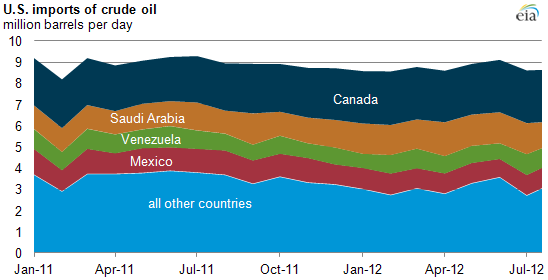
Relatively little of the oil used in the US comes from the middle east. About 40% of the oil used in the US is produced domestically and this number has been climbing. Of the 316 million barrels imported by the US in August 2013, only 67 million came from the Persian Gulf region or about 21%. This 21% is about 13% of total US oil demand and about 2/3 of that 13% is from Saudi Arabia. In fact Saudi Arabia is the only middle eastern country to crack the top 5 exporters to the US - the others being Canada, Mexico, Venezuela and Nigeria.
-
Re:Bull
(due to the US being a net exporter of oil)
You have a strange notion of "net exporter".
And if you think it's too old data because of the shale oil "booming" the EIA also provides data for 2013. -
Re:Bull
(due to the US being a net exporter of oil)
You have a strange notion of "net exporter".
And if you think it's too old data because of the shale oil "booming" the EIA also provides data for 2013. -
US consumption of oil is way down
Increased supply is only part of the equation.
US oil consumption has dropped down to mid 1990's level: http://www.eia.gov/countries/country-data.cfm?fips=US#pet
The trend of declining oil consumption should continue due to factors such as:
- continued underemployment
- aging population
- urbanization
- improved vehicle fuel efficiencyAlso, Iran knows that if Republicans come back to power, Israel will be able to dupe the US into attacking Iran. It is prudent for Iran to negotiate a deal with an administration that is capable of negotiating (and isn't Israel's puppet).
-
Re:Interesting argument
Interestingly enough the US imported more in 2012 from the Persian Gulf. We've mostly trimmed the amount of business we do with nations like Mexico, Nigeria, and Brazil, in response to our new gains in supply. This is just crude oil, a substantial part of US demand is met by imported petroleum products too, of course. U.S. Crude Oil Imports Mexico is due to begin declining in production in the next few years, and the Trans Alaska Pipeline may have to be shut down soon as well - this is more of a wildcard, estimates of how low the flow through can go before it becomes unprofitable to operate vary a great deal - so new sources of supply are going to be needed, even with US demand having peaked and declining slowly owing to less driving/more efficient new vehicles/the slow inroads made by EVs removing demand for gasoline entirely.
-
This is a big deal
Most people don't realize, but wood-burning is the sleeping giant of renewable energy. It's the largest form of renewable energy consumption in the U.S. If you look at the EIA's energy source breakdown, wood falls under biomass. It comprises about half the total renewable energy we produce, and accounts for nearly twice as much energy as hydroelectric (the next largest renewable). Even for electricity generation which isn't wood's forte (heating is), wood is third after hydro and wind, and far ahead of PV solar.
I'm all for cleaner wood-burning stoves. But it has to be done in a cost-effective manner, lest you drive people to dirtier options like coal or oil. -
Re:so green
Energy lost in transmission is about 7%, not 50%.
-
Re: LOL Tesla
I call BS on....average US residential rate of $.125 per kWhr
So in order to be telling the truth (as you claim he can't be) all he needs is :
- to live in an area with cheaper than average electricity
and/or
- have some renewable source in his house. Not that unlikely, we are talking about someone whose interests include sustainable/renewable enrgy and transport, and he has enough money for a brand new car -
Re: LOL Tesla
I call BS on the $17/1k miles, the Leaf has a 24kWhr battery pack and a rated range of 75 miles meaning
-
A best nuclear power will be a niche solution .
For 2008, the average worldwide generated electric power is in the order of 5 TW. . This is estimated to increase at the rate of 2.2 percent per year from 2010 to 2040 .
This means will need to increase generation capacity by about 110 Gigawatts per year. If we generously assume that each nuclear power plant generates 1 GW, to supply all the increase from nuclear generation we will need to open a new plant about every three days. Given the immense cost, complexity and large delays associated with construction of new nuclear plants there is no way we we get close to that number.
-
Re:Oil Sands
Know what, its all good though because after the oil crisis in the 1970's the US got things in order and are no longer dependent on foreign oil right?
Don't take my word for it, read your own publications: http://www.eia.gov/energy_in_brief/article/foreign_oil_dependence.cfm
Ever heard of NATO or understand what these sort of "agreements" stand for? So you are advocating attacking another NATO member?
Perhaps you can cite some figures about "turning people into corpses" and provide the loss numbers on both sides?
Last time I was in NYC (several years ago) I noticed "threat level" signs posted indicating the current "risk level".
I haven't see these in any other country, not sure if this is an indication of "nervousness" or not.
War is rarely the answer, its easier to just buy the oil on the open market -
Re:Its a shame.
Facts are facts. Solar is clean, diverse, expensive and unreliable.
Expensive? Get your facts straight.
http://www.eia.gov/forecasts/capitalcost/
Check out Table 1 from this report we paid for. Assuming the guys we paid to assemble the report did their jobs well, it shows capital costs and operational costs on-par or better than most forms of energy except natural gas. -
Re:Probably Obama. Or the Tea Party.
In Texas there is only one set of wires, for utilities, but are sold via brokers and the provider itself cannot sell direct. It's not that we need a second power company but that our current one is regulated while the brokers are more free to compete against each other.
Basically the more volume they have the better rate they can get. So they compete to get customers to get themselves a better deal.
http://www.eia.gov/electricity/monthly/epm_table_grapher.cfm?t=epmt_5_6_a
-
Re:Double Hazaa! [OOPS: =~20%]
[nuclear] if you're in North America ~30% of your electricity comes from it.
I meant to type ~20%. The actual figure is 19.7% in 2011, it has been as high as 20.6% in 2001.
Source: EIA Annual Energy Review 2012 -
Electric cars are so bullshit
68% of the power in the USA is generated by fossil fuels. source It's why you can half jokingly refer to electric cars as "coal cars", since they're essentially filling up with 37% coal-derived electrons. The lithium ion batteries come with their own environmental costs during their creation, as well. The primary function of today's electric cars is to perform an "out of sight, out of mind" on your carbon footprint. Tesla's cars are toys for rich people who as kids, cleaned their room by shoving everything under their bed.
-
Re:Mini-Streisand effect...
Texas does have some great gas prices, that's for sure.
Nationally, $3.60/gal this year is par for the course.
http://www.eia.gov/todayinenergy/detail.cfm?id=12411
My point was (and is still), however, that electric cars aren't merely for housewives who only pick up groceries on alternating Tuesdays. Electric car drivers, on the whole, don't have to do anything differently unless their daily drive is already outside the range of their car.
For those rare times when you're actually going to make long drives where recharging isn't an option, you can easily rent a car for a fee that's not much more than the gas savings you're already getting.
Sure. Electric cars are expensive, but it's a myth that they're "runabout vehicles."
-
Re:The Second Law of Thermodynamics isn't your fri
The energy loss across the electrical grid is staggering
From the US Energy Information Administration:
According to EIA data, national, annual electricity transmission and distribution losses average about 7% of the electricity that is transmitted in the United States.
Sounds pretty good to me.
(And please realize that liquid fuel doesn't happen for free, either. And that all electric heaters are damn near 100% efficient at converting electricity into heat.)
-
And here is why this is total BS.
Here is why this will never work. You will notice that EU was historically burning about double the coal that North America did. Fact is, that has been the case for the last 100 years. BUT, Europe dropped their rate down to a bit below north America's. In the mean time, Asia's is growing faster than what others can cut. Until the world accept that ALL NATIONS must lower their amount, little will change. This idea that China can output more CO2 than the entire west combined and that Asia accounts for about 60% of coal usage, and within another 3 years, China will account for more than 50% of all of the CO2 emissions, shows that we can not win this. Esp. when you have ppl like this that points to the per capitia output of the west, while ignoring the total emission issue.
-
Re:Nah, they're right, must be something else
... as large as the US in size and population, with even more resources
In some strange alternate universe that might be true. It would be more true to say the size is comparable, the population is 2/3, and the proven resources are largely trivial. Brazil grows vast amounts of sugar cane to process it into a (very poor) substitute for gasoline and diesel fuel for motor vehicles. As it is, Brazil's economy outweighs that of all other latin american countries, and it is a net external creditor. Unemployment is very low. Brazil is doing quite well, but comparable to the US it is decidedly not.
Brazil: population 201 million, land area 8.5 million km^2, crude oil production 2.1 million bpd, proven reserves 14 billion barrels, natural gas production 515 billion cu ft, proven reserves 15 trillion cu ft, coal production 6 million short tons
US: population 317 million, land area 9.8 million km^2, crude oil production 5.7 million bpd, proven reserves 23 billion barrels, natural gas production 22,900 billion cu ft, proven reserves 304 trillion cu ft, coal production 1094 million short tons
References:
Brazil population and area
Brazil energy
US population and area
US energy -
Re:Nah, they're right, must be something else
... as large as the US in size and population, with even more resources
In some strange alternate universe that might be true. It would be more true to say the size is comparable, the population is 2/3, and the proven resources are largely trivial. Brazil grows vast amounts of sugar cane to process it into a (very poor) substitute for gasoline and diesel fuel for motor vehicles. As it is, Brazil's economy outweighs that of all other latin american countries, and it is a net external creditor. Unemployment is very low. Brazil is doing quite well, but comparable to the US it is decidedly not.
Brazil: population 201 million, land area 8.5 million km^2, crude oil production 2.1 million bpd, proven reserves 14 billion barrels, natural gas production 515 billion cu ft, proven reserves 15 trillion cu ft, coal production 6 million short tons
US: population 317 million, land area 9.8 million km^2, crude oil production 5.7 million bpd, proven reserves 23 billion barrels, natural gas production 22,900 billion cu ft, proven reserves 304 trillion cu ft, coal production 1094 million short tons
References:
Brazil population and area
Brazil energy
US population and area
US energy -
Re:pricing
Covering your home in solar panels in Arizona can save you about $100/mo on your power bill, which for a single-family-residence runs about $200 in the winter and about $400 in the summer.
Those panels aren't free. They can take 10+ years to pay for themselves.
You're wrong. A 9 kw system (which fits on the average roof in Arizona) produces enough power to cover the average home's electricity usage for the year. The break even point is 10 years.
[citations]
http://www.eia.gov/consumption/residential/reports/2009/state_briefs/pdf/az.pdf (Information about average power usage in Arizona)
http://www.solar-estimate.org/ (solar system calculator for sizing systems, panel and installation costs, break-even points, etc.) -
How to hit back at a hotel charging for WiFi
I am soon going to New Orleans for a conference, and the hotel charges $14.95 per day for WiFi. Knowing that hot water is not metered, that's what I plan to do:
- Assumption: hot water is produced by natural gas, temperature 50 kelvin above environment. Tap capacity 10 L/min. Natural gas cost: ca. $12 per 1000 cubic feet, equivalent to one million BTU.
- Cost of energy is $12 per GJ, or 43 cents per MWh.
- Power for heating of fully open tap: 10/60 x 4150 x 50 = 35 kW
- Cost of fully open tap: 0.00042 $/second, or $1.51 an hour
Therefore, I will let hot water flow free for about 10 hours (every night, closing it at breakfast) and offset the profit they make on WiFi.
-
Re:Importation
While it is true we have not built any new refiners since the 1970s we are still a net exporter or gasoline and other petroleum products.
From your own source:
http://www.eia.gov/dnav/pet/pet_move_neti_dc_NUS-Z00_mbblpd_m.htm
(I think America needs to build more refineries but does not thanks to NIMBYs)
-
Re:Importation
The US hasn't built any big new refineries in a while - like since the seventies. We actually import refined products like gasoline to meet our needs. Source. Some big upgrades have been done, but we're not bringing lots of new capacity online.
-
Re:XBOX?
- Coal 37%
- Natural Gas 30%
- Nuclear 19%
- Hydropower 7%
- Wind 3.46%
Source: eia.gov
-
Re:XBOX?
Coal is still the major source of electricity at 37%. And natural gas may burn "clean enough" but it's still a limited resource.
-
Re:Oil?
-
Re:Good outcome
[citation needed]
According to http://www.eia.gov/dnav/pet/hist/LeafHandler.ashx?n=PET&s=MCRIMUS1&f=A and http://www.indexmundi.com/energy.aspx?country=us&product=oil&graph=consumption , the US imported about 48% of the oil it used in both 2011 and 2006.
Calculation for 2011:
3261422000 barrels imported / (18989000 barrels consumed per day * 365 days per year) = 0.47 fraction imported
for 2006:
3693081000 barrels imported / (20687000 barrels consumed per day * 365 days per year) = 0.49 fraction imported
-
Re:Fucked up units.
That's a completely fucked up way to state things.
The kicker is that no 'average' home consumes power evenly, nor does any power plant produce it perfectly evenly. So it's all a series of averages.
so 1400TWh/year divided by 11280 kWh/year/home equals about 124 million homes.
and that works out to 1 TWh/year equals 88.6k homes per TWh, which seems reasonable based on where you get your average use data and how you average/round.
Of course, I wonder where you got 1.4k TWh from 4k TWh.
BTW, on average home power consumption - you can divide the USA into regions; the northeast matches Europe(more or less), the South uses enough juice to drag up the average. The NW tends to use more power as well because electricity is so cheap there huge proportions heat everything via electric.
I didn't get it from 1.4TWh. I got it from here: http://www.eia.gov/electricity/ "Electricity consumption totaled nearly 3,856 billion Kilowatthours (kWh) in 2011."
-
Re:It's a shame, but...
Citation needed.
Not that I think you're being dishonest. I'm familiar with Vermont culture, and fully expect the hippies would be pushing for renewables. I just don't think the hippies are the ones building power plants.
According to the US EIA:
Vermont ranks 48th (out of 50 states) in terms of electrical generation capacity.
Nuclear power accounted for about three-fourths of the electricity generated within Vermont in 2011, a higher share than any other State.
Twenty-one percent of Vermont’s net electricity generation in 2011 was from conventional hydroelectric power.
Vermont has a voluntary goal of generating 25 percent of electricity consumed in the state from renewable energy resources by 2025.
Indeed, it seems that none of Vermont's electrical generation runs on fossil fuels, which is impressive. However, only about 10% comes from renewables. Closing Vermont Yankee will remove roughly 70% of Vermont's generating capacity. Hydroelectric sources are already fully developed in Vermont (and pretty much anywhere else in the US). This means that Vermont will either add generating capacity based on fossil fuels to make up the shortfall (and it would be relatively easy to convert Vermont Yankee from nuclear to coal or gas), or it will expand generation capacity sourced from renewables sevenfold. Sevenfold by 2014! Vermont's own [ambitious] target is to source only 25% of its electrical generation from renewable sources, and that's by 2025.
I think it's much more likely that a nuke plant will be retrofitted to burn coal or gas than renewable capacity seeing a sevenfold in the span of a single year. If you disagree, that's fine. Let's meet up again in a year to see whose prediction falls closer to reality.