Slashdot Mirror
Domain: esa.int
Stories and comments across the archive that link to esa.int.
Stories · 342
-
Closer to Deducing the Origin of the Moon
eldavojohn writes "A giant explosion on the sun in January of 2005 allowed SMART-1 (a European spacecraft orbiting the moon) to detect what elements the moon is made up of based on the X-rays from the sun's explosion. This allows scientists to speculate on the moon's origins while seeing data from all over the moon as opposed to the core samples we have collected and returned in the past. From the article: 'Scientists responsible for the D-CIXS instrument on SMART-1 are also announcing that they have detected aluminium, magnesium and silicon. "We have good maps of iron across the lunar surface. Now we can look forward to making maps of the other elements." said SMART-1's Principal Investigator.'" -
Venus Probe Returns First Images
The BBC reports on the first images returned from Venus by the EU probe. From the article: "They show the hothouse planet's south pole from a distance of 206,452km. Mission scientists are already intrigued by a dark 'vortex' feature which can be clearly seen in one image. Venus Express will orbit the planet for about 500 Earth days to study its atmosphere, which is thought to have undergone runaway greenhouse warming." They're offering some high-rez images of the planet at the ESA website. -
First Steps Toward Artificial Gravity
CompaniaHill writes "Have scientists been able to artificially generate a gravitational field? Researchers at the European Space Agency believe so. "Small acceleration sensors placed at different locations close to the spinning superconductor, which has to be accelerated for the effect to be noticeable, recorded an acceleration field outside the superconductor that appears to be produced by gravitomagnetism. This experiment is the gravitational analogue of Faraday's electromagnetic induction experiment in 1831." The effect is very small, so don't expect to see it used in spacecraft any time soon. But the effect is still many times larger than the predictions of Einstein's theories. "If confirmed, this would be a major breakthrough," says [Austrian researcher Martin] Tajmar. "It opens up a new means of investigating general relativity and it consequences in the quantum world."" -
First Steps Toward Artificial Gravity
CompaniaHill writes "Have scientists been able to artificially generate a gravitational field? Researchers at the European Space Agency believe so. "Small acceleration sensors placed at different locations close to the spinning superconductor, which has to be accelerated for the effect to be noticeable, recorded an acceleration field outside the superconductor that appears to be produced by gravitomagnetism. This experiment is the gravitational analogue of Faraday's electromagnetic induction experiment in 1831." The effect is very small, so don't expect to see it used in spacecraft any time soon. But the effect is still many times larger than the predictions of Einstein's theories. "If confirmed, this would be a major breakthrough," says [Austrian researcher Martin] Tajmar. "It opens up a new means of investigating general relativity and it consequences in the quantum world."" -
Spacecraft, Heal Thyself
carpdeus writes "The European Space Agency, citing the fact that we don't glue ourselves together when we nick ourselves, has funded a study toward creating a spacecraft that could fix itself. By replacing a few of the fibers in the resinous material that make up a spacecraft's skin with hollow fibers containing adhesive, the material has a chance to fix itself when it encounters minor damage, much the way our skin does when blood wells up and clots. While admittedly years away, such material makes longer duration missions a possibility." -
New Ion Engine Being Tested
Dr Cool writes "A new design of spacecraft ion engine has been tested by the European Space Agency which dramatically improves performance over present thrusters and marks a major step forward in space propulsion capability. Ion engines are a form of electric propulsion and work by accelerating a beam of positively charged particles (or ions) away from the spacecraft using an electric field. ESA is currently using electric propulsion on its Moon mission, SMART-1. The new engine is over ten times more fuel efficient than the one used on SMART-1." -
ESA Moves Forward on New Electric Engine
museumpeace writes to tell us the ESA is reporting that they have confirmed the principle behind a new space thruster. Plasma Double Layers, first discovered by Australian researchers Christine Charles and Rod Boswell, may help to develop a new electric engine that gives more thrust than traditional engines while still maintaining efficiency. From the article: "In essence, a plasma double layer is the electrostatic equivalent of a waterfall. Just as water molecules pick up energy as they fall between the two different heights, so electrically charged particles pick up energy as they travel through the layers of different electrical properties." -
Venus Express Blasts Off
kitzilla writes "The European Space Agency's Venus Express probe has been successfully launched from the Baikonur cosmodrome in Kazakhstan. The mission's first attempt was scrubbed last month after technicians spotted a problem with the lift vehicle. In about five months, Venus Express will pull into orbit around our closest planetary neighbor and begin five months of scheduled observations. On the short list of mission objectives: a detailed mapping of Venus' surface, a survey of the planet's complex atmosphere, and a look into the possibility of active Venusian volcanoes." -
ESA Cryosat Launch Reported Failure
hptux06 writes "Earlier today the ESA lauched their "Cryosat" satellite, designed to monitor ice levels across the Arctic/Antarctic. It's being reported a failure, disappearing 90 minutes after the launch. It cost £90M (160M US$) to build, and was supposed to spend three years determining the effects of global warming." From the article: "The satellite rode into space on a Rockot vehicle, a converted SS-19 intercontinental ballistic missile. The rocket, which in the Cold War would have been armed with nuclear weapons, had been modified for peaceful space duties with the addition of a Breeze-KM upper stage. Dr Matthias Oehm, chief executive officer of Eurockot, said they had not received the expected signals from either the spacecraft or the upper stage of the rocket that should have injected it into orbit. " -
ESA Cryosat Launch Reported Failure
hptux06 writes "Earlier today the ESA lauched their "Cryosat" satellite, designed to monitor ice levels across the Arctic/Antarctic. It's being reported a failure, disappearing 90 minutes after the launch. It cost £90M (160M US$) to build, and was supposed to spend three years determining the effects of global warming." From the article: "The satellite rode into space on a Rockot vehicle, a converted SS-19 intercontinental ballistic missile. The rocket, which in the Cold War would have been armed with nuclear weapons, had been modified for peaceful space duties with the addition of a Breeze-KM upper stage. Dr Matthias Oehm, chief executive officer of Eurockot, said they had not received the expected signals from either the spacecraft or the upper stage of the rocket that should have injected it into orbit. " -
ESA Selects Targets for Asteroid Deflection Test
Vandil X writes "The European Space Agency has announced that it has selected two candidate asteroid targets for a planned mission to impact an asteroid in an attempt to deflect the asteroid off course by a measurable amount. The mission, dubbed "Don Quijote," will send two spacecraft to their final choice asteroid. One craft will impact the asteroid while the other will observe the asteroid before and after the collision. The mission craft and target selection are expected to be finalized sometime in 2007." -
European Students to Put Microsatellite Into Orbit
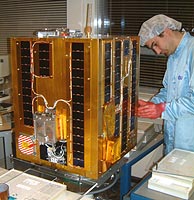
Astervitude writes "A Frankenstein's microsatellite made out of parts "donated" by university students across Europe will be launched on September 30 atop a Russian booster. Space.com reports that more than 400 students "spread across 23 universities and 12 countries" spent 18 months designing and building the SSETI Express. While its acronym sounds suspiciously similar to that of a project that seeks to uncover signs of intelligent life beyond Earth, the SSETI or Student Space Exploration Technology Initiative mission is actually part of an effort by the European Space Agency "to boost student interest in space technology and offer some hands-on experience." The satellite itself weighs a mere 136 pounds and is the "size of a small washing machine", as shown in this ESA photo. Visitors to the mission site may want to check out the contest page for ham radio operators to help collect data from the satellite." -
European Students to Put Microsatellite Into Orbit
Astervitude writes "A Frankenstein's microsatellite made out of parts "donated" by university students across Europe will be launched on September 30 atop a Russian booster. Space.com reports that more than 400 students "spread across 23 universities and 12 countries" spent 18 months designing and building the SSETI Express. While its acronym sounds suspiciously similar to that of a project that seeks to uncover signs of intelligent life beyond Earth, the SSETI or Student Space Exploration Technology Initiative mission is actually part of an effort by the European Space Agency "to boost student interest in space technology and offer some hands-on experience." The satellite itself weighs a mere 136 pounds and is the "size of a small washing machine", as shown in this ESA photo. Visitors to the mission site may want to check out the contest page for ham radio operators to help collect data from the satellite." -
Ice Lake on Mars
DecoDragon writes "The ESA's Mars Express discovered an ice lake on Mars. The ESA has a number of images and an explanation of what was found. The lake was found in an unnamed crater. The report says it can't be carbon dioxide, because carbon dioxide ice had already disappeared from the northern polar cap at the time the image was taken." Coverage from the BBC also available. From the article: "The team has also been able to detect faint traces of water ice along the rim of the crater and on the crater walls. Mars is covered with deep gorges, apparently carved out by rivers and glaciers, although most of the water vanished millions of years ago. " -
'Haute Cuisine' on Mars
Roland Piquepaille writes "If you're lucky enough to be a crew member of one of the next European Space Agency (ESA) long-term missions, you will have the choice between eleven new delicious recipes, such as 'martian bread and green tomato jam' or 'potato and tomato mille-feuilles' when it's time for dinner. In 'Ready for dinner on Mars?,' ESA says that these recipes will use fresh ingredients grown in greenhouses built on Mars colonies or other planets. The future astronauts -- should I write 'farmonauts'? -- will grow potatoes, onions, rice, soya or lettuce. And it's interesting to note that the new menus were elaborated with the help of Alain Ducasse, the French chef who has almost as many stars in the 'Guide Michelin' as there are planets in our Solar system. This overview contains more details and references about eating in space." -
Possible Cryovolcano Discovered on Titan
Rei writes "NASA's Jet Propulsion Laboratory is reporting that the Cassini spacecraft has observed what appears to be a cryovolcano on Saturn's moon Titan. Given the absense of a global methane sea on Titan, the snail-shaped structure with what appears to be a caldera on top could explain how Titan's methane stays replenished. It could further explain the dry drainage channels discovered by the Huygens lander as being formed by heavy methane rainfall after eruptions." -
Mars Express' 2nd Boom Deployment Postponed
ricshaw2k4 writes "Releasing the second MARSIS radar boom from Mars Express has been delayed after a problem with the first boom was discovered. From the BBC "Officials said 12 out of 13 segments that comprise the first boom had deployed successfully, but segment 10 was not fully locked into place." Lets just hope segment 10 wasn't eaten by the Martians!" -
Mars Express' 2nd Boom Deployment Postponed
ricshaw2k4 writes "Releasing the second MARSIS radar boom from Mars Express has been delayed after a problem with the first boom was discovered. From the BBC "Officials said 12 out of 13 segments that comprise the first boom had deployed successfully, but segment 10 was not fully locked into place." Lets just hope segment 10 wasn't eaten by the Martians!" -
The Sharpest Ever Global Earth Map
Roland Piquepaille writes "The GLOBCOVER project, started by the European Space Agency (ESA), has a very simple goal. It will create the most detailed portrait of the Earth's land surface with a resolution three times sharper than any previous satellite map. The image acquisition will be done throughout 2005 and use the Medium Resolution Imaging Spectrometer (MERIS) instrument of the Envisat environmental satellite. To create this sharp map, the GLOBCOVER project will analyze about 20 terabytes of data gathered by the European satellite. When it's completed, the map will have numerous uses, 'including plotting worldwide land use trends, studying natural and managed ecosystems and modelling climate change extent and impacts.'" -
ESA and NASA Consider Joint Mission To Europa
ewg writes "In defiance of the monolith, the European Space Agency and NASA are in the early planning stages of an automated joint mission to Europa, Jupiter's watery moon. This follows the triumphant Cassini-Huygens mission to Saturn's moon Titan. "All these worlds are yours, except Europa..."" -
Rosetta's View of Earth
ssbljk writes "Rosetta has been mentioned a few times on Slashdot during last 365 days. Last time it was on August 4th when she took images of the Earth and Moon from a distance of 70 million kilometers. Now, she came back to fly by Earth again and recorded a series of black-and-white images of our home planet from distance of 1954km." -
First Launch of new heavy-lift Ariane 5 rocket
obiwan2u writes "In the article Europe's super-rocket rides high, BBC talks about the Feb 12th launch of Arianespace's new bigger/better Ariane 5-ECA. The new rocket can lift multiple satellites totalling 10 metric tons (10K kilograms or about 11 olde english tons) into geosync orbit. The price will hopefully around $15K-$20K per kg. The first launch included a communications satellite and a science experiment called (I'm not making this up) SloshSat , designed to investigate the dynamics of fluids in microgravity. " -
Huygens Wind Experiment Salvaged
SeaDour writes "Earlier, it was reported that the data from a critical wind speed experiment onboard the Huygens probe to Titan was completely lost due to someone forgetting to turn on one of Cassini's communications channels. However, it now appears that ground-based radio telescopes from the National Radio Astronomy Observatory were able to record the transmission's many subtle doppler shifts and reconstruct that lost wind data. The winds altered the probe's horizontal rate of descent, thereby producing a change in the frequency of the signal received on Earth. Additionally, the resolution of the radio telescopes was good enough to track Huygen's position to within one kilometer, allowing for the creation of a three-dimensional model of Huygen's descent." -
ESA to Deploy Mars Express Radar
fenimor writes "Mars Express was launched on 2 June 2003 and reached the planet on 25 December 2003. After eight months of intensive computer simulations and technical investigations the European Space Agency has given the green light for the MARSIS radar on board Mars Express spacecraft to be deployed during the first week of May. Assuming that this operation is successful, the radar will finally start the search for subsurface water reservoirs and studies of the Martian ionosphere." -
Titan Photos and Sounds
ahsile writes "NASA and the ESA have released the first images from Titan. The ESA also has available sounds from the surface." Reader ZZip writes: "Apparently a bunch of enthusiasts has compiled the first mosaics from the raw data delivered by the Huygens probe. Meanwhile space.com has more coverage and pictures from NASA/ESA." Say a silent thank-you to the persistent troubleshooters of the world, without whom none of this would be possible. -
Huygens Probe Lands on Titan
WillDraven writes "CNN, NASA and the ESA are reporting that the Huygens space probe has entered the atmosphere of Saturn's moon Titan after traveling 2.2 billion miles. Pictures from the moon's surface should be available sometime this afternoon" according to the NASA TV schedule. What we know so far is that Huygens landed successfully and sent at least the carrier signal from the surface to Cassini for 90+ minutes, more than expected, and that Cassini has successfully repointed at the Earth and begun relaying the data it received, beginning with test packets. Huygens now sits on Titan, silent forever, while we wait to see whether or how much valuable data Cassini obtained and can send back. Update: 01/14 17:20 GMT by M : So far: they report zero lost packets in the transmission, but one of the two independent data-collection systems is apparently giving some problems. Update: 01/14 21:40 GMT by J : The news is pretty much all good: a very successful mission. Expect to see many photos within hours, but for now apparently only three have been released. Ice blocks or rolling stones -- let the debates begin! -
ESA Announces Space Elevator Sci-Fi Contest
Neil Halelamien writes "The European Space Agency has announced the 2005 Clarke-Bradbury International Science Fiction competition. For the competition, the ESA's Innovative Technologies from Science Fiction for Space Applications (ITSF) project is accepting short stories and artwork which incorporates or depicts a space elevator in some way. The competition is open to members of all nations, with a submission deadline of February 25, 2005. Winners and runners-up in each category will receive $600 and $300 respectively, with winning entries appearing in an upcoming book on the space elevator." -
Student Satellite Ready for Space
An anonymous contributor writes "Nearly one hundred students from all over Europe have been working hard on SSETI Express Satellite (Student Space Education and Technology Initiative). Last week a handful of students gathered at the Netherlands to put the finishing touches to the flight model. The final exams in the space simulators will follow in January - the last hurdle before launch in May 2005. The satellite has been largely designed and built via the Internet. The students keep each other informed about the latest developments using a special news server and weekly chat sessions." -
Environmentally Friendly Race Cars, Military Vehicles
jackelfish writes "The non-profit organization IdéeVerte Compétition has created a 'space age' race car that runs on Liquefied Petroleum Gas (propane or butane) and is lubricated with sunflower oil. Sponsored by the European Space Agency, the car recently broke the 'LPG powered vehicle' speed record of 315 km/h. The car also utilizes space technologies such as a titanium fuel tank, heat shielding developed for the Ariane launch vehicles and an EGNOS satellite navigation system to determine the speed, acceleration and position of the car in real-time." And reader gkbarr writes "Is the DoD feeling the crunch of sky-high gasoline prices or are they being overrun by a bunch of Greens? Who cares, the latest Humvee looks to be a more capable and greener machine than its predecessors." -
Environmentally Friendly Race Cars, Military Vehicles
jackelfish writes "The non-profit organization IdéeVerte Compétition has created a 'space age' race car that runs on Liquefied Petroleum Gas (propane or butane) and is lubricated with sunflower oil. Sponsored by the European Space Agency, the car recently broke the 'LPG powered vehicle' speed record of 315 km/h. The car also utilizes space technologies such as a titanium fuel tank, heat shielding developed for the Ariane launch vehicles and an EGNOS satellite navigation system to determine the speed, acceleration and position of the car in real-time." And reader gkbarr writes "Is the DoD feeling the crunch of sky-high gasoline prices or are they being overrun by a bunch of Greens? Who cares, the latest Humvee looks to be a more capable and greener machine than its predecessors." -
Environmentally Friendly Race Cars, Military Vehicles
jackelfish writes "The non-profit organization IdéeVerte Compétition has created a 'space age' race car that runs on Liquefied Petroleum Gas (propane or butane) and is lubricated with sunflower oil. Sponsored by the European Space Agency, the car recently broke the 'LPG powered vehicle' speed record of 315 km/h. The car also utilizes space technologies such as a titanium fuel tank, heat shielding developed for the Ariane launch vehicles and an EGNOS satellite navigation system to determine the speed, acceleration and position of the car in real-time." And reader gkbarr writes "Is the DoD feeling the crunch of sky-high gasoline prices or are they being overrun by a bunch of Greens? Who cares, the latest Humvee looks to be a more capable and greener machine than its predecessors." -
Martian Moon Phobos in Detail
neutron_p writes "Today we can see the highest-resolution pictures so far of the Martian moon Phobos. These images show new detail that will keep planetary scientists busy for years, working to unravel the mysteries of this moon. The images show the Mars-facing side of the moon, taken by Mars Express from a distance of less than 200 kilometres with a resolution of about seven metres per pixel." -
Evidence of Glaciers on Mars?
cyclop writes "Nature reports that the Mars Express mission has photographed evidence of ancient glaciers on Mars. It seems glaciers have sculpted valleys on the red planet, much like on Earth." Reader macguys writes "Space.com is reporting that the Mars Rover Opportunity has received an unexpected and unexplained power boost of between 2 and 5 percent. The NASA Rover site is so far silent on the boost." -
Hibernating to Mars
neutron_p writes "Manned missions beyond the Moon are no longer wild dreams. NASA plans a manned mission to Mars before 2020. With automatic systems in control, astronauts would face the challenge of living in a confined space with not much to do for an extremely long period. 'Might as well sleep it off!' Studies initiated by ESA have gone one step further. Wouldn't it be nice if astronauts could hibernate! ESA biologists are conducting investigations into the physiological mechanisms that mammals use to hibernate." -
Marsquakes, Add Water and Shake
An anonymous reader writes "Analysis of Mars orbital data shows northern pit chains as evidence for relatively recent seismic activity. If marsquakes release water-ice to the surface, then such young features may be reshaping and eroding the landscape from below. No modern volcanic or seismic activity has ever been confirmed before. A long-standing mystery is why the northern hemisphere is smooth, while the martian south is so rugged." -
Europe's New ET Life Search Programme
hotsauce writes "The Guardian has a report on Europe's ambitious new programme to search for extra terrestial life. ESA has started a program called Cosmic Visions which will launch a series of satelites, starting with Gaia in 2011, and possibly culminating with the Exo-Earth Imager, a mission consisting of 10.000 3-metre mirror telescopes. The French are leading the charge with Corot in 2008." -
Europe's New ET Life Search Programme
hotsauce writes "The Guardian has a report on Europe's ambitious new programme to search for extra terrestial life. ESA has started a program called Cosmic Visions which will launch a series of satelites, starting with Gaia in 2011, and possibly culminating with the Exo-Earth Imager, a mission consisting of 10.000 3-metre mirror telescopes. The French are leading the charge with Corot in 2008." -
Europe's New ET Life Search Programme
hotsauce writes "The Guardian has a report on Europe's ambitious new programme to search for extra terrestial life. ESA has started a program called Cosmic Visions which will launch a series of satelites, starting with Gaia in 2011, and possibly culminating with the Exo-Earth Imager, a mission consisting of 10.000 3-metre mirror telescopes. The French are leading the charge with Corot in 2008." -
Students Design A Satellite Via Internet
Roland Piquepaille writes "A group of 250 students from many European universities has collectively designed a satellite by using a dedicated news server and weekly chats on Internet. By using the Web, the virtual team was able to move from design to construction in less than a year. The SSETI Express is currently under integration in one of the technology centers of the European Space Agency (ESA) in the Netherlands. Only a few selected members of the team will attend the launch which will be part of the Russian mission Cosmos DMC-3 in May 2005. The SSETI Express will embark three mini 'cubesats' for specific experiments while the main satellite will test a propulsion system and act as a transponder for amateur radio users. I sure hope that this collaborative action will be successful. Read this summary for more details." -
New Clue for Life on Mars?
thhamm writes "Recent analyses of ESA's Mars Express data reveal that concentrations of water vapour and methane in the atmosphere of Mars significantly overlap. This result, from data obtained by the Planetary Fourier Spectrometer (PFS), gives a boost to understanding of geological and atmospheric processes on Mars, and provides important new hints to evaluate the hypothesis of present life on the Red Planet." -
New Clue for Life on Mars?
thhamm writes "Recent analyses of ESA's Mars Express data reveal that concentrations of water vapour and methane in the atmosphere of Mars significantly overlap. This result, from data obtained by the Planetary Fourier Spectrometer (PFS), gives a boost to understanding of geological and atmospheric processes on Mars, and provides important new hints to evaluate the hypothesis of present life on the Red Planet." -
Space-Age Houses
An anonymous reader writes "The dream of building the Jetson's Skypad Apartment may come to true because technology designed for space could become the basis of the new German Antarctic station. The same ultra-light composites that ESA uses onboard its spacecraft for antennas and solar panels, will be used to make a self-supporting lightweight shell-like structure able to withstand severe earthquakes. This approach is in sharp contrast to many contemporary design solutions that use ever more steel and concrete..." -
Rosetta Comet Chaser Images Earth and Moon
An anonymous reader writes "Using its navigation cameras at the end of July, the comet chasing probe, Rosetta, captured this photograph while looking back towards Earth. From a distance of over 42 million miles, the Earth and Moon look faintly like two headlights on a deserted road. The larger image particularly seems to underscore why Carl Sagan reflected (PDF) on all the battles fought for what?--to become 'the momentary masters of a fraction of a tiny dot.'" -
Rosetta Comet Chaser Images Earth and Moon
An anonymous reader writes "Using its navigation cameras at the end of July, the comet chasing probe, Rosetta, captured this photograph while looking back towards Earth. From a distance of over 42 million miles, the Earth and Moon look faintly like two headlights on a deserted road. The larger image particularly seems to underscore why Carl Sagan reflected (PDF) on all the battles fought for what?--to become 'the momentary masters of a fraction of a tiny dot.'" -
Mapping The Tour de France Riders From Space
Roland Piquepaille writes "It was just a matter of time before someone gets the idea of using satellite localization to map the positions of the cyclists of the Tour de France. In a first test on July 21 during the ascension to l'Alpe d'Huez, ten riders were equipped with receivers and tracked by the EGNOS European satellite positioning system, a preparatory programme for the Galileo system. The European Space Agency (ESA) reports about this first test in "The best view of the Tour is from space." It's highly possible that all riders can get receivers as soon as next year. And this data will be available on the Web, so you will know in real time the exact location of your favorite champion. Read this summary for more details and a computer-generated image showing the respective positions of Lance Armstrong and Richard Virenque, the top-ranked climber, while climbing to the top of l'Alpe d'Huez." -
Martian Racetracks
An anonymous reader writes "The European Mars Express spacecraft has released stunning images of 'yardangs': racetrack-like grooves eroded from an otherwise flat plain without obstacles. The terrain in high resolution is shown near the largest volcano in our solar system, Olympus Mons. Notable in the image is an abrupt left turn like the beginnings of a curved terrace." -
Ship-Sinking Monster Waves Revealed
vinlud writes "Once dismissed as a nautical myth, freakish ocean waves that rise as tall as ten-storey apartment blocks have been accepted as a leading cause of large ship sinkings. Results from ESA's ERS satellites helped establish the widespread existence of these 'rogue' waves and are now being used to study their origins. ESA writes about it in a story. More information about this phenomena at the website of Karsten Trulsen, Associate Professor at the University of Oslo." -
Ship-Sinking Monster Waves Revealed
vinlud writes "Once dismissed as a nautical myth, freakish ocean waves that rise as tall as ten-storey apartment blocks have been accepted as a leading cause of large ship sinkings. Results from ESA's ERS satellites helped establish the widespread existence of these 'rogue' waves and are now being used to study their origins. ESA writes about it in a story. More information about this phenomena at the website of Karsten Trulsen, Associate Professor at the University of Oslo." -
ESA Plans Test of Asteroid Defense System
vinlud writes "It has been announced by Dutch television ESA has chosen the Don Quijote programme to investigate the possibilities of altering the collision course of asteroids heading for Earth. The program, selected among five other studies, contains two spacecraft: Hidalgo and Sancho. Hidalgo will impact an asteroid of approximately 500 m diameter at a relative speed of at least 10 km/s while Sancho will retreat to a safe distance to observe the impact. An animation of the mission sequence (6.49 Mb) can be downloaded from here." -
ESA Plans Test of Asteroid Defense System
vinlud writes "It has been announced by Dutch television ESA has chosen the Don Quijote programme to investigate the possibilities of altering the collision course of asteroids heading for Earth. The program, selected among five other studies, contains two spacecraft: Hidalgo and Sancho. Hidalgo will impact an asteroid of approximately 500 m diameter at a relative speed of at least 10 km/s while Sancho will retreat to a safe distance to observe the impact. An animation of the mission sequence (6.49 Mb) can be downloaded from here."