Slashdot Mirror
Domain: everything2.com
Stories and comments across the archive that link to everything2.com.
Comments · 3,172
-
Re:OMG! It's not true??
It be great if chris was worry about his write as much as care about markup his crap posts. At least he didn't feel the need to to everything
-
Re:Sad times indeed
I can't work out if you're playing along with this or whether you don't realise that "BSD is dying" is not only a troll, but an exceedingly old one at that.
(The linked article is dated late 2002, and it's implied that the troll had been around for quite some time even then! "Its impressive that after so long it still gets people responding").
-
Re:I'm shocked
Not that I disagree that solid rocket motors are bad idea for manned flight, but whilst they can't be throttled thrust can be removed using blowout panels. Solid fuel ICMBs use Thrust Termination to kill thrust as desired.
-
Re:you are too stupid for words, literally
Frenchmen spotted
Your english is quite good.
PS: https://everything2.com/title/... -
Or. . . . we dis-assemble the Solar System. . .
. . . and re-use the mass to create something akin to an Dyson Sphere. I'd suggest a Ringworld, but the mechanical properties of Niven's "scrith" simply aren't possible, at least with any level of material science we currently have or are likely to have. . .
-
GNOME is a bag of shit
It needs serious reworking to be usable. Keep it clean. Stay minty.
-
Re:futurist
... would we only take scientists, engineers and mathematicians?
Sure, everyone else could go in Ark B
-
Re:Going by the data in the summary...
I can't say for certain, bit I think that it originated with the popularity ofSix Sigma.
-
Re:Was this before or after
Hah! No-one is gullible enough to still believe such nonsense are they?
The B-Ark seems unlikely to you?
-
Re:It's been a vegetable for at least five years n
Hahah, yeah, I was being conservative with that time frame.
But then we still have the other almost dead Slashdot sister site http://everything2.com/ formerly known as everything.com.
-
RIP Kuro5hin *and* my world-famous chili recipe
Well damn, that's a real shame. When that site was up 'n running, it was such a great site. Yea, a lot of trolling on the front end, but behind that, there were some great technical posters that kept me coming back. Sadly, that death of that site means my world-famous chili recipe may also be gone. There was a call for chili recipes, I posted mine. Meat steamed in beer, no beans, and let the chili stew (ie ferment) overnight. Gawd-dam! was it good.
It was especially good, as I made it all completely up. Loosely based on my mom's recipe, but mostly a total fake-er-roo. Yet people made it, a lot of them. And they all loved it. Yep, I trolled K5 with a bogus chili recipe.
Then Rusty kept doing shit that made it no so much fun to visit as often. Then kept doing more of that shit that made it even less fun to visit. So I quit visiting. Other favorite sites have also disappeared: fuckedcompany.com and stilenetwork.com among them. At least http://everything2.com/ is still going, kind of.
-
here's what you do in a situation like this...
First thing you do is sit down and write two letters...
-
Re:invalid data
Also, this.
"African American" may be the accepted term for black people within the US, and as one that reinforces their identity as part of America, that's perfectly fine and probably desirable. Just don't assume that usage of the term can- or should- be used outwith the US context, though.
-
Re:Reddit....
I was shadow banned from a science related subeddit that is my professional field (40 years) and whose main posters I would bet a large sum of money couldn't pass a high school science class.
So go somewhere that people give two shits about your education when you write, like Everything2. There's a community there of people who support one another. Go write with them, and leave alone the boards known for assholery.
-
Also, the DECWriter
pidib pidip pidip pdawww... Or something like that as it wrote each line. And then the paper feed. And sometimes it furiously printing in both directions....
http://everything2.com/title/D...One on YouTube:
https://www.youtube.com/watch?...Hard to explain to my kid that you needed lots of sheets of fanfold paper when you wanted to use "the computer".
-
Re:SNOBOL/SPITBOL . . . JCL . . .?
Is anyone here old enough to remember those languages . . . ?
For a brief period I worked with SNOBOL. I was reading old SNOBOL programs and re-writing them in AWK.
The AWK programs were smaller and simple to understand. The SNOBOL programs were hard to figure out... I would describe the process almost as "reverse-engineering".
SNOBOL's design dates back to the bad old days. It has "goto" hard-wired into the language; it has "fields" where you put certain things in certain places on the line, and then the control flow changes via goto branching. One field is the "goto on success" field, another is the "goto on failure" field. I didn't like this.
Even worse, the specific implementation of SNOBOL that we were using used simple recursion with backtracking for pattern matching, and it was possible for some patterns to consume unreasonable amounts of time. As a result, the SNOBOL contained a "heuristics" feature that would decide if a search seemed to be taking an unreasonable amount of time, and terminate the search early. Since there were valid patterns that could take that much time on valid inputs, there was also a global variable to switch the heuristics off, so you could force it to wait long enough to get a correct result if that occurred.
AWK, on the other hand, compiled regular expressions into a deterministic finite state automaton that would make one state transition per input character. It was so much faster than the SNOBOL programs.
So SNOBOL was hard to write, hard to understand, and had terrible performance. Other than that I guess it's okay.
-
They did it on purpose
It's ironic that it doesn't run Linux well, given that [a] Linux can be installed on everything from mechanical watches to dead badgers, and [b] Google insists on the non-release of Windows drivers for their Chromebooks.
-
Re:Assignement in Python
Assigning a number or a list in Python and many other languages (Julia) is a different operation. Such as
>>> a = 2
>>> b = a
>>> a = 1
>>> b
2>>> a = [2]
>>> b = a
>>> a[0] = 1
>>> b
[1]Octave (Matlab) is more consistent on this point, every assignement is a memory copy.
I'd find it alarming if Python *didn't* act that way! In Python, everything is an object and objects are passed by reference; hence altering the contents of "a" in your second example is clearly going to alter the contents of "b", since they're references to the same object. In the first case, you're altering *which object* "a" points to. It's completely consistent.
The alternatives would be crazy (from an OO perspective).
To make your second example act like your first one, we would need to *pass* everything by value. This means we couldn't, for example, use a "Logger" to collect messages from different parts of the program. Instead, each method would end up with its own copy of the Logger, containing only those messages from function activations which are still on the stack. As soon as any method returns, its Logger would be lost, along with all of the messages, unless we bypassed the language via the filesystem or a DB. This is *exactly* the situation you describe, except with "Logger" instead of "List" and "message" instead of "number". Note that this is exactly the situation in Haskell, which is why it needs things like the Writer Monad.
To make your first example act like your second, we'd need to *assign* everything by reference, in which case your first example would replace the "2" object with the "1" object, which is a pretty bad idea ( http://everything2.com/title/C... )
-
Re:Oh...they have access to better imagery...
...has a high enough resolution to use facial detection algorithms on the images.
Not possible: http://everything2.com/title/S...
-
Re:Poms are weak arseholes
Maybe this explains the state of US education.
-
Re:Climate Science Defector Forced to Resign
-
Re:Cut much, much deeper
To make that easier, encourage the unorganized militia to self-train and equip.
Your whole idea is contrary to the goals of the elite. They don't want unbrainwashed individuals learning how to kill. That doesn't work for them at all. Also, we'd have to stop fattening America if you want those people to be able to serve as soldiers without being forced onto a food and exercise plan.
This, of course, is a design closer to that which was intended by the authors of the US Constitution.
And that's why the traitorous scum running the country today isn't interested in your ideas.
-
Re:the ultimate torture or assassination device
I was thinking more along the lines of http://everything2.com/title/c... but that works too.
-
Re:ON Topic, But Really Cool
Did you know that McMurdo base in Antarctica operated a small (1.2MW) nuclear micro-reactor from 1962-1972? It had a disappointing but uneventful service record -- until it reached sudden end-of-life when cracks were discovered at welds in the pressure vessel. That is why I really said "CAT diesels to the rescue" but forgot to add the context.
To avoid weld vulnerabilities at any stage of life, modern light water reactor designs call for a single-casted pressure vessel of 'nuclear grade steel'. Nuclear Grade Steel is to Steel as Superman is to Man.
-
Re:Fireworks in 3...2...1...
I mean, really, you might as well be trying to convince the world that ideas themselves are deadly weapons.
Memetic Warfare (military orientation)
Survival of the Fittest Ideas: The New Style of War -- a Struggle Among Memes (academic orientation)
http://everything2.com/title/Meme+Warfare (the "I fell asleep after five minutes, can you summarise the lecture for me" orientation)
So, sometimes? Yes.
-
Re:Huh? What?
"Cow orker" is something I saw years ago for the first time in AFU. That group predates Usenet and is the origin of snopes.com. That was in the time when people wanted to know if floss glows(*).
It was funny as hell, but I guess you should have been there.
hou-"I have only one name, so where is the middle"-ghi
(*)No, that was not the actual subject. I don't even DARE to bring up the actual subject and I do not use any smileys either.
-
Re:good news for NSA
I'll undo my moderation in this thread just to tell you that you are wrong. One cannot determine the key from the ciphertext. If they can this is known as a "break" in the cipher.
A "break" in a cipher does not mean that it is practical to find the key, merely that it is more feasible than mere brute force. For example, a "break" could reduce the effective strength of a cipher from 256 bits to 212 bits under a known plaintext attack. This is a BAD break in the cipher given current standards, but it is the cipher is still completely uncrackable in human (or even geologic) timescales.
The "weeks or months" number, by the way, has nothing to do with cracking cryptographic keys. I would surmise that is a number more geared towards cracking passwords, which is an entirely different topic. Also, for some realistic numbers on cracking encryption keys, check out Thermodynamic limits on cryptanalysis
-
Re:Yet another great argument...
http://everything2.com/title/expatriation+tax
Yeah, except for that huge chunk of change Uncle Sam wants before he lets you leave.
-
Re:To quote Einstein
But . . . but what if you need to reconfigure the value of pi during runtime?!
-
Re:Keypad
I've never tried it, but apparently you can brute force one of those within a half hour.
-
oh good grief, use the canonical priorties troll!
-
Re:My answer
"Oh belgium, man, belgium!"
http://everything2.com/title/Swear+words+from+science+fiction -
What a piece of work is a cow!
The study is flawed, it treats defecation as the problem. Poop is the problem, defecation is the solution.
"What a piece of work is a cow! how now in reason!
how infinite in lactation! in form and moooving how
express and admoooable...''
~Captain Jean Luc Picard, USS Enterprise: Cow Greeting, Alpha Prime -
Re:Summary...
What, did someone invent Scrith ? Without scrith, the Ringworld is not feasable.
-
Re:It is official; Netcraft confirms: *BSD is dyin
-
Re:Pull a few Billion...
IIRC, Gene Kranz and a couple others from Mission Control have stated that the CYA guy from Grumman was a cinematic invention by Ron Howard. And that Grumman actually distinguished themselves quite well during the mission.
They damned well better have, considering the towing bill they sent NAA:
-
Re:Without the use of a loop!?
I picked the one out that I actually thought might prove you right (Sinclair), and imagine my surprise when I was able to prove you wrong with the first link I clicked. Pay careful attention to the example program which includes multi-statement lines like: 170 LET in=1: IF r$="y" THEN GO TO 210 and 510 IF qf>nq-1 THEN PRINT "I'm sure your animal is very", "interesting, but I don't have","room for it just now.": GO TO 800
I accept your apology. -
Re:NOT A REAL GERMAN ADVERT
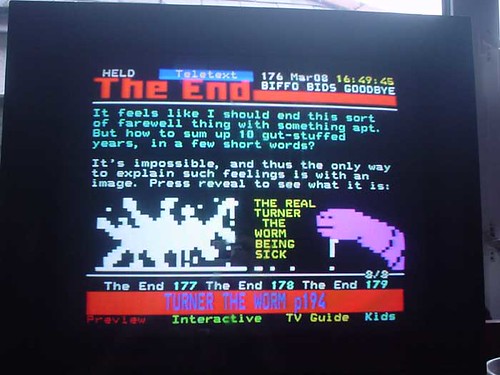
The real Turner The Worm being sick.
Oh, I'll admit I really hate it when people on Slashdot "helpfully" explain a joke or reference, especially when it's one that most people here will get (thus cheapening its appeal to those who got it, and not really making it funny to those who didn't).
But the infamous Turner the Worm being being sick incident is just too important to risk going over American Slashdotters' heads.
(BTW, should I label the above as being "NSFW" bearing in mind it was aimed at *children*?!) -
Re:Calm before the hyperbole
I was going to post a longer comment about sensationalism and reality, but then I remembered this:
http://everything2.com/title/The+Projectionist%2527s+Nightmare -
Re:or, they could bombard it with neutrinos..
From what I understand the process that causes neutrinos to speed up radiocative decay is the result of inverse beta decay (I'd link to a Wikipedia article but WP thinks that the term 'inverse beta decay' is synonymous with electron capture. There seems to be no independent article for this process I refer to, despite the fact that this process was used in the Cowan-Reines experiment that was the first conclusive evidence for the neutrino, and won for Frederick Reines his share of the 1995 Nobel Prize in Physics!). Anyway, if you had neutrinos energetic enough to make this process frequent enough (never mind that doing this is very difficult), these neutrinos would then hardly be harmless to living things. They're only harmless to us because the interaction cross section for the vast majority of neutrinos is so small, and so their chances of interacting with ordinary matter so remote as to be almost nonexistent: you could send a neutrino of typical energies through light years of solid steel before it interacted with anything. If you could somehow produce a neutrino beam that was of high enough energy, it would readily transmute normal matter in its path: an antineutrino beam would turn protons into neutrons, and a neutrino beam would turn neutrons into protons. If you had hydrogen (e.g. in water), you would get high-energy free neutrons, and that is the way to increase the radioactivity of something, not decrease it!
-
Re:I'll believe it when I see...
Sigh.
You are wrong. Go take a physics class.
You cited it on an Intraweb page, so it must be true.
-
Re:I'll believe it when I see...
-
Re:I'll believe it when I see...
For chrissake:
FTL implies at least backwards communication is possible under any method you can think of. If you get get to Alpha Centauri by stuffing yourself in your ass, it will still allow backwards time travel.
-
Re:Yes
It feels like UIs are getting dumber and dumber...
I believe strongly that "dumb" is the wrong word. Am I a "dumb" driver because I don't want to play around with the engine for ten minutes every time I want it to start up, and prefer to have an ignition key that does whatever towards the end result I desire?
Usability is goal-driven - if your goal is to tinker with the OS and write device drivers, your requirements are different than for the other guy, who wants to watch videos and play games.
However, there are also common tasks. Both you and your grandmother are surfing the web and using e-mail. You probably use more functionality of the browser than she does, but there are common functionalities that you both use. I'm sure you enjoy that you can just click on a link, compared to, say, having to navigate to it with keyboard combinations and then manually typing a 7-digit code just because. That might sound ridiculous, but a lot of the early computer "things" are in that area of the ridiculous if you think about it from today's perspective. For example, LOAD "*",8,1 sounds as ridiculous to us today as hunting through three layers of submenus in the start menu sounds to any user of Quicksilver or Alfred.
where is that covered panel in Android? Gnome3? iOS? Windows 8?
Many versions of windows have had "advanced settings" buttons. Let's ignore for the moment that the distribution of things between basic and advanced settings seems random at best.
OS X and most Linux distributions have features hidden from the GUI that you can tweak with either special software (say, Onyx) or through commandline or text file (.plist,It's like driving in a car with fixed seat and steering-wheel position.
No, it isn't. That is a matter of ergonomics, a totally different area.
Configuration has at least as much psychological effect as it has usability effects. It's an act of taking possession of the machine. Average users change their desktop background, geeks need to tweak something about the system. I'm not sure where it comes from, because I don't feel that way (I use one of the standard backgrounds on my iMac, for example), but the amount of hostility you get when you disable these options, e.g. in a corporate environment, makes it clear how important psychologically they are.
If the GUI you work with is well designed, I'm not sure you really need to tweak all that much about it. I'm speaking from personal experience here, having jumped from a heavily, heavily personalized Linux environment to OS X some years back. And by that I mean that I'd patched my WM and maintained my own branch of my favourite text editor, because the upstream was not being updated anymore.
And yet, here I am, with no desire to write my own text editor or install a different WM or whatever, because the stuff simply works and I can focus on the work I actually want to get done. It's a kind of freedom, maybe you should try it. You can always go back if you don't like it.
The problem with the Linux world is, to be honest, that all the UIs suck, and suck badly. That's why you have to tweak them. Linux is a second windows - a bunch of nerds copying stuff from all around that they like with no fashion sense. None of it fits together well, so despite being made up of really nice pieces, the sum total is but ugly.
Linux lacks a Linus on the UI side of things. A strong, respected visionaire who knows his stuff and makes sure the big picture is right. -
Re:The PC is Dying
Noob. He just changed a few words from this.
-
Re:Inevitably...
Luckily that never happens and nukes are only launched after extensive consideration.
-
Re:Why would it need studies?
They still do. Or at least some...others claim to have stopped the practice.
-
Re:Encryption
Considering the (mostly) invincible state of good encryption, this seems unnecessary. Sure, it is a fun idea, but not a practical one.
No encryption is invincible. Especially 5 years from now... Computing power has advanced to the point where you can just brute force "invincible encryption" from a few years back...
A few have pointed out that the keys are too large to brute force. I figure you out to know why that is: http://everything2.com/title/Thermodynamics+limits+on+cryptanalysis
That is a good little write up on the subject. Short, sweet, and easy to follow. It demonstrates that non quantum 256 bit keys are safe from brute force attacks for... ever.
Two wrenches (one esoteric, one practical): Reversable Computation and Quantum Computers.
First the "practical" one, Quantum Computers. The algorithm for searching an unsorted database for a key is Grover's Algorithm. This gives a speed up of O(N1/2) and a space complexity of O(log N). For a 256 bit key this gives a time complexity of 2**128 and a space complexity of 78. Now, that time complexity will kill you. Move to a 512 bit key and we are back to 2**256 time complexity (jsut like in the linked article). The space complexity goes to 155. It might not seem like a big deal, but adding another qbit to a quantum machine isn't trivial. In fact it is properly hard, and gets harder for every extra qbit. also that space complexity is a multiplier, not a count. you need log N * or something along that scale (Big O notation demonstrates the rate of growth as things go to infinity so small problems can be dominated by other factors till they "scale up"). Obviously even quantum computation isn't going to help crack a 256 bit key and a 512 bit key will restore the same level of security even IF they could be built large enough and numerous enough and fast enough for the 256 bit version (LOTS OF IFS and with an easy out. As pointed out increasing an encryption key's size is relatively trivial)
Now for the one that caused me some trouble, Reversable Computing. Fancy way of saying that the computation is reversable with no energy expended after being performed and reversed (actually arbitrarily little energy appraoching zero as closely as you care to come... kinda. Physical devices pose practical problems, but let us se that asside for a moment). This is a theory, and a good one. The problem is that you need to drive through all of the states. Let us assume that a computation takes one plank time on our perfect reversable computer (this is impossible, of course. It would be far higher even with a "perfect" device, but this is a lower bound given to us by nature). You need 1.4 * 10**16 time the current age of the universe (1.979 * 10**26 years) worth of computer time to go through all the states. Average is half that to find the correct key. Now you'll want to parallelize this computer to get to that (wholly impractical) time faster. How many can you build? How large are they? I'll leave it as an exerccise to the reader to determine how many you might be able to construct before they collapsed into a black hole. Also: 1 plank time is a few dozens of orders of magnitude smaller than any computation done with matter can achieve. It takes 4.48*10**20 plank times for a photon to pass an electron (if wolfram alpha is being nice to me, that is). Scale your time to be, say, the same as the time it takes a photon to cross your theoretical perfect reversable computer and then work out how many you need to complete the cracking of the key within a reasonable time. You'll get a black hole or incredible distances beyond the mortal ken.
Conclusion: Brute forcing any appreciably sized cryptographic key (512 bit or greater) will never, ever be possible no matter what happens with technology so long as computers are made of matter and compute in space. Period.
256 bit keys will remain equally unchallenged until we can create and power quantum computers the size of grains of sand trilions at a time.Take that Moore's law
-
Re:Oh the possibilities
-
Re:Not smart Enough?
the only logical conclusion of your argument is that white people are smarter than any other race.
I'm Asian-American. You whites and blacks have certainly made a mess of the place. What you need is a surge of Asians to take over your dilapidated institutions and revitalize the country.
Just kidding. Actually, I'm part-Asian. And I think that everybody just gotta keep fucking everybody till they're all the same color.