Slashdot Mirror
Domain: folklore.org
Stories and comments across the archive that link to folklore.org.
Comments · 501
-
Re: Not the programming language
> Assembly written by Bill Atkinson is better than (pick your language) written by a lousy programmer.
"Hey, that's not the right way to code. What are you guys, a bunch of hackers? I'm not sure that I want to work with a bunch of hackers."
-
Re:So much venom
Folklore.org to the rescue again!
https://www.folklore.org/StoryView.py?story=Busy_Being_Born.txt
-
Re: Good 'ol Days ...
The slow disk copying (at least after a decent amount of RAM was finally available) was apparently the result of a bug.
-
Re:So much venom
The NeXT Cube was basically Jobs's attempt to make good on the "3M" machine he didn't get to do at Apple.
See: https://www.folklore.org/StoryView.py?project=Macintosh&story=Whats_A_Megaflop?.txt
-
Re:So much venom
In fact, Wozniak racked his brains for a month trying to figure out how to do overlapping windows (and updating said windows) to come up with regions. He promptly got into an airplane crash and when Jobs went to visit Woz in the hospital, the first thing Woz said was "Don't worry, I still remember regions". Woz later asked Xerox about it and they said they didn't have overlapping windows.
Woz didn't work on Mac system software. You're thinking of Bill Atkinson's car crash:
https://www.folklore.org/StoryView.py?project=Macintosh&story=I_Still_Remember_Regions.txt
-
Re:Memory
I think they mean at launch...but Apple did offer a "Mac Plus" upgrade kit later for $995. Steve Jobs was against it:
"Even though the diagnostic port was scuttled, it wasn't the last attempt at surreptitious hardware expandability. When the Mac digital board was redesigned for the last time in August 1982, the next generation of RAM chips was already on the horizon. The Mac used 16 64Kbit RAM chips, giving it 128K of memory. The next generation chip was 256Kbits, giving us 512K bytes instead, which made a huge difference.
"Burrell was afraid the 128Kbyte Mac would seem inadequate soon after launch, and there were no slots for the user to add RAM. He realized that he could support 256Kbit RAM chips simply by routing a few extra lines on the PC board, allowing adventurous people who knew how to wield a soldering gun to replace their RAM chips with the newer generation. The extra lines would only cost pennies to add.
"But once again, Steve Jobs objected, because he didn't like the idea of customers mucking with the innards of their computer. He would also rather have them buy a new 512K Mac instead of them buying more RAM from a third-party. But this time Burrell prevailed, because the change was so minimal. He just left it in there and no one bothered to mention it to Steve, much to the eventual benefit of customers, who didn't have to buy a whole new Mac to expand their memory."
https://www.folklore.org/StoryView.py?project=Macintosh&story=Diagnostic_Port.txt
-
Re:Acorn Archimedes
Yeah, the NeXT was basically Steve Jobs's attempt to finish the "3M" machine Apple didn't do.
See: What's a Megaflop?
-
Re:Convert it to x86?
-
Re:Well that's unfortunate.
> If you send a lot of random shit at something, of course it's going to crash.
Oy! Is that what they teach in CS curricula these days?
Back in the day, we tested by throwing random shit at the software until it didn't crash.
-
Re:How much does Bill Gates understand about...
Has Bill Gates been successful in spending his money? Is there evidence he has deep knowledge about technology? Is there evidence he has deep knowledge about programming, for example?
Andy Hetzfeld was somewhat dumbfounded at some bad programming Gates was apparently involved with.
For some reason Slashdot isn’t letting me insert the hyperlink into the sentence above... but here it is:
https://www.folklore.org/Story... -
It's about style over substance
And it's always been this way.
Like that time Steve Jobs wanted the PCB layout redone in the original Macintosh to one that looked more pretty, rather than the one that worked.
-
Re:And then there's this
"He explicitly wanted the user to have to buy a new computer if they wanted to upgrade"
Well, no. Apple offered 512K logic board upgrades to purchasers of the original 128K Macs.
Against Steve's wishes, though.
Steve had left by the time the Mac II came out, and it was Gassee's call to allow expansion slots.
I will say the Power Mac 7500 I bought in 1995 was supremely expandable, and easy to open the case and work inside it. I upgraded the RAM, hard drive, CPU (to a G3) and optical drive. I got a lot of miles out of that Mac!
-
On Key Combos
From: https://www.folklore.org/Story...
I added a feature that allowed the user to kill the current application if it was hung up, by monitoring for a specific key combination during the vertical blanking interrupt handler.
I knew that I had to pick a very rare key combination, because you didn't want users killing their applications accidentally. I decided on shift-command-option-period, four keys held down at once, which I thought would be pretty hard to stumble into accidentally. But I was surprised when I got a call from Jeff Harbers at Microsoft.
"Hey, I like that abort feature that you just added, but you're going to have to change the key combination, because we're using that in Microsoft Word.", Jeff told me. Microsoft Word was very complex, and it possessed an enormous range of keyboard shortcuts, way too many, as far as I was concerned.
"OK, suggest something for me to change it to and I'll consider it," I told Jeff.
Jeff didn't have anything specific in mind, so he told me that he would get back to me soon. I had to laugh when he called me back the next day, and told me that he wanted to withdraw his request and that I should keep shift-command-option-period as the abort sequence.
"OK, that sounds good to me, " I told him. "But why the change? Doesn't it still conflict with Word?"
"We'll change Word in the next release not to use it. The problem was that we couldn't find a safe sequence - I guess we're already using every key combination!"
-
Re:MacBook Pros now Dogshit
driven no doubt by narcissistic sociopath pseudoartist Steve Jobs
Like the time he made the engineers on the original Macintosh redo the PCB layout to make it more "pretty" as opposed to routing the trace lengths for memory timing. (Spoiler: it didn't work and they had to change it back)
-
Re:Apple & Amiga
Apple had Switcher in 1985. It supported full screen programs and switched between them.
-
Re:Add another prize
Another problem is that the same user interface will not appeal to all users, especially those with various levels of expertise.
Right. But it still helps to test, to make sure that the labels and messages are clear.
When Apple was developing the Lisa software, they tested it on potential users, to make sure that it was clear how to use it. The proceed/cancel buttons were originally labeled "Do It" and "Cancel". The testers got confused by these buttons. One tester even got a little bit angry. The Apple moderator asked him what was wrong. The tester replied, "I'm not a dolt. Why is the software calling me a dolt?" With the font that was on the buttons, the label "Do It" looked like the word "Dolt".
So Apple decided to re-label the "Do It" button to "OK".
An Apple employee named Larry Tesler really pushed user tests like this.
-
Re:Stanford
Smalltalk?
Oh, I forgot... Jef Raskin invented it first.
-
Re:Really?!
Actually, that was Bill Atkinson: http://www.folklore.org/StoryV...
-
Re:Rounded corners!
-
Re:Pascal, “not clean”???
I agree with you about the cleanliness of Pascal. But just FYI the current MacOS (OSX) is mostly written in C, assembly, and Objective-C, since its based off BSD. You're probably thinking of the original Mac OS, but from what I understand, it's not *quite* correct that it was Pascal either. Instead, they hand-translated some existing Pascal routines from the Apple Lisa into assembly to save on memory. So, it sounds like it was the Apple Lisa that largely used Pascal.
Also, it's wildly incorrect to say there were "no exploits". All modern operating systems have had LOTS of exploits over the years, because very early on, security wasn't even considered. Probably not quite as many as Windows, but certainly not zero.
-
Re:Fighting what they once were
Sure it did. I had a Mac Color Classic, it had an expansion slot, ports for accessories, and extra RAM slots.
Oh, my sweet, summer child. If you became familar with doorstop Macintoshes with the Color Classic, you came very, very late to the Apple party. My first three computers were a C= 16, an Amiga 500... and an Apple ][+ with an 80 column card. I didn't personally have a Macintosh 128k, but a friend (still one of my best friends actually) had one at home. The Macintosh 128k did not have any expansion slot; hell, it did not even have SCSI, which is broadly considered to have been a major defining feature of Macintosh computers of the era, and for quite some time thereafter. The only way to expand the system was, as stated previously, to get in between the CPU and the CPU socket. This approach was very commonly used on computers built with the MC68000 processor, because you could swap either to the MC68010 (which had a couple of additional instructions that could speed up some operations) or even to the 68020. The 68020 was pin-compatible with the 68000 but wasn't available in a DIP package, as most 68000s (and the 68010) were; it was PGA (as were some 68010s) so in order to slot one into a machine with a 68000 you had to use a daughterboard. The same approach could be used to add peripherals to a computer, at need; since the Macintosh 128k had no expansion bus, there was need.
Anyway, you don't have to take my word for it, you can go to a reputable source. Then you can be better educated than the legions of iFanboys who cry when you point out true negative facts about Apple.
Today, I still own a Mac SE with an accelerator in it (IIRC it's a 68020, too) as well as a Radius display card. I also own the very last Dome-shaped iMac, the one with 1GB RAM and a halfway decent discrete GPU.
-
Re:Old vs common use of word "hacker"
-
Re:Bill Gates said
Lines of Code has always been a bullshit metric.
-
Re: Please, no.
Macintosh and Xerox Alto were only similar in that they had a bitmapped display and a mouse. That's basically it.
Literally everything else we accept as being a GUI widget of some kind was invented at Apple - drop down menus, contextual menus, desktop metaphor of files in folders, heirarchic folders, drag-and-drop, the clipboard, etc.
Here is a former researcher from Xerox PARC, and member of the original Macintosh team, talking about exactly this.
-
Re:It's the day innovation died at Apple
Raskin was brilliant, but he had a serious Dunning-Krueger thing going on. He had a bad habit of taking credit for other people's work and overestimating how important his his own ideas were.
See: I Invented Burrell
-
Re:Could we also remember how he ran his company?
> Cook improves (or adapt, as you wish), and Jobs created.
What did Jobs ever create?
The only thing he's on record as ever having designed is the original Mac calculator desk accessory interface.
-
Re:I'm out
Irrelevant. This is about Steve Jobs's attitude toward Apple's customers.
-
Re:I'm out
Irrelevant. This is about Steve Jobs's attitude toward Apple's customers.
-
Re:I'm out
Irrelevant. This is about Steve Jobs's attitude toward Apple's customers.
-
Re:Aaaannnd there it is...
If by stolen you mean bought, then yes. He recognised the people and paid for it. MS copied it.
All history now of course and I actually quite like Win 10. Just the Xerox myth keeps getting trotted out without any recognition of the fact Jobs paid and brought on the actual engineers to carry on working with it. More here, amongst other places. -
Re:Just as long as tabs can be turned OFF by the u
The cognitive load induced by hiding the state of other windows is considerable.
I agree with you. But when I've mentioned this before on Slashdot, a lot of replies were to the effect that "all maximized all the time" behavior is something that people can and ought to just learn to tolerate. I seem to remember their reasoning being along the lines that people got used to it on the Apple II, Commodore 64, IBM PC running DOS, and old Macs running Switcher, and they can get used to it now.
- Slashdot user Kjella, for instance, prefers "maximized apps and rapid switching" on a 24 inch monitor.
- Slashdot user donaldm thinks "having a single session display with a single task window is very appealing and easy to get use to".
- Slashdot user exomondo thinks Microsoft lacks a monopoly on personal computer operating systems because Android successfully competes with Windows, and the fact that stock Android doesn't support multi-window mode is "irrelevant" and prefers full screen for "an IDE [...] video editing, audio editing, photo editing, gaming and obviously innumerable other tasks".
-
Re:in an attempt to explain this to others....
You might be interested to know that there were some on the original Macintosh team (notably, the late, great Jef Raskin) that were lobbying (hard!) for an up to FIVE button-mouse.
I highly doubt that. Raskin didn't want a mouse on the Mac at all:
He was dead set against the mouse as well, preferring dedicated meta-keys to do the pointing.
If that article you linked didn't purport to be written by Andy Hertzfeld, I would have immediately thought it was b.s.
I couldn't find a reference that agreed with my memory, true; but I do offer this Slashdot thread on the subject of "Why Apple makes a 1 button mouse". There are several references to the "Left/Right Click confusion", and other posts that generally support what I was saying (nevermind the possibly misremembered Raskin reference. my brain is old and grizzled...) -
Re:in an attempt to explain this to others....
You might be interested to know that there were some on the original Macintosh team (notably, the late, great Jef Raskin) that were lobbying (hard!) for an up to FIVE button-mouse.
I highly doubt that. Raskin didn't want a mouse on the Mac at all:
He was dead set against the mouse as well, preferring dedicated meta-keys to do the pointing.
-
Re:Well...
The original Apple II was pretty open, although some of the later ones weren't. The original Macs were not intended to be opened by the user, but then they started shipping Macs that were.
Woz: "Slots!" [Apple II]
Jobs: "No slots." [Lisa]
Wendell Sanders: "Slots!" [Apple III]
Jobs: "No slots." [Mac]
Jean-Louis Gassee: "Slots!" [Mac II]
Jobs: "No slots." [iMac]Burrell Smith: "How about a diagnostic port?"
-
Re:Yet another non-response.
I don't think he ever did, so I'm not really addressing your challenge... but I found it telling that the guy who was the real "father of the Macintosh" pointed out that Steve never designed a product himself, despite his implying that he had done so in the past.
The closest he got was designing the interface for the original Mac calculator, and he needed to have his hand held to do that.
-
Aesthetics and practicality to computing
In the early years Woz was undoubtably important. In particular, I think it is clear that electronically, technically the brains was Steve Wozniak. This is obvious especially if you hear about the story of them working on Breakout together. And at that time in the late seventies where computers were expensive and being very clever about reducing the number of chips to the bare minimum, Woz's skill set was important. These skills became less important as hardware became cheaper and economy of scale made ASICs practical (look at the design of the Commodore 64). You could argue the weird interleaved video memory was a design flaw that hung around on the Apple II forever, but it was necessary to get color cheaply enough with just stock 74 series logic and 6502 CPU. On the other hand, the idea of making an all-inclusive consumer item with an injection molded case was definitely pushed for by Jobs (apple 2 history). That is what made the Apple II sell where the Apple I didn't. Woz's world view was that everybody could just put together a kit and choose a keyboard and their own TV (that was the Apple I). That wasn't going to fly in the long run, and Woz didn't see that, but Jobs did. I think a lot of people here are saying Jobs was a great salesman. That is true, but I think it is more that he wanted to make a beautiful product that he would enjoy and thus it would sell because others would enjoy the beautiful deisgn too.
I think in later years, especially the development of the Macintosh, Jobs was much more influential. Read folklore.org. There are concrete aesthetic pushes that Jobs asked for. That is good leadership. Did he make the prototypes, did he design the prototypes. No, but he had taste and pushed it and chose people that would satisfy it. You can see the difference between the Atari ST, windows 1.0, amiga OS and Mac OS. Mac OS had a brillaint aesthetic with good fonts (he had taken calligraphy and cared about fonts). The others were rubbish. It took until Windows 95 for PCs to look as good as Mac OS did. But by 2000 MacOS X had pushed the visual aesthetic of operating systems to the next level. It's hard to over-estimate how important it is for a machine to look good and to have good aesthetic, and many of the nerds here that are all function over form kind of people just don't get it. The rounded rect anecdote on folklore.org is another great thing to look at.
I think that is what he added to the equation, even on the Apple II. I think where Jobs was smart was that he wasn't just form over function. He desired to have things looking good everywhere, but if it wasn't going to electronically work, then he wouldn't force it (see mac PC board).
He had insight on how to do that several times. Apple II was the start of it, Mac was even better, NeXT was a refinement of Mac, but the ipod, iphone, and MacOS were the things that sealed his legacy.
Did Steve Jobs design everything. No. Was he the messiah. No. But he often acted as a catalyst and had a unifying vision and was capable of building teams to realize that vision. -
Aesthetics and practicality to computing
In the early years Woz was undoubtably important. In particular, I think it is clear that electronically, technically the brains was Steve Wozniak. This is obvious especially if you hear about the story of them working on Breakout together. And at that time in the late seventies where computers were expensive and being very clever about reducing the number of chips to the bare minimum, Woz's skill set was important. These skills became less important as hardware became cheaper and economy of scale made ASICs practical (look at the design of the Commodore 64). You could argue the weird interleaved video memory was a design flaw that hung around on the Apple II forever, but it was necessary to get color cheaply enough with just stock 74 series logic and 6502 CPU. On the other hand, the idea of making an all-inclusive consumer item with an injection molded case was definitely pushed for by Jobs (apple 2 history). That is what made the Apple II sell where the Apple I didn't. Woz's world view was that everybody could just put together a kit and choose a keyboard and their own TV (that was the Apple I). That wasn't going to fly in the long run, and Woz didn't see that, but Jobs did. I think a lot of people here are saying Jobs was a great salesman. That is true, but I think it is more that he wanted to make a beautiful product that he would enjoy and thus it would sell because others would enjoy the beautiful deisgn too.
I think in later years, especially the development of the Macintosh, Jobs was much more influential. Read folklore.org. There are concrete aesthetic pushes that Jobs asked for. That is good leadership. Did he make the prototypes, did he design the prototypes. No, but he had taste and pushed it and chose people that would satisfy it. You can see the difference between the Atari ST, windows 1.0, amiga OS and Mac OS. Mac OS had a brillaint aesthetic with good fonts (he had taken calligraphy and cared about fonts). The others were rubbish. It took until Windows 95 for PCs to look as good as Mac OS did. But by 2000 MacOS X had pushed the visual aesthetic of operating systems to the next level. It's hard to over-estimate how important it is for a machine to look good and to have good aesthetic, and many of the nerds here that are all function over form kind of people just don't get it. The rounded rect anecdote on folklore.org is another great thing to look at.
I think that is what he added to the equation, even on the Apple II. I think where Jobs was smart was that he wasn't just form over function. He desired to have things looking good everywhere, but if it wasn't going to electronically work, then he wouldn't force it (see mac PC board).
He had insight on how to do that several times. Apple II was the start of it, Mac was even better, NeXT was a refinement of Mac, but the ipod, iphone, and MacOS were the things that sealed his legacy.
Did Steve Jobs design everything. No. Was he the messiah. No. But he often acted as a catalyst and had a unifying vision and was capable of building teams to realize that vision. -
Re:Sorry, but Apple still deserves most of the cre
Eject a disk by moving it from my desktop to the trash with all the files I want to delete? Makes sense.
Well, to understand this, you have to recall that early Macs had to be able to run off of a single floppy drive. Users might buy a hard drive or a second floppy drive (or if they had a dual-floppy SE, a third floppy drive for some reason) but it couldn't be relied on. Yet they still had to be able to tolerate having the OS disc ejected at times.
So there was a distinction between physically ejecting a disc while keeping it mounted (which was represented onscreen by a greyed out disc icon) so that you could copy to it, and both physically ejecting _and_ dismounting a disc.
The formal way that you were supposed to do this was by using menu commands. The Eject command was for eject-but-keep-mounted while the generally ignored Put Away command was for eject-and-dismount. It was also possible to use Put Away on an already greyed out, ejected-but-mounted disc icon.
User testing showed that this was inconvenient, and one of the OS developers eventually created a shortcut for the Put Away command, which was to drag a disc icon to the trash. It wound up being so popular that it shipped.
Apparently there had been some thought at the time about changing the Trash icon into some sort of Eject icon in the case of ejecting a disc, but apparently this was felt to be confusing or too difficult, so it wasn't done. In OS X the idea was revisited, and now the Trash icon does turn into a standard Eject icon when you're dragging a disc.
In any case, in real life, whatever confusion dragging disc icons to the trash might have caused, everyone got over it basically immediately.
Switching tiled applications makes the one menu bar change? Sure. It's not like moving the cursor half the screen for each click is a waste of time.
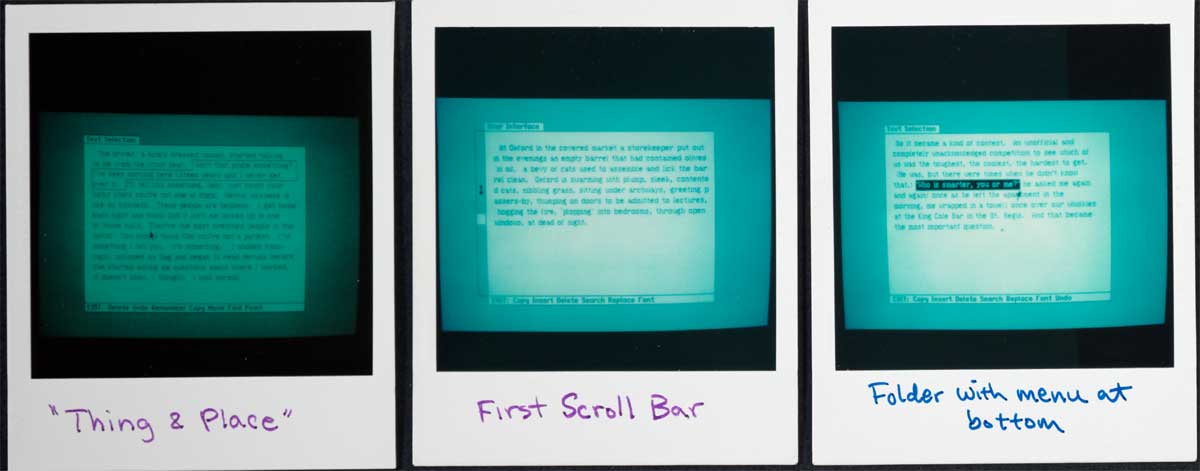
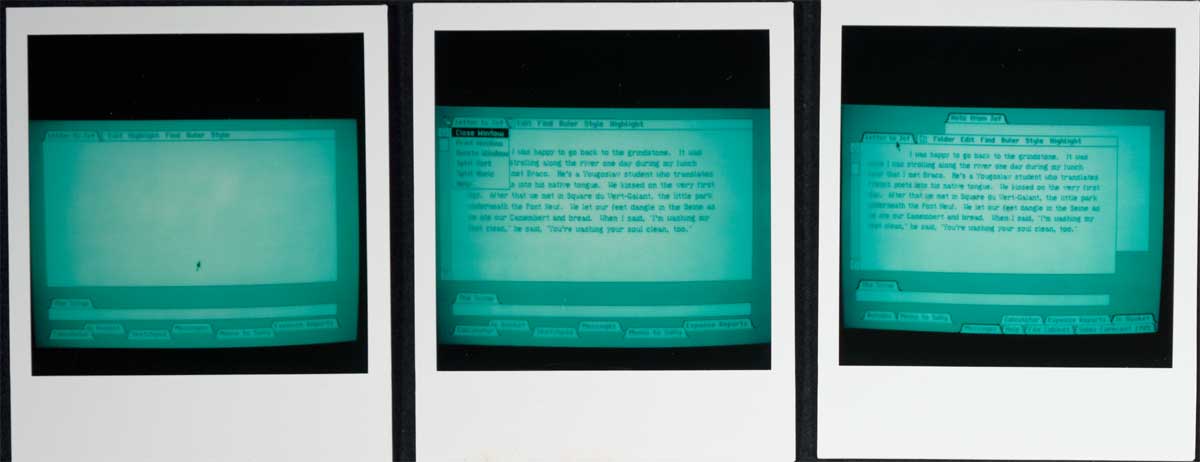
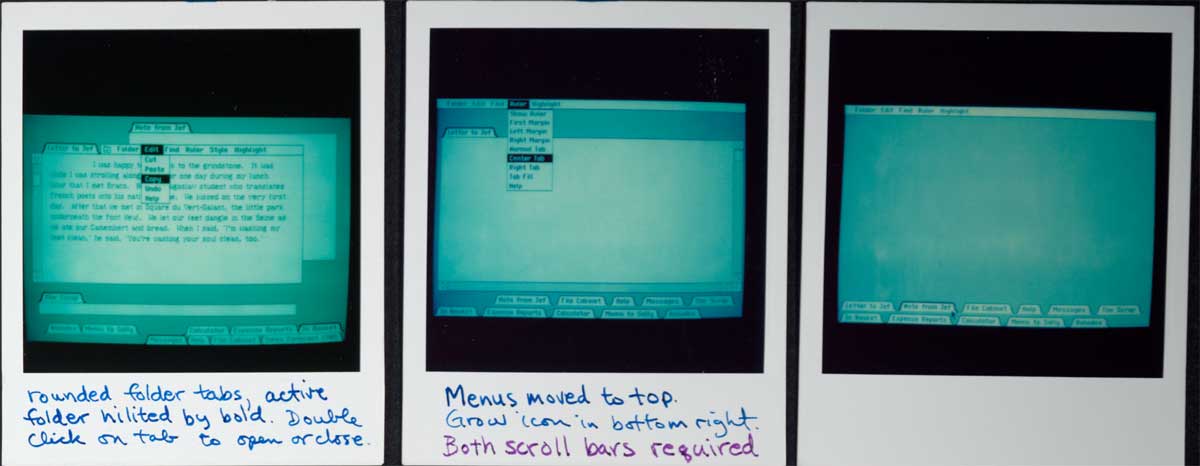
It's not; since there's nothing above the menubar, you can just slam the mouse up. It turns out to be faster and easier than having multiple menu bars. The Mac and Lisa groups did consider per-window menubars, but having tested the idea, it was rejected. For example, here's some polaroids of a screen from 1980 showing a Lisa with a menu attached to the bottom of a window: http://www.folklore.org/images... Later that year, the menu had moved to the top of the windows: http://www.folklore.org/images... And early the next year, it finally settled at the top of the screen: http://www.folklore.org/images...
-
Re:Sorry, but Apple still deserves most of the cre
Eject a disk by moving it from my desktop to the trash with all the files I want to delete? Makes sense.
Well, to understand this, you have to recall that early Macs had to be able to run off of a single floppy drive. Users might buy a hard drive or a second floppy drive (or if they had a dual-floppy SE, a third floppy drive for some reason) but it couldn't be relied on. Yet they still had to be able to tolerate having the OS disc ejected at times.
So there was a distinction between physically ejecting a disc while keeping it mounted (which was represented onscreen by a greyed out disc icon) so that you could copy to it, and both physically ejecting _and_ dismounting a disc.
The formal way that you were supposed to do this was by using menu commands. The Eject command was for eject-but-keep-mounted while the generally ignored Put Away command was for eject-and-dismount. It was also possible to use Put Away on an already greyed out, ejected-but-mounted disc icon.
User testing showed that this was inconvenient, and one of the OS developers eventually created a shortcut for the Put Away command, which was to drag a disc icon to the trash. It wound up being so popular that it shipped.
Apparently there had been some thought at the time about changing the Trash icon into some sort of Eject icon in the case of ejecting a disc, but apparently this was felt to be confusing or too difficult, so it wasn't done. In OS X the idea was revisited, and now the Trash icon does turn into a standard Eject icon when you're dragging a disc.
In any case, in real life, whatever confusion dragging disc icons to the trash might have caused, everyone got over it basically immediately.
Switching tiled applications makes the one menu bar change? Sure. It's not like moving the cursor half the screen for each click is a waste of time.
It's not; since there's nothing above the menubar, you can just slam the mouse up. It turns out to be faster and easier than having multiple menu bars. The Mac and Lisa groups did consider per-window menubars, but having tested the idea, it was rejected. For example, here's some polaroids of a screen from 1980 showing a Lisa with a menu attached to the bottom of a window: http://www.folklore.org/images... Later that year, the menu had moved to the top of the windows: http://www.folklore.org/images... And early the next year, it finally settled at the top of the screen: http://www.folklore.org/images...
-
Re:Sorry, but Apple still deserves most of the cre
Eject a disk by moving it from my desktop to the trash with all the files I want to delete? Makes sense.
Well, to understand this, you have to recall that early Macs had to be able to run off of a single floppy drive. Users might buy a hard drive or a second floppy drive (or if they had a dual-floppy SE, a third floppy drive for some reason) but it couldn't be relied on. Yet they still had to be able to tolerate having the OS disc ejected at times.
So there was a distinction between physically ejecting a disc while keeping it mounted (which was represented onscreen by a greyed out disc icon) so that you could copy to it, and both physically ejecting _and_ dismounting a disc.
The formal way that you were supposed to do this was by using menu commands. The Eject command was for eject-but-keep-mounted while the generally ignored Put Away command was for eject-and-dismount. It was also possible to use Put Away on an already greyed out, ejected-but-mounted disc icon.
User testing showed that this was inconvenient, and one of the OS developers eventually created a shortcut for the Put Away command, which was to drag a disc icon to the trash. It wound up being so popular that it shipped.
Apparently there had been some thought at the time about changing the Trash icon into some sort of Eject icon in the case of ejecting a disc, but apparently this was felt to be confusing or too difficult, so it wasn't done. In OS X the idea was revisited, and now the Trash icon does turn into a standard Eject icon when you're dragging a disc.
In any case, in real life, whatever confusion dragging disc icons to the trash might have caused, everyone got over it basically immediately.
Switching tiled applications makes the one menu bar change? Sure. It's not like moving the cursor half the screen for each click is a waste of time.
It's not; since there's nothing above the menubar, you can just slam the mouse up. It turns out to be faster and easier than having multiple menu bars. The Mac and Lisa groups did consider per-window menubars, but having tested the idea, it was rejected. For example, here's some polaroids of a screen from 1980 showing a Lisa with a menu attached to the bottom of a window: http://www.folklore.org/images... Later that year, the menu had moved to the top of the windows: http://www.folklore.org/images... And early the next year, it finally settled at the top of the screen: http://www.folklore.org/images...
-
Re:In mainframe? Hell no!
He's right, sort of.
Jobs insisted that the first Mac not have any expandability including additional RAM because he didn't want customers "mucking with the innards."
He was pretty much okay with selling them a new computer if they needed more RAM!
-
Jobs was great...
It's amusing, for instance, how George Crow and Bob Belleville had to sneak a deal with Sony behind Job's back, or the original Mac would have been delayed by months.
In another episode, Bob Belleville was the guy with the blind-spot, as he wanted to fire Bruce Horn, the guy working on Resource Manager subsystem (a nifty development/hacking tool that was fundamental to Mac applications until the advent of PowerPC). Bruce and his coworkers stood their ground (and also got Jobs involved) and thwarted what would have been a serious managerial mistake.
-
Jobs was great...
It's amusing, for instance, how George Crow and Bob Belleville had to sneak a deal with Sony behind Job's back, or the original Mac would have been delayed by months.
In another episode, Bob Belleville was the guy with the blind-spot, as he wanted to fire Bruce Horn, the guy working on Resource Manager subsystem (a nifty development/hacking tool that was fundamental to Mac applications until the advent of PowerPC). Bruce and his coworkers stood their ground (and also got Jobs involved) and thwarted what would have been a serious managerial mistake.
-
Re:Hero worship comes in all sizes
He did seem to have that ability, but it was as nothing to his greatest strength: the Reality Distortion Field. If you read accounts of the early Apple days even back then much of his success was due to simply convincing people that everything his company produced was great, even when it wasn't.
-
Re:A story of how women wereSounds as bad as this
Steve started critiquing the layout on a purely esthetic basis. "That part's really pretty", he proclaimed. "But look at the memory chips. That's ugly. The lines are too close together".
-
Re: Name one original thing that Elon Musk has don
Everything I said is true. Apple did create their GUI based on what Xerox showed them, but they built it from scratch.
Alan Kay came up with Smalltalk, but he never worked with Engelbart at Stanford, and the Stanford people who worked at PARC basically took the ideas with them in the same way Apple took them from Xerox.
-
Re:Jobs is admired because greed
He designed the calculator desk accessory interface on the original Mac:
http://www.folklore.org/StoryView.py?story=Calculator_Construction_Set.txt
-
Zen and the Art of Creating Computers
"I'm gonna see it! I want it to be as beautiful as possible, even if it's inside the box. A great carpenter isn't going to use lousy wood for the back of a cabinet, even though nobody's going to see it." This is Steve Jobs pushing the Macintosh team to redesign the circuit board because some of the spacing was ugly.
Steve Jobs also pushed them to make it boot as fast as possible, rejected computer fans because of noise, and said a multibutton mouse would be inelegant. He went to great pains to make the Apple Store out of glass. Even his slides were Zen.
He was a complex character. He certainly wasn't your typical businessman:
"My passion has been to build an enduring company where people were motivated to make great products . . . the products, not the profits, were the motivation. Sculley flipped these priorities to where the goal was to make money. It's a subtle difference, but it ends up meaning everything."
-
Zen and the Art of Creating Computers
"I'm gonna see it! I want it to be as beautiful as possible, even if it's inside the box. A great carpenter isn't going to use lousy wood for the back of a cabinet, even though nobody's going to see it." This is Steve Jobs pushing the Macintosh team to redesign the circuit board because some of the spacing was ugly.
Steve Jobs also pushed them to make it boot as fast as possible, rejected computer fans because of noise, and said a multibutton mouse would be inelegant. He went to great pains to make the Apple Store out of glass. Even his slides were Zen.
He was a complex character. He certainly wasn't your typical businessman:
"My passion has been to build an enduring company where people were motivated to make great products . . . the products, not the profits, were the motivation. Sculley flipped these priorities to where the goal was to make money. It's a subtle difference, but it ends up meaning everything."
-
Re:We're All Dicks
We're all dicks.
I dislike how this phrase is being used because I think it trivializes the extent to which Jobs was not a good person and introduces an inappropriate levity into the discussion. A much better term would have been acute sociopath.
And another movie about Jobs? Sounds more myopic than biopic. When Hollywood starts making remakes of their failed biographies you know they've scraped through the bottom of the barrel. Most people today only know Jobs as the other Santa who introduced shiny new toys once a year. If you want to read about the interesting stuff, just check out Folklore.org. It's filled with fascinating stories written by the people who created the Macintosh. Steve Jobs even shows up a couple of times.