Slashdot Mirror
Domain: gatech.edu
Stories and comments across the archive that link to gatech.edu.
Comments · 849
-
Ahead of what curve?Did Newton owners choose wrong or were they simply ahead of the curve?
Read about the history of pen based computing here. Basically, the Newton seems in part an attempt to commecialize aspects of Alan Kay's vision of the Dynabook, and most of the technology had been previously explored, going back to the 1960's.
-
Kiss and say goodbye to Java language!!
No Java, no JSP man. Simply use PHP for web development.
Forget Java man and go to PHP!
PHP is 4 times faster than Java technology 'JSP' (Java server pages).
This tallies because compiled "C" program is 4 times faster than Java.
Moreover, PHP is getting the object oriented features of Java language.
The real usefulness of Java is 'Java applets' which run on client browsers but on the server side you simply use PHP.
PHP is a very lightening fast object oriented scripting language. PHP is 100% written in "C" and there is no virtual machine as in Java. Nothing can beat "C" language ("C" is a language which never dies!!)
(Java is just another language. The PHP project needs millions of Java programmers who can add the Java's language features like inner classes, static, private, protected and others to PHP. PHP already has some of java' features).
Java programmers will really "LOVE" PHP as PHP class is identical to Java's class keyword.
Read the benchmars of Java JSP and PHP. PHP tops in the speed!!
Read the doc here and mirrors at [1], [2], [3], [4]. -
Kiss and say goodbye to Java language!!
No Java, no JSP man. Simply use PHP for web development.
Forget Java man and go to PHP!
PHP is 4 times faster than Java technology 'JSP' (Java server pages).
This tallies because compiled "C" program is 4 times faster than Java.
Moreover, PHP is getting the object oriented features of Java language.
The real usefulness of Java is 'Java applets' which run on client browsers but on the server side you simply use PHP.
PHP is a very lightening fast object oriented scripting language. PHP is 100% written in "C" and there is no virtual machine as in Java. Nothing can beat "C" language ("C" is a language which never dies!!)
(Java is just another language. The PHP project needs millions of Java programmers who can add the Java's language features like inner classes, static, private, protected and others to PHP. PHP already has some of java' features).
Java programmers will really "LOVE" PHP as PHP class is identical to Java's class keyword.
Read the benchmars of Java JSP and PHP. PHP tops in the speed!!
Read the doc here and mirrors at [1], [2], [3], [4]. -
Re:That's Great ...what about AHRI at Georgia Tech
Stupid me posts as code... this is the LINKY
-
Ga Tech's been doing this for a while now....I live next door to the house they built. It was finished just when I moved in, as I was taking the place of someone moving into it. Sounds like MS is re-hashing the same stuff being done here, specifically senior care. IIRC the house here has motion detectors in the hallway to automagically turn on lights, other sensors to make sure they are taking the right meds, and others to call for help if they've fallen and cant get up. The big difference being the people are actually LIVING in this house full time.
Tm
-
Re:Air behaves as an incompressible fluid as well.
According to this page, air is essentially incompressible until roughly 1/3 the speed of sound. I was wrong about where the onset of compressibility takes place, but I was clearly correct about the notion that air acts incompressibly at low airspeeds and exhibits compressibility only at higher airspeeds.
Furthermore, although you throw a bunch of terms around very nicely, you clearly don't know what you're writing about. Induced drag has nothing to do with airspeed -- that's form or parasitic drag. Induced drag is the drag induced by the creation of lift, and can be thought of in terms of the backward tilt of the lift vector as you increase g loading, as in a high performance turn. Induced drag is one of the two main reasons that fighters need afterburners -- the other being in order to accelerate quickly to top speed. -
Re:Olympic Sprinter?No, that's not quite right either. A 5 minute mile is no easy feat.
For comparison, the fastest 100m dash was 10.2 meters per second, or almost 23 mph. A segway goes 12.5 mph, which is about 5.6 m/s -- faster than a swarm of killer bees or an australian crocodile, but not quite as fast as a steep lava flow (9.1 m/s) or a Tyrannosaurus Rex (estimated at 11.1 m/s).
The segway is nearly as fast as a roadrunner (6.7 m/s)... just wait 'til Wiley E. Coyote gets his hands on one. In the meantime, imagine getting nailed by a 250 pound metal cyborg roadrunner as you walk to work.
Hope that clears things up.
-
Re:I can't believe the ideas the RIAA thinks they.
Putting a tax on blank media isn't anything new. An example would be the 1765 Stamp Act that Great Britain put on the American colonies. Legally and morally the colonists were obligated to pay the tax but because it was wrong they chose to protest it and, after they were ignored, rebelled. Okay, so this isn't colonial America and the RIAA isn't King George but it may still be a useful model.
-
diamond park
The first example of this I saw was Diamond Park in 1995, a 3d virtual world from Mitsubishi ER Labs that you navigated on a bicycle. Then Georgia Tech published a bike race virtual environment based on the olympics in '97, that project is still going. My gym at work has 2 Tectrix VR exercise bicycles with video monitors and left/right turn by leaning that give you the option of a winter tour, island tour, or basic games, you can do any of the above with 2 players, and you can set it to pay attention to hills or not... I find that using it instead of the regular exercise bike I will get a lot more violent, as if I were playing a real sport, a lot more cardio workout, and it's fun when you go to the gym with a friend, whereas with the other I just plot along reading my magazine or book... but they don't make them anymore, according to the gym, so when they break, we're SOL. www.bodyquest.com claims to still sell them, but I think their website is just out of date.
-
Related to NCD's NAS?
-
Re:College Radio!There are a lot of really good college stations that are (still) streaming, and might just be able to continue doing so.
Here's a short listing of some I know about (thanks to another poster for reminding me about KDVS):
- Pittsburg: WRCT
- Georgia: WREK
- New York: WFUV
- Los Altos, CA: KFJC
- Berkeley, CA: KALX
- San Francisco, CA KUSF
- Davis, CA: KDVS
- Stanford, CA: KZSU
One thing to remember about college radio is that it changes constantly from program to program... there's often very litte of an attempt at presenting a consistent sound as in commercial radio. So don't just listen once or twice to a station and assume you know what they're about. Maybe you should look for an online program schedule to figure out when to listen.
-
Fortran compilers and LinuxHere is a more in-depth comparison of Fortran 90 compilers for linux. They compared Intel, NAG, Lahey, and a couple of other compilers. Here is a comparison of Fortran 77 compilers from the same folks. GNU g77 is actually the slowest of them all, and I've actually confirmed that it is the slowest of a group consisting of DEC/Win32, Lahey/Linux, and g77. I've always dreamed of the day that open source developers would throw some real brainweight at a really well optimized Fortran compiler for linux, but it looks like I'll just have to keep dreaming. Lahey is only $199 or so, but they place some HORRIBLE licensing restrictions on the binaries that are created with their compiler. The DEC/Win32 compiler is also really nice, but since I'm not in school anymore, I'm not licensed to use it, and even if I _wanted_ to whore myself out to Micro$oft, I couldn't afford to.
Just to put some things into perspective, here are some numerical results. These were obtained on my dual-athlon 1.4GHz w/ 1GB of RAM. The task was to compute the TE and TM surface currents induced on a circular cylinder 10 wavelengths in circumferece and having a relative permittivity equal to 4-j2. The program simultaneously solves the perfect electric conducting case. The surface was discretized into 60 cells using 120 unknowns (way overkill, but just to prove the point) using the Integral Equation Asymptotic Phase method.
g77 Compiler (-O2 -malign-double -funroll-loops): 24.11s
Lahey Compiler (equivalent paramters): 16.45sAs you can see, there's really no comparison, except that the lahey-created binary uses about 10% more RAM than does the one created with g77. This is just a summary comparison as I did not go into measuring the difference in the error of the two results compared to a reference solution. I'm assuming that both solutions are about the same with regard to accuracy.
-
Smart Law for Smart GunsRead the summary and the article carefully. This law won't have any affect on gun sales until three years AFTER the state Attorney General approves a prototype as "safe and commercially available".
The only reason this law exists (and most of the concerns of anti-gun folk) stem from the catastrophic results of error in the use of gun technology.
See Don Norman
for such design questions, who points out that designers must:
- Understand the causes of error and design to minimize those causes
- Make it possible to reverse actions, to "undo" them, or make it harder to do what cannot be reversed
- Make it easier to discover the errors that do occur, and make them easier to correct
- Change the attitude toward errors. Don't think of the user as making errors; think of the actions as approximations of what is desired
This law is a forcing function onto a forcing function! It's a law that mandates you build systems that prevent the user from making errors. - Understand the causes of error and design to minimize those causes
-
Re:Prototypes
I'm sorry, but they hardly look impressive to me. Take a look at this, if you are looking for something impressive.
I'm happy that a celebrity has condescended to write free software, but I am sure the world can do without another Email client with one frame for folders and another for a list of messages. -
Re:I am also reading this book.
Some other links that I found interesting relating to the wearable computing section of the book include Steve Mann's wearcam site, Thad Starner's info at Georgia Tech, and Melanie McGee's site.
-
Patterns of physical proximity, over timeI can't help but mention a project similar in flavor that we did at MERL and the Everyday Computing Lab at Georgia Tech. It's called Social Net and its basic premise is to use patterns of physical proximity, over time, to infer relationships between people.
The basic notion is this: we regularly spend time physically near people we are related to. We can thus go the other way and use physical proximity data to infer relationships between people. For example, during weekday business hours, I am near business colleagues, while at night and on weekends I am near friends and family. By simply observing these patterns of who I am near, when, and for how long, the system can infer the types of relationships I have with the people I encounter (for example, it can distinguish between business and social relationships).
The first application of this idea was Social Net, a system to introduce users to new people. Social Net notices patterns of physical proximity over time (i.e., frequent and/or long encounters) to infer that two people are engaged in a similar activity (or that they share interests). If the two people don't know each other, Social Net looks for a mutual friend (ie, someone who knows both). If a mutual friend is found, he/she receives a message suggesting the two people should be introduced.
Using physical proximity data, over time, allows Social Net to infer shared interests between people without requiring them to identify what those interests are. It has the nice property of filtering out chance encounters with people on the street, since we it considers the duration and frequency of an encounter. Finally, the mutual friend brings accountability into the whole process, so that your device is not telling you to go up to a complete stranger and introduce yourself.
There are other neat things you can do with this data. For example, an app can infer business vs. close interpersonal relationships, then attenuate a cell phone's ringer when the user is near friends or family (since it will be able to infer that the other people are friends or family based on past histories of physical proximity). An app could also automatically exchange music lists between people as suggested by Korteum, but use patterns of physical proximity to infer shared interests, rather than requiring users to manually enter those interests in. The real hurdle to getting these apps out there, of course, is finding the one killer app that makes people less wary of transmitting presence information into the environment.
-
Patterns of physical proximity, over timeI can't help but mention a project similar in flavor that we did at MERL and the Everyday Computing Lab at Georgia Tech. It's called Social Net and its basic premise is to use patterns of physical proximity, over time, to infer relationships between people.
The basic notion is this: we regularly spend time physically near people we are related to. We can thus go the other way and use physical proximity data to infer relationships between people. For example, during weekday business hours, I am near business colleagues, while at night and on weekends I am near friends and family. By simply observing these patterns of who I am near, when, and for how long, the system can infer the types of relationships I have with the people I encounter (for example, it can distinguish between business and social relationships).
The first application of this idea was Social Net, a system to introduce users to new people. Social Net notices patterns of physical proximity over time (i.e., frequent and/or long encounters) to infer that two people are engaged in a similar activity (or that they share interests). If the two people don't know each other, Social Net looks for a mutual friend (ie, someone who knows both). If a mutual friend is found, he/she receives a message suggesting the two people should be introduced.
Using physical proximity data, over time, allows Social Net to infer shared interests between people without requiring them to identify what those interests are. It has the nice property of filtering out chance encounters with people on the street, since we it considers the duration and frequency of an encounter. Finally, the mutual friend brings accountability into the whole process, so that your device is not telling you to go up to a complete stranger and introduce yourself.
There are other neat things you can do with this data. For example, an app can infer business vs. close interpersonal relationships, then attenuate a cell phone's ringer when the user is near friends or family (since it will be able to infer that the other people are friends or family based on past histories of physical proximity). An app could also automatically exchange music lists between people as suggested by Korteum, but use patterns of physical proximity to infer shared interests, rather than requiring users to manually enter those interests in. The real hurdle to getting these apps out there, of course, is finding the one killer app that makes people less wary of transmitting presence information into the environment.
-
Re:Refreshening.I get up at 3:30AM to run 10k before going to work at 5... every day
The last Leonid shower I saw was in 1998 while I was doing some work at the Woodbury Research Facility... It was quite a good show and since this place is in rural Georgia, it was extremely dark... I tried looking at last year's shower, but the light situation in suburban Philly is horrible..
One other fun thing that I've found to look at is occultation around the edge of the moon. On occasion, mountains on the moon obscure stars passing near the horizon for a few minutes. With a small scope, it's really cool to watch them disappear and reappear along the edge. You can find occultations listen in Astronomy Magazine...
Happy Viewing...
-
Re:HP calculators - MOD PARENT DOWN
I agree with this parent. Who really needs RPN? I'm doing electrical engineering in my junior year in my BS and I haven't seen hide nor hair of it. RPN is just a toy that nerds use to separate themselves from "the common folk". Kind of like the language twins invent so they can isolate themselves from everyone else.
Grow up, if RPN was important, they'd teach me by now. Well, they didn't so it's not. If you can't deal with parenthesis, you shouldn't be doing math.
I found an interesting web page (http://users.ece.gatech.edu/~mleach/revpol/)and I'd like to quote from it:
In talking to students who have HP calculators, I have not found one who knows the rpn algorithm.
For something to be popular, it doesn't need to be better. Dvorak or other keyboard layouts have been proven to let the learned user type faster than QWERTY layouts, but what layout does the majority of keyboards use, that's right, QWERTY.
If you want RPN to be the standard, get teachers to teach it instead of traditional equations.
If you want Dvorak or another keyboard layout to be used more, build and sell the keyboards for less than QWERTY's.
On a side note, I love my TI-89 more than HP calculators if only for the fact that the TI-89 has a much better resolution, the 49G has the same resolution TI-82's had and it feels like I'm in the 6th grade. -
Re:Timing is everythingFor those who've never read the whole thing, link to the entire speech.
Should I keep back my opinions at such a time, through fear of giving offense, I should consider myself as guilty of treason towards my country, and of an act of disloyalty toward the Majesty of Heaven, which I revere above all earthly kings. Mr. President, it is natural to man to indulge in the illusions of hope. We are apt to shut our eyes against a painful truth, and listen to the song of that siren till she transforms us into beasts. Is this the part of wise men, engaged in a great and arduous struggle for liberty? Are we disposed to be of the number of those who, having eyes, see not, and, having ears, hear not, the things which so nearly concern their temporal salvation?
-
Smalltalk
Take a look at these sites:
Squeak (Apple's Implementation of Smalltalk-80)
Smalltalk/X from Exept Software
Cheers! -
Re:Isn't the Most Secure OS... It had recent explo10 seconds with google was all it took to find evidence to prove you wrong. This is just a DoS, but you just said exploit, not run arbitrary code or anything like that. There's also the Mac Attack: send a certain 40 byte UDP packet to a MacOS computer, and it sends a 1500 byte ICMP packet to the source address of the UDP packet. There is a Mac security website that looks useful for people interested in making a Mac secure (rather than raving on
Cool Mac software that I found while looking for info: ssh and sftp for mac with SSH2 support. License? Well, there's a GNU head on the website
-
Stephenson was first
Read The Diamond Age by Neil Stephenson. He talks about rod logic in there, similar to what they are doing at IBM.
-
Electronic (Educational) Communities ResearchExist For a Reason
Some researchers are actively investigating online communities. At least ones where the reason for the community to exist is educational.
The Collaborative Software Laboratory
Electronic Learning CommunitiesI think the "reason to exist" for many communities is so members can learn from each other. Thus, this research should be widely applicable.
Disclaimer: I am a student at Georgia Tech, but not associated with either of these labs
-
Electronic (Educational) Communities ResearchExist For a Reason
Some researchers are actively investigating online communities. At least ones where the reason for the community to exist is educational.
The Collaborative Software Laboratory
Electronic Learning CommunitiesI think the "reason to exist" for many communities is so members can learn from each other. Thus, this research should be widely applicable.
Disclaimer: I am a student at Georgia Tech, but not associated with either of these labs
-
More books.
Eckel gets it.
Here's more gratis books. Site 1 | Site 2 (Math)
-
Reminds me of a good story . . .Anyone else happen to have a 4600 lb. magnet lying around?
When I was in school, one of my professors (the guy who's work is talked about in this
A large cylindrical magnet was being delivered to a second floor lab. By large I mean 5 feet in diameter and 3.5 feet wide. Because of university policy, the university maintence crew was to move the magnet to its final destination. After getting it onto the service elevator, they arrived on the second floor.
From the service elevator, the magnet had to move almost the length of the building, turn a corner, and go about another twenty feet to the lab. The three men moving the magnet got it out of the elevator, and started down the hall.
Being a large heavy object, they had to push really hard to get it moving. They kept pushing really hard all the way down the hall. Not being physicists, they assumed that the magnet would stop rolling when they stoped pushing. They were quite wrong. Not only did the magnet not stop when they stopped pushing, but it didn't stop when it hit the wall of the corner room. The exterior wall of the building didn't stop it either. It came to rest embeded deep in the ground outside the lab.
It was much funnier when he told it.
-
Re:WHY?
It would be pretty cool if they could build a decent screen into a pair of glasses though. Then the portability of something this size would be a definite benifit.
Like this?
They havent got it quite right just yet. However, I've been wearing a version that clips onto your classes for over 3 years now. -
Re:Morphic says not
I know only its name, so go here tp learn more.
BugBear -
Re:Hmmm....
Funded by DARPA = Eventual military use for this...
So what exactly is this for, remotely wardriving in Afganistan?
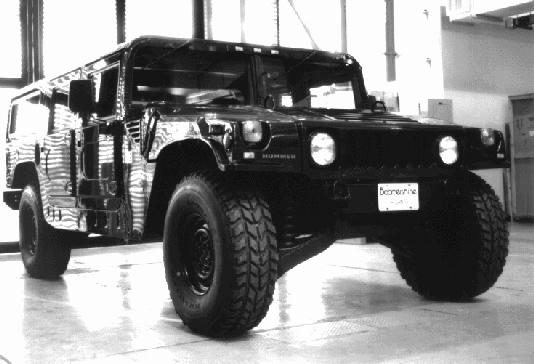
There is a program at known as Future Combat Systems. One of their big things right now is teleoperation technologies. They are looking at a whole school of Unmanned X Vehichles, where X is both arial and ground vehicles. At my work, we've been collaborating with the Mobile Robotics Lab at Georgia Tech, turning a Hummer and some robots known as ATRVs into teleoperated bots. We have been doing this as part of the communications portion of the Future Combat Systems project, to demonstrate an IP based communications network developed by another company. Last week we drove the ATRV from New Jersey while the robot was in Atlanta. The hummer can now be driven over telnet, and probably can be driven over a similar distance (although safty concerns make testing such things a little more difficult, and caused us not to try). We can drive any of the robots by gaming joystick from a computer on the internet, with video latency being the limiting factor. And yes, all ye Linux zelots, all the computers in the project run Linux, except an old PC-104 stack running Dos from a floppy.
One think that I have picked up is that just because DARPA is currently looking at things, it does NOT mean that they are making any of them. DARPA will from time to time fund things like this just to find out what the "Best Effort" of industry is, that way they know exactly what they CAN have made.
To get my email address, add "@mail.gatech.edu" to my slashdot ID. -
Re:Hmmm....
Funded by DARPA = Eventual military use for this...
So what exactly is this for, remotely wardriving in Afganistan?
There is a program at known as Future Combat Systems. One of their big things right now is teleoperation technologies. They are looking at a whole school of Unmanned X Vehichles, where X is both arial and ground vehicles. At my work, we've been collaborating with the Mobile Robotics Lab at Georgia Tech, turning a Hummer and some robots known as ATRVs into teleoperated bots. We have been doing this as part of the communications portion of the Future Combat Systems project, to demonstrate an IP based communications network developed by another company. Last week we drove the ATRV from New Jersey while the robot was in Atlanta. The hummer can now be driven over telnet, and probably can be driven over a similar distance (although safty concerns make testing such things a little more difficult, and caused us not to try). We can drive any of the robots by gaming joystick from a computer on the internet, with video latency being the limiting factor. And yes, all ye Linux zelots, all the computers in the project run Linux, except an old PC-104 stack running Dos from a floppy.
One think that I have picked up is that just because DARPA is currently looking at things, it does NOT mean that they are making any of them. DARPA will from time to time fund things like this just to find out what the "Best Effort" of industry is, that way they know exactly what they CAN have made.
To get my email address, add "@mail.gatech.edu" to my slashdot ID. -
Re:Hmmm....
Funded by DARPA = Eventual military use for this...
So what exactly is this for, remotely wardriving in Afganistan?
There is a program at known as Future Combat Systems. One of their big things right now is teleoperation technologies. They are looking at a whole school of Unmanned X Vehichles, where X is both arial and ground vehicles. At my work, we've been collaborating with the Mobile Robotics Lab at Georgia Tech, turning a Hummer and some robots known as ATRVs into teleoperated bots. We have been doing this as part of the communications portion of the Future Combat Systems project, to demonstrate an IP based communications network developed by another company. Last week we drove the ATRV from New Jersey while the robot was in Atlanta. The hummer can now be driven over telnet, and probably can be driven over a similar distance (although safty concerns make testing such things a little more difficult, and caused us not to try). We can drive any of the robots by gaming joystick from a computer on the internet, with video latency being the limiting factor. And yes, all ye Linux zelots, all the computers in the project run Linux, except an old PC-104 stack running Dos from a floppy.
One think that I have picked up is that just because DARPA is currently looking at things, it does NOT mean that they are making any of them. DARPA will from time to time fund things like this just to find out what the "Best Effort" of industry is, that way they know exactly what they CAN have made.
To get my email address, add "@mail.gatech.edu" to my slashdot ID. -
Re:use a Wiki... yeah!Don't forget the squeak smalltalk Swiki
It's probably one of the more feature complete ones out there, and essentially comes with it's own development environment, the Smalltalk system that runs it...
You can use the swiki tools themselves, or the Squeak Server Pages extension too.
It's a breeze to set up and run, and it's easy to maintain.
Swiki.net is a website offering free swiki hosts using Squeak Swiki as the back end. -
Some wikis are also 'scale free'
Look at SeattleWireless' HowDoesThisWikiLookLike there are few pages with a lot of references to or from other pages, and many pages with few references. It seems to follow a 'power law' too(~ 'scale free').
So, the 'inside' of the web seems to follow the same rules. It is particulary interresting with wikis because of the unplanned, distributed growth (like the Internet).
As the belgian provider, where the pictures are, seems to be down. You can also see the pictures in ReseauCitoyen.be's TopologieDuWiki
I thing it would be a good idea to have a discussion on
I know of only one book on the subject : "The Wiki Way: Collaboration and Sharing on the Internet" by Bo Leuf, Ward Cunningham (of c2.com, creator of the Wiki concept).
If you search Google for 'RecentChanges' (a good marker for wikis (?)), you get a lot of them, more and more (A survey by country domain sept->oct 2002)
There are some scientific papers at GaTech.edu -
Re:LinuxFromNotSoScratch.com
-
Tech has a better solution :)
We've actually been keeping our bandwidth down at Georgia Tech via a neat little student-run/built Samba crawler, know as BuzzSearch.
We also limit outbound connections to 50k/s.
These things combined means a lot more people are using our "free", internal bandwidth to download, rather than saturating our Internet line. Pings are WAY down from last year, and transfer speeds to legitimate things are up. It's amazing how people act when you show them the wonders of stuff on campus (about 3TB and counting -
Re:Lost, please return
You forgot to mention section 4 of this act:
Section 4
That this act shall continue to be in force until March 3, 1801, and no longer.
The Sedition Act of 1798 -
SqueakFor those interested in oo-language derivitives for teaching another popular one is Squeak. Just as Logo is Lisp-derived Squeak is Smalltalk-derived.
Small, portable, virtual-machine based, simple enough for kids to get started (and excited on) it's powerful enough for 'real stuff'. Check out the FAQ based on a Squeak Swiki.
Oh, and as Logo had Seymor Papert as 'the guy' behind it Squeak had Alan Kay who did lots of early work on 3D graphics, ARPAnet, windowing interfaces, modern oo programming, and inventor of the Dynabook.
-
Don't forget StarSqueak
StarSqueak has been in the Squeak Smalltalk System's base image for a couple of years. The interface was modelled on StarLogo, and has some mighty impressive demos in the distribution. (Squeak is free to use, and very cross-platform.)
-
FTP mirrors
-
Slashdot Myopia?
When I went to school we had whole labs of machines donated by Sun and Intel which no one protested about being out of the ordinary. Similarly there is at least one mandatory classes for CS majors which uses Sun Microsystem's proprietary progamming language and many optional classes as well require Java or strongly suggest it.
Until Slashdot started trying to cause a controversy with the C#/University of Waterloo thing I had assumed this widespread practice in the American university system was taken for granted. Academia is all about politics especially when it comes to the curriculum, technical arguments for or against programming languages are just one slice of the cake. If it wasn't about politics we'd all be learning Lisp and Smalltalk in school instead of C++ and Java. OK, we actually did learn Scheme and Smalltalk at GA Tech so maybe that's a bad example.
Disclaimer: The opinions expressed in this post are mine and do not reflect the opinions, thoughts, strategies or plans of my employer. -
Ousterhout on Threads
-
Depends on where you went to school
There's hacking classes in college? Somebody needs to smack the entire H.R. dept. for weeding out a lot of talented folks.
I distinctly remember taking a Linux kernel hacking class when I was in college which amongst other things included hacking Linux on the iPaq. I also seem to remember that one of my group members was in a video game class at the same time which included projects such as hack Quake I. -
Depends on where you went to school
There's hacking classes in college? Somebody needs to smack the entire H.R. dept. for weeding out a lot of talented folks.
I distinctly remember taking a Linux kernel hacking class when I was in college which amongst other things included hacking Linux on the iPaq. I also seem to remember that one of my group members was in a video game class at the same time which included projects such as hack Quake I. -
Re:I am offended
OK, I'll use Comanche instead.
-
Re:link correction
Constantinos Dovrolis has moved to Georgia, and so did the web page mentioned above.
-
Have you considered Wikis for content management?If you like to keep things simple, sometimes a Wiki might be the only thing you need.
Here is the original WikiWikiWeb: http://c2.com/cgi/wiki?WelcomeVisitors
Here is a Wiki you can easily install on your own machine: http://minnow.cc.gatech.edu/swiki/15
Here is a free Wiki farm that let's you start your own on a shared server: http://www.seedwiki.com -
OT: Cygwin tips.
Some random tips...
1) Make sure you set up your
mkpasswd -l >
mkpasswd -d -u USERNAME >>
2) The Cygwin bash term (like if you go to the start menu and get a bash shell) takes the standard ANSI escape sequences. So you can do the normal PROMPT_COMMAND things and have your cwd in the title in the term window. I love this. Problem is, the termcap doesn't seem to totally jibe with termcaps on the Solaris machines I log in to, so I still have to use XTerms if I want scrolling in say man pages to work right. Set this up in the
3) cygstart (in the cygutils package) is your friend. It's the glue that integrates the Windows and Cygwin sides well. cygstart --open on a Windows App path will open it in a new window. cygstart --open on a doc will open the doc in the app associated with it in Windows. If you pass in paths from cygwin to a windows app, translate the path before. Here, $(cygpath -w unix_style_path) is your other friend.
4) If you want to open a cygwin app without the attendant DOS window, check out the run utility.
5) Look for "Command Prompt here" on Microsoft web sites. Then open up RegEdit, look for DosHere, and change the command to the path to your bash shell. Then you can open up bash shells in any directory. Nice. -
Autonomous model helicoptersAnd the robotics professor who tried controlling it by computer really only got it to fly up 15 centimeters and land without help. That was a bit disappointing, as I'd love to work on programming one of these puppies.
Others have already pointed out the open source Autopilot project.
The Draganflyer is limited to 5 minutes because it's so small and light, and runs on batteries. If you go with one of the more established conventional helis, you can get longer flight times. The longest times are still achieved by combustion engines, using either model fuel or regular gasoline, and it's quite easy to achieve more than 15 minutes with one of those.
However, I don't think it's any accident that the Draganflyer has an unconventional four-rotor design - this allows it to avoid many of the instabilities that a regular helicopter suffers from, and probably makes the job of programming an autopilot for it much easier.
Still, computer-controlled regular helis, even fully autonomous ones, are possible and have been done. There's even an annual International Aerial Robotics Contest. The site doesn't seem to be responding right now (secondary
In the past, these have been pretty expensive devices to put together. Nowadays, as the Draganflyer proves, it's not as expensive as it used to be. The piezo gyros are pretty cheap - in the $100 range for a decent one. Building your own computer-controlled helicopter is definitely doable. The Sourceforge project is probably a good place to start, especially since it'll be a lot easier if it's not a one-man project.
-
Show Me The Money
First, let me say that what I'm about to show might be entirely common among colleges, not just the Georgia Institute of Technology. But whenever I see some academic group pushing something that is inexorably linked to commercial interests, I start looking for a money trail.
EPICS, Georgia Tech Receives Software Grant to Improve Retention For Minority Students (2000)
This year, they'll have even more to celebrate, as Microsoft Research's University Relations Group announces a grant that will put "bundles" of its latest software and publications in the hands of 1,000 underrepresented students over the next two years.
EPICS, Microsoft Partnership Donates Software to Hands On Atlanta (date unknown)
"Thanks to the partnership of the nationally based Engineering Projects In Community Service (EPICS) and Microsoft Corporation, a generous software gift was recently donated to HOA. This software, Microsoft Project 2000, will allow the organization to implement a system to improve its special events planning. "
Microsoft Exec to Address Georgia Tech Grads (1999)
Deborah Willingham, vice president of Microsoft Corporation's Business and Enterprise Division Marketing, will address Georgia Institute of Technology's 205th Commencement ceremony on Saturday, December 18.
Microsoft grant gives OMED another reason to celebrate at Tower Awards(date unknown)
This year, adding to the excitement, Microsoft Research's University Relations Group announced a grant that will put "bundles" of its latest software and publications in the hands of 1,000 underrepresented [Georgia Tech] students over the next two years.
This was just a quick check on Google.
Again, there might not be a cookie jar that Microsoft doesn't have their fist in, but it might be nice to know.