Slashdot Mirror
Domain: geocities.com
Stories and comments across the archive that link to geocities.com.
Comments · 8,978
-
Re:Ho hum
Of course its the minority, but that's all it takes.
I think 10% is a very, very reasonable estimate. You think when they have 200,000 people out in the streets all chanting "death to America" and burning our flag and efagies of Bush that represents everyone in the world with that view? What, they all just fly from country to country holding these rallies? Radical islam roadies?
So the muslims that burned 21,000 cars in France were what, 1% of the population?
Forget it. Good night. -
Re:We know it's true
Futurama: Future Stock
That Guy: Let's cut to the chase. There are two kinds of people: Sheep and sharks. Anyone who's a sheep is fired. Who's a sheep?
Zoidberg: Uh, excuse me? Which is the one people like to hug?
That Guy: Gutsy question. You're a shark. Sharks are winners and they don't look back 'cause they don't have necks. Necks are for sheep. [Everyone sinks down and covers their necks.] I am proud to be the shepherd of this herd of sharks and I am gonna lead you to the top in this industry
---
It's on topic because it happens in the future and Zoidberg is a shellfish. -
This is the AI problem
Being able to compress knowledge well is believed to be related to acting intelligently.
There's actually a little more to it than that. The creators of the Hutter prize believe that intelligence is the ability to compress knowledge. That's why they're offering this prize -- to solve the artificial intelligence problem. I'm not saying I buy into it, but that's their claim. That's why they call it "The most crucial technology prize of all." Here is the page describing the origin of the prize. -
Re:New definition for "initiated"
Yeah, it was pretty awful of those Democrats in 1941 to start things off by attacking Pearl Harbor.
And forcing the Third Reich to declare war on the United States. -
Re:Seems like a waste of money to me.
But if I was looking for diamonds, diamond.com wouldn't be my first port of call - I'd be more likely to search, or go to a known brand name retailer online.
When you search for "diamonds" on Google, what do you think is going to be one of the first results? More importantly, if you see the first couple are http://www.geocities.com/diamonds , and the third is http://www.diamonds.com/ , which result do you think you'd follow?In fact, it could be argued, they do BETTER - decent, unique brand names stick in consumer's minds far better than relying on a recycled word.
That only works if you're going to spend significant ammounts of money BUILDING brand recognition to begin with... Most don't. -
Boy scouts gone bad
http://www.geocities.com/~Pack215/wolf.html#GOD
For me, Boy Scouts went south right here, at the cub scouts level.
I'm not trying to bash God loving people here or anything, but this sort of screws atheists. It's a required piece for advancement too. -
Re:In a 40' container since 1999
High Cubes are less common. I had to ask my supplier for them.
They are 9'6" tall and MUCH more desirable for a dwelling!
http://www.tis-gdv.de/tis/taz/h/high_cube.jpg
http://www.proboxinc.com/productsp.htm
Lotta pics and parts:
http://www.tandemloc.com/
BattleBox
http://www.geocities.com/strategicmaneuver/battleb oxes.htm
Sea Box (food for thought)
http://www.seabox.com/id-2 -
Re:Ungrateful Bitching
Before putting Firefox 2.0 RC2 in my knoppix remaster, I had to do something about the 4 MB list of phishing sites that Firefox uses to see if the user is looking at a fake website.
I can't use it in a livecd linux that is supposed to run satisfactorily on older hardware. I'm using the 2.4 kernel, and can run well on 128 MB ram with PII or AMD K6-2. The list would go in ~/.mozilla, in
Also, Firefox will have to download the list each time it is booted, as I have Firefox delete it's ~/.mozilla when closed. Done for security and privacy reasons. I have Flock 0.7.6 do that also, as it tends to keep a file on your searchs, even if you have it delete private data on close. One might ask, what is the point on a livecd linux, just turn the box off, and everything goes. But if a "persistent home directory" knoppix.img is run on a hard drive partition, then we have something that could bring back the Ghost of Christmas Past, so to speak. I have a bunch of RSS feeds for Firefox, so I get about 240K of download when the browser starts, anyway. Just didn't think the phishing sites item was worth it.
I like RC2, now I guess I'll have to put Firefox 2.0 RC3 in there!
I'm impressed with the claim that it will use less memory than Opera 9, which I also have in the CD.
-- Rapidweather -
quite right
you are actually quite right, it is about female psychology. it is a fact that women are on average lot more egocentric. the reason for it is very simple - biologically males are expendable, females are not.
but times has changed, human society now is very different to human society hunderds of thousands years ago. behaviour patterns which worked back then are serious dated now. males have adapted to the 21st century, females not, and this causes lots of problems.
there is a great german word for those who have modded you down: "berufsbetroffene". this word describes people who see it as their job being conserned and offended. they read your opinion and are offended about you being misogynic in their eyes. they are the same people who try to be overly political correct.
well, i've got news for all those bleeding hearts: males and females are NOT equal. equal rights, yes. but that's it. women are on average lot more egocentric and they listen more to their instincts and to their emotions than to their consciousness.
anyway, read more here -
There is only on logical choiceSecretly http://www.geocities.com/hirak_99/goodies/secretl
y .htmlIt is the fastest virtual desktop switcher out there, no pause, no hesitation whatsoever. Icons for the most part stay on their own virtual desktop. There is no gui,everything works by hotkey. It is the only virtual desktop manager that just stays out of my way and works.
Most virtual desktop managers for windows are dog slow, you can watch the minimized icons dissapear one by one, then the desktop switches, then the icons for that desktop pop into place, one by one. None of that for me, I am sticking with Secretly.
It was designed to be the ultimate boss key program, but it is more of a linux junkies favorite utility when forced to work in Windows.
-
Easy way to make true AI
I posted this before if you want True AI If you want smarter networks. Take Digg, then add groups.
For example you have if you're a Republican or a Democrat.
Democrats mod stuff down Republicans may mod up. So they should each have their own scoring section.
There are a LOT of groups people can be a part of. Even social cliques if you so desire.
Eventually people who's articles that get modded up a lot will start with a degree of moderation to them.
Or you can search on your favorite authors.
I hate the internet because I always know what is coming next, but never the motivation to code it. -
Re:Huh? India's 1st test was in 1974
-
My 5
Strider - Game that looks hard but is actually quite easy and fun to play. You always feel like you're doing amazing things.
Puzzle Pirates - Time to bilge your life. Yarr.
Ikaruga - My nethack. Just play. You're dead. Ouch.
Sim Golf - I don't actually like playing golf, but for some reason running a golf course is really relaxing.
Ore No Ryouri - No matter how panicked things might get in real life, nothing can compare to running a japanese ramen house in a video game. -
Hang on
Let's ask this guy first.
-
Re:Opera still feels more responsive, uses less RAThis is an update to my post above. I am now running RC2 as a temporary install, and it seems just fine. (This is a livecd linux)
For those knoppix fans, you have to leave out your "home=scan" in your boot cheatcodes to be able to tar -xvf the Firefox downloaded file. Then, after you get a ~/firefox (not the ~/.mozilla) just copy it to a spare hard drive partition, and then reboot, now using your "knoppix.img" with "home=scan".
Next, copy the ~/firefox to ~/ so it will be included in your knoppix.img. You may change the owner/group to knoppix.knoppix for all of ~/firefox.
Last, make a menu entry or desktop icon for RC2 in place of the Mozilla Firefox that you had.
Mine is:
prog "Mozilla Firefox 2.0 RC2"
That is for the IceWM toolbar icon in Rapidweather Remaster of Knoppix Linux.
There are some screenshots below showing a prior Firefox running in IceWM, here is one that shows the toolbar.
Now, when you set up the browser the way you want, the "persistent home directory" knoppix.img will keep your changes from bootup to bootup.
I put the bookmarks with the 9 RSS feeds in ~/firefox so RC2 has them also.
This has been a description of how to temporarily install RC2, when a "knoppix.img" is being used. (This box has a 200 MB one., so about 53% of that is being used for the new Firefox, and Google Earth, both temporary "installs".)
Now I am going to enjoy using Mozilla Firefox 2.0 RC2 for the rest of the evening.
-- Rapidweather
-
Re:Opera still feels more responsive, uses less RA
I'm using RC1 now on Rapidweather Remaster of Knoppix Linux on a dual 200 mmx box with 256 MB of RAM. Seems ok to me, I'll get over to my cable modem box today and download RC2 and give it a try.
I use a "persistent home directory" knoppix.img for ~/, and on this box it's 500 MB, so my RAM does not change, it's at 556 K, (1%) according to "df". The knoppix.img is on
I don't have to use the CD to boot, have a loadlin setup using a MSDOS menu. My remaster uses the 2.4 kernel, so it runs well on older boxes. I have loaded my remaster up with fonts, so the web pages look better than they do in Opera or Firefox running on Windows XP, on the same machine. The "oem" knoppix 3.4 had so-so fonts, not acceptable to me. I symlink to the ~/.fonts.cache-1, so it does not use any ~/ ram to speak of. It's 304.70 KB, so you can see why I would want to symlink it.
I can run the remaster directly off the CD, with no real problems, it is just a little slower to start up applications, as they have to decompress off the CD first in typical knoppix style. 7200 RPM hard drives offer a boost, and since they are there, why not use them.
I don't see any reason why I can't put RC2 in the CD, unless they have somehow fowled something up, over RC1, which I doubt. I do have Opera 9.02, and Flock, which is based on the stable Mozilla Firefox 1.5.0.6.
I pre-configure all three browsers in the CD, mainly pointing them to a built-in home page like this one. The users wind up in less of a "walled garden" with a page like that, or at least I have tried to make it so.
I do have RC1 running the NoScript extension, does give one the impression, at least, that you are keeping the bad javascripts out, but it winds up being a nuisance sometimes, having to enable js on sites.
With the knoppix.img setup for ~/ I can easily add something like Google Earth, which I run on a P4 HT with 1GB RAM.
About "top", I have been up nearly an hour, and I have zero swap used, and 26484KB free. (This is a 256 MB box)
It's probably the 2.4 kernel that allows me to have these numbers. Some of the 2.2 kernel machines I have do even better, but, they will not run the new browsers, either.
-- Rapidweather -
Re:Opera still feels more responsive, uses less RA
I'm using RC1 now on Rapidweather Remaster of Knoppix Linux on a dual 200 mmx box with 256 MB of RAM. Seems ok to me, I'll get over to my cable modem box today and download RC2 and give it a try.
I use a "persistent home directory" knoppix.img for ~/, and on this box it's 500 MB, so my RAM does not change, it's at 556 K, (1%) according to "df". The knoppix.img is on
I don't have to use the CD to boot, have a loadlin setup using a MSDOS menu. My remaster uses the 2.4 kernel, so it runs well on older boxes. I have loaded my remaster up with fonts, so the web pages look better than they do in Opera or Firefox running on Windows XP, on the same machine. The "oem" knoppix 3.4 had so-so fonts, not acceptable to me. I symlink to the ~/.fonts.cache-1, so it does not use any ~/ ram to speak of. It's 304.70 KB, so you can see why I would want to symlink it.
I can run the remaster directly off the CD, with no real problems, it is just a little slower to start up applications, as they have to decompress off the CD first in typical knoppix style. 7200 RPM hard drives offer a boost, and since they are there, why not use them.
I don't see any reason why I can't put RC2 in the CD, unless they have somehow fowled something up, over RC1, which I doubt. I do have Opera 9.02, and Flock, which is based on the stable Mozilla Firefox 1.5.0.6.
I pre-configure all three browsers in the CD, mainly pointing them to a built-in home page like this one. The users wind up in less of a "walled garden" with a page like that, or at least I have tried to make it so.
I do have RC1 running the NoScript extension, does give one the impression, at least, that you are keeping the bad javascripts out, but it winds up being a nuisance sometimes, having to enable js on sites.
With the knoppix.img setup for ~/ I can easily add something like Google Earth, which I run on a P4 HT with 1GB RAM.
About "top", I have been up nearly an hour, and I have zero swap used, and 26484KB free. (This is a 256 MB box)
It's probably the 2.4 kernel that allows me to have these numbers. Some of the 2.2 kernel machines I have do even better, but, they will not run the new browsers, either.
-- Rapidweather -
Re:Can't WAIT!!!
I once had the idea that any OS that one installs on a PC needs to more or less match the time the PC was put on the market so as to provide drivers for the hardware, etc. A Pentium II equals Windows 98.
I have had lots of problems getting linux 2.6 kernel OS's to run fast enough on Pentium II's, for instance.
If that meant putting SuSE 6.3 on one of those, then that's what I did.
From the get-go Microsoft said that Vista would require a lot more in the way of memory, graphics, processor speed than previous products. I think they have backed off somewhat on that, with a tiered setup, allowing for some older boxes. I know XP has been factory-installed on machines with only 128 MB of RAM, with the result running way too slow. Getting that price way down, apparently.
I stick with a 2.4 kernel for my knoppix remaster Rapidweather Remaster of Knoppix Linux and I am able to get the latest web browsers, Firefox 2.0, Opera 9, Flock (based on Mozilla 1.5.0.7) to run on Pentium II and AMD K6-2 with 128 MB of RAM. The on-chip cache seems to make a big difference, those processors with only 64 K cache run slower than those with 512K, some almost unacceptable if running only 266 MHZ.
I get good results with AMD running 400 MHZ/ 128MB RAM, and excellent results with 256MB RAM.
The SuSE 6.3 installs won't run the latest web browsers, and it takes a lot of time to configure. I usually dd the install to a new HDD to save time. Generally too much trouble compared to the livecd linux.
I'd like to install this trial Vista, but don't have a spare box of sufficient power, and I know this OS will time out soon, and most likely won't give the protection against viruses, trojans, etc. than I have already with my remaster.
I'm able to run Google Earth using my remaster, with a "knoppix.img" for the ~/ on a spare HDD partition.
Google Earth runs just fine, although I have discovered, like others, that the maps are old.
This box I'm using now has a P4 HT, with 1 GB RAM, 128MB ATI, plenty for Vista, but installing the Vista RC would probably hose my XP Pro install here. I rarely use it, but did pay for it in the beginning. Had to fix it a lot, one time had to reinstall. Too much trouble overall, and wouldn't expect Vista to be any different over a few years use.
Main thing I like about running my remaster using a "fromhd=/dev/hda3" setup, with a "knoppix.img" is that the hard drive activity is way down, compared to running XP. The drive stays really quiet, much easier on the box as a whole. I have 320GB of HDD space, and I would imagine that Vista would work those drives over pretty good, compared to what I have right now.
I know I am missing a wonderful "out of box experience" with the Vista install, but I like to get results quicker than that, so that's why I use a livecd linux.
-- Rapidweather -
on a similar note
Who could forget Doom for the Atari 2600?
-
Microsoft's ProblemIf I were in Ray Ozzie's shoes I would apply something like the The Hutter Prize for Lossless Compression of Human Knowledge to the entirety of MS's software services suite. This, of course, requires making a rigorous spec for testing purposes.
Make the engine, upon which the winning succinct byte code runs, a new W3C standard browser programming language (or at least virtual machine) and reduce the Microsoft OS CD to those components required to create a web-delivered application platform using the winning engine. Such an engine would, of course, have some features that dynamically encached expansions (and/or "memoizations") similar to the Hotspot optimization technology that originated with the Self programming language (and was later adopted by Sun's Java Virtual Machine). Hence it would make sense to have the OS CD contain a partially pre-expanded/optimized code base.
Then, for delivery of software services to pre-existing platforms, create a legacy port of the services code to pre-existing W3C standards like XForms implemented in a downloadable ECMAScript Client/SOA library in a manner similar to the way TIBET(tm) does. The idea is to go "Live", ie: web-delivered, with a fundamentally new W3C base (whatever engine won the prize) but support legacy W3C environments for migration.
Again, this prize-oriented strategy would, of course, require a rigorous specification of the software services so the testing could be largely automated.
This approach addresses Microsoft's 2 biggest problems deriving from the same fundamental reality: Everyone has needed their OS to interoperate with the bulk of the information industry.
The first problem is ethical and really goes beyond the scope of my professional opinions to my public opinions about the support of property rights. Suffice to say, I have no trouble with someone who goes after a natural monopoly position and succeeds. I have a problem with someone who then refuses to use that position of success to fix the bug in the society that made them inordinately rich and their technology inordinately influential.
The second problem is technical, which is what my argument here is really all about.
Basically Microsoft's code bloat problem derives from its monopoly position. This may seem like a truism since all of the software "profession" suffers from code bloat, but only Microsoft can take this to monopolistic proportions -- proportions that make Ma Bell's monopolistic complexities of yore look Spartan.
So Microsoft has this problem and it has many programmers (contributing to the code-bloat problem). It also has mountains of cash.
So how can Microsoft bust its own monopoly position turning its many programmers and mountains of cash into succinct code?
Monetary Incentives for the Programmers, ala the Hutter Prize:
S = size of uncompressed code-base
P = size of program outputting the uncompressed code-base
R = S/P (the compression ratio).Award monies in a manner similar to the M-Prize:
Previous record ratio: R0
New record ratio: R1=R0+X
Fund contains: $Z at the time of the new record
Winner receives: $Z * (X/(R0+X))What happens very rapidly is the programmers first apply their skills to maximally refactoring. What falls out is a series of legacy API layers written atop a tight core.
They'd have to spend more money on code testing to verify the compressed code-bases of the competing teams actually worked to spec but the results should be quite gratifying.
-
Re:cracked!
I needed a good laugh today, and when I saw the hour limit on the web browser, etc. that did it.
I couldn't help but note the I *despise* Linux on the desktop item in prior post.
All I can offer there are the screenshots, below, for my linux livecd system.
Or, you could just go here for one of my favorites.
System requirements? 128 MB RAM, 200 MMX or better processor, Already have a Windows 98 installation at
Plenty of older boxes qualify, that's what I use every day.
-- Rapidweather -
Re:Yet nothing is changin....
I have an old Macintosh Quadra 660AV, and it came with Norton. Really funny, because Norton would pop up and say, "It seems that your system clock needs adjusting.. Would you like me to fix it?"
Naturally, I always clicked "yes", and was rewarded by Norton.
You know, that is always a good question to ask, because only one clock in the USA is probably correct, and that is the one that the government uses for the official US time.
After Norton fixed my clock, then I really had no way of knowing if it was right or not.
So, after that, I tend to look at all Norton products the same way, a lot of what is done is just for a show, and really does not do anything. Sure takes a long time, however, I have one box that Norton takes 45 minutes to scan all 320 GB for viruses. That's 45 minutes that I could have spent surfing the web on a livecd linux system like mine, Rapidweather Remaster of Knoppix Linux. (Also, see screenshots.)
I am not sorry for the shameless plug, but people will use Windows, and suffer all the faults, and pay whatever Microsoft wants. Now, they can hardly wait for Vista. It'll cost an arm and a leg. But, it has been beta tested by millions, and supposedly, all bugs have been fixed, avoided, or involved in a work-a-round.
We won't know, because the code for all things Vista is hidden. "No idea how they do that." is all that can be said for what you see when you run XP, and soon Vista. Maybe the Chinese will force Microsoft into showing them the Vista source code, so they can make sure the "State Department" does not have a backdoor to Chinese computers running Microsoft products. Didn't they do that with XP?
-- Rapidweather -
True prior art
The 1954 McCutchen machine is an all-rotating helicopter.
The idea of making it invisible by making the center of gravity a "hole" is not new either. I believe many people came up with this idea independently. I though about it some 20 years ago. -
Re:I Feel so much safer
You might want to look into alternative means of exchange as well.
Ithaca Hours:
http://www.geocities.com/RainForest/7813/ccs-ithi. htm
KFG -
No one looks at the cost of reproductionThe big reason Asians can compete with Westerners -- particularly Western technologists -- is the rising cost of reproduction in the West.
The cost of reproduction has risen by a factor of nearly 4 since I was born in 1954, fertilizing the portfolios of landlords, or more properly, land barons, with the decomposing marriages, fetuses and sometimes bodies of the bulk of the baby boom generation, leaving a demographic hole being filled with imported slaves* by those same landlords.
The baronage calls this "progress", even as as the price of homes was removed from the consumer price index while introducing CPI factors like "hedonic value" and "imputed rent" to make it appear "real" earnings have increased over the time period of demographic collapse and loss of ethnic enfranchisement to imported laborers for the baronage.
I call it genocide.
*It is really being too kind to the baronage to call the imported laborers "slaves" since the baronage doesn't have to pay for their human capital upkeep--the rest of us do via social programs. Southern Plantation owners were far more moral than these sorry excuses for human beings.
Figures from my insurance agent sent to me on my birthday:
The two big ticket necessities:
3 bedroom house price increase: 22 times
1954 $ 10,250
2006 $219,375car price increase: 18 times
1954 $ 1,567
2006 $28,000Even if we grant that the quality/cost ratio of manufactured goods has gone up so much during the last 52 years that $1,567 for a used car in 2006 is as good as a new car was in 1954, it doesn't bring down the sum of the 2 major debt-service items much:
house+car increase: 19 times
1954 $ 11,817 =$1,567+$10,250
2006 $220942 =$1,567+$219,375So the debt-service load in a family household has gone up nearly a factor of 20 in the last 52 years.
And don't kid yourself that it didn't hit hardest at the peak child-bearing potential of the mid-to-late boomers who were paying 20% mortgage rates when they were trying to form families in the early 1980s.
Look at these foreclosure rates peaking within the first 10 years of boomer's trying to form families:
Year $ value of mortgage loans foreclosed (in millions)
1965 944
1966 1,034
1967 957
1968 865
1969 364
1970 321
1971 438
1972 478
1973 577
1974 715
1975 1,086
1976 1,129
1977 868
1978 723
1979 683
1980 917
1981 1,563
1982 3,282
1983 4,240
1984 6,163
1985 8,675
1986 13,942
1987 18,373
1988 18,859
1989 18,189
1990 22,862
1991 17,105
1992 12,408
1993 6,852
1994 3,422
1995 2,506
1996 2,138
1997 1,805
1998 1,470
1999 1,022
2000 900Has household income kept up? Hardly...
average household income increase: 13 times
1954 $ 4,137 (one wage earner)
2006 $54,000 (two wage earners)So household income has gone up only about 70% as much as the essential household debt service in the last 52 years.
Oh, but wait--that "household" in 1954 was one income and the income was relatively stable--the woman stayed at home and raised the kids.
How can we factor not only that both parents must work in 2006 and not only are each of their jobs less secure, but the effective income of the household, adjusting for risk of not being able to meet debt payments for a substantial period of time?
Here's a realistic option: We can reasonably say that the odds of both parents being out of work at any given point of time in 2006 is comparable to the odds of the father being out of work in 1954. Hence the reliable household income--the income stream that can service debt without foreclosure--is approximately 1/2 of the household income. Certainly we can say that there w
-
No one looks at the cost of reproductionThe big reason Asians can compete with Westerners -- particularly Western technologists -- is the rising cost of reproduction in the West.
The cost of reproduction has risen by a factor of nearly 4 since I was born in 1954, fertilizing the portfolios of landlords, or more properly, land barons, with the decomposing marriages, fetuses and sometimes bodies of the bulk of the baby boom generation, leaving a demographic hole being filled with imported slaves* by those same landlords.
The baronage calls this "progress", even as as the price of homes was removed from the consumer price index while introducing CPI factors like "hedonic value" and "imputed rent" to make it appear "real" earnings have increased over the time period of demographic collapse and loss of ethnic enfranchisement to imported laborers for the baronage.
I call it genocide.
*It is really being too kind to the baronage to call the imported laborers "slaves" since the baronage doesn't have to pay for their human capital upkeep--the rest of us do via social programs. Southern Plantation owners were far more moral than these sorry excuses for human beings.
Figures from my insurance agent sent to me on my birthday:
The two big ticket necessities:
3 bedroom house price increase: 22 times
1954 $ 10,250
2006 $219,375car price increase: 18 times
1954 $ 1,567
2006 $28,000Even if we grant that the quality/cost ratio of manufactured goods has gone up so much during the last 52 years that $1,567 for a used car in 2006 is as good as a new car was in 1954, it doesn't bring down the sum of the 2 major debt-service items much:
house+car increase: 19 times
1954 $ 11,817 =$1,567+$10,250
2006 $220942 =$1,567+$219,375So the debt-service load in a family household has gone up nearly a factor of 20 in the last 52 years.
And don't kid yourself that it didn't hit hardest at the peak child-bearing potential of the mid-to-late boomers who were paying 20% mortgage rates when they were trying to form families in the early 1980s.
Look at these foreclosure rates peaking within the first 10 years of boomer's trying to form families:
Year $ value of mortgage loans foreclosed (in millions)
1965 944
1966 1,034
1967 957
1968 865
1969 364
1970 321
1971 438
1972 478
1973 577
1974 715
1975 1,086
1976 1,129
1977 868
1978 723
1979 683
1980 917
1981 1,563
1982 3,282
1983 4,240
1984 6,163
1985 8,675
1986 13,942
1987 18,373
1988 18,859
1989 18,189
1990 22,862
1991 17,105
1992 12,408
1993 6,852
1994 3,422
1995 2,506
1996 2,138
1997 1,805
1998 1,470
1999 1,022
2000 900Has household income kept up? Hardly...
average household income increase: 13 times
1954 $ 4,137 (one wage earner)
2006 $54,000 (two wage earners)So household income has gone up only about 70% as much as the essential household debt service in the last 52 years.
Oh, but wait--that "household" in 1954 was one income and the income was relatively stable--the woman stayed at home and raised the kids.
How can we factor not only that both parents must work in 2006 and not only are each of their jobs less secure, but the effective income of the household, adjusting for risk of not being able to meet debt payments for a substantial period of time?
Here's a realistic option: We can reasonably say that the odds of both parents being out of work at any given point of time in 2006 is comparable to the odds of the father being out of work in 1954. Hence the reliable household income--the income stream that can service debt without foreclosure--is approximately 1/2 of the household income. Certainly we can say that there w
-
bus evolution
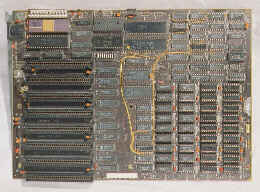
I think the problem may have to do with the fundamental concept of a computer being an exposed motherboard with a series of slots that house exposed cards. This goes all the way back 30 years to the first micro bus standard (S-100) through most subsequent computers.
http://www.geocities.com/SiliconValley/Lakes/6757/ images/chassistop.jpg
http://www.oldcomputers.arcula.co.uk/files/images/ intl103t.jpg
http://www.infodip.com/pages/axiom/bus-passif/imag es/ATX60206.jpg
http://www.infodip.com/pages/axiom/bus-passif/imag es/ATX6021_4.jpg
http://www.ixbt.com/mainboard/epox/8npa-sli/board. jpg
This is indeed a practical and economical solution to the idea of putting together and updating your computer. It's really a holdover from the hobbyist days and people have gotten used to it, but it's not really consumer-friendly.
The cartridge approach as used with videogame consoles is better.
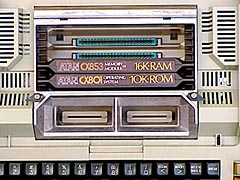
I think Atari had the right idea with how it implemented expansion on the 800.
http://oldcomputers.net/pics/cartports3.JPG
The only exposed surfaces were the card edges and the slot. Then you just close the lid.
You see this kind of design approach applied currently to flash memory. If you follow the evolution of the MMC card up through SD and into MINI SD and MICRO SD adapters, imagine the same approach taken with bus specifications. Older cards could be used with newer bus specifications via adapter sleeves. But you'd standardize on a singular form-factor. When you open up your PC, all of the guts would be hidden behind the casing except for the mating surfaces for the cards. All cards would be enclosed.
I don't see this happening because computer technology is by definition transient, disposeable. So nobody wastes money on ergonomics like this. Bus standards change so frequently that you can't even keep your motherboard that long anymore let alone your cards. So you might not even swap cards that much for the lifecycle of the PC beyond the initial system setup.
What I'd really like to see is more effort spent on coming up with a universal backplane that would be more future-proof, maybe something more passive where the glue that binds everything together was itself a module you could swap out. That way maybe the underlying frame could last much longer before becoming obsolete. -
Here's my entry...
http://www.geocities.com/Hollywood/Set/6172/photo
s /fembot2.jpg
Incase link has already been slashdotted, It's an Austin Powers Fem Bot -
Re:Man, I just won $240 today
Why?
http://www.geocities.com/James_Sager_PA/love8.html
(your website, for those who didn't check)
To store up all of the money you intend to give to the poor? -
The real importance of mass produced U.C.'s
People think mass produced ultracapacitors revolutionizing car transportation is the real imortance here but they're mistaken. The real importance is that there will be thousands of garage tinkerers trying their hand at various techniques to produce fusion energy. They will probably come up with ideas more workable than the Tokamak (although that isn't saying much by itself).
-
Re:Odd occurrence today
No the router password is not the default
Browsing with Windows / Mozilla 1.7 / NoScript
Here's the page if you want to haev a look (NSFW): http://www.geocities.com/Colosseum/Gym/1661/ -
Re:Reading between the lines...
The F-14 wings don't fold like most other US naval aircraft. For storage they sweep further back than they do in flight. This is referred to as 'oversweeping'.
-
Re:Easy..
You release albums as individual cartridges for portable players... it gives you a tactile "thing" with a label, contains mp3's in a generic format, is in a durable case
So in other words, a mp3 playing Pocket Rocker. -
Trade global warming for acid rain? no thanks
Gee, just inject 5 MILLION TONS of sulfur dioxide into the atmosphere, where it will promptly turn into sulfuric acid and rain back down on the world, making it look like a disaster area. Good thinking!
-
Error level in the ice core data is +/- 2-3 ppm
"The most common omission I find is the error level on charts. Take the ice core samples, what is the error level? Most I have seen have stated that the current PPM of CO2 is at an all time high! It has been stated that the current CO2 levels are 330+ ppm and from ice cores we know it has never been higher, or do we? What is the error level of the ice cores? +/- ??? If it is +/- 500ppm than the charts are junk, if it is +/- 2ppm then they may mean something. To date I have not been able to find anything that states the accuracy of the reading or the error level of the ice cores."
I did a quick Google search. The uncertainty in the Vostok ice core data is plus or minus 2-3 parts per million by volume.
Here's the data: http://www.ncdc.noaa.gov/paleo/icecore/antarctica
/ vostok/vostok_co2.htmlFrom the description:
"CO2 and CH4 measurements have been performed using the methods and analytical procedures previously described (Barnola et al., 1987, Chappellaz et al, 1990). However, the CO2 measuring system has been slightly modified in order to increase the sensitivity of the CO2 detection. The thermal conductivity chromatographic detector has been replaced by a flame ionisation detector which measures CO2 after its transformation into CH4. The overall accuracy for CH4 and CO2 measurements are ± 20 ppbv and 2-3 ppmv respectively. No gravitational correction has been applied."
If anyone wants to see what the Vostok ice core data looks like, here's an open letter I sent to the Canadian environment minister, including a graph of the ice core data: http://www.geocities.com/rwvong/future/greenhouse
. htmlYou may not be too worried about a CO2 level of 370 ppm, but it's still rising. If we proceed with business as usual, by 2100 it'll be at 800 ppm. (Again, looking at the ice core data, it's never been higher than 300 ppm at any time in the previous 400,000 years, which includes several ice ages. In comparison, settled civilization based on agriculture is less than 10,000 years old.)
If we make a serious effort to stabilize and reduce CO2 emissions in the next ten years--if the EU countries can do it, why can't we?--then we should be able to stabilize CO2 levels at about 500 ppm. There'll still be warming, but it'll be slow enough to adapt.
-
TDE -- Thomson Davis Editor
Forget elvis, vim, vi, gvim... WinVi32...and certainly forget emacs (even emacs in viper mode...the spawn of both these evil ones...) forget 'em all.
You need TDE!
http://www.geocities.com/jadoxa/tde/index.html
I am in no way affiliated with TDE. -
Dude, you're screwed.
I post my songs on Myspace, and with my high-quality sound system there is not a single bit of artifacting that I can hear, and I upload all of my songs at 192 kbps. Thank you.
-
Re:Average time-to-market?...my new laptop still dies after an hour and a half.
Also, there is the replacement cost of a laptop battery, they fail after a few years of use. By that time, the new laptops have increased in power and performance, so I tend to want to weigh the cost of a new battery vs just getting a new laptop. New battery, delivered, perhaps less than 15-20% of the cost of a new laptop, but consider this:- Toshiba T1910CS, 4 MB of RAM, DOS/Windows 3.1, lots of handy Toshiba utilities, such as Windows 3.1 or DOS floppy disk creator, so you can give everyone a set of DOS or Windows 3.1 installer floppies. Upgraded everything, so it has Internet Explorer and can dial up using the PCMCIA modem, and surf the web. Windows 3.1 did not do that unless upgraded (a lot).
Cost $999.00, memory upgrade 16MB, total 20 MB, $350.00.
Screen now almost gone, very dim, and battery is dead. Will run, and you can see the display if you turn off all the room lights. I can run Arachne on it, and some have installed linux, the link above shows that. - Toshiba 4015CDS, 32 MB RAM standard, upgrade to 160 MB about $50.00 (friend couldn't use the stick).
Windows 98, 4 GB hard drive. Will run my livecd linux (see screenshots, below) directly from the hard drive, using loadlin and some menu batch files, completely freeing the CDROM Drive. Battery is dead. New one probably over $120.00 delivered. Laptop when new was (gasp) $2100.00. I buried the receipt in a time capsule to be opened in 100 years (just kidding).
One advantage to the 4015CDS is that it can run linux which is easier on the hard drive (and the battery), than Windows 98, now an unsupported OS. PCMCIA modem gives good dial-up performance, usually 48000 bps or higher. Does 800x600x24, display still works good.
Still, considering the cost of the battery, a new laptop might be worth it. Windows XP would be nice to run for music and photo's , but I would not really want to let it out onto the internet. To do that, I'll use my livecd linux, especially when doing online banking and bill paying. I can easily download songs while booted into linux and place them in the XP filesystem, reboot and play them there. I think one can download the Windows Update patches (according to Kyle Rankin) using linux, and then reboot and apply them.
So, new battery technology is long awaited, especially for all kinds of mobile devices, laptops, etc. - Toshiba T1910CS, 4 MB of RAM, DOS/Windows 3.1, lots of handy Toshiba utilities, such as Windows 3.1 or DOS floppy disk creator, so you can give everyone a set of DOS or Windows 3.1 installer floppies. Upgraded everything, so it has Internet Explorer and can dial up using the PCMCIA modem, and surf the web. Windows 3.1 did not do that unless upgraded (a lot).
-
Wow, someone didn't even search the internet.
Searching for GW-Basic, results in hundreds of links pointing to the original BASIC MS-DOS language, GW-Basic..
http://www.geocities.com/KindlyRat/GWBASIC.html -
Out of the Underland?
Here's one of my favorites -- this one deserves a mention for its sheer volume of nonsense and horrible design. A lawsuit against Bill Gates? Good luck finding a coherent paragraph anywhere on this page: http://www.geocities.com/redmondrose/
-
Re:Worst website according to Digg...
When I took a web design course, our instructor actually used this site as an example of what NOT to do. It remains the very worst site I've ever seen to this very day:
http://www.geocities.com/sassy_angel_kisses/index. html -
Re:You know, though this is a dupe
or download gw-basic... http://www.geocities.com/KindlyRat/GWBASIC.html
-
I don't know what he's crapping on about
You can download GWBASIC here: http://www.geocities.com/KindlyRat/GWBASIC.html I just tried it and it works. If you want to get the full window, type "screen 0"
-
Re: your sig
God spoke to me.
No, He didn't.
-
Re:I agree (sort of)
I have to cringe when someone wants to go back to Windows...
Do you really want to do online banking using Windows?
We're trying to make linux easy-to-use for the ordinary person that mainly wants to surf the web.
Today that means making on-line purchases, and next up is visiting your credit card website, make a payment, or go to your bank's website, and see if those checks cleared.
I have a lot of people tell me they are happy doing that with OSX, they can afford Apple machines and they are easy to use. Still a hard drive installation, however.
I tried Ubuntu, did not like it for a couple of reasons. 1. Would not run on older PC's, and 2. Asks too many questions at bootup.
I have a livecd linux, see the screenshots in signature, below. Having had my say about security, I went out on a limb and put Mozilla Firefox 2.0b2 in the CD yesterday, mainly because they finally fixed the tab close (X) so it's on the tab and not down on the right end. Opera has gotten this right for a while now, Firefox needed to do that, almost all websites look correct in Firefox, not all in Opera 9. (a shame).
What follows, however is not for the average user, but does result in a neat setup for a secure livecd linux:
I get around the need to enter "knoppix cheatcodes" at bootup by using loadlin and a MSDOS batch file with all the necessary cheatcodes for a particular box provided in the loadlin command line. So, I don't run it as a livecd on any particular box that I will be using all the time, I copy the
None of that is "part of the CD", it has to be custom-configured using files on a floppy, and using the CD to get some of the required components. If one has a CDROM drive, however, using the livecd is easiest and gives immediate results, all the other procedures are on the to-do list for someone booting up the machine every day.
I do target older Windows 98 machines, however, for my livecd linux. 128 MB of RAM is fine, processor speed 266 mhz will do nicely. I run on a 200 MMX every day, plenty fast enough to handle Firefox 2.0b2.
The 2.4 kernel does the trick, I'm based on Knoppix 3.4.
My blog is here, Getting Started Guide is here.
-- Rapidweather -
High MotionI've been wishing for that for a long time, but it doesn't seem to be something that too many people are pushing for.
IMAX can use 48 fps. Apparently the first two movies shot with the 70 mm Todd-AO format were done with 30 fps (Around the World in Eighty Days, and Oklahoma!), but after that they switched to the more conventional 24 fps.
One new proposed film format with 48 fps is MaxiVision48. Showscan is done at 60 fps. I'm pretty doubtful that a new film-based format can take off, because of the high cost of switching projection equipment, and because there will be increasing pressure to switch to digital to lower distribution costs. The last few times that I've gone to theaters, I've been appalled at the crappy image quality--I think we've actually gone backwards since the era of 70 mm movies like Laurence of Arabia (I saw a new print of that screened a few years ago, and it was amazing!), and I think the future, unfortunately, will be medium-quality digital, full of banding and compression artifacts.
I think movies with lots of rapid camera movements and hyperkinetic fight scenes would definitely benefit from switching to 48 fps or higher. While most people can't tell the difference between 24, 30, and 60 fps, I think they can subconsciously feel it. On the other hand, there are many people who feel that such "high motion" filming actually interferes with audience's suspension of disbelief, or that acting and directing would have to change to work in that format. (see this article).
-
Re:Everybody wins! (sort of.)Everyone here knows there are alternatives to running Windows on PC's.
I use my livecd linux (screenshots below), and lately I have been installing the system on machines allowing booting without a CD, or a boot: prompt, using MSDOS batch files.
I keep Windows 98 on the boxes, sometimes formatting and doing a clean install, but without any internet connection applications (won't be needed, will be going onto the internet using Linux).
Not really necessary to partition the drive for a swap partition, when knoppix boots, it allows creation of a swap folder on hda1.
I have it set for >= 128 MB RAM (minimum).My blog is here, lately I have been rambling along about this topic.
Some machines can have Windows desktop icons for linux, or the msdos menu. The one I am on now can boot linux into KDE, IceWM, Fluxbox or TWM, all custom configured and set up with Guarddog firewall. The user gets a choice either from the MSDOS menu, or from Windows 98 desktop icons.
Today I have set up a Toshiba 4015CDS laptop to run the livecd linux "off the hard drive", and on that one, there is a simple menu batch file that's run by autoexec.bat, allowing a choice between Linux and Windows. Very nice, using vga=788 in the loadlin command line to get framebuffer 800x600 for the linux desktop.
I got off on this track because some users objected to having to enter a knoppix cheatcode at the boot prompt, and to having to use a CD in the drive to run the system. I don't blame them, they might have to enter something like this each time the system is booted:
boot: fb800x600 knoppix acpi=off myconfig=scan
Some are a lot worse than that.
Those cheatcodes are now contained in the linux.bat that runs loadlin.exe, and the rest of the command line. (command.com limited to 128 characters/spaces)
In some cases, linux boots up to a desktop faster than Windows.
Then they get Mozilla Firefox, Flock or Opera to surf with.
My 150+ KB "Getting Started Guide" is here, does not have anything in it yet about these hard drive "installations". I am thinking about packaging up everything needed, instructions, etc. in the CD. May even write an installer script, to make it automatic. None of this works on XP boxes, but is intended to salvage '98 boxes and have them run Linux. --Rapidweather
-
Compare: Apple
It's interesting to note the difference between Bill Gates and Steve Jobs here. Gates' solution for education is technology. Jobs' solution is the opposite:
"I absolutely don't believe that. As you've pointed out I've helped with more computers in more schools than anybody else in the world and I absolutely convinced that is by no means the most important thing. The most important thing is a person." (Steve Jobs, 1995, from here) -
Re:Queue the East Fishkill jokes here
It's no joke that the IC industry is dirty. Just ask the people who live there.
-
Re:PC is better and reusable
That is a good question. I hope they released the sourcecode somewhere. I don't have an Xbox, but I would like to have that program--I have had two strokes.
Maybe it works on Linux in general, and they wanted to make it more widespread? The glove appears to work on PCs to. No Mac drivers apparently, but according to this page, they eventually made linux ones.
Here are some interesting links for the glove: Linux patch to blacklist the P5 from HID (apparently it reports itself as HID device, but does not comply with standard.) Library to use the P5 in Linux geocities page with lots of links to P5 info Page with lots of technical details about the glove
One question I have: I tried Essential Reality's site, and there is another company listed there. Did they get bought out or go out of business? Is the glove still being made?
After looking at all this, I want one of these. This would be a kick-ass input device even for regular computing. You could probably use it as a mouse and keyboard (one handed--no pr0n jokes please