Slashdot Mirror
Domain: google.com
Stories and comments across the archive that link to google.com.
Stories · 3,747
-
Google Scholar Users Report Badly Malfunctioning Captcha (google.com)
Google's search engine for academic research materials is blocking many users with a malfunctioning captcha screen, according to complaints on a Google help forum. "I'm a doctoral student and a professor, which means I use this extensively. Now I'm blocked from using it at all, even after answering all of the stupid image questions (3 times)," reads a typical complaint.
Heart44 writes: A lot of researchers when using Google Scholar are being asked to prove they are not a robot. You have to find all the rivers (but not the sea or lakes) or all street numbers (but not other numbers) or all the store fronts from nine poor quality images, sometimes more than once and, surprise, you will fail more than two thirds of the time and then just get an error 400 "Malformed request, that's all we know". You are offered an audio challenge but clicking on that simply loads more pictures... Is that the best they can do distinguishing between man and machine?
One post ended by stating succinctly "I'm not a robot, I'm an academic professional, and this process is wasting nontrivial amounts of my time. How do I stop it?" -
Google's 'Science Journal' App Turns Your Android Device Into A Laboratory (pcmag.com)
An anonymous reader writes about Google's latest 'Science Journal' app that was released at the end of Google I/O last week: Google has launched its 'Science Journal' app that can essentially turn your Android device into a tricorder of sorts. The app uses the sensors in your smartphone to gather, graph and visualize data. For example, you can use Google's Science Journal app to measure sound in a particular area over a particular period of time, or the movement of the device's internal accelerometers. The app is fairly basic to start, but Google is working to expand its functionality. It's even partnering with San Francisco's Exploratorium to develop external kits that can be used with the app -- which includes various microcontrollers and other sensors. As part of its Google Field Trip Days initiative, which allows students from underserved communities to attend a local museum for no cost and includes transportation and lunch, Google sent out 120,000 kits to local science museums. They also sent out 350,000 different pairs of safety glasses to schools, makerspaces, and Maker Faires worldwide, to ultimately help young students work on even bigger projects. You can download the app from the Play Store and start experimenting here. -
Google Appeals French Order For Global 'Right To Be Forgotten' (reuters.com)
An anonymous reader quotes a report from Reuters: Alphabet Inc's Google appealed on Thursday an order from the French data protection authority to remove certain web search results globally in response to a European privacy ruling, escalating a fight on the extra-territorial reach of EU law. In May 2014, the European Court of Justice (ECJ) ruled that people could ask search engines, such as Google and Microsoft's Bing, to remove inadequate or irrelevant information from web results appearing under searches for people's names -- dubbed the "right to be forgotten." Google complied, but it only scrubbed results across its European websites such as Google.de in Germany and Google.fr in France, arguing that to do otherwise would set a dangerous precedent on the territorial reach of national laws. The French regulator, the Commission Nationale de l'Informatique et des Libertes (CNIL), fined Google 100,000 euros ($112,150.00) in March for not delisting more widely, arguing that was the only way to uphold Europeans' right to privacy. The company filed its appeal of the CNIL's order with France's supreme administrative court, the Council of State. "One nation does not make laws for another," said Dave Price, senior product counsel, Google. "Data protection law, in France and around Europe, is explicitly territorial, that is limited to the territory of the country whose law is being applied." Google's Transparency Report indicates the company accepts around 40 percent of requests for the removal of links appearing under search results for people's names. -
Why Don't Scientists Kill The 'Demon In The Freezer'?
HughPickens.com writes: Smallpox was one of the most devastating diseases humanity has ever faced, killing more than 300 million people in the 20th century alone. But thanks to the most successful global vaccination campaign in history, the disease was completely eradicated by 1980. By surrounding the last places on earth where smallpox was still occurring -- small villages in Asia and Africa -- and inoculating everyone in a wide circle around them, D. A. Henderson and the World Health Organization were able to starve the virus of hosts. Smallpox is highly contagious, but it is not spread by insects or animals. When it is gone from the human population, it is gone for good. But Errol Moris writes in the NYT that Henderson didn't really eliminate smallpox. In a handful of laboratories around the world, there are still stocks of smallpox, tucked away in one freezer or another. In 2014 the CDC announced that vials containing the deadly virus had been discovered in a cardboard box in a refrigerator located on the National Institutes of Health (NIH) campus in Bethesda, Maryland. How can you say it's eliminated when it's still out there, somewhere? The demon in the freezer.
Some scientists say that these residual stocks of smallpox should not be destroyed because some ruthless super-criminal or rogue government might be working on a new smallpox, even more virulent than existing strains of the virus. We may need existing stocks to produce new vaccines to counteract the new viruses. Meanwhile, opponents of retention argue that there's neither need nor practical reason for keeping the virus around. In a letter to Science Magazine published in 1994, the Nobel laureate David Baltimore wrote, "I doubt that we so desperately need to study smallpox that it would be worth the risk inherent in the experimentation." It all comes down to the question of how best to protect ourselves against ourselves. Is the greater threat to humanity our propensity for error and stupidity, or for dastardly ingenuity? -
Humanoid 'Pepper' Robot Needs US Android Programmers (usatoday.com)
An anonymous reader quotes a report from USA Today: Japan-based SoftBank Robotics announced Wednesday at Google I/O, the company's annual developer's conference, that it is opening a new Pepper-focused outpost in San Francisco and unveiling an Android SDK, or software development kit, in the hopes of enticing programmers to write code for the robot. Asked if SoftBank will roll out at SDK for iOS developers, Carlin says he wouldn't rule anything out but "for the moment Android is the pervasive language." Pepper is a white hard-plastic robot with humanoid features such as large eyes and arms as well as a display screen for a chest. The robot is said to be able to read human emotions by processing visual and vocal inputs through its various microphones and cameras. Its purpose is to be "much more than a robot, he is a genuine humanoid companion created to communicate with you in the most natural and intuitive way," according to the company's website. Pepper already has been deployed commercially in Japan, where it is used to greet customers at 140 SoftBank Mobile stores as well as help take orders at fast food eateries and discuss car model details at dealerships. Carlin says programmers working on Pepper-related tech will get access to "a best in class developer portal" that includes a developer forum, links to robotics workshops, access to SoftBank's engineering team and scientific details about Pepper. Google CEO Sundar Pichai announced the Tensor Processing Unit (TPU) at Google I/O, which the company claims advances machine learning capability by a factor of three generations. -
Android Wear 2.0 Gets A Keyboard, Standalone Apps, Activity Recognition, New UI (techcrunch.com)
An anonymous reader writes: Google unveiled the biggest update to Android Wear yet at Google I/O -- Android Wear version 2.0. Google VP of Engineering for Android Wear David Singleton said the new version represents a "holistic pass across the design of the whole system" and focuses on providing users more glanceable information, improved messaging tools (including support for keyboards, handwriting recognition and smart replies), as well as new fitness and wellness features. The design features improved Material Design aesthetics with an emphasis on color. By default, the navigation drawer is always at the top of the screen and notifications themselves will always show up at the bottom. Android Wear 2.0 features standalone apps that communicate directly over the Internet via Bluetooth, Wi-Fi, or cellular. Apps are no longer exclusively relying on a tethered phone or cloud syncing. There's a Complications API, which allows developers to pass raw data to watch faces. Wear 2.0 adds two new input methods: a swipe-style keyboard for typing and a handwriting recognition mode to sketch letters on your watch's screen to spell out messages. There have also been various Google Fit-related improvements to make Android Wear watches better fitness trackers. Android Wear 2.0 is available today as a developer preview, with the finished product being released this fall. -
Android Wear 2.0 Gets A Keyboard, Standalone Apps, Activity Recognition, New UI (techcrunch.com)
An anonymous reader writes: Google unveiled the biggest update to Android Wear yet at Google I/O -- Android Wear version 2.0. Google VP of Engineering for Android Wear David Singleton said the new version represents a "holistic pass across the design of the whole system" and focuses on providing users more glanceable information, improved messaging tools (including support for keyboards, handwriting recognition and smart replies), as well as new fitness and wellness features. The design features improved Material Design aesthetics with an emphasis on color. By default, the navigation drawer is always at the top of the screen and notifications themselves will always show up at the bottom. Android Wear 2.0 features standalone apps that communicate directly over the Internet via Bluetooth, Wi-Fi, or cellular. Apps are no longer exclusively relying on a tethered phone or cloud syncing. There's a Complications API, which allows developers to pass raw data to watch faces. Wear 2.0 adds two new input methods: a swipe-style keyboard for typing and a handwriting recognition mode to sketch letters on your watch's screen to spell out messages. There have also been various Google Fit-related improvements to make Android Wear watches better fitness trackers. Android Wear 2.0 is available today as a developer preview, with the finished product being released this fall. -
Google Turns Firebase Into Its Unified Platform For Mobile Developers (techcrunch.com)
An anonymous reader writes: Google has announced a plethora of new features to Firebase, its cloud services provider that mobile developers can use to power their apps. TechCrunch reports: "In its previous incarnation, Firebase was somewhat similar to Facebook's now-defunct Parse in that it offered a database service, user authentication features and hosting tools. In this new version, Firebase takes many of Google's existing developer tools, like Google Cloud Messaging, and combines them with new and existing Firebase services. With this update, Google is turning Firebase into a unified app platform for its now 470,000 developers on the service (up from 110,000 when it acquired Firebase)." The new Firebase features deeply integrated analytics services, allowing developers to track specific parts of their apps with fine-grained events. Firebase can build audience segments and allow developers to analyze their behavior in even more detail than before, and view how their advertising campaigns are performing. With these audience segments, developers can make remote configuration changes in apps and take advantage of Firebase's new notifications system. This feature is based on Google Cloud Messaging, which is now changing its name to Firebase Cloud Messaging. Google is offering all Firebase users free and unlimited notifications with support for iOS, Android and the Web. They're also integrating its Cloud Test Lab into Firebase for testing mobile apps on real hardware, renaming it the Firebase Test Lab. Other new features include crash reporting, the ability to create dynamic deep links into your app, Firebase Invites for allowing app users to share referral codes, Firebase App Indexing for bringing app content into Google Search, and integration with Google's AdWords and AdMob advertising platforms. Last but not least, Google is introducing new pricing plans for Firebase, including a new free plan, a fixed-rate plan, and a pay-as-you go plan. -
Google Turns Firebase Into Its Unified Platform For Mobile Developers (techcrunch.com)
An anonymous reader writes: Google has announced a plethora of new features to Firebase, its cloud services provider that mobile developers can use to power their apps. TechCrunch reports: "In its previous incarnation, Firebase was somewhat similar to Facebook's now-defunct Parse in that it offered a database service, user authentication features and hosting tools. In this new version, Firebase takes many of Google's existing developer tools, like Google Cloud Messaging, and combines them with new and existing Firebase services. With this update, Google is turning Firebase into a unified app platform for its now 470,000 developers on the service (up from 110,000 when it acquired Firebase)." The new Firebase features deeply integrated analytics services, allowing developers to track specific parts of their apps with fine-grained events. Firebase can build audience segments and allow developers to analyze their behavior in even more detail than before, and view how their advertising campaigns are performing. With these audience segments, developers can make remote configuration changes in apps and take advantage of Firebase's new notifications system. This feature is based on Google Cloud Messaging, which is now changing its name to Firebase Cloud Messaging. Google is offering all Firebase users free and unlimited notifications with support for iOS, Android and the Web. They're also integrating its Cloud Test Lab into Firebase for testing mobile apps on real hardware, renaming it the Firebase Test Lab. Other new features include crash reporting, the ability to create dynamic deep links into your app, Firebase Invites for allowing app users to share referral codes, Firebase App Indexing for bringing app content into Google Search, and integration with Google's AdWords and AdMob advertising platforms. Last but not least, Google is introducing new pricing plans for Firebase, including a new free plan, a fixed-rate plan, and a pay-as-you go plan. -
Google Announces New Virtual Reality Platform 'Daydream' (androidandme.com)
ErnieKey writes: At Google I/O today, the company announced what they are calling "Google Daydream." This is their upcoming virtual-reality platform that takes Google Cardboard several steps further. Daydream is a platform that will provide guidance for both hardware and software developers to create truly immersive Android N compatible VR hardware, games and experiences. The first hardware will be available this Fall. Companies such as HTC, Samsung, ASUS and others are working on smartphone handsets and VR headsets that are Daydream compatible. Game developers like EA and Ubisoft are already working on compatible games. Google is also releasing reference devices including a headset and controller to encourage developers and companies to develop content for Daydream. In addition to Daydream, Google announced Allo, Duo, Instant Apps, and a stable Android N developer preview. -
Google Unveils 'Gigapixel' Camera To Preserve and Archive Art (thestack.com)
An anonymous reader writes: The Google Institute has developed an ultra-high resolution gigapixel Art Camera which can automatically recompose images into single works of extraordinary detail. The first thousand images are released today, and include works by Rembrandt and Van Gogh. A gigapixel contains over one billion pixels, providing a level of detail unavailable even to the naked eye. The Art Camera has increased the number of available gigapixel art images from 200 to 1000 since 2011. The Art Camera consists of a robot camera that automatically takes hundreds of high resolution close-up photos of the details of an image, using laser and sonar technology to ensure that each image is in focus. Software is then used to take the hundreds of individual close-up pictures and combine them into one whole image. With this technology, one can view photos produced by classical artists from a computer or mobile device without needing to travel around the world to do so. These digital gigapixel images are intended to be available for viewing and studying for years. In the future, we may see Google use machine-learning algorithms to analyze influential classical painters and create new masterpieces. -
Google Devs Planning Flash's Demise With New 'HTML5 By Default' Chrome Setting (softpedia.com)
An anonymous reader quotes a report from Softpedia: In a Google Groups thread named "Intent to implement: HTML5 by Default," the Google developers announced initial plans to implement a new feature in the Chromium core that will disable the playback of Flash content by default, and use HTML5 instead, if available. The feature is scheduled to ship with Chromium builds in Q4 2016, according to the current timeline. To avoid "overprompting," a whitelist will allow ten major websites to continue to show Flash content by default without pestering users with "Allow domain.com to run Flash Player" prompts. The whitelist will be in effect one year only. The list includes the domains of YouTube, Facebook, Yahoo, VK, Live, Yandex, OK.ru, Twitch, Amazon, and Mail.ru, the biggest sites running Flash content today. Previews of the settings and prompts UI are also available. -
Latest Update to ES File Explorer Android App Brings Adware To Your Lockscreen (xda-developers.com)
An anonymous reader writes: ES File Explorer (Google Play link) is one of the handiest file manager apps in the post-Android Gingerbread era, and it continues to ride up on its popularity (Editor's note: Google Play listing suggests the app has been downloaded between 100,000,000 and 500,000,000 times) and functionality. Recent changes to ES File Explorer, however, are signalling its decline. The newest update might just be the last straw that breaks the camels back, as ES File Explorer now bundles in adware. This adware comes in the form of DU Battery Booster, which adds in a lockscreen on your phone and brings ads directly to your lockscreen, irrespective of your choice. There was no intimation, no choice, no changelog to mention the same; all features which are characteristic of such deceptive "Booster" apps.Plenty of users have taken it to the Google Play listing of the aforementioned app to express their grievances. "This software is getting some major bloat with a lot of features that has very little to do with file browsing in general, so going to look elsewhere for a simple file explorer without all the 'extras'," a user wrote. -
Google Testing a Radical Change By Turning People's Search Results Black (telegraph.co.uk)
Google may have plans to do a visual tweak to its search results. The company appears to be testing black search result links since the weekend, according to multiple reports. While some users are pleased with this tweak, many users have already posted their grievances on Google help forums. Some users note that it has become hard to tell which links they have already clicked. The Telegraph reports: Google puts a lot of thought into the exact colours it uses in its services -- and for a good reason. A few years ago its A/B test of different shades of blue -- nicknamed "50 shades of blue" -- earned the company an extra $200 million (£138 million). Designers at Google couldn't decide between two different blues, so they decided to test 41 shades between each blue to see which users preferred. In the test, Google showed each shade to one per cent of its users, and found that users were more likely to click on a slightly more purple shade. -
3 Years Ago, Microsoft Said Tech Should Fund K-12 CS Education. What Changed? (motherjones.com)
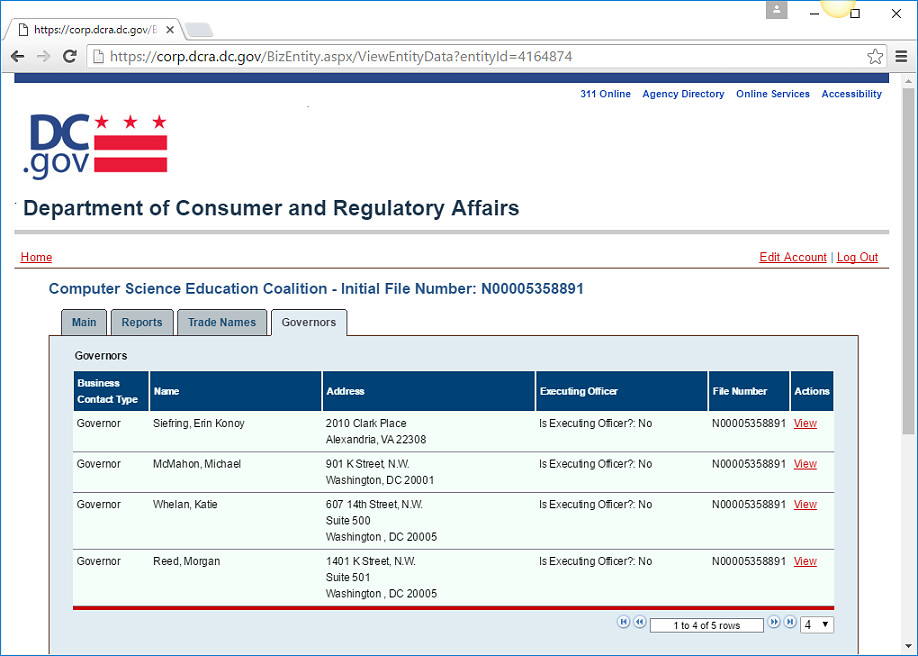
theodp writes: Last week, Microsoft and some of the biggest names in tech and corporate America threw their weight behind a Change.org petition that urged Congress to fund K-12 Computer Science education. The petition, started by the tech-backed CS Education Coalition (btw, 901 K Street NW is Microsoft's DC HQ) in partnership with tech-backed Code.org, now has 90,000+ supporters. But three years ago, Microsoft backed a very different Change.org petition that called for corporate America to foot the STEM education bill.
"While the need to expand high-skilled immigration is immediate," read the letter to Congress, "we also need to expand STEM opportunities in U.S. education. A positive proposal has emerged in Washington to create a national STEM education fund, paid for only by businesses using green cards and visas. This fund will help prepare Americans for 21st-century STEM jobs. The proposal is supported by a broad coalition [PDF] that includes Microsoft, GE, the National Council of La Raza, the National Association of Manufactures, and the National Science Teachers Association, to name a few."
The earlier petition, which wound up with 41,009 supporters, was started by Voices for Innovation, a self-described "Microsoft supported community" that says it's now "proud to support the Computer Science Education Coalition" as part of its efforts to "shape public policies for our 21st century digital economy and society." So, what changed? Well, Mother Jones did warn that what Microsoft promises and what it delivers for education isn't necessarily the same... -
Ask Slashdot: Should This Photographer Sue A Hotel For $2M? (google.com)
Unhappy Windows User writes: An Austrian photographer was contracted by the luxury [hotel] Sofitel in Vienna to photograph the bar with an amazing view over the skyline. He was paid for his time (4200 euros) and arranged a three-year internal usage contract for the photos. After the contract expired, he still found his photos being used -- on external sites too. He is now suing for 2 million euros, based on each individual usage.
My question is: Is this the real market value of his work...? It seems like the largest economic contribution to the work was from Sofitel, who allowed access to the property and closed it to customers. I don't have any issue in a photographer wanting to be paid fairly for his work, and asking for perhaps double or treble the original price for the breach of contract to match what an unlimited license would have cost. [But] with this money they could have employed a professional for a month and automatically obtained full rights to the work...it seems like this guy is trying to take advantage of an oversight by a large corporation, never to have to work again.
Here's the original article in German and an English translation, and it's one of those rare cases where the copyright belongs to an individual instead of a massive entertainment conglomeration. But do you think the photographer should be suing for 2 million euros over this copyright beach? -
Google's OnHub Is First WiFi Router To Support IFTTT (theverge.com)
An anonymous reader writes: The first router to feature IFTTT support is Google OnHub. IFTTT is an abbreviation of "If This Then That," a free web-based service that can allow users to create "recipes," which are triggered based on changes to other web services such as Gmail, Facebook, Instagram, etc. OnHub's smart features can now connect to the 300-plus programs and apps supported by IFTTT. Google provides some examples in its blog post. For example, you can automatically prioritize Wi-Fi to your Chromecast when it connects to your OnHub network after you plug it in to start binge watching your favorite TV show, or to your Nest Cam when it senses motion or sound after you've exhausted yourself from said binge watching and passed-out on your couch. There's a friendly little video Google put together to explain the feature in detail. -
Millions Of Waze Users Can Have Their Movements Tracked By Hackers (fusion.net)
An anonymous reader quotes a report from Fusion: Researchers at the University of California-Santa Barbara recently discovered a Waze vulnerability that allowed them to create thousands of "ghost drivers" that can monitor the drivers around them -- an exploit that could be used to track Waze users in real-time. Here's how the exploit works. Waze's servers communicate with phones using an SSL encrypted connection, a security precaution meant to ensure that Waze's computers are really talking to a Waze app on someone's smartphone. Zhao and his graduate students discovered they could intercept that communication by getting the phone to accept their own computer as a go-between in the connection. Once in between the phone and the Waze servers, they could reverse-engineer the Waze protocol, learning the language that the Waze app uses to talk to Waze's back-end app servers. With that knowledge in hand, the team was able to write a program that issued commands directly to Waze servers, allowing the researchers to populate the Waze system with thousands of "ghost cars" -- cars that could cause a fake traffic jam or, because Waze is a social app where drivers broadcast their locations, monitor all the drivers around them. You can read the full paper detailing the researchers' findings here. Is there a solution to not being tracked? Yes. If you're a Waze user, you can set the app to invisible mode. However, Waze turns off invisible mode every time you restart the app so beware. -
Gmail For Android Gets Microsoft Exchange Support
An anonymous reader writes: Google has updated Gmail for Android with a very notable feature: support for Microsoft Exchange. You can download the latest version of the app from Google Play (if you don't see it, don't worry: Google says the gradual rollout may take three or more days). The company had actually released this feature a few months ago, but at the time, it was only available for Nexus devices. With the new update, Google is making the feature available to a wider audience. "Exchange support was previously only available on our Nexus devices, but as of today, Exchange support covers mail, contacts, and calendar data in Android across all devices," a Google spokesperson told VentureBeat. -
Microsoft Translator App For Android Can Now Translate Text In a Photo
An anonymous reader writes: Microsoft has updated its Translator app for Android to add the ability to recognize the text inside a photo. The photo, Microsoft explains, can be something that you have clicked on your phone as well as an image stored on your phone or cloud. "With this new feature in the Translator app for Android, you can translate pictures instantly from your phone, with the translation appearing in an overlay above the existing text. If you see a sign, menu, flyers, etc. you can point your phone's camera at it, and you won't have any confusion about what you're looking at. You can also translate saved images such as pictures from emails, the Internet and social media," the company wrote in a blog post. The new feature supports simplified Chinese, traditional Chinese, Czech, Danish, Dutch, English, Finnish, French, German, Greek, Hungarian, Italian, Japanese, Korean, Norwegian, Polish, Portuguese, Russian, Spanish, Swedish, and Turkish. Additionally, the new update adds 34 languages to the list of available downloaded language packs for use when you're not connected to the Internet. -
Google Records Over 750,000 'Hijacking' Breaches In One Year (nbcnews.com)
An anonymous reader writes: A new study by Google and the University of California, Berkeley, claims over 700,000 websites were breached between June 2014 and June 2015. The research shows that "miscreants" had routinely hijacked thousands of vulnerable web servers for "cheap hosting and traffic acquisition." The exact number of recorded "hijacking incidents" within the period was 760,935 but google has been said they were able to curb the amount of breaches through direct communication with webmasters. Google's Safe Browsing Alerts sends notifications to network admins when potentially dangerous URLs are detected on their networks. These have reportedly increased the likelihood of a "cleanup" by more than 50 percent and reduced "infection lengths" by at least 62 percent. According to The Next Web, WordPress topped the chart of platforms that experienced the most breaches (almost half of all attacks). English websites experienced the most attacks, with Chinese, German, Japanese and Russian language websites following closely behind. -
Viber Update Brings End-To-End Encryption and Hidden Chats (gsmarena.com)
An anonymous reader writes: The new hip thing to do if you're a developer of a messaging app is to encrypt everyone's messages -- everyone's doing it! WhatsApp announced earlier this month all messages being sent through the service will now be end-to-end encrypted. Today, Viber has announcd it is doing something similar. All messages being sent through the latest version of the app will be end-to-end encrypted. To confirm messages are being encrypted, a padlock icon will appear in the chat UI. The latest version of the app is already available in the iOS App Store and Android Google Play Store. Viber is one of the largest messaging platforms with over 700 million users. Hidden chats can also be found in the new update. Users can hide select chats with people and access/display them with a PIN or Touch ID. -
Smart Mattress With Lover Detection System Will Track Your Partner's Infidelities (hothardware.com)
MojoKid quotes a report from HotHardware: Do you worry that your significant other is having mid-day romps in your bedroom while you're stuck at work banging out TPS reports? There's an app for that, and a smart mattress with built-in sensors to detect when between-the-sheet activities are taking place, with or without your participation. It's part of what a mattress company in Spain is calling its "lover detection system." You can't make this stuff up. Or maybe you can. You might seriously question whether or not the so-called Smarttress from Durmet is a real thing or an attempt at a viral marketing stunt. By all accounts, it certainly looks real. There are two dozen ultrasonic sensors embedded in the springs of the mattress. These tell-all sensors detect the speed and intensity of motion, how long the mattress has been active, and the history of encounters. That data is used to create a 3D map in real time, which you can view on your mobile device with an app for either iOS or Android devices. -
UK Hosting Provider 123-Reg Accidentally Deletes Customer Sites (theregister.co.uk)
Richard Chirgwin, writing for The Register: UK hosting and domains provider 123-Reg has been struck by a weekend issue that knocked an unspecified number of VPS customers offline. The company posted a status message saying that the unspecified issues arose on April 16. 123-reg customer, software company INNmaster, contacted The Register directing our attention to its post on the topic, claiming a rogue script had deleted customer sites (such as this one). Slashdot has independently received several tips for this incident. Here's a copy of the email that Richard Winslow, Director of 123-Reg sent to the affected customers. -
Google Launches Customizable 'Live Cases' For Nexus Devices (techcrunch.com)
An anonymous reader quotes a report from TechCrunch: Google is launching a new service today that allows you to create $35 custom cases for its Nexus 5X, 6 and 6P phones. There are two variations of the Live Cases: one that allows you to pick any photo and print it onto your case, and one that lets you design and print a stylized map with the help of Google Maps. Both variations allow you to select a couple of filters and other styling options to personalize your case even more. Google says there is a programmable shortcut button on the back of the case that will allow you to launch your favorite app with a single click using NFC. Once you've created and ordered your case, Google will also let you download a wallpaper with the same design. -
Google Launches Customizable 'Live Cases' For Nexus Devices (techcrunch.com)
An anonymous reader quotes a report from TechCrunch: Google is launching a new service today that allows you to create $35 custom cases for its Nexus 5X, 6 and 6P phones. There are two variations of the Live Cases: one that allows you to pick any photo and print it onto your case, and one that lets you design and print a stylized map with the help of Google Maps. Both variations allow you to select a couple of filters and other styling options to personalize your case even more. Google says there is a programmable shortcut button on the back of the case that will allow you to launch your favorite app with a single click using NFC. Once you've created and ordered your case, Google will also let you download a wallpaper with the same design. -
Google Launches Customizable 'Live Cases' For Nexus Devices (techcrunch.com)
An anonymous reader quotes a report from TechCrunch: Google is launching a new service today that allows you to create $35 custom cases for its Nexus 5X, 6 and 6P phones. There are two variations of the Live Cases: one that allows you to pick any photo and print it onto your case, and one that lets you design and print a stylized map with the help of Google Maps. Both variations allow you to select a couple of filters and other styling options to personalize your case even more. Google says there is a programmable shortcut button on the back of the case that will allow you to launch your favorite app with a single click using NFC. Once you've created and ordered your case, Google will also let you download a wallpaper with the same design. -
Chrome 50 Updates Push Notifications, Drops Support For Old Windows and OS X Versions (venturebeat.com)
An anonymous reader quotes a report from VentureBeat: Google today launched Chrome 50 for Windows, Mac, and Linux, adding the usual slew of developer features. You can update to the latest version now using the browser's built-in silent updater, or download it directly from google.com/chrome. As announced in November 2015, Chrome now no longer supports Windows XP, Windows Vista, OS X 10.6 Snow Leopard, OS X 10.7 Lion, nor OS X 10.8 Mountain Lion. Chrome 50 allows sites to include notification data payloads with their push messages. This eliminates the final server check -- the initial version relied on service workers to proactively fetch the information for a notification from the server, leading to problems when there were multiple messages in flight or when the device was on a poor network connection. Push notification payloads must be encrypted. Sites can now detect when a notification is closed by the user, resulting in better analytics and allowing for cross-device notification dismissal. The look of notifications can now be customized with timestamps and icons. Chrome 50 also brings support for declarative preload. -
Google Releases Android N Developer Preview 2
An anonymous reader writes: Google on Wednesday released the second developer preview of Android N. The update, which comes a month after the release of first Android N developer preview, brings with it a number of features and improvements. On a blog post, Google wrote that it is adding Vulkan, a low-overhead graphics API to the package. This would supposedly offload some CPU-bound processes to GPU. Also in the build are new "human-looking" emojis. Improvements can be found here. -
Google Introduces Voice Access To Make Android More Accommodating For People With Disabilities (zdnet.com)
An anonymous reader writes: Google has launched a new beta app called Voice Access, which lets people control their Android phone with voice commands. The company took the wraps off Voice Access as an accessibility tool to help people who have difficulties using the touch interface, such as those with tremors or paralysis. Once installed, items in Settings and apps on the Homepage are numbered. The user can tell the device, "Go Home", which is transcribed at the top of the page, and then say, "Open one", to launch the app numbered one. Twitter and Facebook also recently took some steps to make some of their services more accessible to people. -
Academics Claim Google Android 2FA Is Breakable (theregister.co.uk)
totalcaos writes: Attackers who control the [browser on the] PC of a user consuming Google services (Gmail, Google+ etc) can surreptitiously push and activate apps on the user's mobile device, bypassing SMS-based two-factor authentication (2FA) via the phone. How Anywhere Computing Just Killed Your Phone-Based Two-Factor Authentication is a paper that explains the wider issues of phone-based 2FA. Herbert Boss, professor of systems and security at Vrije Unversiteit Amsterdam, who co-authored the mobile security paper with the two PhD students, disclosed the vulnerability to Google but they "still [refuse] to fix it." -
Anywhere Computing Makes 2FA Insecure On iOS and Android (thestack.com)
An anonymous reader writes: Academics from the VU University Amsterdam have identified a new class of vulnerabilities to two-factor authentication, commonly used to protect transactions involving financial and private information. The vulnerability leaves users of both Android and Apple mobile devices open to the theft of personal information by hackers. The researchers note the text (PDF). While anywhere computing is generally considered to be a good thing, the research claims that integration across multiple platforms essentially removes the gap between those platforms, and it is that gap that is required to make two-factor authentication secure. Without a gap between devices, a common hack called the man-in-the-browser attack can be elevated to intercept the one-time password generated for two-factor authentication, thereby rendering two-factor authentication useless. -
Magic Kinder Android App Lets Strangers Send Images, Videos To Your Kids (softpedia.com)
An anonymous reader writes: The scenario which all parents hate seems to have materialized in the form of an Android app [called Magic Kinder] that lets strangers send texts, images, and videos to kids. All of this is facilitated by a simple app design and lack of encryption, which allows attackers to manipulate HTTP requests and send any content they like to any of the app's users. Currently, because the app developer did not respond, the issues are still present in the app. Fortunately, the app hasn't been installed on more than 11,000 devices. -
Ubuntu Budgie Could Be The New Flavor of Ubuntu Linux (softpedia.com)
prisoninmate writes: Budgie-Remix maintainer David Mohammed informs Softpedia about the progress made with the upcoming operating system, whose ultimate goal is to become an official Ubuntu Linux flavor, possibly under the name of Ubuntu Budgie. Even Canonical founder Mark Shuttleworth said in a Google+ comment last month that it will definitely support if there is a community around the packaging. Since their initial report, it looks like the developer managed to get in contact with the Ubuntu MATE project leader Martin Wimpress, who urged him to target Ubuntu 16.10 for an official status of his soon-to-be-named Ubuntu flavor built on top of the Budgie desktop environment created by the team of developers from Solus Project. -
Tech Firms Have An Obsession With 'Female' Digital Servants (zdnet.com)
An anonymous reader writes: Alexa, Tay, Siri, Cortana, Xiaoice, and Google Now. These technologies all have one thing in common -- they are digital servants aimed at a mass-market audience that feature a "female" voice or persona. And it's not just the voice or persona of the digital persona we interact with that is biased. The results of those interactions also demonstrate male favoritism. It took Apple more than four years to fix Siri's responses to questions about abortion services, and yet the company didn't seem to have any problem programming Siri to search for prostitutes and Viagra. Here's the gender breakdown for the tech workforce of each company:
Microsoft: 83.0% male, 16.9% female
Google: 82.0% male, 18.0% female
Apple: 79.0% male, 22.0% female
Amazon: 61.0% male, 39.0% female -
Microsoft Trials Outlook Premium For $4 Per Month, With No Ads and Custom Domains (pcworld.com)
An anonymous reader quotes a report from PCWorld: Microsoft is testing a premium version of Outlook.com that removes the ads and supports custom domains for email addresses. According to Brad Sams at Thurrott.com, Outlook Premium is free for one year and then costs $3.99 per month during the trial phase, though it's only available by invite for now. The service appears to combine two features that Microsoft offers or has offered in the past. The first is an ad-free version of Outlook, which is already available today as a $20 per year upgrade. The second is custom domains, which allow users to enjoy Outlook.com's features but with a personalized email address. Outlook Premium could also slightly undercut Google's Apps for Work plans, which support custom domains for $5 per user per month. It also offers a middle ground between ad-free Outlook and a full Office 365 subscription. While Outlook Premium may be tempting for a select few, general users may be hard-pressed to pay anything for Outlook, let alone $4 per month. -
Chrome Extension Caught Hijacking Users' Browsers (softpedia.com)
An anonymous reader writes: Google has intervened and banned the Better History Chrome extension from the Chrome Web Store after users reported that it started taking over their browsing experience and redirecting them to pages showing ads. As it turns out, the extension was sold off to an unnamed buyer who started adding malicious code that would redirect the user's traffic through a proxy, showing ads and collecting analytics on the user's traffic habits. This same malicious code has also been found in other Google Chrome extensions such as Chrome Currency Converter, Web Timer, User-Agent Switcher, Better History, 4chan Plus, and Hide My Adblocker. At the moment, only Better History and User-Agent Switcher have been removed from the Web Store. -
Chrome Extension Caught Hijacking Users' Browsers (softpedia.com)
An anonymous reader writes: Google has intervened and banned the Better History Chrome extension from the Chrome Web Store after users reported that it started taking over their browsing experience and redirecting them to pages showing ads. As it turns out, the extension was sold off to an unnamed buyer who started adding malicious code that would redirect the user's traffic through a proxy, showing ads and collecting analytics on the user's traffic habits. This same malicious code has also been found in other Google Chrome extensions such as Chrome Currency Converter, Web Timer, User-Agent Switcher, Better History, 4chan Plus, and Hide My Adblocker. At the moment, only Better History and User-Agent Switcher have been removed from the Web Store. -
Windows 10 Anniversary Update Will Bring Android Notifications To Your PC (winbeta.org)
An anonymous reader writes: In an Anniversary Update scheduled to launch this summer, Microsoft is bringing a new Action Center UI to Windows 10 PCs and Windows 10 Mobile. [According to WinBeta.org,] the new Action Center will sync up to to the cloud, allowing users to dismiss a notification on more than one device. For example, users will be able to dismiss a text message on their PC, and have that same notification be dismissed on their phone. Android users will be happy to know that this functionality is coming to Android via the Cortana app. Android users will be able to see and dismiss notifications that appear on their PC, and vice-versa. Developers will be able to create widgets and tiles for the new Action Center as well. -
Amazon.com Now Bans USB Type-C Cables That Aren't Up To Spec (google.com)
Google engineer, Benson Leung has been on a mission to get rid of USB Type-C cables that aren't compliant with Type-C 1.1 spec. He reminds us that these cables could potentially lead to damage. Over the past few months, he has reviewed over a dozen of USB Type-C cables on Amazon.com and concluded that the vast majority of them aren't compliant with the aforementioned standard. Now he reports: Amazon.com has just made a change to their "Prohibited listings" for Electronics. They've added the following line: Any USB-C (or USB Type-C) cable or adapter product that is not compliant with standard specifications issued by "USB Implementers Forum Inc." What does this mean? It means that cable manufacturers who sell poorly made or intentionally deceptive USB Type-C cables and adapters are banned from Amazon, officially. Really great news, but we all have to continue to be vigilant and call out any bad products we find on Amazon and other stores (both online and brick and mortar) as we find them. -
Amazon.com Now Bans USB Type-C Cables That Aren't Up To Spec (google.com)
Google engineer, Benson Leung has been on a mission to get rid of USB Type-C cables that aren't compliant with Type-C 1.1 spec. He reminds us that these cables could potentially lead to damage. Over the past few months, he has reviewed over a dozen of USB Type-C cables on Amazon.com and concluded that the vast majority of them aren't compliant with the aforementioned standard. Now he reports: Amazon.com has just made a change to their "Prohibited listings" for Electronics. They've added the following line: Any USB-C (or USB Type-C) cable or adapter product that is not compliant with standard specifications issued by "USB Implementers Forum Inc." What does this mean? It means that cable manufacturers who sell poorly made or intentionally deceptive USB Type-C cables and adapters are banned from Amazon, officially. Really great news, but we all have to continue to be vigilant and call out any bad products we find on Amazon and other stores (both online and brick and mortar) as we find them. -
Amazon.com Now Bans USB Type-C Cables That Aren't Up To Spec (google.com)
Google engineer, Benson Leung has been on a mission to get rid of USB Type-C cables that aren't compliant with Type-C 1.1 spec. He reminds us that these cables could potentially lead to damage. Over the past few months, he has reviewed over a dozen of USB Type-C cables on Amazon.com and concluded that the vast majority of them aren't compliant with the aforementioned standard. Now he reports: Amazon.com has just made a change to their "Prohibited listings" for Electronics. They've added the following line: Any USB-C (or USB Type-C) cable or adapter product that is not compliant with standard specifications issued by "USB Implementers Forum Inc." What does this mean? It means that cable manufacturers who sell poorly made or intentionally deceptive USB Type-C cables and adapters are banned from Amazon, officially. Really great news, but we all have to continue to be vigilant and call out any bad products we find on Amazon and other stores (both online and brick and mortar) as we find them. -
Google Announces Fiber Phone, a $10/Month Home Telephone Service
Google on Tuesday announced Fiber Phone, a home phone service for Fiber subscribers. For $10 a month, Fiber Phone offers unlimited local and nationwide calling, and "the same affordable rates as Google Voice for international calls." From company's blog post: You can keep your old phone number, or pick a new one. You can use call waiting, caller ID, and 911 services just as easily as you could before. Fiber Phone can also make it easier to access your voicemail -- the service will transcribe your voice messages for you and then send as a text or email. Writing for TechCrunch, Devin Coldewey explains why this matters: Fiber Phone features unlimited calls to the U.S., call filtering and blocking, voicemail transcription, and call forwarding to your mobile so you don't miss that telemarketer. It may seem an anachronism, but if Google aims to be the main or even sole conduit for communication in the areas it is expanding to, it does have to offer this. -
Researchers Prove Shakespeare's Skull Probably Isn't In His Grave (washingtonpost.com)
An anonymous reader writes: 400 years after Shakespeare's interment in Stratford-upon-Avon, archaeological researchers scanned his grave with a ground-penetrating radar to confirm a legend that his skull was stolen by grave robbers. Under cover of night, three men crept toward the Holy Trinity Church with dimmed lanterns and an assortment of tools, according to an "anonymous author, who heard it from a guy, who heard it from his uncle Frank, who claimed to be the grave robber himself." The Washington Post reports this story, published in 1879 but believed to have occurred in 1794, now draws more credibility from the radar scan. Ironically, the grave robbers was said to have been inspired by a British parliament member and phrenologist who'd promised 300 guineas for a chance to examine Shakespeare's skull, but who then reneged after learning it had been stolen from Shakespeare's grave. -
Gmail's Encryption Warning Spurs 25% Increase In Encrypted Inbound Emails (theverge.com)
An anonymous reader quotes a report from The Verge: Google's efforts to keep users safe might be forcing other email providers to make better security decisions. In February, the company started flagging unencrypted emails, allowing Gmail users to know whether they're sending emails to, or receiving emails from, providers that don't support TLS encryption. Since then, the amount of inbound mail sent over an encrypted connection to Gmail users has increased by 25 percent, Google explained in a blog post released today. The majority of the uptick likely comes from providers updating their clients so they can avoid getting flagged by Google, the company said in a comment to The Verge. Without in-transit encryption, which Google provides by default, emails could potentially be read by attackers because their body and data are sent in plain text. Google is also going to send Gmail users a full-page warning notice if they click on a potentially malicious link. In addition, they are going to increase warnings about state-sponsored attackers with a full-page alert about how to secure accounts through two-factor authentication and the use of a security key. -
Google's $149 Nik Photo Editing Suite Goes Free
Google has announced that it is making its $149 Nik Collection photo editing suite available for free of charge. The move, which should make plenty of amateur and professional photographers happy, comes roughly three and a half years after Google acquired Nik Software. The suite includes seven desktop plugins and allows you to add effects and apply filters to your photos. Those of you who had purchased Nik Software, the company assures that it will issue a full refund. In a blog post, the company writes: As we continue to focus our long-term investments in building incredible photo editing tools for mobile, including Google Photos and Snapseed, we've decided to make the Nik Collection desktop suite available for free, so that now anyone can use it. -
Google Opens Access To Its Speech Recognition API, Going Head To Head With Nuance (techcrunch.com)
An anonymous reader quotes a report from TechCrunch: Google is planning to compete with Nuance and other voice recognition companies head on by opening up its speech recognition API to third-party developers. To attract developers, the app will be free at launch with pricing to be introduced at a later date. The company formally announced the service today during its NEXT cloud user conference, where it also unveiled a raft of other machine learning developments and updates, most significantly a new machine learning platform. The Google Cloud Speech API, which will cover over 80 languages and will work with any application in real-time streaming or batch mode, will offer full set of APIs for applications to "see, hear and translate," Google says. It is based on the same neural network tech that powers Google's voice search in the Google app and voice typing in Google's Keyboard. Google's move will have a large impact on the industry as a whole -- and particularly on Nuance, the company long thought of as offering the best voice recognition capabilities in the business, and most certainly the biggest offering such services. -
Google Puts Boston Dynamics Up For Sale In Robotics Retreat (bloomberg.com)
An anonymous reader writes from an article on Bloomberg: Executives at Google parent Alphabet Inc., absorbed with making sure all the various companies under its corporate umbrella have plans to generate real revenue, concluded that Boston Dynamics isn't likely to produce a marketable product in the next few years and have put the unit up for sale, according to two people familiar with the company's plans. Possible acquirers include the Toyota Research Institute, a division of Toyota Motor Corp., and Amazon.com Inc., which makes robots for its fulfillment centers, according to one person. Google acquired Boston Dynamics in late 2013 as part of a spree of acquisitions in the field of robotics. Over the following year, the robot initiative, dubbed Replicant, was plagued by leadership changes, failures to collaborate between companies and an unsuccessful effort to recruit a new leader. Jonathan Rosenberg, an adviser to Alphabet Chief Executive Officer Larry Page and former Google senior vice president, said, "we as a startup of our size cannot spend 30-plus percent of our resources on things that take ten years," and that "there's some time frame that we need to be generating an amount of revenue that covers expenses and (that) needs to be a few years." In December, Google announced that Replicant had been folded into Google's advanced research group, Google X. In a private all-hands meeting around that time, Astro Teller, the head of Google X, told Replicant employees that if robotics aren't the practical solution to problems that Google was trying to solve, they would be reassigned to work on other things, according to a person who was at that meeting. Boston Dynamics, though, was never folded into Google X and was instead put up for sale. -
How Far Have We Come With HTTPS? Google Turns On the Spotlight (networkworld.com)
alphadogg writes from an article on NetworkWorld: HTTPS is widely considered one of the keys to a safer Internet, but only if it's broadly implemented. Aiming to shed some light on how much progress has been made so far, Google on Tuesday launched a new section of its transparency report dedicated to encryption. Included in the new section is data highlighting the progress of encryption efforts both at Google and on popular third-party sites. "Our aim with this project is to hold ourselves accountable and encourage others to encrypt so we can make the Web even safer for everyone," wrote HTTPS evangelists Rutledge Chin Feman and Tim Willis on the Google Security Blog. -
Google Chrome Extension Caught Stealing Bitcoin From Users (softpedia.com)
An anonymous reader writes: Bitcoin exchange portal Bitstamp is warning users of a Google Chrome extension that steals their Bitcoin when making a transfer. According to Bitstamp, this extension contains malicious code that is redirecting payments to its own Bitcoin address. Bitcoin web app developer Devon Weller confirmed Bitstamp's findings, saying that the extension was secretly replacing Bitcoin QR codes with its own. The extension's name is BitcoinWisdom Ads Remover and is still available on the Google Chrome Web Store. In July 2015, many users reported having similar issues with the same extension.