Slashdot Mirror
Domain: insideevs.com
Stories and comments across the archive that link to insideevs.com.
Comments · 156
-
Re:#factorygated
Now that they're out of Q2 he doesn't have to keep the production numbers down to retain the tax incentive anymore.
I believe you're referring to the 200K FIT credit expiration. That applies to total US deliveries per manufacturer and has nothing to do with production. On that topic, some predict it was already exceeded before Q3(though only Tesla knows for sure at this point) https://insideevs.com/why-we-b...
-
Re:BeauHD shading the truth again...
-
Re:BeauHD shading the truth again...
-
Re:BeauHD shading the truth again...
I do have to say that numbers are getting interesting.EC180 sales for the year is at 27279. OTOH, the Model 3 hit 18,305 at the end of may And that does not include the fact that Tesla is now building M3 each week, what BYD sells EACH MONTH. Yes, Tesla is now building 5000 M3 / week, with another 2000 MS/X. So, Tesla is building (i.e. selling) around 20,000 model 3 for a total of 28,000 EVs each month.
If this holds, then they will surpass all car makers later this year. -
Re:Management by conspiracy theory
Lets see. Global Leaf sales are headed right now for 100K/year
Though in April, global sales plummeted, while in may they came back a bit
OTOH, Model 3 is working towards 250K / year. And unlike the leaf, they have pre-sold enough that if they delivered -
Re:an anonymous reader
Nissan's Leaf is the 7th best selling EV in the US. You are entitled to your own opinions, but not your own facts.
You do know there's these things called 'other countries' yeah? A quick google tells me that there's over 300k Nissan Leafs and Tesla produced their 300k'th car this year. Based on this I wouldn't say Telsa is the biggest, although they probably will be very soon.
-
Re: By the numbers
Here is the information that you insist on keeping to yourself:
Electric Car Sales by Manufacturer for 2017
There are 6 manufacturers all with annual sales between 103,000 and 119,000.
While it is true that the top selling "manufacturer" is "Renault-Nissan-Mitsubishi Alliance", I don't agree that this means RNM are the top selling manufacturer. The Nissan Leaf isn't called the Renault-Nissan-Mitsubishi Leaf is it?
BYD, BAIC and Geely are all individual manufacturers, and all have larger sales than Renault, Nissan or Mitsubishi individually. As does Tesla.
In conclusion: Yes it is.
-
Re:Stock price assumes Tesla is ALREADY biggest co
No it isn't. Here are the best selling EVs on a carefully selected subset of the market to make Tesla look better than they really are.
Here is the list
- 1) Model 3
- 2) Prius Prime
- 3) Model S
- 4) Model X
- 5) Bolt
- 6) Volt
Fixed that for you.
-
Re:an anonymous reader
That is the amusing this: you are wrong and you don't even know it. Tesla is NOT the largest battery manufacturer for EVs (by far) and is not the largest EV manufacturer (Nissan is). You Musk fanboys are so delusional! You believe the marketing.
Nissan's Leaf is the 7th best selling EV in the US. You are entitled to your own opinions, but not your own facts. Also, Tesla has manufactured and deployed a Gwh of batteries from the gigafactory which is about half of the worlds deployed batteries (which includes categories of batteries that Tesla doesn't make). Enjoy your losses sucker.
-
Re:Stock price assumes Tesla is ALREADY biggest co
The Nissan Leaf is the best selling EV on the market today and starts at $29k and is actually available. THAT is a real EV for the masses. Tesla is just promising a $38k car while delivering cars for the 1%. The truth is exactly opposite of what you have said.
No it isn't. Here are the best selling EVs on the market today.
Here is the list
- 1) Model 3
- 2) Prius Prime
- 3) Model S
- 4) Model X
- 5) Bolt
- 6) Volt
-
Re:No they didn't Rei and Bruce
What is it with you fanbois always moving the goalposts? Original claim was there were a bunch of guaranteed sales therefore everything is rosey, citation proves that the premise isn't quite so true, and you come back with something completely unrelated to guaranteed sales.
Those people could also go buy a bolt or a redesigned leaf (which is also selling faster than factory capacity, but they are turning out way more of them than tesla is). 6-12 months down the road the competition landscape is going to be even worse for tesla and that backlog is still going to be in the hundreds of thousands.
Tesla themselves said they will exhaust the current model 3 backlog over the next 12 months. The real question is how quickly does that backlog fill back up afterwards. Also, Tesla sells 3 models of car with higher sales than the Bolt or Volt and that's before they increase their sales by a factor of 4 to consume the current backlog.
The real fantasy here is that GM could make 100,000 EVs in a year...that's the thing that's not possible right now. Where would they get that many batteries? None of the other auto makers has their own a large scale battery factory. Also, GM looses $9,000 on each Volt and Bolt they sell while Tesla can make better types of EVs for about $17,000 less per car (compared to GM).
-
Re: Time it just right
And what information do you have to back your assertion? According to the standard EV industry report Tesla models are 3 of the top 4 electric cars sold so far this year.
-
Re:One of these days
a vehicle that does nothing but depreciate the instant you drive it off the lot
As opposed to...? Hilariously, though...
-
Battery swaps
The problem is that the car is basically built around the battery.
I agree, we could even say, that you basically are buying a giant battery from Tesla, and for that price, they throw in a car bolted on it for cheap.
(Given the relative price).It's even more noticeable with manufacturer where the car and the battery can by sold separately (e.g.: Renault - the 45kWh battery costs around 10k EUR)
It is installed into the vehicle partially with adhesives,
Maybe in the latest models? (the platform used to build model 3 upon, maybe ? I haven't been following that in details)
But older platfroms where designed with battery swapping in mind, I've read. Supposedly, once the shield is disassembled, the battery module should be coming out relatively easily). I'll have to find back 3rd party sources.
Similarly a lot of other cars have also been planned with battery swapping. Most manufacturer though the idea seemed logical.
which is why Tesla probably never actually swapped a single customer battery.
I though it was the general lack of interest from the public which caused manufacturers of e-cars such as Telsa to drop the idea of battery swaps.
Already back the first Tesla, but nowadays nearly all electric vehicle (except for the cheapest alternative entry-level in the range) have batteries that enable the driver to driver for at least 2-3 hours in a row. By which time taking a break is *extremely strongly* recommended. (Or even mandatory for professional drivers in some European jurisdictions - such as FR and CH, at least). And thus leaving the car plugged-in for half an hour or an hour while taking a leak, having a coffee, eating something or even taking a power-nap is perfectly acceptable for most drivers of e-cars, thus the general lack of interested for swap by owners.
Only the marginal "drive 8 hours straight without a stop ! go pee in a plastic bottle !!!" insane crowd would be clamoring for fast swaps.
Here's Elon Musk wrap-up about the abandoned battery swap : they invited 100 clients to test the battery swaps, only 5 them did swap battery and each only swapped once, no-one trying again. (Okay, it's not a third party's analysis, it's Elon himself and he might be telling whatever is needed to make the investors happy and confident).
But, you can find similar analysis about consumer battery swap from every single other company which did consider the idea.
Renault-Nissan CEO similarly reporting they're dropping swaps, also due to lack of interest from the public.
General sum-up about the trend.Note that this is specific for consumer cars.
In some professional settings, battery swaps make actually entirely sense.
Buses and vans are such things : it makes more sense to swap the driver and the batteries while the remaining of the giant vehicle is used on the next shift (with a fresh rested new driver and a new fully charged battery pack).
Instead of having the drivers napping in a hammock and the giant fricking vehicle staying plugged into a charger.(They didn't actually swap the battery in their stage demonstration, either; Tesla has literally never shown a single battery swap.)
https://www.youtube.com/watch?...
- 1.16 : bolt un-screwer visible.
- 1.30 : lower shield + battery assembly being visibly lowered.
- 2.00 : lower shield + battery assembly being visibly raised.Did they do an actual full blown battery swap ? Probably not. (Elon doesn't even mention how the disconnect/reconnect the batteries from the liquid cooling loop. Redundant Zero-spill Quick-disconnect valves, perhaps ?)
But they proved that it's not impossib -
Re:Next - janitorial staffing updates
Why are you mixing together total sales with monthly sales? Here are monthly sales. 3820 Model 3s are estimated sold and delivered in the US in March, vs. 1774 Bolts.
And why are you comparing total production of the Bolt vs. the Model 3 to begin with?
The Bolt concept car was unveiled in January 2015; pre-production vehicles were seen in testing in mid-2015; the first production car shown at the end of 2015; the production line started making vehicles in fall of 2016; and sales were opened to the public in December 2016.
The Model 3 concept car was unveiled in March 2016; final design was completed in mid-2016 and parts ordered for 300 prototypes; the first 30 vehicles off the line were in July of 2017; and the Model 3 hit 345/wk in November 2017 (1060 in December).
You're comparing total numbers of a car that's literally been around for an entire extra year. Also note the above: even with Tesla's delays, they still made the Model 3 faster than GM made the Bolt. With a much more ambitious plant (aka, designed for scaling to far larger volumes, meaning more work to do before even the first vehicle rolls off the line).
-
Re:Next - janitorial staffing updates
Not my post, but:
"I know, right! The Model 3 is already the best selling (as in actual deliveries) EV." - Ref
Accura TLX: Pretty close. The TLX had a March sales jump, but with the new 3 production rate, there's no way it'll beat the 3 again.
Mercedes C/CLA: Model 3 sold over 50% more
Audi A4: Closer, but still a solid Model 3 win.
Lexus RC: Over an order of magnitude more Model 3 sales
BMW 2: 3 1/2 times more Model 3s.
BMW 3: Actually the 3-series edged out the Model 3... but it's unlikely to do so again.
BMW 4: Model 3 wins.Why the incredulity? You've been reading too much doom-and-gloom from the Tesla shorts. Model 3 production has rapidly accelerated.
(Note: the GP was clearly talking about the US, so I used US market figures)
-
Re:Next - janitorial staffing updates
Not my post, but:
"I know, right! The Model 3 is already the best selling (as in actual deliveries) EV." - Ref
Accura TLX: Pretty close. The TLX had a March sales jump, but with the new 3 production rate, there's no way it'll beat the 3 again.
Mercedes C/CLA: Model 3 sold over 50% more
Audi A4: Closer, but still a solid Model 3 win.
Lexus RC: Over an order of magnitude more Model 3 sales
BMW 2: 3 1/2 times more Model 3s.
BMW 3: Actually the 3-series edged out the Model 3... but it's unlikely to do so again.
BMW 4: Model 3 wins.Why the incredulity? You've been reading too much doom-and-gloom from the Tesla shorts. Model 3 production has rapidly accelerated.
(Note: the GP was clearly talking about the US, so I used US market figures)
-
Re:One of two in Sweden
Siemens have built a pilot of the overhead catenary in Carson, California. They're building another just south of Frankfurt in Germany.
From the picture it looks like the overhead version will only work with trucks, but the rails embedded in tarmac version will work most vehicles.
-
Re:Battery wear
https://www.teslarati.com/tesl...
https://insideevs.com/200000-m...
They don't use those 18650B cells, they use a different chemistry.
-
Battery production
Except for patents, is there any reason why GM etc. cannot quickly start battery production of their own?
In principle not that I'm aware of. It would probably make more sense for them to buy an already existing battery manufacturer at this point since they would be a bit behind the curve otherwise. Or they would need to establish a partnership on similar terms to the one Tesla has with Panasonic.
For double points, they hire ex-Tesla employees or conduct some good-natured spying / social engineering to learn from Tesla's manufacturing ?
Remember that Tesla is partnered with Panasonic for the gigafactory and Panasonic is the worlds biggest battery maker. So Tesla isn't really the company to worry about as far as GM is concerned. Most of the big battery manufacturers are Asian companies.
-
Re:Cutting corners
tesla owner nearly burned to death
Even back in 2014 when the tech wasn't as mature as it is today, rates of EV fires, including rates of Tesla fires, were much lower than they are for gasoline vehicles. Yes, it's possible to burn a battery pack, but you have to really mess it up to do so. As an example of how fire resistant they are, this Model S was entirely gutted in an unrelated fire, to the point of leaving a pool of molten alumium on the ground, and still didn't manage to burn the battery pack. Here's the results of what happens when you deliberately try to burn a Powerpack (same basic tech).
Gee, who'dathunkit that filling a pack with fire barriers and surrounding every cell with a non-flammable coolant might mean something?
tesla almost kills owner when it rams concrete barrier
OMG, a car got in a nonfatal accident at highway speeds and protects its occupant! Quick, ring the New York Times, have them dispatch an autogyro to the scene, post haste!
tesla almost kills driver and multiple fire fighters due to their shit system
OMG, another highway-speed crash with an astoundingly small amount of damage (" minor cuts and bruises from the accident but was otherwise unharmed"), caused due to a fire truck stopped on a highway causing traffic to have to swerve out of its way, causing minimal damage to the fire truck, with the Tesla driver openly stating that the accident was his fault? WORLD NEWS MEDIA, WHERE ARE YOU? This is the story of the century! Cars never crash, and yet... twice!
tesla delivers accident waiting to happen to owner due to shit quality control
Dear Lord, a vehicle with a manufacturing defect, from a company making a hundred thousand vehicles per year? I've never heard of such a thing! That's never happened before in history! What's next... two? Three even? Oh, precious God in heaven above! They've even fooled new owners picking up their vehicles on the Tesla forums into not finding defects on their cars. What sort of sorcery are they playing here? They even got Consumer Reports to rank Model S above average in reliability. Witchcraft!
tesla cuts corner by not having a proper gauges in front of driver. glued on iPad they use instead causes deadly shards of glass to be thrown at occupants.
Oh, precious Heaven above, a car gets in an accident because he wasn't paying attention and praises how well it protected him, writing "“Everyone from the paramedics to the tow truck driver said that people don’t usually walk away from this. Had this been a regular ICE vehicle, I would be dead or in a lot worse condition." WON'T SOMEONE PLEASE STOP TESLA BEFORE THEY KILL AGAIN????
Also: clearly, NOBODY has EVER before in the history of time made a car with a central speedometer. It's just never happened! Certainly not completely>/i> centred ones, let alone "right beside the wheel" like in Model 3. Nope, never happened! Because it's so much safer to have to look "down and then through an obstruction" to see your speed, vs. "down and slightly right with no obstructions". Obviously!
-
Re:Ford sells too many trucks
Like the ultra-lightweight, rounded trailer they used, for 100 miles at a shot. Yeah, totally worst case!
But I suggest you look at Bjorn's own data. It supports the exact same finding as Edmunds - about a 100 mile (160 km) range, at 55 MPH (Bjorn does 80 kph, about 50 MPH), for about the same size trailer (medium, 1100 pound trailer) gets about 600 Wh/mi. I think the issue isn't the data - it is consistent. The issue is that you don't like what is found by either Edmunds or Nyland, and thus have somehow romanticized it in your mind to something that simply is a fantasy.
Bottom line: Edmunds' data is 100% corroborated with Nyland's data, and if you're towing a smallish, lightweight, aerodynamic trailer at low freeway speeds, you're going to get about 100-130 miles between charges. Meaning you drive for 2 hours, then sit and charge for an hour.
-
Re:I believe the children are our future...
Just so you know - naturally everyone is using this as a chance to pile on Musk, but the Panasonic cells used in the Model S and X get their cobalt from the Philippines, and Tesla is setting up Gigafactory supply contracts with American and Canadian mines. Musk has a personal obsession with physically shortening supply chains.
-
Re:Oh Fuck off Bloomberg.com
Bolt has a lot of potential but GM seems to be content to only produce ~25,000 per year. Kinda looks like Musk was right, that they can't sell it for the price without CARB credits or they'd lose money. Over in Europe GM may have been losing as much as $12 000 per bolt. https://insideevs.com/gm-repor...
-
Re: Free, but not obligatory?
https://insideevs.com/tesla-re...
https://news.energysage.com/wh...
Dude, just because you work for Communist CHina does not mean that you have to be this stupid. Plenty of search engines to show you that you are wrong. -
Re:Nothing to do with renewables
The purpose of the batteries is to maintain grid stability. They can respond in milliseconds, where other technologies take seconds to fire up or produce more power, thus preventing a snow-ball effect. The ability is increasingly important with increased reliance on wind and solar, which exhibit more fluctuations over short time-frames.
-
Re: Where did you read that?
Nope. You are correct. https://insideevs.com/rush-shi... Toyota is switching big time over to EVs and will be trying to grab as much of Tesla's work as possible.
-
Hnt: YES
Are they expensive to install? YES THEY ARE.
That's also ignoring the cost of getting wiring TO each spot, and the huge additional burden of ongoing maintenance all of the wiring and chargers entail.
So what's the hold-up? I'd say it's the complete lack of demand.
There are already areas with high Tesla ownership running into issues. There's plenty of demand in places, but why would there be a rush to build out expensive support that no-one will be paying for?
Unlike your fantasies, I have resources to back up what I am saying, not to mention simple common sense for anyone that spends ten minutes on the thought experiment of what it means to wire every spot (or even just most spots) in a parking lot.
-
Hnt: YES
Are they expensive to install? YES THEY ARE.
That's also ignoring the cost of getting wiring TO each spot, and the huge additional burden of ongoing maintenance all of the wiring and chargers entail.
So what's the hold-up? I'd say it's the complete lack of demand.
There are already areas with high Tesla ownership running into issues. There's plenty of demand in places, but why would there be a rush to build out expensive support that no-one will be paying for?
Unlike your fantasies, I have resources to back up what I am saying, not to mention simple common sense for anyone that spends ten minutes on the thought experiment of what it means to wire every spot (or even just most spots) in a parking lot.
-
There's a reason for the model we have
For instance, what if all the other parking lots for restaurants, shopping centers, etc.
I'm sure that all these extremely thin margin businesses will be delighted to spend hundreds of billions of dollars to upgrade every low-tech parking sport to a high-tech charging spot that now requires wiring, vastly more electricity and an order of magnitude more expensive upkeep than paving. Oh, and they get to give away all that electricity for free to add to the fiscal overhead fun!
Sure it will take some time to build out,
Problem is not (just) time, but expense, recurring expenses, and demand on the grid. Even just adding a handful of spots is pretty expensive which is why malls today don't have many.
-
Re:Wait till you have to replace the battery
https://insideevs.com/tesla-le... - read this article for an update... in case you don't, a quote "it appears that most users are retaining over 90% of their vehicles’ original range, even after the odometer rolls well into the 6 digits."
-
Re:Battery replacement costs
this might help https://insideevs.com/tesla-le...
quote form the article "it appears that most users are retaining over 90% of their vehicles’ original range, even after the odometer rolls well into the 6 digits." -
Re:The Tesla Semi takes 7.2 megawatt hours per cha
https://insideevs.com/tesla-semi-truck-battery-is-how-big/
As the above demonstrates, the battery required would need to store approximately 1.2 megawatt hours
Your 7.2 megawatt hour figure is bullshit. You're lying. Where's the video?
-
Re:Toyota is...
Ahem.
I can only guess that those other 2% have never actually used the thing or known anyone who has.
-
Re: Its ok...
No, they turned out 2000+ cars in Oct.
They only turned out 145 Model 3 in oct, for a grand total of 367 total. -
Re:Great, now it'll ALL be made in CHINA!
lets see.
Tesla's CObalt is currently coming from Canada, with Idaho starting up as well
Lithium is coming from Northern Mexico, along with Nevada.
Nickel does come from Australia,Indonesia, and Japan, so, those will be imported.
Steel and Aluminum are from all over, including America.
However, these are the RAW materials. As it stands, IIRC, Model 3 is about 93% American made. Corvette, like its speed, does not touch it., -
Re:Guess they are not big into the whole news thin
Tesla promised to start deliveries by the end of 2017, and to move 500,000 units a year (including Model S and Model X sales) by 2020.
Musk, apparently feeling his company isn't under quite enough pressure, upped the ante during Wednesday's call, saying he'll deliver 100,000 cars by the end of 2017 and hit the half-million threshold in 2018.
I'll repeat: Tesla accelerated their own schedule. Their original schedule was "something, at some point, in 2017". They changed it to an extremely aggressive S curve starting in July. As for the latter part:
"I think it’s worth explaining sort of how manufacturing a complex object with several thousand unique components actually works. And what date’s relevant and – in order to achieve volume production of a new car with several thousand unique items, you actually have to set a target date internally and with suppliers that is quite aggressive.”
According to Musk, that target date in July 1 of 2017. That doesn’t mean that the Model 3 will enter production on July 1st, because as Musk explains:
“Now, will we actually be able to achieve volume production on July 1 next year? Of course, not. The reason is that even if 99% of the internally produced items and supplier items are available on July 1, we still cannot produce the car because you cannot produce a car that is missing 1% of its component.”
Musk says that actual production will be “some number of months later,” due to supply chain issues and internal production problems. This, according to Musk, is how the entire automotive industry works. In some ways then,start of production for the Model 3 is not entirely controlled by Tesla.
Musk concluded this part of the discussion with this statement:
“So in order for us to be confident of achieving volume production of Model 3 by late 2017, we actually have to set a date of mid-2017 and really hold people’s feet to the fire internally and externally to achieve an actual volume production date of late 2017.”
He then provided a production target, which is way beyond what we’d expected to hear:
“So as a rough guess, I would say we would aim to produce 100,000 to 200,000 Model 3s in the second half of next year. That’s my expectation right now.
-
Re: If they ban existing vehicles I will sue
Norway has the highest amount of electric vehicles on the planet per capita even though they're a major oil producer because they pay no taxes on EVs, meaning no VAT and no additional vehicle taxes that normal cars are subject to. Additionally, electric vehicles are not subject to road tolls. AT the same time, gas costs 2 dollars a litre, meaning 7,5 dollars a gallon, and that's cheap for Norway, the last time I was there it was higher.
So all we need to do is:
Slap huge vehicle taxes on non-electric cars, Impose a hefty VAT on non-electric vehicles, And tax gasoline until it is $7.50/gal?
THEN weâ(TM)ll start to see sales of electric vehicle increase? I canâ(TM)t imagine any unintended consequences from such market manipulations, can you?
It's already happening (unintended consequences). Now that most modern vehicles use much less gas than before, U.S. states are losing fuel tax revenue and are starting implement 'electric car fees' to make up the difference. Uncle Sam is gonna get their pound of flesh no matter how you try to avoid it. https://insideevs.com/u-s-stat...
-
Re:PC baloney
PC baloney
You keep using that word. I do not think it means what you think it means.
While electrons are easier to transport over distances, molecules are much easier to stockpile and transfer without loss.
Merely even refining transportation fuels is a much less efficient process than charging li-ions.
Carrying your own oxidizer with you is stupid when the air is 20% oxygen, not to mention that riding on a ton of fuel and oxidizer packed in close proximity is silly
Li-ions don't work by oxidation processes, they work by intercalation processes. On one side you have graphite and/or silicon, and on the other you have nickel/cobalt/aluminum oxides. One or both of them are infiltrated with lithium ions in the interstitial space; the charge state is defined by which side the lithium is on.
You seem to be under the mistaken concept that energy density corresponds to safety. Tell me, which is more of a hazard, 100kg of aluminum or 100kg of nitroglycerine? Now tell me, which is more energy dense?
Here's the reality of fire safety in Tesla battery packs. They're so non-flammable that you can generally burn the rest of the car to the ground without burning the pack. Try that with a gasoline car. Gasoline fires in cars are extremely common. 152k gasoline cars catch fire in the US alone every year. Tesla rates of fires are far less than those in gasoline cars.
What boggles the mind *to me* is that gasoline vehicles are allowed to store such huge quantities of a highly flammable fuel in just a big tank. No compartmentalization / isolation system, just pour it in, and there you go!
And lastly: IC engines have consumables yes, but they are field-serviceable and don't require complete remanufacturing to maintain their efficiency.
Simply not true. ICE efficiencies decline over time, and the level of cost required to keep them running at as-of-manufactured efficiency makes it impractical to do for most consumers. Older ICE vehicles are generally much less efficient than new ones. Which also, BTW, reduces range. Proper li-ion packs, like Tesla's, do lose range with time, but only slowly. Click on "charts". Typical degradation is about 4% in the first year, but much slower thereafter. A typical 5-year old car has only about 6-7% total degradation. It's hard to know at this point whether you can continue extrapolating such a slow decline slope over time, but it's at the very least extremely promising. Typical results from Tesla taxis with hundreds of thousands of miles on them are less than 10% degradation.
We're talking "Now, not in a hundred years."
BTW, it also sounds like you're under the impression that EVs remain unusually heavy. Check out the curb weights of the Model 3 variants. SR is 3549lbs (1609kg) and LR is 3814 lbs (1730kg). Its ICE class competitors (BMW 3-series, Audi A4, Mercedes C300, etc) come in a wide variety of configurations:
BMW 3-Series: 1475-1770kg
Audi A4: 1410-1695kg
Mercedes C300: 1630-1715+kgThere's nothing unusual about the Model 3's weight versus its ICE competitors. The LR is a bit on the heavy side, but the SR slots right in the middle.
-
Re:it's just another prototype.
Wow, there are Teslas doing taxi duty in harsh climates?
Can I request a Tesla for my next Uber ride?
I don't think so; but you might get lucky via UberX?
-
Re:it's just another prototype.
What we haven't seen to date, though, is a company other than Tesla who can actually deliver a production electric vehicle that people really want to drive.
You're wrong. Chevy Volt selling as much as Tesla S. Toyota Prius and Chevy Bolt EV each selling as much as Tesla X. Nissan Leaf a couple thousand behind. See here: http://insideevs.com/monthly-p...
-
Re:Too little, too late
It's funny when you get a response that's like the person didn't even read your post or just skimmed over it.
While there is some lithium produced from hard rock mining, as I distinctly pointed out to you, most lithium is produced from salars, which is probably the most environmentally-nondestructive means of "mining" imaginable. I showed you pictures, but it appears you never clicked the link. By contrast, while you write that you "can" dig pits for steel, that's not accurate - you must dig pits to get at iron ore. They look like this. Perhaps worse is the effect of smelting.
Recycling batteries is not a "joke" - I literally just gave you research showing that in mass production, precisely the opposite is true. Asserting that it's wrong doesn't make it so. In mass production, battery prices are limited by raw materials costs; producers are raw materials constrained. Recycling becomes an important part of the supply chain. And in case you're curious how recycling works: batteries are crushed in controlled conditions. The electrolyte is extracted with supercritical CO2 and distilled. The crushed batteries are ground, then gravimetrically separated. The recovered material can then be recycled directly, or more commonly, sent off for re-smelting (the cathodes are quite similar to natural nickel-cobalt ores). The quantity to be smelted is vastly less than the quantity of steel smelted for a car.
While we are on the subject of end of life of batteries lets consider the environmental effects of disposing carbon fiber.
I'm not sure why we should because not many EVs use carbon fiber - but if you want to. Carbon fibre is disposed of like plastic - either landfills or incineration. All cars make extensive use of plastic parts, so this shouldn't be particularly shocking. Additionally, CF is sometimes ground up and used as fill in new plastics - it only slightly increases their mechanical properties, but some manufacturers like using it because it increases their sales value to say that they have carbon fibre in their part (for example, laptops with "carbon fibre" moulding).
Concerning fire, you don't need to resort to hyperbole - here's what happens if you try to burn one of Tesla's battery packs (that's a powerwall, but it's the same basic technology). They're quite resistant to fire - certainly much more than gasoline. There have only been two Tesla battery packs to catch fire by "puncture", and it wasn't so much "puncture" as being deeply gashed down their length by metal road debris. Since Tesla responded by installing a debris shield, there have been no more such incidents.
Far more of the (few) fires that have occured in Teslas have been from other areas of the vehicle, not the battery pack. And they often don't even manage to burn the battery pack - even if the rest of the vehicle is gutted. As of 2014, there had been well over a billion electric miles driven. For gasoline cars, there is an average of 90 fires per billion miles driven. For the EVs, passing their first billion? Six fires. Zero deaths. Zero injuries.
-
Re:Yawn.Cumulative number of Tesla S sold = 150,000
Cumulative number of Chevy Bolts sold = 8,000
Cumulative number of Chevy Volts sold = 124,000
Cumulative number of Toyota Prius sold = 4 million
Cumulative number of Toyota hybrids sold = 9 million
In terms of number of battery units produced, Tesla and GM are roundoff error compared to Toyota.Tesla sells actual electric cars that people get in a waiting list years in advance to buy.
That tells you that there's something seriously wrong with the scalability of their production. (If you want to know what the problem is, Tesla relies on selling ZEV credits to other automakers to keep from going bankrupt. But other automakers only need a certain number of ZEV credits each year to comply with CARB regulations. So Tesla has to be careful not to produce too many ZEVs lest they cause the price of ZEV credits to plummet due to oversupply.)
-
Re: This sounds like nothing
Total 2016 vehicle sales in U.S.17.55 million. Tesla sales in U.S. 45,000 units. What, exactly, is a "small niche" to you?
Sources: http://www.latimes.com/busines... and http://insideevs.com/tesla-mot... -
Re:great
It's probably pretty good with the right tires. The weight is all down low and it has a massive amount of low-end torque, not to mention very good traction control. It also has a very stiff body. While it may not have as high of clearance as some other cars (though with active suspension it can raise itself), other than that it should do quite well. http://insideevs.com/tesla-mod...
-
Re:Did someone do the math on this first?
Real-world charging efficiency is about 80% [tesla.com], so 53.125 kWh is needed to put 42.5 kWh into the car's battery.
Lol, no. Those are wildly varying self-reported numbers for home charging users with tons of other potential confounding factors. Tesla claims their supercharging efficiency is 92%, so in the absence of better relevant data that's the number to use. That makes your initial figure ~46.196 kWh.
Assume 160 W/m^2 commercial panels.
Again, no. Let's use some actual solar cells that Tesla are making, which are 320 W/m^2. Since we're not dealing with utility-scale solar, let's keep your 0.185 capacity factor. That makes it 59.2W avg over 24h or 1.4208 kWh / m^2.
46.196 kWh / 1.4208 kWh/m^2 ~= 32.51 m^2 of solar panels
The Tesla Powerwall round-trip efficiency is 92.5% when brand new, so for battery-backed solar that becomes 32.51 / 0.925 ~= 35.15 m^2 of panels per car per day.
Keeping your 156 vehicle/day rate, that comes to 156 vehicles * 35.15 m^2/vehicle ~= 5,483 m^2 of solar panels per Supercharger station, or approximately 74m x 74m of solar panels. More aptly, since the average size of a parking space is also 30 m^2 that's about 183 parking spaces covered in solar cells. For another comparison, that's also roughly 1/3rd the size of a Walmart Supercenter.
-
Re:Okay, but...
Tesla is up to 150kW in Europe (120kW in the US). Hyundai Ioniq supports 70kW according to this site: http://insideevs.com/hyundai-i... . So nope, still no other car with similar capabilities. I don't doubt that this will change in future, but for now only Teslas can really the full supercharger capabilities.
-
Re:Tesla will flourish if complexity is reduced...
Never mind passenger cars that can out-race a Porsche.
-
Re:Hey GM, how about that EV1?
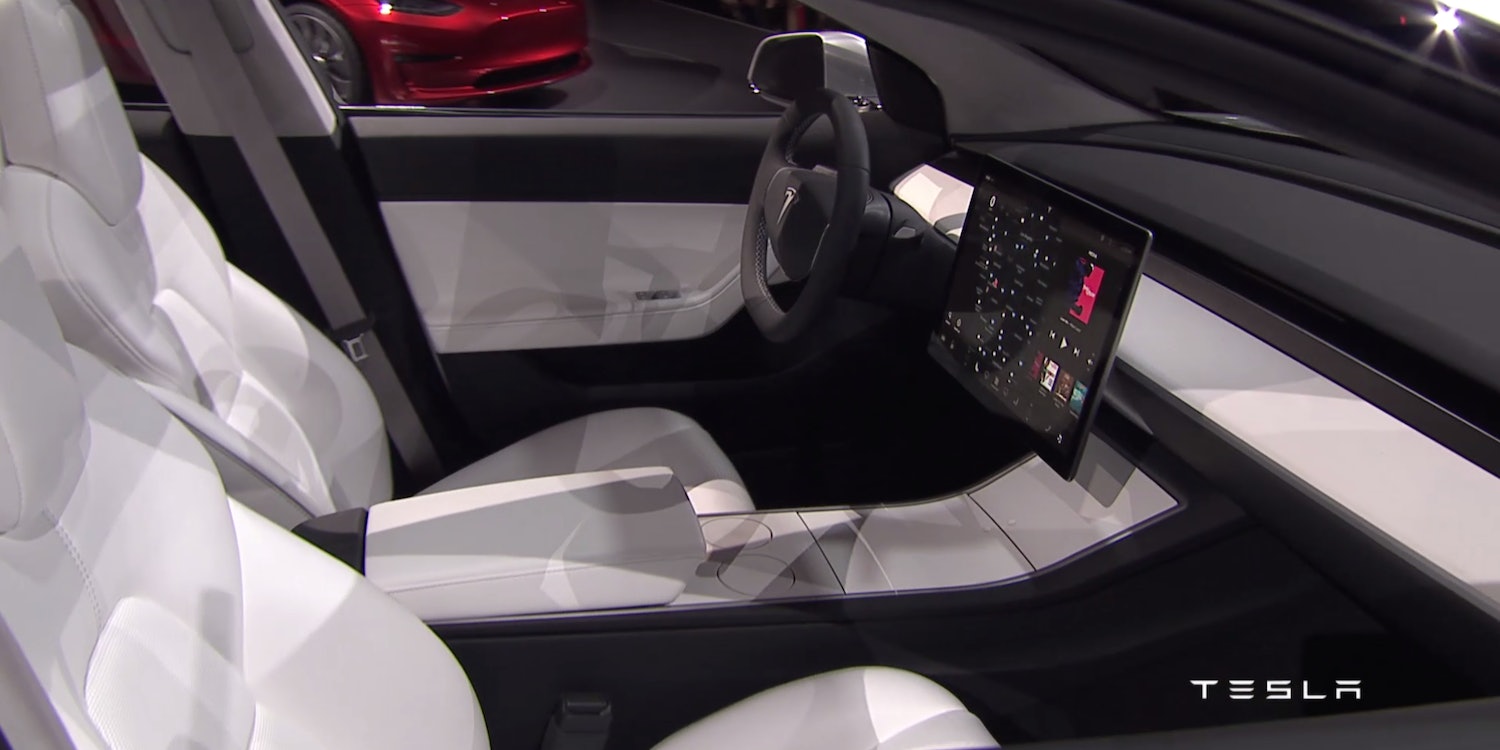
Nissan are in danger of missing the boat too. The Leaf is a great car and they have done a lot to get people driving EVs, especially in Europe. The problem is that circumstances have kind of screwed them - Tesla's Model 3 is looking unbeatable right now, so far ahead of anything anyone else can offer it's stunning. That big screen, full self driving if not from day one fairly early in its life, and best of all software updates in an age when most manufacturers can't keep the sat nav up to date.
I honestly disagree and here's the main reason why :
https://fsmedia.imgix.net/49/6...
Elon Musk stated that it was temporary, but for now this is what the design look like. I personally hate that "stripped down" inside, there's literally nothing except that "computer screen"
On the other end, ever heard of the Chevrolet Bolt? (Not the Volt)
It's specs and price are similar to the Tesla Model 3. And here's what the inside of the Bolt look like :
http://insideevs.com/wp-conten...
So yeah, I disagree about the Tesla Model 3 being "unbeatable".
-
Re:Hey GM, how about that EV1?
No, they do not.
Tesla has outsold leaf for some time.
In terms of total sales, they are currently running neck and neck, but that is because Nissan sells the entire world, while Tesla is still pretty confined to America and Europe.