Slashdot Mirror
Domain: inverse.com
Stories and comments across the archive that link to inverse.com.
Stories · 25
-
Portland City Council May Ask FCC To Investigate Health Risks of 5G Networks (inverse.com)
An anonymous reader quotes a report from Inverse: Fearing unknown health risks, members of the City Council in Portland, Oregon, will vote Wednesday to oppose the rollout of 5G wireless networks. In a proposed resolution, Mayor Ted Wheeler, along with Commissioners Chloe Eudaly and Amanda Fritz, write that there's evidence suggesting wireless networks can cause health problems -- including cancer. They express concern that the Federal Communications Commission has not conducted enough research to demonstrate that 5G networks are safe, while at the same time prohibiting state and local governments from passing their own regulations on telecommunications technology. And while Wheeler, Eudaly, and Fritz are correct about the FCC's power to dictate how state and local governments manage wireless networks, the connection between 5G networks and cancer is a lot more complicated than they say it is.
"There is evidence to suggest that exposure to radio frequency emissions generated by wireless technologies could contribute to adverse health conditions such as cancer," reads the proposed resolution. This evidence comes from a large-scale study conducted by the National Toxicology Program (NTP), a division of the US Department of Health and Human Services. The final results of this study, published in November 2018, showed a strong association between the type of radiation used for mobile phone signals and certain types of cancerous tumors in lab rats. But that's where the situation gets tough. The NTP study, which took place over 10 years and involved exposing more than 7,000 rats and mice to radio-frequency radiation, focused on signals used by wireless technology under the 2G and 3G standards. It's nearly impossible to say whether these results will apply to 5G hardware.
"Since the available research doesn't address 5G, the Portland City Council's resolution demands that the FCC embark on another such research project to assess the health effects of 5G," reports Inverse. "Presumably, it would take just as long to conduct another study on the hypothesized connection between 5G and cancer, but by that time, the industry will almost certainly have moved on to 6G -- or 7G." -
'This Person Does Not Exist' Website Uses AI To Create Realistic Yet Horrifying Faces (inverse.com)
A website that uses AI -- Generative Adversarial Networks (GANs) -- to generate photos of people who do not exist is circulating on social media and forums this week. A news writeup adds: Every time the site is refreshed, a shockingly realistic -- but totally fake --picture of a person's face appears. Uber software engineer Phillip Wang created the page to demonstrate what GANs are capable of, and then posted it to the public Facebook group "Artificial Intelligence & Deep Learning" on Tuesday. The underlying code that made this possible, titled StyleGAN, was written by Nvidia and featured in a paper that has yet to be peer-reviewed. This exact type of neural network has the potential to revolutionize video game and 3D-modeling technology, but, as with almost any kind of technology, it could also be used for more sinister purposes. -
Elon Musk Says Autopilot Will Soon Recognize Emergency Response Vehicles (inverse.com)
Over the weekend, Elon Musk alluded to impending software updates that would make Teslas even safer than they already are. In response to a story about a DUI where a Tesla autopilot may have been involved, Musk said Autopilot may soon be able to recognize emergency response vehicles and react accordingly. Inverse reports: "Default Autopilot behavior, if there's no driver input, is to slow gradually to a stop & turn on hazard lights," Musk explained in the replies. "Tesla service then contacts the owner." That naturally got people wondering whether or not Tesla's autopilot was capable of differentiating between emergency response vehicles and everyone else. Presumably, someday soon autonomous vehicles are going to be able to recognize sirens (or their futuristic software equivalent.) If an ambulance pulls up behind an autonomous car on a single-lane road, it will need some mechanism to know it's supposed to get out of the way. In the meanwhile, Musk said that Tesla is already working on the first half of that problem, by teaching neural net to be able to recognize police cars, ambulances, and fire trucks. On Twitter, he said that this capability would be added to the neural net "in the coming months." -
ADHD Drugs Aren't Doing What You Think, Scientists Warn (inverse.com)
An anonymous reader quotes a report from Inverse: The study authors Lisa Weyandt, Ph.D., a professor of psychology at the University of Rhode Island, and Tara White, Ph.D., an assistant professor of Behavioral and Social Sciences at Brown University, started out investigating the effects of ADHD medications in students that actually have a diagnosable attention deficit disorder. They showed that in these students, there is decreased activity in the areas of the brain controlling "executive functions," which can make it hard for them to stay organized or focused. But because both authors work with college students, they soon became more interested in the misuse of Adderall. In students whose brains aren't affected by ADHD, does Adderall act as a supercharger? Does it make those areas fly into overdrive and unlock otherwise untapped intellectual ability, as all pill-popping students hope?
Weyant and White's double-blind, placebo-controlled study on 13 college students was a small sample, they admit, but their experiment had a rigorous study design. Neither the students nor the researchers knew who was getting Adderall and who was getting placebo sugar pill. The six tests evaluated different aspects of cognition, like working memory, reading ability and reaction time. While students on Adderall did make fewer errors on a reaction time test, it actually worsened working memory, as shown by a decline in performance on a task where they had to repeat sequences of numbers. In short, Adderall improved focus and attention -- but it didn't actually make anyone smarter. The research has been published in the journal Pharmacy. -
MIT's AI Uses Radio Signals To See People Through Walls (inverse.com)
Researchers at the Massachusetts Institute of Technology have developed a new piece of software that uses wifi signals to monitor the movements, breathing, and heartbeats of humans on the other side of walls. While the researchers say this new tech could be used in areas like remote healthcare, it could in theory be used in more dystopian applications. Inverse reports: "We actually are tracking 14 different joints on the body [...] the head, the neck, the shoulders, the elbows, the wrists, the hips, the knees, and the feet," Dina Katabi, an electrical engineering and computer science teacher at MIT, said. "So you can get the full stick-figure that is dynamically moving with the individuals that are obstructed from you -- and that's something new that was not possible before." The technology works a little bit like radar, but to teach their neural network how to interpret these granular bits of human activity, the team at MIT's Computer Science and Artificial Intelligence Laboratory (CSAIL) had to create two separate A.I.s: a student and a teacher.
[T]he team developed one A.I. program that monitored human movements with a camera, on one side of a wall, and fed that information to their wifi X-ray A.I., called RF-Pose, as it struggled to make sense of the radio waves passing through that wall on the other side. The research builds off of a longstanding project at CSAIL lead by Katabi, which hopes to use this wifi tracking to help passively monitor the elderly and automate any emergency alerts to EMTs and medical professionals if they were to fall or suffer some other injury. For more information, a press release and video about the software are available. -
Is Cockroach Milk the Ultimate Superfood? (globalnews.ca)
An anonymous reader quotes a report from Global News: It may not be everyone's cup of milk, but for years now, some researchers believe insect milk, like cockroach milk, could be the next big dairy alternative. A report in 2016 found Pacific Beetle cockroaches specifically created nutrient-filled milk crystals that could also benefit humans, the Hindustan Times reports. Others report producing cockroach milk isn't easy, either -- it takes 1,000 cockroaches to make 100 grams of milk, Inverse reports, and other options could include a cockroach milk pill. And although it has been two years since the study, some people are still hopeful. Insect milk, or entomilk, is already being used and consumed by Cape Town-based company Gourmet Grubb, IOL reports.
Jarrod Goldin, [president of Entomo Farms which launched in 2014], got interested in the insect market after the Food and Agriculture Organization of the United Nation in 2013 announced people around the world were consuming more than 1,900 insects. As his brothers were already farming insects for fishing and reptile use, Goldin thought it would be a smart business opportunity to focus on food. Goldin adds studies have shown cricket powder can be a high source of protein and B12. The PC version his company produces has 13 grams of protein per every 2 1/2 tbsps. Toronto-based registered dietitian Andy De Santis says for protein alternatives, insects are definitely in the playing field. According to ScienceAlert, Diploptera punctate is the only known cockroach to give birth to live young and has been shown to pump out a type of "milk" containing protein crystals to feed its babies. "The fact that an insect produces milk is pretty fascinating -- but what fascinated researchers is the fact that a single one of these protein crystals contains more than three times the amount of energy found in an equivalent amount of buffalo milk (which is also higher in calories than regular cow's milk)."
Researchers are now working to replicate the crystals in the lab. They are working with yeast to produce the crystal in much larger quantities -- "making it slightly more efficient than extracting crystals from cockroach's guts," reports ScienceAlert. -
Tesla Model X Breaks Electric Towing Record By Pulling Boeing 787 (inverse.com)
A Tesla Model X has set the world record for heaviest tow by electric production passenger vehicle when it pulled a Boeing 787-9 Dreamliner at the Melbourne Airport in Australia. The video can be viewed on YouTube. Inverse reports: As probably expected, the plane far exceeds the Model X's recommended tow limit of around 5,000 pounds. In fact, the weight of the unloaded 787 with a minimal amount of fuel came closer to around 300,000 pounds. The airline pulled the Dreamliner around 1,000 feet down the tarmac. The stunt was part of a wider campaign around Qantas' new work with Tesla, which involves offering high-powered chargers at its Sydney, Melbourne, Brisbane and Adelaide facilities as well as offsetting miles for Tesla drivers that are also frequent flyer members. -
Net Neutrality Is Over Monday, But Experts Say ISPs Will Wait To Screw Us (inverse.com)
An anonymous reader quotes a report from Inverse: Parts of the Federal Communication Commission's repeal of net neutrality is slated to take effect on April 23, causing worry among internet users who fear the worst from their internet service providers. However, many experts believe there won't be immediate changes come Monday, but that ISPs will wait until users aren't paying attention to make their move. "Don't expect any changes right out of the gate," Dary Merckens, CTO of Gunner Technology, tells Inverse. Merckens specializes in JavaScript development for government and business, and sees why ISPs would want to lay low for a while before enacting real changes. "It would be a PR nightmare for ISPs if they introduced sweeping changes immediately after the repeal of net neutrality," he says.
While parts of the FCC's new plan will go into effect on Monday, the majority of the order still doesn't have a date for when it will be official. Specific rules that modify data collection requirements still have to be approved by the Office of Management and Budget, and the earliest that can happen is on April 27. Tech experts and consumer policy advocates don't expect changes to happen right away, as ISPs will likely avoid any large-scale changes in order to convince policymakers that the net neutrality repeal was no big deal after all. -
Zuckerberg Testimony: Facebook AI Will Curb Hate Speech In 5 To 10 Years (inverse.com)
An anonymous reader quotes a report from Inverse: After a question from Senator John Thune (R-SD) about why the public should believe that Facebook was earnestly working towards improving privacy, Zuckerberg essentially responded by saying that things are different now. Zuckerberg said that the platform is going through a "broad philosophical shift in how we approach our responsibility as a company." "We need to now take a more proactive view at policing the ecosystem," he said. In part, Zuckerberg was talking about hate speech and the various ways his platform has been used to seed misinformation. This prompted Thune to ask what steps Facebook was taking to improve its ability to define what is and what is not hate speech.
"Hate speech is one of the hardest," Zuckerberg said. "Determining if something is hate speech is very linguistically nuanced. You need to understand what is a slur and whether something is hateful, and not just in English..." Zuckerberg said that the company is increasingly developing AI tools to flag hate speech proactively, rather than relying on reactions from users and employees to flag offensive content. But according to the CEO, because flagging hate speech is so complex, he estimates it could take five to 10 years to create adequate A.I. "Today we're just not there on that," he said. For now, Zuckerberg said, it's still on users to flag offensive content. "We have people look at it, we have policies to try and make it as not subjective as possible, but until we get it more automated there is a higher error rate than I'm happy with," he said. -
Controversial Study Claims 'Smartphone Addiction' Alters the Brain (inverse.com)
An anonymous reader quotes a report from Inverse: In the new paper, presented Thursday at the annual meeting of the Radiological Society of North America, a team of radiologists at Korea University report that smartphone addiction changes teenagers' brains. Using brain imaging, they argue that smartphone- and internet-addicted teenagers have imbalanced brain chemistry when compared to their peers who aren't addicted to smartphones or the internet. But scientists not involved with the study have some serious issues with their research. Perhaps the most important of these issues is the fact that "smartphone addiction" is not a scientifically established thing -- at least not yet.
In the study, the team led by Dr. Hyung Suk Seo used "standardized internet and smartphone addiction tests to measure the severity of internet addiction" in nine boys and 10 girls, according to a statement. Then, they used MRS, a brain imaging technique that can identify particular brain chemicals, to examine the participants' brains before and after taking nine weeks of cognitive behavioral therapy to help their "addiction." Compared to a control group, the "smartphone addicts" had skewed levels of neurotransmitters in their brains. In particular, they had a higher ratio of GABA to Glx (glutamateglutamine), which are respectively responsible for slowing down brain signals and exciting neurons. An elevated ratio of GABA to Glx, the researchers concluded, can be associated with the self-reported symptoms of the "smartphone addict" teens, including depression, anxiety, insomnia severity and impulsivity. After 12 of the teens participated in cognitive behavior therapy, the scientists report, their chemical imbalances appeared to even out to look more like the control group's. -
Human Mini-Brains Growing Inside Rat Bodies Are Starting To Integrate (inverse.com)
At the annual meeting of the Society for Neuroscience starting November 11 in Washington D.C., two teams of scientists plan to present previously unpublished research on the unexpected interaction between human mini-brains and their rat and mouse hosts. "In the new papers, according to STAT, scientists will report that the organoids survived for extended periods of time -- two months in one case -- and even connected to lab animals' circulatory and nervous systems, transferring blood and nerve signals between the host animal and the implanted human cells," reports Inverse. "This is an unprecedented advancement for mini-brain research." From the report: That mini-brains can even be grown in the lab is a huge advancement in the first place, as they have many of the same characteristics as living human brains that are in the early stages of development. Though they're not "alive" in the same sense that you and I are, they grow and are organized into different layers like our brains are. They even react in similar ways to stimuli like psychedelic drugs. Organoids are poised to revolutionize research on the human brain since scientists can perform tests on them that would be unethical to attempt on living humans. STAT also reports that a third lab, in addition to the two presenting at the Society for Neuroscience meeting, has successfully connected human brain organoids to blood vessels. This attempt veered into such challenging ethical territory, though, that the lab reportedly paused its efforts. -
Google Will Hit 100 Percent Renewable Energy This Year (inverse.com)
An anonymous reader quotes a report from Inverse: Google has announced that after 10 years a carbon-neutral company, it will be able to brag running on entirely renewable energy at the end of 2017. That means that all of the electricity the company consumes in both its data centers and offices are provided by wind and solar energy. Announced in Google's 2017 environmental report, Google says it has created "new energy purchasing models that others can follow" and that "we've helped drive wide-scale global adoption of clean energy." In addition to being an obvious PR boon, the company says its mission of full sustainability fits in with its larger mission. (It also makes the fact that as recently as 2015 Google alone reportedly consumed as much energy as the entire city of San Francisco in a year way more palatable.)
One step the company has recently taken in marrying its ethos of sustainability with its products is a new initiative to equip Google Street View vehicles with air quality sensors. In addition to its goal of being run by renewable energy, Google is also working on achieving zero waste to landfill. Nearly half of the company's 14 data centers have already reached this goal, according to Google executive Urs Holzle's 2017 Google Environmental report released on Tuesday. -
Here's Elon Musk's Plan To Power the US on Solar Energy (inverse.com)
An anonymous reader shares an excerpt from Musk's keynote speech: Tesla CEO Elon Musk -- whose company makes electric cars and has a new solar roof panel division -- reminded more than 30 state governors at the National Governors Association meeting this weekend exactly how much real-estate is needed to make sure America can run totally on solar energy. "If you wanted to power the entire United States with solar panels, it would take a fairly small corner of Nevada or Texas or Utah; you only need about 100 miles by 100 miles of solar panels to power the entire United States," Musk said during his keynote conversation on Saturday at the event in Rhode Island. "The batteries you need to store the energy, so you have 24/7 power, is 1 mile by 1 mile. One square-mile." It's "a little square on the U.S. map, and then there's a little pixel inside there, and that's the size of the battery park that you need to support that. Real tiny." -
Researchers Found Perfect Contraceptives In Traditional Chinese Medicine (inverse.com)
hackingbear writes: Researchers at U.C. Berkeley found a birth control that was hormone-free, 100 percent natural, resulted in no side effects, didn't harm either eggs nor sperm, could be used in the long-term or short-term, and -- perhaps the best part of all -- could be used either before or after conception, from ancient Chinese folk medicine... "Because these two plant compounds block fertilization at very, very low concentrations -- about 10 times lower than levels of levonorgestrel in Plan B -- they could be a new generation of emergency contraceptive we nicknamed 'molecular condoms,'" team leader Polina Lishko. -
North Korea Parades Hybrid 'Frankenmissile', Then Fails Yet Another Missile Launch Test (cnn.com)
First, an anonymous reader quotes Inverse: On Saturday, the North Korean military paraded an unprecedented array of weapons through Kim Il-sung Square in the center of Pyongyang... "We're totally floored right now," Dave Schmerler of the Middlebury Institute of International Studies in Monterey, California, tells the Wall Street Journal. "I was not expecting to see this many new missile designs." Schmerler tells The Journal that the large missiles -- the "frankenmissiles," as he calls them -- in the parade appear to be hybrids of the North Korean KN-08 and KN-14 missiles, both of which are ICBMs.
But at least one arms control expert noted that while the parade included ICBM-sized canisters, "what's inside is anyone's guess" -- and there's still mixed results for the country's missile program. "An attempted missile launch by North Korea on Sunday failed, US and South Korean defense officials told CNN... At this point, US military officials don't believe the missile had intercontinental capabilities, a US defense official told CNN." The official said there was limited data -- because the missile blew up so quickly -- prompting CNN.com to run the story under the headline "Show of Strength a Flop."
Update: Slashdot reader Dan Drollette is a science writer/editor and foreign correspondent for Bulletin of the Atomic Scientists, and contacted us earlier today to share his recently-published analysis "to delve into what has been happening lately...and to discredit some common tropes in the media, such as the idea that 'North Korea is about to collapse,' 'China has a lot of influence over North Korea,' 'North Korea can credibly threaten the United States right now,' 'North Korea has no reason to feel threatened,' or 'The North can be completely denuclearized.'" -
Uber Launches 'Uber Freight' Website To Prepare the World For Autonomous Delivery Trucks (inverse.com)
Uber has launched a website for a service called Uber Freight. While there are little details about the company's expansion from ride-hailing, Uber Freight is meant to prepare the world for autonomous delivery trucks, according to Inverse. From the report: Uber acquired a startup called Otto, which planned to bring the first self-driving trucks to market, in August. Since then the company has used its trucks to deliver 50,000 cans of beer and hundreds of Christmas trees in San Francisco. This new service won't use those trucks, at least not at the beginning. Instead it will function much like Uber's existing platform: Some people will sign up to drive items across the country, and others will join so they can send packages without having to sign a contract with established shipping companies. The service will likely bring "surge pricing" to trucking, too. Uber Freight could also help Otto's trucks by using data gathered from drivers on the platform. This would allow the self-driving vehicles to learn from experienced people while regulators figure out how to govern autonomous trucks and the technology catches up to all of the promises made by its creators. Uber Freight's launch coincides with growing interest in trucking from many tech companies. Nikola Motor Company wants to use tech to make trucking more environmentally friendly and appealing to millennials; Tesla's working on self-driving trucks; the list could go on. Uber told Inverse it's going to wait until the new year to elaborate on how the system works. "We don't have any new information to share at the moment," a spokesperson said, "but hope to in the new year so please do stay in touch." It looks like the future of trucking -- or at least one potential future -- is going to take a little while longer to make its debut. -
Uber Launches 'Uber Freight' Website To Prepare the World For Autonomous Delivery Trucks (inverse.com)
Uber has launched a website for a service called Uber Freight. While there are little details about the company's expansion from ride-hailing, Uber Freight is meant to prepare the world for autonomous delivery trucks, according to Inverse. From the report: Uber acquired a startup called Otto, which planned to bring the first self-driving trucks to market, in August. Since then the company has used its trucks to deliver 50,000 cans of beer and hundreds of Christmas trees in San Francisco. This new service won't use those trucks, at least not at the beginning. Instead it will function much like Uber's existing platform: Some people will sign up to drive items across the country, and others will join so they can send packages without having to sign a contract with established shipping companies. The service will likely bring "surge pricing" to trucking, too. Uber Freight could also help Otto's trucks by using data gathered from drivers on the platform. This would allow the self-driving vehicles to learn from experienced people while regulators figure out how to govern autonomous trucks and the technology catches up to all of the promises made by its creators. Uber Freight's launch coincides with growing interest in trucking from many tech companies. Nikola Motor Company wants to use tech to make trucking more environmentally friendly and appealing to millennials; Tesla's working on self-driving trucks; the list could go on. Uber told Inverse it's going to wait until the new year to elaborate on how the system works. "We don't have any new information to share at the moment," a spokesperson said, "but hope to in the new year so please do stay in touch." It looks like the future of trucking -- or at least one potential future -- is going to take a little while longer to make its debut. -
When Mercedes-Benz Starts Selling Self-Driving Cars, It Will Prioritize Driver's Safety Over Pedestrian's (inverse.com)
From a report on Inverse: When Mercedes-Benz starts selling self-driving cars, it will choose to prioritize driver safety over pedestrians', a company manager has confirmed. The ethical conundrum of how A.I.-powered machines should act in life-or-death situations has received more scrutiny as driverless cars become a reality, but the car manufacturer believes that it's safer to save the life you have greater control over. "You could sacrifice the car. You could, but then the people you've saved initially, you don't know what happens to them after that in situations that are often very complex, so you save the ones you know you can save," said Christoph von Hugo, Mercedes' manager of driver assistance systems. "If you know you can save at least one person, at least save that one. Save the one in the car. This moral question of whom to save: 99 percent of our engineering work is to prevent these situations from happening at all. We are working so our cars don't drive into situations where that could happen and [will] drive away from potential situations where those decisions have to be made."As long as they are better at driving and safety than humans, it is a progress, in my opinion. -
Juno Probe To Get First Up-Close Look At Jupiter On Saturday (space.com)
NASA's Juno spacecraft will get its first up-close view at Jupiter this Saturday. Space.com reports: "At 8:51 a.m. EDT (1251 GMT) on Saturday (Aug. 27), Juno will zoom within 2,600 miles (4,000 kilometers) of Jupiter's cloud tops -- closer than the probe is scheduled to come during its entire mission, NASA officials said. And Juno will have all of its science instruments during Saturday's flyby. This was not the case during the spacecraft's only previous close approach to Jupiter, which occurred July 4 when Juno arrived in orbit around the giant planet. During Saturday's close pass, all eight of Juno's science instruments will be collecting data, and the probe's visible-light imager, known as JunoCam, will take close-up photos." You can also look forward to Venus-Jupiter Conjunction 2016, an event happening on August 27 where Venus and Jupiter's respective orbits will bring the two planets the closest that they'll be to each other until 2065. The two planets will be positioned roughly five degrees above the Western horizon on August 27. -
Researchers Create Algorithm That Diagnoses Depression From Your Instagram Feed (inverse.com)
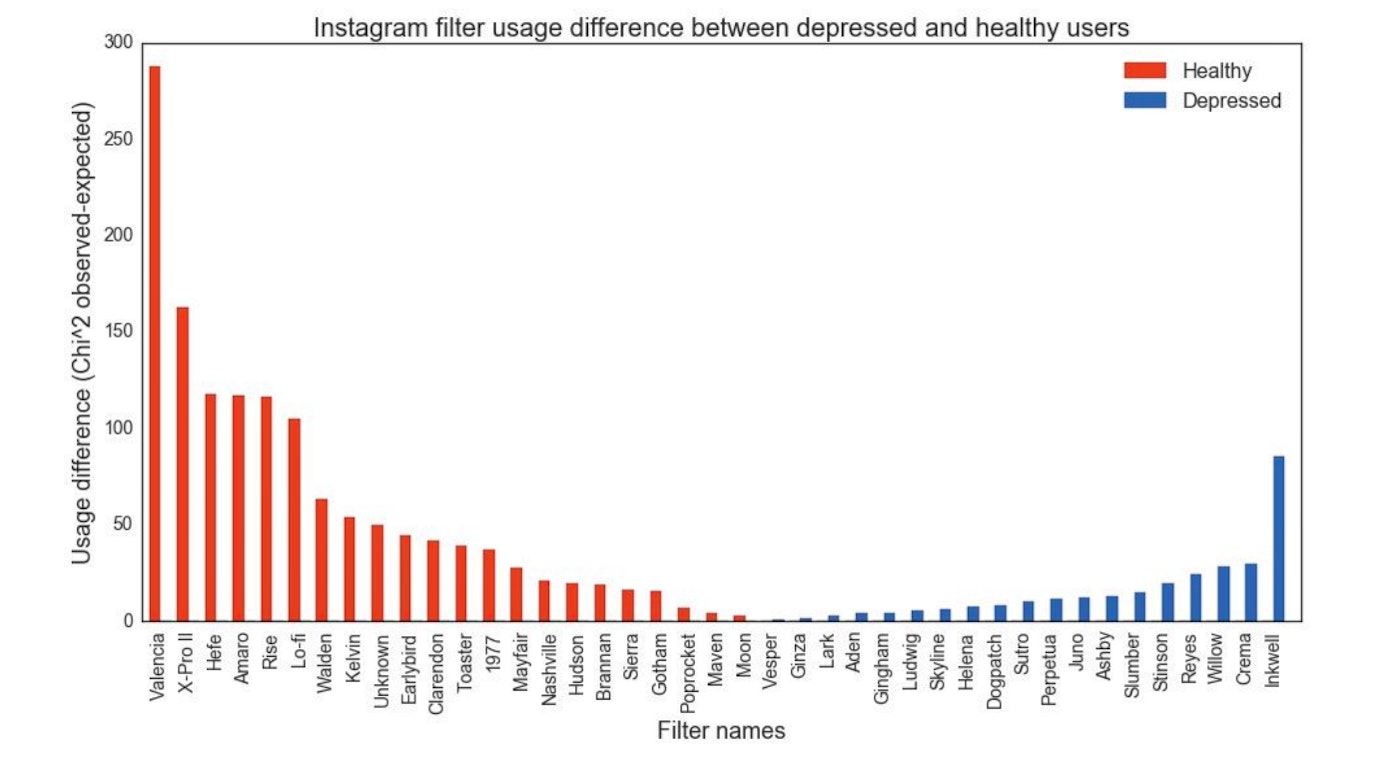
An anonymous reader quotes a report from Inverse: Harvard University's Andrew Reece and the University of Vermont's Chris Danforth crafted an algorithm that can correctly diagnose depression, with up to 70 percent accuracy, based on a patient's Instagram feed alone. After a careful screening process, the team analyzed almost 50,000 photos from 166 participants, all of whom were Instagram users and 71 of whom had already been diagnosed with clinical depression. Their results confirmed their two hypotheses: first, that "markers of depression are observable in Instagram user behavior," and second, that "these depressive signals are detectable in posts made even before the date of first diagnosis." The duo had good rationale for both hypotheses. Photos shared on Instagram, despite their innocent appearance, are data-laden: Photos are either taken during the day or at night, in- or outdoors. They may include or exclude people. The user may or may not have used a filter. You can imagine an algorithm drooling at these binary inputs, all of which reflect a person's preferences, and, in turn, their well-being. Metadata is likewise full of analyzable information: How many people liked the photo? How many commented on it? How often does the user post, and how often do they browse? Many studies have shown that depressed people both perceive less color in the world and prefer dark, anemic scenes and images. The majority of healthy people, on the other hand, prefer colorful things. [Reece and Danforth] collected each photo's hue, saturation, and value averages. Depressed people, they found, tended to post photos that were more bluish, unsaturated, and dark. "Increased hue, along with decreased brightness and saturation, predicted depression," they write. The researchers found that happy people post less than depressed people, happy people post photos with more people in them than their depressed counterparts. and that depressed participants were less likely to use filters. The majority of "healthy" participants chose the Valencia filter, while the majority of "depressed" participants chose the Inkwell filter. Inverse has a neat little chart embedded in their report that shows the usage of Instagram filters between depressed and healthy users. -
Future Phones May Use Vacuum Tube Chips As Silicon Hits Moore's Law Extremes (inverse.com)
An anonymous reader writes: A team of researchers want to replace transistors with vacuum tubes. Vacuum tubes are nothing new, however the ones in development at Caltech's Nanofabrication Group are a million times smaller than the ones in use 100 years ago. "Computer technologies seem to work in cycles," Alan Huang, a former electrical engineer for Bell Laboratories, told the New York Times. "Some of the same algorithms that were developed for the last generation can sometimes be used for the next generation." Dr. Axel Scherer, head of the Nanofabrication Group, said to the New York Times on Sunday, "Ten years ago, silicon transistors could meet all our demands. In the next decade, that will no longer be true." He argues silicon transistors can only take us so far. Vacuum tubes, for comparison, use tiny metal tubes that can control the flow of electricity. They're especially intriguing to researchers as they can provide a better solution to silicon transistors as they can consume less power and take-up a much smaller footprint. The report mentions they have the potential to bring an end to Moore's Law, even if silicon transistors show no signs of disappearing. For example, Lockheed Martin published new cooling methods in March that could help cool chips with tiny drops of water. With that said, Boeing has invested in researching vacuum tube chips. They may appear in the aviation industry before 2020, but it's unlikely we'll see Caltech's research appear in smartphones anytime soon. -
How 'The Jungle Book' Made Its Animals Look So Real With Groundbreaking VFX (inverse.com)
An anonymous reader shares an article on Inverse that looks into how The Jungle Book movie was made. Following are some of the interesting tidbits from the story: Directed by Jon Favreau, this version of The Jungle Book, which borrows from both Disney's 1967 cartoon and the original Rudyard Kipling novel, sets a new standard for life-like CGI animals. Shot entirely on a soundstage in downtown Los Angeles, it is sort of a hybrid of Avatar and Who Framed Roger Rabbit, with one human performer surrounded by animated creatures -- the difference being that every effort was made to trick the audience into believing the animals were real. [...] For the most complicated scenes, the computational power required was astounding. "It would take 30-40 hours per frame, and since it's stereo [or 3D], it requires two frames to produce one frame of the movie -- at 2K, not even 4K," Oscar-winning visual effects director Rob Legato said. "So you can tell how much the computer has to figure out, exactly what it's doing, how it's bouncing, how much of the light is absorbed, because when it hits an object, some gets absorbed and some gets reflected." The math there is mind-boggling; it takes a full 24 frames to make up a single second of the movie, and most shots are between five and ten seconds. That required "literally thousands of computers," Legato said, and eventually, some creative solutions. "I think they started using the Google cloud, which has tens of thousands of computers, and sometimes it would take two or three days to render a shot, he said, exasperated at the mere thought of the process. As powerful as the computers were, they ultimately were just taking cues from the human innovators who spent years on the film. "In all this," Legato said, "there's no real computer that replaces the skill of the operator, of the person who is pushing the buttons." -
Anonymous's War on Trump Described as Successful and Disastrous (techinsider.io)
CitizensForTrump.com and the Trump Hotel Collection site reportedly went offline Friday, seeming to confirm threats made by the hacktivist collective Anonymous. But TechInsider is reporting that "The 'total war' that Anonymous declared earlier this month against Donald Trump has devolved into a war among hackers fighting within the group and pro-Trump supporters who are trolling them within their chat rooms." They describe two warring factions within the group's anti-Trump movement, also quoting CloudFlare's CEO as saying denial of service attacks "are sort of the functional equivalent of a caveman with a club." But while Trump has warned that law enforcement officials are pursuing the attackers, one Anonymous member unequivocally announced that still more attacks were planned. "This is NOT the last time you hear of this operation. We will be watching, and will act when the time is right." -
Hyperloop to Feature 'Augmented' and 'Interactive' Windows (inverse.com)
An anonymous reader writes about the much-anticipated Hyperloop transportation system: Dirk Ahlborn, CEO of Hyperloop Transportation Technologies, took to the stage at SXSW to announce that the Hyperloop will have "interactive panels" as windows. Through these "augmented windows," users will be able to "look out" at "motion capture technology." He added, "Based on your position, we're actually manipulating the image. [...] It's psychologically really important and great to have the possibility to look out the window." -
VC Firm Y Combinator Launches an Experiment In Universal Basic Income (fastcoexist.com)
New submitter Gordon_Shure writes: Silicon Valley startup financer Y Combinator, remembered for successes like Airbnb and Dropbox, is launching an experiment to give people a Universal Basic Income. At present, the plan is for hundreds of participants to get repeated cash payments unconditionally. Then, assessors will record life consequences like changes in work patterns, self-employment, artistic endeavors, or idleness.
Recent focus on UBI in Finland, Switzerland and other countries see proponents claim a basic income will — in a world facing structural unemployment due to jobs taken by automated AI, robotics and machines — combat poverty and work insecurity. Others remain unconvinced. What do you think about the significance of what this kind of small-population study would show?