Slashdot Mirror
Domain: jaxa.jp
Stories and comments across the archive that link to jaxa.jp.
Comments · 127
-
Re:Worst headline ever
Here is a link with a picture of the explosive unit used for this experiment (don't know what happened with the first link paste-in). And an even cooler video of the test impact.
-
Re:Nice, but...
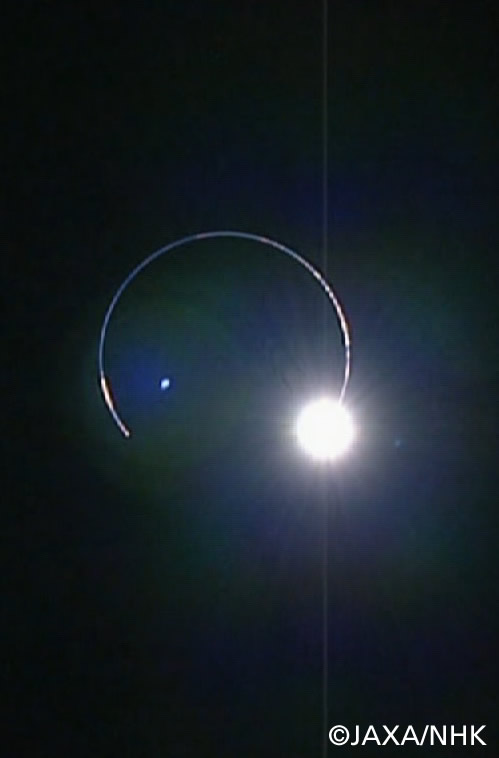
Hehe, good point. Although what would then be a solar eclipse from the moon is still not as spectacular as a solar eclipse from earth where the similar angular size of the moon and sun enable us to see the sun's magnificent corona. You would get to see though, the atmosphere of the earth light up like a thin ring, which while less spectacular than the corona (at least for repeated viewings) would certainly give you more food for thought.
To get back to the original topic, a lunar eclipse can be beautiful in itself, especially if the atmospheric conditions give you that nice deep red color. For example here is a timelapse video and photos I took from the 9/2015 lunar eclipse with an 80mm apochromatic telescope. Quite nice if I may say so. -
Re:What we need right now...
-
Re:Collector, or simple de-orbit tool?
There is some more info here: http://www.ard.jaxa.jp/eng/res...
From the statement on that site they say they want to de-orbit larger debris before it can disintegrate into smaller particles.
I think the net idea is because of confusion about the company that made the tether, Nitto Seimo, whose main business is fishing nets. It's an impressive company, developing high tech nets and going since 1910. Still relatively small with about 250 people, and a high tech manufacturing powerhouse that manages to compete well with cheaper low tech copies.
-
Re:US Bill is only 4 Trillion?
I think the study's methodology is highly suspect. What of all those people in India and China (and other parts of the world) who burn organics like wood or straw or animal dung for heat, cooking, etc? That puts out far more pollution than a gas or even coal-fired power plant per capita. The paper is currently paywalled, but I think the study and its methodology deserve some close scrutiny before people start jumping on this bandwagon. [Jane Q. Public, 2015-09-09]
As others have explained, burning wood can be carbon neutral. And as I just told Jane, the only real caveat here is significant land use change, like deforestation. I've also told Jane that in the 1990s, the upper bound on CO2 emissions due to land-use changes was less than half of the lower bound on those due to fossil fuel emissions.
This can be confirmed using simple accounting or by using 14C isotope ratios. Burning wood releases unstable 14C carbon because it hasn't had time to decay, but there is no 14C in coal. So we actually have several independent ways to see that Jane Q. Public and John O'Sullivan are wrong when they keep blaming developing countries for supposedly emitting "far more" CO2 than developed nations:
... THE ACTUAL DATA from the IBUKI CO2-mapping satellite show that developed "Western" nations are net CO2 absorbers, not emitters. Far more CO2 is generated (and less absorbed in proportion), in the tropics and third-world countries.
I've already told Jane this is nonsense, but he refused to retract this Sky Dragon Slayer claim and keeps blaming developing countries for supposedly emitting "far more" CO2 than developed nations. Once again, John O'Sullivan showed the part of Figure 3 with the net fluxes in July 2009 but "forgot" to show the fluxes for the rest of the year. Since July is summer in the northern hemisphere, those trees grow leaves which temporarily removes CO2 from the atmosphere. But this reverses during winter, which might be why John O'Sullivan "forgot" to show those fluxes. "Principia Scientific International" and several others repeated O'Sullivan's misinformation.
Ironically, when one isn't talking to Sky Dragon Slayers like John O'Sullivan, it isn't controversial to note that developed countries are responsible for most of the CO2 rise. Here's an interactive tool to explore historical CO2 emissions
-
Re:No they don't
It's still a current project:
http://www.ard.jaxa.jp/researc...
http://www8.cao.go.jp/space/pl...They are exhibited it recently: http://global.jaxa.jp/area/ssp...
They took a major step forwards with the technology only weeks ago: http://phys.org/news/2015-03-j...
-
Re:No they don't
It's still a current project:
http://www.ard.jaxa.jp/researc...
http://www8.cao.go.jp/space/pl...They are exhibited it recently: http://global.jaxa.jp/area/ssp...
They took a major step forwards with the technology only weeks ago: http://phys.org/news/2015-03-j...
-
Re:Uh, simple
-
Re:The joys (and problems) of romaji
It's Kibou, with the long o (and there's more than one way to romanize Japanese; the one I usually use doesn't rely on extended ascii and things like the macron).
The Japanese site for the module makes that explicit if you can read hiragana:
http://iss.jaxa.jp/kibo/Using hiragana means they don't narrow the meaning down, but yeah, "hope" is what it's supposed to mean if you go through the full text ( http://kibo.jaxa.jp/en/about/ ):
"The Japanese Experiment Module (JEM), known as "Kibo" (pronounced key-bow) which means hope in Japanese, is Japan's first human-rated space facility and the Japan Aerospace Exploration Agency's (JAXA's) first contribution to the International Space Station (ISS) program." -
Re:The joys (and problems) of romaji
It's Kibou, with the long o (and there's more than one way to romanize Japanese; the one I usually use doesn't rely on extended ascii and things like the macron).
The Japanese site for the module makes that explicit if you can read hiragana:
http://iss.jaxa.jp/kibo/Using hiragana means they don't narrow the meaning down, but yeah, "hope" is what it's supposed to mean if you go through the full text ( http://kibo.jaxa.jp/en/about/ ):
"The Japanese Experiment Module (JEM), known as "Kibo" (pronounced key-bow) which means hope in Japanese, is Japan's first human-rated space facility and the Japan Aerospace Exploration Agency's (JAXA's) first contribution to the International Space Station (ISS) program." -
Jane is Lonny Eachus
Do you still repeat O'Sullivan's "PSI" misinformation about CO2 emissions now that you know he "forgot" to show the winter fluxes? Will you retract your comment, or do you still think it was honest, true and correct?
You have mentioned this to me. I don't "know" it because I haven't seen any evidence. But it could be true. I'd have to see the evidence before I made up my mind.
I already did: "John O’Sullivan showed the part of Figure 3 with the net fluxes in July 2009 but “forgot” to show the fluxes for the rest of the year."
Click on "Figure 3" then scroll down to Figure 3 to verify, but this shouldn't be necessary because a comment by truegoogle on your original "PSI" link already made that point.
You can call it "pedantry" if you want, but I call it "taking your words at face value, and refusing to assume you meant something else when you wrote them". That is a pretty obvious difference between you and me. [Jane Q. Public, 2014-07-09]
Can we agree that our carbon emissions are ~200% as large as the rise in atmospheric CO2?
-
Propellent Questions
They use springs. The J-SSOD click through in the article has a lot more information on the inner workings of the contraption. Its more like a nerf gun than a cannon. http://iss.jaxa.jp/en/kiboexp/jssod/
-
Re:Weeds first, THEN interesting plants
If you can grow crabgrass, dandelions, and kudzu, then you could grow basil and turnips instead with no substantial difference in difficulty. What's the real difference? Astronauts would rather eat basil-turnips stew than kudzu crabgrass salad. The experiment is actually somewhat needed since it'll give us better estimates on the amount of area food production will take (it depends on the growth rate of the foods).
If we're talking terraforming and not just growing goodies to eat in a mostly closed cycle (poo is fertilizer, albeit rather 'hot' with bacteria), then we'll want some kind of genetically engineered microbes and lichen, etc which can survive on water mixed with regolith + heat and break down the rocks into more useful soil. You'd be wanting that under a dome of sorts, maybe in a crater or two on the south pole, so any gases produced wouldn't be blown away by solar winds.
We're a long way off from lunar dome construction and genetically engineered lunar microbes. However, we have all the technology required to put a habitat on the moon -- Just not funding to do so. You want funding you need to aim for getting people off the planet. Joe sixpack is inspired by people, not probes or plants. Folks atrophy in low G, so it limits the time humans can spend in a habitat; One that's big enough for long term missions and food cultivation would have to be cycled like the ISS does, but the gravity may let them stay longer than orbital platforms -- It's the radiation I'd be worried about.
Actually, this just reminded me I need to catch up on Space Brothers -- An anime series about the human element involved in becoming a JAXA astronaut, international cooperation, brotherly love and rivalry, and performing Lunar and other missions. I recognized many Houstonian landmarks in their episodes at NASA / Johnson Space Center. There were episodes about such a lunar habitat, and while I'm sure artistic license is taken, the show demonstrates some impressive real life space agency involvement for an show. The current arc includes training in an international undersea platform must be inspired by actual plans. Space Brothers includes the first voice acting to ever be recorded in space (by Akihiko Hoshide). In the live action movie based on the anime / manga, Buzz Aldrin makes a cameo appearance as himself.
I don't mean to ramble on about this series (which you can find free streaming online w/ ads on crunchroll among other places), but IMO, this sort of thing I think about as "baby steps". I agree with you on that front. NASA needs more Community Involvement, sparking public interest especially among children. They're getting a bit better with social media, and we have NASA TV, but it's not half as entertaining to minds young or old as comic books, animations, or movies about what it would be like to live in space in the future. All around the world I see cultures becoming more excited about space, and yet here in the USA most common people are disenchanted with it, and many are actively negative towards awarding any funding. That Gravity film was in the right vein, but far more expensive than a manga or anime. It's a shame the stigma western societies have over art mediums like these (and even games) -- It's just as valid a medium as film, radio, theater, or painting, but western animation studios (like Dreamworks or Pixar) are hampered by the expectation that animation is for kids, and thereby kid-safe and lacking most mature dramatic elements. I'd much rather see something like an American version of Space Brothers on prime time TV than yet another Simpsons wannabe.
Ultimately space exploration's goal must include spreading life beyond our planet.
-
JAXA already working on it
JAXA (Japan Aerospace Exploration Agency) has been working on such a system from a number of years and plans to have 1-gigawatt space solar power system operating around 2030. http://www.jaxa.jp/article/interview/vol53/index_e.html
-
Re:Worked for 4 years.
The forthcoming ASTRO-H X-ray observatory mission will have a cooling system that will be able to run without coolent. The X-ray microcalorimeter detectors must be cooled down to 50 mK in temperature. ASTRO-H should be launched in 2014.
-
Re:Has anyone considered...
-
Re:Okay, and?We have a party line now on Slashdot? that's news to me
It's true that I'm no expert, so I aped what I read somewhere else. I'll look it up for you now.- http://en.wikipedia.org/wiki/Space_medicine#Barotrauma (yes, Wikipedia is not a primary source, I know)
- http://rp3.abs-cbnnews.com/lifestyle/07/13/11/dreams-are-possible-says-1st-southeast-asian-astronaut (only an anecdote though)
- http://iss.jaxa.jp/med/index_e.html JAXA has an article in English on Space Medicine but they don't mention the teeth or the scars
- http://hdl.handle.net/2060/20100014348 this one looks like a primary source; but its only a NASA presentation. on p. 19 under "risk of EVAC" the IMM simulation data table on the left side, lists most likely reason "medical illness" (71%), and in the list of 6 conditions mentioned, nr. 1 is "Dental Abscess". So that explains the exploding teeth
- Maybe there is Soviet or Russian info on space medicine that talks about that: can a kind soul who reads Russian report if http://www.imbp.ru/ (Windows-1251 charset encoding) has any more information?
Conclusion: forget what I said about the scars opening in space.
-
Original article has more details
The English article edited out some information that was in the Japanese article.
Currently it doesn't tell you the precise amount of radiation being emitted but you get an idea of the highs and lows from it.
The technology that was developed for a detector installed in Japan's next-generation astronomical observatory satellite, the Astro H, to observe gamma ray bursts caused by astronomical events such as old stars exploding into supernovae. JAXA's Professor Tadayuki Takahashi who developed it says, "I want to aim at making this a practical tool quickly." And here is the Prof. Takahashi's cool page and Japanese version which shows news items too.
You will find several English papers on his work by Google: "High-Resolution CdTe Detectors and Application to Gamma-Ray Imaging"
Finally there are links from the Japanese page to a lot of detailed info about the gamma ray camera, though in Japanese there are PDFs including with photos of the supermarket experiment: here,pdf 1. pdf2, here.
-
Original article has more details
The English article edited out some information that was in the Japanese article.
Currently it doesn't tell you the precise amount of radiation being emitted but you get an idea of the highs and lows from it.
The technology that was developed for a detector installed in Japan's next-generation astronomical observatory satellite, the Astro H, to observe gamma ray bursts caused by astronomical events such as old stars exploding into supernovae. JAXA's Professor Tadayuki Takahashi who developed it says, "I want to aim at making this a practical tool quickly." And here is the Prof. Takahashi's cool page and Japanese version which shows news items too.
You will find several English papers on his work by Google: "High-Resolution CdTe Detectors and Application to Gamma-Ray Imaging"
Finally there are links from the Japanese page to a lot of detailed info about the gamma ray camera, though in Japanese there are PDFs including with photos of the supermarket experiment: here,pdf 1. pdf2, here.
-
Original article has more details
The English article edited out some information that was in the Japanese article.
Currently it doesn't tell you the precise amount of radiation being emitted but you get an idea of the highs and lows from it.
The technology that was developed for a detector installed in Japan's next-generation astronomical observatory satellite, the Astro H, to observe gamma ray bursts caused by astronomical events such as old stars exploding into supernovae. JAXA's Professor Tadayuki Takahashi who developed it says, "I want to aim at making this a practical tool quickly." And here is the Prof. Takahashi's cool page and Japanese version which shows news items too.
You will find several English papers on his work by Google: "High-Resolution CdTe Detectors and Application to Gamma-Ray Imaging"
Finally there are links from the Japanese page to a lot of detailed info about the gamma ray camera, though in Japanese there are PDFs including with photos of the supermarket experiment: here,pdf 1. pdf2, here.
-
Original article has more details
The English article edited out some information that was in the Japanese article.
Currently it doesn't tell you the precise amount of radiation being emitted but you get an idea of the highs and lows from it.
The technology that was developed for a detector installed in Japan's next-generation astronomical observatory satellite, the Astro H, to observe gamma ray bursts caused by astronomical events such as old stars exploding into supernovae. JAXA's Professor Tadayuki Takahashi who developed it says, "I want to aim at making this a practical tool quickly." And here is the Prof. Takahashi's cool page and Japanese version which shows news items too.
You will find several English papers on his work by Google: "High-Resolution CdTe Detectors and Application to Gamma-Ray Imaging"
Finally there are links from the Japanese page to a lot of detailed info about the gamma ray camera, though in Japanese there are PDFs including with photos of the supermarket experiment: here,pdf 1. pdf2, here.
-
Original article has more details
The English article edited out some information that was in the Japanese article.
Currently it doesn't tell you the precise amount of radiation being emitted but you get an idea of the highs and lows from it.
The technology that was developed for a detector installed in Japan's next-generation astronomical observatory satellite, the Astro H, to observe gamma ray bursts caused by astronomical events such as old stars exploding into supernovae. JAXA's Professor Tadayuki Takahashi who developed it says, "I want to aim at making this a practical tool quickly." And here is the Prof. Takahashi's cool page and Japanese version which shows news items too.
You will find several English papers on his work by Google: "High-Resolution CdTe Detectors and Application to Gamma-Ray Imaging"
Finally there are links from the Japanese page to a lot of detailed info about the gamma ray camera, though in Japanese there are PDFs including with photos of the supermarket experiment: here,pdf 1. pdf2, here.
-
Original article has more details
The English article edited out some information that was in the Japanese article.
Currently it doesn't tell you the precise amount of radiation being emitted but you get an idea of the highs and lows from it.
The technology that was developed for a detector installed in Japan's next-generation astronomical observatory satellite, the Astro H, to observe gamma ray bursts caused by astronomical events such as old stars exploding into supernovae. JAXA's Professor Tadayuki Takahashi who developed it says, "I want to aim at making this a practical tool quickly." And here is the Prof. Takahashi's cool page and Japanese version which shows news items too.
You will find several English papers on his work by Google: "High-Resolution CdTe Detectors and Application to Gamma-Ray Imaging"
Finally there are links from the Japanese page to a lot of detailed info about the gamma ray camera, though in Japanese there are PDFs including with photos of the supermarket experiment: here,pdf 1. pdf2, here.
-
Grrr. First by me doesn't mean first.
Here is a Clue : It's Grail's first video, not anything like the first video.
Never mind Luna 3 in 1959 (which was stills). Never mind Lunar Orbiter (stills) and Apollo (movies). Never mind that Clementine mapped the whole of the Far Side over a decade ago. What about Selene ? It had an HD camera, and sent back video of far side, including cool shots like this one, of Malapert Mt and Shackleton Crater, at the Lunar South Pole, or this video of Tsiolkovsky Crater, deep into the Far Side. These videos are cool, and worth spending some time with.
-
Re:Zzz
When blaming the US for CO2 production, it's also worth considering this lil' thingy I ran into a while ago (googled for it again)
http://johnosullivan.livejournal.com/41060.html
Yes, it is true the US produces a hell of a lot of CO2 per capita. It is also true that the US has the good fortune, climate wise, to be an overall net absorber of CO2.
Actually, the claim is wrong and the article you link to is either incompetent or a lie. The author carefully (or carelessly) picked the net emission map from July 2009. Spring and summer is the main growing season for yearly plants, and for deciduous forests. That's why the plants in the Northern hemisphere pick up a lot of CO2 in the summer. Of course, they release most of it again in fall and winter, when leaves and other plant matter decompose. A meaningful comparison can be only made for a full seasonal cycle. The original report by JAXA shows emission estimate maps for all four seasons (scroll down to near the end, Figure 3), and it also shows the impact of seasonal patterns (Figure 2). Interestingly enough, 3 of the 4 maps show the US as net emitters, and 2 of the 4 show Europe as net emitters.
Of course, we also know that these seasonal fluxes are much larger than human emissions. But they balance out over time, while humans just keep adding CO2. If you check the Keeling Curve of CO2 measured in Hawai, you can see the seasonal effect as small, very regular wiggles in the overall increase. The difference between summer and winter does not balance out, since most land (and hence most seasonal growth) by far is in the Northern hemisphere. The size of the seasonal variation is about comparable to the secular increase of 5-10 years, depending on the point in time you pick. We are releasing CO2 now a lot faster than 1960.
-
Absolute balloon altitude record
The absolute balloon altitude record was set by the BU60-1 balloon from the Institute of Space and Astronautical Science of the Japan Aerospace Exploration Agency, which reached 53.0 km (173,900 ft) on the morning of 23 May 2002.
-
Re:Sorry but the Japanese deployed a larger one.
The Russians deployed the Znamya space mirror from a Progress resupply ship in 1993, and tried a second time in 1999. The Progress propelled and steered it to reflect a spot of light down on the Earth, so it didn't do actual solar sailing. IKAROS has that distinction. This new mission will actually test a 38m x 38m sail, so it will be the largest.
-
Re:Japanese Orbiter?
Kaguya did its thing, then they crashed it to avoid creating more space junk. It took some seriously cool pictures and movies.
...laura
-
Re:This isn't auto mechanics!
http://airex.tksc.jaxa.jp/pl/dr/19930073399
one example of many.
-
Re:Wha?
Um...stay amused. Your characterization of me couldn't be more wrong (hint: my work is on-orbit right now). It's got nothing to do with sci-fi, and everything to do with sci-ence.
JAXA's solar-sail thing was spectacular. This, spectacular #fail.
The other ideas in TFA (attaching a drag balloon to a satellite to increase the rate at which its orbit decays, and using a self-propelled satellite with detachable butterfly nets to snag individual objects and deorbit them) actually make more physical sense, but still come out #fail. The balloon is susceptible to pinholes from other space-junk (and it's everywhere), and the satellite would have to be one huge propulsion tank to make more than a few orbital changes, and with 200 nets it would be chasing fiddling small junk, and just sounds super expensive for what it's after.
One big net with no smarts just doesn't make any sense at all if you know how space works.
-
Re:Oh yeah?
Solar microwave satellites were fun in SimCity 2000, and I'd still like to see them operational, but I've not seen even any proof of concept devices yet.
We're working on it. These things take time though.
...why will we be building megastructures in space in the first place?
Because some of us think it is boring and downright stupid to keep our entire species piddling away on this silly little blue marble of ours. If you are comfortable in the warm, cushy confines of your home, that's fine and dandy. Other folks, with different values than you, would be happy living out the remainder of their days barely scratching a living from harsh environment that is space, even if that living is only for another couple days, hours, or minutes. Why? I couldn't tell you. Maybe we really are all nuts. But some of us value pushing the envelope, even at the risk of our own lives, far more than we do a comfy home and a warm fireplace.
-
Re:Ok we get it already
To which your average helium balloon is quite close and overcoming it requires pretty high tech.
Hydrogen?
-
Re:Ok we get it already
A balloon has some fundamental limitations, a...ceiling. To which your average helium balloon is quite close and overcoming it requires pretty high tech. Once you get the hang of proper handling (ever more difficult with higher tech), what limits you is the (lack of) atmosphere and slight manufacturing faults of the balloon.
That said - yes, it's fun. Yes, we don't need to see it reported all the time.
-
IKAROS?
How will this affect IKAROS, the Japanese solar sail?
-
Re:Sad writing (and summary)
The JAXA press release is altogether more interesting, even if it is presented in the dry language of science.
I think that very language is part of its charm. The focus is not on the drama of space flight but on experimental measurement and the inferences made possible by measurement accuracy. Not to discount the you-only-get-one-chance-at-this engineering challenges in a project of this kind, but from a science perspective, that's the real achievement: data which shows acceleration not only taking place but also lying neatly within the predicted range. Nice. -
Re:Sad writing (and summary)
So, if the velocity graph has no units, is it safe to
assume the measurement is in "Furlongs Per Fortnight" ??Anybody have a metric equivalent ?
> http://www.jaxa.jp/press/2010/07/20100709_ikaros_e.html
> the actual press release from the people that *made* the thing. It has
> better math, as well as a couple fancy graphs. Perhaps this is what
> should have been posted to -
Re:Sad writing (and summary)
http://www.jaxa.jp/press/2010/07/20100709_ikaros_e.html
the actual press release from the people that *made* the thing. It has better math, as well as a couple fancy graphs. Perhaps this is what should have been posted to -
Re:Not really that amazing
It is probably more accurate to say that Hayabusa was parked next to the asteroid, which in itself is quite an accomplishment.
That was the plan, but oops, MINERVA, the detachable mini-lander, missed, and went sailing off into deep space.
For the sampling mission, the plan was to make brief contact with the sample-grabbing-gadget, but the probe actually sat there for 30 minutes. Then it popped back up, and tried again a few days later.
Maybe it had a weight of a tenth of a gram in the feeble gravity of a 500-meter rubble pile, but it's technically correct (the best kind of correct!) to say that not only did Hayabusa land on an asteroid, it landed twice on the asteroid.
Kudos to JAXA for a job well-done, and the image of Earth on final approach was just sweet. Totally unnecessary to verify that the probe was on target, but taken just because after 7 years of mission-threatening failures, it was good to be home. (Even if its last thoughts were "I wonder if it'll be friends with me?" in reference to the wind, not the ground
-
Contrast it with this:
Contrast what this article says (Ohhh! Nothing found!) with this one: http://www.rtve.es/noticias/20100629/tesoro-extraterrestre-encerrado-capsula-hayabusa/337615.shtml (Spanish, Google translator is your friend) "Confirmed. The probe Hayabusa has brought asteroid dust. JAXA scientists have not opened the probe yet [...] but they made a X ray analysis and learned that inside of the capsule there are some particles smaller than a millimeter." They link to http://www.jaxa.jp/press/2010/06/20100624_hayabusa_e.html for the particle confirmation, but there's nothing of the sorts here. So, while some journalists claim that nothing (aside from gas) was found, some others claim that there really are some dust particles inside. All this, while JAXA just says that they are still working on it. Who needs facts when you have a news story?
-
Not a fair summary
"The probe did return, however, and JAXA hoped to salvage something, but now it appears that the only thing it accomplished was one long and error-prone journey."
No, it tested the ion propulsion system and the pictures of the asteroid are fantastic. Look at them all. The first "rubble pile" asteroid photographed up close. There was a whole special issue of Science dedicated to the imaging and other results. Sure, plenty of things didn't work, plenty of things broke, it took much longer, but the real accomplishment was still managing to get a very useful mission out of it, and as others have pointed out, it's premature to say there is nothing in the sample container.
This mission was a triumph! A huge success. And they're still doing science!
-
Re:Hayabusa was a platform for testing new technol
-
Re:Thank you Slashdot.
If you want to hear more stories about space missions, particularly cutting edge ones, check out some of the following sites:
Spaceflightnow.com
Space.com
The Space Fellowship
The Planetary Society
and, of course,
JAXA
NASA
JPL
There are other sites, but those are some of my favorite. -
Re:Anybody else notice the fake photo ?
No, that is not a fake photo. That is a artist's image for commentary of IKAROS. The image was drawn before launching IKAROS. You can see it in the commentary page of IKAROS.
If you want a real photo, see the press release.(Japanese language) -
Re:Anybody else notice the fake photo ?
No, that is not a fake photo. That is a artist's image for commentary of IKAROS. The image was drawn before launching IKAROS. You can see it in the commentary page of IKAROS.
If you want a real photo, see the press release.(Japanese language) -
Better Articles!
Oh for fuck's sake why do we keep linking to Inhabitat for news on space missions? The Ikaros project is, indeed, a newsworthy and exciting piece of nerd information. However, linking to a stupid environmental blog that holds informational gems like:
"Solar sails offer the best hope for deep space exploration because they eliminate the need to carry fuel." (Hint: No, they don't. They don't do that at all. You need maneuvering thrusters to align your spacecraft before deployment. You need a power source to provide electricity to power your control motors when you get too far away from the sun. Saying solar sails eliminate the need to carry fuel is like saying that a spoiler eliminates the need for a gas tank on a car because it improves gas mileage. That is a completely asinine statement.)
And:
"spacecraft — unlike airplanes — don’t have to contend with drag," (Also untrue. Depending on what orbit/space environment you are in, you may still have to contend with the drag of Earth's atmosphere. If you are deploying in LEO, this could induce a significant moment on your spacecraft. Also, thank you for pointing out the difference between aircraft and spacecraft...that was really weighing on my mind while reading about a spacecraft mission that is proof-of-concepting a new technology).
And:
"Of course, aliens aren’t the only reason to want to travel through space without carrying rocket fuel. NASA is also working with solar sails to develop ultra-efficient spacecrafts. " (Aliens and ultra-efficient spacecrafts eh? That's your high-quality independent journalism right there? Give me a break this kind of stupid babbling about a very important mission does nothing but patronize the spacecraft industry and the folks who worked on this particular bird).
Let me give you a hint Inhabitat readers, if you want to track the progress of an impressive space mission, try going to a news site that actually is focused on space. Maybe you should check out: Centauri Dreams or one of JAXA's own website's regarding the hardwork and impressive design that went into designing this mission. Perhaps you should read and link to some articles that actually contain interesting, relevant, tech-centric discussions of the mission rather than your latest, retarded, three paragraph, juvenile blog whose most interesting mission detail: "....allowing it to launch the
-
Better Articles!
Oh for fuck's sake why do we keep linking to Inhabitat for news on space missions? The Ikaros project is, indeed, a newsworthy and exciting piece of nerd information. However, linking to a stupid environmental blog that holds informational gems like:
"Solar sails offer the best hope for deep space exploration because they eliminate the need to carry fuel." (Hint: No, they don't. They don't do that at all. You need maneuvering thrusters to align your spacecraft before deployment. You need a power source to provide electricity to power your control motors when you get too far away from the sun. Saying solar sails eliminate the need to carry fuel is like saying that a spoiler eliminates the need for a gas tank on a car because it improves gas mileage. That is a completely asinine statement.)
And:
"spacecraft — unlike airplanes — don’t have to contend with drag," (Also untrue. Depending on what orbit/space environment you are in, you may still have to contend with the drag of Earth's atmosphere. If you are deploying in LEO, this could induce a significant moment on your spacecraft. Also, thank you for pointing out the difference between aircraft and spacecraft...that was really weighing on my mind while reading about a spacecraft mission that is proof-of-concepting a new technology).
And:
"Of course, aliens aren’t the only reason to want to travel through space without carrying rocket fuel. NASA is also working with solar sails to develop ultra-efficient spacecrafts. " (Aliens and ultra-efficient spacecrafts eh? That's your high-quality independent journalism right there? Give me a break this kind of stupid babbling about a very important mission does nothing but patronize the spacecraft industry and the folks who worked on this particular bird).
Let me give you a hint Inhabitat readers, if you want to track the progress of an impressive space mission, try going to a news site that actually is focused on space. Maybe you should check out: Centauri Dreams or one of JAXA's own website's regarding the hardwork and impressive design that went into designing this mission. Perhaps you should read and link to some articles that actually contain interesting, relevant, tech-centric discussions of the mission rather than your latest, retarded, three paragraph, juvenile blog whose most interesting mission detail: "....allowing it to launch the
-
A plucky little space probe
There have been *so* many technical problems with this mission, such as failure of reaction wheels, loss of the rover during deployment, damage to the solar cells by a flare, loss of attitude and communications due to a fuel leak, and so on. The mission timeline reads like "And then this broke, and we managed to fix it. And then this, and we fixed that. And
The engineers and scientists that are running the mission deserve a lot of credit for keeping this thing going despite the problems (the contractors that built it, not as much
-
We get it, the legs are long...
Seriously... all fashion concept drawings look like this. I don't understand them either, but, apparently designers and fashion-types do if they can translate that to what it will actually look like.
The thing is, this outfit will probably look great when actually constructed. In any case, it'll look better than if she was just floating around in baggy overalls, and for someone with small proportions it might even be more comfortable.
Also, Japan has some precedent here: check out Soichi Noguchi's spacesuit - it looks very Japanese and sci-fi/anime-esque, and very cool when compared against the standard NASA suits. Also, check out his photos he posts to twitter from ISS here - some really cool stuff (mostly taken with a professional Nikon DSLR).
-
*SA
ESA = European Space Agency
http://www.esa.int/CSA = Canadian Space Agency
http://www.asc-csa.gc.ca/eng/default.aspJAXA = Japan Aerospace Exploration Agency
(ooops)
http://www.jaxa.jp/ -
Yet Another Frequency Shift
There's no difference in this application than most of the others ever produced. They're all simply frequency shifted time series. Any pseudo-regular simple or complex wave can be sifted to any frequency. Radio-astronomy has been the biggest source so far, though brain recordings have been done. At this point about the only novel application would be taking recorded sound and shifting it up to visual light.
The application I've found that uses amplitude modulation (notes from data points rather than time series wave forms) is Moonbell http://wms.selene.jaxa.jp/selene_sok/about_en.html Musical notes are created from lunar altitude measurements done by Selene.