Slashdot Mirror
Domain: jhuapl.edu
Stories and comments across the archive that link to jhuapl.edu.
Comments · 278
-
Re:useless solution too
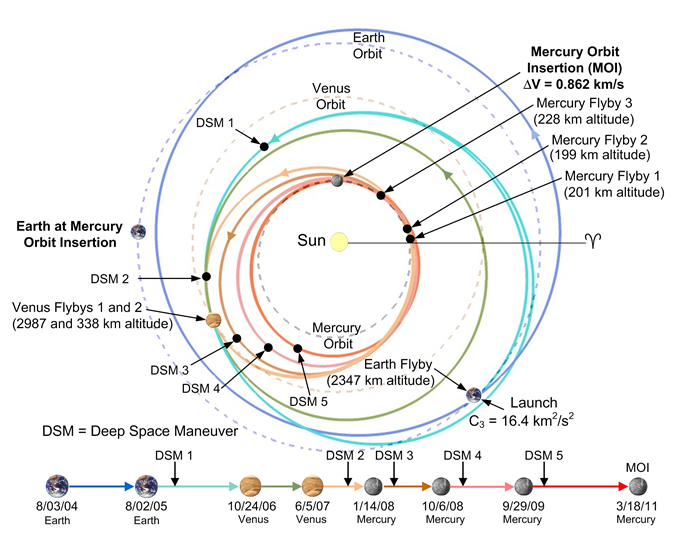
Actually, the closest approach doesn't necessarily matter, especially for the inner planets as the traveled path usually uses gravity assists. Here is an example of Parker's path to get close to the sun:
https://directory.eoportal.org...And one for Messenger going to Mercury:
http://messenger.jhuapl.edu/Ab...It's not like you can take a direct route without using a shitload of fuel.
-
Re: What now?
Indeed, NH is not in an heliocentric orbit and cannot currently attempt to come back inside the Kuiper belt perimeter at current velocity with its remaining delta-V from thrusters, or at least get to any usable heliocentric orbit. It would need a massive object to further alter trajectory. There might be other flyby targets possible, but they would always be farther away.
You can see the current NH trajectory here:
http://pluto.jhuapl.edu/ -
Here's a link to pictures
This link is stolen from an AC that responded to you, inexplicably down-modded despite having very useful information:
-
Re:Well?
lol "the verge". slashdot has really gone downhill.
It's Not much to see anyway -
Re:Aaannnddd...
In defense of NASA, this was an idea floated by a political appointee. I highly doubt this is something being pushed by the NASA rank and file. I suspect their reaction is the same as yours and mine.
But in the meantime, NASA is still doing exploration and useful science. They launched the Parker solar probe just a few weeks ago. People are still living on the International Space Station. We have a nuclear-powered rover on Mars that was delivered by a rocket skycrane. On New Years's Day, the New Horizons probe will fly past a Kuiper Belt Object - a spec so tiny they needed teams of telescopes in remote places just to confirm where it's orbit is. And then there's NASA's ongoing development of commercial crew vehicles. SpaceX and Boeing are, naturally, doing the bulk of the work, but NASA has a lot of say in the design and certification. NASA also happens to be the customer. And, oh yeah, when those capsules launch, they'll be crewed by NASA astronauts.
God... can't I grouse about shit at all?
You're right of course... I know. I know. -sigh-
I just need to vent sometimes and slashdot is like, I think, 50%+ people being pissed off and venting. If that ever becomes a real problem, I will have to fork Slashcode and create a new site: Ventdot: The weblog/forum for people to come and just... scream incoherently into the digital void.
Oh wait, did I just describe Reddit? LOL
-
Re:Aaannnddd...
In defense of NASA, this was an idea floated by a political appointee. I highly doubt this is something being pushed by the NASA rank and file. I suspect their reaction is the same as yours and mine.
But in the meantime, NASA is still doing exploration and useful science. They launched the Parker solar probe just a few weeks ago. People are still living on the International Space Station. We have a nuclear-powered rover on Mars that was delivered by a rocket skycrane. On New Years's Day, the New Horizons probe will fly past a Kuiper Belt Object - a spec so tiny they needed teams of telescopes in remote places just to confirm where it's orbit is. And then there's NASA's ongoing development of commercial crew vehicles. SpaceX and Boeing are, naturally, doing the bulk of the work, but NASA has a lot of say in the design and certification. NASA also happens to be the customer. And, oh yeah, when those capsules launch, they'll be crewed by NASA astronauts.
God... can't I grouse about shit at all?
You're right of course... I know. I know. -sigh-
I just need to vent sometimes and slashdot is like, I think, 50%+ people being pissed off and venting. If that ever becomes a real problem, I will have to fork Slashcode and create a new site: Ventdot: The weblog/forum for people to come and just... scream incoherently into the digital void.
Oh wait, did I just describe Reddit? LOL
-
Re:Aaannnddd...
In defense of NASA, this was an idea floated by a political appointee. I highly doubt this is something being pushed by the NASA rank and file. I suspect their reaction is the same as yours and mine.
But in the meantime, NASA is still doing exploration and useful science. They launched the Parker solar probe just a few weeks ago. People are still living on the International Space Station. We have a nuclear-powered rover on Mars that was delivered by a rocket skycrane. On New Years's Day, the New Horizons probe will fly past a Kuiper Belt Object - a spec so tiny they needed teams of telescopes in remote places just to confirm where it's orbit is. And then there's NASA's ongoing development of commercial crew vehicles. SpaceX and Boeing are, naturally, doing the bulk of the work, but NASA has a lot of say in the design and certification. NASA also happens to be the customer. And, oh yeah, when those capsules launch, they'll be crewed by NASA astronauts. -
Re:Aaannnddd...
In defense of NASA, this was an idea floated by a political appointee. I highly doubt this is something being pushed by the NASA rank and file. I suspect their reaction is the same as yours and mine.
But in the meantime, NASA is still doing exploration and useful science. They launched the Parker solar probe just a few weeks ago. People are still living on the International Space Station. We have a nuclear-powered rover on Mars that was delivered by a rocket skycrane. On New Years's Day, the New Horizons probe will fly past a Kuiper Belt Object - a spec so tiny they needed teams of telescopes in remote places just to confirm where it's orbit is. And then there's NASA's ongoing development of commercial crew vehicles. SpaceX and Boeing are, naturally, doing the bulk of the work, but NASA has a lot of say in the design and certification. NASA also happens to be the customer. And, oh yeah, when those capsules launch, they'll be crewed by NASA astronauts. -
Actual press release
A link to to the actual New Horizons site should be informative as well.
-
A little bit too late
From http://parkersolarprobe.jhuapl... : "The deadline for submissions was April 27, 2018 at 11:59 PM EST and entries are no longer being accepted."
-
Send Your Name to the Sun - There's still time!
Submit your name and it will be included in a memory card that will fly aboard Parker Solar Probe spacecraft.
Submissions will be accepted through April 27, 2018.
http://parkersolarprobe.jhuapl... -
Information on the Software
There have been multiple public presentations about the software on this mission.
http://flightsoftware.jhuapl.e...
http://flightsoftware.jhuapl.e...Goddard also has the interesting framework Core Flight System (cFE/cFS) which is available as open source. Again multiple presentations on it but a nice presentation by Dave McComas on it is here:
-
Information on the Software
There have been multiple public presentations about the software on this mission.
http://flightsoftware.jhuapl.e...
http://flightsoftware.jhuapl.e...Goddard also has the interesting framework Core Flight System (cFE/cFS) which is available as open source. Again multiple presentations on it but a nice presentation by Dave McComas on it is here:
-
NASA Link
For those who want the direct link to the NASA release:
I don't know if there's a page for the comet sample return mission, but Dragonfly has a page (with video) here: http://dragonfly.jhuapl.edu/
-
Very light article
Not much there to go on, but that said the Wikipedia article is substantially outdated. A more recent description of field experiments can be found at: http://www.jhuapl.edu/techdige....
There are plenty of papers paywalled at the SPIE site as well if you'd like to get a better feel on what the state of the art is post the 2012 experiment described in the linked article.
All that said, the environment is your enemy as you go up in frequency - things like clouds, rain (but not always), fog (again, not always), and the pigeon that someone mentioned previously can break the link, but proper design of the modems can get through some of that. That said "some of that" will not get you 5 9's link reliability over all weather condition. It's not just optical; the mm-wave stuff being thrown around for 5G systems has many of the same problems - heck, certain bands of high frequency (say around 60 GHz) get soaked up by oxygen at incredible rates.
Regarding data rates, RF systems will struggle to beat FSOC. Well designed FSOC systems leverage technologies used in fiber communications; I've worked on air-to-ground links that exceeded 80 Gbps over a decade ago, it would be trivial to double (or more!) that rate.
Another consideration is cost - FSOC systems in general utilize pretty sophisticated optical systems that are effectively your antenna. The modem cost can be driven to par pretty easily, but RF antennas are generally much lower cost than optics.
But you don't have to fight for spectrum, which is a major advantage. The FCC and I imagine nearly every other country's spectrum regulatory agency do not regulate the near IR wavelengths FSOC systems run at. There are safety issues that need to be taken into account (eye damage), but those are well defined and don't generally represent that much of a problem. -
A bit of a come down
after the utterly spectacular imaging of Pluto by New Horizons. AKATSUKI is amateur hour in comparison.
-
Re: Question about deep space pictures
FWIW, here's more info about one of the main imaging cameras (LORRI).
Short story:1Kx1K** CCD sensor w/ 350 nm to 850 nm panchromatic sensor. To compensate for the low light levels, the primary mirror is 20.8cm in diameter, the field of view is only 0.29 and the integration times are pretty long (100-150ms or so).
AFAIK, the images they have posted so far are generally the CCD images only processed to remove CCD bias, read-out smearing, and fixed-pattern non-uniformity effects.
**The sensor also support a 2x2 pixel binning mode to reduce smear for really long exposure times or high sensitivity shots.
-
Re:Question about deep space pictures
Do realize that LORRI isn't just a camera, it's actually more of a telescope. And they can expose the images as long as they want, and even stack them if they want.
If you think it's hard to get pictures on the sunlit side, that's nothing - they actually plan to try to get pictures on the side *not* lit by the sun, just by the pathetically weak light reflected by Charon. Getting images on the lit side is easy, but the dark side is going to be very difficult, involving lots of stacking.
-
Re:Why are we doing this?
Our solar system consists of 3 classes of objects: rocky planets, gas giants, dwarf bodies. Going to Pluto allows us to study the 3rd class. Scientists think these dwarf objects in the Kuiper Belt are the building blocks of planets but did not have a chance to accumulate into one since our solar system formed and studying objects in that area will give us a more complete understanding of what happened during the early age of our solar system.
http://pluto.jhuapl.edu/Pluto/...
I think this mission is especially challenging because it's so far away. Mission planners need to account for the considerable latency involved.
-
Re:This is why physics is the king of the sciences
Agreed. Here's the page where it shows the significant events of the mission.
-
Re:Drop rate
This document shows the schedule for which camera will be taking what photos, the quality of the photos, and when they will be transmitted to earth:
-
Re:July 1?
Especially when JPL has photos available from yesterday morning.
-
Re:Frozen
Uhh, these don't look like planets:
http://pluto.jhuapl.edu/soc/Pl...But if it feels inside like all its life its really been a planet, who are you to judge. Insensitive clod!
-
Re:"as a means to raise awareness ..."
Depends on what the term "killer asteroid" means. For a once-in-five-hundred-thousand-year civilization destroying asteroids larger than 1 km we have already identified all of them. Possible threats from this population can be projected developing centuries in the future.
For the less extreme threats in the ranges from 100 meters to 1000 meters (which covers impacts in an energy range from 100 megatons to 100,000 megatons) we do have a good way to go, but we are closing in on a 90% detection rate for the larger members of this group.
A 100 meter, 100 megaton asteroid can destroy a city, if it hits it, but is only a localized threat. The large majority of such impactors will cause little or no loss of life since only about 1% of Earth's surface is urbanized. Unless the target is a city the most practical means of dealing with the threat will be local evacuations. For this size a month's warning should be sufficient to deal with the situation. This size can also be completely destroyed by a nuclear explosion, so that a ready-for-launch strategic-sized nuclear warhead could be employed.
A significant fraction of severe threats can never be handled by an Earth-surface survey program - the threat posed by long period comets. This represents as much as 20% of the total threat, but these can only be detected effectively by space-based infrared telescopes, and the warning we will get will only be a couple of years in advance as they approach from the outer reaches of the solar system.
-
Re:Movie?
I'm pretty sure the color movie is made of MVIC images. LORRI doesn't do color, but has much higher resolution. The LORRI images (and this movie) can all be found here.
-
Re:Movie?
Obviously the LORRI images have stars in them that one can use as reference points.
-
Re:how Mercury evolved?
Lots of things evidently crash into it:
-
Re:Nice
the probe is not designed to transmit while aiming its instruments (to save money; contrast with Voyagers)
Voyager has most of its instruments, including the cameras, on a movable platform. This allowed the positioning of the spacecraft and its high-gain antenna (the dish) to be decoupled from the positioning of the sensors. That made it very versatile and capable but, as you mentioned, more expensive. It also increases technical risk. What if the scanning platform jams up? (Some instruments could end up forever pointed back at the spacecraft! There are only so many multi-spectral selfies you would ever want to have.)
New Horzions is, for all intents and purposes, a single solid body. For 98% of its operational life, it's spin stabilized with its dish pointed squarely back towards Earth. That won't suffice for the intensive observations it was built for, so it will stop spinning and tilt itself this way and that to point its sensors at Pluto during its close encounter. Of course, when it is tilting this way and that, it is no longer pointing its main dish at Earth, so there can't be substantial communications. There is still the low-gain antenna, which is much less directional, which will allow for continuous commanding and telemetry, but has too little bandwidth for much science data to be beamed back. (more info here) -
Not Yet Better than Hubble
New Horizons will start imaging (and optical navigation) this month, but it won't be better than Hubble until mid-May. That's when the fun will really start.
-
Re:Let me guess
guy could even wear a shirt with sleeves and thee only immediate thing you would notice is the hands.
They don't mention it in this article, but they do have a silicon cover for the Prosthetic Limb designed to match the patients skin color (and even includes artificial arm hair). It'll feel odd to touch it, but it looks quite realistic.
As for power, I believe the batteries are self-contained within the upper arm, with the entire prosthetic designed to be comparable to a real Human Arm in terms of weight and freedom of movement. The APL website has more details. http://www.jhuapl.edu/prosthet...
-
The Pluto site
Here is the New Horzens website http://pluto.jhuapl.edu/
-
Or maybe it's already been done...
The Modular Prosthetic Limb, developed by the Johns Hopkins University Applied Physics Laboratory with funding from the Defense Advanced Research Projects Agency provides 26 degrees of motion, including independent movement of each finger, in a package that weighs about nine pounds and has the dexterity of a natural limb. In 2012, a patient at the University of Pittsburgh Medical Center successfully demonstrated that the arm could be controlled by the user’s thoughts. Several patients, including a decorated Afghanistan war hero, are helping researchers further develop the prosthesis. In 2013, the MPL will continue to be tested and refined in a clinical trial at the California Institute of Technology.
-
Re:Flyby nice, but we need a probe in Pluto roxy
This is a technology problem, not a policy problem. The New Horizons probe is doing a flyby because that is currently the _only_ way to get a probe near far away Pluto. The probe is going extremely fast and in order to decelerate into orbit of such a small planet, you'd need to be taking along a lot more fuel than that probe has on board. Alternately, you could take a much slower and longer (decades if not hundreds of years) lower energy transfer orbit.
This isn't Star Trek. NASA has to deal with real physics. Start here: http://pluto.jhuapl.edu/mission/whereis_nh.php
Necron69
-
Re:Only good for testing the model
-
New Horizons on the way
Quite true. We are existing the Age of Reason into the Age of Dark Ages 2. From the proponents of ignorance (ie. intelligent design) to people's tendency to bashing science as "unscientific" because it does not paint rosy pictures for them (eg. AGW) to simple fear of unknown (eg. nuclear). It has been rather sad last 20 years in terms of people's perception of science.
On another note, there is another probe racing for Pluto. It will then go on exploring the Kuiper belt.
http://en.wikipedia.org/wiki/New_Horizons
http://pluto.jhuapl.edu/Voyager 1 is moving a bit faster though so it will remain furthest measurement platform out there until it stops working, but still, new tech is on the way out there too.
After New Horizons, well, don't expect much for at least the next 20 years..
-
Re:Holy Crap
The talk I was referencing was given by Nitish Thakor, of the Biomedical Engineering department at Johns Hopkins (website link: http://web1.johnshopkins.edu/nthakor/); I would have listed the name earlier, but it eluded me and I didn't have my EMBC booklet/DVD with me.
As an aside, if you're interested in just the high-level overview of the work, check out the following press release: http://www.jhuapl.edu/newscenter/pressreleases/2007/070426.asp (note that the system in question is the same as that mentioned in Mikael's link: http://www.ric.org/research/accomplishments/Bionic.aspx) -
Re:Just some things
There's a link from this page to the app store;
http://pluto.jhuapl.edu/epoapps/
I have it on my own iphone, so I'm sure it exists. It's not very exciting just now, (though you can see the images from the Jupiter flyby).
-
Detailed location data
-
new basis for probe?
Any chance we could do something similar with a probe and get a little bottle of the sun's gas to look at? It looks like we already plan on crashing a probe into the sun in a decaying orbit: http://solarprobe.jhuapl.edu/ , but I don't think anyone considered the possibility of its survival. We could still take magnetic measurements on the way in, and maybe an initial layer of ice could help boost it back out, too...
-
Re:This Just In
So the cost to get someone into LEO in their birthday suit, let alone anywhere interesting like an established moon base, currently exceeds the average total asset holdings of most first world citizens.
And it just keeps getting worse from there. Scientists who actually understand this stuff - all of them supporters of manned space exploration! - have come up with some interesting numbers for the expense of long-range expeditions. Ralph McNutt at JHU wrote a good article about exploring the outer planets using currently feasible technology. He envisions a series of five missions, each designed to avoid lethal radiation exposure, in the latter half of the 21st century. Estimated cost: $4 trillion. There's no colonization involved - this is just for doing flybys of gas giants and their moons. Sustaining a permanent settlement somewhere won't be any easier, because we'd need constant supply runs from Earth. How long does anyone think a moon base would last without a supply line? Think it'll be any easier on Mars?
Now, I actually think we should do all this stuff at some point in the future - but it needs to get at least an order of magnitude cheaper before I'll advocate spending other people's money on it. Maybe with another hundred years' scientific development in the fields of human physiology, nanotechnology, and propulsion systems we'll be able to afford interplanetary travel for relatively large numbers of people. Right now, however, if we try to establish a permanent base (which we can't afford) on Mars, with enough fertile individuals to perpetuate the human race, they're basically equally fucked if the Earth gets hit by an asteroid - they'll just take a little longer to die.
-
regarding
the messenger site has the information
http://messenger.jhuapl.edu/gallery/sciencePhotos/image.php?gallery_id=2&image_id=649 -
Re:Power?
The question of how they can manage to launch it from a point of view of politics and negative publicity was my real question
A combination of low profile and good engineering. As a general rule, the public doesn't know or care much about plutonium on spacecraft. The issues come to the public's attention when engineers recognize serious potential problems and talk about them to the media.
Case in point, the last plutonium-powered spacecraft most people remember was Cassini. This got a lot of attention because engineers pointed out that while the power source it used was designed to survive if the rocket blew up during launch, it wasn't designed to survive re-entry from escape velocity: since Cassini did an Earth gravity assist maneuver a couple years after launch, if someone messed up the flyby there was a risk of loss-of-containment. The press overblew the issues, as they always do, but the point is that there was a real issue which provoked some real engineers to raise real concerns to get the story running.
In this case, all the engineers who know enough about MSL's nuclear safety design to critique it are satisfied that it's not going to be a problem, so nobody is whispering in the media's ear. Same goes for other plutonium-powered missions since Cassini, which you probably haven't heard about.
-
Re:It's too bad NASA doesn't do anything anymore.
-
Re:It's too bad NASA doesn't do anything anymore.
-
Re:It's too bad NASA doesn't do anything anymore.
-
Re:It's too bad NASA doesn't do anything anymore.
-
Re:It's too bad NASA doesn't do anything anymore.
-
Re:Don't underestimate the energy of small asteroi
Yes. Yes, we have. Orbited an asteroid, that is, not the nuking bit. And we'll do it again next month. Of course, these are much, much bigger hunks of rock.
-
The "color" images look gray
Lame indeed. I just took a look at Messenger's supposed First Color Image of Mercury from Orbit. I thought I'd gone color blind. It looked so gray. Trying to reproduce the subtle shades in a color printer would be a terrible waste of ink or toner, as you'd be forced to go Cyan-Magenta-Yellow (CMY) to print out something not quite Black (K) or gray.
The mission may yet turn up some astounding scientific discovery, but Mercury isn't a very photogenic planet, as far as celestial bodies go.
-
Why not post the actual NASA link?