Slashdot Mirror
Domain: linux.com
Stories and comments across the archive that link to linux.com.
Comments · 933
-
Re:China Airlines uses Linux on their in-flight
It looks like Linux has got a place in the Sky
http://www.linux.com/feature/119544 (October 2007
"The Linux-based eX2 in-flight entertainment system (IFE) from Panasonic Avionics was the big winner at this year's Avion Awards, sponsored by an IFE trade group. The Best Overall IFE awards went to Emirates, Singapore Airlines and Cathay Pacific Airways, all running variants of eX2""About the awards
The World Airline Entertainment Association (WAEA), based near Washington, DC, sponsors the Avion Awards. This year's winners were chosen based on a worldwide poll of 36,000 air travelers, says Elinor Kinnier, public relations manager for WAEA. Poll-based awards were given for overall and regional excellence -- a change from prior years, when a panel of judges chose winners in a variety of specific categories as well as an overall winner."
Panasonic uses redhat as a basis of their in flight Entertainment Systems with over 3000 planes fitted with them and as you can see they have been getting better
http://www.panasonic.aero/innovation.html
Panasonic seems to be doing well, with their inflight systems as Quantas has ordered 4 more systems for airbus 380's
http://www.linuxdevices.com/news/NS5534592156.html
Virgin have an inhouse system called RED for trans atlantic flights.
http://www.engadget.com/2007/02/10/mega-hands-on-virgin-americas-airbus-a320-with-red-in-flight-e/ again Linux based.
Seems like Linux is taking off all over and a commercial success story.
-
Re:No surprise here..."Its no surprise that Linux supports more devices."
I say! Hallo over there.
Could some of you fine upstanding penguins please find it in your pint-size reptilian hearts to migrate over here to Van Daemon's Land this season, and help our poor bewildered little FreeBSD creature rebuild his USB nest?
This is no joke, penguin people. Seriously, I need to keep a Kubuntu machine handy just to read the SD cards from my Canon. That simple task crashes FreeBSD. Regularly, reliably crashes it.
I will probably be hunted down and speared with a tiny fork for this. But I think we need some penguin DNA over here, because no one has been able to properly deal with this for the past six years or more.
There's a recent article at Linux.com about the ancient FreeBSD kernel panic involved in this, that has now even tripped up the PC-BSD project. http://www.linux.com/feature/149224
And now, I must scurry hurry to hide from the fork prongs!
Sincerely - a frightened daemon captive
-
Re:Ha ha, that's true.
Nice troll.
-
Linux
A lot of people have already suggested linux and though it may not be the right answer in this case I completely second using linux. I switched to kubuntu after I "tried" it for a while. I never had to worry about accursed anti-virus software. With xbindkeys command line is the frontline.
Now even starting a movie goes like this
ctrl-alt-t gets me cmd window then i navigate to folder and type in xine movie-name
The vista bloat is still there in my laptop as I need to use photoshop once in a while...... someday I will try gimp. -
Re:Why not ZFS?
No, it wouldn't. A microkernel loads modules into the kernel space. You're talking about running in user space. So when an application makes a system call, the kernel has to translate it to the FUSE layer into user space. So there's an extra layer consuming time. On top of that, kernel space isn't generally swapped out, but user space can be. Obviously it should never happen, but wouldn't it suck if your disk driver was swapped out?
See the diagram at the bottom of this page: http://fuse.sourceforge.net/
Also, ZFS (like ReiserFS) handles its metadata differently from ext3, so you have to translate the differences between the virtual file system and ZFS. This is why writes are significantly slower. Reads are not so bad. The NFS penalty would be huge. See http://www.linux.com/feature/138452
-
Re:Want!
Oh, and to answer your printer question:
http://www.linuxprinting.org/show_printer.cgi?recnum=Epson-Stylus_CX5400
http://www.linuxprinting.org/show_printer.cgi?recnum=Epson-Stylus_Photo_R1800
http://www.openprinting.org/printer_list.cgi?make=KONICA+MINOLTAEpson and Minolta only support Windows and Mac OSX.
Bullshit:
http://www.linux.com/feature/113738
"The Epson America website directs you to Epson Kowa for Linux drivers for their printers, including one for the CX5400. You can download their GPLd binaries and source code from here."
-
Don't worry
Microsoft will be forthcoming with massive discounts 5 minutes before the deal with RedHat is signed and our government will renege on any promises they made.
It's the traditional "what do you mean we don't get a discount? Well, ya know, Open Source is getting more and more acceptable..."
Unfortunately, the moral imperative for schools to use exclusively Free Software is not even a consideration here.
-
I have an idea.
It seems to me that we need a system with entirely unpredictable text, that requires minimal admin time for creation and maintenance. Further it needs to direct the user to some action that a human could do perform but that a bot either couldn't understand or would be unable to do.
Here is my idea, someone tell me why this wouldn't work.
In place of the captcha you have instructions directing the user to go to a certain website and copy / paste a certain bit of information into the field. Before the system does this it goes to the page and captures that information.
So it would look something like this:
"Before you can use this system please provide the following information: Go to $designated_website and copy and paste the $requested_information into the following field."
You then randomize $designated_website and $requested_information. It could be any website, including sub page, and any information.
Now a bot could be designed to read your text and try and interpret the results so that it would know where to go and watch to fetch IF your request was simple but if the request was more complicated then it wouldn't know how to respond.
For instance:
Go to news.google.com and give the title of the second story under Top Stories.
Go to http://www.linux.com/articles/feature/ and give me the name of the author of the third article on the left.
Dynamic non-admin generated data, a ruleset that's easy to write, and instructions that are hard to follow for a bot because they change.
What am I missing?
-
TrueCrypt
You've missed the whole point of my post
And you missed the whole point of my post.
Swap files which, unless the whole disk is encrypted, won't be. Files used in hibernation (Linux uses swap, not sure about Windows).
I have 2GB in my MacBook Pro, which it came with as standard more than a year ago. If I wanted to I could add another 2GB. For now at least I seriously doubt I come near maxing that. I can see doing it when I start working on multi-media. However if I wanted to I could move my swap. Windows users can also move their swap, as can Linux users.
you can't simply send a message to the operating system to say "This is now in secure mode, any user data or swapfiles must be stored in THIS location and any which are outstanding must be moved and the disk area they occupied securely wiped".
When I installed Linux, years ago, it asked me where I want the swap partition to be. I'm not positive but I'm pretty sure I also told Windows where to put swap.
This is the kind of feature corporates will demand because you can never guarantee that nobody will ever lose a key or forget their password and "your data is now toast you silly fool" is seldom an acceptable outcome to such a scenario.
Yea, I'd imagine a corporation would have a backup key.
It's also the kind of feature which is highly unlikely to be implemented in any F/OSS solution like TrueCrypt because it's a potential security risk
How is TrueCrypt riskier or potentially riskier than a closed source proprietary program? Whereas anyone can examine the source for TrueCrypt and spot possible security holes, nobody can legally see source code that's closed. And that source code can be riddled with holes. Sure some cracker may find a hole in code that's open but with thousands of others having the code the likelihood of someone else seeing is better than if the code is closed, and closing the code only stops some.
Unless the disk is heavily encrypted then any boot password can be trivially worked around
Not too long ago, last month I think, there was an article on
Falcon
-
Green Party was the first to support open source
The federal Green Party was the first major Canadian party to include support for net neutrality and open source in its platform.
-
A quick Googling of Stallman and inevitable
http://www.linux.com/articles/35369
And the article is, how about that, marketing for GNU. RMS is right again! -
CylantSecure, it's been done before...
CylantSecure has been doing this for about 8 years. They put hooks in the kernel and run a model to detect deviance in the kernel processes from the model. The model can be generated from usage and modified to fit changes in usage. So, is this new korset open source? If it's not It' not news.
-
Re:Mmmm, Kay.
...but I'm never going to write a web-app, or a word-processor in Prolog.
Many of these languages are very clever when it comes to doing certain things, but how often do you actually need to do those things?Yeah, but how often are you going to need to write a web-app or a word-processor? Thanks to the open-source movement there's an abundance of applications & packages which are freely accessible to you as a developer; if you're writing code to do common things then perhaps you're not making use of what is available to you. BTW, freeing yourself up to think beyond the confines of a common paradigm, tool, etc. is what learning is all about; you can do most things you want to do with a UNIX shell using Scheme/LISP but most people don't because they don't realize they can. Given your experience you probably understand my point but I think that if you state that there's no place for alternative languages (or that their place is limited and/or small) you're essentially laying the groundwork for the logic which precludes those other languanges a priori.
-
grism looks promising
check out this article on grism: http://www.linux.com/feature/146313 its written in ruby. been meaning to check it out for a while.
-
Re:This is ridiculous
+1
And some of the responses...
"I followed a tutorial and now I'm an expert, do this that and this. This expert recommends using ($token_enterprisey || $pet_distro). To secure the system you'll want to rely on prepackaged binaries like Debian's OpenSSL package. To optimize you'll want to run a generic kernel, grab them prepackaged binaries from package management, smear yourself in butter and do 100 hail marys."
-
Re:When it comes to HP, I bite!
. The areas in which I find these environments still wanting are the following:
1: Let's be able to configure shares easily. Right now its a mess and as a matter of fact, KDE does not seem to have something to represent Microsoft's "Add network places."
Euh, Places --> remote places ? Never had problems, all is available as far as I see.
2: Fonts still terrible on Linux. I will jump with joy the day fonts on a Linux machine will look beautiful bey default. Right now, one has to install Microsoft's TT fonts and/or do some compilation. This is a non starter.
Euh, compile fonts?? You download them, just as in windows, and install them in the appropriate place. If too difficult, check http://www.linux.com/feature/133559
3: Software installation is still a mess. The other day, I tried to get Adobe's Flash player installed on a Debian system and I was not that successful till I installed from source. I do not see Joe Six Pack going through this.
Install Adobe flash from source?? It is a closed source program! You download it and run whatever they say in the documentation to extract it and move it to the correct folders. Anyway, Ubuntu has a package for that.
-
Re:To expand on that
I'd recommend XFS from previous experience, but I'm not sure if it can be resized down
-
Re:evidence free
-
Re:NASA needs Linux
Funny thing: after leaving this thread, I saw the Linux.com thing on the side of Slashdot. At the top was: PostPath: Enterprise-strength open source alternative for Exchange.
-
Re:Your computer is broken
Huh? What architecture specifically are you having trouble getting flash to work with? 4k stacks have been on many "stock kernels" for at least three years now. And what security issues are you worried about specific to Flash that don't affect your browser as well?
See my previous post - your computer is broken in some other way. All of these things are perfectly feasible and have been for some time with Flash 9 on Linux. Why don't you post some details of what you can't figure out and we'll see if we can help you here. -
Re:A solved challenge, mind you
It's stable, been around a while, and is written by me
I believe rsyncrypto leaks information even if the attacker only sees one version (this is in addition to the diff based attack mentioned by others). As the author, would you agree with these analysis? Do have any further analysis of the security of rsyncrypto anywhere?
I ask because I have thought about using rsyncrypto, but was stopped by what I perceived as insecurities, and I would like to give you a chance to correct me if I'm mistaken. (Yeah, diff based attacks may be a necessary evil, but attacks without even seing the diff are scary.)
-
Re:I knew a guy who always had headaches
Here's a review of rsyncrypto that also says it isn't really secure:
For an example of an information leak, suppose you have an XML file and you use rsyncrypto to copy the file to a remote host. Then you change a single XML attribute and use rsyncrypto to copy the updates across. Now suppose an attacker captured the encrypted versions in transit, and thus has copies of both the encrypted file before the change and after the change. The first thing they learn is that only the first 8KB of the file changed, because that is all that was sent the second time. If they can speculate what sort of file the unencrypted file was (for example, an XML file) then they can try to use that guess in an attempt to recover information.
Rsyncrypto encrypts parts of the file independently, thus keeping any changes you make to a single block of the file local to that block in the encrypted version. If you're protecting a collection of personal files from a possible remote system compromise, such a tradeoff in security might be acceptable. On the other hand, if you cannot allow any information leaks, then you'll have to accept that the whole encrypted file will change radically each time you change the unencrypted file.
-
Lack of Free (or even shared-source) drivers
It's not necessarily you being lame, it's either game developers being lame by not porting their games
Up until very recently, it was also video card manufacturers being lame by not making OpenGL drivers for Linux that the community can help debug. But ATI, one of the two makers of chipsets for video cards,[1] plans to stop being lame. And some people would claim that it's distribution maintainers being lame by not providing more thorough binary compatibility across multiple families of GNU/Linux distributions. ("What's an LSB again?")
[1] Intel GMA is not available on a card.
-
Sounds like spam to me
Apart from the fact that this news sounds more like a spam... oh yeah I haven't heard of anything remotely sounding like Likewise Enterprise. I do all my authentication using standard kerberos, pam.d and libnss-ldap May this be your guide. http://www.linux.com/articles/114087
-
Re:Legal requirements for using software?
> Which part of the GPL says that?
It's under 3.c):
"For an executable work, complete source code means all the source code for all modules it contains, plus any associated interface definition files, plus the scripts used to control compilation and installation of the executable." I'm not a lawyer, so I can't know what it means, but I interpret the spirit of it as "give me the build system parts to make it go."Don't get me wrong, I'm a big supporter of open source. I just really dislike the extremes the FSF has gone to to make sure that they can stomp anyone that touches code in a way they don't condone. It's become pretty clear from things like the Mepis fiasco that even people with the best of intentions will get eagerly screwed by GNU. Much less draconian licenses for things like Apache haven't had the squelching effect on open source that GPL advocates claim, and they aren't nearly as scary to business. I'm pretty firmly on the Linus side of the "make things work"/"burn the infidels!" split.
-
atom linux article
-
The font still sucks
After all these years, release after release, the default font still completely, utterly sucks. Are they ever going to change fonts?
http://www.linux.com/var/uploads/Image/articles/142661.png
Yuck.
-
Mish-mashFrom TA
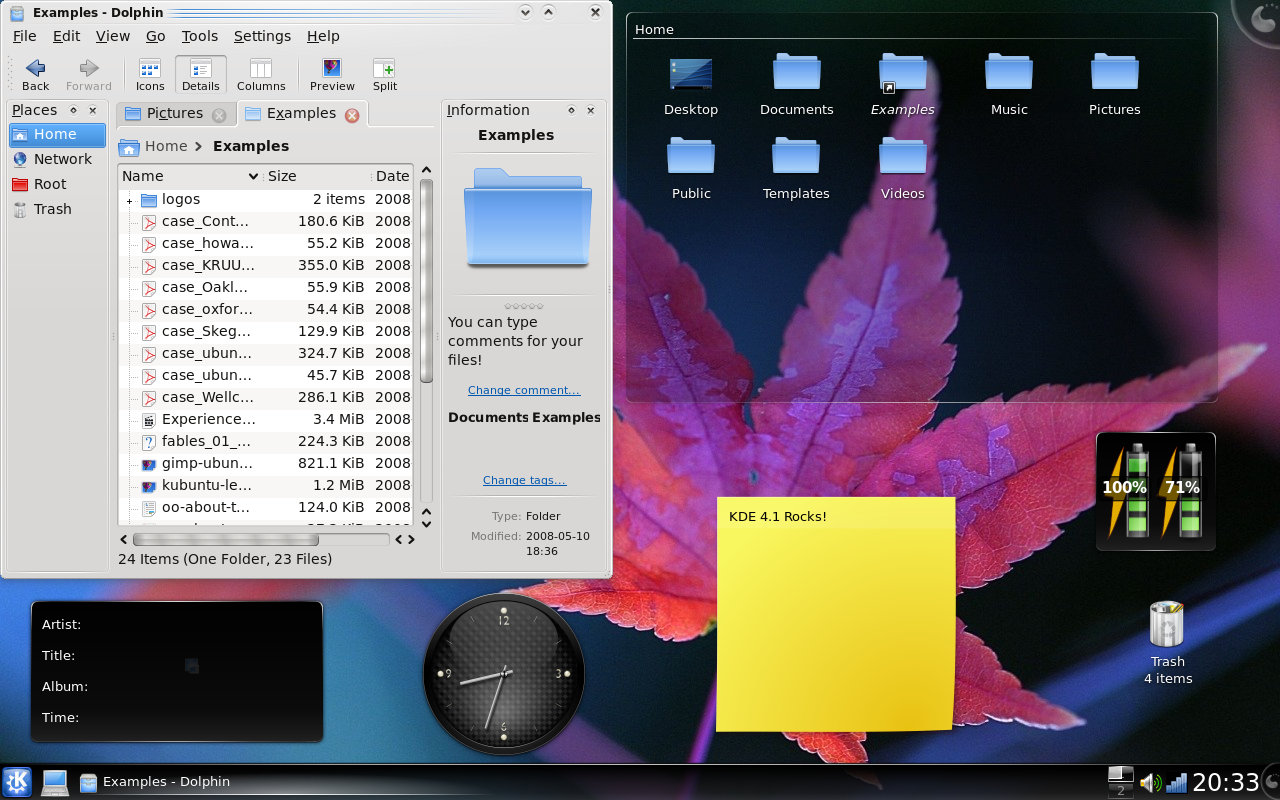
"As far as eye candy, KDE 4.1 looks simply stunning."
I look at this screenshot linked from the article however and I see a confusing mash-up of design agendas. Dolphin file manager looks drab and strangely cluttered with shallow implied 3D for tabs and other delimiters yet the OS X style scroll bars bulge out. What are those scrollbars supposed to be made of? Blown glass? Gel? The panel at the bottom caves in with greater depth than the background image.. The simulated lighting model they're using to shade elements come from all over the place. I can count about 3 contradicting implied directional lights, from the panel to the icons to the widgets themselves..
Other things confuse: What is that Logitech logo doing in the top-right corner? Those tiny minimise/maximise buttons look like they're from another universe entirely: not echoed in any other element on the desktop, lest of all the stripey title bar.
I'm not convinced much effort has been spent on making KDE look 'stunning'..
KDE was very tweakable last time I looked so I'm sure someone will come up with a unifying theme. Glad to hear stability and speed have been greatly improved. -
Re:Mac OS X ...Server?
But on OSX, we'd see non-ASCII chars simply garbaged with no obvious pattern.
My guess is you were using a codepage instead of Unicode. I've had issues with old MP3 files ripped over the years - for example Björk
http://www.joelonsoftware.com/articles/Unicode.html
http://unicoderewriter.sourceforge.net/
http://www.unicodetools.com/
http://www.linux.com/feature/58689 -
Microsoft Virtual PC 2007...
Only uses a single core.
http://www.linux.com/feature/60742 -
Re:He is confusedHe also missed:
- digiKam
- gThumb
- BlueMarine
-
Re:NAS *AND* tape backup
For these requirements it is easier to team up with a buddy and use rsync to copy files back and forth through a VPN tunnel. Off-site, no handling, nothing to forget, fully automated.
Look here for a step-by-step guide: http://www.linux.com/feature/113847
-
Re:oh come on
Photoshop Replacement - The GIMP
So the GIMP supports my $300 in Photoshop plugins now? Not. Because Photoshop is an art tool supporting artistic workflow, not a photo editor with. Color Profiles, while a must are only one of the must have features to be a Photshop Replacement. Personally, I buy Pixel and install it on Linux. It is a photoshop replacement. (Also, this example disproves the all Linux Nerds are freeloaders who won't pay for software, but I digress.)
-Labyrinthe configuration utilities and applet
Something like YaST from SuSE or Redhat's Linuxconf, perhaps? The Linux Journal (or even a Google search) will beat stinky-pedia for real, not just made in the last 5 minutes, information.
To the OP,
-Full command line environment (DOS)
Your definition of 'Full' intrigues me and I would like to subscribe to your newsletter.
-
Iptables
What is running on the box? With GNU/Linux it can range from not all that difficult to quite complex.
Then there's always the option of getting something like a WRT54GL and loading OpenWRT on it and setting that up - which would be even more complex since you're then getting into vlan configurations for the ports and such. -
Re:Then STOP releasing the product!
You can use your webcam with any software that supports Video4Linux. There's even a Webcam HOWTO that has a bunch of software you could use to grab a frame. Why exactly was this so hard for you?
-
Re:PR problem for Sun...
-
stupid fucking new comment systemRead and/or watch from 3:20 of
-
Re:They've been planning this for a long time
I don't think you should link pro or anti DRM measures implicitly to 'open-source'ness' as in GPLv3 (see Linus's concerns about this http://www.linux.com/articles/51826)
-
The feed for me
My list of feeds:
Slashdot main : http://rss.slashdot.org/Slashdot/slashdot
Obvious ReasonsLinux.com : http://www.linux.com/feature/?theme=rss
Useful tips for using Linux on a daily basis and for my sysadmin jobLifehacker : http://lifehacker.com/excerpts.xml
Tips for life in generalHack a Day : http://www.hackaday.com/rss.xml
Stuff I wish I had the motivation to doGoogle Open Source Blog : http://google-opensource.blogspot.com/feeds/posts/default?alt=rss
Keeping current with The Goog's OSS effortsGoogle Summer of Code Blog : http://feeds.feedburner.com/GoogleSummerOfCodePodcasts
Seeing the State of the ProgramThe Art of Manliness : http://feeds.feedburner.com/TheArtOfManliness
Do you really have to ask? -
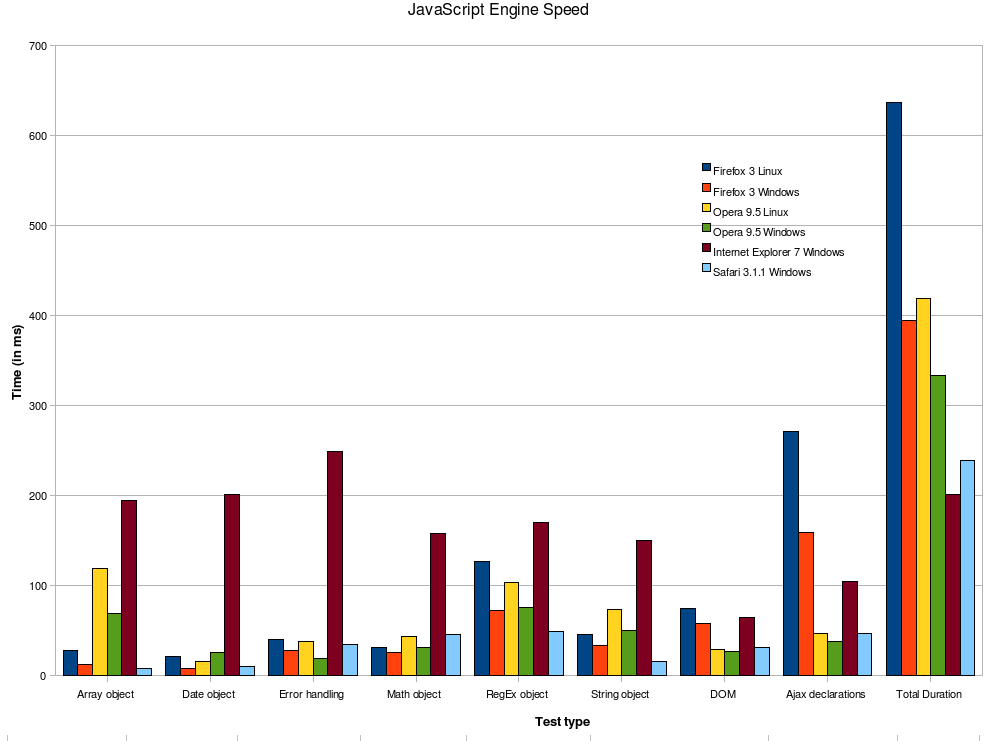
Why is the bar for IE so low?
I am no statistician, but I kinda assumed that the 'Total Duration" group in the Javascript Engine Speed test was a sum of the previous bars. Assuming that is true, why is the bar in that group for IE 7 so short? http://www.linux.com/var/uploads/Image/articles/139212-3.png
-
Re:Next step is to ship this with Linux UMPCs
And most of their legacy Windows malware too!
-
Paul Allen
ah. the evil thickens. i literally have only one other option for my area, and that's clearwire, which is just unacceptably slow and overpriced. color me depressed.
You probably won't like this either then, Paul Allen also kicked in $500 million to start DreamWorks SKG. Don't let it get too down though, DreamWorks uses Linux.
Falcon -
Re:GPL 3Just FYI, Linus isn't as anti-GPLv3 as he once was, quote:
I was impressed in the sense that it was a hell of a lot better than the disaster that were the earlier drafts.
I still think GPLv2 is simply the better license.
I consider dual-licensing unlikely (and technically quite hard), but at least _possible_ in theory. I have yet to see any actual *reasons* for licensing under the GPLv3, though. All I've heard are shrill voices about "tivoization" (which I expressly think is ok) and panicked worries about Novell-MS (which seems way overblown, and quite frankly, the argument seems to not so much be about the Novell deal, as about an excuse to push the GPLv3).
-
Re:Well, for one thing..I can see your point but for the average person to use Linux they are going to want it pre-installed.
No argument here; I agree that the average person needs/wants a pre-install. On the other hand, I'm not average. What really stuck in my craw, however, was the $300 difference, with the cheaper version (i.e. Windows) having better hardware.
Windows costs money. There isn't any getting around that fact. But honestly, I don't want to pay for a piece of software that I will not use. But, I do want the better hardware for cheaper price.
Your tactic looks like Anti-Microsoft tactic.No, it's not at all anti-Microsoft. It is anti-force-it-down-my-throat. I respect Microsoft, both as a company, and, with competition, an innovator. But for my needs, the MS paradigm just doesn't cut it. With that in mind, my tactic is merely good business/free market sense: get better hardware for less money. The additional refund is token, but sends a message that I don't want the software, just the hardware.
But it really isn't since so few people will ever do it to make any difference.Perhaps, but I prefer to remain hopeful, and generally think of this style of thought process as short-sighted. People often think "Oh, just me won't matter", or "One isolated event doesn't influence the grand scheme of things." I tend to disagree, and long-term is what I'm thinking.
Buying a Dell with Linux is a much better Pro-Linux move.To be clear, I'm not "pro-Linux". I am pro-choice. Big difference.
-
Re:Well, for one thing..I tried to get the "Windows Tax Refund" from HP after buying a machine pre-installed with Windows from them, and they were very rude and in the end would not refund my money.
I don't think it really matters that you were with HP. I think a couple of things were in my favor when I got my refund from Dell:
- I got lucky - I got a nice representative
- I realized that I had to get him on my side: I called late in the day, and finally got through after "closing time." When he finally understood that I wanted a refund, and said "No, I can't do that" I responded "Hmm. Well, this problem isn't going to go away, why don't we tackle this in the morning, let you get off work at a reasonable time, etc." Honey 'n vinegar, and all that.
Be persistent, be firm, and be nice -- realize that the customer representative is just a regular Joe/Jane, like you.
Also, for those who don't read the previously posted article, remember that the point is not to get your money back; the point is to respectfully decline the MS Tax, and let them know your doing it.
N.B. It took me about a total of two hours on the phone.
-
Re:Well, for one thing..In capitalism, buying decisions are the primary means of sending messages to the producers. Agreed, but I'd think being specific as a consumer where possible would be good. That's why when I recently bought my Dell, I bought it with Windows instead of Linux. (It was a good $300 cheaper for better hardware!) Then, when the computer arrived, I rejected the on-first-boot MS Eula and got a refund for a little over $50 dollars. This way, I still got what I wanted, and I was able to send the most accurate message as well. The article that gave me the idea: How to Get a Windows Tax Refund
-
A possible benefit to OEM PC makers everywhere
From the start, Microsoft offered PC makers the option of pre-loading MS-Windows on PCs. Remember, most people had to install MS-DOS themselves. Then setup MS-Windows. But then, as MS-Windows evolved and shed MS-DOS, PCs came preloaded with Windows. How convenient. Ever since then and until the DOJ ruling, no one has been able to pre-install any other OS except MS-Windows on an OEM PC. Some PC manufacturers do offer Linux, but it is behind the scenes. Not really out there for the average person to see. Why? Because Microsoft puts the screws into the PC manufacturers and structures the MS-Windows promotional packages so that it is tied to the extreme discounts PC makers can have of licensing MS-Windows. If the DOJ did not at least bring Microsoft's anti-trust actions to light, you would have never had Linux on PCs today, I guaranteed it.
Now we have a flip situation, where a PC platform started off with Linux. And now to be "fair" (***see note below) we are going to include MS-Windows in a dual-boot form alongside Linux.
So some PC manufacturers who really want to offer Linux (like Dell) might be able to, in the light of DOJ observation or just in the public eye, offer Linux in a dual-boot form on their MS-Windows only PCs. After all, we want this to be as convenient as possible for consumers of computer technology so they have
"a choice."
---
*** oh, excuse me, I shouldn't say it that way, "to be fair." We all know that everyone REALLY WANTS MS-Windows, so why should we withhold technology that "everybody wants." Shame on me. I should know better that the current atmosphere does offer a "fair" choice already. Could it even be "better" than that? Yes. And that is the unfairness of it. We do have better technology out there than MS-Windows. But if that better technology is artificially held back on the same hardware platform, a majority of people will ever know about it. Especially schools and low-income people who are stuck paying into technology that really could be improved, but can't, because a big fat gorilla holds it all at bay. And in the United States at least, the government presided by the Bush administration who quieted the DOJ for Microsoft because of campaign contributions, is letting them. 'See http://www.linux.com/articles/35173 and Google') -
Re:I hope so.
Damn right I have a reason! I have a 64 bit CPU. Isn't that reason enough?
Uhh, no, it really isn't.
Sorry, but if you're a desktop user and you don't need >4GB of RAM, 64-bit is just asking for trouble (believe it or not, not all software is 64-bit compatible). I understand some tweakers running it for kicks and bragging rights, but other than that, there's very little reason to run x64. And no, the following reasons don't apply:
Why is everyone so dismissive of x86_64? 64 bit is the future.
Yeah... that's some real solid, airtight logic, there.
The architecture is such an improvement over i386, it is no contest whatsoever, people.
Really? Because, last I checked, 64-bit provided a modest-to-nonexistent performance improvement over x86. Now, granted, things may have changed since then, but even if you get, say, a 10% performance boost from the extra registers, it's still not even remotely worth the trouble. -
OpenBSD spamd
I've had excellent results with this particular product. Spamd uses blacklisting, greylisting, and tarpitting. It really is delightfully evil and still makes me smile because it includes a fake smtp daemon which sets the tcp rcv window to 1. This is a kick in the nuts to the spammer. I've used it with resounding success at a client who was recieving 2000 spam emails a day. Prior to implementing spamd, we were using just a Barracuda. When I combined spamd and the Barracuda, spamd caught about 1975 of the spam messages and the barracuda took over from there. No false positives and we've been running for three months. This link details how to set it up, http://www.linux.com/feature/61103.
-
Re:Hang in there guys
Microsoft Word has many more (and more mature) features than OO.org
I beg to differ:
http://www.linux.com/feature/118986
And since we're on the topic, let's also see Impress vs Powerpoint and Calc vs Excel:
http://www.linux.com/feature/119546
http://www.linux.com/feature/119513
Conclusion: evenly matched.