Slashdot Mirror
Domain: livescience.com
Stories and comments across the archive that link to livescience.com.
Stories · 189
-
Bloodsucking Parasite Named After Bob Marley
Hugh Pickens writes "The Christian Science Monitor reports that Gnathia marleyi, a tiny crustacean that feeds off the blood of reef-dwelling Caribbean fish, has been named in honor – for lack of a better term – of the Jamaican musician Bob Marley. Marley, who died in 1981, was an iconic exponent of the Jamaican-born music known as reggae. One of his standards is 'No Woman, No Cry.' Marley joins the 'I have a species named after me' club, which includes Barack Obama, Stephen Colbert, Mick Jagger, and Beyonce. 'I named this species, which is truly a natural wonder, after Marley because of my respect and admiration for Marley's music,' says Paul Sikkel, an assistant professor of marine ecology at Arkansas State University. 'Plus, this species is as uniquely Caribbean as was Marley.' Juvenile gnathid isopods hide within coral rubble or algae so they can launch surprise attacks on fish, and then infest them. As adults, the parasites don't eat. 'We believe that adults subsist for two to three weeks on the last feedings they had as juveniles and then die, hopefully after they have reproduced,' says Sikkel. Specimens of Gnathia marleyi will be housed indefinitely at the American Museum of Natural History in New York City. 'We are currently discussing with AMNH the possibility of creating an exhibit featuring this species that could be viewed by the public.'" -
Nanotech Surprise: Shooting Lasers at Buckyballs Makes Them Bigger
SchrodingerZ writes "Since 1985, scientists have been trying to determine how Buckyballs (scientifically named Buckminsterfullerene) are created. They are molecules with the formula C60 (a fullerene) that forms a hexagonal sphere of interlocking carbon atoms. 'But how these often highly symmetric, beautiful molecules with extremely fascinating properties form in the first place has been a mystery.' For over three decades the creation of these molecules have baffled the scientific community. Recently researchers at Florida State University, in cooperation with MagLab, have looked deeper into the creation process and determined their origin. It was already known the the process for buckyball creation was under highly energetic conditions over an instant, 'We started with a paste of pre-existing fullerene molecules mixed with carbon and helium, shot it with a laser, and instead of destroying the fullerenes we were surprised to find they'd actually grown.' The fullerenes were able to absorb and incorporate carbon from the surrounding gas. This study will help to illuminate the path towards carbon nanotechnology and extraterrestrial environmental studies, due to buckyball's abundance in extrasolar clouds." -
Scientists Solve Mystery of Ireland's Moving Boulders
Hugh Pickens writes "How has a 78-ton boulder traveled 130 meters inland from the sea since 1991? Live Science reports that geologists have puzzled for years over the mysterious boulders that litter the desolate coastline of Ireland's Aran Islands that somehow move on their own when no one is looking. The sizes of the boulders in the formations range 'from merely impressive to mind-bogglingly stupendous,' writes geoscientist Rónadh Cox. While some researchers contend that only a tsunami could push these stones, new research finds that plain old ocean waves, with the help of some strong storms, do the job. Some boulders move inland at an average rate of nearly 3 meters per decade, with one rock moving 3.5 meters vertically and 69 meters horizontally in one year. The team compared modern high-altitude photos of the coastline to a set of meticulous maps from 1839 that identified the location of the boulders' ridges — nearly 100 years after the most recent tsunami to hit the region, which struck in 1755. The Aran cliffs rise nearly vertically out of the Atlantic (video), leaving very deep water close to the shore. As waves slam into the sheer cliff, that water is abruptly deflected back out toward the oncoming waves. This backflow may amplify subsequent waves resulting an occasional storm wave that is much larger than one would expect. 'There's a tendency to attribute the movement of large objects to tsunami,' says Cox. 'We're saying hold the phone. Big boulders are getting moved by storm waves.'" -
The Science of Handedness
Hugh Pickens writes "Representing only 10 percent of the general human population, scientists have long wondered why left-handed people are a rarity. Now a new study suggests lefties are rare because of the balance between cooperation and competition in human evolution and a mathematical model was developed that predicts the percentage of left-handers by sport based on each sport's degree of cooperation versus competition. 'The more social the animal—where cooperation is highly valued—the more the general population will trend toward one side,' says study author Daniel M. Abrams. 'The most important factor for an efficient society is a high degree of cooperation. In humans, this has resulted in a right-handed majority.' If societies were entirely cooperative everyone would be same-handed, but if competition were more important, one could expect the population to be 50-50 because cooperation favors same-handedness—for sharing the same tools, for example while physical competition favors the unusual. In a fight, for example, a left-hander would have the advantage in a right-handed world. The mathematical model accurately predicted the number of elite left-handed athletes in baseball, boxing, hockey, fencing, and table tennis (PDF)—more than 50 percent among top baseball players and well above 10 percent (the general population rate) for the other sports. For other sports like football or hockey where team cooperation is paramount, it is ideal for all individuals to possess the same handedness. For example, in football, blocking schemes are often designed to protect a quarterback's blind side. As a result, it is beneficial for all quarterbacks on the roster to possess the same handedness to minimize variations of the offensive sets. 'The accuracy of our model's predictions when applied to sports data supports the idea that we are seeing the same effect in human society.'" -
Technology Makes It Harder To Save Money
Hugh Pickens writes "LiveScience reports that a survey conducted for the American Institute of CPAs reveals that while more than half of U.S. adults believe technology has made it easier to spend money, just three percent think it has made it easier to save. The research found that Americans who subscribe to digital services spend an average of $166 each month for cable TV, home Internet access, mobile phone service and digital subscriptions, such as satellite radio and streaming video — the equivalent of 17 percent of their monthly rent or mortgage payment. Those who download songs, apps and other products spend an additional $38 per month. 'Our gadgets and connections can bring benefits like mobility and efficiency,' says Jordan Amin. 'But they can also bring financial challenges, like taking money that could go to savings, for instance, or contributing to credit card debt.' If facing a financial crunch, Americans would rather change what they eat than give up their cell phones, downloads or digital TV services. Asked to choose the one action they would most likely take in tight time, 41 percent said they would cut back on eating out, 20 percent said they would cut off cable TV, 8 percent said they would end cell phone service and 8 percent said they would stop downloading songs and digital products." -
Magical Thinking Is Good For You
Hugh Pickens writes "Natalie Wolchover says even the most die-hard skeptics among us believe in magic. Humans can't help it: though we try to be logical, irrational beliefs — many of which we aren't even conscious of — are hardwired in our psyches. 'The unavoidable habits of mind that make us think luck and supernatural forces are real, that objects and symbols have power, and that humans have souls and destinies are part of what has made our species so evolutionarily successful,' writes Wolchover. 'Believing in magic is good for us.' For example, what do religion, anthropomorphism, mysticism and the widespread notion that each of us has a destiny to fulfill have in common? According to research by Matthew Hutson, underlying all these forms of magical thinking is the innate sense that everything happens for a reason. And that stems from paranoia, which is a safety mechanism that protects us. 'We have a bias to see events as intentional, and to see objects as intentionally designed,' says Hutson. 'If we don't see any biological agent, like a person or animal, then we might assume that there's some sort of invisible agent: God or the universe in general with a mind of its own.' According to anthropologists, the reason we have a bias to assume things are intentional is that typically it's safer to spot another agent in your environment than to miss another agent. 'It's better to mistake a boulder for a bear than a bear for a boulder,' says Stewart Guthrie. In a recent Gallup poll, three in four Americans admitted to believing in at least one paranormal phenomenon. 'But even for those few of us who claim to be complete skeptics, belief quietly sneaks in. Maybe you feel anxious on Friday the 13th. Maybe the idea of a heart transplant from a convicted killer weirds you out. ... If so, on some level you believe in magic.'" -
Do Women Make Better Bosses?
Hugh Pickens writes "David Mielach reports on a new study which finds that women in management positions lead in a more democratic way, allowing employees to participate in decision-making and establishing interpersonal channels of communication. 'In line with known gender differences in individual leadership, we find that in workplaces with more women managers, more individualized employee feedback is carried out,' says study author Eduardo Melero. 'Likewise, we can see evidence, although weaker, that in these workplaces decisions are made more democratically and more interpersonal channels of communications are established.' The research was based on data from the Workplace Employment Relationships Survey, a survey of workplaces in the United Kingdom. Melero analyzed this data by looking at the number of women in management positions in companies and the leadership tactics employed at those companies. He found increased communication between management and employees in companies with women in management positions led to more well-informed decisions, since employee feedback will be utilized in the decision-making process. Still, correlation does not equal causation. 'One might question the direction of the relation: is it women managers who are the behind these policies, or is it that more progressive organizations are more accessible for women leaders than other workplaces (PDF)?'" -
The Vortex Gun Coming Soon To a Protest Near You
An anonymous reader writes "Vortex technology has been used in everything from rocket-powered fire extinguishers to Nerf guns, but neither of those things are capable of giving the beat-down to hapless protesters. By giving spinning vortices an electric charge, though, pepper spray can be sent over 150 feet at between 60 and 90 mph. A vortex gun uses a pressure wave and a carefully designed barrel to fire donut-shaped rings of air that can hold themselves together over long distances. The military (starting with the German military during World War II) has been running experiments with using vortex canons to knock things over, but it's not a particularly efficient or effective way to go. What the gas rings can be used for is transporting other gasses (like pepper spray or tear gas or pesticide) long distances with a decent amount of accuracy, holding their cargo inside the calm center spinning vortex." -
Why Did It Take So Long To Invent the Wheel?
Hugh Pickens writes "Wheels are the archetype of a primitive, caveman-level technology, and we tend to think that inventing the wheel was the number one item on man's to-do list after learning to walk upright. But LiveScience reports that it took until the bronze age (3500 BC), when humans were already casting metal alloys and constructing canals and sailboats, for someone to invent the wheel-and-axle, a task so challenging archaeologists say it probably happened only once, in one place. The tricky thing about the wheel isn't a cylinder rolling on its edge, but figuring out how to connect a stable, stationary platform to that cylinder. 'The stroke of brilliance was the wheel-and-axle concept,' says David Anthony, author of The Horse, the Wheel, and Language. To make a fixed axle with revolving wheels, the ends of the axle have to be nearly perfectly smooth and round, as did the holes in the center of the wheels. The axles have to fit snugly inside the wheels' holes, but not too snug, or there will be too much friction for the wheels to turn. But the real reason it took so long is that whoever invented the wheel would have needed metal tools to chisel fine-fitted holes and axles. 'It was the carpentry that probably delayed the invention until 3500 BC or so, because it was only after about 4000 BC that cast copper chisels and gouges became common in the Near East.'" -
Do Companies Punish Workers Who Take Vacations?
Hugh Pickens writes "Chad Brooks reports that a steady stream of research over the past year reveals that Americans aren't taking vacations and it's because they are afraid to take time off from work for fear of appearing less than dedicated to their employer with one survey showing that 70 percent of employees said they weren't using all their earned vacation days in 2011. 'You have this kind of fear of not wanting to be seen as a slacker,' says John de Graaf, executive director of Take Back Your Time, an organization focused on challenging the epidemic of overwork, over-scheduling and time famine facing society. De Graaf adds that while some companies are good about encouraging employees to use earned time off, there also are some that aren't worried about the potential repercussions that may come from that nose-to-the-grindstone approach. 'They think, "If I burn someone out, I can always find someone else,"' says de Graaf. 'They think [employees] are expendable.' Even when they do take vacation, research shows many employees aren't leaving their work behind. In one study, 66 percent of surveyed employees said they would check and respond to email during their time off, and 29 percent expect to attend meetings virtually while on vacation. De Graaf is not optimistic anything will ever get done to free employees of their fear of taking time off. 'This is the only wealthy country in the world that does not guarantee any paid vacation time,' says de Graaf. 'Every other country understands that this makes people healthier and creates a better workforce.'" -
Mathematics Says Romney and Santorum Tied In Iowa
Hugh Pickens writes "Presidential candidate Mitt Romney received eight more votes than candidate Rick Santorum or 0.007 percent of the total number of caucus votes in the Iowa caucus, 'eking out a victory' on the path to winning the Republican nomination for president but experts in statistics say Romney and Santorum actually tied. 'From a statistical point of view, you can't say Romney won any more than you can say Santorum won,' says Charles Seife, a professor of journalism at New York University who studies election error. That's because in the Iowa caucus, where voters marked their choices with check marks or by writing the candidates' names in by hand, the error rate in counting the votes, which is also done by hand is orders of magnitude above the victory margin — around 0.5 to 1 percent. There are several sources of error that could easily render eight votes meaningless." (Read on for more.) Hugh Pickens continues: "First, ballots sometimes stick to the bottom of ballot boxes when the boxes are overturned, and fail to be counted. Next, election officials occasionally misread messy handwriting, or tally their totals incorrectly. Finally officials can misjudge who a voter intended to vote for: 'You'd be surprised how often people place a check mark in an ambiguous place,' says Seife. Whether it's statistically significant or not, any official declaration of victory can have big ramifications. With political pundits regarding Romney's 'victory' as evidence that he's in a good position to win the Republican nomination, the failure to recognize a statistical tie in Iowa could impact the future of the country. 'It's Romney, not Santorum, who can head to New Hampshire claiming the win,' writes Nick Rizzo. 'But if you just counted the exact same votes all over again, there's a good chance the result would be different.'" -
Periodic Table To Welcome Two New Elements
adeelarshad82 writes "Chemistry's periodic table can soon welcome livermorium and flerovium, two newly named elements, which were announced Thursday (Dec. 1) by the International Union of Pure and Applied Chemistry. The new names will undergo a five-month public comment period before the official paperwork gets processed and they show up on the table. Three other new elements just recently finished this process, filling in the 110, 111 and 112 spots." -
Periodic Table To Welcome Two New Elements
adeelarshad82 writes "Chemistry's periodic table can soon welcome livermorium and flerovium, two newly named elements, which were announced Thursday (Dec. 1) by the International Union of Pure and Applied Chemistry. The new names will undergo a five-month public comment period before the official paperwork gets processed and they show up on the table. Three other new elements just recently finished this process, filling in the 110, 111 and 112 spots." -
Why So Many Crashes of Bee-Carrying Trucks?
Hugh Pickens writes "Interstate 15 in southern Utah has been reopened and officials say 25 million bees that closed the road have been accounted for after a flatbed truck heading for California carrying 460 beehives overturned near a construction zone. The bees were on their way to Bakersfield, California for almond pollination next spring. 'The driver lost control, hit the concrete barrier and rolled over,' says Corporal Todd Johnson with the Utah Highway Patrol. 'Of course we then had bees everywhere.' But a similar incident happened in July, when 14 million bees, as well as a river of honey, flowed out of a wrecked semi in Idaho; and 17 million bees escaped a fatal truck crash in Minnesota last year. Why so many highway accidents involving bees? The uptick results from more and more honey bee colonies being transported around the country via highways in recent years. Local bee populations are rapidly dying off from a little-understood disease called 'colony collapse disorder': 'The number of managed honey bee colonies [in the U.S.] has dropped from 5 million in the 1940s to only 2.5 million today,' says the U.S. Department of Agriculture. Unfortunately, some honey bee scientists suspect that the rise of migratory beekeeping may be contributing to the species' decline as transporting hives from farm to farm spreads pathogens to local bee populations." -
Can the Hottest Peppers In the World Kill You?
Hugh Pickens writes "Katharine Gammon writes that last week, the Kismot Indian restaurant in Edinburgh, Scotland, held a competition to eat the extra-hot Kismot Killer curry and several ambulances were called after some of the competitive eaters were left writhing on the floor in agony, vomiting and fainting. Paul Bosland, professor of horticulture at New Mexico State University and director of the Chile Pepper Institute, says that chili peppers can indeed cause death — but most people's bodies would falter long before they reached that point. 'Theoretically, one could eat enough really hot chiles to kill you,' says Bosland adding that a research study in 1980 calculated that three pounds of the hottest peppers in the world — something like the Bhut Jolokia — eaten all at once could kill a 150-pound person. Chili peppers cause the eater's insides to rev up, activating the sympathetic nervous system — which helps control most of the body's internal organs — to expend more energy, so the body burns more calories when the same food is eaten with chili peppers. But tissue inflammation could explain why the contestants in the Killer Curry contest said they felt like chainsaws were ripping through their insides. As for the contest, restaurant owner Abdul Ali admitted the fiery dish may have been too spicy after the Scottish Ambulance Service warned him to review his event. 'I think we'll tone it down, but we'll definitely do it next year.'" -
The Average Human Has 60 New Genetic Mutations
mcgrew pointed out a story about a new study that found the average person is born with 60 genetic mutations, very few of which involve weather manipulation or an amazing healing factor. This number was less than expected, leading the researchers to believe human evolution happens more slowly than previously thought. From the article: "Sixty mutations may sound like a lot, but according to the international team of geneticists behind the new research, it is actually fewer than expected. 'We had previously estimated that parents would contribute an average of 100 to 200 mistakes to their child,' Philip Awadalla, a geneticist at the University of Montreal who co-led the project, said in a press release. 'Our genetic study, the first of its kind, shows that actually much fewer mistakes, or mutations, are made.' -
16-Year-Old Discovers Potential Treatment For Cystic Fibrosis
Bob the Super Hamste writes "According to a story at LiveScience, a 16-year-old Canadian 11th grade student has discovered a possible treatment for cystic fibrosis. The treatment is a combination of two drugs which, in a computer simulation on the Canadian SCINET supercomputing network, did not interfere with each other while interacting with the defective protein responsible for the disorder. He has also tested the drug combination on living cells with results that 'exceeded his expectations.'" -
Rumors of Higgs Boson Discovery At LHC
Magnifico writes "LiveScience is reporting that scientists are abuzz over a controversial rumor that the 'God particle' has been detected by a particle-detection experiment at LHC at CERN. The Higgs boson rumor is based on what appears to be a leaked internal note from physicists at the Large Hadron Collider (LHC), a 17-mile-long particle accelerator near Geneva, Switzerland. It's not entirely clear at this point if the memo is authentic... The buzz started when an anonymous commenter recently posted an abstract of the note on Columbia University mathematician Peter Woit's blog, Not Even Wrong. This could be a flat-out hoax or a statistical anomaly or... confirmation of the particle that bestows mass on all the other particles." -
Just In: Yellowstone Is Big(ger)
jd writes "Really big. By using electrical conductivity tests rather than seismic waves, geologists have remapped the Yellowstone caldera. Whilst seismic waves indicate differences in the reflectivity of different materials, it doesn't show everything and contrast isn't always great. By looking at the electrical conductivity instead, different characteristics of molten and semi-molten rock can be measured and observed. The result — the caldera is far larger than had previously been suspected. This doesn't alter the chances of an eruption, and it's not even clear it would change the scale (prior eruptions are very easy to study, as they're on the surface) but it certainly changes the dynamics and our understanding of this fierce supervolcano." -
Police Chief Teaches Parents To Keylog Kids
Hugh Pickens writes writes "LiveScience reports that James Batelli, the police chief of Mahwah, NJ, and his detectives conduct seminars that teach parents how to outfit a computer with keystroke logging software, giving them access to the full spectrum of their kids' online activities. Batelli explains that kids put themselves in potentially dangerous situations online every day, especially on Facebook, where they run the risk of coming into contact with child predators who troll the social networking site. 'When it comes down to safety and welfare of your child, I don't think any parent would sacrifice anything to make sure nothing happens to their children,' he says." -
A Lost Civilization Beneath the Persian Gulf?
Phoghat sends news of a new theory that a once-fertile landmass beneath the Persian Gulf may have supported some of the earliest humans outside of Africa. "Perhaps it is no coincidence that the founding of such remarkably well developed communities along the shoreline corresponds with the flooding of the Persian Gulf basin around 8,000 years ago... These new colonists may have come from the heart of the Gulf, displaced by rising water levels that plunged the once fertile landscape beneath the waters of the Indian Ocean." -
China Now Halting Shipments of Rare Earth Minerals To US
blackraven14250 writes with news that China, after putting at least a temporary stop to rare earth exports to Japan, is now doing the same with exports to the US; according to the linked article, this is in response to recent US promises to investigate certain Chinese trade practices. -
Sex Boosts Brain Growth
climenole writes "Sex apparently can help the brain grow, according to new findings in rats. Sexually active rodents also seemed less anxious than virgins, Princeton scientists discovered. Past findings had shown that stressful, unpleasant events could stifle brain cell growth in adults. To see if pleasant albeit stressful experiences could have the opposite effect, researchers studied the effects of sex in rats." -
Antarctic Experiment Finds Puzzling Distribution of Cosmic Rays
pitchpipe writes "A puzzling pattern in the cosmic rays bombarding Earth from space has been discovered by an experiment buried deep under the ice of Antarctica. ... It turns out these particles are not arriving uniformly from all directions. The new study detected an overabundance of cosmic rays coming from one part of the sky, and a lack of cosmic rays coming from another." The map of this uneven distribution comes from the IceCube neutrino observatory last mentioned several days ago. -
The Canadian Who Holds the Key To the Internet
drbutts writes "The Toronto Star has an interesting story on how they are securing DNS: 'It's housed in two high-security facilities separated by the North American landmass. The one authenticated map of the Internet. Were it to be lost — either through a catastrophic physical or cyber attack — it could be recreated by seven individuals spread around the globe. One of them is Ottawa's Norm Ritchie. Ritchie was recently chosen to hold one of seven smartcards that can rebuild the root key that underpins this system' called DNSSEC (Domain Name System Security Extensions). In essence, these seven can rebuild the architecture that allows users to know for certain where they are and where they are going when navigating the Web." -
Video Gamers Have Power Over Their Dreams
Ponca City, We love you writes "Live Science reports that researchers say playing video games before bedtime may give gamers an unusual level of awareness and control in their dreams, which could provide an edge when fighting nightmares or even mental trauma. 'If you're spending hours a day in a virtual reality, if nothing else it's practice,' says Jayne Gackenbach, a psychologist at Grant MacEwan University in Canada, who says that hardcore gamers represent the leading edge of immersion in virtual worlds that increasingly has come to define a large part of contemporary entertainment and communication. 'Gamers are used to controlling their game environments, so that can translate into dreams.' One intriguing theory holds that dreams are a sort of threat simulation where nightmares help organisms hone their skills in a protective environment, and ideally prepare organisms for a real-life situation. To test that theory, Gackenbach conducted a study using independent assessments that coded threat levels in after-dream reports and found that gamers experienced less or even reversed threat simulation (in which the dreamer became the threatening presence), with fewer aggression dreams overall. In other words, a scary nightmare scenario turned into something 'fun' for a gamer." -
Research Suggests Brain Has a 2-Task Limit for Multitasking
suraj.sun writes with a story from LiveScience about just how much attention you can devote to each of the tasks on hand that scream for it: "The brain is set up to manage two tasks, but not more, a new study suggests. That's because, when faced with two tasks, a part of the brain known as the medial prefrontal cortex (MFC) divides so that half of the region focuses on one task and the other half on the other task. This division of labor allows a person to keep track of two tasks pretty readily, but if you throw in a third, things get a bit muddled. 'What really the results show is that we can readily divide tasking. We can cook, and at the same time talk on the phone, and switch back and forth between these two activities,' said study researcher Etienne Koechlin of the Université Pierre et Marie Curie in Paris, France. 'However, we cannot multitask with more than two tasks.'" -
Do Car Safety Problems Come From Outer Space?
Hugh Pickens writes "As electronic devices are made to perform more and more functions on smaller circuit chips, the systems become more sensitive and vulnerable to corruption from single event upsets. This is especially true of Toyota, which has led the auto industry in its widespread inclusion of electronic controls in the manufacture of their various car models. 'These circuit families store not just data, but their basic function electrically,' says Lloyd W. Massengill, director of engineering at the Vanderbilt Institute for Space and Defense Electronics at Vanderbilt University. 'In the unfortunate event of a particle flipping just the right bit, a circuit configured to carry out a benign action may be reprogrammed to carry out some unintended action.' Denise Chow writes in Live Science that some scientists are pointing to cosmic ray radiation as a plausible mechanism behind the sudden, unexplained acceleration reported to have occurred with the late model Toyotas." "As the design of automobile systems continues to evolve from mechanical to electronic controls, relying more and more on various circuitry and chips, these electronic components may be vulnerable to being confounded by high-energy radiation writes Chow. Federal regulators were prompted to look into the possible role that cosmic rays played in Toyota's product recall fiasco after an anonymous tipster suggested the design of Toyota's microprocessors, software and memory chips could make them more vulnerable (PDF) to interference from radiation compared with other automakers. 'What's not known is what direction Toyota and other automakers are taking in terms of finding and correcting these issues,' says senior researcher Ewart Blackmore." -
Laptop Computers Detect and Monitor Earthquakes
Pickens writes "Live Science reports that 1,000 people from 61 countries have signed up with the Quake-Catcher Network to take advantage of built-in accelerometers in newer laptops that transmit data about earthquakes to researchers at UC Irvine and Stanford University. 'It's providing additional data that can be fed into the seismic networks,' says Elizabeth Cochran, a UC Irvine geoscientist. 'It also allows us to record earthquakes at a scale that we haven't been able to before because of the cost.' Cochran came up with the idea for the Quake-Catcher Network when she learned that most new laptops come equipped with accelerometers designed to switch off the hard drive if the laptop is dropped. 'I figured that we could easily tap into this data and use it to record earthquakes.' While traditional seismic monitors can detect earthquakes of magnitude 1.0 or less, the lowest magnitude the Quake-Catcher Network can detect is about 4.0, a moderate quake much like the one that hit LA on March 16. But what the network lacks in sensitivity, it makes up for in price as traditional seismic sensors cost $5,000 to $10,000 apiece. 'Ideally we would have seismometers in every building, or at least on every block. And in tall buildings, we'd have multiple sensors [on different floors],' says Cochran. 'That way, we would be able to actually get much higher detail images of how the ground shakes during an earthquake.'" -
Plasma Jets Could Replace Dental Drills
Hugh Pickens writes "The first electric dental drill was patented in 1875; modern drills grind the diseased portions of teeth away at up to 500,000 rpm. But dentists have been seeking less invasive ways of wiping out stubborn, tooth-decaying bacteria. Now Live Science reports that bacteria-killing jets of plasma could soon replace the drills used to treat cavities in our teeth. Researchers recently demonstrated that a small, blowtorch-like device emitting a relatively cool beam of purple plasma could eliminate oral bacteria in cavities, leaving more tooth structure intact than a drill does. To test how well 'cold' plasma jets (about 100F or 38C) sterilize tooth material, researchers took slices of dentin from extracted human molars, doused them with bacteria, and torched them with the plasma jet. An inspection via a scanning electron microscope of the damage done to the germs shows bacterial remnants had holes in their cell walls. When the plasma jet fires, it charges oxygen in the surrounding air, creating highly reactive molecules that can break down the bacteria's defenses. Researchers believe the technique could be available to general dentistry in three to five years." -
Studies Reveal Why Kids Get Bullied and Rejected
Thelasko writes "I'm sure many here have been the victim of bullying at some point in their lives. A new study suggests why. '...now researchers have found at least three factors in a child's behavior that can lead to social rejection. The factors involve a child's inability to pick up on and respond to nonverbal cues from their pals.' The article sketches out some ways teachers and councilors are working with bullied kids to help them develop the missing social skills." -
World's Smallest Hot Rod
head_dunce writes "A new nanodragster has been built that measures about 50,000 times thinner than a human hair and going at speeds of up to .0005 inches per hour while doing a wheelie! Maybe the NHRA should stand for Nano-Hot Rod Association?" -
Black Soot May Be Aiding Melting In the Himalayas
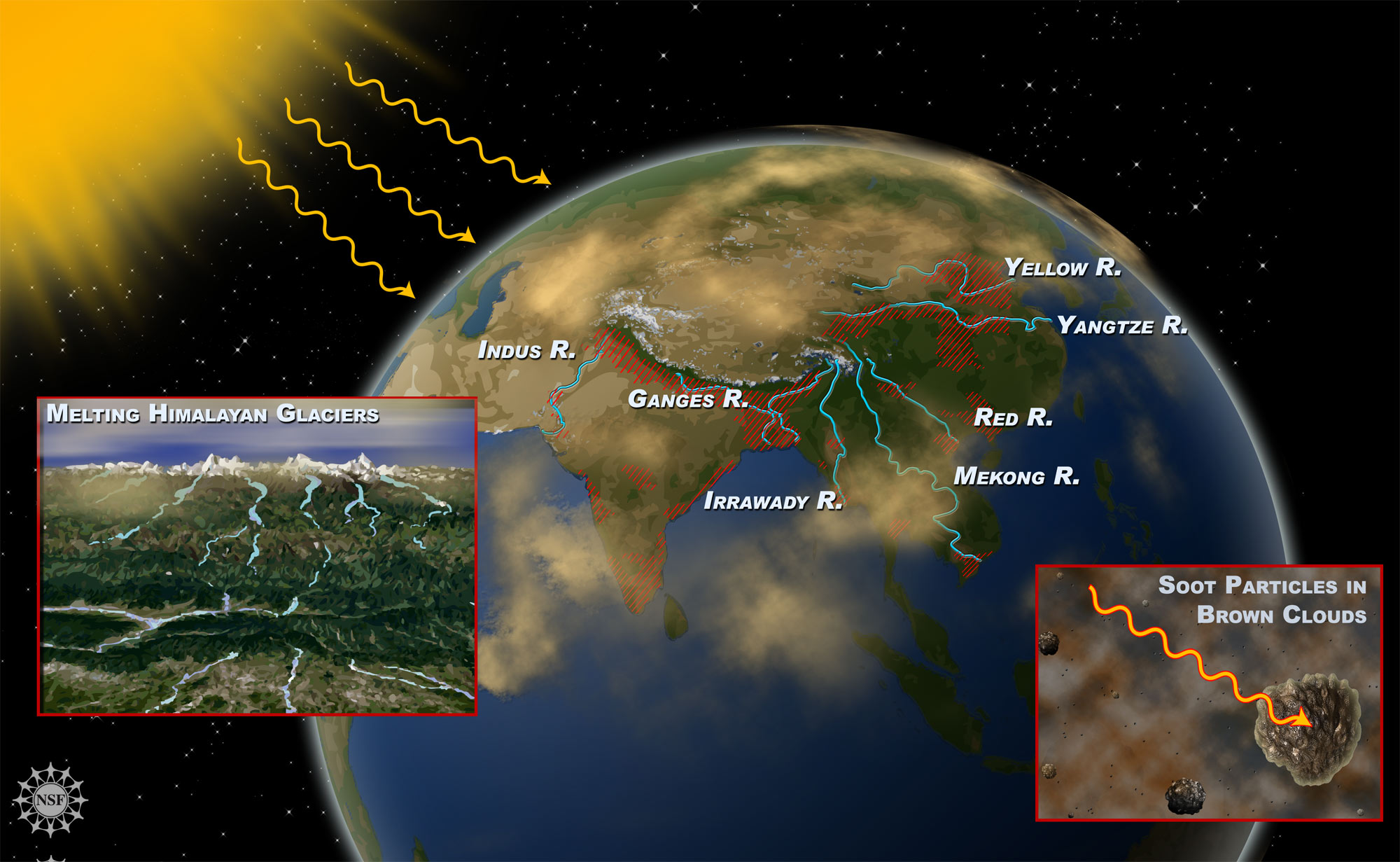
Hugh Pickens writes "The Himalayas, home to some 10,000 glaciers, are the main source of replenishment to lakes, streams, and some of the continent's mightiest rivers, on which millions of people depend for their water supplies. Since the 1960s, the acreage covered by Himalayan glaciers has declined by more than 20 percent with a rate of warming twice the global average over the past 30 years. Now Live Science reports that tiny particles of pollution known as 'black carbon' — and not heat-trapping greenhouse gases — may be causing much of the rapid melting of glaciers in the Himalayas. 'Tibet's glaciers are retreating at an alarming rate,' says James Hansen, director of NASA's Goddard Institute for Space Studies in New York City. 'Black soot is probably responsible for as much as half of the glacial melt, and greenhouse gases are responsible for the rest.' The circulation of the atmosphere in the region causes much of the soot-laden air to 'pile up' against the Himalayas. The soot mixes with other dust from nearby deserts, creating a massive brown cloud visible from space that absorbs incoming solar radiation. As this layer heats up in the Himalayan foothills, it rises and enhances the seasonal northward flow of humid monsoon winds, forcing moisture and hot air up the slopes of the mountain range." -
Not Enough Women In Computing, Or Too Many Men?
itwbennett writes "Do geeks really 'drive girls out of computer science,' as the headline of a LiveScience article contends? Blogger Cameron Laird doesn't think so. In fact, 'I don't think "gender issues in computing" is important enough to merit the attention it gets,' says Laird in a recent post. And maybe the problem isn't that there are too few women in computing, but that there are too many men. 'I'm waiting to read the headline: "Women too smart for careers with computers,"' says Laird, 'where another researcher concludes that only "boys" are stupid enough to go into a field that's globally-fungible, where entry-level salaries are declining, and it's common to think that staying up all night for a company-paid pizza is a good deal.'" -
Fines Fail To Curb Cell Phone Usage While Driving
andylim writes "An in-depth study of over 14,000 London drivers by the Transport Research Laboratory has found an increase in the number of London motorists making and taking calls using their handsets at the wheel between 2008 and 2009, even though harsher penalties were introduced in 2007. It seems that most people, at least in London, still don't respect the fact that there's a much higher risk of being involved in an accident if you're using your cell phone." -
Algae Could Be the Key To Ultra-Thin Batteries
MikeChino writes "Algae is often touted as the next big thing in biofuels, but the slimy stuff could also be the key to paper-thin biodegradable batteries, according to researchers at Uppsala University in Sweden. Uppsala researcher Maria Stromme and her team has found that the smelly algae species that clumps on beaches, known as Cladophora, can also be used to make a type of cellulose that has 100 times the surface area of cellulose found in paper. That means it can hold enough conducting polymers to effectively recharge and hold electricity for long amounts of time. Eventually, the bio batteries could compete with commercial lithium-ion batteries." -
UAVs Go Green With Fuel-Cell Powered "Ion Tiger"
Hugh Pickens writes "Increasingly, the military is deploying unmanned aerial vehicles, or UAVs, as eyes in the sky to scan the ground for targets and threats, especially for missions that are too dangerous for manned aircraft. Now Live Science reports that a new robotic spy plane called 'Ion Tiger' will harness alternative energy to make it more covert and longer lasting than battery-powered or engine-powered UAVs. A 550-watt, 0.75 horsepower hydrogen fuel cell will power the Ion Tiger with four times the efficiency of a comparable internal combustion engine and seven times the energy of the equivalent weight of batteries. When Ion Tiger took flight in October, it exceeded any demonstration of electrically powered flight so far, flying 23 hours and 17 minutes. 'And it carried a 5 lbs. payload to boot — enough to carry, say, a day-and-night camera,' says researcher Karen Swider-Lyons, head of the alternative energy section at the Naval Research Laboratory in Washington. 'No one has come close to flying 24 hours with a significant payload before.' Another big advantage is the Ion Tiger's reduced noise, heat and emissions. 'Think about lawnmowers or chainsaws — they're really loud,' says Swider-Lyons. 'It's hard to spy on people when they know you're there, so you had to fly them at high altitudes to keep them from being heard.'" -
Bug Wears Armor Made of Poo
richardkelleher writes "It seems it doesn't always roll downhill, sometimes it is armor. The case-bearing leaf beetle apparently protects itself by constructing armor made from excrement. Females of these species typically construct bell-shaped receptacles made of feces around an egg immediately after they lay one." -
Swarm of Giant Jellyfish Capsize 10-Ton Trawler
Hugh Pickens writes "The Telegraph reports that the Japanese trawler Diasan Shinsho-maru has capsized off the coast of China, as its three-man crew dragged their net through a swarm of giant jellyfish (which can grow up to six feet in diameter and travel in packs) and tried to haul up a net that was too heavy. The crew was thrown into the sea when the vessel capsized, but the three men were rescued by another trawler. Relatively little is known about Nomura's jellyfish, such as why some years see thousands of the creatures floating across the Sea of Japan on the Tsushima Current, but last year there were virtually no sightings. In 2007, there were 15,500 reports of damage to fishing equipment caused by the creatures. Experts believe that one contributing factor to the jellyfish becoming more frequent visitors to Japanese waters may be a decline in the number of predators, which include sea turtles and certain species of fish. 'Jellies have likely swum and swarmed in our seas for over 600 million years,' says scientist Monty Graham of the Dauphin Island Sea Lab in Alabama. 'When conditions are right, jelly swarms can form quickly. They appear to do this for sexual reproduction.'" -
Controlling Games and Apps Through Muscle Sensors
A team with members from Microsoft, the University of Toronto, and the University of Washington have developed an interface that uses electrodes to monitor muscle signals and translate those into commands or button presses, allowing a user to bypass a physical input device and even control a game or application while their hands are full. The video demonstration shows somebody playing Guitar Hero by making strumming motions and tapping his fingers together, a jogger changing his music without having to touch the device, and a man flexing a muscle to open the trunk of his car while he carries objects in both hands. The academic paper (PDF) is available online. -
Astronomers Find the Calmest Place On Earth
The Narrative Fallacy writes "Live Science reports that astronomers in search of the perfect site to take pictures of the heavens have combined data from satellites, ground stations and climate models in a study to assess the many factors that affect image quality — cloud cover, temperature, sky-brightness, water vapor, wind speeds and atmospheric turbulence. They have pinpointed the coldest, driest, calmest place on earth, known simply as Ridge A, 13,297 feet high on the Antarctic Plateau. 'It's so calm that there's almost no wind or weather there at all,' says study leader Will Saunders, of the Anglo-Australian Observatory. 'The astronomical images taken at Ridge A should be at least three times sharper than at the best sites currently used by astronomers.' Located within the Australian Antarctic Territory, the site is 89 miles from the PLATO (PLATeau Observatory) international robotic observatory. The new site would be superior to the best existing observatories on high mountain tops in Hawaii and Chile, Saunders says. 'Because the sky there is so much darker and drier, it means that a modestly-sized telescope would be as powerful as the largest telescopes anywhere else on earth.'" -
US Life Expectancy May Have Peaked
Hugh Pickens writes "Live Science reports that although life expectancy in the United States has risen to an all-time high of 77.9 years in 2007 up from 77.7 in 2006, gains in life expectancy may be pretty much over, as some groups — particularly people in rural locations are already stagnating or slipping in contrast to all other industrialized nations. Hardest hit are regions in the Deep South, along the Mississippi River, in Appalachia and also the southern part of the Midwest reaching into Texas. The culprits — largely preventable with better diet and access to medical services — are diabetes, cancers and heart disease caused by smoking, high blood pressure and obesity. What the new analysis reveals is the reality of two Americas, one on par with most of Europe and parts of Asia, and another no different than a third-world nation with the United States placing 41st on the 2008 CIA World Factbook list, behind Bosnia but still edging out Albania. 'Beginning in the early 1980s and continuing through 1999 those who were already disadvantaged did not benefit from the gains in life expectancy experienced by the advantaged, and some became even worse off,' says a report published in PLoS Medicine by a team led by Harvard's Majid Ezzati, adding that 'study results are troubling because an oft-stated aim of the US health system is the improvement of the health of "all people, and especially those at greater risk of health disparities.'" -
US Life Expectancy May Have Peaked
Hugh Pickens writes "Live Science reports that although life expectancy in the United States has risen to an all-time high of 77.9 years in 2007 up from 77.7 in 2006, gains in life expectancy may be pretty much over, as some groups — particularly people in rural locations are already stagnating or slipping in contrast to all other industrialized nations. Hardest hit are regions in the Deep South, along the Mississippi River, in Appalachia and also the southern part of the Midwest reaching into Texas. The culprits — largely preventable with better diet and access to medical services — are diabetes, cancers and heart disease caused by smoking, high blood pressure and obesity. What the new analysis reveals is the reality of two Americas, one on par with most of Europe and parts of Asia, and another no different than a third-world nation with the United States placing 41st on the 2008 CIA World Factbook list, behind Bosnia but still edging out Albania. 'Beginning in the early 1980s and continuing through 1999 those who were already disadvantaged did not benefit from the gains in life expectancy experienced by the advantaged, and some became even worse off,' says a report published in PLoS Medicine by a team led by Harvard's Majid Ezzati, adding that 'study results are troubling because an oft-stated aim of the US health system is the improvement of the health of "all people, and especially those at greater risk of health disparities.'" -
Experts Puzzled By Bright Spot On Venus
Hugh Pickens writes "BBC reports that astronomers are puzzled by a strange bright spot which has appeared in the clouds of Venus, first identified by US amateur astronomer Frank Melillo on 19 July and later confirmed by the European Space Agency's Venus Express spacecraft. 'I have seen bright spots before but this one is an exceptionally bright and quite intense area,' says Melillo. The bright spot has started to expand since its first appearance, being spread by winds in Venus' thick atmosphere. Scientists are unsure as to what is causing the spot. 'An eruption would have to be quite energetic to get a cloud this high,' said Dr. Sanjay Limaye of the University of Wisconsin. Furthermore, at a latitude of 50 degrees south, the spot lies outside the region of known volcanoes on Venus. Another potential source for the bright spot are charged particles from the Sun interacting with Venus' atmosphere. It's also possible that atmospheric turbulence may have caused bright material to become concentrated in one area. 'Right now, I think it's anybody's guess,' adds Limaye." -
Jellyfish Swimming Is Mixing the Oceans
eviltangerine writes "A new article from LiveScience suggests that marine creatures, such as the jellyfish, may contribute as much to ocean mixing as wind and tides. Wired is also covering the story and includes a video of the jellyfish in action. From the article, 'The mere act of swimming implies that some water travels with the swimmer,' said CalTech engineer Kakani Katija, co-author of the study in Nature Wednesday. 'Drift applies to all animals, to anything with a body.' No word yet on when the jellyfish blender is to debut." -
Facebook Users Get Lower Grades In College
Hugh Pickens writes "According to a survey of college students Facebook users have lower overall grades than non-users. The study by Aryn Karpinski, an education researcher at Ohio State University, found that Facebook user GPAs are in the 3.0 to 3.5 range on average, compared to 3.5 to 4.0 for non-users and that Facebook users also studied anywhere from one to five hours per week, compared to non-users who studied 11 to 15 or more hours per week. Karpinski emphasized that correlation does not equal causation and that the grades association could be caused by something else. 'I'm just saying that there's some kind of relationship there, and there's many third variables that need to be studied.' One hypothesis is that students who spend more time enjoying themselves rather than studying might tend to latch onto the nearest distraction, such as Facebook or that students who use the social networking site might also spend more time on other non-studying activities such as sports or music. 'It may be that if it wasn't for Facebook, some students would still find other ways to avoid studying, and would still get lower grades. But perhaps the lower GPAs could actually be because students are spending too much time socializing online.' As for herself, Karpinski said she doesn't have a Facebook account, although the co-author of the study does. 'For me, I think Facebook is a huge distraction.'" -
Robot Makes Scientific Discovery (Mostly) On Its Own
Hugh Pickens writes "A science-savvy robot called Adam has successfully developed and tested its first scientific hypothesis, discovering that certain genes in baker's yeast code for specific enzymes which encourage biochemical reactions in yeast, then ran an experiment with its lab hardware to test its predictions, and analyzed the results, all without human intervention. Adam was equipped with a database on genes that are known to be present in bacteria, mice and people, so it knew roughly where it should search in the genetic material for the lysine gene in baker's yeast, Saccharomyces cerevisiae. Ross King, a computer scientist and biologist at Aberystwyth University, first created a computer that could generate hypotheses and perform experiments five years ago. 'This is one of the first systems to get [artificial intelligence] to try and control laboratory automation,' King says. '[Current robots] tend to do one thing or a sequence of things. The complexity of Adam is that it has cycles.' Adam has cost roughly $1 million to develop and the software that drives Adam's thought process sits on three computers, allowing Adam to investigate a thousand experiments a day and still keep track of all the results better than humans can. King's group has also created another robot scientist called Eve dedicated to screening chemical compounds for new pharmaceutical drugs that could combat diseases such as malaria. -
Violent Video Games Can Improve Vision
Ponca City, We love you writes "According to a new study, people who played fighting games on their PCs became up to a 58 percent better at perceiving fine contrast differences, an important aspect of eyesight. The breakthrough is significant because it was previously thought that the ability to notice even very small changes in shades of grey against a uniform background could not be improved. Contrast sensitivity is the primary limiting factor in how well one sees. Volunteers in the study played intensively for 50 hours over nine weeks with either Unreal Tournament 2004 and Call of Duty 2, and the results were compared with another group who played The Sims 2, which is richly visual but does not require as much hand-eye coordination. The improvements lasted for months after game play stopped. The new finding suggests action video games could be used as training devices as a useful complement to eye-correction techniques, since gaming may teach the brain's visual cortex to make better use of the information it receives." -
Why Toddlers Don't Do What They're Told
Hugh Pickens writes "New cognitive research shows that 3-year-olds neither plan for the future nor live completely in the present, but instead call up the past as they need it. 'There is a lot of work in the field of cognitive development that focuses on how kids are basically little versions of adults trying to do the same things adults do, but they're just not as good at it yet. What we show here is they are doing something completely different,' says professor Yuko Munakata at the University of Colorado at Boulder. Munakata's team used a computer game and a setup that measures the diameter of the pupil of the eye to determine mental effort to study the cognitive abilities of 3-and-a-half-year-olds and 8-year-olds. The research concluded that while everything you tell toddlers seems to go in one ear and out the other, the study found that toddlers listen, but then store the information for later use. 'For example, let's say it's cold outside and you tell your 3-year-old to go get his jacket out of his bedroom and get ready to go outside,' says doctoral student Christopher Chatham. 'You might expect the child to plan for the future, think "OK it's cold outside so the jacket will keep me warm." But what we suggest is that this isn't what goes on in a 3-year-old's brain. Rather, they run outside, discover that it is cold, and then retrieve the memory of where their jacket is, and then they go get it.'" -
The 300 Million Year Old Brain
Pickens writes "Paleontologists recently discovered the world's oldest brain nestled within a 300-million-year-old fish fossil of one of the extinct relatives of modern ratfishes, also known as 'host sharks' or chimaeras. These chimaera relatives, called iniopterygians, represented bizarre beasts that sported massive skulls with huge eye sockets, shark-like teeth in rows, tails with clubs, huge pectoral fins that were placed almost on their backs, and bone-like spikes or hooks tipping the fins. The brain shows details such as a large vision lobe and optic nerve stretching to the proper place on the braincase, which fits with the fish's large eye sockets. The ear canals of the extinct fish only exist on a horizontal plane so the fish could only detect side-to-side movements, and not up or down. 'There is nothing like this known today; it is really bizarre,' said John Maisey, paleontologist at the American Museum of Natural History in New York City. 'But now that we know that brains might be preserved in such ancient fossils, we can start looking for others. We are limited in information about early vertebrate brains, and the evolution of the brain lies at the core of vertebrate history.'"