Slashdot Mirror
Domain: maths.org
Stories and comments across the archive that link to maths.org.
Comments · 41
-
Re:"developed an artificial intelligence(AI) progr
The only thing the 1950s needed to obtain recent results in convolutional neural networks, was the planar process of 1959 and a suitably accelerated coefficient of Moore's law. We can get there by applying the inverse Hackermann function.
When planning a project, increase the amount of time that you estimate it will take by doubling the number and going up to the next time unit.
Dividing 18 by 2 and shifting to a lower unit gives us a doubling time of nine weeks. Probably we're recognizing cats by 1967. Before the modern API was half fleshed out.
Seriously, have you looked at the sophistication of mathematics in the 1950s?
The discovery came when Ono and fellow mathematician Andrew Granville were leafing through Ramanujan's manuscripts, kept at the Wren Library at Trinity College, Cambridge. "We were sitting right next to the librarian's desk, flipping page by page through the Ramanujan box," recalls Ono. "We came across this one page which had on it the two representations of 1729 [as the sum of cubes]. We started laughing immediately."
What the equation in Ramanujan's manuscript illustrates is that Ramanujan had found a whole family (in fact an infinite family) of positive whole number triples x, y and z that very nearly, but not quite, satisfy Fermat's famous equation for n=3.
Ono and Trebat-Leder found that Ramanujan had also delved into the theory of elliptic curves. He did not anticipate the path taken by Wiles, but instead discovered an object that is more complicated than elliptic curves. When objects of this kind were rediscovered around forty years later they were adorned with the name of K3 surfaces — in honour of the mathematicians Ernst Kummer, Erich Kahler and Kunihiko Kodaira, and the mountain K2, which is as difficult to climb as K3 surfaces are difficult to handle mathematically.
His work amounts to one box, kept at Trinity College, and three notebooks, kept at the University of Madras. That's not a lot. It's crazy that we are still figuring out what he had in mind. When is it going to end?"
The book is not even closed yet on the mathematics of the 1920s.
-
Re:Senile?
No, he was asked a leading question by someone about us being in a simulation, and answered it using the standard philosophical argument people use for the simulation argument. And then he clarified that he and his brother are no longer allowed to discuss these things in hot tubs anymore.
Everyone, I assume, has entertained these ideas and thought about them. He didn't bring it up, he wasn't out to make some real point. You can use similar arguments to argue that we are at, or close to, one of the last human generations, or that the traffic in the other lane really does go faster.
They are all examples of the observation selection effect, wherein you make the assumption that you as the observer are a randomly chosen sample in the population space. In my mind, that right there is the trouble with all the arguments using that principle. You start out with an assumption of the distribution of a random sample, then you _force_ that random sample to be you, and then make conclusions based on the (no longer) random sample. Any conclusions made after the force are not valid. Just like in magic, if every time the magician shows you a "random" card from a deck, it's the 3 of clubs, then obviously the whole deck contains only 3 of clubs, right?
-
Re:Religion and ethics vs. money
A very good discussion of Adam Smith's Invisible Hand and how the atheists Ayn Rand and Ludwig Von Mises were subtly perverting it.
-
Re:Golden Ratio
This is the best ratio, it is natural and beautiful.
Because it has some intrinsic property that makes it so, or because everyone just believes that to be true?
Given how prevalent it is in nature and human culture, there is probably a little of both. The wikipedia article on the Golden Ratio notes several diverse places where it's appeared through history and nature. It is frequently associated with beauty and harmony, and there seems to be some indication that it correlates well with what we consider beautiful when looking at people.
Pertinent to your question, the Wikipedia page does note that there seems to be some disagreement on whether we do indeed have a preference for the Golden Ratio in aesthetics. http://plus.maths.org/content/os/issue22/features/golden/index is one of the linked articles, and seems interesting reading.
-
Re:Size.
Burning buried sunshine | plus.maths.org. 23 tons of organic matter in every litre, baby!
-
Re:Another couple of factors
Your figure assumes that 100% of the plant matter per year is transformed into coal/oil/etc. This is not even close. Only about 0.0093% of the carbon in plant matter becomes fossil fuels. The remainder stays in the carbon cycle.
That comes to 3.72% of annual plant matter generation to supply the same energy. Though probably at least double that to account for efficiency.
Whether that amount is sustainable is left as an exercise for someone else.
-
Re:Proof use a lot of brute force
A really good proof would be able to show a solution for n dimensions, where n > 2, but all we have as a proof is an exhaustive enumeration of the possible networks in 2 dimensions. Most unsatisfying, to those of us who like to see analytical proofs that don't rely on mechanical methods.
While I am inclined to agree with you, the thing is that there is no a priori reason why such a proof should exist. We should be happy that a proof exists at all.
For some additional perspective on this, here is a very readable article by Chaitin on his Omega number. (Since this is a divulgation article, it may be advisable to read first his short bio at the end, otherwise this may seem crackpottery to some).
-
Re:150 million per ticket?
If you like thinking about this kind of stuff, I recommend reading "Fooled by Randomness" by N. Taleb where he talks about stuff like survivorship bias among rich traders :
"Say we have a collection of traders whose strategies do no better than random: they will have a good year half the time, a bad year the other half. Half of them will have a good year. A quarter will have two good years in a row, and so on. One in 32 will do well five years running. Of course, it never occurs to them that their success is random: they attribute it to their superior strategy, and imagine they are in the top 3% of traders."
-
False positive?
While entirely possible that there are illicit drug usage at the Kennedy Space Center, it is also entirely possible that it was a false positive given that it was a field tests by law enforcement officials, it does not confirm anything. AFAIK there are a number of substances that produce false positives for most illicit drug field tests (which are merely quick and simple tests). And if you want a work place with possible mundane usage of unusual chemical substances that most street thugs don't have in their kitchen, then KSC is the place to be.
While the initial report is newsworthy, it isn't particularly interesting until the substance is at least confirmed in an analytic laboratory.
Maybe I'm going to have to write a math test module for the Slash code, testing basic statistical knowledge before to post stories and comments.
-
Re:Science?
and this.
-
Re:Electric cars are dumb.
Oh, is that what's tripping you up? Here:
https://nrich.maths.org/discus/messages/8577/7263.html?1071520520
v = u + at
27m/s = 0 + (a * 5s)
a = 27m/s / 5s
a = 5.4m/s^25.4m/s^2 * 4,865kg = 26,271 newtons = 26kW
That sounds about right. Snack time!
Fig newton?
-
Re:Truth
I feel as safe on my bike as I do driving a car... if not safer due to the added awareness and fewer distractions riding a motorcycle gives you.
And people feel safer in SUVs than in sedans, and safer in cars than in airplanes. One source I found claims that driving a motorcycle for the same number of miles as a in a car exposes one to 40 times the risk of death. Not saying you shouldn't use a motorcycle, just noting that feeling safe doesn't imply being safe.
-
Re:Some recommendations
I'd like to add a couple -
as a kid I really enjoyed the 'Cosmos' TV series by Carl Sagan. It's available on DVD -
http://stores.channeladvisor.com/Movie-Mars/items/ item.aspx?itemid=2805613
and I found "In Code: a young woman's mathematical journey" by Sarah Flannery to be a great read about how a young girl became a math wiz and develops her own cryptographic algorithm for a pan-european science project. It's written in the first person, and gives a great picture of what it's like to live a life that includes math. I'm not all the way through - I wanted to wait until I had access to the software so I could follow along with the examples in the book, but I was really inspired by what I've read so far.
more info: http://plus.maths.org/issue14/reviews/book2/index. html
Best of luck inspiring young minds to take on these challenges when there are so many other flashier distractions. -
Dangerous fun with Capacitors aside...
First off, the electroplating tank:
These are a blast. Everything looks better if you electroplate it!
Any of the cool looking, under the hood gagetry for your car, found cheaply at Schuks Auto would look better in gold. Any flat sided metal object can be enhanced with whatever artwork you can make a sillouette of on your computer, print in Press-n-Peel masking material
iron on, and plate.
Flatware should never be monochromatic
Your own Electron Microscope? Sweet.
The first thing to do is find the guy that's good at operating this and buy him several good lunches. Getting good images is tricky. That done, there is a world of stuff that looks better super close up, and best yet, the annoyingly black and white nature of this device lends itself to.... Yes! Electroplate sillouttes! Imagine how cool the aluminum case sides of your favorite computer would be if this were etched on the side. Your kids/nephews could have the coolest metal lunchboxes in the school. Like this or this or this or this.
A clear spray-on enamel will keep oxidation from uglying things up if your experiment with some of the more easily tarnished metals like copper and silver....
Sounds like you're in for a good time. Good luck. -
Taipei 101 is "earthquake proof"
Search for "TMD" (tuned mass damper) on this page.
-
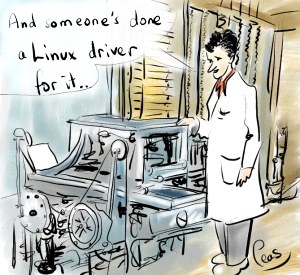
Nothing Beats a 9 Pin Dot Matrix Printer?
If you are going to go old tech, go all the way.
Our good friend and frustrated hero of the Victorian age designed a printer for his Difference Engine. Using his blueprints, the Science Museum of London has got this printer working.
Naturally, it's easy to find some humour for the Linux crowd about this printer too. -
Re:Interesting ProjectThanks for the idea of using bugmenot!
Okay, I got the software and it's pretty interesting. Basically, you can imagine it as modelling the spread of a meme throughout a social network. So, you start out with a population that's never heard of $JOKE. One person makes it up (gets "infectious" status), and starts transmitting it to their "Susceptible" friends; this increases those with "exposured" status.
Eventually, their friends get the idea to start telling other friends (i.e. they're "infectious"). After a while the joke gets old and they're through ("recovered" status). However, their friends tell the $JOKE to their own circle of friends, expanding the $JOKE outwards.
You can see this cascading effect in the "timeSeries" window. The blue dots represent "Susceptible", yellow="Exposed", red="Infectious", Green="Recovered".
Of course, the program is more like spreading a joke verbally instead of across the internet, because it takes physical proximity to spread a disease. However, it can jump from city-to-city via air transportation, etc.
The interesting thing about this program is that you can effectively modify the structure of the social network, by changing the geometry and connections between cities, etc. In the past, very simple models have been created without taking spatiotemporal effects into account.
In case you're wondering, I once tried to model the spread of an infectious disease within a city. But due to my lack of programming skills, I couldn't get it to work.
-
Re:LazinessPeople need to feel that what they're being taught is relevant to them; otherwise, they'll never learn it. I can attest to this, as I'm sure can most people here.
I agree with you. Here's a free online video on demand series called "For All Practical Purposes" meant to address the issue with 26 half-hour programs (Episode 14, "Zero Sum Games" is pretty neat) from the Annenberg Corporation for Public Broadcasting, and the accompanying textbook. That was the easy part. Now, how're we going to get the kids to watch it?
= 9J =
-
Re:twin primes.
Good summary from a waveform perspective.
There are definitely an infinitely large number of primes. Proof: assume a finite number of primes p1,p2,...,pn (counting from smallest to largest). Then p1*p2*...*pn + 1 is divisible by none of these (hence is prime) and is larger than pn. This is a contradiction of the original assumption, which must therefore be wrong. Hence there are an infinite number of primes. -
Re:Microsoft - Standard Oil * How to lie with stat"Statistics 'prove'..."
Maybe Darrell Huff's "How to lie with statistics" should become a mandatory read at all high schools - read an review here.
A very good read if you want to know how statistics can be (and is) abused to 'prove' all kind of things. -
Re:You didn't read the book, did you?"Which success are you talking about? I haven't known of any success in explaining consciousness based on which parts of the brain use more energy when we do certain tasks."
Success as far as in, "This is Wernicke's area, this is where we put meaning together" or "This is Broca's area, this is where the brain decides how to move the parts of the mouth and throat in order to make speech". This is opposed to what came before, which was basically "We have no flipping clue, but it certainly is the brain that is thinking!"
See, before we had the entire brain, take it or leave it, accounting for consciousness as a whole, take it or leave it. Now, with brain scans and studies of lesion and stroke patients, we can identify parts of consciousness, which are directly correlated with parts of the brain. We now have thinking organs: e.g. This part handles motion, this part detects faces, this part recognizes close relatives. People who have these certain parts knocked out physically are actually missing parts of their consciousness.
" As Doug Lenat's program Eurisko proved, Turing machines are pretty good in understanding theorems. Google it.".
As Goedel showed, there is at least one theorem that computers can't understand. Not 'can't' as in, "we don't think so", nor "maybe if we had better/faster computers they could", but can't as in demonstrably, logically proved that computers (read: turing machines) can not, will not be, and are not capable of understanding. Google it.
-
Idiot.Hmm.. Wasn't there? I can recall having an encylopedia on CD in '95 IIRC.
The bet was made in 1972. Did You have an encyclopedia on CD back then? On diskette? Must have been awfully abridged. Project Gutenberg was started just the year before in 1971- I doubt you had a computerized dictionary, let alone an encyclopedia.
-
Re:Actually...
check out this article featured on plus magazine (maths web magazine by cambridge university - part of the millennuim mathematics programme.) by Livio entitled, "The golden ratio and aesthetics".
-
Re:Actually...
check out this article featured on plus magazine (maths web magazine by cambridge university - part of the millennuim mathematics programme.) by Livio entitled, "The golden ratio and aesthetics".
-
Re:Actually...
check out this article featured on plus magazine (maths web magazine by cambridge university - part of the millennuim mathematics programme.) by Livio entitled, "The golden ratio and aesthetics".
-
Valles Marineris made by lightning?Ha ha ha ha ha ha ha ha ha ha ha ha ha ha ha ha ha ha ha ha ha
That's the stupidest thing I've ever heard. I'm not certain why you'd need a gigantinormous lightning bolt to explain loose rock on the surface of a planet which bears the scars of millions of impacts. And since planetary surfaces tend to act as equipotential surfaces, what sort of bizarro explanation do you have for a lightning bolt that travels horizontally for 4000 km? You claim that "water, sand and tectonics don't explain much" without one shred of evidence. Here's what the USGS has to say about the formation of the Valles Marineris:
"[F]irst the surface collapsed into a few deep depressions that later became filled with layered material, perhaps as lake deposits. Then graben-forming faults cut across some of the older troughs thus widening existing troughs, breaching barriers between troughs, and forming additional ones. At that time the interior deposits were locally bent and tilted, and perhaps water, if still present, spilled out and flowed toward the outflow channels. Huge landslides fell into the voids created by the new grabens. Wind-drifted material, mostly dark in color, apparently still moves along the canyon floor and locally forms conspicuous dunes."
I don't think this theory relies on tectonics per se. The surface collapse was merely due to the enormous weight of the nearby and recently extruded Tharsis bulge. But in the strange world of leonbrooks, the theory that requires the largest rewrite of physics is always the correct one.
Your ideas about the magnetic fields of planets are almost as wacko. Ignoring the fact that each planet's chemistry, structure, rotation, and history are unique and that dynamo theories are highly nonlinear, you insist that the noted variation in them can't be explained by dynamo theories and give no evidence.
How you'd set about reconciling a dynamo theory with the lesser gas giants is beyond me. John, if you do try to explain it (as many great men have tried to do in the past) please give me time to sell tickets.
Too late. Its already been done. Perhaps if you weren't wasting your time vainly trying to debunk all mainstream science, you'd have noticed.....
-
Wow
You managed to stay on topic for only 20% of your rant. Sticking with magnetic fields for the moment.... Another poster has already pointed out quite reasonable explanations for the magnetic fields of the terrestrial planets. "It is quite clear that our current ideas about planetary magnetism are at best whistling in the dark" because we don't know enough about the interiors of the planets, not because of fundamental flaws in physics theories as you seem to imply. A recent model has explained the complex fields of Neptune and Uranus, relying on a thin convective region over a nonconvective fluid. It would thus be quite difficult to compare Venus and Uranus, as their internal structures are radically different.
-
Re:550 Pounds of money?!?!?!?
it's only because you are all too stupid that you can't fucking handle the cahnge[sic].
No, it's only because we're so omnipotent, we don't have to.
Mars Polar Lander, anyone?
-
The irrational number defense
How about a non-terminating, non repeating decimal expansion of a number? Pi? sqrt(2)? The square root of 2, in particular, has been shown to be an irrational number. This means that it cannot be written as the form m/n, where m and n are integers.
This means that it can't be repeating (0.454545... = 45/99) and it can't terminate (0.3453 = 3453/10000). This was proved back in pythagorean times (second yellow box as you scroll down the page).
Note that most square roots, cube roots, 4th roots, etc are going to be irrational. Is that a big enough choice of random OTPs for you? Say only a tiny fraction of numbers are irrational. A tiny fraction of an Aleph-one infinite numbers is still infinite. (See degrees of infinity, about halfway down the page). -
Turns out I was wrong
After googling, I guess I ranted too soon. It turns it the Puzzle got solved by 2 mathematicians. It's incredible how they did it.
-
triumph of taylorismThank you, Sue Clayton, for indirectly pointing out that Hollywood is suffering from creative necrosis.
There are, of course, scientific guidelines behind any art form, such as the Golden Ratio, but this isn't one of them. While I am open to the possibility that there may be some universals in human narrative, I shudder to think that the commodified culture of Hollywood might impose its formulas on us like a mental template. Or is it too late?
Whenever Taylorism is applied to a creative endeavour, we get quanity over quality and the fears of General Ned Ludd and the Army of Redressers as well as Socrates become valid.
Dehumanized art is dead art.
-
Re:Most exciting!
These scrolls are not lost to us!
They're lost to me. I haven't seen any of them yet, nor am I sure where to look if they've been published. Will they be published? I found an old article which seems to indicate so, but nothing more. I didn't search very hard though.
...and how long until Hollywood tries to declare copyright on them, and the only way you will "see" them is through the eyes of a low brow movie.
And why, in the case of the Library of Alexandria?
Religious ferver. It was burned to the ground by followers of Christ.
Don't worry, I'm sure the MPAA, RIAA, and Microsoft will help the modern world overcome such heresy, but with DRM rejection certificates instead of book burning.
I tried a Google search, but didn't find anything very interesting. A little more info at an article titled "Ancient maths revealed". Some possibly interesting links (at bottom of page). An article at BYU which goes into slightly more detail about the multi-spectral imaging technology. Though your "religious ferver" comment may apply here. If BYU does create a digital archive, will they really release lesbian poetry?
-
Re:77 Million Years?
-
Erlang's formula might help you outPeople oversell their connectivity all the time, and if people tell you they don't, you are going to pay more. Erlang's formula, properly adapted and applied, will make sure there are as few expensive bits of equipment lying around idle as possible by estimating the traffic you are likely to get. The downside is that you get a statistical probability of your users peaking out during rush hours or if the formula is applied in error. The upside is a cheaper connection because your vendor isn't sitting on redundant equipment.
It all depends what you are after. I would go for the cheaper service if I was satisfied with them, especially since I have a knee-jerk reaction to salespeople who try to shuffle the last fifty years or so of traffic estimation techniques under the carpet to sell a more expensive solution.
Other people have told you to ask for the usage graphs of your present provider. That will tell you if his resources are maxed out for any reasonable amounts of time. If they are, take it up with him. If they aren't, give the salesdroid a kick on the shin from me.
-
Re:A Dilemma:
-
Re:just wondering...
-
Re:And the bell tolls...You are very mistaken. Capitalism works precisely because it does _not_ assume that people are good and honest. Capitalism assumes that people will act out of self-interest, which is usually true.
Sorry, Capitalism doesn't really assume that people will be good, but it does assume that they will play fair.
Somehow when an area is dominated by one corporation who is overcharging for bad service, a small company is supposed to be able to start up and offer some innovatice new approach which will lead to competition, improved service, and cheaper prices for everyone. After all, when confronted with a cheaper better product, the larger company will have to improve to stay competitive, right?
Well what if instead of playing fair the big competitor does a little more marketing, and then drops the price on their product to less than it costs to make it? Or if there's a high barrier to entry into the market, they don't even need to drop it that low, just below the price for the new company to provide the service given the added entry costs. Wait a few months, new company goes bankrupt, big company raises the rates again.
That's not how capitalism is supposed to work, and the only reason it doesn't happen more often is because the Government stepped in and made laws to try and make the coporations "play nice."
Yeah, communism is even more idealistic and way ahead of it's time, but Capitalism takes a lot of things on faith too.
If the corporations ever got big enough and the government looked the other way long enough, you would eventually find corporations buying "compulsion" lisences, either secretly or out in the open. Mafioso guys showing up at your door to convince you to shut down your new startup operation is not what Capitalism is supposed to be about, but it is a realistic extension of the idea.
Even Adam Smith himself believe that fair play was needed in order for capitalism to work successfully.
-
#define socialism?
As a Finn I often find the US conception of socialism more than slightly odd.
Addmittedly we don't have a Thatcher-Reagan economy and our right-wing parties start to the left of the Democrats. Still socialism is not the right term if you ask me. Such terms as the welfare state or social democracy are more suited.
We do have extensive social security, public education and public health services. Trade unions are also major political organizations instead of mob gangs. This still doesn't mean that the workers control the means of production as our friend Karl Marx put it.
Only a few things like trains and the state alcohol resale monopoly (still exists!) are still mostly or completely owned by the government. Except for the national broadcasting company nearly everything is on the privatization list.
We do have more governmental control in many areas (radio licensing,
-
Re:f=ma? You are such a troll.
Just because a bunch of people do something stupid, does not make it any less stupid.
I know what the hell 'Priori' means, I'm just ignoring it. It relates more to you then me. Mostly everybody believed the world was flat once but is that the case. NO(I said that about 2 posts ago.) I agree with the Anonymous Poster, you need to have a more of an open mind. Something with as little proof as their is needs to be questioned. I spilled theory on your plate. I never said it was right. I said it had the possibility of being right. I don't agree with Einstein's theory of relativity because it has problems(too many assumed unproven theories.) I've read many Physics books and have taken several physic's classes and understand theory. I just don't agree with it. I'm probably in a better position to argue because I ACTUALLY UNDERSTAND PHYSICS. Their are more then one theory, live with it. Try to prove yours right. I'll believe it when I see it. Like I said earlier, everything we deal with are still theories. Just because millions of people believe something and continues the theory by researching it and building on it, does not make it more right. People will believe what they want to believe.
---- -
Re:AI = Lemon fresh scentPlanning and scheduling are hard AI problems and way way more complex than IP routing or print spooling
These are all the same problem, if you consider them in their full glory; a really good print spooler that respects job priorities, printer statuses, patterns of use, etc. etc. might wind up printing three-lower priority jobs over one high priority job, or split a high priority job between printers (and proceed each piece with a cover sheet giving directions on how to re-assemble the job). Or it could detect a paper out condition and move the rest of the job to another printer. Or, in fact, make use of any sort of fancy planning / scheduling trick you care to think of. It's all the same problem.
And yes, it is a hard (NP complete, runs into the frame problem, etc.) problem. But that doesn't mean that any attack on it is AI! This is a classic (and too often revisited) logic error. You have a goal (AI). If you could obtain that goal, it would have some consequence (you could presumably write good scheduling software). You obtain the consequent, and announce that you have reached the goal!
To see that this is fallacious, consider: You have a goal (go to Scottland); it would have a consequence (you could try haggis). So then someone in your home town feeds you haggis, and you mistakenly announce that you have been to Scotland!
These problems are AI in the sense that (a) no known tractable engineering solution exists and (b) they are tasks that lie squarely in the province of (talented and capable) human beings.
This statement argues for my side, since they evidently have (a) found a tractable engineering solution and (b) it doesn't involve sending talented and capable human beings with each mission. Therefore it must not be AI.
--MarkusQ
P.S. (I invite you to try writing serious planning/scheduling software if you doubt me.)
I'm afraid I didn't wait for your invitation. Been there, done that. Many times.
-
Re:Next step is to put a vacuum in the tubes...
I'm wondering who blew their moderator points on your comment. The fact is that there ARE CURRENT DAY THEORIES on using mediums (non-vacuum) to enable FTL communications. And no, anonymous cowards, this is not a goat sex link.