Slashdot Mirror
Domain: microsoft.com
Stories and comments across the archive that link to microsoft.com.
Stories · 1,971
-
Microsoft's Security Bulletins Will End In February (computerworld.com)
Remember how Microsoft switched to cumulative updates? Now Computerworld points out that that's bringing another change. An anonymous reader quotes their report: Microsoft next month will stop issuing detailed security bulletins, which for nearly 20 years have provided individual users and IT professionals information about vulnerabilities and their patches... A searchable database of support documents will replace the bulletins; that database has been available, albeit in preview, since November on the portal Microsoft dubbed the "Security Updates Guide," or SUG. The documents stored in the database are specific to a vulnerability on an edition of Windows, or a version of another Microsoft product. They can be sorted and filtered by the affected software, the patch's release date, its CVE identifier, and the numerical label of the KB, or "knowledge base" support document.
Redmond Magazine reports that Microsoft still plans to continue to issue its security advisories, and to issue "out-of-band" security update releases as necessary. -
Rumors of Cmd's Death Have Been Greatly Exaggerated (microsoft.com)
Senior Program Manager at Microsoft has responded to speculations that Command Prompt is going away. He writes: The Cmd shell remains an essential part of Windows, and is used daily by millions of businesses, developers, and IT Pro's around the world. In fact:
1. Much of the automated system that builds and tests Windows itself is a collection of many Cmd scripts that have been created over many years, without which we couldn't build Windows itself!
2. Cmd is one of the most frequently run executables on Windows with a similar number of daily launches as File Explorer, Edge and Internet Explorer!
3. Many of our customers and partners are totally dependent on Cmd, and all its quirks, for their companies" existence!
In short: Cmd is an absolutely vital feature of Windows and, until there's almost nobody running Cmd scripts or tools, Cmd will remain within Windows. -
FBI and Homeland Security Detail Russian Hacking Campaign In New Report (theguardian.com)
An anonymous reader quotes a report from The Guardian: The U.S. Department of Homeland Security (DHS) and FBI have released an analysis of the allegedly Russian government-sponsored hacking groups blamed for breaching several different parts of the Democratic party during the 2016 elections. The 13-page document, released on Thursday and meant for information technology professionals, came as Barack Obama announced sanctions against Russia for interfering in the 2016 elections. The report was criticized by security experts, who said it lacked depth and came too late. "The activity by [Russian intelligence services] is part of an ongoing campaign of cyber-enabled operations directed at the U.S. government and its citizens," wrote the authors of the government report. "This [joint analysis report] provides technical indicators related to many of these operations, recommended mitigations, suggested actions to take in response to the indicators provided, and information on how to report such incidents to the U.S. government." The government report follows several from the private sector, notably a lengthy section in a Microsoft report from 2015 on a hacking team referred to as "advanced persistent threat 28" (APT 28), which the company's internal nomenclature calls Strontium and others have called Fancy Bear. Also mentioned in the government document is another group called APT 29 or Cozy Bear. The Microsoft report contains a history of the groups' operation; a report by security analysts ThreatConnect describes the team's modus operandi; and competing firm CrowdStrike detailed the attack on the Democratic National Committee shortly before subsequent breaches of the Democratic Congressional Campaign Committee and the Hillary Clinton campaign were discovered. -
Microsoft Formally Introduces Zo, Its Latest AI-Powered Chatbot (windowscentral.com)
An anonymous reader quotes a report from Windows Central: Microsoft is surging forward with its commitment to artificial intelligence (AI), formally announcing its latest chatbot, Zo. In a post outlining its commitment to AI, Microsoft introduced Zo as the next chapter in the evolution of its attempts to create a social chatbot. Zo is built on the back of the same technology that powers Microsoft's other chatbots in China and Japan, Xiaoice and Rinna. Zo is meant to learn from her interactions with humans, and is able to respond to conversations with her own personality. In a nod to an awkward turn of events involving Microsoft's last attempt at a social chatbot, Tay, the company notes that Zo has guards in place to prevent exploitation. While you can currently only strike up a conversation with Zo on Kik messenger, Microsoft says it has plans to bring the chatbot to Skype and Facebook Messenger as well. Still, if you use Kik, you can start a conversation up with Zo now. Otherwise, head to Zo.ai to request an invite to chat with the bot on Messenger when it's available. -
New Bug In Windows 10 Anniversary Update Brings Wi-Fi Disconnects (infoworld.com)
Some Windows 10 PCs are now experiencing sudden drops in their Wi-Fi connections, with the Network Diagnostics tool reporting "Wi-Fi doesn't have a valid IP configuration." An anonymous reader quotes InfoWorld's Woody Leonhard: I've heard from many people who blame the Wi-Fi disconnect on Friday's KB 3201845, the patch (which still isn't documented on the Win10 update history site) that brings version 1607 up to build 14393.479. It's unlikely that the new patch brought on the bug because the large influx of complaints started on December 7 -- two days before the patch...
Speculation at this point says the disconnect results when a machine performs a fast startup, setting the machine's IP address to 169.x.x.x. It's an old problem, but somehow it's come back in spades in the past two days. I have no idea what triggered the sudden outbreak, as there were no Win10 1607 patches issued on December 6, 7 or 8.
Microsoft acknowledged the problem Thursday, recommending customers try restarting their PCs (or performing a clean start). Woody writes that it looks like Microsoft's latest Windows 10 patch "didn't cause the bug. But the patch didn't fix it, either." -
Microsoft Researchers Offer Predictions For AI, Deep Learning (theverge.com)
An anonymous reader quotes a report from The Verge: Microsoft polled 17 women working in its research organization about the technology advances they expect to see in 2017, as well as a decade later in 2027. The researchers' predictions touch on natural language processing, machine learning, agricultural software, and virtual reality, among other topics. For virtual reality, Mar Gonzalez Franco, a researcher in Microsoft's Redmond lab, believes body tracking will improve next year, and then over the next decade we'll have "rich multi-sensorial experiences that will be capable of producing hallucinations which blend or alter perceives reality." Haptic devices will simulate touch to further enhance the sensory experience. Meanwhile, Susan Dumais, a scientist and deputy managing director at the Redmond lab, believes deep learning will help improve web search results next year. In 2027, however, the search box will disappear, she says. It'll be replaced by search that's more "ubiquitous, embedded, and contextually sensitive." She says we're already seeing some of this in voice-controlled searches through mobile and smart home devices. We might eventually be able to look things up with either sound, images, or video. Plus, our searches will respond to "current location, content, entities, and activities" without us explicitly mentioning them, she says. Of course, it's worth noting that Microsoft has been losing the search box war to Google, so it isn't surprising that the company thinks search will die. With global warming as a looming threat, Asta Roseway, principal research designer, says by 2027 famers will use AI to maintain healthy crop yields, even with "climate change, drought, and disaster." Low-energy farming solutions, like vertical farming and aquaponics, will also be essential to keeping the food supply high, she says. You can view all 17 predictions here. -
Microsoft Researchers Offer Predictions For AI, Deep Learning (theverge.com)
An anonymous reader quotes a report from The Verge: Microsoft polled 17 women working in its research organization about the technology advances they expect to see in 2017, as well as a decade later in 2027. The researchers' predictions touch on natural language processing, machine learning, agricultural software, and virtual reality, among other topics. For virtual reality, Mar Gonzalez Franco, a researcher in Microsoft's Redmond lab, believes body tracking will improve next year, and then over the next decade we'll have "rich multi-sensorial experiences that will be capable of producing hallucinations which blend or alter perceives reality." Haptic devices will simulate touch to further enhance the sensory experience. Meanwhile, Susan Dumais, a scientist and deputy managing director at the Redmond lab, believes deep learning will help improve web search results next year. In 2027, however, the search box will disappear, she says. It'll be replaced by search that's more "ubiquitous, embedded, and contextually sensitive." She says we're already seeing some of this in voice-controlled searches through mobile and smart home devices. We might eventually be able to look things up with either sound, images, or video. Plus, our searches will respond to "current location, content, entities, and activities" without us explicitly mentioning them, she says. Of course, it's worth noting that Microsoft has been losing the search box war to Google, so it isn't surprising that the company thinks search will die. With global warming as a looming threat, Asta Roseway, principal research designer, says by 2027 famers will use AI to maintain healthy crop yields, even with "climate change, drought, and disaster." Low-energy farming solutions, like vertical farming and aquaponics, will also be essential to keeping the food supply high, she says. You can view all 17 predictions here. -
Microsoft Researchers Offer Predictions For AI, Deep Learning (theverge.com)
An anonymous reader quotes a report from The Verge: Microsoft polled 17 women working in its research organization about the technology advances they expect to see in 2017, as well as a decade later in 2027. The researchers' predictions touch on natural language processing, machine learning, agricultural software, and virtual reality, among other topics. For virtual reality, Mar Gonzalez Franco, a researcher in Microsoft's Redmond lab, believes body tracking will improve next year, and then over the next decade we'll have "rich multi-sensorial experiences that will be capable of producing hallucinations which blend or alter perceives reality." Haptic devices will simulate touch to further enhance the sensory experience. Meanwhile, Susan Dumais, a scientist and deputy managing director at the Redmond lab, believes deep learning will help improve web search results next year. In 2027, however, the search box will disappear, she says. It'll be replaced by search that's more "ubiquitous, embedded, and contextually sensitive." She says we're already seeing some of this in voice-controlled searches through mobile and smart home devices. We might eventually be able to look things up with either sound, images, or video. Plus, our searches will respond to "current location, content, entities, and activities" without us explicitly mentioning them, she says. Of course, it's worth noting that Microsoft has been losing the search box war to Google, so it isn't surprising that the company thinks search will die. With global warming as a looming threat, Asta Roseway, principal research designer, says by 2027 famers will use AI to maintain healthy crop yields, even with "climate change, drought, and disaster." Low-energy farming solutions, like vertical farming and aquaponics, will also be essential to keeping the food supply high, she says. You can view all 17 predictions here. -
Microsoft Researchers Offer Predictions For AI, Deep Learning (theverge.com)
An anonymous reader quotes a report from The Verge: Microsoft polled 17 women working in its research organization about the technology advances they expect to see in 2017, as well as a decade later in 2027. The researchers' predictions touch on natural language processing, machine learning, agricultural software, and virtual reality, among other topics. For virtual reality, Mar Gonzalez Franco, a researcher in Microsoft's Redmond lab, believes body tracking will improve next year, and then over the next decade we'll have "rich multi-sensorial experiences that will be capable of producing hallucinations which blend or alter perceives reality." Haptic devices will simulate touch to further enhance the sensory experience. Meanwhile, Susan Dumais, a scientist and deputy managing director at the Redmond lab, believes deep learning will help improve web search results next year. In 2027, however, the search box will disappear, she says. It'll be replaced by search that's more "ubiquitous, embedded, and contextually sensitive." She says we're already seeing some of this in voice-controlled searches through mobile and smart home devices. We might eventually be able to look things up with either sound, images, or video. Plus, our searches will respond to "current location, content, entities, and activities" without us explicitly mentioning them, she says. Of course, it's worth noting that Microsoft has been losing the search box war to Google, so it isn't surprising that the company thinks search will die. With global warming as a looming threat, Asta Roseway, principal research designer, says by 2027 famers will use AI to maintain healthy crop yields, even with "climate change, drought, and disaster." Low-energy farming solutions, like vertical farming and aquaponics, will also be essential to keeping the food supply high, she says. You can view all 17 predictions here. -
How Microsoft Lost In Court Over Windows 10 Upgrades (digitaltrends.com)
In June a California woman successfully sued Microsoft for $10,000 over forced Windows 10 upgrades, and she's now written a 58-page ebook about her battle (which she's selling for $9.99). But an anonymous Slashdot reader shares another inspiring story about a Texas IT worker and Linux geek who got Microsoft to pay him $650 for all the time that he lost. "Worley built a Windows 7 machine for his grandfather, who has Alzheimer's Disease, [customized] to look like Windows XP, an operating system his grandfather still remembered well..." writes Digital Trends. "But thanks to Microsoft's persistent Windows 10 upgrade program, Worley's grandfather unknowingly initiated the Win 10 upgrade by clicking the 'X' to close an upgrade window." After Worley filed a legal "Notice of Dispute," Microsoft quickly agreed to his demand for $650, which he donated to a non-profit focusing on Alzheimer's patients.
But according to the article, that's just the beginning, since Worley now "hopes people impacted by the forced Windows 10 upgrade will write a complaint to Microsoft demanding a settlement for their wasted time and money in repairing the device," and on his web page suggests that if people don't need the money, they should give it to charities fighting Alzheimer's. "If Microsoft isn't going to wake up and realize that lobbing intentionally-tricky updates at people who don't need and can't use them actively damages not only the lives of the Alzheimer's sufferer, but those of their whole family, then let's cure the disease on Microsoft's dime so their tactics and those of companies that will follow their reckless example aren't as damaging."
Worley suggests each Notice of Dispute should demand at least $50 per hour from Microsoft, adding "If recent history holds steady they might just write you a check!" -
Holding Shift + F10 During Windows 10 Updates Opens Root CLI, Bypasses BitLocker (bleepingcomputer.com)
An anonymous reader quotes a report from BleepingComputer: Windows security expert and infrastructure trainer Sami Laiho says that by holding SHIFT + F10 while a Windows 10 computer is installing a new OS build, an attacker can open a command-line interface with SYSTEM privileges. This CLI debugging interface also grants the attacker full access to the computer's hard drive data, despite the presence of BitLocker. The CLI debugging interface is present when updating to new Windows 10 and Windows 10 Insiders builds. The most obvious exploitation scenario is when a user leaves his computer unattended during the update procedure. A malicious insider can open the CLI debugger and perform malicious operations under a root user, despite BitLocker's presence. But there are other scenarios where Laiho's SHIFT + F10 trick can come in handy. For example when police have seized computers from users who deployed BitLocker or when someone steals your laptop. Windows 10 defaults help police/thieves in this case because these defaults forcibly update computers, even if the user hasn't logged on for weeks or months. This CLI debugging interface grants the attacker full access to the computer's hard drive, despite the presence of BitLocker. The reason is that during the Windows 10 update procedure, the OS disables BitLocker while the Windows PE (Preinstallation Environment) installs a new image of the main Windows 10 operating system. "This [update procedure] has a feature for troubleshooting that allows you to press SHIFT + F10 to get a Command Prompt," Laiho writes on his blog. "The real issue here is the Elevation of Privilege that takes a non-admin to SYSTEM (the root of Windows) even on a BitLocker (Microsoft's hard disk encryption) protected machine." Laiho informed Microsoft of the issue and the company is apparently working on a fix. -
Has The 'Hour of Code' Turned Into a Giant Corporate Infomercial? (theregister.co.uk)
It happens every December. During "Computer Science Education Week," schools around the world dedicate a special hour towards getting kids excited about programming. But theodp writes: With Microsoft, Apple, and Google vying for the opportunity to put their products in front of tens of millions of K-12 students, The Register's Andrew Orlowski opines that the Hour of Code is turning into a giant corporate infomercial for kids. "Parents, such as the late Steve Jobs, tend to ration their children's use of technology," notes Orlowski. "But would Jobs, who consistently praised the value of broad liberal arts, approve of an hour of [Microsoft] Minecraft? It's doubtful." Google, he adds, is keen on dishing out its VR headsets to students and, not to be undone, Apple is also muscling in with an hour of code [and offering free workshops at Apple Stores].
This year Microsoft is even introducing a special online 'Hour of Code' edition" of Minecraft, according to the article, which points out that last year 31 million schoolchildren just spent their "Hour of Code" playing Minecraft. -
Microsoft Survey Shows Negative Online Interactions Affect People In Real Life (computerworld.com)
"Preliminary results of a new Microsoft survey show nearly two-thirds of people surveyed had at least one negative online experience that had an impact on them in the real world, ranging from a loss of trust in others, increased stress or sleep deprivation," reports Computerworld. Microsoft's chief online safety officer writes: Both adults and teens said they became less trusting of others in the real world after a negative interaction online (adults: 31%, teens: 29%). Consequences to adults that outpaced those to teens included the older generation becoming less trusting of people online (42% of adults vs. 37% of youth), and a reluctance to participate in blogs and other online forums (23% of adults vs. 20% of teens)... The study, "Civility, Safety and Interaction Online -- 2016," polled youth ages 13-17 and adults ages 18-74 in 14 countries... Half reported being "extremely or very" worried about online risks generally, with the most common concerns being unwanted contact (43%) and various forms of harassment (39%).
Microsoft's blog post urges people to "Embrace digital civility and model healthy behaviors for young people both online and off" -- and also notes that today is World Kindness Day. -
Is Microsoft Mainstreaming Machine Learning? (networkworld.com)
Tuesday Microsoft updated their open source Microsoft Cognitive Toolkit (CNTK), adding support for both C++ and Python. "This announcement is more than a point release..." argues Network World. "It's the recognition of AI and machine learning as the next big platform after mobile." This announcement represents a shift in Microsoft's customer focus from research to implementation... The toolkit is a supervised machine learning system in the same category of other open-source projects such as Tensorflow, Caffe and Torch. Microsoft is one of the leading investors in and contributors to the open machine learning software and research community. A glance at the Neural Information Processing Systems conference reveals that there are just four major technology companies committed to moving the field of neural networks forward: Microsoft, Google, Facebook and IBM.
A Microsoft engineer described CNTK as "democratizing AI," according to Microsoft's announcement, which also notes that their toolkit "has been optimized to best take advantage of the NVIDIA hardware and Azure networking capabilities that are part of the Azure offering." -
Microsoft Shares Hit All-Time High As Company Strengthens Its Cloud Grip (usatoday.com)
Marco della Cava, reporting for USA Today: Microsoft shares surged 5% in early trading Friday, and passed a high set in 1999, helped by enthusiasm for progress in its cloud business. The stock was at up at $60.11, breezing past the $58.72 mark set in December 1999. Friday's rally follows Microsoft's latest quarterly report, out late Thursday, that beat analyst expectations for adjusted sales and profit and showcased a doubling of growth in its Azure cloud business, while reflecting continued strain from consumers' pivot away from PCs and traditional software purchases.Microsoft reported its Q1 2017 earnings yesterday, noting a revenue of $20.5 billion, which was higher than Wall Street's expectations. Company's Intellgent Cloud revenue was up 8 percent, whereas Azure revenue observed 116 percent growth year-on-year. -
Why Your Devices Are Probably Eroding Your Productivity (kqed.org)
University of California, San Francisco neuroscientist Adam Gazzaley and California State University, Dominguez Hills professor emeritus Larry Rosen explain in their book "The Distracted Mind: Ancient Brains in a High Tech World" why people have trouble multitasking, and specifically why one's productivity output is lowered when keeping up with emails, for example. Lesley McClurg writes via KQED Science: When you engage in one task at a time, the prefrontal cortex works in harmony with other parts of the brain, but when you toss in another task it forces the left and right sides of the brain to work independently. The process of splitting our attention usually leads to mistakes. In other words, each time our eyes glance away from our computer monitor to sneak a peak at a text message, the brain takes in new information, which reduces our primary focus. We think the mind can juggle two or three activities successfully at once, but Gazzaley says we woefully overestimate our ability to multitask. In regard to answering emails, McClurg writes: Gazzaley stresses that our tendency to respond immediately to emails and texts hinders high-level thinking. If you're working on a project and you stop to answer an email, the research shows, it will take you nearly a half-hour to get back on task. "When a focused stream of thought is interrupted it needs to be reset," explains Gazzaley. "You can't just press a button and switch back to it. You have to re-engage those thought processes, and recreate all the elements of what you were engaged in. That takes time, and frequently one interruption leads to another." In other words, repetitively switching tasks lowers performance and productivity because your brain can only fully and efficiently focus on one thing at a time. Plus, mounting evidence shows that multitasking could impair the brain's cognitive abilities. Stanford researchers studied the minds of people who regularly engage in several digital communication streams at once. They found that high-tech jugglers struggle to pay attention, recall information, or complete one task at a time. And the habit of multitasking could lower your score on an IQ test, according to researchers at the University of London. The saving grace is that we don't need to ditch technology as "there's a time and place for multitasking," according to Gazzaley. "If you're in the midst of a mundane task that just has to get done, it's probably not detrimental to have your phone nearby or a bunch of tabs open. The distractions may reduce boredom and help you stay engaged. But if you're finishing a business plan, or a high-level writing project, then it's a good idea to set yourself up to stay focused." -
There's Bugs In The Windows 10 Implementation of Bash (altervista.org)
First-time submitter Big O Notation shares "an honest review about the new Ubuntu Bash" that shipped with the Windows 10 Anniversary Update. While it's still officially beta, most of the commands work as expected, and it includes popular programs like the Pico text editor. Here's some of the review's highlights: Pros: You can also manage and manipulate other files inside your entire Hard Disk, even those outside of your Linux home directory.
Cons: Even if you chmod something properly, when you use ls -l the Bash would not show the correct permissions. [And] if you try to create a Folder in your Linux Home Directory by using the Windows GUI, it would be impossible to read and manage it. Don't try this at home.
Microsoft says they've included the Windows Subsystem for Linux primarily as "a tool for developers -- especially web developers and those who work on or with open source projects." One Scandinavian developer has even tried running X on Bash on Ubuntu on Windows, reporting success running simpler programs like xcalc and xclock, as well as Gnome Control Center and xeditor and SciTE. "Things start to fall apart if you try to get more ambitious, though." -
Microsoft Expands Azure Data Centers To France, Launches Trust Offensive vs AWS, Google (thestack.com)
Microsoft announced on Monday that it plans to build its first Azure data center in France this year as part of its $3 billion investment for building cloud services in Europe. The company today also launched a new publication dubbed, Cloud for Global Good with no fewer than 78 public policy recommendations in 15 categories such as data protection and accessibility issues. TechCrunch adds:The new expansion, investment and "trust" initiative were revealed by Microsoft CEO Satya Nadella, who was speaking at an event in Dublin, Ireland. He said that the expansion would mean that Microsoft covers "more regions than any other cloud provider... In the last year the capacity has more than doubled." As a measure of how Microsoft and Amazon are intent on levelling each other on service availability right now, the news of the French data center comes one month after Amazon announced that it would also be building a data center in France. Nadella, of course, did not mention AWS by name but that is the big elephant in the room for Microsoft. Nadella said today that Microsoft has data centers covering 30 regions across the globe, "more regions than any other cloud provider," with the European footprint including Ireland, the Netherlands, the UK and Germany.An anonymous reader writes: Satya Nadella, currently on a whirlwind tour of Europe, says that Microsoft has now invested over $3 billion in cloud infrastructure in Europe, and will extend that to governance-friendly French data centers in 2017. The company has also released a new publication calling for 78 policy reviews in 15 sectors of Cloud, including an overhaul of the verbose and opaque way that end-users are required to click legal agreements over data, some of which are specious and others of which are critical: "Because data is now collected and used in so many different ways, people can be overwhelmed if constantly presented with privacy choices and requests to consent to data collection. Requiring express consent in every situation could also make it difficult to understand which situations raise serious privacy implications and which are trivial." -
Microsoft Bungles This Week's Windows 10 Anniversary Update (zdnet.com)
An anonymous Slashdot reader quotes ZDNet: Microsoft rolled out this week the seventh Cumulative Update of fixes to Windows 10 Anniversary Update since the Anniversary version of Windows 10 began going to customers on August 2...causing installation issues for some users. I don't know how many are affected -- it's definitely nowhere near "all" -- but reports are coming in on Twitter and in Microsoft support forums from those who can't install the update, resulting (at least for some) in an endless loop of repeated attempts...
But a few of those affected have pointed out that when Microsoft first delivered this update to its "Release Preview" ring of Insider testers at the start of this week, some testers reported the installation failure/reboot issue. Despite those reports, Microsoft still pushed this update out to those not in the Insider program... Unsurprisingly, this issue is triggering a round of "What's the point of Insider testing?" questions. It looks to some like Microsoft is just ignoring Insider feedback...
Paul Thurrott reports that the problems are "widespread... Microsoft is pushing the idea that you should always patch your machine on the day the update is released as they often release security patches that fix vulnerabilities. But, until the company can get a handle on their quality control issues...it feels like every time you run Windows update you are rolling the dice." -
Microsoft Partners With Bank of America On Blockchain Trade Finance (securityweek.com)
wiredmikey quotes a report from SecurityWeek: Microsoft and Bank of America Merrill Lynch said they are working together to make financial transactions more efficient with blockchain technology -- the foundation of bitcoin digital currency. Blockchains are considered tamper-proof registers in which entries are time-stamped and linked to previous "blocks" in a data chain. As expected, the technology that drives the shadowy bitcoin cryptocurrency is drawing interest from the established banking industry, which sees a potential to revolutionize the sector. The companies said they will build and test frameworks for blockchain-powered exchanges between businesses and their customers and banks. Microsoft plans to use its Azure cloud service platform to enable blockchain transactions between a major corporate treasury and a financial institution. "Blockchains serve as public ledgers considered easy to audit and verify. They are also automated, speeding up transactions and limiting potential for error or revision," the report adds. The companies said that by using blockchain technology, they can digitalize and automate trade finance processes, which are traditionally highly manual, time-consuming and costly. -
TypeScript 2.0 Released (arstechnica.com)
An anonymous reader quotes a report from Ars Technica: Since its introduction, TypeScript has included new features to improve performance, enhance JavaScript compatibility, and extend the range of error checking that the TypeScript compiler performs. TypeScript 2.0 introduces a big step forward here by giving developers greater control over null values. null, used to denote (in some broad, hand-waving sense) that a variable holds no value at all, has been called the billion dollar mistake. Time and time again, programs trip up by not properly checking to see if a variable is null, and for good or ill, every mainstream programming language continues to support the null concept. TypeScript 2.0 brings a range of new features, but the biggest is control over these null values. With TypeScript 2.0, programmers can opt into a new behavior that by default prevents values from being null. With this option enabled, variables by default will be required to have a value and can't be set to null accidentally. This in turn allows the compiler to find other errors such as variables that are never initialized. -
Microsoft Unveils $37 Nokia 216 Feature Phone (theverge.com)
Earlier this year, Microsoft announced that it had sold Nokia's remaining feature phone business to FIH Mobile, a subsidiary of Foxconn, for $350 million. Today, Microsoft unveiled the Nokia 216 feature phone, dispelling rumors that it would stop making Nokia phones. The Verge reports: The new Nokia 216 is one of the most basic phones that Microsoft manufactures, and it will be available in India next month for around $37. It includes a 2.4-inch QVGA display, with 0.3-megapixel cameras at the front and rear, running on the Series 30 OS with the Opera mini browser. It even has a headphone jack. It's easy to understand why Microsoft continues to create feature phones, as the company still sells millions of them every month. Microsoft previously hoped that feature phone users would create a Microsoft account and become part of the Microsoft ecosystem, but it's not clear whether the millions of feature phone users ever actually did that. Microsoft hinted earlier this year that it's planning to kill off its Lumia smartphones, and recent rumors have suggested that the Lumia brand will die off toward the end of the year. -
Microsoft Has More Open Source Contributors On GitHub Than Facebook and Google (thenextweb.com)
An anonymous reader writes from a report via The Next Web: Microsoft CEO Satya Nadella has really embraced open source over the past couple of years. GitHub, a site that is home to a number of the web's biggest collaborative code projects, has counted more than 5.8 million active users on its platform over the past 12 months, and says that Microsoft has the most open source contributors. Microsoft has 16,419 contributors, beating out Facebook's 15,682 contributors, Docker's 14,059 contributors, and Google's 12,140 contributors. The Next Web reports: "Of course, this didn't happen overnight. In October 2014, it open sourced its .NET framework, which is the company's programming infrastructure for building and running apps and services -- a major move towards introducing more developers to its server-side stack. Since then, it's open sourced its Chakra JavaScript engine, Visual Studio's MSBuild compiling engine, the Computational Networks Toolkit for deep learning applications, its Xamarin tool for building cross-platform apps and most recently, PowerShell. It's also worth noting that the company's Visual Studio Code text editor made GitHub's list of repositories with the most contributors. You can check out these lists, as well as other data from GitHub's platform on this page." GitHub CEO Chris Wanstrath said in an interview with Fortune, "The big .Net project has more people outside of Microsoft contributing to it than people who work at Microsoft." -
Microsoft Helps Develop Smart, IoT-Enabled Refrigerators (microsoft.com)
An anonymous Slashdot reader writes: Promising "intelligent food management" to help with shopping and meal planning, Microsoft is collaborating with household appliance manufacturer Liebherr to develop a refrigerator where stored groceries "can be monitored using internal cameras." The refrigerators will use Microsoft's object recognition technology to create a list of your groceries -- with photos -- accessible via an an Android or iOS app (or a Windows device).
"Microsoft is providing computer vision capability as part of this collaboration," says their web page, citing the deep-learning technology underlying the Microsoft Cognitive Services Computer Vision API, released in Microsoft's open source Computational Network Toolkit. "Using the deep learning algorithms contained within CNTK, Microsoft data scientists worked with Liebherr to build a new image processing system to detect specific food products present inside a Liebherr refrigerator..." -
Microsoft Deprecating 'Obsolete' SmartScreen Spam Filters In Outlook and Exchange (winbeta.org)
An anonymous reader quotes a report from WinBeta: Microsoft is making changes to SmartScreen, a spam content filter, available in Windows 10. These changes will affect Outlook and Exchange users. In Outlook and Exchange, SmartScreen analyzes each email message and rates the email according to SmartScreen's Spam Confidence Level (SCL). These emails are then sent to Outlook's junk folder. Here's a look at the changes to SmartScreen, according to Microsoft: 1. "On November 1, 2016, Microsoft will stop generating updates for the SmartScreen spam filters in Exchange Server 2016 and earlier (2013, 2010, 2007), Outlook 2016 for Windows and earlier (2013, 2010, 2007) and Outlook 2011 for Mac. The SmartScreen spam filter will be removed from future versions of Exchange Server and Outlook for Windows. (SmartScreen is not available in any other version of Outlook). This announcement does not affect the SmartScreen Filter online protection features built into Windows, Microsoft Edge and Internet Explorer browsers. While branded similarly, those features are technically distinct. These SmartScreen Filters to help people to stay protected from malicious websites and downloads." After November 1, 2016, Microsoft will no longer release spam definition updates to SmartScreen filters in Outlook and Exchange. Your existing SmartScreen spam filters will remain in place; Microsoft will simply no longer provide updates for them. -
Baidu Open-Sources Its Deep Learning Tools (theverge.com)
An anonymous reader quotes a report from The Verge: Microsoft, Google, Facebook, and Amazon have all done it -- and now Baidu's doing it, too. The Chinese tech giant has open sourced one of its key machine learning tools, PaddlePaddle, offering the software up to the global community of AI researchers. Baidu's big claim for PaddlePaddle is that it's easier to use than rival programs. Like Amazon's DSSTNE and Microsoft's CNTK, PaddlePaddle offers a toolkit for deep learning, but Baidu says comparable software is designed to work in too many different situations, making it less approachable to newcomers. Xu Wei, the leader of Baidu's PaddlePaddle development, tells The Verge that a machine translation program written with Baidu's software needs only a quarter of the amount of code demanded by other deep learning tools. Baidu is hoping this ease of use will make PaddlePaddle more attractive to computer scientists, and draw attention away from machine learning tools released by Google and Facebook. Baidu says PaddlePaddle is already being used by more than 30 of its offline and online products and services, covering sectors from search to finance to health. Xu said that if one of its machine learning tools became too monopolistic, it would be like "trying to use one programming language to code all applications." Xu doesn't believe that any one company will dominate this area. "Different tools have different strengths," he said. "The deep learning ecosystem will end up having different tools optimized for different uses. Just like no programming language truly dominates software development." -
Ask Slashdot: What's The Best Way To Backup Large Amounts Of Personal Data? (foxdeploy.com)
An anonymous Slashdot reader has "approximately two terabytes of photos, currently sitting on two 4-terabyte 'Intel Rapid Storage' RAID 1 disks." But now they're considering three alternatives after moving to a new PC: a) Keep these exactly as they are... The current configuration is OK, but it's a pain if a RAID re-sync is needed as it takes a long time to check four terabytes.
b) Move to "Storage Spaces". I've not used Storage Spaces before, but reports seem to show it's good... It's a Good Thing that the disks are 100% identical and removable and readable separately. Downside? Unknown territory.
c) Break the RAID, and set up the second disk as a file-copied backup... [This] would lose a (small) amount of resilience, but wouldn't suffer from the RAID-sync issues, ideally a Mac-like "TimeMachine" backup would handle file histories.
Any recommendations?
This is also a good time to share your experiences with Storage Spaces, so leave your answers in the comments. What's the best way to backup large amounts of personal data? -
Latest Windows 10 Update Breaks PowerShell (infoworld.com)
whoever57 writes: According to a report via InfoWorld, the latest Windows 10 update [KB 3176934] breaks Desired State Configuration (DSC) functionality in PowerShell. Some things that were broken in the prior update, such as support of many webcams and a freeze issue, don't appear to have been fixed in this update. Windows PowerShell Blog reported last night: "Due to a missing .MOF file in the build package, the update breaks DSC. All DSC operations will result in an 'Invalid Property' error. If you are using DSC from or on any Windows client, take the following steps: Uninstall the update if already installed [...]; If using WSUS, do not approve the update. Otherwise, Use Group Policy to set the 'Configure Automatic Updates' to '2 -- Notify for download and notify for install' [...] A fix for this issue will be included in the next Windows update which is due out 8/30/2016." -
Latest Windows 10 Update Breaks PowerShell (infoworld.com)
whoever57 writes: According to a report via InfoWorld, the latest Windows 10 update [KB 3176934] breaks Desired State Configuration (DSC) functionality in PowerShell. Some things that were broken in the prior update, such as support of many webcams and a freeze issue, don't appear to have been fixed in this update. Windows PowerShell Blog reported last night: "Due to a missing .MOF file in the build package, the update breaks DSC. All DSC operations will result in an 'Invalid Property' error. If you are using DSC from or on any Windows client, take the following steps: Uninstall the update if already installed [...]; If using WSUS, do not approve the update. Otherwise, Use Group Policy to set the 'Configure Automatic Updates' to '2 -- Notify for download and notify for install' [...] A fix for this issue will be included in the next Windows update which is due out 8/30/2016." -
Microsoft Buys AI-Powered Scheduling App Genee (thestack.com)
An anonymous reader quotes a report from The Stack: Microsoft has announced that it has completed its acquisition of artificial intelligence-based scheduling app Genee for an undisclosed amount. The app, which was launched in beta last year, uses natural language processing tools and decision-making algorithms to allow users to schedule appointments without having to consult a calendar. Prior to the acquisition, Genee supported scheduling across Facebook, Twitter, Skype, email, and via SMS. From September 1, Genee will close its own service and will officially join Microsoft, supposedly the Office 365 team. Microsoft believes the addition will help it "further [its] ambition to bring intelligence into every digital experience." -
Microsoft Apps Will Be Pre-loaded On Lenovo and Motorola Android Devices (betanews.com)
An anonymous reader writes: There was a time when Microsoft was seen as the enemy of Linux and Apple communities. Understandably, at the time, the company only wanted Windows to succeed. Nowadays, however, the operating system is sort of inconsequential. Microsoft seems happy to have its software succeed on 'competitor' platforms such as iOS, Android, macOS, Ubuntu and more. Today, Microsoft announces that it has partnered with Lenovo on a new mobile initiative. The Windows-maker's productivity apps will be pre-loaded on Lenovo and Motorola-branded devices running Google's Linux-based Android operating system.As of earlier this year, Microsoft had over 74 Android OEM partners. As for submitter's take on this, it's pretty simple. Microsoft is going where users are. If they are not going to purchase Windows Phones, Microsoft will go to Android and iOS. -
Ask Slashdot: How Will You Handle Microsoft's New 'Cumulative' Windows Updates? (slashdot.org)
Microsoft's announced they'll discontinue "individual patches" for Windows 7 and 8.1 (as well as Windows Server 2008 R2, 2012, and 2012 R2). Instead they'll have monthly "cumulative" rollups of each month's patches, and while there will be a separate "security-only" bundle each month, "individual patches will no longer be available." This has one anonymous Slashdot reader asking what's the alternative: We've read about the changes coming to Windows Update in October 2016... But what happens when it's time to wipe and reload the OS? Or what about installing Windows on different hardware? Admittedly, there are useful non-security updates worth having, but plenty to avoid (e.g. telemetry).
How does one handle this challenge? Set up a personal WSUS box before October to sync all desired updates through October 2016? System images can work if you don't change primary hardware, but what if you do? Or should one just bend the knee to Microsoft...?
Should they use AutoPatcher? Switch to Linux? Or just disconnect their Windows boxes from the internet... Leave your answers in the comments. How do you plan to handle Microsoft's new 'cumulative' Windows Updates? -
Microsoft Announces 'Cumulative' Updates Will Become Mandatory For Windows 7 and 8.1 (microsoft.com)
Microsoft's now changing the way updates are delivered for Windows 7 and 8.1. Slashdot reader JustAnotherOldGuy writes: Microsoft's Senior Product Marketing Manager Nathan Mercer just announced that, "From October 2016 onwards, Windows will release a single Monthly Rollup that addresses both security issues and reliability issues in a single update... Each month's rollup will supersede the previous month's rollup, so there will always be only one update required for your Windows PCs to get current."
What this means is that individual patches will no longer be available after October 2016, and Windows 7 and Windows 8 users will now only have two choices: stop updating completely and leave your computers vulnerable to security holes, or accept everything single thing Microsoft sends you whether you want it or not.
Microsoft says their new approach "increases Windows operating system reliability, by eliminating update fragmentation and providing more proactive patches for known issues." They added that "Several update types aren't included in a rollup, such as those for Servicing Stack and Adobe Flash," and that "the .NET Framework will also follow the Monthly Rollup model." According to Microsoft's blog post, they'll also be releasing a monthly "security-only" update, but again, "individual patches will no longer be available". -
Microsoft Extends Again Support For Windows 7, 8.1 Skylake-based Devices (zdnet.com)
Microsoft says it is giving more time to users on Windows 7 and Windows 8.1 devices running sixth generation Intel Skylake chips. Earlier the company had said that it would end support for such systems on July 17, 2018 (before that the end date was July 17, 2017). Today's announcement further pushes the deadline, giving Windows 7 users till January 14, 2020, and Windows 8.1 users till January 2023. ZDNet adds: Today's latest change to the Skylake support cut-off dates also applies to Windows Embedded 7, 8 and 8.1 devices. As of this latest change, supported devices running Skylake -- here's the list of PCs that qualify, along with embedded devices -- will get all applicable security updates for Windows 7 and 8.1 until the end of support dates for each product. What we don't really know is why Microsoft made this latest change. Did Intel "fix" Skylake? Did customers, especially those wanting to downgrade to Windows 7, complain a lot? The official word is "This change is designed to help our customers purchase modern hardware with confidence, while continuing to manage their migrations to Windows 10." -
Microsoft Disables RC4 In Internet Explorer 11 and Edge (winbeta.org)
An anonymous reader quotes a report from WinBeta: Microsoft released KB3151631 as part of today's Patch Tuesday set of updates that will disable RC4 in both Internet Explorer 11 on Windows 7 and later and in the Edge browser on Windows 10. As the company describes things: "RC4 is a stream cipher that was first described in 1987, and has been widely supported across web browsers and online services. Modern attacks have demonstrated that RC4 can be broken within hours or days. The typical attacks on RC4 exploit biases in the RC4 keystream to recover repeatedly encrypted plaintexts. In February 2015, these new attacks prompted the Internet Engineering Task Force to prohibit the use of RC4 with TLS. Previously, Microsoft Edge and Internet Explorer 11 allowed RC4 during a fallback from TLS 1.2 or 1.1 to TLS 1.0. A fallback to TLS 1.0 with RC4 is most often the result of an innocent error, but this is indistinguishable from a man-in-the-middle attack. For this reason, RC4 is now entirely disabled by default for Microsoft Edge and Internet Explorer users on Windows 7, Windows 8.1 and Windows 10." -
Microsoft's HoloLens Is Now On Sale To Anyone In The US Or Canada (computerworld.com)
Microsoft is now selling its augmented reality headset dubbed HoloLens to anyone in the United States or Canada for $3,000 a pop. Computerworld reports: Until now, HoloLens was available only to developers and companies through Microsoft sales reps, but starting Tuesday, anyone in the U.S. or Canada can buy up to five headsets online through the Microsoft Store. There was no word about availability in other countries. The HoloLens now on sale is the same developer edition that has been offered to Microsoft partners, and buyers are asked to acknowledge before completing purchase that they understand it's not a finished product intended for consumers. Microsoft also asks buyers to agree not to resell the product and acknowledge that no refunds are available. The move should expand the community of developers working to build apps and other content for the headset before a consumer version is officially available. -
PSA: Windows 10 Is Still Free For Those Who Use Assistive Technologies (theregister.co.uk)
BarbaraHudson writes: When is a deadline not a deadline? The Register is reporting that the Windows 10 upgrade is still free for 7/8.1 users. [Microsoft] had previously said that those who use assistive technologies would continue to be eligible after the July 29th deadline had passed, and I pointed out in a story last month that Microsoft hadn't figured out yet how they would be able to tell who would be eligible. Looks like they never did figure that one out. [The Register reports:] "Microsoft's year-long Windows 10 free upgrade offer ended over the weekend, but it's still possible to secure Redmond's finest -- even the new Anniversary Update -- for the low low price of 0.00 in whatever currency you prefer. The free upgrade is reserved for those who use assistive technologies, the many features that magnify text, offer text-to-speech or otherwise assist those who don't see or hear with the perfect acuity. But The Register browsed the site and found no checks before downloading. It looks like it's open to anyone." -
All Windows 10 Kernel Mode Drivers Must Be Digitally Signed By Microsoft (i-programmer.info)
"Last year, we announced that beginning with the release of Windows 10, all new Windows 10 kernel mode drivers must be submitted to the Windows Hardware Developer Center Dashboard portal to be digitally signed by Microsoft," reads a MSDN blog post. "However, due to technical and ecosystem readiness issues, this was not enforced by Windows Code Integrity and remained only a policy statement. Starting with new installations of Windows 10, version 1607, the previously defined driver signing rules will be enforced by the Operating System, and Windows 10, version 1607 will not load any new kernel mode drivers which are not signed by the Dev Portal."
Slashdot reader mikejuk quotes a report from i-programmer.info which argues "the control of what software users can run on their machines is becoming ever tighter," and compares Microsoft's proposal to an XKCD cartoon: Before you start to panic about backward compatibility with existing drivers the lockdown is only going to be enforced on new installations of Windows 10. If you simply upgrade an existing system then the OS will take over the drivers that are already installed... Only new installations, i.e. installing all drivers from scratch, will enforce the new rules from Windows 10 version 1607... Be warned, if you need to do a fresh install of Windows 10 in the future you might find that your existing drivers are rejected. -
Microsoft Rewrites Wassenaar Arms Control Pact To Protect The Infosec Industry (theregister.co.uk)
The Wassenaar Arrangement "is threatening to choke the cyber-security industry, according to a consortium of cyber-security companies...supported by Microsoft among others," reports SC Magazine. "'Because the regulation is so overly broad, it would require cyber responders and security researchers to obtain an export license prior to exchanging essential information to remediate a newly identified network vulnerability, even when that vulnerability is capable of being exploited for purposes of surveillance,' wrote Alan Cohn from the CRC on a Microsoft blog." Reporter Darren Pauli contacted Slashdot with this report: If the Wassenaar Arrangement carries through under its current state, it will force Microsoft to submit some 3800 applications for arms export every year, company assistant general counsel Cristin Goodwin says... The Wassenaar Arrangement caught all corners of the security industry off guard, but its full potentially-devastating effects will only be realised in coming months and years... Goodwin and [Symantec director of government affairs] Fletcher are calling on the industry to lobby their agencies to overhaul the dual-use software definition of the Arrangement ahead of a closed-door meeting in September where changes can be proposed. -
Microsoft Stream Is a New Video Service For Businesses (techcrunch.com)
An anonymous reader shares a TechCrunch report: Microsoft today launched Stream, a new business video service that aims to give businesses that want to share video internally the same kind of tools and flexibility that YouTube offers to consumers -- but with the added benefits of the security tools enterprises expect from their document management services. The service is now available as a free preview. As James Phillips, Microsoft's corporate VP of its Business Intelligence Products Group, told me, all it takes to get started with Stream is an email address. The user experience in Stream does take its cues from consumer services like Vimeo and YouTube, and includes a number of social features, including likes and comments, as well as recommendations. "We've all been trained as consumers to understand what beautiful and fully featured software looks like," Phillips told me. "And we are now delivering on those experiences in business software." Some of the basic use cases for using video in a company include training and employee communications. -
Microsoft Store Offers Free Laptop If They Can't Upgrade Your PC To Windows 10 (microsoft.com)
Microsoft is now promising that their Microsoft Store employees "will give you a free Dell laptop if the staff can't do a same-day upgrade on your eligible PC by close of business," reports new Slashdot submitter Pritam Dash. To be eligible for the Dell Inspiron 15, the PC must meet Microsoft's upgrade requirements -- and be checked in by noon -- and in a further effort to boost adoption for their of the Windows 10 operating system, Microsoft is also announcing that "If your PC isn't compatible with Windows 10, we'll recycle it and give you $150 toward the purchase of a new PC." (This second offer is limited to PCs already running Windows 8). Both offers are valid until July 29th, "while supplies last."
Meanwhile, the U.S. army is "half a year behind the January 2017 deadline to adopt Windows 10 set by Defense Department Chief Information Officer Terry Halvorsen," and has hired Microsoft engineers to assess their 1.1 million devices and legacy systems. -
Microsoft: Only Microsoft Edge Will Play Netflix Content At 1080p On Your PC (pcworld.com)
An anonymous reader writes from a report via PCWorld: Microsoft made the bold claim on Wednesday that its Edge browser was the only browser of the big four browsers -- Chrome, Firefox, and Opera -- to play Netflix content at a 1080p resolution. PCWorld tested the four browsers and found this claim to be valid. The other three browsers capped out at a 720p resolution. Microsoft has been trying to boost Edge's reputation. Microsoft recently claimed that its Edge browser is more power-efficient than Chrome. (Opera later denied those claims.) This is the latest bold claim to come from Microsoft in regard to its Edge browser. Microsoft has even publicized a Netflix support document to show that Netflix streams at 1080p on Internet Explorer and Edge, and 720p on the other browsers. PCWorld used the "secret Netflix menus" that were first unearthed by Reddit users (Ctrl+Alt+Shift+D) to display the resolution and bitrate and confirm that Microsoft's claims are true. "In a blog post, Microsoft claimed Microsoft Edge was built to take advantage of platform features in Windows 10, including the PlayReady Content Protection and the media engine's Protected Media Path," reports PCWorld. "The company said it is working with the Open Media Alliance to develop next-generation media formats, codecs, and other technologies for UltraHD video, and with chipset companies to develop Enhanced Content Protection that moves the protected media path into peripheral hardware for an even higher level of security, and one that could be used to protect 4K media." -
Vulnerability Exploitable Via Printer Protocols Affects All Windows Versions (softpedia.com)
An anonymous reader writes from a report via Softpedia: "Microsoft patched today a critical security vulnerability in the Print Spooler service that allows attackers to take over devices," reports Softpedia. "The vulnerability affects all Windows versions ever released. [Security firm Vectra discovered the vulnerability (CVE-2016-3238), which Microsoft fixed in MS16-087.] At its core, the issue resides in how Windows handles printer driver installations and how end users connect to printers. By default, in corporate networks, network admins allow printers to deliver the necessary drivers to workstations connected to the network. These drivers are silently installed without any user interaction and run under the SYSTEM user, with all the available privileges." An attacker can hack printers and replace these files with his own. The vulnerability is exploitable from both the local network, but also from the internet, thanks to protocols like Internet Printing Protocol or the webPointNPrint. The exploit can be delivered via ads or JavaScript code inside a compromised website. The vulnerability is actually an OS design issue and affects all Windows versions ever released. Microsoft also announced today plans to make its recently renamed Windows 10 Enterprise product available as a subscription for $7 per user per month, or $84 per year. -
Microsoft Prepares One Final, Full-Screen Get Windows 10 Nag (zdnet.com)
An anonymous reader shares a ZDNet report:Those persistent Get Windows 10 pop-ups are going away soon, after Microsoft's free upgrade offer for Windows 10 expires on July 29. During those final days and hours, anyone still running Windows 7 or Windows 8.1 should brace for one last round of upgrade prods from Redmond, including a full-screen message, as the GWX program moves into its final phase. The details are in a new Knowledge Base article, "Windows 8.1 and Windows 7 SP1 end of free upgrade offer notification," which includes a screenshot of the message as well as some helpful hints on how to avoid seeing it more than once. Two noteworthy additions are visible in the lower left corner of that screen. Instead of merely dismissing the reminder, you can ask to be notified up to three more times or specify that you've made your mind up and you don't want any more notifications. -
.NET Core 1.0 Released, Now Officially Supported By Red Hat (arstechnica.com)
Microsoft on Monday announced the release of .NET Core, the open source .NET runtime platform. Finally! (It was first announced in 2014). The company also released ASP.NET Core 1.0, the open-source version of Microsoft's Web development stack. ArsTechnica reports:Microsoft picked an unusual venue to announce the release: the Red Hat Summit. One of the purposes of .NET Core was to make Linux and OS X into first-class supported platforms, with .NET developers able to reach Windows, OS X, Linux, and (with Xamarin) iOS and Android, too. At the summit today, Red Hat announced that this release would be actively supported by the company on Red Hat Enterprise Linux. -
Microsoft Tests New Tool To Remove OEM Crapware (arstechnica.com)
An anonymous reader quotes a report from Ars Technica: Windows 10 already includes ways to clear out applications and data to repair misbehaving systems or prepare them to be sold, courtesy of the Refresh and Reset features added in Windows 8. Microsoft is now adding a third option: a new refresh tool. Currently available only for Windows Insiders, the new tool fetches a copy of Windows online and performs a clean installation. The only option is whether or not you want to preserve your personal data. Any other software that's installed will be blown away, including the various applications and utilities that OEMs continue to bundle with their systems. Ars Technica points out that the tool isn't perfect. For example, "it installs a preview build from the fast track, but Microsoft notes that the new tool can sometimes install a version older than the one currently installed. When this kind of version mismatch occurs, the option to preserve your files is removed." -
Microsoft Tests New Tool To Remove OEM Crapware (arstechnica.com)
An anonymous reader quotes a report from Ars Technica: Windows 10 already includes ways to clear out applications and data to repair misbehaving systems or prepare them to be sold, courtesy of the Refresh and Reset features added in Windows 8. Microsoft is now adding a third option: a new refresh tool. Currently available only for Windows Insiders, the new tool fetches a copy of Windows online and performs a clean installation. The only option is whether or not you want to preserve your personal data. Any other software that's installed will be blown away, including the various applications and utilities that OEMs continue to bundle with their systems. Ars Technica points out that the tool isn't perfect. For example, "it installs a preview build from the fast track, but Microsoft notes that the new tool can sometimes install a version older than the one currently installed. When this kind of version mismatch occurs, the option to preserve your files is removed." -
Microsoft Is Buying LinkedIn For $26.2 Billion (microsoft.com)
Microsoft on Monday announced it is acquiring LinkedIn, the social network for professionals, for a whopping sum of $26 billion -- or $196 per share, in cash. The transactions, the companies say, has already been approved by both boards. As part of the agreement, LinkedIn will get to keep its branding, and will become part of Microsoft's productivity and business processes segment. Jeff Weiner will remain CEO of LinkedIn, and now report to Microsoft CEO Satya Nadella. In a statement, Nadella said: The LinkedIn team has grown a fantastic business centered on connecting the world's professionals. Together we can accelerate the growth of LinkedIn, as well as Microsoft Office 365 and Dynamics as we seek to empower every person and organization on the planet.LinkedIn has over 430M members on its network. LinkedIn's purchase marks Microsoft's 196th acquisition of another company -- it is incidentally also its most expensive purchase. Four years ago, Weiner laughed at the idea of a Microsoft buyout. Update: 06/13 13:31 GMT by M :According to Bloomberg, LinkedIn shares surged 49 percent in premarket trading in New York to $194.63. Microsoft fell 3.7 percent to $49.60. -
Microsoft Declines To Make a 64-Bit Visual Studio (uservoice.com)
OhPlz writes: A request was made back in 2011 for Microsoft to provide a 64 bit version of Visual Studio to address out-of-memory issues. After sitting on the request for all that time, Microsoft is now declining it, stating that it would not be good for performance.
After almost five years, the request received 3,127 votes on the UserVoice forum for Visual Studio. Microsoft instead recommended the vsFunnel extension to optimize memory by filtering low-priority projects, adding "we highly value your feedback." They cited a December MSDN post that had argued "smaller is faster," and that no performance benefits would be realized for users whose code and data already fit into a 32-bit address space, while most other issues could be addressed with better data design. -
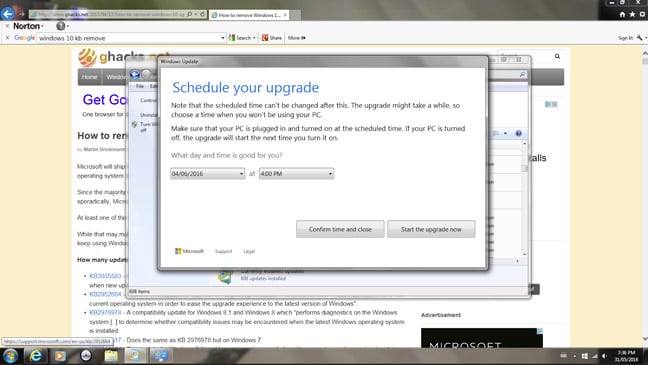
Microsoft Removes the 'X' From Windows 10 Update Leaving No Way Out (theregister.co.uk)
simpz writes: The Register reports that Microsoft has changed the Windows 10 update dialog and no longer shows the "X" close button. They say once agreed to there is no obvious back-out method and it is now out of step with Microsoft's own documentation on this. They have a screenshot of this. As noted above, the latest move is out of step with Microsoft's Knowledge Base documentation, which says you can re-schedule your upgrade.