Slashdot Mirror
Domain: mit.edu
Stories and comments across the archive that link to mit.edu.
Comments · 7,673
-
Re:Armour them and spin them.
Tin Foil [...] If it's good enough to stop the beams entering my head
That's just what They want you to think.
-
Re:what are the technical probs with Theora?
You are aware that article is from over 2 1/2 years ago and theora's development did not stop dead at that point, right?
More recent developments seem quite promising.
-
Ahh.. the fairness of slashdot.
Ah, nothing like Slashdot to bring out the best in humanity. The doom9 comparison is four years old... that would be like comparing something to the MPEG reference code. The latest work on Theora shows a pretty clear doubling of quality per bitrate vs theora from a few months ago... but since this is Slashdot, I'm sure that little details like that won't slow anyone down. Good job, Nokia.
-
Theora quality; An exciting battleI might claim that this event is unimportant due to Theora's quality compared to the leading-edge codecs, but it looks like that has been fixed, or soon will be. Obviously no one sane will knock Vorbis' quality.
With the way things are going this sounds like it's going to be quite a fight between the proprietary and open worlds. I can't think of anyone better than Noikia and Apple to play the side of proprietary.
Of course, this is interesting to more than just Wikipedia, but few other players are both as important and have such a clear long-term vision.
Round TWO! FIGHT!
-
Swing dancing!
It sounds kind of non-geeky at first, but for the past several years I (and many other geeks) have found swing dancing an excellent way to take care of both exercise and socialization with one stone. I actually started with DDR, and somehow ended up transitioning from that to actual dancing...
For whatever reason, there seems to be a surprisingly large amount of overlap between the populations of geeks and swing dancers -- maybe it's because swing dancing is a rather interesting finite state machine? In my experience the number of IT and programming folks in the swing dance community is quite high compared to the general populace.
Swing dancing involves a wide range of muscle groups, and can be quite athletic, especially when one is dancing the more fast-paced variants like Lindy Hop or Jive. Also, many of the best swing dancers are rather heavy-set, so having a large amount of weight isn't thought of negatively in the scene. An added bonus to swing dancing is that there's usually a drastic surplus of women and a shortage of men, so it's an excellent way to meet women.
-
MIT curriculum already online
The OP forgot that the MIT curriculum -- the lectures themselves -- are already largely available. The course materials for nearly two thousand courses at MIT are available here:
http://ocw.mit.edu/OcwWeb/web/home/home/index.htmSo are all of the lectures from an experiment in Computer Science education that predates MIT's open courseware, http://aduni.org/ .
-
Re:yep
According to this MIT study, no.
-
Math or hardware?
There are basically two ways to approach things: from the hardware side, or from the math side. The spectrum of languages is something like: machine code -> assembly -> C/Fortran -> C++/Java -> Python/Ruby -> Lisp/Smalltalk -> lambda calculus.
If your son is interested in abstract math, you'd be hard-pressed to find a better teaching language than Scheme (with SICP, of course).
If he's more into concrete, hands-on stuff, why not assembly? It isn't all that hard, and will teach him a lot about how computers work.
Of course, you could pick a language somewhere in between those extremes; but I think sticking to one end of the spectrum or the other is better for teaching and learning, since there are fewer distractions. -
You might try MIT's Scratch
Since you said he is a young teenager, you might try the MIT Media Lab's Scratch project: http://scratch.mit.edu/
-
Logo
I haven't read anyone state the obvious... at least for me.
My first contact with a computer was, fortunately, my first contact with a programming language. That is, LOGO.
I would strongly suggest you give a look at Starlogo TNG.
StarLogo TNG is real graphical programming in that you create programs by stacking boxes together (each box representing a different instruction like, if, then, while, etc). And the result is a 3D Turtle (yup, our beloved Logo turtle) moving in a 3D environment, which can also be modified.
Regards.
-
Scratch
I'm surprised no one has mentioned Scratch yet. It gives quick results and teaches the basics of program flow.
-
The resources are already out there for teaching
The teaching resources are already out there. Maybe a bit heavy for a kid learning the ropes but he doesn't have to cram a course into 15 or so weeks.
My concern would be that if I just let him do a project that he wants to do he may not learn the overall picture. Maybe I'm wrong but I'd sooner have a rounded understanding of what's all there. I recall as a n00b with a fantastic Vic 20 that I just did what I wanted to do without following that fine manual page for page and while I learned a lot I also missed a lot. it wasn't until I got a C=64 and some intermediate programing guides that I found that some of the stuff I was doing was doing it the hard way.
But I didn't have anyone who knew how to code to help lead the way either. I was really in the dark with a candle, trying to find my way around. -
Re:Son?
I can't comment to a teenager, but I've been having success getting my 7 year old daughter interested in programming with Scratch. She's been using it to make movies and games. The thing that really captured her attention was that she could publish her work through Scratch and get positive feedback from the community on the Scratch website. The idea of building a fan base really appeals to her. I've also told her that if she develops the skills, when she's ready for her first job, we will give her part time work instead of her having to get a job in some fast food joint or convenience store, and that seems to have made an impression on her.
Seems to me the best thing you can do to get your teenager involved in *nix programming is to get them involved in an online community that will give them some positive feedback and the possibility of celebrity, then show them some of the success stories out there that started in just that way. And, of course, let them know you're genuinely proud of them when they create something. -
I think it's difficult.
There are a couple of reasons that it's getting harder to teach languages.
1. Languages are moving away from knowing fundemental coding constructs (loops, if statements, etc) and towards knowing an API. You can't really do anything with a modern language without knowing what the libraries are. I suspect these things are frustrating for the learner programmer. I'd pick something with as simple an API as possible.
2. Back in the day, a junior programmer could write something in a couple of hours that was almost as good as the games, etc you purchased. This is no longer the case. I think it's difficult teaching the basics of programming when no child is going to produce anything that comes close to the games they play or the programs they use.
If I were to try and teach programming, I'd look at something like scratch or Hackety Hack
Good luck.
-
math & SICP
Get him good introductory math books. Get him the SICP book. Show him high order languages like Ocaml, Haskell, CommonLisp.
-
Scratch: A visual programming tool
scratch.mit.edu should be enough for introduction. It is visual and like building Lego. It contains the known parts of a programming language (loops and tests and stuff).
-
MIT Media Lab
There's some really cool stuff happening at the MIT Media Lab. For example, Ed Boyden is working on curing Parkinson's and schizophrenia by modifying neurons so they fire in the presence of yellow light. He has some really interesting thoughts on creativity, expectation and placebo.
The personal robots group is also doing some pretty amazing things with teddy bears and some other cool platforms. Some of their prototypes are really freaky but awesome at the same time. (Depending on your opinion of scary toys taking over the world..)
The smart cities group is working on a new form of car where the wheels contain all the drive and steering equipment. You can essentially snap them onto anything and use it. They've got plans for a car that will fold up and stack while charging, and they're working on deploying a similar scooter based system in Paris.
Here's some cool links:
http://cities.media.mit.edu/
http://www.media.mit.edu/research/
http://neuro.media.mit.edu/
http://robotic.media.mit.edu/
***Disclaimer: I work there. I think its freaking awesome. -
MIT Media Lab
There's some really cool stuff happening at the MIT Media Lab. For example, Ed Boyden is working on curing Parkinson's and schizophrenia by modifying neurons so they fire in the presence of yellow light. He has some really interesting thoughts on creativity, expectation and placebo.
The personal robots group is also doing some pretty amazing things with teddy bears and some other cool platforms. Some of their prototypes are really freaky but awesome at the same time. (Depending on your opinion of scary toys taking over the world..)
The smart cities group is working on a new form of car where the wheels contain all the drive and steering equipment. You can essentially snap them onto anything and use it. They've got plans for a car that will fold up and stack while charging, and they're working on deploying a similar scooter based system in Paris.
Here's some cool links:
http://cities.media.mit.edu/
http://www.media.mit.edu/research/
http://neuro.media.mit.edu/
http://robotic.media.mit.edu/
***Disclaimer: I work there. I think its freaking awesome. -
MIT Media Lab
There's some really cool stuff happening at the MIT Media Lab. For example, Ed Boyden is working on curing Parkinson's and schizophrenia by modifying neurons so they fire in the presence of yellow light. He has some really interesting thoughts on creativity, expectation and placebo.
The personal robots group is also doing some pretty amazing things with teddy bears and some other cool platforms. Some of their prototypes are really freaky but awesome at the same time. (Depending on your opinion of scary toys taking over the world..)
The smart cities group is working on a new form of car where the wheels contain all the drive and steering equipment. You can essentially snap them onto anything and use it. They've got plans for a car that will fold up and stack while charging, and they're working on deploying a similar scooter based system in Paris.
Here's some cool links:
http://cities.media.mit.edu/
http://www.media.mit.edu/research/
http://neuro.media.mit.edu/
http://robotic.media.mit.edu/
***Disclaimer: I work there. I think its freaking awesome. -
MIT Media Lab
There's some really cool stuff happening at the MIT Media Lab. For example, Ed Boyden is working on curing Parkinson's and schizophrenia by modifying neurons so they fire in the presence of yellow light. He has some really interesting thoughts on creativity, expectation and placebo.
The personal robots group is also doing some pretty amazing things with teddy bears and some other cool platforms. Some of their prototypes are really freaky but awesome at the same time. (Depending on your opinion of scary toys taking over the world..)
The smart cities group is working on a new form of car where the wheels contain all the drive and steering equipment. You can essentially snap them onto anything and use it. They've got plans for a car that will fold up and stack while charging, and they're working on deploying a similar scooter based system in Paris.
Here's some cool links:
http://cities.media.mit.edu/
http://www.media.mit.edu/research/
http://neuro.media.mit.edu/
http://robotic.media.mit.edu/
***Disclaimer: I work there. I think its freaking awesome. -
Re:Wait to winter time when there is less sun to s
If you wanted to be a crotchety bitch, which clearly you did, you would have mentioned that it'll take him roughly 11-15 years to recoup his investment of $40,000 for the equipment and setup. That's what I'd go with.
Unless of course the price of energy rises significantly, then he will probably "recoup his investment" quicker. Not to mention that he is less dependant on energy companies and that the effectiveness of solar panels is bound to increase. As mentioned in this earlier Slashdot post:
http://web.mit.edu/newsoffice/2008/solarcells-0710.html
http://hardware.slashdot.org/article.pl?sid=08/07/11/2017237
Even if solar panels only reduces your energy consumption during the summer; if everyone in a relevant area did this perhaps the general price of energy would drop; even during winter. Since the general consumption would be reduced. -
Re:A Trust Web for Victory
BTW, the MIT PGP Public Key Server's FAQ is a nice list illustrating the most serious shortcomings of the OpenPGP PKI infrastructure based on PGP keyservers. Revocation can become quite a problem if it's the responsibility of a key holder himself and there's no central authority.
-
Re:Turtles All the Way Down
Well, that's an interesting question - but I know I'm not an exception merely by the make-up of my department.
When I first came here, 60% of the 30 graduate students were women, which was pretty impressive for a hard-science (astrophysics, actually). However, out of 10 postdocs (the immediate "next step" in the career path after earning a Ph.D.) only 1 was a women. As far as the faculty went, out of 20 active professesors only 2 were women. Then, in the last 7 years, we've hired 6 new tenure-track faculty, ALL have been men and ALL have finished their Ph.D. in the last 12 years. Can you honestly tell me that not a single women was qualified for any of those positions? These are not senior faculty spots - so the complete absence of women in the field 30 - 40 years ago makes absolutely no dfference.
All of the very driven (male) young faculty have now decided to be "more selective" when it comest to admitting graduate students. One outcome was to place more emphasis on the physics GRE, even though study after study has pretty much said that success in graduate school in astrophysics is not correlated at all to Physics GRE score (the exception is theoretical astrophysics - there is a slight correlation there. Note that my department does not focus on theoretical astrophysics) The result - in the last three years, out of 15 new graduate students, we've admitted only three women. In this case, "selective" seems to have meant "male". Honestly, as a senior student who works closely with many of these guys, I don't see a huge difference in intelligence.
The only ray of hope is that we now have more postdocs in general and more of them are women, but if the percentages between students and postdocs are finally balancing out it's because we admit fewer female students!
This isn't just at my institution, there have been all sorts of investigations about whether this "leaky pipeline" is a real effect. The answers aren't particularly clear, mostly because women are reported to leave over "other reasons". I want to know what those "other reasons" are. Is it like MIT, where the female scientists had notably smaller offices, were offered fewer resources and made less money? Is it because women have to exist on soft money for so long after watching plum tenure track jobs go to their male colleagues again and again? Is it the poor timing of a career in science - that grad school, a post-doc, and assitant professorships can leave a woman in her early 40s with no kids?
In the end, what I know is that if one of the seven hires HAD to be female, we'd probably now have a very driven, talented woman faculty member. At the top, the actual difference between the people they hire and the people they don't hire is miniscule and my point in the original post was that "other factors" come into play. One of those is whether the current faculty believe you will succeed enough in the long run to be worth a tenured position and I really believe that being in the "boys club" is going to give you a leg up.
-
Radio Telescope
Build a radio telescope. Check out the Haystack project at MIT http://web.haystack.mit.edu/ I built one back in 2002 for a class project. ~$2000, but worth it. The software for it was written in Java.
-
Re:Wow...Parent post is correct about the 9th Circuit not being overturned at a higher rate than other Circuit courts.
See my post at: http://yro.slashdot.org/comments.pl?sid=273917&cid=20289001Where I said:
Your statistics are correct, however there is some additional information that should be considered.The 9th Circuit Court processed (the courts say "terminated") 13,424 cases in 2006. That's right, over thirteen thousand. Out of thirteen thousand, 22 cases were heard by the Supreme Court, and 19 were reversed. That is not a bad record.
Data here http://www.uscourts.gov/cgi-bin/cmsa2006.pl (choose 9th Circuit) and here http://www.uscourts.gov/judbususc/judbus.html (choose 2006).
Also, note that the appeals process is designed to overturn incorrect decisions. For an example of this, see the statistics at this http://web.mit.edu/keithw/www/statestats.html page. Note the percentages of cases that are reversed or vacated for all courts.
The percentage of overturned cases should be higher for the Supreme Court, as they get to decide whether to review cases or not. This means they will mainly choose cases where they think they need to correct a bad decision, clarify a law, etc. So, having a high percentage of cases overturned by the Supreme Court means that the Supreme Court is doing its job well, not that the other courts are doing a bad job.
-
Improved solar concentrator
-
Re:toys for billionaires
Those are AC motors.
Here's some info on DC motors. (Note the curves are theoretical, and simplified).
http://lancet.mit.edu/motors/motors3.html
Torque is max at 0 RPM.
-
Missing links
For some reason the news office didn't link to D-lab. But there are actually plenty of groups at MIT doing stuff like this,
including the Public Service Center's IDEAS competition, several Mech-E student ptojects, Design for Change,
and the spin-off Design that matters.These groups work on a lot of interesting things. Some of them, like the Kinkajou projector, see somewhat esoteric or "luxurious,"
but others are pretty basic and nifty. There are a lot of bicycle flywheel-moderated pedal powered devices that seem to fill genuine
needs, as does the famous peanut sheller. -
Missing links
For some reason the news office didn't link to D-lab. But there are actually plenty of groups at MIT doing stuff like this,
including the Public Service Center's IDEAS competition, several Mech-E student ptojects, Design for Change,
and the spin-off Design that matters.These groups work on a lot of interesting things. Some of them, like the Kinkajou projector, see somewhat esoteric or "luxurious,"
but others are pretty basic and nifty. There are a lot of bicycle flywheel-moderated pedal powered devices that seem to fill genuine
needs, as does the famous peanut sheller. -
Missing links
For some reason the news office didn't link to D-lab. But there are actually plenty of groups at MIT doing stuff like this,
including the Public Service Center's IDEAS competition, several Mech-E student ptojects, Design for Change,
and the spin-off Design that matters.These groups work on a lot of interesting things. Some of them, like the Kinkajou projector, see somewhat esoteric or "luxurious,"
but others are pretty basic and nifty. There are a lot of bicycle flywheel-moderated pedal powered devices that seem to fill genuine
needs, as does the famous peanut sheller. -
What Killed *BSD
What We Can Learn From BSD
By Chinese Karma Whore, Version 1.0
Everyone knows about BSD's failure and imminent demise. As we pore over the history of BSD, we'll uncover a story of fatal mistakes, poor priorities, and personal rivalry, and we'll learn what mistakes to avoid so as to save Linux from a similarly grisly fate.
Let's not be overly morbid and give BSD credit for its early successes. In the 1970s, Ken Thompson and Bill Joy both made significant contributions to the computing world on the BSD platform. In the 80s, DARPA saw BSD as the premiere open platform, and, after initial successes with the 4.1BSD product, gave the BSD company a 2 year contract.
These early triumphs would soon be forgotten in a series of internal conflicts that would mar BSD's progress. In 1992, AT&T filed suit against Berkeley Software, claiming that proprietary code agreements had been haphazardly violated. In the same year, BSD filed countersuit, reciprocating bad intentions and fueling internal rivalry. While AT&T and Berkeley Software lawyers battled in court, lead developers of various BSD distributions quarreled on Usenet. In 1995, Theo de Raadt, one of the founders of the NetBSD project, formed his own rival distribution, OpenBSD, as the result of a quarrel that he documents on his website. Mr. de Raadt's stubborn arrogance was later seen in his clash with Darren Reed, which resulted in the expulsion of IPF from the OpenBSD distribution.
As personal rivalries took precedence over a quality product, BSD's codebase became worse and worse. As we all know, incompatibilities between each BSD distribution make code sharing an arduous task. Research conducted at MIT found BSD's filesystem implementation to be "very poorly performing." Even BSD's acclaimed TCP/IP stack has lagged behind, according to this study.
Problems with BSD's codebase were compounded by fundamental flaws in the BSD design approach. As argued by Eric Raymond in his watershed essay, The Cathedral and the Bazaar, rapid, decentralized development models are inherently superior to slow, centralized ones in software development. BSD developers never heeded Mr. Raymond's lesson and insisted that centralized models lead to 'cleaner code.' Don't believe their hype - BSD's development model has significantly impaired its progress. Any achievements that BSD managed to make were nullified by the BSD license, which allows corporations and coders alike to reap profits without reciprocating the goodwill of open-source. Fortunately, Linux is not prone to this exploitation, as it is licensed under the GPL.
The failure of BSD culminated in the resignation of Jordan Hubbard and Michael Smith from the FreeBSD core team. They both believed that FreeBSD had long lost its earlier vitality. Like an empire in decline, BSD had become bureaucratic and stagnant. As Linux gains market share and as BSD sinks deeper into the mire of decay, their parting addresses will resound as fitting eulogies to BSD's demise. -
Mod parent up
Though nominally it does not assume any mathematical knowledge on the onset, the Road to Reality gives an unadulterated description of modern physics in more mathematical detail than any other book for common consumption. Unlike most physics books, which give a roughly chronological description of physics (teaching the classical Newtonian approximations before the correct modern theories), this book races through teaching math and then shows how general relativity and the standard model plop right out.
The book is quite dense and not for the faint hearted. If I recall, chapter 1 is the introduction, chapter 2 is on non-euclidean geometry, chapter 15 is gauge theory and fibre bundles, and they cover the basics of complex analysis, topology, and 10 billion other things. This is a book that will make you feel stupid. I never did slog my way through the whole thing, but for someone of your background and goals, it seems perfect.
If you want to go over classical mechanics and are a CS type person, may I suggest Structure and Interpretation of Classical Mechanics, from the people who brought you Scheme. It's main strength, in my view, is cleaned up notation (I hate most mathematical notation) and a nice environment to "play" around in, which for a person of your background may not be as useful as it is to me. Still, it's free.
-
Always Best To Go To The Source ...
I've audited several of MIT's OpenCourseWare offerings in Physics. Some are ridiculously easy while others have thrashed my intellectual behind back and forth across the Internet. And the best part? They're free. http://ocw.mit.edu/OcwWeb/Physics/ [mit.edu]
-
Re:wow - 25nm
I'm still trying to figure out what the heck "scientists at the Space Nanotechnology Laboratory at MIT " is?? Are they like...A small lab on the space station??? Huh?
er, MIT is a school in Massachusettes. They have a laboratory called the Space Nanotechnology Lab. -
Re:Expensive stuff
Yeah, uhm, even if you don't want to read it, the article has some pretty pictures.
http://web.mit.edu/newsoffice/2008/solar-nsf-enlarged.html
(should explain things to you)
actually, here.
Alternatively, the partially transmissive concentrator can function as a window.
You see, you don't actually have to put it in the vertical position for it to work. Isn't that amazing and innovative?
Or maybe you just shut up and let the smart people work, dumbass.
-
My stars and garters
What We Can Learn From BSD
By Chinese Karma Whore, Version 1.0
Everyone knows about BSD's failure and imminent demise. As we pore over the history of BSD, we'll uncover a story of fatal mistakes, poor priorities, and personal rivalry, and we'll learn what mistakes to avoid so as to save Linux from a similarly grisly fate.
Let's not be overly morbid and give BSD credit for its early successes. In the 1970s, Ken Thompson and Bill Joy both made significant contributions to the computing world on the BSD platform. In the 80s, DARPA saw BSD as the premiere open platform, and, after initial successes with the 4.1BSD product, gave the BSD company a 2 year contract.
These early triumphs would soon be forgotten in a series of internal conflicts that would mar BSD's progress. In 1992, AT&T filed suit against Berkeley Software, claiming that proprietary code agreements had been haphazardly violated. In the same year, BSD filed countersuit, reciprocating bad intentions and fueling internal rivalry. While AT&T and Berkeley Software lawyers battled in court, lead developers of various BSD distributions quarreled on Usenet. In 1995, Theo de Raadt, one of the founders of the NetBSD project, formed his own rival distribution, OpenBSD, as the result of a quarrel that he documents on his website. Mr. de Raadt's stubborn arrogance was later seen in his clash with Darren Reed, which resulted in the expulsion of IPF from the OpenBSD distribution.
As personal rivalries took precedence over a quality product, BSD's codebase became worse and worse. As we all know, incompatibilities between each BSD distribution make code sharing an arduous task. Research conducted at MIT found BSD's filesystem implementation to be "very poorly performing." Even BSD's acclaimed TCP/IP stack has lagged behind, according to this study.
Problems with BSD's codebase were compounded by fundamental flaws in the BSD design approach. As argued by Eric Raymond in his watershed essay, The Cathedral and the Bazaar, rapid, decentralized development models are inherently superior to slow, centralized ones in software development. BSD developers never heeded Mr. Raymond's lesson and insisted that centralized models lead to 'cleaner code.' Don't believe their hype - BSD's development model has significantly impaired its progress. Any achievements that BSD managed to make were nullified by the BSD license, which allows corporations and coders alike to reap profits without reciprocating the goodwill of open-source. Fortunately, Linux is not prone to this exploitation, as it is licensed under the GPL.
The failure of BSD culminated in the resignation of Jordan Hubbard and Michael Smith from the FreeBSD core team. They both believed that FreeBSD had long lost its earlier vitality. Like an empire in decline, BSD had become bureaucratic and stagnant. As Linux gains market share and as BSD sinks deeper into the mire of decay, their parting addresses will resound as fitting eulogies to BSD's demise. -
Re:Oh, Is It That Time Again?
All sentences in the linked article are artfully crafted to contain snippets like 'increases power', 'decreases cost'.
However the linked movie is fairly insightful.
What they're saying is: we absorb light in the coating. Most of then energy that's absorbed is transmitted through the glass to the frame, where it is converted into electrical energy. This idea is from the '70s, but advances in the materials used have improved the efficiency.
Nevertheless, no word is uttered on any practical installations, nor is there any mention of the efficiency compared to the most efficient currently available system, which is very suspicious.
If this becomes popular and oil prices go up, you better get used to living in an orange environment.
Since this coating absors mainly non-orange, it might be possible to combine this with greenhouses. The plants get the orange light and the coating takes the rest. -
The World is Flat
I would suggest reading The World is Flat by Thomas L. Friedman.
Friedman goes through great effort to explain how and why jobs are being outsourced, and also provides some guidance on what we can do to survive in a "flat" world. I would call this book required reading for anyone working in any level of IT.
If you're not the reading type, there's a video of Friedman at MIT where he coveres much of the first three chapters. -
Re:Forget flying cars...You might be interested in this: MIT's Assist Sketch Understanding System. I'm fairly sure it was on
-
I AM laughing at you!
http://people.csail.mit.edu/rahimi/helmet/
Conclusion
The helmets amplify frequency bands that coincide with those allocated to the US government between 1.2 Ghz and 1.4 Ghz. According to the FCC, These bands are supposedly reserved for ''radio location'' (ie, GPS), and other communications with satellites (see, for example, [3]). The 2.6 Ghz band coincides with mobile phone technology. Though not affiliated by government, these bands are at the hands of multinational corporations.It requires no stretch of the imagination to conclude that the current helmet craze is likely to have been propagated by the Government, possibly with the involvement of the FCC. We hope this report will encourage the paranoid community to develop improved helmet designs to avoid falling prey to these shortcomings.
Ha Ha!
-
Woo-hoo, another Google press release!
Why read Slashdot -- go straight to the source of all your Google and MIT press releases:
-
Holographic Projector?
I'm wondering whether some advanced LASER show wouldn't be more useful.
I doubt though that anything like holograms could be easily used for this but who knows where we can get with the following
http://www.media.mit.edu/spi/holoVideoAll.htm
What I like about this is the idea that it doesn't have to be perfect for a fireworks display so the technology should be usable early on, and any artifacts could be declared special effects.
The problem will be that high powered lasers will be needed to get the same effect as with a normal firework.
I'm also wondering where the noise will come from, it could be replaced by music from "Disaster Area" however.
With some luck one could use the lasers to make some noise, here is a good one
http://legolas.ece.wisc.edu/current/laser/index.html
They are talking about shock waves at least.
All in all if you look at the cost you will figure out that producing the Laser will be expensive energy wise, more so than fireworks actually. Also you won't be able to develop stuff like this in China so you may have to pay some engineers locally to come up with something. With all the SUVs they are driving it won't be good for the environment either.
If you want to see a star spangled banner in the sky though, just turn off the lights and pray for good weather. That will give you a whole milky way of stars if the moon isn't out. I saw this once in Australia it was just awesome.
-
Re:Coke II
The correct response to that question is, "why WOULD you design it without MySQL or some other database engines?"
That's not the correct answer, but it's a reasonable question.
SQL databases are great for a certain range of problems. They're obviously terrible for other sorts. And there's a fair bit of middle ground where the right choice depends on conditions. If you don't understand other options, you can't possibly know when those other options are the right ones.
FYI I'm not the only person who thinks this. One of the fathers of the modern database, Michael Stonebraker, recently said this:
"We conclude that the current RDBMS code lines, while attempting to be a 'one size fits all' solution, in fact, excel at nothing. Hence, they are 25 year old legacy code lines that should be retired in favor of a collection of âoefrom scratchâ specialized engines. The DBMS vendors (and the research community) should start with a clean sheet of paper and design systems for tomorrow's requirements, not continue to push code lines and architectures designed for yesterday's needs." -- From the paper The End of an Architectural Era (It's Time for a Complete Rewrite).
Of course, sometimes you don't care that your system excels at anything. There are plenty of average problems out there, and as long as that's all you want to work on, only knowing how to design for SQL databases can be perfectly fine.
There's definitely work out there for people who are one trick ponies, but generally not on the projects where I help with the hiring.
-
Re:I support this
whiner, $75 is cheap! I paid over $200 for Internal Combustion Engine Fundamentals. That was a few years ago. Open Courseware my ass! Heywood doesn't post the book online. Just the labs, homework, and syllabus.
-
Re:Short answer: noI find it hard to believe that an OS that was even further abstracted, by being placed on top of another operating system, could be faster or more stable.
Surprisingly, you're wrong.
Sandboxing an unstable app or OS is a good way of improving the overall stability of the system. Check this out, for example;
Vx32 is a user-mode library that can be linked into arbitrary applications that wish to create secure, isolated execution environments in which to run untrusted extensions or plug-ins implemented as native x86 code. Vx32 is similar in purpose to the Java or
-
Re:EU requests private US citizen data
You can fake visas and passports, but you will have a hard time faking a fingerprint.
I take it you haven't been watching Mythbusters, then. See http://www.youtube.com/watch?v=LA4Xx5Noxyo
Slides from 2002 about reproducing fingerprints in gelatin http://web.mit.edu/6.857/OldStuff/Fall03/ref/gummy-slides.pdf
Besides, you can have all the biometry you want. All you've got is a document stating that a fingerprint that looks like this (image) belongs to a person that looks like this (image), has irises that look like this (image), has a signature that looks approximately like this (image), is called (name), is a citizen of (country), is (male/female), was born on that date at that location, was given this document with that serial number by that authority on that date, and this document expires on that date.
Now, what of this can you verify? You can trust the authority that granted the document by inspecting the security measures embedded within. Perhaps you can even contact the authority and ask about the content of the document by its serial number. You can even go so far as to determine that the person actually is the one who they claim to be. Then again, what does it prove? That they have not committed any crimes? That they will not commit any crimes? That they have not or will not use a false identity in the future?
-
Re:Still a long way from sci-fi
Also, I'm highly skeptical of the claim that computer enthusiasts coming out of MIT, no matter how new, are attractive.
Really? How about this young woman? http://coop.jsc.nasa.gov/biography/jordann.html
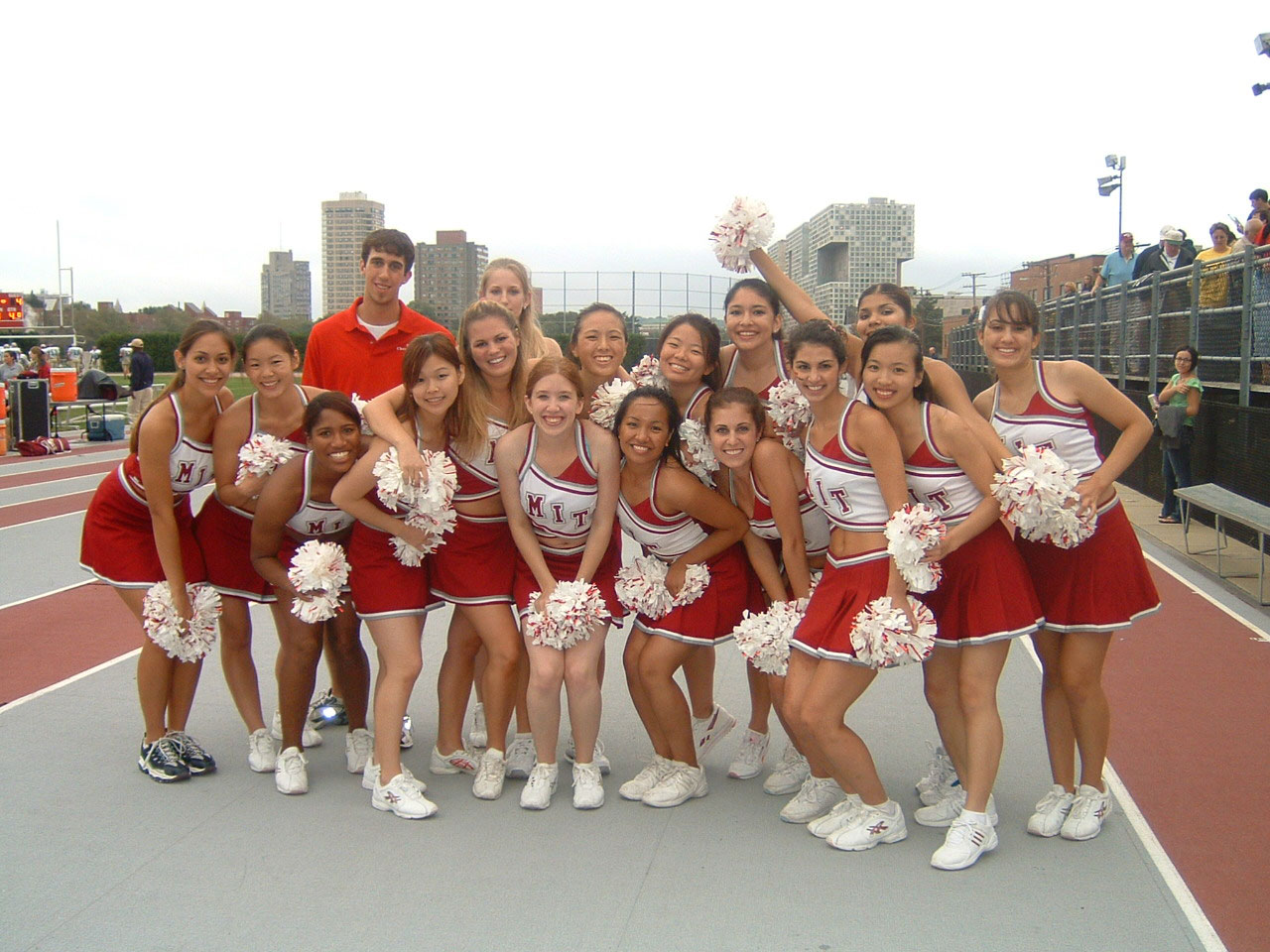
Or these ladies? http://web.mit.edu/madmatt/Public/Pics/cheerbig.jpg
Or if you like a little controversy with your sexy, how about one of the most gifted (and hot) young computer enthusiasts I know - http://bea.st/sight/archive/08/05/star/ -
Re:The WH's boss is still we the people you know
...the Bush admins just flat out break law after law and absolutely nothing happens.Happens with every administration. Best example in the Clinton days:
Al Gore and those fund-raising calls made from his office. Illegal, to be sure, and when that was pointed out, he said that basically he was above the law. So he admitted it, denied that he was subject to "no controlling legal authority", and what'd Reno do? Nada.
Not that Bush's excuses are any better, but still.... this is politics as usual.
-
Open Mind Commen Sense
Open Mind Common Sense. A project at the MIT Media Lab to collect an open ontology of general knowledge.
One non-obvious cool aspect of the site is that if you create an account, it will ask you questions that are intended to fill in gaps in its knowledge.
-
Re:Dear Slashdot...One of my theories is brains predict possible futures (by modelling reality in parallel), and consciousness is what happens when a brain recursively tries to simulate and predict itself.
Wouldn't that be an application of Baysian Estimation?
You may enjoy this book if you haven't already.