Slashdot Mirror
Domain: mit.edu
Stories and comments across the archive that link to mit.edu.
Comments · 7,673
-
FSFS
One of the bigger changes that users of 1.0.x will see when upgrading is Greg Hudson's awesome new FSFS filesystem.
Subversion uses a db-like transactional filesystem to store your files, up until v1.1, Subversion used Berkeley DB to implement this filesystem. But BDB was somewhat of a headache for many Subversion users. Some issues:
-
no networked filesystem - since BDB (along with many other databases)
used file locking features that were not available over network shares,
you couldn't host your Subversion project over NFS/AFS/CIFS(Samba).
With FSFS this problem is gone.
-
wedged repositories - for some people their Subversion filesystem would
inexplicably "lock up", requiring the sysadmin to run "sdvnadmin
recover" on the repo. It was actually BDB that locked up, and sdvnadmin
recover actually ran the Berkeley DB recovery procedure on a repository,
but most people blamed Subversion.
This never happens with FSFS.
- smaller repositories - because it stores deltas, FSFS repositories are smaller than BDB ones. Greg Hudson's FSFS documents claims that "space savings are on the order of 10-20%", but that's a modest claim. I've personally seen myself (and others have mentioned) significantly smaller repos when switching over to FSFS.
Of course there are a ton of other nice fixes and improvements to 1.1, but FSFS shines above the rest. Also, there are rumors that FSFS will soon become the default filesystem in Subversion, I for one will welcome that change.
For more information about FSFS, Greg Hudson's original FSFS document is required reading.
I'm sorry if this post comes off as Berkeley DB bashing, I really didn't intend for it to be like that. To be fair, I think that Subversion put DB to use in ways that perhaps it was not intended to, and coupled with the fact that Berkeley DB is mostly a commercial product, I can sort of see why an opensource project like Subversion would take backseat to Sleepycat's paying customers. (I should probably mention that Sleepycat recently placed one of their employees as a "Subversion liaison" to help resolve BDB bugs/issues quicker.)
Thomas
-
no networked filesystem - since BDB (along with many other databases)
used file locking features that were not available over network shares,
you couldn't host your Subversion project over NFS/AFS/CIFS(Samba).
-
Cult of Prior Art
Many of you talk a good game of prior art, providing oodles of weblinks that supposedly prove your searching brilliance and the Patent Office's ineptitude. However, after looking over the "prior art" references cited in this thread, I fail to see any that would actually fully read on Xybernaut's claimed subject matter.
For instance, both the Nomadic Radio and Smart Cow Collar lack a display controller, and from all appearances also lack any computer components enclosed in the collar that can movably extend outside the collar adjacent to the user's face.
Simply mentioning that the Gumstix computer is small enough to fit under a collar doesn't remotely cover the myriad of claimed limitations in Xybernaut's patent.
This Hewlett-Packard paper merely states, "A collar mounted near-field transceiver allows connection to head-mounted peripherals." Again, nothing about a display controller (or any other computer components) movably extending from inside to outside the collar.
The Invisible Computer talks optimistically about a future when, "Computers will be in your collar, so you can whisper when you talk with them and hear without bothering others." The specific operational structure of Xybernaut's claimed invention is not here either.
Levi's Industrial Clothing apparently comes, "Armed with a remote, [so] you can switch between [an MP3] player and [a mobile] phone, while earphones and microphones are concealed in the jacket collar." No mention of display control. No mention of collar component extension.
This 'Enter the Cyborg' article further describes Levi's Industrial Clothing as having, "a microphone hidden in the collar, and retractable earphones [that] extend out from the shoulders for listening to both music and phone calls." So we have computer component extension -- but from the shoulders, not from the collar. And still, mind you, no display controller enclosed in the collar.
This Carnegie Mellon University paper reveals, "The general areas we have found to be the most unobtrusive for wearable objects are: (a) collar area..." Okay, great. But yet again, no display controller and no collar extension.
The closest prior art comes from Accenture's Personal Awareness Assistant. However, the earliest mention of the Personal Awareness Assistant on Accenture's website appears to be January 2002. And Xybernaut's invention was filed on January 2, 2001. Besides that, saying Accenture's mini digital camera constitutes a "display controller" would be a bit of a stretch. Regardless, Accenture also fails to say anything about "input/output connectors" or "peripheral ports" -- as claimed by Xybernaut. So another dead end here.
Now you may well make the argument that Xybernaut's invention is an obvious variant (where "obviousness" is completely subjective and easily disputable) of the above prior art. But that position is dramatically different from declaring Xybernaut's invention not to be novel. For Xybernaut's invention not to be novel, you would have to find a piece of prior art dated before 2001 that contains each and every limitation recited in claims 1, 11, 20, or 22 (a -
Thats nice for IBM but real computing power..
comes from building hardware for a specific task. Unfortunately most of you can't access this little bit of nerd heaven but some incredibly cool hardware architectures are being described at the High Performance Embedded Computing conference. Sky and Mercury have some of their hottest new designs here. How about a machine that can do a 256 mega-sample FFT in real time?, or a self configuring supercomputer on a chip? Of course most of these tricks will never escape the lab except for the speed-ups for rendering engines...one place where gamers and the DOD are driving technology in a dead heat race with lots of winners. Besides, in a few months, something will come along that will go even faster than blue gene.
-
Re:No reason for alarm
How are you +5 again? Perhaps the moderators should google a little first. seeing how pgpFONE is not much of an option: MIT is no longer distributing PGPfone. Given that the software has not been maintained since 1997, we doubt it would run on most modern systems.
-
Leaving Carver Mead off the list is a JOKE!
Carver Mead has done more for the computer industry than Linus, Mr. Bill, or most of the others on that list.
READ about him before you judge this statement.
Not having him on this "Agenda Setters" list undermines it's validity. -
Thank you, thank you, thank you.
I thought I was the only person in my town who even knew that you could pedal distances and maintain speeds most people only expect a car can do. [working at an MIT lab means I am not the only person at my office who knows this funny little secret.] I might have missed the establishment of this repository despite my various bookmarks on HPV links to some of the content....but its ok with me if god let there be slashdot and then let me get addicted to it just so I would pick up on this trove as soon as it had a URL. OK, I admit not every programmer also has filled lab notebooks with as many sketchs of recumbent trikes and automatic transmissions for bikes as of code or UML or ERDs. There certainly are software engineers who waddle back and forth between vending machine and workstation but they may not have grokked the essential parallel between cycling and programming: the challenge of wresting unlimited accomplishments from strictly limited resources by dint of hard work.
Of course, if you want most of what's useful science in this compendium without having to suck it all down from the web you could just buy a copy of David Wilson's Bicycling Science . Sorry, I am not being facetious or cheeky this evening. -
Being Done Already
The "Semantic Web" is already being done in a quite sophisticated manner by computational linguists. The major stumbling block: money. It takes a lot of time (and hence, money) to build these systems and no one seems to appreciate the possible impact.
-
Re:Bull-pucky.Can you please point out where in any founding document where there is a seperation of church and state the way you define it?
Can you please point out where the words "fair trial" appear in any founding document? Oh, you can't. Know why? Because it's not mentioned anywhere. Does that matter? Not a bit.
Correct there is no formal accountability in the big government sense, but they are responsible to the children and the parents.
So, let the market decide, then? The almighty dollar is once again the force from which all good will spring forth?
Not under NCLB. Good try.
Have you READ the NCLB? Title IX: Equity -- Prohibits discrimination on the basis of race, ethnicity, color, or national origin. Notice something missing? Religious preference and gender. Now, I don't know what public schools are like in your neck of the woods, but in every state I've ever lived in, Muslim children and Christian children are permitted to learn together. Boys and girls, too. But nice try.
how does this prevent children frpom going to another school?
It doesn't, provided another school is an available option. Oh right, the market will decide whether a non-religious school should exist in Salt Lake City. Right. Well, I guess those few families that are affected can just move.
Assuming that the schols is underfunded is a gross inaccuracy, I;ll let you in on a little math.
Amazing. You sound consevative, yet what you advocate is essentially a giant welfare program for private schools. Can you please explain why want to replace one central plan with another central plan?
How is this in line with any economic system? The number of schools is not fixed, and it can grow with demand.
Sure it can. Just like private universities. And look at how fair and equal they are. Oh, but that's different, right?
And none of this addresses the main solution vouchers aim to satisfy -- specifically, what about the students? Many see vouchers as a magical salve that will cure whatever ills are creating poor students, yet studies show that there are no achievement gains between children attending private schools under voucher programs versus staying in public schools.
"Based on three years of data from New York and Washington, D.C., and two years from Dayton, the authors find no evidence of an overall achievement difference between the public and the private schools either in the aggregate or for any of the individual cities. This finding that the private schools are no better at raising the performance of low-income students than are the public schools flies in the face of well-known claims made by pro-voucher researchers such as John Chubb and Terry Moe that the autonomy of private schools will make them more productive than the more bureaucratic private schools." -- Helen Ladd, Duke University
-
Re:Not very impressive
-
Does he know ANYTHING about Subversion?Incrementally better naming scheme for revisions and branches? I am not sure if he means the per-file vs. per-repository revision numbers, or their tagging and branching systems, but either way the two have nothing in common. It just doesn't get more "non-incremental" than going from CVS's file tagging to svn's copy-to-branch/tag mechanism.
The BDB backend has it's problems (though none of them nearly as drastic as he seems to think), but has he really never heard of the FSFS backend?
The rest of the criticism is so vague that it kinda makes it hard to reply to: "it takes too many steps backward in various areas", oh, "various areas" - of course! I've been noticing that.
I'm in the process of moving to Subversion from CVS (which I agree is deeply broken, by todays standards), and I've yet to encounter a single thing that Subversion is worse at than CVS. And a hell of a lot of things that it does much, much better.
Now if that interview presented the tiniest bit of information about what arch does differently (apart from, you know, not being "teh suck") I would be tempted to check it out.
-
Re:All that and he doesn't explain...
Correct link, without the trailing slash:
http://web.mit.edu/ghudson/info/fsfs -
Re:All that and he doesn't explain...
As to svn backends... I think it is prudent to point out a false statement made by Lord.
from: http://web.mit.edu/ghudson/info/fsfs/
"FSFS" is the name of a Subversion filesystem implementation, an
alternative to the original Berkeley DB-based implementation. See
http://subversion.tigris.org/ for information about Subversion. This
is a propaganda document for FSFS, to help people determine if they
should be interested in using it instead of the BDB filesystem.
and from http://subversion.tigris.org/svn_1.1_releasenotes. html
"Non-database repositories
It's now possible to create repositories that don't use a BerkeleyDB database. Instead, these new repositories store data in the ordinary filesystem. Because Subversion developers often refer to the repository as "The Filesystem", we have adopted the rather confusing habit of referring to these new repositories as "fsfs" repositories... that is, a Filesystem implementation that uses the OS filesystem to store data." -
Re:Simple questionAs the Green Party Presidential candidate, would you support the disposal of fission byproducts by shooting them into the sun?
Gads I hope not. Take a look at this 1999 article for a reality check about the reliability of rockets:Anxieties were heightened when three launches failed within the eight-day period that ended a week ago Tuesday. One of those malfunctions involved a Titan IV rocket, the launch vehicle the U.S. military depends on to put its highest priority satellites into orbit. The Titan IV has now suffered three failures in three flights since August, including a fiery explosion over the launch pad at Cape Canaveral Air Force Station that destroyed a $1 billion top-secret intelligence satellite.
In addition to the Titan mishaps, a commercial Athena rocket lost a satellite in April, and last Tuesday, the new Delta III rocket suffered its second failure since August.
I'd much rather have nuclear waste travelling down railroad tracks or in highway convoys than to regularly launch the practical equivalent of a maximum-damage "dirty bomb" and effectively roll the dice again and again, hoping that none ever blow up over Florida or the ocean or fail to reach orbit and burn up in the atmosphere.
Putting nuclear waste in rockets would probably be just about the most irresponsible thing you could do with it short of flying around and dumping it out of planes or shovelling it into incinerators. -
Re:"May not get built without help from U.S. Gov.."There is NO physically reasonable scenario in which all or most of the ribbon encounters the atmosphere EITHER in a small space OR in a short time."
Really? What do you base that on? I just watched the animation again. In this model, about 25% of the fastest moving end of the cable breaks off and a away, the rest falls. The last 5-10% of the cable slaps the earth in a couple of the final frames. So what are the energy dynamics?
Is it inconceivable that that last 5% of the ribbon length carries 30-50% of the entire kinetic energy of the system? So how bad is a terajoule released over a million square meters for 10 minutes? It's about 2000 Watts/m^2. Probably nothing to worry about. About twice the mean solar intercept for the area in question for 10 minutes.
"I'm in the middle of a multi-MEGATON event right now -- but since it's otherwise known as a sunny September day"
Righto. Please notice I'm actually using the solar intercept energy as a comparison point. Remember your multi-MEGATON event is spread over a much vaster area (the hemispherical area of the planet surface) then a one meter by 1000km ribbon impact.
Even so, that solar energy, at lower density, fuels large atmospheric effects (hurricanes, tornados) known to produce substantial destructive effects on human habitation
Further, what happens 15 years later when we have not the one, but dozens, or hundreds of elevators, including "heavy lifters" weighing in at 70,000 tons instead of 700 tons? Will the catistrophic fall of one ribbon, sweep down 20-50% of the others? They're all placed in a very tight equatorial band.
-
CTSS Technical Notes
Nostalgia or machinropology, whatever, http://www.lcs.mit.edu/publications/pubs/pdf/MIT-
L CS-TR-016.pdf -
Re:What's a little profiling among friends?What is so bad about the idea of establishing criteria for high risk passengers?
Simple, that the true baddies will avoid to fall into this profile. Since more attention is directed towards those folks of which the computer believes fall into the category of baddies, less attention is dialed out to those that don't fall into this category and this will be exploited.
Read about the Carnival Booth Algorithm for more information.
-
Re:PGPhoneDo you actually use it or did you just google it to get your Karma up?
From PGPFone Home "MIT is no longer distributing PGPfone. Given that the software has not been maintained since 1997, we doubt it would run on most modern systems.".
With a little searching I was able to find a slightly newer version and some pages as new as Jan, 2001. I wouldn't consider this product too interesting based on that, though you never know, I could be wrong.
-
missing link for the kite photography
-
MIT's City Scanning Project
Take a look at: http://city.csail.mit.edu/city.html/ This project has been leveraging the annotation of GPS, as well as pose information for applications in computer vision and navigation.
-
Re:Most japanese bipeds use ZMP, not static stabil
I guess my terminology was poorly chosen, my being acquainted with the field but not an expert within it. In any case, I had more in mind robots wherein the center of pressure is not always within the support polygon (and for some robots, almost never is). The MIT Leg Lab has several examples, and in any case, this is in stark contrast to the equilibrium methods used in any of the Honda or Sony robots I've seen so far.
-
Hannibal and Attila?
Does anyone know how this differs from the insect-like robots (like Hannibal and Attilla) developed by Rod Brooks' group in the MIT AI Lab? It's been a while since I took his class, but I remember that they found that remarkably simple distributed control systems could be used to generate adaptive legged locomation patterns without requiring complex centralized control.
-
Even Better:
Also note worthy is that researchers at MIT have found a way to produce similar results using animal flesh. The most drastic results, reaching the unheard of 99% efficiency level, are in the Equus Caballus species. A resurgence in the use of the term "horse power" is expected.
-
TFA Linkhttp://web.mit.edu/newsoffice/2004/spinach-0915.h
t mlThis is a link to a relevant article on the mit servers (the other ones are toasted)
-
SchoolsWhy Cambridge's Harvard Square? 'Cause it's a popular hangout for students & recently-student folks out for dinner, a show, some shopping (still has a few good bookstores.) Check out this list of area-schools and see why companies retain offices in the area just for recruiting
- Babson College Wellesley
- Bentley College Waltham
- Berklee College of Music Boston
- Boston Architectural Center Boston
- Boston College Newton
- Boston Conservatory, The Boston
- Boston University Boston
- Brandeis University Waltham
- Bunker Hill Community College Boston
- Cambridge College Cambridge
- Emerson College Boston
- Emmanuel College Boston
- Fisher College Boston
- Harvard University Cambridge
- Hellenic College Brookline
- Lesley College Cambridge
- MIT Cambridge
- Massachusetts College of Art Boston
- Massachusetts College of Pharmacy
and Allied Health Sciences Boston - Mount Ida College Newton
- New England Conservatory of Music Boston
- New England School of Law Boston
- Northeastern University Boston
- Pine Manor College Chestnut Hill
- Radcliffe College Cambridge
- Simmons College Boston
- Suffolk University Boston
- Tufts University Medford
- Wellesley College Wellesley
- Wentworth Institute of Technology Boston
- Wheelock College Boston
e nt industries all also bring in, and offer up, a lot of folks too. I'm only in town part-time but it does make for a heady mix of bright-types. -
M2
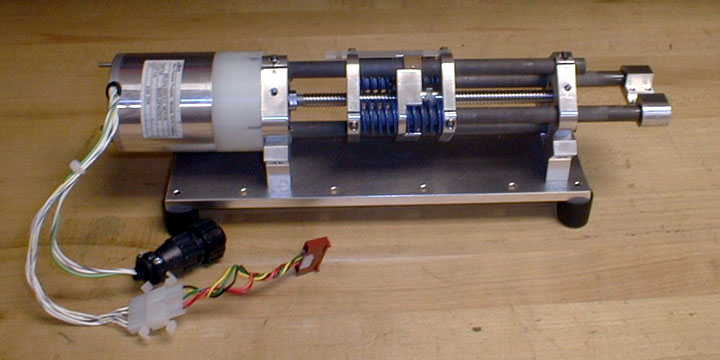
I actually spent this last summer working on M2, so I can tell you a little about how it works. M2 was designed to make use of two nifty ideas, the first being Series-Elastic Actuators (photo)and the other being Virtual Model Control link to pdf journal article).
The series elastic actuators are meant to simulate the interaction of a human muscle-tendon-bone system, and to allow for the design of a low-impedance system. M2 is designed to actually mimic the inherent low-impedence (low-stiffness) mechanical system that people represent. People are really awful at position based/high-impedance control, which is what most traditional robots use. This is useful for manufacturing, when you want the robot arm to always put the bolts in the same place, but leads to stereotypical "robot" movement (like the guy spastically jerking around on the dance floor). People are pretty good at force control though (there are all sorts of biological reasons for this). So M2 was built to be low-impedance like a person by using these S-A Actuators.
Virtual Model Control is supposed to allow more a more intuitive control of a robot by simulating it as a mechanical system. VMC lets you basically define springs and dampers at different points which are then simulated by the actuators. So to keep M2 standing, you might make a granny-walker out of springs, and to make it walk you could "attach" a spring to its chest pulling it forward. VMC has been implemented in simulation (where it works great), but it's not quite ready in real life.
The really cool thing about M2 is its potential. It already moves much more fluidly and naturally than any other robot out there, and its not nearly done yet. Once its working properly, it'll be able to walk essentially blindly (becuase its low impedance) like a person, rather than needing to know exactly where to place each foot (*cough*ASIMO*cough*) to keep from shattering itself.
If anyone has any other questions about how M2 actually works, I'd be happy to answer them.
-Zach -
Re:Yey Baby!
miss massachusetts is MIT class of '04
check it out -
Re:Something not so funny about Bill Gates ...
Well, if this were an MIT building, it would get assigned a number, and nobody would care.
The New CS building is 32.
You mean the Stata Center, home of the Gates Tower?
-
Re:Something not so funny about Bill Gates ...
Well, if this were an MIT building, it would get assigned a number, and nobody would care.
The New CS building is 32.
You mean the Stata Center, home of the Gates Tower?
-
Let's just hope...
That it turns out better than Stata (Which Gates also donated a large sum to help build)
-
What CMU had to do to get thisCMU has put out a never-ending stream of disgusting propaganda since last February when Gates gave a "lecture" at CMU. If you don't care to RTFM, CMU's "alumni magazine" (even more of a blatant PR mill than at most schools) spends an entire article bragging about how wonderful it is for CMU to have tons of incestuous connections with Microsoft. (The message: come to CMU and work for Microsoft!)
CMU may have quite a few good individual professors and research projects in CS, but the institution as a whole doesn't think twice about being a corporate-flak career school... from their advertising slogan "The Professional Choice" in the early '80s on (when CMU accepted a certain large donation from IBM and almost decided to make all its students buy PC's in 1982).
Thankfully, many CMU students are still practicing some degree of creative resistance, although a penguin statue allegedly placed on the roof of the student center overnight before the Gates speech was hurriedly removed since apparently CMU values its clean public image more than its students' creativity.
One other thing to note is that this is likely not much more than a matching grant for further increases in students' tuition, which pays for a much higher share of an education at CMU than at many peer schools.
-
Re:Bright Blue eh?
It will be ugly all right, if it looks anything like this Bill Gates computer science building.
-
Re:Bad newsI agree that this is BAD NEWS in a big way. But...
In 10 years, will Fahrenheit 911 sequels ever reach the public ?
YES.
Michael Moore's claims of "censorship" are laughable. If you make a high-budget movie for Miramax, you'd better believe they're going to release it. As long as that sort of financial backing is available, he's got nothing to worry about.
Others have had more serious problems.
Though if we give it 100 years instead of 10... your guess is as good as mine.
-
Re:Beats doing it in software
I realize that Dr Mead's Foveon has narrowed down to digital imaging products, but one of his PhD's, Rahul Sarpeshkar, has gone on to a professorship at MIT, and has taken the cochelar implant one step beyond what was done at Caltech.
That article is from May of 2003, and I don't know if they have reached human trials yet, but I'd hardly call it a dead-end.
Digital SP has sped up a lot in the past decade, of course, but the process that we're seeking to model is still on the order of tens of thousands (for auditory) to tens of millions (for visual) of signals being processed in parallel. It's just plain nuts to try to model this with a general-purpose, serial processor. Particularly when there is a reasonably mature science of building specific parallel-input hardware to mimic the natural processes.
But then again, I'm just a hobbyist in the field. I'm neither a researcher nor a professional in the area, so take my thoughts with the appropriate grain of salt. -
Re:Another very good book
Note that this parallels the title of the Abelson and Sussman book, Structure and Interpretation of Computer Programs, which is the classic text for the first programming course at MIT and Berkeley.
It's also availible online. -
Another very good bookStructure and Interpretation of Classical Mechanics, by Gerald Jay Sussman and Jack Wisdom:
The book is also online in html form. It sounds like you weren't used to the Lagrangian formulation of mechanics, which has been around for a long time but is usuually not taught in lower level undergrad physics courses (i.e. normal engineering physics). If you take an upper level class in classical mechanics, you'd cover it thoroughly. Sussman and Wisdom's book presents it in an interesting computer-inspired way. Note though that this is a textbook (with problem sets and all that), not a popularization.
-
Another very good bookStructure and Interpretation of Classical Mechanics, by Gerald Jay Sussman and Jack Wisdom:
The book is also online in html form. It sounds like you weren't used to the Lagrangian formulation of mechanics, which has been around for a long time but is usuually not taught in lower level undergrad physics courses (i.e. normal engineering physics). If you take an upper level class in classical mechanics, you'd cover it thoroughly. Sussman and Wisdom's book presents it in an interesting computer-inspired way. Note though that this is a textbook (with problem sets and all that), not a popularization.
-
Re:Best quote from article
Has there been a case where faulty software killed someone?
Yes. -
Re:UCLA discovers ultrapeers!
Not quite... Note: I'm about to karma whore here.
About a year ago, right before starting my senior year at UCLA, I was offered an opportunity to work on this P2P project. At the time it was called "Gnucla," and was being developed by the UCLA EE department's Complex Networks Group. I turned it down, because I had already committed to working on a p2p system in the CS department. But since in all honesty their research was more novel than ours (and my friend was in their group), I subscribed to their mailing list and kept informed on what they were doing.
What they've done isn't find a novel way of picking ultrapeers. Let's review what motivated ultrapeers -- in the beginning, there was Gnutella. Gnutella was a power-law based network. What this meant is that there was no real "topology" to it, unlike peer to peer networks that were emerging and based on Distributed Hash Tables (such as Chord, Pastry, Kademlia [on which Coral is based]). It had nice properties: a low diameter, and very resilient to attacks common on p2p networks. (Loads of peers dropping simultaneously could not partition the network, unlike, say, in Pastry -- unless they are high degree nodes.) But the big problem was that to search the network, you had to flood it. And that generated so much traffic that the network eventually tore itself apart under its own load.
So someone thought that maybe if only a few, select, high-capacity nodes participated in the power-law network, it wouldn't tear itself apart because they could handle the load. These would become the ultrapeers. The nodes that couldn't handle the demands of a flooding, power-law network would connect to ultrapeers and let the ultrapeers take note of their shared files, and handle search requests for them. Thus, when a peer searches, no peer connected to an ultrapeer ever sees the search unless they have the file being searched for, because the searching happens at a level above them. Between low-capacity nodes and ultrapeers, it's much like a client-server model. Between ultrapeers, it's still a power-law network.
But the ultrapeer network has problems in itself, so this group sought to find a way to search a power-law based network, such as Gnutella, without flooding. They exploited the fact that, in a power-law network, select nodes have very high degree connectivity. If you take a random walk on a power-law based network (meaning, starting from your own PC, randomly jump to a node connected to you, randomly jump to a node connected to that node, etc...) you'll end up at or passing through a node with very high connectivity. Thus, they were a natrual spot rendezvous point for clients wishing to share files, and clients wishing to download files. Perhaps, in this sense, they are an "ultrapeer," but we haven't separated the network into two different architectures like before. The network is still entirely power-law based, and retains all its wonderful properties.
But that's not the entire story, just the gist of it. There are other neat tricks to it... Trust me, this is really good stuff we're talking about here. They recently won Best Paper Award at the 2004 IEEE International Conference on Peer-to-Peer Computing. (See paper here.)
"Brunet," as they call it, is designed to be a framework for any peer-to-peer application that could exploit the percolation search outlined above. Google-like searching is just one possible approach (and perhaps a little unrealistic...). Right now I can tell you that they have a chat program in the works, and it is working well. The framework should be released when it's ready.
Please don't flood me with questions -- remember, I'm not actually in their research group
- sm -
Is DRM Necessary?It's interesting that the article parrots conventional wisdom by presenting ubiquitous DRM as inevitable, rather than one possible future. Personally I think that DRM may end up a lot less widespread than most people expect.
The premise that we can't do without DRM is based on a couple of unfounded assumptions. One is that people will always avoid paying if they can. This has already been proven wrong by the success of iTunes Store (and to a lesser extent competiting offering), despite the fact that there are plenty of sources of free music on the internet (especially P2P software like Kazaa and eMule). The second is that DRM actually works; actually there have been convincing arguments that this will never work, especially considering the fact that a D->A->D conversion will produce very good results (probably as good as 128 bit MP3) and is basically impossible to prevent.
Then consider how much of a turnoff DRM is for customers. I think a good analogy is the early software industry. It used to be that floppy disks were crippled with "copy protection" technology, and a lot of software required the use of a hardware dongle. Nowadays these approaches have gone the way of the dinosaur and software companies tend to rely on much, much lighter weight protection like a simple license code. The reason is that copy protection was more likely to deter well-meaning novice users than hardened hackers, resulting in reduced sales. The software industry eventually realized that the right price points and distribution mechanisms were going to raise their revenues and profits a lot more than these "protections".
To me it seems logical that the music industry will eventually go the same route, even if it means that today's leading players will be dethroned by more forward-looking challengers. They're only clinging to DRM now because they are terrified of cannibalizing their existing revenue streams. This might work for a while but history suggests that they can't hold back the tide of technology forever.
-
Also interesting
Saul Griffith at Mit Media Lab has worked with 3-D lego printers that put down wax and chocolate.
His master's thesis: http://web.media.mit.edu/~saul/mlmasters/sm_master s.pdf
is about "Towards Personal Fabricators: Tabletop tools for micron and submicron scale functional rapid prototyping".
I'm more intested in putting down plaster myself.
Then you can cast metal in it... -
Mirror
Apparently some people can't get to the site, which is funny because I'm having no problem, but here is a mirror.
The Roots of any Polynomial Equation -
my roommate did this as an undergrad
Bah. My roommate did this three years ago when he was an undergrad at MIT for his senior thesis. He designed and built it himself. You can see it here. Granted, it is entirely mechanical, but dang it's cool. He's got a video of it going across water.
Most recently he built a robotic snail that, in its current incarnation, actually goes completely upside down. Oddly enough, he calls it robosnail.
Did I mention the dude makes his own swords? -
my roommate did this as an undergrad
Bah. My roommate did this three years ago when he was an undergrad at MIT for his senior thesis. He designed and built it himself. You can see it here. Granted, it is entirely mechanical, but dang it's cool. He's got a video of it going across water.
Most recently he built a robotic snail that, in its current incarnation, actually goes completely upside down. Oddly enough, he calls it robosnail.
Did I mention the dude makes his own swords? -
my roommate did this as an undergrad
Bah. My roommate did this three years ago when he was an undergrad at MIT for his senior thesis. He designed and built it himself. You can see it here. Granted, it is entirely mechanical, but dang it's cool. He's got a video of it going across water.
Most recently he built a robotic snail that, in its current incarnation, actually goes completely upside down. Oddly enough, he calls it robosnail.
Did I mention the dude makes his own swords? -
Re:Poor planning
Not surprisingly, it's MIT. They own 018.x.x.x
-
So where are the cops?Breaking into someone else's computer without permission is illegal. A zombie network of 20,000 PCs means that someone has compromised 20,000 computers and, apparently, advertising that fact for personal gain. How hard would it be for a cop to shell out the $2000, then arrest spammer? Of course anyone who has read Sterling's The Hacker Crackdown realizes just how clueless law enforcement can be with technical issues, but this one looks like a no brainer:
- The perpetrator (a spammer) is almost universally hated.
- Spammers do real damage.
- They are doing this damage for a pure profit motive.
- They are operating out in the open, making for an easy arrest.
-
Re:Thomas Jefferson's opinionExactly... I guess when it came to this idea, the original poster didn't want you to possess the whole of it [Jefferson's complete thought]
Here is the whole thing, in context.
-
Gastrobots
Robots that have biotic stomachs are sometimes called 'Gastrobots'. There is a paper from MIT on the subject. Another paper from some guy at USF has this choice quote:
Few robotics engineers would disagree that robot development has often been inspired by biological examples (Beer et al., 1997)
This is not a unique insight but it is funny if you misread it as "biological examples, e.g. Beer".
-
Re:NeatoWould it be practical to use the neutrino signal as an alarm to look out for super-novas?
I doubt anyone's still reading this, but... yes.
-
Some other sourcesIn addition to Wikipedia, here are a couple other good sources of politics-related info (or, as the case may be, data).
Project Vote-Smart has a ton of unbiased information, including profiles of politicians such as VP Cheney.
Government Information Awareness (cached copy; the site has been dodgy lately) is "a research effort by the Computing Culture group of the MIT Media Lab. It aims to provide software and data to help citizens understand the complexities of their government". I find it entertaining, at least.