Slashdot Mirror
Domain: mit.edu
Stories and comments across the archive that link to mit.edu.
Comments · 7,673
-
Re:Assassins's Guild?
There's one at MIT, too. No word yet on how many have been jailed.
-
Re:Pascal's Wager is a fraud...Well, no, "the value of Jesus teaching people to be good to each other" is certainly not dependent on whether he came back from the dead, or even existed. But there's a big difference between appreciating (or even respecting and living by) some or all of his teachings, and being a Christian.
The most broadly accepted definition of a Christian is one who believes and accepts the Nicene Creed. That includes lots of stuff other than the equivalent of "I appreciate that Jesus (whether or no he actually existed) was a pretty nice guy and said some deep things".
-
Logo
I still think the best language to learn to program for kids (starting around 7) is Logo. Instant gratification, cool animation, you can make impressive patterns quickly and it teaches the basic control structures.
Then, they can graduate to StarLogo, an object-oriented version of logo which is easy to learn, but very powerful. A number of labs are using it for research simulation. Go with the turtle.
-
Re:There was an article on this(+)
The danger level is achieving 1 Telsa in the body. Now power lines may not reach that level (the EMF strength is reduced as the square of the distance after all), but things like electrical power meter boxes DO reach that kind of strength for a radius of 2-3 feet, and I was sleeping in such a field (there were 16 boxes on the other side of the wall. Based upon measurements of a single box in our house by the electric company, those boxes may have been producing as much as 25 Telsa at the point of my head, and less down the length of my body. That's thru a stone wall from the other side too.)
Where on earth did you live that you were subjected to an EMF field of 25 Tesla?! A typical MRI machine only generates a magnetic field of about 1 Tesla (see, for example, this link), and high magnetic field laboratories only achieve magnetic fields on the order of 10 Tesla with specially designed electromagnets powered by very high currents with lots of cooling (see, for example, this link) and only within small (maybe a cubic foot) volumes. I do hope that you can provide a citation to this article which claims causation between EMF and cancer, because I am only aware of studies claiming correlation between the two. -
Re:Scientific Urban Legend
at best a warning to shut of indoor air ionizers whose output of ozone can lead to concentrations in excess those present of ambient pollution levels
Heh. Talk about a rock and a hard place.
Either your product doesn't do anything at all or it causes cancer, or maybe just other health risks (hint - read "The Buzz").
Note that the product in question hasn't bothered with getting any independant certification of claims (by, oh say, AHAM) and is currently suing Consumer Reports over alleged improper testing practices. It might be worth noting that Consumer Reports has never lost or settled a lawsuit regarding its testing procedures. -
Re:Beginning of a frightening trend?
The DMCA is the embodiment of a WTO treaty. This is the same WTO that people are protesting in the streets of Seattle, Quebec and Genoa.
You see, we techno-IP geeks (which we kind-of are) realize The Corporations are using the WIPO/WTO to shaft us -- Australia is just the most recent nation to fall victim -- these OTHERS are aware of their own areas. Artists talk about National Culture (arts, public broadcasting, museams, film production), people like Jose Bove talks about regional farming, farmers, land, food supply/quality, Maude Barlow and The Council Of Canadians speak about national soverignty, GM Biotech, etc etc etc.
What is happening is that Corporations are subverting social structures. In every facet of our culture, in every way, profit-driven organizations -- with incredible power, will and ability -- are un-democratically ruling.
In Feudal Europe, land-owners ruled. Peasants were lucky to have a 'job' where they were essentially powerless slaves, removed from decion making in their collective lives. Democratic Revolutions -- who's roots were in Ancient philosophies -- solved some of their problems, enabling the masses to exercise their will. Basically, one person, one vote. This was a 'better idea'. Then, in the late 18th century, some people began to see Democracy wasnt enough. Democratic control of the economy was necessary to remove the hammer and influence of wealth on society. Communist revolutions started around the world. Common people wanted to not only rule their civil lives but their economic lives via democracy. Many of the Communist Revolutions failed for various reasons... some survive today.
What(i belive) we are seeing right now, is the effective collapse of the Democratic Reovolutions. In the not-so-distant future, our very-own elected governments (already subverted) are going to create law that Over-Rule the rights of the Government to control The Corporations. These organizations will then assert feudal control over their segments of the economy -- nothing can challenge them (except maybe other corporations, but that is another discussion). Disjointed world-governance and the lack of a Powerful United Nations is to their advantage (it allows nations to be pitted against on another (Not joining the race to the bottom == starve more quickly))
Australia's new DMCA-alike laws are the embodiment of a WTO treaty, and not a surprise. Slowly but surely, all law will be removed that isnt 100% pro-corporation and pro-profit. There will be no other law*.
*you and the perpetual abortion debate/pageant does qualify as effective political discourse... dont be fooled by shiney things.
-
What he meant wasAn Omnidirectional optical mirror in a cladded-superlattice structure , or the The Perfect Dielectric mirror
Stop making things so simple
-
Re:Mathematics not universal?
If mathematics are not universal, then the mathematical reasoning that can be conducted to deduce the laws of nature is also not universal.
You're assuming a relationship between mathematics and the "laws of nature" that isn't there. As Einstein put it, As far as the laws of mathematics refer to reality, they are not certain; as far as they are certain, they do not refer to reality."
Mathematics is as socially constructed as any other form of language. It is based on axioms and defintions, not observation of reality. We select those axioms and definitions in a way to be useful to us, just as we select for those lingustic constructs that are useful. But this selection is based on our desire to communicate with others - it is a social construct. Once upon a time if you asked mathematicians what nubmer, when squared, gave negative one, they'd say there was no such number; now, any bright middle school kids know it's i.
"Reality" is also to a large degree socially constructed, since all can ever speak of is our observations, which are socially conditioned. You see what you expect to see or are trained to see. (You don't see the fnords, or Sombody Else's Problem, while the hypothetical planet Vulcan (the one inside the orbit of Mercury, not Mr. Spock's home) was observed several times, as were Blondlot's N-rays.) This is why double-blind protocols are used - though if everyone involved has an expectation, that doesn't help.
What we think of as "reality" is just a model that we mostly share. The electron, for example, is not a component of human experience but a component of a model that unifies and predicts many observations. That is a very good and useful model, but it is entirely conceivable that some extra-terrestrial civilization has (or some future human civilization will have) a model that is just as useful but doesn't contain anything like electrons. (Just like Chinese Medicine has a "patterne-thinking" model of the human being that is radically different than and incompatible with the reductionist model, yet is extremely useful.) What would such an electron-free model look like? I can't tell you, I'm too conditioned by the electron model.
Remember: for any set of observations, there are an infinite number of hypothesis to fit them. There's no end to the curves you can plot through any finite set of data points. We see the points and call them a line, but it ain't necessarily so. The best we can do is eliminate lines that don't go anywhere near the points.
-
Online Video of Wolfram Lecture
MIT hosts videos of many different speakers who have come to their university. Stephen Wolfram is one of them: http://mitworld.mit.edu/video/149/
-
Good, but not a good starting point
Speaking from some experience (CS undergrad TA while in grad school)....
A few thoughts:
It's essential to teach some assembly at some point in a CS undergrad - A CS course should give full insight into the workings of a real CPU, and should give as wide a variety as possible.
At Edinburgh the first year CS course included assembly, C, and
When I was a CS undergrad we had practical classes in no fewer than 17 languages, covering the range of imperative, declarative, functional and stack based, plus specialist toys like theorem provers and SQL.
The best starting point for a university level course is the good old procedural language - in my day it was Pascal, C++ and Modula-3, these days I'd use Java (and many CS departments do).
Also, when you do get to assembler, I don't think using a real assembler is the best teaching tool - assemblers are intended for developing real low level code, or as back end targets for compilers. For teaching at Edinburgh, we used an X11 based tool called xspim which simulated a MIPS R2000 (we actually ran it on Sun Sparc-II's, not that it matters), and it let you single step and examine registers without the complexity of adding a debugger, and had a window where you could see the registers, CPU pipeline etc. displayed.
For introducing programming concepts to a younger audience I think an interpreted language which will execute command lines, allowing them to experiment while avoiding the edit-compile-run cycle, is very important. Some are better than others; when I was a kid the 8 bit micros (Apple, Commodore, Atari,
I don't like Pilot or Comal for teaching (failed experiments of the 1980's) but I think LOGO is a very commendable way to make concepts accessible to the young.
A perhaps unexpected place I was made to learn with an interpreted environment was as an undergrad at Cambridge University, where the first programming language taught is ML which for the CS people who haven't heard of is an implementation of lambda calculus with a sane syntax. -
SICP
Sounds like a bad idea to me, for reasons pointed out in other posts.
For a first course in CS, I think it would be hard to do better than one based on Structure and Interpretation of Computer Programs
This book takes one from zero to writing a compiler in a few hundred pages, including a chapter on writing code for register machines which gives the student a good idea of what is going on "under the hood."
To those who would say that Scheme is useless outside of academics, I would counter that once the concepts in this text are mastered, it is easy to transfer them to other languages. -
Really -- the rich and cutting edge disagree
I and others disagree. Here's two:
Consider Paul Graham: Beating the Averages. Considering that he's the kind of guy that gets invited to MIT as a language wizard (along with Guy Steele, David Detlefs, Martin Rinard, Jonathan Rees, and David Moon), and considering that he has a net worth in the (hundreds of) millions, I'll go with his choice: abstraction rules.
Consider Erann Gat from JPL (the guys who get to send robots to Mars and build autonomously controlled space probes) disagrees and empirically proves it.
Diamond Walker emphatically endorses LISP - his story is very compelling.
The list goes on and on: Dan Friedman, Mitchell Wand, Shriram Krishnamurthi, Christian Quiennec
But, to paraphrase Graham, if you don't know these people I guess I don't have to worry about you. -
Re:Of course...
building nuclear ramjets in the 50's
"Project Pluto" - a nuclear ramjet powered bomber project begun in the 50's - but it never flew and was cancelled in 1964. However, there were test-firings of a prototype engine. These produced 35,000 lbs of thrust - but that's only one quarter of today's most powerful aircraft engine (127,000 lbs thrust).
Has the EU ever even fired a nuclear engine?
It's a pity that the American nuclear rocket test firings nuked their own citizens.
FYI, the ESA is currently using ion plasma electric propulsion engines in their current generation of spacecraft. The SMART-1 probe, launched late last year and currently on it's way to the moon is powered by such a drive. NASA also has an ion drive on the Deep Space-1 probe. -
Re:Who cares about any of that!
Link to the whole directory and see more.
For some truely geeky stuff try this, or you can substitute your own terms for some interesting results. -
Who cares about any of that!
Check out Eric Jonas' sister, Courtney.
Not bad at-tall...
---anactofgod--- -
good time to point out...
It's a good time to reference:
The Table of Condiments (that Periodically Go Bad),
which is arranged in order of lifetime. -
Re:Why aren't there useful public-domain textbooksThanks for the links!
So if the public domain textbooks exist, the next logical question is why they are not being used as official course materials? At the K-12 level it would save school districts (and thus taxpayers) a lot of money. And at the college level, it would save students money.
MIT seems to actually understand that their value proposition involves much more than the raw course materials, and that it will not hurt them to actually give course materials away, thus their OpenCourseWare program. This has more potential for improving education than almost any other initiative I've heard of.
-
Self Education
Why do textbooks cost so much? There must be some value right? So read them and educate yourself. Don't bother matriculating anywhere.
It's time to open source fundamental knowledge anyways. What's the point of having the Internet unless we all put the knowledge required for earning university degrees online? MIT's OpenCourseWare is a fine start but now we all do it ourselves. Wikipedia is an example of our will to make knowledge freely available. Let's go to the next level by tracing the paths through our reasoning and knowledge. -
Become a craftsman...My recommendation would be to first decide how you best learn. If you learn best in a classroom, go for it. Otherwise - you already have a graduate degree in your MD, so you don't really need a computer science degree as well to convince people you're educated. If MIT's OpenCourseWare works for you - by all means use it. There are also numerous excellent books on most aspects of computer science available - Knuth, Stevens, Richter, Petzold, Stroustrop and many other good authors made far better teachers for me than I ever found in a university.
The market is currently quite rough, especially to break into. After being laid off when a product tanked on the market, I've gone a few months without having a single resume responded to - and I have almost a decade of professional programming experience that was applicable to the jobs I've applied for (and my resume used to keep the phones ringing daily for months when I posted it - the market has changed a bit).
I've been spending the extra time continuing development on my personal code library and projects, writing open source code, and working on a few products that I expect there to be a market for when they're done. That's how I'd suggest breaking into the field as well.
You have a very special situation though - you know, or can find out if you think about it and ask your colleagues, exactly what one fairly wealthy niche market needs. What software would help you - as a doctor - work more efficiently? What software have you and your colleagues found lacking? There's your first project
It won't be easy, and you won't make money fast. My recommendation would be to start learning about computers and computer programming now while thinking about products. As soon as you feel like you can design a useful program and have one in mind - take a shot at it.
Use CVS ( or for Windows, WinCVS ) or some other revision control so you can keep track of all the code you write (I wish I had when I started!). Estimate for yourself how long tasks should take - track those estimates, and figure out why they were right or wrong. Document everything, especially the code.
Once you have a product you think is worthy for your target audience - use it yourself in your work. Then let some colleagues try it out. Fix anything you find wrong with it, and ask your colleagues for suggestions.
Then, set up a website, advertise it, and try to sell it - or set up a project on SourceForge and make it open source - whichever you feel more comfortable with. On SourceForge, you'll be able to enlist the help of other more experienced programmers and together tailor the product towards excellence. If you sell it and it's successful, you'll be able to afford to switch careers to full-time programmer/entreprenuer and just work on your business.
That brings me to another point - if you aren't currently running your own doctor's office, start learning business skills too. They're just as hard to pick up as programming skills - possibly harder for some. Figure out what you'll need to do to start running your own software company. Even if you decide to write your own software as open source and become an employee for someone else professionally, this will help you at the negotiating table.
What I would NOT recommend is dropping out of medicine, getting a BS in computer science, and expect doors to be immediately open when you g
-
Re:Read These!Forgot one: Structure and Interpretation of Computer Programs
This is the introductory computer science textbook at MIT as you mentioned. If you truly understand this book and course you can program in any language. This and all of the above languages have free, opensource programming and OS environments.
-
Re:Read These!Forgot one: Structure and Interpretation of Computer Programs
This is the introductory computer science textbook at MIT as you mentioned. If you truly understand this book and course you can program in any language. This and all of the above languages have free, opensource programming and OS environments.
-
One entrepreneur's experienceHere's my experience writing and selling ClarisWorks:
http://www-swiss.ai.mit.edu/~bob/clarisworks.php
It's a bit out of date (we started in '89), but even so, we were told it was too late to get into the software startup game. We had no business plan. Yet we managed to beat our Microsoft competition (MS Works), with no venture capital, in fact without even incorporating... of course, getting bought by Claris helped. But I think keeping everything ultra-low overhead was essential - *all* of our time was spent designing and developing, and none on coming up with a business plan, a "failure plan", etc., as described on the MSDN article. YMMV...
There are still plenty of great ideas out there, waiting to see the light of day.
-
Re:under the collar?
The glasses don't have to look that geeky.
-
Re:Pitchforks???
No, we have to make sure they know we aren't just a bunch of guys with pitchforks. We're hackers with pitchforks. I'm thinking load a bunch of pitchforks into something disguised as a medieval catapult and launch them onto SCO's front lawn.
Or maybe do a Google hack -- link all searches on "pitchfork", "demonize", and similar things to SCO's homepage. Or link "SCO" to a page with a picture of a pitchfork and a message that says "You asked for it" with a link to this article.
I don't want to actually cause damage (like MyDoom), more like mit hack ethics. And of course you know they deserve it.
-
Re:RFID + Palladium = ?
Here is an interesting idea for blocking them:
MIT BLOCKER TAG -
Patent cross-licensing key to ending competition.
IBM holds zillions of patents they don't enforce.
According to Roger Smith, IBM Assistant General Counsel in "Think" magazine #5, 1990:
"You get value from patents in two ways," says Roger Smith, IBM Assistant General Counsel, intellectual property law. "Through fees, and through licensing negotiations that give IBM access to other patents.
"The IBM patent portfolio gains us the freedom to do what we need to do through cross-licensing--it gives us access to the inventions of others that are the key to rapid innovation. Access is far more valuable to IBM than the fees it receives from its 9,000 active patents. There's no direct calculation of this value, but it's many times larger than the fee income, perhaps an order of magnitude larger."
This article has the appropriate take on this point:
This article should dispell the idea that the patent system will "protect" a small software developer from competition from IBM. IBM can always find patents in its collection which the small developer is infringing, and thus obtain a cross-license.
The real value in patents isn't in collecting license fees, it's in cross-licensing. RMS has talked about this before with his usually astute analysis that is well worth hearing. He too explains, in detail, the real value of amassing a huge library of patents.
-
Some ideas...
You could try using Ratpoison and screen. Of course, there are a number of projects that seek to change the way various information is handled/presented/etc. See, for example, Chandler, Haystack,Gnome Storage, and WinFS. These all seem to be addressing the fundamental problem of managing ever growing amounts of information on personal computers.
-
No.
I was sure that to place a sound spatially your brain relies on the delay between hearing the sound in one ear and then the other.
Knowing nothing about human hearing we can almost rule out this conjecture. Noise travels at about 761.207051 mph and your ears are about a foot apart.
That means there is a difference of 895.706603 microseconds between when the first ear would hear the sound and when the second one would.
This is 1/1116th of a second, meaning that if your brain 'ticks' subconsciously at anything less than 1100 hertz its timing would be too coarse to catch this minute difference.
The brain, in fact, ticks a couple of orders of magnitude slower than this, and moreover the theoretical maximum a single neuron can tick is 2000 hertz, so there would have to be ~0 ms delay in signal propagation between neurons, and the signals would have to make a straight line from each ear toward the area in which the signal is to be processed in order for comparison to occur together with pertinent timing information. (The brain, of course, is not so precisely wired that it could take into account some kind of fixed minute differences in timing among various input sources.)
So we can rule that out. The next idea continues with your implicit assumption that each ear is, logically, a fixed point of input, with the brain reconstructing all spatial information. (Ears, in fact, have a complex set of ridges precisely because they do convey spatial information)
But if we thought of ears as mere fixed points of frequency/amplitude sampling, we might be tempted to think that all spatial information is reconstructed from minute differences in amplitude -- the ear nearer the sound source would hear it more loudly. We can also eliminate this conjecture because the two spheres of possible sound location a given distance from each ear intersect not in one point but a whole arc of possible places. What I mean is, if all your brain knew is : "Ear 1 hears source at A loudness and ear 2 hears source at B loudness, and ear1 is at (x1, y1) and ear2 is at (x2, y2)", then, together with information about how sound loses amplitude with the square of the distance it travels and inversely with the frequency (assume the pertinent natural laws are hard-wired), it could produce the fact: A-ha! The source must be 10 feet from ear1 but 10.23 feet from ear2.
The problem is, there is not ONE point that fits those descriptions, but an infinitely many.
If your ears were just input points, then, if you start playing a sound file on the computer in front if you, it should sound the same with your eyes closed now as it would if you turned around and heard it from behind: Each ear hears an equally loud sound, only now from behind instead of in front. The problem is, you can tell that it's from behind and not from in front of you! (Try a double-blind test if you're not sure -- place one speaker dead in front of you and one speaker an equal distance dead behind you, write a script to randomly play either full left or full right balance, close your eyes and listen to the random tests; you'll always be able to tell where the sound source is coming from.).
Okay, so now we've long-windedly debunked the naive assumptions about how the brain might reconstruct spatial information. How does it?
Beats me. -
Deja Vu
Vocaloid has been covered on Slashdot before. It is one of the many impressive projects to have at least in part come out of the Music Technology Group at Institut Universitari de L'Audiovisual in Barcelona.
This is one of many impressive Music Technology groups in the world who is kind enough to provide us with open source software such as CLAM. Similarly there are some groups out there doing interesting things. Needless to say, I could link all day...
I am a graduate student in this field -
This is a NON-STORY--here's why
Once established, a trademark must be "policed" to maintain rights. If you allow your mark to become synonymous with others' goods or services, you run the risk that your trademark rights will be lost because the name may be deemed to have become "generic" and, thereby no longer identifies a source, but a good or service available from several sources.
From http://www.mit.edu:8001/activities/e-club/8.html -
Prost PistWhat We Can Learn From BSD
By Chinese Karma Whore, Version 1.0Everyone knows about BSD's failure and imminent demise. As we pore over the history of BSD, we'll uncover a story of fatal mistakes, poor priorities, and personal rivalry, and we'll learn what mistakes to avoid so as to save Linux from a similarly grisly fate.
Let's not be overly morbid and give BSD credit for its early successes. In the 1970s, Ken Thompson and Bill Joy both made significant contributions to the computing world on the BSD platform. In the 80s, DARPA saw BSD as the premiere open platform, and, after initial successes with the 4.1BSD product, gave the BSD company a 2 year contract.
These early triumphs would soon be forgotten in a series of internal conflicts that would mar BSD's progress. In 1992, AT&T filed suit against Berkeley Software, claiming that proprietary code agreements had been haphazardly violated. In the same year, BSD filed countersuit, reciprocating bad intentions and fueling internal rivalry. While AT&T and Berkeley Software lawyers battled in court, lead developers of various BSD distributions quarreled on Usenet. In 1995, Theo de Raadt, one of the founders of the NetBSD project, formed his own rival distribution, OpenBSD, as the result of a quarrel that he documents on his website. Mr. de Raadt's stubborn arrogance was later seen in his clash with Darren Reed, which resulted in the expulsion of IPF from the OpenBSD distribution.
As personal rivalries took precedence over a quality product, BSD's codebase became worse and worse. As we all know, incompatibilities between each BSD distribution make code sharing an arduous task. Research conducted at MIT found BSD's filesystem implementation to be "very poorly performing." Even BSD's acclaimed TCP/IP stack has lagged behind, according to this study.
Problems with BSD's codebase were compounded by fundamental flaws in the BSD design approach. As argued by Eric Raymond in his watershed essay, The Cathedral and the Bazaar, rapid, decentralized development models are inherently superior to slow, centralized ones in software development. BSD developers never heeded Mr. Raymond's lesson and insisted that centralized models lead to 'cleaner code.' Don't believe their hype - BSD's development model has significantly impaired its progress. Any achievements that BSD managed to make were nullified by the BSD license, which allows corporations and coders alike to reap profits without reciprocating the goodwill of open-source. Fortunately, Linux is not prone to this exploitation, as it is licensed under the GPL.
The failure of BSD culminated in the resignation of Jordan Hubbard and Michael Smith from the FreeBSD core team. They both believed that FreeBSD had long lost its earlier vitality. Like an empire in decline, BSD had become bureaucratic and stagnant. As Linux gains market share and as BSD sinks deeper into the mire of decay, their parting addresses will resound as fitting eulogies to BSD's demise.
-
Re:RMS's desktop
What, there's no open source speech recognition system he could use? (or maybe none yet compare to Dragon Naturally Speaking on windows).
Typing for RMS can get one to go place. I remeber attending a talk by Guy Steele and he was hired to type for RMS back in the AI lab days while he was in high school. Since then, he was on committee to standardize LISP, C, C++ and now on steering Java language standard. -
This is slashdotting?Come on, I'm disappointed, only 7143 people linked to TMRC from slashdot in the last 4.5 hours? At least you're nearly saturating our puny 10bT connection to the outside world.
Outgoing rates: 7329.4 kbits/sec 621.8 packets/sec
-
RFID is not your enemy
People love to whine about rfid privacy, consider:
http://theory.lcs.mit.edu/~rivest/JuelsRivestSzydl o-TheBlockerTag.pdf
RFID interrogators use a binary tree walking protocol to enumerate tags in the field. Get a tag that responds to every query, and you have effectively jammed RFID interrogation around your person.
This is just the first of many ideas; very simple but very effective. Just as many people are working on privacy solutions as are working on the rest of the devices.
It's a very lucrative market after all (privacy sector) because as as we all know:
1) FUD
2) ???
3) profit!!!
Contrary to popular hysteria, RFID is not your enemy. -
Re:CCNA is worthless for this very reason
Yep, ABET is enough for me. You're an engineer (for whatever that's worth from me
No offense was intended -- but at the schools I'm familiar with (UF, MIT) CS is distinct from CE, and CE is a subset of EE, but it's not in the degree title. That is, you can get an EE "specializing" in Computer Engineering. It's still called a "BSEE". So, the "Computer Engineers" I know all have BSEE's. They're EE's who specialized in digital and skipped some analog/fields stuff. Sounds like that's what you did.
And then there's CS. It has "computer" in the name of the degree (EE doesn't). Seems there's a trend, even at MIT to add "Enginnering" to the name of the CS degree in some desccriptions, but the paper you get won't include the word "Engineering". There's still three distinct degrees there, "Bachelor of Science in Electrical Science and Engineering" (BSEE), "Bachelor of Science in Electrical Engineering and Computer Science" (BSEE -or- BSCS -- you pick), and "Bachelor of Science in Computer Science and Engineering" (BSCS).
Keep reading down the page to see the requirements and what the degree will say. BSCS isn't engineering, IMHO. It's science. Not that there's anything wrong with that.
-
This is a Federal Felony!Unauthorized access to a Federal interest computer is a felony if the information taken is valued at over $5,000. I'm sure this information qualifies as being worth well over this amount. See the Computer Fraud and Abuse Act of 1986 (updated many times)
See http://www.swiss.ai.mit.edu/6805/legislation/18usc 1030/s982-cr-analysis.html for a summary of the pertinent laws. -
Re:Flash Speed
Well, sure - but that's not the point.
These guys tore apart a disposable camera and wired it up to a micocontroller with the delay set up with some dip switches, and got some suprisingly decent results!
Sure, it isn't going to produce images with comparable detail to a 1/200,000 second strobe, but it is pretty interesting what they were able to accomplish with much less sophisticated gear. -
Re:"Images in science"
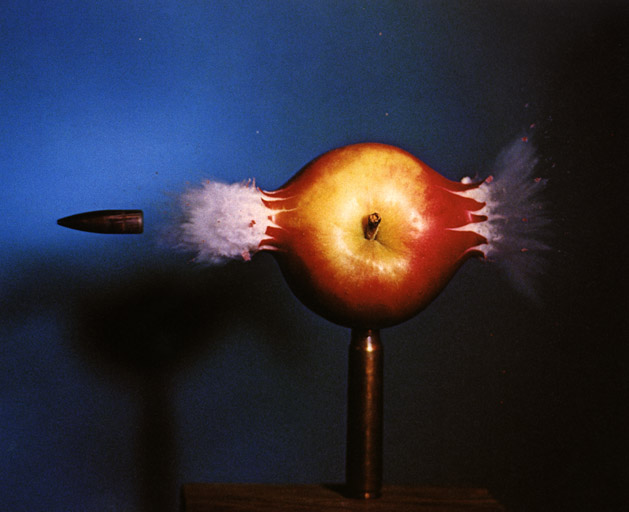
The photograph of the apple and the bullet is the work of Harold E. "Doc" Edgerton. "By synchronizing strobe flashes with the motion being examined (for example, the spinning of engine rotors), then taking a series of photos through an open shutter at the rate of many flashes per second, Edgerton invented ultra-high-speed and stop-action photography (1931)." See Exploring the Art and Science of Stopping Time for more information on Harold Edgerton's life and work.
-
Re:"Images in science"
The photograph of the apple and the bullet is the work of Harold E. "Doc" Edgerton. "By synchronizing strobe flashes with the motion being examined (for example, the spinning of engine rotors), then taking a series of photos through an open shutter at the rate of many flashes per second, Edgerton invented ultra-high-speed and stop-action photography (1931)." See Exploring the Art and Science of Stopping Time for more information on Harold Edgerton's life and work.
-
Ob. link to the DocThis kind of high-speed stroboscopic photography was pioneered by Harold "Doc" Edgerton. You've undoubtedly seen some of his images.
He was a MIT professor, prolific inventor, artist and by all acounts an incredibly nice person.
He's also responsible for one of my favorite quotes:
Work like hell
Tell everyone everything you know
Close a dread with a handshake
Have fun -
Ob. link to the DocThis kind of high-speed stroboscopic photography was pioneered by Harold "Doc" Edgerton. You've undoubtedly seen some of his images.
He was a MIT professor, prolific inventor, artist and by all acounts an incredibly nice person.
He's also responsible for one of my favorite quotes:
Work like hell
Tell everyone everything you know
Close a dread with a handshake
Have fun -
Can we slashdot MIT?Just in case...
So here's the story: We are three nerds (Isaac, Damon, and Reid). Upon Damon's return from MIT to our native quaint mountain village of Ashland, Oregon during winter break, he decided that the BASIC micro-controller he had just procured should be used in a high-speed flash photography lab. This was something Damon and Isaac had considered before, but not very seriously. Anyway, for this we also needed something moving or changing very fast, so we decided to build a bolt gun. Of course, bolt guns aren't very fun unless you can see, in great detail, the object they are hitting explode, so these two projects seemed like a match made in nerd heaven. With the aforementioned micro-controller, we simply had no choice but to build a flash timing mechanism to capture images of hot bolt-on-food action.
The mechanism works something like this: An air compressor is used to build up pressure behind a sprinkler valve. This valve is attached to a long PVC pipe which acts as the barrel of our gun. A button is hit, telling the micro-controller to open the valve, thus releasing the pressure and sending the waiting bolt hurdling forth at around 150 m/sec towards its suculent victim. When the bolt exits the barrel, it dislodges a piece of paper (thanks, Reid for the idea) which is blocking a beam of light. Once the paper is gone the light hits a photo-resistor, thus lowering the voltage output of a voltage divider, and triggering a binary input pin on the micro-controller. At this point the micro-controller counts to a number dictated to it by some DIP switches. We used a delay of 5 ms in most of our pictures. After this delay, the flash is triggered through a high-current relay. We simply set a couple of nice digital cameras (thanks, Damon's mom and Isaac!) to long exposures while the lab was completely dark, so all the cameras captured was the image at the time of the flash. This timing worked out so well in our lab sessions that we could determine where we wanted the bolt to be in relation to the unfortunate edible object in the shot by simply moving the morsel forward or backwards a few inches. The flash we used was a disposable camera that Damon gutted and soldered a relay into. Considering the speed of the bolt when it exited the barrel, the flash performed quite respectably for a disposable. Anyway, that's about all there is to it, so have a look at the pictures. In some of them you can see the piece of cardboard used to block the photo-resistor flying by in the background. All pictures were taken in Damon's garage-lab (thanks, Damon's garage!)
Note: even though we're absent minded, we (gasp!) did consider our safety in doing this. We put a slab of old carpet behind the fruit we were shooting, in the path of the bolt. This way the bolt didn't go across the room, bounce off of various objects, and become swiftly lodged into our soft brains. If you try something like this, we highly suggest you block the path of your projectile in a similar manner, wear goggles, and don't sit too close to the end of the barrel, like Isaac did.
If you want any of these pictures in a larger format, take a look here.
-
Bless you!
-
One Handed Keyboards?
Any one handed keyboards, like the twiddler? They use these for the MIThril wearable project. Some modification required. Location-Based Wi-Fi
-
Is This The Correct Case Study?Ah! That narrows the search at bit. I believe the case study in question can be found at Harvard Business Online, search on "emi".
"EMI and the CT Scanner (A) & (B)", case numbers 9-383-194 and 9-383-195, 26 pages, US$13 to purchase on line.
For you cheap bastards, like me, see MITOpenCourseWare (Made In India), and scroll down to lecture #8.
-
Re:Using heuristics in searches
Not so.
A heuristic is an estimate of the distance to your goal that you can use to evaluate which node in the seach space to expand next.
Your truths about the world are sentences that exist in the knowlage base.
There are some really good notes on search on the MIT Open Course Ware website here. -
Re:Really, it's research.overture.comYup. Seems so. If you look at the staff, a lot of them come from Overture, even the big boss:
The organization will be led by Yahoo!'s Head and Principal Scientist Dr. Gary William Flake, former chief science officer of Overture and founder of Overture Research.
It is interesting that, this Gary William Flake (who looks like a nice guy) may have done a lot before joining Overture (the books he wrote, for instance). But that company in itself does not seem to be much of a credential. I mean, building a search engine which ranks results according to an advertiser bidding system (sort by $bid_amount$) was a very neat idea. A very neat *business idea*, that is. But it does not seem to be ground for any technical innovation claim.
Overture (formerly know as "GoTo") will continue to be more famous as the bright child of IdeaLab, the controversial and trouble mother-of-all-incubators. -
Re:You raise very good points.
I would tend to agree with you that concerns about the security of ECC are overblown, and tend to come from the common wisdom that old-and-proven is better than new-and-unproven.
Let's see, RSA was put forth in 1977. ECC was first discussed in the mid-1980s, by Victor Miller (IBM) and Neal Koblitz.
So which is suppose to be "old-and-proven" and "new-and-unproven"?
In fact there is no assurance that RSA or DSA is any more secure than ECC. RSA is not proven (in the math sense) to be secure. We do not know for sure that if there is no easy way to factor large integers into their prime factors. -
Re:He has some points
I also think that cyber terrorism is a bad thing
But for now CyberTerrorism is still a fiction, we haven't yet seen any. At most all we've seen is CyberVandalism and CyberPettycrime.
This article brings to mind the hacker crackdown of the late 1980s and early 1990s (Bruce Sterling wrote a fairly good book about this) when the Secret Service was arresting kids for distributing publicly available documents, raiding game publishers and seizing thier computers, and spreading rumor and inuendo about the crash of AT&Ts long distance service that occurred on Martin Luter King Day in 1990.
While the graver danger we face as individuals is the potential loss of our privacy, freedom, civil liberties, and access to (accurate, non-biased) information to an ever growing government/corporate power structure, the media and our elected officials churn out statements such as the Baio's in order to create paranoia and a feeling of powerlessness among the general public, and to engender acceptance of oppressive regulation, control over the distribution of information, and the removal of privacy protections.
The author of the article is helping to set the stage for acceptance of Microsoft's "Trusted Computing" infrastructure, when the real problem is (as it was on MLK day in 1990) the growing monoculture of the internet (and general computing) infrastructure (which in turn is necessary for effective manditory DRM, manditory centralized personal data collection, and un-circumventable user monitoring).
-
Microsoft is just covering their asses
So, this all sounded pretty stupid, until I realized that well, Microsoft is pretty much just covering their ass. IANAL, but, it seems that this would fall under Trademark infringement. And if i remember correctly, a company risks loosing their trademark if they don't stop people from using it incorrectly. So, basically, I think Microsoft would just rather not have this happen, as loosing the rights to their name might have bad consequences. Hell, we could start making Microsoft Linux, and could you imagine, Microsoft OpenOffice. So yeah. The whole thing sounds a little weird at first, asking this guy to hand over the domain, but if you were Microsoft's Lawyers, what would you do?