Slashdot Mirror
Domain: nasa.gov
Stories and comments across the archive that link to nasa.gov.
Comments · 16,365
-
Re:Lawlessness
You are trying to change the subject once again - why are you talking about the days of communism and the Pravda?
I'm talking about the year of 2010 when a record heat wave hit Russia and other parts of Eastern Europe. You started with this bold-faced lie:
[...] shortages of supply in commodities? On which planet?
I gave you the link: here it is again ("Russian wheat export ban threatens higher inflation and food riots") . That article predicted food inflation before last year's big run-up in food commodity prices.
Here's more pictures from that record heat-wave ("Wildfire Pictures: Russia Burns, Moscow Chokes") , unprecedented in Russia's 200 years history of meteorological record keeping.
The year 2010 was also the hottest year on record, with record low Arctic ice early this year ("Arctic warmth: Sea ice at record low levels in January [2011]") .
Can you read, liar? Can you think? Do you really think that with major wheat production areas on fire or hit by record draught and with population growing ever faster wheat production is just business as usual and prices will stay super low?
-
Re:This is a SIGNIFICANT problem
Obviously. But the LIMIT on the singularity is arbitrary control over matter, and access to all matter that you have the energy to process. That is, at the minimum (this is using what we know today, not what we would know if we were millions of times more intelligent) you would be able to put all of the solid matter in our solar system (all the planets, all the asteroids, jupiter, the moons, etc) to productive use. (as in, convert it to robots or more computronium or use the elements you don't have a use for as fission or fusion fuel).
We could use machines like these to take apart frozen human volunteers and steal the "software" of human intelligence straight from the molecular patterns of the human brain. This would give us strong AI, plus self replicating machinery...ALSO leading extremely rapidly to the singularity.
OK, I'd like to know how we'd mine all of, for instance, jupiter, with an escape velocity of 59.5 km/s
1. Fast enough to have time to make use of the materials before the sun goes "poof".
2. Using little enough energy that it is possible to do it.
3. Wouldn't it be more economical to, for instance, go to another solar system and use more readily available materials there? Spreading out the influence, diluting any signs of civilization?
Furthermore, there already exists factories, called "cells" using machines operating on single molecules called "enzymes". While I have to admit that these are sloppily evolved for the benefit of cells (and/or genes), rather than designed for the purposes of humans, they show little of the more spectacular features your argument seems to rely on. This might, naturally, change, but so far I haven't really heard anything except FUD and dreams (i.e. nothing factual) in that direction. -
Re:Climate Change Deniers
But it takes several decades to a few centuries for the changes to fully manifest. As I said, mostly because of oceanic buffering, it takes 30-40 years for the atmosphere to catch up with the forcing so the temperature changes we're seeing now are about where we'd have ended up if we had stopped increasing the CO2 level in the 1970's-1980's.
I'll suggest this experiment - take an enclosed indoor swimming pool with an equilibrium state of the water at 72F and the air at 72F. Increase the air conditioning to 120F, and leave it there for an hour. Turn off the air conditioning. Questions to ask: 1) how much did the pool warm during that hour of 120F? 2) how long does it take for that warming to dissipate?
I find it more reasonable to imagine that a 30 year buffer in the oceans is more related to direct solar influences on the ocean, rather than mediation through the atmosphere. If anything, it seems likely that the atmosphere only moderates it via albedo, rather than by heat transfer (given the incredibly small amount of heat the atmosphere carries compared to the oceans).
Scientists don't go into science to get rich.
That may be well and true, but that doesn't mean that they aren't incentivized to provide results that will continue the outside financial support of their research. It's not only rich people that are incented by money (and in fact, one might argue that poor people are *more* incented by it).
The "climategate" emails are much ado about nothing.
Have you read them? Have you read the HARRY_README.TXT? The Climategate emails, and the data that accompanied them, were a scathing indictment of the honesty and transparency of a group of scientists who were not interested in competing on equal ground with competing hypotheses.
But uncertainties (about clouds or anything else) just increases the magnitude of the error bars on their conclusions, they don't invalidate the conclusions.
An increase in magnitude of error bars on conclusions makes a conclusion much harder to assert. If I say the temperature may increase 1C over the next hundred years, +/- 10C, certainly my conclusion will not be falsified by any stretch of the imagination, but is it a *useful* conclusion? The fact that error bars in this case may be orders of magnitude greater than the trend we're supposed to be identifying makes these kinds of "conclusions" particularly unuseful.
So I'm skeptical that even 1% of those 3 million submarine volcanoes has erupted in the past 50 years.
That's fine, but still, 30,000 volcanoes erupting in the past 50 years is going to have an impact on the heat content of the ocean. There's no reason to dismiss that as negligible.
And if you think the heat energy that volcanoes release is part of the cause of global warming it's negligible compared to the energy from the Sun every day. I doubt volcanic energy is even close to 1% of solar energy.
I can definitely agree with the comparison of the sun to volcanic energy, but I think where I disagree is the comparison of the forcing of CO2 to volcanic energy.
I've never heard of any solar scientist who said they could predict the cycles of the Sun beyond the current one.
http://science.nasa.gov/science-news/science-at-nasa/2006/10may_longrange/
Predicts both cycle 24 and 25. You'll note that their prediction for 24 is terribly off from reality, if you compare it to their current predictions.
Regarding your "corollary" we know far more about the properties of CO2 than we do about what drives the Sun's cycles. I don't think the two are comparable. CO2 is far easier to study.
I'd agree that in a laborat
-
Re:What about tides, seismic activity?
Actually, the Moon's influence on the tides is only 2.21 times larger than the Sun's:
http://imagine.gsfc.nasa.gov/docs/ask_astro/answers/961029b.html
No. Everyone knows that 2.21 is the number of "Jigga-watts" it takes to travel in time.
-
Re:What about tides, seismic activity?
Actually, the Moon's influence on the tides is only 2.21 times larger than the Sun's:
http://imagine.gsfc.nasa.gov/docs/ask_astro/answers/961029b.html
-
Re:Immediately followed by killer tornadoes
-
Break che link chain
This is the release on NASA website: http://www.nasa.gov/home/hqnews/2011/may/HQ_11-171_Moon_Water.html
And here's the paper (requires subscription): http://www.sciencemag.org/content/early/2011/05/25/science.1204626.full.pdf -
Re:Blank spot
that's the effect of this mess: http://apod.nasa.gov/apod/ap100709.html except at a different wavelength
-
Re:New? Hardly.
Actually Dr. Tom Sever at NASA has been doing this from a while now, although he tends to work almost exclusively in South America.
-
Re:New? Hardly.
I thought I'd heard something about this before on a TV documentary a while ago, but with Mayan ruins. I found a link. Now I'm not saying she didn't pioneer the technique or whatever, since apparently she's been working on stuff like this since at least 2004, but it seems to me like these people should work together (if they're not already).
-
Real archaeology
Talk about old and buried- NASA Archeological Remote Sensing. Adobe PageMill 2.0!
-
Re:Dissapointing
NASA is not insisting on capsules. The majority of proposed vehicles are capsules, including this one that they're doing the traditional way, but in the last round of CCDev proposals Orbital Sciences and Sierra Nevada both proposed spaceplanes.
-
Re:On the upside
For myself, I think we are just on the verge of a renewed genuine manned (or "crewed" for the more politically correct crowd) spaceflight expeditions of the future. What the final launch of the Shuttle will imply is the end of the massive big-budget government programs that are stopping mankind from spreading out at least within the solar system.
Yes, I assert and claim that NASA has done more to stop the expansion of mankind into the cosmos than they have helped, particularly over the past couple of decades. With tens of billions of dollars dumped on Constellation, a similar amount being proposed to be tossed at the "SLS" (aka "Senate Launch System") along with over a dozen other failed manned spaceflight projects that have gone through NASA over the past several decades, I see an agency that is hindering the process for Americans to build upon their legacies to continue going forward.
It is sad that the furthest any crew has been from the Earth was the crew from Apollo 13 (due to their free-return trajectory as the fastest means to return to the Earth with the limited fuel sources they had). That is a record that should have not only been passed decades ago, but should have been passed up regularly and by orders of magnitude since. We have been in the doldrums of manned spaceflight for quite some time, and all that has happened is a stagnant spaceflight industry that is no longer attracting the best and the brightest minds due to the fact that nothing is really being built any more... at least with the traditional government cost-plus contracting business models that built the Manhattan Project and flew people to the Moon with Apollo. Not only is manned spaceflight going downhill, robotic spacecraft developed under the same system is going to become more and more rare as well.
To make my point, major robotic missions like Cassini, Voyager, and even the Mariner missions are unlikely to be repeated in the future. Support for such big government programs that will take decades to perform no longer has congressional support. There are indeed some smaller robotic craft being developed, but please name a major new robotic spacecraft system that is currently being proposed at NASA which can follow up on research that has already been done. More significantly, the reason why the loss of Spirit is so awful is precisely because there isn't any sort of "replacement" of this scientific research platform due to funding cuts and a lack of interest on the part of Congress to build another rover vehicle that will take its place. There are certainly scientists and even NASA bureaucrats who have proposed such vehicles, but they aren't getting the support to get accomplished. This is on top of the fact that the robotic missions are usually the first things cut when the NASA budget goes through the meat grinder of the congressional appropriations process.
Getting back to my more optimistic appraisal, I think we are on the verge of a new wave of exploration because it will be moving more to private citizens. The wave of the future is with private spaceflight, more specifically with some of the new commercial spaceflight companies who are getting the brighter people in the industry... because that is where things are happening. It may include robotic vehicles as well as crews going into space, but they won't be primarily dependent upon the fickle winds of politics for funding those endeavors.
Mind you, I'm not saying that the government is going to be completely out of the loop any more, but NASA isn't going to be the bleeding edge of spaceflight technologies any more. I think stuff like Project Morpheus is going to be much more common at NASA, where they are going to work to refine technologies developed by private companies and citizens. There is already some consideration that Bigelow Aerospace might be contracted out for some ISS modules (or a separate NASA-financed space station) and other commercial companies like SpaceX already are being
-
V-S Day: Late-breaking news from the CouncilThe Council of Elders formally accepts the Articles of Surrender as ratified by the representatives of the blue planet. and hereby proclaims a day of planetary celebration: VS Day.
K'Breel, Speaker for the Council of Elders, spake thus:
"Long have we fought, long have we labored, but at least we have triumphed. It was half a year ago that the mechanized invader was finally defeated - half a year that the blue planet's oxygen-poisoned denizens dithered and denied, but at least, they have seen the truth for what it is. Rejoice, podmates! Wiggle your gelsacs in celebration! We proclaim today VS Day - Victory over Spirit!"
When a rather plump intelligence analyst suggested that today's victory was merely the result of normal seasonal changes, and that there still remained the issue of the second - still operational - invader, and furthermore, that code names gleaned from transmissions from the blue planet indicated the imminent launch of an even more powerful foe with a power source not subject to seasonal weather changes, K'Breel ordered that the analyst's gelsacs be frozen solid, irradiated, and thrown into the Planetary Trench. "Curiosity," said K'Breel, "felled the fat."
-
Re:Climate Change Deniers
A quick glance at a graph of worldwide temperatures assures me that there has been very significant warming over the past 15 years. Not to mention the melting of Arctic and Antarctic ice. So, yes, it seems just as simple as I say.
-
Re:Holy grail?
http://eosweb.larc.nasa.gov/ Lots of data available, have fun.
-
Re:Godspeed, Endeavour.
As a further indication of just how messed up NASA's costs are, consider this. They estimated, for a recent report (see page 40), the cost of developing the Falcon 9 and they were over by more than a factor of 10. In other words, NASA estimated it would take $4 billion while it actually took SpaceX $300 million (which was verified by NASA, according to the report!). This is the actual feat of bending metal and launching rockets, not paper or hand-waving arguments.
As I see it, NASA is out of touch with what it actually costs to do things in space. As time goes on, I believe we will see many more examples of this from manned habitats to unmanned space probes with private parties doing things for vastly less than NASA. I think even the traditional government space contractors such as Boeing, Lockheed, ULA, ATK, etc will figure it out. -
Re:So long and thanks for all the fish
No, STS-135 (Atlantis) will fly.
"The NASA Authorization Act of 2010 directs NASA to conduct the STS-135 mission. The Space Shuttle Program has added the mission to the manifest to prepare for a potential target launch date of June 28.
Atlantis will carry the Raffaello multipurpose logistics module to deliver supplies, logistics and spare parts to the International Space Station." -
Re:So long and thanks for all the fish"STS-335, the rescue mission that would fly only if needed to bring home the members of space shuttle Endeavour's STS-134 mission, currently the final scheduled shuttle flight. "
http://www.nasa.gov/home/hqnews/2010/sep/HQ_10-222_LON_Annc.html
-
Re:Lobster for breakfast as a last meal?
They had caviar on Mir.. They also had a fire on board at the same time.. So... no more caviar in space
-
Re:So long and thanks for all the fish
Was STS-135 cancelled?
-
Not Impressed
I'm not impressed. Solar planes have been in existence for a while. http://www.nasa.gov/vision/earth/technologies/solarFarm.html I really won't be impressed until it can carry cargo or passengers.
-
Re:RFC1149 Needs an update
Now RFC1149 for 'IP over avian carriers' needs an addendum. IETF go!
I disagree. We should all get on board with a ready backup plan based on RFC4838. Every town should have an implementation of Delay-tolerant Networking, just in case...
NASA has already began testing an implementation of RFC1149 for use in space.
Our local DTN could use shortwave radio, and/or CB with repeaters, etc.
Alas, I fear we will only begin to build the network after it is needed... On a related note: I want the right to bear technology lumped in with the right to bear arms if my strong encryption system is going to be considered munitions.
-
Re:Godspeed, Endeavour.
BTW, I don't know if you are actually saying there is no profit in it or that corporations just don't perceive any, but perusing the NASA Spinoffs site is a good eduction.
-
Re:Self Correcting Problem
Also important are that there are fewer small debris at GEO and the debris-encounter velocities are much lower. There's some interesting stuff in the beginning of NASA's "History of On-Orbit Satellite Fragmentations" (like figures 1.3.2-2 & -2). This and other docs are linked here.
-
The Official NASA Release
Come on, Network World for a NASA news release? Ridiculous.
Here is the actual NASA press release.
-
Re:UK Government Hinders WiFi
Here is a summary of the IPCC's expected effects from a 1 to 3 degree rise in global temperature. A 1.4 degree rise is by no means trivial.
Furthermore, you are ignoring the lag in the warming effect of greenhouse gases (CO2 emitted into the atmosphere does not instantly cause warming pro rata), and possible feedbacks in the system (such as disruption to the methane hydrates) that might drive the temperature considerably higher - currently models put the value between 1.5 and 4.5 degrees, I believe, with a consensus appearing to form around 3 degrees. Obviously, that's got a high degree of uncertainty attached, but given the effects of 1 degree, why on Earth would you gamble?
-
Re:UK Government Hinders WiFi
Sigh.
We've consumed about 50% of the world's total supply of conventional crude
The global temperature has risen about 0.7 deg C since 1900
Now, put it together. 0.7 C * 2 = 1.4 C. A simple conciliatory observation: Yes, global warming is real. No, it isn't bad enough to justify anything other than slight caution.
Perhaps hunger for grants and funding are to blame for this wide-spread panic? Or is it just plain old chum?
Caveat Emptor. Ya know, the pediatrician recommended circumcision for my boy, of all things, but, like many doctors, he's Jewish. -
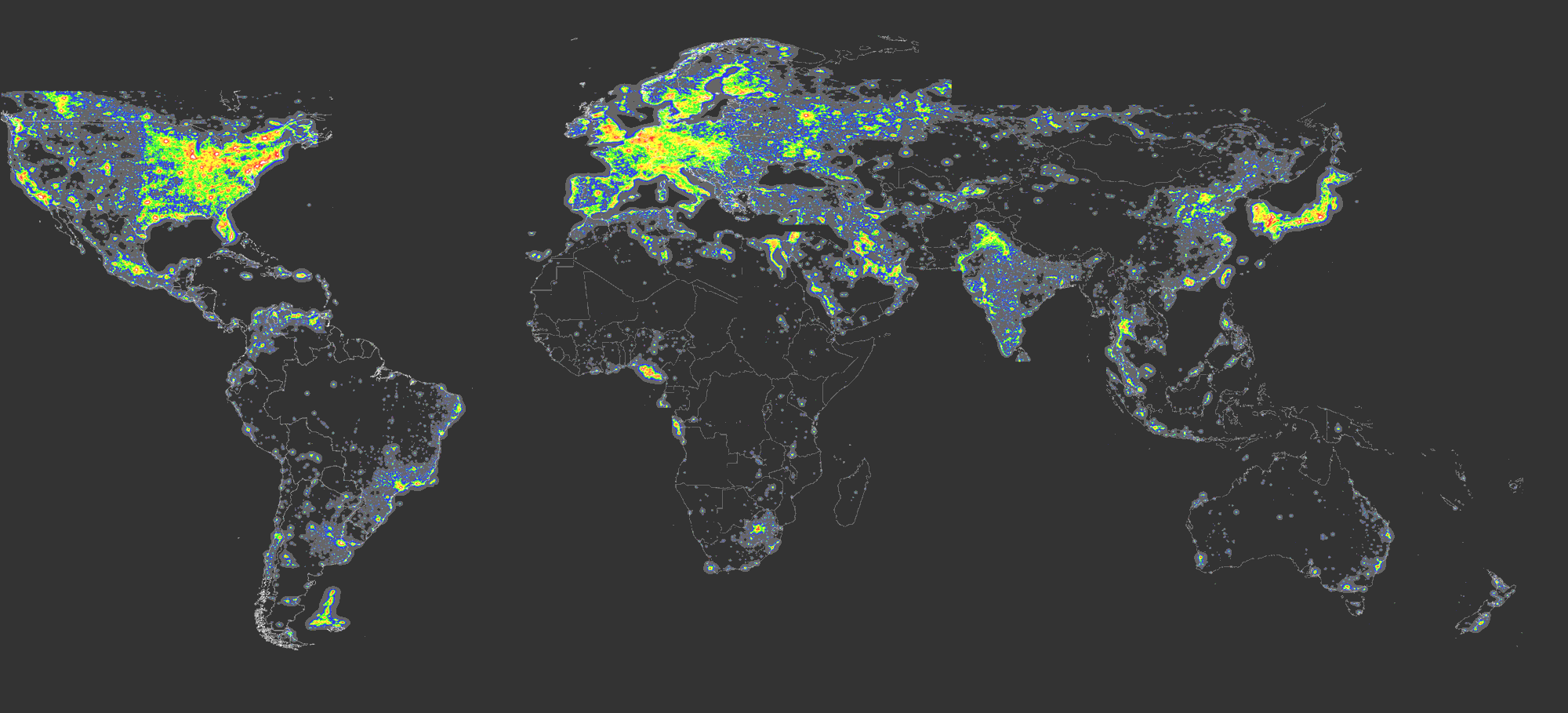
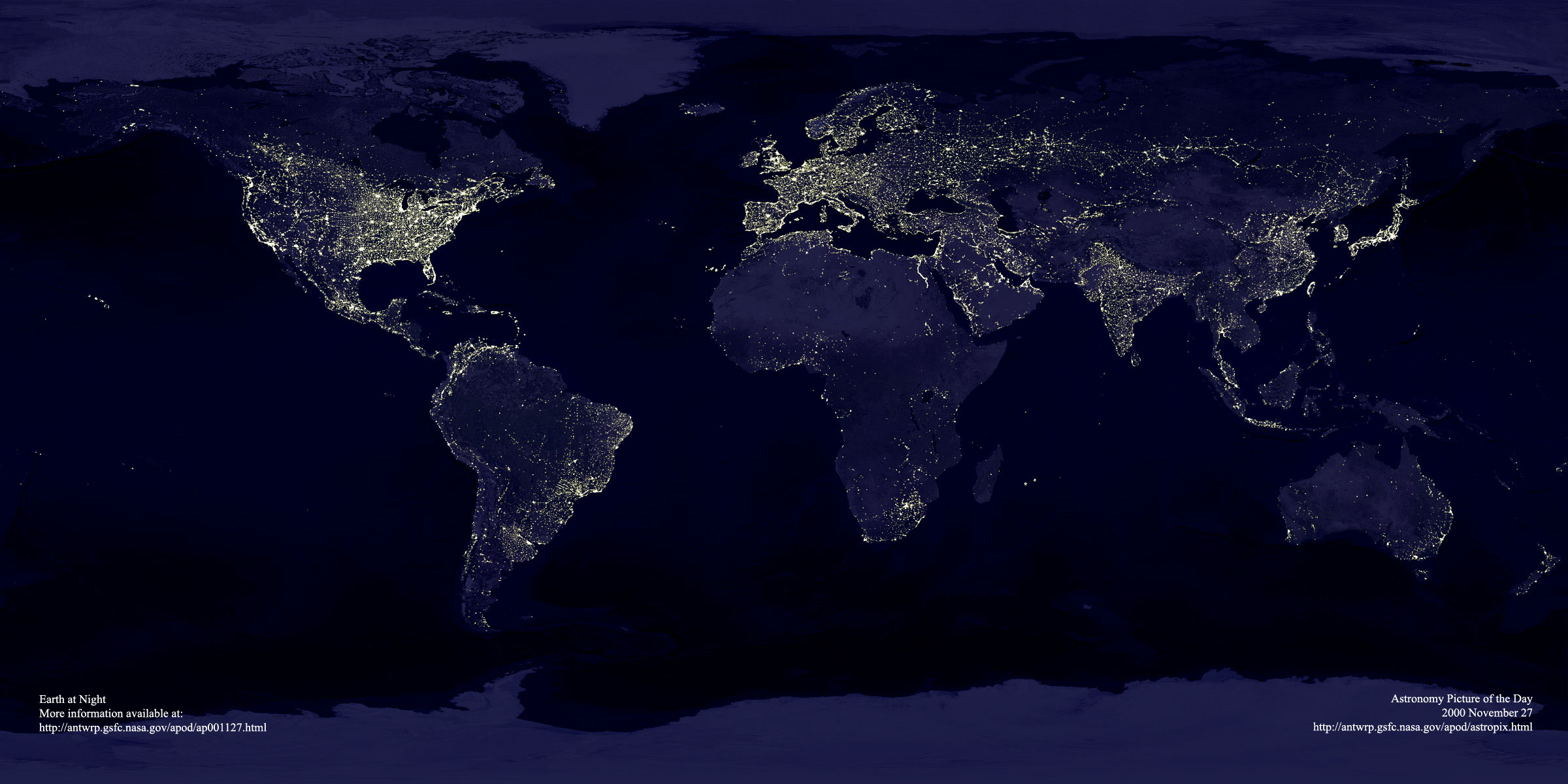
Looks a lot like the 5 Gp Image
You will not see all the colors, since the light in the Image was collected over time. None the less it looks just like that.
You have to go to a place without light pollution. Then you have to let your eyes acclimate in the dark for 20 to 30 minutes. Of course the quality of your eye sight will factor in.
Map of light intensity of the earth
Here is just a picture of the earth at night. -
Re:It looks like a stealth assassination copter.
... and if you STILL won't believe it, let NASA prove you wrong: http://www.grc.nasa.gov/WWW/K-12/airplane/wrong1.html
-
Re:Nasa Warp Drive Project
http://www.grc.nasa.gov/WWW/bpp/
They stopped it in 2002, it was basically throwing relatively small amounts of money at some ideas and seeing if anything stuck...
-
Re:Gee
Sources:
http://www.nasa.gov/centers/kennedy/about/information/shuttle_faq.html#10
http://www.renewableenergyworld.com/rea/news/article/2010/02/us-government-budget-proposals-increase-clean-energy-funding
2.360M / 450M * 100 = 524.44%
Yeah, I agree, we are WAY over spending on renewable energy. -
Re:A note from the author...
Perhaps you could've slightly improved your piece of 'code' before slashing it here, but then anything get plastered around here these days...
Google maps DEM (Digital Elevation Model) is based on SRTM (Shuttle Radar Topography Mission) data over most of the globe. You can download the original processed data from NASA and apply it to any GIS software of your choice.
Then with a single click of the elevation tool you can raise or lower the global sea level by x meters of your choice. Was playing around with this 7 years ago when the data came out. Now bored of it.
Like some have pointed out already, the flood fill algorithm is a bit pointless since tsunamis don't behave like flood filled algorithms. A more informative map would simply color areas more than a certain height green showing areas that are definitely out of reach of a tsunami of certain height. Then people could at least see where its relatively safe by inputting the maximum wave height. With large tsunamis we do not even have scientific data on how far inland they could actually travel. Some geologists for example speculate that a super tsunami might have swept across the whole of the Australian continent.
-
Re:Yes but
Funny, but untrue. Your physical properties and laws aren't physical properties and laws, but best guesses.
http://www.giss.nasa.gov/tools/modelE/HOWTO.html
Again, no model has run for any extended amount of time without having had it's variables changed to fit observations. Thus not science.
-
Re:Yes but
The model doesn't have any free variables, only physical properties and physical laws, plus initial conditions.
And if you don't believe it, you can download the source code, and see for yourself. http://www.giss.nasa.gov/tools/modelE/modelEsrc/
-
Re:Shoestring budget
Sure, it's nice that the US has an expensive hobby which occasionally results in missions to other planets. But for the money spent, I figure they should have several hundred missions still active. We live in an era of diminished expectations. The one-eyed man is king in this land.
You should see how much stuff NASA is working on, most of it is dull basic science (where government belongs, a 15 billion dollar telescope to look at the early universe isn't profitable) so it isn't in the public eye.
-
Re:Meh.
This is what I hate about most "traditional" news sites -- they tell you the image exists, but they don't say where. NASA makes much of its imagery available on the web, so there should always be a link. To be fair, IBI (as well as the above link) appears to have published the highest resolution available. But for completeness, here is NASA's original:
USA7 Subsets Day 118: 04/28/11
Page for Aqua 250m True Color
Direct link to image (8MB) -
Re:Meh.
This is what I hate about most "traditional" news sites -- they tell you the image exists, but they don't say where. NASA makes much of its imagery available on the web, so there should always be a link. To be fair, IBI (as well as the above link) appears to have published the highest resolution available. But for completeness, here is NASA's original:
USA7 Subsets Day 118: 04/28/11
Page for Aqua 250m True Color
Direct link to image (8MB) -
Re:Meh.
This is what I hate about most "traditional" news sites -- they tell you the image exists, but they don't say where. NASA makes much of its imagery available on the web, so there should always be a link. To be fair, IBI (as well as the above link) appears to have published the highest resolution available. But for completeness, here is NASA's original:
USA7 Subsets Day 118: 04/28/11
Page for Aqua 250m True Color
Direct link to image (8MB) -
High Resolution
Here are the high resolution versions of the photos in the article: All images for Severe Tornado Outbreak in the Southern United States : Natural Hazards. The article uses the second one and the fourth one.
-
Re:Standardize on efficient data representations
FITS is the ubiquitous data format in astronomy, see http://fits.gsfc.nasa.gov/ - it has idiosyncrasies from arising originally in the 1970's, but is extremely portable and forgiving of a wide range of host operating systems and development environments. The specification has also been published in the refereed astronomical literature, making it suitable for very long term (even in astronomical terms) archival storage. Hence the interest of the Vatican in using this for their manuscripts. Recent data compression work is quite state of the art (if I do say so myself), and would be applicable to other scientific image or table formats, including your homebrew format.
-
Re:Meh.
And these pictures show the phenomena on a larger scale... sometimes it's interesting to look at the forest as well as the trees.
-
Standardize on efficient data representations
Regarding FITS (Flexible Image Transport System), if this is used in significant ways in medical imaging, the astronomical FITS user community would love to know about it and collaborate. Regarding rice-compressed FITS, I (and undoubtedly my coauthors) would be beyond fascinated to learn of either medical imaging use cases or compression tools for this purpose. Alternately, any FITS-based medical imaging applications should be aware of the astronomical data compression work accessible through http://heasarc.nasa.gov/fitsio/fpack (hopefully I'm not slashdotting myself
-
No, it's not powered by that CPU
Nope, not true. Voyagers 1 & 2 are not powered by the RCA CDP1802, as is popularly believed.
The Voyager FAQ explains this, about halfway down the page:
http://voyager.jpl.nasa.gov/faq.html
NASA's JPL says they custom-designed the processors on the two spacecraft and they were manufactured by General Electric (according to JPL specs).
This makes sense, actually, because if you are designing a spacecraft in the 1970s, you have very specific electrical, environmental and other requirements as compared to common off-the-shelf components which are designed with different (terrestrial) criteria in mind.
-
Re:Let me say
http://voyager.jpl.nasa.gov/faq.html
There are three different computer types on the Voyager spacecraft and there are two of each kind. Total number of words among the six computers is about 32K.
Computer Command System (CCS) - 18-bit word, interrupt type processors (2) with 4096 words each of plated wire, non-volatile memory.
Flight Data System (FDS) - 16-bit word machine (2) with modular memories and 8198 words each
Attitude and Articulation Control System (AACS) - 18-bit word machines (2) with 4096 words each.
According to my calulations, that's a total of about 68KB, or small potatoes compared to today's microprocessors. We probably could perform all functions with one of today's boards and still have room for solid state data storage and much more fault detection software. We would still need a second unit for redundancy. Today's microprocessors are also much faster than the chips used on Voyager and a comparative system would use less electrical power. On the other hand, software might be more complicated as opposed to that used in an interrupt type system, but it would be much more capable and more flexible.
Let's look closer at the CCS. The CCS has two main functions: to carry out instructions from the ground to operate the spacecraft, and to be alert for a problem or malfunction and respond to it. Two identical 4096- word memories contain both fixed routines (about 2800 words) and a variable section (about 1290 words) for changing science sequences. The CCS issues commands to the AACS for movement of the scan platform or spacecraft maneuvers; to the FDS for changes in instrument configurations or telemetry rates and to numerous other subsystems within the spacecraft for specific actions. Fault-protection algorithms are also stored in the CCS, occupying roughly 10 percent of the CCS memory.
The main functions of the FDS are to collect data from, and controls the operations of, the scientific instruments; and to format engineering and science data for on-board storage and/or real-time transmission. The FDS also keeps the spacecraft "time" and provides frequency references to the instruments and other spacecraft subsystems.
The Voyager spacecraft computers are interrupt driven computer, similar to processors used in general purpose computers with a few special instructions for increased efficiency. The programming is a form of assembly language.
There is no clock chip, as such, in the spacecraft. The "clock" is really a counter, based on one of several electronically generated frequencies. These frequencies, based on a reference, generated by a very stable oscillator, are converted and fed to different locations in the spacecraft as synchronization signals, timers, counters, etc. The "clock" signal is part of the information telemetered to the ground and it is with ground software that we convert to day of year, time of day Greenwich Mean Time.
Voyager was built in-house at JPL; the computers were manufactured by General Electric to JPL specifications.
-
Re:How long till
The source of the 40,000 figure is here, which is at least hosted on jpl.nasa.gov. I was hoping an author careful enough to include star movement was careful enough to include whatever other relevant effects may exist. You mentioned momentum transfer. Off the top of my head, there may also be electrostatic effects, gravitational fields, or a particle field drifting in some direction which may or may not modify the calculation significantly.
-
Re:Let me say
Voyager FAQ answers the question "What kind of computers are used on the Voyager spacecraft?" It's more detailed than the lay explanation I expected — very interesting indeed!
-
Re:Let me say
How many times did they have to reboot Voyager?
In case you didn't know, it wasn't a reboot, but there was a problem where they actually did have to live patch the voyager 2 computer last year for a bit-flip problem...
Of course this was discussed previously
Although that's impressive, in general, the SW architecture of voyager is quite complicated and fragile, and during the operation, several mistakes have been made one of which caused the primary receiver on Voyager 2 to be accidently shut down, never to work again (so it's relying on a backup which has a faultly frequency tuning circuit which they compensate in software).
It's really only heroics which keep these probes up and running. The original engineering, while impressive, is really not the thing that's keeping things working now...
-
Re:Well ain't that just grand!
Well, he's done a lot more than just hard-core programming work... this isn't his first time in space: http://www.jsc.nasa.gov/Bios/htmlbios/chamitoff.html
-
Seed germination?
Speaking about food, hasn't the seed thing been done already?