Slashdot Mirror
Domain: phoronix.com
Stories and comments across the archive that link to phoronix.com.
Comments · 898
-
Re:hmm...
Even if you could get WINE working with it, You're only going to be able to get a few windows games working.
1) Wine runs plenty of games, provided that you have a good enough video card. I personally use it for Supreme Commander, Borderlands, C&C3, and the StarCraft II Beta - and I'm only using a GeForce 8600M.
2) Linux has it's own games. In addition to the FOSS games there are plenty of indie titles, all of Id's games support Linux, and we're anticipating Steam for Linux in the near future. -
Phoronix Test Suite
Phoronix Test Suite ( http://www.phoronix-test-suite.com/ ) supports Win7 now. It also allows comparison against OSX and Linux ( http://www.phoronix.com/scan.php?page=article&item=linux_windows_part3&num=1 ).
It's Free, it's Open Source and has a bucketload of tests already. You can combine result sets and you can even get the results uploaded for comparison at http://global.phoronix-test-suite.com/
Creating your own tests is nice and easy too.
(Full disclosure - I am one of the project members).
-
Re:Right
Bah, fud and rubbish. Ext4 used to be a bit faster than btrfs but as of 2.6.33-rc4 (back in January) that situation has reversed, as Phoronix discovered when they tested it. And as for on disk format changes they've already stated that there won't be any more changes now unless they find any critical bugs that require it.
-
Meego is Switching
Meego is already switching:
http://www.phoronix.com/scan.php?page=news_item&px=ODIzOA
This is happening sooner than I thought. Maybe people are just getting pig sick of long fscks on large drives and partitions, which ext4 just doesn't solve to any degree of sastisfaction? I know I am.
Server-wise I run a lot of OpenVZ machines and snapshotting them through LVM and occasionally fscking the volume, which you have todo, is painful. ext3 has outlived its usefulness there. I could move to XFS but XFS just simply doesn't have the broad support from a lot of software out there unforutunately and you start getting into doing certain hacks for it. The xfs_freeze is one thing it has going for it though and it is very useful if you don't or can't run LVM. ext4 just doesn't give me confidence that anything will fundamentally improve over ext3 from what I've seen. The ext filesystem line, LVM and software RAID has served us well but it's time to start moving on. -
Re:They shouldn't have bothered.
It's not yet "superior in practically every single way"- and you should avoid making remarks of that nature.
Check the recent benchmarks out : http://www.phoronix.com/scan.php?page=article&item=gcc_llvm_clang&num=1
For starters, if it was as you claim, it wouldn't have been edged out by the LLVM backend on GCC- but that was the case in most of the benchmark tests.
Second, if it was as you claim, it wouldn't have failed to run some of the benchmarks- if it's better in every way, it should be able to do the SAME things as GCC without failure, without flaws in execution and not fail where there are flaws within GCC (And there are some...).
In the end, superior means robust compilation results, and peak performance. Neither of which Clang brings to the table yet. The main reason Apple did this is that they wanted their OWN compiler toolchain that wasn't beholden to FSF- it's only real "compelling" thing is that it's under the BSD license. Now, having said all of the aforementioned, it's got potential to do what you claim. It's a good redesign of things using LLVM as the backend engine. But your assertion at this point in time is inaccurate.
-
Re:Except...
-
Re:Except...
Well, that an the big X memory leak... http://www.phoronix.com/scan.php?page=news_item&px=ODE3MA
-
More evidence
http://store.steampowered.com/public/client/steam_client_linux Probably helps the cause too. Phoronix has posted a new article: http://www.phoronix.com/scan.php?page=news_item&px=ODE3Mw
-
Re:I will buy
Slowly but surely.. Look up Gallium3D:
ATI's Gallium3D Driver Is Still Playing Catch-Up -
Re:What platform does this run on?
According to phoronix, it's available for Linux. Not sure about other platforms. Somebody on the phoronix forums remembers using it on Windows.
-
Personal data protection WTF ;)
This picture AFAICT shows a grading page from the class book (LHS). The class book had pages for grades for each subject, for attendance, etc. It seems this format was spread across former Soviet bloc. You can notice that the class had 40 students (ugh). The grades are 2 to 5, with 2 being a failing grade. Student #37 was named Shrayer V. (in a loose transliteration), and was decent enough (only one 2, mostly 4s and 5s).
-
Re:Overheard at nVidia:
Fuck everything, we're doing seven panels.
-
Re:anyone know if the ati linux drivers work for t
allow me to answer my own question:
-
Re:A moral win?
The same way that it helps normal power users who want to use their ATI and Intel cards on 64-bit OSes when Linux's customer base shrinks to nothing because the "normal people" migrate to Windows due to their refusal to ship closed-source drivers with the kernel
Unfortunately that doesn't aid your argument one bit, as it's Windows Firefox users that are the relevant demographic here. Last October Phoronix reported on a question and answer session with NVIDIA's Andy Ritger who leads the user-space side of the NVIDIA UNIX Graphics Driver team, where he stated that their linux driver download rate is 0.5% the size of their Windows driver downloads. Kind of puts things in perspective eh!
Taking a stand will always alienate some people, but surrendering will similarly always hurt your chances of success. The key is in knowing when to do which one, and I (along with the Mozilla guys and a good portion of the F/OSS community) believe it's time for the former.
No one who advocates including H.264 in Firefox today is talking about surrender. If you must, then think of it as a strategic retreat in order to regroup for a battle to come, because now is not the right time. Getting Theora friendly browser installs out there in sufficient numbers before making a big push for change is essential for success. If you can't see that then I'm sorry for you, cos you're wrong. As for a good portion of the F/OSS community supporting your position, I don't think you have a majority on this at all. There are a lot of hard core F/OSS supporter out there who are speaking against against Mozilla on this one because we believe it's tantamount to cutting off your nose to spite your face.
You don't? fork Firefox and add h.264 support yourself, or just move to IE if that's what you want
Not possible for me as I don't run Windows (only Mac OS X and Linux). I've already made my choice (to eat my own dog food) and switched to Chrome/Chromium on both of them. And this is why your argument (and Mozilla's) is so weak: why should I make the effort to fork and hack Firefox when competitors (Google and Opera) have already done the hard work for me? For a Windows user who doesn't give a flying fig about F/OSS and just wants to view their content the choice is even easier: IE, Safari, Chrome or Opera. Firefox will be the least attractive option because functionally it will appear broken.
As for me, well you can serve me H.264 or Theora and I'm covered thank you very much.
-
Changing very rapidlyI have an AMD/ATI HD3200 (non-expensive on-motherboard graphics card) and I've been trying to follow and understand the development for the past year or so. My opinion is that it's changing very rapidly, that the (few?) developers working on it are working their collective asses off.
There's a hardware-news website which keeps a close tab on the developments called http://www.phoronix.com (also tracks NVIDIA developments; this article in particular might be interesting to NVIDIA owners: Benchmarks Of Nouveau's Gallium3D OpenGL Driver).
Also, you can follow the development of mesa at http://cgit.freedesktop.org/mesa/.
Current AMD status seems to be that for older ATI's (up to R500 series) there's a "normal" X driver (supporting KMS?) + "bleeding edge" newer, probably highly experimental Gallium3D r300g driver, and for the newer R600, R700 series there's only the normal X driver, with KMS, called xserver-xorg-video-ati. There's also an xserver-xorg-video-radeonhd but I think it's a bit less developed.
With the following "testing" and "unstable" stuff installed on Debian:- xserver-xorg-video-ati 1:6.12.6-1
- libdrm2 2.4.18-2
- libgl1-mesa-dri 7.7-4 (and the other mesa stuff)
- linux-image-2.6.32-trunk-amd64 2.6.32-5
I can play tremulous, urbanterror, and openarena normally, but nexuiz crashes the X server and the commercial ETQW and quake4 crashes missing some higher OpenGL functionality, so YMMV.
It is my opinion that this risky "develop everything anew" Gallium3D strategy will pay off, because the AMD/ATI, Intel, Nouveau and VMware teams can then bundle their efforts on the exciting higher-level "state tracker" layers (such as more recent OpenGL with GLSL for games, and OpenCL!, and maybe some kind of video acceleration or at least DCT also if they agree on which one) and only need to write modesetting and Gallium driver compiler stuff themselves.
But nobody can say for sure if all the temporary instabilities and incompatibilities will all be behind us at the end of 2010. It's good enough for me -
Changing very rapidlyI have an AMD/ATI HD3200 (non-expensive on-motherboard graphics card) and I've been trying to follow and understand the development for the past year or so. My opinion is that it's changing very rapidly, that the (few?) developers working on it are working their collective asses off.
There's a hardware-news website which keeps a close tab on the developments called http://www.phoronix.com (also tracks NVIDIA developments; this article in particular might be interesting to NVIDIA owners: Benchmarks Of Nouveau's Gallium3D OpenGL Driver).
Also, you can follow the development of mesa at http://cgit.freedesktop.org/mesa/.
Current AMD status seems to be that for older ATI's (up to R500 series) there's a "normal" X driver (supporting KMS?) + "bleeding edge" newer, probably highly experimental Gallium3D r300g driver, and for the newer R600, R700 series there's only the normal X driver, with KMS, called xserver-xorg-video-ati. There's also an xserver-xorg-video-radeonhd but I think it's a bit less developed.
With the following "testing" and "unstable" stuff installed on Debian:- xserver-xorg-video-ati 1:6.12.6-1
- libdrm2 2.4.18-2
- libgl1-mesa-dri 7.7-4 (and the other mesa stuff)
- linux-image-2.6.32-trunk-amd64 2.6.32-5
I can play tremulous, urbanterror, and openarena normally, but nexuiz crashes the X server and the commercial ETQW and quake4 crashes missing some higher OpenGL functionality, so YMMV.
It is my opinion that this risky "develop everything anew" Gallium3D strategy will pay off, because the AMD/ATI, Intel, Nouveau and VMware teams can then bundle their efforts on the exciting higher-level "state tracker" layers (such as more recent OpenGL with GLSL for games, and OpenCL!, and maybe some kind of video acceleration or at least DCT also if they agree on which one) and only need to write modesetting and Gallium driver compiler stuff themselves.
But nobody can say for sure if all the temporary instabilities and incompatibilities will all be behind us at the end of 2010. It's good enough for me -
Re:Crap Hardware vs. Crap Drivers? Is that it atm?
A bit outdated. Here: http://www.phoronix.com/scan.php?page=article&item=unigine_20_performance&num=2 .
-
Re:Bad move....
What other architecture are you talking about, BSD and Solaris? Both supported [nvidia.com] by NV but ATI only does Linux.
AMD has released full documentation for ATI cards. If other OSen want to have drivers, AMD has provided everything they need to do it.
Freedom for who, why should a company that spent 100's of millions of dollars in RD give away the keys to kingdom?
Because it increases their customer base. The products are graphics cards, not drivers. Both companies are just going to reverse engineer each other's products, anyway, so what's the documentation going to hurt any?
Both companies are pushing GPGPU, and that means there's a good reason to have high quality Linux drivers, preferably open source ones that can be tweaked specifically for the task. It's not just games anymore.
-
Re:Bad move....
When was the last time you used them in Windows...1997? It certainly hasn't been since they were bought by AMD, because ever since AMD took over their drivers have been solid as a rock. Hell I am typing this on a quad core AMD with a 4650 and an ATI TV Tuner, and damned if even the TV Tuner isn't stable as hell, and those things are NEVER stable!
So I would say give them another try. You can buy a 4xxx series card for under $50 (I bought this 1Gb 4650 for $36 after rebate) and the thing is quiet as a church mouse and gives me a real nice picture and hardware accelerated everything. you really can't beat the "bang for the buck" in the AMD camp these days. And since AMD is releasing the full specs I'm sure the AMD drivers will get nothing but better in Linux.
-
Non-issue really.
I use an Nvidia video card with the Nouveau driver on my desktop. Sure, it's not as fast as Nvidia's closed source driver but it works well for me. Fedora 13 will have a Nouveau release with out of the box 3D acceleration and DisplayPort support too.
-
More GPU bound than CPU bound nowadays
Any CPU with more than 2 cores, should be able to handle most of what you want... I've been testing a dual core Atom 330 at work, and it's actually easy to forget it's not a "real" CPU (unless some FPU-intensive screensaver comes on).
For mid-to-low-end systems, GPUs are really the discriminator
http://www.videocardbenchmark.net/ - a good comprehensive list that boils down and ranks just about every card out there into a single (artificial) benchmark number.
Wikipedia also has surprisingly good coverage of every family of chip, and what products are based off of them and tables of supported features - crucial for system building. So I use it primarily to figure out things like: which nVidia Geforce is equivalent to which Quadro FX branded model, what is the fastest memory my "Barton" core Athlon would support, what the hell is the difference between a 2.2Ghz "Williamette" vs. a 2.2Ghz "Prescott", etc.
I've also taken a liking to checking with http://www.phoronix.com/ for Linux benchmarks and support for new hardware features and drivers... such as nVidia vs. ATi vs. Intel, which distribution has better VPDAU or audio support, etc.
And definitely once in a while read up on http://anandtech.com/ and http://tomshardware.com/ if it's been a while and you need a comprehensive explanation of new tech, such as SSDs or long-term price vs. performance investment strategies... those can really help you plan ahead (Intel & nVidia's tick-tock release cycle, finding the best value, and just generally knowing which buzzwords are important and which are just marketing rubbish.
-
Re:The first thing to come to my mind...
-
Re:And Valve releases heavy hints about steam on o
We also may see the source engine come to Linux, as it is rumored that valve has been rewriting the engine to run natively on linux. http://www.phoronix.com/scan.php?page=article&item=source_linux&num=1
-
Re:Why BSD?
You mean you can't find it because this shows Linux ahead of FreeBSD (for reliability)? Or this, where several different Linux distros beat FreeBSD soundly in most benchmarks?
Sorry, but your nonsense about FreeBSD performing better than Linux is just that: nonsense. In some cases it does, in other cases it doesn't. Use the tool you think suits you best (and there are plenty of reasons to prefer BSD), but claims that FreeBSD generally performs "better" is just delusional fanboy bullshit. It's still a good, clean Unix with excellent performance.
-
More likely a Linux client
http://www.phoronix.com/scan.php?page=article&item=steam_confirmation&num=1 It's old, but talk of Steam coming to Linux has been going around in a number of places.
-
Re:Well this sucks...
But keep in mind that FreeBSD is a slowest OS. And probably the most conservative and really old at ecosystem. And also has completely f*cked up release time schedule (even Warner Losh himself agreed on that). As well as quality is quite shitty for other things than just a network router. And threads there are mostly crap.
OpenSolaris has *valid* open source license, so your statement "I want fully free and opensource, hence FreeBSD" -- is sounds more like a FUD.
YMMV.
-
Awesome
I'm actually pretty impressed, I didn't expect they'd be this successful getting a development community and a working driver going. I'm curious as to the stability, I noticed there was one issue with the fonts in the review. Personally stability would be the big selling point for me, I've had issues with the proprietary drivers in the past and it would be great if there was a highly dependable open source driver I could count on.
On a related topic does anyone know the state of the open source ATI driver? I saw a phoronix article claiming it was more popular than the proprietary one but other than that I don't know what it has for performance or features. It would be interesting to compare since the ATI made the specs available.
-
Re:free software drivers?
Can someone who knows these products tell me if these laptops will work well with free software, or are they are disaster like the Intel GMA500(right?) based laptops?
Since no one who "knows" these products is giving good answers...
By "free" do you mean free drivers as well as OS? If you're okay with proprietary drivers, then Phoronix's articles on ION/Atom seem to show that they work well (by Linux standards) with Ubuntu and NVIDIA's proprietary drivers. 3D acceleration and video acceleration (VDPAU) both seem to work.
-
Re:free software drivers?
Can someone who knows these products tell me if these laptops will work well with free software, or are they are disaster like the Intel GMA500(right?) based laptops?
Since no one who "knows" these products is giving good answers...
By "free" do you mean free drivers as well as OS? If you're okay with proprietary drivers, then Phoronix's articles on ION/Atom seem to show that they work well (by Linux standards) with Ubuntu and NVIDIA's proprietary drivers. 3D acceleration and video acceleration (VDPAU) both seem to work.
-
Re:What's taking so long?
-
Phoronix
While they're really the only group that does a lot of linux benchmarking, I'd put a *large* grain of salt in their results.
They have no problem blindly accepting something like this without investigating why it is so much faster and seeing if there's a problem with their testing.
-
Re:State of AMD for HTPC Use?
From what I understand hardware acceleration is now somewhat usable with the Catalyst drivers (source). But for the open source drivers there is nothing, there's no specs for UVD and even though it should be possible to implement a shader-based acceleration and the docs for that is out, no one has done it yet.
-
Re:FireFox is great, but...
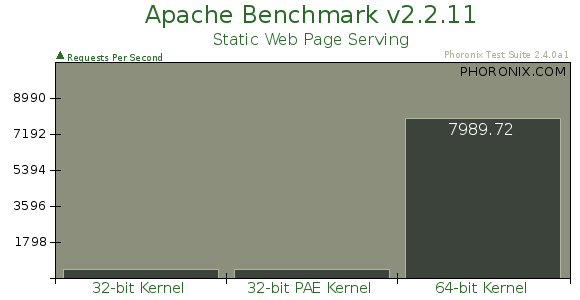
I still use a 32 bit OS because I see no need in switching to a 64 bit OS. I'm currently running Ubuntu 32 bit on a 64 bit CPU, I really don't see the need in changing.
Recent benchmarks pin 64bit Ubuntu as faster than 32bit Ubuntu on a variety of operations.
Unless you want a huge amount of RAM, theres little need to get a 64 bit OS.
but a lot of software is 32 bit only.
Not a problem for FOSS, plus a 64bit kernel has no problem running 32bit apps (as per article there is a 1-2% hit, but
-
Broadcom Crystal HD has open-source drivers
Phoronix covered that, and I think someone else did too. XBMC has got the Broadcom Crystal HD (I don't remember the exact model number(s), but they're all over eBay and logicsupply has some) working, and their current solution apparently works across linux, OSX, and windows.
Fingers crossed that it doesn't use some kind of horribly strange API. I was hoping it would be VA-API supportive, but it's alright...
http://www.phoronix.com/scan.php?page=news_item&px=Nzg0OQ
This would be marvellous for an HTPC with an Atom. I'm pretty sure the 230/N270 can already play N64 games with Mupen64Plus, 1964, and Project64, at full framerates (but custom textures and such would be another issue) so your gaming is also covered (let's face it, classic nintendo games were win. You might be able to pull off PS2 emulation with a 330 or its sucessor).
-
Re:How does it compare with the other NVidia drive
You heard wrong or are just outright lying. I choose the latter because you reek of fanboi.
ATI and Intel both release documents for their hardware and actively work on X.org themselves to ensure that their hardware works. The default ati and intel drivers in Mesa are maintained by their respective companies now. Every release gets magnitudes more performance with their cards as X.org becomes more capable of taking full advantage of them. Meanwhile, nVidia becomes even more of a headache for everyone because other people have to do the work to maintain backwards compatibility with their binary blob.
nVidia simply refuses all efforts to be a good neighbor, or even act competitive in this case. But because many of the Linux world still live in 2005, when ATI (pre-AMD buyout) refused to give Linux any attention, still cling to your nVidia blob driver regardless, they have no incentive. Plus, if you haven't noticed, Linux isn't exactly the gaming market nVidia is after anyway.
OPs opinions are not the facts, they are just FUD. nVidia is the very distant last in terms of Linux support. Even VIA does more to support Chrome. You can find actual benchmarks around http://www.phoronix.com/
Disclaimer: I rub elbows with some people from X.org.
-
Not an OS per se...
...as it doesn't specify a single kernel. [source] It's more of a unified platform for development on Samsung phones.
It also probably uses EFL, as Samsung was recently shown to sponsor the development of Enlightenment and its supporting libraries [source]
With Nokia moving to a unified development environment across most of their devices, it's really not a surprising move for the #2 mobile phone manufacturer in the world.
-
But not xrandr 1.2 yet
For multimon on the fly you really need xrandr 1.2 though. In an interview a while back an NVIDIA dev mentioned they hadn't had the time to add xrandr 1.2+ support but it looks like xrandr 1.2 will be arriving to the NVIDIA binary drivers soon.
-
But not xrandr 1.2 yet
For multimon on the fly you really need xrandr 1.2 though. In an interview a while back an NVIDIA dev mentioned they hadn't had the time to add xrandr 1.2+ support but it looks like xrandr 1.2 will be arriving to the NVIDIA binary drivers soon.
-
Re:Well, it's open source, so fork it.
Looks like 8.0 gets whipped on phoronix
-
Reiser4 info here as of Nov 10 2009
-
Re:Article is trollbait
Addendum:
Ubuntu 8.04 vs Solaris vs Windows benchmarks.
http://www.phoronix.com/scan.php?page=article&item=nvidia_workstation_perf&num=1
--
BMO -
Re:Anime on Ubuntu? Seriously??
You sound like you never heard of mplayer. I have been watching anime on Linux weekly for years, in several formats like mpeg, divx, realmedia and mkv!
B.S.
Softsubs were relatively recently properly implemented in Mplayer. (Though "couple of years" technically is "for years" too.)
Well, if I recall correctly, on VLC softsubs have worked quite a while. Don't know about mplayer, because it was only recently I noticed that it had support for ASS subtitles. It just had to be enabled manually. Even without enabling them, mplayer still could display the subs, they just were horrible to watch. VLC worked fine.
Likewise, proper MKV support is also very young. Before Mplayer wasn't demuxing the files properly nor could switch between audio/subtitle channels on the file. Due to bogus demuxing audio skips were also common.
Never seen anything like this. Though I never wanted to hear English dubs, so don't know about audio channels. Nowadays they do work, since I've watched some movies with multiple audio channels.
By the way, what does 'proper support' mean? I mean, I've never had any problems whatsoever.
I'm not an Ubuntu user, I love the simplicity of elden distros like Debian and Slackware.
Well, there's your problem.
Maybe it's just that Ubuntu doesn't have an mplayer package, or has its very own "Super Cool Ubuntu Media Player" that overshines it. Could anybody enlight me?
There is mplayer in Ubuntu (not installed by default). And it even ships with VDPAU-support (well, in 9.10). And if one chooses to use Totem media player (that's the shiny one you're talking about), it actually downloads the required codecs from the repositories (no searching the Internets, incredible huh?), and it just works. Anyways, all the codecs (atleast most used codecs) ARE available in the repos.
Audio on Linux is a total mess, unless of course you are lucky to have single sound card in your PC (and distro of your choice hasn't succumbed to PulseAudio madness). Many have at least two, since modern MBs have some primitive card always on-board. Managing two sound cards under Linux is still a must, since most applications (Mplayer included) do not integrate with KDE or Gnome and bypass most of the configuration.
Yeah, audio sucks on Linux. Without Pulseaudio everything basically just works (and on OSS4 even better). On the issue of several sound cards I don't have much to say, other than that problem probably exists only on minority. Why would a normal user want to use several sound cards? (The onboard one can be disabled from the BIOS, and it's possible from Linux also).
Nevertheless, even with Pulseaudio everything has worked for me. No playing around. Except when Pulseaudio decides to cap one core to the max. Or just crashes, or decides that I don't need to hear any sounds, but that's another story.
Video and video acceleration is much cleaner on Linux. In sense that it is completely absent. And to smoothly playback H.264 files of 720p/bigger resolutions one need either H/W accelerated video playback (which is mostly absent) or properly optimized H.264 decoder (and forked ffmpeg of Mplayer isn't).
Well first of all, 720p should play smoothly even on an older dual core (and even single core, haven't tested it though). My laptops Core Duo 1.6ghz plays even 1080p video smoothly, although on lower bitrates only.
Second of all, there IS hardware acceleration support on Linux, both with Nvidia and Ati cards. Nvidias VDPAU support is compiled in mplayer found in Ubuntu repos (9.10, once again). For what I've read, there's some support even for Ati cards.
I've watched anime for years, but on Linux only since 2005 when I made The Jump(tm).
-
Re:Shocking.
Will be out in the first quarter of 2010.
http://www.phoronix.com/scan.php?page=news_item&px=NzY5MQ -
Re:Feh
-
Re:LGPL-3?
Samsung could, of course, hand over a fist full of dollars to the copyright holders and walk away with a copy of the code under whatever license they ask for.
Or maybe I'm just making this up.
-
Re:Radeons don't have video acceleration
Wrong! But I'll cut ya some slack cause it was only released a few weeks ago:
http://www.phoronix.com/scan.php?page=article&item=amd_xvba_vaapi&num=1ATI cards do support video acceleration under linux, although not as nice of an implementation as Nvidia's yet...
-
Re:Radeons don't have video acceleration
That's not completely true: http://www.phoronix.com/scan.php?page=article&item=amd_xvba_vaapi&num=1
there is Linux hardware acceleration, just not the documentation to make use of this feature yet. -
Re:Windows only..
Seriously -- where is the OSX version?!121!: http://www.phoronix.com/scan.php?page=news_item&px=NzE5NQ
-
Re:Windows sucks
Yep, this year the Voodoo graphic driver got updated: http://www.phoronix.com/scan.php?page=news_item&px=NzA4Nw
-
Re:Choosing the correct abstraction layer
The reason that nvidia doesn't use DRI and all that is that this allows them to share massive amounts of Code with their drivers for other OSs, and not that DRI is somehow broken.
http://www.phoronix.com/scan.php?page=article&item=nvidia_qa_linux&num=1