Slashdot Mirror
Domain: pipex.com
Stories and comments across the archive that link to pipex.com.
Comments · 203
-
Re:What else can they do?
Also, just in case it's not clear, the necessity for multiple stages of different working fluids - which might seem like an overly complex mess guaranteed to fail - well the necessity for it is that you cannot use ultahighpressure steam boilers going all the way to 1500C, you might be able to push it to 500C (when atmospheric pressure boiling point of water is 100C), but the pressure you're dealing with are so humongous, that there are not structural materials able to hold your boiler together. Switching to another top working fluid, such as potassium is discussed in the literature, allows working at the high temperature with that working fluid under moderate pressure, able to use existing structural boiler materials. Then using the bottoming heat, the heat given off when, say the potassium-steam goes from vapor to liquid, at 1 atmosphere on the potassium side, at the boiling point of potassium (which can be lowered much below the atmospheric 774C if using a vacuum condenser, like a lot of 1960's steam locomotives started using), so suppose you're not running at one atmosphere on the potassium side, but 0.01 atmosphere, and the boiling temperature might be 500C, so on the other side of the heat exchanger you're able to raise steam at say 2000 psi pressure and 500C (i'm too lazy to look up the actual number right now, the principle is what matters), a nice high pressure that you can expand efficiently compared if you only raised steam at 200psi and 150C(whatever the number is), where the Carnot cycle efficiency is very low. Also in absence of the topping cycle, raising steam at 500C to begin with, and not using potassium vapor at say 2000 psi at 1100C, expanding to vaccuum of 0.01psi at 500C, you are discarding a lot of usable energy, sort of like you have a dam, of 100 yards height, and you let the water freely drop, as a waterfall to 25 yards, where you collect it, then you run a turbine on 25yards head pressure, as opposed to the full 100 yards pressure you could have in the first place. Sadi Carnot derived his efficiency of heat engines principles discussing how the heat fluid, that permeates the material, called caloric, falls from heights of high temperature to lower temperature, even if this day we abandoned the concept of caloric because it can be freely generated in a calorimeter by simple stirring about a spindle with flaps on it, friction generates heat from mechanical motion, therefore heat IS mechanical motion at the molecular level, in a different state of entropy, and not a conserved fluid or principle, as the existence of caloric would make you believe.
And by the way a good site for amusing overengineered compound locomotives to read is at
http://www.aqpl43.dsl.pipex.co...So everything I said here may in the end not be justified, compared to the status quo, when nuclear fuel is so cheap, that wasting 99% of it in a LWR and dealing with the relatively small amount of waste (compared to, say CO2 emissions from coal power plants or cars) is the best economy. I just wrote all this stuff up to keep people informed, especially the researchers, as there is constant push in this field, such as the Russian lead-bismuth accidents, so just because the major power companies like simple to deal with LWR's, it does not mean that's the ultimate end of story, and in theory, higher efficiency is achievable through better technology, but you have to carefully watch the added complexity cost that brings all kinds of failure and safety issues with it. But as there are present places use liquid sodium, knowing the practicality of dealing with chemicals, I cannot anything but wholeheartedly recommend gallium, which is so mild, if cooled to human body temperature, it looks like liquid mercury, and you can almost sweep it around with your bare palms. But it's not fully researched, and the gotchas, if there are any, you'd only find out along the way of trying.
-
Re:UK mags rock
Amiga computing & gaming rags
I feel the urge to DISSEMINATE ESSENTIAL INFORMATION. Natch.
-
Re:Not impressive
Check out these pix... incredibly impressive (or not?)
Acoustic Location and Sound Mirrors: http://www.aqpl43.dsl.pipex.com/MUSEUM/COMMS/ear/ear.htm
bwahahaha
today we can do it with iPads!
-
Re:Is AmigaOS still that different/revolutionary?
Amiga Format game reviews? Pah, amateurs!
Remember now: Bob is a hamster. Natch. -
Re:Seymour Cray and Steve Jobs
Seems Steve Jobs, upon the success of the first Macs, was getting ready for the next step and he went to Cray Computer to buy one (probably to help design the PowerPC?).
Anyway, Cray Computers were not just sitting on the shelf waiting to be sold, so it seems Jobs created an altercation and demanded to see the manager about getting one, so they called Seymour down to the lobby. Steve introduced himself and said words to the effect of "I'd like to use a Cray to design the next Apple Computer". Seymour replied "Thats great. I used an Apple Computer to design my Cray".Not sure about your quote, but Apple did have a Cray. That's why they're address is "1 Infinite Loop" - the joke was the Cray was so fast, it ran an infinite loop in seconds.
Then again, a quick Google came up with these links
http://www.clock.org/~fair/computers/sgi-cray.html (it was used for a supercomputing project, and it was Sculley)
http://www.thocp.net/biographies/cray_seymour.htm claims the quote is "When told that Steve Jobs bought a CRAY to help design the next Apple, Seymour Cray said, "Funny, I am using an Apple to simulate the CRAY-3." http://www.spikynorman.dsl.pipex.com/CrayWWWStuff/Cfaqp3.html#TOC23 seems to have a more detailed version of the Apple-Cray connection.I guess the next question is - why didn't Microsoft have one?
-
No, they're not talking to spies.
That station isn't talking to spies. There's too little data transmitted. There are "numbers stations" which do that; here.s one in English. Many exist; the US has some, the UK has some, Egypt has some, etc. Some broadcast with a live voice, some use a voice synthesizer. There are also "polytone stations", which broadcast slow tone-coded data, like an ancient modem. Some such data has been successfully decoded into 5-digit groups of decimal digits.
Nor is it likely to be a "we're still alive and everything is OK" signal; signals for that exist, and they have some cryptographic content so they can't be easily faked.
If it's mostly steady pulses, it's probably for propagation measurement. That might be done so that some other related station can get through better. But the pulse station itself seems to lack much of a data payload.
-
Re:what about a weird-arch linux?
Well, we all love the DeathStation 9000. But I guess that it would take a lot of development time and nasal deamons to compile gcc on that architecture without destoying nearby cities, let alone port a complete linux distribution to the DS9K...
-
Re:Par for the course?
Publishers don't make games - developers do.
Publishers were lured away from the Amiga because Sega and Nintendo offered them a higher markup. Sega/Nintendo collectively set higher prices than was standard for Amiga/PC software (£25 vs £30-£50 per game). Sega/Nintendo splashed out on advertising for their platform - Sega/Nintendo grew a larger customer base willing to pay more money for games. Commodore weren't nearly as effective.
http://dspace.dial.pipex.com/ap2/bad/summit.html
Then Sony brought out the super-flashy Playstation, customers ran to it and Sega/Nintendo's 16 bit platforms died off far quicker than anyone imagined.
Seriously - it wasn't about piracy then, and it's not about piracy now. It's about how much money you make regardless of the quality of software you release. It's about managing risk. Every big publisher would prefer if the public could be reliably managed - "if I put $X into development and $Y into marketing, I will get at least $X+$Y+$Z back in sales."
At the moment they're failing, and trying to get a better $Z by reducing $X and increasing $Y by spending $Y on legislators rather than the ungrateful masses.
-
Re:I want 2!!!!
Or 1910s era cool!
http://www.dself.dsl.pipex.com/MUSEUM/TRANSPORT/gyrocars/schilovs.htm -
Re:Is this a giant scam?
No, really! It's made by the same company that made this revolutionary new locomotive design:
http://www.dself.dsl.pipex.com/MUSEUM/LOCOLOCO/holman/holman.htm -
Re:Temperature
Fact: Cold air does not come from the polar regions. Cold air comes from high in the atmosphere where air radiates heat to space. Warm air comes from contact with sun warmed ground and sea.
http://www.rcn27.dial.pipex.com/cloudsrus/wind.htmlYour reference does not support your alledged Fact, and your alledged Fact ignores the concept of adiabatic warming. The poles are colder than the equator because they receive less energy from the sun, not because descending air is colder. This casts a LOT of doubt to the validity of the rest of your arguments as well.
*Note that the adiabatic warming reference is from an education institution site, not a property development site.
-
Re:Temperature
Fact: Cold air does not come from the polar regions. Cold air comes from high in the atmosphere where air radiates heat to space. Warm air comes from contact with sun warmed ground and sea.
http://www.rcn27.dial.pipex.com/cloudsrus/wind.htmlYour reference does not support your alledged Fact, and your alledged Fact ignores the concept of adiabatic warming. The poles are colder than the equator because they receive less energy from the sun, not because descending air is colder. This casts a LOT of doubt to the validity of the rest of your arguments as well.
*Note that the adiabatic warming reference is from an education institution site, not a property development site.
-
Re:Temperature
Actually the bit about snow was misleading. The article was about sea ice thickness. Sea ice is caused by cold air flowing from a pole toward the equator and cooling the ocean. More about that in a bit.
Back to the bit about "to cold to snow". Really cold air carries very little water vapour.
http://www.theweatherprediction.com/habyhints/222/Now back to the article. The article described 1 year sea ice thickness. This is ice that forms on the sea over one winter and is essentially a measure of how cold the air was that winter. So first thought is that more ice implies a colder winter. Yes I agree with that. The question is what is the average global temperature. Global warming (called climate change by those who think explaining all the details will confuse people) does not mean it warms up everywhere.
Fact: Cold air does not come from the polar regions. Cold air comes from high in the atmosphere where air radiates heat to space. Warm air comes from contact with sun warmed ground and sea.
http://www.rcn27.dial.pipex.com/cloudsrus/wind.htmlSo the polar regions are cold because they get more cold air dropped on them from high in the atmosphere. What pushes the whole cycle is "heat". We like to think of hot and cold as relative to our norms. Real tempeature is degrees Kelvin. So the polar regions just have less heat than the equatorial regions.
Back to the circulation putting more heat into the system results in a global warming but also in an accelerated wind system. This will push more cold air down at the poles. Essentially making the poles colder and the polar winds colder. This will make the polar regions colder --- when they are not heated by the sun.
So from global warming we can actually expect colder winters at the poles. Overall they will be shorter due to the added heat. There are lots of balances and more complex things. Particularly the global air circulation is not 1 cycle equator to poles, but banded. But the general idea is there.
-
No backup to SD card? Um, what?On my Treo, I use NVBackup, but there's also Red Feline Backup, both of which are free and open source, not even getting into the numerous for-pay options. They can be run off of SD card so if you've got a card reader you don't even need to use HotSync to install them.
Of course, I haven't had the problems syncing you have. I can't recall a time I lost data from it. Of course, I mostly use Linux (pilot-xfer, JPilot), so perhaps they're more reliable about that.
None of this applies to the new phone, of course, since it's not running Palm OS. Still, while PalmOS has many faults, I've never see the sync as one of them.
-
Re:not at all
However, there comes a point where it becomes ABSOLUTELY ridiculous. I am very keen on my sounds, and have some high end equipment in my living room.
As you said, to get the best out of it, you NEED high end throughout, no point having a "weakest link". So the source should be good quality well recorded CD/SACD/DVD-Audio/Other LossLess format. No point using a "high end" system with low quality MP3s.
Where the source is digital, ideally keep the signal digital, and unprocessed to the receiver, via TOSlink/SPDIF/HDMI(BluRay), and use the same transmission as the source, so if the source is CD, ensure the transmission is 44.1khz, 16bit,stereo. I have seen so called "Gold Plated TOSlink Optical cables" begin sold for a huge premium. This is ridiculous, as the gold plating has absolutely no effect on an optical cable. Instead, you want to know the quality of the glass used. Again, this is somethign that makes more of a issue with distance. For a 1m Cable, the absolute top quality may be overkill, as signal degradation will be lower than the tolerances of the error correction system. Again the key here is that Digital degrades differently to analogue, and may be up to a point far more forgiving.
How the hell did the parent get modded "Informative". It's standard audiophile drivel with a tiny hint of awareness of the ridiculousness of the phenomenon...
Let's start with the complete bullshit notion that the composition of digital cables can in any way affect their performance. If a digital signal gets through a $5 Walmart cable, it's as good as a signal that goes through a $5,000 audiophile cable. Period. End of story. Analog degradation of a digital signal makes absolutely no difference as long as the signal is recovered at the other end.
For analogue (and electrical based digital cabling), you need impedance matched "OxygenFree" cabling, where the connectors are electrically/chemically and mechanically matched. No point using a Cable with Gold Plated connectors, if the sockets on the source, or receiver is normal steel (this is a BAD thing, to mix gold plated and non gold plated, especially silver).
The same thing applies to speaker wires/connectors, make sure they are matched to the speakers, and the source.
Oh, goody. Now we move onto the bullshit about analog cables and how audiophiles think they can hear tiny anomalies in the conductance of wires that can hardly be detected by sensitive lab instruments.
Being an audiophile is all about self-delusion and elitism as far as I can tell. There is not a shred of evidence that they can actually tell the difference in carefully controlled double blind listening tests (which tend to really piss them off). This NYT article about high-end speaker wire is pretty funny: http://query.nytimes.com/gst/fullpage.html?res=9D06E1D61739F930A15751C1A96F958260&sec=&spon=&pagewanted=all.
If I ever find myself out of work, and lose all self-respect and sell my soul, I know I'll be able to make a living inventing bullshit audiophile products and peddling them with a straight face. Like a rock that sits on top of your CD player and adds "sonic purity" to its output. Oh wait, that one already exists.
For a good refutation of "subjectivist audiophile" BS by a respected audio engineer, read this: http://www.dself.dsl.pipex.com/ampins/pseudo/subjectv.htm (WARNING: Contains actual testable scientific arguments.)
-
Re:Naive question...
Cray and Steve Jobs are interestingly similar thinking people.
If you think about the fact that nobody (except armed guards and some top clearance people) will actually see the supercomputer and guy even uses a Mac Laptop to display a Macromedia powered animation on that case, you can easily think that guys are very similar to each other. That thing you see on machine is actually a Mac Powerbook http://www.spikynorman.dsl.pipex.com/CrayWWWStuff/Criscan/t3d_fr.jpg . Poor thing displays a single animation all its life
-
Re:It's said...
I can easily say that Apple and Cray connection is a valid claim since a very high profile Cray guy confirms it on the Cray FAQ:
http://www.spikynorman.dsl.pipex.com/CrayWWWStuff/Cfaqp3.html#TOC23
The FAQ also explains why a Beowulf can't match a supercomputer for certain tasks.
What makes me wonder is, what really happened to "Connection Machine" which is a massive break from Von Neumann architecture. It is like a plane compared to a car. How come they didn't evaluate such an invention?
http://en.wikipedia.org/wiki/Connection_machineOr is it like hybrid kernels which e.g. Apple took good side of Mach Microkernel but also added monolithic stuff?
-
Re:Naive question...
Did you know that a very credible FAQ mentions Apple purchased a Cray for manufacturing/design and someone actually saw them emulate MacOS on that monster?
http://www.spikynorman.dsl.pipex.com/CrayWWWStuff/Cfaqp3.html#TOC23
I bet they tried some games too
-
Re:Not surprising....
While reading about supercomputers from Cray, I found out they purchased a Cray supercomputer to run the design process of PowerBook and solve issues with Cube.
http://www.spikynorman.dsl.pipex.com/craywwwstuff/Cfaqp3.html#TOC23
The tool FAQ mentions is MOLDFLOW and when I checked its site (moldflow.com) , it is indeed owned by Autodesk, makers of Autocad. They also made poor thing run MacOS emulator but it is not on topic
So, if they needed to feed monster with massive amounts of data and make sure the data is intact/secure, their choice would be a mainframe. On the FAQ you also read they used the Cray as file server for a while. So, an Apple sized company may actually need a mainframe too. I wonder if they have but it is impossible to learn because I don't even know what is new in OS X 10.5.5 update as a user.
-
Re:my $0.02
Reminds me of Tom "Deckie" Andrews and his threats.
-
Re:Read up on the Little Ice AgeThe Little Ice age only ended roughly 150 years ago, and we're still warming back up from it. To the contrary, 20th/21st century natural sources of warming (e.g., increased solar activity, decreased volcanism) do not agree with the recent warming in timing, rate, or magnitude. Temperatures in Europe are still several degrees C lower than they were pre-Little Ice Age (which started between 1350-1450). Provide a citation. This disagrees with the conclusions of the 2007 IPCC assessment report (WG1). There's plenty of evidence to support this from many universities and various environmental research groups. Then it should be easy to provide such evidence, shouldn't it? Why haven't you? If the predicted effects of an increase of 5 degrees C are so catastrophic, how come we weren't wiped out 1,000 years ago when temperatures ACTUALLY were where they're predicted to go? Temperatures 1000 years ago were not 5 C warmer than today. I had to do some research on the Little Ice Age a few years ago and every single source I found came back to the same thing, that we're still warming back up and that it's still significantly colder than it was 1,000 years ago. "Every single source"? You mean every skeptic website? Maybe you should look just slightly harder for a source that doesn't agree with your claims. Disclaimer: No, referencing research by various groups that contradict "the sky is falling" mentality of global warming is NOT flaimbait. Except you haven't even done that much: you referenced no actual research, just made a bunch of unsupported claims. But hey, we all know that preemptively invoking moderator persecution usually results in comments being modded up. No, we will most likely not have a huge catastrophe that destroys mankind. Who is claiming that we will have a huge catastrophe that "destroys mankind"? Perhaps you should read this about the likely impacts of climate change.
-
Re:Everything that's old is new again
I've always loved the look of the Cray 2:
http://www.spikynorman.dsl.pipex.com/CrayWWWStuff/Criscan/Cray2cascade.jpg
http://en.wikipedia.org/wiki/Image:Cray2.jpg
Not only was it water cooled, but I think the encasement was designed by DEVO. -
Re:Thank heaven for emulators!
BeebEm is pretty good, cross-platform and comes with the source code as well. it also emulates multiple versions of the bee (Model B, B+ and master 128).
It Can be found at http://www.mikebuk.dsl.pipex.com/beebem/
The comp.sys.acorn.misc Usenet group is a good place to discuss Beebem
Some good game images can be found at http://www.bbcmicrogames.com/
-
Re:Memories
Try this: http://www.mikebuk.dsl.pipex.com/beebem/
Not quite the same but you can experiment to your hearts content (and change the machine between A, B and Master.
-
Re:A non-issue!
I hear this bandied about quite a bit, and while the age of menarche (the date of first menstruation for women) has been changing, it has been doing so for long before hormone-fed cattle and processed and/or GE foods have been around.
Take a look at this chart with sources here. As you can see, menarche has been decreasing in women since the 1840s, which makes it much more likely that it is nutritional changes and/or urbanization (specifically with regards to increasing population density - ie, more available mates means the body gets ready to mate sooner) that is causing the decline in the age of puberty.
Not that I don't trust the entirely speculative and paranoid hypothesis of internet crackpots and parents alike... -
Re:A non-issue!
I hear this bandied about quite a bit, and while the age of menarche (the date of first menstruation for women) has been changing, it has been doing so for long before hormone-fed cattle and processed and/or GE foods have been around.
Take a look at this chart with sources here. As you can see, menarche has been decreasing in women since the 1840s, which makes it much more likely that it is nutritional changes and/or urbanization (specifically with regards to increasing population density - ie, more available mates means the body gets ready to mate sooner) that is causing the decline in the age of puberty.
Not that I don't trust the entirely speculative and paranoid hypothesis of internet crackpots and parents alike... -
Re:Audio gadgets
For amplifier design and the like, not a lot has happened in decades, really. High-end audio is not very attractive for good engineers as it tends to revolve around audiophile nonsense where you're not supposed to measure the performance with repeatable methods (THD and the like). Therefore getting good revies in audiophile mags has as much to do with using $500 wooden knobs and cool sounding (and very very expensive) audiophile components in the electronics that has makes no measurable difference in the product. And actually the audiophile equipment often performs poorly on objective test..
Great write-up about all this by very experienced audio engineer: http://www.dself.dsl.pipex.com/ampins/pseudo/subjectv.htm
Wikipedia also has decent collection of links on the issue. Some slant there for the audiophile POW, no big surprise.
Again, thought, the amplifier design as such has been perfected to a great extent. We're more into the territory of cramming as many channels into as cheap amplifier as possible for home theater use in current equipment..
My favourite bit about expensive nonsense - Tube amplifiers "sound" nicer in certain conditions. This is actually due to inherent distortion of the equipment type. It'd be perfectly possible (and not terribly hard) to add "niceness" knob to standard amplifiers where you can decide yourself how "nice" the sound should be like. Think of it as the "film noise" garbage added into digitally shot movies -
Audio gadgets
I've seen a list of audiophile gadgets here:
http://www.ilikejam.dsl.pipex.com/audiophile.htm -
Cray had the first commercial SSD
The Cray 1M was the first commercial system that I'm aware of that had an SSD option.
I was a sysop in the 1990s on a Cray Y-MP C916/12 512. Its SSD was a $2M option (guessing).
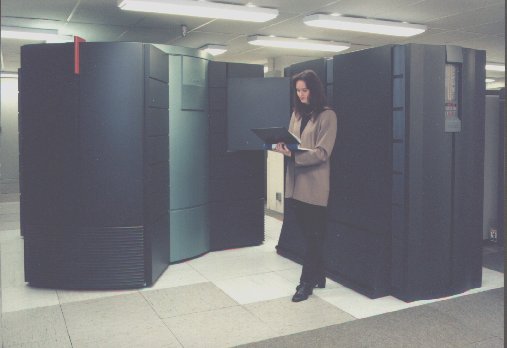
Here's a great photo of a Cray C90 with an SSD. The SSD is the smaller cabinet to the back of the girl. Both cabinets were liquid cooled, hence their small size.
Our Cray C90 had twelve central processing units (custom vector silicon) with a clock speed of 230 MHz and contained 512 megawords (4096 megabytes) of shared memory. It also had a 512 megaword Solid State storage Device (SSD). Its I/O subsystem also connected to a Cray 2 to handle all access to real disk - making that Cray 2 one of the most expensive disk controllers ever.
Though the vector CPUs were outmatched by newer systems, we continued to use the C90 into 1999 for oil exploration because of its incredible I/O throughput and ability to handle very large datasets (1GB) efficiently.
-
Re:Carbon credits = lame
Tell you what: I'll show you lists of the authors and reviewers of the latest IPCC assessments, and you show me a list of the "several prominent meterologists" who disagree with them. My money is on the group that just won a Nobel Prize.
Here are the IPCC's working groups: The Physical Science Basis contributors and reviewers (see Annex II in that file); Impacts, Adaptation and Vulnerability contributors and reviewers; Mitigation of Climate Change contributors and reviewers. IPCC press information claims 800 contributing authors, 450 lead authors, and 2,500 scientific expert reviewers.
-
Re:Carbon credits = lame
Tell you what: I'll show you lists of the authors and reviewers of the latest IPCC assessments, and you show me a list of the "several prominent meterologists" who disagree with them. My money is on the group that just won a Nobel Prize.
Here are the IPCC's working groups: The Physical Science Basis contributors and reviewers (see Annex II in that file); Impacts, Adaptation and Vulnerability contributors and reviewers; Mitigation of Climate Change contributors and reviewers. IPCC press information claims 800 contributing authors, 450 lead authors, and 2,500 scientific expert reviewers.
-
Re:New Analog FormatIt sounds like someone at Wired has drank the audiophile kool-aid... Another reason for vinyl's sonic superiority is that no matter how high a sampling rate is, it can never contain all of the data present in an analog groove, Nyquist's theorem to the contrary. Are you kidding me? A CD with a sampling frequency of 44 kHz carries sound up to 20 kHz, which is beyond the hearing limit of most humans. An analog groove may in theory carry sound up to very high frequencies, but is badly limited in practice by the difficulty of cutting a precise high-frequency groove, the non-linear response of the cartridge at high frequency, and a host of other factors. Not to mention the fact that NO ONE CAN HEAR THOSE SOUNDS above 20 kHz! And to get top-notch frequency response out of a record player, you have to obsess over the cleanliness and storage of your records and player... and even then you're likely to degrade the frequency response RAPIDLY to well below the level of a CD (http://en.wikipedia.org/wiki/Vinyl_record#Frequency_response_and_noise)
Wired seems to take all the standard audiophile BS hook, line, and sinker... "analog provides a warmer sound" (much more total harmonic distortion than a digital player), etc.
The argument about hot mastered CDs is particularly hilarious (reduced dynamic range). Basically, this is a result of crappy commercial pressure to sound louder, and is common but by no means universal. The fact that vinyl lacks this possibility is touted as an advantage. It's like claiming that a knife is better than a gun, because you can't shoot yourself in the foot with the knife.
For a devastating rebuttal of audiophile BS from a very experienced engineer, read Douglas Self's site: http://www.dself.dsl.pipex.com/ampins/pseudo/subjectv.htm -
Re:Slashdotted?
Here is something to look at since the site is down...
http://www.dself.dsl.pipex.com/MUSEUM/TRANSPORT/cyclogyro/cyclogyro.htm -
Re:Seeing as the link to TFA is dead ...
Dammit, posting the actual link would have helped here. Anyways, for the rebound:
http://www.dself.dsl.pipex.com/MUSEUM/TRANSPORT/cyclogyro/cyclogyro.htm -
Re:Digital Evolution
Test it one more time. On an array with several unique fields. You'll see how wrong you were.
It's here:
http://www.deth.dsl.pipex.com/sus.html - Thomas -
Funniest. List. Ever..
... are listed here http://www.ilikejam.dsl.pipex.com/audiophile.htm. Those wooden knobs are a real bargain! Only $485!
Can we mod this one to six? (or 11 (base 5))..
I *love* the CD/DVD demagnetiser. For just $417.92 you can buy the Furutech RD-2 Demagnetiser - all those pesky magnetic fields that have plagued aluminium/plastic CDs/DVDs for so long are no more!! To quote:
"You have to de-magnitize your CDs, CDRs, DVDs, Cables etc to get the most out of your setup! All kind of optical discs (CDs, CDRs, DVDs, SACDs and more) benefit from being demagnitized! The sound is clearer and with more dynamics and power. The same goes for cables! "
In fact *even* dye-based CDR/DVDR's can benefit! Now, wheres my VISA card..
Did you ever get the feeling you are in the wrong business? sigh.. -
All the things true Audiophile needs....
... are listed here. Those wooden knobs are a real bargain! Only $485!
-
Re:I RTFA yesterday when I saw it on the Firehose
A lot of people have proposed and built sleeve-valve and rotary-valve engines. The most powerful and longest-lasting aircraft engines of WWII were all sleeve-valve-based, and many snowmobile and some light aircraft engines still use them. I think the planetary-driven Aspin valve looks superb: there is very little valve-opening or valve-closing time, since the sleeve isn't moving at a constant speed.
The snag with solenoids is basically that they fail. So do cams, granted, but if you have 64 valves on your engine, that's four cams, driven by two belts, but 64 electromechanical solenoids -- a considerably higher mechanical count. I think piston-ported turbo diesel seems like a much better idea, since there's no valve train at all. -
Re:Heh
Actually, fluid cooling of circuits has been around quite a while. Oil is a silly choice though. The Cray II had cooling stacks that pumped a liquid coolant through the machine core. Looked kinda futuristic and cool too: http://www.spikynorman.dsl.pipex.com/CrayWWWStuff
/ Criscan/Cray2cascade.jpg -
The backup plan
Whatver happens it'll be ok, they have a backup rover: MarsRover2.jpg
-
Re:Improve your product Apple... duh
> finally, a voice of reason.
For more reasonable, sensible, measurable audiophile stuff:
http://www.audioholics.com/techtips/audioprinciple s/index.php
and
http://www.ilikejam.dsl.pipex.com/audiophile.htm
They're sort of the mythbusters of audiophile.
B. -
Re:Other Apple prototypes
The iPod Cathode - So named for it's use of four EL84 vacuum tubes in the circuit that drives the headphones
Picture here: http://www.dself.dsl.pipex.com/ampins/failproj/bel trad.jpg -
Close shot of the four legged dolphin
Close shot of the four legged dolphin can be seen here.
-
Re:Meaning what?
You can't have a pony.
http://www.ilikejam.dsl.pipex.com/pix/pony.jpg -
Re:They were Fake Apemen. OK
> I've always wondered how they could have evolved from something like the sabre toothed cat.
Actually, it is the other way around. Large, saber-tooth cats evolved separately several times throughout history from different base feline stocks. The domestic house cat likely derives from similar sized wild cats: http://ds.dial.pipex.com/agarman/blackfoo.htm/ -
Re:My solutionI really like that program. I also like that I can use Java Keyring to open the file on Windows, and confirm that I'm making a good backup of the database.
In my ideal world, there would be a port of it to the BlackBerry, as I carry that more than my Palm Pilot nowadays.
-
simmilar to the glider in 007's "Die Another Day"
http://www.aptt79.dsl.pipex.com/StillsGallery/Hir
e sHTM/Switchblade1.htm here is a link to some CA drawings of the james bond one. It is called "swithcblade" and is sort of the opposite in that ride that one and this one you are under it. wonder what the benifits of each style are. -
Re:Saw this earlier today...
it's near impossible (I've been unable to find) reviews of quantifiable components such as interconnection cables.Well, my friend, you just haven't been looking hard enough. Scroll down for cable reviews.
-
Re:I Used BootCamp -- No IssuesThe biggest pain was getting my copy of XP updated to XP SP2 for the install.
Agreed. I did the slipstream thing and the hardest part was getting the mkisofs command line juuuust right. this page was helpful.
The hardest part after that was generating an XP key to use.
Wait. I didn't say that out loud, did I?
-
Re:People Unclear on the ConceptDear refugee from the 1980s:
- perhaps you should try a mobile phone made in the current millennium.
- perhaps you should stop clenching your butt about the sound quality of a freaking phone call.
- perhaps you should stop watching so many stupid TV commercials and try any of the dozens of unlimited calling options from the various phone companies these days.