Slashdot Mirror
Domain: rebelbase.com
Stories and comments across the archive that link to rebelbase.com.
Comments · 44
-
Re:Shhhhhhhhh
-
Re:Shhhhhhhhh
No.
-
Re:uuencode/decode. C'mon, support it.
Check out Pan (available on almost all platforms) here. Pan has been dormant for almost a year - it's in the process of being resurrected, but It's a damn good newsreader that supports yEnc. Plus it supports plonking
-
Re:uuencode/decode. C'mon, support it.
What Thunderbird really needs is to support uuencode/decode. Why does only Freeagent and some freeware newsreader support this, yet is wideley used on usenet? What's the difficulty here?
Well a lot of basic tools (mirc, anyone?) on Windows are often crippled shareware. I suggest using Linux to avoid this problem. Pan or KLibido work nicely. Pan in particular is good for people who are familiar with Free Agent's UI. -
Re:Jesus Christ!
I found them!
http://www.rebelbase.com/
I hear those rebel's have a Pimp Ass Newsreader too. -
PIMP is taken
PIMP is taken, twice: as an older name for NSIS, and as part of the name of a Usenet UA for the GNOME desktop.
-
Re:News reader still has a way to go
Assuming you're on a *nix system, I would recommend Pan. Nice GTK-based newsreader, and the only one for UNIX to get a perfect score on the Good Net-Keeping Seal of Approval evaluations. And it has all kinds of features for alt.binaries lurkers like you, for example yEnc support.
I dunno, personally I'd probably never use my email client as a news client as well. I kinda like the two things separate... for some reason I never liked the user interface of a combined mail/news reader. But I read my mail with mutt anyway, so I'm not really representative anywhere outside Slashdot...
-
Re:Popularity
Any serious usenet junkie will tell you TB won't cut it-- same with OE, though. I like pan.
-
Re:This is why all good software dies...There was a joke done by the authors of PAN about an RIAA lawsuit against them based on their newsreader being used to download copyrighted songs.
Wonder how long before it becomes reality?
-
Re:How does this compare to Forte's Agent on Windo
If you want a replacement for Forte Agent, you should check out Pan (pimp ass newsreader). This is the best newsreader if you want text groups or if you want to leech binaries.
-
Re:It's the licenseI'm not going to debate the relative merits of Qt to Gtk+, but I do want to correct some misconceptions you have about Gtk+.
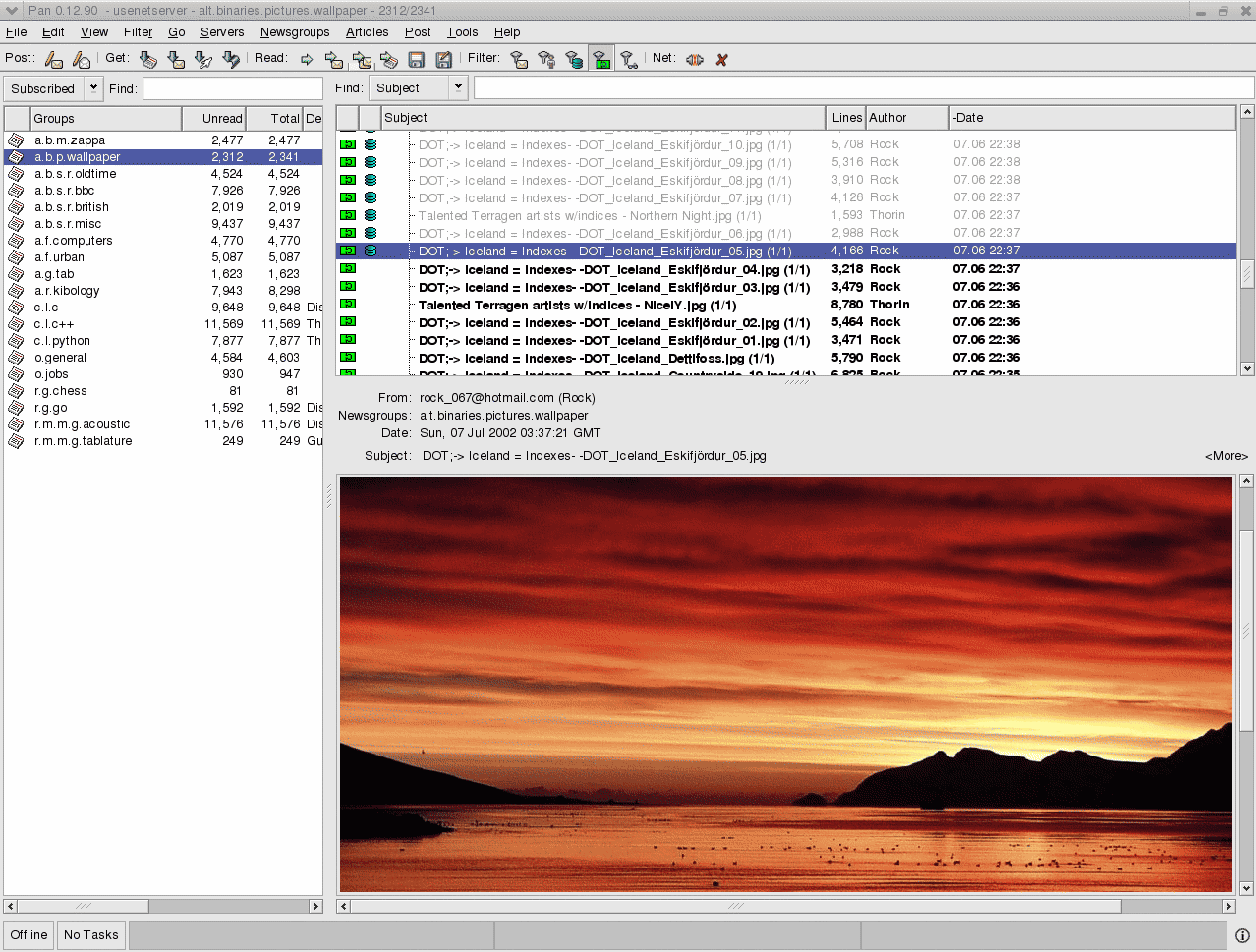
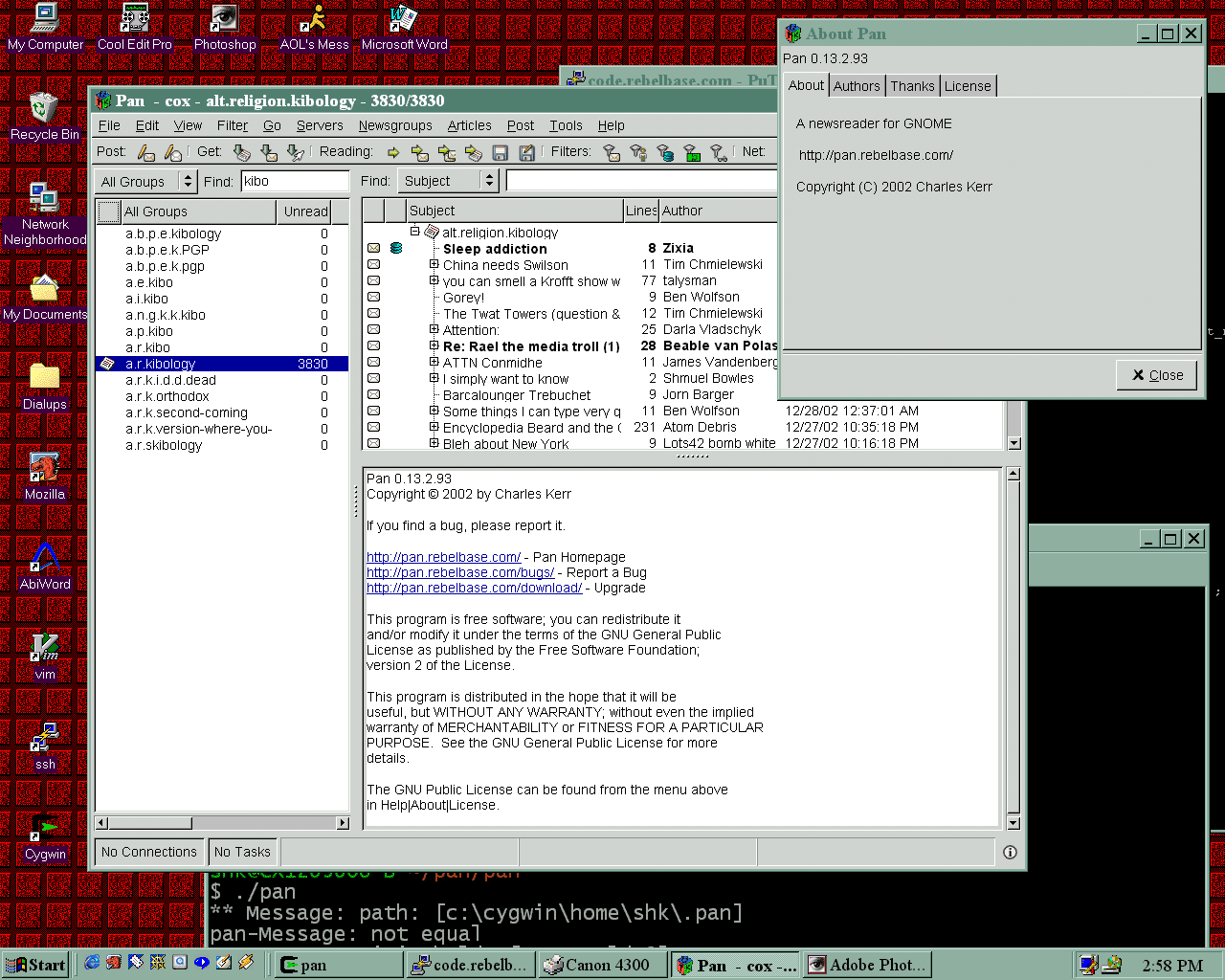
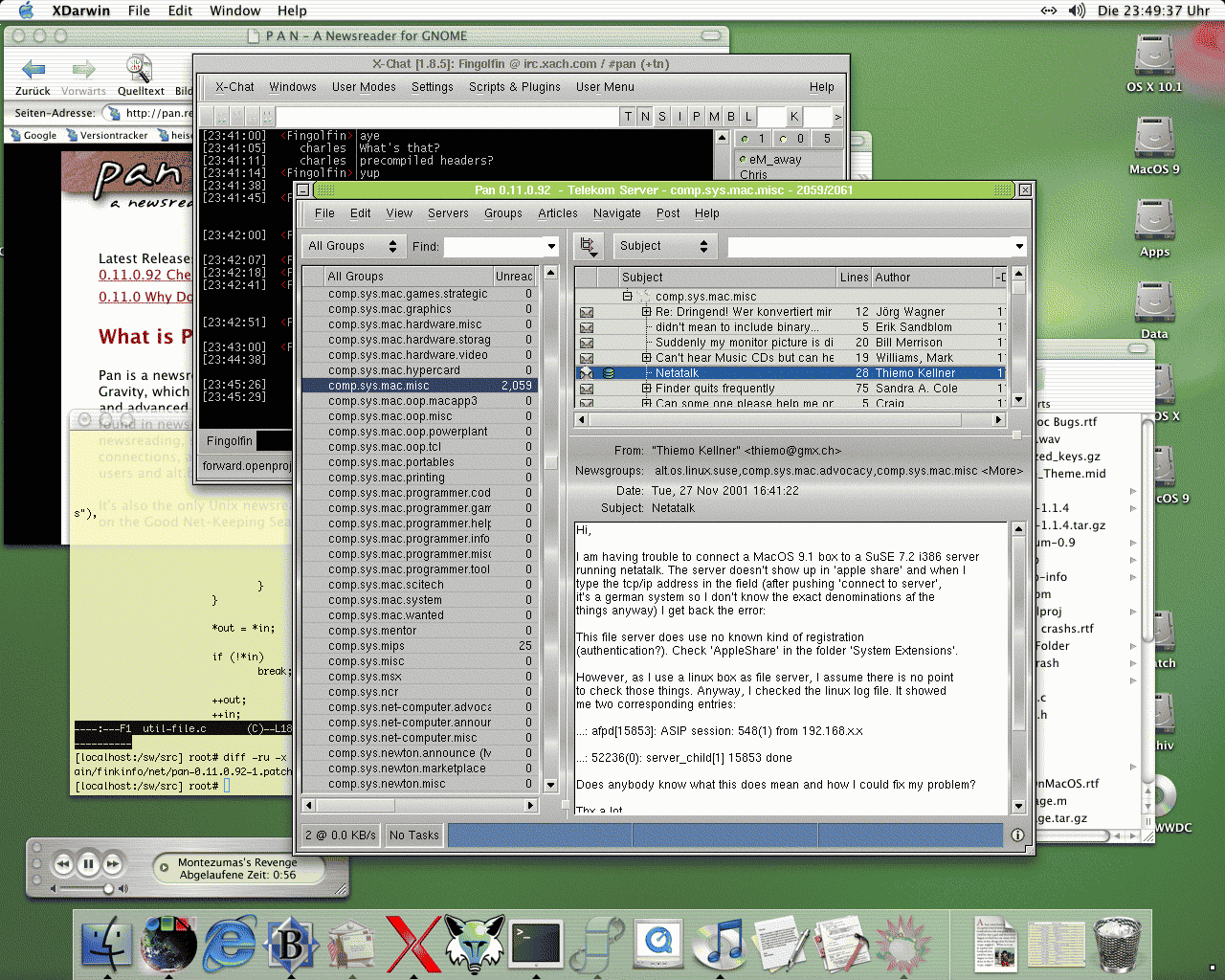
- When you write in Gtk+, you can get an application that runs on all the platforms you listed. My gtk+ newsreader Pan runs on Linux, Windows, and Mac OSX.
- The window manager is orthogonal to the topic of what's important from the software maker's point of view: ICCCM compliance is the only feature any application writer cares about. No application requires a specific WM. To do so would needlessly limit their audience.
- Likewise, you're misinformed about Mono: nobody is telling anyone that they have to port anything to Mono. C# is just another language that Gnome supports. Never in the 4+ years I've worked on Pan has anyone mentioned porting Pan to C#.
- gtk doesn't lack documentation. In fact the documentation team has made leaps and bounds over the last year.
- If you prefer RAD tools, Anjuta and Glade are available.
- Discussing Qt as a `modern C++ based toolkit' and disparaging Gtk+ as lacking a `modern API' is just language bias (and ignores moc's pre-STL cruftiness). If you want to use gtk+ in an OO language, many language bindings are available.
Again, this isn't to take anything away from Qt -- its tools are pretty good, and its documentation is excellent. However, Gtk+ is very good too.
-
Re:It's the licenseI'm not going to debate the relative merits of Qt to Gtk+, but I do want to correct some misconceptions you have about Gtk+.
- When you write in Gtk+, you can get an application that runs on all the platforms you listed. My gtk+ newsreader Pan runs on Linux, Windows, and Mac OSX.
- The window manager is orthogonal to the topic of what's important from the software maker's point of view: ICCCM compliance is the only feature any application writer cares about. No application requires a specific WM. To do so would needlessly limit their audience.
- Likewise, you're misinformed about Mono: nobody is telling anyone that they have to port anything to Mono. C# is just another language that Gnome supports. Never in the 4+ years I've worked on Pan has anyone mentioned porting Pan to C#.
- gtk doesn't lack documentation. In fact the documentation team has made leaps and bounds over the last year.
- If you prefer RAD tools, Anjuta and Glade are available.
- Discussing Qt as a `modern C++ based toolkit' and disparaging Gtk+ as lacking a `modern API' is just language bias (and ignores moc's pre-STL cruftiness). If you want to use gtk+ in an OO language, many language bindings are available.
Again, this isn't to take anything away from Qt -- its tools are pretty good, and its documentation is excellent. However, Gtk+ is very good too.
-
Re:It's the licenseI'm not going to debate the relative merits of Qt to Gtk+, but I do want to correct some misconceptions you have about Gtk+.
- When you write in Gtk+, you can get an application that runs on all the platforms you listed. My gtk+ newsreader Pan runs on Linux, Windows, and Mac OSX.
- The window manager is orthogonal to the topic of what's important from the software maker's point of view: ICCCM compliance is the only feature any application writer cares about. No application requires a specific WM. To do so would needlessly limit their audience.
- Likewise, you're misinformed about Mono: nobody is telling anyone that they have to port anything to Mono. C# is just another language that Gnome supports. Never in the 4+ years I've worked on Pan has anyone mentioned porting Pan to C#.
- gtk doesn't lack documentation. In fact the documentation team has made leaps and bounds over the last year.
- If you prefer RAD tools, Anjuta and Glade are available.
- Discussing Qt as a `modern C++ based toolkit' and disparaging Gtk+ as lacking a `modern API' is just language bias (and ignores moc's pre-STL cruftiness). If you want to use gtk+ in an OO language, many language bindings are available.
Again, this isn't to take anything away from Qt -- its tools are pretty good, and its documentation is excellent. However, Gtk+ is very good too.
-
Re:It's the licenseI'm not going to debate the relative merits of Qt to Gtk+, but I do want to correct some misconceptions you have about Gtk+.
- When you write in Gtk+, you can get an application that runs on all the platforms you listed. My gtk+ newsreader Pan runs on Linux, Windows, and Mac OSX.
- The window manager is orthogonal to the topic of what's important from the software maker's point of view: ICCCM compliance is the only feature any application writer cares about. No application requires a specific WM. To do so would needlessly limit their audience.
- Likewise, you're misinformed about Mono: nobody is telling anyone that they have to port anything to Mono. C# is just another language that Gnome supports. Never in the 4+ years I've worked on Pan has anyone mentioned porting Pan to C#.
- gtk doesn't lack documentation. In fact the documentation team has made leaps and bounds over the last year.
- If you prefer RAD tools, Anjuta and Glade are available.
- Discussing Qt as a `modern C++ based toolkit' and disparaging Gtk+ as lacking a `modern API' is just language bias (and ignores moc's pre-STL cruftiness). If you want to use gtk+ in an OO language, many language bindings are available.
Again, this isn't to take anything away from Qt -- its tools are pretty good, and its documentation is excellent. However, Gtk+ is very good too.
-
On the naming of projectsThis is definitely true. I'm the lead on the newsreader Pan, which the original author wrote as "Pimp-Ass Newsreader". There were people, both in Gnome and in two big Linux distros, that wanted to keep Pan at arm's length until we changed Pan's acronym from "Pimp-Ass Newsreader" with "Pan's A Newsreader".
As a side note, naming rule #2 should be:
Pick a greppable name.
When I grep Usenet for mentions of Pan, I have to filter out a lot of false positives because the word "Pan" is so common. -
Re:Agreed, somewhat
I really don't know, but last I heard they had given up on news support. If you want real news support use Pan. Pan has all the nice features.
Pan Homepage -
Sticks and Stones the Weapons of Choice
I wonder why this hasn't happened earlier - I think someone evil is finally going to notice that Usenet is 95% warez/moviez, and go after the big companies that run Usenet servers. This will probably happen after someone makes a tool that allows for easy use of Usenet, ie, a "download, unpar, unrar" tool, that keeps track of binary groups.
You mean, like pan?
I think the battle you speak of will heat up, and the future for free thought may be a very bleak one indeed.
On a completely different note, it would not surprise me at all, in light of congresses latest whorish display of its ability to move in contortions suggestive of a complete lack of backbone in granting president Baby Bush with a blank check for mayhem and idiocy, we didn't find ourselves embroiled in a war by this time next year that is far bigger, and far uglier, than we ever intended.
It would only surprise me a little if by this time next year we have been reduced to fighting this war with sticks and stones, however, a few more years of this sort of leadership and I wouldn't be surprised at all.
My prediction on next years technical innovation: The C.L.U.B. Mark I and the S.T.I.C.K./2003 as the state of the art in human weaponry, deployed far and wide and stockpiled in every home. -
Andreas' ad hominem attacks avoid DEP's questionsDisclosure: I'm a Gnome programmer who likes both Gnome and KDE.
Andreas Pour's response just says that he's not going to speak to DEP because he's not fond of the things that DEP has written.
His response to the Kompany's Shawn Gordon dismisses everything as, "a non-issue and just part of some mud-slinging campaign."
"ad hominem" simply means attacking the person making the argument, rather than the argument, itself. IMO this is what Andreas is doing, which is a shame because the argument itself needs answering, namely:
The KDE League's web site was down, it hadn't filed its Deleware paperwork as an organization, and it hasn't made any press releases since its launch in 2000. If the KDE League is still in business, what is it doing other than collecting quarterly $500 or $2,500 checks from its ten members?
There's no doubt that Andreas is the person who should answer this question: he's the chairman of the KDE League, he's listed in the KDE Promotion FAQ as the KDE League's point of contact, and, for crying out loud, a reverse lookup on the phone number in kdeleague.org's whois address gives Andreas' phone number in an apartment complex.
Which brings my two questions:
If the KDE League is really just Andreas, is he just pocketing these members' checks, or is it being fed back to KDE Developers?
If there really are other members, why on Earth are they letting him destroy the League's credibility this way?
The only reason I can think of for the KDE League to not answer is if it's done nothing since its inception.
The only reason I can think of for other League members to stay quiet is that either there aren't any, or that they know the jig is up and would rather let Andreas take the heat.
-
Re:XNews port?
You should use Pan. (Check it out here.) Pan is easily the best newsreader I've ever used, on any platform. Plus, the newer versions have been ported to G2D, which means it gets the accessibility for free (in theory, I haven't used a11y features in G2D).
-
Re:Bound to happen..
Another app taking advantage of GTK 2.x on Windows is the newsreader Pan. Since I don't use Windows, it's hard to say how that version is going, but if the GNOME/GTK version is any indictation, Agent has some real competition.
-
Re:Any reviews?On a Pentium 450 running Limbo, I can start up Pan 0.12.91 with valgrind --num-callers=16 --leak-check=yes --leak-resolution=med in one minute, nine seconds. On an otherwise-idle Sparc Ultra 10 running Solaris 7, it takes Pan built with "purify -chain-length=7 -cache-dir=/tmp -always-use-cache-dir=yes" more than 15 minutes to start up, with the CPU pegged at 100% the entire time.
If there's a secret "Don't Run Slow" switch to Purify, let me know what it is.
-
Re:Any reviews?I've been using Valgrind on Pan, which is multithreaded, and it works fine. Maybe given more time I'll find features that I miss from Purify, but for now I'm very happy.
Things I like better in Valgrind:
- Valgrind works on Linux.
- Valgrind doesn't require instrumenting each object file and library at build time. (This is a biggie)
- Valgrind's run-time options are more flexible.
- Valgrind works with both gcc 2 and 3.
- Valgrind seems to run faster than Purify. (Different hardware and OSes, so this is a guess.)
- Valgrind doesn't have a Motif GUI.
- Valgrind doesn't have an insane, broken license manager.
- Valgrind's technical support is better. (Yes, I've dealt with both.)
- Valgrind doesn't cost $2,364 per seat.
Things I like better in Purify:
- Purify can handle static libraries.
- Purify makes it easier to disable errors/warnings from libraries out of your scope.
- Valgrind doesn't work on Solaris, so I'm stuck with Purify for my day job.
-
Re:Usenet overlooked?
Try PAN. It consolidates multi-part posts so you seemingly download 1 large file rather than many smaller files.
-
KDE myths
Confronting the KDE propaganda machine.
The KDE project is famous for its funded and organised trolling of weblogs and message board associated with Linux and Free software/open source. Outrageous newbie impressing claims are made for the software and huge quanities of FUD are spread to destroy competitors. If this sounds familiar, then you are correct, most of these tactics were lifted straight from Microsoft's arsenal of dirty tricks. The Windows look and feel is not the only thing the KDE project has copied! In this short article I will address some of the lies and FUD spread by the KDE trolling teams. It is my hope that this, in some small way, will redress the balance and re-introduce two things almost eradicated by the KDE project: Honesty and facts.
-
Myth #1 - KDE is more integrated than GNOME
The oft-heard cry of the noisiest KDE advocates. No explanation is given, the reader is expected to simply grok the wholesomeness of KDE and the lack of this mystical quality in GNOME. It is nonsense of course. Neither desktop is particularly "integrated" compared to Windows XP, and certainly not compared any version of the Apple Mac. Whatever "integrated" actually means.
-
Myth #2 - KDE is easier to use
Again, such nebulous arguments are never explained, and the reader is expected to simply understand the truth of the zealots statement. Both KDE and GNOME have user-interface irritations (all systems do), but "ease of use" is not a simple thing to measure. KDE has never been subjected to detailed user testing, unlike GNOME, and the claims of user-friendliness are from crazed supporters and not average users. Furthermore, the KDE faithful rarely look beyond simple-minded copying of Windows, and forget that administering a desktop system is just as important as having widgets in the correct place on the toolbar. For example: What about application installation and removal? GNOME has the excellent RedCarpet by Ximian, which makes the installation, removal and updating of applications trivial. KDE users are expected to fend for themselves with brutal command line driven systems. GNOME also has the excellent Ximian setup tools to handle various tricky cross-platform and potentially risky system configuration operations. KDE offers none of this, only a few small and lame Linux-only tools, which make no attempt at check-pointing to return to known working configurations.
-
Myth #3 - KDE is more popular
In what sense? Arguably more people use KDE, but it is a close run thing. Most KDE zealots use the results of online polls as proof of their superior userbase - which is, quite frankly, complete and utter nonsense. Online polls are the joke of the century; it doesn't even require a motivated script kiddie to render then worthless. A single post alerting the faithful on a zealot-ridden site can skew the result so much it makes American presidential elections look fair and well organised. Popularity is also difficult to measure when *both* GNOME and KDE are frequently installed on the same system. The systems can co-exist and even run at the same time, except for certain applications such as panels. Many KDE users actually run GNOME applications for their superior features and stability, not realising that by doing so they are barely running KDE at all.
One of the few solid measures of popularity is commercial use of a desktop, and here, GNOME is far ahead with both Hewlett Packard and Sun committing to using GNOME as the desktop for their Unix systems. This also ties in with the previously mentioned ease of use. Sun's major contribution to the GNOME project is in the areas of user/developer documentation, testing, accessiblity and user-testing. Three of the less glamourous parts of desktop development. The arrival of the GNOME 2.x series will see these contributions reach fruitition and allow GNOME to make a quantum leap ahead of KDE in most of the basic computer/user issues.
-
Myth #4 - Konqueror is the best Linux browser
Oh for a penny every time this lie is told in any KDE story! Konqueror not a bad piece of software. It's authors deserve praise for the work done on it. However, the sheer amount of orgasmic gushing by the KDE faithful is completely out of proportion to its actual quality. It is quite unreliable and even simple standards compliant pages can crash it quite comprehensively. It is also lax in its support of basic web standards compared to either Mozilla or Opera. It is also extremely slow - much slower than the latest incarnations of the GNOME Nautilus filemanager/browser (a target of much KDE FUD during its development).
-
Myth #5 - KDE applications are better/more advanced than GNOME ones due to the ease of developing in C++ using the Qt toolkit
This is the most common wail heard by KDE developers, and yet it is easily disproved by looking at the actual applications for GNOME/GTK and KDE/Qt. KDE applications often have larger version numbers than GNOME ones... an old trick played by commerical software developers. Most KDE apps seem to jump for 1.x releases long before they are ready - KOffice being the best example. None of the components in Koffice are worthy of a 1.0 release, let alone 1.1 or 1.2.
GNOME applications get a good deal more testing in their 0.x stages, and despite shorter development phases they mature and reach stable featureful release versions much more quickly. Some examples of this are: the superb Evolution (groupware/email), Gnumeric (spreadsheet), Pan (newsreader), The GIMP (image manipulation), Abiword (word processing), RedCarpet, X-Chat (IRC client), XMMS (media player), Galeon (web browser), and for developers: Glade and Anjuta. All of these packages ooze quality, and far outclass their KDE counterparts. It is no understatement to say that GNOME is at least 18 months ahead of KDE in applications, and pulling still further ahead.
It's not just in the area of user applications that GNOME is vastly more advanced. With the forthcoming 2.x release, a number of impressive behind the scenes technologies will finally mature: component technology (bonobo), media (Gstreamer), internationalisation (pango). As a developement platform, GNOME 2.x is, conservatively, 2-3 years ahead of KDE. And what is more, because it is not tied to a lowest common denominator cross-platform bloat-fest like the Qt toolkit, the lead (as with applications) can only increase further.
It is also worth noting that GNOME also develops code for use outside the project (see the XML libraries as one example) - the KDE project rarely (if ever) engages in this kind of work. KDE developers ensure that all software must link with Qt, and hence tie it closely with the Qt toolkit preventing re-use and enhancing the value of TrollTech intellectual property.
Yet despite all this, we are still regularly fed the lie that Qt and C++ makes application and desktop development easier. Judge for yourself. -
Myth #6 - KDE is faster and takes less memory than GNOME
KDE is written in C++. While this is not necessarily a problem, it can be when Visual Basic reject programmers (which the KDE project is overrun with) do not know enough to avoid important pitfalls that plague C++ software projects. Stupid use of autoincrementing operators and iteration with C++ objects; and masses of unnecessary allocations and deallocations of memory are two of the most common. KDE suffers badly from both problems.
Perhaps the most cretinous of all problems is blaming the extremely slow startup times of KDE apps on GCC. The GNOME 1.x releases were hardly svelt (2.x fixes many of these issues - in fact, GNOME 2 is significantly faster with fewer resources than previous version, a feat quite beyond the KDE project), but GNOME is a fashion cat-walk superwaif when compared to KDE's 500lb fat-momma cheese-burger scoffing trailer trash. One need only look at the recent fuss over ugly KDE hacks (such as prelinking) used to bandage up the design and coding flaws in the decrepit KDE architecture to see the truth.
-
Myth #7 - GNOME development is slower. KDE releases faster.
Fundamental misunderstanding. The KDE project releases as one big lump of code due to its use of C++ and the many problems this causes with libraries. The project bumps the version number of the entire KDE system for the smallest modifications. GNOME, on the other hand is componentized and each component releases on a (almost) separate schedule, bumping it's own version number but not the main GNOME version (1.4, for example). Occasional releases of the entire GNOME system happen, and that's when the GNOME version number is bumped (currently it is at 1.4). To see this in action, use RedCarpet and you will regular updates to GNOME components. GNOME development is not slower, it is in fact faster and more advanced. Lamers and newbies, however, fail to understand the advantages of this method and just see KDE 1.1.1 followed a few weeks later by KDE 1.1.2. Wow! KDE roolz.
Perhaps the greatest example of KDE release games occured with the recent KDE 3.0 release. In a desperate race to beat GNOME 2.0 to, the KDE team did not put back their schedule in the middle of a late release freeze when they suddenly added lots of new features - and, as expected, this has proved to be disasterous. KDE 3.0 is the worst KDE release yet in terms of reliablity - and is essentially early beta software put out as a stable release. Compare this with GNOME, which has had a number of betas and quality assurance procedures leading up to the eventual release of GNOME 2.0. The difference in approach is obviously due to the ultimate destinations of the systems and the vastly more experienced developers behind GNOME. GNOME is heading for commerical use on Sun and HP desktops, and hence requires commericial release quality. While KDE is destined for the porn and MP3 boxes of noisy advocates who don't mind huge numbers of crashes while waiting for KDE 3.0.0.4 to fix issues overlooked in the mindless rush to release. Quality control is an afterthought to the KDE project - the version number and releasing first are everything. -
Myth #8 - The Qt toolkit is cross-platform and yet takes advantage of each individual platform
The Qt toolkit (the software at the heart of KDE) is supposedly a cross-platform toolkit allowing the lucky developer the opportunity to write Windows/Linux/Mac software all at once. And yet, among the magical mythical claims made, the most nonsensical is that it makes applications which take advantage of the distinct features of the different platforms. This is of course, nonsense. Qt is a bloated, slow layer that is slapped over a native system's APIs in an attempt to make all the systems look alike. It no more takes advantage of Linux/Windows/Mac than Java does - in fact it offers many of the disadvantages of Java with few of the advantages. If you have ever wondered why the KDE desktop looks so much like Windows... you need look no further than Qt. Qt is a lowest common denominator toolkit, and that LCD is Windows - Trolltech's, the creator of Qt, real market.
-
Myth #9 - TrollTech is a friend of Free software
To Be Written. Ideas: Qt started out as non-Free. KDE developers knew this violated the GPL, didn't care, stole others' GPL code by porting it to link (in violation of the license) with Qt and are therefore untrustworthy. KDE core developers work for TrollTech. Expensive per developer licensing for writing closed-source with Qt, and hence KDE. Trolltech only moved towards the GPL because of the success of GNOME. Labyrinthine licensing nightmare (3 licenses to deal with). Gradual migration of features belonging in KDE into Qt (and so into TrollTech's IP portfolio), allowing easy porting of apps to the revenue generating Windows world (see TheKompany for a perfect example), thereby making KDE an irrelevant launcher of Qt applications. Claims made that Qt is GPL, while true, hide the real truth. There cannot be a real fork of Qt for the KDE project: Core developers work for Trolltech; any fork would need to be full GPL and hence ban any closed-source apps from KDE altogether (all KDE apps must link with Qt); Any commerical licensees of Qt (non-GPL) would and could only follow TrollTech. KDE is stitched up good and proper.
-
Myth #10 - KDE is more than attractive, but GNOME/GTK is ugly
To be Written. Ideas: Mosfet liquid theme is an ugly and unstable hack. GNOME GTk icons are better thought-out and of a far higher quality than the poorly drawn and cartoonish and confusing KDE ones. Qt is basically a Windows-look on a Unix platform.
-
-
Re:What about software?
For leeching in the binaries-groups, Binary News Reaper is by far the best one! It can assemble parts from multiple servers, which is a great feature if you are using newsfeeds.com which has a per-server-per-day downloadlimit (17 servers, total of 10GB/day).. Too bad it's only freeware and not Open Source though..
If you only have a single server, PAN is a better bet, as it also supports "normal" Usenet-usage (discussions).. It's a shame that "assemble parts from multiple servers" is not even in the TODO-list for Pan..
For downloading whole groups there is a lot of options.. I've tried them all and I found UBH (Usenet Binary Harvester) to be the most powerful and flexible one. -
Re:What about software?As someone else mentioned, Pan is pretty much the GUI newsreader of choice. I use to to browse and read news.
As for downloading, I find it a little lacking, though and do all my bulk downloads with nget. It's a command-line client with great regexp support and it's easy to set up a queue script to grab a bunch of stuff, usually to run overnight for me. It also has nice handling of multiple servers, with weighting, so you can have it grab the bulk from one source (ie your free one) and missing parts from another (the premium).
ObTopic: I also recommend Easynews. Almost always complete (if not, the problem was probably on the sender's end) and the retention is sick through the web interface. At $10/mo for 6 GB, it's a great fills server solution to complement a free ISP-provided server.
-
Sacrilige (aka: wine/winex)
Hi. It's sacriligious, I know, but try out the latest Wine stuff (www.winehq.com) and you can run much good windows software even under linux.
Not being a big news kindof guy, though, News was basically invented under the *nix umbrellas, and I'm pretty sure there is some excellent newsreading software out there. Witness P.A.N. (which used to stand for "Pimp Ass Newsreader", which it still deserves the title). It's great and gets a perfect score according to the "good netiquette institute". How it handles pr0n/w4rez, I'm not sure, since I use debian, mostly.
--Robert -
MS Pan name infringes on (open source) newsreader
There's already a Pan, and it's a newsreader. So I think the Pan newsreader people ought to go tell MS to rename their Pan or face court. Besides, it'd be fun to use MS's tactics upon MS for a change. Can't you just hear Gates and Ballmer now? "Waaaah, the Linux freaks are stifling our innovation! Wahhhh!"
-
Pan?
Funny, I thought Pan was the Pimp Ass Newsreader. or maybe they're thinking of the pan flute instead.
-
Re:So...
Same reason you can't have Photoshop for Linux, or Microsoft Office for Linux: because the vendor wouldn't make any money off of a version of their software for Linux.
Yet you can buy Maya for Linux, which costs just a hair more than Photoshop or Microsoft Office. You can buy Star Office, but most people don't, because OpenOffice is nearly the same quality with the definate promise of improvement. There's also Abiword. Gnumeric is a top-notch spreadsheet program that I've come to prefer to excel. There's more like this. There's really very little incentive to buy an office suite when you can get better for free.
In other fields, the Free alternatives tend to kick the hiney of their commercial counterparts. Let's try a few, okay? Pan, a newsreader based loosley on Agent. Pan is the only newsreader to score perfectly on the GNKSA Evaluations. Compared this to its commercial basis, Agent's score really sucks. Then there's Quanta for HTML editing. VIM is fine for most people, but if you need that Dreamweaver-like crap, Quanta does it without getting in your way. And it's REALLY good. Oh yes, it's Free with a capital "EFF."
This is a silly arguement to make against "Linux." This is Capitalism 101. Good products offered under better conditions succeed while inferior products do not. Maya is wonderful under Linux, and there is nothing else in its league available on a Unix-ish (OS X, Linux) platform.
Oh, yes. You can also buy numerous games, of course. Neverwinter Nights in particular will be releasing for all three major platforms in a single box. We'll see what this does for sales.
-
Re:Congratulations!
Confronting the KDE propaganda machine.
The KDE project is famous for its funded and organised trolling of weblogs and message board associated with Linux and Free software/open source. Outrageous newbie impressing claims are made for the software and huge quanities of FUD are spread to destroy competitors. If this sounds familiar, then you are correct, most of these tactics were lifted straight from Microsoft's arsenal of dirty tricks. The Windows look and feel is not the only thing the KDE project has copied! In this short article I will address some of the lies and FUD spread by the KDE trolling teams. It is my hope that this, in some small way, will redress the balance and re-introduce two things almost eradicated by the KDE project: Honesty and facts.
-
Myth #1 - KDE is more integrated than GNOME
The oft-heard cry of the noisiest KDE advocates. No explanation is given, the reader is expected to simply grok the wholesomeness of KDE and the lack of this mystical quality in GNOME. It is nonsense of course. Neither desktop is particularly "integrated" compared to Windows XP, and certainly not compared any version of the Apple Mac. Whatever "integrated" actually means.
-
Myth #2 - KDE is easier to use
Again, such nebulous arguments are never explained, and the reader is expected to simply understand the truth of the zealots statement. Both KDE and GNOME have user-interface irritations (all systems do), but "ease of use" is not a simple thing to measure. KDE has never been subjected to detailed user testing, unlike GNOME, and the claims of user-friendliness are from crazed supporters and not average users. Furthermore, the KDE faithful rarely look beyond simple-minded copying of Windows, and forget that administering a desktop system is just as important as having widgets in the correct place on the toolbar. For example: What about application installation and removal? GNOME has the excellent RedCarpet by Ximian, which makes the installation, removal and updating of applications trivial. KDE users are expected to fend for themselves with brutal command line driven systems. GNOME also has the excellent Ximian setup tools to handle various tricky cross-platform and potentially risky system configuration operations. KDE offers none of this, only a few small and lame Linux-only tools, which make no attempt at check-pointing to return to known working configurations.
-
Myth #3 - KDE is more popular
In what sense? Arguably more people use KDE, but it is a close run thing. Most KDE zealots use the results of online polls as proof of their superior userbase - which is, quite frankly, complete and utter nonsense. Online polls are the joke of the century; it doesn't even require a motivated script kiddie to render then worthless. A single post alerting the faithful on a zealot-ridden site can skew the result so much it makes American presidential elections look fair and well organised. Popularity is also difficult to measure when *both* GNOME and KDE are frequently installed on the same system. The systems can co-exist and even run at the same time, except for certain applications such as panels. Many KDE users actually run GNOME applications for their superior features and stability, not realising that by doing so they are barely running KDE at all.
One of the few solid measures of popularity is commercial use of a desktop, and here, GNOME is far ahead with both Hewlett Packard and Sun committing to using GNOME as the desktop for their Unix systems. This also ties in with the previously mentioned ease of use. Sun's major contribution to the GNOME project is in the areas of user/developer documentation, testing, accessiblity and user-testing. Three of the less glamourous parts of desktop development. The arrival of the GNOME 2.x series will see these contributions reach fruitition and allow GNOME to make a quantum leap ahead of KDE in most of the basic computer/user issues.
-
Myth #4 - Konqueror is the best Linux browser
Oh for a penny every time this lie is told in any KDE story! Konqueror not a bad piece of software. It's authors deserve praise for the work done on it. However, the sheer amount of orgasmic gushing by the KDE faithful is completely out of proportion to its actual quality. It is quite unreliable and even simple standards compliant pages can crash it quite comprehensively. It is also lax in its support of basic web standards compared to either Mozilla or Opera. It is also extremely slow - much slower than the latest incarnations of the GNOME Nautilus filemanager/browser (a target of much KDE FUD during its development).
-
Myth #5 - KDE applications are better/more advanced than GNOME ones due to the ease of developing in C++ using the Qt toolkit
This is the most common wail heard by KDE developers, and yet it is easily disproved by looking at the actual applications for GNOME/GTK and KDE/Qt. KDE applications often have larger version numbers than GNOME ones... an old trick played by commerical software developers. Most KDE apps seem to jump for 1.x releases long before they are ready - KOffice being the best example. None of the components in Koffice are worthy of a 1.0 release, let alone 1.1 or 1.2.
GNOME applications get a good deal more testing in their 0.x stages, and despite shorter development phases they mature and reach stable featureful release versions much more quickly. Some examples of this are: the superb Evolution (groupware/email), Gnumeric (spreadsheet), Pan (newsreader), The GIMP (image manipulation), Abiword (word processing), RedCarpet, X-Chat (IRC client), XMMS (media player), Galeon (web browser), and for developers: Glade and Anjuta. All of these packages ooze quality, and far outclass their KDE counterparts. It is no understatement to say that GNOME is at least 18 months ahead of KDE in applications, and pulling still further ahead.
It's not just in the area of user applications that GNOME is vastly more advanced. With the forthcoming 2.x release, a number of impressive behind the scenes technologies will finally mature: component technology (bonobo), media (Gstreamer), internationalisation (pango). As a developement platform, GNOME 2.x is, conservatively, 2-3 years ahead of KDE. And what is more, because it is not tied to a lowest common denominator cross-platform bloat-fest like the Qt toolkit, the lead (as with applications) can only increase further.
It is also worth noting that GNOME also develops code for use outside the project (see the XML libraries as one example) - the KDE project rarely (if ever) engages in this kind of work. KDE developers ensure that all software must link with Qt, and hence tie it closely with the Qt toolkit preventing re-use and enhancing the value of TrollTech intellectual property.
Yet despite all this, we are still regularly fed the lie that Qt and C++ makes application and desktop development easier. Judge for yourself. -
Myth #6 - KDE is faster and takes less memory than GNOME
KDE is written in C++. While this is not necessarily a problem, it can be when Visual Basic reject programmers (which the KDE project is overrun with) do not know enough to avoid important pitfalls that plague C++ software projects. Stupid use of autoincrementing operators and iteration with C++ objects; and masses of unnecessary allocations and deallocations of memory are two of the most common. KDE suffers badly from both problems.
Perhaps the most cretinous of all problems is blaming the extremely slow startup times of KDE apps on GCC. The GNOME 1.x releases were hardly svelt (2.x fixes many of these issues), but GNOME is a fashion cat-walk superwaif when compared to KDE's 500lb fat-momma cheese-burger scoffing trailer trash. One need only look at the recent fuss over ugly KDE hacks (such as prelinking) used to bandage up the design and coding flaws in the decrepit KDE architecture to see the truth.
-
Myth #7 - GNOME development is slower. KDE releases faster.
Fundamental misunderstanding. The KDE project releases as one big lump of code due to its use of C++ and the many problems this causes with libraries. The project bumps the version number of the entire KDE system for the smallest modifications. GNOME, on the other hand is componentized and each component releases on a (almost) separate schedule, bumping it's own version number but not the main GNOME version (1.4, for example). Occasional releases of the entire GNOME system happen, and that's when the GNOME version number is bumped (currently it is at 1.4). To see this in action, use RedCarpet and you will regular updates to GNOME components. GNOME development is not slower, it is in fact faster and more advanced. Lamers and newbies, however, fail to understand the advantages of this method and just see KDE 1.1.1 followed a few weeks later by KDE 1.1.2. Wow! KDE roolz.
Perhaps the greatest example of KDE release games occured with the recent KDE 3.0 release. In a desperate race to beat GNOME 2.0 to, the KDE team did not put back their schedule in the middle of a late release freeze when they suddenly added lots of new features - and, as expected, -
Myth #10 - KDE is more than attractive, but GNOME/GTK is ugly
To be Written. Ideas: Mosfet liquid theme is an ugly and unstable hack. GNOME GTk icons are better thought-out and of a far higher quality than the poorly drawn and cartoonish and confusing KDE ones. Qt is basically a Windows-look on a Unix platform.
-
-
Re:Off topic, but I have a question
There is a similar kind of site at www.kuro5hin.org
Also, check out Usenet. You'll need a newsreader and the address of a newsserver (your isp should have a server). I use Pan for newsreading on Linux, get it here
If you use Windows, try Freeagent, available here
-
Jeremy's right, but it's too late now.I'm one of the authors of the Pan newsreader and agree with Jeremy's analysis of yEnc. yEnc repeats many of uu's mistakes, so news clients have to search text/plain messages for =ybegin and =yend blocks instead of looking in the headers.
But yEnc's bandwidth savings are real, which is a huge win for alt.binaries users. yEnc has been the most-requested feature for Pan over the last month. (0.11.2.90 supports it.) IMO yEnc is the format to use for multiparts right now.
Hopefully yEnc will motivate others to come up with a mime-friendly alternative encoding for Usenet. yEnc Considered Harmful is another yEnc opposition page that suggests mzip compression, but I haven't seen any public discussion of it yet.
If/when such a replacment comes along, Pan will support it too and add an are-you-sure dialog for yEnc postings.
-
Jeremy's right, but it's too late now.I'm one of the authors of the Pan newsreader and agree with Jeremy's analysis of yEnc. yEnc repeats many of uu's mistakes, so news clients have to search text/plain messages for =ybegin and =yend blocks instead of looking in the headers.
But yEnc's bandwidth savings are real, which is a huge win for alt.binaries users. yEnc has been the most-requested feature for Pan over the last month. (0.11.2.90 supports it.) IMO yEnc is the format to use for multiparts right now.
Hopefully yEnc will motivate others to come up with a mime-friendly alternative encoding for Usenet. yEnc Considered Harmful is another yEnc opposition page that suggests mzip compression, but I haven't seen any public discussion of it yet.
If/when such a replacment comes along, Pan will support it too and add an are-you-sure dialog for yEnc postings.
-
pan does yenc
PAN has yenc support in the latest dev code, however it's pretty rough. 0.11.3 is gonna have it fixed tho i think. if you're looking for a great gtk news reader, this is it! 100% gnksa approved too. been using it for a while now.
-
Pan
And Pan's got it too. Tastes great, less filling!
I wonder if it's in CPAN yet...
Module Convert::yEnc (P/PN/PNE/Convert-yEnc-0.03.tar.gz)
Yep. Works for me! -
KDE MythsFree software is a hotbed of myths and general nonsense - and perhaps the most prevalent myths of all are the ones surrounding the entire KDE/GNOME desktop schism. In this short article I hope to do away with some of the more half-assed nonsense spewed by KDE zealots.
- Myth: KDE is more integrated than GNOME
Reality: The oft-heard cry of the noisiest KDE advocates. No explanation is given - the reader is expected to simply grok the wholesomeness of KDE, and the lack of this mystical quality in GNOME. It's nonsense of course. Neither desktop is particularly "integrated" compared to Windows XP, and certainly not compared any version of the Apple Mac. - Myth: KDE is easier to use
Reality: Again, such nebulous arguments are never explained, and the reader is expected to simply understand the truth. Both KDE and GNOME have user-interface irritations (indeed, all systems do) - but "ease of use" is not a simple thing to measure. What about application (see GNOME apps later) installation and removal: GNOME has the excellent RedCarpet by Ximian , which makes the installation, removal and updating of applications trivial. KDE users are expected to fend for themselves with brutal command line driven systems. GNOME also has the excellent Ximian setup tools to handle various very tricky cross-platform and potentially risky system configuration operations - KDE offers a few small half-assed Linux-only tools, which make no attempt at check-pointing to return to known working configurations. - Myth: KDE is more popular
Reality: In what sense? Arguably more people use KDE - but it is a close run thing. Most KDE zealots claim the results of online polls as proof of their superior userbase... which is, quite frankly, complete and utter nonsense. Online polls are the joke of the century; it doesn't even require a motivated script kiddie to render then worthless. A single post on a zealot-ridden site can reduce the result to a running joke. Popularity is also difficult to measure when both GNOME and KDE are frequently installed on the same system - and indeed, can co-exist except for certain applications such as panels. Many KDE users actually run GNOME applications for their superior features and stability.One of the few solid measures of popularity is the adoption in commercial use - and here, GNOME is far ahead. Both Hewlett- Packard and Sun Microsystems have committed to using GNOME as the desktop for their Unix systems. This ties in with the previously mentioned ease of use - Sun's major contribution to the GNOME effort is in the areas of user/developer documentation, testing, accessiblity and user-testing. Three of the less glamourous parts of desktop development. The arrival of the GNOME 2.x series will see these contributions reach fruitition and allow GNOME to make a quantum leap ahead of KDE in most of the basic computer/user issues.
- Myth: Konqueror is the best Linux browser
Reality: Oh for a penny every time this lie is told in any KDE story! Konqueror is a fine piece of software - it's authors deserve plently of praise - it is, however, quite unreliable and lax in its support of basic web standards compared to either Mozilla or Opera . It is also extremely slow - slower than the latest incarnations of the GNOME Nautilus filemanager/browser. - Myth: KDE applications are better/more advanced than GNOME ones due to the ease of developing in C++ using the Qt toolkit
Reality: See also: Qt/TrollTech. Easily the most common wail heard by KDE developers - and yet it is easily disproved by looking at the actual applications for GNOME/GTK and KDE/Qt . KDE applications often have larger version numbers than GNOME ones... an old trick played by commerical software developers. Most KDE apps seem to jump for 1.x releases long before they are ready - KOffice being the best example. None of the components in Koffice are worthy of a 1.0 release, let alone 1.1 or 1.2. GNOME applications wait longer and get more testing in their 0.x stages and despite shorter development phases mature more quickly and reach stable featureful release states more quickly: the superb Evolution (groupware/email), Gnumeric (spreadsheet), Pan (newsreader), The GIMP (image manipulation), Abiword (word processing), RedCarpet - Myth: KDE is faster and/or takes less memory than GNOME
Reality: KDE is written in C++. While this is not necessarily a bad thing, it is when the programmers do not know enough to avoid certain pitfalls that can plague software projects. Stupid use of ++/-- with C++ objects; masses of unnecessary allocations and deallocations of memory, and the most cretinous of all, blaming the extremely slow startup times of KDE apps on GCC. The GNOME 1.x releases were hardly svelt (2.x fixes many of these issues), but GNOME is a fashion cat-walk superwaif when compared to KDE's 500lb fat-momma cheese-burger scoffing trailer trash. One need only look at the recent fuss over ugly KDE hacks (such as prelinking) to see the problem inherent in the KDE architecture and basic design. - Myth: GNOME development is slower. KDE releases faster.
Reality: Fundamental misunderstanding. KDE releases as one big lump of code due to its use of C++ and the consequent problems with libraries. It bumps the version number of the entire KDE system for the smallest modifications. GNOME, on the other hand is componentized and each component releases on a (almost) separate schedule, bumping it's own version number but not the main GNOME version. Occasional releases of the entire GNOME system are done, and that's when the GNOME version number is bumped (currently it is 1.4). To see this in action, use RedCarpet and you will regular updates to GNOME components. GNOME development is not slower, it is in fact faster and more advanced. Lamers and newbies, however, fail to understand the advantages and just see KDE 1.1.1 followed a few weeks later by KDE 1.1.2. Wow! KDE roolz. - Myth: TrollTech is a friend of Free software.
Reality: Qt started out as non-Free. KDE developers knew this violated the GPL and are therefore untrustworthy. KDE core developers work for TrollTech. Expensive per developer licensing for writing closed-source with Qt. Labyrinthine licensing nightmare. - Myth: Most good GNOME apps are actually GTK applications.
Reality: Most KDE apps, such as those from The Kompany are actually Qt apps because they want to port to the more lucrative Windows/Qt market. - Myth: KDE is attractive/GNOME/GTK is ugly
Reality: Mosfet liquid theme is an ugly and unstable hack. GNOME GTk icons are of a far higher quality than the cartoonish and confusing KDE ones. Qt is basically a Windows-look on a Unix platform.
- Myth: KDE is more integrated than GNOME
-
Re:Using your analogy...
Didn't someone harass the author of the PAN newsreader for copyright infringement? Tried to get him to remove the decode function?
-
KDE MythsFree software is a hotbed of myths and general nonsense, and perhaps the most prevalent myths of all are the ones surrounding the entire KDE/GNOME desktop schism. The KDE project is famous for its organised trolling of various weblogs and message board associated with Linux and Free software/open source. In this short article I will answer some of the more half-assed nonsense, FUD and myths spewed by KDE zealots.
- Myth: KDE is more integrated than GNOME
Reality: The oft-heard cry of the noisiest KDE advocates. No explanation is given - the reader is expected to simply grok the wholesomeness of KDE, and the lack of this mystical quality in GNOME. It's nonsense of course. Neither desktop is particularly "integrated" compared to Windows XP, and certainly not compared to any version of the Apple Mac. Whatever "integrated" really means. - Myth: KDE is easier to use
Reality: Again, such nebulous arguments are never explained, and the reader is expected to simply understand the truth of the zealots statement. Both KDE and GNOME have user-interface irritations (indeed, all systems do) - but "ease of use" is not a simple thing to measure. KDE has never been subjected to detailed user testing, unlike GNOME [gnome.org], and the claims of user-friendliness are from crazed supporters and not average users. Furthermore, the KDE faithful rarely look beyond simple-minded copying of Windows, and forget that administering a desktop system is just as important as having widgets in the correct place on the toolbar. For example: What about application installation and removal? GNOME has the excellent RedCarpet [ximian.com] by Ximian [ximian.com], which makes the installation, removal and updating of applications trivial. KDE users are expected to fend for themselves with brutal command line driven systems. GNOME also has the excellent Ximian setup tools to handle various very tricky cross-platform and potentially risky system configuration operations - KDE offers none of this, only a few small half-assed Linux-only tools, which make no attempt at check-pointing to return to known working configurations. - Myth: KDE is more popular
Reality: In what sense? Arguably more people use KDE - but it is a close run thing. Most KDE zealots claim the results of online polls as proof of their superior userbase - which is, quite frankly, complete and utter nonsense. Online polls are the joke of the century; it doesn't even require a motivated script kiddie to render then worthless. A single post alerting the faithful on a zealot-ridden site can skew the result so much it makes American presidential elections look fair and well organised. Popularity is also difficult to measure when both GNOME and KDE are frequently installed on the same system. Indeed, the systems can co-exist and even run at the same time, except for certain applications such as panels. Many KDE users actually run GNOME applications for their superior features and stability, not realising that by doing so they are barely running KDE at all.One of the few solid measures of popularity is the adoption in commercial use - and here, GNOME is far ahead, with both Hewlett-Packard [hp.com] and Sun Microsystems [sun.com] committing to using GNOME as the desktop for their Unix systems. This also ties in with the previously mentioned ease of use - Sun's major contribution to the GNOME project is in the areas of user/developer documentation, testing, accessiblity and user-testing. Three of the less glamourous parts of desktop development. The arrival of the GNOME 2.x series will see these contributions reach fruitition and allow GNOME to make a quantum leap ahead of KDE in most of the basic computer/user issues.
- Myth: Konqueror is the best Linux browser
Reality: Oh for a penny every time this lie is told in any KDE story! Konqueror [konqueror.org] is not a bad piece of software - its authors deserve praise for the work done in it. However, the sheer amount of orgasmic praise lavished by the KDE faithful is completely out of proportion to its actual quality. It is quite unreliable and even simple standards compliant pages can crash it quite comprehensively. It is also lax in its support of basic web standards compared to either Mozilla [mozilla.org] or Opera [opera.com]. It is also extremely slow - much slower than the latest incarnations of the GNOME Nautilus [eazel.com] filemanager/browser (a target of much KDE FUD during its development).
. - Myth: KDE applications are better/more advanced than GNOME ones due to the ease of developing in C++ using the Qt toolkit
Reality: Easily the most common wail heard by KDE developers, and yet it is easily disproved by looking at the actual applications for GNOME/GTK [gtk.org] and KDE/Qt [trolltech.com]. KDE applications often have larger version numbers than GNOME ones... an old trick played by commerical software developers. Most KDE apps seem to jump for 1.x releases long before they are ready - KOffice [koffice.org] being the best example. None of the components in Koffice are worthy of a 1.0 release, let alone 1.1 or 1.2.GNOME applications [gnome.org] wait longer and get more testing in their 0.x stages and despite shorter development phases mature more quickly and reach stable featureful release states more quickly. Some examples of this are the superb Evolution [ximian.com] (groupware/email), Gnumeric [gnome.org] (spreadsheet), Pan [rebelbase.com] (newsreader), The GIMP [gimp.org] (image manipulation), Abiword [abisource.com] (word processing), RedCarpet [ximian.com], X-Chat [xchat.org] (IRC client), XMMS [xmms.org] (media player), Galeon [sourceforge.net] (web browser), and for developers: Glade [gnome.org] and Anjuta [sourceforge.net]. All of these packages ooze quality, and far outclass the KDE counterparts. It is no understatement to say that GNOME is at least 18 months ahead of KDE in applications, and pulling still further ahead.
It's not only in the area of user applications that GNOME is lightyears ahead. With the forthcoming 2.x a number of impressive behind the scenes technology will finally mature: component technology (bonobo [gnome.org]), media (Gstreamer [gstreamer.net]), internationalisation (pango [pango.org]). As a developement platform, GNOME 2.x is, conservatively, 2-3 years ahead of KDE. And what's more, because it is not tied to a lowest common denominator cross-platform bloat-fest like the Qt toolkit, the lead (as with applications) can only increase further.
Yet despite all this, we are still regularly fed the lie that Qt and C++ makes application and desktop development easier. Judge for yourself.
- Myth: KDE is faster and takes less memory than GNOME
Reality: KDE is written in C++. While this is not necessarily a problem, it can be when Visual Basic reject programmers (which the KDE project is overrun with) do not know enough to avoid important pitfalls that plague C++ software projects. Stupid use of autoincrementing operators and iteration with C++ objects, and masses of unnecessary allocations and deallocations of memory, are two of the most common. KDE suffers badly from both problems.Perhaps the most cretinous of all problems is blaming the extremely slow startup times of KDE apps on GCC. The GNOME 1.x releases were hardly svelt (2.x fixes many of these issues), but GNOME is a fashion cat-walk superwaif when compared to KDE's 500lb fat-momma cheese-burger scoffing trailer trash. One need only look at the recent fuss over ugly KDE hacks (such as prelinking) to see the problem inherent in the poor KDE architecture and basic design flaws.
- Myth: GNOME development is slower. KDE releases faster.
Reality: Fundamental misunderstanding. KDE releases as one big lump of code due to its use of C++ and the many problems this causes with libraries. The project bumps the version number of the entire KDE system for the smallest modifications. GNOME, on the other hand is componentized and each component releases on a (almost) separate schedule, bumping it's own version number but not the main GNOME version (1.4, for example). Occasional releases of the entire GNOME system happen, and that's when the GNOME version number is bumped (currently it is at 1.4). To see this in action, use RedCarpet and you will see regular updates to GNOME components. GNOME development is not slower, it is in fact faster and more advanced. Lamers and newbies, however, fail to understand the advantages of this method and just see KDE 1.1.1 followed a few weeks later by KDE 1.1.2. Wow! KDE roolz. - Myth: TrollTech is a friend of Free software.
Reality: TO BE WROTE -- IDEAS Qt started out as non-Free. KDE developers knew this violated the GPL, didn't care, stole others' GPL code by porting it to link (in violation of the license) with Qt and are therefore untrustworthy. KDE core developers work for TrollTech. Expensive per developer licensing for writing closed-source with Qt. Trolltech only moved towards the GPL because of the success of GNOME. Labyrinthine licensing nightmare. Gradual migration of features into Qt (and so into TrollTech's IP portfolio), allowing easy porting of apps to the revenue generating Windows world (see TheKompany for a perfect example), thereby making KDE irrelevant. - Myth: Most good GNOME apps are actually GTK applications.
Reality: TO BE WROTE -- IDEAS Most KDE apps, such as those from The Kompany [thekompany.com] are actually Qt apps because they want to port to the more lucrative Windows/Qt market.Myth: KDE is more than attractive - GNOME/GTK is ugly
Reality: Mosfet liquid theme is an ugly and unstable hack. GNOME GTk icons are of a far higher quality than the cartoonish and confusing KDE ones. Qt is basically a Windows-look on a Unix platform.
This troll was reposted from the Troll Library without permission of the original author. If you object to this post, or if you wish to add your troll to the Troll Library, please reply to this message.
- Myth: KDE is more integrated than GNOME
-
The Pimp-Ass Newsreader
PAN (the Pimp Ass Newsreader) is without a doubt the best newsreader I've used on any platform. Pan seems to be Unix/Linux only, and is based on the gtk+ toolkit.
Check it out at http://pan.rebelbase.com. -
Re:I don't understand
Wow, PAN (pan.rebelbase.com) looks awesome.
-
Re:Here we go againDespite the best efforts of the RIAA to stamp out filesharing services, they have yet to seriously move against Usenet or
convince any of the major ISP's to not carry the alt.binaries hierarchy. (I beleive Earthnet caved into the BSA and stopped
carrying a lot of the alt.binaries.warez groups)
They might not have directly try to shutdown Usenet but they have tried to shutdown Usenet clients like pan. I can't find the link to the legal problems pan has had which is a pitty because it's kind of funny. Stuff like:
bad guys: How would you like it if we gave out 1000s of copies of Pan for free?
Pan guys: We like that, have you heard of the GPL before?
-
Pan NewsreaderI've found the PAN (Newsreader) project to be very collaborative. The main programmer asked me to contribute after reading a supportive post I made to Usenet, and although I've only had time to submit 2 patches I've got a good overview of the development process.
There are two mailing lists, a developer's list and a very active user's mailing list. Users are encouraged to submit bug reports and requests for enhancement to the list, and we'll try to fix it as soon as possible.
There's a public CVS available so you can keep up with the latest version and somebody with write access will commit any good patches you submit.
This is a great project to get involved with, it's already in a usable state and it's actively worked on with new versions regulary released. I got involved because I wanted a Free alternative to Forte Agent (which works very well under Wine). Even if you can't program please use Pan and submit bug reports, any help is good.
-
Pan NewsreaderI've found the PAN (Newsreader) project to be very collaborative. The main programmer asked me to contribute after reading a supportive post I made to Usenet, and although I've only had time to submit 2 patches I've got a good overview of the development process.
There are two mailing lists, a developer's list and a very active user's mailing list. Users are encouraged to submit bug reports and requests for enhancement to the list, and we'll try to fix it as soon as possible.
There's a public CVS available so you can keep up with the latest version and somebody with write access will commit any good patches you submit.
This is a great project to get involved with, it's already in a usable state and it's actively worked on with new versions regulary released. I got involved because I wanted a Free alternative to Forte Agent (which works very well under Wine). Even if you can't program please use Pan and submit bug reports, any help is good.