Slashdot Mirror
Domain: seekingalpha.com
Stories and comments across the archive that link to seekingalpha.com.
Comments · 281
-
Re:It's not the console, it's the games
You heard wrong, then. The first console to be sold at a loss was the Saturn. Sega even went as far as to ask retailers to sell it at a loss to help eat some of the expense. The PS1, N64, and Gamecube were all sold for a profit. Everyone (including Microsoft) seems to have bought into the give-away-the-razor, sell-the-blades urban legend in regards to game consoles though.
Here's an analysis of the state of the current generation.
--Jeremy
-
Re:Talked to a friend at Google about this
Let's do the math here.
Average incoming sunlight to a desert location in the southern U.S. is about 300 W/m^2 averaged over the day and year. Let's assume 25% conversion efficiency from sunlight to electricity (better than photovoltaics, but worse than fossil fuels). To produce 300 GW of electricity (about half of present US needs), we need about 4 billion square meters of mirror. (Laid out flat, it'd be an area 63 km on a side. It's a lot of land, but it's doable.)
Let's assume we're making these out of solid aluminum sheets -- if we're talking ordinary glass mirrors here, it's *glass* that's the limiting factor, not aluminum -- about 3 mm thick. That should be enough for a panel to maintain a rigid shape, with a little bit of crossbracing. Anyway, that comes to 12 million cubic meters of aluminum, or 32 million metric tons.
Global aluminum production in 2001 was 25 million metric tons, with another 10 million tons from recycling.
So as long as you build out your solar plants over the course of a decade or so, you'd be using "only" 10% or so of the world supply of aluminum. At current prices of $2000/tonne, it'll cost you $64 billion. If you assume aluminum prices will spike when you do this, maybe $100 billion.
It's not a cheap proposition, but we're talking about powering the whole US here. At $80/megawatt-hour wholesale prices, 300 GW of electricity is worth $210 billion/year.
The electricity produced has a wholesale value Solar panels will eventually need to be replaced, but that's easy: recycle and re-cast them on-site, using solar electric power.
In short, it's massive but totally doable.
https://www.cia.gov/library/publications/the-world-factbook/geos/us.html
http://preview.tinyurl.com/oygcnb
http://seekingalpha.com/article/105000-wholesale-electricity-prices-fall-by-51-to-77
-
Think so? Think again.
IBM would not last a month if it were prohibited from selling products or services in the United States.
A few minutes with Google suggests otherwise.
"At the beginning of 2009, 71% of IBM's nearly 400,000 employees are working overseas - a 65% increase from two years prior." http://seekingalpha.com/article/131421-ibm-s-broad-global-presence-should-boost-q1-earnings
"IBM cut U.S. workforce by 6,000 while adding 18,000 overseas in 2008" http://localtechwire.com/business/local_tech_wire/news/story/4783439/
"IBM is aggressively selling to small businesses and local governments around the world." http://www.fool.com/investing/general/2009/01/22/ibm-is-dead-long-live-ibm.aspx
"Not so gradually over the next five to 10 years, the 70/30 split between domestic and foreign investment could invert, resulting in an optimal placement of 70 percent of U.S. investment capital in international ventures."
http://www-03.ibm.com/industries/financialservices/us/detail/resource/B069979J37301Z69.html -
Re:Who's chasing them?
Exxon, They paid about 44% in 2007 and 47% in 2008. BTW, that comes to around 35 billion per year in taxes they paid.
The rate isn't there to be actually paid. The government provided deductions and exemptions in order to steer businesses into certain directions and to get certain things accomplished that wouldn't have normally happened. The rate, just like you do no pay your actual rate, is 1: graduated progressively so it will never be the entire amount, and 2: it's there only for people and companies who do not follow the direction the government wants them to.
They profited nearly $40 Billion in 2007.
http://money.cnn.com/magazines/fortune/fortune_archive/2007/04/30/8405398/index.htm
Before Tax was much higher:
http://seekingalpha.com/article/63131-exxon-s-2007-tax-bill-30-billion
You expect me to cry over their taxes paid? -
Re:Yeah! We're number one!
Fact: Canada pays about 35% less for drugs than the US. source - pdf alert
Fact: The US drug market is currently almost $300 billion - $291 billion in 2008. source
So, IF the US were to implement a single payer system like Canada's, we would presumably be paying what Canadians do for drugs... in our case saving about $100 billion dollars.
Where, exactly, does my logic fail? In what way is that $100 billion not acting as a subsidy?
-
Re:Where in the hell do people get this money?
I would think most of the "trickle down", like any other manufacturing company, would come from the fact that with the more expensive line of cars they now have the basic infrastructure to begin planing new models with possibly many parts in common with the old model, thus reducing the price of both design and hard manufacturing.
While it is true that Lithium-ion batteries seem to have stagnated in price for nearly a decade, by the time the Model S comes out, maybe even in order for the Model S to be able to come out, we may see lead carbon batteries paired with an Ultracapacitor become viable. Or maybe Lithium-ion batteries may actually decrease in price as they as promised for about 9 years now, possibly due to lower consumer demand. -
Re:Talk about a lousy job...
They'll have to work pretty hard to sell 10x the number of computers... Common wisdom is that Apple stores have just about the highest revenue-per-square-foot in retail -- the 5th Avenue Apple Store in New York exceeds even Tiffany's.
-
Re:meh
So you're saying the people who didn't see the current crisis coming, assured us it was contained, and then told us we barely avoided catastrophe know what they're doing and are the perfect stewards for our monetary system?
Not perfect stewards, no. But they're still better stewards than mining companies and gold-consuming industries. The alternative is for the value of our currency be affected by what sort of rocks were uncovered recently or how many edge connectors and necklaces are being manufactured; do you really think that would be an improvement?
The Federal Reserve was founded in 1913. The Great Depression started 16 years later.
Surely you aren't trying to imply causality there, are you? Because recessions have gotten shorter and less frequent since 1900.
The intrinsic value of gold is that it is rare enough to hold large quantities of wealth and cannot be manufactured arbitrarily. The second reason is why every fiat currency has historically failed
Except the ones that haven't, you mean?
-
It was never about wind, it's all about WATER
It was never about wind, it was about WATER, and Mr Pickens' newly-granted powers of Eminent Domain!
http://www.lubbockonline.com/stories/071008/loc_302185743.shtml
http://www.junkscience.com/ByTheJunkman/20080731.html
http://www.washingtonexaminer.com/opinion/columns/TimothyCarney/T_Boone_Pickens_wants_your_water.html
http://seekingalpha.com/article/24410-t-boone-pickens-invests-in-water-should-you -
Re:A fool and his money are some party
There IS more to it...WATER and his newly-granted powers of Eminent Domain!
http://www.lubbockonline.com/stories/071008/loc_302185743.shtml
http://www.junkscience.com/ByTheJunkman/20080731.html
http://www.washingtonexaminer.com/opinion/columns/TimothyCarney/T_Boone_Pickens_wants_your_water.html
http://seekingalpha.com/article/24410-t-boone-pickens-invests-in-water-should-you -
Some say that the freebie version will end, tooSeeking Alpha says that Google may be killing off the free "Standard" edition now that Apps is no longer beta. "The current sign up page makes no mention of the previously free Standard edition." That would leave only the Education version as the freebie.
Julie
--
Take a gander at Network World's Google Subnet
Google news for the enterprise. -
Re:She seems to grow
The West, and the US in particular, is a wealthy society.
The United States is beyond broke. Debt is NOT wealth. California is within 2 months of not being able to meet payroll and other expenses. Cities are massively overbuilt with houses that are worse than useless - wrong types of buildings in the wrong places - the banks can't even GIVE them to the cities for free because cities want the banks to pay for the cost of tearing them down. The deficit is blowing past anything that was ever contemplated. One in every 2 mortgages will be under water soon.
The median house price in Detroit is $7,500.00. That's one city that is never coming back, which is why it is being systematically bulldozed, street by street, as properties are abandoned.
The current public debt is over $11 trillion, but after you add in unfunded social security and medicare obligations, it's over $100 trillion, or $1.45 million for a family of 4. Unfunded health-care obligations are what bankrupted GM. Why won't they bankrupt the US?
-
Re:Time value of money
A little more about predicting inflation:
First of all, if you want to know what the markets "expect" inflation to be 10 years down the line, take a look at e.g. the spreads between 10 year fixed rates Treasuries and inflation-protected TIPS (source). The link from the parent only shows *current* and *past* inflation information, which doesn't help you get a feel for the future one bit. (2)
Second of all, if you're convinced that inflation is going to get out of hand down the road thanks to the Fed's printing presses, there are more elegant ways of making that bet than installing your own solar panels. Some ideas:
- Buying commodities denominated in dollars, such as oil, gold, silver, or baskets of commodities. When the dollar's purchasing power goes down (i.e. inflation), the value of your holdings will go up(1).
- Invest directly in TIPS. ETFs again offer an attractive way to do this (e.g. ticker TIP) .
- A variety of more exotic ways to bet against the value of US treasuries, and hence bet on inflation, are discussed here.
(1) Be careful buying e.g. shares of USO due to persistent contango in the oil markets, and the inherent problems in using futures contract rolling to attempt to mimic the spot price of oil. GLD does an admirable job of tracking the spot price of gold since it's holding physical gold in its vault, but the gold market is full of gold bugs, doomsdayers, etc. driving up the price and contributing to volatility.
(2) And the grandparent's post is even worse -- needless fearmongering with no substance to back it up.
-
Re:Then boycott MS
When I googled ' "corporate tax rates", usa, graph ' I, too, got the Wikipedia that makes it look like the USA has very high corporate tax rates:
http://en.wikipedia.org/wiki/Tax_rates_around_the_worldBut I also got this link, a discussion of statutory tax rates, vs effective tax rates (after all the deductions and other tax reliefs had been subtracted): http://seekingalpha.com/article/92485-statutory-vs-effective-tax-rates
http://www.oecdobserver.org/news/fullstory.php/aid/2229/Corporate_tax_warning.html
By the way, terrific comedy about how if Microsoft won't move, somebody else will start up a company with maybe over 10 percent monetary advantage due to lower taxes elsewhere, and thereby out-compete MS from the market. "...you can't stop the free market". Dude, the entire anti-trust action was about how Microsoft is no longer subject to the free market. Hell, you can produce superior products and give them away for FREE and not out-compete Microsoft. So some little tax break isn't going to make a tiny bit of difference to their market share.
Microsoft probably wouldn't be where it is today if it had started in another country. They got access to a large, young, very educated workforce and were able to sell to the world's largest government and corporations as a local, patriotic choice. Try, just try, selling the US military in particular, any foreign-based product. Alas, it takes a lot of tax money to support that that large government, that huge, well-funded military, provide the schools and superhighways that train and transport that smart workforce. People who imagine taxes as a national drain rather than a national investment (generally by cherry-picking the least-defensible 1% of budget items as pork while ignoring the 99% that goes to very defensible schools, roads, etc) always imagine that the circumstances of their success are some kind of natural resource that was "just there". No, those circumstances were expensively built and expensively maintained, and recently, that's been done with borrowed money, and it's time to pay up.
People like Ballmer, of course, know all this. Ballmer is bluffing. Call him on it.
-
Effectiveness of share repurchases
Assuming share repurchasing is really the intent here, and that's not a bad guess, let me offer a contrarian view to your rosy perspective to MSFT's move.
By borrowing dollars in the bond market to fund a share buyback, MSFT's board is effectively using borrowed money to place a wager that the market is currently undervaluing MSFT's stock. By choosing to throw their extra cash, along with borrowed dollars, at this share buyback scheme, MSFT is betting that they can predict the future better than the market.
What would be really great is if someone had done a study of the effect of share buybacks undertaken by S&P 500 companies, to test whether they work at all. Oh wait, S&P itself has. If you're a MSFT shareholder, ask yourself whether MSFT should be using their extra cash to pay dividends instead of embarking on harebrained schemes like this. Actually, I take that back -- you'd probably prefer they spend money buying back their own shares and paying bond interest rather than flushing it down the Zune toilet.
-
Re:I hope the article is right
"Nowhere am I comparing "spec sheets""
- Really? How about we take a quote from your original post . . "it lacked many features that were commonplace even on cheap bog-standard phones (video, 3G, Java etc)." Gee, that sounds like a spec comparison to me!
I just love how you proved MY point. . . YOU just don't get it!
I've got evidence though if that is what you want. Customer satisfaction ratings for the iPhone surpass ALL OTHER PHONES by a HUGE margin ( http://seekingalpha.com/article/50765-apple-s-iphone-builds-huge-lead-in-customer-satisfaction )! Is it because the iPhone has the most advanced camera? . . . No. Is it because it has the most memory out of any other phone? . . . No. It's the EXPERIENCE, and you can't measure that except through customer satisfaction ratings.
Your attempt to use specs alone as a measuring stick shows you don't understand why the iPhone is so successful and appealing to people. In fact you purposely attempt to negate any argument other than spec sheet comparisons because you can't make the mental leap that the iPhone's appeal has more to do with the overall experience and enjoyment of using the phone. But thankfully I tried to help you by providing the evidence you asked for, but I have no doubt that you'll find some way to try and disqualify the customer satisfaction results as proof of my point.
-
Re:Business expense?
The stock price for LNUX (the owner of slashdot) has dropped from $242 at IPO to $0.82 now. Even if you look over 1 year it still seems to show a downward trend - i.e. the 52 week high was 2.18 and the low was 0.32. It's still deflating, just very slowly.
http://www.google.com/finance?client=ob&q=NASDAQ:LNUX
In fact a few days ago the transferred ownership of linux.com over to the non profit Linux foundation.
What does it all mean? I'm not sure. You have to wonder what LNUX's business model actually is. It seems to be web based advertising e.g. from here
http://seekingalpha.com/article/4701-how-much-is-slashdot-and-thus-va-linux-worth-lnux
We nearly doubled our average CPM rate during the quarter from $11.28 to $20.63. Our top advertisers during the first quarter included AMD, Microsoft, IBM, Rack Space and HP. (Quotes are from the CCBN StreetEvents transcript.)
The things these numbers seem highly optimistic to me. I don't think I've ever clicked on an advert from slashdot. Most of them I block and the ones I don't block I ignore.
-
Re:thats nice
Dang, I had the same idea... now the price is gonna shoot up overnight as all the slashdotters rush to fill their basements with tellurium!
Actually, a little googling came up with this tidbit of info:
http://seekingalpha.com/article/55959-the-tellurium-supernovaLooks like the price already did its little "massive production price increase"... partially due to its use in solar panels by First Solar, starting in 2005. (surprise!)
Interestingly, tellurium is most commonly produced as a by-product of electro-refining gold and copper. From the article I linked, we discover that "Annual global tellurium production is about 170 tons to 200 tons, based on various different estimates." Combine this with the use of approximately 8 grams per panel (also in the article), and we discover that the most massive solar panel production was using... almost 4% of the annual production. The following year, that dropped to 1.6%. Tellurium is also used in recordable optical media and electronics (it appears it is used to dope silicon to make it electrically conductive), to name just a few other uses. It would appear that its primary use is as an alloying agent in iron and steel to improve machinability.
While tellurium is likely to increase in value slightly over the next decade or so, this is not the makings of a "gold rush". To be quite honest, this isn't even really news, considering that First Solar has been using tellurium in their solar panels for 4 years now.
-
Re:About time
Do you care to expand on your argument, this time laying out your reasons for making it in clear, concise manner with appropriate references? Because I can.
- MP3 and other patents will be expiring within the next 2-3 years.
- Microsoft not having the same teeth: here, here, here, and here, and here.
OTOH, you have given us no reason to accept your argument.
-
Re:You can't have it. Too bad it took
People toss around words like traitor because it's all they have left. Look at this
The Big 3 pay $73 bucks per hour compared to Toyota's $48. Even Toyota is paying people way above the US average for manufacturing workers ($31). Now if that extra cash bought extra productivity, it would be OK. My guess is that at Toyota, it probably does more than at the Big 3.
In which case the Big 3 have two problems. One is the management, which is famously incompetent and unable to react to trends like more fuel economy. The other is the workers who have essentially used the unions to extort far more money out of the employer than they are worth.
So you end up with with cars that are not ideal for the market and cost way to much to make competing with Toyotas which are better tuned and cheaper to build. At that point, you're pretty much guaranteed to hear things like traitor from the Big 3 unions and the politicians they own. Oh and a request for a bailout.
-
Re:No surprises here
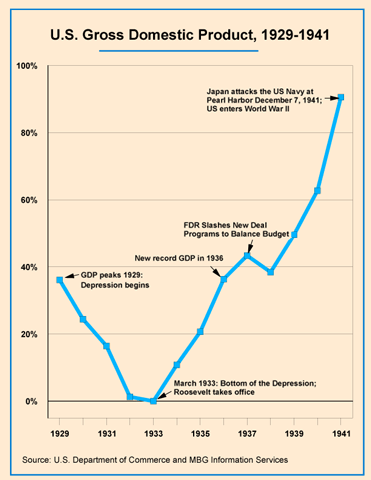
So much for the idea the recovery occurred in 1946:
http://static.seekingalpha.com/uploads/2009/2/17/saupload_depressiongdp.png
-
Re:Ballmer's Xbox Fiasco, Search Insanity, And Oth
Your post seems to be just pulling data out of thin air and pushing it as fact. Could you link your sources? I'm unable to find anything close to the figure you give
See When Will Microsoft Own Up to the XBox Bomb As of the 1st quarter of 2007 they'd invested over $21 billion and had chalked up over $5 billion in operating losses on their "Home Entertainment" (read XBox) division since 2001.
the suggestion that Microsoft is still losing money on consoles, again this is outright false and hasn't been true since about Q3 2006
Microsoft's HE division turned a small profit starting a year or two ago - I don't know if they've recorded a consistent profit each quarter since - but according to this analysis they still aren't making any money on the consoles themselves (articles back in 2005 indicated MS might have been losing a staggering $500 a console). I guess the hope is they'll make the money back on games, but they'd have to move billions of titles to make up for the $30 billion or so they've dumped into the gaming business. (Don't forget, the "red ring of death" is going to cost them between another $1 to $5 billion, according to published reports. Ouch!)
Regarding the suggestion that Microsoft is possibly a bigger loser than the PS3, I'm trying to figure out how you can calculate that one.
Because Sony successfully used the PS3 to push Blu-Ray as a new standard. Even if they're never able to make much money off the consoles themselves, between the games and Blu-Ray licensing fees, Sony will probably eke out a tiny profit off of the PS3. With its more sophisticated hardware and its ability to be used as a Blu-Ray player (among other things), the PS3 will probably have a longer shelflife than either the 360 or the Wii, giving them more time to recoup their investment.
In contrast, the piddling earnings Microsoft's getting from its Home Entertainment division - a paltry $151 million for the most recent quarter - can't even hope to fill the $30 billion chasm that division has dug for itself over the past decade fighting the console wars. Worse, those reduced HE earnings came on increased HE revenues. What happens if the economy continues to slump and sales actually decline? Looks to me like their Home Entertainment division will promptly plunge back into the red again. Whoops.
Comparing to the likes of the iPhone and the Wii is rather ignorant of the long term goal here. Microsoft wanted to break into the home entertainment area because it believes having a box under the TV is important because that box will be called upon to play games, movies and offer countless other entertainment services within a few years.
If Microsoft does manage to get a box under every TV how do you think that's going to boost their profits?
You might as well ask what's gonna happen if Microsoft discovers a way to turn lead into gold, because they have as much of a chance at that as they do at getting a "box under every TV". Which, when you think about it, is a pretty useless strategy to begin with since that box is a worthless hunk of plastic and silicon without content. And Microsoft doesn't make content.
Does anyone in their right mind think Hollywood is gonna sit back and let the likes of Microsoft control a single point of access to the home (the only way Microsoft's massive investment in consoles could ever hope to pay off)? Good luck with that strategy, Redmond. Heck, even the game developers are smart enough to realize they're better off with two (or more) players competing against one another for dominance in the home.
Beyond that, as time passes it's only going to get easier - and cheaper - to create and market devices that
-
Re:Subject
Even more basic than ROE...
Where the hell are they going to get all this money from for all these programs?It is printed out of thin air [1] That is why the USD has a beautiful long term slide [2]
Why does this happen? (A) Because It is a tax you cannot see or calculate into your yearly salary - purchasing power is lost without your noticing - so you do not complain. and (B) The money flows right off the printing press into the pockets of whatever industry the Government happens to favor at the time, which is usually the Military Industrial Complex but sometimes large scale social programs. The first one get the money hot off the printing press get the most value out of it.If your really interested see the links in [3] for some more...
[1] http://www.econlib.org/library/Enc/MoneySupply.html
[2] Decline in the U.S. dollar's purchasing power (1800-2005) Source: Barron's
http://seekingalpha.com/wp-content/seekingalpha/images/cash.gif[3] Economist Rober Higss (of the ratchet effect theory):
http://en.wikipedia.org/wiki/Robert_Higgs
Banking Act of 1935 + Fedâ(TM)s Exercise of This Authority = New Deal Policy
http://www.independent.org/blog/?p=633
http://www.independent.org/blog/?p=201 -
Re:simpler explanation
> most things that are designed to make people forget about their problems do
> very well indeed during periods of economic downturnNot to pile on, but yup, here's still more supporting evidence of that in reference to the movie industry.
-
Re:In other news...
For the record, it looks like the PS2s best selling year was when it sold about 22 million units in 2003. In 2004 it sold about 20 million. Notice that the console came out in 2000 and 2003 was it's third year out. The Nintendo Wii looks like it'll sell 20-24 million a year beginning with its second year. I think it could sell 100 million over five years thanks to the prohibitively high cost of the PS3 and the 360 providing enough competition this generation in the EU and US against the PS3 to keep one from being a runaway success.
-
Re:And the web site was already slow this morning.
One thing you can always count on is the ineptitude of government.
That being said... The President of the US actually has very little to do with the economic health of the nation. See below:
SeekingAlpha
American Spectator
Mackinac CenterFurther, most experts agree that the *actual* problem of this current market collapse stems to four things:
#1 - The CRA expansion in 1995, which put 30% more people on the housing market than there should have been, creating an incredible sellers' market in which housing, which previously had roughly paced inflation, spiraled up until people were looking at "house value" increases of over 200%.#2 - The change in the Fed's policy when Alan Greenspan was appointed chair, which changed from relatively aggressive use of the Fed Funds Rate to deflate economic bubbles and contain damage (the cause of the late-'80s "recession" for example) to allowing bubbles to grow and grow under the idea that lowering the Fed Funds Rate after the fact would "clean up the mess" and that there would be "better growth" under the bubble... unfortunately economic bubbles are more like cysts or abcesses than blisters.
#3 - The abrupt change between a far-too-liberal and far-too-conservative method of valuing a lot of mortgages. Prior to the Enron debacle and Sarbanes-Oxley reforms, the "valuation" of many of these loans (which were being used to back other securities which in turn backed more securities) was at 100% of the loan hidden in "tier 3" assets (e.g. "things we can't put a price on at this second so we'll estimate it and get back to you later) on most companies' balance sheets. This is called "mark-to-model."
Post-SOX (and coming to today because it takes years for large companies to bring everything in line with new reforms like that), the companies were required to mark the mortgages to their actual market worth (e.g. what they could get if someone bought the mortgage from them this minute). Unfortunately, since they were all being massively marked down as someone tried to PUT a market worth to them, there were suddenly MASSIVE amounts of these loans on the market, and as a result they were getting marked down to literally pennies on the dollar. This shift to "mark-to-market" accounting on the loans is what pulled the rug out from underneath a lot of other securities whose backing could be traced back to them, as well as requiring the banks (which had been using these loans as collateral on the balance sheets) to start holding back a lot more capital to service their existing accounts.
There needed to be a middle ground in this, but there wasn't.
#4 - The 1999 dissolution of the 1933 Glass-Steagall reforms, which had previously prevented investment banks from owning other financial institutions, caused much of the "piling-on" of securities backed by other securities backed by other securities backed by... well, it turned out, nearly-worthless (in the mark-to-market sense) loans.
The only part Bush plays in this is that he (a) signed SOX (which passed nearly damn unanimously from the Congress and could easily have been a Veto Override anyways) and (b) he let Greenspan, and then Greenspan's hand-picked successor, run the Fed.
P.S. I'm not a fan of Bush by any means, but fair's fair - he doesn't get the blame for this one and I'm a bit disappointed in the person who posted this and the person who posted an ill-considered, ill-thought, ill-informed rant on this contest.
-
Re:How do they do it?
i'm not assuming anything. i'm suggesting that it would be a good move on the part of both companies. that doesn't mean that i think either of them will go for it. in fact, it's very unlikely that such a deal would occur. and you seem to immediately contradict yourself right after your first sentence. first you imply that Sony would not accept a partnership with Amazon's ebook distribution system without offering any kind reason for thinking so. then you go on to state that the Sony reader has a nice design, but lacks content, whereas the Kindle looks homely but has "a MASSIVE selection of content and a terrific distribution system." well isn't that exactly what Sony needs/is missing? if a lack of content and distribution system is what's preventing the Sony Reader from succeeding, then why would they not partner up with Amazon? it seems like that would be the only logical thing for them to do.
the fact that the current Kindle doesn't use WiFi doesn't play any part in this deal. Sony Reader/PSP/Zune/iPhone users can just access the Kindle Store website. it's not like EVDO is required to purchase ebooks from the Kindle Store.
and while Apple is currently making most of its money from selling iPods, the iTunes store is quickly dominating the music retail industry. in 2007 they became the 3rd largest music retailer in the U.S. with 10% market share. in 2008 it accounted for 70% of worldwide digital music sales. and despite the RIAA's claims to the otherwise, iTunes has revitalized the music industry and driven net profits up. our indie record label now receives over 75% of our music sales from iTunes alone.
so while iPod sales generated $3.36 billion in revenue for Apple in 2007, the iTunes Store brought in $1.9 billion of Apple's $2.7 billion in total music-related revenue in 2007. and iPod sales appear to be tapering off while iTunes is experiencing continued growth. so it's not inconceivable that iTunes will become an even bigger revenue stream for Apple in the future.
but i agree with you that the PSP/iPhone are not the ideal ebook reader for everyone. my Dad, for instance, simply can't read text printed on the PSP. so he can't really use his PSP as a web browser or an e-book reader. but that doesn't stop millions of young people from using their PSPs and cellphones to read books (if they can read web pages, then why not e-books?). the Japanese have even created an entire literary genre of serial literature that's distributed and consumed entirely by cellphones.
for older users with poorer eyesight or who have to read long, dense technical materials, a dedicated ebook reader like the Kindle is definitely a must. but that's still a niche market. and for the majority of young people whom the PSP & iPhone are aimed at, being able to read e-books on their portable devices would be a huge value add--it's actually my favorite use for the PSP.
-
Re:Oh boy!
Agreed, and I used rough numbers all around. Fact of the matter is that WoW is a billion+ dollar making game which was put out by a company that puts out #1 ranked titles year after year.
http://seekingalpha.com/article/94051-ride-out-the-recession-with-activision-blizzard
"For the full year ended March 2008, Activision had revenue of $2.8 billion, operating margins of 16.55% and operating income of $479.61 million. For the calendar year 2007, Blizzard's revenue was $1.2 billion, up 58% year-over-year. Operating margins at Blizzard were estimated at 40% in the Vivendi press release announcing the spin-off. The combined company reported revenue of over $1 billion in the June quarter and according to this BusinessWeek article, Activision Blizzard is projected to have annual revenues of nearly $4.5 billion."
Check the link. -
Amazon Auctions
This is the first time in quite a few years that I've heard someone mention the (defunct) Amazon Auctions service as if it were active.
Not having heard Amazon's auction was defunct I googled it and found this "Amazon vs. eBay: Battle of the Online Auctions" from 31 January 2008. It was the third result out of more than 3 million. Restricting the search to just the past month still results in about 137,000. E-Commerce News published the article "Online Auctions, Part 1: The eBay Earthquake" on 9 September. In it there's this: "By restructuring its fees, eBay is likely attempting to ratchet up its competitiveness with Amazon.com (Nasdaq: AMZN) Latest News about Amazon.com, which has no listing fees." So they didn't know Amazon went defunct either. Also in the ad area to the right there's an ad for Amazon Auctions, now why would Amazon be buying add for a service that doesn't exist anymore?
On the other hand, I don't see auctions listed on Amazon, so maybe it's only been recently that Amazon stopped auctioning. What I find ironic if true is that the first result searching Amazon for auction is "How to Sell Anything on Amazon...and Make a Fortune!".
Falcon
-
Re:Great, we get to pay for them again!
Tax cuts for big oil? They should really pay more than 40% of their profits in taxes, and also jack up the price of gas to $12/gallon so they have even more profits to suck from so we can raise welfare salary for those 4th generation welfare kids.
-
Growth
What is really shocking about this is many stock analysts view Apple's stock as significantly undervalued.
http://seekingalpha.com/article/88230-replacing-p-e-in-valuing-apple-stock
Of course if Steve Jobs were run over by a truck tomorrow it would dive hard.
-
Re:It's called speculation...
Exactly. If speculators were driving up the equilibrium spot price of oil, then there would have to be excess supply on the market. This implies that the excess supply has to be going into storage somewhere. The burden of proof is on those who blame speculators for the high price of oil to show where the excess supply is being stored. To date, noone has been able to show where this excess supply is being stored.
Paul Krugman and James Hamilton have discussed this in some detail recently. -
Re:The only place Democrats want to drilll:
You do realize that their profit isn't all from gas and Diesel fuels right? They have wells that produce oil sold on the open market, they own stations or station lands and building and lease them out to private operators, produce and sell natural gas and home heating oil plus a number of chemicals.
In fact, Fivecentnickel did a break down of were the money goes in a gallon of gas. As it turns out, refining and profit is of gas is only about 10% of the price per gallon. This isn't off from other estimates either. And it isn't excessive compared to other industries. Microsoft kept 27.3 cents of every $1 in revenue in its most recent quarter; General Electric, 11.4 cents and McDonald's, 12.3 cents. In fact, Exxon is below the 11-cent average of Standard & Poor's 500 companies, says analyst Howard Silverblatt.
So lets look at this, 10% per gallon. That is 40 cents on $4.00 gas. But wait, 40 percent or more of that goes to income taxes. So in reality, of the 40 cents, they keep around 23 ti 24 cents per gallon. Of course federal highway and state taxes average around 13% depending on the price and location but lets not focus on that. So If Exxon (the countries largest oil company) decided to cut their profits in half to save the consumer, that would only effect gas prices by 5% or 20 cents on a $4.00 per gallon gasoline. Does $3.80 compared to $4.00 a gallon seem like gouging?
The problem is that we only have about 5 major oil companies operating in the US with only 4 of them operating in any given state at a time. This problem is compounded by not being able to develop oil fields in the US because of environmental concerns and not being able to open refineries because of the same problems. This means that with all of the smaller oil companies, the major ones just do enormous volume in sales which is why they make so much. In 2007, the US consumed 142 billion gallons of gas (about 390 million gallons per day).
So if we look at this 142 billion gallon figure, we can do a number of things. Lets multiply it by $4.00 per gallon of gas, thats $568,000,000,000 or 568 billion dollars in sales. Now of the 10% holds true, that is 56.8 billion in profit across the US. Lets divide that into quarters to compare it against profits for Exxon. It comes to around 14.2 billion dollar profit per quarter in the US gas market alone. Now assuming that usage hasn't went down in the US in more then a negligible amount, with Exxon's $11.7 billion profit posted this quarter and forgetting that it makes money in places other then Gasoline sales (about 65 billion gallons of diesel and heating oil in 2007 nation wide )plus natural gas supplies and all, 11.7 billion profit in a quarter at $4.00 a gallon is only about 79% of the market.
Now we know that Exxon doesn't control 79% of the US market. So were did all the extra come from? Well, it isn't a calculation error (even though I rounded some numbers) and it isn't a number error, the 8k sec filing shows us that the US market is a very small portion of Exxon's sales compared to world wide participation. It refined 2,584,000 barrels of liquid product (or 2,584 kbd in case I got my abbreviations wrong) in the second quart in the US where it refined 4,191,000 barrels elsewhere in the world for a total of 6,775,000 (6,775 kbd). And forgetting about all the other areas for profit, Roughly 38% of their profit would be derived from within the US. So if we take 38% of the 11.
-
Re:Are the enviromentralists killing our PCs?
I've read a few stories about this too: http://seekingalpha.com/article/81647-microsoft-s-red-ring-riddle-resolved
-
Re:AC know thyself
Both myself and the original AC know nothing of Apple's internal plan. However, since we are talking about publicly stated goal, at least we can get the stated goal right before we judge whether iPhone meets the expectation or not.
On a sister reply to that I wrote before, you also said:
The 10 million figure was based on the iPhone I. To meet expectations the combined sales of both models will have to well exceeed 10 million this year.
That is not right either. Apple does not break down models when talking about goals and sales. They only break down categories. iPod sales is always iPod sales, not iPod nano, iPod touch, iPod Classic sales. Portable sales is always notebook sales, not MacBook, MacBook Pro, MacBook Air sales. The stated goal is 10M iPhones (not iPhone EDGE, iPhone 3G) in (not by the end of) 2008. That's it.
We are very pleased with iPhone momentum and customer feedback continues to be outstanding. We remain confident in achieving our goal of selling 10 million iPhones in calendar 2008.
- Peter Oppenheimer, F2Q08 Earnings Call Transcript by Seeking AlphaClear enough?
-
Re:Breaking news!
an average investor doesn't have access to such markets
Actually, the average investor DOES have easy access to such markets. There are ETFs that you can buy like a stock that will do the investing for you. There are even ETFs that allow you to bet on declines in oil futures. -
Re:extinction of zinc?
Inelastic demand?
Peak oil a current reality? Perhaps, but you should look elsewhere for an explanation on why prices are sky high.
-
energy
You seem to be under the impression I am advocating coal
No, I don't have the impression you're pro coal. I do think you're pro nuclear power, wanting to build more power plants "with only a few thousand nuclear plants, eventually, powering the US"
Environmental impact of energy production comes from the waste emissions
Environmental impacts also come from mining as well as pre and post processing solid waste.
That's where nuclear becomes a very attractive option.
Uranium mining can be very dirty and destructive. "Uranium mining left a legacy of death". The Navajo have had to live with it. "Navajos won't allow uranium mining"[pdf]. Throughout the world it's mostly Indigenous peoples who carry the burden of uranium mining. "Indigeneous Peoples Call for Global Ban on Uranium Mining".
when we're redirecting enough solar energy to electricity that we start losing vegetation?
Any vegetation effected by solar power, PVs or concentrated, will only be where the concentrators or PVs are.
Nuclear, on the other hand, won't still the tides, it won't slow the winds, it doesn't soak up the sun's radiation, and it won't release the CO2 that we now know from experience warms the earth.
Forgetting mining, the construction of nuclear power plants releases a lot of CO2. Construction of plants require prodigious amounts of concrete and steel, both of which require massive amounts of heat energy to manufacture, and more than likely it come from coal. Then there's the need to transport them.
Like there are air conditioners and refrigerators of the coast. There are more than likely houses with them near mining and manufacturing though. Then there's the need for water for the mining yet water isn't readily available where the uranium is. In Colorado "Gov. Ritter Signs Uranium Mining Water Protection Bill".
The Univ. of Delaware study you linked to (see, I click! I read! Feel the love, Falcon.) plans to generate 330GW of power annually - from 166,720 turbines floating on top of fifty thousand square miles of ocean.
That area is still capable of being used as it is now. Ships and sail boats can still sail. Fishermen can still fish, actually because of the platforms needed for wind ginnies more fish could live there. Then with more fish more people could be encouraged to swim or snorkel and dive, which could boost the economy of the area. This is being done in Florida, artificial reefs are made by sinking cleaned objects which then encourages coral to grow. The coral offers shelters and food to fish.
That's a wind farm roughly one-fifth the area of Texas
Texas, specifically west Texas has wind farms that prod
-
Re:Drill Everywhere, Drill Now
Here are lots of pretty charts showing the price of oil in dollars compared to price in euros:
http://seekingalpha.com/article/80874-how-oil-and-gas-prices-fare-in-dollar-vs-euro-terms -
Re:From the Trenches
-
Re:ahem, more expensive?
i think the whole CO2 debate is nonsense anyway
SO all those scientists are wrong?
CO2 sequesturing should be a cheap alternative given CO2 is heavier than air. once it's in the ground it'll stay there
Oh really? Tell that to those living around Lake Nyos and Lake Monoun.
solar and wind on the other hand is hopeless at supplying base load. BASE LOAD you tree huggers. learn what it is.
And research is being done on storage, in "A Solar Grand Plan" Sciam says solar power can provide 69% of the US's energy needs by 2050. TFA goes over some of the research on storage. Base Load? Geothermal is a base load.
Falcon -
Re:My question is...
One of these days the board will realize that the Xbox team is the only one left with a fucking clue and put them in charge.
Say WHAT?!? Microsoft has dumped in excess of $20 BILLION into the development and production of their gaming systems and other home entertainment products (mostly on the XBoxen, and also that brown turd the Zune). The 360's Red Ring of Death bug alone cost them a billion. So far, that division's only managed to turn a profit in a couple of quarters, and its been in the millions.
At that rate, it'll take Microsoft a century to recoup their cost. See When Will MS Own Up to the XBox Bomb?
They'd have made more money burning $20 billion in bundles of dollar bills to drive a turbine to generate electricity. The XBox 360 is a fine videogame machine, but from a financial perspective it's been a disaster. If it weren't for the Windows Tax and the Office Tax they'd never get away with this kind of stupidity. And as personal computing moves away from the PC and toward mobile devices like the iPhone, they probably won't be able to get away with it much longer. -
Re:Cut taxes until the federal government collapse
Yeah, nobody wants to be rich because they wouldn't be able to afford the taxes. Wait a minute...
Sarcasm doesn't make an argument. Facts do.
Here's an interesting snippet for all you whiny libs out there that think corporations are EVIL:
Over the last three years, Exxon Mobil has paid an average of $27 billion annually in taxes. That's $27,000,000,000 per year, a number so large it's hard to comprehend. Here's one way to put Exxon's taxes into perspective.
According to IRS data for 2004, the most recent year available:
Total number of tax returns: 130 million
Number of Tax Returns for the Bottom 50%: 65 million
Adjusted Gross Income for the Bottom 50%: $922 billion
Total Income Tax Paid by the Bottom 50%: $27.4 billion
Conclusion: In other words, just one corporation (Exxon Mobil) pays as much in taxes ($27 billion) annually as the entire bottom 50% of individual taxpayers, which is 65,000,000 people! Further, the tax rate for the bottom 50% is only 3% of adjusted gross income ($27.4 billion / $922 billion), and the tax rate for Exxon was 41% in 2006 ($67.4 billion in taxable income, $27.9 billion in taxes).
This dude makes a great point.
So they made about 10 billion in profit last year. Microsoft made around 6 billion.
OMG EVIL! If you still think they are evil, consider that they are supporting roads, housing for people too lazy to work, social programs for the 18 year-old unwed mothers who have 3 kids and no job (and are about to have their 4th by any number of daddies). They support dirtbags like my neighbor who sit home and drink beer all day in their bathrobe while the working-class go out and actually produce. If you want to vilify anyone, it should be the government. What right do they have to take your money, and my money and give it to people who do jack shit.
If Exxon Mobile or Microsoft decided they had enough and just closed up shop or moved out of the country--you can bet it would seriously impact the government. On the flip side, if my neighbor moved out of the country, it would impact exactly dick. -
Re:That sound you hear...
And Virgin could simply have passed the price onto their customers as subscription channels. How can it be a win for Virgin when their cable TV division has made a loss for two quarters?
According to this article, Sky have effectively lost 3.3m customers from their advertising reach, and would have to regain 200,000 subscribers to balance the books.
The name calling continues Burch calls Sky behaving like school bully. -
Financial blogs getting heavily shilled
Take a few minutes off of Slashdotting to look here. IMHO, Dennis Byron is a one-man Microsoft promotion machine, specializing in OOXML. He sometimes writes on the same blog as "Research 2.0", going so far as occasional visits to the make-believe world of SCO.
-
Financial blogs getting heavily shilled
Take a few minutes off of Slashdotting to look here. IMHO, Dennis Byron is a one-man Microsoft promotion machine, specializing in OOXML. He sometimes writes on the same blog as "Research 2.0", going so far as occasional visits to the make-believe world of SCO.
-
Financial blogs getting heavily shilled
Take a few minutes off of Slashdotting to look here. IMHO, Dennis Byron is a one-man Microsoft promotion machine, specializing in OOXML. He sometimes writes on the same blog as "Research 2.0", going so far as occasional visits to the make-believe world of SCO.
-
Financial blogs getting heavily shilled
Take a few minutes off of Slashdotting to look here. IMHO, Dennis Byron is a one-man Microsoft promotion machine, specializing in OOXML. He sometimes writes on the same blog as "Research 2.0", going so far as occasional visits to the make-believe world of SCO.
-
Re:Questions?
though they also payed as much taxes as half of america.
-
Re:Basic premise in the USA ..
It looks like to me that the basic premise for most things in the USA is to do something or grant something and then let the courts work it out after the fact. This has the benefit of getting things done cheaply along with that only the people who are grievously upset will bother to fight things in the courts (which is really those who have money to do so)
Actually, I suspect it has more to do with the progression of the legal system. At first glance the rules which govern what is patentable are based on common sense and would rule out probably 70% or more of the current patents filed today and 100% of all software patents. Unfortunately, through many years of work by lawyers and legislatures the common sense of the patent rules have been trampled and raped to the point where anything can be patented no matter how obsurd. If you look at the history of software patent cases in the courts we went from "Gottschalk v. Benson, 409 U.S. 63 (1972). In this decision, the Court ruled that a program to convert binary-coded decimal numbers to binary was not patentable, since it was merely an algorithm, This decision laid the basis for the view that programs are not patentable, which held sway until 1981." where software absolutely could not be patented, duh, to "Diamond v. Diehr, 450 U.S. 175 (1981). Here the Court ruled that a process (for curing rubber) that used a computer program could be patentable, even though it made use of a mathematical algorithm." where the machine, which included software, was patentable, to today where software companies are filing thousands of patents every years.
To me this is a direct result of a purely capitalistic approach - the worship of the Dollar.
And sadly, while there have been patent trolls probably since the inception of the patent system, the worship of the dollar has turned it into an art where it now threatens the very purpose of the patent system "To promote the Progress of Science and useful Arts, by securing for limited Times to Authors and Inventors the exclusive Right to their respective Writings and Discoveries;".
Case in point, how much is NTP doing to progress the science of wireless communications and devices versus RIM who recently paid NTP over $600 million for to license their patents. RIM invests about 8% of their revenue in research and development and the result, they pay an additional $600 million to NTP who produces paperwork.
This nonsense should be stopped right now simply by upholding the original common sense of the patent system and the first step is, abolish software patents.