Slashdot Mirror
Domain: slashdot.org
Stories and comments across the archive that link to slashdot.org.
Stories · 37,380
-
Librarians As the First Line of Privacy Defense
The Guardian features a look at the influence of librarians in the evolving fight for various of the liberties that here on Slashdot we group together as Your Rights Online. The article points out that the evolution of libraries from book repositiories to more general centers for information technology means that librarians have been pressured in many small ways to give up their patrons' privacy, and have (at least often) successfully resisted that pressure, including some from the NSA. A small slice: The first politician to discover the danger of underestimating what happens when you have thousands of librarians on your case was attorney general John Ashcroft who, in 2003, accused the American Library Association of “baseless hysteria” and ridiculed their protests against the Patriot Act. ... US libraries were once protected from blanket requests for records of what their patrons were reading or viewing online, but the legislation rushed through after after 9/11 threatened to wreck this tradition of confidentiality in ways that presaged later discoveries of bulk telephone and internet record collection." -
Ask Slashdot: Options After Google Chrome Discontinues NPAPI Support?
An anonymous reader writes: I've been using Google Chrome almost exclusively for more than 3 years. I stopped using Mozilla Firefox because it was becoming bloated and slow, and I migrated all my bookmarks etc. to Chrome. Now Chrome plans to end NPAPI support — which means that I will not be able to access any sites that use Java, and I need this for work. I tried going back to Firefox for a couple of days but it still seems slow — starting it takes time, even the time taken to load a page seems more than Chrome. So what are my options now? Export all my bookmarks and go back to Mozilla Firefox and just learn to live with the performance drop? Or can I tweak Firefox performance in any way? FWIW, I am on a Windows 7 machine at work. Have a question for Slashdot's readers? Take a look at other recent questions first to see if someone else has had a similar question. And if not, ask away! The more details and context you include, the more likely your question will be selected. -
Ask Slashdot: Options After Google Chrome Discontinues NPAPI Support?
An anonymous reader writes: I've been using Google Chrome almost exclusively for more than 3 years. I stopped using Mozilla Firefox because it was becoming bloated and slow, and I migrated all my bookmarks etc. to Chrome. Now Chrome plans to end NPAPI support — which means that I will not be able to access any sites that use Java, and I need this for work. I tried going back to Firefox for a couple of days but it still seems slow — starting it takes time, even the time taken to load a page seems more than Chrome. So what are my options now? Export all my bookmarks and go back to Mozilla Firefox and just learn to live with the performance drop? Or can I tweak Firefox performance in any way? FWIW, I am on a Windows 7 machine at work. Have a question for Slashdot's readers? Take a look at other recent questions first to see if someone else has had a similar question. And if not, ask away! The more details and context you include, the more likely your question will be selected. -
Google Releases Report On Autonomous Vehicle Accidents
An anonymous reader writes: Back in May, a report from the Associated Press pieced together information on car accidents that involved autonomous vehicles. Google, the company testing the most self-driving cars on public roads right now, said the automation technology was not at fault in any of the accidents. However, they took criticism for declining to provide any detail. Now, they've changed that stance, releasing specifics on all of the accidents involving their autonomous cars. They set up a new website for releasing monthly reports. According to their first report (PDF), there have been 12 accidents since 2010. The vast majority of them involved another car rear-ending the Google car while waiting at a stop sign/light. There was one incident where another car rolled a stop sign, one in which another car veered into the AV's lane, and one incident where a Google employee driving the car in manual mode rear-ended another car. None of the accidents resulted in an injury. -
How Does Musk's Government Funding Compare To Competitors?
Rei writes: We recently discussed an article in the LA Times complaining about how Elon Musk has built his corporate empires — Solar City, Tesla Motors and SpaceX — on the back of government subsidies. However, how does the funding compare in context to various competitors? USC professor Greg Autry breaks it down, noting among other things that SpaceX's competitors have benefited from decades of tremendous government money and a launch monopoly, while the Volt receives — on a percentage basis — 2 1/2 times greater subsidy than a Model S, and was developed on the government's dime. -
SourceForge Responds To nmap Maintainer's Claims
An anonymous reader writes: A few days ago, the maintainer of nmap (an open source network mapping tool) complained that SourceForge had taken over the nmap project page. SourceForge has now responded with a technical analysis of the nmap project history. They said, "We've confirmed conclusively that no changes were made to the project or data, and that all past download delivery by nmap on SourceForge was through our web hosting service where content is project-administered."
They detail the history of services used by the nmap project, and use screenshots from the Internet Archive to show how long the project was empty. SourceForge said, "The last update date in 2013 relates to the migration of the nmap project (along with all other projects on the site) from SourceForge's sfx code base to the new Apache Allura-based code base. This migration was an automated operation conducted for all projects, and this platform change did not augment data in the Project Web service or File Release System. We therefore conclude that no content has been removed from the nmap project page." They also confirmed that nmap downloads were never bundled with ads: "Infosec professionals do not generally wish to install secondary offers." Note: SourceForge and Slashdot share a corporate overlord. -
Baidu Forced To Withdraw Last Month's ImageNet Test Results
elwinc writes: Back in mid-May, Baidu, a computer research and services organization in Mainland China, announced impressive results on the ImageNet "Large Scale Visual Recognition Challenge," besting results posted by Google and Microsoft. Turns out, Baidu gamed the system, creating 30 accounts and running far more than the 2 tests per week allowed in the contest. Having been caught cheating, Baidu has been banned for a year from the challenge. I believe all competitors are using variations on the convolutional neural network, AKA deep network. Running the test dozens of times per week might allow a competitor to pre-tune parameters for the particular problem, thus producing results that might not generalize to other problems. All of which makes it quite ironic that a Baidu scientist crowed "Our company is now leading the race in computer intelligence!" -
Features That Windows 10 Will Deprecate
jones_supa writes: Microsoft announced that a Windows 10 upgrade will be free for users running Windows 7 and 8.1, but there will be a number of features that will no longer work after that upgrade. The features that will no longer work are listed on the official specifications page on Microsoft's website. Some of the deprecated features include: Media Center, out-of-the-box DVD playback and USB floppy support, desktop gadgets, deferring updates (Home edition), old versions of Windows games, and Windows Live Essentials version of OneDrive. -
Making an AR-15 In the Wired San Francisco Office
An anonymous reader writes: Wired's writer Andy Greenberg writes about his experience fabricating an AR-15 lower receiver with the Ghost Gunner CNC mill. (That's the same device that was demoed in a Slashdot video earlier this year.) Greenberg points out that CNC millng isn't new, but reports nonetheless: "Aside from a single brief hardware hiccup, it worked remarkably well. In fact, the Ghost Gunner worked so well that it may signal a new era in the gun control debate, one where the barrier to legally building an untraceable, durable, and deadly semiautomatic rifle has reached an unprecedented low point in cost and skill." -
Valve Introduces Steam Refunds In Advance of Summer Sale
Deathspawner writes: Despite all of its competition, Valve's Steam service remains the most popular digital PC game store around. While Steam does do a lot of things right, it can sometimes stumble in the worst of ways. Look no further than April's Skyrim mod debacle as a good example. Well, just as Valve fixed up that issue, it's gone ahead and fixed another: it's making refunds dead simple. While refunds have been possible in the past, it's required gamers to jump through hoops to get them. Now, Valve has set certain criteria for granting a refund, no questions asked: if you've bought the game within the past two weeks and played it for two hours or less, your refund is guaranteed. The changes are being welcomed by most, but not all: some developers of smaller games that take less time to play through are worried that this will lead to abuse, and the system may enable more risk-free review-bombing as well. -
nmap Maintainer Warns He Doesn't Control nmap SourceForge Mirror
vivaoporto writes: Gordon Lyon (better known as Fyodor, author of nmap and maintainer of the internet security resource sites insecure.org, nmap.org, seclists.org, and sectools.org) warns on the nmap development mailing list that he does not control the SourceForge nmap project.
According to him the old Nmap project page (located at http://sourceforge.net/projects/nmap/, screenshot) was changed to a blank page and its contents were moved to a new page (http://sourceforge.net/projects/nmap.mirror/, screenshot) which is controlled by sf-editor1 and sf-editor3, in a pattern mirroring the much discussed takeover of the GIMP-Win page discussed last week on Ars Technica, IT World and eventually this week on Slashdot.
On Monday, Sourceforge promised to stop "presenting third party offers for unmaintained SourceForge projects," and to their credit Fyodor states, "So far they seem to be providing just the official Nmap files," but reiterates "that you should only download Nmap from our official SSL Nmap site: https://nmap.org/download.html." To browse the projects and mirrors currently controlled by SourceForge, you can look at these account pages: sf-editor1, sf-editor2, and sf-editor3. -
Tim Cook: "Weakening Encryption Or Taking It Away Harms Good People"
Patrick O'Neill writes: Over the last year, Apple CEO Tim Cook has repeatedly made headlines as a spearpoint in the new crypto wars. As FBI director James Comey pushes for legally mandated backdoors on encryption, Cook has added default strong encryption to Apple devices and vocally resisted Comey's campaign. Echoing warnings from technical experts across the world, Cook said that adding encryption backdoors for law enforcement would weaken the security of all devices and "is incredibly dangerous," he said last night at the Electronic Privacy Information Center awards dinner. "So let me be crystal clear: Weakening encryption or taking it away harms good people who are using it for the right reason." -
Ask Slashdot: Your Most Unusual Hardware Hack?
An anonymous reader writes: Another Slashdotter recently asked what kind of things someone can power with an external USB battery. I have a followup along those lines: what kind of modifications have you made to your gadgets to do things that they were never meant to do? Consider old routers, cell phones, monitors, etc. that have absolutely no use or value anymore in their intended form. What can you do with them? -
GameStop Swoops In To Buy ThinkGeek For $140 Million
Lirodon writes: Remember a few days ago, when Slashdot's former parent company was the subject of a $122 million takeover bid by Hot Topic? Well, another geeky retailer entered the fray in the battle for ThinkGeek, and won. GameStop will be acquiring Geeknet for $140 million. The video game retailer has promised synergies, such as in-store pickup and integration with its rewards program. -
Mercedes-Benz Copies Tesla, Plans To Offer Home Energy Storage
cartechboy writes: It's like a game of follow the leader. First, Tesla announced its Powerwall Batteries, and now Mercedes-Benz plans to follow suit by entering the energy-storage business as well. A division of parent company Daimler has been testing battery packs that can power houses, and plans to launch commercially in September. Supposedly a battery pack for "light industrial, commercial, and private" use is being tested with sizes ranging from 2.5 kWh to 5.9 kWh. While Tesla's building a massive Gigafactory to make all its batteries for its Powerwall and electric cars, it's unclear exactly how Daimler plans to produce its batteries in a larger-scale energy-storage operation. -
SourceForge and GIMP [Updated]
New submitter tresf writes: In response to a Google+ post from the Gimp project claiming that "[Sourceforge] is now distributing an ads-enabled installer of GIMP," Sourceforge had this response: "In cases where a project is no longer actively being maintained, SourceForge has in some cases established a mirror of releases that are hosted elsewhere. This was done for GIMP-Win.
Submitter's note: Gimp is actively being maintained and the definition of "mirror" is quite misleading here as a modified binary is no longer a verbatim copy. Download statistics for Gimp on Windows show SourceForge as offering over 1,000 downloads per day of the Gimp software.
In an official response to this incident, the official Gimp project team reminds users to use official download methods. Slashdotters may remember the last time news like this surfaced (2013) when the Gimp team decided to move downloads from SourceForge to their own FTP service. "Therefore, we remind you again that GIMP only provides builds for Windows via its official Downloads page." Note: SourceForge and Slashdot share a corporate parent. Editor's note: I just got back from a busy weekend to see that a bunch of people are freaking out that we're "burying" this story, so here it is. Go hog wild. Sorry it took so long. (And for future reference, user submissions are easily found in the firehose, listed in the order they appear, newest first.)
Update: 06/01 22:37 GMT by T : The SourceForge blog has a welcome update; SourceForge, it says, has effective today "stopped presenting third party offers for unmaintained SourceForge projects. ... At this time, we present third party offers only with a few projects where it is explicitly approved by the project developer, or if the project is already bundling third party offers." -
SourceForge and GIMP [Updated]
New submitter tresf writes: In response to a Google+ post from the Gimp project claiming that "[Sourceforge] is now distributing an ads-enabled installer of GIMP," Sourceforge had this response: "In cases where a project is no longer actively being maintained, SourceForge has in some cases established a mirror of releases that are hosted elsewhere. This was done for GIMP-Win.
Submitter's note: Gimp is actively being maintained and the definition of "mirror" is quite misleading here as a modified binary is no longer a verbatim copy. Download statistics for Gimp on Windows show SourceForge as offering over 1,000 downloads per day of the Gimp software.
In an official response to this incident, the official Gimp project team reminds users to use official download methods. Slashdotters may remember the last time news like this surfaced (2013) when the Gimp team decided to move downloads from SourceForge to their own FTP service. "Therefore, we remind you again that GIMP only provides builds for Windows via its official Downloads page." Note: SourceForge and Slashdot share a corporate parent. Editor's note: I just got back from a busy weekend to see that a bunch of people are freaking out that we're "burying" this story, so here it is. Go hog wild. Sorry it took so long. (And for future reference, user submissions are easily found in the firehose, listed in the order they appear, newest first.)
Update: 06/01 22:37 GMT by T : The SourceForge blog has a welcome update; SourceForge, it says, has effective today "stopped presenting third party offers for unmaintained SourceForge projects. ... At this time, we present third party offers only with a few projects where it is explicitly approved by the project developer, or if the project is already bundling third party offers." -
Patriot Act Spy Powers To Expire As Rand Paul Blocks USA Freedom Act Vote
Saturday, we mentioned that three major spying powers that the U.S. government has exercised under the Patriot Act might be nixed, as the sections of the Act granting authority to use them expires. The Daily Dot reports that Senator (and presidential contender) Rand Paul today used Senate rules to block a bill which would have extended those powers, which means that as of midnight Sunday on the U.S. east coast, sections 206, 207 and 215 of the Patriot Act will have expired. Says the Daily Dot's article, linked by reader blottsie: The reform bill, which the House passed before leaving town for a week-long recess, would end the government's bulk collection of Americans' phone records under the Patriot Act's controversial Section 215 but leaves the other two provisions intact. ... Sunday's procedural meltdown was the second narrow defeat for the USA Freedom Act. In a late-night session on Friday, May 22, the bill fell three votes short of an initial procedural step after [Senate Majority Leader] McConnell lobbied hard against it. The Senate's failure to meet its deadline was a blow to President Obama, who on Friday had warned lawmakers that the country would be vulnerable if the USA Freedom Act did not pass. -
How Elon Musk's Growing Empire is Fueled By Government Subsidies
theodp writes: By the Los Angeles Times' reckoning, Elon Musk's Tesla Motors, SolarCity, and SpaceX together have benefited from an estimated $4.9 billion in government support. The figure compiled by The Times, explains reporter Jerry Hirsch, comprises a variety of government incentives, including grants, tax breaks, factory construction, discounted loans and environmental credits that Tesla can sell. It also includes tax credits and rebates to buyers of solar panels and electric cars. "He definitely goes where there is government money," said an equity research analyst. "Musk and his companies' investors enjoy most of the financial upside of the government support, while taxpayers shoulder the cost," Hirsch adds. "The payoff for the public would come in the form of major pollution reductions, but only if solar panels and electric cars break through as viable mass-market products. For now, both remain niche products for mostly well-heeled customers." And as Musk moves into a new industry — battery-based home energy storage — Hirsch notes Tesla has already secured a commitment of $126 million in California subsidies to companies developing energy storage technology. -
Ground Crew Back In Touch With LightSail Solar Spacecraft
Yesterday, we noted that the Planetary Society's solar-sail powered craft had lost radio contact with its controllers here on Earth; Engadget reports that the group has issued an update, and the news is good. From the Society's release: "The solar sailing spacecraft test mission, a precursor to a 2016 mission, has now resumed contact after a suspected software glitch affected communications. The LightSail team will soon determine when to attempt deployment of the spacecraft’s Mylar solar sails." -
Steve Albini: The Music Industry Is a Parasite -- and Copyright Is Dead
journovampire sends word of another thought-provoking rant from Steve Albini (mentioned here last a few years back for his paean to the beauty of analog tape for recording): The veteran producer addressed an audience in Barcelona on Saturday: "The old copyright model – the person who creates something owns it and anyone else that wants to use it or see it has to pay them – has expired." -
Ask Slashdot: What Interesting Things Can I Power With an External USB Battery?
New submitter expert464 writes: I just purchased an external USB battery for the main purpose of charging smartphones. I've also thought of using it to power a USB lamp and charge a bluetooth speaker. What other things am I missing that would be useful and/or interesting to power when not near an electrical outlet? Have a question for Slashdot's readers? Take a look at other recent questions first to see if someone else has had a similar question. And if not, ask away! The more details and context you include, the more likely your question will be selected. -
Ask Slashdot: What Interesting Things Can I Power With an External USB Battery?
New submitter expert464 writes: I just purchased an external USB battery for the main purpose of charging smartphones. I've also thought of using it to power a USB lamp and charge a bluetooth speaker. What other things am I missing that would be useful and/or interesting to power when not near an electrical outlet? Have a question for Slashdot's readers? Take a look at other recent questions first to see if someone else has had a similar question. And if not, ask away! The more details and context you include, the more likely your question will be selected. -
Ask Slashdot: Switching Careers From Software Engineering To Networking?
An anonymous reader writes: I am a software engineer with over 10 years of experience making approx 210k a year after bonus. I've seen countless of software engineering jobs off-shored or taken by H1Bs over the past 5 years. While I am pretty safe at my current job, software engineering as a profession is beginning to look bleak, and i am not even sure if I can ask for the same money if I decide to jump ship to another company (I live in an expensive area).
A friend of mine who works as a network architect with dual CCIEs have no problem finding/landing jobs with high salary. His profession doesn't seem to be affected by outsourcing or H1bs, so I am tempted to switch from my field to networking for better stability and greener pastures.
So the question is, should I do it? The reason why I am looking for the long-term stability is because I've a family of 3 to feed. I cannot afford to be jobless for more than 3 months if I do get laid-off, and software engineering doesn't seem to be the profession after years of observation to provide long-term stability. Have a question for Slashdot's readers? Take a look at other recent questions first to see if someone else has had a similar question. And if not, ask away! The more details and context you include, the more likely your question will be selected. -
Ask Slashdot: Switching Careers From Software Engineering To Networking?
An anonymous reader writes: I am a software engineer with over 10 years of experience making approx 210k a year after bonus. I've seen countless of software engineering jobs off-shored or taken by H1Bs over the past 5 years. While I am pretty safe at my current job, software engineering as a profession is beginning to look bleak, and i am not even sure if I can ask for the same money if I decide to jump ship to another company (I live in an expensive area).
A friend of mine who works as a network architect with dual CCIEs have no problem finding/landing jobs with high salary. His profession doesn't seem to be affected by outsourcing or H1bs, so I am tempted to switch from my field to networking for better stability and greener pastures.
So the question is, should I do it? The reason why I am looking for the long-term stability is because I've a family of 3 to feed. I cannot afford to be jobless for more than 3 months if I do get laid-off, and software engineering doesn't seem to be the profession after years of observation to provide long-term stability. Have a question for Slashdot's readers? Take a look at other recent questions first to see if someone else has had a similar question. And if not, ask away! The more details and context you include, the more likely your question will be selected. -
Let's Take This Open Floor Plan To the Next Level
theodp writes: In response to those of you who are unhappy with your Open Office, McSweeney's has some ideas for taking the open floor plan to the next level. "Our open floor plan was decided upon after rigorous research that primarily involved looking at what cool internet companies were doing and reflexively copying them," writes Kelsey Rexroat. "We're dismayed and confused as to why their model isn't succeeding for our own business, and have concluded that we just haven't embraced the open floor plan ideals as fully as we possibly can. So team, let's take this open floor plan to the next level!" Among the changes being implemented in the spirit of transparency and collaboration: 1. "All tables, chairs, and filing cabinets will be replaced by see-through plastic furnishings." 2. "All desks will be mounted on wheels and arranged into four-desk clusters. At random intervals throughout the day, a whistle will blow, at which point you should quickly roll your desk into a new cluster." 3. "Employees' desktops will be randomly projected onto a movie screen in the center of the office." 4. "You can now dial into a designated phone line to listen in on any calls taking place within the office and add your opinion." Some workplaces might make you question just how tongue-in-cheek this description is. -
Mandriva CEO: Employee Lawsuits Put Us Out of Business
Julie188 writes: As you probably heard by now, Linux company Mandriva has finally, officially gone out of business. The CEO has opened up, telling his side of the story. He blames employee lawsuits after a layoff in 2013, the French labor laws and the courts. "Those court decisions forced the company to announce bankruptcy," he said. -
Hacking Your Body Through a Nerve In Your Neck
agent elevator writes: IEEE Spectrum has a feature (part of its Hacking the Human OS issue) on the future of vagus nerve stimulation, a device-based therapy with the potential to treat a ridiculously wide variety of ailments: epilepsy, depression, stroke, tinnitus, heart failure, migraines, asthma, the list goes on. One problem is that, because it required an implant (a bit like a pacemaker), it was never anybody's first-choice therapy. But now there's a non-invasive version, a device you just hold to your neck twice a day for a few minutes. It's being trialed first for migraines and cluster headaches (which sound horrible). If it works, vagus nerve stimulation could compete directly with drug treatments on cost and convenience and it would let doctors find new ways to hack human physiology. -
More About Dan Shapiro and the Glowforge CNC Laser Cutter (Video #2)
Yesterday Glowforge Co-Founder and CEO Dan Shapiro told us that the Glowforge machine is a CNC laser cutter and engraver, not a 3-D Printer -- even though the first words on Glowforge's main page are, "The First 3D Laser Printer," a description Dan says is there for people not familiar with things like laser cutters and 3-D printers, who want to call the Glowforge a 3-D printer even though people who know about this stuff know what it is at first glance. He also talks about his previous startup, Robot Turtles; what it is, how it came to be, and why kids like it so much. This interview is worth watching (or reading) for the Robot Turtles section alone, especially if you have children or are thinking about designing board games for kids. -
Professional Internet Troll Sues Her Former Employer
baegucb sends a followup to the news from March that professional internet trolls were operating by the hundreds at factories in Russia. A woman hired to be one of these trolls, Lyudmila Savchuk, spoke to the media about her job, which led to her being fired. She's now suing her former employer and providing further details about how they operate. "The 'troll factory' operates based on very weird schemes, but all those firms are connected to each other, even though they are separate legal entities," she said. "I knew it was something bad, but of course I never suspected that it was this horrible and this large-scale." She describes how they flooded comment sections with pro-Putin responses, pushed out over 100 blog posts each shift, and doctored images to suit their employers' needs. Savchuk is now gathering activists to oppose this form of internet propaganda. -
Emulator Now Runs x86 Apps On All Raspberry Pi Models
DeviceGuru writes: Russia-based Eltechs announced its ExaGear Desktop virtual machine last August, enabling Linux/ARMv7 SBCs and mini-PCs to run x86 software. That meant that users of the quad-core, Cortex-A7-based Raspberry Pi 2 Model B, could use it as well, although the software was not yet optimized for it. Now Eltechs has extended extended ExaGear to support earlier ARMv6 versions of the Raspberry Pi. The company also optimized the emulator for the Pi 2 allowing, for example, Pi 2 users to use automatically forwarding startup scripts. -
Uber Revises Privacy Policy, Wants More Data From Users
itwbennett tips news that Uber has amended its privacy policy, making it much simpler to read and understand. But the policy also includes changes to what data Uber collects about its riders. Beginning July 15th, the Uber phone app will keep track of a rider's location while it's running in the background. Uber says riders will be able to opt out of this tracking. The policy changes also allow for advertising using the rider's contact list: "for example the ability to send special offers to riders' friends or family." The revision of Uber's privacy policy followed complaints at the end of last year that the company was overstepping its bounds. -
Crowdfunded, Solar-powered Spacecraft Goes Silent
Last week saw the successful launch of the Planetary Society's LightSail spacecraft, the solar-powered satellite that runs Linux and was crowdfunded on Kickstarter. The spacecraft worked flawlessly for two days, but then fell silent, and the engineering team has been working hard on a fix ever since. They've pinpointed the problem: a software glitch. "Every 15 seconds, LightSail transmits a telemetry beacon packet. The software controlling the main system board writes corresponding information to a file called beacon.csv. If you're not familiar with CSV files, you can think of them as simplified spreadsheets—in fact, most can be opened with Microsoft Excel. As more beacons are transmitted, the file grows in size. When it reaches 32 megabytes—roughly the size of ten compressed music files—it can crash the flight system." Unfortunately, the only way to clear that CSV file is to reboot LightSail. It can be done remotely, but as anyone who deals with crashing computers understands, remote commands don't always work. The command has been sent a few dozen times already, but LightSail remains silent. The best hope may now be that the system spontaneously reboots on its own. -
Ask Slashdot: What Happens If We Perfect Age Reversing?
ourlovecanlastforeve writes: With biologists getting closer and closer to reversing the aging process in human cells, the reality of greatly extended life draws closer. This brings up a very important conundrum: You can't tell people not to reproduce and you can't kill people to preserve resources and space. Even at our current growth rate there's not enough for everyone. Not enough food, not enough space, not enough medical care. If — no, when — age reversal becomes a reality, who gets to live? And if everyone gets to live, how will we provide for them? -
Why Detecting Drones Is a Tough Gig
An anonymous reader writes with a link to some interesting commentary at Help Net Security from Drone Lab CEO Zain Naboulsi about a security issue of a (so far) unusual kind: detecting drones whose masters are bent on malice. That's relevant after the recent drone flight close enough to the White House to spook the Secret Service, and that wasn't the first -- even if no malice was involved. Drones at their most dangerous in that context are small, quiet, and flying through busy, populated spaces, which makes even detecting them tough, never mind defeating them. From the article, which briefly describes pros and cons of various detection methods: Audio detection does NOT work in urban environments - period. Most microphones only listen well at 25 to 50 feet so, because of the ambient noise in the area, any audio detection method would be rendered useless at 1600 Pennsylvania Avenue. It is also too simple for an operator to change the sound signature of a drone by buying different propellers or making other modifications. It doesn't take much to defeat the many weaknesses of audio detection. -
Why Detecting Drones Is a Tough Gig
An anonymous reader writes with a link to some interesting commentary at Help Net Security from Drone Lab CEO Zain Naboulsi about a security issue of a (so far) unusual kind: detecting drones whose masters are bent on malice. That's relevant after the recent drone flight close enough to the White House to spook the Secret Service, and that wasn't the first -- even if no malice was involved. Drones at their most dangerous in that context are small, quiet, and flying through busy, populated spaces, which makes even detecting them tough, never mind defeating them. From the article, which briefly describes pros and cons of various detection methods: Audio detection does NOT work in urban environments - period. Most microphones only listen well at 25 to 50 feet so, because of the ambient noise in the area, any audio detection method would be rendered useless at 1600 Pennsylvania Avenue. It is also too simple for an operator to change the sound signature of a drone by buying different propellers or making other modifications. It doesn't take much to defeat the many weaknesses of audio detection. -
GM To Offer Apple CarPlay and Android Auto API In Most 2016 Vehicles
Lucas123 writes: GM today announced it will offer Apple CarPlay and Android Auto mirroring APIs on 14 of its 2016 vehicles. GM's announcement follows one earlier this week by Hyundai, which said it would offer Android Auto in its Sonata Sedan this year. Some of GM's Chevrolet vehicles — such as the Malibu, Camaro and Silverado truck — use a seven-inch MyLink infotainment system; those systems will be compatible with both Android Auto and Apple CarPlay in the beginning of 2016. Those models offering the smartphone mirroring apps include the all-new 2016 Cruze compact, which will debut on June 24. Other GM vehicles use an eight-inch version of MyLink that will only be compatible with Apple CarPlay at the beginning of the new model year. While development and testing is not yet complete, Android Auto compatibility may be available on the eight-inch version of MyLink later in the 2016 model year, GM said. -
Prospects and Limits For the LHC's Capabilities To Test String Theory
StartsWithABang writes: The Large Hadron Collider has just been upgraded, and is now making the highest energy collisions of any human-made machine ever. But even at 13 TeV, what are the prospects for testing String Theory, considering that the string energy scale should be up at around 10^19 GeV or so? Surprisingly, there are a number of phenomenological consequences that should emerge, and looking at what we've seen so far, they may disfavor String Theory after all. -
Clinton Foundation: Kids' Lack of CS Savvy Threatens the US Economy
theodp writes: As the press digs for details on Clinton Foundation donations, including a reported $26+ million from Microsoft and Bill Gates, it's probably worth noting the interest the Clintons have developed in computer science and the role they have played — and continue to play — in the national K-12 CS and tech immigration crisis that materialized after Microsoft proposed creating such a crisis to advance its 'two-pronged' National Talent Strategy, which aims to increase K-12 CS education and the number of H-1B visas. Next thing you know, Bill is the face of CS at the launch of Code.org. Then Hillary uses the Clinton Global Initiative (CGI) conference to launch a Facebook, Microsoft, and Google initiative to boost the ranks of female and students of color in CS, and starts decrying woeful CS enrollment. Not to be left out, Chelsea keynotes the NCWIT Summit and launches Google's $50M girls-only Made With Code initiative with now-U.S. CTO Megan Smith. And last December, the Clinton Foundation touted its initiatives to engage middle school girls in CS, revamp the nation's AP CS program, and retrain out-of-work Americans as coders. At next month's CGI America 2015, the conference will kick off with a Beer Bust that CGI says "will also provide an opportunity to learn about Tech Girls Rock, a CGI Commitment to Action launched by CA Technologies in partnership with the Boys & Girls Clubs of America that helps girls discover an interest in tech-related educational opportunities and careers." On the following days, CGI sessions will discuss tech's need for a strong and diverse talent pipeline for computer and information technology jobs, which it says is threatened by "the persistent poor performance of American students in science, technology, engineering, and math," presenting "serious implications for the long-term competitiveness of the U.S. economy." So what's the long-term solution? Expanding CS education, of course! -
Clinton Foundation: Kids' Lack of CS Savvy Threatens the US Economy
theodp writes: As the press digs for details on Clinton Foundation donations, including a reported $26+ million from Microsoft and Bill Gates, it's probably worth noting the interest the Clintons have developed in computer science and the role they have played — and continue to play — in the national K-12 CS and tech immigration crisis that materialized after Microsoft proposed creating such a crisis to advance its 'two-pronged' National Talent Strategy, which aims to increase K-12 CS education and the number of H-1B visas. Next thing you know, Bill is the face of CS at the launch of Code.org. Then Hillary uses the Clinton Global Initiative (CGI) conference to launch a Facebook, Microsoft, and Google initiative to boost the ranks of female and students of color in CS, and starts decrying woeful CS enrollment. Not to be left out, Chelsea keynotes the NCWIT Summit and launches Google's $50M girls-only Made With Code initiative with now-U.S. CTO Megan Smith. And last December, the Clinton Foundation touted its initiatives to engage middle school girls in CS, revamp the nation's AP CS program, and retrain out-of-work Americans as coders. At next month's CGI America 2015, the conference will kick off with a Beer Bust that CGI says "will also provide an opportunity to learn about Tech Girls Rock, a CGI Commitment to Action launched by CA Technologies in partnership with the Boys & Girls Clubs of America that helps girls discover an interest in tech-related educational opportunities and careers." On the following days, CGI sessions will discuss tech's need for a strong and diverse talent pipeline for computer and information technology jobs, which it says is threatened by "the persistent poor performance of American students in science, technology, engineering, and math," presenting "serious implications for the long-term competitiveness of the U.S. economy." So what's the long-term solution? Expanding CS education, of course! -
Mandriva Goes Out of Business
An anonymous reader writes: After struggling for the past several years, Mandriva has finally gone out of business, and is in the process of being liquidated. The company was responsible for Mandriva Linux, itself a combination of Mandrake Linux and Conectiva Linux. When Mandriva fell upon hard times, many of the distro's developers migrated to Mageia Linux, which is still going strong and just putting the final touches on its next major version (5). -
Russian Space Agency Misused $1.8 Billion, May Be Replaced
An anonymous reader writes: After a pair of high profile launch failures in the past few months, Russian space agency Roscosmos is making headlines again: this time for corruption. A public spending watchdog reported that the organization had misused 92 billion rubles ($1.8 billion) in 2014 alone. Deputy Prime Minister Dmitry Rogozin said their space efforts have been undermined by rampant corruption. "We have uncovered acts of fraud, abuse of authority (and) document forgery. With such a level of moral decay, one should not be surprised at the high accident rate." He also said Roscosmos is to be "abolished," and replaced by a state corporation of the same name by the end of the year. "In its new, corporate identity, Roscosmos will be responsible not only for setting mission goals but managing wages for space industry workers and modernizing production facilities." -
Russian Space Agency Misused $1.8 Billion, May Be Replaced
An anonymous reader writes: After a pair of high profile launch failures in the past few months, Russian space agency Roscosmos is making headlines again: this time for corruption. A public spending watchdog reported that the organization had misused 92 billion rubles ($1.8 billion) in 2014 alone. Deputy Prime Minister Dmitry Rogozin said their space efforts have been undermined by rampant corruption. "We have uncovered acts of fraud, abuse of authority (and) document forgery. With such a level of moral decay, one should not be surprised at the high accident rate." He also said Roscosmos is to be "abolished," and replaced by a state corporation of the same name by the end of the year. "In its new, corporate identity, Roscosmos will be responsible not only for setting mission goals but managing wages for space industry workers and modernizing production facilities." -
Amtrak Installing Cameras To Watch Train Engineers
An anonymous reader writes: In the aftermath of the derailment of an Amtrak train in Philadelphia a couple weeks ago, the company has caved to demands that it install video cameras to monitor and record the actions of the engineers driving their trains. The National Transportation Safety Board has been recommending such cameras for the past five years. Amtrak CEO Joe Boardman says the cameras will improve train safety, though the engineers' union disagrees. In 2013, the union's president said, "Installation of cameras will provide the public nothing more than a false sense of security. More than a century of research establishes that monitoring workers actually reduces the ability to perform complex tasks, such as operating a train, because of the distractive effect." -
Google's Diversity Chief: Mamas Don't Let Their Baby Girls Grow Up To Be Coders
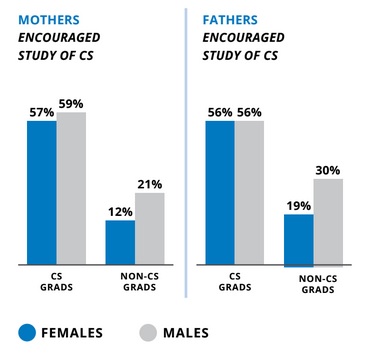
theodp writes: Explaining the reasons for its less-than-diverse tech workforce, Google fingered bad parenting for its lack of women techies. From the interview with Google Director of Diversity and Inclusion Nancy Lee: "Q. What explains the drop [since 1984] in women studying computer science? A. We commissioned original research that revealed it's primarily parents' encouragement, and perception and access. Parents don't see their young girls as wanting to pursue computer science and don't steer them in that direction. There's this perception that coding and computer science is ... a 'brogrammer' culture for boys, for games, for competition. There hasn't been enough emphasis on the power computing has in achieving social impact. That's what girls are interested in. They want to do things that matter." While scant on details, the Google study's charts appear to show that, overall, fathers encourage young women to study CS more than mothers. Google feels that reeducation is necessary. "Outreach programs," advises Google, "should include a parent education component, so that parents learn how to actively encourage their daughters." -
No, Your SSD Won't Quickly Lose Data While Powered Down
An anonymous reader writes: A few weeks ago, we discussed reports that enterprise SSDs would lose data in a surprisingly short amount of time if left powered off. The reports were based on a presentation from Alvin Cox, a Seagate engineer, about enterprise storage practices. PCWorld spoke to him and another engineer for Seagate, and they say the whole thing was blown out of proportion. Alvin Cox said, "I wouldn't worry about (losing data). This all pertains to end of life. As a consumer, an SSD product or even a flash product is never going to get to the point where it's temperature-dependent on retaining the data." The intent of the original presentation was to set expectations for a worst case scenario — a data center writing huge amounts of data to old SSDs and then storing them long-term at unusual temperatures. It's not a very realistic situation for businesses with responsible IT departments, and almost impossible for personal drives. -
Microsoft Tries Another Icon Theme For Windows 10
jones_supa writes: Back in February, users decried the new icon look in Windows 10. In response to that feedback, Microsoft has implemented a new icon pack in build 10125, which was leaked early but expected to arrive soon for Technical Preview testers. Screenshots show what the final version of the OS could look like when it goes live this summer. The new icons go all-in on a flat approach, following the same design cues as the rest of the operating system, but the "pixel art" style has been abandoned. Once again, Softpedia asked for user experiences, and this time the comments have been mostly positive. -
Machine That "Uncooks Eggs" Used To Improve Cancer Treatment
hypnosec writes: An Australian invention that gained attention for being able to "unboil" an egg has now been put to use in the treatment of cancer. The device has boosted the potency of a common cancer treatment drug, carboplatino, as much as four-and-a-half-times. ABC.net reports: "Flinders Centre for Innovation in Cancer director Professor Ross McKinnon said it meant a huge advance for cancer treatment. 'It gives us the promise of offering an alternative where we have more drug being delivered to the tumour and less drug being delivered to the rest of the body,' he said. 'That means less side-effects for the patient and hopefully a much better effect in terms of tumour response. What this group are doing is an example of one drug but we would hope we could extend this to many drugs.' The device can process proteins more efficiently than current methods, with possible big ramifications for the pharmaceuticals industry. -
What AI Experts Think About the Existential Risk of AI
DaveS7 writes: There's been no shortage of high profile people weighing in on the subject of AI lately. We've heard warnings from Elon Musk, Bill Gates, and Stephen Hawking while Woz seems to have a more ambivalent opinion on the subject. The Epoch Times has compiled a list of academics in the field of AI research who are offering their own opinions. From the article: "A 2014 survey conducted by Vincent Müller and Nick Bostrom of 170 of the leading experts in the field found that a full 18 percent believe that if a machine super-intelligence did emerge, it would unleash an 'existential catastrophe' on humanity. A further 13 percent said that advanced AI would be a net negative for humans, and only a slight majority said it would be a net positive." -
What AI Experts Think About the Existential Risk of AI
DaveS7 writes: There's been no shortage of high profile people weighing in on the subject of AI lately. We've heard warnings from Elon Musk, Bill Gates, and Stephen Hawking while Woz seems to have a more ambivalent opinion on the subject. The Epoch Times has compiled a list of academics in the field of AI research who are offering their own opinions. From the article: "A 2014 survey conducted by Vincent Müller and Nick Bostrom of 170 of the leading experts in the field found that a full 18 percent believe that if a machine super-intelligence did emerge, it would unleash an 'existential catastrophe' on humanity. A further 13 percent said that advanced AI would be a net negative for humans, and only a slight majority said it would be a net positive."