Slashdot Mirror
Domain: slashdot.org
Stories and comments across the archive that link to slashdot.org.
Stories · 37,380
-
OneDrive Is Microsoft's Rebranded Name For SkyDrive
SmartAboutThings writes with news that Microsoft finally figured out what to rename SkyDrive, after losing rights to the trademark last year. From the article: "Microsoft has just announced that SkyDrive, their cloud storage service, will be renamed to OneDrive very soon. This follows the news of trademark infringement case filed by British Sky Broadcasting Group (BSkyB) last year over SkyDrive branding. Microsoft had initially hinted at fighting BSkyB's claims over SkyDrive branding, but then decided to step back and rebrand their cloud offering. The Redmond giant has registered onedrive.com and has also posted a promotional video on YouTube announcing the upcoming change." -
FBI Has Tor Mail's Entire Email Database
An anonymous reader writes "Tor Mail was an anonymized email service run over Tor. It was operated by a company called Freedom Hosting, which was shut down by the FBI last August. The owner was arrested for 'enabling child porn,' and the Tor Mail servers suddenly began hosting FBI malware that attempted to de-anonymize users. Now, Wired reports on a new court filing which indicates that the FBI was also able to grab Tor Mail's entire email database. 'The filings show the FBI built its case in part by executing a search warrant on a Gmail account used by the counterfeiters, where they found that orders for forged cards were being sent to a TorMail e-mail account: "platplus@tormail.net." Acting on that lead in September, the FBI obtained a search warrant for the TorMail account, and then accessed it from the bureau's own copy of "data and information from the TorMail e-mail server, including the content of TorMail e-mail accounts," according to the complaint (PDF) sworn out by U.S. Postal Inspector Eric Malecki.'" -
FBI Has Tor Mail's Entire Email Database
An anonymous reader writes "Tor Mail was an anonymized email service run over Tor. It was operated by a company called Freedom Hosting, which was shut down by the FBI last August. The owner was arrested for 'enabling child porn,' and the Tor Mail servers suddenly began hosting FBI malware that attempted to de-anonymize users. Now, Wired reports on a new court filing which indicates that the FBI was also able to grab Tor Mail's entire email database. 'The filings show the FBI built its case in part by executing a search warrant on a Gmail account used by the counterfeiters, where they found that orders for forged cards were being sent to a TorMail e-mail account: "platplus@tormail.net." Acting on that lead in September, the FBI obtained a search warrant for the TorMail account, and then accessed it from the bureau's own copy of "data and information from the TorMail e-mail server, including the content of TorMail e-mail accounts," according to the complaint (PDF) sworn out by U.S. Postal Inspector Eric Malecki.'" -
Ask Slashdot: What Does Edward Snowden Deserve?
Nerval's Lobster writes "U.S. Attorney General Eric Holder made government whistleblower Edward Snowden a very peculiar offer last week: plead guilty, and the U.S. government would consider how to handle his criminal case. That seems an inverted way of doing things—in the United States, the discussions (if not the trial) usually come before the guilty plea—but Holder's statement hints yet again at the conundrum facing the government when it comes to Snowden, a former subcontractor for the National Security Agency (NSA) who leaked secrets about that group's intelligence operations to a number of newspapers, most notably The Guardian. It's unlikely that the U.S. government would ever consider giving full clemency to Snowden, but now it seems that various officials are willing to offer something other than locking him in a deep, dark cell and throwing away the key. If Snowden ever risked coming back to the United States (or if he was forced to return, thanks to the Russians kicking him out and no other country willing to give him asylum), and you were Holder and Obama, what sort of deal would you try to strike with everybody's favorite secrets-leaker?" -
Michael Mann Defamation Suit Against National Review Writer to Proceed
From Ars Technica comes this update in the defamation case filed by climate researcher Michael Mann against political commentator Mark Steyn of National Review magazine, who rhetorically compared Mann to Penn State coach Jerry Sandusky and accused him of publishing intentionally misleading research results. "The defendants tried to get it dismissed under the District of Columbia's Strategic Lawsuit Against Public Participation (SLAPP) statute, which attempts to keep people from being silenced by frivolous lawsuits. The judge hearing the case denied the attempt and then promptly retired; Mann next amended his complaint, leading an appeals court to send the whole thing back to a new trial judge. Now the new judge has denied the SLAPP attempt yet again. In a decision released late last week (and hosted by defendant Mark Steyn), the judge recognizes that the comparison to a child molester is part of the "opinions and rhetorical hyperbole" that are protected speech when used against public figures like Mann. However, the accompanying accusations of fraud are not exempt:" -
Watch Steve Jobs Demo the Mac, In 1984
VentureBeat is one of the many outlets featuring recently surfaced video of Steve Jobs doing an early demo of the Macintosh, 30 years ago. I remember first seeing one of these Macs in 1984 at a tiny computer store in bustling downtown Westminster, Maryland, and mostly hogging it while other customers (or, I should say, actual customers) tapped their feet impatiently. -
Powering Phones, PCs Using Sugar
Nerval's Lobster writes "A team of researchers at Virginia Tech University have developed a battery with energy density an order of magnitude higher than lithium-ion batteries, while being almost endlessly rechargeable and biodegradable as well – because it's made of sugar. The battery is an enzymatic biofuel fuel cell – a type of fuel cell that uses a catalyst to strip molecules from molecules of a fuel material. Instead of using platinum or nickel for catalysts, however, biofuel cells use the catalysts made from enzymes similar to those used to break down and digest food in the body. Sugar is a good fuel material because it is energy dense, easy to obtain and transport, and so simple to biodegrade that almost anything biological can eat it. Sugar-based fuel cells aren't new, but existing designs use only a small number of enzymes that don't oxidize the sugar completely, meaning the resulting battery can hold only small amounts of energy that it releases slowly. A new design that uses 13 enzymes that can circulate freely to get better access to sugar molecules, however, is able to store energy at a density of 596 amp-hours per kilogram – an order of magnitude higher than lithium-ion batteries, according to Y.H. Percival Zhang, who studies biological systems engineering at the College of Agriculture and Life Sciences and College of Engineering at Virginia Tech. "Sugar is a perfect energy storage compound in nature," Zhang said in a statement announcing publication in Nature Communications of his paper describing the battery. "So it's only logical that we try to harness this natural power in an environmentally friendly way to produce a battery."" -
VC Likens Google Bus Backlash To Nazi Rampage
theodp writes "Valleywag reports on legendary Silicon Valley venture capitalist Tom Perkins' WSJ op-ed on class tensions, in which the KPCB founder and former HP and News Corp. board member likens criticism of the techno-affluent and their transformation of San Francisco to one of the most horrific events in Western history. 'I would call attention to the parallels of Nazi Germany to its war on its "one percent," namely its Jews, to the progressive war on the American one percent, namely the "rich,"' Perkins writes. 'There is outraged public reaction to the Google buses carrying technology workers from the city to the peninsula high-tech companies which employ them. We have outrage over the rising real-estate prices which these "techno geeks" can pay...This is a very dangerous drift in our American thinking. Kristallnacht was unthinkable in 1930; is its descendent 'progressive' radicalism unthinkable now?"'" -
K-12 CS Education Funding: Taxes, H-1B Fees, Donations?
theodp writes "Back in 2010, Bill Gates Sr. made the case for I-1098, an initiative for a WA state income tax that Gates argued was needed to address K-12 funding inequity, which he claimed was forcing businesses "to import technically-trained employees, while our own people are shut out of highly paid careers." Opposed by the deep-pocketed, high-tech studded Defeat 1098, the initiative was defeated. Four years later, some of the same high-tech leaders who records show funded Defeat 1098 — including Microsoft CEO Steve Ballmer ($425K), Microsoft General Counsel Brad Smith ($10K), Code.org founder Hadi Partovi ($10K), Amazon CEO Jeff Bezos ($100K), Microsoft Corporation ($75K) — have gotten behind groups like Mark Zuckerberg's FWD.us and Code.org, which are singing a similar Chicken Little tune, telling lawmakers that U.S. students will continue to be shut out of highly paid computer science careers without additional K-12 funding, and the U.S. will lose its competitive edge unless tech is permitted to import even more technically-trained employees. In a departure from Gates' income-tax based solution, Microsoft and Code.org argue that the-problem-is-the-solution, proposing that tech visa fees be used to fund K-12 CS programs. To 'accept that computer science classes are only available to the privileged few,' writes Code.org, 'seems un-American'. So, as some of the nation's biggest K-12 school systems turn to Code.org for CS education programs, should they expect the funding to come from taxes, H-1B tech visa fees, or the-kindness-of-wealthy-strangers philanthropy?" -
'Opportunity' Celebrates 10 Year Anniversary Roving Mars
An anonymous reader writes "Ten years ago today, six and half months after launch, the NASA Jet Propulsion Laboratory's six-wheeled, solar-powered Opportunity rover landed on the surface of Mars, tumbling into a previously unknown feature now referred to as the 'Eagle Crater'. Opportunity and its twin Rover Spirit, which had arrived three weeks earlier, proceeded to crawl over and through plains, craters, and sand dunes, collecting and analyzing soil and rock samples, and taking panoramic photos of their surroundings, blowing orders of magnitude past the original projected 90 day mission timeframe. Spirit's mission drew to a close after it became irretrievably bogged down in soft soil in 2009; scientists lost contact with the rover in early 2010. Meanwhile, Opportunity is still going strong, with scientists announcing new evidence this past week of an ancient mild watery environment conducive to microbial life. Several web sites have mined the NASA archives to assemble tributes commemorating 10 years of work from Opportunity: Time, space.com, Information Week/Techweb. There's also a bricks-and-mortar tribute; the Smithsonian National Air and Space Museum in Washington, DC has just opened an exhibit featuring photos sent by the two rovers." -
How Silicon Valley CEOs Conspired To Suppress Engineers' Wages
Oneflower writes "As we discussed last week, a lawsuit is moving forward that alleges widespread conspiracy among the CEOs of Apple, Google, Intel, Adobe, Intuit, and Pixar to suppress the wages of their tech staff. Mark Ames at Pando explains how it happened, and showcases some of the emails involving Steve Jobs and other CEOs. Quoting: 'Shortly after sealing the pact with Google, Jobs strong-armed Adobe into joining after he complained to CEO Bruce Chizen that Adobe was recruiting Apple’s employees. Chizen sheepishly responded that he thought only a small class of employees were off-limits: "I thought we agreed not to recruit any senior level employees. I would propose we keep it that way. Open to discuss. It would be good to agree." Jobs responded by threatening war: "OK, I’ll tell our recruiters they are free to approach any Adobe employee who is not a Sr. Director or VP. Am I understanding your position correctly?" Adobe’s Chizen immediately backed down.'" -
Apple Macintosh Turns 30
snydeq writes "30 years ago today, Apple debuted the Macintosh. Here are some reviews of the early Mac models, including the Macintosh ('will be compared to other machines not only in terms of its features but also in the light of the lavish claims and promises made by Apple co-founder Steven Jobs'), the Mac SE ('contains some radical changes, including room for a second internal drive and even a fan'), the Mac IIx ('a chorus of yawns'), and the Mac Portable ('you may develop a bad case of the wannas for this lovable [16-lb.] luggable'). Plus insights on the Macintosh II's prospects from Bill Gates: 'If you look at a product like Mac Word III on that full-page display, it's pretty awesome. ... But the corporate buyer is never going to be a strong point for Apple.'" iFixit got their hands on a Mac 128K and did a teardown, evaluating the old hardware for repairability. What will the Mac look like in another 30 years? -
Stephen Hawking: 'There Are No Black Holes'
ananyo writes "Stephen Hawking has proposed a new solution to the black-hole firewall paradox, which has been vexing physicists for almost two years. The paradox troubles physicists because if the firewall scenario is correct, Einstein's general theory of relativity is flouted. But the classical theory black hole cannot be reconciled to the quantum mechanical prediction that energy and information can escape from a black hole. Now Hawking has proposed a tantalizingly simple solution to the paradox which allows both quantum mechanics and general relativity to remain intact — black holes simply do not have an event horizon to catch fire. The key to his claim is that quantum effects around the black hole cause spacetime to fluctuate too wildly for a sharp boundary surface to exist. As Hawking writes in his paper, 'The absence of event horizons mean that there are no black holes — in the sense of regimes from which light can't escape to infinity.'" -
Facebook Mocks 'Infection' Study, Predicts Princeton's Demise
Okian Warrior writes "In a followup to the earlier story about Princeton researchers predicting the end of Facebook by 2017, Facebook has struck back with a post using similar statistical techniques to predict that Princeton itself may be facing irreversible decline. By using similar methods ('likes', mentions in scholarly papers, Google searches) Facebook has created graphs that indicate Princeton is losing ground compared with its rivals and may have no students at all by 2021." -
Should Self-Driving Cars Chauffeur Shopping 'Whales' For Free?
theodp writes "Probably not the most fortuitous timing, but the USPTO has granted Google its wish for a patent on Transportation-Aware Physical Advertising Conversions, a system that arranges for free or discounted transportation to an advertiser's business location that will be more or less convenient based upon how profitable a customer is deemed. It's reminiscent of the free personal chauffeured limousine rides long enjoyed by Las Vegas casino 'whales', but at scale and using cars that may not have drivers. A server, Google explains, 'arranges the selected transportation option, for example, by dispatching a vehicle or providing instructions for using public transportation.' So, it seems a Larry or Sergey type might expect to be taken gratis to the Tesla dealership via a private autonomous car or even helicopter, while others may get a discount on a SF Muni bus ride to Safeway. Google also describes how advertisers will be able to use a customer's profile 'to exclude a customer from being considered for an offer based on exclusion criteria identified by a business,' such as age, job title, purchasing history, clothing size, or other 'desirable' characteristics." -
Facebook Is a Plague That'll Burn Out In a Few Years, Says Study
Nerval's Lobster writes "Facebook will bleed the majority of its users over the next three years, according to Princeton researchers John Cannarella and Joshua Spechler, who arrived at that conclusion by comparing Facebook to an infectious disease. That's sort of logical: both Facebook and viruses depend on networks of human beings to "transmit" and grow; and just as people shake off viruses, they should (according to the theory, at least) eventually stop using Facebook. But how do a bunch of determined scientists actually trace Facebook's theoretical rise and fall? Cannarella and Spechler decided to use the frequency with which "Facebook" is typed into Google as their main dataset (various other studies have also relied on Google Trends as the basis for predictions). Those search queries reached a peak in December 2012. The researchers took that dataset and plugged it into prebuilt model for the spread of infectious disease (PDF), tweaked things a bit, and found that Facebook—like any plague that's burned through a significant portion of a population—will decline before the decade is out. Seem unlikely? To be fair, the researchers ran the term 'MySpace' through their model and found it traced that social network's rise and fall with some accuracy; but Facebook is much larger than MySpace at its peak, and woven much more pervasively throughout the fabric of the Web—thousands of Websites rely on the Network That Zuckerberg Built to connect with users, advertise, sell products, and much more. That prevalence alone should slow any Facebook decline. In addition, Facebook has begun releasing standalone apps such as Messenger, as part of a broader strategy to expand the company's branding and functionality beyond its core Website. Whether or not you like this theory that Facebook will 'burn out' has any validity, it's clear the social network is trying to mutate." -
Surveillance Watchdog Concludes Metadata Program Is Illegal, "Should End"
An anonymous reader writes "Three out of five PCLOB board members are in agreement: The NSA spy programs are illegal.. Unfortunately, these lawyers are not in a position to act or make any changes, only to advise congress and the president. Could this be the start of change to come? 'According to leaked copies of a forthcoming report by the Privacy and Civil Liberties Oversight Board (PCLOB), the government's metadata collection program "lacks a viable legal foundation under Section 215, implicates constitutional concerns under the First and Fourth Amendments, raises serious threats to privacy and civil liberties as a policy matter, and has shown only limited value As a result, the board recommends that the government end the program.'" Not surprisingly, the Obama administration disagrees. -
Lenovo To Buy IBM's Server Business For $2.3 Billion
itwbennett writes "Well, that was fast. Earlier this week the rumor mill was getting revved up about a potential sale of IBM's x86 server business, with Lenovo, Dell, and Fujitsu reportedly all interested in scooping it up. On Thursday, Lenovo Group announced it has agreed to buy IBM's x86 server hardware business and related maintenance services for $2.3 billion. The deal encompasses IBM's System x, BladeCenter and Flex System blade servers and switches, x86-based Flex integrated systems, NeXtScale and iDataPlex servers and associated software, blade networking and maintenance operations. IBM will retain its System z mainframes, Power Systems, Storage Systems, Power-based Flex servers, and PureApplication and PureData appliances." SlashBI has some words from an analyst about why Lenovo wants the x86 product line more than IBM does. -
Lenovo To Buy IBM's Server Business For $2.3 Billion
itwbennett writes "Well, that was fast. Earlier this week the rumor mill was getting revved up about a potential sale of IBM's x86 server business, with Lenovo, Dell, and Fujitsu reportedly all interested in scooping it up. On Thursday, Lenovo Group announced it has agreed to buy IBM's x86 server hardware business and related maintenance services for $2.3 billion. The deal encompasses IBM's System x, BladeCenter and Flex System blade servers and switches, x86-based Flex integrated systems, NeXtScale and iDataPlex servers and associated software, blade networking and maintenance operations. IBM will retain its System z mainframes, Power Systems, Storage Systems, Power-based Flex servers, and PureApplication and PureData appliances." SlashBI has some words from an analyst about why Lenovo wants the x86 product line more than IBM does. -
Yep, People Are Still Using '123456' and 'Password' As Passwords In 2014
Nerval's Lobster writes "Earlier this week, SplashData released its annual list of the 25 most common passwords used on the Internet — and no surprise, most are so blindingly obvious it's a shock that people still rely on them to protect their data: '12345,' 'password,' 'qwerty' '11111,' and worse. There were some interesting quirks in the dataset, however. Following a massive security breach in late 2013, a large amount of Adobe users' passwords leaked onto the broader Web; many of those users based their password on either 'Adobe' or 'Photoshop,' which are terms (along with the ever-popular 'password') easily discoverable using today's hacker tools. 'Seeing passwords like "adobe123" and "photoshop" on this list offers a good reminder not to base your password on the name of the website or application you are accessing,' Morgan Slain, CEO of SplashData, wrote in a statement. Slashdotters have known for years that while it's always tempting to create a password that's easy to remember — especially if you maintain profiles on multiple online services — the consequences of an attacker breaking into your accounts are potentially devastating." -
CES 2014: Formlabs 3-D Printing Redux, With New Software (Video)
Slashdot visited the Formlabs CES display in 2013. Tim looked at their Stereolithgraphy 3-D printer again this year. The company is now boasting about their PreForm 1.0 software, and not as much about their hardware, which was their main focus last year. Another important difference was that at CES 2013 they couldn't talk about sales because they hadn't sold any units yet, but now they claim they've sold over 1000. And the last major problem they faced was a patent infringement suit, which seems to be settled (or nearly so). According to this Oct. 2013 article, it's doubtful that Formlabs would have been able to raise $2.95 million through Kickstarter, followed by another $19 million from traditional venture capitalists, if the lawsuit wasn't close to settlement -- which may not matter much in the long run, since many key patents in the field have either expired or are due to expire between now and 2015. -
CmdrTaco Launches Trove, a Curated News Startup
jigamo writes "The Verge reports on a new app from Slashdot co-founder Rob Malda, a.k.a. CmdrTaco, which aims to provide a user-powered and -curated stream of news. It's called Trove, and it's currently available on the web as well as iPhones and iPads. From the article: 'Trove basically lets users opt in to feeds of stories that align with their interests. Users are encouraged to curate "troves," collections of stories that relate to a particular theme.' You can also read CmdrTaco's announcement post." Rob says, "At its simplest, Slashdot combines editor quality control and insight with crowd-sourced harvesting to cover the 'News for Nerds' space. Trove uses automated harvesting and machine learning to simplify a workflow for curators interested in ANY topic. The idea is that this opens up non-nerdy subjects. This will let us maintain a strong signal/noise ratio for casual users less interested in expending effort to get their news across diverse subject matter." -
Scientists Detect Two Dozen Computers Trying To Sabotage Tor Privacy Network
New submitter fynbar writes "Computer scientists have identified almost two dozen computers that were actively working to sabotage the Tor privacy network by carrying out attacks that can degrade encrypted connections between end users and the websites or servers they visit (PDF). 'Two of the 25 servers appeared to redirect traffic when end users attempted to visit pornography sites, leading the researchers to suspect they were carrying out censorship regimes required by the countries in which they operated. A third server suffered from what researchers said was a configuration error in the OpenDNS server. The remainder carried out so-called man-in-the-middle (MitM) attacks designed to degrade encrypted Web or SSH traffic to plaintext traffic. The servers did this by using the well-known sslstrip attack designed by researcher Moxie Marlinspike or another common MitM technique that converts unreadable HTTPS traffic into plaintext HTTP.'" -
IBM's x86 Server Business Back On the Market
itwbennett writes "It was widely reported last year (including on Slashdot) that IBM attempted to sell off its x86 server business to Lenovo, which seemed logical as Lenovo had bought out the IBM's PC business a decade ago. However, the two firms could not come to financial terms and the deal was never struck. Well, the rumors have started up again, only this time Lenovo has some competition, as Dell and Fujitsu are now being thrown into the mix as possible suitors." -
Sites Blocked By Smartfilter, Censored in Saudi Arabia
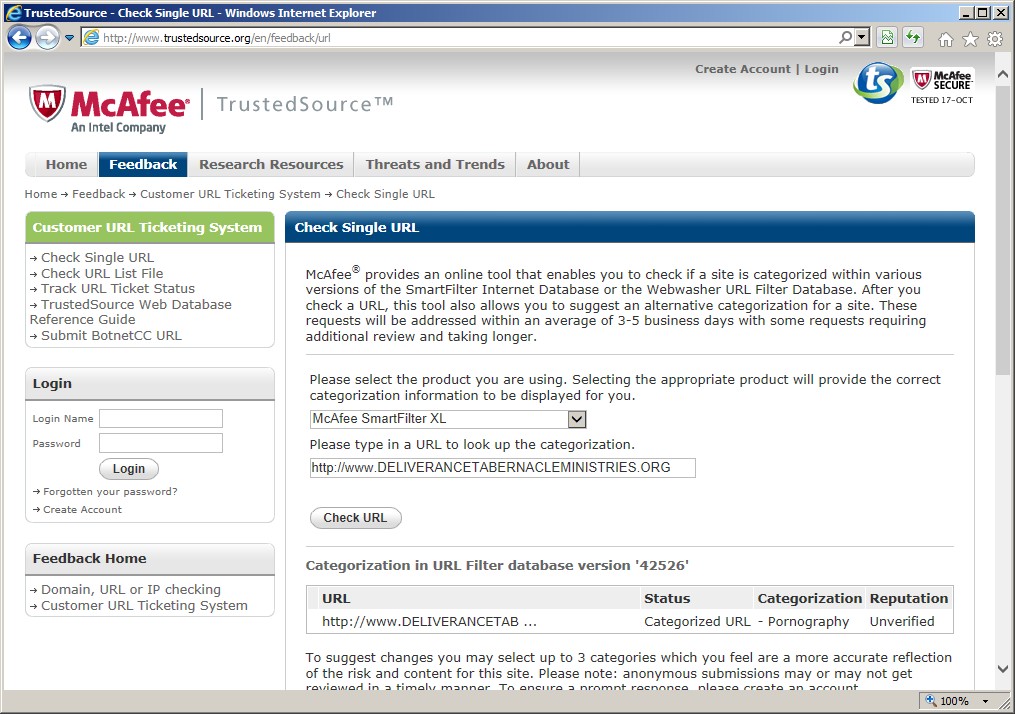
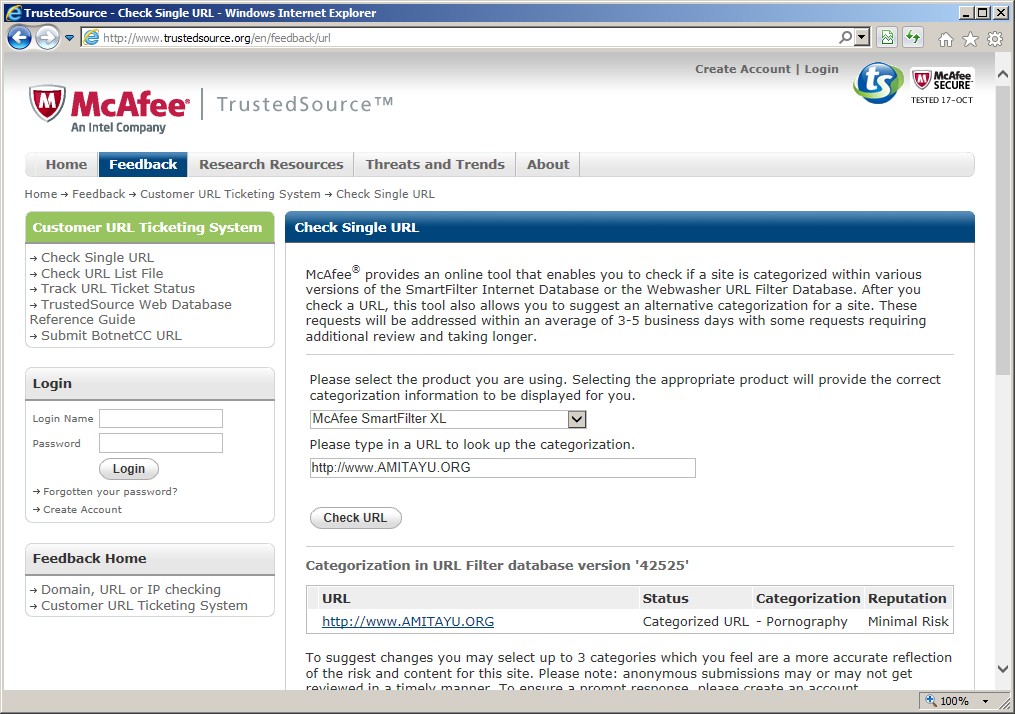
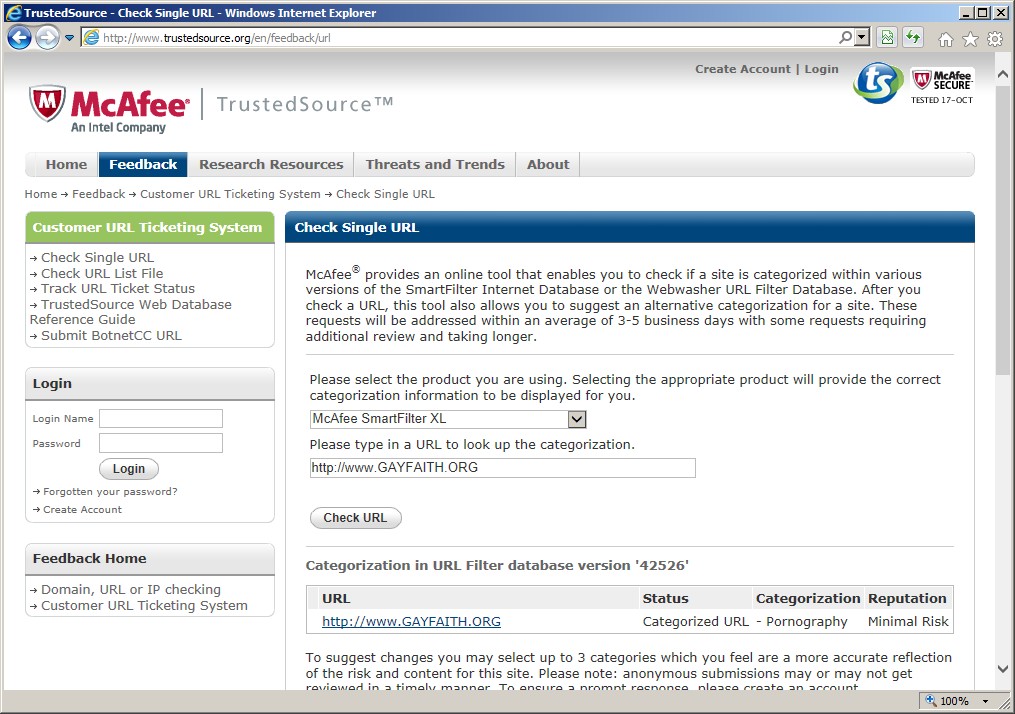
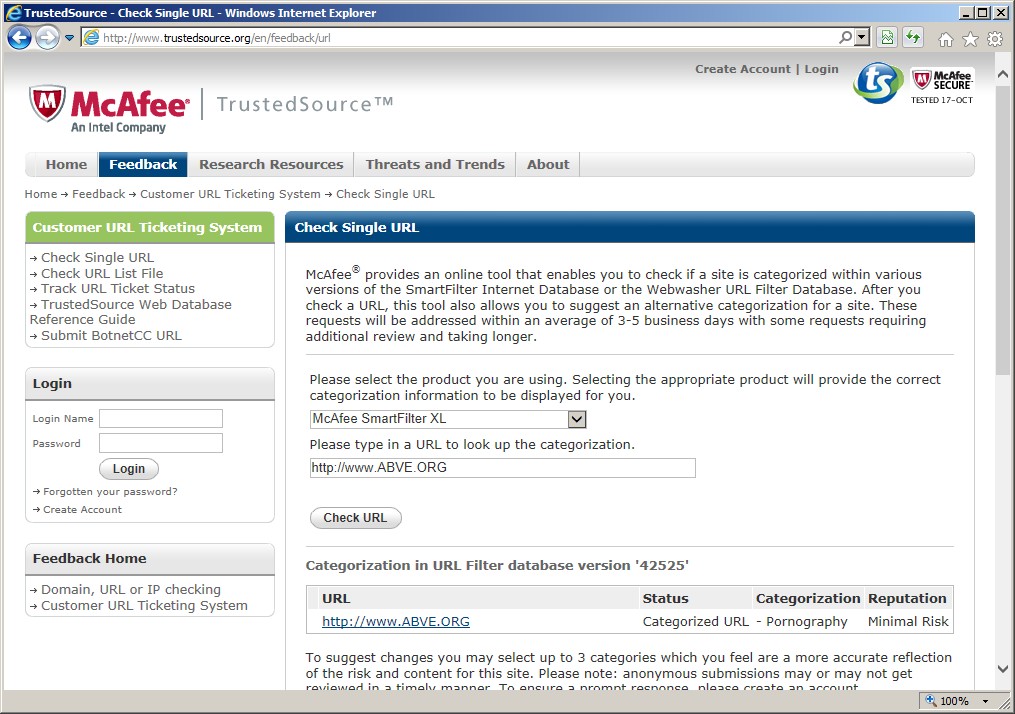
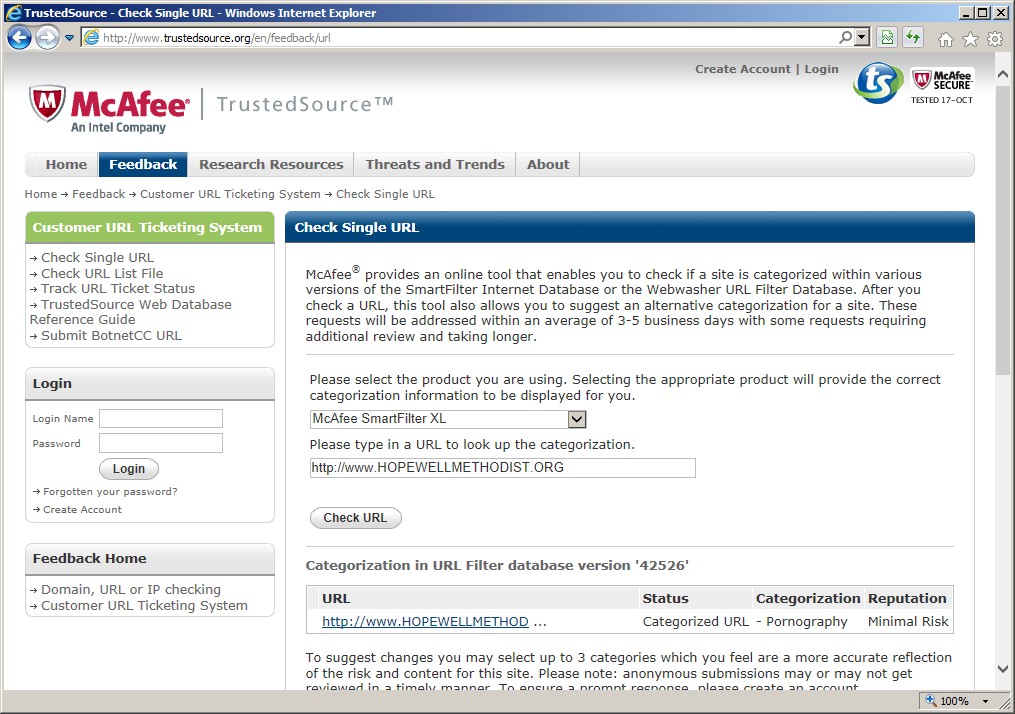
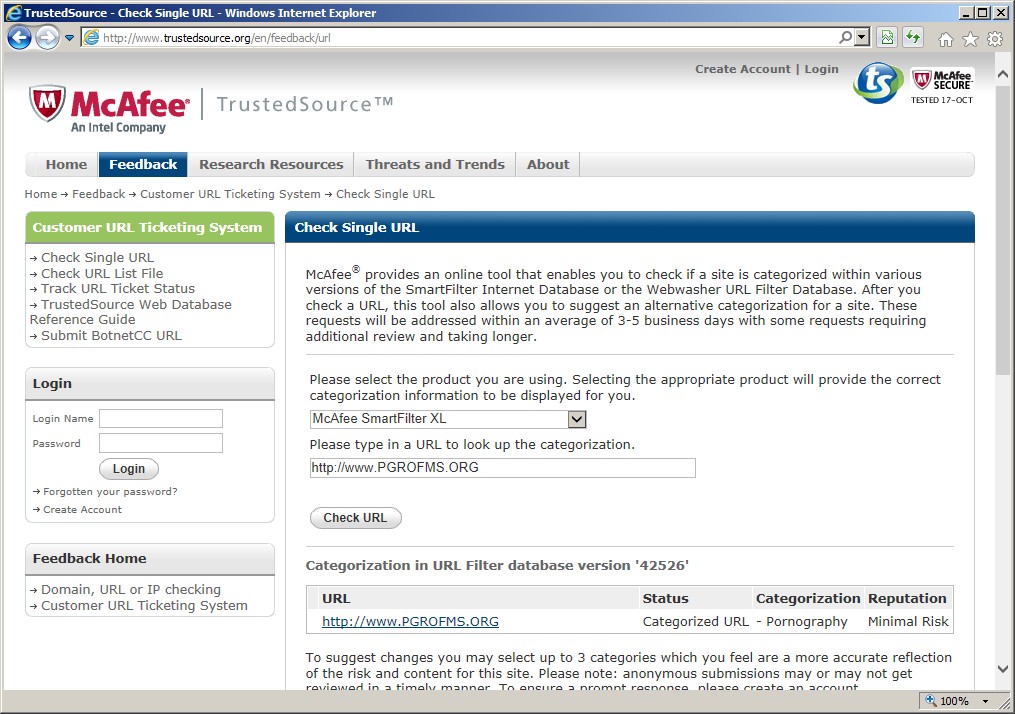
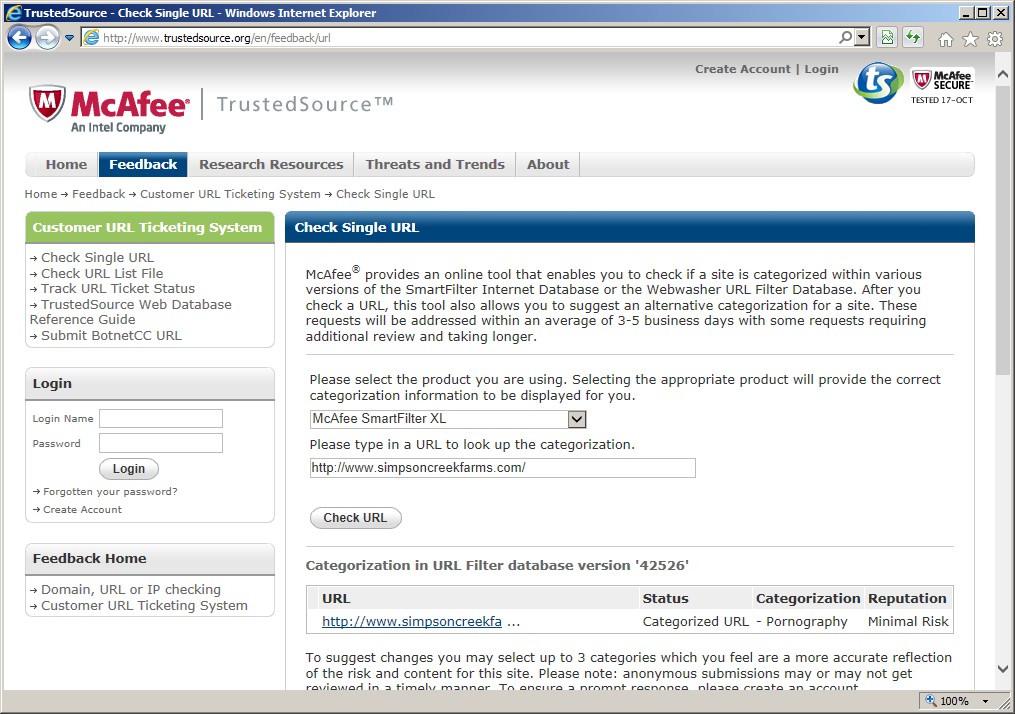
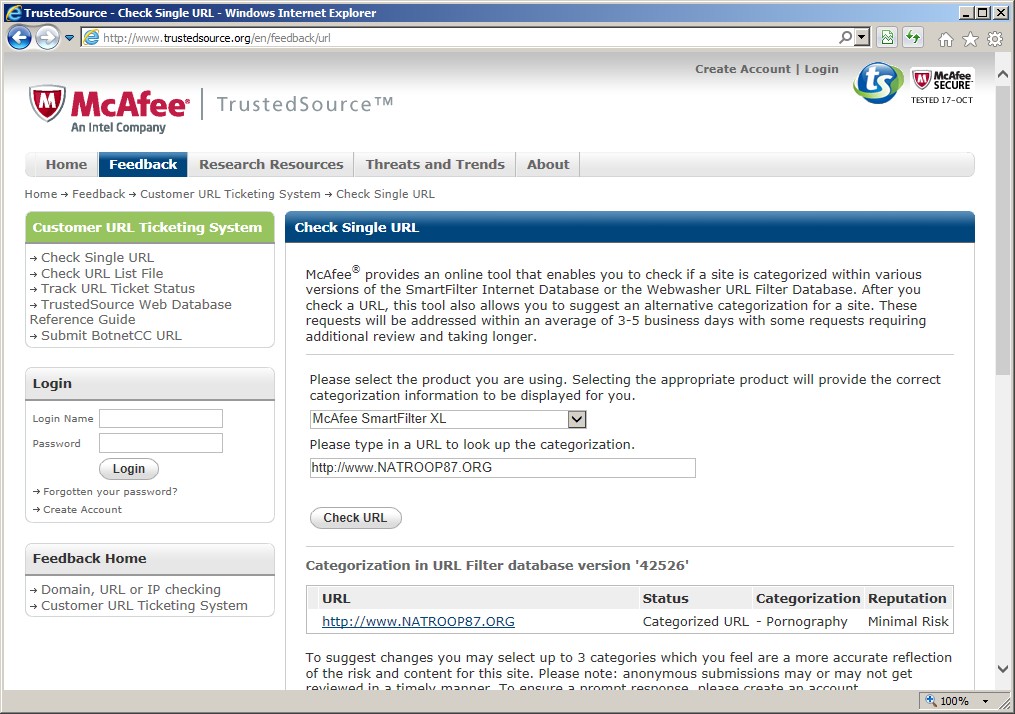
Slashdot contributor Bennett Haselton writes: "Internet users in Saudi Arabia, along with most users in the United Arab Emirates, are blocked by their respective government censors from accessing the websites of the Trinity Davison Lutheran Church, Deliverance Tabernacle Ministries in Pittsburgh, the Amitayu Buddhist Society of Taiwan, and GayFaith.org. An attempt to access any of those websites yields an error page like this one. However, the sites are not blocked because they conflict with the religions beliefs of those countries' governments. Rather, they are blocked because Smartfilter -- the American-made blocking program sold by McAfee, and used for state-mandated Internet censorship in those countries -- classifies those sites as "pornography". You can see the screen shots here, here, here and here." Read on for the rest of Bennett's thoughts.I found these blocked sites by starting with a combination of URL lists and ad hoc spidering, and running as many sites as possible through the Saudi filters to catch the ones that were blocked. Some of the sites were blocked for reasons that were easy to guess -- for example, http://www.bighornbasinsfw.org/, the home page of the Big Horn Basin, Wyoming chapter of Sportsmen for Fish & Wildlife, was almost certainly blocked because of the slang term "nsfw" in their URL. http://www.AgainstPornography.org and http://www.SearchingForMySpermDonorFather.org were presumably blocked because of the presence of the words "porn" and "sperm".
On the other hand, there appears to be no rational reason why the Filipino American Women's Network, the Tuscon Jazz Institute, or the Sacramento Police Activities League would have been blocked by Smartfilter, even by accident. A partial list of the blocked sites that I found is in the blog post I wrote for Citizen Lab, an Internet censorship research center at the University of Toronto.
Articles about sites that are erroneously blocked by Internet censorship software, have a storied history. The first widely read piece was the article "Keys to the Kingdom" written by Brock Meeks and Declan McCullagh in 1996, calling out Cyber Patrol for blocking EnviroLink.org and the University of Newcastle Computer Science Department, and CYBERsitter for blocking the National Organization for Women. I made a minor name for myself and the Peacefire.org site in the late 1990's by writing more pages about sites blocked by other products, including some (like X-Stop and SurfWatch) which no longer exist, and others that are still around, including Smartfilter. I was also one of six people comprising the Censorware Project, a loosely organized group of volunteers that published a few more reports.
By the early 2000's, however, it became clear that anyone whose mind was likely to be changed by information about what kinds of sites were blocked by blocking software, would have changed their mind already (or would, if they came across the research that had already been done up to that point). So the further reports on Internet blocking software errors, by me and other people, slowed to a trickle. I wrote a report in January 2002 on the latest list of sites blocked by Cyber Patrol, a product that most people today have forgotten. In 2006 I worked with the ACLU of Washington to publish a report on sites erroneously blocked by FortiGuard, a program used on computers in some libraries in central Washington, as part of the ACLU's suit to challenge the constitutionality of the program's use on public library terminals. (The Washington State Supreme Court rejected the lawsuit on the grounds that, regardless of what sites were blocked on the computers, it didn't matter because an adult library patron could request for the filter to be turned off.) In 2007 I wrote an article for Slashdot titled "From Bess to Worse" listing some sites that were blocked by an Internet filtering program called Bess (which was later bought out by Smartfilter and discontinued).
Most people's awareness of this debate, if they had heard about it at all, was limited to the perception that "breast cancer sites" and sites about "chicken breast recipes" were sometimes filtered by Internet blocking programs. Or they heard that "Beaver College" actually had to change its name to avoid being censored by web filters. As I tried to explain in a FAQ (written, according to the Wayback Machine, in 1999, but which still broadly holds true today), these examples are true, but they miss the point. These examples make it sound as if blocking software companies are doing the best job they can under the circumstances, and that the errors are unavoidable due to limitations on machine intelligence. In reality, any software algorithm that blocks the American Board of Vocational Experts, the Hopewell United Methodist Church, and the Patriot Guard Riders of Mississippi, as "pornography" (as Smartfilter currently does), is probably not the best algorithm the company could have come up with -- but there's no incentive for them to try harder, because few people will ever look that deep.
And yet, people continue to remember the "breast cancer site" examples. This sounds to me like an example of the narrative fallacy -- people remember that breast cancer sites were blocked, because there's a tidy explanation. There is no tidy explanation for most other examples of blocked sites, so the meme never spreads very far. Conveniently for the blocking companies, the blocked-site errors which make the company look most sloppy (the Kennels at Simpson Creek Farms, the St. Francis Institute of Milwaukee, etc.) are precisely the ones that, due to the narrative fallacy, most people won't remember or hear about.
One company, CYBERsitter, did manage to make a few blocking decisions in the 1990s that were egregious enough that their antics did make the news, and did finally raise some people's awareness that the controversy over private Internet filtering extended beyond "breast cancer sites". After TIME Magazine's website published an article (no longer online) that criticized CYBERsitter's blocking policies, CYBERsitter responded by blocking TIME Magazine's pathfinder.com domain. A few months earlier, CYBERsitter had blacklisted the monthly e-Zine "The Ethical Spectacle, after the Spectacle's founder, Jonathan Wallace, published an article criticizing CYBERsitter for blocking my own Peacefire.org website. And Peacefire.org had been blocked, in turn, because of a page I wrote (now very much out of date) listing some of the sites that CYBERsitter blocked, including the International Gay and Lesbian Human Rights Commission and Mother Jones. (Nowadays, of course, nobody would be surprised that filtering companies block Peacefire.org, since the site publishes ample instructions on how to get around Internet blockers. But at the time, the site's first and only article was the list of sites blocked by CYBERsitter, which is why CYBERsitter received so much criticism for blocking the domain in retaliation.) CYBERsitter also threatened to have Meeks and McCullagh criminally prosecuted for writing "Keys to the Kingdom" and threatened to sue me over the page that I had made.)
The moral, it seems, is that if you want an example of a censored web site to stick in people's minds, it either has to be a forgivable error, or an insane vindictive dick move -- because in either of those cases, people will understand why it happened. The vast swaths of censored websites on the spectrum in between, the ones for which there is no rational explanation for the blocking, go ignored.
These days, though, American and Canadian "censorware" makers have also come under fire for selling censoring software to foreign governments which use them for country-wide censorship. Most of the criticism focuses, naturally, not on the kinds of sites that are accidentally blocked by the blocking software, but on the immorality of these companies enabling statewide foreign censorship in the first place. Netsweeper, Blue Coat, and McAfee have all made the claim that "Once we sell their product to them, we have no control over what they do with it" -- which, as I wrote previously in Slashdot, is nonsense, because for the product to be effective, it has to rely on updates to the blocked-site list, which are provided at regular intervals by the manufacturer. Cut off the updates, and the product will not work, at least not as well.
So the fact that McAfee has classified the Boy Scout Troop 87 of North Andover, the Pan-Iranist Party of Iran, and Reptile Conservation International as "Pornography" is (rightly) overshadowed by the fact that McAfee is selling to government censors in Saudi Arabia and the UAE in the first place. However, as long as the filters are installed, these blocked sites are at least part of the problem for users in those countries, just as much as they are for students or cubicle workers in the U.S. whose network administrators happen to use Smartfilter. And, of course, I sampled only a miniscule fraction of the Web to find these examples of blocked sites, so the true number of stupid blocks affecting Saudi and UAE users is likely to be much larger. For each individual example, you might reasonably ask, "Is it really a big deal if Saudis are blocked from accessing Boy Scout Troop 87 of North Andover?" But it adds up.
-
Sites Blocked By Smartfilter, Censored in Saudi Arabia
Slashdot contributor Bennett Haselton writes: "Internet users in Saudi Arabia, along with most users in the United Arab Emirates, are blocked by their respective government censors from accessing the websites of the Trinity Davison Lutheran Church, Deliverance Tabernacle Ministries in Pittsburgh, the Amitayu Buddhist Society of Taiwan, and GayFaith.org. An attempt to access any of those websites yields an error page like this one. However, the sites are not blocked because they conflict with the religions beliefs of those countries' governments. Rather, they are blocked because Smartfilter -- the American-made blocking program sold by McAfee, and used for state-mandated Internet censorship in those countries -- classifies those sites as "pornography". You can see the screen shots here, here, here and here." Read on for the rest of Bennett's thoughts.I found these blocked sites by starting with a combination of URL lists and ad hoc spidering, and running as many sites as possible through the Saudi filters to catch the ones that were blocked. Some of the sites were blocked for reasons that were easy to guess -- for example, http://www.bighornbasinsfw.org/, the home page of the Big Horn Basin, Wyoming chapter of Sportsmen for Fish & Wildlife, was almost certainly blocked because of the slang term "nsfw" in their URL. http://www.AgainstPornography.org and http://www.SearchingForMySpermDonorFather.org were presumably blocked because of the presence of the words "porn" and "sperm".
On the other hand, there appears to be no rational reason why the Filipino American Women's Network, the Tuscon Jazz Institute, or the Sacramento Police Activities League would have been blocked by Smartfilter, even by accident. A partial list of the blocked sites that I found is in the blog post I wrote for Citizen Lab, an Internet censorship research center at the University of Toronto.
Articles about sites that are erroneously blocked by Internet censorship software, have a storied history. The first widely read piece was the article "Keys to the Kingdom" written by Brock Meeks and Declan McCullagh in 1996, calling out Cyber Patrol for blocking EnviroLink.org and the University of Newcastle Computer Science Department, and CYBERsitter for blocking the National Organization for Women. I made a minor name for myself and the Peacefire.org site in the late 1990's by writing more pages about sites blocked by other products, including some (like X-Stop and SurfWatch) which no longer exist, and others that are still around, including Smartfilter. I was also one of six people comprising the Censorware Project, a loosely organized group of volunteers that published a few more reports.
By the early 2000's, however, it became clear that anyone whose mind was likely to be changed by information about what kinds of sites were blocked by blocking software, would have changed their mind already (or would, if they came across the research that had already been done up to that point). So the further reports on Internet blocking software errors, by me and other people, slowed to a trickle. I wrote a report in January 2002 on the latest list of sites blocked by Cyber Patrol, a product that most people today have forgotten. In 2006 I worked with the ACLU of Washington to publish a report on sites erroneously blocked by FortiGuard, a program used on computers in some libraries in central Washington, as part of the ACLU's suit to challenge the constitutionality of the program's use on public library terminals. (The Washington State Supreme Court rejected the lawsuit on the grounds that, regardless of what sites were blocked on the computers, it didn't matter because an adult library patron could request for the filter to be turned off.) In 2007 I wrote an article for Slashdot titled "From Bess to Worse" listing some sites that were blocked by an Internet filtering program called Bess (which was later bought out by Smartfilter and discontinued).
Most people's awareness of this debate, if they had heard about it at all, was limited to the perception that "breast cancer sites" and sites about "chicken breast recipes" were sometimes filtered by Internet blocking programs. Or they heard that "Beaver College" actually had to change its name to avoid being censored by web filters. As I tried to explain in a FAQ (written, according to the Wayback Machine, in 1999, but which still broadly holds true today), these examples are true, but they miss the point. These examples make it sound as if blocking software companies are doing the best job they can under the circumstances, and that the errors are unavoidable due to limitations on machine intelligence. In reality, any software algorithm that blocks the American Board of Vocational Experts, the Hopewell United Methodist Church, and the Patriot Guard Riders of Mississippi, as "pornography" (as Smartfilter currently does), is probably not the best algorithm the company could have come up with -- but there's no incentive for them to try harder, because few people will ever look that deep.
And yet, people continue to remember the "breast cancer site" examples. This sounds to me like an example of the narrative fallacy -- people remember that breast cancer sites were blocked, because there's a tidy explanation. There is no tidy explanation for most other examples of blocked sites, so the meme never spreads very far. Conveniently for the blocking companies, the blocked-site errors which make the company look most sloppy (the Kennels at Simpson Creek Farms, the St. Francis Institute of Milwaukee, etc.) are precisely the ones that, due to the narrative fallacy, most people won't remember or hear about.
One company, CYBERsitter, did manage to make a few blocking decisions in the 1990s that were egregious enough that their antics did make the news, and did finally raise some people's awareness that the controversy over private Internet filtering extended beyond "breast cancer sites". After TIME Magazine's website published an article (no longer online) that criticized CYBERsitter's blocking policies, CYBERsitter responded by blocking TIME Magazine's pathfinder.com domain. A few months earlier, CYBERsitter had blacklisted the monthly e-Zine "The Ethical Spectacle, after the Spectacle's founder, Jonathan Wallace, published an article criticizing CYBERsitter for blocking my own Peacefire.org website. And Peacefire.org had been blocked, in turn, because of a page I wrote (now very much out of date) listing some of the sites that CYBERsitter blocked, including the International Gay and Lesbian Human Rights Commission and Mother Jones. (Nowadays, of course, nobody would be surprised that filtering companies block Peacefire.org, since the site publishes ample instructions on how to get around Internet blockers. But at the time, the site's first and only article was the list of sites blocked by CYBERsitter, which is why CYBERsitter received so much criticism for blocking the domain in retaliation.) CYBERsitter also threatened to have Meeks and McCullagh criminally prosecuted for writing "Keys to the Kingdom" and threatened to sue me over the page that I had made.)
The moral, it seems, is that if you want an example of a censored web site to stick in people's minds, it either has to be a forgivable error, or an insane vindictive dick move -- because in either of those cases, people will understand why it happened. The vast swaths of censored websites on the spectrum in between, the ones for which there is no rational explanation for the blocking, go ignored.
These days, though, American and Canadian "censorware" makers have also come under fire for selling censoring software to foreign governments which use them for country-wide censorship. Most of the criticism focuses, naturally, not on the kinds of sites that are accidentally blocked by the blocking software, but on the immorality of these companies enabling statewide foreign censorship in the first place. Netsweeper, Blue Coat, and McAfee have all made the claim that "Once we sell their product to them, we have no control over what they do with it" -- which, as I wrote previously in Slashdot, is nonsense, because for the product to be effective, it has to rely on updates to the blocked-site list, which are provided at regular intervals by the manufacturer. Cut off the updates, and the product will not work, at least not as well.
So the fact that McAfee has classified the Boy Scout Troop 87 of North Andover, the Pan-Iranist Party of Iran, and Reptile Conservation International as "Pornography" is (rightly) overshadowed by the fact that McAfee is selling to government censors in Saudi Arabia and the UAE in the first place. However, as long as the filters are installed, these blocked sites are at least part of the problem for users in those countries, just as much as they are for students or cubicle workers in the U.S. whose network administrators happen to use Smartfilter. And, of course, I sampled only a miniscule fraction of the Web to find these examples of blocked sites, so the true number of stupid blocks affecting Saudi and UAE users is likely to be much larger. For each individual example, you might reasonably ask, "Is it really a big deal if Saudis are blocked from accessing Boy Scout Troop 87 of North Andover?" But it adds up.
-
HP Brings Back Windows 7 'By Popular Demand' As Buyers Shun Windows 8
Hugh Pickens DOT Com writes "Gregg Keizer reports at Computerworld that Hewlett-Packard has stuck their finger in Microsoft's eye by launching a new promotion that discounts several consumer PCs by $150 when equipped with Windows 7, saying the four-year-old OS is 'back by popular demand.' 'The reality is that there are a lot of people who still want Windows 7,' says Bob O'Donnel. 'This is a twist, though, and may appeal to those who said, "I do want a new PC, but I thought I couldn't get Windows 7."' The promotion reminded O'Donnell and others of the dark days of Windows Vista, when customers avoided Windows 7's predecessor and instead clamored for the older Windows XP on their new PCs. Then, customers who had heard mostly negative comments about Vista from friends, family and the media, decided they would rather work with the devil they knew rather than the new one they did not. 'It's not a perfect comparison,' says O'Donnell, of equating Windows 8 with Vista, 'but the perception of Windows 8 is negative. I said early on that Windows 8 could clearly be Vista Version 2, and that seems to have happened.' HP has decided that the popularity of Windows 7 is its best chance of encouraging more people to buy new computers in a declining market and is not the first time that HP has spoken out against Microsoft. 'Look at the business model difference between Intel and ARM. Look at the operating systems. In today's world, other than Microsoft there's no one else who charges for an operating system,' said HP executive Sridhar Solur in December, adding that that the next generation of computers could very well not be dominated by Microsoft." Also at SlashCloud. -
Data Analysts Attempt To Predict World's Largest Music Vote, Again
littlekorea writes "Data analysts in the U.S. and Australia have come up with alternative means to predict the world's largest music vote, Triple J's Hottest 100. The Warmest 100 was close to spot on last year after analysts mined data from social posts auto-generated during the voting process. This year, with that avenue shut off, they relied on data extracted using the Instagram API, among others, and hope to achieve similar results." -
How Can Nintendo Recover?
Nerval's Lobster writes "Nintendo's revenue and profits are tumbling faster than Mario into a bottomless pit. Company executives recently suggested the next-generation Wii U console would sell 2.8 million units between April 2013 and March 2014 — significantly below the 9 million units predicted in previous estimates. Contrast that with Sony's PlayStation 4 and Microsoft's Xbox One, which sold 4.2 million and 3 million units, respectively, in their first six weeks of release. In lowering its hardware and software estimates, Nintendo also expects to take a loss by the end of its fiscal year in March. Nintendo's attempt to carve a niche for itself as an ecosystem for casual gamers has also run into a massive obstacle in the form of smartphones and tablets, which quickly developed into popular gaming platforms. Nintendo is reportedly considering a 'new business model,' according to Bloomberg, with its CEO telling a gathering of reporters in Osaka: 'Given the expansion of smart devices, we are naturally studying how smart devices can be used to grow the game-player business. It's not as simple as enabling Mario to move on a smartphone.' While Nintendo could probably made some good money off legacy gamers by bringing its (much loved) portfolio of older titles to iOS, Android, and other platforms, that move to mobile might further weaken its hardware sales. So what do you think? If you were in charge of Nintendo, how would you turn it around?" -
More Details About Mars Mystery Rock
First time accepted submitter GPS Pilot writes "Previous reports said the rock that suddenly appeared out of nowhere was merely 'the size of a jelly doughnut.' Now, a color image shows additional reasons for this metaphor: 'It's white around the outside, in the middle there's kind of a low spot that's dark red,' said lead scientist Steve Squyres. In the image, the object does stick out like a sore thumb amidst the surrounding orange rocks and soil. Its composition is 'like nothing we've ever seen before. It's very high in sulfur, it's very high in magnesium, it's got twice as much manganese as we've ever seen in anything on Mars.'" -
RSA Boycot Group Sets Up Rival Conference
judgecorp writes "The group of security experts who urged people to boycot the RSA conference (over allegations that the security firm RSA has taken a $10 million bribe from the NSA to weaken the security of its products) have put together a rival conference called TrustyCon just down the road from San Francisco's Moscone Center, where the EMC-owned firm will have its conference at the end of February." -
Examining the User-Reported Issues With Upgrading From GCC 4.7 To 4.8
Nerval's Lobster writes "Developer and editor Jeff Cogswell writes: 'When I set out to review how different compilers generate possibly different assembly code (specifically for vectorized and multicore code), I noticed a possible anomaly when comparing two recent versions of the g++ compiler, 4.7 and 4.8. When I mentioned my concerns, at least one user commented that he also had a codebase that ran fine after compiling with 4.6 and 4.7, but not with 4.8.' So he decided to explore the difference and see if there was a problem between 4.7 and 4.8.1, and found a number of issues, most related to optimization. Does this mean 4.8 is flawed, or that you shouldn't use it? 'Not at all,' he concluded. 'You can certainly use 4.8,' provided you keep in mind the occasional bug in the system." -
Examining the User-Reported Issues With Upgrading From GCC 4.7 To 4.8
Nerval's Lobster writes "Developer and editor Jeff Cogswell writes: 'When I set out to review how different compilers generate possibly different assembly code (specifically for vectorized and multicore code), I noticed a possible anomaly when comparing two recent versions of the g++ compiler, 4.7 and 4.8. When I mentioned my concerns, at least one user commented that he also had a codebase that ran fine after compiling with 4.6 and 4.7, but not with 4.8.' So he decided to explore the difference and see if there was a problem between 4.7 and 4.8.1, and found a number of issues, most related to optimization. Does this mean 4.8 is flawed, or that you shouldn't use it? 'Not at all,' he concluded. 'You can certainly use 4.8,' provided you keep in mind the occasional bug in the system." -
Linux 3.13 Released
diegocg writes "Linux kernel 3.13 has been released. This release includes nftables (the successor of iptables); a revamp of the block layer designed for high-performance SSDs; a framework to cap power consumption in Intel RAPL devices; improved squashfs performance; AMD Radeon power management enabled by default and automatic AMD Radeon GPU switching; improved NUMA and hugepage performance; TCP Fast Open enabled by default; support for NFC payments; support for the High-Availability Seamless Redundancy protocol; new drivers; and many other small improvements. Here's the full list of changes." -
AMD Considered GDDR5 For Kaveri, Might Release Eight-Core Variant
MojoKid writes "Of all the rumors that swirled around Kaveri before the APU debuted last week, one of the more interesting bits was that AMD might debut GDDR5 as a desktop option. GDDR5 isn't bonded in sticks for easy motherboard socketing, and motherboard OEMs were unlikely to be interested in paying to solder 4-8GB of RAM directly. Such a move would shift the RMA responsibilities for RAM failures back to the board manufacturer. It seemed unlikely that Sunnyvale would consider such an option but a deep dive into Kaveri's technical documentation shows that AMD did indeed consider a quad-channel GDDR5 interface. Future versions of the Kaveri APU could potentially also implement 2x 64-bit DDR3 channels alongside 2x 32-bit GDDR5 channels, with the latter serving as a framebuffer for graphics operations. The other document making the rounds is AMD's software optimization guide for Family 15h processors. This guide specifically shows an eight-core Kaveri-based variant attached to a multi-socket system. In fact, the guide goes so far as to say that these chips in particular contain five links for connection to I/O and other processors, whereas the older Family 15h chips (Bulldozer and Piledriver) only offer four Hypertransport links." -
Romanian Bitcoin Entrepreneur Steps In To Pay OpenBSD Shortfall
New submitter MrBingoBoingo writes "Recently it was announced here on Slashdot that OpenBSD was facing an impending shortfall that jeopardized its continued existence. A sponsorship to save OpenBSD has been announced, and it wasn't one of the usual culprits that saved OpenBSD, but a Romanian Bitcoin billionaire." -
In Greece, 10 Months In Prison For "Blasphemous" Facebook Page
First time accepted submitter etash writes "A bit more than a year ago a man was arrested in Greece for satirizing a dead monk, after the far-right party golden dawn, petitioned for his arrest. A couple of days ago he was given a ten-month sentence. What actually enraged the religious Greek blogosphere was not the satire. He wrote a fictitious story about a miracle done in the past by this specific monk. The story was then sent to [a religious blog] and then in a matter of days it was copy pasted and presented as true by most of the religious and far-right blogs and news sites. The final act of the dramedy took place when he came out and revealed that the story was not real; he intended to show the absurdity and the lack of reliability of these sites." -
Amazon: We Can Ship Items Before Customers Order
An anonymous reader writes "The WSJ is reporting that Amazon has obtained a patent for 'anticipatory shipping,'' and claims it knows its customers so well it can start shipping even before orders are placed. The technique could cut delivery time and discourage consumers from visiting physical stores. In the patent document, Amazon says delays between ordering and receiving purchases 'may dissuade customers from buying items from online merchants.' Of course, Amazon's algorithms might sometimes err, prompting costly returns. To minimize those costs, Amazon said it might consider giving customers discounts, or convert the unwanted delivery into a gift. 'Delivering the package to the given customer as a promotional gift may be used to build goodwill,' the patent said. Considering the problems that can arise when shipping something a customer did not order anticipatory shipping has the potential to backfire faster than an Amazon drone can deliver." -
Amazon: We Can Ship Items Before Customers Order
An anonymous reader writes "The WSJ is reporting that Amazon has obtained a patent for 'anticipatory shipping,'' and claims it knows its customers so well it can start shipping even before orders are placed. The technique could cut delivery time and discourage consumers from visiting physical stores. In the patent document, Amazon says delays between ordering and receiving purchases 'may dissuade customers from buying items from online merchants.' Of course, Amazon's algorithms might sometimes err, prompting costly returns. To minimize those costs, Amazon said it might consider giving customers discounts, or convert the unwanted delivery into a gift. 'Delivering the package to the given customer as a promotional gift may be used to build goodwill,' the patent said. Considering the problems that can arise when shipping something a customer did not order anticipatory shipping has the potential to backfire faster than an Amazon drone can deliver." -
OpenBSD Moving Towards Signed Packages — Based On D. J. Bernstein Crypto
ConstantineM writes "It's official: 'we are moving towards signed packages,' says Theo de Raadt on the misc@ mailing list. This is shortly after a new utility, signify, was committed into the base tree. The reason a new utility had to be written in the first place is that gnupg is too big to fit on the floppy discs, which are still a supported installation medium for OpenBSD. Signatures are based on the Ed25519 public-key signature system from D. J. Bernstein and co., and his public domain code once again appears in the base tree of OpenBSD, only a few weeks after some other DJB inventions made it into the nearby OpenSSH as well." -
Court Victory Gives Blogger Same Speech Protections As Traditional Press
cold fjord writes "Reuters reports, 'A blogger is entitled to the same free speech protections as a traditional journalist and cannot be liable for defamation unless she acted negligently, a federal appeals court ruled on Friday. Crystal Cox lost a defamation trial in 2011 over a blog post she wrote accusing a bankruptcy trustee and Obsidian Finance Group of tax fraud. A lower court judge had found that Obsidian did not have to prove that Cox acted negligently because Cox failed to submit evidence of her status as a journalist. But in the ruling, the 9th U.S. Circuit Court of Appeals in San Francisco said Cox deserved a new trial, regardless of the fact that she is not a traditional reporter. "As the Supreme Court has accurately warned, a First Amendment distinction between the institutional press and other speakers is unworkable."... Eugene Volokh, [a] Law professor who represented Cox, said Obsidian would now have to show that Cox had actual knowledge that her post was false when she published it. ... "In this day and age, with so much important stuff produced by people who are not professionals, it's harder than ever to decide who is a member of the institutional press."' Further details are available at Courthouse News Service." -
Analyst Calls Russian Teen Author of Target Malware
Nerval's Lobster writes "A digital-activity data analytics firm called IntelCrawler, Inc. claims to have identified the author of the BlackPOS malware used in attacks against Target and Neiman Marcus, and spotted similar attacks that are still in progress against six other retailers. Andrey Komarov, CEO of the Los Angeles-based IntelCrawler, told Reuters Jan. 17 that his company had spotted the six ongoing attacks while analyzing Web traffic in search of the specific entry points and origin of the malware infection behind the Target data breach, which allowed hackers to steak magnetic card-strip data on 40 million debit- and credit cards and demographic data on 70 million additional customers. According to Komarov, BlackPOS was developed by a 17-year-old Russian who goes by the username Ree4 and lives in St. Petersburg. Ree4 probably did not participate in the attack on Target, but did sell the malware to the actual attackers, according to Komarov, who refused to identify the source of his information other than to say he had been monitoring forums on which he said Ree4 sells malware. In a series of chat clips Komarov said are exchanges between buyer and seller, Ree4 tells a potential customer that the price for the software is US$2,000 and that the malware grabs credit-card numbers from system memory as they're scanned, dumps them into a file called time.txt that is sent back to the controller. Ree4 also said the app works only on standalone point-of-sale terminals with a separate monitor that also runs Windows, but not on Verifone systems, which can be attached to PCs but secure credit-card data before it can be scraped by BlackPOS." -
Mozilla Is Mapping Cell Towers and WiFi Access Points
First time accepted submitter neiras writes "Mozilla is building a map of publicly-observable cell tower and WiFi access points to compete with proprietary geolocation services like Google's. Coverage is a bit thin so far but is improving rapidly. Anyone with an Android phone can help by downloading the MozStumbler app and letting it run while walking or driving around. The application is also available on the F-Droid market." "Thin" is relative; it's quite a few data points since we first mentioned the pilot program a few months ago. -
Driver Privacy Act Introduced In US Senate
greatgreygreengreasy writes "In 2005, then-governor of North Dakota John Hoeven signed into law a bill 'ensuring drivers' ownership of their EDR (Electronic Data Recorder) data.' Now a U.S. senator, Hoeven (R-ND) has teamed up with Amy Klobuchar, D-MN, to introduce similar legislation at the Federal level. 'Under this legislation, EDR data could only be retrieved [for specific reasons].' The EFF has expressed concern in the past over the so-called black boxes and their privacy implications. This legislation, however, would not address the recent revelations by a Ford executive on their access to data, since in those cases, 'The vehicle owner or lessee consents to the data retrieval.' The bill has gained the support of about 20 senators so far." -
Controversial Execution In Ohio Uses New Lethal Drug Combination
Hugh Pickens DOT Com writes "CNN reports that Ohio inmate Dennis McGuire appeared to gasp and convulse for roughly 10 minutes before he finally died during his execution by lethal injection using a new combination of drugs. The new drugs were used because European-based manufacturers banned U.S. prisons from using their drugs in executions — among them, Danish-based Lundbeck, which manufactures pentobarbital. The state used a combination of the drugs midazolam, a sedative, and the painkiller hydromorphone, the state corrections department told CNN. In an opinion piece written for CNN earlier this week, a law professor noted that McGuire's attorneys argued he would 'suffocate to death in agony and terror.' 'The state disagrees. But the truth is that no one knows exactly how McGuire will die, how long it will take or what he will experience in the process,' wrote Elisabeth A. Semel, clinic professor of law and director of the Death Penalty Clinic at U.C. Berkeley School of Law. According to a pool report from journalists who witnessed the execution, the whole process took more than 15 minutes, during which McGuire made 'several loud snorting or snoring sounds.' Allen Bohnert, a public defender who lead McGuire's appeal to stop his execution in federal court on the grounds that the drugs would cause undue agony and terror, called the execution process a 'failed experiment' and said his office will look into what happened. 'The people of the state of Ohio should be appalled by what took place here today in their name.'" -
Building an Open Source Nest
An anonymous reader writes "Google's recent acquisition of Nest, the maker of smart thermostats and smoke detectors, has sparked concerns of future plans for the devices, and how Google's omnipresent thirst for information will affect them. Thus, a team of engineers at Spark sat down and roughed out a prototype for an open source version of Nest. It looks surprisingly good for such a short development cycle, and they've posted their code on Github. The article has a number of short videos illustrating the technology they used, and how they used it. Quoting: 'All in, we spent about $70 on components to put this together (including $39 for the Spark Core); the wood and acrylic were free. We started working at 10am and finished at 3am, with 3.5 engineers involved (one went to bed early), and the only work we did in advance was order the electronic components. We're not saying that you can build a $3.2 billion company in a day. But we are saying that you can build a $3.2 billion company, and it's easier now than it's ever been before.'" -
Obama Announces Surveillance Reforms
In a speech today, U.S. President Barack Obama announced changes for the operations of the country's intelligence agencies. He says the current program will end "as it currently exists," though most of the data collection schemes will remain intact. However, the data collected in these sweeps will not be stored by the U.S. government, instead residing with either the communications providers or another third party. (He pointed out that storing private data within a commercial entity can have its own oversight issues, so the attorney general and intelligence officials will have to figure out the best compromise.) In order for the NSA to query the database, they will need specific approval from a national security court. Obama also announced "new oversight" to spying on foreign leaders, and an end to spying on leaders of friendly and allied countries. Further, decisions from the Foreign Intelligence Surveillance Court will be annually reviewed for declassification. A panel advocating for citizen privacy will have input into the FISC. There will be chances to national security letters: they will no longer have an indefinite secrecy period. Companies will be able to disclose some amount of information about the NSLs they receive, something they've been asking for. Another change is a reduction in the number of steps from suspected terrorists that phone data can be gathered. Instead of grabbing all the data from people three steps away, it's now limited to two. -
Obama Announces Surveillance Reforms
In a speech today, U.S. President Barack Obama announced changes for the operations of the country's intelligence agencies. He says the current program will end "as it currently exists," though most of the data collection schemes will remain intact. However, the data collected in these sweeps will not be stored by the U.S. government, instead residing with either the communications providers or another third party. (He pointed out that storing private data within a commercial entity can have its own oversight issues, so the attorney general and intelligence officials will have to figure out the best compromise.) In order for the NSA to query the database, they will need specific approval from a national security court. Obama also announced "new oversight" to spying on foreign leaders, and an end to spying on leaders of friendly and allied countries. Further, decisions from the Foreign Intelligence Surveillance Court will be annually reviewed for declassification. A panel advocating for citizen privacy will have input into the FISC. There will be chances to national security letters: they will no longer have an indefinite secrecy period. Companies will be able to disclose some amount of information about the NSLs they receive, something they've been asking for. Another change is a reduction in the number of steps from suspected terrorists that phone data can be gathered. Instead of grabbing all the data from people three steps away, it's now limited to two. -
Google Announces Smart Contact Lens Project For Diabetics
An anonymous reader writes "Google has announced on its official blog that it's working on a new way for diabetics to monitor their blood sugar: a 'smart' contact lens. Diabetes is a difficult condition to treat because blood sugar levels vary widely by a person's activity level and food intake. It's also hard to monitor without painful and intrusive measurements — people can feel normal at dangerously high blood sugar levels, while extremely low levels can impair their ability to seek treatment. Google says, 'Over the years, many scientists have investigated various body fluids—such as tears—in the hopes of finding an easier way for people to track their glucose levels. But as you can imagine, tears are hard to collect and study. At Google[x], we wondered if miniaturized electronics—think: chips and sensors so small they look like bits of glitter, and an antenna thinner than a human hair—might be a way to crack the mystery of tear glucose and measure it with greater accuracy. We're now testing a smart contact lens that's built to measure glucose levels in tears using a tiny wireless chip and miniaturized glucose sensor that are embedded between two layers of soft contact lens material. We're testing prototypes that can generate a reading once per second.' They're talking with the FDA and bringing in experts to help them figure out the best way to do it." -
Google Glass User Fights Speeding Ticket, Saying She's Defending the Future
Nerval's Lobster writes "A California software developer dubbed an explorer by Google and a scofflaw by the California Highway Patrol appeared in court to fight over the purpose and usage of wearable electronics. Cecilia Abadie denies she was doing 80 mph in a 65 mph zone when she was pulled over by the CHP Oct. 29 of last year, but proudly admits wearing her early edition of Google's Google Glass augmented-reality goggles. She just doesn't agree with the CHP's contention that Google Glass is a television. Abadie, who works at virtual-reality sports software developer Full Swing Golf and was one of the first 'explorers' chosen by Google as early testers of Google Glass before they were released, wears the goggles for as long as 12 hours per day, using them both as a way to pull email, driving directions and other information into her view and to push pictures, Tweets, updates and other information out to professional and social networks in a process she describes as 'living in transparency.' The California Highway Patrol, unfortunately for Abadie, considered wearing Google Glass to be the same as watching television while driving. One of the two citations Abadie was given was for speeding; the other was for 'driving with a monitor visible in violation of California Vehicle Code 27602.' Fighting that perception in court is 'a big responsibility for me and also for the judge who is going to interpret a very old law compared with how fast technology is changing,' Abadie told the Associated Press for a Jan. 16 story." A court commissioner in San Diego dismissed the Google Glass ticket, saying he could find no evidence that the device was in use while Abadie was driving.