Slashdot Mirror
Domain: slashdot.org
Stories and comments across the archive that link to slashdot.org.
Stories · 37,380
-
Netflix Is Ending Reviews July 30th
goombah99 writes: Netflix is sending emails to subscribers announcing the end of user-authored reviews on Netflix. Past reviews are being archived. The stated reason is declining usage. This follows on the previous years' decision to remove range voting for user ratings (0 to 5 stars) and substitute a thumbs up/down approval voting system. One suspects that the former is an unintended consequence of the latter, since the purpose of people who write a review is to try to explain the nuances of their decision. An inexpressive rating system defeats that. It can be argued that approval voting has technical advantages in aggregating ratings for a recommendation engine as it doesn't need to normalize the biases in a rating system between different users and mostly heads off gaming the system with exaggerated degrees of rating. But evidently that was also a necessary component of the review process itself regardless of its utility for recommendation engines. The email that Netflix is sending users is short and to the point: "You contributed a review on Netflix within the last year. We wanted to let you know that this feature will be retired on July 30th due to declining usage. We appreciate you taking time to write a review. All of your reviews will be available at netflix.com/reviews through July 30th." -
AT&T Has To Pay Up Millions After Two Major 911 Outages Last Year (gizmodo.com)
AT&T has been fined $5.25 million for an outage last year that resulted in 12,000 callers not being able to reach 911. The FCC's Enforcement Bureau made the announcement on Thursday, stating that "such preventable outages are unacceptable." Gizmodo reports: Aside from the fine -- which is really a drop in the bucket for the billion-dollar behemoth -- AT&T must also make changes and enhancements to its systems to mitigate and soften the blow of future outages, as well as "regularly file compliance reports with the FCC." According to FCC rules, AT&T was required to "transmit all wireless 911 calls" as well as let emergency call centers know about outages if they last longer than 30 minutes. The two AT&T 911 outages investigated by the FCC, which occurred on March 8 and May 1 of 2017, lasted about five hours and 47 minutes, respectively. Around 12,600 users were unable to complete 911 calls during the March outage, with 2,600 failed 911 calls during the May outage. -
Data From Open-Source Ancestry Site Leads to More Arrests (fastcompany.com)
schwit1 tipped us off to new arrests made with genealogical evidence -- and growing interest in open source genealogy databases. Fast Company reports: In the last week, police have arrested two suspects in unrelated cold cases thanks to data gleaned from open-source ancestry site GEDMatch, reports the New York Times. That's the same open-source ancestry site that was used to track down the alleged Golden State Killer earlier this year. One of the arrests this week was of a 66-year-old nurse who is suspected of killing a 12-year-old girl in 1986. The other arrest is of a 49-year-old DJ who strangled a schoolteacher in 1992. Thanks to data from GEDMatch, Texas law enforcement also thinks that a man who was executed in 1999 for killing a 9-year-old girl was now also behind the murder of a 40-year-old realtor in 1981.
It all reminds me of that scene in "The Circle" where they demo technology that finds "a randomly-selected fugitive from justice -- a proven menace to our global community" -- within 20 minutes.
Last month DNA-based investigations also led to the arrest of the suspected murderer of two vacationers in 1987, and helped identify a suicide cold case from 2001.
Now an Ohio newspaper reports: Emboldened by that breakthrough, a number of private investigators are spearheading a call for amateur genealogists to help solve other cold cases by contributing their own genetic information to the same public database. They say a larger array of genetic information would widen the pool to find criminals who have eluded capture. The idea is to get people to transfer profiles compiled by commercial genealogy sites such as Ancestry.com and 23andMe onto the smaller, public open-source database created in 2010, called GEDmatch. The commercial sites require authorities to obtain search warrants for the information; the public site does not.
But the push is running up against privacy concerns. -
Is Google's Promotion of HTTPS Misguided? (this.how)
Long-time software guru Dave Winer is criticizing Google's plans to deprecate HTTP (by, for example, penalizing sites that use HTTP instead of HTTPS in search results and flagging them as "insecure" in Chrome). Winer writes: A lot of the web consists of archives. Files put in places that no one maintains. They just work. There's no one there to do the work that Google wants all sites to do. And some people have large numbers of domains and sub-domains hosted on all kinds of software Google never thought about. Places where the work required to convert wouldn't be justified by the possible benefit. The reason there's so much diversity is that the web is an open thing, it was never owned....
If Google succeeds, it will make a lot of the web's history inaccessible. People put stuff on the web precisely so it would be preserved over time. That's why it's important that no one has the power to change what the web is. It's like a massive book burning, at a much bigger scale than ever done before.
"Many of these sites don't collect user data or provide user interaction," adds Slashdot reader saccade.com, "so the 'risks' of not using HTTPS are irrelevant." And Winer summarizes his position in three points.- The web is an open platform, not a corporate platform.
- It is defined by its stability. 25-plus years and it's still going strong.
- Google is a guest on the web, as we all are. Guests don't make the rules.
"The web is a social agreement not to break things," Winer writes. "It's served us for 25 years. I don't want to give it up because a bunch of nerds at Google think they know best."
-
Is Google's Promotion of HTTPS Misguided? (this.how)
Long-time software guru Dave Winer is criticizing Google's plans to deprecate HTTP (by, for example, penalizing sites that use HTTP instead of HTTPS in search results and flagging them as "insecure" in Chrome). Winer writes: A lot of the web consists of archives. Files put in places that no one maintains. They just work. There's no one there to do the work that Google wants all sites to do. And some people have large numbers of domains and sub-domains hosted on all kinds of software Google never thought about. Places where the work required to convert wouldn't be justified by the possible benefit. The reason there's so much diversity is that the web is an open thing, it was never owned....
If Google succeeds, it will make a lot of the web's history inaccessible. People put stuff on the web precisely so it would be preserved over time. That's why it's important that no one has the power to change what the web is. It's like a massive book burning, at a much bigger scale than ever done before.
"Many of these sites don't collect user data or provide user interaction," adds Slashdot reader saccade.com, "so the 'risks' of not using HTTPS are irrelevant." And Winer summarizes his position in three points.- The web is an open platform, not a corporate platform.
- It is defined by its stability. 25-plus years and it's still going strong.
- Google is a guest on the web, as we all are. Guests don't make the rules.
"The web is a social agreement not to break things," Winer writes. "It's served us for 25 years. I don't want to give it up because a bunch of nerds at Google think they know best."
-
Bitcoin Drops Below $6,000, An 8-Month Low (reuters.com)
An anonymous reader quotes Reuters: Bitcoin's value slid to its lowest level since November on Friday, as waning investor interest and recent negative headlines from global regulators weakened demand for the cryptocurrency and most of its rivals. Virtual currencies, including the best-known and biggest, bitcoin, have been stuck in a downward trend for most of 2018 after last year's frenzied interest fizzled. Recent hacks and the "cyber intrusion" of cryptocurrency exchanges in key Asian markets has also encouraged investors to exit.
Bitcoin fell to as low as $5,774 on the Bitstamp exchange, the lowest since November 12... So far in 2018, bitcoin has tumbled almost 60 percent after soaring more than 1,300 percent last year. It is now down 70 percent from its December peak... The total market capitalization of cryptocurrencies has fallen to around $230 billion from a peak of around $800 billion in January.
Will Hobbs, Head of Investment Strategy at Barclays Smart Investor, now tells Reuters that "None of the crypto currencies currently fulfill any of the criteria that we would look for in an investible asset, and we would continue to advise extreme caution. The rout in crypto currencies is still not finished." -
Ask Slashdot: Is There a 'Gig Economy' Site For Tech Skills?
"Where I can meet up with people who just need solutions implemented?" asks Slashdot reader datavirtue: Somewhere people can go when they have a solution designed in-house with documented requirements and are in need of a competent engineer(s) to assist with implementation. Where timelines and price estimates and rates are well defined and enforced. If they like me, and agree to the terms, we can proceed with the project -- expecting solid deliveries at each milestone....
I have been on some gig projects where the relationship was well structured by a third party and it was a lot of fun. I know a lot of engineers who would use a system like this if it streamlines entering the freelance tech market for them. People who would rarely take gigs otherwise. I have looked around but the services feel dead. I have been approached by startups in the past wanting to sign me up their service...but they didn't really go anywhere.
The original submission complains that many projects end up going to consulting firms that just scrounge up candidates from job boards. But what's the alternative? "Am I missing some great online community or website that has already solved this?"
Leave your own thoughts in the comments. Is there a 'gig economy' site for tech skills? -
Microsoft Details Secret 'Pocketable' Surface Device (theverge.com)
Microsoft's mysterious new Surface device, codenamed Andromeda, that's been in development for the past two years is going to be pocketable, reports The Verge. The company says it will create a "new and disruptive" device category to influence the overall Surface roadmap and blur the lines between what's considered PC and mobile. From the report: "It's a new pocketable Surface device form factor that brings together innovative new hardware and software experiences to create a truly personal and versatile computing experience," is exactly how Microsoft describes the device internally. The Andromeda device is still being developed in secrecy inside Microsoft, with a wraparound display that bridges the gap of the hinge when it's fully opened. We understand current engineering samples of the pocketable Surface look identical to the 3D concept created by David Breyer.
Microsoft has also been experimenting with stylus input for Andromeda, so that the device can fold over like a book and a pen can be used to capture digital ink. Microsoft is also experimenting with ARM processors inside prototype Andromeda devices. Microsoft views Andromeda as a unique response to its failures with Windows Phone devices. "It will blur the lines between mobile and stationary computing," reads one internal document describing the device. Microsoft is tentatively planning to release Andromeda in 2018, with similar devices from some of Microsoft's top OEMs to "follow afterwards." -
Google Invests $22 Million In Feature Phone Operating System KaiOS (techcrunch.com)
An anonymous reader quotes a report from TechCrunch: Google is turning startup investor to further its goal of putting Google services like search, maps, and its voice assistant front and center for the next billion internet users in emerging markets. It has invested $22 million into KaiOS, the company that has built an eponymous operating system for feature phones that packs a range of native apps and other smartphone-like services. As part of the investment, KaiOS will be working on integrating Google services like search, maps, YouTube and its voice assistant into more KaiOS devices, after initially announcing Google apps for KaiOS-powered Nokia phones earlier this year.
KaiOS is a U.S.-based project that started in 2017, built on the ashes of Mozilla's failed Firefox OS experiment, as a fork of the Linux codebase. Firefox OS was intended to be the basis of a new wave of HTML-5, low-cost smartphones. And while those devices and the wider ecosystem never really took off, KaiOS has fared significantly better. KaiOS powers phones made by OEMs including Nokia (HMD), Micromax and Alcatel, and it works with carriers including Sprint and AT&T -- it counts offices in North America, Europe and Asia. But its most significant deployment to date has been with India's Reliance Jio, the challenger telco that disrupted the Indian market with affordable 4G data packages. "This funding will help us fast-track development and global deployment of KaiOS-enabled smart feature phones, allowing us to connect the vast population that still cannot access the internet, especially in emerging markets," said KaiOS CEO Sebastien Codeville in a statement. -
EFF Sues To Invalidate FOSTA, An Unconstitutional Internet Censorship Law (eff.org)
schwit1 quotes a report from the Electronic Frontier Foundation: We are asking a court to declare the Allow States and Victims to Fight Online Sex Trafficking Act of 2017 ("FOSTA") unconstitutional and prevent it from being enforced. The law was written so poorly that it actually criminalizes a substantial amount of protected speech and, according to experts, actually hinders efforts to prosecute sex traffickers and aid victims. In our lawsuit, two human rights organizations, an individual advocate for sex workers, a certified non-sexual massage therapist, and the Internet Archive, are challenging the law as an unconstitutional violation of the First and Fifth Amendments. Although the law was passed by Congress for the worthy purpose of fighting sex trafficking, its broad language makes criminal of those who advocate for and provide resources to adult, consensual sex workers and actually hinders efforts to prosecute sex traffickers and aid victims. The EFF goes on to cite some examples of how FOSTA has already censored the internet. Most notably, two days after FOSTA was passed in the Senate, "Craigslist eliminated its Personals section, including non-sexual subcategories such as 'Missed Connections' and 'Strictly Platonic,'" reports the EFF. Reddit even removed some of its subreddits out of fear of future lawsuits. -
EFF Sues To Invalidate FOSTA, An Unconstitutional Internet Censorship Law (eff.org)
schwit1 quotes a report from the Electronic Frontier Foundation: We are asking a court to declare the Allow States and Victims to Fight Online Sex Trafficking Act of 2017 ("FOSTA") unconstitutional and prevent it from being enforced. The law was written so poorly that it actually criminalizes a substantial amount of protected speech and, according to experts, actually hinders efforts to prosecute sex traffickers and aid victims. In our lawsuit, two human rights organizations, an individual advocate for sex workers, a certified non-sexual massage therapist, and the Internet Archive, are challenging the law as an unconstitutional violation of the First and Fifth Amendments. Although the law was passed by Congress for the worthy purpose of fighting sex trafficking, its broad language makes criminal of those who advocate for and provide resources to adult, consensual sex workers and actually hinders efforts to prosecute sex traffickers and aid victims. The EFF goes on to cite some examples of how FOSTA has already censored the internet. Most notably, two days after FOSTA was passed in the Senate, "Craigslist eliminated its Personals section, including non-sexual subcategories such as 'Missed Connections' and 'Strictly Platonic,'" reports the EFF. Reddit even removed some of its subreddits out of fear of future lawsuits. -
Uber Could Resume Testing of Its Self-Driving Vehicles this Summer (bizjournals.com)
Uber could resume its testing of self-driving vehicles this summer after a long pause on the program following a fatal crash in March. From a report: The possible restart of Uber's self-driving testing comes after the company conducted an internal safety review that led to 16 recommended improvements, according to a source familiar with the matter. Those changes would all be implemented before Uber returns its vehicles to the road. The recommendations "include developing emergency braking features to help minimize collisions if the main self-driving system fails," as first reported in The Information. -
Google Is Planning a Game Platform That Could Take On Xbox and PlayStation (kotaku.com)
An anonymous reader quotes a report from Kotaku: We haven't heard many specifics about Google's video game plans, but what we have heard is that it's a three-pronged approach: 1) Some sort of streaming platform, 2) some sort of hardware, and 3) an attempt to bring game developers under the Google umbrella, whether through aggressive recruiting or even major acquisitions. That's the word from five people who have either been briefed on Google's plans or heard about them secondhand.
So what is this streaming platform, exactly? Like Nvidia's GeForce Now, the Google service would offload the work of rendering graphics to beefy computers elsewhere, allowing even the cheapest PCs to play high-end games. The biggest advantage of streaming, as opposed to physical discs or downloads, is that it removes hardware barriers for games. Whispers have been quieter about Google's hardware, whatever that may look like, but the rumors we've heard suggest that it will link up with the streaming service in some way. We're not sure whether Google is looking to compete with the technical specs of the next PlayStation and Xbox or whether this Google console will be cheaper and low-end, relying on the streaming service to pull weight. The streaming platform, which is code-named Yeti, was first reported by the website The Information earlier this year. -
California Lawmakers Pass Bill To Give Consumers Broad Privacy Rights (cnet.com)
An anonymous reader shares a report: A major privacy bill on the table in California on Thursday could reshape how Silicon Valley does business. If the bill becomes law, people living in the Golden State can tell companies to stop collecting or selling their personal data. In two votes Thursday, the state's Senate and Assembly both passed the bill in an effort to get it on Gov. Jerry Brown's desk by the end of the day. The tight deadline comes courtesy of an even stricter voter initiative that will appear on California ballots this November if lawmakers can't get the bill through by 5 p.m. PT Thursday. The bill -- AB 375, or the California Consumer Privacy Act -- turns the tech world's business model on its head by letting regular internet users ask for the data a company has collected on them and who it's sold that data to. That alone could be eye-opening for consumers. Most people understand their online activity is being tracked for targeted advertising, but we don't have a broad understanding of what data's being used. If Gov. Jerry Brown signs this bill on Thursday, Californians will have increased control over their personal data -- and one less thing to vote on in November. -
AT&T Removes HBO From an Unlimited Data Plan After Buying Time Warner (arstechnica.com)
AT&T revamped its two unlimited mobile plans this week, and in the process it raised the price for the entry-level plan by $5 a month while removing the free HBO perk. The entry-level unlimited plan now starts at $70 instead of $65. ArsTechnica adds: Existing customers can keep their old plan and the free HBO, but new customers or those who switch plans will have to buy the more expensive unlimited plan to get HBO at no added cost. AT&T did add some video options to both plans, however. Both unlimited plans get AT&T's new "WatchTV" streaming service that comes with more than 30 channels, and buyers of the more expensive unlimited plan can choose to get HBO or another premium add-on. While "HBO is no longer included on the lower-priced plan," "customers who remain on their existing plan won't see any change and will keep the HBO benefit for as long as they remain on their current plan," AT&T told Ars. Further reading: AT&T Is Screwing Customers By Almost Tripling a Bogus Fee. -
Facebook Faces New Accusation of Data Leak Via Quiz App (politico.eu)
A security failure in a popular quiz app on Facebook left millions of people's data exposed for almost two years, a cybersecurity activist revealed Thursday. From a report: The application, called Nametests.com, has run Facebook quizzes for years, but it left unprotected the personal data of Facebook users taking such a quiz on its website, allowing third parties to read and steal the data, the activist said. The leak was discovered by Belgian hacker Inti de Ceukelaire, who published his findings in a blog post. "There was a security leak at one of the most popular quiz apps that was accessible for at least two years," De Ceukelaire told POLITICO. "I can only note that Facebook didn't see this." He added that the data exposed included pictures, status updates, friends lists and more. -
Ocean Spray On Saturn Moon Contains Crucial Constituents For Life (theguardian.com)
Astronomers have found that blasts of ocean spray erupting from the Saturn moon of Enceladus contain complex organic molecules, "making it the only place beyond Earth known to harbor crucial constituents for life as we know it," reports The Guardian. From the report: Astronomers detected the compounds in plumes of water and ice that shoot from huge fractures in the south pole of Enceladus, a 300-mile-wide ice ball that orbits Saturn along with 52 other moons. Enceladus stands out among the planet's natural satellites because it hosts a global water ocean beneath its frozen crust. German and U.S. scientists found tell-tale signs of organic molecules far more complex than amino acids and 10 times heavier than methane in data gathered by Nasa's Cassini probe as it flew over the fractures on Enceladus. Known as "tiger stripes," the fissures reach several miles down into the ice and are largely filled with ocean water that percolates up from the ocean.
Writing in the journal Nature, Frank Postberg, a planetary scientist who worked on the data at Heidelberg University, and his colleagues describe their analysis of fresh Cassini data that shows that most ice particles blasting out of Enceladus are almost pure water. But a small proportion, about 1%, are rich in organic molecules containing carbon, hydrogen, oxygen and potentially nitrogen too. Some were made up of hundreds of atoms. "Our results mark the first ever detection of complex organics coming from an extraterrestrial water world," said Postberg. -
Google Doubles Down on Linux and Open Source (zdnet.com)
Steven J. Vaughan-Nichols, writing for ZDNet: Google couldn't exist without Linux and open-source software. While you may not think of Google as a Linux company in the same way as you do Canonical, Red Hat, or SUSE, it wouldn't be the search and advertising giant it is today without Linux. So, it makes sense that Google is moving up from its Silver membership in The Linux Foundation, to the Platinum level. With this jump in status, Google gets a seat on the Foundation's board of directors. This position will be filled by Sarah Novotny, the head of open source strategy for Google Cloud Platform. Earlier this week, Chinese tech giant Tencent joined the Linux Foundation as a platinum member. -
Apple, Samsung Settle After Fighting Seven Years in Court (bloomberg.com)
Apple and Samsung reached a settlement in their U.S. patent battle, putting an end to a seven-year fight over smartphone designs. From a report: The string of lawsuits started in 2011 when Apple sued Samsung for allegedly copying the design of the iPhone in the creation of its own line of smartphones. Terms of the accord weren't immediately disclosed. The settlement follows a damages retrial in which Apple won a $539 million jury award in May. -
NASA Again Delays Launch of Troubled Webb Telescope (nytimes.com)
In a blow to NASA's prestige and its budget, America's next great space telescope has been postponed again. From a report: NASA announced on Wednesday that the James Webb Space Telescope, once scheduled to be launched into orbit around the sun this fall, will take three more years and another billion dollars to complete. A report delivered to NASA by an independent review board estimated that the cost of the troubled Webb telescope would now be $9.66 billion, and that it would not be ready to launch until March 30, 2021. -
The Billionaire Space Race Is Making Life Difficult for Airlines (bloomberg.com)
On Feb. 6, Elon Musk's SpaceX launched its largest rocket into the blue Florida sky. Onboard was "Starman," a dummy strapped into the billionaire's cherry red Tesla roadster. Minutes later, fans cheered as Musk topped himself by nailing a simultaneous landing of the Falcon Heavy's boosters. It was arguably a turning point for the commercial space age. Airlines were somewhat less thrilled. From a report: On that day, 563 flights were delayed and 62 extra miles added to flights in the southeast region of the U.S., according to Federal Aviation Administration data released Tuesday by the Air Line Pilots Association, or ALPA.
America's airspace is a finite resource, and the growth of commercial launches has U.S. airlines worried. Whenever Musk or one of his rivals sends up a spacecraft, the carriers which operate closer to the ground must avoid large swaths of territory and incur sizable expenses. Most of the commercial activity to date has been focused on Cape Canaveral, the Air Force post on Florida's Atlantic coast, where Musk's Space Exploration Technologies and Jeff Bezos's Blue Origin base their stellar operations. It is one of 22 active U.S. launch sites, and a number of other locales -- including Brownsville, Texas; Watkins, Colorado; and Camden County, Georgia -- are pursuing new spaceport ventures to capitalize on commercial space activity. -
Google Opens Its Human-Sounding Duplex AI To Public Testing (cnet.com)
Google is moving ahead with Duplex, the stunningly human-sounding artificial intelligence software behind its new automated system that places phone calls on your behalf with a natural-sounding voice instead of a robotic one. From a report: The search giant said Wednesday it's beginning public testing of the software, which debuted in May and which is designed to make calls to businesses and book appointments. Duplex instantly raised questions over the ethics and privacy implications of using an AI assistant to hold lifelike conversations for you. Google says its plan is to start its public trial with a small group of "trusted testers" and businesses that have opted into receiving calls from Duplex. Over the "coming weeks," the software will only call businesses to confirm business and holiday hours, such as open and close times for the Fourth of July. People will be able to start booking reservations at restaurants and hair salons starting "later this summer." -
Google Opens Its Human-Sounding Duplex AI To Public Testing (cnet.com)
Google is moving ahead with Duplex, the stunningly human-sounding artificial intelligence software behind its new automated system that places phone calls on your behalf with a natural-sounding voice instead of a robotic one. From a report: The search giant said Wednesday it's beginning public testing of the software, which debuted in May and which is designed to make calls to businesses and book appointments. Duplex instantly raised questions over the ethics and privacy implications of using an AI assistant to hold lifelike conversations for you. Google says its plan is to start its public trial with a small group of "trusted testers" and businesses that have opted into receiving calls from Duplex. Over the "coming weeks," the software will only call businesses to confirm business and holiday hours, such as open and close times for the Fourth of July. People will be able to start booking reservations at restaurants and hair salons starting "later this summer." -
Uber Granted Short-Term License To Operate In London (bbc.co.uk)
Uber has been granted a short-term license to operate in London following a court hearing. BBC reports: Transport for London (TfL) refused to renew the license when it expired last September, saying the U.S. taxi app was not a "fit and proper" operator. Uber has now been awarded a license but it has been put on probation for 15 months. The company had been seeking a five-year license when it was refused last year. Following a two-day hearing at Westminster Magistrates' Court, Chief Magistrate Emma Arbuthnot said Uber was now considered "fit and proper." She ordered the company to pay TfL's legal costs of [approximately $562,000]. -
Facebook Reverses Its Crypto Ad Ban (techcrunch.com)
Back in January, Facebook banned cryptocurrency ads because too many companies in this space were "not currently operating in good faith." Now the social media company is reversing its ban effective immediately. "The company says it will allow ads and related content from 'pre-approved advertisers,' but will still not allow ads promoting binary options and initial coin offerings," reports TechCrunch. From the report: This time around, it's making advertisers go through an application process to determine their eligibility. Facebook will ask advertisers to include on their applications details like what licenses they've obtained, whether they're a publicly traded company, and other relevant background information regarding their business. How thoroughly this information is fact-checked by Facebook staff remains unclear.
The company reminded users in the same announcement that they should continue to flag ad content that violates its guidelines. In other words, expect some bad ads to get through. Facebook explains its new requirements will keep some crypto advertisers from being able to hawk their businesses on the social network, but adds that its policy in this area continues to be a work in progress. Facebook's Product Management Director, Rob Leathern, made the announcement. -
AIM Has Been Resurrected. Kind Of. (vice.com)
AOL discontinued AIM, its 20-year-old iconic instant messaging service, last December, months after cutting third-party access to it. Now Motherboard reports a a small team of developers has resurrected it with a private server. From the report: The new chat service is called AIM Phoenix, and it works by running the messages through a private Dynamic DNS run by Wildman Productions, a non-profit group of hobbyist programers. This isn't a new AIM client, it literally uses the old software running on a new server, so it looks and feels exactly like AIM. It's simple to set up. First, you download an old version of AIM from the AIM Phoenix website, register for a new username, tweak the settings to reroute through Wildman Productions' server, and then open yourself up the nostalgic glory of Web 2.0. The old versions of AIM are touchy on new machines and I had to play with a few different versions before I got 5.0 working on my Windows 10 machine. -
AIM Has Been Resurrected. Kind Of. (vice.com)
AOL discontinued AIM, its 20-year-old iconic instant messaging service, last December, months after cutting third-party access to it. Now Motherboard reports a a small team of developers has resurrected it with a private server. From the report: The new chat service is called AIM Phoenix, and it works by running the messages through a private Dynamic DNS run by Wildman Productions, a non-profit group of hobbyist programers. This isn't a new AIM client, it literally uses the old software running on a new server, so it looks and feels exactly like AIM. It's simple to set up. First, you download an old version of AIM from the AIM Phoenix website, register for a new username, tweak the settings to reroute through Wildman Productions' server, and then open yourself up the nostalgic glory of Web 2.0. The old versions of AIM are touchy on new machines and I had to play with a few different versions before I got 5.0 working on my Windows 10 machine. -
'Have I Been Pwned' Is Being Integrated Into Firefox, 1Password (troyhunt.com)
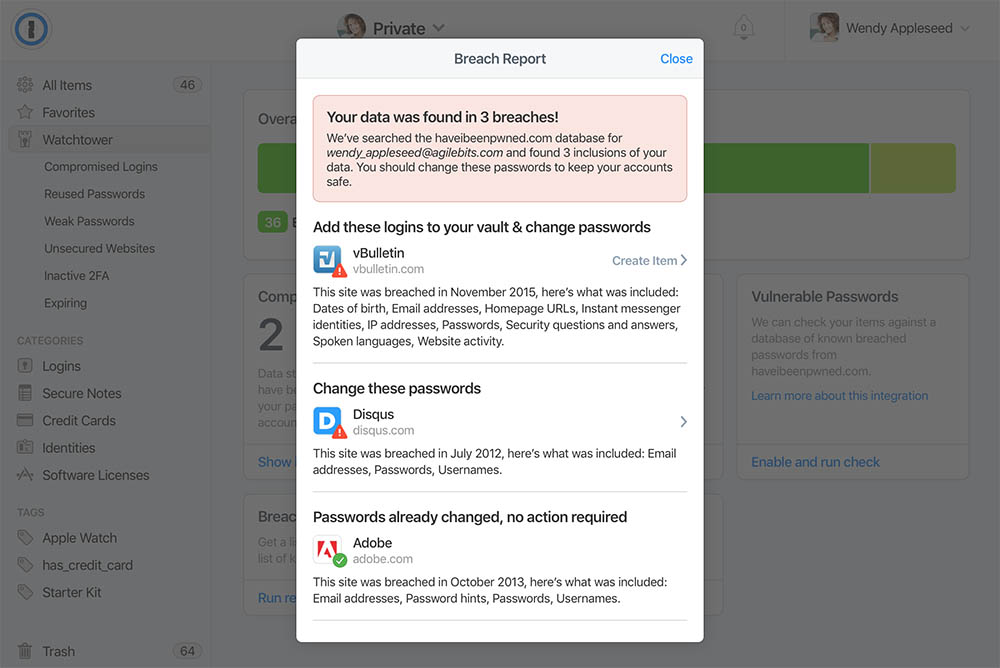
Troy Hunt, web security expert and creator of the website Have I Been Pwned (HIBP), wrote a blog post announcing his partnerships with Firefox and 1Password. For those unfamiliar with the site, Have I Been Pwned allows you to search across multiple data breaches to see if your email address has been compromised. The service is especially handy now that data breaches are becoming a daily occurrence. Hunt writes: Last November, there was much press about Mozilla integrating HIBP into Firefox. I was a bit surprised at the time as it was nothing more than their Breach Alerts feature which simply highlighted if the site being visited had previously been in a data breach (it draws this from the freely accessible breach API on HIBP). But the press picked up on some signals which indicated that in the long term, we had bigger plans than that and the whole thing got a heap of very positive attention. I ended up fielding a heap of media calls just on that one little feature - people loved the idea of HIBP in Firefox, even in a very simple form. As it turns out, we had much bigger plans and that's what I'm sharing here today. Over the coming weeks, Mozilla will begin trialling integration between HIBP and Firefox to make breach data searchable via a new tool called "Firefox Monitor." Here's what Hunt has to say about 1Password: As of now, you can search HIBP from directly within 1Password via the Watchtower feature in the web version of the product. This helps Watchtower become "mission control" for accounts and introduces the "Breach Report" feature. If you're a 1Password user you can use this feature right now, just head on over to the 1Password login page. -
Trump Officials Planning Escalation of US-China Tech Trade War (arstechnica.com)
An anonymous reader quotes a report from Ars Technica: The Trump administration is looking to widen its trade war with China by restricting Chinese access to U.S. technology, according to reports from the Wall Street Journal and Reuters. "The Treasury Department is crafting rules that would block firms with at least 25 percent Chinese ownership from buying companies involved in what the White House calls 'industrially significant technology,'" the Wall Street Journal says. A separate proposal would institute beefed-up export controls preventing Chinese companies from buying these technologies from U.S. firms. The policies could be announced as soon as this week, the Journal says. In the past, the Trump administration has blocked multiple attempts by Chinese companies to buy U.S. semiconductor firms and imposed a sweeping export ban on Chinese smartphone maker ZTE after ZTE was caught selling U.S. technology to Iran and North Korea -- though the administration recently lifted the ban. -
Trump Officials Planning Escalation of US-China Tech Trade War (arstechnica.com)
An anonymous reader quotes a report from Ars Technica: The Trump administration is looking to widen its trade war with China by restricting Chinese access to U.S. technology, according to reports from the Wall Street Journal and Reuters. "The Treasury Department is crafting rules that would block firms with at least 25 percent Chinese ownership from buying companies involved in what the White House calls 'industrially significant technology,'" the Wall Street Journal says. A separate proposal would institute beefed-up export controls preventing Chinese companies from buying these technologies from U.S. firms. The policies could be announced as soon as this week, the Journal says. In the past, the Trump administration has blocked multiple attempts by Chinese companies to buy U.S. semiconductor firms and imposed a sweeping export ban on Chinese smartphone maker ZTE after ZTE was caught selling U.S. technology to Iran and North Korea -- though the administration recently lifted the ban. -
Trump Officials Planning Escalation of US-China Tech Trade War (arstechnica.com)
An anonymous reader quotes a report from Ars Technica: The Trump administration is looking to widen its trade war with China by restricting Chinese access to U.S. technology, according to reports from the Wall Street Journal and Reuters. "The Treasury Department is crafting rules that would block firms with at least 25 percent Chinese ownership from buying companies involved in what the White House calls 'industrially significant technology,'" the Wall Street Journal says. A separate proposal would institute beefed-up export controls preventing Chinese companies from buying these technologies from U.S. firms. The policies could be announced as soon as this week, the Journal says. In the past, the Trump administration has blocked multiple attempts by Chinese companies to buy U.S. semiconductor firms and imposed a sweeping export ban on Chinese smartphone maker ZTE after ZTE was caught selling U.S. technology to Iran and North Korea -- though the administration recently lifted the ban. -
CEO of Facial Recognition Company Kairos Argues that the Technology's Bias and Capacity For Abuse Make It Too Dangerous For Use By Law Enforcement (techcrunch.com)
Brian Brackeen, chief executive officer of the facial recognition software developer Kairos, writes in an op-ed: Recent news of Amazon's engagement with law enforcement to provide facial recognition surveillance (branded "Rekognition"), along with the almost unbelievable news of China's use of the technology, means that the technology industry needs to address the darker, more offensive side of some of its more spectacular advancements. Facial recognition technologies, used in the identification of suspects, negatively affects people of color. To deny this fact would be a lie. And clearly, facial recognition-powered government surveillance is an extraordinary invasion of the privacy of all citizens -- and a slippery slope to losing control of our identities altogether.
There's really no "nice" way to acknowledge these things. I've been pretty clear about the potential dangers associated with current racial biases in face recognition, and open in my opposition to the use of the technology in law enforcement. [...] To be truly effective, the algorithms powering facial recognition software require a massive amount of information. The more images of people of color it sees, the more likely it is to properly identify them. The problem is, existing software has not been exposed to enough images of people of color to be confidently relied upon to identify them. -
CEO of Facial Recognition Company Kairos Argues that the Technology's Bias and Capacity For Abuse Make It Too Dangerous For Use By Law Enforcement (techcrunch.com)
Brian Brackeen, chief executive officer of the facial recognition software developer Kairos, writes in an op-ed: Recent news of Amazon's engagement with law enforcement to provide facial recognition surveillance (branded "Rekognition"), along with the almost unbelievable news of China's use of the technology, means that the technology industry needs to address the darker, more offensive side of some of its more spectacular advancements. Facial recognition technologies, used in the identification of suspects, negatively affects people of color. To deny this fact would be a lie. And clearly, facial recognition-powered government surveillance is an extraordinary invasion of the privacy of all citizens -- and a slippery slope to losing control of our identities altogether.
There's really no "nice" way to acknowledge these things. I've been pretty clear about the potential dangers associated with current racial biases in face recognition, and open in my opposition to the use of the technology in law enforcement. [...] To be truly effective, the algorithms powering facial recognition software require a massive amount of information. The more images of people of color it sees, the more likely it is to properly identify them. The problem is, existing software has not been exposed to enough images of people of color to be confidently relied upon to identify them. -
CEO of Facial Recognition Company Kairos Argues that the Technology's Bias and Capacity For Abuse Make It Too Dangerous For Use By Law Enforcement (techcrunch.com)
Brian Brackeen, chief executive officer of the facial recognition software developer Kairos, writes in an op-ed: Recent news of Amazon's engagement with law enforcement to provide facial recognition surveillance (branded "Rekognition"), along with the almost unbelievable news of China's use of the technology, means that the technology industry needs to address the darker, more offensive side of some of its more spectacular advancements. Facial recognition technologies, used in the identification of suspects, negatively affects people of color. To deny this fact would be a lie. And clearly, facial recognition-powered government surveillance is an extraordinary invasion of the privacy of all citizens -- and a slippery slope to losing control of our identities altogether.
There's really no "nice" way to acknowledge these things. I've been pretty clear about the potential dangers associated with current racial biases in face recognition, and open in my opposition to the use of the technology in law enforcement. [...] To be truly effective, the algorithms powering facial recognition software require a massive amount of information. The more images of people of color it sees, the more likely it is to properly identify them. The problem is, existing software has not been exposed to enough images of people of color to be confidently relied upon to identify them. -
CEO of Facial Recognition Company Kairos Argues that the Technology's Bias and Capacity For Abuse Make It Too Dangerous For Use By Law Enforcement (techcrunch.com)
Brian Brackeen, chief executive officer of the facial recognition software developer Kairos, writes in an op-ed: Recent news of Amazon's engagement with law enforcement to provide facial recognition surveillance (branded "Rekognition"), along with the almost unbelievable news of China's use of the technology, means that the technology industry needs to address the darker, more offensive side of some of its more spectacular advancements. Facial recognition technologies, used in the identification of suspects, negatively affects people of color. To deny this fact would be a lie. And clearly, facial recognition-powered government surveillance is an extraordinary invasion of the privacy of all citizens -- and a slippery slope to losing control of our identities altogether.
There's really no "nice" way to acknowledge these things. I've been pretty clear about the potential dangers associated with current racial biases in face recognition, and open in my opposition to the use of the technology in law enforcement. [...] To be truly effective, the algorithms powering facial recognition software require a massive amount of information. The more images of people of color it sees, the more likely it is to properly identify them. The problem is, existing software has not been exposed to enough images of people of color to be confidently relied upon to identify them. -
MoviePass is Going To Start Charging More For Popular Movies Next Month (qz.com)
As if seeing a popular movie with MoviePass -- where you can't reserve tickets in advance -- wasn't stressful enough, it's about to get more expensive, too. From a report: The movie-ticket subscription service, which charges $9.95 per month to see a movie a day in the US, will start surge pricing on popular movies next month, Business Insider reported. MoviePass will charge subscribers $2 or more to see titles that the app decides are very popular with its members beginning in July, Mitch Lowe, MoviePass's CEO, told the publication. He was vague on the details. "At certain times for certain films -- on opening weekend -- there could be an additional charge for films," Lowe said, calling the forthcoming policy "high-demand" pricing. But if you've paid for a year's subscription to MoviePass upfront, don't worry: Lowe said these subscribers would not be subjected to the new pricing policy. MoviePass will begin rolling out two other previously announced features, like the option to upgrade to premium movie formats such 3D and IMAX, or bring a friend to the movies, by August, Lowe added. -
WHO Gaming Disorder Listing a 'Moral Panic', Say Experts (bbc.com)
The decision to class gaming addiction as a mental health disorder was "premature" and based on a "moral panic," experts have said. From a report: The World Health Organization included "gaming disorder" in the latest version of its disease classification manual. But biological psychology lecturer Dr Peter Etchells said the move risked "pathologising" a behaviour that was harmless for most people. The WHO said it had reviewed available evidence before including it. It added that the views reflected a "consensus of experts from different disciplines and geographical regions" and defined addiction as a pattern of persistent gaming behaviour so severe it "takes precedence over other life interests." Speaking at the Science Media Centre in London, experts said that while the decision was well intentioned, there was a lack of good quality scientific evidence about how to properly diagnose video game addiction. -
Google is Adding Anti-Tampering DRM To Android Apps in the Play Store (androidcentral.com)
Google has introduced a small change to Play Store apps that could significantly protect several Android users. From a report: Earlier this week, Google quietly rolled out a feature that adds a string of metadata to all APK files (that's the file type for Android apps) when they are signed by the developer. You can't install an application that hasn't been signed during its final build, so that means that all apps built using the latest APK Signature Scheme will have a nice little chunk of DRM built into them. And eventually, your phone will run a version of Android that won't be able to install apps without it. -
Google is Adding Anti-Tampering DRM To Android Apps in the Play Store (androidcentral.com)
Google has introduced a small change to Play Store apps that could significantly protect several Android users. From a report: Earlier this week, Google quietly rolled out a feature that adds a string of metadata to all APK files (that's the file type for Android apps) when they are signed by the developer. You can't install an application that hasn't been signed during its final build, so that means that all apps built using the latest APK Signature Scheme will have a nice little chunk of DRM built into them. And eventually, your phone will run a version of Android that won't be able to install apps without it. -
Warner Bros Is Cracking Down On Harry Potter Festivals (apnews.com)
Warner Bros is cracking down on local Harry Potter fan festivals around the country, saying it's necessary to halt unauthorized commercial activity. From a report: Fans, however, liken the move to Dementors sucking the joy out of homegrown fun, while festival directors say they'll transfigure the events into generic celebrations of magic. "It's almost as if Warner Bros. has been taken over by Voldemort, trying to use dark magic to destroy the light of a little town," said Sarah Jo Tucker, a 21-year-old junior at Chestnut Hill College, which hosts a Quidditch tournament that coincides with the annual suburban Philadelphia festival. Philip Dawson, Chestnut Hill's business district director, said Warner Bros. reached out to his group in May, letting them know new guidelines prohibit festivals' use of any names, places or objects from the series. That ruled out everything from meet-and-greet with Dumbledore and Harry to Defense Against the Dark Arts classes. Related story, from 18 years ago: Harry Potter Sites vs. Warner Brothers. -
'Snapdragon 1000' Chip May Be Designed For PCs From the Ground Up (engadget.com)
Qualcomm's Snapdragon 850 processor may be intended for PCs, but it's still a half step -- it's really a higher-clocked version of the same processor you'd find in your phone. The company may be more adventurous the next time, though. From a report: WinFuture says it has obtained details surrounding SDM1000 (possibly Snapdragon 1000), a previously hinted-at CPU that would be designed from the start for PCs. It would have a relatively huge design compared to most ARM designs (20mm x 15mm) and would consume a laptop-like 12W of power across the entire system-on-a-chip. It would compete directly with Intel's low-power Core processors where the existing 835 isn't really in the ballpark. A reference design found in import databases might give a clue as to what you could expect: it'd have up to 16GB of RAM and two 128GB storage modules. -
8 Months After a Surge of Complaints, Apple Announces a Repair Program For Its Flawed MacBooks and MacBook Pros (theoutline.com)
Casey Johnston, writing for The Outline: At long last, Apple admitted to its customers that its MacBook and MacBook Pro keyboard designs are so flawed and prone to sticking or dead keys, as originally reported by The Outline in October, and that it will cover the cost of repairs beyond the products' normal warranty. The admission comes after the company has been hit with no fewer than three class action lawsuits concerning the computers and their ultra-thin butterfly-switch keyboards. While the repair and replacement program covers costs and notes that Apple will repair both single keys as well as whole keyboards when necessary, it doesn't note whether the replacements will be a different, improved design that will prevent the problem from happening again (and again, and again). -
8 Months After a Surge of Complaints, Apple Announces a Repair Program For Its Flawed MacBooks and MacBook Pros (theoutline.com)
Casey Johnston, writing for The Outline: At long last, Apple admitted to its customers that its MacBook and MacBook Pro keyboard designs are so flawed and prone to sticking or dead keys, as originally reported by The Outline in October, and that it will cover the cost of repairs beyond the products' normal warranty. The admission comes after the company has been hit with no fewer than three class action lawsuits concerning the computers and their ultra-thin butterfly-switch keyboards. While the repair and replacement program covers costs and notes that Apple will repair both single keys as well as whole keyboards when necessary, it doesn't note whether the replacements will be a different, improved design that will prevent the problem from happening again (and again, and again). -
8 Months After a Surge of Complaints, Apple Announces a Repair Program For Its Flawed MacBooks and MacBook Pros (theoutline.com)
Casey Johnston, writing for The Outline: At long last, Apple admitted to its customers that its MacBook and MacBook Pro keyboard designs are so flawed and prone to sticking or dead keys, as originally reported by The Outline in October, and that it will cover the cost of repairs beyond the products' normal warranty. The admission comes after the company has been hit with no fewer than three class action lawsuits concerning the computers and their ultra-thin butterfly-switch keyboards. While the repair and replacement program covers costs and notes that Apple will repair both single keys as well as whole keyboards when necessary, it doesn't note whether the replacements will be a different, improved design that will prevent the problem from happening again (and again, and again). -
Tech Giants Urge Congress To 'Protect Entrepreneurs' From Supreme Court Ruling (theverge.com)
U.S. states can now require online retailers to collect local sales taxes, according to a recent Supreme Court ruling that could affect thousands of third-party sellers on top tech sites. An anonymous reader quotes The Verge: In fact, Amazon, which last year started collecting sales tax in all 45 states that require it by law, may have a substantial amount of work to do to help its Amazon Marketplace sellers stay compliant. Yet we don't know if that burden will fall primarily on Amazon or if it will be the responsibility of the sellers. More than 50 percent of all sales on the site are conducted via third-party sellers, some of which use Amazon for fulfillment but otherwise operate independent small- to medium-sized businesses... Etsy, eBay, and others are in similar boats. According to the US Government Accountability Office, as much as $13 billion in annual sales tax revenue is at stake....
Etsy is concerned about what it sees as "significant complexities in the thousands of state and local sales tax laws" and that by overruling the Quill decision, the Supreme Court has put the ball in Congress' court. "We believe there is now a call to action for Congress to create a simple, fair federal solution for micro-businesses," Silverman added.
The Verge writes that "the case may be litigated for years to come to figure out how to account for the over 10,000 state jurisdictions that govern sales tax across the country. That is, unless congressional legislation supersedes the state court decisions... Even groups that were in favor of the ruling, like the nonpartisan research institute the Information Technology and Innovation Foundation, are imploring Congress to act."
eBay has already mass-emailed many of their users urging them to sign an online petition "to protect entrepreneurs, artisans and small businesses from potentially devastating Internet sales tax legislation." The petition presses state governors, U.S. lawmakers, and president Trump to "support the millions of small businesses and consumers across the country."
Keep reading to see what eBay is urging legislators to do...
- Keep the Internet as free from government taxation and regulation as possible.
- Protect entrepreneurs, small businesses and artisans from new taxes, audits or collection burdens because they can least afford the added costs.
- Continue to prohibit states and localities from applying and enforcing sales and use tax laws on small, remote local businesses who have no political or voting connection to the taxing state.
- Reject tax policies that raise prices on consumers who shop online with small businesses for artisan, craft, religious, vintage or other niche products because they should not be paying more taxes.
Do you agree with the Supreme Court -- or with the tech companies who want a new federal solution?
Leave your thoughts in the comments... -
Tech Giants Urge Congress To 'Protect Entrepreneurs' From Supreme Court Ruling (theverge.com)
U.S. states can now require online retailers to collect local sales taxes, according to a recent Supreme Court ruling that could affect thousands of third-party sellers on top tech sites. An anonymous reader quotes The Verge: In fact, Amazon, which last year started collecting sales tax in all 45 states that require it by law, may have a substantial amount of work to do to help its Amazon Marketplace sellers stay compliant. Yet we don't know if that burden will fall primarily on Amazon or if it will be the responsibility of the sellers. More than 50 percent of all sales on the site are conducted via third-party sellers, some of which use Amazon for fulfillment but otherwise operate independent small- to medium-sized businesses... Etsy, eBay, and others are in similar boats. According to the US Government Accountability Office, as much as $13 billion in annual sales tax revenue is at stake....
Etsy is concerned about what it sees as "significant complexities in the thousands of state and local sales tax laws" and that by overruling the Quill decision, the Supreme Court has put the ball in Congress' court. "We believe there is now a call to action for Congress to create a simple, fair federal solution for micro-businesses," Silverman added.
The Verge writes that "the case may be litigated for years to come to figure out how to account for the over 10,000 state jurisdictions that govern sales tax across the country. That is, unless congressional legislation supersedes the state court decisions... Even groups that were in favor of the ruling, like the nonpartisan research institute the Information Technology and Innovation Foundation, are imploring Congress to act."
eBay has already mass-emailed many of their users urging them to sign an online petition "to protect entrepreneurs, artisans and small businesses from potentially devastating Internet sales tax legislation." The petition presses state governors, U.S. lawmakers, and president Trump to "support the millions of small businesses and consumers across the country."
Keep reading to see what eBay is urging legislators to do...
- Keep the Internet as free from government taxation and regulation as possible.
- Protect entrepreneurs, small businesses and artisans from new taxes, audits or collection burdens because they can least afford the added costs.
- Continue to prohibit states and localities from applying and enforcing sales and use tax laws on small, remote local businesses who have no political or voting connection to the taxing state.
- Reject tax policies that raise prices on consumers who shop online with small businesses for artisan, craft, religious, vintage or other niche products because they should not be paying more taxes.
Do you agree with the Supreme Court -- or with the tech companies who want a new federal solution?
Leave your thoughts in the comments... -
Facebook Messenger Kids App Is Expanding (fortune.com)
Facebook's controversial Messenger Kids app is heading outside the U.S. to Canada and Peru. From a report: As part of the expansion, the social networking giant said Friday that it would also debut Spanish and French language versions of the children's messaging app that are now available in all three countries where the service is available. Facebook introduced Messenger Kids in December, pitching it as a safer way for children under 13 to chat with friends while sending them silly GIFs, emoji, and other goofy digital imagery. Unlike the core Facebook social networking service or other messaging apps, Facebook said that Messenger Kids does not display any online ads or allow kids to buy things within the app. -
Facebook Messenger Kids App Is Expanding (fortune.com)
Facebook's controversial Messenger Kids app is heading outside the U.S. to Canada and Peru. From a report: As part of the expansion, the social networking giant said Friday that it would also debut Spanish and French language versions of the children's messaging app that are now available in all three countries where the service is available. Facebook introduced Messenger Kids in December, pitching it as a safer way for children under 13 to chat with friends while sending them silly GIFs, emoji, and other goofy digital imagery. Unlike the core Facebook social networking service or other messaging apps, Facebook said that Messenger Kids does not display any online ads or allow kids to buy things within the app. -
Uber Driver Was Streaming Hulu Just Before Fatal Self-Driving Car Crash, Says Police (arstechnica.com)
An anonymous reader quotes a report from Ars Technica: Tempe, Arizona, police have released a massive report on the fatal Uber vehicle crash that killed pedestrian Elaine Herzberg in March. The report provides more evidence that driver Rafaela Vasquez was distracted in the seconds before the crash. "This crash would not have occurred if Vasquez would have been monitoring the vehicle and roadway conditions and was not distracted,'' the report concludes. Police obtained records from Hulu suggesting that Vasquez was watching "The Voice," a singing talent competition that airs on NBC, just before the crash. Hulu's records showed she began watching the program at 9:16pm. Streaming of the show ended at 9:59pm, which "coincides with the approximate time of the collision," according to the police report. -
Why Antarctica Is Getting Taller (livescience.com)
An anonymous reader quotes a report from Live Science: Bedrock under Antarctica is rising more swiftly than ever recorded -- about 1.6 inches (41 millimeters) upward per year. And thinning ice in Antarctica may be responsible. That's because as ice melts, its weight on the rock below lightens. And over time, when enormous quantities of ice have disappeared, the bedrock rises in response, pushed up by the flow of the viscous mantle below Earth's surface, scientists reported in a new study. These uplifting findings are both bad news and good news for the frozen continent. The good news is that the uplift of supporting bedrock could make the remaining ice sheets more stable. The bad news is that in recent years, the rising earth has probably skewed satellite measurements of ice loss, leading researchers to underestimate the rate of vanishing ice by as much as 10 percent, the scientists reported. The findings were published in the journal Science.