Slashdot Mirror
Domain: spaceflightnow.com
Stories and comments across the archive that link to spaceflightnow.com.
Comments · 567
-
Images of bird impact and debris
-
Re:I call shenanigans.
I first heard about this at about 11:30 EDT on NPR. By now, Spaceflight Now has a preliminary discussion.
I hope Stephen King's OK.
-
Pictures of the TYVEK
You can see pictures of the TYVEK covers, as well as the bird, at http://spaceflightnow.com/shuttle/sts114/050726im
a ges/ -
'Twas a bird, perhaps (proof inside)From SpaceflightNow's Status Report:
2129 GMT (5:29 p.m. EDT)
Launch imagery also reveals the top of the external tank hit a bird about 2.5 seconds after liftoff. -
I call shenanigans.
SpaceflightNow's status page has nothing, Space.com's coverage has nothing, and NASA's official Return to Flight page has nothing, whether in coverage or in the videos. So I'm calling shens.
BTW, I just heard on talk radio that Stephen King was found dead in his Maine home today. Truly an American icon. -
Re:Big Chunk Of Something fell off
Also, an image of the debris was posted.
Look at the shape of the debris... my first thought was that it might be Arthur Dent catching a ride.
Or for another interpretation... how long before the Weekly World News runs the headline, "Angel Photographed by NASA"? -
Re:Big Chunk Of Something fell off
There's been updates since then:
---
1605 GMT (12:05 p.m. EDT)
Mission management team chairmain Wayne Hale says he doesn't know any details about the debris coming off the tank noted just after booster separation. He said the film experts will be studying all launch footage frame by frame, as was plan doing into this first post-Columbia launch.
---
Also, an image of the debris was posted. -
debris?
SpaceflightNow reporting
- An image from the external tank video shows the chunk of debris breaking away from the tank just after the solid boosters separated.
See the image here -
debris?
SpaceflightNow reporting
- An image from the external tank video shows the chunk of debris breaking away from the tank just after the solid boosters separated.
See the image here -
Piece of debris of the external tank
Spaceflight now has an image from the external tank video that shows a piece of debris falling off from the external tank, just after the solid boosters separated. It doesn't seem to fall in the shuttles direction.
-
Piece of debris of the external tank
Spaceflight now has an image from the external tank video that shows a piece of debris falling off from the external tank, just after the solid boosters separated. It doesn't seem to fall in the shuttles direction.
-
Big Chunk Of Something fell off
From Spaceflight Now:
1512 GMT (11:12 a.m. EDT)
T+plus 33 minutes. A few seconds after solid rocket booster separation, a large chunk of something broke free from the external fuel tank. The onboard video camera mounted on the tank showed the object flying away from the vehicle without striking Discovery. -
Mission Status Center link
The missing link: Spaceflight Now's Mission Status Center (text version).
Darned Dallas newspaper printed the 10:39 time as though it were local, so I missed it. The Mission Status Center is the next best thing. Interesting tidbit: "Mission specialist No. 3 Andy Thomas -
Re:Two stable only if...
You are correct. I was wrong to state two Lagrange points are stable without some qualification.
Since we were talking about Earth-Moon Lagrange points (presumably, as I did not RTFA). This system does exceed the stability ratio, so I didn't feel the need to qualify it. As you point out the Earth-Sun system also has two stable Lagrange points, as well as many other bodies in our solar system.
While L4 & L5 are valuable real estate (in a sense) as the article apparently implies, L1, L2, & L3 are also of value for low energy transport nodes. (http://spaceflightnow.com/news/n0207/21highway/ and http://www.sciencenews.org/articles/20050416/bob9. asp).
Of course, trying to try L1, L2 and L3 into choke points such as L4 & L5 would be a fuel expensive proposition.
In any event, keeping all of these points freely available I feel ought to bring far more benefits than restricting access to any of them. Again, I did not RTFA, so I'm just responding to the -
Re:Redundant systemEr, no.
Depending on where the sensors are located, engineers may need to remove the orbiter from the boosters. That requires towing the shuttle back to the Vehicle Assembly Building (VAB).
On STS-98 the launch was pushed back 2 weeks when they had to roll the shuttle back to the VAB to repair a damaged cable on one of the SRB's.
-
Re:not a surprise
"even if they hadnt for the sensor, they where likely going to scrub it for weather"
What are you talking about?
1724 GMT (1:24 p.m. EDT)
None of the weather rules are being broken now. The current conditions have improved and the cumulus and anvil cloud rules are no longer violated.
Six minutes later the fuel sensor problem was detected.
http://spaceflightnow.com/shuttle/sts114/status.ht ml -
Launch WindowFrom Spacelight Now:
"There is no word how long the delay will last and when Discovery's launch could be rescheduled. NASA has through July 31 to launch Discovery or else wait until September 9 due to the need to lift off and separate the external tank in daylight."
-
How NOT to write a headline
Here's the story I saw.
Cockpit window falls from Discovery, hits engine pod...
Is this what you would call "sensationalistic"? Jeez, and I thought the Star was bad. -
No DelaysAccording to SpaceFlightNow there will be NO delays with the launch.
"NASA managers Thursday evening decided to begin preparing the shuttle Discovery for a possible roll back to the protection of the Vehicle Assembly Building should Hurricane Dennis take a turn to the east and threaten the Space Coast. At a midnight meeting, however, officials put those preparations on hold. And this morning the decision was made to cancel any rollback.
Technicians at launch pad 39B have disconnected explosive ordnance as part of early rollback preparations. At a midnight senior management meeting, however, officials decided not to continue with the list of chores to unhook Discovery from its seaside complex given a more optimistic weather outlook that keeps Dennis well away from Kennedy Space Center. Proceeding with more rollback activities overnight would have prevented an on-time launch Wednesday.
Rollback to the VAB would have to be completed before the wind reaches 40 knots (46 MPH). [It would take] about 48 hours from the time the decision is made to the time we are in the VAB. We had a weather briefing and at this point we are fairly confident we will not have to fuss with the storm, at least this one this time. It's a long hurricane season."
-
Re:Not really 23,000 miles an hour23,000 miles per hour is the relative velocity.
http://www.spaceflightnow.com/deepimpact/050628mi
s sion.htmlBoth the Deep Impact spacecraft and comet Tempel 1 are in their own unique orbits around the Sun. However, the comet is traveling substantially faster (29.9 kilometers per second (66,880 miles per hour)) than the spacecraft (21.9 kilometers per second (48,990 miles per hour)).
-
SF Chron / AP reporting signals heard
Mission controllers may have received signal from solar sail By JOHN ANTCZAK, Associated Press Writer
Tuesday, June 21, 2005
(06-21) 22:13 PDT Pasadena, Calif. (AP) --Signals may have been detected from the Cosmos 1 solar sail spacecraft that lost communication during launch on a converted missile fired from a Russian submarine under the Barrents Sea, mission officials said late Tuesday night.
The news came after an all-day search for Cosmos 1, which is intended to demonstrate that a spacecraft can be propelled by the pressure of light from the sun. If it is confirmed that the signals detected by three ground stations did come from Cosmos 1, it means that the craft did achieve orbit, said mission official Jim Cantrell.
...
Spaceflight.com adds:
Update for June 22 @ 1 a.m. EDT: Mission controllers revealed a short time ago that weak blips of data believed transmitted from the Cosmos 1 spacecraft have been found in recordings at tracking station passes immediately after launch. The Planetary Society originally said that no signals were heard. If the new revelation is true, it suggests that the solar sail did reach some sort of orbit around Earth despite what Russian media reports indicate was a rocket engine problem during ascent. However, the U.S. military's space tracking network has not found the craft and its current orbit is unknown. "So now we search. It could take days to find," the Society said in a statement.
-
Spaceflight now has the scoop
Spaceflight Now has posted a story about the launch. The 1st stage failed after 83 seconds.
-
Deja Vu
I swear I remember this happening before.
-
Iridium 9501 Satellite Pager by Motorola
The reason you only got "a couple listings" is because Iridium is pretty much the only game in town, and there's pretty much only one pager. There weren't exactly a lot of devices made for this market. It's no small feat to operate a global voice/data satellite network. There are only a "couple" of other providers (geared more toward government, military, and enterprise, and without "pager" offerings): InMarSat and GlobalStar, for example.
The Motorola 9501 for Iridium is, as I said, essentially the only satellite pager:
http://www.iridium.com/product/iri_product-detail. asp?productid=445
http://shop.infosat.com/pagers/
http://www.infosat.com/services/iridium/motorola_9 501_pager.htm
http://www.satwest.com/satellite_pagers_mi9501.htm l
More...
Of course, you may be interested in a satellite handset, not strictly a "pager", than can also get email and numeric messages. Keep in mind, though, that all of these satellite devices are subject to normal satellite requirements, e.g., line of sight to the sky. Yes, sometimes they'll "kind of" work in vehicles, wooded areas, etc., and you will get confirmed delivery of messages once you're again in range, but these things aren't exactly set up to work in houses and buildings. You may have no choice but to have a conventional cell phone/pager AND a satellite device for when you're remote, and have your automated systems and/or people try both devices.
For others in a similar boat, but not quite as remote as the submitter, you may also consider a conventional 2-way or 1.5-way nationwide pager, which provides delivery confirmation and re-attempts if you're temporarily out of range. But if you know you're going to be out of range for a while, you pretty much restricted to something like one of the satellite solutions. Consider a mobile phone. Most providers' digital networks offer email service, numeric "paging", and even true TAP/IXO paging. Just look into a provider that covers your area(s).
A bit of history on Iridium: Iridium was the satellite phone service launched by Motorola on Sept 23, 1998, when the last satellite of its global constellation was in place. Handset prices (over $3000) and airtime fees (several dollars per minute), as well as attempting to market to ordinary folks doomed the service from the beginning. Motorola decided to end the Iridium service on March 17, 2000, at 11:59pm. After billions were spent on the 66 satellites, and the $1 million per month that it cost Motorola for Boeing operate the satellites, Motorola initiated plans to deorbit and destroy the constellation. Various investor groups attempted to save Iridium, and the Defense Department even provided $72 million to keep the satellites operational (in the face of concerns of debris from the deorbited satellites actually hitting someone on earth, which NASA pinned at 1 in 250). In any event, Iridium Satellite LLC successfully purchased the assets of the $7 billion Motorola Iridium program in November 2000 for a mere $25 million:
http://spaceflightnow.com/news/n0011/16iridium/
http://spaceflightnow.com/news/n0103/29iridium/
The new Iridium, launched in March 2001, attempts to fix the shortcomings of the original by expanding beyond satellite voice telephone service, into data, video, realtime monitoring, and special applications in markets such as mining, oil/gas, m -
Iridium 9501 Satellite Pager by Motorola
The reason you only got "a couple listings" is because Iridium is pretty much the only game in town, and there's pretty much only one pager. There weren't exactly a lot of devices made for this market. It's no small feat to operate a global voice/data satellite network. There are only a "couple" of other providers (geared more toward government, military, and enterprise, and without "pager" offerings): InMarSat and GlobalStar, for example.
The Motorola 9501 for Iridium is, as I said, essentially the only satellite pager:
http://www.iridium.com/product/iri_product-detail. asp?productid=445
http://shop.infosat.com/pagers/
http://www.infosat.com/services/iridium/motorola_9 501_pager.htm
http://www.satwest.com/satellite_pagers_mi9501.htm l
More...
Of course, you may be interested in a satellite handset, not strictly a "pager", than can also get email and numeric messages. Keep in mind, though, that all of these satellite devices are subject to normal satellite requirements, e.g., line of sight to the sky. Yes, sometimes they'll "kind of" work in vehicles, wooded areas, etc., and you will get confirmed delivery of messages once you're again in range, but these things aren't exactly set up to work in houses and buildings. You may have no choice but to have a conventional cell phone/pager AND a satellite device for when you're remote, and have your automated systems and/or people try both devices.
For others in a similar boat, but not quite as remote as the submitter, you may also consider a conventional 2-way or 1.5-way nationwide pager, which provides delivery confirmation and re-attempts if you're temporarily out of range. But if you know you're going to be out of range for a while, you pretty much restricted to something like one of the satellite solutions. Consider a mobile phone. Most providers' digital networks offer email service, numeric "paging", and even true TAP/IXO paging. Just look into a provider that covers your area(s).
A bit of history on Iridium: Iridium was the satellite phone service launched by Motorola on Sept 23, 1998, when the last satellite of its global constellation was in place. Handset prices (over $3000) and airtime fees (several dollars per minute), as well as attempting to market to ordinary folks doomed the service from the beginning. Motorola decided to end the Iridium service on March 17, 2000, at 11:59pm. After billions were spent on the 66 satellites, and the $1 million per month that it cost Motorola for Boeing operate the satellites, Motorola initiated plans to deorbit and destroy the constellation. Various investor groups attempted to save Iridium, and the Defense Department even provided $72 million to keep the satellites operational (in the face of concerns of debris from the deorbited satellites actually hitting someone on earth, which NASA pinned at 1 in 250). In any event, Iridium Satellite LLC successfully purchased the assets of the $7 billion Motorola Iridium program in November 2000 for a mere $25 million:
http://spaceflightnow.com/news/n0011/16iridium/
http://spaceflightnow.com/news/n0103/29iridium/
The new Iridium, launched in March 2001, attempts to fix the shortcomings of the original by expanding beyond satellite voice telephone service, into data, video, realtime monitoring, and special applications in markets such as mining, oil/gas, m -
Lets not have a repeat ...
-
Re:Eden Baby, Yeah!
That said, is it feasible that we will see it reduced by a factor of 1000?
From an interview with Elon Musk:
"Long term plans call for development of a heavy lift product and even a super-heavy, if there is customer demand. We expect that each size increase would result in a meaningful decrease in cost per pound to orbit. For example, dollar cost per pound to orbit dropped from $4,000 to $1,300 between Falcon 1 and Falcon 5. Ultimately, I believe $500 per pound or less is very achievable."
(Not quite 1000x less, but it's close.) -
The real world of space launchesThe Slashdot crowd never seems to be aware of what is happening in the real world. The preference is to spout off and pretend to be experts when they have no grasp of any facts.
For example, this week Boeing and Lockheed, the two main rocket booster builders in the US, decided to merge their efforts and build a joint production facility. See http://spaceflightnow.com/news/n0505/01eelv/
Although this article dosen't say so, the reason they are merging is that the space launch business is in a masive slump. (There was an article in the LA Times that talked about this, but I couldn't find it online.) In the 90s everyone though that there would be a boom because of space communications, but it didn't happen. The Europeans, Russians and Chinese all went commercial, and now there are too many rockets and not enough payloads.
So all you whiners who blame NASA for blocking space flight, shut you holes. You are ignorant and just plane wrong. You want free enterprize to blast us into space, you got it and it DOSEN'T WORK! (Except for stuff like DirectTV.)
The way we are going into space for real is through government programs. It may be the US or India or China or Japan, but it will be a government. And don't whine about Rutan and the X-Prize. It was a great effort, but it is ultimatly an aircraft/spaceplane, not a orbital vehicle. That is a whole lot harder.
There will eventually be non-government space efforts, but the time is not now. For proof, just look at what happened when Rutan won the X-Prize. Everyone else gave up. If there was a viable place to make money in space, at least some of these efforts would be continuing. So far, only Rutan and Branson have any idea how to make any money (outside of communications) and they are still non-orbital. We have a lot more research to do before there will be a self supporting non-government space effort.
-
Re: Cool
Saw the satellite separate from the second stage in a parking lot in Cary, NC at 9pm. At first I thought it was a firework: there was an expanding ring of yellow-white light that grew to about 2 moon diameters before fading out. Very cool.
There is a good timeline for the ascent at http://www.spaceflightnow.com/titan/b30/status.htm l . -
JIMO a no-go?
Early mission plans for Prometheus 1 (Jupiter Icy Moons Orbiter) indicate that the spacecraft would orbit Callisto, Ganymede, and Europa individually, and perhaps have a lifespan of about 20 years."
Looks like those "early mission plans" have been revised. See the second half of this article. Here's the relevant paragraph:
JIMO, whose launch had already been pushed back from around 2012 to 2015, faced what NASA called "concerns over costs and technical complexity," leading the agency to effectively cancel the mission. JIMO was intended to be the cornerstone of Project Prometheus, a nuclear power and propulsion program; NASA will instead seek a less-complex alternative mission to demonstrate those technologies.
-
DirectTV going HDTV
Tuesday morning, DirectTV is going to be putting up a new bird, the Spaceway 1.
"After a checkout period, Spaceway 1 will go into service this summer to begin DIRECTV's new program offering for both national and local high-definition channels to its customers across the United States. It will later be joined by three other satellites to fully implement the system by 2007."
"By 2007, the number of high-definition channels will be expanded to over 1,500, and DIRECTV says its next-generation services will be able to reach every U.S. household."
"Spaceway 1 carries a two-meter transmit antenna with full steering ability that can form multiple spot beams to customize programming in different regions of the country. This communications payload has a total bandwidth capacity of about 10 gigabytes per second."
I find this preferable to our government's enforced upgrades, although I can see the arguments for more efficient bandwidth usage.
More info -
hubble update
Looks like the door just opened again on the hubble servicing mission: http://www.spaceflightnow.com/news/n0504/12griffi
n
from the article:
"Actually, until I was nominated by the president to be his choice for administrator, I was the independent chair of the robotic servicing mission design review committee," he said. "As you know, and as was in the news very recently, that committee, now without me as its head, that committee has concluded that the robotic servicing mission is not feasible for a reasonable amount of money and within the time we have available before the Hubble wears out. So I would like to take the robotic mission off the plate. "And so I believe that this comes down to reinstating a shuttle servicing mission or possibly a very simple robotic deorbiting mission. The decision not to execute the planned shuttle servicing mission was made in the immediate aftermath of the loss of Columbia. When we return to flight, it will be with essentially a new vehicle, which will have a new risk analysis associated with it and so on and so forth. "At that time, I think we should reassess the earlier decision in light of what we learn after we return to flight" -
No balls on this one
remember back when astronauts had balls?
Yeah, but this commander doesn't have one:
Go Cmdr. Collins! -
wow, i was just reading that at spaceflight.com
at http://spaceflightnow.com/news/n0504/05mera/
then i come here and its here
I hope nasa takes a timelapsed view of the basic from the hill, 1 pic every 5mins would look cool. -
Flyby telescope is out of focus!
DOH!
http://spaceflightnow.com/news/n0503/25deepimpact/
Looks like another big blunder! -
Re:Halfassed NASA Eggheads?Ice and dust debris will be ejected from the crater revealing the material beneath.
No one earth other than those with proper instrumentation will "feel" the effects of the impact.
Here's a story I ran across that would be of interest to those keeping up with "Independence Day" effects on Earth.
One day it's a giant asteroid that will snuff out all life on earth, another day it's a "super volcano", now this.
-
Outer Space A Source Of Trouble
I'm sure they're subject-shopping, but it's interesting that there are so many weird things going on out there.
It does feel like there are a few things about to tease themselves apart in cosmology...
Gravity seems to be behaving oddly, with things like the Pioneer acceleration and the anomalous in-track acceleration of the LAGEOS satellites.
The limited age of the universe is being stretched to strange proportions of late with observations of the early universe looking more developed than expected. Observations by the Spitzer may throw even more confusion on the fire.
Add to the pile interesting oddities like Quantized Redshift, originally proposed by Tifft and still observed, that would see to put us at the center of the universe (we shouldn't see the equivalent of even "shells" from our point of view). The Fingers of God is an interesting graphic interpretation.
Association of high-redshift quasars with low-redshift galaxies rounds off the plate.
Actually, a number of these controversies have been around since the mid-80's, but the power and spectrum spread of our telescopes has been getting better. It's been hard to get time to observe the controversial objects - the allocation committees tend to turn such proposals down - but there are plenty of controversies left in the skies, even when we don't go looking for them
Personally, I'm excited by the possibilities. It feels like there's something just around the corner, if only we can get some research time in on it.
-
Cat calls from the cheap seats
Let the New Scientist criticize from the cheap seats. It is hard to argue that the rovers have been anything other than a resounding success for over 400 days. I would have hoped
-
Re:It's not just methane....
Yeah, that's happened to me several times -- I submit a story, only to have it rejected and have another submission pop up several days later, with far fewer details and more innane banter. I think you needed to have references to the Genesis Device in yours.
For example, I've had the following submission already rejected once. Maybe I'm weird, but IMHO it seems very much "News for Nerds" and "Stuff that Matters":
Bigelow to launch CSS Skywalker orbital resort by 2010
Popular Science has a cover feature on self-made billionaire and space enthusiast Robert Bigelow (who's been mentioned before on Slashdot). Bigelow plans to launch a 'CSS Skywalker' orbital resort by 2010 and sell space habitats to others, such as scientists, manufacturers, Hollywood producers, and countries. The habitats will be made of inflatable modules with multilayered kevlar-like walls. A prototype habitat will be launching on a SpaceX Falcon V next year. To help ensure cost-effective access to the station, Bigelow is also running the $50 million America's Space Prize. In the long run, the modules could be the basis for space yachts and moon cruisers.
I tried resubmitting it after changing the title and reorganizing it to make it better somehow, but it's been sitting in the submission queue for about a day now. -
Re:Sirius sucks -- NOT
Not true. Sirius uses a highly inclined elliptical orbit that scribes a sort of figure 8, with the fat part over North America. Each satellite spends about 16hrs/day over North America. When the sat crosses the equator going south, they turn off the transmitter. As it crosses back over the equator heading north, they turn it back on. And there are always two satellites over NA at all times.
Here's a couple links:
http://www.spaceflightnow.com/proton/sirius3/00113 0sirius.html
http://www.space.com/businesstechnology/technology -
More info on SpaceX
I tried submitting a story on SpaceX a couple of weeks ago, but it was sadly rejected. Here's the text of the submission, along with some other interesting info:
Spaceflight Now has an article on SpaceX, a low-cost space launch company started by PayPal co-founder Elon Musk (he is no longer with PayPal). The article describes SpaceX's small-size Falcon I rocket, scheduled to launch a military imaging satellite on its maiden flight in March, and their medium-size Falcon V rocket, scheduled to lift a prototype Bigelow inflatable space habitat next year. Interestingly, the Falcon V has enough capacity to lift a Gemini-style capsule with 5-6 people to orbit. Both rockets have per-pound launch costs approximately one-fifth that of comparable rockets. Long-term plans call for evolving the basic design to heavy-lift and super-heavy lift rockets, assuming SpaceX survives its legal battles with defense giants like Northrup Grumman. Musk believes that ultimately a launch cost of '$500 per pound or less is very achievable' (compared to $10,000 per pound for the Space Shuttle). Elon Musk is a member of the Mars Society, and started SpaceX after he realized that current launch costs would be a large barrier to his plans for a philanthropic mission to put an experimental greenhouse with food crops on Mars.
This radio interview with Elon Musk from 2001 is pretty neat, and has some information I haven't seen elsewhere. -
More info on SpaceX
I tried submitting a story on SpaceX a couple of weeks ago, but it was sadly rejected. Here's the text of the submission, along with some other interesting info:
Spaceflight Now has an article on SpaceX, a low-cost space launch company started by PayPal co-founder Elon Musk (he is no longer with PayPal). The article describes SpaceX's small-size Falcon I rocket, scheduled to launch a military imaging satellite on its maiden flight in March, and their medium-size Falcon V rocket, scheduled to lift a prototype Bigelow inflatable space habitat next year. Interestingly, the Falcon V has enough capacity to lift a Gemini-style capsule with 5-6 people to orbit. Both rockets have per-pound launch costs approximately one-fifth that of comparable rockets. Long-term plans call for evolving the basic design to heavy-lift and super-heavy lift rockets, assuming SpaceX survives its legal battles with defense giants like Northrup Grumman. Musk believes that ultimately a launch cost of '$500 per pound or less is very achievable' (compared to $10,000 per pound for the Space Shuttle). Elon Musk is a member of the Mars Society, and started SpaceX after he realized that current launch costs would be a large barrier to his plans for a philanthropic mission to put an experimental greenhouse with food crops on Mars.
This radio interview with Elon Musk from 2001 is pretty neat, and has some information I haven't seen elsewhere. -
Delta 4-Heavy
Not NASA as such, but their supplier Boeing is working on scaling up the Delta 4 vehicle by clustering several rockets. (http://www.spaceflightnow.com/delta/d4h.html/.) A cluster of 3 rockets was tested in December, with 6 or 7 rockets it should be able to launch a CEV into orbit.
-
Nothing was lost, all data is safe
The article isn't quite correct. A fuller description would take a while to type, so I summarise:
Two redundant radio channels were used to get data from the lander to the orbiter, which relays the data to earth. The signal for the orbiter to start listening on the high-sensitivity channel, channel A, was never given. The data was transmitted redundantly on both channels, except for images and the output of the Doppler wind speed experiment. Fortunately, all was not lost, as scientists donated radio telescope time around the earth to search directly for the A signal, despite it not being relayed via the orbiter. Thanks to this increase in sensitivity, the data acquired was good enough to fulfill all objectives of all experiments.
So everyone can relax and get one with the analysis... -
What is Torrence Johnson smoking?
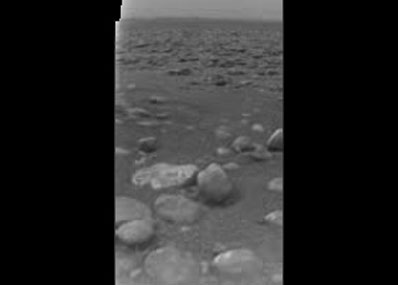
Scientists normally don't like to speculate when examining data. But in this article at SpaceflightNow.com, Torrance Johnson, a member of the NASA Cassini imaging team, can't speculate enough abou interpreting the first picture from Titan. First we are told that "researchers expected Huygens to find a truly alien landscape under the smoggy haze. They got what they wanted." Then Johnson says,
"Surprises are always the things that get you."
Earth to Tor: There are no surprises here. We're seeing pretty much exactly what we expected to see. Apparently Johnson did a few more bong hits and then proclaimed that the first picture from the surface showed a field of ice boulders that exhibited signs of weathering and erosion. Cool.
Unfortunately, updated information indicates that the objects in that picture are only a few inches across: not much more than pebbles, really. Way to go there, Tor.
Notice that Tor Johnson (wasn't that the name of the guy in those Ed Wood movies?) works for NASA, not the ESA. This is significant only in that CBS would rather speak to an American than one of the ESA project scientists. Odds are CBS didn't even realize the Huygens probe wasn't a NASA/JPL program. I see 3 possibilities:
1. Tor Johnson was paid by CBS to speculate on the pictures and, with NASA's blessing, spewed forth with his uneducated opinion on what they showed and unremarkable insight on scientific discovery.
2. Tor Johnson is talking out his ass.
3. Tor Johnson was stoned when he made his comments.
More than one may be true. To me the only surprise is that it's so hard to identify anything at all on the ground with certainty from the mosaic taken at around 8,000 meters altitude. Are the light areas ice, clouds or fog? Are the dark areas liquid or frozen flats?
I hope there is enough data returned to answer these questions after it's been examined by scientists more informed than Torrence Johnson. Where is the panorama mosaic taken from 1,000 meters up? I've posted on this subject before. The Huygens probe was a waste IMO because it wasn't designed to return enough useful data to make a significant difference in what we already know about Titan. I hope I'm wrong, but when all is said and done I predict we won't have any really new information about Titan other than an atmospheric wind speed and temperature profile. We all want hard scientific data, true, but the public at large that pays for these things wants PICTURES, DAMMIT! And lots of them.
Score:
Cassini 24,000
Huygens 3
Tor 0 -
What is Torrence Johnson smoking?
Scientists normally don't like to speculate when examining data. But in this article at SpaceflightNow.com, Torrance Johnson, a member of the NASA Cassini imaging team, can't speculate enough abou interpreting the first picture from Titan. First we are told that "researchers expected Huygens to find a truly alien landscape under the smoggy haze. They got what they wanted." Then Johnson says,
"Surprises are always the things that get you."
Earth to Tor: There are no surprises here. We're seeing pretty much exactly what we expected to see. Apparently Johnson did a few more bong hits and then proclaimed that the first picture from the surface showed a field of ice boulders that exhibited signs of weathering and erosion. Cool.
Unfortunately, updated information indicates that the objects in that picture are only a few inches across: not much more than pebbles, really. Way to go there, Tor.
Notice that Tor Johnson (wasn't that the name of the guy in those Ed Wood movies?) works for NASA, not the ESA. This is significant only in that CBS would rather speak to an American than one of the ESA project scientists. Odds are CBS didn't even realize the Huygens probe wasn't a NASA/JPL program. I see 3 possibilities:
1. Tor Johnson was paid by CBS to speculate on the pictures and, with NASA's blessing, spewed forth with his uneducated opinion on what they showed and unremarkable insight on scientific discovery.
2. Tor Johnson is talking out his ass.
3. Tor Johnson was stoned when he made his comments.
More than one may be true. To me the only surprise is that it's so hard to identify anything at all on the ground with certainty from the mosaic taken at around 8,000 meters altitude. Are the light areas ice, clouds or fog? Are the dark areas liquid or frozen flats?
I hope there is enough data returned to answer these questions after it's been examined by scientists more informed than Torrence Johnson. Where is the panorama mosaic taken from 1,000 meters up? I've posted on this subject before. The Huygens probe was a waste IMO because it wasn't designed to return enough useful data to make a significant difference in what we already know about Titan. I hope I'm wrong, but when all is said and done I predict we won't have any really new information about Titan other than an atmospheric wind speed and temperature profile. We all want hard scientific data, true, but the public at large that pays for these things wants PICTURES, DAMMIT! And lots of them.
Score:
Cassini 24,000
Huygens 3
Tor 0 -
First photo from the surface!!!
-
Second pic - from the surface
Until it gets
-
16km - Drainage Channels flowing to psbl shoreline
"The first image shows what appear to be drainage channels flowing to a possible shoreline, the camera's scientist says."
http://www.spaceflightnow.com/cassini/050114pic1.h tml
Very cool. Wish my seven year old was at work with me to share this science moment with him. -
First Images...