Slashdot Mirror
Domain: spacex.com
Stories and comments across the archive that link to spacex.com.
Comments · 425
-
Shuttle costs in context of other space activities
There's an interesting post over on Clark Lindsay's RLV and Space Transport News, part of which I've pasted below:
http://www.hobbyspace.com/nucleus/index.php?itemid =894
* Florida Today points out that "In the past three years, Congress has given the [Shuttle] program $13 billion, and all that money has resulted in just two flights". Sword of Damocles: NASA must safely launch the space shuttles this year, or the program wont survive - Florida Today - Feb.5.06.
To put that into perspective:
* Elon Musk has spent about $100M so far on developing the line of SpaceX Falcon launchers. The first Falcon 9 launch is scheduled for 2007. He hasn't said how much more money it will take to reach that launch but I doubt it could be more than another $100M.
* Kistler says it needs a few hundred million dollars to finish its fully reusable two stage K-1 vehicle.
* T/Space said it can build a CEV system capable of taking crews and cargo to the ISS for around $500M.
* LockMart once promised to build the VentureStar for $6B. If they had a 100% overrun that would still be less than $13B. -
Shuttle costs in context of other space activities
There's an interesting post over on Clark Lindsay's RLV and Space Transport News, part of which I've pasted below:
http://www.hobbyspace.com/nucleus/index.php?itemid =894
* Florida Today points out that "In the past three years, Congress has given the [Shuttle] program $13 billion, and all that money has resulted in just two flights". Sword of Damocles: NASA must safely launch the space shuttles this year, or the program wont survive - Florida Today - Feb.5.06.
To put that into perspective:
* Elon Musk has spent about $100M so far on developing the line of SpaceX Falcon launchers. The first Falcon 9 launch is scheduled for 2007. He hasn't said how much more money it will take to reach that launch but I doubt it could be more than another $100M.
* Kistler says it needs a few hundred million dollars to finish its fully reusable two stage K-1 vehicle.
* T/Space said it can build a CEV system capable of taking crews and cargo to the ISS for around $500M.
* LockMart once promised to build the VentureStar for $6B. If they had a 100% overrun that would still be less than $13B. -
COTS
-
Millenium Falcon
This rocket (the whole family) was named Falcon after Millenium Falcon. See http://www.spacex.com/media21.php That's what happens when geeks go into space business. Go, Falcon, go!
-
Lots of private ventures...
... you just havent looked hard enough:
xcor
blue origin (Jeff Bezos, Amazon)
spaceX
Armadillo Aerospace (John Carmack)
(Not mentioning the obvious: Virgin Galactic and Scaled Composites.)
And don't forget about America's Space Prize a $50 million dollar prize for the development of a reusable vehicle to service http://www.bigelowaerospace.com/">Bigelow Aerospace's inflatable space hotel. (Robert Bigelow owns the "Budget Suites of America" hoetl chain). Several contendors for the prize at the moment.
And actually the american government is quite progressive on commercial space travel. They have an office: the office of Commercial Space Transportation. They actually recently put out a 120+ page proposal on regulations for human spaceflight, open for suggestions from the "players". Revisions are being suggested from companies and actually heeded. The system is working quite well.
Just from discussing it with customers of mine (who pay $150,000 for a week in Vegas for 2 people, what's $150,000 to hit space?), I bet there are at least 100,000 people in the world who would pay $50,000 to travel.
I've read studies that have similar numbers of people willing to pay bigger dollar amounts. The market is there; thats why the companies listed, among others, are working on a solution.
For anyone who has done more research than I could, what are the obstacles to private research? There's a market, there's a will, so there must be a way. Who is putting the kibosh on it?
Money. Gotta get those venture capitalists to see the vision. There are safer investments than human space travel. The companies that are most likely to succeed are the ones that are self-funded (see the ones with big names next to them) or the ones that handle both commercial and govenment contracts (for example, Xcor does government research, and spaceX does government launches. It pays the bills and bolsters investor confidence.)
-everphilski- -
Re:Disappointed
It's a little disconcerting that a "structural" problem would be found only 15 minutes before the launch. The only thing I can think of off hand that makes sense is something related to fueling the rocket.
Actually, the problem was in draining the rocket. From the official update page:
Due to high winds, we placed the countdown on hold and began draining the fuel tank. As we drained fuel from the 1st stage tank, a faulty pressurization valve caused a vacuum condition in the tank. This caused a fuel tank barrel section to deform and suck inward. It is important to note that the root cause is an electrical fault with a valve, not structural design. -
Re:Excellent idea
There are lots of companies out there developing commerical launch systems. http://www.spacex.com/ http://www.kistleraerospace.com/ http://www.garvspace.com/ http://www.zigaero.com/
-
Real information, as of 0018 GMT
Is linking to a page about a launch which hasn't happened yet, in a language that most slashdotters can't even read, some kind of sick prank? In any case, as of now (0018 GMT, 4:18 PM PST), the launch has been delayed a couple of times today. The first delay was due to overcast skies (they were afraid of possibly generating a lightning strike with the rocket plumes), and the current delays are due to problems with their liquid oxygen fuel boiling off during the first delay.
Here are some good sources of up-to-the-minute coverage:
* Spaceflight Now's Falcon 1 Mission Status Center
* Liveblogging by Out of the Cradle
* Liveblogging by space reporter Michael Belfiore
* SpaceX's official launch info (good info, but not updated as often as other sources)
They just got an extension on their launch window, and are still hoping to launch today (5pm PST at last report).
I've been eagerly awaiting this launch for the past couple of years. If it succeeds, it's going to change everything. Although their first rocket is relatively small, they're already working on much larger successors, all at a selling price which is a small fraction of their competitors'. Drastically cutting launch costs, increasing the launch rate, and enhancing space accessibility is crucial to SpaceX founder Elon Musk's long-term goal: helping humanity become a spacefaring civilization.
If it doesn't succeed, well, Musk has stated that he can afford up to three consecutive launch failures before calling it quits.
The following have some more background info on what Elon Musk is trying to achieve with SpaceX:
* Hopes of Start-Up Rocket Company Are Riding on First Launch (LA Times)
* SpaceX wikipedia article
* Big Plans for SpaceX (The Space Review, discusses plans for human spaceflight and building world's largest rocket engine)
* Shooting the Moon (Discover Magazine)
* -
Real information, as of 0018 GMT
Is linking to a page about a launch which hasn't happened yet, in a language that most slashdotters can't even read, some kind of sick prank? In any case, as of now (0018 GMT, 4:18 PM PST), the launch has been delayed a couple of times today. The first delay was due to overcast skies (they were afraid of possibly generating a lightning strike with the rocket plumes), and the current delays are due to problems with their liquid oxygen fuel boiling off during the first delay.
Here are some good sources of up-to-the-minute coverage:
* Spaceflight Now's Falcon 1 Mission Status Center
* Liveblogging by Out of the Cradle
* Liveblogging by space reporter Michael Belfiore
* SpaceX's official launch info (good info, but not updated as often as other sources)
They just got an extension on their launch window, and are still hoping to launch today (5pm PST at last report).
I've been eagerly awaiting this launch for the past couple of years. If it succeeds, it's going to change everything. Although their first rocket is relatively small, they're already working on much larger successors, all at a selling price which is a small fraction of their competitors'. Drastically cutting launch costs, increasing the launch rate, and enhancing space accessibility is crucial to SpaceX founder Elon Musk's long-term goal: helping humanity become a spacefaring civilization.
If it doesn't succeed, well, Musk has stated that he can afford up to three consecutive launch failures before calling it quits.
The following have some more background info on what Elon Musk is trying to achieve with SpaceX:
* Hopes of Start-Up Rocket Company Are Riding on First Launch (LA Times)
* SpaceX wikipedia article
* Big Plans for SpaceX (The Space Review, discusses plans for human spaceflight and building world's largest rocket engine)
* Shooting the Moon (Discover Magazine)
* -
Re:Probably still not enough of a wake up callHow does the cost of NASA compare the amount squandered on the military?
NASA is much smaller. Note that some view the money spent on NASA as "squandered". I see value in what NASA does, but I do feel it's a very inefficient organization in some areas (manned space flight being the worst). Now we have the ISS doing nothing useful for 5 or so years... Yeesh that thing is a white elephant.
If Bush were serious about interplanetary flight he'd start construction of a nuclear powered space-only ship, with a hefty lander, using ISS as the assembly plant. I'm pretty sure we could build a low-thrust nuclear design that'd get to Mars in a few weeks rather than many months. That would greatly change the equation in many ways, and would show the utility of the space station concept. It would even make Mars colonization practical.
SpaceX is doing some great things, and shows the power of private ownership to lower costs. Their newest design, Falcon 9, is impressive with an ability to loft 24 metric tons at a time into LEO, at only $78 million a shot. You could build a massive interplanetary craft with just a few shots... I can't see this approach costing "hundreds of billions of dollars", but then again I'm not a government expert at inflating costs.
Of course our Luddite anti-nuclear "friends" would scream bloody murder about the Mars ship being nuclear, so it won't happen anytime soon, IMO.
-
Re:Eh, well, it's a matter of scale
Perhaps we'll soon have more private companies like SpaceX ready at a moments notice with their latest rocket, straight off the production line. Currently they have to wait on major governnment contractors like boeing to launch their rockets, which has meant months and months of delays for them. They eventually built their own launch complex in the middle of the pacific, so that they aren't tied down by the current state of things. I think the politics of space travel are going to change in the next few years, with certainty, because they have a production schedule and they don't disappoint with unnecessary hype, at least they haven't yet.
-
Re: SpaceX
www.spacex.com - not to be confused with the x-prize competition.
-
NASA and Commercial ISS Transport
It's worth noting that NASA has also previously announced that they will be offering commercial contracts to US companies for transportation of cargo and eventually crew to the ISS. These would be fixed-cost contracts for services rendered, rather than the more traditional cost-plus contracts which reward inefficiency and waste. Unfortunately, none of the US companies are where they need to be yet, although it's looking like SpaceX should be there in a few years.
From this article:
NASA will soon solicit offers from firms interested in delivering cargo and crew to the international space station (ISS), but NASA Administrator Mike Griffin said he wants to buy services, not dole out development contracts to newcomers who were shut out of the competition to build the space shuttle's replacement.
Griffin said he also would like to see a robust commercial space transportation industry take root and thrive, and said the best way for NASA to help is "to utilize the market that is offered by the international space station's requirement to supply crew and cargo as the years unfold."
Griffin promised that NASA would give priority to non-government services should they become available, although he cautioned that deliberately "under utilizing" a NASA-owned and -operated system could encounter resistance from lawmakers intent on protecting government jobs.
Another difference between a traditional government contract and the deals Griffin hopes to make is that they would emphasize "performance rather than process." While NASA would insist on "certain standards," Griffin said "It's not up to me as the procurer of that service to determine how the engineers working for you, the provider, provide that service."
Charles Miller, president of Constellation Services International, said he was "enthusiastically looking forward" to NASA's crew and cargo solicitation. Constellation Services Internationals, Woodland Hills, Calif., is developing what it calls the LEO (low Earth orbit) Express standardized cargo container, which could launch atop virtually any rocket, as an affordable, near-term solution to NASA's space station re-supply needs.
Elon Musk, president of Space Exploration Technologies, said he was "definitely encouraged" by Griffin's remarks. "This is a market SpaceX has been interested in for a long time," Musk said. -
What about SpaceX?
Buying Soyuz when SpaceX is here? Oh, wait, can't actually admit that commercial is 7% the cost of NASA efforts, now can we.
http://www.spacex.com/
I'm going to assume this is more bozorific NASA politics unless someone can explain why they won't use SpaceX for this job. -
Re:Gosh, real science over in Japan
You didn't look at SpaceX did you? Try this link:
http://www.spacex.com/ -
Re:Article text14,000 pounds (9,500 kilograms) to Low Earth Orbit (LEO) in its medium configuration and 35,000 pounds (25,000 kilograms)
What unit is that? A pound normally is around 0.454 kg
Reading the announcement at http://www.spacex.com/, I see:
21,000 lbs (9,500 kg) to Low Earth Orbit (LEO) in its medium configuration and 55,000 lbs (25,000 kg) -
Re:I think SpaceX must be compensating for somethiI guess their problem is that existing clients have satellites which are too big for their current launchers, so they cannot capture that market. Their new designs at 9650kg to GTO max put them right there with the big boys, including Ariane 5 ECA and most EELVs. The 3400kg for the smallest Falcon 9 is respectable, although it could be better. I suppose they tried to make the Falcon 9 base smaller because, as announced, they intend to reuse its first stage for Falcon 5 with less engines.
I will hold my breath until they have a successful Falcon I launch however.
-
Re:A Better Question Is:You have no idea exactly what constraints most government institutions outside the defense sector, starved of healthy revenue by a hostile administrative regime, have, do you?
Are you implying NASA budgets have dropped? They haven't...
Further, NASA suffers from the same problems many government bureaucracies fall into...slow to react, inneffectual, and slow to innovate. There is little sense of urgency for many government employees, at all levels.
This is laughable. What are you speaking of is pure insider speculative pork. We know that the lowest bidder would inevitably produce a lower-quality product; and the average government contract usually guarantees a number of things which include payment on cost overruns and the like.
You're describing the CURRENT situation with NASA. Private industry already manufactures everything for the government. What it doesn't do is manage the actual use of the items once manufactured. Whatever they get they already get from the lowest bidder, unless they jump through elaborate hoops. I hope SpaceX and other such enterprises do really well and start to make space flight truly cost effective.
NASA still has a purpose, pure R&D. It's time to put commercially viable portions of space flight such as satellite (and later, heavy payload) launches in the hands of private enterprise. I predict it'll be the beginning of a big space boom if things go in that direction.
-
escape velocity for microsatellites with ion drive
I think somebody needs to develop an ion engine for micro-satellites, then universities may be able to afford rockets like the spacex falcon1 which puts their satellite into low-earth orbit, where it uses the ion engine to build up its speed for escape velocity. Perhaps this is the next "killer app" for these private space enthusiasts. So far JPL is the only place to find a highly efficient ion engine. They just came up with a high efficiency, high-power design for project prometheus. Ion engine micro-satellite, watch for them.
-
Re:Launching
I'd give very, very serious thoughts to trading both nuts to work in his shop.
In case you were serious, both Scaled and Virgin Galactic are hiring, as are Blue Origin, Bigelow Aerospace, and SpaceX:
http://www.scaled.com/careers/
http://www.virgingalactic.com/jobs.asp
http://www.blueorigin.com/jobs.htm
http://www.spacex.com/index.html?section=careers&c ontent=http%3A//www.spacex.com/careers.php
http://www.bigelowaerospace.com/employment.html -
Stick with the old design
Yeah I say we just use the cheapest designs. 30 years ago they had guys sitting at a station monitoring the reactor, Homer Simpson style. From what I've read, both Chernobyl and Three Mile Island could have been prevented with better sensors. Three mile island didn't coolant leak and nobody knew about it or something? Sounds like the reactor designs are perfectly fine, it's just a matter of using the latest technology to make it cheaper and safer at the same time, like Elon Musk is doing with his SpaceX company.
-
Sounds like they need to bring out "Big Gemini"
In case you never have heard about this program, this is the Big Gemini or Gemini II Project that was proposed to NASA right at the end of the original Gemini missions. You can also see the "real thing" that was built as part of a full-scale mock-up.
There was another "failed" hold over from the pre-Shuttle days called Apollo II as well, that was essentially a beefed up Apollo capsule that could hold up to seven passengers and crew. Basically the current crew load of the Shuttle. Trying to build on the Apollo technology, it would also incorporate some of the ideas that also developed from Gemini. Keep in mind that despite the fact that the Apollo capsules went to the moon later, the Gemini program was in some ways a more advanced program than the Apollo system... in part because it was built with newer technologies.
One of the reasons why Gemini is getting another look today is because the standard two-person version can fit on top of the Falcon V, and make a base design for an orbital vehicle. The Falcon V is going to be man-rated, and a bit cheaper than the Russians are able to put somebody up into orbit. Plus (for those that care), SpaceX is an American company, avoiding the political issues of going to Russia for at least American companies or tourists.
A beefed up Falcon V (Falcon X?) could in theory be able to launch seven astronauts at once. Certainly at a substantial fraction of the price for a single shuttle launch, and to the same orbit. -
Re:My memories
I'll take Burt hands down. I'm never gonna make it to the ISS, Burt maybe I have a chance to at least get in to space for a reasonable price.
Burt Rutan is cool and all, but as far as inexpensive commercial orbital spaceflight goes, I suspect Elon Musk's SpaceX is going to be first. They've already announced their intent to compete for America's Space Prize. -
Re:Just deorbit the barrel of pork...
SpaceX can't get humans to the orbit.
Yet.
Falcon V (currently under construction) will be man-rated and fully capable of carrying a capsule-type spacecraft which can reach and dock with ISS. Manned spaceflight is a stated long-term goal of SpaceX (http://www.spacex.com/updates.php). -
Just deorbit the barrel of pork...
...and kill the shuttle too. Seriously. The international space station is useless pile of orbiting pork. It represents how the US subsidizes industry. No real science gets done up there. The last few years it had only a skeleton crew, barely sufficient for maintenance work.
Kill it. Kill it now. It will free up tens of billions. The shuttle flights alone are $500-800 million a pop. Put the money into real space science and development of cheap launch systems.
Oh wait! Looks like http://www.spacex.com/ is already doing the latter. With private money. Why not go with them? Well, cause that robs the US of an instrument of industrial policy: order way-too-expensive space systems from Boeing and blame the Europeans for subsidizing Airbus.
-
Re:Can someone explain to me...
Actually the cost of sending one 25 ton payload into space is cheaper than 5 5ton payloads into space.
Let's do the math.List price of a SpaceX Falcon V launch vehicle, with 5.5 ton payload to International Space Station orbit:
$16 million
Estimated / planning price for a Delta IV Heavy launch, with payload of 22 tons or so to space station orbit...
$280 million
4 x $16 million = $64 million
1 x $280 million = $280 million$64 million is a little bit less than $280 million
The only caveat here is that Falcon V hasn't flown yet and Delta IV Heavy has flown once, with a moderate non-catastrophic failure.
-
About the name
Anyone else wondering if it's named that because of the Millenium Falcon?
According to this press release, the name of the Falcon I is indeed a tribute to Han Solo's spacecraft. -
Re:checking my online bank account...Nowhere does SpaceX claim to be building to Man-rated specs on their Website under the Falcon V info.
From here:
In addition to the existing Falcon I and V features, Musk said SpaceX has "a long-term interest" in making the Falcon V upper stage and the first stage recoverable. He has also held formal discussions with NASA about using later versions for manned missions such as to the International Space Station. With that in mind, the avionics and other parameters of the Falcon V will be man-rated from the beginning, Musk said.
I also don't see any capsule system for the Falcon V to hold passengers
That's Bigelow's job. SpaceX will provide the booster, and Bigelow will provide the spacecraft and destination. (read: Inflatable Space Station)
that is not a trivial undertaking as no capsule has been built in the USA since Apollo. We have lost a lot of that know how.
Rubbish. Look at the Lockheed design from yesterday's story. It's nothing more than an advanced and reusable capsule design. In fact, it looks very much like the Big Gemini design which was supposed to be the first reusable capsule.
Not to say they can't get there if they wanted to, but right now Falcon is a low-cost challenge to the current launchers like Delta IV, Arianne, etc.
That's really the trick when it comes down to it. A booster is a booster is a booster. Combining it with the spacecraft only makes for a lot of unnecessary complications. Take the Energia-Buran as an example. The Russians designed it to almost exactly the US Shuttle Specs. *But* they had over a decade of NASA's mistakes behind them, so they made a variety of tweaks to the design. One of those tweaks was to strap the shuttle to a BDB instead of using the whole fuel-tank->engines piping mess. -
Rocket Science is ... Rocket ScienceThe "test firing" URL is particularly interesting with some neat pictures. And for those that think "Rocket Science" is so easy, I thought this quote summerizes it well.
In this process, I think I've come to realize what makes orbital rocket development so tough. It is not that any particular element is all that difficult, but rather that you are forced to develop a very complex product that can't be fully tested in its real environment until launch and, when you do launch, there can be zero significant errors. Unlike other products, there is no chance of issuing a bug fix or recall after liftoff. You are also forced to use very narrow structural safety margins, compared to an aircraft or suborbital rocket, to have any chance of reaching orbit at all and must hit a bull's eye when you do.
-
Re:Finance: Money for Moon Base Unknown
how about we get private corps to build even launch vehicles on their own..
http://spacex.com/
http://en.wikipedia.org/wiki/SpaceX -
Sorry, correct link to SpaceX Corp is...
http://spacex.com. Sorry about that.
-
Re:Good
What we need is a system that has a disposable top, But, a reusable first stage booster assembly. This sounds a lot like the Falcon V[spacex.com], the rocket Bigelow's booked for the launch of his Genesis Pathfinder module.
-
Re:Space: A whole lotta nuthin
The current "going rate" for getting a seat on a Soyuz spacecraft is right now about $20 million USD. And that appears to be going up slightly due to interest by would-be space tourists, as well as the fact that NASA is now buying as many slots as they can until the shuttle program gets going again to keep the ISS up and running.
In comparison, the Falcon V by SpaceX is going to have a price tag of about $16 million USD, which is going to be man-rated. Assuming that an amortized manned payload vehicle is going to cost about that same amount, for the sake of this discussion the total will be about $30 million USD for a manned spaceflight on the Falcon V. With the current discussion that it will be in a configuration of one pilot and four passengers, that ends up being about $8 million USD per passenger.
I think that is a price point that people will be shooting for in the near-term for actual spaceflight to LEO. I don't know what increase in space tourism will result when the cost is lowered by only $10 million, but the key here is that neither NASA nor the Russian government will be able to turn down passengers in this situation.
BTW, $10 million is a figure that is within reason for lottery systems to get a chance to fly in space, as well as for major promotional advertising campaigns. Or four minutes of commercial advertising with the Super Bowl. This is a bit high, but not unreasonbly so, for a corporate research budget, especially if coupled with private space stations that don't have to go through NASA scrutiny and materials with processes that get patent protection.
Mind you, this is for people to be able to get into LEO, not just sub-orbital flight. If Scaled Composites or Armadillo Aerospace can shave the $10 million per passenger per flight figure down even more, there is a huge group of people that could afford to go up for much less. The cost for traveling to the moon would be about double this cost. As Robert A. Heinlein put it, getting to Low-Earth Orbit is halfway to the rest of the solar system.
Assuming huge economies of scale kick in so that a trip to the moon will cost roughly $1 million. That is the amount that an ordinary working person in a 1st world country makes in a lifetime, and the value of some rather ordinary homes in California. If you compared that to what people spent to pay for colonization efforts to the Americas in the 15th & 16th Centuries vs. what ordinary people could afford to pay to travel to the Americas back then, this is very comparable. All that is left for Lunar colonization to be self-sufficient is political will to allow it to happen. And once you have cities on the Moon it will be all but impossible to keep people away from Mars and the asteroids.
This is not just the realm of multi-millionaires, and certainly well within the reach of billionaires just wanting to take an exotic vacation. -
More info on SpaceX
I tried submitting a story on SpaceX a couple of weeks ago, but it was sadly rejected. Here's the text of the submission, along with some other interesting info:
Spaceflight Now has an article on SpaceX, a low-cost space launch company started by PayPal co-founder Elon Musk (he is no longer with PayPal). The article describes SpaceX's small-size Falcon I rocket, scheduled to launch a military imaging satellite on its maiden flight in March, and their medium-size Falcon V rocket, scheduled to lift a prototype Bigelow inflatable space habitat next year. Interestingly, the Falcon V has enough capacity to lift a Gemini-style capsule with 5-6 people to orbit. Both rockets have per-pound launch costs approximately one-fifth that of comparable rockets. Long-term plans call for evolving the basic design to heavy-lift and super-heavy lift rockets, assuming SpaceX survives its legal battles with defense giants like Northrup Grumman. Musk believes that ultimately a launch cost of '$500 per pound or less is very achievable' (compared to $10,000 per pound for the Space Shuttle). Elon Musk is a member of the Mars Society, and started SpaceX after he realized that current launch costs would be a large barrier to his plans for a philanthropic mission to put an experimental greenhouse with food crops on Mars.
This radio interview with Elon Musk from 2001 is pretty neat, and has some information I haven't seen elsewhere. -
Why falcons are cheap..
The reason falcons will be cheap is not because they use cheap components, but because they have a different approach than old defense contractors like boeing and lockheed.
In fact they use very high quality materials such as a titanium thrust frame in the first stage. But they can afford that because the first stage is reusable.
They also try to avoid any hazardous materials like explosive bolts and dangerous chemicals since that makes working with the rocket before launch much safer and thus cheaper. The falcon I is the first rocket that is allowed to fly without an explosive flight termination system because of redundant thrust termination systems. So there is no bomb on board.
Take a look at the falcon launch complex. It is basically just a simple concrete building and a flatbed truck. The satellite is integrated while the rocket is horizontal, so they do not need a huge building for satellite integration.
The launch control center is a truck trailer, so they only need one for all launch pads and do not have all that expensive computer hardware sitting around idle.
Now compare that with the launch complex for the boeing delta IV. There is a vertical integration building for fitting the payload, a huge umbilical tower and all kinds of facilities to handle the huge quantities of liquid hydrogen that the delta IV needs.
The only large rocket that has a comparably clean launch pad like the falcon is the russian/ukrainian Zenit (also used by Sea Launch), which is also the cheapest of its class.
The falcon I will also have a very benign launch environment for the payload. The amount of vibration is much lower than with other rockets since the falcon does not use solids. See the payload users guide for details. -
Why falcons are cheap..
The reason falcons will be cheap is not because they use cheap components, but because they have a different approach than old defense contractors like boeing and lockheed.
In fact they use very high quality materials such as a titanium thrust frame in the first stage. But they can afford that because the first stage is reusable.
They also try to avoid any hazardous materials like explosive bolts and dangerous chemicals since that makes working with the rocket before launch much safer and thus cheaper. The falcon I is the first rocket that is allowed to fly without an explosive flight termination system because of redundant thrust termination systems. So there is no bomb on board.
Take a look at the falcon launch complex. It is basically just a simple concrete building and a flatbed truck. The satellite is integrated while the rocket is horizontal, so they do not need a huge building for satellite integration.
The launch control center is a truck trailer, so they only need one for all launch pads and do not have all that expensive computer hardware sitting around idle.
Now compare that with the launch complex for the boeing delta IV. There is a vertical integration building for fitting the payload, a huge umbilical tower and all kinds of facilities to handle the huge quantities of liquid hydrogen that the delta IV needs.
The only large rocket that has a comparably clean launch pad like the falcon is the russian/ukrainian Zenit (also used by Sea Launch), which is also the cheapest of its class.
The falcon I will also have a very benign launch environment for the payload. The amount of vibration is much lower than with other rockets since the falcon does not use solids. See the payload users guide for details. -
Re:Isn't this just an RD-180 in disguise?
Just how is their Merlin engine different from the Russian RD-180?
Other than being completely different?
Such as 10 times smaller?RD-180:
RD-180 info at astronautix.com
Propellants: Lox/Kerosene
Thrust(vac): 423,050 kgf.
Thrust(vac): 4,152.00 kN.
Isp: 338 sec.
Isp (sea level): 311 sec.
Burn time: 150 sec.
Mass Engine: 5,393 kg.
Diameter: 3.00 m.
Length: 3.56 m.
Chambers: 2.
Chamber Pressure: 257.00 bar.
Area Ratio: 36.87.Oxidizer to Fuel Ratio: 2.72. Country: Russia/USA.
Status: Hardware.
First Flight: 1999Merlin:
SpaceX page on Merlin via flash link
Sea Level Thrust 71,500 lb
Vacuum Thrust 85,000 lb
Sea Level Isp 261
Vacuum Isp 310
Thrust to weight (fully accounted) 94 -
Re:Big rockets?
I think he's actually spending a pretty modest amount on development. From an older interview:
While Musk said he is not the company's sole backer, he said he is prepared to fund the development of the Falcon LV entirely out of his own pocket if he has to. He declined to say exactly how much he expects to spend developing the rocket, only that the figure will be "in the tens of millions" of dollars. -
Re:SpaceExEven better.
It's not even the right name for the company.
See www.spacex.com
Someone's got an itchy E key.
-
How to get back to the moon: t/Space
Back in September, NASA selected 11 companies to conduct preliminary concept studies for human lunar exploration and the development of the NASA's Crew Exploration Vehicle. Many of these are your typical aerospace dinosaurs, but a notable exception is t/Space, a new company which includes people like Burt Rutan (of Scaled Composites and SpaceShipOne), Elon Musk (of SpaceX), Red Whittaker (of the Red Team, which constructed an autonomous vehicle which competed in DARPA's Grand Challenge), and several of the new companies in the budding private space industry.
According to their page: Our core mission requirement is to enable prompt, affordable, safe and sustainable lunar exploration and development by the largest possible number of Americans, both in person and via telepresence.
Under our approach, government incentives focus exclusively on top-level goals, with technology and operational choices left to the private sector. The government incentives will be matched to specific top-level needs, but the "invisible hand" of market forces will shape choices as they flow down multiple supplier chains. Incentives will be structured so that several companies in each major area have an opportunity to win this support. With this competitive industrial base, two major processes become possible:
* Market forces will continually launch new products that replace established goods and services (the "creative destruction" that Joseph Schumpeter [Austrian economist 1883-1950] identified as the key element of capitalism). Poorly performing systems will be killed off quickly via competition rather than via burdensome NASA reviews or Congressional intervention.
* Capability gap analyses will be performed by dozens and ultimately hundreds of companies on a continuous basis. As happens now in all competitive industries, the successful companies will be those who listen closely to their customers and accurately predict their future needs - in other words, capability gap analysis by multiple independent profit-seekers.
Commercial firms will create and own infrastructure that offers services that overlap in many cases. The overlaps found in a competitive private space economy will provide the resiliency now lacking in single-string solutions such as the Space Shuttle and Space Station, for which there are no ready alternatives. While functional overlaps are viewed as inefficiencies in centrally-planned systems, in a market-based system they drive costs lower (by reducing monopoly power and spurring innovation) and accelerate schedules (by eliminating single-point bottlenecks among suppliers and spurring competition).
If I understand correctly, tSpace's plan is to design an overall space architecture, and have companies compete for different components, whether they be launch vehicles, space station life support modules, or lunar landers. Many of these components will also be available commercially, keeping the price down and the reliability high. I suspect it's going to be difficult to keep from being eaten alive by the huge aerospace companies (Boeing, Lockheed, etc.), but I have a hope that they'll somehow end up getting the contract and end up completely reforming our approach to space.
I highly recommend reading through their presentation. The things they discuss are quite insightful, and they have some incredible ideas. Here's a few of their points:
Safety results from design choices, not oversight
* Attempting to produce safety by inspection, quality control, -
Rutan and orbit; SpaceX
In the recent Discovery Channel documentary, "Black Sky: The Race for Space," Burt Rutan revealed one of his preliminary designs for an orbital craft. Basically, it looked like SpaceShipOne, except it had a huge rocket roughly twice it's length sticking out its rear. I'm guessing Rutan has some tricks up his sleeve to deal with the reentry issue.
However, I'm not sure if we'll see Rutan launching such an orbital craft in time for this prize. From a recent speech he gave:
I put out there that before I die I want to see affordable travel to the Moon, that's essentially where I'm going. What I mean by affordable is not what Houston talks about affordable; I'm talking about where a third of the people in this room can afford to go to the Moon when I finally kick off. That's my vision.
Now, when you do that, you can draw a schedule back to show this above low Earth orbit stuff, and this low orbit stuff, and this suborbital stuff. Tier One is suborbital manned spaceflight, Tier Two is low Earth orbit manned spaceflight, and Tier Three is what we do above low Earth orbit, and it does have to start very soon after we have affordable Earth orbit stuff. I drew a schedule for all of that about three and a half months ago, and I decided what had to happen at every point to get to that. As of the 27th of September, I'm already six months ahead three months into the schedule. I did not think that there would be a major investment by a major guy who can and will do it. Can anyone here think of a better guy that will actually go out and build a spaceline [than Richard Branson]? I couldn't.
Can anyone here think of a better guy that will actually go out and build a spaceline [than Richard Branson]? I couldn't.
I could move directly on to orbital ops from a research standpoint, but I decided that since I didn't seem to have a real close competitor to the X Prize, that maybe I ought to stay with suborbital and make damn sure that there's a successful, certified, safe system out there flying many passengers every day suborbitally before I lose interest in it and go on to orbital. And that's what I'm going to do. Is it going to be tough? Yeah, there's some tough things. Are the regulatory issues going to be tough? Yeah. But I'm not as scared of that program that is in front of me right now as I was scared of the SpaceShipOne program that was in front of me in 2001.
Personally, I'm guessing that to win this prize somebody will end up designing a capsule to launch on SpaceX's reusable Falcon V rocket, which, starting next year, will be launching 4200kg payloads (enough for a manned capsule) to orbit for $12 million. -
Rutan and orbit; SpaceX
In the recent Discovery Channel documentary, "Black Sky: The Race for Space," Burt Rutan revealed one of his preliminary designs for an orbital craft. Basically, it looked like SpaceShipOne, except it had a huge rocket roughly twice it's length sticking out its rear. I'm guessing Rutan has some tricks up his sleeve to deal with the reentry issue.
However, I'm not sure if we'll see Rutan launching such an orbital craft in time for this prize. From a recent speech he gave:
I put out there that before I die I want to see affordable travel to the Moon, that's essentially where I'm going. What I mean by affordable is not what Houston talks about affordable; I'm talking about where a third of the people in this room can afford to go to the Moon when I finally kick off. That's my vision.
Now, when you do that, you can draw a schedule back to show this above low Earth orbit stuff, and this low orbit stuff, and this suborbital stuff. Tier One is suborbital manned spaceflight, Tier Two is low Earth orbit manned spaceflight, and Tier Three is what we do above low Earth orbit, and it does have to start very soon after we have affordable Earth orbit stuff. I drew a schedule for all of that about three and a half months ago, and I decided what had to happen at every point to get to that. As of the 27th of September, I'm already six months ahead three months into the schedule. I did not think that there would be a major investment by a major guy who can and will do it. Can anyone here think of a better guy that will actually go out and build a spaceline [than Richard Branson]? I couldn't.
Can anyone here think of a better guy that will actually go out and build a spaceline [than Richard Branson]? I couldn't.
I could move directly on to orbital ops from a research standpoint, but I decided that since I didn't seem to have a real close competitor to the X Prize, that maybe I ought to stay with suborbital and make damn sure that there's a successful, certified, safe system out there flying many passengers every day suborbitally before I lose interest in it and go on to orbital. And that's what I'm going to do. Is it going to be tough? Yeah, there's some tough things. Are the regulatory issues going to be tough? Yeah. But I'm not as scared of that program that is in front of me right now as I was scared of the SpaceShipOne program that was in front of me in 2001.
Personally, I'm guessing that to win this prize somebody will end up designing a capsule to launch on SpaceX's reusable Falcon V rocket, which, starting next year, will be launching 4200kg payloads (enough for a manned capsule) to orbit for $12 million. -
This is a setup for SpaceX
This prize appears custom-tailored for a win on a Falcon V, a new rocket aiming for first flight in 2005 carrying a Bigelow Aerospace test module. The Falcon V is manufactured by SpaceX, Elon Musk's new rocket firm. Assuming that the Falcon V is a successful rocket, all of the prize rules are within the design capabilities of the Falcon V.
This appears to be part of Bigelow's demonstration to Musk that he will have a sufficient private market should Musk invest in designing a capsule plus ground infrastructure. Look at it as $50 million cash plus hundreds of millions in solid follow-on business. The prize reduces the risk of Musk's business case, which is important since the technical challenges of a capsule are certainly non-trivial. -
This is a setup for SpaceX
This prize appears custom-tailored for a win on a Falcon V, a new rocket aiming for first flight in 2005 carrying a Bigelow Aerospace test module. The Falcon V is manufactured by SpaceX, Elon Musk's new rocket firm. Assuming that the Falcon V is a successful rocket, all of the prize rules are within the design capabilities of the Falcon V.
This appears to be part of Bigelow's demonstration to Musk that he will have a sufficient private market should Musk invest in designing a capsule plus ground infrastructure. Look at it as $50 million cash plus hundreds of millions in solid follow-on business. The prize reduces the risk of Musk's business case, which is important since the technical challenges of a capsule are certainly non-trivial. -
More info on Bigelow inflatable modules
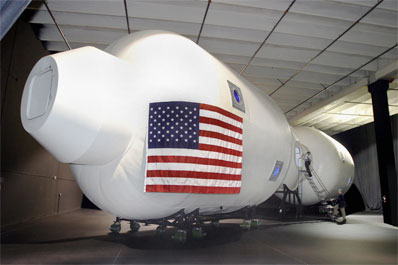
The submission was a little sparse on the info, and since I've been following Bigelow Aerospace for a while, I feel obligated to share some more info on it. First off, there's an article with better photographs available here, and a press release here. The founder Robert Bigelow was also the founder of Budget Suites of America, and is applying a lot of the cost-cutting tricks he learned from his previous contracting experience to the aerospace industry. He licensed the Transhab technology from NASA (which had previously had its funding cut), and is subcontracting for things like life support from other companies who already have systems running.
The inflatables themselves (photograph here)are quite interesting, with a docking mechanism designed to attach with either a Russian Soyuz, a Chinese Shenzhou, and/or whatever vehicle comes out of the aforementioned America's Space Prize. A one-third size prototype of the inflatable module will be launched on the maiden flight of SpaceX's Falcon V rocket, which is itself a very interesting vehicle (~3000kg into LEO for $12 million, and the first orbital vehicle designed to be man-rated since the space shuttle). The first full-size inflatable habitat will be up by 2008, and it's planned to have a crew by 2010.
What's exciting about this is that the inflatable modules appear to be designed, built, and have undergone some preliminary tests. The outsides of the modules have withstood projectile impact tests fairly well. Pretty much all that needs to happen now is for them to undergo further tests and be launched. Bigelow's use of multiple contractors for the same part will allow him to ramp up production if there's a demand for it, and sell the inflatable modules for ~$100 million each to whoever wants them.
Regarding the prize itself, I'd actually be quite interested to see if somebody ends up just designing a descent capsule and sticks it on a Falcon V. -
Re:NASA should enterI'd be on Elon Musk's SpaceX. Unlike most private teams, it seems like he already has orbit-capable rockets with launch countracts - and he has a clear vision to geospatial anc escape velocity.
I still find it so cool, how now that Software stopped being high-tech, all the top software visionaries are off doing space programs.
- SpaceX = Elon Musk from PayPal, Zip2
- Armadillo Aero = Carmack from Id
- Blue Origin = Bezos from Amazon.
- Scaled = Allen from Microsoft.
-
www.spacex.com
Check out Space Exploration Technologies. (spacex)Yes, they are the real thing. Wish I could say more except "Magic Dragon".
-
Re:Private enterprise, blah blah...
Name one.
SpaceX -
Falcon, X-Prize and the FutureElon Musk the founder of SpaceX did not start this company to compete for the X-Prize and indeed the Falcon is not even competing for the prize. Instead Elon has loftier goals. After being very successful in the tech world he decided to turn his passsion into reality now that he had the money to do so. But he is a businessman first and foremost. Which means he was not about to dump money into a competition with no real business plan going forward. Instead he researched the market to try and find a niche he could enter. The low end market was needing of a cheap, reliable alternative. So he started SpaceX. To do this he needed to create 'new technology', a leap that would bring the cost down. He appears to have succeeded, we won't know until he has a successful launch. But if he does succeed then he will have brought the cost of launch down and created a market for himself.
While not as lucrative as PayPal which he co-founded, he will have created a legitimate business in an area he is passionate about.
What does this mean for the future? I think when all the X-Prize hype has evaporated people will pay more attention to what SpaceX has developed. Which is cheaper, partly reusable rockets. And although his rockets are not man rated, yet, anyone who knows Elon knows what he wants for the future of space exploration.
-
Re:Armadillo aren't stopping...That's a good example for a goal that _doesn't_ need a prize, because the profit of the returned satellites would be its own prize.
The point of the prizes is to inspire the costly "small steps" to get the technology ready for the absurdly profitible tourism, mining, and "planetary redundancy " for the survival of the human race goals that are the real rewards.