Slashdot Mirror
Domain: tvlicensing.co.uk
Stories and comments across the archive that link to tvlicensing.co.uk.
Comments · 156
-
TV License
No, I'm not from the UK, but I read an official website on this issue. For those of you that are wondering, I'm from the USA. First limit yourself to one TV if you can, this means on VCR DVR or anything else that has an antenna input. If you can, get a black and white TV as these are cheaper. You may also qualify for a university student discount for your license. DON'T skip the license as this could cost you 1,000 POUNDS for a fine. The TV license website is http://www.tvlicensing.co.uk/index.jsp. I'm going off to a different type of college soon, I will spare you the details to keep this post on topic.
-
At least in the US our TV is free too...
I'm surprised you don't have to pay a radio license.
TV Licensing in the UK -
Re:And yet their DRM...
I'd wager there that the BBC is different, but in a slightly different way than you'd expect.
That difference is the £126.50 TV license that any TV-owning UK household has to pay. Hence this is is the reason why content is locked in via country - it's not really free as such, we're paying for it. However, it's damn good money for 365 days a year of TV and full content from their online service (including iMP).
£126.50? It's a bargain. Do I mind that I pay for it? No, not at all... -
Re:When will the rest of the world sign on?
Here's what wikipedia has to say:
"In the United Kingdom, these fees are set by Parliament and go directly to the funding of the BBC, enabling it to run without the need for market competition. The licence fee, initially for radio sets (exempt since 1971), was mandated by the 1904 Wireless Telegraphy Act. The fee was originally 10 shillings (£0.50) and in 2005 was £126.50 for colour TV and £42 for monochrome TV. There are concessions for the elderly (free for over 75s) and blind people (50% off). Only one licence is required per household. It is believed that approximately 5% of TVs are unlicensed. With the BBC's increased worldwide output (including its online services) there has been a debate as to the abolition of the TV licence, which has been denounced as a violation of the freedom to receive information without inteference. Generally, competing television companies favour the licence fee since it means the BBC will not compete with them for advertising or subscriptions. Proper debate of the licence fee is consistently suppressed by the BBC from its own airwaves. Numerous polls show significant public opposition to the fee.
According to the definition of TV receiving apparatus [1], a licence must be obtained for any device which is "installed or used" for receiving broadcasts, which potentially covers devices such as a tuner card in a PC or a portable television. However a television installed and used for some other purpose, such as a closed-circuit monitor, video player or a games console, is exempt provided the owner can demonstrate it is not used for receiving broadcasts.
Enforcement in the UK is provided by Capita Group and the AMV consortium. Capita agents are paid bonuses on the basis of the convictions they secure. AMV is an advertising and public relations agency. Several hundred thousand prosecutions are brought each year. Observations at magistrates court show that a very large proportion of those prosecuted are single women on benefits. Capita maintain a database of all addresses in the country, with electronics retailers being subject to large fines if they do not pass on the addresses of anyone buying television receiving equipment. Addresses with no licence are assumed to have a television, and are subject to repeated threatening mailshots and visits by the enforcement agency. In addition to the database, the BBC claims that electronic detectors are used to pick up the small amount of energy re-radiated by the local oscillator in the tuning circuitry. There is no evidence of any prosecution ever having been brought on this basis of this warrantless electronic surveillance and it is widely suspected that the famous detector vans are no more than mock-ups designed to intimidate viewers. It's open to doubt how well the much advertised detectors would work on a TV tuner card within the electrically noisy Faraday cage enclosure of a PC: the simpler method of calling round and looking for the aerial or an operating television would seem more effective. Note that, since the inspectors are not police officers or any other type of government official, they have no right to enter private property unless invited. Some feel that the scheme is as a regressive tax, in that the very poorest are those least likely to have a licence, and least able to pay the fine for not having a licence. A report ("TV sinners", March 1998) by the National Association of Citizens Advice Bureaux pointed out that failure to pay the fine is the single largest reason for the imprisonment of single mothers. However, supporters of the licence fee claim that it helps maintain a higher quality of programming on the BBC compared to its commercial rivals. Some also claim that it also leads to better programmes on the commercial channels as they seek to draw viewers/listeners away from the BBC's output."
Any other questions should probably be directed here. -
our expensive boxes don't have much to do w/ATSC
The boxes you talk about with analog and such are not ATSC boxes, they're cable boxes. ATSC is pure digital.
As to ATSC being parochial and backwards, don't confuse popularity with superiority. Cheapness of DVB chips is because DVB is popular. But the popularity of DVB no longer means it is superior to ATSC than the popularity of VHS meant it was better than Beta. I do find the 6MHz fixation of ATSC odd, but that's not that big a problem.
And it isn't parochial either. ATSC was created in 1995. DVB-T was ratified in 1997. This falls along the same lines as saying the US is remiss in that we use phones that are incompatible with GSM. What these people don't understand is we had cell phones before GSM. I personally had a cell phone before GSM was activated anywhere in the world. The GSM people deciced to make a new standard that was incompatible with what the Americans had already done. (The US has since created at least 3 digital systems that are compatible with the existing analog setups.) And in this case, it's perhaps a bit of that. The EU could have embraced ATSC, instead they decided to create another new standard, although I can see that leveraging from the previous (satellite only) DVB standards had some value too.
I'm not a fan of SCART. I've used it. It's a standard connector, but I'm not a big fan of it. It's a big connector, a big cable, and even though the connector is standard doesn't mean the device you are attaching to will work anyway! Some device use SCART but only accept (or emit!) composite. That's probably less likely nowadays. Anyway, I know that RCA jacks aren't wonderful either.
US digital (as you see it) is taking off slower because few people use over the air here, and the FCC decided cable systems didn't have to carry the digital versions of TV channels. Cable systems view their digital offerings as premium, and they know customers prefer to use the tuners in their TVs over an external one. It's too bad no one (including the UK) standardized a tuner control interface so you could use an external tuner as easily as built-in one. Actually, I guess we just standardized that stuff with CableCARD in the US, although it isn't taking off.
Where digital has taken off in the US is in satellite. We've embraced that quite well, you just don't see that probably since DTV doesn't use standard boxes (yet).
Thanks for the info on the UK licensing. The website didn't make it clear. I assumed that since there were separate fees for B/W and color that you had to pay per TV. The site just didn't make it clear.
http://www.tvlicensing.co.uk/information -
Re:Before anyone asks..
Actually, it's never been tied to how you use it. Any household containing a device *capable* of receiving TV - including PCs with a TV tuner card - is subject to the license.
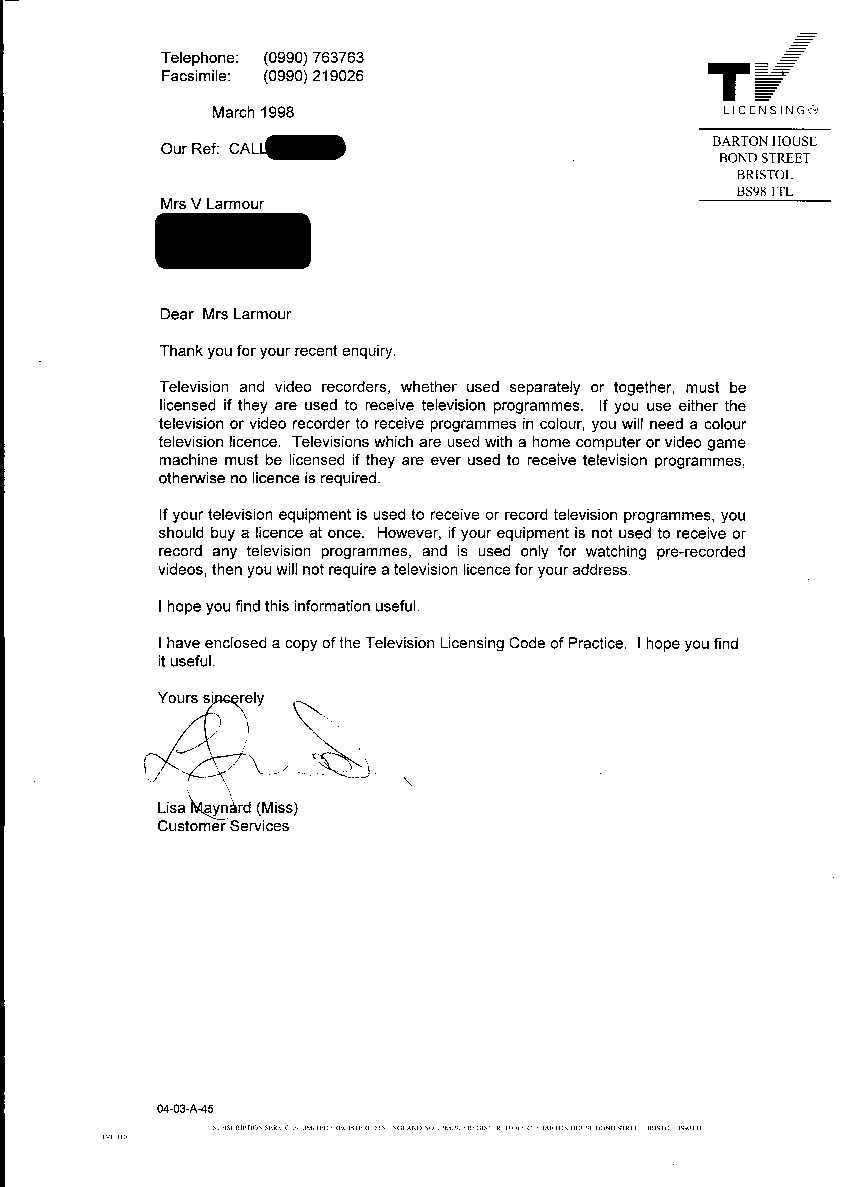
not quite true. if you use a TV tuner card to watch tv, then yes, you need a licence, but the Licence is, or certainly was at the start of last year, only for the use of a TV to watch broadcasts. not purely for the ownership of a device which can watch TV. The TV licencing company don't like to admit it, but here is a quote from their webpage:
http://www.tvlicensing.co.uk/information/index.jsp
"Do I need a licence?
If you use a TV or any other device to receive or record TV programmes (for example, a VCR, set-top box, DVD recorder or PC with a broadcast card) - you need a TV Licence. You are required by law to have one."
look at what they are not saying. they do not say that if you have a device that can record TV then you need a licence. they only say that if you *use* a TV or other device to receive TV then you need a licence.
My best friend used a TV purely for dvd's, xbox and playstation for years and after informing the TV licencing company they left him alone (for about a year, and then hassled him again) and didn't require him to buy a licence.
also note that you do not need to disable the TV tuner in a device either. simple not having it plugged into an aerial is technically enough. I think that detuning channels would be a wise move too
this guy managed to get an admittance of the facts from the TV licencing people
http://www.jifvik.org/tv/tvl1.jpg
dave -
Re:The Beeb
Here you go... it's 126.50 GBP per year, or you can pay monthly by direct debit (which works out a little cheaper).
-
Re:God, Socialism sucks doesn't it?
Wrong. You can have as many colour tvs and radios in your house as you want and just need the one license. If you have multiple properties you need one in each property though. In fact, you don't need a TV license to listen to a radio. Read the FAQs
-
Re:Reason for difference
Now I am living in the apartment and I do not watch TV, usually I see DVD's on my computer but someone told me that if I have the TV, the government do not care if you actually see broadcasting channels, you have to pay... and of course if you get cable tv, you have to pay it (it does not matter that you do not see public broadcasting tv channels)... this sucks! I only want to see DVD's or whatever!
In general, "someone told me" counts for very little. You only need a license if you receive or record TV programmes, however you do need to notify them.
A word of warning though - if you get caught receiving broadcast TV without a license, claiming you are a helicopter doesn't work.
-
Re:Reason for difference
Now I am living in the apartment and I do not watch TV, usually I see DVD's on my computer but someone told me that if I have the TV, the government do not care if you actually see broadcasting channels, you have to pay... and of course if you get cable tv, you have to pay it (it does not matter that you do not see public broadcasting tv channels)... this sucks! I only want to see DVD's or whatever!
In general, "someone told me" counts for very little. You only need a license if you receive or record TV programmes, however you do need to notify them.
A word of warning though - if you get caught receiving broadcast TV without a license, claiming you are a helicopter doesn't work.
-
Re:Reason for difference
Now I am living in the apartment and I do not watch TV, usually I see DVD's on my computer but someone told me that if I have the TV, the government do not care if you actually see broadcasting channels, you have to pay... and of course if you get cable tv, you have to pay it (it does not matter that you do not see public broadcasting tv channels)... this sucks! I only want to see DVD's or whatever!
In general, "someone told me" counts for very little. You only need a license if you receive or record TV programmes, however you do need to notify them.
A word of warning though - if you get caught receiving broadcast TV without a license, claiming you are a helicopter doesn't work.
-
Re:Reason for difference
Actually, if you don't watch any broadcasts (only DVD and so on) you don't need a licence: http://www.tvlicensing.co.uk/gethelp/faqs.jsp?que
s tion=1#link1 -
Re:No, I have not RTFA
FYI:
In the UK, you are required to pay for a TV License (currently £126.50 {$228.14} or just £42.00 {£75.75} for black and white) every year.
From the TV Licensing website:
"If you use a TV or any other device to receive or record TV programmes (for example, a VCR, set-top box, DVD recorder or PC with a broadcast card) - you need a TV Licence. You are required by law to have one." -
Re:In Perspective...
Out of curiosity I looked this up. This is almost unbelievable, but it's true. Information is available at http://www.tvlicensing.co.uk/information/index.js
p it's £126.50 per year for a color TV currently, which amounts to about $224. And if you're blind, you only have to pay 50% to watch TV! -
Re:Parent is troll
my facts beat your anecdote:
Do I need a licence?
-
If you use a TV or any other device to receive or record TV programmes (for example, a VCR, set-top box, DVD recorder or PC with a broadcast card) - you need a TV Licence. You are required by law to have one.
http://www.tvlicensing.co.uk/information/index.jsp #link1 -
Re:the BBC
Yes, they don't rely on money for adverts because if you own a television in Great Britain, you are required to purchase and annually renew a "TV License" that will set you back £126 each year. Click here for more information. Yep, I'm glad I don't live in that country with their sky-high taxes on everything and $8 per gallon gasoline, and the dreaded "value-added tax"! I know it sounds fecitious, but I don't think you get what you pay for when you pay those taxes!
-
Re:yeah.. right..
In the UK, they are required to pay an annual licensing fee per TV that they own, the money of which supports the BBC. Fees are higher for color than B&W TV's. You an find some more information here.
-
Re:Nope, you are wrong.
Tell that to the 20 people thrown in jail in 2003 for not paying the licence and not paying the fine.
Scroll down to page 5. -
Re:HmmmNice troll. For those who are unaware of such things (many are judging by the +4 moderation) the official line can be found on the TV licensing web page: FAQ.
The simple fact of the matter is that if you only use a TV for consoles or DVDs you do not need a license.
-
Re:Nope, you are wrong.
Sorry you are wrong in this believ
From http://www.tvlicensing.co.uk/aboutus/
As a result of The Broadcast Act 1990, the BBC were made responsible for licence administration. TV Licensing is the trading name used by the BBC's agents who collect the licence fee on their behalf.
Over 1200 staff are employed at TV Licensing's main Contact Centres based in Bristol and Darwen in Lancashire.
-
Re:Nope, you are wrong.
TV Licensing staff are like vampires - you have to INVITE them over your threshold, and can also ask them to leave at any time.
See the PDF file linked halfway down this page http://www.tvlicensing.co.uk/aboutus/abouttvlicens ing.jsp/ -
Re:Nope, you are wrong.Oh, for crying out loud.
What if I only use a TV to watch videos/DVDs/as a monitor for my games console? Do I still need a licence?
http://www.tvlicensing.co.uk/gethelp/faqs.jsp
You need to notify us in writing that this is the case and one our Enforcement Officers may need to visit you to confirm that you do not need a licence.
Also: http://www.marmalade.net/lime/ has some interesting information from the other side of the argument.
Not specifically getting stressed at you, cowbutt.. just that practically all the siblings, parents and children to this post are hearsay stated as fact. -
Re:Nope, you are wrong.
You're NOT breaking the law. I think you just made that up. The device has to receive the TV signal. You don't need a license for a computer monitor or a TV which isn't tuned in to any channels. But you do need a "TV" license for ANY device which utilises the TV channels, even if it isn't a TV. Eg you need a licence even if you ONLY have a video and no TV.
The TV licensing website says this:
"If you use a TV or any other device to receive or record TV programmes (for example, a VCR, set-top box, DVD recorder or PC with a broadcast card) - you need a TV Licence. You are required by law to have one." (source) -
Re:Hmmm
you don't need to buy a TV license if
That's wrong, See the official information. I quoteIf you use a TV or any other device to receive or record TV programmes (for example, a VCR, set-top box, DVD recorder or PC with a broadcast card) - you need a TV Licence. You are required by law to have one.
-
Re:Nope, you are wrong.
I always thought the law was "If you have equipment capable of receiving..."
But the BBC says this:
"If you use a TV or any other device to receive or record TV programmes (for example, a VCR, set-top box, DVD recorder or PC with a broadcast card) - you need a TV Licence. You are required by law to have one."
Looks like using one for a DVD player, or your old Commadore 64 would be OK without a licence, the key is "If you use", not "If you have".
You DO need one "If you use" a tuner card in your PC to watch TV, but not if you use it for digitising home movies.
-
Hang about
I thought this was kind of covered already
I don't know quite how they'd do this? I suppose they could tax TV cards at sale, or maybe they can detect the use of the receiving equipment as they currently do. That said maybe they can pick up any CRT display device??
-
Hang about
I thought this was kind of covered already
I don't know quite how they'd do this? I suppose they could tax TV cards at sale, or maybe they can detect the use of the receiving equipment as they currently do. That said maybe they can pick up any CRT display device??
-
Re:Better analogyEven if you never use the Television set for anything more than watching your own DVDs you will have to pay the annual TV-license fee of just over 100 pounds.
If you just use the TV to watch DVD's and don't have an aerial plugged in then they don't make you get a Licence, but you to have to notify them
-
Re:State-run telco services have failed everywhereYou are correct that a government minister sets the fee, but the BBC's agents collect the fee and prosecute non-payers (see tvlicensing). Their operation has a quasi-governmental feel to it I think.
I agree with your second and third paragraphs, and think there is anything wrong with effective governmental provision of public services and infrastructure.
The Texas state law prohibiting municipalities from providing information infrastructure to their citizens serves no interest other than that of big telecom, and seems like an unsustainable violation of the principle of separation of powers. I would like to know how the sponsors of this law try to justify interfering with the relationship between a local government and its citizens.
-
Re:Makes a bit of sense.
Some US
http://www.tvlicensing.co.uk/index.jsp
While the system may make some sense, it was a bit of a surprise to me, finding out how the BBC funded many of the programs I thought were just put out by the govt there as a sort of handout; "we've made this good stuff just for you, no thanks, we don't accept payment, etc".
So, someone who DLs TV shows there, but doesn't own a TV (read: TV License) is taking something he didn't pay (fully) for, and doesn't have a right to use.
But, before I sound too holier-than-thou, I'm still completing my "Father Ted" collection on WinMX.
http://www.fathertedonline.ukf.net/ -
Re:UK TV Licenses
Well you could try Google.
TV licencing press release. Scroll down.
TV licencing FAQ. Slightly rephrased, but essentially identical: If you use a TV or any other device to receive or record TV programmes (for example, a VCR, set-top box, DVD recorder or PC with a broadcast card) - you need a TV Licence. You are required by law to have one.
This information is easily available. If you're going to claim that somebody's "talking bollocks", it doesn't hurt to check your facts first, especially on a matter of law. I realise that it's extremely unlikely that some idiot is stupid enough to actually believe this post and act on it, but spreading misinformation is not particularly productive. -
Re:UK TV Licenses
Well you could try Google.
TV licencing press release. Scroll down.
TV licencing FAQ. Slightly rephrased, but essentially identical: If you use a TV or any other device to receive or record TV programmes (for example, a VCR, set-top box, DVD recorder or PC with a broadcast card) - you need a TV Licence. You are required by law to have one.
This information is easily available. If you're going to claim that somebody's "talking bollocks", it doesn't hurt to check your facts first, especially on a matter of law. I realise that it's extremely unlikely that some idiot is stupid enough to actually believe this post and act on it, but spreading misinformation is not particularly productive. -
Re:UK TV Licenses
Instead of trolling like the prick above, here's a useful link:
TV Licensing FAQ
Yes, I thought you needed a license anyway and it surprised me. -
Re:We do pay for it
What pisses me off about the TV license is that you can only pay for a full year, which is crap if you only have a TV for a limited period.
You can claim a refund for any unused quarter; so although stricly speaking you're correct (as you'd have to pay it all, then get the refund; bad if you're short of cash), you don't ultimately lose out by that much. -
Re:License Fee
£55? A colour TV license is £121/year, a black and white £40.50 - details here.
-
Re:A lot less invasiveReminds me.
I was in the U.K. in the early '80's, with pals having an unlicensed television in their squat. The detector-van spotted the operation of their set, and dispatched license-fee collector to the addresss.
My mates, upon recieving the notice for license payment and fine collection, tried to demonstrate that the set in question was in disrepair, and could only receive broadcast signal from ITV. The license, it was argued, was a subscription subsidy for the two BBC channels - which they were not privileged to enjoy.
The argument did not carry water with the myrmidon from television licensing, and funds were managed, to the disadvantage of an off-license that week.
-
Re:The Journal "Duh!"
I own a TV, I'm just not legally allowed to watch it as I don't have a TV license.
This is, of course by choice as "everything IS crap!@!#". I use it for DVDs. -
Re:TV License in the UK
And even if you don't have a TV, the dreaded TV Licensing people - winner more than once of privacy invasion awards - will still come after you with automated threats spat out roughly annually.
I have even had them phone me to threaten me, a large part of the reason why my phone number is now nowhere to be found. The best response to this is a demand for the call centre worker's name and home address as a summons for defamation is on its way - it is good to ask for the Chief Executive's home address as well for the same purpose.
The TV licensing outfit is NOT a part of the BBC though it likes to pretend it is. From their website on the "About" page. http://www.tvlicensing.co.uk/
"TV Licensing is the trading name used by the BBC's agents who collect the licence fee on behalf of the BBC."
They used to be a part of the Post Office when the phones were as well. I suppose the BBC prefers to keep such activities at arm's length nowadays. -
TV License in the UK
I was unaware of the "TV Tax" in Europe, so I checked with my friend google and came up with the following:
Official website for the UK: http://www.tvlicensing.co.uk/
I'd like to propose a new pay TV service to you.It will provide you with 5 broadcast channels. Yes, broadcast channels--cable or satellite will cost substantially extra. These are not specialty or niche channels. They just contain your usual mix of re-runs, soap operas, sitcoms, and miniseries; you will love some of these programs, dislike others, and ignore many of them. And, yes, there will commercials.
Subscribing to this service will cost you $15 a month. Not subscribing will cost you $1600. Those are your only choices. Take your pick.
Doesn't sound like a good deal? Welcome to England.
That's right: England--home of the Magna Carta, birthplace of modern civil liberties, cradle of the freedom of the press--does not allow a citizen to so much as own a television unless he pays £112 per year for a license. And don't try to fool TV Licensing. If you live in a flat with no TV license, you will receive a series of ominous letters warning you that agents of the government could drive down your block at any moment, hunting for contraband picture tubes, ready to fine you £1000 if they find one. (How do I know about these letters? Don't ask.) Stores cannot so much as sell you a VCR without reporting your name and address to the Powers That Be.
And if your TV purchase somehow slips through the net, TV Licensing's website warns, "the fact that our enquiry officers are now so well equipped with the latest technology means that there is virtually no way to avoid detection... We can detect a TV in use, in any area. That's because every TV contains a component called the 'local oscillator', which emits a signal when the television is switched on. It's this signal that the equipment on our vans picks up." The websight also contains anecdotes that are presumably meant to humanize the inspectors, but which come across as rather chilling. Witness, for example, the one about the husband and wife who refuse the inspector entry, hurriedly shut their curtains, attempt to sneak the TV into the trunk of their car, and drive off.
So, which branch of the government has such terrifying powers as to send grown men and women scurrying into the night like common criminals? Is such mighty authority vested in the hands of Scotland Yard, or MI5? Nope: the men hunting through the mean streets of London for rogue local oscillators are employees of the BBC, which may be the only pay network in the world with the authority to forcibly acquire customers. And you thought HBO had a brilliant business model.
TV Licensing is merciful, though. Blind people who own colour TV's need only pay £56 a year. If that sounds generous, reflect that fully sighted people who own black and white tellies pay only £37.50. According to the wisdom of TV Licensing, it is a greater hardship to see a program in black and white than not to see it at all.
And in case you're wondering: blind people with black and white TV's only pay £18.72 a year. I'd ask why being unable to see a colour television costs more than being unable to see a black and white one, but an unmarked van just drove slowly by my flat, and I think I need to go hide. -
Re:There's isn't a 42 joke in here, I swear!charged to all owners of Tv's and radios like a tax.
No, just TVs; they gave up on taxing radios decades ago, after the invention of the transistor made radios so small, cheap and portable that it was impossible to keep track of them. TV's are getting near that magic transition point too, plus what the licensing people don't want the general public to realise is that digital TV tuners aren't detectable by their much hyped but rarely seen detection equipment... The TV tax is an anachronism, but politicians like having the BBC utterly dependent on their goodwill = recently one radio reporter did a report critical of the Government, and it scared the Beeb so shitless that a governor resigned,,,
-
Orwell got it right about TVOrwell was right in 1984 to link "Big Brother" so closely with TV. For the details, go to:
Follow the link to "Detection and Penalities." The fine for not having a license for your TV set, however modest and worthless, can run up to $1500, which also means that your name and address must be in the BBC's database. They also know about your vacation home and camper van.
Think they can't know if you watch in a windowless room? Think again, recalling WWII spy movies where a resistance radio operator is hurrying to get out a message as a Nazi radio van closes in. The BBC has a fleet of such vehicles prowling neighborhoods, listening for the "local oscillator" in your TV. You can read about that at:
Think living in a crowded apartment or dorm filled with overlaping signals will protect you? Not so. An "enquiry officer" will prowl the halls with a hand-held scanner. Does this also constitute a legal "probable cause" to compel entry? That they don't say.
It gets even scarier. Suppose you've got better things to do with your time that watch TV. Well, the merry ole BBC won't take you at your word, like you're expected to take them at their word when they bring you the news. No way. If you'd like to know the details, download the BBC pamphlet from:
And you'll discover this little notice:
If people reply to our letters to the effect that no television is used at their address, we place a stop on further enquiry letters and arrange for a Visiting Officer to call upon them to verify the situation.
Read on and you'll discover that letting this "Visiting Officer" prowl through your house only gets you off the hook for three years. After that it's more intrusive letters and another visit. They do say that you are "under no legal obligation to allow entry," but hint that if you don't there will be "futher enquiries"--whatever that means. (Think threatening bill collectors.)Reading all that makes me glad to live in the U.S.A., where streaming video, library tapes, and PBS make my TV viewing almost commercial free without all the cost and hassle of the BBC--Big Brother Collecting.
--Mike Perry, Inkling blog , Seattle
-
Orwell got it right about TVOrwell was right in 1984 to link "Big Brother" so closely with TV. For the details, go to:
Follow the link to "Detection and Penalities." The fine for not having a license for your TV set, however modest and worthless, can run up to $1500, which also means that your name and address must be in the BBC's database. They also know about your vacation home and camper van.
Think they can't know if you watch in a windowless room? Think again, recalling WWII spy movies where a resistance radio operator is hurrying to get out a message as a Nazi radio van closes in. The BBC has a fleet of such vehicles prowling neighborhoods, listening for the "local oscillator" in your TV. You can read about that at:
Think living in a crowded apartment or dorm filled with overlaping signals will protect you? Not so. An "enquiry officer" will prowl the halls with a hand-held scanner. Does this also constitute a legal "probable cause" to compel entry? That they don't say.
It gets even scarier. Suppose you've got better things to do with your time that watch TV. Well, the merry ole BBC won't take you at your word, like you're expected to take them at their word when they bring you the news. No way. If you'd like to know the details, download the BBC pamphlet from:
And you'll discover this little notice:
If people reply to our letters to the effect that no television is used at their address, we place a stop on further enquiry letters and arrange for a Visiting Officer to call upon them to verify the situation.
Read on and you'll discover that letting this "Visiting Officer" prowl through your house only gets you off the hook for three years. After that it's more intrusive letters and another visit. They do say that you are "under no legal obligation to allow entry," but hint that if you don't there will be "futher enquiries"--whatever that means. (Think threatening bill collectors.)Reading all that makes me glad to live in the U.S.A., where streaming video, library tapes, and PBS make my TV viewing almost commercial free without all the cost and hassle of the BBC--Big Brother Collecting.
--Mike Perry, Inkling blog , Seattle
-
Orwell got it right about TVOrwell was right in 1984 to link "Big Brother" so closely with TV. For the details, go to:
Follow the link to "Detection and Penalities." The fine for not having a license for your TV set, however modest and worthless, can run up to $1500, which also means that your name and address must be in the BBC's database. They also know about your vacation home and camper van.
Think they can't know if you watch in a windowless room? Think again, recalling WWII spy movies where a resistance radio operator is hurrying to get out a message as a Nazi radio van closes in. The BBC has a fleet of such vehicles prowling neighborhoods, listening for the "local oscillator" in your TV. You can read about that at:
Think living in a crowded apartment or dorm filled with overlaping signals will protect you? Not so. An "enquiry officer" will prowl the halls with a hand-held scanner. Does this also constitute a legal "probable cause" to compel entry? That they don't say.
It gets even scarier. Suppose you've got better things to do with your time that watch TV. Well, the merry ole BBC won't take you at your word, like you're expected to take them at their word when they bring you the news. No way. If you'd like to know the details, download the BBC pamphlet from:
And you'll discover this little notice:
If people reply to our letters to the effect that no television is used at their address, we place a stop on further enquiry letters and arrange for a Visiting Officer to call upon them to verify the situation.
Read on and you'll discover that letting this "Visiting Officer" prowl through your house only gets you off the hook for three years. After that it's more intrusive letters and another visit. They do say that you are "under no legal obligation to allow entry," but hint that if you don't there will be "futher enquiries"--whatever that means. (Think threatening bill collectors.)Reading all that makes me glad to live in the U.S.A., where streaming video, library tapes, and PBS make my TV viewing almost commercial free without all the cost and hassle of the BBC--Big Brother Collecting.
--Mike Perry, Inkling blog , Seattle
-
Only in the US
This contrasts with TV technology, for which viewers and broadcasters alike make a one-off royalties payment when they buy their equipment.
Again, there are other countries in the world where things don't happen that way. In most of the EC in fact...
For your information Michael, the Beeb is in the UK where your statement doesn't apply. -
Re:WiFi PoliceAfter a bit of searching, I guess it is for real:
Welcome to TV Licensing
Detection and PenaltiesUsing television receiving equipment to receive or record broadcast television programmes without the correct licence is a criminal offence. You could therefore face prosecution and a hefty fine of up to £1,000.
You may be asking yourself 'how will they know if I'm using a TV without a licence?' The answer is through a number of different methods.
At the heart of our operation is the TV Licensing database. It has details of over 26 million UK addresses.
Our officers have access to this computer system and a fleet of detector vans and hand-held detectors to track down and prosecute people who use a television without a licence. To find out how effective our methods are click here.
Each year it becomes easier to find and prosecute people breaking the law in this way.
So please be aware:
- Using a television without an appropriate licence is a criminal offence.
- Every day we catch an average of 1,200 people using a TV without a licence.
-
Re:WiFi PoliceAfter a bit of searching, I guess it is for real:
Welcome to TV Licensing
Detection and PenaltiesUsing television receiving equipment to receive or record broadcast television programmes without the correct licence is a criminal offence. You could therefore face prosecution and a hefty fine of up to £1,000.
You may be asking yourself 'how will they know if I'm using a TV without a licence?' The answer is through a number of different methods.
At the heart of our operation is the TV Licensing database. It has details of over 26 million UK addresses.
Our officers have access to this computer system and a fleet of detector vans and hand-held detectors to track down and prosecute people who use a television without a licence. To find out how effective our methods are click here.
Each year it becomes easier to find and prosecute people breaking the law in this way.
So please be aware:
- Using a television without an appropriate licence is a criminal offence.
- Every day we catch an average of 1,200 people using a TV without a licence.
-
Re:Government?
I have several letters from the TV licensing that say otherwise.
Also our courts put the burden of proof on TV licensing. If he got fined it was because they brought a detector around and found him recieving a signal.
Unless they catch you at it all they can do is warn you of the large fines you could be made to pay if you are caught.
From the TV Licensing web site:If you use or install television receiving equipment to receive or record television programme services you are required by law to have a valid TV Licence.
The key words here are use or install. For a TV to be considered installed it must be set up to receive broadcasts. So it:- Must be connected to an arial or a cable/sky box
- Must be tuned in
If neither of these are true your TV is not installed to receive or record television programme services and you don't need a license.
Do as I did the first time I tried it out. Phrase your letter as a question describing your circumstances and asking if it's true that you don't require a license - it could save you a hundred quid.
-
Re:License fee
From the TV Licensing website, it is:
Colour TV licence is GBP121
Black and white TV licence GBP40.50
Over 75's get it for free
Blind people get a 50% discount
-
Re:License fee
All retailers must obtain your details if you're buying a TV. Most retailers will also take your details for a video recorder as well (as it implies that you have a TV).
-
cool, but...
am I gona need a new TV license if I get one?
ps: the Brits are insane.