Slashdot Mirror
Domain: uiowa.edu
Stories and comments across the archive that link to uiowa.edu.
Comments · 277
-
Pigeons
Great. But can it beat the pigeons?
-
Re: Reasoning
State level, you need a LOT of corruption across a highly distributed network of independent voluntary organizations to impact a vote
The votes move from hand to hand from thousands of locations through small groups of trusted parties. That's tens of thousands of weak links--millions in some states.
The paper based voting system in the US that has been used for decades is pretty good.
It is. It's a complex mess with enormous integrity problems, but it's only severely-abused in a few places--and that severe abuse is relatively minor. A strong, decisive victory or even just huge voter turn-out is usually enough to overcome the level of tampering even in states where it's rampant.
We estimate about 30,000 ballots just tossed out in Florida every year. Ohio did a recount once and came up 3,500+ ballots short, with the excuse that "it's probably spoiled ballots" but no trace to show which ballots were spoiled (yeah, "We're not sure, we guess it's X, it's probably fine, trust us" fuck you).
Small numbers.
My concern is we can't prove integrity. I can fix that with electronic voting machines, so long as we follow some god damned strict standards. Give me a little time; we have to do this right.
end voter manipulation via social media that has been their only real threats.
You should see paper ballot security considerations. Many of these are built on the idea that you can trust some party by putting other parties around them, under the theory that they're adversarial and will act as checks on each other; unfortunately, we have Democrats endorsing Republican candidates now, and besides that you can just join a party and carry out espionage (really, vote tampering is an enormous offense and an attack on our national security).
You can fix that with voting rules that reflect the voter's preferences better. The combination of Single Transferable Vote for multi-winner elections, the Big Party Rule (a party with 25%+ registered voters can nominate two candidates for single-winner elections, but only by primary election using STV), and a strategy-resistant Condorcet method like Tideman's Alternative Smith would provide pretty good protection. Electoral Fusion helps, too.
Big Party Rule upends the base voter issue: a ton of people will vote R or D, and now they have two R and two D candidates. You get Trump vs. Rubio, Bernie vs. Hillary. Combine this with any Condorcet system and you now need a mutual majority favor.
Under the Big Party Rule, you would probably get Bernie from the left and Hillary from the moderate Democrats; interfere with a huge pro-Bernie propaganda campaign and you get excitement for Bernie, but who is the second choice? It's
Hit the General Election and now what?
Well the entire moderate independent vote is going Hillary-Rubio or Rubio-Hillary. The moderate R goes Rubio-Trump or, for the Never Trump crowd who voted Hillary, Rubio-Hillary. The Pro-Trump crowd will go Trump-Rubio-Johnson-Hillary because they want to shoot down Bernie Sanders by putting Hillary above him (they might or might not rank Stein above or below Bernie at the tail end). The Bernie crowd is going Bernie-Stein-Hillary-Rubio, Bernie-Hillary-Stein-Rubio, or so forth.
In this scenario, a huge amount of the population is trying to NOT elect Trump or NOT elect Bernie. That makes those two unelectable. The voters on the left have said they'll concede to the Republicans if they take Rubio (that's what actually would have happened in this line-up, based on the data I've been able to dig up); the voters on the far right have said they'll settle for Rubio if not Trump; moderates are taking Rub
-
Re:Electronic devices
"As long as they are regular electronic devices, the data on them is neither a weapon or a terrorist"
-
A new age of internet
It's even worse than that.
There are actual published papers, such as this one, that can't tell the difference between fake and real.
The cited paper specifically calls out the infamous spirit cooking article from InfoWars.
The problem is, although that article sparked a torrent of fake claims, everything actually presented in that article was verified. None of the "fakeness" came from the article, only by people repeating the information and adding hyperbole. John Podesta did get an invite, it was a spirit cooking invite, and Abramovic did in fact pose with a bloody goat's head. Nothing to do with Clinton, and Podesta declined the invite.
That article was roundly derided on the internet because it went against the narrative. It's now enshrined as a classic piece of fake news simply because the informations presented were politically motivated and "inconvenient".
It almost seems like we're entering a new age of internet news, where what is considered "fake" is judged by the consensus of likes and dislikes.
-
Here's a clean 'hydrogen bomb'
-
PAYWALLED was Re:Smearing?
You are a good example for this study:
http://now.uiowa.edu/2015/11/s...The cited paper is behind a fucking paywall.
-
Re:Smearing?You are a good example for this study: http://now.uiowa.edu/2015/11/s...
A new study from the University of Iowa finds that once people reach a conclusion, they aren’t likely to change their minds, even when new information shows their initial belief is likely wrong and clinging to that belief costs real money.
-
Re:No it hasn't
Z has plenty of custom hardware - I think it's fair to say it's predominantly custom - the branch predictor would have to be pretty different, and of course power doesn't have a BCD arithmetic unit.
Actually, it does have IEEE decimal floating-point, as does z/Architecture. z/Architecture has decimal fixed point, but, these days, it might just trap to millicode doing tricks such as excess-6 for carry propagation. (And the PowerPC processors in at least some AS/400 machines added some instructions to assist BCD arithmetic.)
Anyway, I'll argue that they're spiritually and economically related, and there's more than a passing family resemblance. Kind of like power and modern ("advanced server") iSeries,
There is no iSeries any more, there's just the IBM Power Systems, which are the successors to both RS/6000^WpSeries^WSystem p and to AS/400^WiSeries^WSystem i; they can run both AIX and IBM i.
Meanwhile, channel controllers aren't as dumb as they look. A little wikipedia action here (I know, citing wikipedia, but it's monday and I'm still tired): https://en.wikipedia.org/wiki/... . Turns out the little dickens can do a decent amount of work on its own. I think the wikipedia entry is showing its age... seems like IBM's done a lot more work since this.
Yes, but they're still I/O boxes, not general-purpose computers (well, they might be implemented with z/Architecture or Power ISA processors, but what's exposed to the OS or application programmer is just the ability to run limited channel programs). The z/Architecture Principles of Operation says in "Execution of I/O Operations", in chapter 15 "Basic I/O Functions":
For subchannels operating in command mode, the channel subsystem can execute seven types of commands: write, read, read backward, control, sense, sense ID, and transfer in channel. Each command, except transfer in channel, initiates a corresponding I/O operation.
and
For subchannels operating in transport mode, the channel subsystem can transport six types of com- mands for execution: write, read, control, sense, sense ID, and interrogate. Each command initiates a corresponding device operation.
-
Re:Russia's longer hours...
Child labor laws were not brought about singularly by unions:
Child labor began to decline as the labor and reform movements grew and labor standards in general began improving, increasing the political power of working people and other social reformers to demand legislation regulating child labor. Union organizing and child labor reform were often intertwined. .
. .
This success arose not only from popular hostility to child labor, generated in no small measure by the long-term work of the child labor committees and the climate of reform in the New Deal period, but also from the desire of Americans in a period of high unemployment to open jobs held by children to adults.
This is not to say that unions weren't important, but they were as much a part of a larger social movement as they were a cause.
-
Re:Economists shconomists
Especially in the USA there's this underclass of people having trouble to make ends meet while working two or three jobs AND getting handouts.
Then there's the other underclass which does no legal work, takes handouts and spreads like locust leaving desolation in its path. That's the REAL story of Ferguson, Missouri btw. The locusts have arrived and are about to consume the town. All the stories and accusations of police misconduct are just bs pushed by the criminals and their enablers in the public arena.
-
Pick Fail
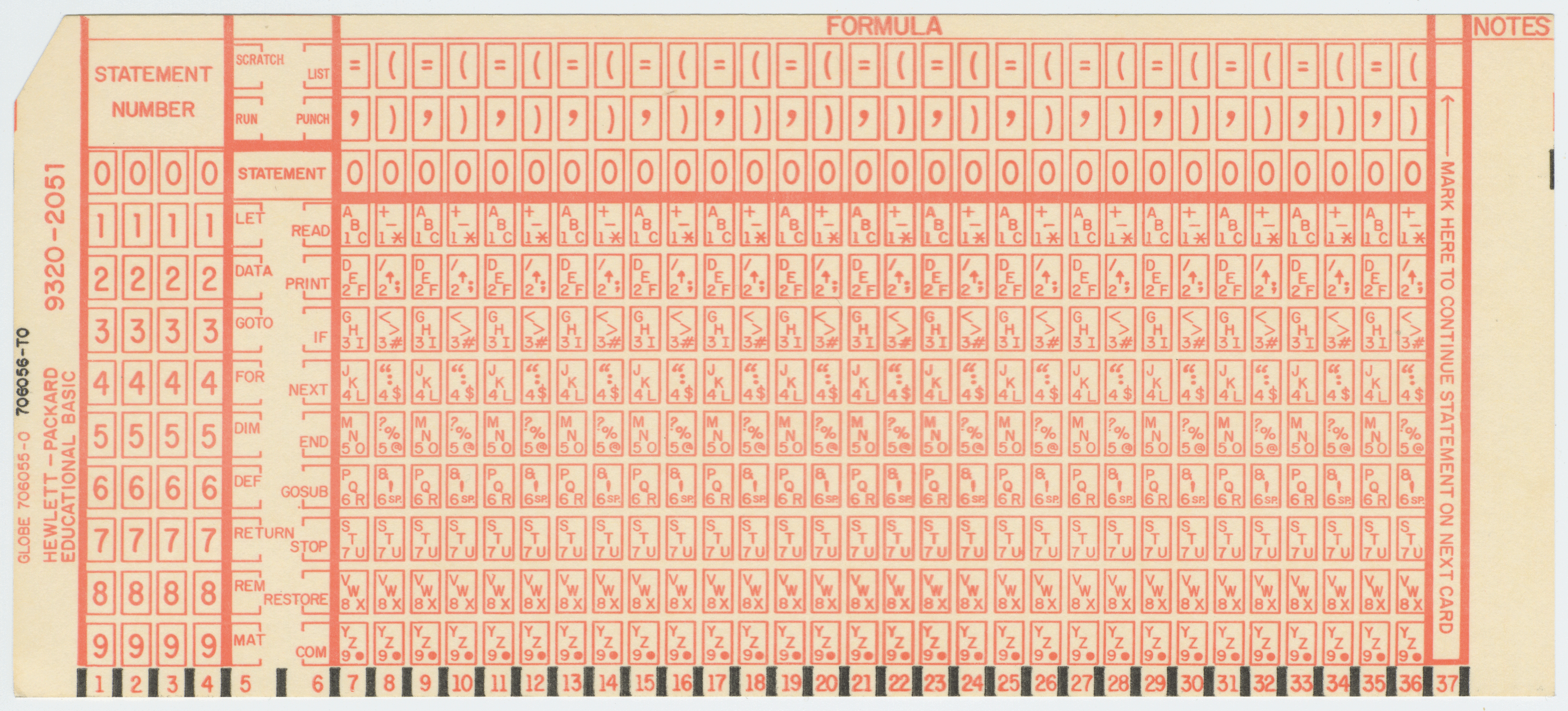
In Arlington County, Virginia of the mid-1970's, 7th and 8th grade math students were treated to a week-long exploration of BASIC programming, complete with access to a
HP 9830A, and an HP 7260A Optical Mark Reader. We used HP Educational BASIC Cards.
So, the drill was: write your program on paper, transcribe it to the cards with #2 pencil, then get in line to put your cards in the reader. Inevitably the Reader would choke on a card, and issue a "Pick Fail" error. That could be due to a damaged card or to the number of erasures and rewrites on a card. Pick Fails were always accompanied by three honks from an alarm inside the Reader. Moans from students waiting in line for card reading usually followed. The best you could hope for was one iteration of your program per day, but realistically you got 2 or 3 runs during programming week, what with all the Pick Fails. -
Re:reduce the amount
> RAIDZ can be dynamically expanded
--To the best of my knowledge, not so much. You can create a pool of mirrors and expand that, but expanding a RAIDZ (ideally) should be done with the same number (and capacity) of drives that was in the original RAIDZ - for balancing purposes. Otherwise you get weird errors and possible performance impact. Building asymmetrical pools is fine in a VM, but on bare-metal you kinda have to start to question what to do if there's data loss.
http://serverfault.com/questio...
--You can expand the underlying disks in a pool, but it's a PITA and requires repetitive resilvers.
http://jsosic.wordpress.com/20...
http://www.itsacon.net/compute...
--Honestly, adding a 4-port SATA card to an existing system and using all-new drives is probably the best bet for expanding existing storage. You can buy 2-4TB drives depending on budget, copy the data over, and repurpose the existing pool of old/smaller drives until the HW starts failing.
PROTIP: With newer drives (4k sectors) you're better off setting the ASHIFT to 12 on your ZFS pool right off the bat. Will save you trouble later -- I speak from experience.
https://www.icts.uiowa.edu/con...
/ Btrfs has some promising features, but practically I would give it another ~2 years to get to production-ready as of this writing. Just my $2.02
-
not really crowdsourcing
Crowdsourcing did not fail because what occurred was not crowdsourcing.
There is a distinction between, on the one hand, the emergent behavior which spontaneously arises from ungoverned social interaction and, on the other hand, the management practice of dividing and framing a problem such that it can be solved by large, loosely-affiliated groups of anonymous individuals working in parallel. The latter is crowdsourcing. The former, in the case of attempts to identify Boston Marathon suspects in online fora such as reddit, is a vigilante mob.
At least that interpretation is consistent with the conventional usage of the term "crowdsourcing" up to this point. Consider well-known examples such as the Mechanical Turk, the search for the wreckage of Steve Fosset's plane and prediction markets such as Iowa Electonic Markets. In all case the role of any individual in the crowd is predefined and constrained in advance by design. Constraints can include the dimension of response and the information to be evaluated.
-
Re:There's Foresight Exchange
IEM's been running real-money prediction markets since 1988. They're still up and running fine (and their FAQ links to their CTFC approval letter).
-
Re:The question
Drugs, polygamy, gambling, legal age prostitution, etc., could all be arguably classified under victim-less crimes.
That's not the issue here at all. http://tippie.uiowa.edu/ and other futures markets run without CTFC interference.
It's not gambling that's the issue here. The investigation at hand is about undocumented payments from the company to its (retired) founder and others, and whether there's potential investor fraud--a crime with an actual victim--going on.
-
Re:So...
Yeah, it's here: http://betsofbitco.in/
Also, the Iowa Electronic Market is still up in the US (and has CTFC approval) if you prefer dollars: http://tippie.uiowa.edu/
-
Not the only one around, nor the oldest
I never understood why Intrade got so much press--the Iowa Electronic Market has been doing the "online futures trading" thing for far longer. They're still up and running at: http://tippie.uiowa.edu/iem/
And they have approval from the CTFC: http://www.cftc.gov/files/foia/repfoia/foirf0503b004.pdf
-
Iowa Electronic Markets
The Iowa Electronic Markets put Obama at a 74.9% chance. These are the people who put money with their predictions. http://iemweb.biz.uiowa.edu/graphs/graph_Pres12_WTA.cfm
-
Re:Unions are archaic
They kept child labor in the mines but made more money for the children's parents and for the union bosses.
Unions in the US started denouncing child labor as far back as 1832 and continued to push for banning of child labor until they got it banned nationally over a century later in 1938 (source).
The purpose of a union is that if pay and/or working conditions are intolerable, workers have something of value to bargain with. If 1 guy quits, the company is just a bit shorthanded until they can hire somebody else, while that employee starves. If 10,000 guys quit all at once, it's harder for the company to deal with. That threat is about the only leverage that, say, factory workers have.
Which also explains why most programmers don't see a need to unionize: 1. Working conditions are usually decent or at least not physically dangerous, and pay is typically solidly middle-class. 2. Programming jobs are usually plentiful enough that somebody can find a new job elsewhere if their current one isn't what they want it to be.
-
Re:Working at 14
http://en.wikipedia.org/wiki/Child_labor_laws_in_the_United_States#Activism_against_child_labor
http://www.continuetolearn.uiowa.edu/laborctr/child_labor/about/us_history.html
>The National Child Labor Committee’s work to end child labor was combined with efforts to provide free, compulsory education for all children
http://www.jstor.org/discover/10.2307/367352?uid=2129&uid=2&uid=70&uid=4&sid=21101184617233
Or just look up anything about the beginning of compulsory education, it will show you how it was intertwined with the end of child labor. -
Re:Always the frontrunner?
Sorry, but wrong. Voyager I overtook Pioneer 10 in 1998
Until 17 February 1998, the heliocentric radial distance of Pioneer 10 has been greater than that of any other manmade object. But late on that date Voyager 1's heliocentric radial distance, in the approximate apex direction, equaled that of Pioneer 10 at 69.419 AU. Thereafter, Voyager 1's distance will exceed that of Pioneer 10 at the approximate rate of 1.016 AU per year.
-
Re:IBM Cards
I'm pretty sure that 5081 refers to a specific single-field layout, not to 80-column punched cards as such. There were many layouts. I seem to recall using something very similar to this FORTRAN card even when I wasn't doing FORTRAN, and I don't think they had "FORTRAN STATEMENT" printed on them.
I don't recall anybody loathing punched cards. They were a simple, reliable, if somewhat bulky medium. It is true that magnetic discs represented a great improvement. In my case, floppies were never more than a backup medium, since the systems I worked with always had hard disks.
Yep. Dug into the closet and only the "blank" cards say 5081 on them. The yellow Assembler cards have a different number (two of them actually, since they're not Genuine IBM), blue COBOL cards are 3393 and the pink FORTRAN (sic) cards have a 88157 on them.
I recall being disgusted because after too many trips through the RJE card reader, a quarter-inch wide notch would wear out in the top center of the cards (where the picker pushed them) and quite a few incidents of woe from dropped decks, but the only floppy I ever got near on a mainframe was the one that held its microcode. For actual data and program entry people were either using punched cards or key-to-disk/disk-to-tape systems.
-
Re:IBM Cards
I'm pretty sure that 5081 refers to a specific single-field layout, not to 80-column punched cards as such. There were many layouts. I seem to recall using something very similar to this FORTRAN card even when I wasn't doing FORTRAN, and I don't think they had "FORTRAN STATEMENT" printed on them.
I don't recall anybody loathing punched cards. They were a simple, reliable, if somewhat bulky medium. It is true that magnetic discs represented a great improvement. In my case, floppies were never more than a backup medium, since the systems I worked with always had hard disks.
Yep. Dug into the closet and only the "blank" cards say 5081 on them. The yellow Assembler cards have a different number (two of them actually, since they're not Genuine IBM), blue COBOL cards are 3393 and the pink FORTRAN (sic) cards have a 88157 on them.
I recall being disgusted because after too many trips through the RJE card reader, a quarter-inch wide notch would wear out in the top center of the cards (where the picker pushed them) and quite a few incidents of woe from dropped decks, but the only floppy I ever got near on a mainframe was the one that held its microcode. For actual data and program entry people were either using punched cards or key-to-disk/disk-to-tape systems.
-
IBM Cards
I'm pretty sure that 5081 refers to a specific single-field layout, not to 80-column punched cards as such. There were many layouts. I seem to recall using something very similar to this FORTRAN card even when I wasn't doing FORTRAN, and I don't think they had "FORTRAN STATEMENT" printed on them.
I don't recall anybody loathing punched cards. They were a simple, reliable, if somewhat bulky medium. It is true that magnetic discs represented a great improvement. In my case, floppies were never more than a backup medium, since the systems I worked with always had hard disks.
-
IBM Cards
I'm pretty sure that 5081 refers to a specific single-field layout, not to 80-column punched cards as such. There were many layouts. I seem to recall using something very similar to this FORTRAN card even when I wasn't doing FORTRAN, and I don't think they had "FORTRAN STATEMENT" printed on them.
I don't recall anybody loathing punched cards. They were a simple, reliable, if somewhat bulky medium. It is true that magnetic discs represented a great improvement. In my case, floppies were never more than a backup medium, since the systems I worked with always had hard disks.
-
Better simulators exist. They're huge.
Here's the National Advanced Driving Simulator, which is in Iowa. This not only has a Stewart platform, the Stewart Platform is mounted on an X-Y table about 60 feet square. Toyota has an even bigger one with over 100 feet of linear travel.
The need for huge linear travel comes from the need to simulate the feeling of a hard stop. To some extent, deceleration can be simulated with tilt. But at the end of a stop, deceleration suddenly ceases without a change in attitude. You can't simulate that with a Stewart platform. If you want to test people's behavior during hard braking, you need a huge simulator.
-
Re:CmdrTaco "hears" when I cum in his mouth.
There are audio recordings of the rapid changes in the Earth's magnetic field at points on the ground.
http://www.ab9il.net/vlf/vlf1.html
Various events also have their own sounds:
-
As much as I want to promote my Alma Mater...
The site seems to be a waste of energy when alternative sources exist with a much greater volume of activity. The prime example that comes to my mind is the Iowa Electronic Markets. I understand the Big Ten rivalry, but why reinvent the wheel? Do they honestly expect to get valuable commentary in conjunction with the votes?
-
Re:This does _not_ imply scalability!
For conventional computers, as soon as you have "and" and "not" in gate-form, you can do everything, as you can just connect them together. For quantum computers that is not true, as all elements performing the complete computation need to be entangled the whole time.
Actually for conventional computers, to implement any binary function you only need either NAND or NOR, the "universal gates".
For qbit-based Quantum Computing, the universal gate is Controlled Not (CNOT) gate, which can be used to realize any quantum computation.
But you are correct that in many quantum computations, large number of qubits may need to have coherent entangled states, and that is has proven challenging to scale up large numbers of entangled qubits.
-
Re:Easy
That was my response as well. Whereever Oxygen and Hydrogen exist, the problem is NOT creating water. In fact, it's very likely that the largest source of water outside of the Earth in our Solar System is orbiting Saturn.
You may be right about the source being other moons. Comets are another potential source, Louis Frank published his theory in The Big Splash, but it never seemed to gain a lot of traction, even though the guys has a lot of credentials. It was generally disregarded, like so many other novel theories.
In the book he postulates that thousands of small fluffy snow-ball comets with no hard central core and which which don't really show up in radar or visually, deposit tons of water on the earth's atmosphere and the moon every year. He even had images in his book about impacts on the moon.
-
Re:Punchcards
It actually predates Turing all the way back to Hollerith taking his inspiration from the Jacquard Loom http://www.divms.uiowa.edu/~jones/cards/history.html
-
Re:Do NOT stick with Excel
PLEASE ACTUALLY READ WHAT YOU LINK TO.
MODERATORS: LOOK AT WHAT YOU ARE CALLING INFORMATIVE.
YEP, I'M YELLING. DEALING WITH STUIPIDITY IS FRUSTRATING.Excel and other spreadsheets suck at stats:
That is one camp of thought. There are others. Every package has it's limitations
* Burns, P. (2005). Spreadsheet Addiction.
Doesn't talk about never using statistics. Talks about misusing them by pressing them past their limits. "I know there are many spreadsheets in financial companies that take all night to compute. These are complicated and commonly fail. When such spreadsheets are replaced by code more suited to the task, it is not unusual for the computation time to be cut to a few minutes and the process much easier to understand."
* Cryer, J. (2001). Problems with using Microsoft Excel for StatisticsPDF.
Focuses on poor charting in the Excel 95 era. Title should be problems for using Excel for graphing. The article is a decade old. Excel has had several refreshes.
* Pottel, H. (n.d.). Statistical flaws in Excel. PDF
Another article about Excel 97 and 2000. Decade old software. Many flaws since addressed, and new flaws added. Clearly Excel bashing was popular around 2000.
* Practical Stats (n.d.), Is Microsoft Excel an Adequate Statistics Package?
This one suggests it's just fine for the submitter's purposes.
"Excel’s limitations, and its errors, make this a very questionable practice for scientific applications. For business applications where questions might be simpler and precision not as necessary, Excel may be just fine"
* Heiser, D. (2008). Errors, faults and fixes for Excel statistical functions and routines
For a more comprehensive and technical discussion, see the papers by Yu (2008); Yalta (2008); and McCullough & Heiser in Computational Statistics and Data Analysis 52(10).
Gets very technical, and I bet some of those remarks are valid, but if it's important you become aware of and work around the problem. If it's not, there is no problem. If you don't understand what you're asking Excel to calculate and why it might be wrong, it doesn't matter.
The more you go into this, the more it requires specialist training. The idea that just replacing one software package with flaws and features you don't understand with another geekier more difficult product with flaws and features you don't understand is ridiculous. As is moderation on slashdot. The comments are being moderated by monkeys practicing to type up Shakespeare..
-
Do NOT stick with Excel
Excel and other spreadsheets suck at stats:
* Burns, P. (2005). Spreadsheet Addiction.
* Cryer, J. (2001). Problems with using Microsoft Excel for StatisticsPDF.
* Pottel, H. (n.d.). Statistical flaws in Excel. PDF
* Practical Stats (n.d.), Is Microsoft Excel an Adequate Statistics Package?
* Heiser, D. (2008). Errors, faults and fixes for Excel statistical functions and routinesFor a more comprehensive and technical discussion, see the papers by Yu (2008); Yalta (2008); and McCullough & Heiser in Computational Statistics and Data Analysis 52(10).
-
Re:Or you can use Excel
Please, please, please have a look at http://www.stat.uiowa.edu/~jcryer/JSMTalk2001.pdf and at http://www.burns-stat.com/pages/Tutor/spreadsheet_addiction.html "The hard way looks easy, the easy way looks hard."
-
Re:Or you can use Excel
It is no good idea to do statistics with Excel:
* Burns, P. (2005): Spreadsheet Addiction.
* Cryer, J. (2001): Problems with using Microsoft Excel for Statistics. (PDF)
* Pottel, H. (n.d.): Statistical flaws in Excel. (PDF)
* Practical Stats (n.d.): Is Microsoft Excel an Adequate Statistics Package?
* Heiser, D. (2008): Errors, faults and fixes for Excel statistical functions and routines
For a more comprehensive and technical discussion, see the papers by Yu (2008); Yalta (2008); and McCullough & Heiser in Computational Statistics and Data Analysis 52(10)
-
Re:Or you can use Excel
People who know more about statistics than I do severely criticize Excel, e.g. http://www.stat.uiowa.edu/~jcryer/JSMTalk2001.pdf
-
iTBS?
From the caption on the pretty picture in TFA:
Brain slice of the frontal cortex of a rat showing nerve cells before and after treatment with the iTBS protocol
When I read that, the very first thing I thought of was this ITBS, which pretty much just made learning more obnoxious.
-
Re:Would you like your memories saved in FORTRAN s
Usual problem of 'eternity' in the computing world meaning about ten years or so. I've got a professor friend who proudly shows off his PhD thesis, it's all done on punched cards. It amuses him highly that neither he nor anybody else could read it these days, the machines just don't exist any more.
They can still be read. Your eyeballs or a scanner will do nicely. Or you can send them here.
-
Re:Would you like your memories saved in FORTRAN s
Usual problem of 'eternity' in the computing world meaning about ten years or so. I've got a professor friend who proudly shows off his PhD thesis, it's all done on punched cards. It amuses him highly that neither he nor anybody else could read it these days, the machines just don't exist any more.
They can still be read. Your eyeballs or a scanner will do nicely. Or you can send them here.
-
Free/open textbooks
Open textbooks for freshmen level classes should be possible
There are free/open textbooks in mathematics, at least at the fresher level. Here are a few:
http://www.lightandmatter.com/calc/calc.pdf some physics books are at the same site
ftp://joshua.smcvt.edu/pub/hefferon/book/book.pdf
http://www.math.uiowa.edu/~stroyan/InfsmlCalculus/FoundInfsmlCalc.pdf
http://www.mecmath.net/calc3book.pdf
http://www.opensourcemath.org/books/mauch-applied_math/applied_math.pdf
LaTeX source is available for some of them. These books mostly bridge from high school calculus to first year college vector calculus (the last one goes a bit further), but may not be aligned with a particular professor's path through the topics. There are various others at high school level, and quite a few in specialized/advanced areas, but not so many at the undergrad level. It's worth browsing through the categories at http://planetmath.org/?op=mscbrowse&from=books for slightly more advanced topics. -
Re:The Galileo probe already did this
For those without access to Nature, a Google Scholar search turns up a freely downloadable PDF of the full article.
I remember reading about this in Sagan's "The Pale Blue Dot", and thought it was such an awesome idea. I'm looking forward to reading the original paper.
-
Re:USPS isn't a State Function
State and local gasoline taxes are more than enough to upkeep roads in most cases. They also usually fund things that have nothing to do with roads. That's how it should be.
Yes, that is how it *should* be -- and it's so darned logical that everyone wants to believe it's true. Unfortunately, that's not reality. For example, I live in GA where Vehicle Taxes cover about 3% of road costs and Fuel Taxes cover 5%. The majority of the remaining 92% comes from property taxes (40%) and bonds (30%).
GA is a terrible example, though. On average, US States get about 60% of road funds from combined Fuel and Vehicle Taxes. The remainder comes from bonds and the general state fund.
study from Iowa, backs up my numbers(note: federal fuel tax *does* cover the costs for interstate highways, the above numbers reference local roads and non-interstate highways)
-
Re:What's the pointThe IEM do that too.
And I think for the big bucks, you can even hedge a little political risk with your favorite insurance company.
-
Re:Could have told Vancouver earlier
2006 Olympic Luge Track: http://jasondeem.com/Travel/2006-Winter-Olympics/IMG1203/95743972_uLP92-S-1.jpg
2002 Olympic Luge Track: http://www.cs.uiowa.edu/~cwyman/personal/olympics/web_bobsledtrack.jpg
But Vancouver's luge track is the one you choose to flame. How about letting an athlete willing to do 95 mph down a curvy piece of ice take the blame for once? -
Re:My bad.
Yes, it was you, but no, it is still not legitimate for you to assume you know what I was trying to say, when obviously you don't. You are saying that it is legitimate for you to try to read my mind, and tell me what I meant? I don't think so.
I’m actually quite confused as to what you’re trying to say, so I’m falling back to explaining what I was saying, under the assumption that you misunderstood me, or don’t understand BCD, or both.
Your BCD above is fine if you are referring to simple unsigned BCD, but packed BCD uses the lowest nibble to indicate sign, not to contain a number value. If you don't believe me, read about it here
That entire section is in severe need of a [Citation needed]. Everything I did in college with BCD referred to “packed” BCD as 2 digits per byte with no sign nibble of any sort, and “unpacked” BCD as 1 digit per byte.
If you want to allow for signed packed BCD, fine, but don’t tell me that my unsigned form of packed BCD isn’t packed BCD! Look at any of the google results other than that one Wikipedia article:
Here, here, here, here (pdf), here.
This gem is even entitled “Packed BCD to 16 bit binary conversion”... when of course I’m sure they meant “2’s complement”, not “binary”, since that was the whole problem from the beginning of this discussion! You should e-mail them and tell them to fix it!
What I was writing about was your confusing way of trying to explain it.
You seem to be one of a very small group of people who thought it was confusing. Is that my fault?
But here is what I was talking about: if you input 0x36 into a C program or most other languages that support that number format, and do not do any explicit conversion, that number will be interpreted as 54 decimal, NOT as 0011 0110 (BCD) or 36 decimal. That was my point. You might prefer to write that BCD number as 0x36, but that is not how a compiler will interpret it.
The compiler doesn’t “interpret” anything. The programmer does. The compiler just creates a binary executable that does whatever the programmer designed it to do.
And for that matter, unless you explicitly label that in code as some kind of BCD representation, any programmer to come along later will also assume it is hexadecimal. So you are introducing confusion into the issue.
Yes, which is why we have standards to tell programmers how stuff is supposed to be written.
0x10 is a HEXADECIMAL representation of the decimal number 16.
It is also a BCD representation of the decimal number 36.
I have nothing more to say to you. I have explained this more than once and in about 3 different ways. As Wikipedia (and other sources if you would care to look them up) clearly show, you have been wrong about some of these things. If you still don't understand the rest, I don't feel like spending more time to help you.
And the Wikipedia warrior throws up his hands!
I, on the other hand, didn’t learn everything I know from Wikipedia.
-
WTF?
but that road use tax money should be spend on roads, but is instead diverted to other needs.
That is ridiculous. The problem isn't that gas taxes, etc, are being diverted to other uses - it's that general revenue is being diverted to building and maintaining roads. Per the University of Iowa: "On average, states raise 38% of their road funds from fuel taxes and 22% from vehicle registration fees." So only about 60% of the cost of roads comes from actual user fees. The rest is subsidized from general revenue.
-
Re:Google's brilliant vagueness
There is a straightforward transcription of Hindi devanagari into latin script, so "Gandhi" is obviously right, while "Ghandi" is obviously wrong. (G and Gh represent distinct sounds and different devanagari letters, as do D and Dh.)
-
Re:Bloody difficult.
Do you think that we are doing the LONG-TERM future of competitive sports an injustice by not just completely removing gender segregation entirely from sports and finding a more fair type of skill stratification based on actual strength and endurance testing rather than naive and sometimes incorrect gender/chromosome-based assumptions?
I'm not the tranny AC, but I have an answer for that, writing as someone who lived through the early days of Title IX http://bailiwick.lib.uiowa.edu/ge/aboutRE.html
I think segregation in sports *is* doing women a disservice. Competition Is Good. I could beat all the female track & field high school records when I was a Sophomore and by my Senior year, I could not.
I know from marriage that women are extremely competitive. Perhaps they should be given a chance.
-
Re:Makes sense
I drive the corporate mailing tube there. It's about 1:45 there, and 1:20 coming home.
One cool thing about Coralville is the fossil gorge, if you're into that sort of thing. Iowa City is good fun too. Lots of great food down the ped. mall. Not to mention the last place on earth I'd expect to find palatable nigiri sushi, but it's there. I actually look forward to going to work every week. It's weird.
-
Iowa City
http://www.uiowa.edu/~nathist/
Museum of Natural History at the University of Iowa. I especially recommend the Laysan Island exhibit: it shows 3 extinct species, and tells how more or less well-intentioned people drove them extinct.