Slashdot Mirror
Domain: umich.edu
Stories and comments across the archive that link to umich.edu.
Comments · 1,427
-
Re:True AI - Fundamental Problem
A programming language that has been used for this for a long time is Lisp.
One of the benefits of this language is that it allows the programmer to write code that writes code that... -
Lies and lying liars.This census result is pure hogwash. They asked for the Friggin Phone number, small wonder the majority is Young Men. They were the ones that had the guts to say F**k off.
More infor Here
As usual don't believe things that does not sound right. Check it yourselves.
-
Re:Open Source is a verb?
Verbing weirds language. Note that this is extremely common thing in English.
On a sidenote, if anyone has got a link to the original Calvin & Hobbes strip that came up with the previous quote, pleas post. I searched, but couldn't find it. -
Re:Your new career is going well, mrwonton
However, I live in Ann Arbor, and I spoke with a few (unnamed) students about the general subject of file sharing. They remember a long presentation on file sharing at student orientation (which will figure prominently in any lawsuit, I'm sure - that's what it's really for); most do not remember agreeing to anything or signing anything that limits their use of the network.
Well no one can control what a student remembers or doesn't, but that does not change the fact that they did in fact agree to such things.That said, they ALL use UM resources to download music files, movie files, you name it. Nobody buys CDs, nobody uses lame pay for tunes sites when you can get everything free! The only people who are seen as extreme sharers are people who actually operate servers out of their dorm rooms. I don't think the U has fined anyone.
BZZZZZT! Strike two! Students who get taken off the network more than once for copyright infringement get fined a certain amount of money. They publish their policies for all to see. Take a read. -
UM Campus news articles, etc.Here is our campus newspaper's coverage on the issue from today and January, when the U first learned about the subpoenas.
Students in the dorms also received this e-mail in January regarding the possible subpoena of file-sharer's identities.
In the past, the Vice-President of Student Affairs sent a notice to any students whose information was released under subpoena, explaining that the U was going to do so, and what the reasons were.
-
Re:Sounds interesting
Wow! That's a pretty far-out goal, dude! Like if Linux could possibly, somehow, one day (as inconceivable as this may sound) be as good as a Mac?
Err. No. Mac's don't suck, but they're no Nirvana either.
One of the more important goals of any user interface should be to model the tasks a user needs to complete in such a way that the gulfs of execution and evaluation are minimised.
That might be achieved through the desktop metaphor, a 3D model of a book, an immersive graph of interconnected nodes, or all kinds of things that you, I and thousands of user-centered engineers have not conceived yet; however, what I can guarantee you, is that to be limited by what "the Mac" is, would be indefatigably hatstand.
-
Re:Completely misses the point!
Anonymous Coward wrote: Women don't go as much for 90-hour internships in Emergency Medicine and Surgery, where you lose patients on a daily basis. They go more toward Pediatrics, a 'safe' field that rewards them with seeing a child grow to adulthood.
Wrong. When my sister was in med school, she seriously considered emergency medicine because she wanted to have a family and being a specialist in emergency medicine means never being on call. Many women become emergency medicine doctors for just that reason. Pediatrics, with its midnight phone calls from panicked parents, can play holy heck with your own family life.
In case you are interested, my sister wound up becoming a surgeon because she is very, very good at it. She had to put off child-bearing in order to complete her residency training, a price that male surgeons do not have to pay, and since male fertility extends until much later in life, would be less of a cost anyway. Fortunately, she thinks it was worth it.
As for the part about women not working as many hours, maybe it's because when they get home they have to do most of the housework and child-tending. They are probably too tired to do any more work at their jobs than they already are! (My sister, incidentally, works longer hours than her husband and still does the bulk of the household chores.) -
Maps
-
Maps
-
Re:You numbers are offWTF are you talking about? Are you trolling?
The figures are from here and ARE NOT from the DOE. Incidentally, I just noticed that the figures are from 1984, meaning that the relative cost of the CRT is even cheaper than I mentioned since per-capita BTU consumption has risen in the US by some obscene amount since then.
-
The Grammer Nazi???
You mean this guy?
-
Re:And in other news...
So is Dr. Conway and so am I, so what are you implying?
-
Re:I adore wordperfect
WordPerfect shows you so much more. See for yourself.
-
I have been thinking about doing something similar
-
Re:Solaris doesn't suck...
Linux is still a long way behind Solaris with things like NFS
Behind yes, but not a long way, and the gap has been closing over the past several years.
I'm really looking forward to performance and security of NFSv4, but am apprehensive that the setup appears to be more complicated than just editing a couple files in
BTW, given all the recent hoopla over Sun's commitment to free and open source software, they ought to be recognized for sponsoring the CITI group at UMich that had a lot to do with Linux NFSv4, and for sponsoring the Connectathon series of conferences that I'm hoping will make my Linux desktop NFS client interact better with my Sun NFS fileserver.
-
Re:Alpha Complex and other tunes
Ahh, my favourite was always The Lair of Great Cthulhu. Toe-tappin', marrow-suckin' fun!
-
Re:Alpha Complex and other tunesThat got me to thinking about other game songs that were floating around. One of my favorites was for Cthulhu:
Sung to the theme of "Tiny Toon Adventures'"
We're slimey, we're squishy, we're all a little fishy,
and in this adventure we'll be feasting on your brains.
We're abysmal creatures, with gross horrific features.
In Cthuloid adventures, lose alot of sanity.
So here's Miskatonic U. where all the creatures dwell,
take a look at a mythos book and find yourself in hell.
Your guns aren't defective, they just aren't real effective.
Our feast of human flesh and souls is about to start.
Your magic, and voodo will not stop Great Cthulhu.
Don't eat with the Tchoo Tchoo, and the Migo steal your brain!
Here's Narly, Tsathoggua, over there's Cthugha,
don't forget Ithaqua, and Hastur hates his name.
So here's sunken R'lyeh where the angles are all wrong.
You'll lose your soul, and go insane if you stay there too long.
We're slimey, we're squishy, we're all a little fishy,
Our feast of human flesh and souls is about to start.
And now we'll eat your heart.
Many, many more to be found at the Cthulhu Hymnal webpage. -
Actually Corporate debt is not a Bad Thing
You have to be careful about conventional wisdom when it comes to economics.
Here's a pretty good case study from the Motley Fool on why taking on corporate debt is often better than trading away shares to make acquisitions. Basically, in this case, taking on a lot of debt is fine if it increases cash flow.
In general, if a company's risk rating is good, you could say that it is in fact wasting money by NOT taking on some debt in order to build infrastructure or make acquisitions.
As the Economist points out in an article called Debt is Good For You," "dividends are paid out of companies' net-of-tax income,and are then taxed again in the hands of the recipients. Interest payments on debt, on the other hand, are tax-deductible."
"This means that a firm's overall value should increase as it substitutes debt for equity." -
Why a tablet -- for teaching, they are great!I use a convertable tablet (Toshiba). It has a fair number of minor problems. However, it is wonderful for giving lectures. I use slides, but do a lot of writing on them. Other than being too small, this teaching style is pretty clearly the future. (Well a backlit board you can write on would be better.)
It is also somewhat useful for writing up homework answers for the students--certainly easier to draw state machines than using word. Sadly my handwriting is so bad it makes some of my answers hard to read. Example: Homework answers
-
Re:Interesting but hardly new
Social network analysis has indeed been around for a long time. What makes Newman's work new is that he is applying new algorithms to make sense of large networks. In this particular case, he has devised a new way to divide up a network into subcommunities (see this paper for details [or many of these for lots more network analysis).
Newman, Watts, Barabasi and others are trying to understand the nature of these types of networks (and other types), rather than just the content of the networks (orkut, slashdot, disease networks, etc). -
Re:oh my.. the high-school friend one..
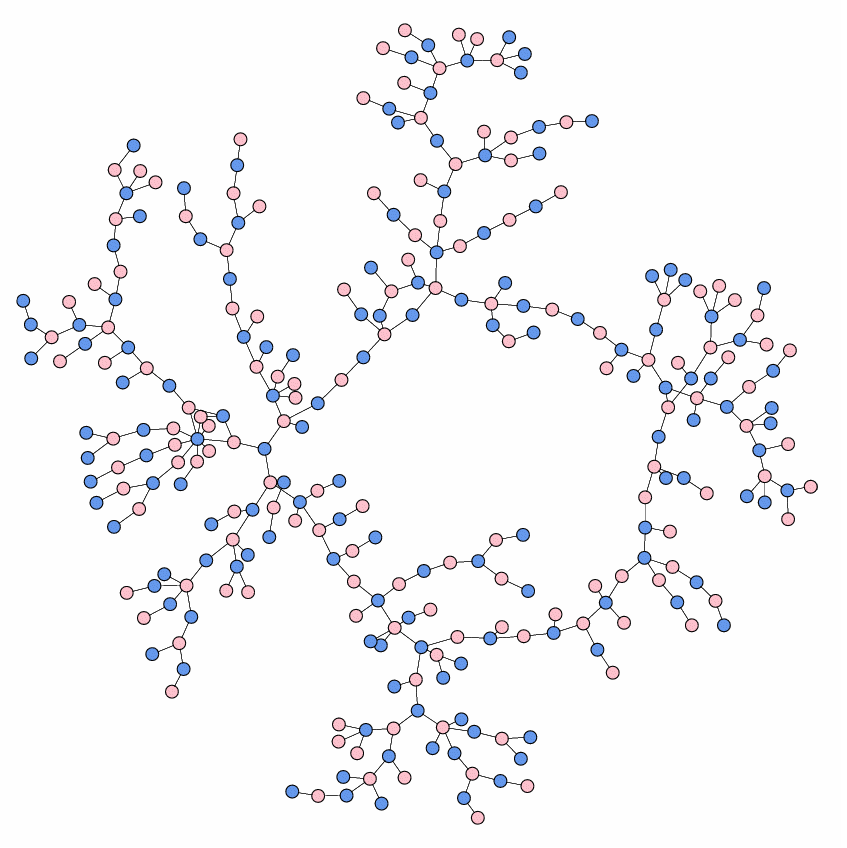
Ok, this is the graph of STD transmission among high school students.
Check out that stud on the left who is banging like 8 different girls. -
Re:oh my.. the high-school friend one..The image of dating is more interesting, I think, because you can actually see what's going on. What's most interesting to me is that there's a fairly large ring in the middle, but much of this ring is made up of thin strings, indicating to me that it's not just a mass of popular kids interbreeding amongst each other. I suppose statistically a cycle should show up eventually, though....
Also interesting is to look at the prevalence of female playahs to male playahs (assuming females are pink and males are blue). Check out that one male playah to the left of the ring, surrounded by seven pink dots.
-
Highschool Friendships
Check out the "highschool friendships" diagram.
I think I was the yellow dot on the far left.
-
Site is slow--Press release
Contact: Nancy Ross-Flanigan rossflan umich edu
734-647-1853
University of Michigan
From football conferences to food webs: U-M researcher uncovers patterns in complicated networks
SEATTLE---The world is full of complicated networks that scientists would like to better understand---human social systems, for example, or food webs in nature. But discerning patterns of organization in such vast, complex systems is no easy task.
"The structure of those networks can tell you quite a lot about how the systems work, but they're far too big to analyze by just putting dots on a piece of paper and drawing lines to connect them," said Mark Newman, an assistant professor of physics and complex systems at the University of Michigan.
One challenge in making sense of a large network is finding clumps---or communities---of members that have something in common, such as Web pages that are all about the same topic, people that socialize together or animals that eat the same kind of food. Newman and collaborator Michelle Girvan, a postdoctoral fellow at the Santa Fe Institute in Santa Fe, New Mexico, have developed a new method for finding communities that reveals a lot about the structure of large, complex networks. Newman will discuss the method and its applications Feb. 15 at the annual meeting of the American Association for the Advancement of Science in Seattle.
"The way most people have approached the problem is to look for the clumps themselves---to look for things that are joined together strongly," said Newman. "We decided to approach it from the other end," by searching out and then eliminating the links that join clumps together. "When we remove those from the network, what we're left with is the clumps."
The researchers tested their method on several networks for which the structure was already known---college football conferences, for example. In college football, teams in the same conference face off more frequently than teams in different conferences. When inter-conference games do occur, they're more likely to be between teams that are geographically close together than between teams that are far apart. Plugging in information on frequency of games between pairs of teams in the 2000 regular season, Newman and Girvan tested their method to see if it could correctly sort the colleges into conferences. "There were a few cases where it made mistakes, but it got well over 90 percent of them right," said Newman. "It gave us the structure we were expecting, so that was encouraging."
Newman and Girvan---and other researchers who've learned about their work---have gone on to apply the technique to systems where the structure is not as well understood, looking at everything from networks of Spanish language web logs to communities of early jazz musicians to a food web of marine organisms living in Chesapeake Bay.
"Networks and other systems that we study are becoming increasingly large and complicated these days," said Newman. "New methods like this help us to make sense of what we see and to understand better how things work."
For more information:
Mark Newman
American Association for the Advancement of Science
Santa Fe Institute -
High school dating chart
The blue node (left center) in this diagram was gettin' some action!
-
Much better picture.
If you want to see this thing up close, here's a better link. click me
-
bandwidth tricks
i work at CITI and we've had recently done a few demos with our high-bandwidth link. one setup included two dell dual-CPU servers, one at either end of a gigabit link. we then used iperf to fill the majority of the link with traffic (using other machines). we then used a CITI project with the intervening Summit 7i switches to reserve bandwidth for a video teleconference. we demonstrated the practical capacity of the link and the ability to honor QoS parameters.
the CITI project used to manage the switches is, among other things, a secure remote invocation architecture that we use for a related network testing and performance-oriented umbrella project. that project's ultimate goal is to provide a distributed, real-time router-to-router traffic analysis system for use in optimizing campus networks and isolating networking failures. check our the web page if it's of interest.
d
. -
University of MichiganI go to Michigan (working on my Computer Engineering BSE) and love it. I know there's an upper-level class in CS/CE that is devoted to networking (EECS 489) - I don't know much about it but all of the content (including lectures) are posted online. Personally I love Ann Arbor and the College of Engineering here, but I have a lot of friends at MSU and they have a respectible program too.
One of the nice things about our CS degree is that it is offered as both an Engineering and Literature Science and Arts degree - basically this means you can opt for more science/math related classes (and no foreign language requirement!) with the engin degree, or more humanities and social studies with the lsa degree.
The EECS department has a lot of ties with the School of Information and the Internet2 project, and they just broke ground on an incredible new CSE building that is going to be a nice place to do research and attend class. The classes are generally big but it's still easy to get to know the profs in office hours (especially if you chat with them about their research interests).
Since you probably won't be able to do much in networking until you work on your masters, another factor you might want to consider is grad school options - Michigan offers two great ones that might appeal to you:
1. CUGS (Concurrent Undergrad/Graduate) - You graduate in 5 years rather than 4, but come out with both a BSE and MSE. You can double-apply your grad school classes to your graduate and undergrad degrees, which may be a good option if you're interested in the grad-level networking offerings. Upside: much more depth; downside: less breadth.
2. 3.4 program - if you keep a 3.4 in your program (not an easy task, mind you) and overall, you are guaranteed a spot in the masters program, no questions asked. A bit more breadth than CUGS, but keeps you in school longer.
Advice for choosing a school: I'd say if you can find the money and time, go visit a few schools that you're really interested in. I had a really hard time choosing schools until I spent a day or two at each - I immediately fell in love with Michigan and will be for the rest of my life. This played a huge part in my decision. Spend some time at a few campuses and see what kind of 'vibe' you get from each one. FIGURE OUT WHAT IS IMPORTANT TO YOU AND MAKE SURE YOU THINK ABOUT THAT WHEN YOU CHOOSE A SCHOOL. You're going to invest a LOT of time (and money) there.
-
University of MichiganI go to Michigan (working on my Computer Engineering BSE) and love it. I know there's an upper-level class in CS/CE that is devoted to networking (EECS 489) - I don't know much about it but all of the content (including lectures) are posted online. Personally I love Ann Arbor and the College of Engineering here, but I have a lot of friends at MSU and they have a respectible program too.
One of the nice things about our CS degree is that it is offered as both an Engineering and Literature Science and Arts degree - basically this means you can opt for more science/math related classes (and no foreign language requirement!) with the engin degree, or more humanities and social studies with the lsa degree.
The EECS department has a lot of ties with the School of Information and the Internet2 project, and they just broke ground on an incredible new CSE building that is going to be a nice place to do research and attend class. The classes are generally big but it's still easy to get to know the profs in office hours (especially if you chat with them about their research interests).
Since you probably won't be able to do much in networking until you work on your masters, another factor you might want to consider is grad school options - Michigan offers two great ones that might appeal to you:
1. CUGS (Concurrent Undergrad/Graduate) - You graduate in 5 years rather than 4, but come out with both a BSE and MSE. You can double-apply your grad school classes to your graduate and undergrad degrees, which may be a good option if you're interested in the grad-level networking offerings. Upside: much more depth; downside: less breadth.
2. 3.4 program - if you keep a 3.4 in your program (not an easy task, mind you) and overall, you are guaranteed a spot in the masters program, no questions asked. A bit more breadth than CUGS, but keeps you in school longer.
Advice for choosing a school: I'd say if you can find the money and time, go visit a few schools that you're really interested in. I had a really hard time choosing schools until I spent a day or two at each - I immediately fell in love with Michigan and will be for the rest of my life. This played a huge part in my decision. Spend some time at a few campuses and see what kind of 'vibe' you get from each one. FIGURE OUT WHAT IS IMPORTANT TO YOU AND MAKE SURE YOU THINK ABOUT THAT WHEN YOU CHOOSE A SCHOOL. You're going to invest a LOT of time (and money) there.
-
University of MichiganI go to Michigan (working on my Computer Engineering BSE) and love it. I know there's an upper-level class in CS/CE that is devoted to networking (EECS 489) - I don't know much about it but all of the content (including lectures) are posted online. Personally I love Ann Arbor and the College of Engineering here, but I have a lot of friends at MSU and they have a respectible program too.
One of the nice things about our CS degree is that it is offered as both an Engineering and Literature Science and Arts degree - basically this means you can opt for more science/math related classes (and no foreign language requirement!) with the engin degree, or more humanities and social studies with the lsa degree.
The EECS department has a lot of ties with the School of Information and the Internet2 project, and they just broke ground on an incredible new CSE building that is going to be a nice place to do research and attend class. The classes are generally big but it's still easy to get to know the profs in office hours (especially if you chat with them about their research interests).
Since you probably won't be able to do much in networking until you work on your masters, another factor you might want to consider is grad school options - Michigan offers two great ones that might appeal to you:
1. CUGS (Concurrent Undergrad/Graduate) - You graduate in 5 years rather than 4, but come out with both a BSE and MSE. You can double-apply your grad school classes to your graduate and undergrad degrees, which may be a good option if you're interested in the grad-level networking offerings. Upside: much more depth; downside: less breadth.
2. 3.4 program - if you keep a 3.4 in your program (not an easy task, mind you) and overall, you are guaranteed a spot in the masters program, no questions asked. A bit more breadth than CUGS, but keeps you in school longer.
Advice for choosing a school: I'd say if you can find the money and time, go visit a few schools that you're really interested in. I had a really hard time choosing schools until I spent a day or two at each - I immediately fell in love with Michigan and will be for the rest of my life. This played a huge part in my decision. Spend some time at a few campuses and see what kind of 'vibe' you get from each one. FIGURE OUT WHAT IS IMPORTANT TO YOU AND MAKE SURE YOU THINK ABOUT THAT WHEN YOU CHOOSE A SCHOOL. You're going to invest a LOT of time (and money) there.
-
University of MichiganI go to Michigan (working on my Computer Engineering BSE) and love it. I know there's an upper-level class in CS/CE that is devoted to networking (EECS 489) - I don't know much about it but all of the content (including lectures) are posted online. Personally I love Ann Arbor and the College of Engineering here, but I have a lot of friends at MSU and they have a respectible program too.
One of the nice things about our CS degree is that it is offered as both an Engineering and Literature Science and Arts degree - basically this means you can opt for more science/math related classes (and no foreign language requirement!) with the engin degree, or more humanities and social studies with the lsa degree.
The EECS department has a lot of ties with the School of Information and the Internet2 project, and they just broke ground on an incredible new CSE building that is going to be a nice place to do research and attend class. The classes are generally big but it's still easy to get to know the profs in office hours (especially if you chat with them about their research interests).
Since you probably won't be able to do much in networking until you work on your masters, another factor you might want to consider is grad school options - Michigan offers two great ones that might appeal to you:
1. CUGS (Concurrent Undergrad/Graduate) - You graduate in 5 years rather than 4, but come out with both a BSE and MSE. You can double-apply your grad school classes to your graduate and undergrad degrees, which may be a good option if you're interested in the grad-level networking offerings. Upside: much more depth; downside: less breadth.
2. 3.4 program - if you keep a 3.4 in your program (not an easy task, mind you) and overall, you are guaranteed a spot in the masters program, no questions asked. A bit more breadth than CUGS, but keeps you in school longer.
Advice for choosing a school: I'd say if you can find the money and time, go visit a few schools that you're really interested in. I had a really hard time choosing schools until I spent a day or two at each - I immediately fell in love with Michigan and will be for the rest of my life. This played a huge part in my decision. Spend some time at a few campuses and see what kind of 'vibe' you get from each one. FIGURE OUT WHAT IS IMPORTANT TO YOU AND MAKE SURE YOU THINK ABOUT THAT WHEN YOU CHOOSE A SCHOOL. You're going to invest a LOT of time (and money) there.
-
University of MichiganI go to Michigan (working on my Computer Engineering BSE) and love it. I know there's an upper-level class in CS/CE that is devoted to networking (EECS 489) - I don't know much about it but all of the content (including lectures) are posted online. Personally I love Ann Arbor and the College of Engineering here, but I have a lot of friends at MSU and they have a respectible program too.
One of the nice things about our CS degree is that it is offered as both an Engineering and Literature Science and Arts degree - basically this means you can opt for more science/math related classes (and no foreign language requirement!) with the engin degree, or more humanities and social studies with the lsa degree.
The EECS department has a lot of ties with the School of Information and the Internet2 project, and they just broke ground on an incredible new CSE building that is going to be a nice place to do research and attend class. The classes are generally big but it's still easy to get to know the profs in office hours (especially if you chat with them about their research interests).
Since you probably won't be able to do much in networking until you work on your masters, another factor you might want to consider is grad school options - Michigan offers two great ones that might appeal to you:
1. CUGS (Concurrent Undergrad/Graduate) - You graduate in 5 years rather than 4, but come out with both a BSE and MSE. You can double-apply your grad school classes to your graduate and undergrad degrees, which may be a good option if you're interested in the grad-level networking offerings. Upside: much more depth; downside: less breadth.
2. 3.4 program - if you keep a 3.4 in your program (not an easy task, mind you) and overall, you are guaranteed a spot in the masters program, no questions asked. A bit more breadth than CUGS, but keeps you in school longer.
Advice for choosing a school: I'd say if you can find the money and time, go visit a few schools that you're really interested in. I had a really hard time choosing schools until I spent a day or two at each - I immediately fell in love with Michigan and will be for the rest of my life. This played a huge part in my decision. Spend some time at a few campuses and see what kind of 'vibe' you get from each one. FIGURE OUT WHAT IS IMPORTANT TO YOU AND MAKE SURE YOU THINK ABOUT THAT WHEN YOU CHOOSE A SCHOOL. You're going to invest a LOT of time (and money) there.
-
Come to Michigan...
...we're all about the Internet2. As far as major, I odn't know that any of our undergrad curricula cover that type of thing, but we have the School of Information, which is a graduate school with tons of IT-type programs and the like.
Hope you're in-state though, 'cuz Michigan is the most expensive public university in the nation. And for some reason we're proud of this. Sheesh. -
Come to Michigan...
...we're all about the Internet2. As far as major, I odn't know that any of our undergrad curricula cover that type of thing, but we have the School of Information, which is a graduate school with tons of IT-type programs and the like.
Hope you're in-state though, 'cuz Michigan is the most expensive public university in the nation. And for some reason we're proud of this. Sheesh. -
Re:More info, in a less technical format
The protocol intro and the short FAQ are now posted. We're going to sort through everything posted here too and incorporate it. Thanks
-
Re:More info, in a less technical format
The protocol intro and the short FAQ are now posted. We're going to sort through everything posted here too and incorporate it. Thanks
-
More info, in a less technical formatHi, I'm one of the authors of the paper mentioned in this post. We have a short summary of reasoning behind the design posted here It is a little less dense than the SSRN paper. Also, I'll get a protocol diagram up shortly, and a short FAQ, linked from the one pager.
Thede Loder
University of Michigan. -
Better linksThe
- Center for Information Technology Integration. These guys are cool. Besides thinking up schemes like this, they also work on things like NFSv4.
- EECS Dept.
- School of Information
---
Proud UofM Alumnus -
Better linksThe
- Center for Information Technology Integration. These guys are cool. Besides thinking up schemes like this, they also work on things like NFSv4.
- EECS Dept.
- School of Information
---
Proud UofM Alumnus -
Better linksThe
- Center for Information Technology Integration. These guys are cool. Besides thinking up schemes like this, they also work on things like NFSv4.
- EECS Dept.
- School of Information
---
Proud UofM Alumnus -
Better linksThe
- Center for Information Technology Integration. These guys are cool. Besides thinking up schemes like this, they also work on things like NFSv4.
- EECS Dept.
- School of Information
---
Proud UofM Alumnus -
A rare blend indeed...
That's the book that was described by one researcher as: "A rare blend of monster raving egomania and utter batshit insanity" which when I first read it made me laugh out loud. I haven't read the book so I don't know how accurate it is.
-
Re:linux.conf.au
Actually, to correct myself, the Tasmanian Devil is not a type of Dunnart, although they both belong to the genus "Sminthopsis".
Tassie Devils and Dunnarts are in the same family, Dasyuridae. They are not in the same genus; the Tassie Devil belongs to the genus Sarcophilus (specifically, Sarcophilus laniarius.)
This page has a pretty neat browser of the taxonomy of the Dasyuridae family (amongst others).
I've seen a couple of dunnart species, Fat-tailed Dunnart and Chestnut Dunnart, in the wild. They are cute, particularly when mum has the kids hanging to her back. While the resemble mice, they're actually quite ferocious insectivores (with nasty, big, pointy teeth - well, pointy anyway.) -
Googling kind of iffy
You've got a point regarding the non-standard names. I heard some people outraged over the idea of somone "googling" them, finding out all kinds of personal information by putting in their name. So, I tried it with my name. To my amazement, I was not only the first result for my name, but showed up another 3 times in the first page of results and several more times in subsequent pages. However, to know which reuslts were actually me required some knowledge of who I was. And at that, the closest I got to embarrasment was that my first results were links to a chess variant and several digital images I created in my middle school and high school years. If you didn't know to pick those things out, I might appear to be a Computer Graphics book author or a Benedictine Monk who plays piano.
Since then, the algorithms have improved, I guess, such that most of my earlier results have slipped off the front page. However, my webjournal is still up there, so I guess I am now more prone to being "googled" as it is easier to figure that that's the right person. (Right age, location, etc) Dem's the breaks, I guess.
Anyhow, my point was simply along the lines of that the efficacy of searching for someone in Google is limited, even more so if they use common words in their name. Ever tried looking up a Catherine Church? -
Lecture by David D. Cole at University of MichiganPosted back in Nov 24th 2003 but still relevant today
---
I would like to encourage you to watch this great lecture streamed through the internet. Prof. David D. Cole of Georgetown University Law Center explores the parallels between the first Red Scare, the era of McCarthyism and todays equivalent... terrorism. If you have a good internet connection with Real player and an hour of your time, I would recommend catching this enlightening lecture. To learn how denying the civil liberties of others may later trample on your very on liberties and rights in the future. Parts of the original Patroit Act are in this lecture as well."Freedom and Terror: September 11th and the 21st Century Challenge Freedom"
by Professor David D. Cole, Georgetown University Law Center
Real Player streamed lectureThe lecture is available by webstream on demand:
http://www.umich.edu/~sacua/webstream.htm
For more information on the Academic Freedom Lecture Series please see:
http://www.umich.edu/~sacua/AFL/afllecture.html
----
"THEY CAME FIRST for the Communists, and I didn't speak up because I wasn't a Communist.
THEN THEY CAME for the Jews, and I didn't speak up because I wasn't a Jew.
THEN THEY CAME for the trade unionists, and I didn't speak up because I wasn't trade unionists.
THEN THEY CAME for the Catholics, and I didn't speak up because I was a Protestant.
THEN THEY CAME for me, and by that time no one was left to speak up."
Martin Niemoeller, Lutheran Pastor. -
High-Speed Internet in Ann Arbor
I'd suggest this for high-speed Internet in AA. I regularly pull down 1 MByte/s on torrents.
In case you're averse to living around the likes of me, however, Comcast does offer cable modem service throughout the Ann Arbor area. As far as I know, their service does not require you to be a cable TV subscriber to sign up.
-
Re:"Images in science"
I also took a lot of pictures of Exploding Apples. However, where this kid used a pneumatic gun and a flash camera, we used large pulses of current. In peak shots, we exceeded 2GW through the apples. Needless to say, they didn't make it.
The biggest difference between our methods, though, is the flash. Nails hitting the apples didn't produce any light, so he wouldn't get an image. We sat with the shutter open in a dark room as well, but all of our shots were simply lit by the light from the explosion. Note how the apples seem to be lit from within... Spooky. Here's a gallery of the various experiments in our HV lab.
-F -
Re:"Images in science"
I also took a lot of pictures of Exploding Apples. However, where this kid used a pneumatic gun and a flash camera, we used large pulses of current. In peak shots, we exceeded 2GW through the apples. Needless to say, they didn't make it.
The biggest difference between our methods, though, is the flash. Nails hitting the apples didn't produce any light, so he wouldn't get an image. We sat with the shutter open in a dark room as well, but all of our shots were simply lit by the light from the explosion. Note how the apples seem to be lit from within... Spooky. Here's a gallery of the various experiments in our HV lab.
-F -
Re:"Images in science"
I also took a lot of pictures of Exploding Apples. However, where this kid used a pneumatic gun and a flash camera, we used large pulses of current. In peak shots, we exceeded 2GW through the apples. Needless to say, they didn't make it.
The biggest difference between our methods, though, is the flash. Nails hitting the apples didn't produce any light, so he wouldn't get an image. We sat with the shutter open in a dark room as well, but all of our shots were simply lit by the light from the explosion. Note how the apples seem to be lit from within... Spooky. Here's a gallery of the various experiments in our HV lab.
-F -
Re:Two Words
You seem to be forgetting that coal kills a lot more people through cancer, poisoning, and bronchitis. From the University of Michigan:
To date, the largest number of noticeable deaths from coal burning was in an air pollution incident (London, 1952) where there were 3500 extra deaths in one week. Of course the nuclear accidents are hypothetical and there are many much worse hypothetical accidents in other electricity generation technologies; e.g., there are hydroelectric dams in California whose sudden failure could cause 200,000 deaths.
Not to mention that the figures for accidental deaths are way high. Depending on who you talk to, the figures of cancer from Chernobyl range from 10 to 200. A far cry from the hundreds of thousands claimed. And in the surprisingly few nuclear accidents that have happened, only on site operators have died (excepting Chernobyl).
Based on the real-life evidence, nuclear rockets used over the oceans would be highly unlikely to kill a single person on the ground. Even in a catastrophic failure.