Slashdot Mirror
Domain: uni-stuttgart.de
Stories and comments across the archive that link to uni-stuttgart.de.
Comments · 98
-
better reference
The DEC manual for the DR11-W is here.
-
Re: the best use
Please provide sources. There are no plant build subsidies, only government loans (admittedly with low interest) that are paid back. I don't know what you mean by plant operating subsidies but the power produced is very scarcely subsidized, according the the Wall Street Journal, nuclear is subsidized at about $1.59 per megawatt hour, whereas solar and wind are given roughly $24 each per MWh. A research study on the externalities of energy found that nuclear externalized 0.2-0.7 cents per kWh depending on the country, while solar externalized 0.6 cents and wind externalized 0.2. For comparison, coal and oil were at around 10 cents per kWh. Plant waste is not subsidized, the cost of disposing/storing nuclear waste is added to the price of the electricity (source). I was unable to find any information on subsidizing retirements for nuclear workers, and I have no idea what you mean by money spent on nuclear education.
I am not "forgetting the other 6 decades", they were taken into account in the $73 billion.
-
Re:It's still using propritary code
Some DEC customers had the microcode listings and tools for the PDP-10, PDP-11, and VAX so they could add their own instructions. An extensible microcode was considered a feature. IBM S/360 and S/370 had editable microcode too, and there was an APL Assist written in microcode. Just because something has microcode doesn't mean the microcode has to be closed source. Intel, on the other hand, doesn't even document the format of their microcode blob. We have to take Intel's word for it that the microcode is fixing bugs, not adding new bugs, and doesn't contain any backdoors, which could be as simple as putting a certain value in a specific register to allow a user-mode program to execute privileged instructions.
-
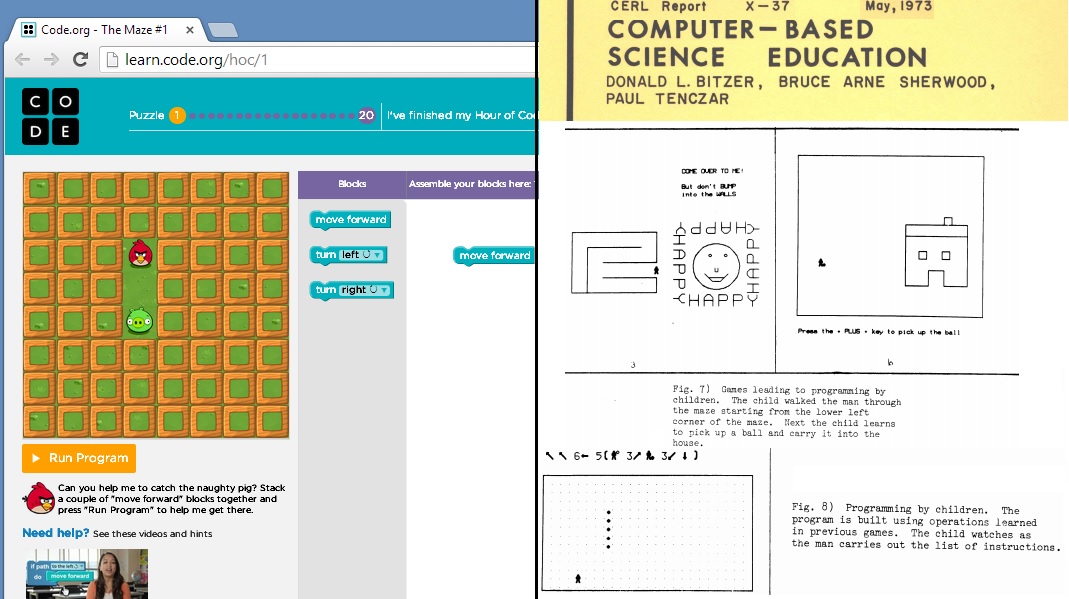
2013 Code.org Like Dumbed-Down 1973 PLATO?
Probably worth mentioning that Code.org's online programming tutorial for kids, created in 2013 with collaboration with engineers from Microsoft, Google, Twitter and Facebook, is kind of like a dumbed-down, albeit slicker, version of online instruction given to children in 1973 on the University of Illinois' PLATO computer-assisted instruction system.
Programming by Children (1973): "Young children can be taught the basic elements of programming...In Figure 7a the child has walked the man, one step at a time, through a maze."
Overview of Code.org's Hour of Code activity (2013): "Our activity is a set of 20 self-guided puzzles that teach the basics of computer science for users with no prior experience. In each puzzle, students write a program that gets a character through a maze."
-
Re:Triple...that would mean 3 phases...
You're nearly 100 years behind the times here. Conducting and insulating states can easily be phases of matter, and are frequently referred to as such in various systems. There are some heavily studied systems that display transitions from insulating to conducting phases. In more extreme cases there is a lot of work on things like superconductor phase transitions, Mott insulator transitions, superinsulator phase transitions, etc. It would seem near impossible to have any exposure to condensed matter physics and not trip over a pile of phase diagrams.
-
Re:And this is why people choose IBM
Which is why perfectly fine programs for the 360 crashed on the 370, because the ZAP instruction's semantics had changed?
I.e., in S/370, invalid signs in decimal numbers suppressed, rather than terminating, the operation? (A change not unique to ZAP.)
-
Re:Bitsavers
-
Re:Bitsavers
-
Re:The Mac sucks for all kinds of development!
As someone that works in that playground, I can tell you that all of the tools on that page aren't chip design tools. Pretty much all of them are schematic capture for PCBs. You didn't find what you thought you did in your search...
For what he's doing, you'd need something more along the lines of the following links:
http://www.verilog.net/free.html
http://www.iti.uni-stuttgart.de/~bartscgr/signs/wiki/index.php/Main_PageTo be sure, there's more, but this is more in line with what he's doing. Do keep in mind, though, if he's designing FPGA configs instead of ASICs, you're going to need to use the VENDOR provided tools to do the work. I can assure you few, if any, supply OSX versions of their tools. I know of only one that's mostly supporting Linux in addition to Windows...Xilinx. Pretty much everyone else does Windows and ONLY Windows.
I'd question the wisdom of spending the cash he did for the MBP based on his requirements, but it's do what he's doing or pick up a similarly decked out PC class machine for nearly the same price-point. The only upshot would be that he'd have the OS he needed to run it on as the main OS then.
-
meh.
"Do not play computer games. That's a complete waste of time. Make computer games: then the guys around you are occupied, and you can work quietly." - Volker Claus http://www.fmi.uni-stuttgart.de/fk/menschen/claus/
-
hardware requirments
System requirements
* At least 300MB GPU memory.
* The Linux version needs the free Qt SDK which can be found here.The application was tested with the graphics boards: NVidia GeForce 8600 GT, ATI Radeon HD 3800.
Distortion of the stellar sky by a Schwarzschild black hole,
Thomas Müller, Daniel Weiskopfit has some pretty stiff hardware requirements!
-
Link, needs torrent.
The link is here, but the file is 262MB.
http://www.vis.uni-stuttgart.de/~muelleta/IntBH/DataDssBH.tarCan someone set up a torrent?
-
Re:Microsoft OSs have a kill switch
Not only that, but you can't even block it with your hosts file.
-
Re:Another victim of C/C++ lack of array safety
-
Re:time to modify the hosts file
That might not work..
http://archive.cert.uni-stuttgart.de/bugtraq/2006/ 04/msg00301.html -
Re:Remote File Inclusion
Actually, it's a perfectly good name for the attack, since the request causes a
Here's an example of an RFI attack designed to exploit a bit of sloppy coding in PHP Nuke. -
Re:Other uses
3d fractals come to mind:
http://www.nsu.ru/fractals/img/cube_big.png or http://www.physcip.uni-stuttgart.de/phy11733/galle ry.html -
Links to papersHere's Marta C. González's publications page. As you can see, the author is a hottie!
Here are links to the paper in PDF format and Postscript format.
-
Links to papersHere's Marta C. González's publications page. As you can see, the author is a hottie!
Here are links to the paper in PDF format and Postscript format.
-
Links to papersHere's Marta C. González's publications page. As you can see, the author is a hottie!
Here are links to the paper in PDF format and Postscript format.
-
Re:Link to the Physical Review Letter
For people who lack a subscription to PRL the article can also be found here. It is a typical physics paper with plenty of vague plots, but little real math. -
Re:Editor for LaTeX with nice Arabic language supp
Arabtex with Emacs works quite nicely for what I need (Arabic quotes in European-language papers). Otherwise you could, you know, look at the information the arabeyes project put together on the subject (basically arabtex + lyx
-
Re:Sued FFII
Not only did they sue FFII, they also registered the domain yaho.co.uk to generate advertising revenues (a fact they now try to suppress), they built sites with anti-semitic content to show up in respective search results, are highly supportive of software patents and generally sue everyone in sight who disagrees with their views.
-
Re:Mac OS X already does it the RIGHT way.
Unix has been doing that for years as well, and quite possibly where the MAC people got the idea.
Unix symbolic links operate in one of two ways currently, SOFT and HARD.
Created via the SOFT mode, with the command "ln -s" the link specifies either a full or relative path to the target.
Created via the HARD mode, the inode use counter is incremented by one, and the entry is added to the directory listing.
Also, NTFS since Windows NT 4.0 or so, has had the capability for doing symbolic links in the HARD form for some time, they are just now getting around to adding an interface to activate the fature. Symbolic links in the SOFT form have been around for a short time now in the form for "Short Cuts" on the windows platform.
Reference to a security problem Windows NT 4.0 and Windows 2000 have with this feature : http://cert.uni-stuttgart.de/archive/bugtraq/2002/ 08/msg00240.html -
Winmodem Drivers for LinuxThen what is this?
"On this page you'll find Linux driver (sources, binary packages) and documentation for so called Winmodems"
http://www.physcip.uni-stuttgart.de/heby/ltmodem/
Microsoft is creating a proprietary software WiFi simulator. The point is that once you move the processing of a WiFi signals to a proprietary software simulator the hardware will no longer work under Linux. This is what happened with the WinModem. -
My Experience
with a winmodem is related to my laptop. It has a lucent chipset. I'm not sure if this is helpful but I have no problem getting up to date binary packages of drivers for this modem. (Right now I run FC3 and the modem works- installed with an rpm package- I consider that pretty current).
Drivers are available at http://www.physcip.uni-stuttgart.de/heby/ltmodem/
Maybe these are just older modems and you can't buy them anymore-- but if this type of modem is still available maybe you can get them for cheaper. -
Root Password
There is also a known vulnerability with the root password
http://cert.uni-stuttgart.de/archive/bugtraq/2001/ 12/msg00067.html -
Old news
-
Re:Yes, it IS different...
However, if I can reverse engineer the bank's device and discover the algorithm in use, it becomes worse than useless, in that instills a false sense of security.
No, not if the algorithm is properly designed; it should rely on the secrecy of the key, not the algorithm. And yes, all tokens are keyed, otherwise they would be completely interchangeable, which they're not.
Strong passwords are still less hassle, don't sacrifice much to security concerns (if never expressed in clear text), and just aren't that freaking hard to create. Pre-shared keys are even better, depending on how strong they are, and how they're distributed. And how well keys are guarded/revoked-if-stolen.
Non-shared keys are better. Like, oh say, public key encryption.
The SecurId algorithm is here btw (from another post in this thread). -
Re:Yes, it IS different...
This sounds like SecureID cards, which are time-synched to a master server which runs the same algorithm/seed. SecureID has a long history in the IT world, and works relatively well (and, as far as I know, no one has ever hacked the algorithm).
The algorithm was posted to BUGTRAQ in 2000. -
Re:This "random" test is dangerously incomplete.> Given the arbitrary limits on this test, it appears to be designed specifically
> to make IE look better than its competitors and prove some point rather
> than be an objective investigation.
It sounds like you have little idea who the author is, or you wouldn't make such a statement. Michal Zalewski is a well-respected security researcher, with impeccable credentials, and no particular love for Microsoft, who's made an undeniably valuable contribution in many areas of IT security.
While he generally seems to work on Unix-like systems, he has also published work on M$ software security problems - e.g. http://www.bindview.com/Support/RAZOR/Advisories/
2 001/adv_mstelnet.cfm
http://news.softpedia.com/news/2/2004/April/7797.s html
http://cert.uni-stuttgart.de/archive/bugtraq/2000/ 06/msg00066.htmlA quick google will repay your time.
Give the guy some credit - it seems he's uncovered a surprising lack of robustness in non-IE browsers - and admittedly an even more surprising degree of resilience in IE's handling of the HTML tag soup he played with
-
Growian and wind energy in Germany
GROWIAN was installed in 1983, and shut down in 1986 due to material problems. It had a power output of 3MW, two rotor blades of ~50 meters each (23 tons per blade).
Wind energy generators installed by danish company in the north of germany now routinely have a power output of 2.5 MW each, and 5 MW are expected to become standard in two or three years time. The German Wind Energy Institute reported a newly installed capacity of 729MW between January 2004 and June 2004, a 13% decrease against the same period in the previous year. The total installed capacity came to 15327 MW in June 2004, 5% more than at the end of 2003. -
I just called tech support
and this is what they had to say
-
Re:It's not "in" the browser
So we banish the "shell" protocol today. Who's to say Windows won't have another flaw in another protocol tomorrow?
Sounds far out? Well it isn`t! telnet:// is handled by telnet.exe, which once contained a buffer overflow resulting in execution of arbitrtairy code by windows handling a telnet url...(html mail, plain html whatever the source, another application launching url`s, etc)
-
Re:Magic roundabout
Have an actual photo of it...
-
Medical Applications
You want to know about Java3D and why people love it? Try looking towards the medical profession, especially radiology and surgical planning. There are a number of Java3D based DICOM viewers out there for viewing CT and MRI images, such as SPLViz and VisAdd.
The cross-platform portability means that the same CT and MRI images can be loaded up onto the same viewer on both the doctor's office PC workstation, their home macintosh or linux system, or even onto one of the esoteric workstations.
To get a better handle on why this images are needed, read up on this article: Combining Local and Remote Visualization Techniques for Interactive Volume Rendering in Medical Applications, and check out the Stanford-NASA National Biocomputation Center Website.
Once you dive around those articles and websites, you'll realize that Java3D supports alot of exotic hardware, such as 5 megapixel LCD monitors, Projection Tables for Virtual and Augmented Reality and Virtual Surgery Tables.
Radiograph images in most hospitals are obtained on VAX or QNX or HP Unix systems, and are then transmitted to Solaris or Windows workstations/servers for post processing. It's typical to have sometype of Oracle database sitting on an imaging archive (we have a 20TB archive, for example), feeding images to the clients sitting on workstations. Sometimes the images are saved as 3D volumetric data, although usually they're saved as 2D slices. So, you need some type of portable 3D viewing application that can sit on nearly any type of box, and can compile the radiographs for whatever local viewing equipment is available...
FYI, medical systems have to conform and perform according to federally mandated law, and there isn't the market pressure to compete with the newest processor on the market. Therefore, priorities are very different in the medical world. Pixel shading and texture mapping are generally on the bottom of our list of importance. True stereoscopic visualization and platform portability are near the top. For our purposes, Java3D outperforms all other competitors, because we *need* the portability, the garbage cleanup of java, and all of the other advantages of Java. -
Lucent
Lucent modems (such as that with a Thikpad T22) work pretty nicely. Look for the ltmodem driver, it claims to work on 2.6.
-
Re:Yes, it probably is
To be accurate, SMTP (via Sendmail) is enabled by default in RedHat 9, though it only listens on the loopback interface.
And this means that it is only vulnerable to local exploit.
RH9 is also two major releases old. Look at the current Red Hat release -- FC2 -- and you will find not one open port in a default out-of-box workstation install.
For a brief illustration of OS X security issues, may I point you to here?
Nonetheless, that's an astonishing improvement over previous RedHat sins, even as late as v6.2, where a machine was guaranteed to be 0wn3d within 15 minutes of gaining internet access, courtesy of wu-ftpd.
Oh, for Chrissake. That was, what, a year before Mac OS X was even *out*? Windows 2000 had barely been released. I admit that 6.2 was when the Linux userbase was definitely moving away from the "everyone's a sysadmin or *IX hobbyist stage", and so it would have behooved them to have wu-ftpd off by default, but you're having to look a lot of releases back here.
If you want to consider that ancient timeframe and mention local exploits as you did above, consider the fact that the Mac OS of the time had effectively no local security, either on the filesystem or in memory.
Well, you made that comparison, not me. Anyway, my point is that even today, most UNIX and Linux (including RedHat) systems come shipped with lots of services enabled by default, with the exception of Mac OS X (and OpenBSD).
And my point is that this is not the case. -
Re:How selfish of him
Yes, he has only given us the best, most stable, FREE OS in the world.
Actually... BSD or FreeBSD is probably the most stable OS judging by Netcraft's Uptime records. (take that! all you "BSD is dead" trolls!)
OpenBSD is obviously the most secure OS in the world, having had only a single remote exploit in more than seven years. Seems like my WinXP machine at work can't go but seven days between "critical" security updates.
I'm writing this post from Moz 1.4.1 on SuSE 8.2 Pro, so that tells you what *my* favorite OS is, however, Linux certainly isn't the "best" OS in every measurable way. -
Signed announcement
here.
To verify it:
$ wget -O- http://cert.uni-stuttgart.de/files/fw/debian-secur ity-20031121.txt | gpg --verify
(drop the space, of course)
Assuming you trust the key it was signed with, of course... -
Banner ads? How about SECURITY?
Blocking banner ads? That's nothing. Norton blocks STARTTLS encryption of SMTP (email) sessions, making it so that users CANNOT both scan outgoing mail for viruses AND encrypt their connection to the mail server. Everyone can read the mail - but at least there are no viruses in it!
Most annoyingly, they intercept the STARTTLS command with an innocuous error code, so that debugging it can be heinously difficult. Afraid to put "550 NAV is responsible for disabling your security" for some reason!
-
Security
Not sabotage, security. In case you don't know: itojun is the guy between all the BSD's IPv6 support, and has been very active in the standarisation process.
-
An extended troll against OpenBSD
Using an unstable development version and then complaing about instability, peppering the results with emotive commentary and clueless rhetoric. (btw the 1024-cylinder boot restriction he complains so much about has been fixed for a while) Especially funny was this idiotic statement:
OpenBSD also caused a lot of grief on the IPv6 front. The OpenBSD guys intentionally broke their IPv6 stack to not allow IPv4 connections to and from IPv6 sockets using the IPv4 mapped addresses that the IPv6 standard defines for thus purpose. I find this behaviour of pissing on internet standards despicable and unworthy of free operating systems.
Someone should hit him with a cluestick on this issue. Yeah, like itojun is despicable and unworthy...OTOH, the results are of concern and should be verified by someone less obviously biased. I haven't noticed them in practice on moderately loaded servers though (but I'm biased in the opposite direction).
-
Re:Its about time.
Er what? Perhaps some statistics might help.
-
Still no patch for the other DCOM vulnerability
Keep in mind that there still isn't any patch for this DCOM issue. So far, only a DoS exploit for Windows 2000 has been posted, but how can you be sure that no further, more severe attacks are possible?
-
Re:Bad choice for a name?
The Ikarus/Icare Project was used for a completely solar powered plane.
Daedalus is the name for a series of human muscle powered plane. -
Why not use a proper Teletype?
The Teletype ASR 33 has a keyboard that is already encoded into proper ASCII, and there is no need to have the printing mechanism enabled. There even is a CTRL key. Not to speach of all the fancy tricks that can be performed with the keypunch - but that is another story...
-
Re:Real, Working Dinosaurs
From Commodore PET page: Das ROM umfaßt 14KB, in denen sich ein 14K-Basicinterpreter einer amerikanischen Firma befindet, die auch heute noch nicht in der Lage ist, fehlerfreie Soft-ware herzustellen.
<babel_fish>
The ROM covers 14KB, in which a 8K-Basicinterpreter of an American company is, which is also today not yet able, error free software to manufacture.
</babel_fish>
I wonder who that might be...
-
For those wer nicht Deutsches sprechen
The site ist here (german only).
Babelfish translation of the link above. There are some cool equipment a couple of clicks in. -
Real, Working DinosaursFor those that are interested: The Informatics Department at the University of Stuttgart, Germany, has a (small) Computer museum with stuff from that era -- not photographs, but actual working devices. The site ist here (german only).
Its quite interresting (and funny), actually.