Slashdot Mirror
Domain: unm.edu
Stories and comments across the archive that link to unm.edu.
Comments · 240
-
Re:Horseshit
It may not apply to current systems, however there are some people around here working towards changing this. I'm not sure if it'll work, but it'd nice if they do.
-
Re:Horseshit
It may not apply to current systems, however there are some people around here working towards changing this. I'm not sure if it'll work, but it'd nice if they do.
-
Re:So by extension...
The big difference is that our bodies are hardwired to 'learn' from virus attacks and build immunities while computers and operating systems are not (well outside of this lab). Currently, resistance to a particular bit of malware is not carried over into other things, unless they're using the same attack vector.
Of course, when people finally get tired of constant virii/worms/trojans/exploits they might eventually demand a system that's designed to be secure; less an an evolving immunity and more of a spontanious improvement across the board. -
Why Word Does ThisI just created a Word document, blah.doc and put some text into it. I made sure I had a couple of undo points. I closed it and opened it back up, I couldn't undo SHIT. So where the hell am I being granted this mysterious "convenience?"
You're not.
There are two ways of saving a word document:
- Fast Save
- Full Save
Fast Save dumps the binary from memory into the file. Full Save compacts the binary image, and reorders it. This takes time.
Word's text stream is stored using a piece table. One of the benefits of a piece table is that if you keep the meta information about the text, you can get nearly infinite undo. The way it does this is by having an original data stream, and an appended data stream. Whenever you add data to the file, it gets added as a chunk to the end of the appended data stream. Whenever you delete, the meta table is updated to remove the text from the stream, but otherwise the text itself is left unaffected.
As a result, text is never removed from the document. A Fast Save (which is the default) under Word dumps the Piece Table as-is (there is probably some compaction over time to remove the no-longer-used data, but it probably only occurs above a given threshold of used to unused text). A full save deconstructs the piece table's meta information, and turns it back into one contiguous stream of data.
It's all just a function of the way the text is stored while it's being edited. Different editors have different mechanisms; some store data based on lines, and some store it using a gap buffer. But ultimately, the problem exists because Word uses a piece table, and it dumps the entire table to a file by default.
It's actually a sensible way of handling the text data. However, whoever designed the Fast Save algorithm probably didn't consider the ramifications of the text still being stored in the document. The best workaround? Wipe the unused sections of the piece table. But then you might as well return to using a Full Save, as you'll be ditching the performance benefits anyway.
Simon -
Re:Sell to average Joe? How bout college students?
Currently there are not very many college students in CS or CompE that use open-source development products.
Really? That hasn't been my experience at all. Here's a list of computers at UNM And not atypical of some other schools I've seen. -
Enough with the damn fingerspelling recognizers!As a hearing person who actually took the time to understand something about sign languages, I'm getting really sick of these ignorant techies and their stupid gloves. Get a clue people!
- Fingerspelling is not sign language
- Sign language translation is really complicated (think of all the problems with machine translation, compounded by a language that's very different from well-known Western European spoken languages, and that no one writes)
- Have you ever tried asking a real live Deaf person what kind of technology they could actually use?
-
Re:Both are linked
I'd much rather have the US system, where one can have a good university system that doesn't cost much -- some schools are pretty damn good, and don't cost much at all. The health care issue is pretty much bullshit -- insurance only costs about $50-$100 per person over here for good coverage. The higher wages I earn over here more than pay for that. Retirement is an issue where investing yourself is more worth it, especially when you consider the fact that most public retirement systems are a pyramid scheme anyways. I'd much rather have the money to invest in stocks and real estate than have someone else decide how I should invest my money. I'm not an idiot, and socialism is simply an insult to my intelligence.
-
Re:Product need...
why would anyone want to buy a single function handheld over a PDA?
Because, despite your satisfaction with the legibility and screen quality of your Palm IIIxe, there is simply no comparison between the screen of a Palm III and the screen of a good, dedicated e-book reader.
It's like comparing the output of my old Epson MX-80 (9-pin, dot-matrix, impact) printer with that of a modern laser printer (if you're too young to know what the MX-80 was, here's a picture of one). I could easily read the printouts from the MX-80. The print from the MX-80 was perfectly legible but the amount of eyestrain that one would experience over the long-haul was really significant.
Note that I do read e-books on a Handspring Visor, but I don't, for a minute, try to convince myself that the quality of the experience is comparable to using a dedicated e-book reader. -
Re:Puns
Ah, this should come in awfully handy.
-
Re:Other 3D UIs: references and links.
You forgot to mention that project based on the Doom source that represented each process as a monster on a map. You could shoot them to kill or slow them down...
That's the URL:
http://www.cs.unm.edu/~dlchao/flake/doom/
Sure, it's not a desktop, but I like the idea of interacting with the system that way. Most of current projects (at least those you mentioned) are simply filesystem navigation tools. I think that 3D desktops will need to represent the system in a more complete way - for example, objects for interacting with your printer (throw a document 'window' at the printer to print?) or setting mouse options, stuff like that... -
Re:Browsing is step one
-
Re:Jur-Ass-Has-Had-It-Park!
Oh, you must mean this 3D filesystem viewer on IRIX (the page even says "as seen in Jurassic Park!").
Well, as it turns out, yes Linux has something like it available.
And, on top of that, what other UNIX allows you blast processes with various armaments?
-
Re:Kill command for *nix
you mean this link?
-
802.16a is to 802.11 as VG-AnyLan is to Fast Ether
I have not studied the final 802.16a yet, but from looking at 802.16 about a year ago, I got the impression that 802.16 is to 802.11 as 802.12 VG-AnyLAN was to 802.3 Fast (100Mbps) Ethernet.
802.3 100bT Fast Ethernet and 802.12 VG-AnyLan were considered competitors in 1994 with VG-AnyLan offering "advanced QoS features making it more suitable for Enterprise applications"
The claims even sound similar:
The 802.12 standard for 100 VG-AnyLAN allows for a backbone supporting both the 802.3 frames and the 802.5 frames. This means that an existing enterprise network with both token ring, ethernet, and some central backbone can easily migrate to the 100 VG-AnyLAN environment. This is due to the diverse media architecture this new technology can utilize: Cat. 3,4,&5 four pair UTP, Cat. 2 two pair STP, and single/multimode optical fiber. Meaning that if there is an existing FDDI, token ring, or 10baseT backbone in place all that need be done is simply replace the endpoints (router or HUB blades), connect the 100 VG-AnyLAN repeaters together, and voila a network structure based on a high speed new technology.
Highlights
# Support for those applications demanding a not only high bandwidth, but that are also time sensitive (this is due to the media access method called demand priority)
# Adapt legacy ethernet and tokenring networks to a high speed backbone with great ease because nodes with 100 VG adapters can be configured to transmit either tokenring or ethernet
# Extremely expandable when compared to tokenring, and all forms of ethernet
# Maximum network diameter 8000 meters
# Cascading up to five levels
Here's an obituary from a 100VG AnyLan FAQ
Hi! Welcome to V1.2 of Richard's Unofficial 100VG AnyLan Web FAQ! This substance of this FAQ was last updated on Sunday, January 28, 1997.
January, 2001: At one time, 100VG AnyLan was a very promising technology. However, due to market forces (Fast Ethernet slaughtered it in the market), VG is a dead technology. To my knowledge, there no currently no VG products for sale. -
Re:it's all lies
Thanks for the links. They're a great resource for research in micro-biology, and I'm sure there is lots of relevant stuff here. It'll just take some time to dig through it. I found the paper by Gary Olson and Carl Woese here most interesting. Then again as a programmer that's maybe not much of a surprise
The conclusion of that paper was pretty much like all other molecular phyogenies I've found. Still inconclusive and raising questions about our former ideas about how the phylogeny should have looked. It's this trend of conflicting findings, that would be expected if our common descent assumption is wrong, that continue to make me think our evidence for common descent is not compelling.
As I find other examples that pertain I'll post them. If you have any in particular you've seen just let me know, thanks again. -
Re:Money
Yes, but will the doctor play quake on the same system that controls the robot?
Well....
Using something like quake for a user interface to other things isn't an unheard of concept; there's a mod for Doom to use it to manage processes. It's not a completely absurd idea to use something like that to present information in a "more meaningful" way.
"Okay, lemme go grab the quad, and then this tumor over here's going down!"
-
Comparisons of Mathematica, Maple, Matlab, etc.Lots of people have talked about this question before. Here are some pointers I found that might be helpful...
- thread on the Maple Users Group list entitled "Maple vs. Mathematica"
- comparison of various operations in various computer algebra systems
- another comparison of various operations in Maple, Matlab, Mathematica, IDL (doesn't look complete, but it offers some discussion)
- some discussion of differences in the programming models between Maple and Mathematica
I'm sure there's a lot more; try some Google searches: maple mathematica matlab, maple vs mathematica, "computer algebra" comparison.
-
Re:Hackers?
While you have a very valid point, the visual animation of the attacks does look quite similar on the surface to that in hackers.
See here. -
Re:Net visualizations?
Hey,
I wonder what network visualization tools they're using? It'd be interesting to see what visualization tools are compelling enough to use in a spectator sport.
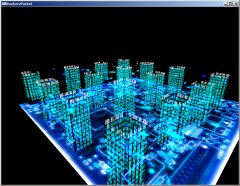
According to the (not very impressive) website, they're using HackerPacket 1.0.
Description:
HackerPacket is a tcpdump utility inspired by "The Gibson"
Features:
Uses Winpcap for packet trapping
New Towers spring up on new host connections
Packets are designated by particles coming from the buildings.
Raw incoming packet information is displayed on the towers, along with IP address
w,s,a,d to move and e to lock the camera.
So apparently it will literally include animations like in the movie 'Hackers.'
Michael -
Venison
For those poor Slashdot readers who have never had the chance to taste real venison jerky, let me recommend a site to you: VenisonWorld.com. Venison World is a little store in po-dunk Eden, TX. Eden is out in the middle of nowhere but I used to drive through there several times a year while travelling between home and college. The venison jerky that this place sells is quite pricey but is really out of this world. That Oberto beef jerky for sale at the 7-Eleven can't touch this stuff.
-
Very confused article.For example, the researchers didn't "...[collide] the circular gold atoms slightly off-center" in order "to simplify their observations." The atoms just collide off center most of the time naturally.
A bit denser, but much more accurate story about RHIC is here.
-
Re:Why we have operating systems
Doesn't anyone think out of the box around here?
We are not talking about what makes a good operating system. We are talking about new ways to interface with computers that are inovative, efficient and radically different than the point and click GUI maps over the OS's.
Anyone remember this DOOM interface for killing processes. Granted, this still requires a sysadmin that knows what he's doing but that's not the point. The point is, this is a radically different interface than anyone has ever done before.
In context it is funny and a rather novel idea that no one would really implement in a production environment. Imagine the havoc!
However, it's not far from what Dr. Gelernter is talking about: Thinking outside the box for new inovative ways for interfacing with the computer. Tying the user closer to the information rather than the intricacies of the system.
In this interface, the information (processes) are presented in a unique way to the user (as demons). The user does not really need to know much about the system or about the OS. To kill a process, use the BFG!
Pretty radical!
This is not the solution so don't nitpick. Its an example of thinking outside the box. Dr. Gelernter's software doesn't necessarily need to be the solution either. But at least he's thinking about it and not trying to duplicate the same old thing. -
Re:Postmodernism in a nonliberal arts field???Actually, in my undergrad days, my favorite class in my mathmatics major was called "modern geometry". The entire thesis of the class was looking at why Euclid developed five postulates instead of four. The first four are obvious:
- A straight line segment can be drawn joining any two points.
- Any straight line segment can be extended indefinitely in a straight line.
- Given any straight line segment, a circle can be drawn having the segment as radius and one endpoint as center.
- All right angles are congruent.
But number five, oh the chaos number five brings:
- If two lines are drawn which intersect a third in such a way that the sum of the inner angles on one side is less than two right angles, then the two lines inevitably must intersect each other on that side if extended far enough. The converse is also assumed, although not stated directly. If the inner angles are 180 or more the lines do not meet on that side. Parallel lines never meet, hence the angles on either side sum to 180.
That beauty (which you may know more succinctly as "Given a line and a point not on that line, there is one and only one line through that point parallel to the first line.") caused a collective, 2000-year "Whaaaa?" in the mathematics world. The solution was that there are three consistent geometries; the euclidean that you were taught in high school, hyperbolic geometry, which models the reality of subatomic particles much more closely than Euclidean geometry does, and spherical. Here is a quick link that dicusses this topic in greater detail.
So yes, postmodernism alive and well in the sciences; I'm actually suprised that the majority of
jaz -
Re:Power supply?Why not eliminate the lever?
Here is a discussion of how PN-junctions absorb electrons directly from a beta-emitter embedded in a semi chip.
-
Re:My personal favorite
Something like this? _Very_ cool looking. I'm curious, to what degree does the sound bouncing off the far end affect the flames?
-
digital camera sample
from a Canon S100 It sure doesn't look like a nicely scanned page, but it's legible and some contrast boost would probably help a lot.
-
Re:Lawful authority? - OT
For the record, in 1732 England opened Georgia as a penal colony.
-
Re:XMMS rocks, where's a no-gui version for old PC
There is some work being done on this (xmmsmg), though I get the impression not all xmms core developers are eager to drop dependency on the X11 gui..
-
ccr - an earlier peer-to-peer MUD
I'm afraid that Brendenland is definitely not the earliest peer-to-peer MUD. David Ackley has been working for many years on ccr, a system where individuals create and interconnect independent MUD-like worlds. One of the most important questions ccr addresses is the issue of security: when you are visiting another person's world, what should that other person be able to do to you? Also, ccr addresses the issue of hacked clients through code signing and chains of trust.
If you are curious about ccr and Dave's ideas, check out his home page and ccr's central keyserver.
--Anil
-
security through obsolescence
I think security thorigh diversity is a much better propostion. It is well known that biological systems become vulnerable if they are too homogeneous. For example, if one species dominates an ecosystem then diseases will spread more rapidly and affect more of the population. The same argument can be applied to computer systems. If one hardware and software configuration is dominant eg MS, then vulnerabilities will affect a larger number of systems and viruses will spread more rapidly.
-
Rumours of Episode VI?
I haven't even heard rumours yet that Episode 6 was being made. I have however heard it's not being made at all, ever. Any total looser can make up rumours, but only a talking dog can insult them.
-
Re:Not that much waterIce is about 1/3 the density of water
If it were 1/3 the density, 2/3 of an ice cube would be above the water line. In fact, ice is about 91% of the density of water, meaning that 9% of an iceberg is above water, 91% below.
q.v. this picture
-
Re:IAAT. Pipe dream: Fund the Grass roots
Couple of responses. First a sheepish apology for the terrible grammar/spelling of the original post. I was in rant mode.
> So, for starters, and since you are a trained taxonomist, what do you think is the fair ballpark >number of species on the planet?
I don't know. I agree with your questioning the total estimates of species, this is very difficult to do as far as I can tell. I will say that in the field there is a somewhat of a "law" (and I use that term in the most unscientific way) that states that every time you do a revision of a group of taxa you double that number of taxa in that group. So for instance I am revising a group that previously had 7 available species names and I now recognize over 20 taxa. A big reason this happens is that we have more specimens, that are better curated, and more powerful tools to observe those specimens. When the group I work with was last revised (around 100 years ago) they had no scanning electron micrographs, we do now...and they reveal a lot that was missed before.
In the family I work with there are over 4000 species estimated to occur (and I believe this to be accurate) and 2000 available species names. What is very important to note is that just because a name is *available* doesn't mean its describing a unique species. Of those 2000 available names, many are synonyms, describing the same species. So the answer to described/undescribed...easily less than half. Finding out names are good and which are not is very difficult. There are many laws that govern this. Note that a HUGE problems is that these laws only apply to "animal" names. Plant names use a completely different system. Want to catalog all the species? You have to reconcile more than one system of naming somehow.
As said elsewhere the number of total species will depend on the species definition. A phylogenetic species concept is commonly used for those who have no biological evidence available. Once more is understood about biology/ecology/DNA of the organism it frequently turns out that a finer level of resolution can be defined. For the purposes of the All Species they will undoubtedly use the phylogenetic species concept.
Does every expedition come up with new species? In the group I work with, almost always (how exciting!). I can take you to a location (of my choice), we can trap bugs for a day or so, I guarantee you we get an undescribed species in the group I work with. Not so for all areas, obviously impacted areas (e.g. crop fields) are depauperate. Also not so for new groups. Want to describe a new species of butterfly/long horned beetle in North America...very difficult to do because they are so popular and many people work on them (unless you work with micro-lepidoptera). Want to describe a new bird or chordate? Almost never.
There are such curves that you seek in some areas, and its frequently debated how they should be done. Its very well known that you capture the common widespread species first, the rare ones last, the payoff decreases exponentially, the more you know, that harder you have to work to get the new species. You may want to check out this book which has some modern, if not somewhat controversial ideas, about the subject, and lots of technical ideas on modeling the problem.
P.S. Look at the massive administration set up for All Species...and they hope to have a "pilot project" (read actual field work) within a year...my guess is it take 3 years before a single species is named from this initiative. Ask again how many of these luminaries listed on the people page are actually describing species now (many have in the past)? Call me a skeptic. -
Gaming Interface for Ease of UsePart of what makes the mind so efficient is the filtering process. So at some point, you would have a filter so that to do not get overwhelmed with data.
I Imagine that the interface would have to be something familiar that most geeks can deal with.
I suggest a gaming interface like Doom. There was that admin tool for killing off zombie processes. Something similar could be used to symbolically represent the people you meet. Bill Gates As Satan, for Example.
Of course, you would have different patches depending on your tastes and opinions.
-
Re:How about a FPS game?
-
Re:How about a FPS game?
Doom as a tool for system administration Ohhh yeah baby!
-
computer immune systems
Some are getting too hung up on carrying the biological metaphor too far. There is no way these systems can, in the short term, be anywhere near as complicated as that of a living system. But neither do they have do be, since the environment in which it operates is vastly less complicated than the physical world. Past success in applying simplistic biological models (GAs, etc) to limited domains seems very encouraging to me.
This link might give some good reading:
http://www.cs.unm.edu/~immsec/ -
Re:I've seen the future, and it is Doom. Good doom
-
a link to Process Killer - but for DOOM
I haven't seen a process killer using quake. AFAIK, I know only one using DOOM. If you know of one using Quake please post the link here!!! The DOOM version is located at: http://www.cs.unm.edu/~dlchao/flake/doom/
-
Re:Not surprised
There is in fact a few colleges in the USA that offer Unix System Admin degrees. I go to one of them, the Unversity of New Mexico - Los Alamos. Check it out at www.la.unm.edu.
-
Re:Holding Companies Liable
-
Re:Gravity is not a 'force' (you had to go there!)
Gravity is Not really a force
I guess it matters relative to (no pun intended) if you are looking at the questions as Newton or Einstein.
"Gravity is the result of four-dimensional space-time being warped by the presence of mass"
consider this, "We constantly fall back on the belief that gravity is a force even when we know otherwise"
And from the WhyFiles,The six-minute guide to space-time, "Einstein concluded that gravity was a property of space-time, not a separate force." -
MUDs, MOOs and Cartoons as UIIt seems that MUDs and MOOs in particular could provide a next generation user interface.
Objects like files and folder could be scripted with methods allowing them to be graphicaly chained together to perform tasks. The resulting chain object would probably look like some sort of Rube Goldberd moustrap contraption. This is similar to a command line like "kill -9 `ps aux | grep netscape | awk '{print $2}' `"
Objects could be created, extended and saved in in a MOO environment. The next level is to make it 3D and interactive like some sort of interactive, cartoon fiction.
It kind of reminds me of ps Doom
Dennis
-
new paradigm for GUIsIs Aqua a new paradigm for GUIs? No, answers the writer:
To see tomorrow's computer systems, go to the video game parlors! Go to the military flight simulators!
I see where he's going with this...he wants an interface where stuff blows up! Oh, wait, it's already been done -
Re:How about this for a niche OS
Ouch. Sounds like you'd need a BFG then, at least to deal with the nastier processes...
-
I can see it now...--Opening scene--
Our hero is using PSDoom to "mannage" a Linux workstation that has been infected with a twisted copy of the MCP. The virus was installed onto a Windows 2000 box on the network by the latest Service Pack. Suddenly, a voice is heard from the workstations speakers.
MCP Virus:
I see you are not running Windows on this workstation. Come to the dark side.
Our Hero:
Never! Just wait till I get the BFG! Then I'll show you whos boss!
MCP Virus:
So... You like to play games, do you?
-- Our hero notices that his mouse, a Micorsoft Optical mouse, starts to pull away from his hand. It flips over, and shoots him with a strange light from its optical window. Our hero finds himself in a place unfamiliar to him. He sees hundreds of Linux sysadmins being held up to the walls of a circular room. They are being scaned by some kind of energy. Something pulls at him, and he is thrown toward one of the empty spots on the wall and held there.
MCP Virus:
HAHAHA!!!
Now you will know my true purpose! I will drain all the knowledge you have and use it for my own evil purpose! I will be [long pause. Drumroll] Windows XP Server!
Voice from off camera:
Not if I have anything to do with it!
-- In walks a short, fat, black and white bird with a yellow beak, wielding a BFG. Camera focuses on him, then the BFG.
Voice from near dead Linux Systems admin off camera:
We're saved! It's Kernel Tux!
-- Uh... He blasts the hell out of everything, the workstation and the world are saved from the horrable evil.
Damn. It's way past my bedtime... -
DENVER MEETING IS STILL ON
The meeting scheduled for tonight regarding the denver protest is still on. This page has the details
-
Textmode Quake!
Slightly OT, but while we're [sort of] on the topic, there is a Textmode Quake package available which provides an interesting idea for user interfaces.
I wonder whether this could be combined with the Doom Sysadmin Tool for a text->GUI->text->severe eyestrain session. -
Re:Is this the start?buildings and rooms in a VR environment, killing off rogue processes with your trusty sword of SIGTERM.
I walk through my process space with a shotgun. After a week as the new sysadmin, I'm finally getting used to the environment. Barrels of toxic waste are scattered throughout, providing temporary recourse against the onslaught of processes. Of course, if the fighting gets too bad, the processes fight among themselves, but only if there are too many processes. Most of the time I must go out on my own. With each shot, a nice command, with each frag, a kill -9. I keep the process space safe for users and processes alike. Within the month, I plan to aquire the rocket launcher, so that I can finally clean out the daemons of X11 sessions gone bad. Right now though, I have but a shotgun, and I cannot go head to head with the monsterous processes that haunt the upper stack. But soon I will.. soon I will succeed...
Your post reminds me of a nice little program that I found a while back... Sysadmin Doom. -
Mobile robots, yes. Human-like motion, why not?
I don't know if this spherical motor would be of much use for it, but as far as human-like motion goes there is a lot of research being done on artificial muscle made from ionized polymeric gels.
There's a lot of interesting info available at the Artificial Muscle Research Institute (free registration required).