Slashdot Mirror
Domain: utexas.edu
Stories and comments across the archive that link to utexas.edu.
Comments · 1,356
-
Fools anthropomorphize
Although these are easily imagined inside our heads, they're surprisingly difficult to define formally in such a way that a computer system would be able to understand.
Perhaps Dijkstra would prove enlightening here.
-
Re:Karma Whore or Just Stupid ?
I'm not sure where you're trying to go with all this - I hadn't mentioned the greenhouse effect, nor did the "prior poster".
Yes, climate scientists are aware that the great majority of trapped warmth is from water, and the effect of CO2 is relatively small. But even tiny effects add up over time when the equilibrium is altered, and we're observing exactly that. The calculated decrease in radiative transfer from the IR blocked by all the extra CO2 agrees very well with these observations - and no other potential cause comes close.
The evidence shows that the localised RWP, MWP, and LIA events were triggered by factors other than CO2 - like fluctuations in solar irradiance and vulcanism.
-
Replace testing with formal verification
As other people have noted, it really needs some native app development capability and I don't see that happening in sub $200 machines.
Hardware-wise, I don't see how "sub $200 machines" can't develop native apps. I used to run DJGPP, a distribution of GCC for MS-DOS, on a 1990s PC with a 25 MHz 486SX CPU and 8 MB (that's 0.008 GB) of RAM. Perhaps the real reason why today's "sub $200 machines" can't develop native apps is that the manufacturer locks them down to prevent native app development, with the intent of selling services to replace the locked-out parts. Notice how only the most expensive Chromebooks nowadays can run Crostini, the container to run GNU/Linux applications inside Chrome OS, and in "developer mode", the firmware makes the powerwash command more prominent than actually booting.
So this means schools that deploy Chromebooks need to carefully consider what students taking "Computer Science I" are supposed to use to complete their assignments. Borrowing time on school computers after school and hoping students have some way to get home after the school buses have left for the day isn't practical for all or probably even most students. Or are high school computer science classes instead supposed to follow the computer-free, formal-verification-oriented structure described in "On the Cruelty of Really Teaching Computer Science" by E. W. Dijkstra? He suggested using a programming language for which nobody has written a compiler or interpreter, such that students are expected to produce a pencil and paper proof that a program meets the functional specification instead of testing the program on a computer:
Right from the beginning, and all through the course, we stress that the programmer's task is not just to write down a program, but that his main task is to give a formal proof that the program he proposes meets the equally formal functional specification. While designing proofs and programs hand in hand, the student gets ample opportunity to perfect his manipulative agility with the predicate calculus. Finally, in order to drive home the message that this introductory programming course is primarily a course in formal mathematics, we see to it that the programming language in question has not been implemented on campus so that students are protected from the temptation to test their programs.
-
Re: We as a culture are not ready for nuclear powe
Let's say I concede the point, that the DOE got the materials needed for solar power off by an order of magnitude you still have on a per megawatt-hour basis....
Solar power requires 3 to 10 times the materials compared to nuclear, depending on how you want to do your math. (And it would be more like 30 times if I don't concede this point.)
Solar power causes 4 to 4000 times as many fatalities. (Here's another source for that: https://www.forbes.com/sites/j... )
Solar power has the same to 10 times the CO2 output as nuclear, depending on who you ask.
(This shows solar has about 3 times CO2 output over nuclear: https://energy.utexas.edu/news...
This shows solar and nuclear at near parity: https://www.carbonbrief.org/so... )As for cost... I can't seem to find a straight answer. I'll search and keep finding sources from nuclear power advocacy places where they show nuclear is cheaper than solar. When I look for data from places that advocate for wind, solar, and hydro, they don't mention nuclear power at all. That in itself is quite telling. There's those studies from a place called Lazard that give wildly varied numbers on solar power based on the specific type and they include a warning not to compare intermittent energy, like wind and solar, to dispatchable energy, like nuclear and natural gas.
This warning from Lazard to compare solar power costs to nuclear become apparent when looking at the paper from Conley and Maloney where they compute that just the backup power in natural gas, or storage from pumped hydro, would cost double to 5 times the generation capacity from nuclear. Again, that's the cost to match the solar supply to the load, before the costs of the actual solar power generation is added. Again I'll give the link: http://www.roadmaptonowhere.co...
To defend your point on material needs you gave a pamphlet on a do-it-herself solar power kit that looks like something someone would prop up at a campsite, not a permanent install done by professionals.
So, if I concede the point on materials needed, and agree the DOE was off by as much as an order of magnitude, then it still doesn't look that great for solar. Would you like to go into the other points against solar now?
-
Re:1-based arrays
Zero-based counting in computers has evolved from a useful efficiency trick during an era of scarce resources into an almost elitist vestigial organ that needs to be chopped off. All it leads to is more intense thought processes and off-by-one bugs.
Actually, the opposite is true - zero-based indexing can help eliminate off-by-one bugs (see https://en.wikipedia.org/wiki/...). It's also not true that the reasoning for it is efficiency (in addition to the wikipedia article, see Dijkstra's take on it - http://www.cs.utexas.edu/users...)
-
Re:Death to the Ribbon
Well, they could keep the Ribbon if they did a few things to it.
Like instead of having an entirely separate 'File' menu, they could include that in the rest of the Ribbon as a 'File' tab.
Then they could get rid of the 'Home' tab (I've never quite understood what it has to do with my home, or even with home base), and they could distribute its contents among other tabs, like maybe tabs named 'Edit', 'View', 'Insert', 'Format', 'Tools', and 'Table'. That would allow them to keep Alt-H for 'Help', where the 'Help' tab could contain things like 'Word Help' and 'About Word' (where the latter would display version information etc.).
Finally, they could allow the user to hide the hieroglyphs and just keep the names of functions, I'll call these "tab elements." Some of these tab elements would correspond to simple commands, like there could be a 'Copy' command in the 'Edit' tab. Other tab elements would have to lead to sub-tabs or dialog boxes. For instance, the 'Format' tab might contain words like 'Font...', 'Paragraph...', 'Bullets and numbering...', 'Borders and shading...' etc., each of which would bring up a sub-tab or a dialog box. I guess these tab elements could be stacked on top of each other.
I thought of getting a patent on this, but it turns out someone already came up with my idea. There's a picture of one of these tabs here: https://www.ischool.utexas.edu...
-
Re:Now that we are onthe same page comrade
That's just not true.
https://sites.utexas.edu/mecc/...
They are having trouble cutting all the excess capacity even though they want to and keep having 5 year plans t do it. But they don't really have the top down control that you claim, to actually go and get it done. https://piie.com/blogs/china-e... -
Dijkstra's wisdom
Dijkstra talked about this. Everyone here who uses terms like "the computer sees X as Y" or "the neural net thinks that A is actually B" or "the AI was mistrained" is making a fundamentally erroneous mistake: the computers do not think. The algorithms do not understand. The machine does not have vision; it does not see.
Does your air conditioning filter understand the difference between air and dust?
Does your cell phone's finger print reader or facial unlocker recognize you? Does your mirror?
Do your headphones speak English? Does your microphone understand what you're saying?
Does Google maps know where you are? Does a paper map know where you are?
Does your thermostat know the temperature of the room? Does a mercury thermometer?
Does your calculator know or understand mathematics? What about an abacus?
I understand that such idioms are handy and sort of get the point across: I use these idioms myself sometimes.
But slashdotters are supposed to be intelligent; are supposed to actually know and understand what the machines are doing and how they work. We are supposed to understand the difference between slang and reality when it comes to technology.
Don't be fooled by the jargon. Don't mistake a complex system with complex inputs and outputs for "understanding" or "knowing" or "intelligence".
Neural nets are nothing more than automatically calibrating digital classifiers. They're nothing more than statistics.
They're not intelligent.
They do not understand nor comprehend.
They do not "see" nor "recognize". -
Re:how do you figure out who's hot or not?
I wouldn't characterize it as perceiving faces as nondescript blurs. You can see the face and it's features just fine when you're looking at it. But a few seconds after looking away you don't really remember it. It's like you mind has a much harder time developing a visual fingerprint of a specific face which would make it easier to recall, or develops a much less sophisticated fingerprint. I have no problem comparing pictures of faces side by side and picking out matches. But if you showed me a picture of a face for 5 seconds, then asked me to pick it out from a dozen photos of similar faces, that would be really hard to impossible for me. (I think the nondescript blurs is specific to people who've suffered brain damage in the part of the brain which recognizes faces. The same part of the brain that makes you see the front of your car as a face, or see a face in a Mars photo.)
A lot of our perception of "beauty" is simply facial symmetry and average features. i.e. Attractive celebrities aren't beautiful because they're unusual. They're beautiful because their faces have less deviation from the average. So you don't need to recognize faces to tell that they're attractive. I'm actually really good at taking flattering portraits of people, probably because I concentrate a lot more on non-facial features like lighting, posing, and expression. And hiding things which make a face appear unattractive is more a mechanical process for me, rather than instinctive. -
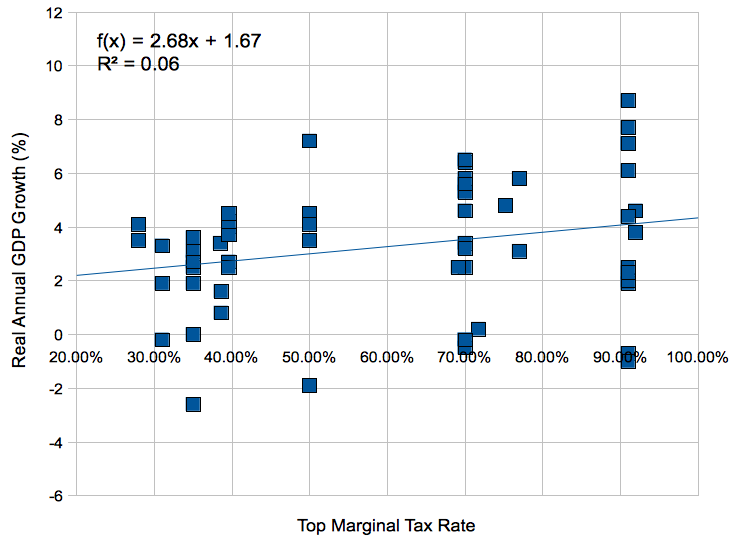
Re:Oh noes! More tax cut "fail"!!!
The ONLY President in US history to never see 3% growth in the US economy in any year of his term..
If you're pulling out simplistic numbers, then clearly the answer is raising taxes.
What's "pulled out" about the fact that the US never saw 3% annual growth under Obama - the only President that never had that? Even Jimmy Fucking Carter managed to get over that bar - it's not that hard.
Obama spent his entire Presidency talking about "remaking the US economy" - meaning along "progressive"/redistributionist lines. He waged a "war on coal" and threw every effort he could to stop fracking. He lived in a pie-in-the-sky world powered by solar, wind, and unicorn farts. It's no surprise employment, wages, and the entire US economy stagnated under his lead - he'd never been in charge of even a two-person 7-11 shift in his entire life.
Given stated economic goals are just about the same as those Hugo Chavez implemented for Venezuela that resulted in an utter, deadly train-wreck of an economy it's probably a good thing Obama was incompetent in getting things done.
Hell, that's a lot more relevant than your bullshit with what? A 0.06 correlation coefficient?
-
Re:Oh noes! More tax cut "fail"!!!
The ONLY President in US history to never see 3% growth in the US economy in any year of his term..
If you're pulling out simplistic numbers, then clearly the answer is raising taxes.
-
Re:Ancestry.com fakes results
Seemed pretty extraordinary so I thought I would validate one of those claims so I picked deborah bolnick
She does exist
https://liberalarts.utexas.edu...
I couldn't find that statement by her with dna and fraudulent
I did find an article by her on "recreational" dna testing here.
https://anthropology.stanford....I think on balance this article supports the parent post's assertions. She says that recreational dna testing is real testing and real science but that there is a low coorelation between dna and race, some of the dna companies only test 1% of the dna, spurious hits for alleged american indian dna markers are found on many different continents in four other 'races'.
She concludes...
---
We must weigh the risks and benefits of
genetic ancestry testing, and as we do so, the
scientific community must break its silence
and make clear the limitations and potential
dangers. Just as the American Society of
Human Genetics recently published a series of
recommendations regarding direct-to-consumer
genetic tests that make health-related
claims (20), we encourage ASHG and other
professional genetic and anthropological associations
to develop policy statements regarding
genetic ancestry testing.
---So- while I didn't validate the entire post, the lead point checks out so the rest would probably check out too. It's certainly credible that some testing companies in the field might have issues (esp the one that tests only 1% of the dna).
A couple points tho. The technology is going to be much better at building likely (but not certainly) family trees. The police have used the technology to solve cold case crimes by locating likely relatives to the DNA associated with the cold crime.
On the part of the medical industry- there is some corporate turf protection. They really don't want the companies that release full genetic maps to associate those with medically useful information. Many people have done so successfully however, identifying risks in time to treat them while they are still very minor.
One argument I see against genetic testing is that it might identify a high risk you will die from something. This seems like a young person's concern to me. Most everyone I know now is planning for death and has a pretty good idea of their likely maximum life span (mine's about 78). Genetic testing (by a doctor) revealed several genetic issues I have which affected my medications. The biggest is that I can't use regular B vitamins very well. My body doesn't "folate" them properly so I have much better results from folated B vitamins. The point being that yes, unsupervised genetic testing might show a high risk and some people might commit suicide but many more will identify risks that can be mitigated.
-
New Battery Technology from John Goodenough
Has anyone accounted for new battery technology developed with the help of the inventor of the original lithium-ion battery technology? https://news.utexas.edu/2017/0...
-
Re:Seems feasible
Hope you don't pull into a supercharger station just after a truck pulled in - and plugged in all the chargers.
No. Because Ohm's Law.
No matter how much current capacity that's sitting there on the lines waiting to flow, the batteries will only take so much and cease drawing current as the resistance rises with the increase in total charge percentage, causing less current to flow. It's the same reason your phone charger (and phone) that only requires a fraction of an amp doesn't go up in flames when plugged into a 15-20-amp AC power outlet.
Not to mention, there's also a crap-ton of high-current regulation circuitry inside both the vehicle and the charging station designed to avoid/mitigate/protect against overcharging, short circuits, bad cells, etc.
Another factor I've not seen mentioned so far in the posts is the possibility that Tesla is introducing or planning to introduce new more-advanced battery tech, like like safer and higher capacity dry Li-On batteries:
https://news.utexas.edu/2017/0...
That would make the Semi's specs much more easily achievable, although I don't doubt Musk and his engineers could and likely have done it with existing battery tech. The man has a track record of successfully landing used rocket boosters (plural) on a tiny floating pad in the ocean and keeping some pretty impressive promises. If he says he's done it with existing battery tech, I'll take him at his word until solid evidence to the contrary appears.
Strat
-
Re:C was technically obsolete by the 1970s
BTW. Probably the most evil thing that C has inflicted upon the world is counting from 0. All pre C languages count from 1, as do children. And then it all changed. And we will live with off by one errors for the rest of time.
Can I just leave this here?. I feel like I need to leave this here for you to read.
Yaz
-
Re:Not "too" hard, just hard
They might have what it takes, but particularly in the US, their abilities were not trained up and refined.
-
sophistication
These attacks have been known for a while, and are not hard at all. All you need is a radio that is stronger than the GPS signal. It's been demonstrated multiple times at DEFCON, and there are youtube videos that show you how to do it with a hackrf radio (for example, if you want to move to a particular place while playing Pokemon Go).
Wikipedia suggests that Russia spoofs GPS whenever Putin is in the area. -
Re:he's not a whistleblower
Women used to be in the field and performing near-parity with men, then tech became a men's job
It probably became a completely different job in the first place. Quoth Dijkstra:
-
If Earth were divided equally
-
This seems to be among the best AI
-
Re:Cue the hipocrisy...
While nobody wants a huge abusive spy agency tracking Americans at all times, there are going to be plenty of people on here jumping up and down hoping for the destruction of the NSA... while simultaneously running around like chickens with their heads cut off claiming that Russian Hackers are the sole reason that Trump is president.
Seriously, WTF is this comment and why is it (currently) +4 Interesting?
#1. Many, many people who have been most critical of the NSA's activities have been skeptical of the claim that Russian hackers are the sole reason Trump is president. This includes Glenn Greenwald as well as many in the security community who don't take leaked reports of CIA briefings at face value. I'm not seeing anyone who is anti-NSA spying wholesale accepting the CIA's story. So the premise of your point is not correct.
#2. Even if they DID accept the Putin story... There is no inherent conflict between not wanting a "huge abusive spy agency tracking Americans at all times" and wanting an agency to protect against foreign attack (if one has occurred, which as I said is not certain).
#3. The NSA has done very little that would have prevented the hacks, while actually having done very much to weaken national security-- the kind of thing that facilitates break-ins. They have compromised security algorithms and pushed the RSA to accept them as standards. They have deliberately inserted weaknesses into Cisco products. There are numerous examples of this. If the "Russians" has hacked us because of weak technology, the NSA very well could be to blame. The assumption that they're some kind of shield against attacks appears to be backwards.
#4. Podesta's emails were reportedly hacked via social engineering. Explain to me how you think the NSA's role has been stopping human beings from typing in their own Gmail login information when tricked to do so.
#5. Finally, elucidate on the connection you make between a "huge spy agency tracking Americans at all times" and an alleged nation state hacking campaign. What the hell does the surveillance state agency spying on all citizen activity have to do with these hacks? If anything, the alleged influence of Russian agents in our election occurred WHILE the mass-spying is occurring. Therefore, by your logic, the NSA should stop all spying to stop Putin. Right?. Right??
In short, your post makes no sense, it is not "insightful"-- it connects dots that don't have anything to do with each other. Worse, it is in some ways dangerous because it is really an attack on questioning authority. There is zero contradiction in opposing an all-powerful state surveillance agency on one hand vs. a corrupted electoral system on the other.
Not to mention that those reports of foreigners meddling in our election originate from an agency with a notorious decades of history in... well, meddling with foreign elections.
-
Re: Finally
http://nn.cs.utexas.edu/downlo... is a useful paper on the subject of intelligence from the orientation of artificial intelligence. They don't have One true good AI in the sense of one AI that is always good at anything, but that is more of a data problem than understanding intelligence problem.
-
Re:Sadly, I agree with her!
The reason we have zero as the first element is deeper than just C believing that arrays and pointers are the same thing (which it doesn't, as a matter of fact, but that's not important). I will not attempt to put it any more rigorously than Dijkstra.
-
Dijkstra
Since the Slashdot community seems to appreciate the work of this fellow, I just read another of his lectures (EWD273) where he had some harsh criticism for both of these languages. (The whole article is a good read, but the first mention of FORTRAN and COBOL can be found in just the last few paragraphs of the transcription.)
-
Re:Umm...
From http://www.hrc.utexas.edu/educ...
Censorship
The Catholic Church quickly realized the potential of the printing press as a challenge to its influence. Censorship was introduced into the print shop in 1487, when Pope Innocent VIII required that Church authorities approve all books before publication. The Church had censored books for centuries, though it became much more difficult to do so after the invention of printing. Controlling a dozen painfully copied manuscripts of a forbidden text may have been a manageable task, but controlling the thousands of copies churning off the presses every year was quite another matter. One of these forbidden texts was the Bible printed in any other language than Latin.
In its zeal to control the publication of books through printing, as it had through controlling the scribes that preceded the printing press, the church enacted quite a few onerous restrictions on reproduction of texts it found disfavorable, and books it felt competed with their monopoly on religious authority-- They viewed it as heretical/irresponsible for lay people to own a bible in any language other than latin, and then ownership was to be restricted only to clergy-- amongst other things. Prior, the church had enjoyed a rather nice position as the monopoly holder on reproduced literary works, and had commanded the market for written literature for quite some time.
The parallel with modern publishers suddenly finding that it is now much more difficult for them to control the circulation of digital media is quite apt.
-
Re:More nation-wrecking idiocy
I think you'll need to try again after you get some more sleep, that link doesn't even mention a left turn lane, it seems like it's talking about a road called Suicide Lane because there were 88 accidents there in 11 months, but no evidence that there was a "suicide lane" there that caused 88 accidents.
Searching for "suicide lane" accident studies gets me articles like this one where apparently the "correct" thing to do is to never allow anyone to ever turn left again because some old woman turned left without checking for oncoming traffic. Likewise "Police and engineers often deride such lanes as 'suicide lanes,' not so much because cars might collide head-on, but because they allow people to cross traffic anywhere." I guess walling off left turns forever resolves my question of whether having the turning lane is safer than having people stop in the "fast" left lane to turn left, though if you're going to go to the expense of installing a wall on a 7 lane road, you might as well give up and upgrade it to a ramp-access freeway with service/frontage roads and underpasses to get to the other side.
The more professional terms "bidirectional left turn lane" or "two way left turn lane/TWLTL" gets a few actual studies. This study says that it's hard to determine if raised medians actually stop wrecks compared to TWLTL or if they move them to the cross streets where people are trying to go around the median to get to the other side. It suggests that raised medians are appropriate for residential sections (like your picture) rather than commercial sections, and feedback from people and companies on proposed median treatments seems to mirror that, with business developers preferring two way left turn lanes to raised medians, and residential developers and residents preferring wide, landscaped medians to both TWLTL and small concrete medians. This study from the '70s likewise suggests that TWLTL are recommended for commercial development. I did find this study where someone complained TWLTLs are scary, which amused me since apparently "scary" is a reason to erase all the lines from the road, but also a reason to not allow people to turn left.
If I had to go around a raised median every day I left my house, I too would demand it to be a very wide landscaped median, so I could actually U-turn around it without having to execute a 3 point turn (this study recommends to plan for a 48 foot turning radius for passenger cars, like turning from an 11' lane around a 22' median with two 11' lanes on the other side ). I'm afraid the street you've got in your photo is just irredeemably fucked. Add frequent speed humps and set the speed limit to 15 MPH with active enforcement by a local sheriff hired with neighborhood association dues to convince through traffic to find some other way around.
-
Re:East Texas patent troll capitol of america ..
-
Re:East Texas patent troll capitol of america ..
-
EWD was here in 1975
The tools we use have a profound (and devious!) influence on our thinking habits, and, therefore, on our thinking abilities.
It is practically impossible to teach good programming to students that have had a prior exposure to BASIC: as potential programmers they are mentally mutilated beyond hope of regeneration.
The use of COBOL cripples the mind; its teaching should, therefore, be regarded as a criminal offence.
FORTRAN --"the infantile disorder"--, by now nearly 20 years old, is hopelessly inadequate for whatever computer application you have in mind today: it is now too clumsy, too risky, and too expensive to use.
PL/I --"the fatal disease"-- belongs more to the problem set than to the solution set.
APL is a mistake, carried through to perfection. It is the language of the future for the programming techniques of the past: it creates a new generation of coding bums.
-
Re:Build the Yellowstone pipeline
Southern California relies on the Colorado River -- which is drying up due to drought, dams, and water being diverted for farmlands. It now ends 50 miles inland instead of reaching the sea.
http://www.smithsonianmag.com/...
California doesn't receive enough rainfall to support the agriculture grown in the region (except maybe the north west portion). Almonds may not be the biggest crop, but they are among the ones which require the most water, and almond growers say that even though they're now giving their almond trees brackish water from wells, they plan to grow more almond trees b/c they're very profitable -- water shortage be damned.
Most farmland is in mid-eastern to eastern half of the US... which gets enough rainfall to support crops. California generally doesn't rely on rainfall - it needs water pumped from rivers, aqueducts, and aquifers. The areas of CA that get the most rainfall are the mountains which feed a few rivers. It's not sustainable. Water rights issues won't matter if there's no water to squabble over. CA needs to build more storage for fresh water -- often, when it rains, water washes quickly into concrete channels and is fed out to the sea instead of stored. Sad, really.
-
Re:Ah, arXiv
In the case of Peter Woit, a member of the arXiv advisory board eventually posted an explanation.
https://golem.ph.utexas.edu/~distler/blog/archives/000760.html
Apparently, despite the fact that Woit is a professor of mathematics at Columbia University, the arXiv moderators felt that he did not qualify as an "active researcher" because he only posted two papers within the last 5 years (at the time of the complaint).
-
Re:work only in english?
Go To Hell Statement Considered Harmful: "In our definition of an algorithm we have stressed that the primitive actions should be executable, that they should be done. "Go to the other side of the square." is perfectly acceptable, "Go to hell.", however, is not an algorithm but a curse, because it cannot be done."
--Edsger W. Dijkstra, 11 May 1930 - 6 August 2002 -
Re: Meh...
I guess your wish to remain ignorant is interfering with your ability to perform a simple internet search. Here, let me help you. What you describe as "toilet to tap" is:
"Cities take water from rivers or wells, contaminate it as they use it, and send it to wastewater treatment plants for sufficient cleanup to return to the rivers, where it heads downstream to the next city."
Your definition of "toilet to tap" is the same water cycle that's been going on since municipal wastewater treatment facilities came into existence (in other words, long before the term "toilet to tap" was even coined).
What the rest of the world describes as "toilet to tap" is a system where a community's sewage is processed through "highly engineered, well-monitored, advanced treatment processes that remove contaminants", typically involving microfiltration, reverse osmosis, and ultraviolet disinfection. The processed water is then reintroduced to the environment upstream of the community that originally created the wastewater.
If you like, I can further help you become better educated on the subject of reclaimed water...I've got all day. But if you can't see the difference in the definitions above, there's little that can be done to help you.
-
Re:can someone teach me ...
Isaac Asimov: The Feeling of Power
-
Re:Adaptation versus Mitigation
I think we're using two different definitions for forcing and researching the matter doesn't really clear it up very well. I was using forcing in the sense that the 280 ppm of CO2 that was in the atmosphere before the recent rise is a forcing and by adding more CO2 we've increase the forcing. A quote from a 2005 paper "Earth's Energy Imbalance: Confirmation and Implications". by James Hansen, et. al. supports this:
The largest forcing is due to well-mixed greenhouse gases (GHGs)—CO2, CH4, N2O, CFCs (chlorofluorocarbons)—and other trace gases, totaling 2.75 W/m^2 in 2003 relative to the 1880 value (Table 1).
Notice the paper says "2.75 W/m^2 in 2003 relative to the 1880 value" which implies they're taking existing natural forcing into account. But I can see where you might consider forcing to mean just that part that's over and above the exiting natural forcing that preexisted anthropogenic climate change.
Also I don't think your math of subtracting the current anthropogenic forcing of 2.9 W/m^2 from the energy imbalance in valid. In the first place if the 2.9 W/m^2 forcing is relative to sometime in the 1800's then we've already realized a fair amount of the warming it caused so the energy imbalance is from only the part of that forcing that hasn't been realized yet, not the whole 2.9 W/m^2. To me that implies if the energy imbalance continues to remain the same over time then the forcing must be increasing to keep the imbalance going. Otherwise the energy imbalance would cause temperatures to eventually catch up to the existing forcing (natural and anthropogenic) reducing the imbalance to zero.
The only way we could reduce the anthropogenic forcing of 2.9 W/m^2 is by reducing the concentration of CO2 in the atmosphere. If all we did was stop emitting CO2 the excess that we've added would remain and the anthropogenic forcing would still exist.
The measure and notion of forcings as applies to computer simulations like the Hansen paper can be confusing when applied/translated to immediate conditions at a point in time. As you note in your quote, the 2.75 number is the impact from the total change in GHG's(not just CO2, nor just human emitted GHG's) from 1880 through 2003. Hansen later notes the overall forcing(not just GHG) from 1880 through 2003:
The net change of effective forcing between 1880 and 2003 is +1.8 W/m2I'm going to reference the +1.8W/M^2 for my prior example, because Hansen does the same later so it's easier to verify against his own words. With a net increase in forcing from 1880 to 2003 of +1.8, and with a imbalance today between 0.5 and 1 we can work out what has already been responded to and what has not. For ease of use, let's pick(as Hansen does) a current imbalance of 0.8W/M^2. In that case, the planet has already responded to 1W/m^2 of the forcing and has 0.8W/m^2 to go. Alternatively to state it as I did earlier, if we returned our atmospheric conditions to 1880 but at our current global temperatures, we'd see the energy imbalance drop by 1.8W/M^2, or a net -1W/m^2, and we'd be forcing ourselves back to an 1880 equilibrium. Hansen says the same thing in different words in your article
This imbalance is consistent with the total forcing of +1.8 W/m2 relative to that in 1880 and climate sensitivity of +2/3-C per W/m2. The observed 1880 to 2003 global warming is 0.6- to 0.7-C (11, 22), which is the full response to nearly 1 W/m2 of forcing. Of the 1.8 W/m2 forcing, 0.85 W/m2 remains.That is all to say that forcings are just measures of changes to the green house effect from one time to another, mostly used in climate simulations as a means to test and understand the workings of the underlying system. If removing XX W/m^2 of forcing from a simulation instantly and with no other changes DOESN'T shift the energy balance the exact same amount, then the underlying basic physi
-
Re:Adaptation versus Mitigation
I think we're using two different definitions for forcing and researching the matter doesn't really clear it up very well. I was using forcing in the sense that the 280 ppm of CO2 that was in the atmosphere before the recent rise is a forcing and by adding more CO2 we've increase the forcing. A quote from a 2005 paper "Earth's Energy Imbalance: Confirmation and Implications". by James Hansen, et. al. supports this:
The largest forcing is due to well-mixed greenhouse gases (GHGs)—CO2, CH4, N2O, CFCs (chlorofluorocarbons)—and other trace gases, totaling 2.75 W/m^2 in 2003 relative to the 1880 value (Table 1).
Notice the paper says "2.75 W/m^2 in 2003 relative to the 1880 value" which implies they're taking existing natural forcing into account. But I can see where you might consider forcing to mean just that part that's over and above the exiting natural forcing that preexisted anthropogenic climate change.
Also I don't think your math of subtracting the current anthropogenic forcing of 2.9 W/m^2 from the energy imbalance in valid. In the first place if the 2.9 W/m^2 forcing is relative to sometime in the 1800's then we've already realized a fair amount of the warming it caused so the energy imbalance is from only the part of that forcing that hasn't been realized yet, not the whole 2.9 W/m^2. To me that implies if the energy imbalance continues to remain the same over time then the forcing must be increasing to keep the imbalance going. Otherwise the energy imbalance would cause temperatures to eventually catch up to the existing forcing (natural and anthropogenic) reducing the imbalance to zero.
The only way we could reduce the anthropogenic forcing of 2.9 W/m^2 is by reducing the concentration of CO2 in the atmosphere. If all we did was stop emitting CO2 the excess that we've added would remain and the anthropogenic forcing would still exist.
-
Re:Anyone who believes Wikipedia
According to Suzanne Massie, "trust, but verify" is the translation of a Russian proverb, "Doveryai no Proveryai," that she taught Reagan, and he repeated this saying more than once. Other source is: www.reagan.utexas.edu/....
Full disclosure: I searched through Wikipedia.
-
Lifestream
https://www.ischool.utexas.edu... This reminded me of this inspiring paper.
-
Re:The Secret of Nim
I completely disagree. I have worked extensively both with Matlab and Numpy, and I much prefer Python's 0-based indexing and half-open intervals over Matlab's 1-based indexing and closed intervals. Edsger Dijkstra, the famous computer scientist, explained why this is a good idea. E.g. splitting the first n items off an array in Matlab is head = x(1:n); tail = x(n+1:end) , while in Python it is head = x[:n]; tail = x[n:] . Even worse is when doing some computation over blocks within an array, in Matlab you do for i=1:n; y(i) = fun(x((i-1)*m+1:i*m)); end , while in Python it is for i in range(n): y[i] = fun(x[i*m:i*m+m]) . In Matlab, you always have to think careful about the extra +-1, which causes many off-by-one errors, while in Python you just write it down intuitively.
-
Facepalm
"The question whether a machine can think is about as interesting as the question whether a submarine can swim". -- Edsger D. Dijkstra
I think anthropomorphism is worst of all. I have now seen programs "trying to do things", "wanting to do things", "believing things to be true", "knowing things" etc. Don't be so naive as to believe that this use of language is harmless. It invites the programmer to identify himself with the execution of the program and almost forces upon him the use of operational semantics. -- Edsger D. Dijkstra
The rhapsodizing and daydreaming on this subject really should embarrass the hell out of a lot of people in this thread. Aren't you all the same ones scoffing and raging over pseudoscience, creationism, and climate change denial? Then you all get hot and bothered as soon as someone mentions AI?! You're doing EXACTLY the same thing you accuse religions and those who are religious of doing.
And here's some more Dijkstra on the subject of anthropomorphising machines and other non-human things
Oh, and just to prove my point let's see how many down votes I get as soon as the trans-humanists and science worshipers read this post which disagrees with them. -
Re:Good Luck
Climate 'scientists' might confidently state that the world will warm by X.YZ degrees in the next 20 years. What they don't ever tell you is the uncertainty in their prediction, basically because it is nearly impossible to quantify.
Take a look at these climate model results:
http://www.ig.utexas.edu/people/staff/charles/uncertainties_in_model_predictio.htm
Which model is closest to correct? Each model makes large numbers of different assumptions about how to mimic radiation, atmospheric turbulence, adequate atmospheric and terrain resolution, and any number of other phenomena. As the actual system is highly nonlinear, even a small uncertainty in the initial conditions can lead to wildly different results even if we had all of the equations exactly correct (which we don't, most are modeling approximations to make the problem tractable).
The best that can be said is that it seems probable that the Earth will be getting warmer. The questions are how much and how quickly? Having a number of predicted outcomes means that there is a range of policy decisions, and politicians can cherry pick the outcomes that resonate with their ideology. If a politician seizes on a prediction that indicates that warming isn't a big deal, they will push for the status quo, especially if the are already benefiting from the status quo. Or maybe they will seize the worst case outcome which suggests major societal upheaval is required to remedy it.
Also, as it is a chaotic system, there really is no way to determine if your attempts to control it were even meaningful, even in hindsight, as chaotic systems change non-linearly without human input. That is the argument of the folks who believe that AGW isn't occurring because the world was warming before humans came along. Others think it's all our fault. Without the ability to spin up a human-free Earth 2.0 as a control, it is very difficult to tease apart what is what.
-
On the cruelty of really teaching...
Learning something new without analogies is probably going to be very slow.
Dijkstra appeared to be a fan of the slow. See his essay "On the cruelty of really teaching computing science".
-
Large data sets
What do you really need a computer for that wasn't achieved by teacher and books?
The ability to apply an algorithm to larger sets of data than can be done in reasonable time through pencil-and-paper calculation. Of course, you can teach computer science without the aid of a computer, as the late Dr. Dijkstra pointed out, but that happens not to be in fashion.
-
the hell with 8K, give me 40K
-
Background: Dijkstra's case against goto
And if anybody doesn't understand: The goto statement is considered harmful, except when it's not. When used in situations where structured programming (while and friends) expresses the intent more cleanly, it's harmful. But when used as the backend of a coroutine macro library, it's not. And when used to jump to cleanup code in exceptional conditions, as seen here, it's not.
-
Drake equation...Of course, all of us here are familiar with the Drake equation, something this article certainly applies to.
But I wonder, has anyone made a serious attempt at coming up with real numbers for the various variables to see what the final number was? Every attempt I've seen thus far at solving the equation either uses very loose figures or doesn't enumerate the variables at all.
What I'd like to see is someone take the most rigorous numbers we can come up with, narrowing the estimated ranges as best as we can with current knowledge and then combine that with the stellar distributions we already have mapped. The idea being come up with our very best guess at the number of systems which harbour life (preferably intelligent life) and how big of a sphere of space would we have to explore before we are mathematically probable likely to encounter/discover alien life. I've seen the Seager Equation, which inherently implies the number of possible life bearing planets within a certain radius sphere {our detection range for biosignature gases} but still doesn't try to plug in the best numbers we can come up with.
There is the Texas U calculator, for anyone who has estimated values for the variables at Drake Calculator But I don't have the data to plug into it, nor do I have the skill needed to evaluate the usefulness of numbers I can search for on my own.
-
Re:Here we go again
If Women make less money than men, then businesses should hire the women first, since it would lower costs.
Except that assumes there's no institutionalized sexism. In reality women are offered lower salaries and women have to hedge against sexism when negotiating.
The fact that women are expected to stay home and men aren't expected to take much time off for paternity leave is sexism that hurts men and women: men because they don't get to spend as much time with their children and women because businesses assume they are going to take time off to spend time with their children.
-
Re:Engineers have no future.
-
Re:A better link for the story
-
Re:so the story goes
From UT Austin: On the Cusp of an Ebola Vaccine
Bush built that lab (Galveston National Laboratory) as part of the $5 billion Project Bioshield Act of 2004, one of two, the other being at Boston University Medical Center. These are the places where actual research on ebola, dengue, hemorrhagic fever, SARS and others has been happening for years while you perfected your Bush derangement syndrome narrative.
Ass monkey.