Slashdot Mirror
Domain: utoronto.ca
Stories and comments across the archive that link to utoronto.ca.
Stories · 49
-
Immune Cells May Play a Role In Causing Cavities (newatlas.com)
Researchers at the University of Toronto have found that cavities may be collateral damage from an overzealous immune system. New Atlas reports: Traditionally, bacteria have taken most of the blame for cavities and tooth decay. The bugs cling to your teeth as plaque and produce acid as waste, which dissolves tooth enamel, dentin and even filling material. But the new study suggests the story is more complicated than that. Oral immune cells called neutrophils are dispatched by the body in response to invading bacteria -- but the researchers found that they might be a little careless in the battle.
On their own, neutrophils can't damage teeth but the problems arise after acids from bacteria demineralize them. Once weakened, enzymes released by the neutrophils could wreak havoc on other tooth substances. Damage was found to appear in a matter of hours, and worse still, it also seems to apply to tooth-colored fillings, which may explain why they tend to fail within five to seven years. The silver lining of the discovery is that it could lead to new types of treatment, or new standards for testing materials that are to be used in fillings. The research was published in the journal Acta Biomateralia. -
Why I'm Usually Unnerved When Modern SSDs Die on Us (utoronto.ca)
Chris Siebenmann, a Unix Systems Administrator at University of Toronto, writes about the inability to figure out the bottleneck when an SSD dies: What unnerves me about these sorts of abrupt SSD failures is how inscrutable they are and how I can't construct a story in my head of what went wrong. With spinning HDs, drives might die abruptly but you could at least construct narratives about what could have happened to do that; perhaps the spindle motor drive seized or the drive had some other gross mechanical failure that brought everything to a crashing halt (perhaps literally). SSDs are both solid state and opaque, so I'm left with no story for what went wrong, especially when a drive is young and isn't supposed to have come anywhere near wearing out its flash cells (as this SSD was).
(When a HD died early, you could also imagine undetected manufacturing flaws that finally gave way. With SSDs, at least in theory that shouldn't happen, so early death feels especially alarming. Probably there are potential undetected manufacturing flaws in the flash cells and so on, though.) When I have no story, my thoughts turn to unnerving possibilities, like that the drive was lying to us about how healthy it was in SMART data and that it was actually running through spare flash capacity and then just ran out, or that it had a firmware flaw that we triggered that bricked it in some way. -
There Are Real Reasons For Linux To Replace ifconfig, netstat and Other Classic Tools (utoronto.ca)
Several readers have shared a blog post: One of the ongoing system administration controversies in Linux is that there is an ongoing effort to obsolete the old, cross-Unix standard network administration and diagnosis commands of ifconfig, netstat and the like and replace them with fresh new Linux specific things like ss and the ip suite. Old sysadmins are generally grumpy about this; they consider it yet another sign of Linux's 'not invented here' attitude that sees Linux breaking from well-established Unix norms to go its own way. Although I'm an old sysadmin myself, I don't have this reaction. Instead, I think that it might be both sensible and honest for Linux to go off in this direction. There are two reasons for this, one ostensible and one subtle.
The ostensible surface issue is that the current code for netstat, ifconfig, and so on operates in an inefficient way. Per various people, netstat et al operate by reading various files in /proc, and doing this is not the most efficient thing in the world (either on the kernel side or on netstat's side). You won't notice this on a small system, but apparently there are real impacts on large ones. Modern commands like ss and ip use Linux's netlink sockets, which are much more efficient. In theory netstat, ifconfig, and company could be rewritten to use netlink too; in practice this doesn't seem to have happened and there may be political issues involving different groups of developers with different opinions on which way to go.
(Netstat and ifconfig are part of net-tools, while ss and ip are part of iproute2.)
However, the deeper issue is the interface that netstat, ifconfig, and company present to users. In practice, these commands are caught between two masters. On the one hand, the information the tools present and the questions they let us ask are deeply intertwined with how the kernel itself does networking, and in general the tools are very much supposed to report the kernel's reality. On the other hand, the users expect netstat, ifconfig and so on to have their traditional interface (in terms of output, command line arguments, and so on); any number of scripts and tools fish things out of ifconfig output, for example. As the Linux kernel has changed how it does networking, this has presented things like ifconfig with a deep conflict; their traditional output is no longer necessarily an accurate representation of reality. -
A Giant, Mysterious Hole Has Opened Up In Antarctica (vice.com)
Scientists are perplexed over a giant hole that has opened up in Antarctica. According to Motherboard, the "gigantic, mysterious hole" is as large as Lake Superior or the state of Maine. From the report: The gigantic, mysterious hole "is quite remarkable," atmospheric physicist Kent Moore, a professor at the University of Toronto's Mississauga campus, told me over the phone. "It looks like you just punched a hole in the ice." Areas of open water surrounded by sea ice, such as this one, are known as polynyas. They form in coastal regions of Antarctica, Moore told me. What's strange here, though, is that this polynya is "deep in the ice pack," he said, and must have formed through other processes that aren't understood. "This is hundreds of kilometers from the ice edge. If we didn't have a satellite, we wouldn't know it was there." (It measured 80,000 km^2 at its peak.) "This is now the second year in a row it's opened after 40 years of not being there," Moore said. (It opened around September 9.) "We're still trying to figure out what's going on." -
University of Toronto: Anti-vaccine Homeopathy Course Is Fine
The University of Toronto recently undertook an investigation of one of its courses, a bachelor-level health class that taught both anti-vaccination materials and the "science" of homeopathy. The investigation was undertaken because of complaints from professors and other scientific and medical experts. Surprisingly, the university concluded that the class was just fine. "Students taking (the course) ... are in their final year of study and are expected to approach controversial topics with a critical lens. The instructor reports that she provides these readings as the students have already seen the other side in previous courses." The course's syllabus is available for reading. It contains quotes like this: "There are broad concepts that bind various 'alternative' medical modalities together. Among these is the assertion that the human organism, which developed as an integrated unit in its formation, also functions as an integrated unit; that mind, body, and spirit are inextricably linked. Disorder or disturbance in any one of these areas can cause disease in another area."
Update: 07/13 14:14 GMT by S : Reader Gallenod points out that the University has now decided that the course will not be taught during the 2015-2016 academic year, or over the summer. -
25 Percent of Cars Cause 90 Percent of Air Pollution
HughPickens.com writes: Sara Novak reports that according to a recent study, "badly tuned" cars and trucks make up one quarter of the vehicles on the road, but cause 95 percent of black carbon, also known as soot, 93 percent of carbon monoxide, and 76 percent of volatile organic chemicals like benzene, toluene, ethylbenzene, and xylenes. "The most surprising thing we found was how broad the range of emissions was," says Greg Evans. "As we looked at the exhaust coming out of individual vehicles, we saw so many variations. How you drive, hard acceleration, age of the vehicle, how the car is maintained – these are things we can influence that can all have an effect on pollution." Researchers at the University of Toronto looked at 100,000 cars as they drove past air sampling probes on one of Toronto's major roads. An automated identification and integration method was applied to high time resolution air pollutant measurements of in-use vehicle emissions performed under real-world conditions at a near-road monitoring station in Toronto, Canada during four seasons, through month-long campaigns in 2013–2014. Based on carbon dioxide measurements, over 100 000 vehicle-related plumes were automatically identified and fuel-based emission factors for nitrogen oxides; carbon monoxide; particle number, black carbon; benzene, toluene, ethylbenzene, and xylenes (BTEX); and methanol were determined for each plume. Evans and his team found that policy changes need to better target cars that are causing the majority of the air pollution. "The ultrafine particles are particularly troubling," says Evans. "Because they are over 1,000 times smaller than the width of a human hair, they have a greater ability to penetrate deeper within the lung and travel in the body." -
The World's Most Wasteful Megacity
merbs writes: The world's most wasteful megacity is a densely populated, steadily aging, consumerist utopia where we buy, and throw away, a staggering amount of stuff (abstract). Where some faucet, toilet, or pipe, is constantly leaking in our apartments. Where an armada of commerce-beckoning lights are always on. Where a fleet of gas-guzzling cars still clog the roadways. I, along with my twenty million or so neighbors, help New York City use more energy, suck down more water, and spew out more solid waste than any other mega-metropolitan area. -
Physicist Claims Black Holes Mathematically Don't Exist
Koreantoast writes: Black holes, the stellar phenomena that continue to capture the imagination of scientists and science fiction authors, may not actually exist. According to a paper published by physics professor Laura Mersini-Houghton at the University of North Carolina and Mathematics Professor Harald Pfeiffer of the University of Toronto, as a collapsing star emits Hawking radiation, it also sheds mass at a rate that suggests it no longer has the density necessary to become a black hole — the singularity and event horizon never form. While the arXiv paper with the exact solution has not yet been peer reviewed, the preceding paper by Mersini-Houghton with the approximate solutions was published in Physics Letters B.
"I'm still not over the shock," said Mersini-Houghton. "We've been studying this problem for a more than 50 years and this solution gives us a lot to think about... Physicists have been trying to merge these two theories – Einstein's theory of gravity and quantum mechanics – for decades, but this scenario brings these two theories together, into harmony." -
Sites Blocked By Smartfilter, Censored in Saudi Arabia
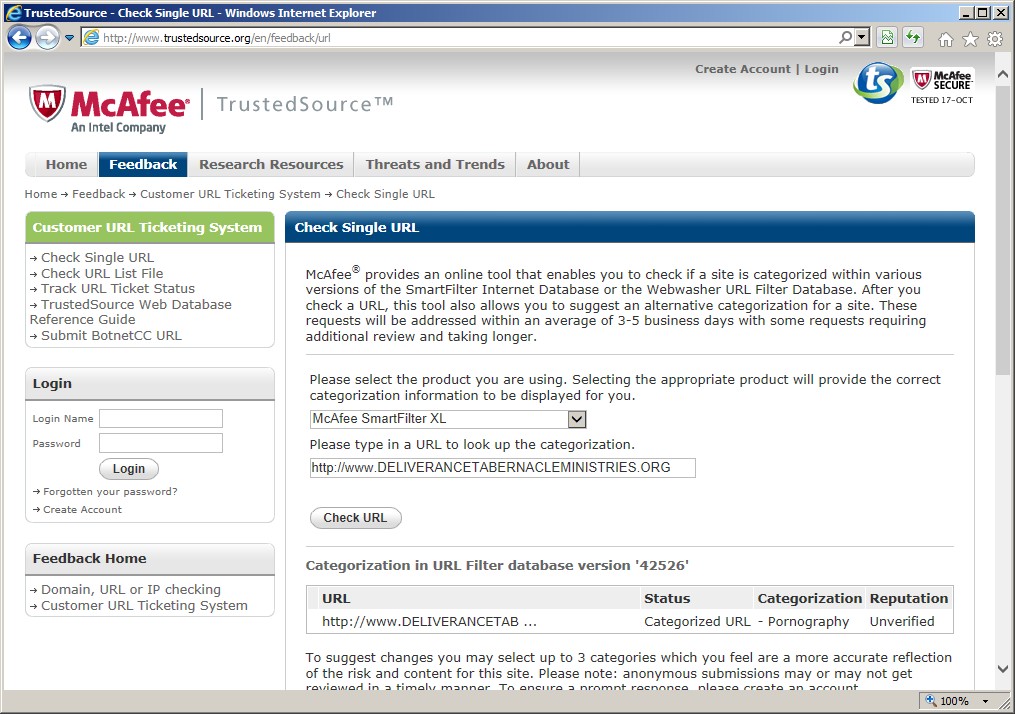
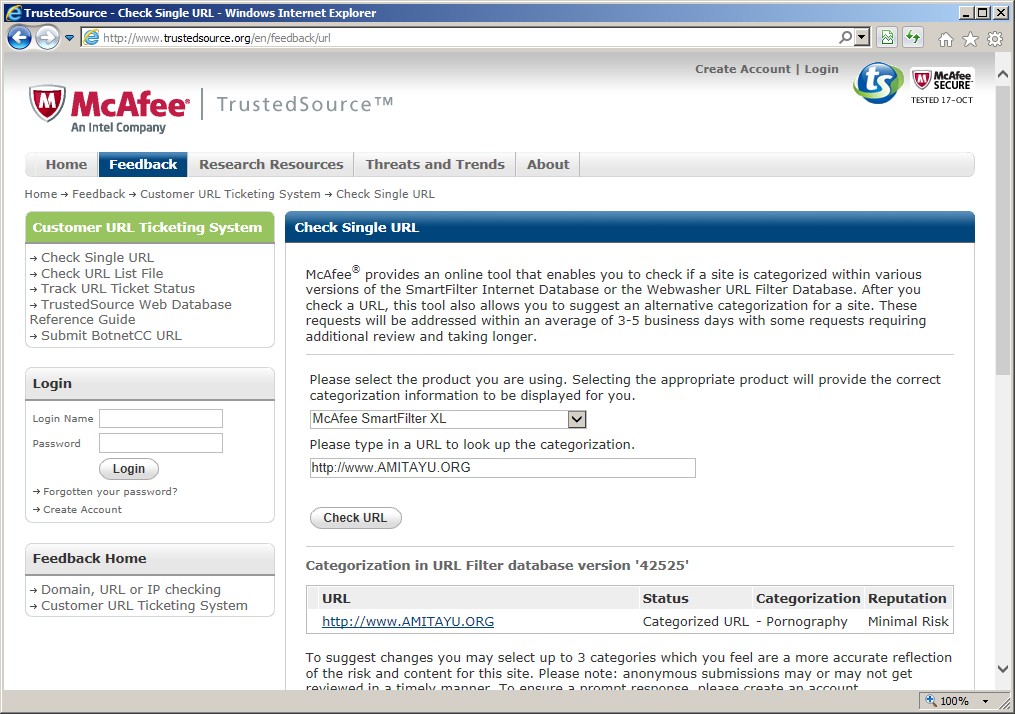
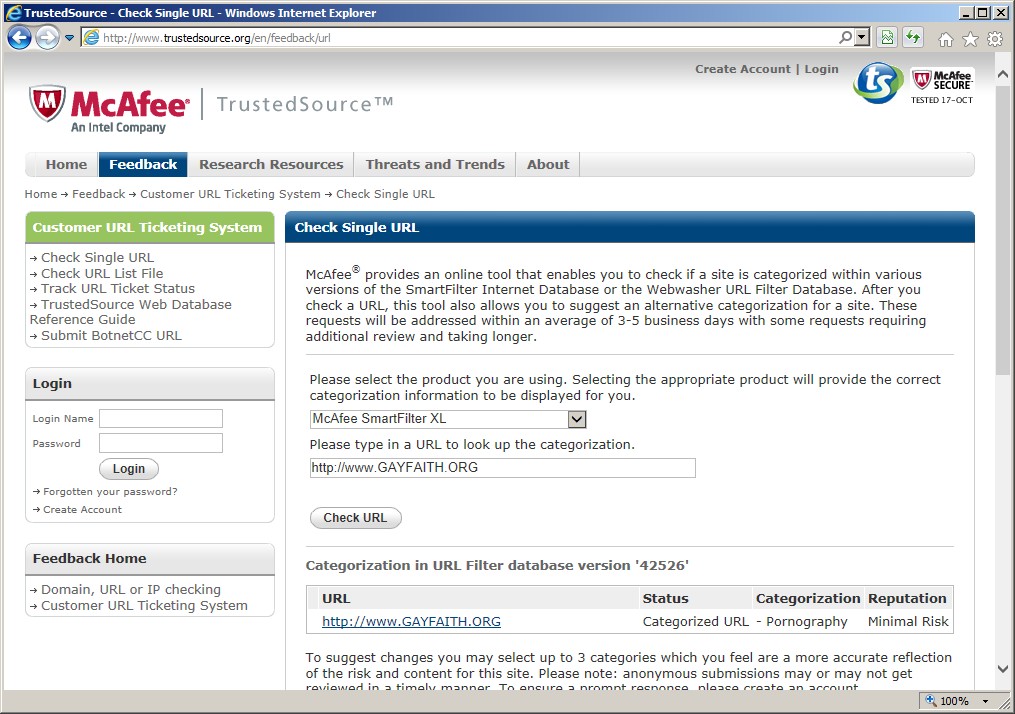
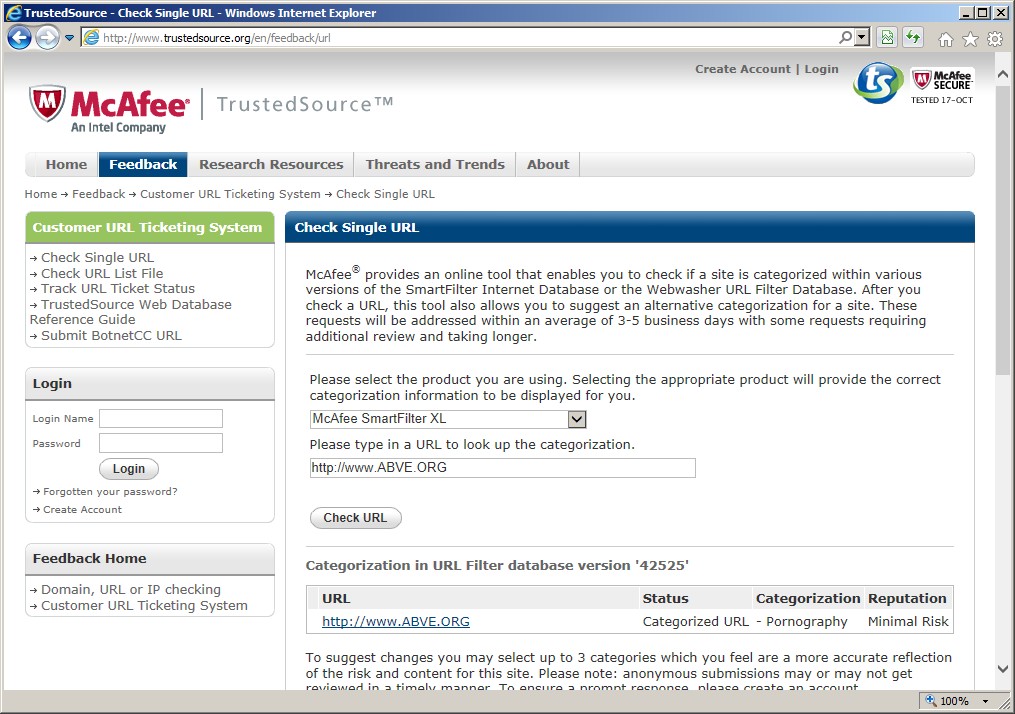
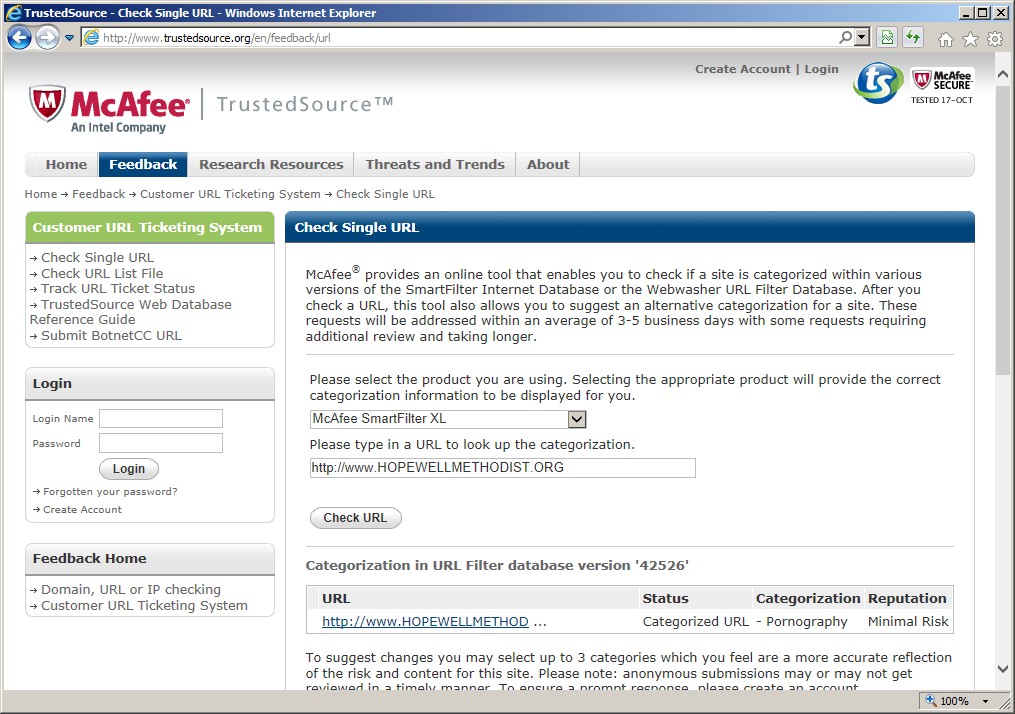
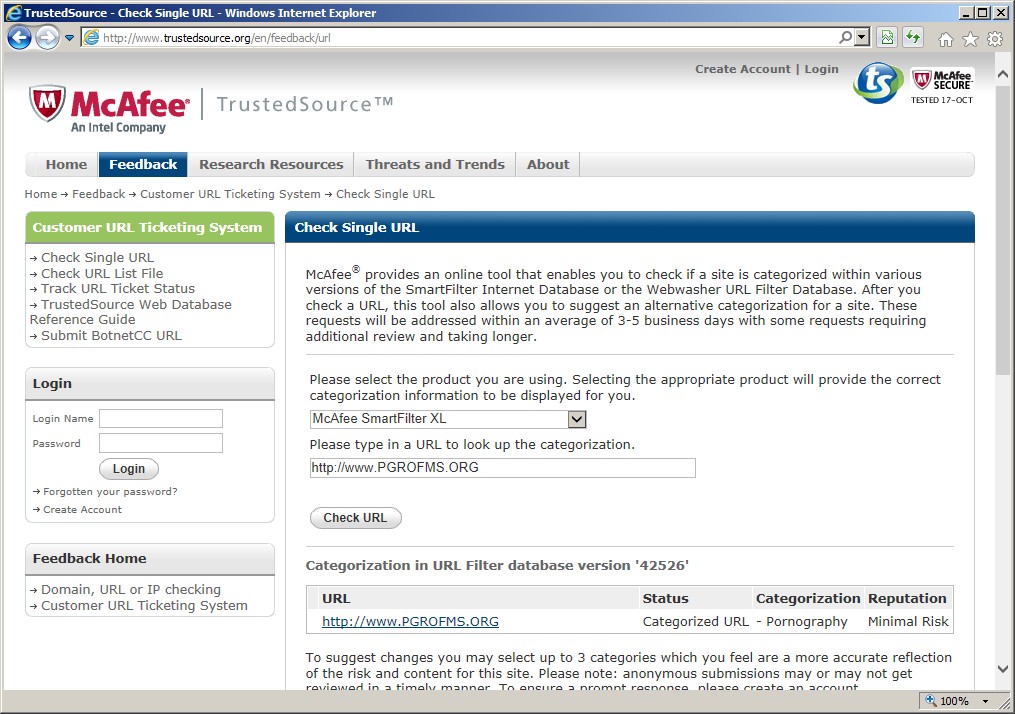
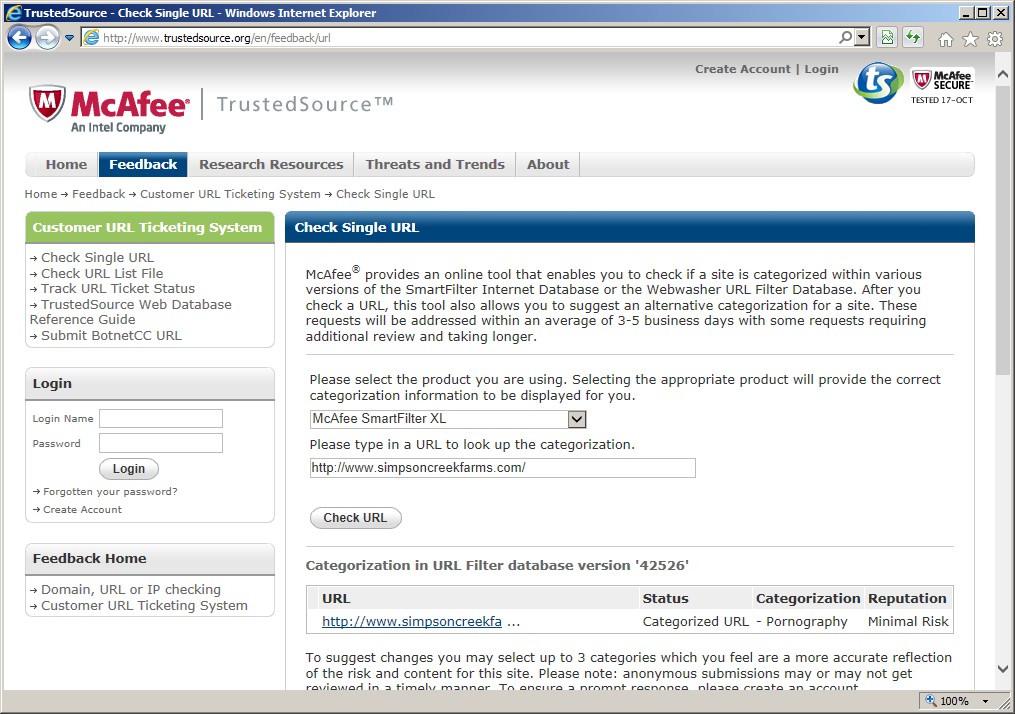
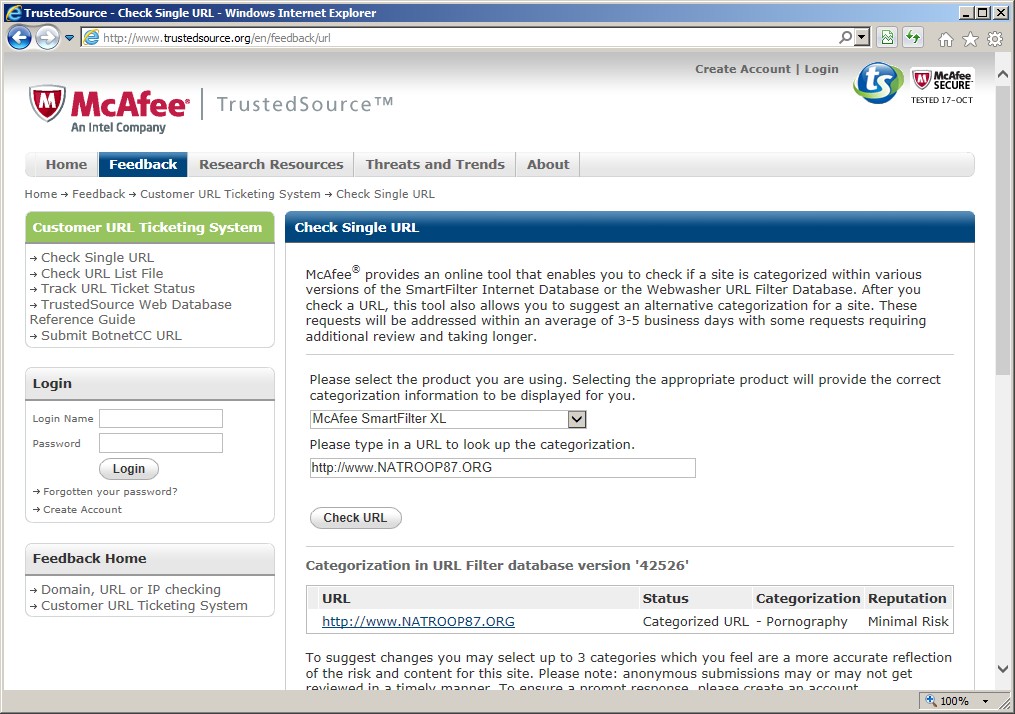
Slashdot contributor Bennett Haselton writes: "Internet users in Saudi Arabia, along with most users in the United Arab Emirates, are blocked by their respective government censors from accessing the websites of the Trinity Davison Lutheran Church, Deliverance Tabernacle Ministries in Pittsburgh, the Amitayu Buddhist Society of Taiwan, and GayFaith.org. An attempt to access any of those websites yields an error page like this one. However, the sites are not blocked because they conflict with the religions beliefs of those countries' governments. Rather, they are blocked because Smartfilter -- the American-made blocking program sold by McAfee, and used for state-mandated Internet censorship in those countries -- classifies those sites as "pornography". You can see the screen shots here, here, here and here." Read on for the rest of Bennett's thoughts.I found these blocked sites by starting with a combination of URL lists and ad hoc spidering, and running as many sites as possible through the Saudi filters to catch the ones that were blocked. Some of the sites were blocked for reasons that were easy to guess -- for example, http://www.bighornbasinsfw.org/, the home page of the Big Horn Basin, Wyoming chapter of Sportsmen for Fish & Wildlife, was almost certainly blocked because of the slang term "nsfw" in their URL. http://www.AgainstPornography.org and http://www.SearchingForMySpermDonorFather.org were presumably blocked because of the presence of the words "porn" and "sperm".
On the other hand, there appears to be no rational reason why the Filipino American Women's Network, the Tuscon Jazz Institute, or the Sacramento Police Activities League would have been blocked by Smartfilter, even by accident. A partial list of the blocked sites that I found is in the blog post I wrote for Citizen Lab, an Internet censorship research center at the University of Toronto.
Articles about sites that are erroneously blocked by Internet censorship software, have a storied history. The first widely read piece was the article "Keys to the Kingdom" written by Brock Meeks and Declan McCullagh in 1996, calling out Cyber Patrol for blocking EnviroLink.org and the University of Newcastle Computer Science Department, and CYBERsitter for blocking the National Organization for Women. I made a minor name for myself and the Peacefire.org site in the late 1990's by writing more pages about sites blocked by other products, including some (like X-Stop and SurfWatch) which no longer exist, and others that are still around, including Smartfilter. I was also one of six people comprising the Censorware Project, a loosely organized group of volunteers that published a few more reports.
By the early 2000's, however, it became clear that anyone whose mind was likely to be changed by information about what kinds of sites were blocked by blocking software, would have changed their mind already (or would, if they came across the research that had already been done up to that point). So the further reports on Internet blocking software errors, by me and other people, slowed to a trickle. I wrote a report in January 2002 on the latest list of sites blocked by Cyber Patrol, a product that most people today have forgotten. In 2006 I worked with the ACLU of Washington to publish a report on sites erroneously blocked by FortiGuard, a program used on computers in some libraries in central Washington, as part of the ACLU's suit to challenge the constitutionality of the program's use on public library terminals. (The Washington State Supreme Court rejected the lawsuit on the grounds that, regardless of what sites were blocked on the computers, it didn't matter because an adult library patron could request for the filter to be turned off.) In 2007 I wrote an article for Slashdot titled "From Bess to Worse" listing some sites that were blocked by an Internet filtering program called Bess (which was later bought out by Smartfilter and discontinued).
Most people's awareness of this debate, if they had heard about it at all, was limited to the perception that "breast cancer sites" and sites about "chicken breast recipes" were sometimes filtered by Internet blocking programs. Or they heard that "Beaver College" actually had to change its name to avoid being censored by web filters. As I tried to explain in a FAQ (written, according to the Wayback Machine, in 1999, but which still broadly holds true today), these examples are true, but they miss the point. These examples make it sound as if blocking software companies are doing the best job they can under the circumstances, and that the errors are unavoidable due to limitations on machine intelligence. In reality, any software algorithm that blocks the American Board of Vocational Experts, the Hopewell United Methodist Church, and the Patriot Guard Riders of Mississippi, as "pornography" (as Smartfilter currently does), is probably not the best algorithm the company could have come up with -- but there's no incentive for them to try harder, because few people will ever look that deep.
And yet, people continue to remember the "breast cancer site" examples. This sounds to me like an example of the narrative fallacy -- people remember that breast cancer sites were blocked, because there's a tidy explanation. There is no tidy explanation for most other examples of blocked sites, so the meme never spreads very far. Conveniently for the blocking companies, the blocked-site errors which make the company look most sloppy (the Kennels at Simpson Creek Farms, the St. Francis Institute of Milwaukee, etc.) are precisely the ones that, due to the narrative fallacy, most people won't remember or hear about.
One company, CYBERsitter, did manage to make a few blocking decisions in the 1990s that were egregious enough that their antics did make the news, and did finally raise some people's awareness that the controversy over private Internet filtering extended beyond "breast cancer sites". After TIME Magazine's website published an article (no longer online) that criticized CYBERsitter's blocking policies, CYBERsitter responded by blocking TIME Magazine's pathfinder.com domain. A few months earlier, CYBERsitter had blacklisted the monthly e-Zine "The Ethical Spectacle, after the Spectacle's founder, Jonathan Wallace, published an article criticizing CYBERsitter for blocking my own Peacefire.org website. And Peacefire.org had been blocked, in turn, because of a page I wrote (now very much out of date) listing some of the sites that CYBERsitter blocked, including the International Gay and Lesbian Human Rights Commission and Mother Jones. (Nowadays, of course, nobody would be surprised that filtering companies block Peacefire.org, since the site publishes ample instructions on how to get around Internet blockers. But at the time, the site's first and only article was the list of sites blocked by CYBERsitter, which is why CYBERsitter received so much criticism for blocking the domain in retaliation.) CYBERsitter also threatened to have Meeks and McCullagh criminally prosecuted for writing "Keys to the Kingdom" and threatened to sue me over the page that I had made.)
The moral, it seems, is that if you want an example of a censored web site to stick in people's minds, it either has to be a forgivable error, or an insane vindictive dick move -- because in either of those cases, people will understand why it happened. The vast swaths of censored websites on the spectrum in between, the ones for which there is no rational explanation for the blocking, go ignored.
These days, though, American and Canadian "censorware" makers have also come under fire for selling censoring software to foreign governments which use them for country-wide censorship. Most of the criticism focuses, naturally, not on the kinds of sites that are accidentally blocked by the blocking software, but on the immorality of these companies enabling statewide foreign censorship in the first place. Netsweeper, Blue Coat, and McAfee have all made the claim that "Once we sell their product to them, we have no control over what they do with it" -- which, as I wrote previously in Slashdot, is nonsense, because for the product to be effective, it has to rely on updates to the blocked-site list, which are provided at regular intervals by the manufacturer. Cut off the updates, and the product will not work, at least not as well.
So the fact that McAfee has classified the Boy Scout Troop 87 of North Andover, the Pan-Iranist Party of Iran, and Reptile Conservation International as "Pornography" is (rightly) overshadowed by the fact that McAfee is selling to government censors in Saudi Arabia and the UAE in the first place. However, as long as the filters are installed, these blocked sites are at least part of the problem for users in those countries, just as much as they are for students or cubicle workers in the U.S. whose network administrators happen to use Smartfilter. And, of course, I sampled only a miniscule fraction of the Web to find these examples of blocked sites, so the true number of stupid blocks affecting Saudi and UAE users is likely to be much larger. For each individual example, you might reasonably ask, "Is it really a big deal if Saudis are blocked from accessing Boy Scout Troop 87 of North Andover?" But it adds up.
-
Newly Discovered Greenhouse Gas Is 7,000 Times More Powerful Than CO2
Hugh Pickens DOT Com writes "Suzanne Goldenberg writes at The Guardian that researchers at the University of Toronto's department of chemistry have identified a newly discovered greenhouse gas, perfluorotributylamine (PFTBA), in use by the electrical industry since the mid-20th century, that is 7,000 times more powerful than carbon dioxide at warming the Earth. 'We claim that PFTBA has the highest radiative efficiency of any molecule detected in the atmosphere to date,' says Angela Hong. Concentrations of PFTBA in the atmosphere are low – 0.18 parts per trillion in the Toronto area – compared to 400 parts per million for carbon dioxide but PFTBA is long-lived. There are no known processes that would destroy or remove PFTBA in the lower atmosphere so it has a very long lifetime, possibly hundreds of years, and is destroyed in the upper atmosphere. 'It is so much less than carbon dioxide, but the important thing is on a per molecule basis, it is very very effective in interacting with heat from the Earth.' PFTBA has been in use since the mid-20th century for various applications in electrical equipment, such as transistors and capacitors. 'PFTBA is just one example of an industrial chemical that is produced but there are no policies that control its production, use or emission,' says Hong. 'It is not being regulated by any type of climate policy.'" -
Building an 'Invisibility Cloak' With Electromagnetic Fields
Nerval's Lobster writes "University of Toronto researchers have demonstrated an invisibility cloak that hides objects within an electromagnetic field, rather than swaddling it in meta-materials as other approaches require. Instead of covering an object completely in an opaque cloak that then mimics the appearance of empty air, the technique developed by university engineering Prof. George Eleftheriades and Ph.D. candidate Michael Selvanayagam makes objects invisible using the ability of electromagnetic fields to redirect or scatter waves of energy. The approach is similar to that of 'stealth' aircraft whose skin is made of material that absorbs the energy from radar systems and deflects the rest away from the radar detectors that sent them. Rather than scattering radio waves passively due to the shape of its exterior, however, the Toronto pair's 'cloak' deflects energy using an electromagnetic field projected by antennas that surround the object being hidden. Most of the proposals in a long list of 'invisibility cloaks' announced during the past few years actually conceal objects by covering them with an opaque blanket, which becomes 'invisible' by displaying an image of what the space it occupies would look like if neither the cloak nor the object it concealed were present. An invisibility cloak concealing an adolescent wizard hiding in a corner, for example, would display an image of the walls behind it in an effort to fool observers into thinking there was no young wizard present to block their view of the empty corner. 'We've taken an electrical engineering approach, but that's what we are excited about,' Eleftheriades said in a public announcement of the paper's publication. (The full text is available as a free PDF here.)" -
Universities Agree To Email Monitoring For Copyright Agency
New submitter fish waffle writes "The universities of Western Ontario and Toronto have signed a deal with Access Copyright that allows for surveillance of faculty correspondence, defines e-mailing hyperlinks as equivalent to photocopying a document, and imposes an annual $27.50 fee for every full-time equivalent student to pay for it all. Access Copyright is a licensing agency historically used by most universities in Canada to give them blanket permission to reproduce copyrighted works, largely to address photocopying concerns that may extend beyond basic fair-use. Since the expiration of this agreement, and with recognition that many academic uses do not require copyright permissions or payments or are already covered under vendor-specific agreements, Canadian academic institutions have been united in opposing continuation of the agreement with the agency. Access Copyright has countered with a proposal for increased fees, and expansion of the definition of copyright to include linking and the need for online surveillance. In a strange breaking of ranks, the University of Western Ontario and the University of Toronto have capitulated and signed agreements that basically accede to the licensing agency's demands. The Canadian Association of University Teachers bulletin provides detailed background on the issue (PDF)." -
Study Says Targeted Ads Gettin' a Lil' Creepy
eldavojohn writes "Ever load up a completely random webpage to see an advertisement at the top for products related to what you're reading about? What about the advertisement with binoculars that says your green denim jacket doesn't really go with your eyes? Well, a recent marketing study (PDF) is saying that making a highly visible advertisement content aware is too much for consumers. It seems that to optimize clicks and purchases you should use a highly visible ad or a more diminutive ad that is content-aware, but not both. For marketers, this report talks about the consumer having this crazy notion of privacy and at some point they start to feel like you're crossing the line." -
Zombie Macs Launch DoS Attack
Cludge writes "ZDNet has a story (and several related articles) about how Symantec has discovered evidence of an all-Mac based botnet that is actively involved in a DOS attack. Apparently, security on the exploited Macs (call them iBots?) was compromised when unwary users bit-torrented pirated copies of iWork 09 and Photoshop CS4 that contained malware. From the article: 'They describe this as the "first real attempt to create a Mac botnet" and note that the zombie Macs are already being used for nefarious purposes.'" -
It's OK to keep AIMing
fooby12 writes "According to the Univeristy of Toronto instant messaging does not hurt the grammar of the people who use it. From the article: "With 80% of Canadian teenagers using instant messaging and adopting its unique linguistic shorthand, many teachers and parents are concerned about the medium's potential to corrupt kids' grammar. But instant messaging doesn't deserve its bad reputation as a spoiler of syntax, suggests a new study from the University of Toronto."" -
190 Million Year Old Dinosaur Embyro
leprasmurf writes "Sci Tech Today is reporting that scientists have cracked open a 190-million-year-old egg to reveal the oldest known dinosaur embryo. Examination of the fetal skeleton suggests the hatchling would have required parental care to survive. This would be the earliest evidence of nurturant behavior, more than 100 million years earlier than previous examples." The University of Toronto has a release about this as well. From the article: "According to Reisz, what makes this discovery particularly significant is the ability to put the embryos into a growth series and work out for the first time how these animals grew from a tiny, 15 centimetre embryo into a five metre adult. 'This has never been done for a dinosaur. Only Massospondylus is represented by embryos as well as by numerous articulated skeletons of juveniles and adults. The results have major implications for our understanding of how these animals grew and evolved,' he says." -
BLAST High Altitude Telescope Launched
Xandu writes "BLAST, the Balloon-borne Large Aperture Sub-millimeter Telescope, was launched on the 11th at 11:09 UTC from Esrange in northern Sweden, and is currently floating over Greenland. BLAST is a 2700kg telescope with a 2 meter primary mirror that hangs from a 1.1 million m^3 balloon floating at an altitude of 38km that will study the star formation history of the universe. It will float west at nearly constant latitude for about 5 days before the flight is terminated over northwest Canada or northern Alaska. Real time position and flight track is available from the NSBF. Two of the graduate students working on the project have photo blogs of the entire (8 week) prep period, including several launch photos. The press has more traditional coverage as well. And if that isn't geeky enough to make it on Slashdot, the flight computers run Slack." -
Breakthrough Efficient, Paintable Solar Cells
An anonymous reader writes "A new solar cell material has been discovered that converts 30% of the sun's energy to electricity." Here's another solar news story. These new cells can harness infrared light which is why they are so much more efficient. -
Student Killed Driving Solar Car
Lev13than writes "Tragedy struck the University of Toronto's Blue Sky Solar Racing Team on Thursday when 21-year old student Andrew Frow was killed in a car accident. It appears that Frow lost control of the low-riding experimental car and was struck by a minivan head-on. The team was driving from Stratford to Waterloo (about an hour west of Toronto) as part of a tour of universities in Ontario and Quebec to mark the one-year anniversary of the 2003 Blackout. This is a big setback for solar power advocates, especially as the blackout anniversary will pass with remedial legislation stranded in Congress. More information on the accident is available here." The vehicle's design is not really street-safe - this will be a problem as more efficient, lighter cars share the road with Hummers. -
Student Killed Driving Solar Car
Lev13than writes "Tragedy struck the University of Toronto's Blue Sky Solar Racing Team on Thursday when 21-year old student Andrew Frow was killed in a car accident. It appears that Frow lost control of the low-riding experimental car and was struck by a minivan head-on. The team was driving from Stratford to Waterloo (about an hour west of Toronto) as part of a tour of universities in Ontario and Quebec to mark the one-year anniversary of the 2003 Blackout. This is a big setback for solar power advocates, especially as the blackout anniversary will pass with remedial legislation stranded in Congress. More information on the accident is available here." The vehicle's design is not really street-safe - this will be a problem as more efficient, lighter cars share the road with Hummers. -
Student Killed Driving Solar Car
Lev13than writes "Tragedy struck the University of Toronto's Blue Sky Solar Racing Team on Thursday when 21-year old student Andrew Frow was killed in a car accident. It appears that Frow lost control of the low-riding experimental car and was struck by a minivan head-on. The team was driving from Stratford to Waterloo (about an hour west of Toronto) as part of a tour of universities in Ontario and Quebec to mark the one-year anniversary of the 2003 Blackout. This is a big setback for solar power advocates, especially as the blackout anniversary will pass with remedial legislation stranded in Congress. More information on the accident is available here." The vehicle's design is not really street-safe - this will be a problem as more efficient, lighter cars share the road with Hummers. -
Advice On A New-School Old-School BBS
An anonymous reader asks I am thinking about setting up a local "community" network over WiFi minus internet connection. In other words, I would like to run a small server isolated from the web as an experiment in small scale networks (e.g., serving a café-heavy one-block radius.) I have plenty of clever ideas -- discussion/gripe boards, weird artistic projects -- anything to bring back the old-school BBS memories where online users were drawn from a single geographic location. But everything I've learned so far is how to act as a small node on someone else's network. How can I make my own -- and make it wireless? Google doesn't pull much up that I can find: it is mostly targeted towards those building a (free or profit) Internet access point." (Read on for more.)" Does anybody have sources of information for how to learn about setting up the network I have in mind? Basic tutorials and those covering more advanced issues such as security would be very helpful. Finally, is there anyone out there with real world experience? Beyond imparting technical help, do you have suggestions for implementation? What worked, and what didn't? Did the lack of internet access make the project unpopular? (And if you did provide internet access as a teaser, how did you handle liability and financial issues?)"
(This reminds me of the Community Memory Project; can anyone point to some modern equivalents?)
-
KDE Conquers Astrophysics With Kst
Telex4 writes "The Free Software community is constantly inundated with interesting new projects, but occasionally something crops up which is really special. Kst is just such a project. Started by Barth Netterfield, an astrophysicist, as a personal project to plot data from his experiments, it has now taken on a life of its own, being used in numerous academic projects, and finding funding from several government agencies. Intrigued by this project's success, and with a little prod from co-developer George Staikos, I interviewed Barth and George about kst, Free Software and physics." -
KDE Conquers Astrophysics With Kst
Telex4 writes "The Free Software community is constantly inundated with interesting new projects, but occasionally something crops up which is really special. Kst is just such a project. Started by Barth Netterfield, an astrophysicist, as a personal project to plot data from his experiments, it has now taken on a life of its own, being used in numerous academic projects, and finding funding from several government agencies. Intrigued by this project's success, and with a little prod from co-developer George Staikos, I interviewed Barth and George about kst, Free Software and physics." -
This Robot Collects Fingerprints
Roland Piquepaille writes "When police officers found suspicious packages today in an airport or a train station, they destroyed them immediately, along with potential fingerprints on them. A new robotic device, dubbed RAFFE (short for "Robot Accessory for Fuming Fingerprint Evidence), developed by scientists from the University of Toronto (U of T) and the University of Calgary, offers a solution to this problem. Mounted on an ordinary robot, it will reveal fingerprints by releasing Super Glue on the object. Then it will take pictures of these fingerprints. The Calgary Police Service is already using RAFFE for field tests. This overview contains more details and extra references." -
Exploding Neutron Star
Mick Ohrberg writes "According to NASA News, scientists at NASA and CITA are watching a neutron star (4U 1820-30, 25,000 light years from Earth) explode. Or rather - watch an explosion happen just a few miles above the surface of this immensely dense body. What happens is that matter (mostly helium) from a companion star is by the gravity of the neutron star and collected on the surface until a layer is formed and sufficient pressure is generated. This will cause the helium to fuse into carbon and other elements, releasing enormous amounts of energy in the X-ray band. The event was caught using NASA's Rossi X-ray Timing Explorer. More details can be found here." -
Toronto Conference On Open Source Announced
Simon Bates writes "The University of Toronto's KMDI is hosting a conference to debate the future of open source models of development in software and beyond, addressing how this movement will affect the way we work, learn and stay healthy. Among the 30 speakers will be Eben Moglen, Columbia law school professor and legal counsel to the Free Software Foundation, who has recently described free software as: 'a social movement with specific political goals which will characterize not only the production of software in the twenty-first century, but the production and distribution of culture generally'. The conference will be held from May 9th to 11th and will be webcast." -
Toronto Conference On Open Source Announced
Simon Bates writes "The University of Toronto's KMDI is hosting a conference to debate the future of open source models of development in software and beyond, addressing how this movement will affect the way we work, learn and stay healthy. Among the 30 speakers will be Eben Moglen, Columbia law school professor and legal counsel to the Free Software Foundation, who has recently described free software as: 'a social movement with specific political goals which will characterize not only the production of software in the twenty-first century, but the production and distribution of culture generally'. The conference will be held from May 9th to 11th and will be webcast." -
Toronto Conference On Open Source Announced
Simon Bates writes "The University of Toronto's KMDI is hosting a conference to debate the future of open source models of development in software and beyond, addressing how this movement will affect the way we work, learn and stay healthy. Among the 30 speakers will be Eben Moglen, Columbia law school professor and legal counsel to the Free Software Foundation, who has recently described free software as: 'a social movement with specific political goals which will characterize not only the production of software in the twenty-first century, but the production and distribution of culture generally'. The conference will be held from May 9th to 11th and will be webcast." -
Using Saran Wrap As A Polarizing Filter
cdneng2 writes "Here's a University of Toronto research paper on how to use ordinary Saran Wrap as a polarized filter to turn your laptop into a stereoscope. From the paper, cellophane (costing mere pennies) proved to be a better half-waveplate than a commercial half-waveplate (costing hundreds of dollars for the required size) for rotating the polarization of white light. The same paper is cited in www.mygeekdom.com." Cellophane wonders may never cease. -
Using Cellophane For 3D Displays On Your Laptop
prestidigital writes "From the abstract: [the authors] present a novel, inexpensive, stereoscopic technique for generating 3D displays from cellophane and a laptop computer screen. (Once again my physnews update sends me email that doesn't suck!)" -
Some Geek Guides for Dating
An anonymous reader sends in this: "In honor of upcoming V-day, here are some geek guides for help in finding your geeky match: Guy's Guide to Geek Girls, Girl's Guide to Geek Guys, advice from a she-geek, Engineer Your Love Life and Bart's Dating Guide for Geeks. And for those of you who are absolutely hopeless, well, there is always Coincidence Designs... It's not too late, so good luck!" Another reader has some good news: "An article in Discover magazine reports on research done by scientists at the University of Toronto about how males attract mates. The cited article claims that when males are young, the show offs are actually the ones who are least likely to succeed later on. This causes a "revenge of the nerds effect:" the football players burn out but the nerds become sexy!" And if all else fails, you can try a Valentine's Day Form Letter. -
Motion Capturing in Three Dimensions?
brokenbeaker asks: "I friend of mine is a modern dancer, and she is working with a 3D modelling program to record dance performances. Apparently, the system is very primitive - if you make a dancer jump, she doesn't fall back down to earth. My question is, does anyone know of a sophisticated (physics based, I guess) modelling program that can be used to record dance? How about motion capture in 3D - would this be feasible? Anyone looking for a programming challenge?" -
Ghost in the Shell 2, Matrix Revisted, Daft Punk
NeoCode sends tons of juice starting with "Ghost in the Shell creator, Masamune Shirow, has talked about a sequel to GITS in a recent interview. The director of the original is working on GITS2. The Matrix Revisted is essentially a prequel to the original Matrix movie. My guess is that the anime story might be along the lines of the Matrix comics that are on their website. Anyways, here are some tidbits about the Matrix anime. And lastly, CartoonNetwork has a interviewed Daft Punk about their anime video and their anime" I saw the Daft Punk (as well as all 3 Gorillaz!) videos on Toonami last friday. Had to immediately hit Cheap CDs and buy the album. (Yes, I'm buying CDs again. I ended my boycott now that Napster battle is over) I thought it was just Gap commercial soundtracks, but those are sweet videos. -
Distinctive Ring Aware Modems And GNU/Linux?
toughguy asks: "I've got a single phone line with three numbers attached to it. The three numbers make three different rings when they are called ("Distinctive Ring Service"). I'm trying to get a Linux machine (RedHat) to answer only on one of the distinctive rings so that it can receive faxes on that line. So far I haven't had any luck. I'm wondering if anyone has been able to get a Linux machine answering distinctive rings. If so, what modem hardware were you using and what software package as well?" -
Milky Way & Andromeda Collision
Frédéric writes: "A lof of people know that our Sun will be a red giant in about 15 billion years, and its size will increase dramaticaly beyond the Mercury orbit and we will burn. But do you know that the Andromeda Galaxy will collide with our Milky Way in about 3 billion years, a first time, then another time after 1 billion years to merge themselves, what a mess! There is some pretty nice simulations in MPEG, and a lot of pictures with some explanation. The simulator use 24 million particles, they are planning a 120 million particles simulation." -
Happy Birthday Hubble
-
Optical Microchip Breakthrough In Canada?
_J_ writes: "The Toronto Star has This Article on their Web site about method to "trap light." Since they call it a break-through to making an optical system it implies that light can be stored in a type of memory. I hope that this implies light-using logical gates." While this sounds like one more Holy Grail Found! announcement, the work that professors Ozin and John (mentioned in article) have done makes it sound like they're no slouches in the photonics or nanotech departments. -
ICMP_HOST_BELOW_HORIZON - TCP/IP Into Orbit
Christopher Neufeld writes "As reported on ScienceDaily today, on April 10 of this year, some standard IP modules were uploaded to UoSAT-12, and got it answering pings. " -
IT Salary Comparisons Worldwide
What's the going rate for a geek in today's high paced IT world? Both Bagpiper and Johnath are about to enter different sectors of the job market, and would like some references on salaries in various computer-related areas, both in the US and abroad. Interested to see what the starting salary for your average coder is in North Carolina? How about Germany? Click below for more.Bagpiper asks: "The combination of a recent /. comment, as well as my wife's desire to live overseas, started my pondering about what my pay (mid-Atlantic US software/firmware engineer w/ 9 yrs exp.) would compare to that of a similar job in another country? Several sources tell me what I'd be making in The Valley or Seattle, but none tell me what I'd make if I moved to Ireland, or to Germany, or to Taiwan (you get the idea)? A related question is what kind of standard of living would I expect in another country on the expected salary? (And just in case my current employers or headhunters see this, I'm not currently looking! I'm just curious."
and this from Johnath: ""The more I look at places like monster.com (and it's Canadian Counterpart) the more I see "Salary: TBD" or "Please submit salary expectations with your resume and cover letter" or other equally vague phrases. As someone in the last year or two of his university education, this gets a little disturbing since I can't really tell what my salary expectations are without some reference for comparison. Normally, I'd get that by looking at the job postings themselves, but of course, they've all taken to being painfully cryptic. So what I want to know is - what's a geek cost these days? What kind of money do Slashdotters make in the various Computing and IT related fields.
What are the broader ranges - do network guys/gals get paid more than code monkeys? How does the pay of the web design team compare to the network admin that keeps the site running (and if they're the same person, how much better is the pay?"
-
IT Salary Comparisons Worldwide
What's the going rate for a geek in today's high paced IT world? Both Bagpiper and Johnath are about to enter different sectors of the job market, and would like some references on salaries in various computer-related areas, both in the US and abroad. Interested to see what the starting salary for your average coder is in North Carolina? How about Germany? Click below for more.Bagpiper asks: "The combination of a recent /. comment, as well as my wife's desire to live overseas, started my pondering about what my pay (mid-Atlantic US software/firmware engineer w/ 9 yrs exp.) would compare to that of a similar job in another country? Several sources tell me what I'd be making in The Valley or Seattle, but none tell me what I'd make if I moved to Ireland, or to Germany, or to Taiwan (you get the idea)? A related question is what kind of standard of living would I expect in another country on the expected salary? (And just in case my current employers or headhunters see this, I'm not currently looking! I'm just curious."
and this from Johnath: ""The more I look at places like monster.com (and it's Canadian Counterpart) the more I see "Salary: TBD" or "Please submit salary expectations with your resume and cover letter" or other equally vague phrases. As someone in the last year or two of his university education, this gets a little disturbing since I can't really tell what my salary expectations are without some reference for comparison. Normally, I'd get that by looking at the job postings themselves, but of course, they've all taken to being painfully cryptic. So what I want to know is - what's a geek cost these days? What kind of money do Slashdotters make in the various Computing and IT related fields.
What are the broader ranges - do network guys/gals get paid more than code monkeys? How does the pay of the web design team compare to the network admin that keeps the site running (and if they're the same person, how much better is the pay?"
-
SourceGear acquires Cyclic
David Neto writes "SourceGear Corp., the parent of AbiSource, has acquired Cyclic. SourceGear will assure continued development of CVS. " Good news for all-SourceGear is going to be the new parent umbrella for AbiSource, trying to extend their name in the public domain. -
Live Video Cam of Star Wars Lines
Vince writes "PhantomCast.com, "The Official Webcast of the Star Wars Lines" has live video of the Westood line, some funny new parodies, and interviews with the people in line. It's almost as good as being there. " In the meantime we can all run around the net trying to find those prequel mp3s. Why must I wait until May 4 for CDNOW to ship me mine? I need a T1! Update: 05/01 04:59 by CT : if you want more SW fun, check out this weeks Dave Barry column (thanks Johnath) -
The Free S/WAN Project:secure TCP/IP
Several folks have wrote in to send us the wired story on S/WAN which strives to allow secure TCP connections between any 2 points on the internet. Written in Canada so it isn't affected by Uncle Sam's braindead encryption export policies. The article refers to the software as freeware, dunno what the license is. You can also just go straight to the software if you like. Update: 04/15 08:01 by CT : Johnathan Nightingale that it is apparently under the GPL where it can be. Just read it. -
Star Wars Ticket Restrictions
Christopher Neufeld writes "The DVD Resource Page reports that Lucasfilm is putting certain restrictions on tickets for SW:TPM. According to "theatre exhibitors", no advance tickets will be available, only same-day showings, for at least the first two weeks of the run, and no theatre rentals will be permitted for the first eight weeks." There goes the plans for LinuxExpo. This is gonna be a pain. -
3D graphics on Modified LCD Flatscreen
Christopher Neufeld writes "New Scientist maganize reports this week on a company designing a 3D vision system which uses a modified LCD flatscreen. The two images are interlaced on the screen, and a holographic lens directs the light from alternating rows to different eyes. " -
Internal layout of Merced
-
Postmodern Essay Generator
Daedalus writes "A link from this week's issue of Science: "...check out the Postmodern Generator, a computer program that writes essays by linking up quotes and jargon." Just reload the page to re-run the generator. " We've mentioned several of these before, but this one is really clean. Generates completely meaningless gibberish, but it sounds like it should make sense. Natural Language Processing is very cool. -
Future Displays
Daedalus writes "EE Times Online has a feature article on the future of different display technologies. " All I know is that I want my next screen to be about 1 inch thick.