Slashdot Mirror
Domain: voxeu.org
Stories and comments across the archive that link to voxeu.org.
Comments · 44
-
Re:wha?Sure, nothing here at all says that you have to be a "monk" and I certainly agree that we'd all rather be rich rather than poor, and that we all like being individuals but let's break this down.
I like meat. i eat it daily. I intend to continue doing so.
I like meat a lot. A lot. That doesn't mean I need to do something that causes ongoing damage. And I'm not suggesting that people engage in complete vegetarianism; heck I'm not a complete vegetarian myself so at minimum, that would be hypocritical in the extreme. But you don't need to eat meat every single day. And if you do care about being rich, then it is worth noting that meat is much more expensive than many non-meat options from a similar material.
I drive a ram pickup. I go where I want to when I want to. I do not wait for public transport. ( I also ride a bicycle. It often seems to be the case that a city bus and a bicycle require roughly the same travel time). Public transport SUCKS
By driving the pickup, you are actively causing harm. But I'm happy that you ride a bike. That's a good, low CO2 production transport method which is very healthy. And yes, public transport in many locations sucks in much of the US. This is due to a variety of different issues. Much of the US is spread out in suburbs and low-density areas, which makes public transit tough. Also, there's a serious lack of funding for public transit- this is connected to an unfortunate self-reinforcing cycle where people don't use public transit because the transit sucks, and then as a result it doesn't get funding. It also combines in other ways with local cultural issues; for example when I lived in Boston, all sorts of people took the subway and bus as a regular thing, and the system worked pretty well. But, when I was in Birmingham, Alabama, the only people using the public transport were by and large black people of a variety of socioeconomic backgrounds and poor white people. (One day when I was taking the bus there was on the bus a black guy who clearly had some sort of mental health issue and was talking outloud to himself describing every single person on the bus. When he got to me, he said something like "And then there's that white dude. Don't know what he's doing here.")
But you can make public transit better by helping lobby for more funding. And the better your public transit gets, the more people willing to use it. The same thing that works in the other direction works to help when you get a critical mass.
And here's an important point: If you are really concerned about going "where I want to when I want to" then it isn't hard to use public transit and to supplement that with other things like bikes. Heck, even having Uber for its occasional use is helpful- I'm currently living in Ames, Iowa, which doesn't have amazing public transit, so I do need to occasionally use Uber. But that's rare, and the use of Uber and Lyft still ends up costing far, far less than owning a car would.
I respect your right to make your own choices. Can you respect mine?
You won't see above anything where I at all said I was going to force you not to have a car. But all of our choices have limits- my rights to make a choice end where they threaten to harm others. Someone is allowed to extend their fist but not if it hits someone else's face. And for many different pollutants we've added taxes or cap and trade systems because of the harm they do to bystanders and it works. For example, the sulfur dioxide cap and trade system https://voxeu.org/article/lessons-climate-policy-us-sulphur-dioxide-cap-and-trade-programme helped spur massive technological innovation and essentially solved the problem of acid rain.
I think that the correct course is not to choose voluntary poverty for the sake of a monkish "sustainability". Rather let us
-
Re:Doing Trump's work for him
I am not sure I follow you.
People get angry because that is what they have been told they are supposed to do. Despite deplorable conditions peasants in medieval settings were not as unhappy as you would think they should be...
http://www.voxeu.org/article/h...As for being insulted that is not any of my concern. If you find your life in a deplorable state and you find someone offering suggestions as insulting then you are probably not motivated enough to fix your life so all I can say is that I am sorry I caused you pain by helping you see your options. Please move your bitching into the worthless Empathy Line to the left and we we know not to help out any more.
The $10 a week at 3% thing is pretty bad advice on face and I can only presume only the mathematically challenged would buy into it. That is like $520 saved a year or $15,600 over 30. To parley that into riches would take Hillary style luck (read corruption). So the whole thing is stupid on face.
That being said your, 'no investments for the poor person' line just just as silly. A quick search of the internet shows banks in my area offering things like 'rewards checking' that (comes with a couple minor stipulations like having direct deposit set up) but offer in the 2%-3% range on up to some mid-level amount of cash ($10,000-$20,000). That should easily get you started.
As for collage I love how you mix 'got myself into bad financial straights' with collage is unfavorable. Yes, if you have already got yourself in a hole anything you do will (at least temporarily) make the whole deeper. What you should be doing is looking for things that might make it worse in the short term but have long term payouts.
Looking again at my local area a 2 year community collage degree is about $6k. Many of them transfer to my local 'real' collage and are equivalent of the first two years of a four year degree (I know as this is what I did). So if you haven't already dug yourself into a hole this is really not that bad. If you have dug yourself into a hole then you look into loans, grants, or companies that offer tuition help to employees.
Again just in my local area a 2 year degree is good for some low level technical job. Probably talking $25k-$35k for a helpdesk/operations position. Most of these companies with cover some tuition reimbursement so if you want to do better the $21k (and two more years) to get a BS isn't that hard.
Yes, you are talking about 2-4 years of hard work and little leisure time. That being said compared to work even 100 years ago it really isn't 'hard' work.
Now, I know there are other paths. If you are fit and/or good with dirty jobs I have a friend who swears by sanitation worker positions. I have a relative who has done really well using the military as a stepping stone to being a mechanic. There are a million ways to success but all of them take some discipline.
Your 'right time' argument is true but doesn't look at the whole picture. Life is compound. Every good thing you do makes your life easier, every bad thing makes it harder. So the sooner you make good choices the better off you will be.
As for the 'road blocks' I can only be insulting and channel Yoda 'There is no try, there is only dew.' or wait was that a commercial... Seriously don't buy into the anger and hopelessness. Remember in the richest country in the world 10% of those born into the lowest 20% of earners makes their way to the highest 20% of earners. Your life is yours to make better!
-
Re:Okay, seriously Britain
No, but wages do go down, because there's less demand for labour.
Shouldn't there be evidence of this, if it were true? Instead, we see that two thirds of the world has increasing wages which indicates that there is increasing demand for labor.
Automation is the primary tool by which demand for labour is reduced. That, by law of supply and demand, makes labour less valuable.
That hasn't happened in practice over the past few centuries. The primary tool by which we make labor less valuable is regulation and taxation.
Hire people to do what, exactly speaking? Manufacture products and services you can't actually sell because everyone's busy trying to minimize their consumption (which is what "reducing their living standards" means in practice)?
Typical demand-side drivel. Who's going to optimize for consuming less when they don't need to? That's silly. And when are you going to be concerned by employers' growing inability to employ? That's an important form of demand that is completely ignored here.
How about we instead drastically reduce the proportion of income going to the 1% and redistribute it to everyone else? That should increase the demand for consumer products a lot, thus pulling the economy back up to speed. It also means nobody needs to live in the gutter.
Because society isn't smart enough to do that without completely fucking everything up. If everyone is unemployed or has a grossly inefficient job (because you messed up society's ability to employ people), then they aren't going to have that income to support the consumption you seem to think is important.
IMHO, we should heavily reward employers (including some of the "1%") who productively employ people. We should encourage new employers (who may some day join the 1%) as well. But fantasizing over imaginary benefits of a one-time taking of wealth from a small class of people? That's a waste of our time. They aren't that wealthy and wealth is not in itself that useful. -
Re:Like most of Earth's existence?
You appear to be assuming the low end of the range is most likely. That's probably a bad bet too. Even 1.5C of warming is significant.
It's dishonest to imply that such a large difference in this parameter doesn't change much. For example, if this parameter is 1.5 C per doubling instead of 3 C per doubling as claimed by the IPCC, then that's 30 years that we have just to get to the point where IPCC claims we are now (at current growth rate in CO2 emissions).
Even if we ignore that all of the predictions are similarly pushed back by many decades and that the IPCC consistently exaggerates how harmful climate change is supposed to be, that means we can grow human societies to become far more wealthy just in those three decades before adverse problems happen. For example, in the 1988-2008 period, two thirds of humanity had 30% or better improvement in net income, adjusted for inflation. This is a huge improvement in human well-being, unrivaled in human history.
We have an opportunity to end almost all global poverty. But that requires prioritizing other things over the climate. And that requires generating a realistic picture of the climate.And my belief is that many scientists are that cheap. Let us keep in mind the nearest analogy, that of economics, which is one of the few fields of science which actually has similar order of magnitude stakes. There you have quite a few economists prostituting themselves to the rich and powerful. Your analogy is BS. Economics is dependent to a large degree on human actions which aren't always that predictable. Some economists may be prostituting themselves to the rich and powerful but I don't see that they have been successful at predicting the future. For example the austerity mavens were predicting runaway inflation due to the Fed shoveling money into the economy but it never happened.
The hard sciences are dependent on the real world which has predictable reactions. The science has to conform to the real world or it is soon found to be wanting. The basic things that climate science has predicted are coming true. The world is getting warmer, ice is melting, sea level is rising and the oceans are acidifying. All this appears to be happening at a rate that is many times the rate of any period in the past (except maybe asteroid strikes). What will happen in the future is uncertain because we don't have any good examples from the past for this kind of change. You can assume it won't be that bad but what do you base that on, some personal feelings. I'd rather listen to the scientists.
I'll just note here that a) climate research also is failing to predict the future, b) it is also based on human behavior, and c) as I noted before, has similar stakes to economics which has these same problems. There's a reason a lot of us aren't buying in.
-
Upheaval
Iceland has had its fair share of political upheaval post 2008. Fantastic country though -- I highly recommend a visit.
These are a very stoic people. They live on a volcanic island that is essentially trying every day to kill them off. In Iceland you can actually see the effect that the environment has on a population. They have some of the most dangerous roads I have ever seen in the world and absolutely no guard rails or for that matter not even much in the way of signs. You can hike out to the West cost of the island (which is the Westernmost point of Europe) and look down to the sea -- which is more than half a kilometer straight down. No railing. No signs. Not even a small rope. Just a nice grassy pleasant stroll until you just walk off the edge and plunge to your death. It's completely fantastic there.
They take this same stoic (you fuck up, you pay the price) view of their politicians and their banks.
-
Re: Actual Reason
And the great incongruity of your post is that the actual quickest and most widespread increase in wealth and living standards in human history happened after the period of time you mention. It is happening now, not in the 1950s. Now is the time of increasing real wages, creation of a global large and financially secure middle, relatively high social mobility, etc. What happened in the developed world then is now happening everywhere. But I guess all those people are kind of hard to see from whatever podunk country you're from.
Citation needed. Social mobility is decreasing. Wages are flat for the middle class since the 70's. Your assertions are wrong.
Ah, yes, the magic demand for a link. Here, you go. Figure one is a graph indicating how global wealth by bracket increased over the period 1988-2008. It does show that the wealthiest people in the world did increase their wealth considerably. It also shows the wealth stagnation of the developed world. But it also shows that two thirds of the world saw large increases in their wealth over that period of time.
That's four to five billion current people whose lives were significantly improved over that twenty year period. Meanwhile global population was only about 2.6 billion in 1950. -
Re: Actual Reason
No. Employers are demand too and there's not enough of them either. You only consider certain demand not all demand. The demand model of an economy is inherently flawed because it deliberately excludes employers, a huge category of demand.
How's that ?
By definition and ideological bias.
The product wasn't real estate. It was credit.
Credit doesn't consume in itself, it just makes it a bit easier. And it's worth noting that a lot of people were just find with that credit being used to build a lot of houses and other things. That physical activity generates a lot of economic activity while pure credit would not.
Yes. Because they're broke. They're broke because they've suffered decades of policies aimed at suppressing their incomes and are additionally suffering from the debt load taken on to maintain the increase in living standards they had grown to expect from the previous thirty years of progress.
I agree. I just think it is policies you favor which do that. It's supply and demand for labor. You cripple the demand and then the price of labor, namely, wages and other benefits goes down. Another effect is that if you force employers and employees to vastly overpay for low value benefits (like weak return pensions or greatly overpriced health care), then you shrink the actual benefit that workers get from working.
The number one economic fallacy is that we compare our world to some unattainable goal rather than the alternative choices we could have made. No choice of the past fifty years would allow the US to maintain its relative standard of living and compete on the global labor market at the wage differentials that existed in 1965.That's because a vast amount of new demand for labor has been created throughout the world. And that gives the lie to the claim that "unimaginably wealthy" people are sucking up the wealth.
It's not a claim, and it's certainly not a lie. It's a fact. The evidence of upwards wealth transfer across the entire world over the last few decades is clear.And whenever this falsehood rears its head, I point out this graph (see figure 1). It shows the wealthiest indeed increasing their wealth over the recent period 1988-2008. But it also shows two thirds of humanity getting substantial increases in their wealth as well. Just because your policies help the wealthy in your country more than they help you, doesn't mean that others in the world aren't becoming better off through no fault of you.
O.o You cannot be serious.
The US is the poster child for this in the developed world, with most worker's wages there having gone nowhere in real terms for the better part of forty years, the labour share of GDP dropping and the capital share of GDP going through the roof. However, it is a trend that is common across the entire developed world to varying degrees (since they're all basically marching to the same drum).Name another good or service, for which people pay money, which you can increase the supply by a factor of five to ten without having the price fall through the floor and stay there. Despite your vigorous and reality-free assertion, wages didn't collapse in the US or the rest of the developed world (except for some particularly dysfunctional countries like Greece). That implies that there was a huge amount of demand creation.
I can't remember the exact numbers off the top of my head, but in the '50s a typical CEO earned something like 25x the typical worker's wages. Now it is more like 300x. In what world does that not represent a dramatic collapse in those workers' wages !?
Of course not. Just because someone else is paid more doesn't imply even in the least that you are paid less.
Another way to look at the colossal -
Globalization
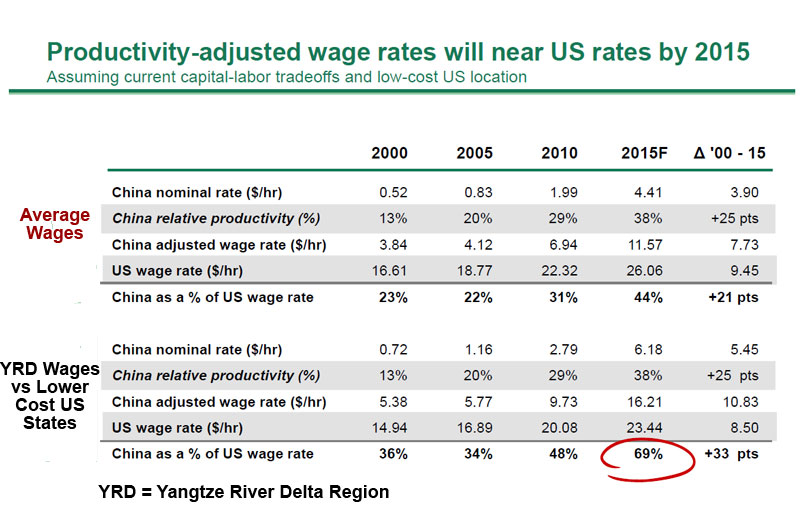
Like everything else, labor price is about supply and demand. For a long time using foreign labor was extremely impractical on so many levels, no doubt Henry Ford had to primarily hire US workers to work on US plants to sell cars to the US population. When it became practical to use Chinese and Indian labor, this lead to a massive influx of unnaturally cheap labor. Look at this table and graph. In 2000 you could hire 30 Chinese workers for the price of one American, productivity was only 13% but you still got 4:1 on your money. Today it's 6 Chinese workers to one American, productivity is up to 38% and 2.3:1 on your money. If you take high-cost China vs low-cost US, you're down to 1.45:1.
No doubt labor costs are going to continue to rise in China. India too is on the rise, though not quite as much. Within the next 5-10 years it'll probably be roughly as expensive to manufacture in China as it is in the US and the massive negative wage pressure will be gone. Same thing with software and India, whether you like it or not it's a global market now and our wages aren't going to rise again until the other workers of the world push global wages higher. If you've seen at the GDP distribution of the world there used to be a big lump at the top in the western world, then actually a drop and then the world's poor. Check out the difference between 1970 and 2006. We just can't keep up the level of inequality we used to.
-
Globalization
Like everything else, labor price is about supply and demand. For a long time using foreign labor was extremely impractical on so many levels, no doubt Henry Ford had to primarily hire US workers to work on US plants to sell cars to the US population. When it became practical to use Chinese and Indian labor, this lead to a massive influx of unnaturally cheap labor. Look at this table and graph. In 2000 you could hire 30 Chinese workers for the price of one American, productivity was only 13% but you still got 4:1 on your money. Today it's 6 Chinese workers to one American, productivity is up to 38% and 2.3:1 on your money. If you take high-cost China vs low-cost US, you're down to 1.45:1.
No doubt labor costs are going to continue to rise in China. India too is on the rise, though not quite as much. Within the next 5-10 years it'll probably be roughly as expensive to manufacture in China as it is in the US and the massive negative wage pressure will be gone. Same thing with software and India, whether you like it or not it's a global market now and our wages aren't going to rise again until the other workers of the world push global wages higher. If you've seen at the GDP distribution of the world there used to be a big lump at the top in the western world, then actually a drop and then the world's poor. Check out the difference between 1970 and 2006. We just can't keep up the level of inequality we used to.
-
Re:This
For starters, the working conditions in India and China are mostly miserable.
India and China started from really bad starting positions. So it doesn't matter if working conditions are "mostly miserable". You completely miss the obvious change, that working conditions, their economies, their standards of living, etc are much better than they were around 1950. Why does your supposed problems exist for your country, but not for these countries?
Secondly, an entire political system that favours trickle down economics over meritocratic incentives.
Another place where you don't seem to be paying attention. What trickle down economics? What meritocratic incentives?
Neo liberalism has screwed us, not labour policy, you twat
Neo liberalism seems to be code for global trade which would have happened anyway. It has elevated many billions of people out of poverty.
Why are you willing to ignore evidence of vast, global improvements in peoples' lives? What's so compelling about this fake story that you peddle that you prefer it over reality? -
Re:In other news
That must be why unemployment is a negative number and workforce participation is at an all time high while wages are rising faster than inflation across the board.
Workforce participation is increasing and I imagine it is at or near an all time high, though mostly due to increased participation by women. Wages are rising faster than inflation for at least two thirds of humanity, just not for the developed world.
OH, wait!, none of those things are happening.
I have to roll my eyes at such pronouncements. Have you never bothered to look? Have you never wondered how the rest of the world can slowly acquire the trappings of the developed world without accumulating wealth in the process?
If you really believe in markets, then you believe that demand for labor is down since any reasonable market theory would predict that given the figures.
Let's see these "figures" at the scale of the entire world.
If you believe demand for labor is up and yet we have unemployment and a depressed workforce participation and stagnant wages, then you clearly don't actually believe market theory.
Who is "we"? The developed world is not the world. You are looking at the wrong scale. The traditional model of supply and demand adequately explains the problem that the developed world has right now. Because of improving and liberalizing global trade, we now have a pool of labor effective much larger than we had in say, 1970, even including population growth. Any market theory would have told you that the price of labor would decline which in our complex world with all sorts of non-market tricks for shoring up wages, translates into declining labor power for any sector which is exposed to competition with the developing world.
Developed world capital has indeed increased with respect to developed world wages. Public sector labor unions have more power than private sector labor unions. The developed world has all sorts of problems with transfer of work to the developing world, automation, and mere closure of business, which the developing world doesn't have. -
Re:In other news
I don't know. I don't think the job market for oxen and horses has ever really recovered.
They're still employed though. And you ignore that humans are a bit more flexible than oxen and horses.
I think you will find that there are just fewer horses and oxen.
The crux of your argument seems to be that automation has not lead to mass unemployment in the past, so why would it in the future? Why worry about it now? I'd argue that while it hasn't lead to mass unemployment yet, it's more recently lead to under-employment and a decline in wealth for everyone except for an increasingly small number of people.
You could argue that, but that's not happening. Sure, there are a small wealthy portion of the world which does well no matter what. But most of the world's population has been getting wealthier and this trend has continued to the present. Life's too short to trust in falsehoods.
I was talking about the US in particular, but yes if you want to go there, wealth has been increasing world-wide. The reason it has is because there is a never ending search for ways to produce goods for less money. So far that has been achieved through both automation and finding sources of cheaper labor. That has elevated the level of wealth for people in those regions with cheap labor. But what is starting to happen is that even dirt cheap labor is becoming more expensive than automation. China's growth economic growth is slowing down for that reason.
Now to get a decent job, most people have got to spend a small fortune on a college education. Most skilled workers start their careers in serious debt. And of course as soon as they start working, they need to start saving for retirement because almost nobody has pensions anymore. Then somewhere down the line they will find that their skills are no longer relevant so they get spend a small fortune on college again, - while trying to save for the kids' college education and their retirement. That's even if a 50 year recent college grad can find work.
It's not my fault some college students made very poor life choices.
The choice to go to college? Not knowing which jobs will be automated 25 years from now? I'm not saying it's anyone individual's fault. I'm saying that we are fast approaching a time where AI and robotics will replace humans at a faster rate than humans can retrained to do the work that's not already being done by machines. There is just less and less that people can do that machines can't do cheaper.
-
Re:In other news
I don't know. I don't think the job market for oxen and horses has ever really recovered.
They're still employed though. And you ignore that humans are a bit more flexible than oxen and horses.
The crux of your argument seems to be that automation has not lead to mass unemployment in the past, so why would it in the future? Why worry about it now?
I'd argue that while it hasn't lead to mass unemployment yet, it's more recently lead to under-employment and a decline in wealth for everyone except for an increasingly small number of people.You could argue that, but that's not happening. Sure, there are a small wealthy portion of the world which does well no matter what. But most of the world's population has been getting wealthier and this trend has continued to the present.
Life's too short to trust in falsehoods.Now to get a decent job, most people have got to spend a small fortune on a college education. Most skilled workers start their careers in serious debt. And of course as soon as they start working, they need to start saving for retirement because almost nobody has pensions anymore. Then somewhere down the line they will find that their skills are no longer relevant so they get spend a small fortune on college again, - while trying to save for the kids' college education and their retirement. That's even if a 50 year recent college grad can find work.
It's not my fault some college students made very poor life choices.
-
Re:Self inflicted damage
http://www.voxeu.org/sites/def...
Try again
-
Re:Don't mess with my jetset lifestyle
The simple fact is Globalism is bad for the globe.
It's amazing what bullshit is being spun as fact these days. Globalism, which really is global trade, has improved the lot of humanity collectively (though at the expense of some dinosaurs in the developed world). Rich people pollute less than poor people. Rich people have less kids than poor people. True story.
For example, take a gander at the first chart in this link. It shows a 60+% increase in global median wages over the period of 1988-2008, adjusted for inflation, and a substantial increase in wages for people between the 10% and 75% income brackets (at least 30% increase). That is the power of global trade.
And to repeat what I noted before, those wealthier people will care more about the environment, pollute less, and have less children (greatly reducing the dominant over-population problem) than if there wasn't global trade.Fundamentally transportation is overhead. If your goal is to maximize the sustainable population (and I am not sure that actually is noble pursuit) than the solution will always be to find ways people can get things they need without having to move, and created out of local resources.
No. Learn about comparative advantage some day. There are advantages to having other people do some of the things you could do less effectively yourself (even if, in a context vacuum you could technically do the task better). These often translate into environmental benefits because you spend less resources and generate less pollution doing stuff.
-
Re:The good outweights the bad
The big thing that is worse, I think, is economic inequality
Except that this is not true either. There was a huge increase in income from about the 10% to 75% (that is, the two thirds of humanity who earned more than the bottom 10% and less than the top 25% over the past twenty years (actually 1988-2008). This has resulted in a considerable decline in global economic inequality despite the wealthiest managing to grow their portion of wealth over that time.
A few days back, we had a couple of stories about how automation was taking away jobs. It was instructive how detached from reality the observations were. One person claimed global median income was stagnant (instead it increased over 60% during the above period as the above link shows). Or that automation this time wasn't resulting in the usual (centuries long trend BTW) increases in employment. But if they had chosen to look, they would have seen at the global scale the usual increase in human employment. It was just in areas that weren't part of the developed world.
My point here is that we have a huge perception problem (this example is in the developed world, but there's nothing special about the developed world when it comes to provincial outlooks). If those previous stories had been about ferners takin' our jerbs away, it'd been laughed off as a clueless hick thing. But mersheens takin' our jerbs away? That's totally different even though the latter debate is driven by the same ignorance as the former. -
Re:Yet another clueless story on automation
We're talking about future developments that will apply everywhere.
I notice that you say a number of wrong things in your comments on this story. The most important is this one:
The problem is that median wages have been stagnating for decades.
Not in the developing world. For example, the first chart at this link shows over 60% growth in real income (adjusted for inflation) for the global median wage over the period 1988-2008. How does a 60+% growth in global median wages translate into "have been stagnating for decades"? They don't. You are ignoring 4/5 of the world's population.
The whole point of this topic is that as the supply of labor (provided by workers and/or robots) goes up, the value goes down
No mention of demand for that labor. Supply of labor has been going up for centuries, yet it is more valued than ever.
If the demand for productive labor can be filled by more robots, the value of human labor can still stay at zero.
The non sequitur.
You certainly could get to a point where it's just too much of a bother to even keep track of a low-achieving human employee vs. having a robot do it. Those people could essentially become unemployable.
We could always make it less of a bother to keep track of low-achieving humans. This is my theme throughout this discussion.
So why should I believe what you have to say about the future, when you are so painfully wrong about the present? -
Re:Is that unreasonable?
The analogy really sucks.
It's very hard to find a photo of Abe Lincoln where he isn't at least a head (including his beard) above everyone else. But today several countries have an average height within a 10 cm of him. The Dutch are 184 cm (about 6' 1"), but Abe was only 193 cm (just under 6' 4"). Partly that's due to nutrition, which has an incredibly complicated relationship to height (the Dutch, for example, are dragged down by the descendents of people born during a famine after WW2. Their grandchildren are unexpectedly short and nobody knows why.).
A Dutch person told me an odd tale about hormones they allowed or put in the food during the 70/80s that led to a single extra tall generation. They got rid of the hormones later and hushed the whole thing up, so now the next generation is back to normal height.
Not sure I believe it though, never found anything to back it up, so it could just be a dutch urban legend.
-
Re:Is that unreasonable?
The analogy really sucks.
It's very hard to find a photo of Abe Lincoln where he isn't at least a head (including his beard) above everyone else. But today several countries have an average height within a 10 cm of him. The Dutch are 184 cm (about 6' 1"), but Abe was only 193 cm (just under 6' 4"). Partly that's due to nutrition, which has an incredibly complicated relationship to height (the Dutch, for example, are dragged down by the descendents of people born during a famine after WW2. Their grandchildren are unexpectedly short and nobody knows why.).
-
Re:The Middle Class is the Bedrock of Society
Right now, banks are sitting on unprecedented levels of excess reserves
I would severely contest that statement. If you are quoting negative basis points implies you are from the EU where banks still routinely fail stress tests because they have too little capital. Back during the financial crisis banks where operating on very thin reserves (a.k.a. risk capital) / highly leveraged / high geared ratio / whatever term you want to call it. This is one of the reasons why the crisis was so bad. On a relative measure (reserves / assets), they are recovering but are still historically below average.
Which takes me to 2 points.
First, what you are seeing is a fight between the politicians (and by extension, the central bankers) and the stock holders. The banks need to recapitalize and deleverage – everybody agrees on that. The central banks want this done fast and remain the same size by issuing new stock to raise fresh capital. The central banks argue that would take the risk out of the banking sector as well as stimulate the economy. The stockholders are resisting this idea. This would water down their stock. They prefer a slower, more organic approach. As loans come due, bring in the profit into the reserves instead of lending it out, shrinking the overall balance sheet. This means reducing the rate of lending.
Secondly, let us consider secular stagnation
Demand isn't really in the equation right now. People and firms aren't looking to borrow because they're concerned about risk.
This is what I hear: People are not looking to borrow because there are few projects with an adequate risk / return profile, ergo demand is low. What is difference in what we are saying?
Interest rates are set by the supply of credit (savings), demand for investments.
I would argue that supply is high. See central banks pushing the money supply.
To extend on the theme that demand is low. Always use a risk / return framework. If not you can get skunked.
There are a variety of measures of risk aversion (VIXX, credit spreads) and these have been falling.
Return is tied to overall growth. If growth sucks, than return sucks. Look beyond the banks to almost every out asset class out there – stocks, real-estate, bonds (government, corporate, high yield, short term, long term) – expected returns are at very low levels.Here is a link to a excellent source – with arguments for both sides.
http://www.voxeu.org/sites/def... -
$30,000 for a battery and some electronics
we are to believe that the electric variant costs $46,650
Sure. These cars involve a large quantity of nickle, cobalt and copper. The 500e in particular is a traditional nickelâ"cobaltâ"manganese lithium-ion battery, just large and expensive. All the high current lines running around between the motor, battery and regen brakes are copper. Seen copper prices lately?
If not for imports it wouldn't be possible to buy these in the US; we can't produce these metals in quantity any longer. Or rather, there is no way to credibly compute how many times more these cars would cost if they were made with domestically produced metals; the only thing you can be certain of it that you couldn't possibly afford it. Nickel, cobalt, manganese and copper mining and refining â" all huge sources of industrial contamination â" are essentially impossible in the US beyond a few legacy, declining sites.
These cars are the epitome of third world pollution shifting.
-
Re:Proof that Obama is corrupt
Not sure what that link is supposed to prove. US does more international trade than any other country, of course it's name will pop up in trade disputes. The closest thing to an authoritative ranking of the countries by protectionism I could find:
http://www.voxeu.org/article/protectionism-s-quiet-return-gta-s-pre-g8-summit-report
Scroll down to "Table 1. Which countries have inflicted the most harm since November 2008?"
It is compiled from GTAâ(TM)s annual reports (which don't rank the countries).
-
Re:Another "moderation" fraud
Our brain is actively maintaining the level of fatness. If your brain feels it has too much fat and your muscles need energy is will try to take calories from the fat instead of food.
How does the brain actively maintain the level of fatness? Are you saying that even in the presence of insulin resistance, that your brain can override your fat and muscle tissue and make them partition fuel despite the influence of insulin?
Insulin resistance will screw with the regulation but that doesn't mean it started the obesity or is the main driver.
I don't know exactly how the brain understands its weight level, but the set point certainly does exist and I can't see how insulin responding to blood sugar alone could be responsible for this.
If a Japanese or Vietnamese person can be thin with a bunch of calories from white rice why can't I?
If a two pack a day smoker can live until 94 years old without lung cancer, why can't everyone?
In the case of people living in Japan or Vietnam, more things than just their caloric intake of white rice vary - other portions of diet, other environmental factors, all can create a situation that isn't applicable to other locations.
Show me a country where 2-pack a day smokers have a drastically lower lung cancer rate and we'll talk.
Here's the big problem with the Taubes idea.
We weren't always fat. Virtually no ancestral cultures have high levels of obesity, but tons have high levels of carb intake. Some even eat a ton of fruit and honey.
You can also swap out a bunch of fat for sugar and not gain weight with modern people.And if carbs are responsible for obesity then why did we eat more calories from carbs 100 years ago than we do today? And why isn't there a correlation between that macronutrient graph and obesity rates over the same period
If your interpretation of the biochemistry tells you that insulin is driving obesity then your interpretation is wrong because the evidence is pretty overwhelming that carbs are not the culprit.
-
Re:Pay for nothing
Fraud is an example of overconsumption of these public goods.
What fraud? Do you have anything documented on pension fraud in western Europe? I am interested.
There's also the common matter of not having enough young workers to support the elderly pensioners
What is relevant is not the number of workers vs pensioners, but the wealth produced by the former and consumed by the later. And since workers productivity grows up, we need less and less workers to create the wealth needed by pensioners. The reason why it has trouble to sustain today is that workers wages do not follow GDP increase, and it even shrinks in percentage.
My claim of "tracking GDP" means a substantial increases in GDP correlate with substantial increases in wages
Numbers will tell that it is true, but at the same time you will find that the percentage of GDP that goes to wages shrank in the last 30 years. This means the economy produces more wealth, but workers reap a smaller part of it. And this is a problem because workers are huge part of the demand on the market. If they cannot afford to purchase the extra produced goods, you get the supply crisis.
I have found research that indicates that wages have gone up considerably globally while simultaneously showing that the developed world wages haven't done that much.
You extrapolate a lot from this study, the summary does not even include the word "wage". Poverty reduction may be done through wage raises, but it may also not be correlated at all. For instance give everyone an universal income based on money creation or taxes, and you reduce poverty.
-
Re:Pay for nothing
Odd examples. I was more referring to what western European countries have been doing with success since 1945, and which is getting more and more impossible to run in a globalized context: public health insurance, public unemployment insurance, public retirement pensions. Where are the tragedy of commons there?
Fraud is an example of overconsumption of these public goods. There's also the common matter of not having enough young workers to support the elderly pensioners. When one couples that with another common overconsumption problem of pensions, promising more than has been put into the pension, you can get shaky pension systems with any funds being drained by the pensioners dependent on the system.
Please prove me wrong. Please show me that percentage of per-capita GDP that goes to wages globally increased since 1980.
I'm not going to, because that's the reverse of what would actually what would happen in a situation where supply of labor has suddenly expanded and it also is beyond any claim I've made. My claim of "tracking GDP" means a substantial increases in GDP correlate with substantial increases in wages, not that wages are going to command greater shares of GDP for some reason.
I have found research that indicates that wages have gone up considerably globally while simultaneously showing that the developed world wages haven't done that much. -
Re:I used to block ads
Went looking for info on your post and found this instead. The cost of consumer products goes down due to increased advertising. Makes sense when you think about it. Demand goes up as more people are informed, supply matches or exceeds demand and an equilibrium point is reached beyond which prices drop.
-
The third Industrial Revolution impact
As mentioned on Slashdot before, Bob Gordon argues that there have been three Industrial Revolutions, the Steam Revolution in the late 18th century, the Electrical and Car Revolution at the turn of the 20th century and the Data Revolution since the 1950ies. Differently than the first two, which yielded immense productivity and wealth increases, the Data Revolution is not living up to its promises yet, though we have many of its aspects already in place, data processing power is at everyone's[*] disposal, a world wide communication network lets you reach a big part of the world population[*] for nearly zero cost, a tremendous source of information is readily available to everyone[*].
[*] everyone either living in the Northwestern hemisphere or being wealthy and influencial enough.
1) Do you agree with Bob Gordon's notion?
2a) If yes, why is that, and will it change in the near future?
2b) If no, where do you see the great increase in productivity and wealth, Bob Gordon is missing? -
Re:blah blah Capitalism Evil blah blah
The US government isn't spending 40% of the GDP.
Yes it is. OECD lists US government spending as around 40% of GDP:
So does Wikipedia:
http://en.wikipedia.org/wiki/Government_spending
The numbers you're quoting our specific acts by individiual policies. There is a general baseline that the article doesn't cover but is neither here nor there at this point.
I pointed you to an article on fiscal multipliers; it provides both general ranges across all policies and specific values. If you want a nice discussion of aggregate impact of fiscal multipliers, look here:
http://www.voxeu.org/article/determining-size-fiscal-multiplier
Note that even in the best of cases, that rises only to about 1.6.
Here is a good discussion in the context of US policy:
http://online.wsj.com/article/SB123258618204604599.html
You've provided no data to support your ludicrously implausible claims. I think it's clear you don't really know what you're talking about.
-
Re:Hooray for Globalization
I know that 'gloom and doom' are popular and easier to believe, but here are some links that you simply must read/watch:
http://www.voxeu.org/article/parametric-estimations-world-distribution-income
http://www.youtube.com/watch?v=jbkSRLYSojo
What is true, is that within the US Gini has been growing dramatically (in layman's English: GLOBALLY income inequality has been GETTING BETTER, but within the US it has been getting worse), and that is largely because of corporatism, and the increasing consolidation of power and control of political structures by kleptocratic financial interests. That is a major problem. But it isn't "capitalism" - it's corporatism - there is actually a difference, a big difference.
-
Re:This is a joke
-
Re:They could disable the majority of botnets
This kind of thing is utterly impossible in Linux
Okay, first off, you're complaining about browser security, and bashing the OS branch of Microsoft, so please redirect your nerd rage accordingly.
Second, before you talk about how there aren't any botnets on linux, lets do a little critical thinking. For the sake of argument, let's assume that the same amount of work will go into a linux vulnerability as a microsoft vulnerability (I know that you may not agree, but I have seen very little concrete evidence to the contrary). For the sake of argument, let's assume that twice as many users of Microsoft XP will do something stupid to let you exploit the vulnerability as users of linux (this statistic is probably low, based on the fact that anyone still using XP is stuck a technological generation back). Then, according to the most recent numbers you can expect 60 times the ROI of a linux exploit on a windows exploit.
Assuming that linux is more secure because it hasn't been the target of a botnet might just be the equivalent of assuming that pink cars are invulnerable based on this chart
-
Re:Bad News for USD
This is VERY bad news to an already weakened dollar.
The dollar has been overvalued for decades, and look at the result: manufacturing jobs have moved overseas, and a vastly negative trade balance. With an over valued currency, It's simply cheaper to import something than to produce it locally.
A high exchange rate doesn't make a currency strong anyway, long term stability and low inflation are more important.
"Overvalued" currencies are a silly excuse for the US's poor trade performance. If currency valuation was the determining factor in the size of trade surpluses then post-plaza accord Japan's trade surplus should have narrowed significantly. In fact it's been rising and falling without much change in the average at all. Or Germany wouldn't run a huge trade surplus with the rest of the EU even though they trade in the same currency.
Furthermore there's a lot of evidence out that a large part of US trade-deficit with China with its undervalued currency is actually a deficit with Taiwan, Korea, Japan and Germany. China is becoming an end point for the assembling of products (iphone, ps3
The rest of the world is getting pretty sick of the US moaning about "undervalued" currencies as well. Here's the governor of the RBA (Reserve Bank of Australia) calling out the falacy in the US's constant whining about the Yuan: http://www.smh.com.au/business/rba-to-usa-wake-up-yer-drongos-20110415-1dgye.html
The reason the US hasn't succeeded as an exporter is because it has systemically failed to make the long-term capital investments necessary to make its industries competitive. It's easier for a CEO to fire 10,000 workers claim a massive increase in profits collecting outrageously huge performance-bonuses (or non-performance please just go away bonuses aka. "golden parachutes") than it is for them to make serious long term investments than sacrifice immediate profit for future-benefit. I'd blame a tax-structure that doesn't provide strong incentives for corporations to bring profits back onshore and reinvest them in infrastructure and employing new workers and an (ultra) short-term focused stock market.
-
Re:Governments love power
It seems that most adult people, at least all but the most naive, understand that corporations' main motivating factor is to increase profits; many of those same people haven't put the government in the same realistic perspective.
I've heard your argument from many smart people. Oh if only the sheeple knew how they were being used by the big bad government! If only the sheeple could have the blinds ripped from their eyes to see the glory of my particular political beliefs!
Here's a shocking prospect for you: Your ideas aren't implemented, because people are ignorant of them. Your ideas aren't implemented, because the people have rejected them.
Well in a democracy, the government is the people. It's not some bogeyman. It's us. If you don't like what your representative does, then vote him out. That's how representative democracies work. In several states, direct democracy through an initiative process exists. Want to change a law? Get a few thousand signatures, and put it on the ballot, and then convince a majority of your fellow state residents, and it's the law. It happens all the time, especially in California.
You claim that the progressive income tax persists because of some sort of illuminatiesque power grab. Well, quite frankly the most common suggested alternatives: the "flat" tax, the VAT, and a national sales tax, all suffer from the same problem. They shift the tax burden even further towards the low end of the economic scale, where -- let's be honest here -- the vast majority of the people are. The simple reason that these alternatives aren't implemented is because they're unpopular because they effectively decrease the take home pay of the majority of voters, while decreasing it substantially for the hyper wealthy supporters of these alternate tax schemes.
You suggest that the only reason why marijuana is illegal is because the bogeyman likes to put people in jail. Well, how do explain that when put to a vote of the people, Californians voted to keep it illegal? The United States is a country with puritanical roots. Pleasure is bad. Work and suffering is good. Many people don't want marijuana legalized because they believe the legalization supporters "just want to get high."
You spout that tax cuts always stimulate the economy while government spending doesn't, and go so far to say, "it's pretty clear that lower taxes stimulate an economy." Actually, that's not clear at all. While cutting taxes can have stimulative effect when tax rates are high, the effect quickly diminishes. Think about it. If taxes were at 90% and they get cut to 50%, for every $100 you had, your after tax earnings increased 5 times. While a tax cut from 10% to 5% only increases your after tax earnings by 1.05 times. The stimulative effect of that extra $5 is negligible. It's called "decreasing returns" and it's a basic economic concept. So how is this applicable to today's economic situation? First, taxes are already low, so as we've seen seen any stimulative effect has long already occurred. Second, the economic consensus is that the economy is stagnant, not from a lack of money, but rather a lack of demand. This is obvious when you examine the SEC filings of publicly traded companies. They have cash, in many instances rather large cash reserves on hand. They could buy anything they want, but they're not. Why? They have excess capacity. The stimulus was to make the government the buyer of last resort, which again the consensus among economists is that the stimulus indeed worked to prevent a depression. Furthermore it's stimulative effects were weakened due to it being not only too small, but also undermined by states' "austerity" measures. (Disclaimer: I'm friends with one of the authors.)
You assert that somehow majority vote election systems are imposed on the
-
Re:More lies with statistics...
I really hate it when people start prattling along about errors with statistics when they don't bother looking at the actual statistics.
And I really hate it when others start prattling about errors with statistics when they don't know when to take an adequate sample.
In the linked 'study', we find that the highest risk category is for black cars, with a theft risk of approximately 0.25% during the length of the study. We also learn that the number of pink vehicles included in the study is just 109.
If car thieves had an identical preference for pink cars and black cars (don't ask me why), then in a sample this size, there's still only about a 25% chance that any of the pink cars would be stolen over the study period. The sample is too small to draw any meaningful conclusions. It could be that car thieves desperately want to take pink cars, but are having too much trouble finding them.
The data used in this study are insufficient to show that pink cars are less likely to be stolen than the other less-common colors; they aren't even a big enough sample to show that pink cars are safer than the most-stolen colors.
-
Actually... No. It is quite the opposite.
From TFA:
http://www.voxeu.org/index.php?q=node/5262
It's resale value, not the fear of getting caught
Is it only resale value that drives the preference of thieves for cars in common exterior colours or does the probability of apprehension also play a role?
The recent history of car theft gives us some idea. Red is obviously a bright colour that attracts attention - including that of the police.
Red is also a colour that has fallen out of fashion since the turn of the century (Figure 1).
In the beginning of the 1990s around 25% of all new cars were red, now the number is close to 5%.
The decline of red doesn't only go for the Netherlands, but is a worldwide trend according data from DuPont.
If thieves are primarily interested in resale value and do not care much about being spotted in a bright coloured car, then we should see higher rates of theft for red cars in the 1990s.
That is exactly what we find. Figure 3 shows that, just with the colour silver/grey, the popularity of red in new car sales is tightly linked with the prevalence of red among stolen cars.
This suggests that car thieves do not seem to be particularly worried about being picked out from traffic by police.Figure 3. Popularity of colour in new car sales vs. theft risk by colour, the Netherlands
http://www.voxeu.org/sites/default/files/image/Vollaardfig3.pngSource: CBS/RDW
Conclusion
Differences in theft rates between cars in common and uncommon colour suggest that resale value is on the mind of car thieves.
We find evidence that it is indeed the resale value rather than the fear of getting caught that is driving this difference.
If the aversion to driving a car in an offbeat colour is not too high - or if someone actually enjoys it - then buying deterrence through an uncommon car colour may be at least as good a deal as buying deterrence through an expensive car security device. -
Actually... No. It is quite the opposite.
From TFA:
http://www.voxeu.org/index.php?q=node/5262
It's resale value, not the fear of getting caught
Is it only resale value that drives the preference of thieves for cars in common exterior colours or does the probability of apprehension also play a role?
The recent history of car theft gives us some idea. Red is obviously a bright colour that attracts attention - including that of the police.
Red is also a colour that has fallen out of fashion since the turn of the century (Figure 1).
In the beginning of the 1990s around 25% of all new cars were red, now the number is close to 5%.
The decline of red doesn't only go for the Netherlands, but is a worldwide trend according data from DuPont.
If thieves are primarily interested in resale value and do not care much about being spotted in a bright coloured car, then we should see higher rates of theft for red cars in the 1990s.
That is exactly what we find. Figure 3 shows that, just with the colour silver/grey, the popularity of red in new car sales is tightly linked with the prevalence of red among stolen cars.
This suggests that car thieves do not seem to be particularly worried about being picked out from traffic by police.Figure 3. Popularity of colour in new car sales vs. theft risk by colour, the Netherlands
http://www.voxeu.org/sites/default/files/image/Vollaardfig3.pngSource: CBS/RDW
Conclusion
Differences in theft rates between cars in common and uncommon colour suggest that resale value is on the mind of car thieves.
We find evidence that it is indeed the resale value rather than the fear of getting caught that is driving this difference.
If the aversion to driving a car in an offbeat colour is not too high - or if someone actually enjoys it - then buying deterrence through an uncommon car colour may be at least as good a deal as buying deterrence through an expensive car security device. -
Direct link to the study
Here:
http://www.voxeu.org/index.php?q=node/5262
I generally agree with you though, I'm not sure the conclusions are valid from what's given. It basically says 0.26% of black cars, the most stolen colour, get stolen, whilst 0.16% of red cars, the least stolen get stolen. Apparently there's something like 6.8 million vehicles in the Netherlands, but it's hard from the data to tell how many cars this actually translates to in practice, particularly as the graph given changes over time, and older cars will most likely be off the road. I'm sure you could figure it out by averaging the amount bought over the period and factor in an exponential decrease in those taken off the road, but it'd be more reasonable if the author had done this. The very fact he does seem to have basically left things half finished and come to a conclusion without providing better supporting evidence and clearer data does leave me a little skeptical I'll admit, the level of work done would be fine for a high school science class, but for a professor of economics? a bit of a poor show to be honest.
-
Sources & Mr. Obvious
Well, according to one source 26% of the cars in Europe are black. Now the original article says that about 26% of the cars stolen in the Netherlands are black (see Figure 2).
Bravo, Mr. Obvious!
How come such an article is on
-
Sources & Mr. Obvious
Well, according to one source 26% of the cars in Europe are black. Now the original article says that about 26% of the cars stolen in the Netherlands are black (see Figure 2).
Bravo, Mr. Obvious!
How come such an article is on
-
Re:Stimulus?
Uh-oh... Do we see a growing resentment of "stimulus"? Perhaps, allowing the government to spend billions of our dollars is not, after all, a better idea, than to simply return it to us (the taxpayers)?
Where it would be used to pay down debts instead of spur demand in the economy, thus lengthening the the duration and depth of the downturn. If anything, the stimulus package was much too small.
-
Re:Reciprocal regulations
Yes, please, let's unlearn everything from the Great Depression in the middle of a recession. What could possibly go wrong?
-
Re:Investigative?
What makes you think they don't earn a profit? The shareholders do, through dividends paid by the Fed.
Non-tradeable stock with a fixed dividend held by member banks is hardly a recipe for perverse incentives. The dividends paid out are proportional to the required reserves held by the banks at the Fed.
Many of those shareholders are foreign investors. What makes you so sure they would act in the best interests of the US?
The fact that, unless something has changed in the past few years, none of those shareholders are foreign investors. The shareholders are US banks whose holdings of Fed stock are requirements of their membership in the Federal Reserve system. As far as I can tell, whoever originated that claim simply fabricated it.
Congress and the US treasury did a fine job running the monetary system for 150 years. What happened in 1913 that suddenly made them too incompetent to do so?
I would take issue with your first sentence. The lack of any sort of fast-acting buffer on the fluctuations in demand for money and debt made for a very exciting banking system as seen here.
In fact, it only took the Fed 16 years to completely bankrupt the banking system and the US government.
I think that we can all acknowledge that the Fed did the wrong thing during the run up to the Great Depression. I'm not sure what that has to do with modern Fed operations.
And they admit that because of the way the government is funded through the Fed they can never pay off the debt. What makes that a good thing?
I have no idea what this refers to, but I strongly suspect that the source is nonsense.
-
Re:Reality check, please!
Your point B is bollocks. Japan has consistently had a lower unemployment rate than the U.S., as have the Netherlands and Denmark. EU-wide unemployment has been falling over the last ten years, so there are 4 million fewer unemployed in the EU than there were in 1996 [src].
Sure, their overall unemployment rate is around 7%-8% (compared to our 4%-5%). But you can't just compare our apples to their oranges. There are several ways of judging "the unemployment picture." One is to say, "if I'm unemployed here, how difficult is it for me to find a job?" Another is to say, "if I'm unemployed here, how bad does it suck?" In the U.S., with its stingier unemployment benefits and its employment-based healthcare system, it's far more risky to be unemployed. A third way is to ask, "If I'm unemployed, how difficult will it be to get a job with the wages and benefits that are important to me?" If you're hoping to land a job with 6 weeks vacation, you're better off looking in Germany. If you want a job that pays a living wage, you're probably also better off looking in Europe (depending on the sort of job you're looking for). If you want a job that gives you health insurance, best to look in America. In the EU, you probably already have it.
Also not everyone thinks Europe is the economic wasteland that you do. -
deflation
The Japanese economy has been experiencing deflation for the past few years.
http://www.voxeu.org/index.php?q=node/624