Slashdot Mirror
Domain: wearcam.org
Stories and comments across the archive that link to wearcam.org.
Comments · 181
-
Re:What does this have to do with online stuff?The problem with surveillance is that everyone involved is a clerk at some level. The lowest level clerk says the manager put the cameras there. The manager says the insurance companies require it. The insurance companies say they just follow standard practices and that it's the manufacturers that cause surveillance.
So if nothing else, sousveillance
(inverse surveillance) can explore a balance of
individuals.
Examples of sousveillance, such as the Rodney King beating,
show us the other side of the story that surveillance
cameras never show us.
Had the police seen the video camera of the King beating, they'd
likely have tried to destroy that data as well.
Online glogs
(cyborglogs) at least balance the equation. -
Re:A few first-hand comments..If you don't mind agreeing to the Terms and Conditions of Adobe, you can get the article in Proprietary Document Format (PDF) from here.
It was also published in a peer-reviewed journal,Surveillance and Society; here is the link: Steve Mann, Jason Nolan and Barry Wellman Sousveillance: Inventing and Using Wearable Computing Devices for Data Collection in Surveillance Environments.
. -
Re:A few first-hand comments..If you don't mind agreeing to the Terms and Conditions of Adobe, you can get the article in Proprietary Document Format (PDF) from here.
It was also published in a peer-reviewed journal,Surveillance and Society; here is the link: Steve Mann, Jason Nolan and Barry Wellman Sousveillance: Inventing and Using Wearable Computing Devices for Data Collection in Surveillance Environments.
. -
Re:He suffers from "transition sickness"
-
Re:computers as mental extensions and I"P".
Yes, these ideas have been discussed in
http://wearcam.org/therighttothink.htm. -
Re:Ummm
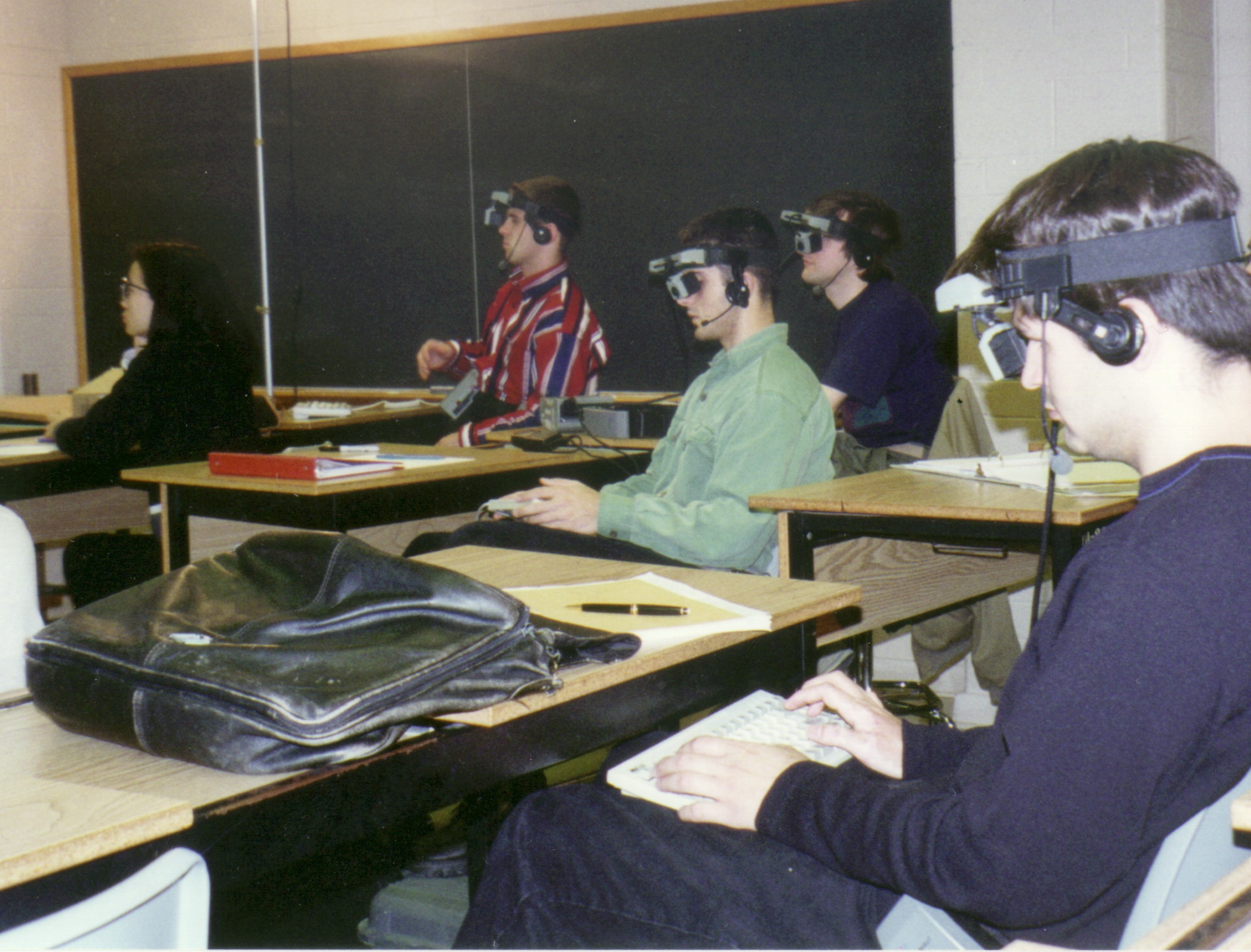
This is a cluster of borgs^h^h^h^h students at Prof. Mann's ECE1766 course at the University of Toronto. http://wearcam.org/ece1766/class2.jpg
-
Seriously, Wouldn't this be a _lot_ easier?
Steve Mann and others developed a system called gunroll that can align and stitch video frames. When frames overlap, it ups the resolution. Makes me think a basic pan and scan of Bryce canyon taking only, say, one minute would produce an even larger image than this one, without manual blends.
see : their paper and see this image which adds resolution as they have discovered : scroll down to the swimming pool
If anyone knows more about Steve Mann's work or got his software to work for the Rest Of Us (tm) please post a reply here! (Steve's C software can be got off the web, google for it.)
Adam.
Arenchagunnarooda? Nahdinwanna. -
Steve Mann
Steve Mann has been doing this for years.
-
Re:MIT's dumb idea??
Hrm... well, this is a page about Canadian wearable computing.
http://wearcam.org/ -
"Diminished Reality"
Steve Mann is way ahead of you
-
Fixed Link
-
Re:Turn Tables
Sousveillance (inverse surveillance) versus surveillance: understanding the concept of directionality, take a look at http://wearcam.org/shootingback/sears.mpg.
-
Re:Turn Tables
Sousveillance (inverse surveillance) versus surveillance: understanding the concept of directionality, take a look at http://wearcam.org/shootingback/sears.mpg.
-
Cyborg Rights (Was Re:I don't get it...)
Well, there already has been a test case of cyborg discrimination. Whether you sympathize with the plight of Prof. Steve Mann at the hands of Air Canada, or think otherwise, the fact is that certain regulations have revealed the potential for discrimination on the basis of technological augmentation of the body.
The specifics of Mann v. Air Canada are not as important as the over-arching issues the case raises. Mann's case cannot be argued on its constitutionality, as there are no constitutional protections against discrimination of cyborgs, or those who are technologically enhanced. However, it was obvious to those of us who saw Mann immediately after the Air Canada incident that the removal of his cyborg accoutrements resulted in significant physical distress. He was unable to maintain balance, properly respond to ambient temperature fluctuations, judge distance for grasping objects, among other physical infirmaties. The symptoms lasted for a little over a month, after which, his body slowly reacclimatized to its non-cyborg state.
The argument cannot be made on the evidence that his wearable computers, and their intrinsic biofeedback mechanisms, were merely fashion accessories or affectations. Because his autonomous body functions had adjusted to Mann's cyborg enhancements, they could rightly be considered part of his (cyborg) biology, necessary to maintain his normal health. In legalese, Mann's cyborg enhancements differed from MP3 players and portable computers "in kind," not merely "in degree." Hence, one could legally consider that Air Canada's security checks should have changed to provide adequate screening without being invasive and destructive. The fact that those with cochlear implants or heart pacemakers are not required to turn off and remove those cyborg enhancements, but Mann was, indicates discrimination.
I am supporting neither Mann nor Air Canada in making these observations. I am pointing out that we already have an important case that raises the issue of the regulatory imposition on those who have technological enhancements to their bodies. The examination of the fundamental issues and the questions they raise is most appropriate to be done now. -
Re:Using Cellphone cameras under J2ME
Not to be rude, but, exactly what sort of things would you be taking pictures of with your camera 'every few minutes'? Judging by where most people keep their phones, it's most likely going to be a pocket, a briefcase, a purse, or perhaps other peoples hips from a holster. While it is a 'neat idea' I wonder about the practical implementation of it (it's more of a 'doing it to say I did it' thing). If you are honestly interested in having a 'mobile webcam' you should look into things such as Professor Steve Mann's wearcam, as well as other things relating to augmented reality or mediated reality. Also, on many phones, the use of the camera drains the battery significantly if used a lot (something you must consider) so you'd probably need the phone plugged in, and finally, you have to consider the cost of 'network airtime' from your provider (but since you say a Sanyo SCP-5300, I'm going to guess that you have PCS vision from sprint).
-
Dr. Steve Mann
The converse has been done (same tech, opposite purpose). He coined the term "mediated reality" for his wearable computer systems that have the ability to recognize, for example, a billboard, as he walks down the street and replaces the ad with something of his own choosing.
Dr. Mann is the original 'Borg', cited here on Slashdot before. Sorry, I'm too lazy to look up the links. -
Re:Why is it [evil]?
Hmm... actually it sounds to me like Prof. Steve Mann (http://wearcam.org/) would have the best chance at this contract.
And maybe he's ready to leave Canada, after being roughed up by Air Canada security last year.
Come over, Steve, the water's great. Just watch out for those security checkpoints. -
enhanced vision/augmented reality
Many other people call this augmented reality, but Steve Mann thinks that of the useful functions of the system would be to screen out advitisements, hence "diminished" as well as "augmented" reality forms "enhanced visions."
One unfortunate thing is that it can be hard to get by when one's enhanced vison is suddenly removed, as Mr. Mann's recent troubles show.
I'd also like to note that ideas about augmented reality are pretty central to ubiquitous computing. -
Re:Clothing
-
Glogs (cyborglogs) have been around for years...
Picture blogs are really not a new thing. Cyborg Logs (cyborglogs, or glogs have been around for years. See for example, a web glog from 1995.
-
Glogs (cyborglogs) have been around for years...
Picture blogs are really not a new thing. Cyborg Logs (cyborglogs, or glogs have been around for years. See for example, a web glog from 1995.
-
Wearable Mobile PhoneWearable phone with head up display, bone conduction headset and twiddler like 'keyboard' would allow non-disruptive use at theaters, etc..
It could work like this: You get call. You hear it on your bone conduction headset and see on head up display. You type replies with twiddler and synthesizer converts text into sound and sends it to the person at other side.
Other people might not even realize you have wearable phone and are 'talking' on it, see modern wearable computer example here.
Downside: Don't see anybody with above like product out
-
Re:The Transparent Society
This is touched on in the "sousveillance" papers at this site. It advocates watching the watcher, so to speak.
-
Re:I am also reading this book.
Some other links that I found interesting relating to the wearable computing section of the book include Steve Mann's wearcam site, Thad Starner's info at Georgia Tech, and Melanie McGee's site.
-
Re:MIT cyborgs
-
Surveillance Camera Players
In addition to the laser pointer discussion, the NYT article went on to discuss the Surveillance Camera Players, who began performing theatrical productions for surveillance cameras in 1996. They have mapped surveillance cameras they have noticed in several areas of Manhattan.
It would be interesting to compare the critiques offered by the Surveillance Camera Players with the ideas of Steve Mann, whom the article does not mention, but who has called for "sousveillance" to counter the dark side of surveillance.
-
this isn't new....
at all. We did this in one of our labs with the self-titled cyborg, Dr.Steve Mann, at University of Toronto. It was lab 5... you can see for yourself. The class websites are at....
http://eyetap.org/ece385/
http://wearcam.org/ece385/
if you know a little about device drivers, then this isn't very hard... -
Re:Ugly, Ugly, Ugly
Prof. Mann at the Univeristy of Toronto has been working on stuff like this.
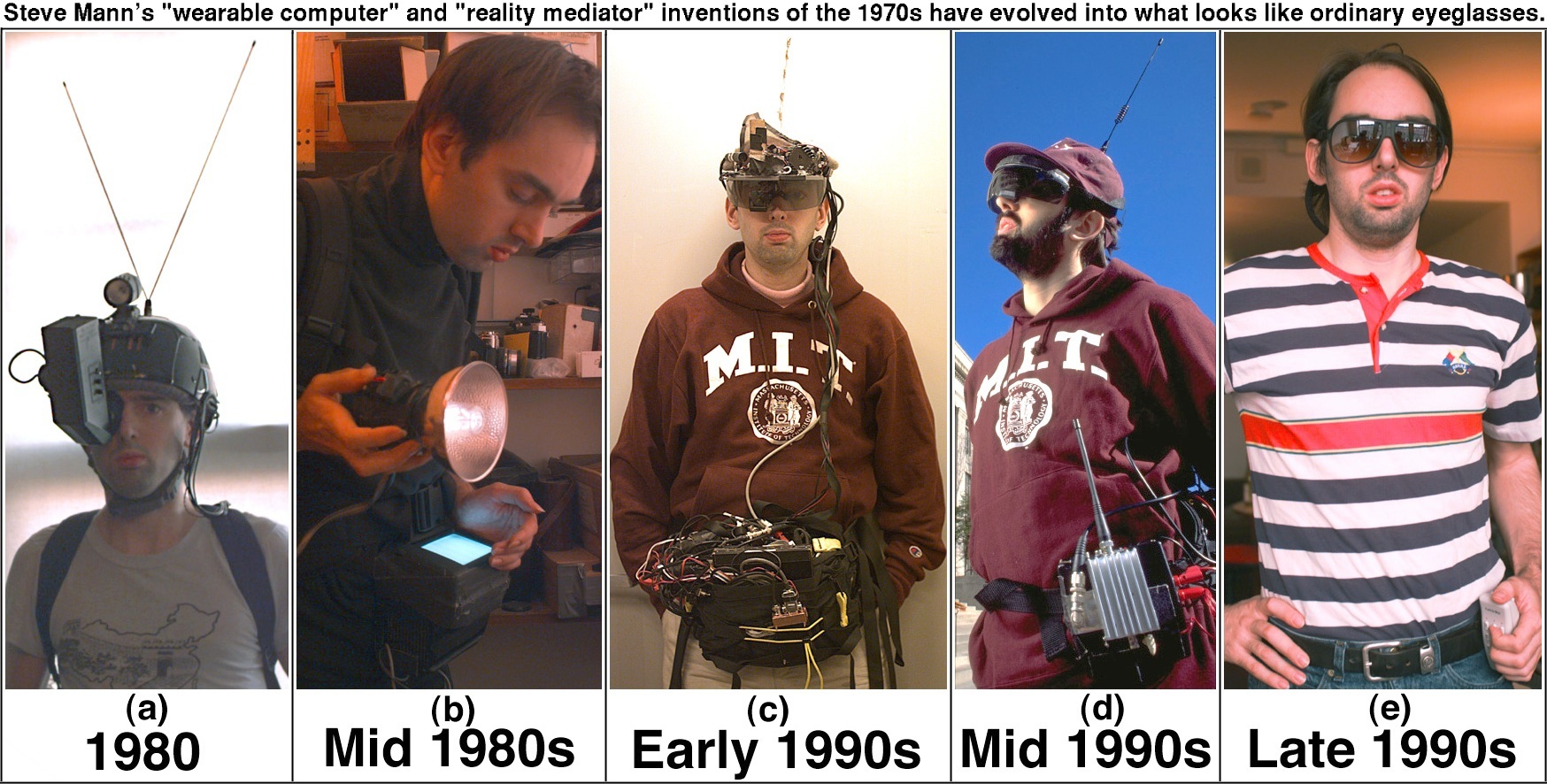
His most recent stuff looks completely normal.
Pictures are here -
Um, you've got the two professors confused...
The nutcase with the implant is Kevin Warwick, a professor of Cybernetics at Reading University, UK.
Steve Mann, who wrote the compositing code that this Slashdot article is about, is a professor at the University of Toronto, teaching wearable computing, and is the one who had his (non-implanted, despite what the slashdot post says) hardware ripped off in Newfoundland.
THEY ARE NOT THE SAME PERSON. -
Clearing up some confusion
My undergraduate design project was with Steve Mann on this technology (objective was the "parallelization" of the software on a Beowulf cluster - shout out to Mike and Anna
The main use of this system so far has been to stitch multiple images into one panoramic shot. Like any auto-stitching program, this requires a certain amount of overlap between frames - the more overlap, the better the stitching. The code works remarkably well, automatically rotating, zooming, skewing and otherwise transforming the images to fit together and then mapping them into a "flat" image as opposed to a parallelogram-shaped one.
Yes, the higher resolution from multiple shots of the same scene works, and is a very cool effect of the system. Of course, this requires a more or less static scene.
Finally, it's not necessarily "video" that it uses, although pulling individual frames from a video would work. It's based of the head-mounted cameras of the wearcam systems, which essentially use a stripped-down webcam for image-gathering, so you already know the fps and resolution limitations involved with those.
Of course, in the 2 years since I've been there, the technology has probably improved, although I doubt the webpage has.
Mann has a bunch of cool projects involved with the wearcam/wearcomps. This is a great one, another is the Photoquantigraphic Lightspace Rendering (painting with light), which can also be found on the wearcam site.
-
Re:This prof looks like an MIB ;)
mib? i guess you're referring to the shades.. guess what those are? his own custom wearable computer. you can read more about it at wearcam.org. this guy is awesome.
-
Re:Many interesting applications...If this technology really works well, it could solve a great many problems associated with computer displays (size, heat generation, cost, etc.)
I'd like to see some kind of "sticker" or something that you can put in your glasses to use as a HUD. Something that doesn't make you look like a freak.
-
Re:can anyone say...
The funny part is that Steve mann has been working at ways to combat this for years. at www.wearcam.org you can find out more.
There are ways to eridacate all visual adverts.. and one of the the brightest minds in the northern hemisphere is working on it right now. -
Several optionsSorry to hear about the condition. If I remember correctly, that IBM computer was a concept machine and not an actual production device
There are some reviews here. I've used the bulky but natural "virtual vision" goggles they mention, and yes, it's perfect for camcorders and mangles text. TekGear has some more modern displays, all of which look like your eyes are being attacked by a small piece of aluminum. They also carry the "best selling QUGA (?) monocule in the world" a one-eyed machine very close to what you describe except that the resolution is low and you look like a call center employee with the microphone stuck in your eye. There are also some in the Imac family, Bizrate has a list of several. Liteye puts out some sufficiently small displays of reasonable image integrity. Once again, still looks funky but in a funkytional sort of way. Plus, they are more of a parts supplier than a solutions provider. MicroOptical has several, with their tech briefly reviewed by about.com.
If you are looking to purchase one, the two buzzwords to use are head mounted display and wearable display. Hitachi even combined buzz and produced a wearable internet applicance, though only for the japanese and who knows if it was released.
I hope that gives you some ideas. I also hope some people post here who didn't just pick through google
-
Re:A progression?
The government isn't going to sell your eyescans to say, doubleclick or something.
Yeah, just like states won't sell your driver's license photos to private companies.
Oh, wait... nevermind. -
Reminds Me of...
Photoquantigraphic Lightspace Paintball, played by Steve Mann and his "cyborgs" at the University of Toronto. Wearcomps and flashguns to paint the Univeristy and the players in their own mediated reality. Fun, fun, fun.
-
Re:I have been a thief for decades!
A Canadian researcher is working on that very technology.
-
Cyborg rightsWhile 'borging is currently primitive, we aren't far away from a day when we'll be using technology for memory extension. Yet when we go to share excerpts from the 'film' of our day with other people, it will turn out that our digitized record contains a number of things we've experienced that are currently regulated as intellectual property. Your record of your day turns out not to belong to you.
Speaking of records, consider what this technology will do for sound when everyone who attends a concert (or just listens to the radio) is able to play back portions of their augmented memory at will. Whether this is in the form of speakers or jacked in more directly to your neurons doesn't change the basic problem. When technology makes augmented memory available it will be a 'killer ap,' and whole industries will be opposed to it, attempting to cripple it by schemes such as forcing watermarking into content and mandating blocking or degrading of that content in memory augmentation devices.
But do we want to enter the new era intentionally crippling ourselves in service to the profits of old business models? Current research shows that the blind can be enabled to see by transforming visual information into aural patterns. Since the process uses a laptop, what's 'seen' can be saved to disk. Should this data be bowlderized if it includes Mickey Mouse on a TV in the background? We could make an exception for the 'disabled,' but 20 years from now not being 'borged with fully capable equipment will be seen as a disability.
The cleanest thing to do is establish a doctrine that experience belongs to the experiencer, and can be freely shared with others. Anything less than this, and we'll be inviting all sorts of corporate and governmental characters to become literally engaged in censoring what's 'inside' our 'borged heads.
___ -
I can't tell you how cool this guy is
Just look at his picture.
-
Re:Why not just use new media?
No matter what kind of 'protection schemes' they create, they'll never get around the fact that the sound becomes analog at some point.
As far as I know, they are making experiments on some guy to avoid that effect.
-
he's totally wrong-headed
IP is a totally broken concept. Do you really want to live in a world where "Remembering is copying, and copying is theft?"
Please, go read some stuff by Eben Moglen. With zero copying costs for software, free riders aren't a problem. The only trouble at the moment is that anyone without a job has no health care, and can't pay rent. I really think that if we had another 100-200 good programmers set loose from the capitalist system, most of the software "industry" would disappear pretty quickly.
-
Details on the medical telemetry
There's a picture of the ProComp and some elctrodes on one of Mann's myriad sites (wearcam.org, wearcomp.com which seems to be down, eyetap.org, U. Toronto EECS, CBC)
Biosensors used in the author's "smart clothing" apparatus include ProComp ECG, EEG, respiration, and sweat sensor built into a Jantzen bathing suit. Upon arriving home, late at night, one is generally too hot from just climbing the stairs, etc., so when first going to sleep, the underwear tells the heater to turn off, but after a couple of hours sleeping, when one's metabolism slows down, the underwear senses the resulting changes in one's body temperature/conductivity, and turns up the heat. Our clothing of the future may some day be interoperable and interconnected, so that it keeps track of our physical condition and allows us to decrypt this information for evaluation by a doctor or other professional of our choosing. Further description of the "smart underwear" prototype, and anecdotes on the author's experience designing, building, and using it is appears in [Mann96b].
It's curious that this page puts an emphasis on personal safety, suggesting that heartrate vs. footsteps could indicate a subject was in distress and that a network of cyborgs could protect each other.
Another of Mann's interests is surveillance. His investigation into the horror that the watchers feel when watched back is interesting, but it always seems to involve a certain amount of confrontation (see his videos if you don't believe me). Did the security personnel know he had cameras in his sunglasses & how did they react when they found out?
-
All about eyetap
If you want to find out how Mann's unique headgear works and why it is so much better than Xybernaut's, then visit http://about.eyetap.org/
I designed the about.eyetap site as part of my ECE1766 coursework at the University Of Toronto btw, but I already received my course grade, so this isn't a shameless plug
Also here is an article from the UofT newspaper about the ECE1766 course. -
All about eyetap
If you want to find out how Mann's unique headgear works and why it is so much better than Xybernaut's then visit http://about.eyetap.org/
I designed the about.eyetap site as part of my ECE1766 coursework at the University Of Toronto btw, but I already received my course grade, so this isn't a shameless plug -
Re:here's a good pic of steve
Is typing some simple html so difficult?
-
Steve Mann
For those of you who don't know, Prof. Mann is generally considered to be the "Father" of Wearable computers, having contstructed one of the first ones out of an Apple 2 in the early 80s to portably control his photographic equipment. He is now a professor at the University of Toronto; he also has an informative personal web page.
-
Yes, I have heard of Steve Mann
I've had an eye (pardon the pun) on his work for years. I always wondered if I'd be able to build a wearable and use it on a daily basis; now that I'm working in
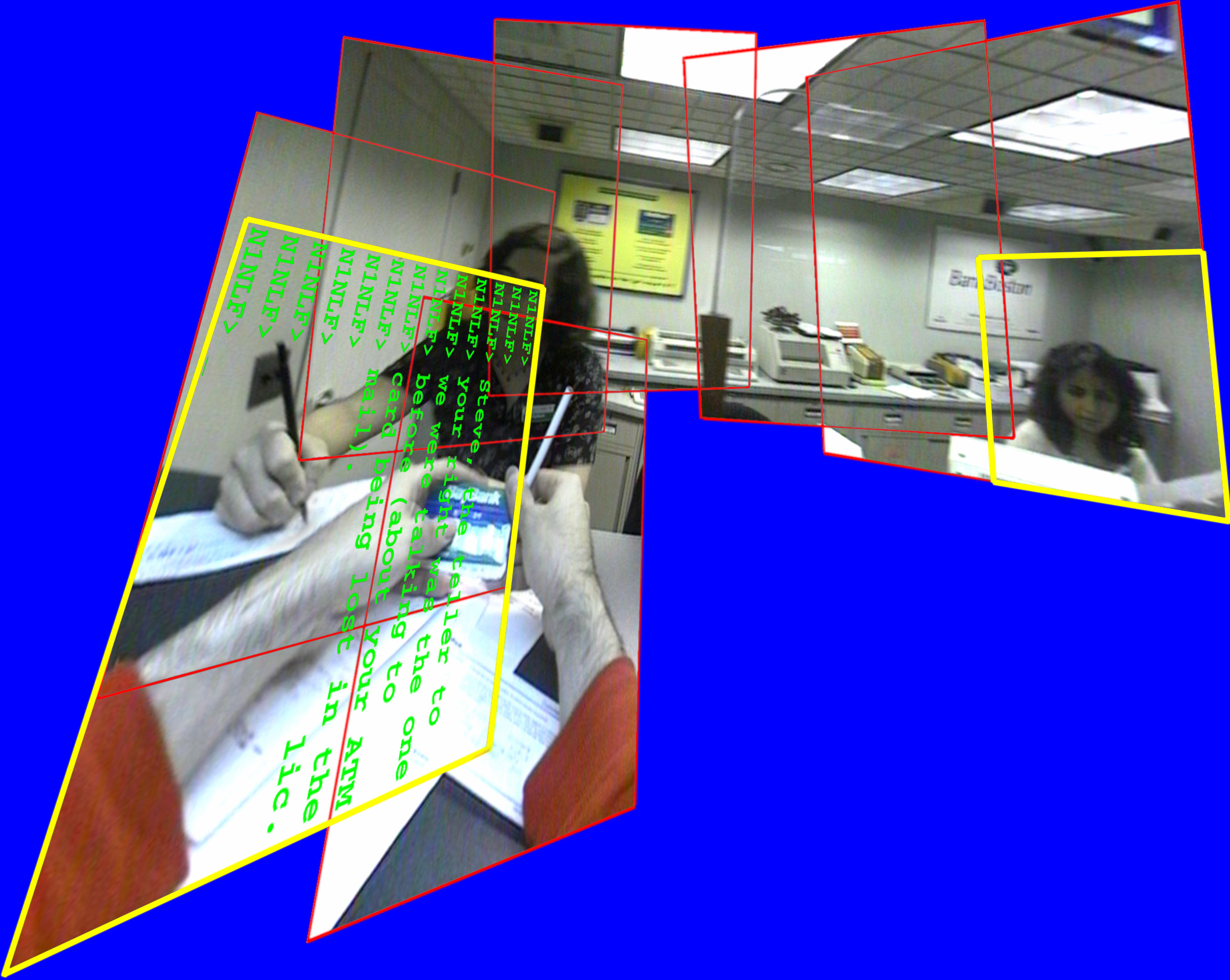
http://www.wearcam.org is (or at least, was) a good place to start looking for information on his projects. (Look here for an interesting screen shot of his view of the world, text interface and all.) There's also http://eyetap.org- a site actually described on wearcam as "a more organized and more desktop computer friendly site". Mann's older sites are not very "prettified" with nice tables and formatting; they're a fairly random pile of information, which probably woul;dn't look bad in a text-only browser, like what he'd have been using -
Yes, I have heard of Steve Mann
I've had an eye (pardon the pun) on his work for years. I always wondered if I'd be able to build a wearable and use it on a daily basis; now that I'm working in
http://www.wearcam.org is (or at least, was) a good place to start looking for information on his projects. (Look here for an interesting screen shot of his view of the world, text interface and all.) There's also http://eyetap.org- a site actually described on wearcam as "a more organized and more desktop computer friendly site". Mann's older sites are not very "prettified" with nice tables and formatting; they're a fairly random pile of information, which probably woul;dn't look bad in a text-only browser, like what he'd have been using -
VideoOrbits will do this
Hi.
Our lab is doing very similar work. We've interpolated frames of video from an 8fps image sequence (taken with a wearable computer) into a smooth 30fps video sequence, using VideoOrbits. Theres a short video example available somewhere on my homepage. Perhaps this would be of interest to you. VideoOrbits is freely available at http://wearcam.org/orbits.
Video Orbits runs at over 11 fps on
a 700 MHz dual processor machine. Its also a featureless tracking algorithm so no point correspondences need to be identified. -
Re:WMA 8 is the way
* Picture perfect at 128 kbit/s
That song looks beautiful, don't you think!?
http://wearcam.org/synesthesia/synesthesia.html