Slashdot Mirror
Domain: wikimedia.org
Stories and comments across the archive that link to wikimedia.org.
Comments · 6,832
-
Re:The heydays ended ten years ago
[smacks G3ckoG33k with a wrench, and drags him into another room]
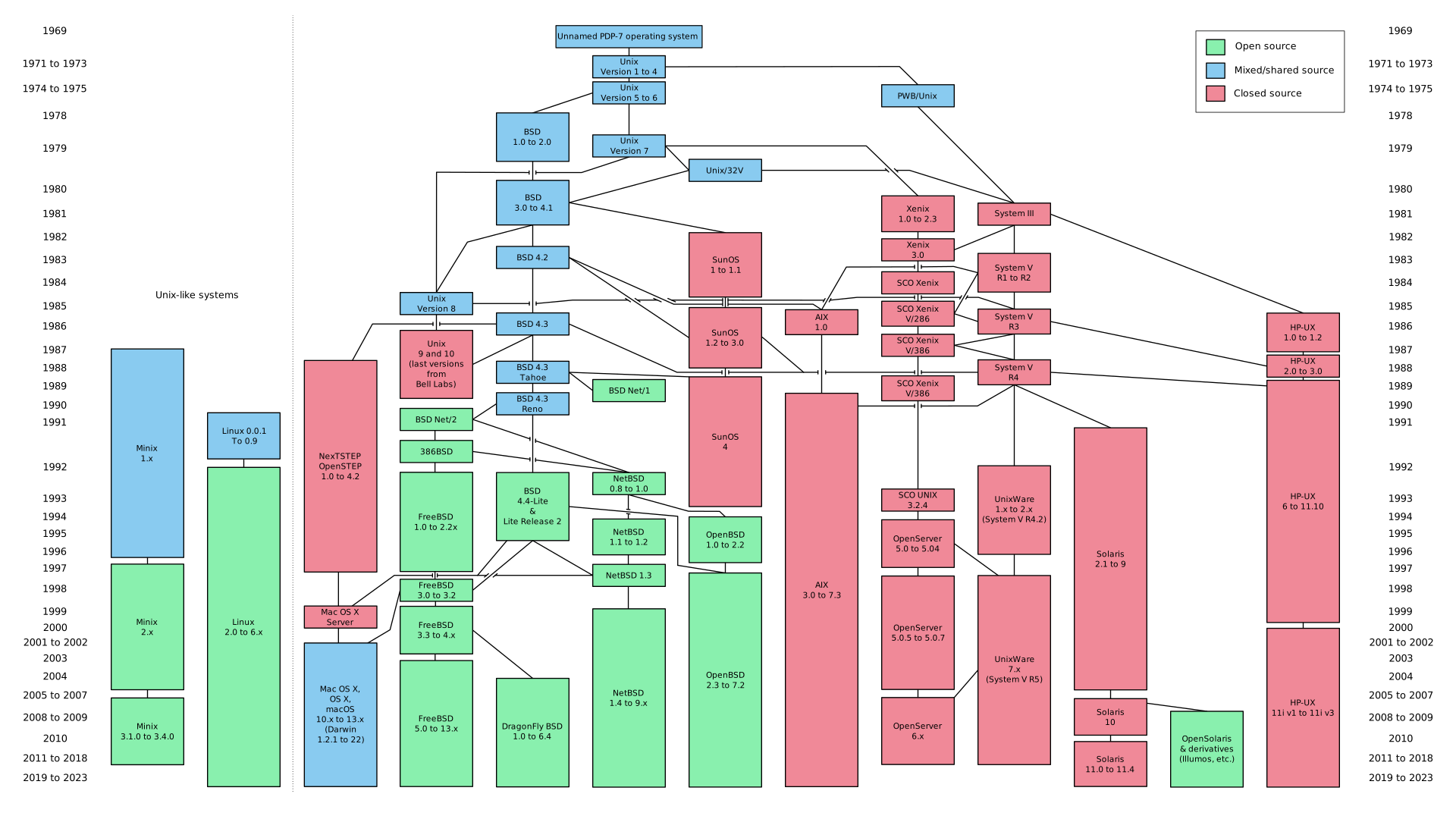
Look here, we have something to explain to you.. Unix spawned many variations.
http://upload.wikimedia.org/wikipedia/commons/7/77/Unix_history-simple.svg
All were similar in concept, but had their own ways of doing things. As this branched away from a common path, most groups agreed on a common set of rules, known as POSIX.
Once you've learned how one Unix-like environment works, you can use them all. You will find that a Linux server, an Android phone, a TiVo DVR, and even an Apple desktop, all operate in very similar ways, although each has its quirks.
The outstanding rogue operating system now is Windows. They too have recognized that they are missing out by remaining completely non-compliant, and have begun incorporating various aspects of POSIX as add-on (SFU or SUA) and 3rd party (Cygwin) packages.
The chart you displayed should have had the "Unix" name divided between major and minor groups. Major being operating systems such as Linux. Minor elements combined in as "Other Unix" and "Other OS". In that, "Windows" having such a minor share, should have only been labeled "Other OS".
In November 1993, Cray, Inc accounted for 40% all systems in the graph, and the largest share of the "Unix" segment. It would have been a mixture of UNICOS, COS, and Solaris. "Unix" as a specific OS only accounted for 15%. Even those were simply the OS name provided for the list, as an indication of a Unix-like operating system, not that it was actually "Unix".
Now get back out there, and don't make me hit you with a wrench again.
-
UNIX family tree
Image from wikimedia of the UNIX Family Tree
-
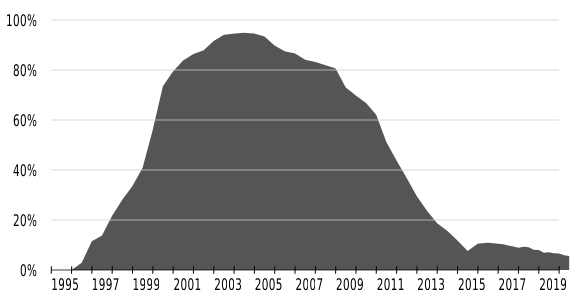
Re:stranglehold broken; don't do it again
Oh, sorry, here's the graph.
The sound that accompanies it as it starts plummeting in 2008 is "aaaaah".
-
Re:I feel better for knowing they are out there
In other news, a partial image was just received from Voyager 2 which has DHS worried. Contact with the probe has not been reestablished.
-
Re:Extremophile Bacteria for Terraforming
It's about time we launched terraforming bacteria at all the planets and moons in the solar system.
Didn't know bacteria could generate magnetic fields on a planetary scale...
Without a magnetosphere any terraformed atmosphere on Mars would be faster blown away by solar winds than it'd take to terraform it in the first place.
There is the hypothesis that mankind could somehow place insanely large objects (moved asteroids or whatever) in Mars' orbit and then let tidal heating ( https://secure.wikimedia.org/wikipedia/en/wiki/Tidal_heating ) melt the core of Mars, so the core can generate a magnetosphere and shield the planet against solar wind.
That said, in the highly unlikely case that model could even work, melting Mars' core would take forever and cause countless earthquakes.Terraforming is bullshit. Nice for science fiction movies but so impractical in real life. If actual Mars colonization ever happens, it'd be so much easier to just move underground. Let the surface shield everything against solar radiation.
-
Re:Edison reaching out from beyond the grave
The problem with DC back in Edison's day was that you couldn't easily step it up or down. DC doesn't have higher losses than AC at the same voltage. In fact, DC radiates less energy away than AC does, and is therefore more efficient.
Ohmic losses all come down to I^2 * R. R is the resistance of the cable, and I is current. To deliver a given amount of power, you have to have a certain V*I. To reduce Ohmic losses, then, you have to reduce the amount of current, which means going up in voltage.
Incidentally, that's also what's driving automobile manufacturers toward 48v instead of 12v, since it would cut the current from the battery by a factor of 4, thereby reducing the amount of loss in the wiring by a factor of 16. That means you can use smaller wires to deliver the same amount of power, safely.
-
Re:Contained
But diamonds are so rare!
It's not like there are thousands of tonnes of diamonds just sitting in vaults somewhere that could be used for this purpose...
I like your idea. I wonder how much of a business need there is in the world to have a random number generator card..
Actually.. if things go the way they are in encryption becoming more used and relevant in daily computing.. perhaps there could be something in this idea.. hmm..
-
Put a kilt on
Back in the 1970s tight underpants and tight jeans used to be the big threat to male fertility.
So I guess if a man wants to conceive, he should start wearing a kilt, a sarong, a thobe/dishdasha/caftan, or something else that gives more room down there. Yet too many men are too uncertain of their masculinity to wear anything but trousers.
-
Put a kilt on
Back in the 1970s tight underpants and tight jeans used to be the big threat to male fertility.
So I guess if a man wants to conceive, he should start wearing a kilt, a sarong, a thobe/dishdasha/caftan, or something else that gives more room down there. Yet too many men are too uncertain of their masculinity to wear anything but trousers.
-
Re:Peh.
Imagine just getting on a plane while carrying this superflu in say London?
-
Re:What's evolution got to do with treatment?
you might want to check this : https://secure.wikimedia.org/wikipedia/en/wiki/Circulatory_system#History_of_discovery and this guy among others : https://secure.wikimedia.org/wikipedia/en/wiki/Avicenna
a nut job is a nut job religion is irrelevant. -
Re:What's evolution got to do with treatment?
you might want to check this : https://secure.wikimedia.org/wikipedia/en/wiki/Circulatory_system#History_of_discovery and this guy among others : https://secure.wikimedia.org/wikipedia/en/wiki/Avicenna
a nut job is a nut job religion is irrelevant. -
Depends on what you want to photograph
There are lots of things one can photograph without needing anything special. It's certainly possible to take a striking photo even with a cell phone. It can look good, if the conditions are right.
Now, that's assuming you don't have special needs. If you want to take photos in challenging conditions, you probably want to get a DSLR. Challenging conditions include: low light (that includes indoors), things that are very far away (say, wildlife photography), things that are very small, long exposures, when you want a shallow depth of field, and situations that require something better than the on-camera flash.
You can try to do most of that with a point and shoot, but even if you choose your composition wonderfully it still won't look very good. DSLRs produce much better results, and also have the huge advantage of being able to choose the lens. I think for most basic things the actual DSLR isn't all that important, as you already gain a huge amount of flexibility from just being able to use a different lens.
-
Re:My interpretation...
As a JRPG fan who only owns Nintendo consoles (as mentioned in this thread, PS2 emulators are getting good enough that I will probably play some PS2 RPGs that I missed soon), my selection is extremely limited (I became a fan when Nintendo was actually good for JRPGs in the SNES days). That said Arc Rise Fantasia is pretty good and Xenoblade Chronicles is getting very good reviews. I find it hard to believe the JRPG selection on other consoles is actually worse than on the Wii.
-
Re:My interpretation...
As a JRPG fan who only owns Nintendo consoles (as mentioned in this thread, PS2 emulators are getting good enough that I will probably play some PS2 RPGs that I missed soon), my selection is extremely limited (I became a fan when Nintendo was actually good for JRPGs in the SNES days). That said Arc Rise Fantasia is pretty good and Xenoblade Chronicles is getting very good reviews. I find it hard to believe the JRPG selection on other consoles is actually worse than on the Wii.
-
Re:To be fair
News flash: Christianity is only 33% of the world belief, so just by that measure, most of the world doesn't believe in the contents, making it a work of fiction in their view.
Jews and Muslims consider the Bible part of their religion as well (at least the Old Testament part). Better get used to the fact that most of the people in the world are religious zealots.
Islam is the world's second largest religion after Christianity. According to a 2009 demographic study, Islam has 1.57 billion adherents, making up 23% of the world population.
, and lets not forget the Jews, who have their own Western tolerated genocidal religious zealotry.
References:
https://secure.wikimedia.org/wikipedia/en/wiki/List_of_countries_by_Muslim_population -
And I call bullshit on that graph...
First off, when you scroll down that same wikiMedia (not wikipedia) page you can find that other map/chart by the same author, which should make you question his/her "unbiased approach to the subject", or at least the precision of his/her data.
Also note that neither of those graphs are currently used - cause, you know... there are better and more precise ones.Then there is the fact that neither of those maps currently used is of any particular value on its own.
ESPECIALLY those related to the headcounts.
Cause, while it may seem from the map of distribution that "Christians RULE!!111eleven!", from "religiosity" and "irreligion" maps one kinda gets the feeling that there may be a rather large percentage of bollocks in those stats.Then, back to that graph, besides it being out of date - there is the fact that CIA's "The World Factbook" (which is the source of data for that graph) doesn't list its sources or methods or sample sizes.
Which makes it basically more akin to guesstimates than statistics.
They can't even be bothered to be up to date with readily available data on USA, let alone the rest of the world.
And where they pulled those numbers on protestants from is anyone's guess.So, I wouldn't really bet the farm on those 55.6% you got from that graph.
Particularly when taken into account the fact that it's mostly the people in "undeveloped countries" who give credence to the stories in ANY of the religious books.And that's all without going into the whole "it's a packaged deal" thing where you can't pick and choose the bits of God's words you'll believe in - making all of them unbelievers to some extent.
-
Re:Experimental Breeder Reactor 1
A true geek would use the opportunity to steal this and install it on his PC case.
-
Re:Allowed by the FCC?
Not true. The FCC has banned listening to the cellphone bands for a very long time now.
https://secure.wikimedia.org/wikipedia/en/wiki/Scanner_(radio)#Legal_issues_in_the_US
I'm interested in where you would buy the equipment to do this. Who is selling lots of small networked cell phone receivers that would pull the IMEI from the datastream? How cheap are they that a shopping mall can buy a box full? And are those same receivers also able to listen in to the conversations, or are they only monitoring the control channel? -
Re:This guy ever been beaten up before?
Other than India's change from a British colony to a sovereign nation, you mean? Are you serious?
https://secure.wikimedia.org/wikipedia/en/wiki/Satyagraha is a cheap tool/trick invented by Gandhi to insult(not defeat) opponents.
-
Re:Of course it is real
Problem is we've been able to accurately measure the minuscule changes in climate for about 50 of 14 billion years.
There wasn't much of a climate to measure before the Earth even existed...
https://secure.wikimedia.org/wikipedia/en/wiki/Formation_and_evolution_of_the_Solar_System#Formation_of_planets -
Re:Kinect - Gathering Dust In Junk Closets Everywh
Both are now sitting unused in those people's junk closets.
Right next to their R.O.Bs. Console gaming systems have been notorious over the years for all sorts of gimmicks and flash-in-the-pan accessories, many of dubious quality or utility, thrown in to boost initial sales and with little thought given to product lifetime of after sales support.
-
Re:Eliminate districts
In the 1938 Anschluss vote, Hitler apparently got the vote of 99.73% of the Austrian people.
-
Re:Every supercomputer should look nice . . .
A picture of the Cray 1, for reference: Computer furniture.
-
Re:What constitutes "survival"?
-
Re:And in the US
That had nothing to do with government greed. It was the right ruling. Should the government tax tomatoes as vegetables? Well, you might say that they are a fruit, and vegetables are things like cucumbers, squash, peppers, eggplant, string beans, pea pods, corn, okra, right? Problem is, everything I just mentioned is also botanically a fruit (fruits that, for some strange reason, people don't embarrass themselves by pointing out that that they're botanical fruits like they do with tomatoes). Cucumbers and squash are pepos (which are actually a type of berry), corn (and wheat and rice) is a type of fruit called a caryopsis, peanuts and string beans are legumes, and eggplant and peppers are berries. Fruit has both a culinary AND scientific meaning. Culinary, it is a sweet part of the plant that is almost always a botanical fruit, but that does not imply that a botanical fruit is also a culinary fruit. Scientifically, milkweed pods, cotton pods, and those little helicopters that fall from maple trees are fruits. Chocolate covered cucumber sound good to you? What about tomato ice cream, or pea pod pie? No? That's because they're not fruits in the everyday speech. You're going to stop calling peanuts and almonds nuts (peanut is a legume and almond is a drupe) or stop calling potatoes root vegetables (they're tubers, which are stems), and no one is calling rice, peppers, or string beans fruits, so why this fixation on the fact that tomatoes are botanical fruits?
Vegetable has no scientific meaning, so it is perfectly reasonable to consider something a botanical fruit and a culinary vegetable. Just by mentioning the term, we know that we're speaking in culinary or horticultural terms, not pure botanical terms. Something can be a root and a vegetable (like carrots) a stem and a vegetable (like potatoes), a leaf and a vegetable (lettuce), a flower and a vegetable (broccoli), and things can be a botanical fruit and a vegetable too. Culinary fruits don't need to be a botanical fruit either. The best example is the strawberry. The actual fruits are the the little seeds on the outside (called achenes), whereas the culinary part is just the large swollen receptacle, which is a modified stem. I think botanists consider the whole thing, both the achenes and the receptacle to be the fruit, so that is a pretty weak example, but that should at least make you think about what a fruit really is. Historically, rhubarb was considered a fruit at times. However, if I gave you a cashew apple (yes, every cashew nut has a fruit to go along with it) or if I gave you the 'fruit' of a native cherry or Japanese raisin tree, you might not be able to tell that they aren't actually fruits. The lleuque 'fruit' doesn't even come from an angiosperm (only angiosperms have fruit)! If any of those were commercially cultivated, what would we call them? Vegetables? Should we regulate something that in terms of cultivation and use is more similar to a cherry like a radish just because of some botanical nitpick? I don't think so.
So, if we were speaking strictly scientifically, we'd treat corn, chili peppers, and pea pods the same as apples, grapes, andbananas. But that'd be pretty darned stupid, right? That's why we don't do it. The government made the right call there. I imagine someone was just being a smartass to get out of some taxes.
-
Re:Any guesses on when IE will natively support We
Any guesses on when IE will no longer define web standards?
https://upload.wikimedia.org/wikipedia/commons/c/ce/Internet-explorer-usage-data.svg
I'm guessing "now".
-
Re:As the French would say...
The only feasible way we have of converting electricity to stored energy and back again for more than an hour with anything like 90% efficiency is pumped hydro
No, it's not the only way, there are several ways.
https://secure.wikimedia.org/wikipedia/en/wiki/Energy_storage#Storage_methodsIncluding pumping air into dis-used mines, molten salts/oil, Fly-wheel (V'large ones).. I'm sure there are plenty more.
-
Re:Open source internet?
Aren't your arguments addressed in the OP?
Here is what Wikipedia's infrastructure looks like:
http://upload.wikimedia.org/wikipedia/commons/d/d8/Wikimedia-servers-2010-12-28.svgThey're not a big money-hungry corporation nor are they a government. They're people who want a free encyclopedia.
If people wanted a free internet, they could probably come up with the funds and organization to make one.
-
meaning of zero-day
0-day used to mean that the exploit was release the day of release. Verses 1-day or later cracks.
Different from my understanding. You're thinking of 0-day warez. Here, WP explains it pretty well:
A zero-day (or zero-hour or day zero) attack or threat is a computer threat that tries to exploit computer application vulnerabilities that are unknown to others or the software developer. Zero-day exploits (actual software that uses a security hole to carry out an attack) are used or shared by attackers before the developer of the target software knows about the vulnerability.
The term derives from the age of the exploit. A "zero day" attack occurs on or before the first or "zeroth" day of developer awareness, meaning the developer has not had any opportunity to distribute a security fix to users of the software.
In short, knowledge of the vulnerability exists with attackers before developers. Developers developers developers developers.
Could someone edit that, actually? s/distribute a security fix/address the vulnerability/ If the developer is unaware, they're neither analyzing, patching, notifying users, nor advising workarounds, let alone distributing security fixes.
-
Re:EU still has some sense left, compared to US
The UK for all it's faults at very least hasn't got anything as bad as France's HADOPI yet, hasn't had anywhere near as bad web blocking orders as in Ireland or the Netherlands, and doesn't at least have as close to the amount of censorship as Germany. Oh, and Sweden is basically a wholly owned subsidiary of the RIAA now.
I'm so glad that the Digital Economy Act and s97A CDPA 1988 were figments of my imagination. I'm glad that the London police aren't extra-judicially working with the IFPI to block payments to sites they don't like, and aren't pushing Nominet into letting them seize domain names based on a mere accusation. On top of that, I'm glad the UK doesn't criminalise people for making harmless jokes on Twitter or for insulting people. While headscarves aren't illegal, the Police can remove and seize anything they think might be being used as a disguise. On the topic of censorship, the UK recently made it potentially illegal to draw stick-figure porn of overage people.
I suppose you can complain about our big brother state but really the reason we have a reputation in that respect is precisely because our population actually stands up and shouts about how unhappy we are with it, which is surely better than most other European states where it's at least as bad but just blindly accepted without much dissent.
The UK has the occasional protest, where people wander through the streets, accompanied by the police, a few of whom get arrested (for the wonderfully-vague "breach of the peace") and everyone goes home happy that nothing will change. Unlike peaceful places like Greece or France.
It's thanks to the fact we do have organisations like Liberty that these things are exposed for what they are attempts at but most the worst stuff our last government proposed that generated all said stories is dead now, the ID card database is gone, many CCTV programmes have been cut/scaled back, libel laws are being reformed.
ID cards went because they were expensive and ineffective (and no one wanted them)... although the database seems to still be around, although mainly used for foreigners. The DNA database is still up and running, despite being declared illegal, most of the "anti-terrorism" legislation New Labour introduced is still on the books aside from the bits the courts struck down (although they're mostly still on the books, just not being applied), including the various 'unreasonable stop-and-search' powers, and while libel-reform is in the works, and has some vague government backing, only last week the responsible minister pointed out to a meeting of the libelreform campaign that there's no guarantee it will happen any time soon. CCTV was never that big an issue (it was vastly exaggerated in the media), so I'll give you that one. Oh, and the UK also imprisons people for not disclosing passwords.
The UK's blasphemy law
-
Re:EU still has some sense left, compared to US
The UK for all it's faults at very least hasn't got anything as bad as France's HADOPI yet, hasn't had anywhere near as bad web blocking orders as in Ireland or the Netherlands, and doesn't at least have as close to the amount of censorship as Germany. Oh, and Sweden is basically a wholly owned subsidiary of the RIAA now.
I'm so glad that the Digital Economy Act and s97A CDPA 1988 were figments of my imagination. I'm glad that the London police aren't extra-judicially working with the IFPI to block payments to sites they don't like, and aren't pushing Nominet into letting them seize domain names based on a mere accusation. On top of that, I'm glad the UK doesn't criminalise people for making harmless jokes on Twitter or for insulting people. While headscarves aren't illegal, the Police can remove and seize anything they think might be being used as a disguise. On the topic of censorship, the UK recently made it potentially illegal to draw stick-figure porn of overage people.
I suppose you can complain about our big brother state but really the reason we have a reputation in that respect is precisely because our population actually stands up and shouts about how unhappy we are with it, which is surely better than most other European states where it's at least as bad but just blindly accepted without much dissent.
The UK has the occasional protest, where people wander through the streets, accompanied by the police, a few of whom get arrested (for the wonderfully-vague "breach of the peace") and everyone goes home happy that nothing will change. Unlike peaceful places like Greece or France.
It's thanks to the fact we do have organisations like Liberty that these things are exposed for what they are attempts at but most the worst stuff our last government proposed that generated all said stories is dead now, the ID card database is gone, many CCTV programmes have been cut/scaled back, libel laws are being reformed.
ID cards went because they were expensive and ineffective (and no one wanted them)... although the database seems to still be around, although mainly used for foreigners. The DNA database is still up and running, despite being declared illegal, most of the "anti-terrorism" legislation New Labour introduced is still on the books aside from the bits the courts struck down (although they're mostly still on the books, just not being applied), including the various 'unreasonable stop-and-search' powers, and while libel-reform is in the works, and has some vague government backing, only last week the responsible minister pointed out to a meeting of the libelreform campaign that there's no guarantee it will happen any time soon. CCTV was never that big an issue (it was vastly exaggerated in the media), so I'll give you that one. Oh, and the UK also imprisons people for not disclosing passwords.
The UK's blasphemy law
-
Re:EU still has some sense left, compared to US
The UK for all it's faults at very least hasn't got anything as bad as France's HADOPI yet, hasn't had anywhere near as bad web blocking orders as in Ireland or the Netherlands, and doesn't at least have as close to the amount of censorship as Germany. Oh, and Sweden is basically a wholly owned subsidiary of the RIAA now.
I'm so glad that the Digital Economy Act and s97A CDPA 1988 were figments of my imagination. I'm glad that the London police aren't extra-judicially working with the IFPI to block payments to sites they don't like, and aren't pushing Nominet into letting them seize domain names based on a mere accusation. On top of that, I'm glad the UK doesn't criminalise people for making harmless jokes on Twitter or for insulting people. While headscarves aren't illegal, the Police can remove and seize anything they think might be being used as a disguise. On the topic of censorship, the UK recently made it potentially illegal to draw stick-figure porn of overage people.
I suppose you can complain about our big brother state but really the reason we have a reputation in that respect is precisely because our population actually stands up and shouts about how unhappy we are with it, which is surely better than most other European states where it's at least as bad but just blindly accepted without much dissent.
The UK has the occasional protest, where people wander through the streets, accompanied by the police, a few of whom get arrested (for the wonderfully-vague "breach of the peace") and everyone goes home happy that nothing will change. Unlike peaceful places like Greece or France.
It's thanks to the fact we do have organisations like Liberty that these things are exposed for what they are attempts at but most the worst stuff our last government proposed that generated all said stories is dead now, the ID card database is gone, many CCTV programmes have been cut/scaled back, libel laws are being reformed.
ID cards went because they were expensive and ineffective (and no one wanted them)... although the database seems to still be around, although mainly used for foreigners. The DNA database is still up and running, despite being declared illegal, most of the "anti-terrorism" legislation New Labour introduced is still on the books aside from the bits the courts struck down (although they're mostly still on the books, just not being applied), including the various 'unreasonable stop-and-search' powers, and while libel-reform is in the works, and has some vague government backing, only last week the responsible minister pointed out to a meeting of the libelreform campaign that there's no guarantee it will happen any time soon. CCTV was never that big an issue (it was vastly exaggerated in the media), so I'll give you that one. Oh, and the UK also imprisons people for not disclosing passwords.
The UK's blasphemy law
-
Re:PETA ...
How is euthanasia not ethical ?
What would you do with abandoned pets? Leave them to starve in the street? Run them over with your car?
-
Re:More Specifically Aimed at Chinese Fur Farms
How is euthanasia not ethical?
-
That just means it's wrong
Relax - that just means that either they implemented a discrete time dynamical system (i.e., the chip's simulation has a discrete clock, which the brain doesn't), or the time constants on their system (ion channel flows, etc) are wrong, or both.
Lots of people have accurately simulated single neurons with hardware components before (see https://secure.wikimedia.org/wikipedia/en/wiki/Hodgkin%E2%80%93Huxley_model for an actual analogue circuit from the 50s) but figuring out the a priori wiring & weights connecting the neurons is far more difficult & they've done nothing to address this. Just consider the fact that our individual neurons aren't that different from other mammals' neurons, but we're much smarter than other mammals. You can't just wire together a million of these chips and have it do anything interesting. "It's the network, stupid."
-
Re:What about that pen that records everything
They're called Digital Pens. Best of both worlds.
-
Re:It should be obvious
Except the editor is wrong, since distributed search engines do exist.
-
Re:Linux support?
You should be able to fit several hundred of these into an E-350.
-
Re:Dibs!
Do you think this volcano might shake that bit of rock loose and sink the USA?
https://secure.wikimedia.org/wikipedia/en/wiki/Megatsunami#Canary_Islands
-
Re:some proteins are better than others
Life expectancy in India is currently 64.7 years. They're 139th on the list.
Ref: https://secure.wikimedia.org/wikipedia/en/wiki/List_of_countries_by_life_expectancy
-
Re:Not impressive
You just say "I started transmitting at x and you received it at y. x-y/speed of sound at sea level = your result.
And then "your result" has at minimum a wavelength or two of precision, which sucks mightily at audio frequencies. This is why they use a nonperiodic (in this case chirped) waveform and correlation instead of "I started transmitting". You could have read this, at least, before making an ass of yourself.
Not that it's so novel as they try to make it sound, either -- SONAR and RADAR guys did all that long ago, and you'd get the basics needed to implement it in your first semester of DSP in any EE program. In fact, if they're even doing "semiautomatic frequency calibration", they're obviously using linear chirps -- exponential chirps are relatively immune to Doppler or other frequency shifts, and since there's no analog design, are no harder to implement -- suggesting they haven't had (or slept through) any formal education in the field.
It just bugs me when people who know even less run down every decent, if not outstanding, project like this with their own mix of even lamer approaches ("just as good!") and pie-in-the-sky fantasy ("then I'll get excited")
-
Tell Australian Politicians.. PLEASE
Currently Australia is trying to implement the National Broadband Network and great debate is currently being had about exactly why we need a fibre network, how many people will actually use it, how it will be implemented and who will pay.
It looks like we could learn a lot from the Brits
-
Re:No people of color my ass
And check the companies ruined or almost ruined by https://secure.wikimedia.org/wikipedia/en/wiki/Forward_caste (FC) Indians.
Adaptec - Indian CEO Subramanian Sundaresh fired. (FC)
AIG (signed outsourcing deal in 2007 in Europe with Accenture Indian frauds, collapsed in 2009) (FC)
AirBus (Qantas plane plunged 650 feet injuring passengers when its computer system written by India disengaged the auto-pilot). (FC)
Apple - R CLOSED in India in 2006. (FC)
Australia's National Australia Bank (Outsourced jobs to India in 2007, nationwide ATM and account failure in late 2010). (FC)
Bell Labs (Arun Netravalli took over, closed, turned into a shopping mall) (FC)
Boeing Dreamliner ES software (written by HCL, banned by FAA) (FC)
Bristol-Myers-Squibb (Trade Secrets and documents stolen in U.S. by Indian national guest worker) (FC)
Caymas - Startup run by Indian CEO, French director of dev, Chinese tech lead. Closed after 5 years of sucking VC out of America. (FC)
Caterpillar misses earnings a mere 4 months after outsourcing to India, Inc. (FC)
Circuit City - Outsourced all IT to Indian-run IBM and went bankrupt shortly thereafter.(FC)
ComAir crew system run by 100% Indian IT workers caused the 12/25/05 U.S. airport shutdown when they used a short int instead of a long int (FC)
Deloitte - 2010 - this Indian-packed consulting company is being sued under RICO fraud charges by Marin Country, California for a failed solution. (FC)
Dell - call center (closed in India) (FC)
Delta call centers (closed in Indiatry) (FC)
Fannie Mae - Hired large numbers of Indians, had to be bailed out. Indian logic bomb creator found guilty. (FC)
GM - Was booming in 2006, signed $300 million outsourcing deal with Wipro that same year, went bankrupt 3 years later (FC)
HSBC ATMs (software taken over by Indians, failed in 2006) (FC)
Intel Whitefield processor project (cancelled, Indian staff canned) (FC)
Lehman (Spectramind software bought by Wipro, ruined, trashed by Indian programmers) (FC)
Medicare - Defrauded by Indian national doctor Arun Sharma & wife in the U.S. (FC)
Microsoft - Employs over 35,000 H-1Bs. Stock used to be $100. Today it's lucky to be over $25. Not to mention that Vista thing. (FC)
MIT Media Lab Asia (canceled) (FC)
PeopleSoft (Taken over by Indians in 2000, collapsed). (FC)
PepsiCo - Slides from #1 to #3 during Indian CEO Indra Nooyi' watch. (FC)
Polycom - Former senior executive Sunil Bhalla charged with insider trading. (FC)
Qantas - See AirBus above (FC)
Quark (Alukah Kamar CEO, fired, lost 60% of its customers to Adobe because Indian-written QuarkExpress 6 was a failure) (FC)
Rolls Royce (Sent aircraft engine work to India in 2006, engines delayed for Boeing 787, and failed on at least 2 Quantas planes in 2010, cost Rolls $500m). (FC)
SAP - Same as Deloitte above in 2010. (FC)
Skype (Madhu Yarlagadda fired) (FC)
State of Indiana $867 million FAILED IBM project, IBM being sued (FC)
State of Texas failed IBM project. (FC)
Sun Micro (Taken over by Indian and Chinese workers in 2001, collapsed, had to be sold off to Oracle). (FC)
UK's NHS outsourced numerous jobs including health records to India in mid-2000 resulting in $26 billion over budget. (FC)
Union Bank of California - Cancelled Finacle project run by India's InfoSys in 2011.(FC)
United - call center (closed in Indiay) (FC)
Victorian Order of Nurses, Canada (Payroll system screwed up by SAP/IBM in mid-2011) (FC)
Virgin Atlantic (software written in India caused cloud IT failure) (FC)
World Bank (Indian fraudsters BANNED for 3 years because they stole data). (FC) -
Re:Privilege of Prosecution.
Uh, "4k" frequently is used to mean 3840xnnnn (not just 4000 or 4096 wide), and that's been available in 22" monitors for a decade -- I have one on my desk now. They cost about $750-$1000 on ebay these days.
And while the original 4xDVI hookup for full 41/48Hz video is a bit arcane, they can handle 24Hz off a single dual-link dvi connection with the appropriate (now available, didn't use to be) converter.
-
Re:Amerika!
Yet millions still flock here every year in the hopes of a better life. Hrmm... I haven't heard of hordes of people looking to improve their lot going to the backwards Eastern European country from which you're probably posting.
I think you overestimate it by a tad. There's no flocking, just over a million immigrants a year. If you look at immigrants per year per head of population, the US comes in 31st. Just above most Western European countries, but way below Australia or Canada. Europe as a whole has a lot more immigrants per year than America does, and that includes Eastern Europe.
America hasn't been the promised land for a long time, and not that many people pick it out as the ideal place to live. It's just because American media doesn't cover any international news or events that Americans themselves don't realize this.
-
Re:Not too surprised...
ED = Encyclopædia Dramatica. but never go there, you will be offended by some of the content.
Even mentioning it in certain places will get you ostracised.
Because Slashdot and extended characters don't always work, the æ is this symbol. -
Re:Not too surprised...
ED = Encyclopædia Dramatica. but never go there, you will be offended by some of the content.
Even mentioning it in certain places will get you ostracised.
Because Slashdot and extended characters don't always work, the æ is this symbol. -
SpaceOrb
Does this help ? https://secure.wikimedia.org/wikipedia/en/wiki/SpaceOrb_360 Descent and Quake II do are "large data sets", aren't they ?
-
Re:tons of choices out there
Be wary when re-purposing keyboards like this - they tend not to work well in certain scenarios, such as very-rapid keypresses or multiple keys pressed at once. Any 3 keys together will likely work, but it gets iffy beyond that, depending on the keyboard and key combination.