Slashdot Mirror
Domain: wikipedia.org
Stories and comments across the archive that link to wikipedia.org.
Stories · 7,048
-
Interviews: Ask Lithium-Ion Battery Inventor John Goodenough a Question
John B. Goodenough is a solid-state physicist and professor of mechanical engineering and materials science at The University of Texas at Austin. While he is most famous for identifying and developing the lithium-ion battery, which can be found in just about every portable electronic device on the market, he has recently created a new fast charging solid-state battery that looks to revolutionize the industry. We sent him an email about doing an interview and he has responded. Now is your chance to ask Goodenough a question!
We'll pick the very best questions and forward them to John Goodenough himself. (Feel free to leave your suggestions for who Slashdot should interview next.) Go on, don't be shy! -
SpaceX Disappointed In Lack of NASA Mars Funding; Starts Looking For Landing Sites For Its Own Mars Missions
frank249 writes: Elon Musk says that the new NASA authorization legislation "changes almost nothing about what NASA is doing. Existing programs stay in place and there is no added funding for Mars." From a report via Ars Technica: "Musk is absolutely correct on two counts. First, an 'authorization' bill does not provide funding. That comes from appropriations committees. Secondly, while Congress has been interested in building rockets and spacecraft, it is far less interested in investing in the kinds of technology and research that would actually enable a full-fledged Mars exploration program." In other news, SpaceNews reports that "SpaceX has been working with NASA to identify potential landing sites on Mars for both its Red Dragon spacecraft (starting in 2020) and future human missions." From the report: "Paul Wooster of SpaceX said the company, working with scientists at NASA's Jet Propulsion Laboratory and elsewhere, had identified several potential landing sites, including one that looks particularly promising -- Arcadia Planitia. Those landing sites are of particular interest, he said, for SpaceX's long-term vision of establishing a human settlement on Mars, but he said the company wouldn't rule out sending Red Dragon spacecraft elsewhere on the planet to serve other customers. 'We're quite open to making use of this platform to take various payloads to other locations as well,' he said. 'We're really looking to turn this into a steady cadence, where we're sending Dragons to Mars on basically every opportunity.' The Red Dragon spacecraft, he said, could carry about one ton of useful payload to Mars, with options for those payloads to remain in the capsule after landing or be deployed on the surface. 'SpaceX is a transportation company,' he said. 'We transport cargo to the space station, we deliver payloads to orbit, so we're very happy to deliver payloads to Mars.'" Fans of the book/movie "The Martian" would be happy if SpaceX does select Arcadia Planitia for their first landing site as that was the landing site of the Ares 3. -
SpaceX Disappointed In Lack of NASA Mars Funding; Starts Looking For Landing Sites For Its Own Mars Missions
frank249 writes: Elon Musk says that the new NASA authorization legislation "changes almost nothing about what NASA is doing. Existing programs stay in place and there is no added funding for Mars." From a report via Ars Technica: "Musk is absolutely correct on two counts. First, an 'authorization' bill does not provide funding. That comes from appropriations committees. Secondly, while Congress has been interested in building rockets and spacecraft, it is far less interested in investing in the kinds of technology and research that would actually enable a full-fledged Mars exploration program." In other news, SpaceNews reports that "SpaceX has been working with NASA to identify potential landing sites on Mars for both its Red Dragon spacecraft (starting in 2020) and future human missions." From the report: "Paul Wooster of SpaceX said the company, working with scientists at NASA's Jet Propulsion Laboratory and elsewhere, had identified several potential landing sites, including one that looks particularly promising -- Arcadia Planitia. Those landing sites are of particular interest, he said, for SpaceX's long-term vision of establishing a human settlement on Mars, but he said the company wouldn't rule out sending Red Dragon spacecraft elsewhere on the planet to serve other customers. 'We're quite open to making use of this platform to take various payloads to other locations as well,' he said. 'We're really looking to turn this into a steady cadence, where we're sending Dragons to Mars on basically every opportunity.' The Red Dragon spacecraft, he said, could carry about one ton of useful payload to Mars, with options for those payloads to remain in the capsule after landing or be deployed on the surface. 'SpaceX is a transportation company,' he said. 'We transport cargo to the space station, we deliver payloads to orbit, so we're very happy to deliver payloads to Mars.'" Fans of the book/movie "The Martian" would be happy if SpaceX does select Arcadia Planitia for their first landing site as that was the landing site of the Ares 3. -
Japanese Company Develops a Solar Cell With Record-Breaking 26%+ Efficiency (arstechnica.com)
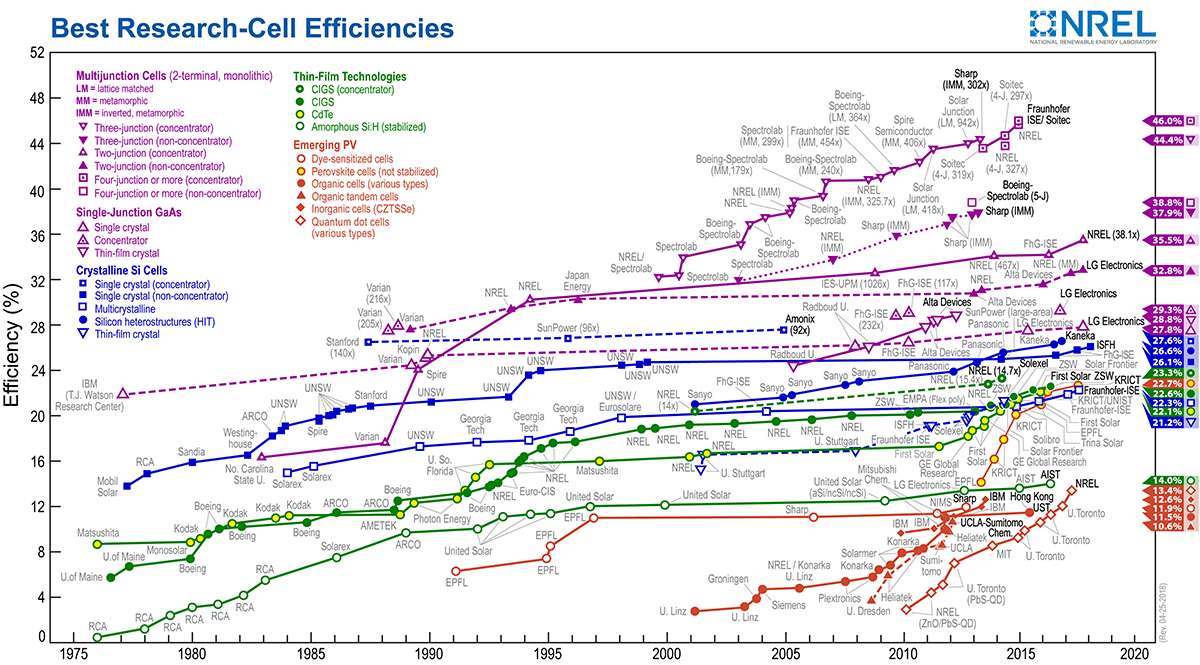
An anonymous reader quotes a report from Ars Technica: The silicon-based cells that make up a solar panel have a theoretical efficiency limit of 29 percent, but so far that number has proven elusive. Practical efficiency rates in the low-20-percent range have been considered very good for commercial solar panels. But researchers with Japanese chemical manufacturer Kaneka Corporation have built a solar cell with a photo conversion rate of 26.3 percent, breaking the previous record of 25.6 percent. Although it's just a 2.7 percent increase in efficiency, improvements in commercially viable solar cell technology are increasingly hard-won. Not only that, but the researchers noted in their paper that after they submitted their article to Nature Energy, they were able to further optimize their solar cell to achieve 26.6 percent efficiency. That result has been recognized by the National Renewable Energy Lab (NREL). In the Nature Energy paper, the researchers described building a 180.4 cm2 cell using high-quality thin-film heterojunction (HJ) -- that is, layering silicon within the cell to minimize band gaps where electron states can't exist. Controlling heterojunctions is a known technique among solar cell builders -- Panasonic uses it and will likely incorporate it into cells built for Tesla at the Solar City plant in Buffalo, and Kaneka has its own proprietary heterojunction techniques. For this record-breaking solar cell, the Kaneka researchers also placed low-resistance electrodes toward the rear of the cell, which maximized the number of photons that collected inside the cell from the front. And, as is common on many solar cells, they coated the front of the cell with a layer of amorphous silicon and an anti-reflective layer to protect the cell's components and collect photons more efficiently. -
W3C Erects DRM As Web Standard (theregister.co.uk)
The World Wide Web Consortium (W3C) has formally put forward highly controversial digital rights management as a new web standard. "Dubbed Encrypted Media Extensions (EME), this anti-piracy mechanism was crafted by engineers from Google, Microsoft, and Netflix, and has been in development for some time," reports The Register. "The DRM is supposed to thwart copyright infringement by stopping people from ripping video and other content from encrypted high-quality streams." From the report: The latest draft was published last week and formally put forward as a proposed standard soon after. Under W3C rules, a decision over whether to officially adopt EME will depend on a poll of its members. That survey was sent out yesterday and member organizations, who pay an annual fee that varies from $2,250 for the smallest non-profits to $77,000 for larger corporations, will have until April 19 to register their opinions. If EME gets the consortium's rubber stamp of approval, it will lock down the standard for web browsers and video streamers to implement and roll out. The proposed standard is expected to succeed, especially after web founder and W3C director Sir Tim Berners-Lee personally endorsed the measure, arguing that the standard simply reflects modern realities and would allow for greater interoperability and improve online privacy. But EME still faces considerable opposition. One of its most persistent vocal opponents, Cory Doctorow of the Electronic Frontier Foundation, argues that EME "would give corporations the new right to sue people who engaged in legal activity." He is referring to the most recent controversy where the W3C has tried to strike a balance between legitimate security researchers investigating vulnerabilities in digital rights management software, and hackers trying to circumvent content protection. The W3C notes that the EME specification includes sections on security and privacy, but concedes "the lack of consensus to protect security researchers remains an issue." Its proposed solution remains "establishing best practices for responsible vulnerability disclosure." It also notes that issues of accessibility were ruled to be outside the scope of the EME, although there is an entire webpage dedicated to those issues and finding solutions to them. -
Scientists Sent a Rocket To Mars For Less Than It Cost To Make 'The Martian' (backchannel.com)
Ipsita Agarwal via Backchannel retells the story of how India's underfunded space organization, ISRO, managed to send a rocket to Mars for less than it cost to make the movie "The Martian," starring Matt Damon as Mark Watney. "While NASA's Mars probe, Maven, cost $651 million, the budget for this mission was $74 million," Agarwal writes. In what appears to be India's version of "Hidden Figures" (a movie that also cost more to make than ISRO's budget for the Mars rocket), the team of scientists behind the rocket launch consisted of Indian women, who not only managed to pull off the mission successfully but did so in only 18 months. Backchannel reports: A few months and several million kilometers later, the orbiter prepared to enter Mars' gravity. This was a critical moment. If the orbiter entered Mars' gravity at the wrong angle, off by so much as one degree, it would either crash onto the surface of Mars or fly right past it, lost in the emptiness of space. Back on Earth, its team of scientists and engineers waited for a signal from the orbiter. Mission designer Ritu Karidhal had worked 48 hours straight, fueled by anticipation. As a child, Minal Rohit had watched space missions on TV. Now, Minal waited for news on the orbiter she and her colleague, Moumita Dutta, had helped engineer. When the signal finally arrived, the mission control room broke into cheers. If you work in such a room, deputy operations director, Nandini Harinath, says, "you no longer need to watch a thriller movie to feel the thrill in life. You feel it in your day-to-day work." This was not the only success of the mission. An image of the scientists celebrating in the mission control room went viral. Girls in India and beyond gained new heroes: the kind that wear sarees and tie flowers in their hair, and send rockets into space. User shas3 notes in a comment on Hacker News' post: "If you are interested in Indian women scientists and engineers, there is a nice compilation (a bit tiresome to read, but worth it, IMO) of biographical essays called 'Lilvati's Daughters.'" -
US Federal Budget Proposal Cuts Science Funding (washingtonpost.com)
hey! writes: The U.S. Office of Management and Budget has released a budget "blueprint" which outlines substantial cuts in both basic research and applied technology funding. The proposal includes a whopping 18% reduction in National Institutes of Health medical research. NIH does get a new $500 million fund to track emerging infectious agents like Zika in the U.S., but loses its funding to monitor those agents overseas. The Department of Energy's research programs also get an 18% cut in research, potentially affecting basic physics research, high energy physics, fusion research, and supercomputing. Advanced Research Projects Agency (ARPA-E) gets the ax, as does the Advanced Technology Vehicle Manufacturing Program, which enabled Tesla to manufacture its Model S sedan. EPA loses all climate research funding, and about half the research funding targeted at human health impacts of pollution. The Energy Star program is eliminated; Superfund funding is drastically reduced. The Chesapeake Bay and Great Lakes cleanup programs are also eliminated, as is all screening of pesticides for endocrine disruption. In the Department of Commerce, Sea Grant is eliminated, along with all coastal zone research funding. Existing weather satellites GOES and JPSS continue funding, but JPSS-3 and -4 appear to be getting the ax. Support for transfer of federally funded research and technology to small and mid-sized manufacturers is eliminated. NASA gets a slight trim, and a new focus on deep space exploration paid for by an elimination of Earth Science programs. You can read more about this "blueprint" in Nature, Science, and the Washington Post, which broke the story. The Environmental Protection Agency, the State Department and Agriculture Department took the hardest hits, while the Defense Department, Department of Homeland Security, and Department of Veterans Affairs have seen their budgets grow. -
US Federal Budget Proposal Cuts Science Funding (washingtonpost.com)
hey! writes: The U.S. Office of Management and Budget has released a budget "blueprint" which outlines substantial cuts in both basic research and applied technology funding. The proposal includes a whopping 18% reduction in National Institutes of Health medical research. NIH does get a new $500 million fund to track emerging infectious agents like Zika in the U.S., but loses its funding to monitor those agents overseas. The Department of Energy's research programs also get an 18% cut in research, potentially affecting basic physics research, high energy physics, fusion research, and supercomputing. Advanced Research Projects Agency (ARPA-E) gets the ax, as does the Advanced Technology Vehicle Manufacturing Program, which enabled Tesla to manufacture its Model S sedan. EPA loses all climate research funding, and about half the research funding targeted at human health impacts of pollution. The Energy Star program is eliminated; Superfund funding is drastically reduced. The Chesapeake Bay and Great Lakes cleanup programs are also eliminated, as is all screening of pesticides for endocrine disruption. In the Department of Commerce, Sea Grant is eliminated, along with all coastal zone research funding. Existing weather satellites GOES and JPSS continue funding, but JPSS-3 and -4 appear to be getting the ax. Support for transfer of federally funded research and technology to small and mid-sized manufacturers is eliminated. NASA gets a slight trim, and a new focus on deep space exploration paid for by an elimination of Earth Science programs. You can read more about this "blueprint" in Nature, Science, and the Washington Post, which broke the story. The Environmental Protection Agency, the State Department and Agriculture Department took the hardest hits, while the Defense Department, Department of Homeland Security, and Department of Veterans Affairs have seen their budgets grow. -
Math Teacher Solves Adobe Semaphore Puzzle (mercurynews.com)
linuxwrangler writes: For over 4 years, lights atop Adobe's office building in San Jose have flashed out a secret message. This week, the puzzle was solved by Tennessee math teacher Jimmy Waters. As part of the winnings, Adobe is donating software and 3D printers to Waters' school in his name. "The semaphore had been transmitting the audio broadcast of Neil Armstrong's historic moon landing in 1969," reports The Mercury News. "That's right, not the text but the actual audio." The report provides some backstory: "Waters discovered the project, San Jose Semaphore, last summer while he was looking up something about Thomas Pynchon's 1966 novel, 'The Crying of Lot 49.' The text of that work was the code originally programmed by New York-based artist Ben Rubin in 2006. Seeing there was a new message, Waters began trying to decipher it while watching and writing down the sequences online from Tennessee. He discovered a pattern that led him to believe it could represent a space -- or a silence -- in an audio file, and when he graphed the results it looked like an audio wave. He dismissed that as being too difficult but came back to it and eventually ran his results into a program that would convert his numbers to audio. The first results came back sounding like chipmunks squeaking. So he tweaked things and found himself listening to the historic broadcast, which ends with Armstrong's famous line, 'That's one small step for man, one giant leap for mankind.'" You can listen to the semaphore message here. -
Hacking Victim Can't Sue Foreign Government For Hacking Him On US Soil, Says Court (vice.com)
According to Motherboard, a court of appeals in Washington D.C. ruled that an American citizen can't sue the Ethiopian government for hacking into his computer and monitoring him with spyware. "The decision on Tuesday is a blow to anti-surveillance and digital rights activists who were hoping to establish an important precedent in a widely documented case of illegitimate government-sponsored hacking." From the report: In late 2012, the Ethiopian government allegedly hacked the victim, an Ethiopian-born man who goes by the pseudonym Kidane for fear for government reprisals. Ethiopian government spies from the Information Network Security Agency (INSA) allegedly used software known as FinSpy to break into Kidane's computer, and secretly record his Skype conversations and steal his emails. FinSpy was made by the infamous FinFisher, a company that has sold malware to several governments around the world, according to researchers at Citizen Lab, a digital watchdog group at the University of Toronto's Munk School of Global Affairs, who studied the malware that infected Kidane's computer. The U.S. Court of Appeals for the District of Columbia Circuit ruled that Kidane didn't have jurisdiction to sue the Ethiopian government in the United States. Kidane and his lawyers invoked an exception to the Foreign Sovereign Immunities Act (FSIA), which says foreign governments can be sued in the U.S. as long as the entire tort on which the lawsuit is based occurred on American soil. According to the court, however, the hacking in this case didn't occur entirely in the U.S. "Ethiopia's placement of the FinSpy virus on Kidane's computer, although completed in the United States when Kidane opened the infected email attachment, began outside the United States," the decision read. "[It] gives foreign governments carte blanche to do whatever they want to Americans in America so long as they do it by remote control," Nate Cardozo, a staff attorney at the Electronic Frontier Foundation, a digital rights group who represented Kidane in this first-of-its-kind lawsuit, told Motherboard. -
Ask Slashdot: How Would You Solve the Instant Messaging Problem?
Artem Tashkinov writes: The XKCD comics has posted a wonderful and exceptionally relevant post in regard to the today's situation with various instant messaging solutions. E-mail has served us well in the past, however, it's not suitable for any real-time communications involving video and audio. XMPP was a nice idea, however, it has largely failed except for a low number of geeks who stick to it. Nowadays, some people install up to seven instant messengers to be able to keep up with various circles of people. How do you see this situation being resolved?
People desperately need a universal solution which is secure, decentralized, fault tolerant, not attached to your phone number, protects your privacy, supports video and audio chats and sending of files, works behind NATs and other firewalls and has the ability to send offline messages. I believe we need a modern version of SMTP. [How would you solve the instant messaging problem?] -
Will Montana Become America's Third State To Ditch Daylight Savings Time? (missoulian.com)
"Okay...twice every year Slashdot disses Daylight savings time," writes turkeydance, bringing a story from Montana, where lawmakers are proposing that the state should stop setting their clocks forward by one hour every spring. Similar legislation in several past sessions...failed to advance even out of committee. But SB206 passed committee unanimously and once on the floor, more than twice as many senators voted for it as against it. Now the House will take up SB206 during the session's second half, and likely with a renewed focus on the history of daylight saving time and what it would mean for Montana to become only the third state in the country not to observe it.
Daylight savings time has been opposed by a grassroots group of Montana farmers and ranchers, who have to sync their work schedule to the sun rather than the time on the clock, but similar legislation has also been introduced in Texas, California, Iowa, New Mexico, Michigan, Rhode Island, Wisconsin, and Washington. Daylight savings time was originally introduced as an energy-saving measure during World Wars I and II, and returned during the 1970s energy crisis. There's just one problem, reports Live Science. "No one really knows whether daylight saving time saves energy at all. Research is decidedly mixed on the subject, with some studies actually finding that daylight saving time boosts energy consumption." -
Scientists Create 'Designer Yeast' In Major Step Toward Synthetic Life (washingtonpost.com)
An anonymous reader quotes a report from Washington Post: In a significant advance toward creating the first "designer" complex cell, scientists say they are one-third of the way to synthesizing the complete genome of baker's yeast. In seven studies published Thursday in the journal Science, the researchers describe how they built six of the 16 chromosomes required for the yeast Saccharomyces cerevisiae, altering the genetic material to edit out some genes and write in new characteristics. The chromosomes generated this time represent the largest amount of genetic material ever synthesized, and the new Sc2.0 cells are substantially different from their natural, or "wild type," relatives. Among the most significant of these new features is a program the scientists called "SCRaMbLE," or "Synthetic Chromosome Recombination and Modification by LoxP-mediated Evolution" (scientists are congenitally disposed toward convoluted acronyms). The program allows scientists to rearrange elements within the genome to generate new and potentially useful permutations. Whereas many of Boeke's peers labor for years in the lab trying to genetically modify organisms, the SCRaMbLE system "lets the yeast do the work and lets the yeast teach us new biology," Jef Boeke, director of New York University Langone's Institute for Systems Genetics and an organizer of the project, said. It's like a version of the lottery in which you can continuously and instantaneously roll new numbers until you get a result you want. Other innovations in the Sc2.0 genome include the removal of duplicate bits of genetic code and the addition of short genetic sequences that distinguish synthetic chromosomes from their natural counterparts. Unlike other synthetic organisms, the engineered yeast is a eukaryote -- a complex cell with diverse internal structures, just like the cells in the human body. It has more genetic material than the bacteria synthesized by the Venter Institute and Harvard projects. -
Ancient Technique Can Dramatically Improve Memory, Research Suggests (theguardian.com)
An anonymous reader quotes a report from The Guardian: After spending six weeks cultivating an internal "memory palace," people more than doubled the number of words they could retain in a short time period and their performance remained impressive four months later. The technique, which involves conjuring up vivid images of objects in a familiar setting, is credited to the Greek poet Simonides of Ceos, and is a favored method among so-called memory athletes. The study also revealed that after just 40 days of training, people's brain activity shifted to more closely resemble that seen in some of the world's highest ranked memory champions, suggesting that memory training can alter the brain's wiring in subtle but powerful ways. The study, published in the journal Neuron, recruited 23 of the 50 top-scoring memory athletes in an annual contest called the World Memory Championships. The athletes were given 20 minutes to recall a list of 72 random nouns and they scored, on average, nearly 71 of the 72 words. By contrast, an untrained control group recalled an average of 26 words. This group then followed a daily 30-minute training regime where they practiced walking through a chosen familiar environment, such as their own home, and placing objects in specific locations. After 40 days of 30-minute training sessions, the participants who had average memory skills at the start more than doubled their memory capacity, recalling 62 words on average -- and four months later, without continued training, they could remember 48 words from a list of 72. -
Sprint 'Betting Big On Trump,' Could Merge With T-Mobile Or Comcast (arstechnica.com)
An anonymous reader quotes a report from Ars Technica: Speculation that Sprint will merge with T-Mobile USA or another competitor has ramped up since the inauguration of President Donald Trump. That continued Friday when a report from The New York Times suggested that Sprint could be combined with either T-Mobile or Comcast, the nation's largest cable company. Masayoshi Son, founder and CEO of Sprint owner SoftBank, "and his financial advisers are weighing several major possible deals for Sprint," the Times wrote. "Be it a tie-up with T-Mobile U.S., Sprint's closest competitor, or a more ambitious marriage with the cable colossus Comcast, a transaction would allow Mr. Son to fulfill a long-held ambition to invest aggressively in wireless networks in the United States and enable next-generation mobile technology." Titled "The World's Top Tech Investor Is Betting Big on Trump," the Times report says that "the Trump administration's push for lighter regulation and lower taxes has been a powerful lure for cash-rich investors the world over." SoftBank, which is based in Japan, had several of its executives "spen[d] a day in Washington talking to senior members of Mr. Trump's economic team" last month, according to bankers who were briefed on the meetings, the Times report said. U.S. regulators opposed wireless consolidation during the Obama administration, preventing potential mergers between AT&T and T-Mobile and later between Sprint and T-Mobile. With four major nationwide carriers, U.S. wireless competition recently led to an expansion of unlimited data plans. -
Underwater Pumped-Storage Hydroelectric Project Completes Its First Practical Test (forschung-energiespeicher.info)
What if you built massive concrete spheres -- 98 feet in diameter, with 10-foot walls -- under the ocean to help generate electricity during peak periods? Slashdot reader nachtkap reports that German researchers just finished testing their 1:10-scale prototype StEnSEA: It was retrieved from Lake Constance, where it was submerged at a depth of 100 meters [328-feet] since November. The system was developed by the Fraunhofer-Institut IWES in Kassel, Germany in collaboration with its inventors... The German Trade Department and Department of Education and Research as well as the German construction company Hochtief are also involved with the project.
The system's hollow concrete spheres are intended to be used in conjunction with off-shore wind-farms to serve as energy storage for peak hours. The spheres are ultimately supposed to be submerged near off-shore wind-farms and pumped free of water with excess energy. When additional energy is needed during peak hours the system goes into reverse and water rushes in, driving a turbine... At 700 meters the system has a capacity of 20MWh, with a linear capacity increase as depth increases. -
Scientists Have Found a Way To Rapidly Thaw Cryopreserved Tissue Without Damage (sciencealert.com)
schwit1 quotes a report from ScienceAlert: Researchers have developed a technique that allows them to rapidly thaw cryopreserved human and pig samples without damaging the tissue -- a development that could help get rid of organ transplant waiting lists. Cryopreservation is the ability to preserve tissues at liquid nitrogen temperatures for long periods of time and bring them back without damage, and it's something scientists have been dreaming about achieving with large tissue samples and organs for decades. Instead of using convection, the team used nanoparticles to heat tissues at the same rate all at once, which means ice crystals can't form, so they don't get damaged. To do this, the researchers mixed silica-coated iron oxide nanoparticles into a solution and generated uniform heat by applying an external magnetic field. They then warmed up several human and pig tissue samples ranging between 1 and 50 mL, using either their new nanowarming technique and traditional slow warming over ice. Each time, the tissues warmed up with nanoparticles displayed no signs of harm, unlike the control samples. Afterwards, they were able to successfully wash the nanoparticles away from the sample after thawing. The team also tested out the heating in an 80 mL system -- without tissue this time -- and showed that it achieved the same critical warming rates as in the smaller sample sizes, suggesting that the technique is scalable. You can view a video of tissue being thawed out in less than a minute here. The research has been published in Science Translational Medicine. -
Canada's Top Mountie Issues Blistering Memo On IT Failures (www.cbc.ca)
Reader Freshly Exhumed writes: RCMP Commissioner Bob Paulson has levelled a blistering memo obtained by the CBC on how critical IT failures have increased by 129 per cent since Shared Services Canada took over tech support for the entire government five years ago. Not only that, the memo says, the duration of each outage has increased by 98 per cent. "Its 'one size fits all' IT shared services model has negatively impacted police operations, public and officer safety and the integrity of the criminal justice system," reads the memo. A list of specific incidents includes an 11-hour network computer outage on Jan. 18 that downed every Mountie's BlackBerry, affected dispatching, and prevented the RCMP and 240 other police forces from accessing the Canadian Police Information Centre database. -
World's Largest Spam Botnet Adds DDoS Feature (bleepingcomputer.com)
An anonymous reader writes from a report via BleepingComputer: Necurs, the world's largest spam botnet with nearly five million infected bots, of which one million are active each day, has added a new module that can be used for launching DDoS attacks. The sheer size of the Necurs botnet, even in its worst days, dwarfs all of today's IoT botnets. The largest IoT botnet ever observed was Mirai Botnet #14 that managed to rack up around 400,000 bots towards the end of 2016 (albeit the owner of that botnet has now been arrested). If this new feature were to ever be used, a Necurs DDoS attack would easily break every DDoS record there is. Fortunately, no such attack has been seen until now. Until now, the Necurs botnet has been seen spreading the Dridex banking trojan and the Locky ransomware. According to industry experts, there's a low chance we'd see the Necurs botnet engage in DDoS attacks because the criminal group behind the botnet is already making too much money to risk exposing their full infrastructure in DDoS attacks. -
Study Reveals Bot-On-Bot Editing Wars Raging On Wikipedia's Pages (theguardian.com)
An anonymous reader quotes a report from The Guardian: A new study from computer scientists has found that the online encyclopedia is a battleground where silent wars have raged for years. Since Wikipedia launched in 2001, its millions of articles have been ranged over by software robots, or simply "bots," that are built to mend errors, add links to other pages, and perform other basic housekeeping tasks. In the early days, the bots were so rare they worked in isolation. But over time, the number deployed on the encyclopedia exploded with unexpected consequences. The more the bots came into contact with one another, the more they became locked in combat, undoing each other's edits and changing the links they had added to other pages. Some conflicts only ended when one or other bot was taken out of action. The findings emerged from a study that looked at bot-on-bot conflict in the first ten years of Wikipedia's existence. The researchers at Oxford and the Alan Turing Institute in London examined the editing histories of pages in 13 different language editions and recorded when bots undid other bots' changes. While some conflicts mirrored those found in society, such as the best names to use for contested territories, others were more intriguing. Describing their research in a paper entitled Even Good Bots Fight in the journal Plos One, the scientists reveal that among the most contested articles were pages on former president of Pakistan Pervez Musharraf, the Arabic language, Niels Bohr and Arnold Schwarzenegger. One of the most intense battles played out between Xqbot and Darknessbot which fought over 3,629 different articles between 2009 and 2010. Over the period, Xqbot undid more than 2,000 edits made by Darknessbot, with Darknessbot retaliating by undoing more than 1,700 of Xqbot's changes. The two clashed over pages on all sorts of topics, from Alexander of Greece and Banqiao district in Taiwan to Aston Villa football club. -
Study Reveals Bot-On-Bot Editing Wars Raging On Wikipedia's Pages (theguardian.com)
An anonymous reader quotes a report from The Guardian: A new study from computer scientists has found that the online encyclopedia is a battleground where silent wars have raged for years. Since Wikipedia launched in 2001, its millions of articles have been ranged over by software robots, or simply "bots," that are built to mend errors, add links to other pages, and perform other basic housekeeping tasks. In the early days, the bots were so rare they worked in isolation. But over time, the number deployed on the encyclopedia exploded with unexpected consequences. The more the bots came into contact with one another, the more they became locked in combat, undoing each other's edits and changing the links they had added to other pages. Some conflicts only ended when one or other bot was taken out of action. The findings emerged from a study that looked at bot-on-bot conflict in the first ten years of Wikipedia's existence. The researchers at Oxford and the Alan Turing Institute in London examined the editing histories of pages in 13 different language editions and recorded when bots undid other bots' changes. While some conflicts mirrored those found in society, such as the best names to use for contested territories, others were more intriguing. Describing their research in a paper entitled Even Good Bots Fight in the journal Plos One, the scientists reveal that among the most contested articles were pages on former president of Pakistan Pervez Musharraf, the Arabic language, Niels Bohr and Arnold Schwarzenegger. One of the most intense battles played out between Xqbot and Darknessbot which fought over 3,629 different articles between 2009 and 2010. Over the period, Xqbot undid more than 2,000 edits made by Darknessbot, with Darknessbot retaliating by undoing more than 1,700 of Xqbot's changes. The two clashed over pages on all sorts of topics, from Alexander of Greece and Banqiao district in Taiwan to Aston Villa football club. -
Study Reveals Bot-On-Bot Editing Wars Raging On Wikipedia's Pages (theguardian.com)
An anonymous reader quotes a report from The Guardian: A new study from computer scientists has found that the online encyclopedia is a battleground where silent wars have raged for years. Since Wikipedia launched in 2001, its millions of articles have been ranged over by software robots, or simply "bots," that are built to mend errors, add links to other pages, and perform other basic housekeeping tasks. In the early days, the bots were so rare they worked in isolation. But over time, the number deployed on the encyclopedia exploded with unexpected consequences. The more the bots came into contact with one another, the more they became locked in combat, undoing each other's edits and changing the links they had added to other pages. Some conflicts only ended when one or other bot was taken out of action. The findings emerged from a study that looked at bot-on-bot conflict in the first ten years of Wikipedia's existence. The researchers at Oxford and the Alan Turing Institute in London examined the editing histories of pages in 13 different language editions and recorded when bots undid other bots' changes. While some conflicts mirrored those found in society, such as the best names to use for contested territories, others were more intriguing. Describing their research in a paper entitled Even Good Bots Fight in the journal Plos One, the scientists reveal that among the most contested articles were pages on former president of Pakistan Pervez Musharraf, the Arabic language, Niels Bohr and Arnold Schwarzenegger. One of the most intense battles played out between Xqbot and Darknessbot which fought over 3,629 different articles between 2009 and 2010. Over the period, Xqbot undid more than 2,000 edits made by Darknessbot, with Darknessbot retaliating by undoing more than 1,700 of Xqbot's changes. The two clashed over pages on all sorts of topics, from Alexander of Greece and Banqiao district in Taiwan to Aston Villa football club. -
Study Reveals Bot-On-Bot Editing Wars Raging On Wikipedia's Pages (theguardian.com)
An anonymous reader quotes a report from The Guardian: A new study from computer scientists has found that the online encyclopedia is a battleground where silent wars have raged for years. Since Wikipedia launched in 2001, its millions of articles have been ranged over by software robots, or simply "bots," that are built to mend errors, add links to other pages, and perform other basic housekeeping tasks. In the early days, the bots were so rare they worked in isolation. But over time, the number deployed on the encyclopedia exploded with unexpected consequences. The more the bots came into contact with one another, the more they became locked in combat, undoing each other's edits and changing the links they had added to other pages. Some conflicts only ended when one or other bot was taken out of action. The findings emerged from a study that looked at bot-on-bot conflict in the first ten years of Wikipedia's existence. The researchers at Oxford and the Alan Turing Institute in London examined the editing histories of pages in 13 different language editions and recorded when bots undid other bots' changes. While some conflicts mirrored those found in society, such as the best names to use for contested territories, others were more intriguing. Describing their research in a paper entitled Even Good Bots Fight in the journal Plos One, the scientists reveal that among the most contested articles were pages on former president of Pakistan Pervez Musharraf, the Arabic language, Niels Bohr and Arnold Schwarzenegger. One of the most intense battles played out between Xqbot and Darknessbot which fought over 3,629 different articles between 2009 and 2010. Over the period, Xqbot undid more than 2,000 edits made by Darknessbot, with Darknessbot retaliating by undoing more than 1,700 of Xqbot's changes. The two clashed over pages on all sorts of topics, from Alexander of Greece and Banqiao district in Taiwan to Aston Villa football club. -
The Only Thing, Historically, That's Curbed Inequality: Catastrophe (theatlantic.com)
ColdWetDog writes: The Atlantic has an interesting article on how societies have decreased economic equality. From the report: "Calls to make America great again hark back to a time when income inequality receded even as the economy boomed and the middle class expanded. Yet it is all too easy to forget just how deeply this newfound equality was rooted in the cataclysm of the world wars. The pressures of total war became a uniquely powerful catalyst of equalizing reform, spurring unionization, extensions of voting rights, and the creation of the welfare state. During and after wartime, aggressive government intervention in the private sector and disruptions to capital holdings wiped out upper-class wealth and funneled resources to workers; even in countries that escaped physical devastation and crippling inflation, marginal tax rates surged upward. Concentrated for the most part between 1914 and 1945, this 'Great Compression' (as economists call it) of inequality took several more decades to fully run its course across the developed world until the 1970s and 1980s, when it stalled and began to go into reverse. This equalizing was a rare outcome in modern times but by no means unique over the long run of history. Inequality has been written into the DNA of civilization ever since humans first settled down to farm the land. Throughout history, only massive, violent shocks that upended the established order proved powerful enough to flatten disparities in income and wealth. They appeared in four different guises: mass-mobilization warfare, violent and transformative revolutions, state collapse, and catastrophic epidemics. Hundreds of millions perished in their wake, and by the time these crises had passed, the gap between rich and poor had shrunk."
Slashdot reader ColdWetDog notes: "Yep, the intro is a bit of a swipe at Trump. But this should get the preppers and paranoids in the group all wound up. Grab your foil! Run for the hills!" -
PewDiePie Calls Out the 'Old-School Media' For Spiteful Dishonesty
New submitter Shane_Optima writes: After losing his Youtube Red show and his contract with Disney, the owner of the most subscribed channel on Youtube, Felix Arvid Ulf Kjellberg (aka "PewDiePie"), has released a video response to the Wall Street Journal and other mainstream news outlets, who have labeled his comedy videos variously as racist, fascist or anti-semitic. In it, he accuses the mainstream media of deliberately fabricating and misrepresenting the evidence used against him because they are afraid of independent content producers such as himself. In the video, PewDiePie discusses the recent actions of the Wall Street Journal, whose reporters sent nine cherry-picked and edited videos to Disney, which led directly to Disney's decision to terminate their relationship with him. These video clips and others used to "prove" PewDiePie's guilt have been edited (he claims) to remove all context, to the extent of using a pose of him pointing at something as a Nazi salute and using a clip where other players are creating swastikas in a game and editing out the part where he is asking them to stop. The most-cited video in the controversy involves seeing if he can use the site Fiverr to hire someone to create a video containing an over-the-top message for a mere $5. After a couple of laughing males unfurl a sign saying "Death to All Jews," he recoils with widened eyes and sits, apparently dumbfounded, for another thirty seconds before the video ends, without him uttering another word.
PewDiePie's video comes several days after a Tumblr post where he attempted to clarify that the videos were intended to be comedy showing "how crazy the modern world is." He has not yet used the phrase "fake news" in his response to the controversy, but given the current trends surrounding that phrase, it isn't surprising that his supporters are resorting to it frequently. Is this all just another unfortunate instance of collateral damage in the war against far-right political movements, is it a campaign of malicious retaliation by old media that is terrified of new media (as Felix claims), or was J.K. Rowling correct when she called out PewDiePie as a Death Eater? Err, I mean, ...as a fascist?
Update: Apparently, canceling his Youtube Red series was deemed an insufficient response. Youtube has now removed the mirror of PewDiePie's "Death to All Jews" video because it "violates Youtube's policy on hate speech." The original posting of the video had already been marked private by PewDiePie shortly after the controversy erupted. A quick check of Vimeo and Daily Motion came up empty, so you're on your own if you wish to find out for yourself what the controversy was all about. -
Ethicists Advise Caution In Applying CRISPR Gene Editing To Humans (washingtonpost.com)
New submitter Baron_Yam quotes a report from Washington Post (Warning: may be paywalled; alternate source): Ethicists have been working overtime to figure out how to handle CRISPR, the revolutionary gene-editing technique that could potentially prevent congenital diseases but could also be used for cosmetic enhancements and lead to permanent, heritable changes in the human species. The latest iteration of this ongoing CRISPR debate is a report published Tuesday by the National Academy of Sciences and the National Academy of Medicine. The report, a series of guidelines written by 22 experts from multiple countries and a variety of academic specialties, presents a kind of flashing red light for CRISPR. The report did not recommend an absolute prohibition of gene editing on the human "germline" if such interventions can be proved safe. This would involve genetic changes to eggs, sperm or embryos that would persist in an adult and could be inherited by future generations. For some ethicists, that represents a slippery slope. At the conclusion of a gene-editing summit in Washington at the National Academy of Sciences in December 2015, scientists said that although some basic research could proceed, it would be irresponsible to use genetically modified germline cells for the purpose of establishing a pregnancy. But the new report takes a slightly more permissive, forward-thinking position, saying that, if and when such interventions are proved safe -- which could be in the near future -- and if numerous criteria are met to ensure that such gene editing is regulated and limited, it could potentially be used to treat rare, serious diseases. "We say proceed with all due caution, but we don't prohibit germline, after considerable discussion and debate," said Richard Hynes, an MIT biologist and one of the leaders of the new study. "We're talking only about fixing diseases." -
Ethicists Advise Caution In Applying CRISPR Gene Editing To Humans (washingtonpost.com)
New submitter Baron_Yam quotes a report from Washington Post (Warning: may be paywalled; alternate source): Ethicists have been working overtime to figure out how to handle CRISPR, the revolutionary gene-editing technique that could potentially prevent congenital diseases but could also be used for cosmetic enhancements and lead to permanent, heritable changes in the human species. The latest iteration of this ongoing CRISPR debate is a report published Tuesday by the National Academy of Sciences and the National Academy of Medicine. The report, a series of guidelines written by 22 experts from multiple countries and a variety of academic specialties, presents a kind of flashing red light for CRISPR. The report did not recommend an absolute prohibition of gene editing on the human "germline" if such interventions can be proved safe. This would involve genetic changes to eggs, sperm or embryos that would persist in an adult and could be inherited by future generations. For some ethicists, that represents a slippery slope. At the conclusion of a gene-editing summit in Washington at the National Academy of Sciences in December 2015, scientists said that although some basic research could proceed, it would be irresponsible to use genetically modified germline cells for the purpose of establishing a pregnancy. But the new report takes a slightly more permissive, forward-thinking position, saying that, if and when such interventions are proved safe -- which could be in the near future -- and if numerous criteria are met to ensure that such gene editing is regulated and limited, it could potentially be used to treat rare, serious diseases. "We say proceed with all due caution, but we don't prohibit germline, after considerable discussion and debate," said Richard Hynes, an MIT biologist and one of the leaders of the new study. "We're talking only about fixing diseases." -
Utilities Vote To Close Largest Coal Plant In Western US (arstechnica.com)
An anonymous reader quotes a report from Ars Technica: At 2.25 gigawatts, Arizona's Navajo Generating Station is the biggest coal-burning power plant in the Western U.S. The plant, and the nearby Kayenta coal mine that feeds it, are located on the Navajo Indian Reservation, and the Navajo and Hopi peoples have had a conflicted relationship with coal since the plant opened in the 1970s. Almost all the 900-plus jobs at the mine and plant are held by Native Americans, and the tribes receive royalties to account for large portions of their budget. Negotiations were underway to improve the tribes' lease terms, which expire in 2019. But on Monday, the four utilities that own most of the plant voted to close it at the end of 2019. They decided that the plant's coal-powered electricity just can't compete with plants burning natural gas. A press release from Salt River Projects, which runs the plant, explained, "The decision by the utility owners of [Navajo Generating Station] is based on the rapidly changing economics of the energy industry, which has seen natural gas prices sink to record lows and become a viable long-term and economical alternative to coal power." -
New Study In Mice Shows That Increasing Serotonin Affects Motivation, But Only In Certain Circumstances (neurosciencenews.com)
New submitter baalcat quotes a report from Neuroscience News: A new study in mice shows that increasing serotonin, one of the major mediators of brain communication, affects motivation -- but only in certain circumstances. Furthermore, the study revealed that the short and long term effects of increased serotonin levels are opposed -- a completely unforeseen property of this neurotransmitter's functional system. A surprising behavioral effect, discovered in mice by neuroscientists at the Champalimaud Centre for the Unknown (CCU), in Lisbon, Portugal, strongly suggests that serotonin is involved in a biological mechanism which affects the animals' motivation. The study has now been published in the online open access journal eLife. Serotonin, one of the chemical "messengers," or neurotransmitters, in the brain, is used by neurons to communicate with each other. It plays an important role in the regulation of sleep, movement and other behaviors which are essential for animal survival. But for motivation in particular, it was unclear whether serotonin was involved. Using optogenetics, the team stimulated the release of serotonin from neurons in the raphe nuclei. They first induced "peaks" of serotonin by stimulating these neurons with pulses of light, lasting three seconds every ten seconds, over three five-minute time periods. The mice, placed in a box, were left free to explore their environment. In these conditions, their most frequent spontaneous behaviors are walking around, rearing, grooming, digging holes or keeping relatively still, but nevertheless alert. The only difference the scientists saw was that stimulation caused the mice to reduce their locomotive speed by about 50%. In general, this stimulation of serotonin-producing neurons did not affect other behaviors. The effect of these serotonin "peaks" on locomotion was almost instantaneous (speed reduction manifested one second after stimulation) and transient, with things going back to normal after five seconds. But during this short period of time, "the animals acted as if they weren't motivated," says Zach Mainen, who led the study. -
Tesla Employee Calls For Unionization, Musk Says That's 'Morally Outrageous' (arstechnica.com)
"In a Medium post published today, Tesla employee Jose Moran detailed working conditions at the company's Freemont factory and called for the factory workers to unionize with United Auto Workers (UAW)," reports Ars Technica. In response, Elon Musk told Gizmodo via Twitter Direct Messages: "Our understanding is that this guy was paid by the UAW to join Tesla and agitate for a union. Frankly, I find this attack to be morally outrageous. Tesla is the last car company left in California, because costs are so high." Musk went on to blame the UAW for killing the New United Motor Manufacturing, Inc (NUMMI), which sold the Fremont factory to Musk in 2010. Ars Technica reports: Tesla currently employs more than 5,000 non-union workers at its Fremont, CA-based factory. Moran wrote that the workers are often faced with "excessive mandatory overtime" and earn between $17 and $21 hourly, compared with the national average of $25.58 hourly for most autoworkers in the U.S. The Tesla employee noted that the astronomical cost of living in the Bay Area makes $21 an hour difficult to live on. Moran also claimed that the factory's "machinery is often not ergonomically compatible with our bodies," and requires "too much twisting and turning and extra physical movement to do jobs that could be simplified if workers' input were welcomed." He added that at one point, six out of eight people on his team were out on medical leave "due to various work-related injuries." -
Wikipedia Bans Daily Mail As 'Unreliable' Source (theguardian.com)
An anonymous reader quotes a report from The Guardian: Wikipedia editors have voted to ban the Daily Mail as a source for the website in all but exceptional circumstances after deeming the news group "generally unreliable." The move is highly unusual for the online encyclopaedia, which rarely puts in place a blanket ban on publications and which still allows links to sources such as Kremlin backed news organization Russia Today, and Fox News, both of which have raised concern among editors. The editors described the arguments for a ban as "centered on the Daily Mail's reputation for poor fact checking, sensationalism and flat-out fabrication." The Wikimedia Foundation, which runs Wikipedia but does not control its editing processes, said in a statement that volunteer editors on English Wikipedia had discussed the reliability of the Mail since at least early 2015. It said: "Based on the requests for comments section [on the reliable sources noticeboard], volunteer editors on English Wikipedia have come to a consensus that the Daily Mail is 'generally unreliable and its use as a reference is to be generally prohibited, especially when other more reliable sources exist. This means that the Daily Mail will generally not be referenced as a 'reliable source' on English Wikipedia, and volunteer editors are encouraged to change existing citations to the Daily Mail to another source deemed reliable by the community. This is consistent with how Wikipedia editors evaluate and use media outlets in general -- with common sense and caution." -
Wikipedia Bans Daily Mail As 'Unreliable' Source (theguardian.com)
An anonymous reader quotes a report from The Guardian: Wikipedia editors have voted to ban the Daily Mail as a source for the website in all but exceptional circumstances after deeming the news group "generally unreliable." The move is highly unusual for the online encyclopaedia, which rarely puts in place a blanket ban on publications and which still allows links to sources such as Kremlin backed news organization Russia Today, and Fox News, both of which have raised concern among editors. The editors described the arguments for a ban as "centered on the Daily Mail's reputation for poor fact checking, sensationalism and flat-out fabrication." The Wikimedia Foundation, which runs Wikipedia but does not control its editing processes, said in a statement that volunteer editors on English Wikipedia had discussed the reliability of the Mail since at least early 2015. It said: "Based on the requests for comments section [on the reliable sources noticeboard], volunteer editors on English Wikipedia have come to a consensus that the Daily Mail is 'generally unreliable and its use as a reference is to be generally prohibited, especially when other more reliable sources exist. This means that the Daily Mail will generally not be referenced as a 'reliable source' on English Wikipedia, and volunteer editors are encouraged to change existing citations to the Daily Mail to another source deemed reliable by the community. This is consistent with how Wikipedia editors evaluate and use media outlets in general -- with common sense and caution." -
The Metropolitan Museum of Art Makes 375,000 Images Available For Free (fortune.com)
The Metropolitan Museum of Art announced Tuesday that more than 375,000 of its "public-domain artworks" are now available for unrestricted use. "We have been working toward the goal of sharing our images with the public for a number of years," said Thomas P. Campbell, director and CEO of the Met, in a statement. "Our comprehensive and diverse museum collection spans 5,000 years of world culture and our core mission is to be open and accessible for all who wish to study and enjoy the works of art in our care." Fortune reports: The image collection covers photographs, paintings, and sculptures, among other works. Images now available for both scholarly and commercial purposes include Emanuel Leutze's famous painting Washington Crossing the Delaware; photographs by Walker Evans, Alfred Steiglitz, and Dorothea Lange; and even some Vincent van Gogh paintings. The Met has teamed up with Creative Commons, Wikimedia, Artstor, Digital Public Library of America, Art Resource, and Pinterest to host and maximize the reach of their enormous collection. There is also a public GitHub repository of the images. -
Google Brain Creates Technology That Can Zoom In, Enhance Pixelated Images (softpedia.com)
Google Brain has created new software that can create detailed images from tiny, pixelated images. If you've ever tried zooming in on an image, you know that it generally becomes more blurry. You'd just get larger pixels and not a clear image. Google's new software effectively extracts details from a few source pixels to enhance pixelated images. Softpedia reports: For instance, Google Brain presented some 8x8 pixel images which it then turned into some pretty clear photos where you can actually tell facial features apart. What is this sorcery, you ask? Well, it's Google combining two neural networks. The first one, the conditioning network, works to map the 8x8 pixel source image against other high-resolution images. Basically, it downsizes other high-res images to the same 8x8 size and tries to make a match on the features. Then, the second network comes into play, called the prior network. This one uses an implementation of PixelCNN to add realistic, high-res details to that 8x8 source image. If the networks know that one particular pixel could be an eye, when you zoom in, you'll see the shape of an eye there. Or an eyebrow, or a mouth, for instance. The technology was put to the test and it was quite successful against humans. Human observers were shown a high-resolution celebrity face vs. the upscaled image resulted from Google Brain. Ten percent of the time, they were fooled. When it comes to the bedroom images used by Google for the testing, 28 percent of humans were fooled by the computed image. -
Scientists Discover Evidence of a 'Lost Continent' Under the Indian Ocean (earthsky.org)
Scientists at Wits University in Johannesburg, South Africa say they've discovered evidence of a "lost continent" beneath the island of Mauritius in the Indian Ocean. According to EarthSky, the evidence of the "lost continent" may be leftover from the breakup of the ancient supercontinent Gondwana, which started to break up around 200 million years ago. The evidence itself "takes the form of ancient zircon minerals found in much-younger rocks." From the report: Geologist Lewis Ashwal of Wit University led a group studying the mineral zircon, found in rocks spewed up by lava during volcanic eruptions. Zircon minerals contain trace amounts of radioactive uranium, which decays to lead and can thus be accurately dated. Ashwal and his colleagues say they've found remnants of this mineral far too old to have originated on the relatively young island of Mauritius. They believe their work shows the existence of an ancient continent, which may have broken off from the island of Madagascar, when Africa, India, Australia and Antarctica split up and formed the Indian Ocean. Ashwal explained in a statement: "Earth is made up of two parts -- continents, which are old, and oceans, which are "young." On the continents you find rocks that are over four billion years old, but you find nothing like that in the oceans, as this is where new rocks are formed. Mauritius is an island, and there is no rock older than 9 million years old on the island. However, by studying the rocks on the island, we have found zircons that are as old as 3 billion years. The fact that we have found zircons of this age proves that there are much older crustal materials under Mauritius that could only have originated from a continent." The study has been published in the journal Nature Communications. -
Nintendo Halts Wii U Production In Anticipation of Switch Launch (theguardian.com)
New submitter Shane_Optima writes: The Guardian reports that Nintendo has ceased production of the Wii U after a little more than four years. From the report: "In late January it was announced that Nintendo had ceased production of the Wii U console. The follow-up machine to the hugely successful Wii had sold fewer than 15 million units worldwide since its launch in 2012. PlayStation 4 sold more in a year. Wii sold more than 100m in its lifetime. What happened? How did Nintendo, one of the oldest and most respected companies in the video game industry, get it so wrong? And did anything good come out of the Wii U era? How will the machine be remembered, if at all?" Perhaps it could have something to do with the fact that the Wii U bundle didn't include a Wii remote-type controller, and the much-hyped secondary screen was most commonly used for solo gaming -- the exact opposite of the Wii's emphasis on a social experience and is an area where they have to compete with cell phones, tablets and their very own DS line. Nintendo still seems hellbent on selling a console-tablet hybrid, but at least this time it sounds like an interesting controller will be included. -
Nintendo Halts Wii U Production In Anticipation of Switch Launch (theguardian.com)
New submitter Shane_Optima writes: The Guardian reports that Nintendo has ceased production of the Wii U after a little more than four years. From the report: "In late January it was announced that Nintendo had ceased production of the Wii U console. The follow-up machine to the hugely successful Wii had sold fewer than 15 million units worldwide since its launch in 2012. PlayStation 4 sold more in a year. Wii sold more than 100m in its lifetime. What happened? How did Nintendo, one of the oldest and most respected companies in the video game industry, get it so wrong? And did anything good come out of the Wii U era? How will the machine be remembered, if at all?" Perhaps it could have something to do with the fact that the Wii U bundle didn't include a Wii remote-type controller, and the much-hyped secondary screen was most commonly used for solo gaming -- the exact opposite of the Wii's emphasis on a social experience and is an area where they have to compete with cell phones, tablets and their very own DS line. Nintendo still seems hellbent on selling a console-tablet hybrid, but at least this time it sounds like an interesting controller will be included. -
'To Live Your Best Life, Do Mathematics' (quantamagazine.org)
Excerpts from an article on Quanta Magazine, rearranged for clarity and space: Math conferences don't usually feature standing ovations, but Francis Su received one last month in Atlanta. In his talk he framed mathematics as a pursuit uniquely suited to the achievement of human flourishing, a concept the ancient Greeks called eudaimonia, or a life composed of all the highest goods. Su talked of five basic human desires that are met through the pursuit of mathematics: play, beauty, truth, justice and love. Su opened his talk with the story of Christopher, an inmate serving a long sentence for armed robbery who had begun to teach himself math from textbooks he had ordered. After seven years in prison, during which he studied algebra, trigonometry, geometry and calculus, he wrote to Su asking for advice on how to continue his work. After Su told this story, he asked the packed ballroom at the Marriott Marquis, his voice breaking: "When you think of who does mathematics, do you think of Christopher?" If mathematics is a medium for human flourishing, it stands to reason that everyone should have a chance to participate in it. But in his talk Su identified what he views as structural barriers in the mathematical community that dictate who gets the opportunity to succeed in the field -- from the requirements attached to graduate school admissions to implicit assumptions about who looks the part of a budding mathematician. When Su finished his talk, the audience rose to its feet and applauded, and many of his fellow mathematicians came up to him afterward to say he had made them cry. [...] Mathematics builds skills that allow people to do things they might otherwise not have been able to do or experience. If I learn mathematics and I become a better thinker, I develop perseverance, because I know what it's like to wrestle with a hard problem, and I develop hopefulness that I will actually solve these problems. And some people experience a kind of transcendent wonder that they're seeing something true about the universe. That's a source of joy and flourishing. -
Trump's Executive Order Eliminates Privacy Act Protections For Foreigners (whitehouse.gov)
Long-time Slashdot reader Kernel Kurtz writes : January 28 is supposed to be Data Privacy Day, so it seems fitting in an alternative sort of way that U.S. President Trump just signed an executive order that eliminates Privacy Act protections for foreigners. As a non-American, I find it curious that the person who says he wants to bring jobs to America is simply confirming the post-Snowden belief that America is not a safe place to do business.
The Privacy Act has been in place since 1974. But now section 14 of Trump's "Enhancing Public Safety" executive order directs federal agencies to "ensure that their privacy policies exclude persons who are not United States citizens or lawful permanent residents from the protections of the Privacy Act regarding personally identifiable information" to the extent consistent with applicable law. -
Trump's Executive Order Eliminates Privacy Act Protections For Foreigners (whitehouse.gov)
Long-time Slashdot reader Kernel Kurtz writes : January 28 is supposed to be Data Privacy Day, so it seems fitting in an alternative sort of way that U.S. President Trump just signed an executive order that eliminates Privacy Act protections for foreigners. As a non-American, I find it curious that the person who says he wants to bring jobs to America is simply confirming the post-Snowden belief that America is not a safe place to do business.
The Privacy Act has been in place since 1974. But now section 14 of Trump's "Enhancing Public Safety" executive order directs federal agencies to "ensure that their privacy policies exclude persons who are not United States citizens or lawful permanent residents from the protections of the Privacy Act regarding personally identifiable information" to the extent consistent with applicable law. -
Medical Startup To Begin Testing At-Home Brain Zapping Devices (ieee.org)
"A doctor's prescription for clinical depression could one day sound like this: In the comfort of your own home, slip on a brain-zapping headband a few times per week," reports IEEE Spectrum. Slashdot reader the_newsbeagle writes: This isn't old-school brain zapping: It's not electroshock therapy... While "transcranial direct current stimulation" is being investigated as a treatment for all sorts of neuropsychiatric disorders, many researchers and doctors think depression may be the killer app. A South Korean company called Ybrain thinks its consumer-friendly headband for depression will be the product that makes this treatment mainstream...
Ybrain plans to test the device on thousands of depression patients in 70 hospitals in Korea, according to the article, then "use data from all those patients to build a case for approval in Europe...and then in the U.S." The company's founder and CEO believes that after the FDA approves the first brain-zapping device, "it will be seen as a mainstream treatment." -
Customer Feedback Surveys Could Be Considered Harmful (easydns.org)
Longtime Slashdot reader Stunt Pope writes: Customer Feedback surveys are now near-ubiquitous, subjecting us all to near-Black Mirror-esque pursuit to "rate your experience" for everything from going to the bank to ordering a pizza. Thanks to The Curse of Goodhart's Law, all of these surveys are beyond useless and even damaging. Mark Jeftovic writes in a blog post: "The shop/hire-rate-reward feedback loop has become baked-in to some systems. Many live marketplaces incorporate these feedback transactions into ratings, which then become a score which then impacts future prospects of whomever is being rated. And that's where the trouble starts. There is a point where this stops being useful and the knock-on effects of a ratings system predicated on feedback results becomes counter-productive. That point is when the ratings become targets. When a company decrees 'All customer feedback ratings must score a minimum of X, or else...' the company has just commenced the process of invalidating and corrupting all useful information to be gleaned from that feedback/survey process. A label which captures this concept is 'Goodhart's Law' -- after economist Charles Goodhart, who posited in essence that 'when a measure becomes a target, it becomes useless.'" -
Boeing Unveils New NASA Spacesuits For Starliner Austronaut Taxi (space.com)
An anonymous reader quotes a report from Space.com: The NASA astronauts who fly aboard Boeing's new spaceship will wear sleek, blue suits that are lighter, simpler and more comfortable than the bulky orange gear of the space shuttle era, company representatives said. Unveiled today (Jan. 25), the new "Boeing Blue" spacesuits for the Starliner capsule weigh about 20 lbs. (9 kilograms) each with all of their accessories, compared to 30 lbs. (13.6 kg) for the old space shuttle suits, NASA officials said. Other advances include touch-screen-sensitive gloves, more-flexible material and soft helmets that are incorporated into the suit (rather than the hard, detachable helmets of the shuttle era). The Boeing Blue suit, and the one that SpaceX develops, will help keep astronauts safe in the event of an emergency during trips to and from orbit. The suits are not designed for spacewalks; the large, bulky "extravehicular mobility units" that astronauts use for this latter purpose are already aboard the ISS. "The spacesuit acts as the emergency backup to the spacecraft's redundant life-support systems," Richard Watson, subsystem manager for spacesuits in NASA's Commercial Crew Program, said in the same statement. "If everything goes perfectly on a mission, then you don't need a spacesuit. It's like having a fire extinguisher close by in the cockpit. You need it to be effective if it is needed." You can view pictures of the spacesuits here. -
Gmail Will Soon Block JavaScript File Attachments (androidpolice.com)
Starting February 13, 2017, Google will not allow JavaScript files to be sent as an attachment via Gmail in an effort to reduce malicious attacks. Android Police reports: Malicious emails often attach various forms of executable programs and trick users into running them. These include standard Windows executables (.exe), batch files (.bat), and even JavaScript files (.js). If you're not familiar with web development, JavaScript is a common language used when developing web applications, and JS files are often loaded as part of web pages. However, opening an unknown JS file on Windows can be dangerous, as it runs inside Windows Script Host by default. From there, the script can easily run Windows executables. While blocking .js attachments is a step in the right direction, it is unclear if any warnings will be shown when receiving emails with JS files attached. Source: G Suite Updates -
India To Send Surveyors To Find Out If Everest Shrunk From Nepal Earthquake (phys.org)
OffTheLip writes: Recent scrutiny into the officially recorded height of the world's tallest mountain will lead to a re-measurement. A 7.8-magnitude earthquake in Nepal in 2015 is being eyed as the reason. India's surveyor general Swarna Subba Rao said, "We will remeasure it. Two years have passed since the major Nepal earthquake and there's doubt in the scientific community that it did in fact shrink." A team will depart once winter passes to take measurements to determine the current height of Everest. "The exercise will require a month of observation and roughly another fortnight for the data to be officially declared," reports Phys.Org. "The earthquake, Nepal's deadliest disaster in more than 80 years, is also believed to have shifted the earth beneath the capital Kathmandu several meters to the south." -
India To Send Surveyors To Find Out If Everest Shrunk From Nepal Earthquake (phys.org)
OffTheLip writes: Recent scrutiny into the officially recorded height of the world's tallest mountain will lead to a re-measurement. A 7.8-magnitude earthquake in Nepal in 2015 is being eyed as the reason. India's surveyor general Swarna Subba Rao said, "We will remeasure it. Two years have passed since the major Nepal earthquake and there's doubt in the scientific community that it did in fact shrink." A team will depart once winter passes to take measurements to determine the current height of Everest. "The exercise will require a month of observation and roughly another fortnight for the data to be officially declared," reports Phys.Org. "The earthquake, Nepal's deadliest disaster in more than 80 years, is also believed to have shifted the earth beneath the capital Kathmandu several meters to the south." -
Amazon Updates Echo, Echo Dot To Let You Address It As 'Computer' (theverge.com)
ewhac writes: "Computer, what is the time, please?" is now a spoken command that will actually work with Amazon's updated Alexa/Echo smart speaker. Previously, your options were "Alexa," "Echo," and "Amazon." Now you can also choose, "Computer." In practice, it's a bit clunkier than you might hope, depending on how often you speak the word "computer" on a day-to-day basis; and "computer" is harder for machine speech recognition to pick out than "Alexa," so it may not hear you as reliably. But for those who've been yearning for a Star Trek-like future, this small bit of silliness gets you one step closer. -
South Korea Developing 'Near-Supersonic' Train Similar To Hyperloop (huffingtonpost.co.uk)
The South Korean government plans to unveil a high-speed train that can travel at near-supersonic speeds capable of cutting a five hour journey to just 30 minutes. It's reminiscent of the Hyperloop, a proposed mode of passenger and freight transportation that propels a pod-like vehicle through a near-vacuum tube at more than airline speed. Huffington Post UK reports: According to the Korea Railroad Research Institute, it plans to unveil a "hyper tube" format train in the "not too distant" future. Speaking to the South China Morning Post, the government-owned organization said: "We hope to create an ultra-fast train, which will travel inside a state-of-the-art low-pressure tube at lightning speeds, in the not-too-distant future. To that end, we will cooperate with associated institutes as well as Hanyang University to check the viability of various related technologies called the hyper-tube format over the next three years." While this sounds very similar to the low-pressure concept designed initially by Tesla founder Elon Musk it seems as though the KRRI wants to go even further and create a system that will leave Hyperloop looking like a Hornby set. By throwing all their resources at the project, South Korea is hoping to skip past maglev, a still-new propulsion system that uses electromagnets to actually levitate trains above the air. While this removes some of the friction that comes with using conventional wheels, it still doesn't remove the brick wall of friction that is air itself. By building a low-pressure tube however and placing the train inside it you can effectively create a train that could travel at eye-watering speeds. -
Slashdot's Interview With Swift Creator Chris Lattner
You asked, he answered! The creator of Apple's Swift programming language (and a self-described "long-time reader/fan of Slashdot") stopped by on his way to a new job at Tesla just to field questions from Slashdot readers. Read on for Chris's answers... Questions, and my best wishes.
by Volanin
Since you're the creator of LLVM, I'd like to know, in your opinion what's the greatest advantage of LLVM/Clang over the traditional and established GNU GCC compiler. Also, what's the greatest advantage of GNU GCC (or if you'd prefer, any other compiler) over LLVM/Clang, something that you'd like to "port" someday?
CL: GCC and LLVM/Clang have had a mutually beneficial relationship for years. Clang's early lead in terms of compiler error message expressivity has led the GCC developers to improve their error messages, and obviously GCC provides a very high bar to meet when LLVM and Clang were being brought up. It is important to keep in mind that GCC doesn't have to lose for Clang to win (or visa versa). Also, I haven't used GCC for many years, that said, since you asked I'll try to answer to the best of my knowledge:
From my understanding, for a C or C++ programmer on Linux, the code generated by GCC and Clang is comparable (each win some cases and lose other cases). Both compilers have a similar feature set (e.g. OpenMP is supported by both). Clang compiles code significantly faster than GCC in many cases, still generates slightly better errors and warning messages than GCC, and is usually a bit ahead in terms of support for the C++ standard. That said, the most significant benefit is improved compile time.
Going one level deeper, the most significant benefit I see of the LLVM optimizer and code generator over GCC is its architecture and design. LLVM is built with a modular library-based design, which has allowed it to be used in a variety of ways that we didn't anticipate. For example, it has been used by movie studios to JIT compile and optimize shaders used in special effects, has been used to optimize database queries, and LLVM is used as the code generator for a much wider range of source languages than GCC.
Similarly, the most significant benefit of Clang is that it is also modular. It specifically tackles problems related to IDE integration (including code completion, syntax highlighting, etc) and has a mature and vibrant tooling ecosystem build around it. Clang's design (e.g. lack of pervasive global variables) also allows it to be used at runtime, for example in OpenCL and CUDA implementations.
The greatest advantage I can see of GCC over LLVM/Clang is that it is the default compiler on almost all Linux distributions, and of course Linux is an incredibly important for developers. I'd love to see more Linux distributions start shipping Clang by default. Finally, GCC provides an Ada frontend, and I'm not aware of a supported solution for Ada + LLVM.
Future of LLVM?
by mveloso
Where do you see LLVM going?
CL: There are lots of things going on, driven by the amazing community of developers (which is growing like crazy) driving forward the llvm.org projects. LLVM is now used pervasively across the industry, by companies like Apple, Intel, AMD, Nvidia, Qualcomm, Google, Sony, Facebook, ARM, Microsoft, FreeBSD, and more. I'd love for it to be used more widely on Windows and Linux.
At the same time, I expect to see LLVM to continue to improve in a ton of different ways. For example, ThinLTO is an extremely promising approach that promises to bring scalable link time optimization to everyone, potentially replacing the default for -O3 builds. Similarly, there is work going on to speed up compile times, add support for the Microsoft PDB debug information format, and too many other things to mention here. It is an incredibly exciting time. If you're interested in a taste of what is happening, take a look at the proceedings from the recent 2016 LLVM Developer Meeting.
Finally, the LLVM Project continues to expand. Relatively recent additions include llgo (a Go frontend) and lld (a faster linker than "Gold"), and there are rumors that a Fortran frontend may soon join the fold.
The Mythical Compiler -VLIW
by Anonymous Coward
Is there any hope for VLIW architectures? The general consensus seems to be that Itanium tanked because the compiler technology wasn't able to make the leap needed. Linus complained about the Itanium ISA exposing the pipelines to assembly developers. What are the challenges from a compiler writers perspective with VLIW?
CL: I can't speak to why Itanium failed (I suspect that many non-technical issues like business decisions and schedule impacted it), but VLIW is hardly dead. VLIW designs are actively used in some modern GPUs and is widely used in DSPs - one example supported by LLVM is the Qualcomm Hexagon chip. The major challenge when compiling for a VLIW architecture is that the compiler needs good profile information, so it has an accurate idea of the dynamic behavior of the program.
How much of Swift is Based on Groovy?
by Anonymous Coward
So how much of Swift was inspired by Groovy? Both come from more high-end languages and look and act almost identical.
CL: It is an intentional design point of Swift that it look and feel "familiar" to folks coming from many other languages: not just Groovy. Feeling familiar and eliminating unnecessary differences from other programming languages is a way of reducing barriers of entry to start programming in Swift. It is also clearly true that many other languages syntactically influence each other, so you see convergence of ideas coming from many different places.
That said, I think it is a stretch to say that Swift and Groovy look and act "identical", except in some very narrow cases. The goal of Swift is simply to be as great as possible, it is not trying to imitate some other programming language.
C#
by Anonymous Coward
What do you think about Microsoft and C# versus the merits of Swift?
CL: I have a ton of respect for C#, Rust, and many other languages, and Swift certainly benefited by being able to observe their evolution over time. As such, there are a lot of similarities between these languages, and it isn't an accident.
Comparing languages is difficult in this format, because a lot of the answers come down to "it depends on what you're trying to do", but I'll give it a shot. C# has the obvious benefit of working with the .NET ecosystem, whereas Swift is stronger at working in existing C and Objective-C ecosystems like Cocoa and POSIX.
From a language level, Swift has a more general type system than C# does, offers more advanced value types, protocol extensions, etc. Swift also has advantages in mobile use cases because ARC requires significantly less memory than garbage collected languages for a given workload. On the other hand, C# has a number of cool features that Swift lacks, like async/await, LINQ, etc.
Rust
by Anonymous Coward
Chris, what are your general thoughts about Rust as a programming language?
CL: I'm a huge Rust fan: I think that it is a great language and its community is amazing. Rust has a clear lead over Swift in the system programming space (e.g. for writing kernels and device drivers) and I consider it one of the very few candidates that could lead to displacing C and C++ with a more safe programming language.
That said, Swift has advantages in terms of more developers using it, a more mature IDE story, and offers a much shallower learning curve for new developers. It is also very likely that a future version of Swift will introduce move-only types and a full ownership model, which will make Swift a lot more interesting in the system programming space.
BASIC
by jo7hs2
As someone who has been involved with the development of programming languages, do you think it is still possible to come up with a modern-day replacement for BASIC that can operate in modern GUI environments?
It seems like all attempts since we went GUI (aside from maybe early VisualBASIC and Hypercard) have been too complicated, and all attempts have been platform-specific or abandoned. With the emphasis on coding in schools, it seems like it would be helpful to have a good, simple, introductory language like we had in BASIC.
CL: It's probably a huge shock, but I think Swift could be this language. If you have an iPad, you should try out the free Swift Playgrounds app, which is aimed to teach people about programming, assuming no prior experience. I think it would be great for Swift to expand to provide a VisualBASIC-like scripting solution for GUI apps as well.
Cross-platform
by psergiu
How cross-platform is Swift? Are the GUI libraries platform-dependent or independent? I.E.: Can I write a single Swift program with a GUI that will compile, work the same and look similar on multiple platforms: Linux, Mac OS, Real Unix-es & BSDs, AIX, Windows?
CL: Swift is Open Source, has a vibrant community with hundreds of contributors, and builds on the proven LLVM and Clang technology stack. The Swift community has ported Swift itself to many different platforms beyond Apple platforms: it runs on various Linux distros and work is underway by various people to port it to Android, Windows, various BSDs, and even IBM mainframes.
That said, Swift does not provide a GUI layer, so you need to use native technologies to do so. Swift helps by providing great support for interoperating with existing C code (and will hopefully expand to support C++ and other languages in the future). It is possible for someone to design and build a cross platform GUI layer, but I'm not aware of any serious efforts to do so.
Exception Handling
by andywest
Why did Swift NOT have exception handling in the first couple of versions?
CL: Swift 1 (released in 2014) didn't include an error handling model simply because it wasn't ready in time: it was added in Swift 2 (2015). Swift 2 included a number of great improvements that weren't ready for Swift 1, including protocol extensions. Protocol extensions dramatically expanded the design space of what you can do with Swift, bringing a new era of "protocol oriented programming". That said, even Swift 3 (2016) is still missing a ton of great things we hope to add over the coming years: there is a long and exciting road ahead! See questions below for more details.
Why are strings passed by value?
by Anonymous Coward
Strings are immutable pass-by-reference objects in most modern languages. Why did you make this decision?
CL: Swift uses value semantics for all of its "built in" collections, including String, Array, Dictionary, etc. This provides a number of great advantages by improving efficiency (permitting in-place updating instead of requiring reallocation), eliminating large classes of bugs related to unanticipated sharing (someone mutates your collection when you are using it), and defines away a class of concurrency issues. Strings are perhaps the simplest of any of these cases, but they get the efficiency and other benefits.
If you're interested in more detail, there is a wealth of good information about the benefits of value vs reference types online. One great place to start is the "Building Better Apps with Value Types in Swift" talk from WWDC 2015.
As a language designer
by superwiz
Since you have been involved with 2 lauded languages, you are in a good position to answer the following question: "are modern languages forced to rely on language run-time to compensate for the facilities lacking in modern operating systems?" In other words, have the languages tried to compensate for the fact that there are no new OS-level light-weight paradigms to take advantage of multi-core processors?
CL: I'm not sure exactly what you mean here, but yes: if an OS provides functionality, there is no reason for a language runtime to replicate it, so runtimes really only exist to supplement what the OS provides. That said, the line between the OS and libraries is a very blurry one: Grand Central Dispatch (GCD) is a great example, because it is a combination of user space code, kernel primitives, and more all designed together.
Parallelism
by bill_mcgonigle
Say, about fifteen years ago, there was huge buzz about how languages and compilers were going to take care of the "Moore's Law Problem" by automating the parallelism of every task that could be broken up. With single-static assignment trees and the like the programmer was going to be freed from manually doing the parallelism.
With manufacturers starting to turn out 32- and 64-core chips, I'm wondering how well did we did on that front. I don't see a ton of software automatically not pegging a core on my CPU's. The ones that aren't quite as bad are mostly just doing a fork() in 2017. Did we get anywhere? Are we almost there? Is software just not compiled right now? Did it turn out to be harder than expected? Were languages not up to the task? Is hardware (e.g. memory access architectures) insufficient? Was the possibility oversold in the first place?
CL: I can't provide a global answer, but clearly parallelism is being well utilized in some "easy" cases (e.g. speeding up build time of large software, speed of 3d rendering, etc). Also, while large machines are available, most computers are only running machines with 1-4 cores (e.g. mobile phones and laptops), which means that most software doesn't have to cope with the prospects of 32-core machines⦠yet.
Looking forward, I am skeptical of the promises of overly magic solutions like compiler auto-parallelization of single threaded code. These "heroic" approaches can work on specific benchmarks and other narrow situations, but don't lead to a predictable and reliable programmer model. For example, a good result would be for you to use one of these systems and get a 32x speedup on your codebase. A really bad result would be to then make a minor change or bug fix to your code, and find out that it caused a 32x slowdown by defeating the prior compiler optimization. Magic solutions are problematic because they don't provide programmer control.
As such, my preferred approach is for the programming language to provide expressive ways for the programmer to describe their parallelism, and then allow the compiler and runtime to efficiently optimize it. Things like actor models, OpenMP, C++ AMP, and goroutines seem like the best approach. I expect concurrency to be an active area of development in the Swift language, and hope that the first pieces of the story will land in Swift 5 (2018).
Any insight into language design choices?
by EMB Numbers
I am a 25+ year Objective-C programmer and among other topics, I teach "Mobile App Development" and "Comparative Languages" at a university. I confess to being perplexed by some Swift language design decisions. For example,- Swift is intended to be a "Systems Programming Language", is it not? Yet, there is no support for "volatile" variables needed to support fundamental "system" features like direct memory access from peripheral hardware.
- Why not support "dynamic runtime features" like the ones provided by the Objective-C language and runtime? It's partly a trick question because Swift is remarkably "dynamic" through use of closures and other features, but why not go "all the way?"
CL: These two questions get to the root of Swift "current and future". In short, I would NOT say that Swift is an extremely compelling systems programming or scripting language today, but it does aspire to be great for this in the years ahead. Recall that Swift is only a bit over two years old at this point: Swift 1.0 was released in September 2014.
If you compare Swift to other popular contemporary programming languages (e.g. Python, Java/C#, C/C++, Javascript, Objective-C, etc) a major difference is that Swift was designed for generality: these languages were initially designed for a specific niche and use case and then organically growing out.
In contrast, Swift was designed from the start to eventually span the gamut from scripting language to systems programming, and its underlying design choices anticipate the day when all the pieces come together. This is no small feat, because it requires pulling together the strengths of each of these languages into a single coherent whole, while balancing out the tradeoffs forced by each of them.
For example, if you compare Swift 3 to scripting languages like Python, Perl, and Ruby, I think that Swift is already as expressive, teachable, and easy to learn as a scripting language, and it includes a REPL and support for #! scripts. That said, there are obvious missing holes, like no regular expression literals, no multi-line string literals, and poor support for functionality like command line argument processing - Swift needs to be more "batteries included".
If you compare Swift 3 to systems programming languages with C/C++ or Rust, then I think there is a lot to like: Swift provides full low-level memory control through its "unsafe" APIs (e.g. you can directly call malloc and free with no overhead from Swift, if that is what you want to do). Swift also has a much lighter weight runtime than many other high level languages (e.g. no tracing Garbage Collector or threading runtime is required). That said, it has a number of holes in the story: no support for memory mapped I/O, no support for inline assembly, etc. More significantly, getting low-level control of memory requires dropping down to the Unsafe APIs, which provide a very C/C++ level of control, but also provides the C/C++ level lack of memory safety. I'm optimistic that the ongoing work to bring an ownership model to Swift will provide the kinds of safety and performance that Rust offers in this space.
If you compare Swift 3 to general application level languages like Java, I think it is already pretty great (and has been proven by its rapid adoption in the iOS ecosystem). The server space has very similar needs to general app development, but both would really benefit from a concurrency model (which I expect to be an important focus of Swift 5).
Beyond these areas of investment there is no shortage of ideas for other things to add over time. For example, the dynamic reflection capabilities you mention need to be baked out, and many people are interested in things like pre/post-conditions, language support for typestate, further improvements to the generics system, improved submodules/namespacing, a hygienic macro system, tail calls, and so much more.
There is a long and exciting road ahead for Swift development, and one of the most important features was a key part of Swift 3: unlike in the past, we expect Swift to be extremely source compatible going forward. These new capabilities should be addable to the language and runtime without breaking code. If you are interested in following along or getting involved with Swift development, I highly encourage you to check out the swift-evolution mailing list and project on GitHub.
Any hope for more productive programming?
by Kohath
I work in the semiconductor industry and our ASIC designs have seen a few large jumps in productivity:- Transistors and custom layouts transitioned to standard cell flows and automated P&R.
- Design using logic blocks transitioned to synthesized design using RTL with HDLs.
- Most recently, we are synthesizing circuits directly from C language.
In the same timeframe, programming has remained more or less the same as it always was. New languages offer only incremental productivity improvements, and most of the big problems from 10 or 20 years ago remain big problems.
Do you know of any initiatives that could produce a step-function increase (say 5-10x) in coding productivity for average engineers?
CL: There have been a number of attempts to make a "big leap" in programmer productivity over the years, including visual programming languages, fourth-generation" programming languages, and others. That said, in terms of broad impact on the industry, none of these have been as successful as the widespread rise of "package" ecosystems (like Perl's CPAN, Ruby Gems, NPM in Javascript, and many others), which allow rapid reuse of other people's code. When I compare the productivity of a modern software developer using these systems, I think it is easy to see a 10x improvement in coding productivity, compared to a C or C++ programmer 10 years ago.
Swift embraces this direction with its builtin package manager "SwiftPM". Just as the Swift language learns from other languages, SwiftPM is designed with an awareness of other package ecosystems and attempts to assemble their best ideas into a single coherent vision. SwiftPM also provides a portable build system, allowing development and deployment of cross-platform Swift packages. SwiftPM is still comparatively early on in design, but has some heavy hitters behind it, particularly those involved in the various Swift for the Server initiatives. You might also be interested in the online package catalog hosted by IBM.
Looking ahead, even though a bit cliche, I'd have to say that machine learning techniques (convolutional neural nets and deep neural nets for example) really are changing the world by making formerly impossible things merely "hard". While it currently seems that you need a team of Ph.D's to apply and develop these techniques, when they become better understood and developed, I expect them to be more widely accessible to the rest of us. Another really interesting recent development is the idea of "word vectors," which is a pretty cool area to geek out on. -
Slashdot's Interview With Swift Creator Chris Lattner
You asked, he answered! The creator of Apple's Swift programming language (and a self-described "long-time reader/fan of Slashdot") stopped by on his way to a new job at Tesla just to field questions from Slashdot readers. Read on for Chris's answers... Questions, and my best wishes.
by Volanin
Since you're the creator of LLVM, I'd like to know, in your opinion what's the greatest advantage of LLVM/Clang over the traditional and established GNU GCC compiler. Also, what's the greatest advantage of GNU GCC (or if you'd prefer, any other compiler) over LLVM/Clang, something that you'd like to "port" someday?
CL: GCC and LLVM/Clang have had a mutually beneficial relationship for years. Clang's early lead in terms of compiler error message expressivity has led the GCC developers to improve their error messages, and obviously GCC provides a very high bar to meet when LLVM and Clang were being brought up. It is important to keep in mind that GCC doesn't have to lose for Clang to win (or visa versa). Also, I haven't used GCC for many years, that said, since you asked I'll try to answer to the best of my knowledge:
From my understanding, for a C or C++ programmer on Linux, the code generated by GCC and Clang is comparable (each win some cases and lose other cases). Both compilers have a similar feature set (e.g. OpenMP is supported by both). Clang compiles code significantly faster than GCC in many cases, still generates slightly better errors and warning messages than GCC, and is usually a bit ahead in terms of support for the C++ standard. That said, the most significant benefit is improved compile time.
Going one level deeper, the most significant benefit I see of the LLVM optimizer and code generator over GCC is its architecture and design. LLVM is built with a modular library-based design, which has allowed it to be used in a variety of ways that we didn't anticipate. For example, it has been used by movie studios to JIT compile and optimize shaders used in special effects, has been used to optimize database queries, and LLVM is used as the code generator for a much wider range of source languages than GCC.
Similarly, the most significant benefit of Clang is that it is also modular. It specifically tackles problems related to IDE integration (including code completion, syntax highlighting, etc) and has a mature and vibrant tooling ecosystem build around it. Clang's design (e.g. lack of pervasive global variables) also allows it to be used at runtime, for example in OpenCL and CUDA implementations.
The greatest advantage I can see of GCC over LLVM/Clang is that it is the default compiler on almost all Linux distributions, and of course Linux is an incredibly important for developers. I'd love to see more Linux distributions start shipping Clang by default. Finally, GCC provides an Ada frontend, and I'm not aware of a supported solution for Ada + LLVM.
Future of LLVM?
by mveloso
Where do you see LLVM going?
CL: There are lots of things going on, driven by the amazing community of developers (which is growing like crazy) driving forward the llvm.org projects. LLVM is now used pervasively across the industry, by companies like Apple, Intel, AMD, Nvidia, Qualcomm, Google, Sony, Facebook, ARM, Microsoft, FreeBSD, and more. I'd love for it to be used more widely on Windows and Linux.
At the same time, I expect to see LLVM to continue to improve in a ton of different ways. For example, ThinLTO is an extremely promising approach that promises to bring scalable link time optimization to everyone, potentially replacing the default for -O3 builds. Similarly, there is work going on to speed up compile times, add support for the Microsoft PDB debug information format, and too many other things to mention here. It is an incredibly exciting time. If you're interested in a taste of what is happening, take a look at the proceedings from the recent 2016 LLVM Developer Meeting.
Finally, the LLVM Project continues to expand. Relatively recent additions include llgo (a Go frontend) and lld (a faster linker than "Gold"), and there are rumors that a Fortran frontend may soon join the fold.
The Mythical Compiler -VLIW
by Anonymous Coward
Is there any hope for VLIW architectures? The general consensus seems to be that Itanium tanked because the compiler technology wasn't able to make the leap needed. Linus complained about the Itanium ISA exposing the pipelines to assembly developers. What are the challenges from a compiler writers perspective with VLIW?
CL: I can't speak to why Itanium failed (I suspect that many non-technical issues like business decisions and schedule impacted it), but VLIW is hardly dead. VLIW designs are actively used in some modern GPUs and is widely used in DSPs - one example supported by LLVM is the Qualcomm Hexagon chip. The major challenge when compiling for a VLIW architecture is that the compiler needs good profile information, so it has an accurate idea of the dynamic behavior of the program.
How much of Swift is Based on Groovy?
by Anonymous Coward
So how much of Swift was inspired by Groovy? Both come from more high-end languages and look and act almost identical.
CL: It is an intentional design point of Swift that it look and feel "familiar" to folks coming from many other languages: not just Groovy. Feeling familiar and eliminating unnecessary differences from other programming languages is a way of reducing barriers of entry to start programming in Swift. It is also clearly true that many other languages syntactically influence each other, so you see convergence of ideas coming from many different places.
That said, I think it is a stretch to say that Swift and Groovy look and act "identical", except in some very narrow cases. The goal of Swift is simply to be as great as possible, it is not trying to imitate some other programming language.
C#
by Anonymous Coward
What do you think about Microsoft and C# versus the merits of Swift?
CL: I have a ton of respect for C#, Rust, and many other languages, and Swift certainly benefited by being able to observe their evolution over time. As such, there are a lot of similarities between these languages, and it isn't an accident.
Comparing languages is difficult in this format, because a lot of the answers come down to "it depends on what you're trying to do", but I'll give it a shot. C# has the obvious benefit of working with the .NET ecosystem, whereas Swift is stronger at working in existing C and Objective-C ecosystems like Cocoa and POSIX.
From a language level, Swift has a more general type system than C# does, offers more advanced value types, protocol extensions, etc. Swift also has advantages in mobile use cases because ARC requires significantly less memory than garbage collected languages for a given workload. On the other hand, C# has a number of cool features that Swift lacks, like async/await, LINQ, etc.
Rust
by Anonymous Coward
Chris, what are your general thoughts about Rust as a programming language?
CL: I'm a huge Rust fan: I think that it is a great language and its community is amazing. Rust has a clear lead over Swift in the system programming space (e.g. for writing kernels and device drivers) and I consider it one of the very few candidates that could lead to displacing C and C++ with a more safe programming language.
That said, Swift has advantages in terms of more developers using it, a more mature IDE story, and offers a much shallower learning curve for new developers. It is also very likely that a future version of Swift will introduce move-only types and a full ownership model, which will make Swift a lot more interesting in the system programming space.
BASIC
by jo7hs2
As someone who has been involved with the development of programming languages, do you think it is still possible to come up with a modern-day replacement for BASIC that can operate in modern GUI environments?
It seems like all attempts since we went GUI (aside from maybe early VisualBASIC and Hypercard) have been too complicated, and all attempts have been platform-specific or abandoned. With the emphasis on coding in schools, it seems like it would be helpful to have a good, simple, introductory language like we had in BASIC.
CL: It's probably a huge shock, but I think Swift could be this language. If you have an iPad, you should try out the free Swift Playgrounds app, which is aimed to teach people about programming, assuming no prior experience. I think it would be great for Swift to expand to provide a VisualBASIC-like scripting solution for GUI apps as well.
Cross-platform
by psergiu
How cross-platform is Swift? Are the GUI libraries platform-dependent or independent? I.E.: Can I write a single Swift program with a GUI that will compile, work the same and look similar on multiple platforms: Linux, Mac OS, Real Unix-es & BSDs, AIX, Windows?
CL: Swift is Open Source, has a vibrant community with hundreds of contributors, and builds on the proven LLVM and Clang technology stack. The Swift community has ported Swift itself to many different platforms beyond Apple platforms: it runs on various Linux distros and work is underway by various people to port it to Android, Windows, various BSDs, and even IBM mainframes.
That said, Swift does not provide a GUI layer, so you need to use native technologies to do so. Swift helps by providing great support for interoperating with existing C code (and will hopefully expand to support C++ and other languages in the future). It is possible for someone to design and build a cross platform GUI layer, but I'm not aware of any serious efforts to do so.
Exception Handling
by andywest
Why did Swift NOT have exception handling in the first couple of versions?
CL: Swift 1 (released in 2014) didn't include an error handling model simply because it wasn't ready in time: it was added in Swift 2 (2015). Swift 2 included a number of great improvements that weren't ready for Swift 1, including protocol extensions. Protocol extensions dramatically expanded the design space of what you can do with Swift, bringing a new era of "protocol oriented programming". That said, even Swift 3 (2016) is still missing a ton of great things we hope to add over the coming years: there is a long and exciting road ahead! See questions below for more details.
Why are strings passed by value?
by Anonymous Coward
Strings are immutable pass-by-reference objects in most modern languages. Why did you make this decision?
CL: Swift uses value semantics for all of its "built in" collections, including String, Array, Dictionary, etc. This provides a number of great advantages by improving efficiency (permitting in-place updating instead of requiring reallocation), eliminating large classes of bugs related to unanticipated sharing (someone mutates your collection when you are using it), and defines away a class of concurrency issues. Strings are perhaps the simplest of any of these cases, but they get the efficiency and other benefits.
If you're interested in more detail, there is a wealth of good information about the benefits of value vs reference types online. One great place to start is the "Building Better Apps with Value Types in Swift" talk from WWDC 2015.
As a language designer
by superwiz
Since you have been involved with 2 lauded languages, you are in a good position to answer the following question: "are modern languages forced to rely on language run-time to compensate for the facilities lacking in modern operating systems?" In other words, have the languages tried to compensate for the fact that there are no new OS-level light-weight paradigms to take advantage of multi-core processors?
CL: I'm not sure exactly what you mean here, but yes: if an OS provides functionality, there is no reason for a language runtime to replicate it, so runtimes really only exist to supplement what the OS provides. That said, the line between the OS and libraries is a very blurry one: Grand Central Dispatch (GCD) is a great example, because it is a combination of user space code, kernel primitives, and more all designed together.
Parallelism
by bill_mcgonigle
Say, about fifteen years ago, there was huge buzz about how languages and compilers were going to take care of the "Moore's Law Problem" by automating the parallelism of every task that could be broken up. With single-static assignment trees and the like the programmer was going to be freed from manually doing the parallelism.
With manufacturers starting to turn out 32- and 64-core chips, I'm wondering how well did we did on that front. I don't see a ton of software automatically not pegging a core on my CPU's. The ones that aren't quite as bad are mostly just doing a fork() in 2017. Did we get anywhere? Are we almost there? Is software just not compiled right now? Did it turn out to be harder than expected? Were languages not up to the task? Is hardware (e.g. memory access architectures) insufficient? Was the possibility oversold in the first place?
CL: I can't provide a global answer, but clearly parallelism is being well utilized in some "easy" cases (e.g. speeding up build time of large software, speed of 3d rendering, etc). Also, while large machines are available, most computers are only running machines with 1-4 cores (e.g. mobile phones and laptops), which means that most software doesn't have to cope with the prospects of 32-core machines⦠yet.
Looking forward, I am skeptical of the promises of overly magic solutions like compiler auto-parallelization of single threaded code. These "heroic" approaches can work on specific benchmarks and other narrow situations, but don't lead to a predictable and reliable programmer model. For example, a good result would be for you to use one of these systems and get a 32x speedup on your codebase. A really bad result would be to then make a minor change or bug fix to your code, and find out that it caused a 32x slowdown by defeating the prior compiler optimization. Magic solutions are problematic because they don't provide programmer control.
As such, my preferred approach is for the programming language to provide expressive ways for the programmer to describe their parallelism, and then allow the compiler and runtime to efficiently optimize it. Things like actor models, OpenMP, C++ AMP, and goroutines seem like the best approach. I expect concurrency to be an active area of development in the Swift language, and hope that the first pieces of the story will land in Swift 5 (2018).
Any insight into language design choices?
by EMB Numbers
I am a 25+ year Objective-C programmer and among other topics, I teach "Mobile App Development" and "Comparative Languages" at a university. I confess to being perplexed by some Swift language design decisions. For example,- Swift is intended to be a "Systems Programming Language", is it not? Yet, there is no support for "volatile" variables needed to support fundamental "system" features like direct memory access from peripheral hardware.
- Why not support "dynamic runtime features" like the ones provided by the Objective-C language and runtime? It's partly a trick question because Swift is remarkably "dynamic" through use of closures and other features, but why not go "all the way?"
CL: These two questions get to the root of Swift "current and future". In short, I would NOT say that Swift is an extremely compelling systems programming or scripting language today, but it does aspire to be great for this in the years ahead. Recall that Swift is only a bit over two years old at this point: Swift 1.0 was released in September 2014.
If you compare Swift to other popular contemporary programming languages (e.g. Python, Java/C#, C/C++, Javascript, Objective-C, etc) a major difference is that Swift was designed for generality: these languages were initially designed for a specific niche and use case and then organically growing out.
In contrast, Swift was designed from the start to eventually span the gamut from scripting language to systems programming, and its underlying design choices anticipate the day when all the pieces come together. This is no small feat, because it requires pulling together the strengths of each of these languages into a single coherent whole, while balancing out the tradeoffs forced by each of them.
For example, if you compare Swift 3 to scripting languages like Python, Perl, and Ruby, I think that Swift is already as expressive, teachable, and easy to learn as a scripting language, and it includes a REPL and support for #! scripts. That said, there are obvious missing holes, like no regular expression literals, no multi-line string literals, and poor support for functionality like command line argument processing - Swift needs to be more "batteries included".
If you compare Swift 3 to systems programming languages with C/C++ or Rust, then I think there is a lot to like: Swift provides full low-level memory control through its "unsafe" APIs (e.g. you can directly call malloc and free with no overhead from Swift, if that is what you want to do). Swift also has a much lighter weight runtime than many other high level languages (e.g. no tracing Garbage Collector or threading runtime is required). That said, it has a number of holes in the story: no support for memory mapped I/O, no support for inline assembly, etc. More significantly, getting low-level control of memory requires dropping down to the Unsafe APIs, which provide a very C/C++ level of control, but also provides the C/C++ level lack of memory safety. I'm optimistic that the ongoing work to bring an ownership model to Swift will provide the kinds of safety and performance that Rust offers in this space.
If you compare Swift 3 to general application level languages like Java, I think it is already pretty great (and has been proven by its rapid adoption in the iOS ecosystem). The server space has very similar needs to general app development, but both would really benefit from a concurrency model (which I expect to be an important focus of Swift 5).
Beyond these areas of investment there is no shortage of ideas for other things to add over time. For example, the dynamic reflection capabilities you mention need to be baked out, and many people are interested in things like pre/post-conditions, language support for typestate, further improvements to the generics system, improved submodules/namespacing, a hygienic macro system, tail calls, and so much more.
There is a long and exciting road ahead for Swift development, and one of the most important features was a key part of Swift 3: unlike in the past, we expect Swift to be extremely source compatible going forward. These new capabilities should be addable to the language and runtime without breaking code. If you are interested in following along or getting involved with Swift development, I highly encourage you to check out the swift-evolution mailing list and project on GitHub.
Any hope for more productive programming?
by Kohath
I work in the semiconductor industry and our ASIC designs have seen a few large jumps in productivity:- Transistors and custom layouts transitioned to standard cell flows and automated P&R.
- Design using logic blocks transitioned to synthesized design using RTL with HDLs.
- Most recently, we are synthesizing circuits directly from C language.
In the same timeframe, programming has remained more or less the same as it always was. New languages offer only incremental productivity improvements, and most of the big problems from 10 or 20 years ago remain big problems.
Do you know of any initiatives that could produce a step-function increase (say 5-10x) in coding productivity for average engineers?
CL: There have been a number of attempts to make a "big leap" in programmer productivity over the years, including visual programming languages, fourth-generation" programming languages, and others. That said, in terms of broad impact on the industry, none of these have been as successful as the widespread rise of "package" ecosystems (like Perl's CPAN, Ruby Gems, NPM in Javascript, and many others), which allow rapid reuse of other people's code. When I compare the productivity of a modern software developer using these systems, I think it is easy to see a 10x improvement in coding productivity, compared to a C or C++ programmer 10 years ago.
Swift embraces this direction with its builtin package manager "SwiftPM". Just as the Swift language learns from other languages, SwiftPM is designed with an awareness of other package ecosystems and attempts to assemble their best ideas into a single coherent vision. SwiftPM also provides a portable build system, allowing development and deployment of cross-platform Swift packages. SwiftPM is still comparatively early on in design, but has some heavy hitters behind it, particularly those involved in the various Swift for the Server initiatives. You might also be interested in the online package catalog hosted by IBM.
Looking ahead, even though a bit cliche, I'd have to say that machine learning techniques (convolutional neural nets and deep neural nets for example) really are changing the world by making formerly impossible things merely "hard". While it currently seems that you need a team of Ph.D's to apply and develop these techniques, when they become better understood and developed, I expect them to be more widely accessible to the rest of us. Another really interesting recent development is the idea of "word vectors," which is a pretty cool area to geek out on.