Slashdot Mirror
Domain: world-nuclear.org
Stories and comments across the archive that link to world-nuclear.org.
Comments · 354
-
Re:So this -still- hasn't been contained?
Also "overheated" is a rather obvious attempt to avoid the word "meltdown".
No, it's not. Overheating nuclear fuel is just that; hot material. Meltdown is nuclear fuel that has actually transitioned from solid to liquid form.
3 Mile Island is a good example of an overheating core that started to melt. Chernobyl and Fukushima are good examples of total meltdowns. Meltdowns breach containment vessels. Overheating cores just get SCRAM'd to capture neutrons and halted.
See also: Chernobyl Elephant's Foot.
Fukushima was not a total meltdown.
"Summary: Major fuel melting occurred early on in all three units, though the fuel remains essentially contained except for some volatile fission products vented early on, or released from unit 2 in mid-March, and some soluble ones which were leaking with the water, especially from unit 2, where the containment is evidently breached. Cooling is provided from external sources, using treated recycled water, with a stable heat removal path from the actual reactors to external heat sinks. Temperatures at the bottom of the reactor pressure vessels have decreased to well below boiling point and are stable. Access has been gained to all three reactor buildings, but dose rates remain high inside. Nitrogen is being injected into all three containment vessels and pressure vessels. Tepco declared "cold shutdown condition" in mid-December 2011 when radioactive releases had reduced to minimal levels."
From The world nuclear Association report on the accident. Basically the cores started to melt but never broke containment and then cooled down. Also, these are 60 year old plants. Can we please get licensing to make newer style plants that don't have the safety problems of LWRs. The anti-nuclear stance of the greens is getting brutally ironic.
-
Re:whare are all the nuclear apologists?
- Chernoby cleanup cost: $235 billion.
- Fukushima cleanup cost: $197 billion
- Total amount of nuclear power generated since commercial nuclear power became widely available: about 86000 TWh
about 20 years ramping up from 0 to 2000 TWh/yr, plus 30 years at about 2200 TWh/yr = (20*2000/2) + (30*2200) = 86000
Cost of the above two cleanups divided by the amount of energy generated by nuclear power: $432 billion / 86000 billion kWh = $0.005 per kWh = 0.5 cents per kWh
I can live with paying an extra half cent per kWh to cover cleaning up after the occasional disaster every 25 years, in exchange for using a completely carbon-neutral power source which boasts the fewest deaths per amount of power generated. Why exactly are you opposed to it? -
Re:Nations will do anything to stop global warming
... but they won't do nuclear power.
There are more than 150 nuclear reactors under construction or on order, with a total estimated power production of 160GW.
The future of nuclear is dim in America, the EU, and Japan. The rest of the world is more bullish.
-
Re:If you repeat that often enough you might belie
We talked about Thailand, especially the place where I live, Isan.
No you specifically talked about that. I talked about the world in general
UK, Denmark, Iceland and Germany
UK gets 21 % of it's power from nuclear
http://www.world-nuclear.org/i...
Iceland gets most of it's power from geothermal. (Not solar Not intermittent and Dispatchable)
Denmark and Germany import electricity from other countries and still have the highest electric rates in Europe likely the world at 41 cents per KWH last I looked.Not even bothering to read the rest of your rant
You're a religious maniac and you don't even understand it. Get thee to a nunnery -
Waste produced
From http://www.world-nuclear.org/i...
Lifecycle emissions (gCO2eq/kWh)
Nuclear, 12
Coal, 820Also worth considering the volume. Nuclear waste volume is much lower per tonne than for coal.
-
Re:Build Me a Wall
You are talking about countries where anti-nuclear hysteria is rampant and affects every stage of design, construction, and operation. In South Korea, where the hysteria level is much lower, nuclear costs are several times lower.
-
Only 2 examples of many: Chernobyl and Fukushima
-
Re:Here come the republicans to deny science exist
Look at how the left/dems are blocking nuke energy from replacing fossil fuels. We can do that rapidly, but the far left is stopping it.
The all powerful hippies are still crushing corporate America under their dirty Birkenstocks! Will hundred billion dollar energy companies never catch a break? Oh the humanity!
This is a fantasy that never dies, since it floats around without the least bit of evidence to support it (notice that Windbourne offers none).
The real truth is that nuclear power is in unattractive investment for capitalists, and without a lot of orders the industry has shriveled and become unreliable for those who do place orders. If you consult this handy industry webpage you will see that no fewer than eleven construction and operating licences for units have been approved since 2007, but of these seven have been withdrawn/cancelled, only two are still under constructions (the two Vogtle units) but which are way over budget (and in imminent danger of cancellation), and two more have yet to break ground. The DOE shares the costs of these license applications, and the U.S. government provides loan guarantees, as well as free insurance, yet no plants are being completed.
It isn't lawsuits, or protests, or public opinion, or "government regulations", bringing these projects down, it is hard-nose corporate bean counters pulling the plugs.
-
Re:The Whole Ruse...
Maybe we could build some nuclear power plants while we figure out how to make wind and solar power work? Nuclear power is as much a "zero emissions" energy source as wind and solar. Nuclear power is already competitive in price but national energy policy puts it in an impossible situation compared to wind.
http://www.world-nuclear.org/i...
In states with deregulated electricity markets, nuclear power plant operators have found increasing difficulty with competition on two fronts: low-cost gas, particularly from shale gas developments, and subsidized wind power with priority grid access. The imposition of a price on carbon dioxide emissions would help in competition with gas and coal, but this is not expected in the short term. Single-unit plants which tend to have higher operating costs per MWh are most vulnerable. The basic problem is low natural gas prices allowing gas-fired plants to undercut power prices. A second problem is the federal production tax credit of $23/MWh paid to wind generators, coupled with their priority access to the grid. When there is oversupply, wind output is taken preferentially. Capacity payments can offset losses to some extent, but where market prices are around $35-$40/MWh, nuclear plants are struggling. According to Exelon, the main operator of merchant plants and a strong supporter of competitive wholesale electricity markets, low prices due to gas competition are survivable, but the subsidized wind is not. In 2016 the subsidy (production tax credit) is $23/MWh. Though wind is a very small part of the supply, and is limited or unavailable most of the time, its effect on electricity prices and the viability of base-load generators âoeis hugeâ.
Wind power gets all the breaks on making money. This is pushing up energy prices and forcing nuclear power plants out of business. This means more natural gas plants get built to replace them, and all the CO2 that comes with it.
You want to reduce CO2? The stop the madness on wind subsidies and let some nuclear power plants make some money.
-
Re:Geopolitics
How in the hell would the USA experience energy shortages? The USA already exports coal. If the USA isn't a net exporter of oil by now it will be one soon, same for natural gas.
I am not agreeing with the "energy shortage" notion at all, but the US is definitely not a "net exporter of oil". The U.S. was a net oil importer at the end of September with 3.065 million barrels a day being imported net (that is 1.8E13 BTU). US natural gas imports and exports almost exactly balance, at the beginning of the year net was zero, the average so far for 2018 was 0.87 BCF/day (9.0E11 BTU, about 10% of production), and the amount of coal we export is 295,000 short tons a day (5.9E12 BTU) so the US is still a net importer of energy to the tune of 1.1E13 BTU a day. Oil production will have to grow another 20% before the US is energy neutral, though at the current rate of growth that might be just after the end of 2019.
Nuclear power output has been growing even though few nuclear reactors have been built in the last 40 years. Upgrades and improved techniques have allowed for greater and greater output from the existing fleet of nuclear power plants.
That was true, but U.S. nuclear power output plateaued almost 20 years ago, and the high point in output was 2007, though it has been essentially flat with only minor year-to-year fluctuations.
There's been a rough restart of building new nuclear power reactors but it's fairly certain that this will be resolved shortly and more new power reactors will be coming online soon.
Oh dear. I don't know how to break this to you but, no, its not. Really its not.
The sad state of nuclear power projects in the U.S. is written here. In the World Nuclear Association tables of reactors under construction, planned or proposed reactors there are 29 projects in U.S. listed with something like 40 units. Licenses are secured for many, loan guarantees are available and awarded for some, but not one of these looks likely to ever operate at this point.
We have been building nuclear power plants recently. We just haven't been finishing them. Eleven reactor projects were started in 2008, or soon after. Nine of them were abandoned, and the last two haven't been cancelled (yet) but they are hugely over budget and their condition looks terminal (the Vogtle AP1000 Gen III+ plants).The only reactor that has started up in the last 22 years actually started construction 45 years ago. And Westinghouse, the creator and sponsor of that AP1000 Gen III+ design, the great nuke hope for lower cost reactors, went bankrupt last year and Toshiba, which bought them has decided to get out of the nuclear power business entirely.
There are nuke-nuts who post here proclaiming that NuScale Power is building 12 tiny (60 MW) reactors, but they aren't - at least not yet. A couple of licenses have been issued (like dozens of other non-built plants) but there are no plans for a ground breaking, no one has put up the money for even one of them, and no site for an actual reactor has been selected.
The wind industry is doing well.
No disagreement there.
-
Re: diesel engines?
Not quite.
The 5th Basic Energy Plan, approved in July 2018, maintains the same electricity percentages as agreed in mid-2015. It presents nuclear power as âoean important base-load power source contributing to the stability of the long-term energy supply-and-demand structure,â and states that necessary measures will be taken to achieve nuclear powerâ(TM)s share of 20-22% in the 2030 energy mix.
http://www.world-nuclear.org/i...
Japan shutdown all nuclear power plants for reviews on safety after the tsunami hit Fukushima. Since then Japan has declared many of the smaller and older plants unfit for restart, a few newer reactors have already been restarted, and about half of their nuclear power plant fleet is set to be restarted soon, and they have plans for the construction of new nuclear power plants. To get from near 0% to 20% nuclear in little over a decade means they intend to be very aggressive in refits on existing nuclear power and in construction of new nuclear power.
Japan has been restricted by their post-WWII constitution from having any military other than a small self defense force. An air force and/or navy capable of acting beyond territorial waters was barred to them as a condition of surrender, and today is considered provocative by their neighbors. Recent events has made Japan quite willing to build up a very real military, as well as the USA willing to give them the freedom to do so. World War II was a long time ago, and even memories of Fukushima are fading fast, given more pressing matters on energy policy and international politics.
I would not be surprised if Japan acquires nuclear submarines soon.
-
Re:Incredible!
France has been recovering uranium for decades.
After some online research, I haven't been able to find any reference undoubtedly confirming your statement in the sense of your intention (i.e., defending that regularly reusing uranium is perfectly feasible for more or less typical nuclear plant operations). There are certainly quite a few references to uranium (or plutonium) recycling (and France does look like being very active on this front), but not indicating the absolute superiority (being the future, lots of work being done on this front or similar) of this approach and/or its suitability for normal or big-scale nuclear power generation. This process seems to have quite a few problems like generation of additional dangerous products, requiring certain kind of inputs (e.g., enriched-more-than-usual uranium) and special conditions (e.g., having to deal with too hot fuel). You can find what looks like a quite good overall summary here. Long-term storage of nuclear waste is likely to be a big concern for France and their high recycling activity might be mostly meant to somehow minimise the impact of this. I couldn't find any reference to waste-recycling having a relevant impact on France's (or any other country's) nuclear power generation though.
In summary and as per my current understanding of this specific aspect of nuclear power, it seems that most of the recycling efforts are either R&D-ish or performed under very specific conditions to somehow improve certain issues (not being a serious fuel alternative for normal operation). There seems to also be another set of sources/interests defending these ideas on more or less abstract lines (like your "France has been recovering uranium for decades"), whose actual knowledge or real interest in the proper, long-term understanding of what all this implies seems very low. Nuclear, financial, misguided-eco lobbies? The kind of people who says things like "all our energy problems will be solved once we get nuclear fusion working". I am more than happy to update my impressions and my (a bit rusty) knowledge on this matter, but this doesn't seem possible via absolute statements with no validation. Please, feel free to share actually-relevant information and to prove me wrong. -
Re:Chernobyl exclusion zone size = Rhode IslandThat's about 20% of the greater Los Angeles area. It's a VERY small area, all things considered. And Chernobyl was hardly a plant failure; it was a failure of thinking by those purposefully disabling the safety shutdowns. But also note that there is:
Resettlement of areas from which people were relocated is ongoing. In 2011 Chernobyl was officially declared a tourist attraction.
Meaning it was about 25 years, not the 10,000 years originally claimed. So IF you have people stupid enough to purposefully shut off all safety systems, run it hard, and then blow up a "reactor [that] is unique and in that respect the accident is thus of little relevance to the rest of the nuclear industry outside the then Eastern Bloc", and then it is safe enough to repopulate after 25 years, then yes - it can be an issue. Pretty different from the original claim, eh?
-
Re:Nuclear power plants.
Here you go.
http://www.world-nuclear.org/i...
Its quite the entertaining read. There is some comments in there that agree with the cost of clean up. From what I read these reactors are a bitch to clean up.
-
Re: Alas, it won't get past the anti-nuke hysteric
You can't produce nuclear plants fast enough.
Sure we can.
There was a time when the USA could build them "fast enough", and the USA has only grown in population, industrial capacity, and wealth. We can afford to build new nuclear. We can't afford not to. The USA built 99 reactors between 1967 and 1990. That's nearly 5 per year, but they were going online much faster than that at the peak.
http://www.world-nuclear.org/i...Just to keep up with the rate of expected closures of old coal and nuclear, and growing electrical demand, the USA will have to build about 2 new nuclear power reactors, of about 1GW capacity, every month. Once we've replaced all the old power plants we will have to keep building them at that rate to replace the ones we build today in 40 or 50 years. This is consistent with EIA projections of 20GW of new natural gas electrical generation capacity this year.
https://www.eia.gov/todayinene...I have heard from a nuclear engineer that a nuclear power plant takes no more materials or engineering than nuclear power. The only difference is in the paperwork. If we can get all the legal hurdles out of the way then we could be building new nuclear like we did in the 1970s and 1980s.
Nuclear power is safe, clean, reliable, and we can build it as cheap as anything. Even with all the current bureaucracy on building nuclear power it is competitive with wind and natural gas, and it's certainly cheaper than solar right now. It's not as cheap as natural gas just yet but it only takes a spike in demand, and therefore prices, to flip that around. I expect that to happen after a couple years of 20GW of more natural gas power coming online every year.
https://en.wikipedia.org/wiki/...It seems all there is to say against nuclear are easily debunked lies. We will have more nuclear power, that not a question any more. The only questions to answer is how quickly we can ramp up production and what kind of nuclear power we will be building. We can build more light water solid fuel reactors like we have for decades, or we can move beyond that and build molten salt reactors.
-
Re:Every 10 year
Links?
Please mod this guy down - he is simply making stuff up.
Here is a list of every power reactor under construction or planned in the world.
There are a total of five reactors under construction, or planned, with Gross MWe of 210 MW or less (I presume this is the standard being used here for "small scale"). They are located in China, Russia, Argentina an no where else. And only three of these (two in China, one in Argentina) is a Gen 4 design.
There's 3 or 4 going live in the next few years in the US, 4 here in Canada, 2 in S.Korea.
These reactors exist only in your imagination there are no such actual projects in any of these nations.
There are a couple of dozen power reactors operating in the world with MWe output of 220 MW or less, but not one of these is a "Gen 4" reactor. There instead old designs (>40 years old) in Russian, India and Pakistan which would not be commercially viable anywhere else.
Now there is a company called "NuScale Power" which claims to have planned projects, but no actual projects have been announced (at least, that were not later retracted.) A press release does not equate to a reactor under construction, not have a "planned" reactor.
-
Re:Trivial solution
Your reading and other comprehension skills baffle me
Your desire to follow me around and "correct" me is baffling.
You show us a link about Denmark: https://en.wikipedia.org/wiki/...
And then you claim, they generate their electricity They get 75% from natural gas, and 25% from wind.
Could you have the dignity to READ your links? And comprehend them?
Denmark produced 2014 47% of its energy by wind, solar and hydro. 7% not 75%, by gas.Yep, I confused the installed capacity with production, so sue me. Here's another site I was able to find with more recent data.
http://www.world-nuclear.org/i...They show about half the electricity from "thermal" (fossil fuels in various forms), and about half from wind.
I don't bother to debunk your other links
I have no "secret agenda", I thought I was quite clear on my agenda. I want to see solutions rather than just complaints on the problem. Solar is not a solution, it can be part of the solution but it is not a solution on it's own. Hydro, nuclear, and wind are solutions. The main part is that hydro, nuclear, and wind must ALL be included in the solution. Without all three the solution falls apart.
Oh, and natural gas. It's going to be difficult to go all hydro, nuclear, and wind at once. Until that happens we should use lots of natural gas to get off of coal and oil.
So far everything you posted about nuclear energy, solar and anything related to power was basically wrong.
Oh, really? Sure would be nice if you posted some links to sources once in a while. Or, just once. Anyone can claim someone is wrong. I can claim you are wrong. Without something to back that up it's just talk.
Seems to me that if you picked up on my "oops" on Denmark that you took some time to look over what I linked. And when you found something wrong you jumped all over it. Since that was the only thing you commented on being wrong tells me you could find nothing else wrong.
Wait, maybe I do have a "secret agenda". It's to get under the skin of people like yourself.
-
Re:Diesel engines are the future, do the math
In other words, the concrete, the rare earths and the steel can all be mined and refined for less than 5% of the energy output of the windmill. Even if increased demand causes us to use slightly less easily mined materials, increasing the energy use by a few percentage points, so what? It would still be immensely profitable from an energy standpoint.
So what? Nuclear power has an energy return between 40 and 80.
http://www.world-nuclear.org/i...That energy return on investment is with 40 year old reactors, reactors that do not use the fuel very efficiently. As the article points out the EROI on nuclear power has a lot of room for improvement but it already beats everything except the best locations for wind and hydro. Third generation reactors have not been operating long enough yet to have good data, and fourth generation reactors are expected to have large improvements over third generation designs.
Which should we choose? Something that has a 25 times return on investment or something that gives us 40 times return?
Then we get back to the resources needed, we can build nuclear reactors right now with the resources we have. Nuclear uses no more steel and concrete than a coal fired plant. We can build them now and not need an increase in any mining. To get the same output with wind requires considerably more mining for steel and concrete, about ten times more. One other limited resource is human resources, it takes more people to build those windmills than to build a nuclear reactor. Unless the goal is just "busy work" then it would be time best spent to build nuclear power.
On the solar side: Concentrators don't require silicon. If silicon consumption really is such a big problem for pv panels, we can build concentrators instead. They're not suited for residential rooftops, but they're fine for large-scale installations.
And concentrated solar thermal gets an EROI of about 10. Maybe there is some room for improvement there but given its intermittent nature this is not likely to improve much.
-
Re:Problem solved! Move along, nothing to see.
So people can talk about nuclear power, but the facts are all the growth is in solar and the numbers will only get better.
Here's some facts...
Its overall share of global power generation remains low (1.7%), but that share has more doubled in just three years.
https://www.bp.com/en/global/c...
All growth is not in solar.
In IEO-2017, renewable energy and natural gas are forecast to be the worldâ(TM)s fastest growing energy sources over 2015-2040. Renewables increase at 2.8%/year, and by 2040 will provide 31% of electricity generation, equal to coal; natural gas increases by 2.1%/year. Generation from nuclear is forecast to increase by 1.6% each year. The net nuclear capacity increase is all in non-OECD countries (growth in South Korea is offset by decreases in both Canada and Europe), and China accounts for 67% of the capacity growth. By 2032, the outlook sees China surprass the United States as the country with the most nuclear generating capacity.
http://www.world-nuclear.org/i...
Is it likely that solar will play an important part in the global energy production? Yes, quite likely. What it will not do is replace nuclear power. We will need both.
-
Good info on decommissioning
If you want to learn more about nuclear decommissioning, see this link.
-
Re:NO NUKES
So, yes, hilariously, nuclear power is sustainable and renewable.
How is it renewable? Is there more uranium being created inside the earth? I thought it came from supernovae. http://www.world-nuclear.org/i...
-
Re:Not Enough!
OK, but we need very little uranium, in comparison to other ways of generating electricity.
I'd say nuclear power uses quite a lot more Uranium in comparison to other ways of generating electricity, considering those other ways don't use any Uranium at all...
According to the World Nuclear Association, nuclear power consumes about 200 tons of Uranium oxide per GWe per year.
I now wonder what is the comparison with mining the raw materials to make all those wind turbine blades and solar panels, as well as the fossil fuel it takes to ship / truck them all over the place for their installation?
Probably not nearly as much as the environmental impact of uranium mining and enrichment. Mining uranium is an ongoing process that produces thousands of tons of radioactive and hazardous waste in the form of mine tailings before it even gets to the enrichment plant.
Solar panels are made primarily from silicon, which is refined from sand and quartz rock. While not all sources of quartz are created equal, it's not exactly hard to come by. Right now there is no method of recycling solar PV panels since there is no economic benefit to figuring out how, and there's not a lot of scrapped PV panels piling up causing a problem: Panels installed decades ago are only recently reaching their natural end of life, and panels produced today have output warranties of 30+ years... so in practical terms they will probably outlive the people who bought them.
For wind turbines, the blades are typically made of carbon and/or glass fiber composites. (Carbon fiber is potentially renewable though AFAIK current industrial scale production relies on petroleum.) The pillars are steel, and the bases are steel and concrete.
Then there is an army of techs necessary to climb those towers and maintain the equipment in the generator room of those wind turbines, and those guys burn gasoline to get to those wind machines.
Unless they use electric vehicles, which would make a lot of sense since they would literally be surrounded by renewable energy sources. And as far as I know, there is no legal limit on how much exposure to a wind turbine nacelle you're allowed in a year.
Solar is probably less maintenance intensive, but can only generate a limited number of hours per day. Right now we have few ways to store generated power, so that situation isn't ideal either.
The "baseload power" argument has been bunk for almost a decade now. Turns out that utility companies from all over the world, who are responsible for maintaining the stability and reliability of the electrical grids within and between their jurisdictions, are keenly aware that renewable energy is going to continue to grow. They're planning for it. They're doing studies and analysis. Those studies keep showing that "baseload" power like coal and nuclear are just not necessary even without storage.
https://www.nrdc.org/experts/k...
Storage is just extra gravy on the side, and since it will take decades to fully transition there's plenty of time to build that, too.
=Smidge= -
Re: Hydroelectric power and Nuclear Energy??
Well, it's not from the levelized cost of energy, as nuclear is better than most renewables, and the always-available nature is highly attractive. But it is extremely expensive, especially because of activist intervention delaying development for 5 to 10 years, or more...
-
Re: Hydroelectric power and Nuclear Energy??
Other than 2.5X the power than all renewables (solar, wind, geothermal, tidal) combined, and at a lower cost. Not to mention it's basically 100% uptime. But yeah, other than massive amounts of highly reliable, affordable power, nuclear has done nothing!
-
Re:How much of that is the anti nuclear lobby?
Where are you getting this incorrect information from? This isn't the first time I've seen you make incorrect statements about energy-related topics. Maybe you should educate yourself a little better on the topic before pretending to know what is going on.
Nuclear Power in China
(Updated June 2018)
Mainland China has 39 nuclear power reactors in operation, about 20 under construction, and more about to start construction.
The government's long-term target, as outlined in its Energy Development Strategy Action Plan 2014-2020, is for 58 GWe capacity by 2020, with 30 GWe more under construction.
The impetus for nuclear power in China is increasingly due to air pollution from coal-fired plants.
China’s policy is to have a closed nuclear fuel cycle.
China has become largely self-sufficient in reactor design and construction, as well as other aspects of the fuel cycle, but is making full use of western technology while adapting and improving it.
Relative to the rest of the world, a major strength is the nuclear supply chain.
China’s policy is to ‘go global’ with exporting nuclear technology including heavy components in the supply chain. -
Meanwhile in China...
Meanwhile, China has 20 new nuclear power plants under construction, and more about to start construction.
Of Chinese nuclear plants, almost 70% (865 GWe) was built within the last decade, whereas in the United States half of the fleet (580 GWe) was over 30 years old.
Longer-term, fast neutron reactors (FNRs) are seen as the main technology for China, and CNNC expects the FNR to become predominant by mid-century. A 65 MWt fast neutron reactor - the Chinese Experimental Fast Reactor (CEFR) - near Beijing achieved criticality in July 2010. Based on this, a 600 MWe pre-conceptual design was developed, the CFR600 began construction in December 2017 at Xiapu in Fujian province, and commissioning is expected in 2023.
-
Re:We'll need nuclear power
All of your complaints come down to mismanagement by government, not from the nuclear power industry. We can fix the government by getting the right people in office. What we need are some people that want to make America great again. Wait, I heard someone say that before.... Anyway, the point is that if we can open up Yucca Mountain then we have the means to dispose of nuclear waste. Putting nuclear waste in a hole is a completely viable method of disposal. Recycling would be better but holes in rocks work too.
When it comes to Japan's problem's they created them because of their own government mishandling the problems. Fukushima was built before Chernobyl. After Chernobyl blew it's top Japan didn't do much on their end to fix things, even though they knew of problems at Fukushima. It's not that Fukushima was old....
FUKUSHIMA IS OLDER THAN CHERNOBYL!!!
Japan could have made the problem disappear if they had kept building new reactors to replace the old. Now that one blew up in their face they are now taking the problem much more seriously and building new reactors again. We know how to build reactors so that they can't blow their top but it will take government action to allow it to happen. In the USA we are still operating nuclear power under rules created in the 1950s. We need new rules.
Again, all you did was complain about the rules the government has imposed on the nuclear power industry. On that we can agree. What you seem to be stuck on is that there is no way for us to change the rules.
What you also seem to miss is that there are many other nations in the world, and 13 of them are building nuclear power plants.
http://www.world-nuclear.org/i...You can point to cancelled nuclear power plants here and there if you like. I can point to failed solar power plants as well. Seems to me that solar has the upper hand for now but if even half of these current nuclear sites come to completion then we'll have experienced and motivated people to build more, and for less money in a shorter period of time. We lost a lot of experience because we stopped building nuclear power for 40 years, it will take time to make up for that. When we do then we will see these old nuclear power plants we have now being replaced with new ones. Oh, and it's quite possible that these new reactors could use the "spent" fuel already on these sites to fuel the next generation reactors. It's probably a good thing we didn't just drop that all in a hole in the ground.
-
Re:nice power point
There's multiple companies already selling 100KW and Megawatt scale regional pwer plants to bury in the ground. TOshiba. Hyperion.
No there aren't. Not one of these proposed systems has yet been brought to market. Here is an up-to-date page from the World Nuclear Association outlining all of the existing reactors and companies proposing small reactor units. Multiple companies have made proposals, none of which exist as products.
It appears that multiple non-ACs here read highly optimistic schemes, oh about 8 to 10 years ago, and assumed that these schemes actually bore fruit on schedule - and are now lying here about having actual knowledge of these units in operation, which in truth do not exist.
-
Re:What nuclear really needs..
There are a lot of countries with the technology to build nuclear power reactors, if they choose to. Most of France's electrical power comes from nuclear power.
Now. Provide a list of every molten salt power reactor operating in the world.
Heck how many are currently under construction? Planned? Proposed?
Let me make is super-easy. Here is a list of every operating, under construction, planned, and proposed power reactor in the entire world- 447 of them. Which ones are molten salt reactors?
Even easier, here is a database of every power reactor ever built in the entire world, which includes a breakdown by type Now how many molten salt reactors are on this list?
Well, consulting the reactor type menu - that option does not exist. Not one has ever been built. Not one is under construction. Not one is planned. Not one is proposed.
If molten salt reactors are "the silver bullet that we desperately need" why is no one anywhere in the world even proposing building one? And without a single operating unit, how can one conclude they have properties - including cost - superior to every existing design?
The fact of the matter is this type of reactor has become a hobby-horse of nerd-dom based on theoretical advantages, but ignoring the enormous list of real, practical obstacles of building a successful commercial model. A good place to start is do materials that will withstand 40 years of the corrosive effects of molten salt even exist? How much do candidate materials cost? If you look into these issues, the reasons no one wants to build one becomes clear.
-
Re:What nuclear really needs..
There are a lot of countries with the technology to build nuclear power reactors, if they choose to. Most of France's electrical power comes from nuclear power.
Now. Provide a list of every molten salt power reactor operating in the world.
Heck how many are currently under construction? Planned? Proposed?
Let me make is super-easy. Here is a list of every operating, under construction, planned, and proposed power reactor in the entire world- 447 of them. Which ones are molten salt reactors?
Even easier, here is a database of every power reactor ever built in the entire world, which includes a breakdown by type Now how many molten salt reactors are on this list?
Well, consulting the reactor type menu - that option does not exist. Not one has ever been built. Not one is under construction. Not one is planned. Not one is proposed.
If molten salt reactors are "the silver bullet that we desperately need" why is no one anywhere in the world even proposing building one? And without a single operating unit, how can one conclude they have properties - including cost - superior to every existing design?
The fact of the matter is this type of reactor has become a hobby-horse of nerd-dom based on theoretical advantages, but ignoring the enormous list of real, practical obstacles of building a successful commercial model. A good place to start is do materials that will withstand 40 years of the corrosive effects of molten salt even exist? How much do candidate materials cost? If you look into these issues, the reasons no one wants to build one becomes clear.
-
Re:Why care about saving energy?
A carbon tax for example.
Why would I vote for a carbon tax? Why would anyone vote for a carbon tax? I'm assuming we are discussing nations where people get to vote. A government can get addicted to taxes, creating a carbon tax means the government will never want to see coal go away. If the government honestly thought electric cars would dominate the roads then they'd be taxing electric cars right now instead of gasoline to pay for highway construction. If anyone thinks that there is an "addiction" to petroleum then that applies to the government tax revenue as much as anything else.
Hardly anyone is building nuclear anymore, because it just can't compete.
Provably false.
http://www.world-nuclear.org/i...There are 400+ nuclear power plants operating now. 50 new plants are currently under construction. 160 are currently planned. Many existing plants are being upgraded and are expected to run for decades longer. In the short term the numbers of total nuclear reactors will remain about the same but total output is increasing. In a decade or so the numbers of operating reactors will be increasing.
Eventually it will all get replaced, of course. But we're already well into the climate danger zone, and if we keep emitting CO2 at anything close to our current rate for another forty years we'll be in really bad shape.
Well then, good thing that there are 20 more nations planning to get nuclear power to meet expected future demand for energy. Wind and solar power can only meet demand if there is storage available. The only technology we have that can do that right now is pumped hydro. Unless a nation has just gobs of existing hydro today then they aren't going to be seeing much for growth in wind and solar in the next 40 years.
But it's not going to magically happen on its own.
There's no "magic" involved here. All we need are government bureaucrats to get out of the way. They need to regulate, not ban, nuclear power. If the government makes rules that are logical then the market will make the nuclear power plants appear. It's not "magic" but it's close, it's called a free market.
-
Re: Political tax
"Literal trillions of dollars as calculated by whom? You magnify the "subsidies" of fossil fuels while handwaving over alternatives."
If you're going to persistently refuse to understand the subject whilst insisting you're right regardless I'm going to stop wasting my time. As I said - a simple Google search will find you hundreds of results, so to answer your question in terms of whom, literally every journalist and scientist that's ever objectively studied the subject. As Google is apparently way too confusing for you though, I'll make it easier:
The IMF: https://www.wsj.com/articles/i...
National Academy of Sciences: http://www.nytimes.com/2009/10...
Side note on the above: "The damages are caused almost equally by coal and oil, according to the study, which was ordered by Congress." - you argue oil is better than coal, it's really not, presumably when you say you like fossil fuels what you really mean is that you're an oil man if you believe what you said.
Forbes Journalist: https://www.forbes.com/sites/j...
MIT Economics Prof: http://news.mit.edu/2016/carbo...
World Nuclear Association: http://www.world-nuclear.org/i...
Union of Concerns Scientists: https://www.ucsusa.org/clean-e...
Skeptical Science: https://skepticalscience.com/p...
Cambridge University: https://www.cisl.cam.ac.uk/bus...
How long do you want me to keep going before you decide to stop being in denial? You can't pretend this is bias or partisanism - as I've said all along, there's a reason why left and right come to the same conclusions when they study this. You cannot pretend the likes of Forbes to the Union of Concerned Scientists, the US government to the IMF, and Cambridge University to the World Nuclear Association are somehow bedfellows that all sit on the exact same end of the political spectrum - they don't, that's nonsense - they all agree because it's true, and if you disagree it's because you're being irrational.
I did as you said regarding earthquakes from dams, and yes, whilst I'm willing to admit I hadn't appreciated quite how harmful some of them had been, I think you still fundamentally fail to understand the differences in scale - we're talking less than a million deaths from them across all time, and yet fossil fuels kill tens (possibly squeezing into hundreds) of millions globally not just in one off incidents, but on an ongoing basis every year. There's still not even a remotely equivalent comparison - the externalities of fossil fuels are still many orders of magnitude higher on healthcare alone - even if you reject the global warming argument, and ignore the geopolitical strife caused by fighting over fossil fuels, you're still seeing orders of magnitude more externalities (and deaths) on fossil fuels based just on the topic of healthcare and nothing more alone. When you factor in the other realities - war, climate change and so forth, it's like comparing a spec of sand to the size of the plant and saying the two are equivalent.
I've Google'd the shit out of trying to find any kind of study showing that other fuels externalities are equivalent to fossil fuels. Guess what? Nothing, whilst it's consistently poss
-
Re:Not sure what that has to do with my comment
I'm not sure what your comment has to do with mine. Of course you don't know everything ahead of time, decision makers make judgement calls based on the available information (and hopefully contingency plans made ahead o time). Judgement calls. Unlike what GP claims, over-reacting is neither required nor particularly frequent. "Limited information" does not mean you must evacuate the whole country, or any specific geographic area.
That's a fine slippery slope we have here. The people making decisions almost certainly don't have evacuation of the entire country in mind - I mean, how would that even be done?
Regardless here is the assessment from another group http://www.world-nuclear.org/i...
They estimate possibly 1000 deaths had the area not been evacuated. Slashdotters can either declare this fake news or believe that 1000 deaths were worth the savings in money.
But how would one even tell? Being that the whole thing is conjecture? Here on Slashdot we are blessed with instantly knowing, based on our outlook.
If you're an official in Florida, or anywhere along the east coast, you should have hurricane plans ready BEFORE hurricane season, when you have time to discuss and plan carefully. Those plans should have triggers assigned ahead of time "when a category 3 storm is 300 miles away, activate chapter 4 of this plan".
The best part of that scenario is that we have a lot of experience with hurricanes, and that given the different strengths, storm surges and even the time it hits land relative to high or low tide, you have a much better idea of the path of destruction. The unknowns are the exact location of landfall, and the details.
With a unplanned powerplant excursion, much less is known. In addition, there is often a veracity problem where many do not believe what they are told. Now if we take say the Fukushima misadventure, the original evacuation order was for 3 kilometers around the plant at 9 p.m. on March 11 after the emergency core cooling system mostly failed.
Then on the 12th, after the emergency batteries ran out on reactor 3, and the fuel rods are exposed, and it started venting steam, the evacuatino zone was extended to 6 kilometers, then 20 kilometers.
On the 25th, the evacuation zone was made voluntary between 20 and 30 kilometers.
In the meantime, on the 14th, Reactor 3 suffers an explosion that damages reactor number 2's cooling system. Then on the 15th Reactor 4 has an explosion, and number 3 suffers a second explosion. Unit's 2 and 3 have white smoke issiung form them.
Now explain exactly how the people in charge over reacted. All cities, states, and countries should have generic "evacuate an area" plans, because all may have something happen that requires an evacuation. (We teach disaster preparedness to government officials at TEEX). In our courses, we have the responsible parties practice the plans, then watch themselves on the video and phone recordings and see what they could improve. Most think they passed along information that they never actually said, that's a very common error.
Ten years after Chernobyl, thousands of people who had been forcibly evacuated still didn't have new homes. That's a failure of planning. The government should have had in place plans to be able to house people affected by some sort of emergency.
That some sort of evacuation might be needed in some part of the country was entirely predictable. The failure wasn't caused by lack of information during the event. They had years before and after to figure out how to house people affected by some sort of disaster.
-
Re:This is some really slimy propaganda
fission is not only a pointlessly dangerous scam, it's an entirely unnecessary one.
Citation needed. Here's mine that says you're full of shit.
https://www.nextbigfuture.com/...Nuclear fission is the safest energy source we have available today. It's also cheaper than solar, hydro, and offshore wind.
https://www.instituteforenergy...Nuclear also has a lower carbon footprint than solar.
http://www.world-nuclear.org/u...If there is an energy scam out there then it's solar. Onshore wind and hydro aren't too bad but they are limited in utility by geography, nuclear energy is not. About the rest of your claims, I think you have your aluminum foil helmet on too tight.
-
Re:Climate Change: the debate continues
The xray everything requirement applies to the current Boiling water and pressurized water designs due to the high pressures being contained. If a different technology with lower operating pressures is used (Liquid Salt for example) the reactor primary loop does not need high pressures or xray quality welding.
To get reasonable efficiency from the heat to electric conversion high pressures may be needed, but they can be kept away from the reactor.
A second benefit of liquid salt reactors, is that they can be designed to burn up some of the otherwise waste isotopes.
See more here:
World Nuclear Association Molten Salt Reactors. Economics are currently not favorable, but the future could bring a more favorable climate. -
I'm tired of this myth too
From TFA:
Itâ(TM)s a tired myth that there is a conflict between environmental protection and economic growth, Partin said.
If we want environmental protection without killing the economy then we need to take a list of what's "green" and what's cheap and see where they overlap, then use those.
What's low on CO2 output? Look here:
http://www.world-nuclear.org/u...
(Page 7 has a nice chart BTW)What's cheap? Look here:
https://www.instituteforenergy...
(Charts and graphs near the bottom of the page.)Looks to me like the winners are wind, hydro, and nuclear. Of course future developments will shift these numbers around so let's not stop the analysis there but now, today, those are our best three choices.
This is not hard people.
Oh, I almost forgot. I'm sure people will bring up issues of safety so let's have a look:
https://www.nextbigfuture.com/...Look, still wind, hydro, and nuclear at the top. To those that think solar has any part to play in this I say look again at the costs, it's easily double or triple what we pay now for natural gas. Natural gas is so cheap now that it will be impossible to do away with it but even then it's got half the CO2 output per MWh compared to coal. If we have to choose between coal, natural gas, or our energy costs doubling then I choose natural gas. Wind, hydro, and nuclear are already cheaper than coal so that choice is obvious.
So, there's our solution, wind, hydro, nuclear, and some more natural gas until we can make the others cheaper. Anything else means more CO2 and/or much higher costs.
-
Re:Enough about the problem, bring me solutions
Saying "safer than wind" or "safer than solar" is "trolling".
Perhaps. By the way the answer is "nuclear fission".
https://www.nextbigfuture.com/...
https://www.nextbigfuture.com/...If taken as a global average, where Chernobyl and Fukushima are included then hydroelectric wins on the "deathprint" metric. Since I assume we've learned out lessons from both, and are not letting engineers from Soviet Russia do the building, then nuclear comes out on top.
Here's an article from GreenPeace that does a different analysis claiming to be more "honest" but still shows nuclear as safe or safer than wind. http://www.greenpeace.org/inte...
The costs metric shows nuclear, natural gas, and geothermal as cheapest. We might want to rule out natural gas on "deathprint" and "carbon footprint". Geothermal is great unless you don't have a place to drill for geothermal. That leaves nuclear.
https://www.instituteforenergy...Another cost analysis shows nuclear cheaper than only coal and solar thermal. Which doesn't help nuclear here but people want reliable power, and so long as it's cheaper than coal I suspect they'd choose that.
http://www.renewable-energysou...Finding a source on energy reliability with a quick Google search was proving to be more difficult than I thought. The best I could find was that same link above on costs where it listed capacity factors.
https://www.instituteforenergy...This use of capacity factor to measure reliability is likely pretty fair for wind, solar, geothermal, nuclear, coal, many forms of natural gas, and biomass, since these are the kinds of energy a utility is going to want to keep up as much as possible for reasons of costs, legal requirements, and such. However this metric really takes a dump on hydro and natural gas turbines since those are kept in reserve to meet peak demands, they are in fact very reliable and that's why they are kept in reserve. With that said, the top of the list includes nuclear and geothermal with capacity factors at 90% or higher. If we account for the peak power technologies of hydro and natural gas turbines we can include those as well.
Let's end with an analysis on carbon footprint, since most people already suspect that fossil fuels lose out big, but let's just take a look at an aggregated "meta-study".
http://www.world-nuclear.org/u...Nuclear, wind, and hydro are effectively tied. PV has more than triple the carbon footprint, but still far better than natural gas. Natural gas being half that of coal might just make it a not so bad choice given it's price, not bad "deathprint", local availability, and reliability.
Best I can tell we have at the top of the list nuclear and maybe natural gas if one considers halving carbon footprint from coal as "good enough". Wind, hydro, and geothermal might beat them out if one has them available nearby. Solar, PV and thermal, are not that great and should be left to off grid situations. Putting solar on the grid only adds to the cost, reduces reliability, and isn't that great on carbon footprint or "deathprint" compared to wind or hydro.
-
Re:Yucca Mountain
(or vitrify it)?
Yup. See reference. There are various approaches which all revolve around binding the radionuclides in some material which is stable over geological timescales, like a glass or synthetic rock.
If the high-level waste can be made non-soluble this way, I have trouble seeing how it can be a problem, short of people deliberately digging it up.
-
Re:That's not happening without nuclear power
It is completely irrelevant how much CO2 could be saved by using nuclear, as it is too expensive.
What? CO2 saved doesn't matter? I thought that CO2 output was the ultimate threat to life on Earth, and reducing it was to be done at any cost!
Also, wind and solar keep promising to be cheaper than coal and any claim that nuclear could get cheaper as well is dismissed. Why can't nuclear get cheaper too? Is there some magical force in the universe preventing this? Nuclear is only going to get cheaper if people take it seriously as an alternative to coal.
If nuclear power is feared more than global warming then why should I fear global warming?
And it would be even more expensive, if it would be scaled up to have a global impact, because you would need to establish completely new fuel cycles.
Why would we need completely new fuel cycles? There's enough uranium on Earth to last until the sun consumes the planet.
For this reasons, it is not a solution for global warming.
Which is just another way of saying that global warming is not a threat.
I know, not in your alternate reality where facts don't matter.
Facts do matter. If all you have against nuclear power is that the technology is expensive and fuel is rare then let's invest in development. Kind of like how we invested in wind and solar.
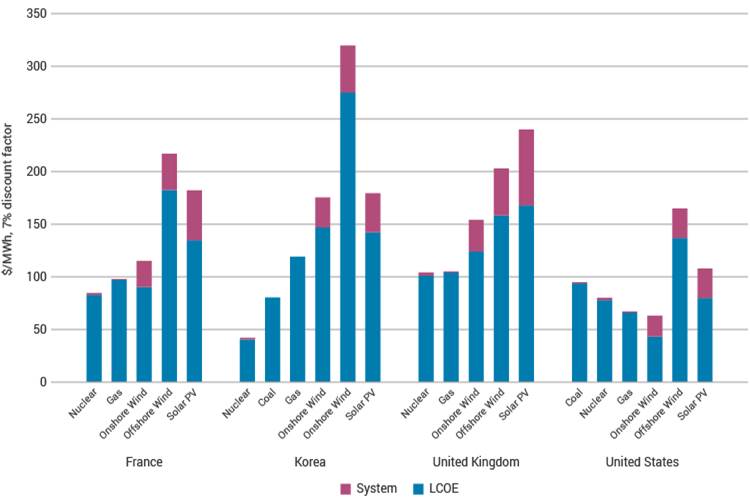
Here's some facts, nuclear is already cheaper than wind in most places on Earth. There's a chart on this article that compares costs.
http://www.world-nuclear.org/i...Facts show that nuclear is not too expensive. If nuclear is too expensive then so is wind and solar because nuclear is cheaper than both, and provably so.
We are running out of places to get cheap wind. In the USA we have onshore wind cheaper than nuclear but how long can that last? We're going to run out of good places for wind. And, we've barely begun to research new nuclear. We've been boiling water with nuclear power for decades. The next generation of nuclear is not likely to be bound by the limits that water imposes on efficiency, safety, and cost. We are getting real close to the limits on wind and solar. We are already seeing the price reductions in solar come at the cost of reduced efficiency.
-
Re:That's not happening without nuclear power
How about you link to an article that doesn't use five year old data?
https://www.forbes.com/sites/j...
http://notrickszone.com/2017/1...
https://www.cleanenergywire.or...The majority of CO2 reductions from Germany in the past 25 years has been from shutting down old Soviet designed power plants that Germany inherited from reunification. If there are any of these inefficient power plants left then any future shutdowns will have diminishing returns on CO2 reductions. A large part of their current zero emission electricity is from currently operating nuclear power. Shutting them down will only increase their CO2 output since nothing has a lower CO2 footprint than nuclear. Wind and hydroelectric have marginally lower CO2 output if good spots are found. Germany ran out of rivers to dam long ago, and their optimal wind locations will only last so long before their CO2 output exceeds nuclear.
http://www.world-nuclear.org/u...
I know the link I provided is from a nuclear power advocacy site, they only compiled data from other sources and funded no studies themselves.
-
Re:goal of 27 percent
So where is the other 73% of their power coming from. Nuclear and natural gas?
Italy has banned the use of nuclear power in its borders. They'll just buy nuclear power from France.
Here's a recent article stating France and Italy plan to build a large HVDC line between the two nations so France can sell it's cheap nuclear power to Italy.
http://www.world-nuclear.org/i...The article also states France plans to cap their nuclear output at current levels, allowing the share of nuclear to reduce from current 75% to 50%, with new growth in demand coming from unreliable energy like wind and solar. This does mean that France will be building new nuclear power plants to replace current plants as they reach end of life. I expect France to reverse their decision on capping nuclear power production, they just make too much money on selling electricity to its neighbors to stop now.
-
Also, the article is total shit.
this shows China way ahead of Europe and America on nuclear power. However, in 2020, China will have 58 GW of nuclear power by 2021.
America has over 100 GW of nuclear power, but sadly, the same idiots from groups like this, continue to drive up our costs.
Europe has over 163 GW of nuclear power, and yet, this article claims that China is winning that? -
Re: it's what's for dinner
No one is replacing old nuclear power plants with coal.
Germany has done just that.
https://carboncounter.wordpres...France too.
http://instituteforenergyresea...Sadly, so is the USA.
https://instituteforenergyrese...
https://www.vox.com/energy-and...Or maybe the USA is replacing nuclear with natural gas.
https://www.forbes.com/sites/j...Japan is almost famous for replacing nuclear with coal
https://www.equaltimes.org/jap...In the UK natural gas is replacing coal and nuclear.
https://arstechnica.com/scienc...I just realized I covered 5 of the "Group of Seven" so let's finish this out and see what Canada and Italy are doing.
Turns out Italy shut down their nuclear a long time ago and relies largely on natural gas.
https://en.wikipedia.org/wiki/...Looks like Canada is neither closing or building new nuclear, demand growth has been met with natural gas and hydro.
https://www.vice.com/en_ca/art...Also in the above article is mention of Russia, China, and South Korea. More about that here:
http://www.world-nuclear.org/i...So, let's review. France, Germany, Japan, and USA have all built significant numbers of coal plants in the past few years to meet growing demand and to make up for retired nuclear. Canada, UK, USA, and Italy rely heavily on natural gas and are building more capacity, while this might not be replacing nuclear it is another fossil fuel being used instead of wind and solar. China, Russia, and South Korea are actually making significant investments in nuclear to replace fossil fuels, which is still consistent with my claim that one must choose nuclear, fossil fuels, or lights going out.
Why do you write such nonsense? Fukushima Daishi had ordinary emergency power generators, like every plant. They did not rely on external power. However, perhaps that escaped you, the emergency power generators got flooded. And for some dumb reason no one came to the idea to helicopter a few military units in.
That's just so much nonsense in one paragraph it's hard to even come up with a reply. Do you really think that no one thought to helicopter in some generators?
In your country? All other countries that introduced wind and solar show that they are very reliabel and cost effective.
Oh, you mean like how last year the German government paid wind energy producers to sit idle to prevent damage to the electrical grid?
http://dailycaller.com/2016/04...That doesn't sound very reliable or cost effective. Seriously, do some research before you post. You are looking like a fool.
-
I was only just reading about this today...
There are existing reactors in the hundred-kilowatt range and potential for development of megawatt range reactors, which are feasible for space - spent about 3 hours today just reading up on VASIMR and MPD engines, which - when combined with modern designs for nuclear reactors - will open up speedy access to the entire solar system, and far beyond. Check this list of reactors - old, new and potential - and the energy outputs we've already achieved: http://www.world-nuclear.org/i... The future of space exploration, is through nuclear reactors and advanced ion engines. This could have been done decades ago - the technology is more than ripe enough, to actually go ahead and do this - now.
-
Re:There's your problem! (Knows nil about India)
While your reasoning is of course correct (higher half life translates into a lower intensity of radiation).
It doesn't mean, however, that radioactive wase doesn't remain dangerous for more than 1000 years. I think nobody in the nuclear industry (not even the proponants) would deny that. Look e.g. to answer on question 4 on this pro nuclar power website where they admit that it takes 1000-10000 years for nuclear waste to become sufficiently safe. link -
Re:We do know how to make nuclear plants..
You appear to have an incorrect understanding of the facts. The regulatory hurdles and battling NIMBYs are indeed one of the main issues leading to such dramatic increased costs in the US.
Nuclear Power in China
(Updated August 2017)
Mainland China has 37 nuclear power reactors in operation, 20 under construction, and more about to start construction.
The reactors under construction include some of the world's most advanced, to give a 70% increase of nuclear capacity to 58 GWe by 2020-21. Plans are for up to 150 GWe by 2030, and much more by 2050.
The impetus for nuclear power in China is increasingly due to air pollution from coal-fired plants.
China’s policy is to have a closed nuclear fuel cycle.
China has become largely self-sufficient in reactor design and construction, as well as other aspects of the fuel cycle, but is making full use of western technology while adapting and improving it.
Relative to the rest of the world, a major strength is the nuclear supply chain.
China’s policy is to ‘go global’ with exporting nuclear technology including heavy components in the supply chain.China and India are going to take the international lead on nuclear energy and the US will end up lacking the expertise to build a nuclear plant for a reasonable price on a reasonable timeline. Most of the nuclear engineers in the US are older, there probably won't be another generation of US workers with the knowledge of how to successfully build a nuclear plant (unless we start actually finishing new nuclear plants). Other nations looking to build nuclear plants won't be turning to us for help, but rather to China.
-
Re:Strange bedfellows
Decommissioning is the responsibility of the owner of the power plant.
-
Re:... with a little bit of nuclear
There was no large scale solar or wind power plant accident so far
Irrelevant. Dead is dead and per gigawatt-hour produced more people died from solar power than nuclear power, and by a large margin.
I'm old enough to remember all the way back to yesterday when I wrote this:
People then tend to dispute the solar death numbers by claiming that trip and fall deaths "don't count" for some reason.
I knew you'd say this, I told you I knew you'd say this, and yet you still brought out this straw man.
You don't seem to be disputing that people have died from solar power, only that they "don't count" because their deaths don't make it beyond the obituary pages in the newspapers. Can we make solar power safer? Sure. Can we make nuclear power safer? Of course. As it is right now nuclear power is safer than solar power by a wide margin.
And regarding CO2 you have no numbers, as I pointed out solar cells/plants can be 100% CO2 neutral, and you pointed out nuclear plants build from concrete/cement: can't.
I gave numbers and I'll give you more. You gave nothing but an unsubstantiated claim.
http://www.world-nuclear.org/u...
https://cleantechnica.com/2014... -
China and non-fossil nuclear power
The plans are not back on, they are only finishing sites that had progressed before the accident.
Do you really believe that? Weird...
You can find a list of nuclear power reactors which started construction in China after Fukushima here, about halfway down the page.
http://www.world-nuclear.org/i...
The [Construction Start] listings in bold are real construction projects, concrete and metal and not just press releases and Powerpoint presentations. They have completion dates ranging from this year through 2021. I count a total of 15 reactors currently under construction which started after March 2011, the date of the Great Tohoku earthquake and the resulting explosions at the Fukushima Daiichi plant. In addition there are six reactors which started construction before March 2011 which have still to be completed but they have not been abandoned. They did suffer from construction delays during the moratorium though.
There's a bunch more reactors in the late planning stage where approval has been given, sites selected, contracts signed and financing arranged but they're not quite at the pouring concrete and bending metal stage so they're not counted. I expect most of those projects will actually go ahead in the future. Past that point there are even more reactor projects still in the early planning stages but it's very likely those plans will change significantly.
-
Re:How about NO?
They are investing in renewables, and also have 5.6 GWe of nuclear under construction.
At least they are using their oil profits to build out carbon-free energy infrastructure. What others do with purchased oil is not their responsibility. Don't like that it is being burned? Support cheaper forms of energy, like nuclear. Advanced reactors producing high temperature heat will also enable economical synthetic fuels as well as desalination.
If you are only advocating renewables and not nuclear, you are a part of the problem.