Slashdot Mirror
Domain: aei.org
Stories and comments across the archive that link to aei.org.
Comments · 171
-
Re:Most people don't care
Expensive tractor repairs are a contributor when you wonder why your grocery bill is so damned high.
Food is cheaper here and now than it has ever been anywhere for anyone.
Why would anyone believe "expensive tractor repairs" make a significant difference? Who is saying they do?
-
Re:GW Alarmists...
Oh, you and I both know quite well what the Left thinks of ordinary Americans, and it's not pretty. Jonathan Haidt's experiments ask liberals and conservatives to fill out questionnaires about their values, then to predict how someone from the opposite tribe would fill out the questionnaire. He finds that conservatives are able to predict liberals' answers just fine and seem to have a pretty good understanding of their worldviews, but that liberals have *no idea* how conservatives think or what they value.
If one side understands the other better, and by extension probably their arguments better too, and still holds their position...that speaks to the strength of their position. When faced with questions such as "One of the worst things a person could do is hurt a defenseless animal" or "Justice is the most important requirement for a society," liberals assumed that conservatives would disagree.
-
Re:Cash still a good thing
>"there is a growing divide between "The Rich" and "The Poor", and the middle-class keeps shrinking, forcing people who were once middle-class into the ranks of "The Working Poor""
That is not what is actually happening in the USA or the world. In both, the "poor class" keeps shrinking while both the middle andupper class have been increasing. In the world it is far more prevalent, but I will stick to the USA
http://www.aei.org/publication...
https://www.forbes.com/sites/t...
So you have to get the whole picture. ALL people are doing better. So although there is a greater divide on the extremes, far fewer people are actually negatively affected by it.
There isn't a fixed pie. The pie has been growing. More people are eating more pie than ever before.
-
It all depends on what you measure
...and the number of minutes on television or column inches in the print media is not a valid metric.
There's many articles demonstrating that if we include health sciences in STEM, that the tables are turned:
http://www.aei.org/publication... -
Re:Not really
Homes today are 1000 sq ft larger than in 1973
Well that's a relief to know square footage is to blame for the 10x increase in home prices.
For a minute there I was worried we were going to have to blame a false economy shored up by hyperinflated value backed by strongarm tactics represented by a global police force, or something.
-
Re:Not really
-
Re:Denialists lost the severity gamble, HARD.
"Denialists lost the severity gamble, HARD"
Really?
As far as I can tell, nearly EVERY prediction about Global Warming from flooded NY to hundreds of millions of climate refugees has been wrong.https://www.wsj.com/articles/t...
https://www.foxnews.com/scienc...
http://www.aei.org/publication...
https://www.thenewamerican.com... -
Re:The deceipt of big numbers over large time span
To expand on that, if the median household income in the Southeast is around $50,000, and there are typically 1.4 workers per household, that would be about $18 per hour, on average. Assuming you lose 0.012 hours per week, that would be about 0.6 hours per year of work (assuming 2 weeks vacation).
So if the cost of climate change abatement is more than ($18 * 0.6) about $11 per year per worker, it is actually an economic loser to try to address it. Better to "accept the loss" of 0.012 hours per week, than spend even more money to try to save that amount of economic activity.
-
Re:In before someone says it
When liberals hate conservatives, it is because they do not understand what conservatives believe, nor do they care to learn. When faced with questions such as "One of the worst things a person could do is hurt a defenseless animal" or "Justice is the most important requirement for a society," liberals assumed that conservatives would disagree.
Jonathan Haidt's experiments ask liberals and conservatives to fill out questionnaires about their values, then to predict how someone from the opposite tribe would fill out the questionnaire. He finds that conservatives are able to predict liberals' answers just fine and seem to have a pretty good understanding of their worldviews, but that liberals have *no idea* how conservatives think or what they value.
One of the most telling discoveries was that conservatives tend to be curious about what liberals think and why, while liberals see conservatives as inferior "other," inherently incapable of thought. The slur as substitute for argument is glaring on this website.
One only needs to utter the name "Sarah Palin" to see how interested liberals are in women's rights, or "Clarence Thomas" to see how interested they are in racial equality.
-
Re:Not the problem
but perhaps there's someone with an economics background out there that can explain exactly why minimum wage increases don't drive inflation as much as some people fear it would or should.
Increases in the minimum wage likey do cause a small increase in inflation, but the effect is small enough that it is lost in the noise.
1. Most increases in the minimum wage are small, and they are one-offs, not tied to inflation.
2. Only 2 percent of full time workers earn the minimum wage
3. 2/3rds of min wage workers get a raise within a year if they stick with the job.
4. Many minimum wage businesses are not as labor intensive as you think. McDonalds spends about 25% of their revenue on labor, and many of those workers make more than min wage."Inflation" is not a very good argument against minimum wages increases. A better argument is that it doesn't do much to help the poor because
A better policy would be to increase programs targeted directly at the working poor, such as EITC.
-
Re:779 billion dollars deficit
Obama was VERY clever. He claimed that 2% GDP growth was the new normal, and then triggered the 4% GDP to only happen once he got out of office. I tip my hat for his forethought
-
It's about material dialecticalism...
AGW, or "Climate Change", or whatever the Nom de Jur is for it, isn't science. Science isn't "settled" and "settled science" isn't science. Climate Change is closer to Lysenkoism than it is to real science. The most disturbing aspect of today's climate change scientists is their willingness to go back into historical data and "correct" it to agree with their theories about CO2. The changes always cool the past and warm the present to make it appear that we are getting warmer. Yet, all their predictions about the disasters they claim would happen failed to materialize. Al Gore quoted an AGW scientist who predicted in 2007 that "within 5 years" ice would be gone from the North Pole for parts of the summer. It never happened. In fact, ice sheets have waxed and waned as they always have, even with AGW folks cooking, trimming and creating data out of thin air.
https://www.investors.com/poli...Hansen and fellow scientist Michael Oppenheimer reported that if the buildup of carbon dioxide and methane continued at the current rate, the Earth would be between three and nine degrees Fahrenheit warmer by the years 2025-2050, and that sea levels would rise between one and four feet in the same time frame. They've got only 5 years left and our globe has to warm 2.5 to 8.5 degrees during that time.
https://www.thenewamerican.com...
Gore’s film predicted a 20-foot sea-level rise in the “near future” owing to ice melt from Greenland and Antarctica. As you can see, it hasn’t happened yet. Gore also predicted the devastation of low-lying Pacific Island nations such as Tuvalu because of sea-level rise. But Tuvalu and some other island nations have actually grown in size since Gore’s pronouncement. A British judge concluded in 2007 that the film contained at least nine factual errors and was, therefore, a political film — not a scientific one.Whenever these predictions of doom don’t pan out, the climate charlatans simply move the prediction back another few decades, long past the time when they’ll actually have to answer for them. It’s a shell game. The real global warming is always under a different cup.
https://polarbearscience.com/2...
http://www.aei.org/publication...
https://casf.me/3-decades-fail...
There was only ONE BIG REASON for the climate hysteria of the last 20 years, which was revealed in the 2009 and 2011 whistleblower release of the CRU emails: redistribute wealth from the Western nations to those ruled by Marxists. So arrogant are they about it that a member of the UN-ICCP stated:
"We (UN-IPCC) redistribute de facto the world's wealth by climate policy
-Dr. Ottmar Endenhofer. IPCC co-chair of Wkring Group 3, November 13, 2010 interview (with Dr. Charles Battig) -
This thinking misses the point
The world is better off as a whole eliminating the work done by the least productive members of society, even if it means subsidizing them through something like a UBI, which is probably the least terrible form of wealth redistribution, but that's an aside. It fails to consider that as the world becomes more productive, the cost of goods and services decreases, which actually means that it becomes cheaper and cheaper to subsidize someone to a basic level of living. You can even see homeless people with smartphones and internet access these days and that's because they both became incredibly inexpensive relative to what they previously were.
Some people like to complain that as this wealth is created that a disproportionate amount of it goes to the wealthiest people, but it misses the point. It doesn't matter if the wealthiest are getting a disproportionate amount of it as long as everyone is moving up, and if you look at the world, poverty has been declining globally at massive rates. Even in the U.S. which is already wealthy, people are moving up. You often see people complain about the shrinking middle class, but what they fail to mention is that it's because the upper middle class is growing.
If anything is a problem with UBI, it's that humans seem to need some purpose in order to function well and for a lot of people that's a job that they feel gives their lives meaning. Many proponents like to think that most UBI recipients will learn new skills, etc. but I think a large number either won't or there might be a few at the bottom who won't be able do any kind of productive labor that wouldn't be better done by a machine. Even though further industrialization will continue to drive productivity higher and make goods more affordable, people without purpose tend to fall victim to substance abuse or other forms of behavior with similar consequences and outcomes. I think that's going to be the harder problem to crack, because I'm not sure if technology can do anything about it. -
Re:Doomed to fail
-
Re:Gender shouldn't matter in physics... but it do
What are you talking about?
52.2% of the PhD and 59% of master degrees are awarded to female. And you still complain about discrimination? If I were to imitate pseudo-feminist, I will certainly call you a sexist pig!
-
Re:Gender shouldn't matter in physics... but it do
What are you talking about?
52.2% of the PhD and 59% of master degrees are awarded to female. And you still complain about discrimination? If I were to imitate pseudo-feminist, I will certainly call you a sexist pig!
-
Replication crisis
China is going strong in the sciences, while America has a replication crisis in the humanities. For anyone who doesn't know, this means that the "science" performed for the last 20-30 years or so in the humanities is not able to be replicated. In other words, it's not science. In a strange coincidence, in the last 20-30 years the intellectual upper class moved far out to the left.
For more on this, see Heterodox Academy's piece on the topic.
-
Re:National turmoil
Jonathan Haidt's experiments ask liberals and conservatives to fill out questionnaires about their values, then to predict how someone from the opposite tribe would fill out the questionnaire. He finds that conservatives are able to predict liberals' answers just fine and seem to have a pretty good understanding of their worldviews, but that liberals have *no idea* how conservatives think or what they value. http://www.aei.org/publication/liberals-or-conservatives-whos-really-close-minded/
Smugness has alienated the left from much of the public, and handicapped leftists' ability to truly understand what drives people on the right. One of Haidt's most telling discoveries was that conservatives tend to be curious about what liberals think and why, while liberals see conservatives as inferior "other," alien and inherently incapable of thought.
-
Re:Typical of this administration
A quick googled turned up this article
http://www.aei.org/publication... -
Re:So?
Again, you make the mistake of not considering the base rate to begin with.
What does that even mean? The article was quite clear, the guy got in to medical school, with lower grades than his Asian American friend who was denied entry, because he pretended to be African American. What does "base rate" have to do with this?
You rant against "minority quota", but how many straight white males also should have flunked out but stayed in?
Listen, facts don't care about your feelings. If you have data that straight white males have been allowed to stay in college even after failing to meet requirements then I'd like to see it.
It's been widely reported that medical schools have been discriminating on race for a long time now. Here's a few articles on it that I found with Google.
https://www.nationalreview.com...
http://www.aei.org/publication...
http://www.aei.org/publication...
http://www.savvypremed.com/sav...
https://www.nytimes.com/2017/0...Kind of stupid of you to assume that everything was all hunky-dory until the minorities got in.
It's kind of stupid to assume everything is "hunky dory" now by letting in students based on race rather than their test scores and other measures of academic achievement. Racial discrimination is illegal in the USA, even if it's to the benefit of minorities. Maybe this tactic of having racial quotas was necessary at some point but it's not helpful any more.
If minorities want to be respected in their fields then their peers need to know that they met the same level of rigor to get where they are as anyone else.
What is horrifying is that this racist tactic of having differing levels on admittance to medical schools is that these people are treating patients when there were others more qualified for the job. This means more mistakes, and it means more people die. I like the idea of computerized diagnostics, but for it to work it takes people with proper knowledge of medicine to enter the right data, interpret the recommendations, and know when the computer is making a mistake. We see this with airline pilots leaning on the automatic pilot too much, they don't realize when the computer has screwed up and/or don't know how to fly the plane when the computer fails. This means people die.
This tactic of taking race of university applicants into account to determine fitness for entry is, by definition, racism. I thought we were trying to do away with racism in America.
-
Re:So?
Again, you make the mistake of not considering the base rate to begin with.
What does that even mean? The article was quite clear, the guy got in to medical school, with lower grades than his Asian American friend who was denied entry, because he pretended to be African American. What does "base rate" have to do with this?
You rant against "minority quota", but how many straight white males also should have flunked out but stayed in?
Listen, facts don't care about your feelings. If you have data that straight white males have been allowed to stay in college even after failing to meet requirements then I'd like to see it.
It's been widely reported that medical schools have been discriminating on race for a long time now. Here's a few articles on it that I found with Google.
https://www.nationalreview.com...
http://www.aei.org/publication...
http://www.aei.org/publication...
http://www.savvypremed.com/sav...
https://www.nytimes.com/2017/0...Kind of stupid of you to assume that everything was all hunky-dory until the minorities got in.
It's kind of stupid to assume everything is "hunky dory" now by letting in students based on race rather than their test scores and other measures of academic achievement. Racial discrimination is illegal in the USA, even if it's to the benefit of minorities. Maybe this tactic of having racial quotas was necessary at some point but it's not helpful any more.
If minorities want to be respected in their fields then their peers need to know that they met the same level of rigor to get where they are as anyone else.
What is horrifying is that this racist tactic of having differing levels on admittance to medical schools is that these people are treating patients when there were others more qualified for the job. This means more mistakes, and it means more people die. I like the idea of computerized diagnostics, but for it to work it takes people with proper knowledge of medicine to enter the right data, interpret the recommendations, and know when the computer is making a mistake. We see this with airline pilots leaning on the automatic pilot too much, they don't realize when the computer has screwed up and/or don't know how to fly the plane when the computer fails. This means people die.
This tactic of taking race of university applicants into account to determine fitness for entry is, by definition, racism. I thought we were trying to do away with racism in America.
-
Re:What the fuck did he do?
Rich people? Is that all you have in your play book? Class envy?
So you are saying a corporate tax cut won't have any positive effects on the economy? All it needs to do is 1% GDP growth improvemnt to break even.
Guess what, we are getting that.... https://tradingeconomics.com/u... GDP growth under Trump has averaged above this target. The stock market has been doing *really* well overall. Unemployment continues to fall with the labor participation rate staying steady, after 8 years of falling under Obama.
Things are getting better for a lot of folks jobs wise.... Under Obama things where getting worse because GDP growth wasn't enough to cover the population increases. Now we are breaking even or better under Trump.
Not all is roses, but it's not a compost heap like it was, when Obama was telling us that 3% GDP growth wasn't in our future anymore. http://www.aei.org/publication... Well Under TRUMP it apparently IS here again.
-
Re:This particular quote is interesting ....
Correlation is not always causation. E.g., violent crime in the US has also dropped as the rate of gun ownership has gone up over the same time period. Which one is it?
-
Re:Righties don't do anything
The whole point of this article is Leftist authoritarianism putting itself in places it doesn't belong - and then the comment I replied to just trashes Rightists for being high in conscientiousness. It's textbook whataboutism. It's a dehumanizing tactic that needs to be called out whenever it appears.
Once identified as right-wing you are beyond the pale of argument; your views are irrelevant, your character discredited, your presence in the world a mistake. You are not an opponent to be argued with, but a disease to be shunned.
Jonathan Haidt's expiriments ask liberals and conservatives to fill out questionnaires about their values, then to predict how someone from the opposite tribe would fill out the questionnaire. He finds that conservatives are able to predict liberals' answers just fine and seem to have a pretty good understanding of their worldviews, but that liberals have *no idea* how conservatives think or what they value. http://www.aei.org/publication/liberals-or-conservatives-whos-really-close-minded/
-
The situation is actually worse than that
The market is highly saturated, and what is offered is sub-par compared to other areas of the country. If you're lucky to own one of these "median" homes, it would probably be built around 1960s, and not upgraded since then. The A/C may or may not be there, the plumbing will suck (or not suck, depending on how you look at it), and you'll be far away from any viable public transport.
There is a lot of resistance to building new structures, and this is all across California. According to one study the entire state of California issued less single family housing permits than a single city (Houston) in Texas: http://www.aei.org/publication...
And do not let me start about the state of the infrastructure, power costs (i.e.: pg&e), traffic and roads, etc.
Do not get me wrong, I still prefer Silicon Valley, however housing is one of the worst aspects of it.
-
Re:1930's responsible government
http://www.aei.org/publication... Nope not twice the taxes at all.
http://www.nbcnews.com/id/2986... Look at how much corporate taxes have lowered, especially compared to income taxes. Income taxes went from 40% of taxes to 45% and corporate taxes halved. -
Re:Good
The DOE performed basic research in the 1970s that led directly to our leadership in today's fracking technology. Basic research funded by the government can be critical to a nation's technology and economic strength. As the articles note, it's not about choosing technologies, but helping them along. This is an important distinction, but it's clear that industry does not always fund basic research very well, esp. that with a long time to pay off. http://www.aei.org/publication... https://www.forbes.com/sites/l...
-
Re: Thanks, $15 minimum wage!
Do you us ATMs and online banking? Do you know how many tellers you have put out of work?
-
Re: The reason for generations (fubared my post)
Very few. Most poor households have zero full time workers. Most people earning minimum wage are 2nd or 3rd earners in middle class households.
That's a pretty bold claim. How about some evidence?
Citation #1: Income inequality by household demographics
The average household in the bottom quintile had 0.43 people earning income. The average household in the top quintile had 2.04 people earning income.
Citation #2: Key facts about the minimum wage
The average household income of a minimum wage earner is $53,000 per year.
Only 2 percent of full-time workers earn the minimum wage.
Two-thirds of minimum wage earners receive a raise within a year if they stick with the job.
Only 9 percent of adults living below the poverty line work full time.
-
Re:Silly definition of wisdom
Let me tell you another thing about poor people you probably don't know. For the most part they work. Often a hell of a lot
Your assertion is not supported by evidence:
Average number of income earners per household in bottom quintile: 0.45
Average number of income earners per household in top quintile: 2.04
Income inequality by household demographics.
Here's some evidence for you, I make $11/ hour, I work mandatory 10 hours 5 days a week then 8 more on saturday and yet I can't afford even the cheapest apartment where I live and no, commuting to work isn't an option since I work a swing shift and as such already have no time to get anything else done or have anything approaching a social life and I'm actually one of the lucky ones, since most of the other employees are making less than $9/hour working the same hours that I am in this town.
"Average wages" are heavily skewed by management and executive pay being lumped in, the bosses where I work make upwards of $300k a year, minimum, while the people who do all of the actual dam work that makes them that money get paid shit and are expected to be grateful about it. And no, those bosses don't do shit but walk around all damn day inspecting everyone's work or pointing employees so that they can be fired for doing things like dragging a skid across the floor or pushing a skid with the fork lift to make more room in a shipping/receiving lane.
Go spend a few months working a real job like the poor do, find out what it's like having no money, ever, what it's like doing exhausting and mind numbing repetitive physical labor for months, constantly being expected to work faster and more hours, knowing that if you don't comply that you are in a high unemployment/under employment area and your employer is talent pooling every day, so if you fuck up and get fired or can't take it anymore your replacement will be hired by the end of your shift.
-
Re:Silly definition of wisdom
Let me tell you another thing about poor people you probably don't know. For the most part they work. Often a hell of a lot
Your assertion is not supported by evidence:
Average number of income earners per household in bottom quintile: 0.45
Average number of income earners per household in top quintile: 2.04
-
Re:Lying Liars Lie, Film at 11.
The right is conservative. They don't change much, if at all. They're the same people they were decades ago, pretty much. The left, on the other hand, is just going further and further left, and anyone to the right of Mao Zedong looks like a Nazi to them. In 1973, all six major US class segments were centrist. Over the next 35 years, five of the segments moved slightly to the right, but "Intellectual Upper Class" moved far out to the left.
The left sees people as a metallurgist sees iron ore. To them, people in the way of their vision are impurities to be removed before forging their utopia. Clay to be molded. Human dust to be brushed around.
Most leftists don't call people that oppose them the enemy. But the people doing it are overwhelmingly leftists.
-
Re:Banks have been automating since the ATM
According to BLS [bls.gov], there are 8.4 million people employed in the US financial sector, and this is expected to go up by half a million in the next 10 years.
I believe you are reading that table wrong. It shows 7,979,500 jobs in "Financial Activities" in 2014, and estimates that there will be 8.4 million in 2024. In 2004 there were 8.1 million in that industry, so the number of jobs actually fell while the US population went from 293 million to 319 million, so a much smaller percentage of the population is working in that industry. Even with the projected rise in total jobs by 2024, it is projected to be an even smaller percentage of the population, all while doing a lot more than they did in the past. Banks used to only do deposit accounts and loans, they are now doing a lot more things with a smaller workforce than before (and making a lot more profits than they were in the past).
I don't think your example illustrates the point you were trying to make, in fact I think the statistics you provided show the opposite. You're not wrong on your specific point (teller jobs have actually increased since the introduction of the ATM, citation here: http://www.aei.org/publication... ) but the data you provided certainly didn't illustrate that. Although that seems like it might be changing, from the article I linked: "Indeed, according to the Labor Department, employment of tellers is projected to decline 8% over the next decade. "
-
Re:Remember kids, there is no inflation
BS. I've done the math more than once.
Maybe you need a new calculator.
The cost per sq area has increased versus the average wage.
-
Re:Low inflation is bogus; only electronics droppi
Meanwhile. a lot of ordinary people, especially those in minimum wage jobs, have extreme difficulty paying for basic necessities. Is there an inflation index for necessities, i.e. food/shelter/clothing and transportation?
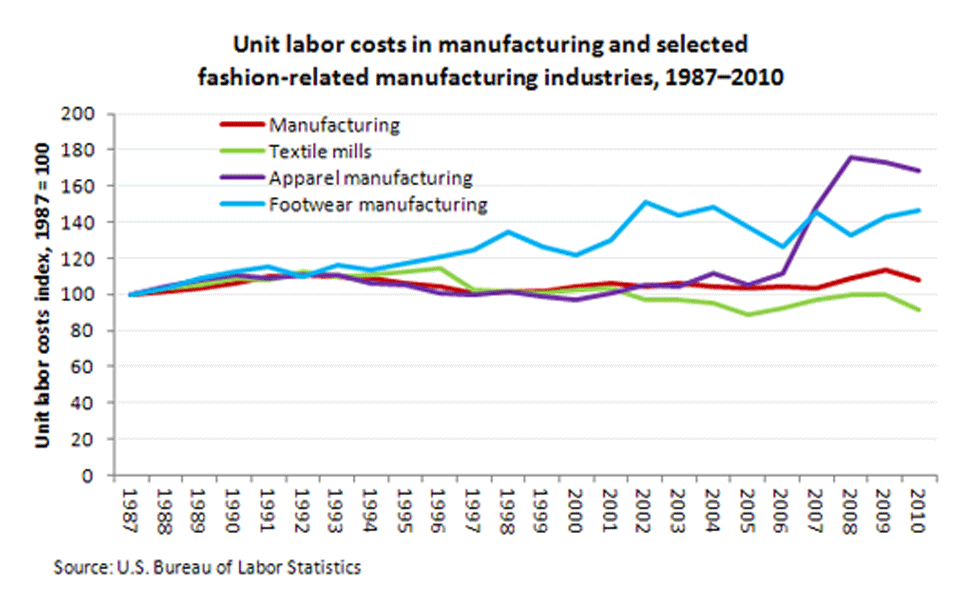
Sounds like a difficult figure to calculate, but you can look at percentage of spending. The lowest quartile spend ~35% of their income on food and that's relatively stable. In 1992 the AAA's driving cost gave a composite index of 38.8 cents/mile for 15k miles, which put into an inflation calculator is 67.9 cents in 2017 dollars while for 2017 it's 56.6 cents. Basic clothing I didn't really find any great statistics for and is hard to separate from design and fashion clothes but labor costs have been pretty flat from the 80s to 2010 which indicates prices on basic clothing wouldn't really get much better either. Price per square feet for a new home is also pretty flat in real dollars, even though the number of square feet per home and per person is growing.
In summary, living on minimum wage wasn't easy a few decades ago, it's still not easy now. It's hard to find some figure that's significantly worse though, though increasing disparity may in itself be a problem if you feel "everybody else" can afford to drink their coffee at Starbucks except you. That's what drives most people into financial disaster, if you accept the social stigma of being poor and just blatantly say you can't afford it you'll probably do okay. It's those who have to try pretending they have money when they don't who bury themselves in credit card debt and end up in a quagmire they never get out of. I have one buddy that is like that, he's made some life choices which has left him quite far behind us financially. And nobody's pushing him to spend, but he's constantly overextending himself.
-
Re:First sentence is absurd
It is just some 3% or 5% of the globe.
By population you mean. The USA is about 20% of the global economy.
http://www.aei.org/publication...
MP: Overall, the US produced 22.5% of world GDP in 2014, with only about 4.6% of the worldâ(TM)s population. Three of Americaâ(TM)s states (California, Texas and New York) â" as separate countries â" would rank in the worldâ(TM)s top 14 largest economies. And one of those states â" California â" produced more than $2 trillion in economic output in 2014 â" and the other two (Texas and New York) produced more than $1.6 trillion and $1.4 trillion of GDP in 2014 respectively. The map and these statistics help remind us of the enormity of the economic powerhouse we live in. So letâ(TM)s not lose sight of how ridiculously large and powerful the US economy is, and how much wealth and prosperity is being created all the time in the worldâ(TM)s largest economic engine.
-
Re:But that's not the issue
The average American home now has 2.93 TV sets per household, up from 2.86 sets per home in 2009, the largest year-over-year increase since 2006 according to Nielsen’s latest Television Audience Report (see chart above). In 2010, the number of U.S. homes with three or more TV sets increased to the highest percentage ever at 55% (up from 54% last year and up from 11% in 1975) and the number of households with only one TV decreased to the lowest level ever, at 17%, down from 18% last year, and down from 57% in 1975. The report also finds that the number of people per TV home has held steady at about 2.54 for the last six years, carrying on the trend of more TVs per home than people.
(Source)
Sorry, you were busy regaling us with stories of how every home had 6-10 tv sets back in the day? Don't let the facts get in your way, creimer. In 1975, 57% of households had only one tv. Only 11% had 3 or more. That means 32% had 2 tvs, or 0 tvs. Which means that only 11% of househoulds *could* have had televisions in every room as you claim, and only if those houses had VERY small numbers of rooms. In reality, you're full of shit, reminiscing about a time that never existed.
-
Price is the same, just marketing fluffRead carefully:
The system will cost between $20,000 and $25,000, compared to conventional systems priced as high as $60,000.
Note they're comparing to conventional systems "priced as high as $60,000." In other words it's a useless marketing comparison designed to trick you into thinking the alternative is expensive by comparing an average price to the highest price you'll ever see.
The $20k-$25k is for a typical U.S. home which is nearly 2700 square feet (250 m^2). Average home size in Germany is about 160 square meters (~1700 square feet).
So to heat/cool a German-sized home would require about 65% the size system, which translates into $13k-$16k. Which at the current exchange rate is about 11.5k-14k Euros. Nearly identical to the prices you've quoted. The heat pump in your link for earth systems is cheaper than for air or water. Typically, the earth systems are most expensive because of the additional digging which is needed to bury the water loops. Air systems simply vent to the air (a backwards air conditioner), while in water systems you just drop the loops into the bottom of a pond or lake. I suspect the prices you're quoting don't include installation, which is a huge part of the cost. -
Re:Let me guess..
look up the performance of the test stores and see that they've actually hired MORE people due to the increased workload.
This is analogous to the way that ATMs increased jobs for human tellers.
Increased efficiency leading to greater demand is known as Jevon's Paradox. It is one more reason why zero-sum reasoning about economic issues is almost always wrong.
Interesting choice of example. Bank tellers are pretty much the most useless job out there and exist mainly because the older generation is still scared of the internet and money. If I have to visit a bank and actually talk to a human being something has gone terribly wrong. In fact, I can think of any common or even semi-rare banking task that I would need a bank teller for.
-
Re:Let me guess..
This is analogous to the way that ATMs increased jobs for human tellers.
From the article you link to:
according to the Labor Department, employment of tellers is projected to decline 8% over the next decade. The number of bank branches is now declining rather than increasing “because of industry consolidation and technological change.”
-
Re:Let me guess..
look up the performance of the test stores and see that they've actually hired MORE people due to the increased workload.
This is analogous to the way that ATMs increased jobs for human tellers.
Increased efficiency leading to greater demand is known as Jevon's Paradox. It is one more reason why zero-sum reasoning about economic issues is almost always wrong.
-
Re:If only we had machines to dispense money
ATMs coupled with internet banking have substantially reduced the need for bank tellers.
Wrong. The number of human tellers has gone up. Prior to ATMs, human tellers mainly took deposits and dispensed cash. After ATMs and Internet banking, tellers do higher level tasks like setting up accounts, helping with mortgage applications, etc. This makes each teller more profitable, and thus banks have employed more of them.
When more efficient use of a resource leads to greater demand, it is an example of Jevon's Paradox.
-
Re:House? What about retirement?
...houses are much larger and nicer than they were in 1970. Living space per person has almost doubled, the average house is 1,000 sq. ft. larger and has amenities like walk-in closets and expensive counter-tops you wouldn't find on an average house in the 70s.
Whilst I can find articles to see where you got this idea from, this doesn't quite pass the smell test. This is true only for new homes (i.e. the well off to construct new dwellings) and if you include established homes and the number of children per adult this picture changes.
Here is a page showing the trend of less people per household in the US over time. It may seem like there has been an improvement in living space per person (again check for all residences and not new ones in your stats), but to me it just means that adults are sharing space in the cities that don't really want to and can't bring up kids like they could in the past for financial reasons.
-
Re:Thank your parrents
Most Americans are in both the top _and_ the bottom quintile of income over the course of their life.
There's tons of mobility between income ranges. Pretty much anyone who is willing to work hard and not at a disabling level of stupidity can become at least upper-middle-class over time. 73% of Americans spend time in the top 20% of income earners.
-
Re:I am skeptical
Certainly not my experience here in Australia, many bank branches have closed, and those still open have very few tellers
That is not the case in America. Since the introduction of ATMs, teller employment has gone up. This is an example of Jevons Paradox. As ATMs proliferated, and could handle routine transactions, human tellers could focus on more high level services. This made human tellers MORE PROFITABLE, so banks wanted more of them, not fewer. The number of tellers in each branch went down, but banks opened a lot more branches. There is a bank branch inside my local grocery store. You can use the ATM there to make a cash withdraw, or you can talk to the human teller about refinancing your mortgage.
Disclaimer: I once visited Australia, but never went in a bank.
-
Re: La Niña is about to bite us in the arse
Here ya go....
https://www.aei.org/publicatio...
They were fabulously totally and completely wrong.
This was easy to find, the fact that you didn't know about this shows how you have blinders on about how alarmists and doomsayers work....
-
Re:Never fly in the USA.
The average new house today is twice the size of a house in 1973. Cars are better, TVs are better, etc. So people aren't working more to "scrape by", they are working more for a much better quality of life.
All of those products have become easier and less expensive to produce. So why should we work more to have them?
-
Re:Never fly in the USA.
Meantime, the stuff you really need like housing (whether you own or rent), food, and drugs are dramatically costlier than they were in the old days.
Wrong. Housing costs have barely changed when measured by the square foot and adjusted for inflation. Food is far cheaper today than it was 40 years ago. Drugs are also cheaper today if you buy the same drugs.
-
Re:Never fly in the USA.
The difference is, back then one earner could provide a middle-class life for a family. Nowdays, two earners barely provide a working class life
The average new house today is twice the size of a house in 1973. Cars are better, TVs are better, etc. So people aren't working more to "scrape by", they are working more for a much better quality of life.
If you want to live like a one-earner household lived in 1973, you can still still easily do that on one income.
-
Women need to take more risk?
Of the about 4500 annual workplace fatalities, 92% are men.
http://www.aei.org/publication...
Because women tend to work in safer occupations than men on average, they have the advantage of being able to work for more than a decade longer than men before they experience the same number of male occupational fatalities in a single year.
Economic theory tells us that the “gender occupational fatality gap” explains part of the “gender pay gap” because a disproportionate number of men work in higher-risk, but higher-paid occupations like coal mining (almost 100% male), fire fighters (95% male), police officers (87% male), correctional officers (72% male), farming, fishing, and forestry (77% male), and construction (97.5% male); BLS data here. On the other hand, a disproportionate number of women work in relatively low-risk industries, often with lower pay to partially compensate for the safer, more comfortable indoor office environments in occupations like office and administrative support (73% female), education, training, and library occupations (74% female), and health care (75% female). The higher concentrations of men in riskier occupations with greater occurrences of workplace injuries and fatalities suggest that more men than women are willing to expose themselves to those work-related injuries or death in exchange for higher wages. In contrast, women more than men prefer lower risk occupations with greater workplace safety, and are frequently willing to accept lower wages for the reduced probability of work-related injury or death.