Slashdot Mirror
Domain: amazon.com
Stories and comments across the archive that link to amazon.com.
Comments · 40,271
-
Re:you only need 5mbps for netflix HD
first of for the record, internet speeds are measured in bits per second this is also the case with video, but not everyone is a movie head. ergo a 60mbps connection is actually a 7.5mBps connection.
http://help.encoding.com/knowledge-base/article/understanding-bitrates-in-video-files/ says a typical 720p will use 2.5 mbps and a 1080p 5 mbps. this is wrong for many reasons. how many audio channels does it have if it's more than 0 it needs at a minimum 64 kbit/s per horrible lossy audio. then the problem with especially rapidly changing graphics causing encode time spikes where the data is not all capable of being stored at the given bitrate, then there is network routing delays and dropped packets. a buffer will usually smooth that out though.
okay then lets see here, every device that is used for youtube and netflix has to work simultaneously on all devices at the same time. sure a 10 mbit/s stream will let you get 2 streams of data, maybe if they're crappy quality you tubes. 60 mbps and then you can possibly stream 8 streams if they're meant to be shared on the internet. while you can thus say 60mbps is plenty fast for home users, there was a time (holidays) when there were 12 people on the wifi at the same time. and consumer wifi can have 50 connections, so realistically people need 375 mbps, so everyone at a party can stream at the same time. no that was a joke... with 6 antennas it is hard to run 50 connections anyways, even with them all being trancievers.
there were people who swore that dialup was enough for them, at the time who would have dared dream of being able to drop $120 for a 128 GigaByte chip the size of a fingernail http://www.amazon.com/SanDisk-Ultra-MicroSDXC-Memory-Adapter/dp/B00IIJ6W4S so saying gigabit networking has no use for home users (though there clearly are for businesses, someone made netflix you know) is to be shortsighted.
-
But- but-
The maximum speed a DOCSYS modem can achieve is 171/122 Mbit/s (using four channels), just a fraction the 273 Gbit/s (per channel) already reached on fiber.
According to this page, the DOCSYS 3.0 ARRIS/Motorola SB6183 and Netgear C6300 can handle 300 Mbit/s.
The SB6183 uses 6 download & 4 upload channels.
-
Re:my motoo is, just let go of the wheel
My motto is "Find a fucking dictionary"
-
Re:Japan isn't the United States
A similar thing did happen in UK, actually, and before this whole 3D gun printing craze at that. There was a guy, you see, who figured out that you can actually make a reasonably efficient firearm (a smoothbore submachinegun chambered in 9x19mm - good enough for distances up to 50m or so) out of shelf components - steel tubes and such - if you just pick the ones with the right diameter. So he set on a quest to do just that, wrote a book detailing how to build one, and published it in 1998.
This being UK, after he published it, they charged him with construction of an illegal firearm. He's still in prison. The book is still on Amazon.
-
Better reading: ad agency processes
If you want a process for fostering creativity, read something like this:
http://smile.amazon.com/Young-...
Ad agencies have to come up with ideas all the time, and their processes for doing so have worked for over a century. Each agency is different, but all of them have to be creative on demand.
-
Re: Easily done:
How about a a whole fucking book of citations?
-
Re:Where is the NFC 2-factor?
I don't see how fumbling around with USB sticks is much better.
I use a YubKey NEO-n. It's a tiny device, only extends from the USB port by a millimeter or so... just enough that you can touch it to activate it. I just leave it plugged into my laptop all the time, so there's no "fumbling with USB sticks", I just run my finger along the side of the laptop until it hits the key. It's extremely convenient.
Doesn't leaving the device plugged into your laptop all the time defeat the purpose of two-factor authentication? If someone steals your laptop they have your key now, same is if you left your one-time pad as a text document on the desktop.
I addressed this in the paragraph below the one you quoted, and a bit more in the paragraph after that.
-
Re:Where is the NFC 2-factor?
I don't see how fumbling around with USB sticks is much better.
I use a YubKey NEO-n. It's a tiny device, only extends from the USB port by a millimeter or so... just enough that you can touch it to activate it. I just leave it plugged into my laptop all the time, so there's no "fumbling with USB sticks", I just run my finger along the side of the laptop until it hits the key. It's extremely convenient.
Doesn't leaving the device plugged into your laptop all the time defeat the purpose of two-factor authentication? If someone steals your laptop they have your key now, same is if you left your one-time pad as a text document on the desktop.
-
Re:Where is the NFC 2-factor?
$60 bucks? No fucking way.
These are devices that have really only been used for enterprise security. Low volume plus low price sensitivity equals high price. As use of security keys becomes more widespread, across more enterprises and businesses, and even to consumers, that will change.
There are other devices available now, including one that is $6. None of the others are as small as the NEO-n, so you'd have to "fumble for USB sticks" rather than leaving them plugged in all the time... but said "fumbling" really isn't that bad. Put it on your key ring, shove it in when needed.
-
Re:Too bad google's own search doesn't turn up any
Inexpensive one: http://www.amazon.com/dp/B00NL...
More expensive one with additional functionality http://www.amazon.com/dp/B00LX... -
Re:Too bad google's own search doesn't turn up any
Inexpensive one: http://www.amazon.com/dp/B00NL...
More expensive one with additional functionality http://www.amazon.com/dp/B00LX... -
Re:Where is the NFC 2-factor?
I don't see how fumbling around with USB sticks is much better.
I use a YubKey NEO-n. It's a tiny device, only extends from the USB port by a millimeter or so... just enough that you can touch it to activate it. I just leave it plugged into my laptop all the time, so there's no "fumbling with USB sticks", I just run my finger along the side of the laptop until it hits the key. It's extremely convenient.
That's okay for you on your laptop. When you go to a conference room with a e.g. a PC set up for conference calls, and someone needs to log in to pull up the hangout, it's a different story (don't even get me started on Chromebox for Meetings...).
Here, having a little dongle sitting in the middle of the desk connected to the main system via USB would provide an easy option to provide at least the 2nd factor auth, without anyone typing in codes or plugging in additional devices. Lots of people walk into a conference room with their phone in hand as it is.
-
Re:Where is the NFC 2-factor?
I don't see how fumbling around with USB sticks is much better.
I use a YubKey NEO-n. It's a tiny device, only extends from the USB port by a millimeter or so... just enough that you can touch it to activate it. I just leave it plugged into my laptop all the time, so there's no "fumbling with USB sticks", I just run my finger along the side of the laptop until it hits the key. It's extremely convenient.
There's an obvious downside of leaving the key plugged into your laptop, of course. If someone steals your laptop they have your key. However, in order to make use of it they have to have (or guess) your password as well, so it's really only a risk if someone is specifically targeting you, in which case they could also steal your phone. Well, it's also a problem if you use a particularly lousy password, and if you don't notice that the laptop/key are gone soon enough that you can disable the key before the attacker guesses your password.
FWIW, Google switched to using security keys for corporate account authentication a while ago. Google's security operations team determined that the risk of theft of a security key is actually lower in practice than the risk that an employee's phone-based OTP might be phished. I would have thought that Google employees were too smart to be phished... but I suppose resistance to phishing attacks is as much about social intelligence as anything else, and Google hires a lot of socially inept people.
-
Re:Dongle Bells!
Not many PCs have 9-pin joystick ports.
You mean a serial port? I bet yours does and you didn't even know it.
And if it doesn't? http://www.amazon.com/USB-9-pi... -
Re:Meanwhile everyone is making Android devices
True. I'm puzzled that no one has sued the bastard. I doubt there was ever a more blatant case of breach of fiduciary duty.
The installment of Elop was actually demanded by Nokia's major shareholders.
For anyone wanting to know more of the strange twists and turns in this story, and how such a giant could fall so quickly, I'd recommend David Cord's The Decline and Fall of Decline , an exhaustive account which confirms a lot of the gossip that I had heard from Nokia employees and contractors here in Finland.
-
Re:Red mouse nub
Products like the BlackBerry Passport (number 2 selling unlocked phone on Amazon right now)
That's ranked 10. It's not binary.
-
Re:Eh
-
Re:It's not censorship or more government control
"Much as I despise the current UK government, and am deeply concerned about surveillance and censorship and erosion of privacy and free speech generally"
This (mass surveillance) is just more part and parcel of state suppression of dissent against corporate interests. They're worried that the more people are going to wake up and corporate centers like the US and canada may be among those who also awaken. See this vid with Zbigniew Brzezinski, former United States National Security Advisor.
https://www.youtube.com/watch?...
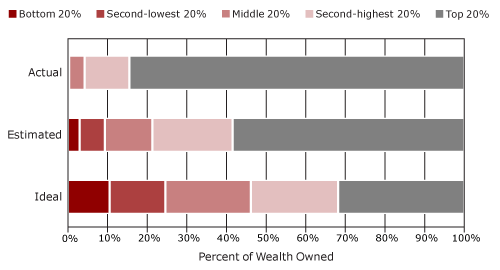
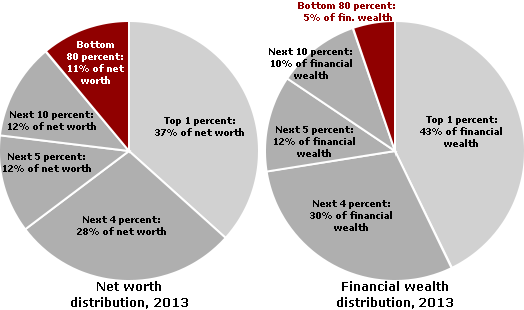
Look at the following graphs:
http://www2.ucsc.edu/whorulesa...
http://www2.ucsc.edu/whorulesa...
http://www2.ucsc.edu/whorulesa...And then...
WIKILEAKS: U.S. Fought To Lower Minimum Wage In Haiti So Hanes And Levis Would Stay Cheap
http://www.businessinsider.com...
https://www.youtube.com/watch?...
Free markets?
https://www.youtube.com/watch?...
http://www.amazon.com/Empire-I...
"We now live in two Americas. One—now the minority—functions in a print-based, literate world that can cope with complexity and can separate illusion from truth. The other—the majority—is retreating from a reality-based world into one of false certainty and magic. To this majority—which crosses social class lines, though the poor are overwhelmingly affected—presidential debate and political rhetoric is pitched at a sixth-grade reading level. In this “other America,” serious film and theater, as well as newspapers and books, are being pushed to the margins of society.
In the tradition of Christopher Lasch’s The Culture of Narcissism and Neil Postman’s Amusing Ourselves to Death, Pulitzer Prize-winner Chris Hedges navigates this culture—attending WWF contests, the Adult Video News Awards in Las Vegas, and Ivy League graduation ceremonies—to expose an age of terrifying decline and heightened self-delusion."
-
One crap audio brand battling with another
Both Bose and Beats are fairly ordinary products that have simply learned to dazzle the public with good marketing. An element of fashion is also involved, as Bose used to be marketed in posh fora and Beats has a distinctive look and Dr Dre endorsement. So, I can't feel sorry for either party -- or for Apple whose own acquisition of Beats betrayed their own tradition of fairly decent sound -- in a bitter patent battle. For what it's worth, after evaluating a few Beats 'phones and being immediately disappointed, I invested in a pair of AKG 701s (see my Amazon review) that offer what one immediately recognizes as better sound, and are around the same price (and well below audiophile woo-woo).
-
Re:I tried this. Once.
Come to me baby. I have a thing I would stick up into your ass: For using it on your head is too late.
-
Re:Prison population
Or could that be due to other factors?
Indeed. Crime rates fell in states that implemented harsh prison sentences, but it also fell in states that did not. It fell slightly more in the "lock-em-up" states, but not near enough to justify the costs.
Other factors:
1. Reduction of environmental lead. This is more strongly correlated with falling crime than any other factor.
2. Abortion. The case for this was laid out well in Freakonomics.
3. Better security, and less stuff to steal. Today, cameras are everywhere, alarm systems are much more common, and most people don't have as much to steal. People carry credit cards instead of cash, modern electronics has very little resale value, and nobody uses real silver silverware anymore.
4. Video games. Young men in their prime crime years spend billions of hours playing video games, leaving far less time on the street getting in trouble. -
Re:The language in the old west
Unless he is somehow referring to George C. Herring:
http://www.amazon.com/George-C.-Herring/e/B001IQXI7M
but I doubt it... -
Fed Reserve research: rewards reduce creativity
See Dan Pink's presentation: http://www.youtube.com/watch?v...
So, much of the premise of differential rewards to spur innovation is flawed (even though it does apply to some extent for hard manual labor not involving much creativity). What Dan Pink says motivates people most to work in creative innovative directions is a sense of purpose, a sense of autonomy, and an increasing sense of mastery.
Also on that theme by Alfie Kohn:
http://www.alfiekohn.org/books...
http://www.amazon.com/No-Conte...See also: http://en.wikipedia.org/wiki/T...
"The book argues that there are "pernicious effects that inequality has on societies: eroding trust, increasing anxiety and illness, (and) encouraging excessive consumption".[5] It claims that for each of eleven different health and social problems: physical health, mental health, drug abuse, education, imprisonment, obesity, social mobility, trust and community life, violence, teenage pregnancies, and child well-being, outcomes are significantly worse in more unequal rich countries.[1] The book contains graphs that are available online.[6]"And see also, on how the logic of diminishing returns in economics got replaced by the concept of "Pareto efficient":
"Economics for the Rest of Us: Debunking the Science That Makes Life Dismal"
http://www.amazon.com/Economic...Also on the social dynamics and mythology related to all this: http://conceptualguerilla.com/...
You made a good presentation of the roots of the better ideas behind capitalism. But somehow along the way, as power accumulated and corrupted our main social institutions in the USA and elsewhere, those ideas got stretched into neoliberalism... Here is a conceptual video on what happens as those neoliberal ideas expand:
http://www.youtube.com/watch?v...For some comic relief (and a bit more insight), the first novel in a futuristic sci-fi series featuring cybertanks fighting against neoliberalism (especially in the third novel in the series started by the Chronicles of Old Guy by Timothy Gawne):
http://www.amazon.com/The-Chro...As long as we have an economy based mostly on exchange and capitalism, and as automation takes more and more jobs, it seems like we would need a basic income to make the system more humane and also keep it going by creating demand. So, to do that, we can just reduce the age of the first Social Security payment from age 65 to age 0, and fund that via taxes and fees royalties on use of government assets (like the Alaska Permanent Fund) and so on. However, long term, as I say on my website, we will likely see a mix of advanced subsistence production (3D printers, solar cells, Mr. Fusion), an expanded gift economy (FOSS, Freecycle), better democratic planning (like via the internet), and an exchange economy softened by a basic income.
-
Fed Reserve research: rewards reduce creativity
See Dan Pink's presentation: http://www.youtube.com/watch?v...
So, much of the premise of differential rewards to spur innovation is flawed (even though it does apply to some extent for hard manual labor not involving much creativity). What Dan Pink says motivates people most to work in creative innovative directions is a sense of purpose, a sense of autonomy, and an increasing sense of mastery.
Also on that theme by Alfie Kohn:
http://www.alfiekohn.org/books...
http://www.amazon.com/No-Conte...See also: http://en.wikipedia.org/wiki/T...
"The book argues that there are "pernicious effects that inequality has on societies: eroding trust, increasing anxiety and illness, (and) encouraging excessive consumption".[5] It claims that for each of eleven different health and social problems: physical health, mental health, drug abuse, education, imprisonment, obesity, social mobility, trust and community life, violence, teenage pregnancies, and child well-being, outcomes are significantly worse in more unequal rich countries.[1] The book contains graphs that are available online.[6]"And see also, on how the logic of diminishing returns in economics got replaced by the concept of "Pareto efficient":
"Economics for the Rest of Us: Debunking the Science That Makes Life Dismal"
http://www.amazon.com/Economic...Also on the social dynamics and mythology related to all this: http://conceptualguerilla.com/...
You made a good presentation of the roots of the better ideas behind capitalism. But somehow along the way, as power accumulated and corrupted our main social institutions in the USA and elsewhere, those ideas got stretched into neoliberalism... Here is a conceptual video on what happens as those neoliberal ideas expand:
http://www.youtube.com/watch?v...For some comic relief (and a bit more insight), the first novel in a futuristic sci-fi series featuring cybertanks fighting against neoliberalism (especially in the third novel in the series started by the Chronicles of Old Guy by Timothy Gawne):
http://www.amazon.com/The-Chro...As long as we have an economy based mostly on exchange and capitalism, and as automation takes more and more jobs, it seems like we would need a basic income to make the system more humane and also keep it going by creating demand. So, to do that, we can just reduce the age of the first Social Security payment from age 65 to age 0, and fund that via taxes and fees royalties on use of government assets (like the Alaska Permanent Fund) and so on. However, long term, as I say on my website, we will likely see a mix of advanced subsistence production (3D printers, solar cells, Mr. Fusion), an expanded gift economy (FOSS, Freecycle), better democratic planning (like via the internet), and an exchange economy softened by a basic income.
-
Fed Reserve research: rewards reduce creativity
See Dan Pink's presentation: http://www.youtube.com/watch?v...
So, much of the premise of differential rewards to spur innovation is flawed (even though it does apply to some extent for hard manual labor not involving much creativity). What Dan Pink says motivates people most to work in creative innovative directions is a sense of purpose, a sense of autonomy, and an increasing sense of mastery.
Also on that theme by Alfie Kohn:
http://www.alfiekohn.org/books...
http://www.amazon.com/No-Conte...See also: http://en.wikipedia.org/wiki/T...
"The book argues that there are "pernicious effects that inequality has on societies: eroding trust, increasing anxiety and illness, (and) encouraging excessive consumption".[5] It claims that for each of eleven different health and social problems: physical health, mental health, drug abuse, education, imprisonment, obesity, social mobility, trust and community life, violence, teenage pregnancies, and child well-being, outcomes are significantly worse in more unequal rich countries.[1] The book contains graphs that are available online.[6]"And see also, on how the logic of diminishing returns in economics got replaced by the concept of "Pareto efficient":
"Economics for the Rest of Us: Debunking the Science That Makes Life Dismal"
http://www.amazon.com/Economic...Also on the social dynamics and mythology related to all this: http://conceptualguerilla.com/...
You made a good presentation of the roots of the better ideas behind capitalism. But somehow along the way, as power accumulated and corrupted our main social institutions in the USA and elsewhere, those ideas got stretched into neoliberalism... Here is a conceptual video on what happens as those neoliberal ideas expand:
http://www.youtube.com/watch?v...For some comic relief (and a bit more insight), the first novel in a futuristic sci-fi series featuring cybertanks fighting against neoliberalism (especially in the third novel in the series started by the Chronicles of Old Guy by Timothy Gawne):
http://www.amazon.com/The-Chro...As long as we have an economy based mostly on exchange and capitalism, and as automation takes more and more jobs, it seems like we would need a basic income to make the system more humane and also keep it going by creating demand. So, to do that, we can just reduce the age of the first Social Security payment from age 65 to age 0, and fund that via taxes and fees royalties on use of government assets (like the Alaska Permanent Fund) and so on. However, long term, as I say on my website, we will likely see a mix of advanced subsistence production (3D printers, solar cells, Mr. Fusion), an expanded gift economy (FOSS, Freecycle), better democratic planning (like via the internet), and an exchange economy softened by a basic income.
-
Links
-
Links
-
Re:200 dollars is too expensive
I agree, before I would do all that I would just setup a server maybe at..
and run a site from there.. I can can setup any level of encryption, authentication, etc I want and not have to charge, carry that thing around, rely on wifi and sell out $200.
-
Re:What?
Ok here is the bloated form for people like you who can't seem to operate a search engine and need every term explained to them or directly linked.
Docker (which is an open platform for developers and sysadmins to build, ship, and run distributed applications. Consisting of Docker Engine, a portable, lightweight runtime and packaging tool, and Docker Hub, a cloud service for sharing applications and automating workflows, Docker enables apps to be quickly assembled from components and eliminates the friction between development, QA, and production environments. As a result, IT can ship faster and run the same app, unchanged, on laptops, data center VMs, and any cloud) isn't niche. It is one of the core technologies for DevOps (a concept dealing with, among other things: software development, operations, and services. It emphasizes communication, collaboration, and integration between software developers and information technology (IT) operations personnel) which is designing application infrastructures where IT provides a platform for in-house and integrate micro-services (that are small, independent processes communicating with each other using language-agnostic APIs to form complex applications) rather than providing monolithic applications (single-tiered software applications in which the user interface and data access code are combined into a single program from a single platform) to departments. Many PaaS (Platform as a Service, a category of cloud computing services that provides a computing platform and a solution stack as a service) systems are based on Docker particularly Helion, CenturyLink, Rackspace its a big player for AWS...
So much easier to understand right?
-
Re:Already gone
Yes, it is a sick society where a lawyer is a basic necessity, like water and electricity.
Lawyers just make it worse. The last thing they want is for the couple to reconcile, so they just try to inflame the situation. When my wife filed for divorce, her lawyer did everything he could to throw gasoline on the flames.
We ended up staying together. What saved my marriage was this yogurt machine. She is lactose intolerant, and also calcium deficient. So she was taking calcium supplements that threw her magnesium electrolytes way out of kilter, and caused her emotions to go berserk. But the bacteria in the yogurt digest all the lactose, and yogurt has calcium and magnesium in the appropriate proportions. That solved the problem.
So if your marriage is in trouble, don't talk to a lawyer. Talk to a chemist.
-
Re:Two global problems solved in my lifetime!
It definitely is a problem. When I go to the store at 2:00 AM, I expect to see no humans. That is the whole fucking point of going to the store at that hour. Yet around here, there are all sorts of fucking minorities hanging around the wallmart in the middle of the night buying shit. Why the FUCK do I have to come across other humans, EVER. This shit pisses me off.
You may be interested in this web site, it should significantly reduce your rate of interaction with other humans.
-
Re:Light on details, however...
Electric ranges (oven and cook-top) are 220V 50A
Electric ranges are pretty common in U.S. homes, although, just some like clothes dryers and hot water heaters, some ranges use natural gas.
The most common receptacle for this in the U.S. is NEMA 14-50R
Larger RVs also use this receptacle for "shore power". -
The American Language
The US changed the language after breaking off from Britain changing 's' to 'z' in many spellings for example
Noah Webster published his speller in 1783. His grammar in 1784, and his dictionary in 1826.
His most important improvement, he claimed, was to rescue "our native tongue" from "the clamour of pedantry" that surrounded English grammar and pronunciation. He complained that the English language had been corrupted by the British aristocracy, which set its own standard for proper spelling and pronunciation. Webster rejected the notion that the study of Greek and Latin must precede the study of English grammar. The appropriate standard for the American language, argued Webster, was "the same republican principles as American civil and ecclesiastical constitutions". This meant that the people-at-large must control the language; popular sovereignty in government must be accompanied by popular usage in language.
This is an essentially modern approach to language and usage.
You see it in H.L. Mencken, you see it in The American Heritage Dictionary.
One of the most provocative essays in Shakespeare in America: An Anthology from the Revolution to Now: (Library of America #251) offers a much needed reminder that Shakespeare first attracted readers and audiences in the states because the language was familiar and accessible.
Very close to what you would have heard on the street.
''American audiences will hear an accent and style surprisingly like their own in its informality and strong r-colored vowels,'' Meier said. ''The original pronunciation performance strongly contrasts with the notions of precise and polished delivery created by John Gielgud, Laurence Olivier and their colleagues from the 20th century British theater.''
Meier said audiences will hear word play and rhymes that ''haven't worked for several hundred years (love/prove, eyes/qualities, etc.) magically restored, as Bottom, Puck and company wind the language clock back to 1595.''
''The audience will hear rough and surprisingly vernacular diction, they will hear echoes of Irish, New England and Cockney that survive to this day as 'dialect fossils.' And they will be delighted by how very understandable the language is, despite the intervening centuries.''
First US performance of Shakespeare in the original pronunciation
-
Re:Too bad...
We're losing polar ice and there are other changes too. How much will that affect the albedo?
Albedo is currently 30%. Losing ice cuts the albedo (this is known as the "ice-albedo feedback"), but not anywhere like from 30% to 7%. Clouds provide a lot of albedo and they're not going anywhere.
55 million years ago, during the Paleocene-Eocene Thermal maximum, the sun was almost as bright as today, there was about 4 times as much CO2 in the atmosphere as today (basically, there was a carbon infusion into the atmosphere roughly equivalent to us burning all known coal reserves), and there was no permanent ice on Antarctica or Greenland, but there was no runaway greenhouse effect. We can also calibrate the strength of the ice-albedo feedback from its contribution to Pleistocene ice age cycles, during which as much as 30% of the earth's land mass was covered with ice and snow.
Don't get me wrong: Global warming is a very real and serious threat. But there is no plausible way it could possibly produce a boil-the-oceans-dry runaway greenhouse effect like we see on Venus. If you're looking for a good scientific treatment, see David Archer's textbook "Global Warming: Understanding the Forecast" for an introductory-level treatment or Raymond Pierrehumbert's book, "Principles of Planetary Climate" for a very rigorous calculus-based Ph.D. level treatment. Also, Andrew Ingersoll, who discovered the runaway greenhouse effect, has a good primer, "Planetary Climates." Realclimate.org also has a good short and clear treatment.
-
Re:Too bad...
We're losing polar ice and there are other changes too. How much will that affect the albedo?
Albedo is currently 30%. Losing ice cuts the albedo (this is known as the "ice-albedo feedback"), but not anywhere like from 30% to 7%. Clouds provide a lot of albedo and they're not going anywhere.
55 million years ago, during the Paleocene-Eocene Thermal maximum, the sun was almost as bright as today, there was about 4 times as much CO2 in the atmosphere as today (basically, there was a carbon infusion into the atmosphere roughly equivalent to us burning all known coal reserves), and there was no permanent ice on Antarctica or Greenland, but there was no runaway greenhouse effect. We can also calibrate the strength of the ice-albedo feedback from its contribution to Pleistocene ice age cycles, during which as much as 30% of the earth's land mass was covered with ice and snow.
Don't get me wrong: Global warming is a very real and serious threat. But there is no plausible way it could possibly produce a boil-the-oceans-dry runaway greenhouse effect like we see on Venus. If you're looking for a good scientific treatment, see David Archer's textbook "Global Warming: Understanding the Forecast" for an introductory-level treatment or Raymond Pierrehumbert's book, "Principles of Planetary Climate" for a very rigorous calculus-based Ph.D. level treatment. Also, Andrew Ingersoll, who discovered the runaway greenhouse effect, has a good primer, "Planetary Climates." Realclimate.org also has a good short and clear treatment.
-
Re:Too bad...
We're losing polar ice and there are other changes too. How much will that affect the albedo?
Albedo is currently 30%. Losing ice cuts the albedo (this is known as the "ice-albedo feedback"), but not anywhere like from 30% to 7%. Clouds provide a lot of albedo and they're not going anywhere.
55 million years ago, during the Paleocene-Eocene Thermal maximum, the sun was almost as bright as today, there was about 4 times as much CO2 in the atmosphere as today (basically, there was a carbon infusion into the atmosphere roughly equivalent to us burning all known coal reserves), and there was no permanent ice on Antarctica or Greenland, but there was no runaway greenhouse effect. We can also calibrate the strength of the ice-albedo feedback from its contribution to Pleistocene ice age cycles, during which as much as 30% of the earth's land mass was covered with ice and snow.
Don't get me wrong: Global warming is a very real and serious threat. But there is no plausible way it could possibly produce a boil-the-oceans-dry runaway greenhouse effect like we see on Venus. If you're looking for a good scientific treatment, see David Archer's textbook "Global Warming: Understanding the Forecast" for an introductory-level treatment or Raymond Pierrehumbert's book, "Principles of Planetary Climate" for a very rigorous calculus-based Ph.D. level treatment. Also, Andrew Ingersoll, who discovered the runaway greenhouse effect, has a good primer, "Planetary Climates." Realclimate.org also has a good short and clear treatment.
-
Re:Neat interview
Hell, Leonov discussed it himself in the book he co-wrote with Dave Scott, Two Sides of the Moon.
-
Check Vladimir Pistalo's book
Depending on your language skills, you might try Vladimir Pistalo: "Nikola Testa, A Portrait Among the Masks" http://www.agora-books.co.rs/i... or http://www.amazon.com/Pishtalo... One curiosity from that book. Shortly after dropping out of school in Graz http://www.teslauniverse.com/n... he moved to Maribor http://www.teslauniverse.com/n... where wasted his energy on alcohol and gambling. What impressed me most was the way his mother cured him of gambling. After he was deported from Maribor back to Gospic, mother gave him all her money and told him to spend it on gambling, and get cured in this way. He was so ashamed that he stopped. Source: http://www.mladina.si/144723/v...
-
Less about the man himself....
But its one of my treasured books.
-
Cheney's "Man out of Time"
I read Margaret Cheney's Tesla: A Man out of Time last year and found it a fantastic read.
-
Re:"Develops", "Solves"
I think a laser projected keyboard that projects onto the side of the forearm or wrist would make more sense.
Something like these--
http://www.amazon.com/s/?ie=UT...coupled with the projector technology that was incorporated into some phones a few years back:
http://www.gizmochina.com/2012...
Basically, the smartwatch just beams a tiny 3 row keyboard onto the wearer's wrist/forearm whenever it detects that the wearer's hand is in the "typing zone". Then the wearer taps away on their arm, and the smartphone registers the input.
But that would probably introduce additional battery life reductions on an already cramped device.
-
Re:Fuck Greenpeace
If you have a bone to pick with an organisation target that organisation. Going for non related entities because they make a softer target is wrong. The end does not justify the means. Where I work we have had death threats directed at us because some of our clients are in the mining and oil & gas space. There is nothing that can justify that type of action.
Greenpeace and other anti-science groups like the Republican Party all take this stone-age "the enemy of my enemy is my friend" and "the friend of my enemy is my enemy" approach to human relations.
Roy Baumeister, in this truly excellent book Evil discusses idealism as a cause of evil, and Greenpeace are a pretty good representation of the logic he describes: if you believe yourself to be purely and ideally good, then anyone opposing you and anyone who helps them in any way must be purely evil. And what lies, threats and violence aren't justified in the name of fighting pure evil?
Baumeister uses actual cases (and lots of them) to show how false-to-fact this kind of thinking always is, and how much moral thinking is actually about delusions of evil rather than evil as it is done. Anyone even mildly interested in making the world actually better, rather than just feeling good about themselves while helping to make things worse, would do well to read this book. It does more for the study of good and evil than three thousand years of fact-free philosophical imaginings.
-
Type 2 Diabetes: Reversible w/ Superior Nutrition
Less of some types of carbs, yes, but more other stuff too: https://www.drfuhrman.com/libr...
"Excess weight interferes with insulin's functions, and is the primary risk factor for developing type 2 diabetes. Therefore the most effective treatment for type 2 diabetes is significant weight loss. However, the primary mode of treatment by physicians today is glucose-lowering medication. These medications give a false sense of security, providing implicit permission to continue the same disease-causing diet and lifestyle that allowed diabetes to develop in the first place. Many of these medications promote weight gain -- making the patient more diabetic; most importantly, these medications do not prevent diabetes from progressing and causing complications.
The key to diabetes reversal is superior nutrition and exercise. It may take a little extra effort, but avoiding the tragic complications of diabetes and a premature death is well worth it. My diabetes-reversal diet is vegetable-based with a high nutrient to calorie ratio, containing lots of greens and beans, other non-starchy vegetables, (such as mushrooms, eggplant, tomatoes and onions), raw nuts and seeds, and limited fresh fruit with no sweeteners or white flour products. When diabetics eat in this style, they lose their excess weight -- the cause of their diabetes -- quickly and easily, reducing or eliminating their need for medications and they also flood the body with disease-protective and healing micronutrients and phytochemicals that aid the body's recovery and self-repair mechanism."For Type II diabetics, such a diet with weight loss brings the body's ability to respond to glucose in line with the remaining capacity to make it as needed. Exercise that builds more muscles and that is done when sugar is spiking can also help in managing glucose levels.
For Type I diabetics however, where the body can't produce much glucose at all if any, this improved diet/exercise is not enough, even if it can improve the situation some what as far as reducing complications. For Type I diabetics, this sort of breakthrough with stem cells, if it works, would be truly amazing.
Sometimes type I diabetics are really misdiagnosed type II, and vice versa, so there is a small level of confusion here where sometimes diet works when you would not expect etc..
BTW, vitamin D deficiency (from lack of natural sunlight) may be involved with the autoimmune response that could cause type I diabetes or perhaps make type II worse.
More from Furhman:
https://www.drfuhrman.com/libr...
http://www.amazon.com/The-End-...More from others:
http://www.rawfor30days.com/
http://www.fatsickandnearlydea...
https://www.drmcdougall.com/he...
http://articles.mercola.com/si...
http://www.dailymail.co.uk/hea...
http://drhyman.com/blog/2010/0...The deeper issue is that our brains and microbiomes are adapted for a scarcity of refined carbs, and we struggle with the abundance of cheap ones:
http://www.drfuhrman.com/libra...
"Scientific evidence suggests that the re-sensitization of taste nerves takes between 30 and 90 days of consistent exposure to less stimulating foods. This means -
Re:Why send humans now
How about genetic engineering to give future humans photosynthesis abilities.
Gene Wolfe had played with such an idea in his The Book of the New Sun with the character of the Green Man, a time traveller from one of several possible future Earths where photosynthesis does sustain human beings. It's neat to see that another writer has come up with something similar.
-
Re:They'll have rights
There is a spectrum of opinion [wikipedia.org] on what "animal rights" means. At the very least, I think animal rights include the right not to suffer needlessly at the hand of humans. I doubt anyone would argue that is also a human right. So, continuing in that direction, I don't think it's a stretch to imagine that many human rights can be accorded to animals also.
More tangibly, this reluctance to abuse other species with certain characteristics is what lead to the domestication of cooperatively useful species (dogs, cats, cattle, etc). But our moral compulsion should not be mistaken for some sort of universally true innate "right".
It seems like these questions are at the forefront more and more these days: what is a right, where do they come from, and how do we know? And your comment touches on another very important point relevant to this thread: animals do have jobs, we just don't pay them a salary beyond food and care. Think of animals in agriculture and transportation, hunters' assistants, seeing-eye dogs and other service animals. Heck, they're even actors. Animals can be said to have jobs in the same way humans do, and in fact we've been working hand-in-paw with them for as long as we can remember.
I know some animal-rights organizations love to call these types of animals "slaves" but there's clearly something different between humans and animals. It just becomes very difficult to pin it down as something other than a matter of degree when we don't even clearly understand the nature of our own consciousness.
Personally, I don't believe animals have rights - I do however believe that we have responsibilities toward the animals, and are under moral obligation not to cause undue suffering. Experimenting on animals is therefore ethically a very sticky area.
BTW, there's a very good graphic novel about Laika that's historically accurate, based on information that became declassified after the fall of the Soviet Union. It's targeted toward adolescents, but worth a read.
-
Re:FreeBSD
Unfortunately, neither my Steinberg UR-22
Well, look at that, 192khz. Can do MIDI and hook up a gee-tar too.
I've DJ'd in Second Life now and again and have thought about picking up one of those Behringer Xenyx 302USB's so I could use a nice mic instead of a headset, but I don't DJ all that often, and I"m not sure how well it works with Linux.
there's a M-Audio device similar to the steinberg:
-
maximum warp!
Well you could try something like this? http://www.amazon.com/TP-LINK-...
-
Mystery Writer Predicted it Years Ago
Have you *read* Null Pointer by Johnny Batch? You should, because it's all about an online murder that only a programmer can solve. http://www.amazon.com/Null-Poi... http://www.barnesandnoble.com/...
-
Google Cardboard?
It would be cooler if it would work with a regular smart-phone and google-cardboard. The cardboard version would overheat my phone, but a plastic version of the cardboard design is able to produce VR that's much more effective than I expected without enclosing the phone and creating a heat problem.
I bought this one, which lacks the magnet required by some VR apps, but works with most Android VR apps. I have not tried it with an iPhone. http://www.amazon.com/gp/produ...
I also picked up a bluetooth game controller and some NFC tags to complete the package http://www.amazon.com/gp/produ... http://www.amazon.com/gp/produ...
It's a fun setup to play around with until OR is released. -
Google Cardboard?
It would be cooler if it would work with a regular smart-phone and google-cardboard. The cardboard version would overheat my phone, but a plastic version of the cardboard design is able to produce VR that's much more effective than I expected without enclosing the phone and creating a heat problem.
I bought this one, which lacks the magnet required by some VR apps, but works with most Android VR apps. I have not tried it with an iPhone. http://www.amazon.com/gp/produ...
I also picked up a bluetooth game controller and some NFC tags to complete the package http://www.amazon.com/gp/produ... http://www.amazon.com/gp/produ...
It's a fun setup to play around with until OR is released.