Slashdot Mirror
Domain: anandtech.com
Stories and comments across the archive that link to anandtech.com.
Comments · 3,318
-
Fatwallet or Anandtech
Look at Fatwallet's or Anandtech's Hot Deals Forums for LCD's...
I always find Screamin deals on LCD's there, I bought 3 Dell 1900FP's Just before X-mas for $1300, Dell was running a Buy 2 get one free deal, and I couldnt pass it up the LCD's are GREAT -
Re:slashdotted already?
anandtech has a mirror . Don't give me karma, just trying to help out the community.. or something like that. -
Re:What about drive failures?
Anandtech did a review on the WD 10K drive where it showed some very good results beating out the 10K SCSI drives on most benchmarks.
-
Worthy of /.?
-
Physical Size
I don't think it's physical size. Take a look at the size of the bluetooth module Dell threw into their new Centrino laptops in this article. I'm tempted to guess power needs, but you could always disable the bluetooth module until you really needed it. The new Palm Tungsten T has built in bluetooth and it's very small. Given the price of the palm, I'll go with cost.
-
There's more to it than that.
What makes the Opteron a server chip is the presense of three hypertransport links, the bus used for communication between multiple CPUs and other components such as the motherboard chipset. The Athlon64 will have only one. This is important since hypertransport, unlike say PCI, uses point-to-point links. The AGP and PCI bridges could be on separate hypertransport links and in theory we could see things like gigE controllers directly attached to the hypertransport bus.
Also, last I heard, the Opteron will use Dual DDR memory, while Athlon64 will have to make do with single-channel DDR. Recall that both Hammer chips (SledgeHammer, aka Opteron, and ClawHammer, aka Athlon64), have the memmory controller integrated onto the CPU.
For both of these reasons, the Opteron and Athlon64 sockets are incompatible (Socket 754 vs Socket 940). There's an old review with plenty of information here
-
WTF is a Latitude 8200?
The AnandTech review made numerous comparisons between the Dell Latitude D800 and the Dell "Latitude 8200." There is no such product. I suspect the comparisons were to the Inspiron 8200, which is not being replaced by the Latitude D800. Ultimately, the Latitude D800 will replace the Latitude C8xx series, but the two products will coexist for a while, because a lot of companies (mine included) own a lot of Latitude Cxxx hardware for which all the docking stations, batteries and CD-ROM/CD-RW/DVD-ROM drives are interchangeable.
In the meantime, the Dell Centrino-based product most comparable to the Inspiron 8200 is the Inspiron 600m.
-
Three centrio notebooks reviewd
Over at Anandtech there are three Pentium M (=centrio) notebooks reviewed.
-> http://www.anandtech.com/mobile/showdoc.html?i=180 1
Interestingly at most benchmarks the Pentium M compares equally to a Pentium 4 2.4GHz. But under "Sysmark Internet Content Creation" the desktop P4 pulls away. Even an comparable Athlon XP M should be faster at this (intel friendly) benchmark. -
Three centrio notebooks reviewd
Over at Anandtech there are three Pentium M (=centrio) notebooks reviewed.
-> http://www.anandtech.com/mobile/showdoc.html?i=180 1
Interestingly at most benchmarks the Pentium M compares equally to a Pentium 4 2.4GHz. But under "Sysmark Internet Content Creation" the desktop P4 pulls away. Even an comparable Athlon XP M should be faster at this (intel friendly) benchmark. -
Re:Nope
Actually, in the Anandtech review, the 3000+ Barton didn't beat the 3.06 Intel in most test. It did in some, but in most it was slightly behind. In tests that make use of SSE2, the Athlon was spanked.
Plus, I don't think this is embarrasing for Intel. Their plan from the start was to make a worse performer/clock, but then to ramp up the clock speed. This possibly was an attempt get customers based just on clock speed, or it could be because they believed they could get more performance than a processor with a smaller pipeline.
Ooops, should have used preview. -
Re:Nope
Actually, in the , the 3000+ Barton didn't beat the 3.06 Intel in most test. It did in some, but in most it was slightly behind. In tests that make use of SSE2, the Athlon was spanked.
Plus, I don't think this is embarrasing for Intel. Their plan from the start was to make a worse performer/clock, but then to ramp up the clock speed. This possibly was an attempt get customers based just on clock speed, or it could be because they believed they could get more performance than a processor with a smaller pipeline. -
Re:AMD Being one up on Intel?
Does anyone know what voltage the XP-M even runs on?
It says in the article than the 'low voltage' ones peak at 25 W. (For comparison, the higher-speed Pentium-M chips peak at 24.5W; the ultra-low-voltage Pentium-M chips peak at 7W. Plus they're likely way better at staying below the 'peak' values.)
http://www.anandtech.com/mobile/showdoc.html?i=180 0&p=8 -
Re:Powerbook G4, ironyWhy are you benchmarking the best apple has got against a 900 mhz P3, which is 2 year old technology?
The Pentium-M 1.6 beat the P4 2.6, so it's at least equal to the G4 per clock cycle, and yet is clocked twice as fast as the G4 0.8. Oh, and it gets 5-7 hours of battery life. In other words, the G4 is thoroughly obsolete.
-
anandtech review
Anandtech also has their review up.
-
Also reviewed on anandtech
Single page link here
Their conclusion:
Final Words
As impressive and respectable as bringing a 10,000 RPM drive to the Serial ATA market is, the Western Digital Raptor, in its current state, does not cut it. The drive exhibits all of the characteristics of a 10,000 RPM SCSI drive, including the high pitched whine (arguably more annoying than either of the SCSI drives in this roundup) and very low access times, but without the overall performance of the 10,000 RPM SCSI drives we're used to.
According to Western Digital's initial press release, the Raptor is supposed to already be shipping, indicating that there's not much room left for serious design changes; this obviously limits the amount we can expect performance to improve with the Raptor by the time it hits retail.
Even with significantly improved performance, we'd say that for those looking for a new desktop hard drive, the Raptor will most likely not be the best option; Western Digital's Caviar line equipped with 8MB buffers will continue to be the highest performing solutions for desktop users. For the enterprise world, we'll have to wait and see what the final version of the Raptor can deliver, but if Western Digital is serious about offering a cheap alternative to the server market, then performance must improve.
Single page link here
-
Also reviewed on anandtech
Single page link here
Their conclusion:
Final Words
As impressive and respectable as bringing a 10,000 RPM drive to the Serial ATA market is, the Western Digital Raptor, in its current state, does not cut it. The drive exhibits all of the characteristics of a 10,000 RPM SCSI drive, including the high pitched whine (arguably more annoying than either of the SCSI drives in this roundup) and very low access times, but without the overall performance of the 10,000 RPM SCSI drives we're used to.
According to Western Digital's initial press release, the Raptor is supposed to already be shipping, indicating that there's not much room left for serious design changes; this obviously limits the amount we can expect performance to improve with the Raptor by the time it hits retail.
Even with significantly improved performance, we'd say that for those looking for a new desktop hard drive, the Raptor will most likely not be the best option; Western Digital's Caviar line equipped with 8MB buffers will continue to be the highest performing solutions for desktop users. For the enterprise world, we'll have to wait and see what the final version of the Raptor can deliver, but if Western Digital is serious about offering a cheap alternative to the server market, then performance must improve.
Single page link here
-
Re:Does that really help?
On the contrary, the jump from 5400 to 7200 RPM was incredible.
You are clouding your own judgement by comparing today's 7200 RPM drives to the 5400 RPM drives. The 5400 RPM drives have good transfer rates due to to their typically higher density, but in terms of random access, 7200 RPM takes the cake.
You CANNOT do fast random access without a fast spindle speed.
Here's a review of the first 7200 RPM IDE drive, introduced by Seagate in 1998. I actually have the 6.4GB version of this drive still running in my server...runs hot, and it's pretty crappy by today's standards, but BOY was it fast in '98.
-
and now a word from our sponsorsif ATI or Nvidia want to optimize their games so that they run super-fast on their cards, that's cool with me as long as it ads to my game playing experience.
When AMD's K6-2 processors were getting stomped by the Pentium II, it turned to 3DNow, leaning heavily on 3DNow-optimized Voodoo2 drivers and a 3DNow-optimized version of Quake 2. Anand's Monster 3D-2 review shows 3DNow improving a last-place 44 FPS to a competitive 76 FPS. Quake 2 played better because of the efforts of AMD and 3dfx. However, the results weren't representative, as the Turok and Forsaken benchmarks show.
I played System Shock 2 on a Voodoo3. At the time, 3dfx had Quake 3 on the brain, struggling to tweak its drivers to keep up with the GeForce. Those efforts were small consolation to me, as each new driver release would break something in System Shock, like making the weapon model sporadically disappear.
The problem with a marquis game like Quake is that it encourages short cuts. The testing is done when Quake runs (a little faster). I, for one, am glad that Quake 3 put an end to the miniGL nonsense. Give me a card with decent, reliable performance in standard APIs like OpenGL and Direct3D. Put it this way: would you buy a TV that was optimized for Friends?
-
List of sites
I have a definite list and surprisingly an order too (anyone else do this compulsively?)
1.) CNN
2.) LinuxToday
3.) OSnews
4.) KernelTrap
5.) Yahoo! Mail - Only including this because it's in my list.
6.) ExtremeTech
7.) AnandTech
8.) Tom's Hardware
9.) 2cpu
10.) Slashdot - Last because it takes the longest.
Hmm, come to think of it I have some wierd habits while surfing too. When I'm traveling my path of websites, I picture them on a 2d plane with distance in between. CNN on the left, linuxtoday in the lower middle, etc. Anyone else do this? -
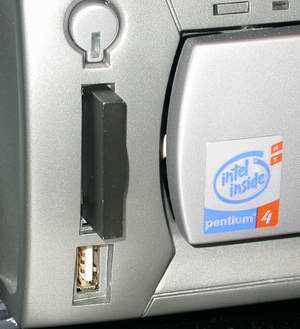
picture of it
Here is a picture of it in an actual computer.
-
Anandtech has coverage as well
Anandtech has a page about EFI as well. It also includes pictures of computers with EFI.
-
Re:Via processorHere's a quick and dirty link with the closest numbers I can find:
http://www.anandtech.com/showdoc.html?i=1396&p =6
This is for the 667MHz chip (which I believe uses the same core). Short answer: a C3 is about 1/3 slower than a Duron or Celeron of similar speed in business benchmarks.
I use the 533MHz Eden processor in a number of embedded-type projects, where CPU power is not overly important. No moving parts, though, is, and the 533MHz doesn't need a CPU fan!
-
Screw OC*, watch out for fraud
The following is my personal opinion, please do your own research on this company.
These guys are notorious for setting up review sites to promote their own products. They use employees to falsely promote their products on different message boards. Resellerratings has had to clear some of this companies sites reviews because they were getting too many fraudulent positive reviews mixed in with the negative reviews.
If you notice this article was submitted by one of their employees. When did
IMO, this is one of those companies that gives Internet commerce a bad name.
You have now been warned.
ResellerRating's OC System
OCZ Memory: Are they able to regain consumer trust?
Update on 'OCZ EXPOSED' -
Screw OC*, watch out for fraud
The following is my personal opinion, please do your own research on this company.
These guys are notorious for setting up review sites to promote their own products. They use employees to falsely promote their products on different message boards. Resellerratings has had to clear some of this companies sites reviews because they were getting too many fraudulent positive reviews mixed in with the negative reviews.
If you notice this article was submitted by one of their employees. When did
IMO, this is one of those companies that gives Internet commerce a bad name.
You have now been warned.
ResellerRating's OC System
OCZ Memory: Are they able to regain consumer trust?
Update on 'OCZ EXPOSED' -
Not so fast, sucker!
Your statement is flat-out untrue. Most current games are CPU-limited, even with the best video cards.
See this article on AnandTech: http://www.anandtech.com/video/showdoc.html?i=1650
In particular, the charts on this page that indicate that the GeForce4 Ti4600 scales up with CPUs all the way to the fastest CPU that was available when the article was written.
Faster graphics cards will only be further limited by the CPU, achieving a smaller percentage of their full potential.
The PC architecture is a little less imbalanced than you think. Spending extra money on a video card your CPU can't feed triangles too fast enough is a complete waste of money, too. Sucker.
-
Not so fast, sucker!
Your statement is flat-out untrue. Most current games are CPU-limited, even with the best video cards.
See this article on AnandTech: http://www.anandtech.com/video/showdoc.html?i=1650
In particular, the charts on this page that indicate that the GeForce4 Ti4600 scales up with CPUs all the way to the fastest CPU that was available when the article was written.
Faster graphics cards will only be further limited by the CPU, achieving a smaller percentage of their full potential.
The PC architecture is a little less imbalanced than you think. Spending extra money on a video card your CPU can't feed triangles too fast enough is a complete waste of money, too. Sucker.
-
Re:Intel comes on TOP
It all depends on which benchmarks you choose. Take a look at the anandtech set of benchmarks for the barton and there are several where the barton wins. Since the architechures are so different, its easy for a reviewer to bias the results towards different CPUs (even inadvertently) by which benchmarks they use. This makes it important to look at a wide variety of benchmarks and try to compare cpus based on which apps a person needs the speed in. That assumes that speed is the main concen.
-
Re:Jujst(sic) ahead of their time...
"the whole PC graphics market has gotten well ahead of their consumers and software"
"Serious Sam 2 AA/Aniso Performance
Minimum FPS - 1600x1200x32
GeForce FX 5800 Ultra: 41.7fps"
http://www.anandtech.com/video/showdoc.html?i=1779 &p=14
Considering that a game that has been out for over 13 months now still is not playable with the maximum quality settings would seem to directly contradict your absurd statement. -
Re:Go INTEL!
one of the coolest things I read about banias/centrino was this IDF demo, where it was drawing only 7 watts while doing 30fps mpeg4 encoding, then dropping down to 1 watt when it was done.
-
Re:640 kb on die cacheIs it really 640Kbyte in total?
AnandTech, one of the more reputable review sites, explains the differences between Intel's and AMD'S cache implementations here.
All caches are not created equal and thus you should not expect AMD to benefit as much as Intel did from going to a 512KB L2 cache. Intel follows a much more conventional L1/L2 cache architecture that uses what is known as the inclusive principle; the inclusive principle states that the contents of the L1 cache are also included in the L2 cache. The obvious downside to this is that the L2 cache contains some data that is redundant that the CPU will never use (if it needs it, it will get it from the faster L1 cache). From the CPU's point of view, an inclusive cache just means it has less room to store its much needed data in, but from the standpoint of the rest of the system an inclusive cache does provide one advantage - if data is updated in main memory (e.g. through DMA), the memory controller only has to check the L2 cache to update data, and there is no need to check L1 for coherency. This is a small but important benefit to an inclusive cache architecture.
Basically, the Althon does not duplicate the contents of its L1 cache in the L2 cache. So it does have a 640KB cache in total (128K of which is faster than rest...)
The opposite, obviously, is a cache subsystem that follows the exclusive principle - such as the Athlon XP's cache. In this case, the contents of the L1 cache are not duplicated in the L2 cache, thus favoring cache size over the added latency of checking for two levels of cache coherency in DMA situations. The exclusive approach makes much more sense for AMD, considering the Athlon XP has an extremely large 128KB L1 cache that would be very costly to duplicate in L2 (compared to Intel's 8KB L1 Data cache that is easily duplicated in L2). -
Re:640 kb on die cacheIs it really 640Kbyte in total?
AnandTech, one of the more reputable review sites, explains the differences between Intel's and AMD'S cache implementations here.
All caches are not created equal and thus you should not expect AMD to benefit as much as Intel did from going to a 512KB L2 cache. Intel follows a much more conventional L1/L2 cache architecture that uses what is known as the inclusive principle; the inclusive principle states that the contents of the L1 cache are also included in the L2 cache. The obvious downside to this is that the L2 cache contains some data that is redundant that the CPU will never use (if it needs it, it will get it from the faster L1 cache). From the CPU's point of view, an inclusive cache just means it has less room to store its much needed data in, but from the standpoint of the rest of the system an inclusive cache does provide one advantage - if data is updated in main memory (e.g. through DMA), the memory controller only has to check the L2 cache to update data, and there is no need to check L1 for coherency. This is a small but important benefit to an inclusive cache architecture.
Basically, the Althon does not duplicate the contents of its L1 cache in the L2 cache. So it does have a 640KB cache in total (128K of which is faster than rest...)
The opposite, obviously, is a cache subsystem that follows the exclusive principle - such as the Athlon XP's cache. In this case, the contents of the L1 cache are not duplicated in the L2 cache, thus favoring cache size over the added latency of checking for two levels of cache coherency in DMA situations. The exclusive approach makes much more sense for AMD, considering the Athlon XP has an extremely large 128KB L1 cache that would be very costly to duplicate in L2 (compared to Intel's 8KB L1 Data cache that is easily duplicated in L2). -
Re:Hurry Up!
While 3+GHz might be overkill right now, is it overkill few years down the road?
Yes. Hell, for most applications, 1GHz is overkill
now, and it's been how long since we hit
that point? Now, I'm all for making long-term
investments, but it's hard to justify an extra
$600 for just a processor, when I can get a
whole 1GHz+ machine for as much that will last just
as long.
The money saved can be used to buy things in the
meantime, like ice cream. Everybody likes ice cream. -
Re:Anandtech link
This is much better. http://www.anandtech.com/printarticle.html?i=1783
--
If cars were open sourced, there would be at least five steering wheels in the cockpit, each operating differently -- but you'd be able to shift gears with your car stereo. -
Anandtech link
so post 'em below..
OK Then... Anandtech link
-
Re:"We upgrade the Geforce 2 Ti 200 ..."
Except there never was any such card.
Hmm, I wonder what this is sitting on my desk that I just removed from my machine and replaced with a Radeon 9000 Pro? Sure looks like a Geforce 2 Ti200.
To the best of my knowledge, anyway. This would be fine except they mention this imaginary product twice.
Since the best of your knowledge isn't very good, you should refrain from such declarative statements. The Geforce2 Ti200 was released at the same time as the Geforce3 Ti200 and Ti500 (i.e., much later than the other Geforce2 models). It's the same chip as the Geforce2 GTS, Pro and Ultra, but with a die shrink and different clock rate. Somewhere in between a Pro and an Ultra in clock.
Read more here.
-
RDRAM vs. DDR
Why is RDRAM a bad thing for computer users? I think promoting better technology is a good thing for users. If people promoted the better technology instead of the cheaper one, companies couldn't dump their obsolete products on the market in order to decrease sales of the better technology. If people bought a product based on its quality, we would have things like organic LED displays instead of truly obsolete LCD screens and CRT monitors.
I don't know where to stand on the issue of who had prior art, but I have talked to people on both sides and they seem to both have valid arguments. I don't believe any of the companies involved are boyscouts. What I am interseted in is which is the better technology. Obviously, if you look at the specs of Rambus, you will see that although DDR 266 is just a lower stepping of PC133 Ram and the bus is double-pumped. Rambus, on the other hand, has a lot more going for it. Its bus has less traces and allows you to more easily have more than one channel. It is also capable of shutting off portions of itself not in use.
If you look at a Tom's Hardware article It mentions that there is a limitation with using parallel designs due to uncontrolled impedence.
Not to mention that memory benchmarks available on many sites show that DDR can't continiously maintian its bandwidth like Rambus can. Instead, its bandwidth is spurty.
Also, Rambus has many new things on the backburner.
Rambus memory has also become much cheaper. I believe in leaving the decision of whether or not
Rambus infringed on patents to the courts and going for what is the best technology so you can give it a boost. What holds back RDRAM in terms of price is that there isn't enough being sold. -
Anand vs. Tom
Ok everyone do me a favor, after you've read the Tom's review PLEASE read the Anandtech review.
I started to feel sick to my stomach when I realized how sloppy and shallow Tom's review was done. Anand truly is "the wonderboy"; he reveals some highly critical issues and has some sweet rollovers comparing the antialiasing and anistropic filtering of each card. He reveals that at the same visual quality settings, the 9700 Pro tops the FX in almost all the benchmarks. "NVIDIA takes the crown! No question about it..." Oh paaleease Tom, research the product before you post! Kudos to Anandtech. -
Sounds familiar...
This reminds me of when the Radeon LE came out ($71) and by doing a couple simple things with some 3rd party software and the windows registry, you could make it perform the same as a Radeon DDR, which sold for about $139 at the time.
-
Windows XP Media Center edition
I dunno if its been covered or not, I throw my modest karma at your mercy, BUT:
Microsoft has released their WinXP MCE doing all the stuff that the artcle talks about wanting to do, and it supposedly outdoes any free option out there. Unfortunatly it only works with a couple video cards, and still uses a lot of cpu power to do what it does. Despite this, Anandtech thinks that the interface is nice and polished and does quite well. I guess the major downside is that you cant actually buy it, you have to buy a computer loaded with it from the start. nngh
Oh well, take a look at that anandtech article and make your own judgements. -
Re:Sure is a cheap fab
That is funny... I don't know where you read the article but the one that is linked in the story states that it is $2.3 Billion...
story
The combination of the Fab and the Dresden Design Center (DDC) was said to require a $2.3 billion investment, with close to $2B already spent and the remaining $300M due to be used by the end of 2003. For an advanced microprocessor fabrication facility like Fab 30 this is the going rate for start-up costs, which is a major part of the reason why there are only two big competitors in the desktop CPU market; with such high barriers to entry, it's very difficult to become a mass market competitor in the CPU business.
sounds like someone looking for cheap karma -
Direct link
-
Re:ISB Router
I work for a small review website. I would have to agree, with the exception of mikhailtech. most of these websites are incredibly poor operations. Several of them except money to do hardware reviews and almost all of them are indescriminate about "editor's choice" awards.
With Tom's Hardware in the situation is it, (Tom cannot enter the united states without getting arrested. Apparently he never paid any American advertisers over the last 4 years), HardOCP and AT are the last large, decent review websites left.
If you want to read about some low quality hardware a 16 year old got for free, check out V1p3r'Sup4Caf3H4rdw4re. If you want to read actual unbiased reviews, try a big name hardware site. Hell, you might even learn something.
AnandTech.com Editor -
Re:SPEC CPU2000
The 3.06 GHz Hyper-Threaded Pentium 4 performs even better than the Xeon I listed.
Dell Precision WorkStation 350 (Pentium 4)
3067 GHz
SPECint2000 = 1130
SPECint_base2000 = 1085
SPECfp2000 = 1103
SPECfp_base2000 = 1092
CINT2000
CFP2000 -
Squeezes out Linux-based de100cThe Linux-based Digtal Entertainment Center (HP de100c, see this group) was discontinued very recently -- just about the time the XP Media Center PCs showed up from HP. The de100c cost about $1000, and had plenty of local storage. It can store/play music, stream internet radio, and display pix (if you enable a hidden UI feature). It can "record" CDs to internal MP3 files, and write CDs (audio, or CD-ROM with MP3 file) using its built-in CD-RW drive.
The new PCs, with Windows XP Media Center Edition (see AnandTech review here of XP Media Center), run about $1500.
HP's new 'Digital Media Receiver' is very similar to the Rio 'Audio Receiver' -- all the way down to the required Windows/PC hosted custom server/streamer program. These receivers are $200-300 depending on configuration.
So HP altered their product line to include only high-end (MediaPC) and low-end (Media Receiver) devices. Personally, I think there is still room in the middle of this product line for the now discontinued, Linux-based de100c. Perhaps Microsoft did not agree? Now, the only devices you can buy from HP to stream audio (or show pix) require Windows: Windows is either resident on the high-end $1500 Media PC itself, or running on a nearby Windows/PC so that the low-end $200-300 Digital Media Receiver can get its stream. Either way, the $100 MS tax is paid.
Note that the Rio (and Dell version) of the Audio Receiver quickly gained a Linux-hosted server: http://www.mock.com/receiver/server/. Perhaps the HP device will gain such support as well?
If you want a media receiver that only streams and has no local storage, I think the AudioTron is a more flexible solution. It can use any SMB (windows-style) share on the network, and does not require a proprietary windows-hosted server application.
For the slightly more DIY-minded crowd, there is also the SliMP3...
-
Re:Do I really want this?
Perhaps you should read the article first. This page in particular.
-
Re:Some things are better left off the computer
I have a TiVo. I use a TiVo instead of piping my cable through my computer for a reason. Its the same reason I have a football games on my GameCube. Some things are just better without the PC. Why would I use awkward PVR abilities of my PC (requiring me to sit in a specific spot, and use a mouse) when I can plop down on my couch and pick up the TiVo remote?
Did you not read the article and decide to comment anyway (like this guy, who at least made a valid point)? Or are you Reading Comprehension Challenged? Either way, surely you've noticed the variety of remote control hardware and software available for PC's now? Not to mention that the XP MCE PC reviewed comes with a (preinstalled even!) remote? And, there's always ATI's Remote Wonder to work with your AIW card, so you can sit on your couch and control your PC in another room. And of course, the XP MCE (as mentioned in the article, is targeted towards being either in your living room or your TV and PC combined (for smaller spaces)p>
There's a reason speciliazed components sell better than PC software geared to do the same thing.
Yeah, but I always thought it was a matter of stability and ease of setup, and sometimes even quality...but maybe it's more consumer ignorance, which you might want to look into becoming the poster child of.
-
Re:Some things are better left off the computer
I have a TiVo. I use a TiVo instead of piping my cable through my computer for a reason. Its the same reason I have a football games on my GameCube. Some things are just better without the PC. Why would I use awkward PVR abilities of my PC (requiring me to sit in a specific spot, and use a mouse) when I can plop down on my couch and pick up the TiVo remote?
Did you not read the article and decide to comment anyway (like this guy, who at least made a valid point)? Or are you Reading Comprehension Challenged? Either way, surely you've noticed the variety of remote control hardware and software available for PC's now? Not to mention that the XP MCE PC reviewed comes with a (preinstalled even!) remote? And, there's always ATI's Remote Wonder to work with your AIW card, so you can sit on your couch and control your PC in another room. And of course, the XP MCE (as mentioned in the article, is targeted towards being either in your living room or your TV and PC combined (for smaller spaces)p>
There's a reason speciliazed components sell better than PC software geared to do the same thing.
Yeah, but I always thought it was a matter of stability and ease of setup, and sometimes even quality...but maybe it's more consumer ignorance, which you might want to look into becoming the poster child of.
-
Yikes! Huge file sizes!
Any TiVo owner will immediately spot this little issue: namely, that 93GB of disk space equals 5 hours 8 minutes of record time at best quality. Even if the space available for PVR functions is 75% of 93GB (as implied in the screenshot), that's still about five hours for 70GB of disk space.
Maybe MCE's definition of "best" quality is dramatically higher than TiVo's, but TiVo can store about 9 hours at "best" quality on a 30GB HD. On a machine with 70GB of disk space, it would easily be able to record over 20 hours at best quality. Why can MCE only squeeze a quarter as much video onto the same amount of space?
Also, I find it ironic that MCE has such grievous hardware requirements. It requires a TV tuner card with hardware MPEG-2 encoding, yet still requires a really fast CPU, fast RAM and a fast, big hard drive. Admittedly, TiVo's aren't sharing their hardware with other apps (in most cases), but first-generation TiVos managed to squeak by with a 50MHz PowerPC and 4400RPM hard drives. Surely, MS can squeeze stutter-free performance out of moderately powerful CPUs and HDs, can't they?
-
Re:Personally I now prefer the integrated solution
Too bad you don't allow comments in your journal. I too have the BEV PVR and love it. Two comments:
- The interactive weather isn't just Canadian cities, it's international
- One of the great features in the BEV PVR, and missing from the MS box is the UHF remote, which means my PVR can be in my basement, away from my TV.
- The IR thing that made you shit your pants
- I didn't know the 5100 was discontinued
Now -
direct link