Slashdot Mirror
Domain: arstechnica.com
Stories and comments across the archive that link to arstechnica.com.
Stories · 4,420
-
Valve Is Shutting Down Steam's Greenlight Community Voting System (theverge.com)
Valve's crowdsourced Greenlight submission program, which let the gaming community select which games get chosen for distribution via Steam, is shutting down after nearly five years. It will be replaced with a new system called Steam Direct that will charge developers a fee for each title they plan to distribute. The Verge reports: Steam Greenlight was launched in 2012 as a way for indie developers to get their games on Steam, even if they weren't working with a big publisher that had a relationship with Valve. Steam users would vote on Greenlight games, and Valve would accept titles with enough support to suggest that they'd sell well. Kroll says that "over 100" Greenlight titles have made $1 million or more. But Greenlight has also had significant problems. Developers could game the system by offering rewards for votes, and worthy projects could get lost amidst a slew of bad proposals. Since Valve ultimately made the call on including games, the process could also seem arbitrary and opaque. The big question is whether what's replacing it is better. To get a game on Steam Direct, developers will need to "complete a set of digital paperwork, personal or company verification, and tax documents similar to the process of applying for a bank account." Then, they'll pay an application fee for each game, "which is intended to decrease the noise in the submission pipeline" -- a polite way of saying that it will make people think twice before spending money submitting a low-quality game. Steam Direct is supposed to launch in spring of 2017, but the application fee hasn't been decided yet. Developer feedback has apparently suggested anything from $100 -- the current Greenlight submission fee -- and $5,000. -
Tesla Employee Calls For Unionization, Musk Says That's 'Morally Outrageous' (arstechnica.com)
"In a Medium post published today, Tesla employee Jose Moran detailed working conditions at the company's Freemont factory and called for the factory workers to unionize with United Auto Workers (UAW)," reports Ars Technica. In response, Elon Musk told Gizmodo via Twitter Direct Messages: "Our understanding is that this guy was paid by the UAW to join Tesla and agitate for a union. Frankly, I find this attack to be morally outrageous. Tesla is the last car company left in California, because costs are so high." Musk went on to blame the UAW for killing the New United Motor Manufacturing, Inc (NUMMI), which sold the Fremont factory to Musk in 2010. Ars Technica reports: Tesla currently employs more than 5,000 non-union workers at its Fremont, CA-based factory. Moran wrote that the workers are often faced with "excessive mandatory overtime" and earn between $17 and $21 hourly, compared with the national average of $25.58 hourly for most autoworkers in the U.S. The Tesla employee noted that the astronomical cost of living in the Bay Area makes $21 an hour difficult to live on. Moran also claimed that the factory's "machinery is often not ergonomically compatible with our bodies," and requires "too much twisting and turning and extra physical movement to do jobs that could be simplified if workers' input were welcomed." He added that at one point, six out of eight people on his team were out on medical leave "due to various work-related injuries." -
Microsoft Teases Windows 10's Upcoming 'Project Neon' Design Language (windowscentral.com)
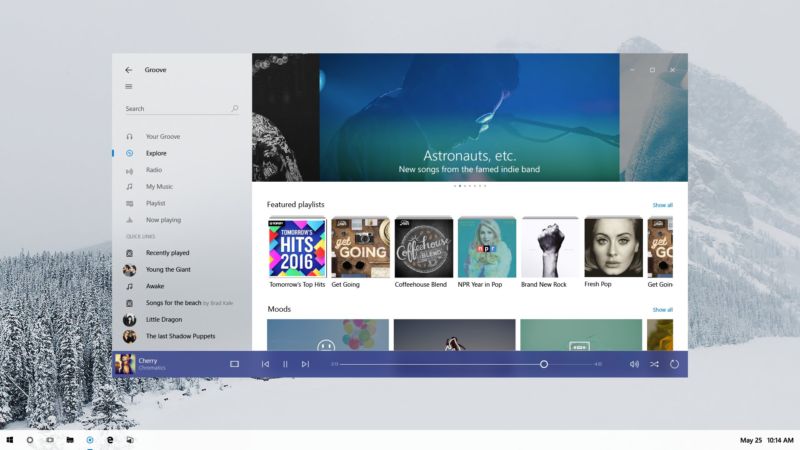
An anonymous reader quotes a report from Windows Central: Microsoft just gave developers a sneak peek at Project Neon, Microsoft's upcoming design language for Windows 10 that aims to add fluidity, animation and blur to apps and the operating system. We exclusively revealed that this was in the works in late 2016, and today Microsoft has given us a first peak at what Project Neon will look like. During the Windows Developer Day livestream, an image of Project Neon was seen the background of one of the PowerPoint slides being shown off on stage. Although not much, it's further confirmation that this is the end goal for Windows 10's UI, and Project Neon will be bringing a fresh coat of paint to apps. Project Neon should benefit all types of Windows 10 devices, including Windows 10 Mobile, HoloLens and even Xbox. We're still several months away from Project Neon being everywhere in Windows 10, and we're expecting to see more at BUILD this coming May. In fact, a lot of the Project Neon APIs are available in the latest Insider Preview builds of Windows 10, meaning developers can already begin taking advantage of these new user interfaces and design language! Animations and transitions are a big deal with Project Neon, with the goal of making the operating system and apps feel like they work together. Peter Bright does a good job summarizing the looks of the screenshot via Ars Technica: "The picture shows a refreshed version of the Groove music app on a Windows desktop. The fundamentals of the app and its layout aren't changed, underscoring that Neon is very much an iteration of the current Metro/Microsoft Design Language (MDL). The window has shed its discrete title bar and one pixel border, with the application content now extending to the very edge of the window. The search text field no longer has a box around it, and the left hand pane has a hint of translucency to it." You can view the screenshot here and judge it for yourself. -
Comcast Should Stop Claiming It Has 'Fastest Internet,' Ad Board Rules (arstechnica.com)
The advertising industry's self-regulation body said Comcast should stop saying in advertisements that it "delivers the fastest internet in America" and the "fastest in-home Wi-Fi." The evidence Comcast uses to substantiate those claims is not sufficient, ruled the National Advertising Review Board (NARB). Ars Technica reports: Verizon had challenged Comcast's advertising claims, leading to today's ruling. Comcast said today that it disagreed with the findings but will comply with the decision. Comcast used crowdsourced speed test data from Ookla to make its claim about Xfinity Internet speeds. "Ookla's data showed only that Xfinity consumers who took advantage of the free tests offered on the Speedtest.net website subscribed to tiers of service with higher download speeds than Verizon FiOS consumers who took advantage of the tests," today's NARB announcement said. The Ookla data's accuracy wasn't questioned, but it was judged to be "not a good fit for an overall claim that an ISP delivers 'America's fastest Internet.'" The ad review board said Comcast's "America's Fastest Internet" claims gave the impression that Comcast offers "overall Internet speed superiority in all tiers of service that it provides." The Comcast ads also give the impression that Comcast "delivers the fastest download and upload speeds," whereas the Ookla data showed that the top 10 percent of Verizon FiOS customers had higher upload speeds than the top 10 percent of Comcast customers. -
We Finally Have a Computer That Can Survive the Surface of Venus (arstechnica.com)
Planet Venus is one of the most inhospitable places in the solar system. The surface temperature there is 470C (878F). This has been one of the key challenges that has prevented us from deeply exploring Venus. Normal chips can only function until around 250C, but it appears, we will soon have a computer that can withstand Venus' weather. From a report on ArsTechnica: Now, researchers out of NASA's Glenn Research Centre appear to have cracked the other big problem with high-temperature integrated circuits: they've crafted interconnects -- the tiny wires that connect transistors and other integrated components together -- that can also survive the extreme conditions on Venus. The NASA Glenn researchers combined the new interconnects with some SiC transistors to create a ceramic-packaged chip. The chip was then placed into the GEER -- the Glenn Extreme Environments Rig, a machine that can maintain Venus-like temperature and pressure for hundreds of hours at a time. The chip, a simple 3-stage oscillator, kept functioning at a steady 1.26MHz for 521 hours (21.7) days before the GEER had to be shut down. -
World of Warcraft Gold Can Now Be Used To Buy Other Blizzard Games (arstechnica.com)
An anonymous reader quotes a report from Ars Technica: It has been almost two years now since Blizzard began letting World of Warcraft players pay for their monthly game-time subscriptions using in-game gold rather than real money. Now, Blizzard is expanding that effort by letting players indirectly trade WoW gold for in-game items in other Blizzard games like Hearthstone and Overwatch. The new feature is really just a slight tweak to the WoW Token, a specialized item that can be purchased for $20 (£15/€20) in real money or for a free-floating, in-game gold price at World of Warcraft auction houses. Those Tokens can still be exchanged for 30 days of World of Warcraft subscription time, but as of this week, they can also be redeemed for $15 in balance on your Battle.net account. (European figures TBC.) That balance can then be spent on packs of Hearthstone cards, Overwatch Loot Boxes, Heroes of the Storm skins, or even downloadable copies of games like StarCraft II and Diablo III. That means that a dedicated WoW player can now fund a multigame Blizzard habit simply by earning enough in-game gold. You'd better be prepared to farm a lot of gold, though. The purchase price for a WoW Token at the auction house can fluctuate wildly -- as of this writing, the tokens have gone for anywhere from 59,833 gold to 108,924 gold in the last 24 hours, according to tracking site WowToken.info. That gives each in-game gold piece a rough value between 1/100th and 2/100th of a cent, when converted to Blizzard.net balance. -
World of Warcraft Gold Can Now Be Used To Buy Other Blizzard Games (arstechnica.com)
An anonymous reader quotes a report from Ars Technica: It has been almost two years now since Blizzard began letting World of Warcraft players pay for their monthly game-time subscriptions using in-game gold rather than real money. Now, Blizzard is expanding that effort by letting players indirectly trade WoW gold for in-game items in other Blizzard games like Hearthstone and Overwatch. The new feature is really just a slight tweak to the WoW Token, a specialized item that can be purchased for $20 (£15/€20) in real money or for a free-floating, in-game gold price at World of Warcraft auction houses. Those Tokens can still be exchanged for 30 days of World of Warcraft subscription time, but as of this week, they can also be redeemed for $15 in balance on your Battle.net account. (European figures TBC.) That balance can then be spent on packs of Hearthstone cards, Overwatch Loot Boxes, Heroes of the Storm skins, or even downloadable copies of games like StarCraft II and Diablo III. That means that a dedicated WoW player can now fund a multigame Blizzard habit simply by earning enough in-game gold. You'd better be prepared to farm a lot of gold, though. The purchase price for a WoW Token at the auction house can fluctuate wildly -- as of this writing, the tokens have gone for anywhere from 59,833 gold to 108,924 gold in the last 24 hours, according to tracking site WowToken.info. That gives each in-game gold piece a rough value between 1/100th and 2/100th of a cent, when converted to Blizzard.net balance. -
Dozens of Popular iOS Apps Vulnerable To Intercept of TLS-Protected Data (arstechnica.com)
Researchers at Sudo Security Group Inc. discovered seventy-six popular applications in Apple's iOS App Store that had implemented encrypted communications with their back-end services in such a way that user information could be intercepted by a man-in-the-middle attack. According to Ars Technica, the applications could be fooled by a forged certificate sent back by a proxy, allowing their Transport Layer Security to be unencrypted and examined as it is passed over the internet. From their report: The discovery was initially the result of bulk analysis done by Sudo's verify.ly, a service that performs bulk static analysis of application binaries from Apple's App Store. Will Strafach, president of Sudo, verified the applications discovered by the system were vulnerable in the lab, using a network proxy configured with its own Secure Socket Layer certificate. In the post about his findings being published today, Strafach wrote: "During the testing process, I was able to confirm 76 popular iOS applications allow a silent man-in-the-middle attack to be performed on connections which should be protected by TLS (HTTPS), allowing interception and/or manipulation of data in motion. According to Apptopia estimates, there has been a combined total of more than 18,000,000 (Eighteen Million) downloads of app versions which are confirmed to be affected by this vulnerability."
The data exposed by the vulnerability in each of the applications varied in sensitivity. For just less than half -- 33 of the applications -- the risk was relatively low, as most of the data was "partially sensitive analytics data," Strafach said. These apps included a number of third-party "uploader" apps for Snapchat (which exposed Snapchat usernames and passwords) and the Vice News app, among others. In 24 cases, the exposed data included login credentials or session tokens that would allow an attacker to hijack the account associated with the application, though those accounts were not tied to highly sensitive data. However, the remaining 19 applications left sensitive data exposed to attack. In these cases, Strafach "confirmed ability to intercept financial or medical service login credentials and/or session authentication tokens for logged in users." -
Overwatch Director Speaks Out Against Console Mouse/keyboard Adapters (arstechnica.com)
Striek quotes a report from Ars Technica: Regardless of where you fall in the long-running debate between keyboard/mouse and analog stick controls, you could historically be relatively sure that everyone on a single platform would be playing with the same control scheme. Recently, though, third-party adapters have started allowing console players to use a mouse and keyboard effectively on dedicated consoles, throwing off the competitive balance in a way that Overwatch director Jeff Kaplan doesn't appreciate. "The Overwatch team objects to the use of mouse and keyboard on console," Kaplan wrote on the Battle.net forums. "We have contacted both first-party console manufacturers and expressed our concern about the use of mouse and keyboard and input conversion devices. We have lobbied and will continue to lobby for first-party console manufacturers to either disallow mouse and keyboard and input conversion devices or openly and easily support mouse and keyboard for all players," he continued. "I encourage you to reach out to the hardware manufacturers and express your concerns (but please do so in a productive and respectful way)." Kaplan is talking about products like the XIM4, a $125 hub that lets certain USB keyboards and mice work natively with some Xbox One and PS4 games (as well as PS3 and Xbox 360 titles). IoGear's $100 Keymander does much the same thing, claiming to be "compatible with all console games." These devices essentially emulate a standard controller through a combination of hardware and software settings, disguising the keyboard and mouse inputs in a way that makes them hard for a developer to detect. This is a problem in competitive online games like Overwatch, where the quickness and precision of mouse aiming can give a decisive advantage over players using a slower and clunkier analog stick. -
Overwatch Director Speaks Out Against Console Mouse/keyboard Adapters (arstechnica.com)
Striek quotes a report from Ars Technica: Regardless of where you fall in the long-running debate between keyboard/mouse and analog stick controls, you could historically be relatively sure that everyone on a single platform would be playing with the same control scheme. Recently, though, third-party adapters have started allowing console players to use a mouse and keyboard effectively on dedicated consoles, throwing off the competitive balance in a way that Overwatch director Jeff Kaplan doesn't appreciate. "The Overwatch team objects to the use of mouse and keyboard on console," Kaplan wrote on the Battle.net forums. "We have contacted both first-party console manufacturers and expressed our concern about the use of mouse and keyboard and input conversion devices. We have lobbied and will continue to lobby for first-party console manufacturers to either disallow mouse and keyboard and input conversion devices or openly and easily support mouse and keyboard for all players," he continued. "I encourage you to reach out to the hardware manufacturers and express your concerns (but please do so in a productive and respectful way)." Kaplan is talking about products like the XIM4, a $125 hub that lets certain USB keyboards and mice work natively with some Xbox One and PS4 games (as well as PS3 and Xbox 360 titles). IoGear's $100 Keymander does much the same thing, claiming to be "compatible with all console games." These devices essentially emulate a standard controller through a combination of hardware and software settings, disguising the keyboard and mouse inputs in a way that makes them hard for a developer to detect. This is a problem in competitive online games like Overwatch, where the quickness and precision of mouse aiming can give a decisive advantage over players using a slower and clunkier analog stick. -
Patent Troll With Good Record in Past Sues Netflix, SoundCloud, Vimeo, Others Over Offline Downloads (arstechnica.com)
Netflix added the ability to download movies and TV episodes for offline viewing in November last year. Music streaming service SoundCloud, and video hosting service Vimeo have had this feature for quite some time, too. But they are all being sued now by a patent troll. From an ArsTechnica report: The plaintiff is a company few have heard of: Blackbird Technologies, a company with no products or assets other than patents. Blackbird's business is to buy up patent rights and file lawsuits over them, a business known colloquially as "patent trolling." Last week, Blackbird (who tells potential clients about being "able to litigate at reduced costs and achieve results") filed lawsuits against Netflix, SoundCloud, Vimeo, Starz, Mubi, and Studio 3 Partners, which owns the Epix TV channel. [...] The patent-holding company, which filed the lawsuits in Delaware federal court, has good reason to hope for success. The '362 patent already has a track record of squeezing settlement cash out of big companies. -
DRM Company Denuvo Forgets To Secure Its Server, Leaks Two Years Of Emails (torrentfreak.com)
Denuvo "left several private directories on its website open to the public," TorrentFreak wrote Sunday, calling it "an embarrassing blunder" for the digital rights management company. "Members of the cracking community are downloading and scrutinizing the contents," the site reports, with one of the finds being an 11-megabyte text file which apparently contains every message sent through Denuvo's web site since 2014. An anonymous reader writes: There's a message from Google's security team, one from Capcom Japan, and "dozens of emails from angry pirates, each looking to vent their anger," according to TorrentFreak. Ars Technica reports that there's also a 2015 message from Microsoft about "an upcoming initiative," as well as messages several game studios, and even one from the producers of Mavis Beacon Teaches Typing. "Combing the log file brings up countless spam messages, along with complaints, confused 'why won't this game work' queries from apparent pirates, and even threats (an example: 'for what you did to arkham knight I will find you and I will kill you and all of your loved ones, this I promise you CEO of this SHIT drm')."
"Since Denuvo's contact page does not contain a link to a private e-mail address -- only a contact form and a phone number to the company's Austrian headquarters -- the form appears to also have been used by many game developers and publishers." And in addition, "much of Denuvo's web database content appears to be entirely unsecured, with root directories for 'fileadmin' and 'logs' sitting in the open right now."
In addition, there's also a slideshow -- which has since been uploaded to Imgur -- bragging that "With over 300 man years of development experience among us, we clearly know what we're doing." -
FCC Rescinds Claim That AT&T, Verizon Violated Net Neutrality (arstechnica.com)
jriding writes: The Federal Communications Commission's new Republican leadership has rescinded a determination that ATT and Verizon Wireless violated net neutrality rules with paid data cap exemptions. The FCC also rescinded several other Wheeler-era reports and actions. The FCC released its report on the data cap exemptions (aka "zero-rating") in the final days of Democrat Tom Wheeler's chairmanship. Because new Chairman Ajit Pai opposed the investigation, the FCC has now formally closed the proceeding. The FCC's Wireless Telecommunications Bureau sent letters to ATT, Verizon, and T-Mobile USA notifying the carriers "that the Bureau has closed this inquiry. Any conclusions, preliminary or otherwise, expressed during the course of the inquiry will have no legal or other meaning or effect going forward." The FCC's Wireline Competition Bureau also sent a letter to Comcast closing an inquiry into the company's Stream TV cable service, which does not count against data caps. The FCC issued an order that "sets aside and rescinds" the Wheeler-era report on zero-rating. All "guidance, determinations, and conclusions" from that report are rescinded, and it will have no legal bearing on FCC proceedings going forward, the order said. ATT and Verizon allow their own video services (DirecTV and Go90, respectively) to stream on their mobile networks without counting against customers' data caps, while charging other video providers for the same data cap exemptions. The FCC under Wheeler determined that ATT and Verizon unreasonably interfered with online video providers' ability to compete against the carriers' video services. -
FCC Rescinds Claim That AT&T, Verizon Violated Net Neutrality (arstechnica.com)
jriding writes: The Federal Communications Commission's new Republican leadership has rescinded a determination that ATT and Verizon Wireless violated net neutrality rules with paid data cap exemptions. The FCC also rescinded several other Wheeler-era reports and actions. The FCC released its report on the data cap exemptions (aka "zero-rating") in the final days of Democrat Tom Wheeler's chairmanship. Because new Chairman Ajit Pai opposed the investigation, the FCC has now formally closed the proceeding. The FCC's Wireless Telecommunications Bureau sent letters to ATT, Verizon, and T-Mobile USA notifying the carriers "that the Bureau has closed this inquiry. Any conclusions, preliminary or otherwise, expressed during the course of the inquiry will have no legal or other meaning or effect going forward." The FCC's Wireline Competition Bureau also sent a letter to Comcast closing an inquiry into the company's Stream TV cable service, which does not count against data caps. The FCC issued an order that "sets aside and rescinds" the Wheeler-era report on zero-rating. All "guidance, determinations, and conclusions" from that report are rescinded, and it will have no legal bearing on FCC proceedings going forward, the order said. ATT and Verizon allow their own video services (DirecTV and Go90, respectively) to stream on their mobile networks without counting against customers' data caps, while charging other video providers for the same data cap exemptions. The FCC under Wheeler determined that ATT and Verizon unreasonably interfered with online video providers' ability to compete against the carriers' video services. -
Nvidia Stops Promotional Game Resales By Tying Codes To Hardware (arstechnica.com)
Nvidia is putting a stop to the resale of bundled promotional game keys by tying them to a specific graphics card purchase, according to Ars Technica. Users will now have to redeem codes via the GeForce Experience (GFE) app, which is directly linked to third-party services like Steam and Uplay. Users must also ensure that the requisite graphics card is "installed before redemption." GFE then performs "a hardware verification step to ensure the coupon code is redeemed on the system with the qualifying GPU." From the report: Previously, retailers sent promotional game codes to customers that purchased a qualifying product. Those codes could then be redeemed on Nvidia's website, which spit out the relevant Steam, Uplay, Origin, or Microsoft Store key. Since the promotional game codes were not tied to a specific account, many users took to either gifting spare keys to friends or selling them on eBay in order to offset the cost of the graphics card purchase. [Ars Technica has updated their report with additional information:] Nvidia has confirmed that while GFE checks to ensure a user has installed a qualifying graphics card like a GTX 1070 or GTX 1080, the game itself is not permanently linked to the hardware. GFE's hardware check is based only on the wider product range, and not on a specific serial number. The company has also confirmed that the redemption process permanently adds the game to the appropriate third-party service. For example, if users redeems a promotional game key through to Steam, that game will be useable on any other device, just like normal Steam games. Users can also opt to uninstall GFE, or install a different graphics card, once the promotional code has been redeemed and still retain full ownership of the game. A full set of instructions for redeeming codes is now available on Nvidia's website. -
Hackers Take Over Unsecured Radio Transmitters, Play Anti-Trump Song (arstechnica.com)
Ars Technica is reporting that "a certain model of Low Power FM radio transmitter with known vulnerabilities has been targeted in a new wave of radio-station hacks this week." Hackers have taken advantage of an exploit that was known all the way back in April 2016 to take over terrestrial radio stations and broadcast the YG and Nipsey Hussle song "Fuck Donald Trump." From the report: News of the song's unexpected playback on radio stations began emerging shortly after Trump's inauguration on January 20, and the hack has continued to affect LPFM stations -- a type of smaller-radius radio station that began to roll out after the FCC approved the designation in 2000. Over a dozen stations experienced confirmed hacks in recent weeks, with more unconfirmed reports trickling in across the nation. Thus far, the stations' commonality isn't the states of operation or music formats; it's the transmitter. Specifically, hackers have targeted products in the Barix Exstreamer line, which can decode many audio file formats and send them along for LPFM transmission. As Barix told its products' owners in 2016, Exstreamer devices openly connected to the Internet are incredibly vulnerable to having their remote login passwords discovered and systems compromised. The company recommends using full, 24-character passwords and placing any live Internet connections behind firewalls or VPNs. Reports have yet to connect any dots on why the exploit has apparently focused on the YG and Nipsey Hussle song -- though it is fairly popular, having recently finished in the Top 15 of the Village Voice's 2016 Pazz and Jop music critics' poll. Plus, the uncensored lyrics and topical nature are certainly more likely to catch people's attention, especially when played on stations with formats like oldies, classic rock, and Tejano. -
2.5 Million Xbox and PlayStation Gamers' Details Have Been Leaked From Piracy Forums (thenextweb.com)
Xbox360ISO.com and PSPISO.com have been hacked by an unknown attacker in late 2015 and the details of the 2.5 million users affected have been leaked online. The leaked information contains email addresses, IP addresses, usernames and passwords. The Next Web reports: It seems that the operator of these sites did nothing to protect the latter, as all passwords were "protected" using the MD5 hashing system, which is trivially easy to overcome. For reference, that's the same hashing system used by LinkedIn. As the names of these sites imply, they were used to share pirated copies of games for Microsoft and Sony's gaming platforms. They also both have a thriving community where people discussed a variety of tech-related topics, including gaming news and software development. If you think you might have had an account on these sites at one point, and want to check if you were affected, you can visit Troy Hunt's Have I Been Pwned. If you have, it's worth emphasizing that anyone who gained access to that site, and anyone who has since downloaded the data dump, will be able to discern your password. If you've used it on another website or platform, you should change it. -
Tim Sweeney Dislikes Windows 10 Cloud Rumors, Calls OS 'Crush Steam Edition' (arstechnica.com)
An anonymous reader quotes a report from Ars Technica: The rumor that Microsoft is building a version of Windows 10 that can only install apps from the Windows Store has drawn criticism before it's even official. Epic Games founder Tim Sweeney took to Twitter to attack the operating system. Although its real name is named Windows 10 Cloud, he's dubbing it "Windows 10 Crush Steam Edition." Sweeney is convinced that Microsoft wants to exercise total control over the Windows platform and destroy Valve's Steam. Last year, Sweeney attacked the Universal Windows Platform API. He claimed (incorrectly) that third-party stores such as Steam would be unable to sell and distribute UWP games, leaving them at a disadvantage relative to Microsoft's own store. He followed this statement with the claim that Microsoft would systematically modify Windows so as to make Steam work worse and worse, such that gamers grow tired of it and switch to the Windows Store. In his tweets, Sweeney recognizes that Microsoft wants to compete with Chrome OS. But he fails to understand what the company must do to actually offer that competition. He wrote that "it's great for Microsoft to compete with ChromeOS, but NOT BY LOCKING OUT COMPETING WINDOWS SOFTWARE STORES." This statement represents a failure to understand that "locking out competing Windows software stores" is, for this market, positively desirable. It's fundamental to preventing the hard-to-support free-for-all that a Windows system would otherwise represent. A later tweet does recognize the value of this lockdown, but Sweeney says that Windows 10's "great admin features to limit user software installs" should be used instead. This again suggests a misunderstanding of the target market: systems will be used with little to no supervision and with little to no administrative oversight. To compete against the Chromebook, Windows 10 Cloud needs to be locked down by default, and it must not offer any ready way to disable that lockdown. In his complaints, Sweeney also fails to consider what happens should the Chromebook threat go unaddressed: Chromebooks running Chrome OS will proliferate. These machines will not support third-party stores, they will not support Steam, and they will not support PC games at all. Sweeney may not want Microsoft to build this world, but even if Microsoft doesn't create it, Google already is doing so. -
Tim Sweeney Dislikes Windows 10 Cloud Rumors, Calls OS 'Crush Steam Edition' (arstechnica.com)
An anonymous reader quotes a report from Ars Technica: The rumor that Microsoft is building a version of Windows 10 that can only install apps from the Windows Store has drawn criticism before it's even official. Epic Games founder Tim Sweeney took to Twitter to attack the operating system. Although its real name is named Windows 10 Cloud, he's dubbing it "Windows 10 Crush Steam Edition." Sweeney is convinced that Microsoft wants to exercise total control over the Windows platform and destroy Valve's Steam. Last year, Sweeney attacked the Universal Windows Platform API. He claimed (incorrectly) that third-party stores such as Steam would be unable to sell and distribute UWP games, leaving them at a disadvantage relative to Microsoft's own store. He followed this statement with the claim that Microsoft would systematically modify Windows so as to make Steam work worse and worse, such that gamers grow tired of it and switch to the Windows Store. In his tweets, Sweeney recognizes that Microsoft wants to compete with Chrome OS. But he fails to understand what the company must do to actually offer that competition. He wrote that "it's great for Microsoft to compete with ChromeOS, but NOT BY LOCKING OUT COMPETING WINDOWS SOFTWARE STORES." This statement represents a failure to understand that "locking out competing Windows software stores" is, for this market, positively desirable. It's fundamental to preventing the hard-to-support free-for-all that a Windows system would otherwise represent. A later tweet does recognize the value of this lockdown, but Sweeney says that Windows 10's "great admin features to limit user software installs" should be used instead. This again suggests a misunderstanding of the target market: systems will be used with little to no supervision and with little to no administrative oversight. To compete against the Chromebook, Windows 10 Cloud needs to be locked down by default, and it must not offer any ready way to disable that lockdown. In his complaints, Sweeney also fails to consider what happens should the Chromebook threat go unaddressed: Chromebooks running Chrome OS will proliferate. These machines will not support third-party stores, they will not support Steam, and they will not support PC games at all. Sweeney may not want Microsoft to build this world, but even if Microsoft doesn't create it, Google already is doing so. -
Tim Sweeney Dislikes Windows 10 Cloud Rumors, Calls OS 'Crush Steam Edition' (arstechnica.com)
An anonymous reader quotes a report from Ars Technica: The rumor that Microsoft is building a version of Windows 10 that can only install apps from the Windows Store has drawn criticism before it's even official. Epic Games founder Tim Sweeney took to Twitter to attack the operating system. Although its real name is named Windows 10 Cloud, he's dubbing it "Windows 10 Crush Steam Edition." Sweeney is convinced that Microsoft wants to exercise total control over the Windows platform and destroy Valve's Steam. Last year, Sweeney attacked the Universal Windows Platform API. He claimed (incorrectly) that third-party stores such as Steam would be unable to sell and distribute UWP games, leaving them at a disadvantage relative to Microsoft's own store. He followed this statement with the claim that Microsoft would systematically modify Windows so as to make Steam work worse and worse, such that gamers grow tired of it and switch to the Windows Store. In his tweets, Sweeney recognizes that Microsoft wants to compete with Chrome OS. But he fails to understand what the company must do to actually offer that competition. He wrote that "it's great for Microsoft to compete with ChromeOS, but NOT BY LOCKING OUT COMPETING WINDOWS SOFTWARE STORES." This statement represents a failure to understand that "locking out competing Windows software stores" is, for this market, positively desirable. It's fundamental to preventing the hard-to-support free-for-all that a Windows system would otherwise represent. A later tweet does recognize the value of this lockdown, but Sweeney says that Windows 10's "great admin features to limit user software installs" should be used instead. This again suggests a misunderstanding of the target market: systems will be used with little to no supervision and with little to no administrative oversight. To compete against the Chromebook, Windows 10 Cloud needs to be locked down by default, and it must not offer any ready way to disable that lockdown. In his complaints, Sweeney also fails to consider what happens should the Chromebook threat go unaddressed: Chromebooks running Chrome OS will proliferate. These machines will not support third-party stores, they will not support Steam, and they will not support PC games at all. Sweeney may not want Microsoft to build this world, but even if Microsoft doesn't create it, Google already is doing so. -
Annual Hard Drive Reliability Report: 8TB, HGST Disks Top Chart Racking Up 45 Years Without Failure (arstechnica.com)
Online backup solution provider Backblaze has released its much-renowned, annual hard drives reliability and failure report. From a report on ArsTechnica: The company uses self-built pods of 45 or 60 disks for its storage. Each pod is initially assembled with identical disks, but different pods use different sizes and models of disk, depending on age and availability. The standout finding: three 45-disk pods using 4TB Toshiba disks, and one 45-disk pod using 8TB HGST disks, went a full year without a single spindle failing. These are, respectively, more than 145 and 45 years of aggregate usage without a fault. The Toshiba result makes for a nice comparison against the drive's spec sheet. Toshiba rates that model as having a 1-million-hour mean time to failure (MTTF). Mean time to failure (or mean time between failures, MTBF -- the two measures are functionally identical for disks, with vendors using both) is an aggregate property: given a large number of disks, Toshiba says that you can expect to see one disk failure for every million hours of aggregated usage. Over 2016, those disks accumulated 1.2 million hours of usage without failing, healthily surpassing their specification. [...] For 2016 as a whole, Backblaze saw its lowest ever failure rate of 1.95 percent. Though a few models remain concerning -- 13.6 percent of one older model of Seagate 4TB disk failed in 2016 -- most are performing well. Seagate's 6TB and 8TB models, in contrast, outperform the average. Improvements to the storage pod design that reduce vibration are also likely to be at play. -
FDA Confirms Toxicity of Homeopathic Baby Products; Maker Refuses To Recall (arstechnica.com)
Last year in November, the Federal Trade Commission issued an enforcement policy statement that requires over-the-counter (OTC) homeopathic drugs and product makers to disclose in their advertisement and labeling that there is no evidence that homeopathic products are effective. At around the same time the FTC issued the statement, the Food and Drug Administration was investigating homeopathic teething gels and tablets, which may have been improperly diluted, thus causing serious harm to infants. The FDA investigated 10 infant deaths and more than 400 reports of seizures, fever, and vomiting and confirmed Friday that belladonna, also known as deadly nightshade, was the prime suspect. When the FDA notified the products' maker, Hyland's, the company would not agree to recall the products. Ars Technica reports: Hyland's has been defensive since the FDA first opened the investigation last September. In an October press release, the company referred to agency's warnings as a source of "confusion" and assured consumers that the products are safe and effective. Still, the company discontinued distribution in the U.S. The National Center for Homeopathy, which has ties with Hyland's, slammed the FDA, calling the agency's warnings "arbitrary and capricious." In an "action alert," the organization went on to suggest that warning was prompted by "groups interested in seeing homeopathy destroyed" and led to "fear mongering" by the media. As before, the FDA is urging parents to avoid the homeopathic teething products and toss any already purchased. The FDA does not evaluate or approve the homeopathic products, which have no proven health benefit. Belladonna is an active ingredient in those products, but is supposed to be heavily diluted. Homeopaths belief that ailments and diseases can be cured by trace amounts or "memories" of toxic substances that mimic or cause similar symptoms. Homeopathy is a pseudoscience that has been squarely debunked, offering no more than a placebo effect. In its announcement Friday, the FDA said it had found inconsistent amounts of belladonna in Hyland's products. Some of the amounts were "far exceeding" what was intended. -
FDA Confirms Toxicity of Homeopathic Baby Products; Maker Refuses To Recall (arstechnica.com)
Last year in November, the Federal Trade Commission issued an enforcement policy statement that requires over-the-counter (OTC) homeopathic drugs and product makers to disclose in their advertisement and labeling that there is no evidence that homeopathic products are effective. At around the same time the FTC issued the statement, the Food and Drug Administration was investigating homeopathic teething gels and tablets, which may have been improperly diluted, thus causing serious harm to infants. The FDA investigated 10 infant deaths and more than 400 reports of seizures, fever, and vomiting and confirmed Friday that belladonna, also known as deadly nightshade, was the prime suspect. When the FDA notified the products' maker, Hyland's, the company would not agree to recall the products. Ars Technica reports: Hyland's has been defensive since the FDA first opened the investigation last September. In an October press release, the company referred to agency's warnings as a source of "confusion" and assured consumers that the products are safe and effective. Still, the company discontinued distribution in the U.S. The National Center for Homeopathy, which has ties with Hyland's, slammed the FDA, calling the agency's warnings "arbitrary and capricious." In an "action alert," the organization went on to suggest that warning was prompted by "groups interested in seeing homeopathy destroyed" and led to "fear mongering" by the media. As before, the FDA is urging parents to avoid the homeopathic teething products and toss any already purchased. The FDA does not evaluate or approve the homeopathic products, which have no proven health benefit. Belladonna is an active ingredient in those products, but is supposed to be heavily diluted. Homeopaths belief that ailments and diseases can be cured by trace amounts or "memories" of toxic substances that mimic or cause similar symptoms. Homeopathy is a pseudoscience that has been squarely debunked, offering no more than a placebo effect. In its announcement Friday, the FDA said it had found inconsistent amounts of belladonna in Hyland's products. Some of the amounts were "far exceeding" what was intended. -
US Intelligence Seeks a Universal Translator For Text Search In Any Language (arstechnica.com)
An anonymous reader quotes a report from Ars Technica: The Intelligence Advanced Research Projects Agency (IARPA), the U.S. Intelligence Community's own science and technology research arm, has announced it is seeking contenders for a program to develop what amounts to the ultimate Google Translator. IARPA's Machine Translation for English Retrieval of Information in Any Language (MATERIAL) program intends to provide researchers and analysts with a tool to search for documents in their field of concern in any of the more than 7,000 languages spoken worldwide. The specific goal, according to IARPA's announcement, is an "'English-in, English-out' information retrieval system that, given a domain-sensitive English query, will retrieve relevant data from a large multilingual repository and display the retrieved information in English as query-biased summaries." Users would be able to search vast numbers of documents with a two-part query: the first giving the "domain" of the search in terms of what sort of information they are seeking (for example, "Government," "Science," or "Health") and the second an English word or phrase describing the information sought (the examples given in the announcement were "zika virus" and "Asperger's syndrome"). The system would be used in situations like natural disasters or military interventions in remote locations where the military has little or no local language expertise. Those taking on the MATERIAL program will be given access to a limited set of machine translation and automatic speech recognition training data from multiple languages "to enable performers to learn how to quickly adapt their methods to a wide variety of materials in various genres and domains," the announcement explained. "As the program progresses, performers will apply and adapt these methods in increasingly shortened time frames to new languages... Since language-independent approaches with quick ramp up time are sought, foreign language expertise in the languages of the program is not expected." The good news for the broader linguistics and technology world is that IARPA expects the teams competing on MATERIAL to publicly publish their research. If successful, this moonshot for translation could radically change how accessible materials in many languages are to the rest of the world.
-
Scientists Finally Turn Hydrogen Into a Metal, Ending a 80-Year Quest (arstechnica.com)
An anonymous reader quotes a report from Ars Technica: In 1935, scientists predicted that the simplest element, hydrogen, could also become metallic under pressure, and they calculated that it would take 25 GigaPascals to force this transition (each Gigapascal is about 10,000 atmospheres of pressure). That estimate, in the words of the people who have finally made metallic hydrogen, "was way off." It took until last year for us to reach pressures where the normal form of hydrogen started breaking down into individual atoms -- at 380 GigaPascals. Now, a pair of Harvard researchers has upped the pressure quite a bit more, and they have finally made hydrogen into a metal. All of these high-pressure studies rely on what are called diamond anvils. This hardware places small samples between two diamonds, which are hard enough to stand up to extreme pressure. As the diamonds are forced together, the pressure keeps going up. Current calculations suggested that metallic hydrogen might require just a slight boost in pressure from the earlier work, at pressures as low as 400 GigaPascals. But the researchers behind the new work, Ranga Dias and Isaac Silvera, discovered it needed quite a bit more than that. In making that discovery, they also came to a separate realization: normal diamonds weren't up to the task. "Diamond failure," they note, "is the principal limitation for achieving the required pressures to observe SMH," where SMH means "solid metallic hydrogen" rather than "shaking my head." The team came up with some ideas about what might be causing the diamonds to fail and corrected them. One possibility was surface defects, so they etched all diamonds down by five microns to eliminate these. Another problem may be that hydrogen under pressure could be forced into the diamond itself, weakening it. So they cooled the hydrogen to slow diffusion and added material to the anvil that absorbed free hydrogen. Shining lasers through the diamond seemed to trigger failures, so they switched to other sources of light to probe the sample. After loading the sample and cranking up the pressure (literally -- they turned a handcrank), they witnessed hydrogen's breakdown at high pressure, which converted it from a clear sample to a black substance, as had been described previously. But then, somewhere between 465 and 495 GigaPascals, the sample turned reflective, a key feature of metals The study has been published in the journal Science. -
Trump's FCC Chairman Pick Ajit Pai Vows To Close Broadband 'Digital Divide' (arstechnica.com)
An anonymous reader quotes a report from Ars Technica: On his first full day as Federal Communications Commission Chairman, Republican Ajit Pai yesterday spoke to FCC staff and said one of his top priorities will be bringing broadband to all Americans. "One of the most significant things that I've seen during my time here is that there is a digital divide in this country -- between those who can use cutting-edge communications services and those who do not," Pai said (transcript). "I believe one of our core priorities going forward should be to close that divide -- to do what's necessary to help the private sector build networks, send signals, and distribute information to American consumers, regardless of race, gender, religion, sexual orientation, or anything else. We must work to bring the benefits of the digital age to all Americans." Pai promised to "hear all points of view -- to approach every issue with a literal open door and a figurative open mind," as the FCC "confronts this and many other challenges." Pai didn't offer any specific initiatives for closing the digital divide yesterday, but in September 2016 he outlined a "digital empowerment agenda." The plan included "remov[ing] regulatory barriers to broadband deployment," changes to pole attachment rules, and "dig once" policies that install broadband conduit when roads are dug up during any road and highway construction project. He also proposed setting aside 10 percent of spectrum auction proceeds for deployment of mobile broadband in rural areas. Pai suggested requiring mobile carriers to build out service to 95 percent of the population in areas where they have spectrum licenses; he noted that some licenses only required service for 66 percent or 75 percent of residents, a problem in sparsely populated rural areas. At the same time, he proposed extending initial spectrum license terms from 10 years to 15 years to give the carriers more time to complete the construction. Pai also proposed creating "gigabit opportunity zones" in areas where average household income is below 75 percent of the national median. In these areas, state and local lawmakers would have to "adopt streamlined, broadband deployment-friendly policies," and there would be tax incentives and tax credits for companies building high-speed networks. -
Cervical Cancer Just Got Much Deadlier -- Because Scientists Fixed a Math Error (arstechnica.com)
An anonymous reader quotes a report from Ars Technica: Cervical cancer is 77 percent more deadly for black women and 44 percent more deadly for white women than previously thought, researchers report today in the journal Cancer. But the lethal boosts aren't from more women actually dying than before -- they're from scientists correcting their own calculation error. In the past, their estimates didn't account for women who had undergone hysterectomies -- which almost always removes the cervix, and with it the risk of getting cervical cancer. We don't include men in our calculation because they are not at risk for cervical cancer and by the same measure, we shouldn't include women who don't have a cervix," Anne F. Rositch, the study's lead author and an epidemiologist at Johns Hopkins told The New York Times. For the study, the researchers looked at national cervical cancer mortality data collected between 2000 to 2012. They also looked into national survey data on the prevalence of hysterectomies. Then, they used those figures to adjust the number of women at risk of dying of cervical cancer. The researchers found that black women have a mortality rate of 10.1 per 100,000. For white women, the rate is 4.7 per 100,000. Past estimates had those rates at 5.7 and 3.2, respectively. The new death rate for black women in the US is on par with that of developing countries. Though the new study wasn't designed to address racial disparities, experts speculate that the large difference reflects unequal access to preventative medicine and quality healthcare. -
Foxconn Considers $7 Billion Screen Factory In US, Which Could Create Up To 50,000 Jobs (arstechnica.com)
An anonymous reader quotes a report from Ars Technica: Foxconn, the Taiwanese contract manufacturing company best known for its partnership with Apple, has said that it is mulling a $7 billion investment in U.S. manufacturing that could create between 30,000 and 50,000 jobs. According to The Wall Street Journal, Foxconn Chairman Terry Gou says the company is talking with the state of Pennsylvania among others about getting the land and electricity subsidies it would need to build a factory. "If U.S. state governments are willing to provide these terms, and we calculate and it is cheaper than shipping from China or Japan, then why wouldn't Sharp build a factory in the U.S.?" said Gou. The factory would build flat-panel screens under the Sharp name -- Foxconn bought Sharp around this time last year for $5.1 billion. Sharp President Tai Jeng-wu hinted in October of 2016 that U.S. manufacturing could be a possibility for Sharp, and he also indicated that Apple could begin using OLED display panels in future iPhones. Apple currently uses OLED in the Apple Watch and in the new MacBook Pro's Touch Bar, but otherwise it hasn't pushed to adopt the technology as some Android phone manufacturers have. -
Are Squirrels A Bigger Threat To Our Critical Infrastructure? (bbc.com)
"The real threat to global critical infrastructure is not enemy states or organizations but squirrels, according to one security expert." Long-time Slashdot reader randomErr quotes the BBC. Cris Thomas has been tracking power cuts caused by animals since 2013... His Cyber Squirrel 1 project was set up to counteract what he called the "ludicrousness of cyber-war claims by people at high levels in government and industry", he told the audience at the Shmoocon security conference in Washington. Squirrels topped the list with 879 "attacks", followed by birds with 434 attacks and then snakes at 83 attacks.
Those three animals -- along with rats -- have caused 1,700 different power cuts affecting nearly 5,000,000 people . -
Second Time In 9 Months: AT&T Raises Phone Activation Fee $5, Now Charges $25 (arstechnica.com)
For the second time in 9 months, ATT is raising its activation and upgrade fee. In April 2016, the fee for non-contract customers was raised from $15 to $20. Today, it has been raised another $5, from $20 to $25, according to PhoneScoop. Ars Technica reports: As the mobile carrier switched from contracts to device payment plans, ATT initially did not charge an activation and upgrade fee for customers who brought their own phone or bought one from ATT on an installment plan. But in July 2015, ATT started charging a $15 activation fee to customers who don't sign two-year contracts. (ATT also raised the activation/upgrade fee for contract customers from $40 to $45 in July 2015.) The $25 fee is charged for new activations or upgrades when customers purchase devices on installment agreements, ATT says. Customers who bring their own phone to the network are charged the $25 fee when they activate a new line of service, but not when they upgrade phones on an existing line. "We are making a minor adjustment to our activation and upgrade fees. The change is effective today," ATT told Ars. ATT also still charges the $45 activation and upgrade fee on two-year contracts, but those contracts are "available only on select devices." -
Netflix Calls Out HBO For Not Letting Subscribers Binge On New Shows (arstechnica.com)
An anonymous reader quotes a report from Ars Technica: Netflix has gleefully poked a stick at its competitors in the video streaming market, after revealing it had added more than seven million subscribers to its service in the last three months of 2016. HBO also got a special mention. In a letter to shareholders, the company's boss Reed Hastings teased the TV drama maker by noting that, if the BBC was willing to stream shows before they air on television, then maybe HBO -- which has rigidly stuck to its strategy of eking out episodes to viewers -- should do the same. He said: "[...] the BBC has become the first major linear network to announce plans to go binge-first with new seasons, favoring internet over linear viewers. We presume HBO is not far behind the BBC. In short, it's becoming an Internet TV world, which presents both challenges and opportunities for Netflix as we strive to earn screen time." But it's worth noting that HBO currently has an exclusive deal with Sky in the UK, Ireland, Germany, Austria, and Italy, allowing the broadcaster to have first-run rights on the likes of Game of Thrones and Westworld until 2020 -- so any such change isn't likely to happen in the near-term. Late last year, it struck a deal with Netflix rival Amazon, allowing Prime members in the US to sign up for a monthly HBO subscription. "We have a very successful partnership with this great company that continues to evolve," said HBO exec Sofia Chang in December. The company's HBO Now streaming service shows no sign of shifting strategy, either, with programs airing simultaneously on traditional TV and online. -
Report: PS4 Is Selling Twice As Well As Xbox One (arstechnica.com)
The latest numbers released by analysts suggest that the Sony PlayStation 4 is selling twice as many units worldwide as the Xbox One since both systems launched in late 2013. The data comes from a new SuperData report on the Nintendo Switch, which is backed up by Niko Partners analyst Daniel Ahmad. SuperData mentions an installed base of 26 million Xbox One units and 55 million PS4 units. Ars Technica reports: Ahmad's chart suggests that Microsoft may have sold slightly more than half of the 53.4 million PS4 units that Sony recently announced it had sold through January 1. Specific numbers aside, though, it's clear Microsoft has done little to close its console sales gap with Sony over the past year -- and may have actually lost ground in that time. The last time we did our own estimate of worldwide console sales, through the end of 2015, we showed the Xbox One with about 57 percent as many systems sold as the PS4 (21.49 million vs. 37.7 million). That lines up broadly with numbers leaked by EA at the time, which suggest the Xbox One had sold about 52.9 percent as well as the PS4 (19 million vs. 35.9 million). One year later, that ratio has dipped to just above or even a bit below 50 percent, according to these reports. The relative sales performance of the Xbox One and PS4 doesn't say anything direct about the health or quality of those platforms, of course. Microsoft doesn't seem to be in any danger of abandoning the Xbox One platform any time soon and has, in fact, recently committed to upgrading it via Project Scorpio later this year. The gap between PS4 and Xbox One sales becomes important only if it becomes so big that publishers start to consider the Xbox One market as a minor afterthought that can be safely ignored for everything but niche games. -
Report: PS4 Is Selling Twice As Well As Xbox One (arstechnica.com)
The latest numbers released by analysts suggest that the Sony PlayStation 4 is selling twice as many units worldwide as the Xbox One since both systems launched in late 2013. The data comes from a new SuperData report on the Nintendo Switch, which is backed up by Niko Partners analyst Daniel Ahmad. SuperData mentions an installed base of 26 million Xbox One units and 55 million PS4 units. Ars Technica reports: Ahmad's chart suggests that Microsoft may have sold slightly more than half of the 53.4 million PS4 units that Sony recently announced it had sold through January 1. Specific numbers aside, though, it's clear Microsoft has done little to close its console sales gap with Sony over the past year -- and may have actually lost ground in that time. The last time we did our own estimate of worldwide console sales, through the end of 2015, we showed the Xbox One with about 57 percent as many systems sold as the PS4 (21.49 million vs. 37.7 million). That lines up broadly with numbers leaked by EA at the time, which suggest the Xbox One had sold about 52.9 percent as well as the PS4 (19 million vs. 35.9 million). One year later, that ratio has dipped to just above or even a bit below 50 percent, according to these reports. The relative sales performance of the Xbox One and PS4 doesn't say anything direct about the health or quality of those platforms, of course. Microsoft doesn't seem to be in any danger of abandoning the Xbox One platform any time soon and has, in fact, recently committed to upgrading it via Project Scorpio later this year. The gap between PS4 and Xbox One sales becomes important only if it becomes so big that publishers start to consider the Xbox One market as a minor afterthought that can be safely ignored for everything but niche games. -
Report: PS4 Is Selling Twice As Well As Xbox One (arstechnica.com)
The latest numbers released by analysts suggest that the Sony PlayStation 4 is selling twice as many units worldwide as the Xbox One since both systems launched in late 2013. The data comes from a new SuperData report on the Nintendo Switch, which is backed up by Niko Partners analyst Daniel Ahmad. SuperData mentions an installed base of 26 million Xbox One units and 55 million PS4 units. Ars Technica reports: Ahmad's chart suggests that Microsoft may have sold slightly more than half of the 53.4 million PS4 units that Sony recently announced it had sold through January 1. Specific numbers aside, though, it's clear Microsoft has done little to close its console sales gap with Sony over the past year -- and may have actually lost ground in that time. The last time we did our own estimate of worldwide console sales, through the end of 2015, we showed the Xbox One with about 57 percent as many systems sold as the PS4 (21.49 million vs. 37.7 million). That lines up broadly with numbers leaked by EA at the time, which suggest the Xbox One had sold about 52.9 percent as well as the PS4 (19 million vs. 35.9 million). One year later, that ratio has dipped to just above or even a bit below 50 percent, according to these reports. The relative sales performance of the Xbox One and PS4 doesn't say anything direct about the health or quality of those platforms, of course. Microsoft doesn't seem to be in any danger of abandoning the Xbox One platform any time soon and has, in fact, recently committed to upgrading it via Project Scorpio later this year. The gap between PS4 and Xbox One sales becomes important only if it becomes so big that publishers start to consider the Xbox One market as a minor afterthought that can be safely ignored for everything but niche games. -
Oculus Accused of Destroying Evidence, Zuckerberg To Testify In $2 Billion Lawsuit (arstechnica.com)
An anonymous reader quotes a report from Ars Technica: ZeniMax Media, the parent company of both Bethesda Softworks and Id Software, says it will prove at trial that John Carmack and others at Oculus stole trade secrets to "misappropriate" virtual reality technology that was first developed while Carmack was working at Id Software. What's more, ZeniMax is now accusing Oculus of "intentional destruction of evidence to cover up their wrongdoing." Mark Zuckerberg, CEO of Oculus parent company Facebook, is scheduled to respond to those accusations in testimony starting tomorrow, according to a report by Business insider. ZeniMax's statement comes after Carmack testified at trial last week, saying the case was "ridiculous and absurd." His testimony echoed Oculus' initial reaction when ZeniMax's accusations first surfaced in 2014. In court filings leading up to the trial, ZeniMax detailed its case that Carmack, while still an employee at Id Software, "designed the specifications and functionality embodied in the Rift SDK and directed its development." Carmack's technology and guidance allegedly "literally transformed" Oculus founder Palmer Luckey's early Rift prototype from a "primitive virtual reality headset" that was "little more than a display panel." Carmack allegedly used "copyrighted computer code, trade secret information, and technical know-how" from his time at ZeniMax after he moved to Oculus as CTO in 2013. As the trial began last week (as reported by a Law360 summary, registration required), Carmack told the court of his development of a virtual reality demo for Doom 3 in 2012 and his search for a VR headset that would be suitable to run it. That's when he says he got in touch with Luckey, leading to the now legendary E3 2012 demo that introduced Oculus to the public. ZeniMax is seeking $2 billion in damage, which matches the value that Facebook paid for Oculus in 2014. The trial is expected to last three weeks. -
Oculus Accused of Destroying Evidence, Zuckerberg To Testify In $2 Billion Lawsuit (arstechnica.com)
An anonymous reader quotes a report from Ars Technica: ZeniMax Media, the parent company of both Bethesda Softworks and Id Software, says it will prove at trial that John Carmack and others at Oculus stole trade secrets to "misappropriate" virtual reality technology that was first developed while Carmack was working at Id Software. What's more, ZeniMax is now accusing Oculus of "intentional destruction of evidence to cover up their wrongdoing." Mark Zuckerberg, CEO of Oculus parent company Facebook, is scheduled to respond to those accusations in testimony starting tomorrow, according to a report by Business insider. ZeniMax's statement comes after Carmack testified at trial last week, saying the case was "ridiculous and absurd." His testimony echoed Oculus' initial reaction when ZeniMax's accusations first surfaced in 2014. In court filings leading up to the trial, ZeniMax detailed its case that Carmack, while still an employee at Id Software, "designed the specifications and functionality embodied in the Rift SDK and directed its development." Carmack's technology and guidance allegedly "literally transformed" Oculus founder Palmer Luckey's early Rift prototype from a "primitive virtual reality headset" that was "little more than a display panel." Carmack allegedly used "copyrighted computer code, trade secret information, and technical know-how" from his time at ZeniMax after he moved to Oculus as CTO in 2013. As the trial began last week (as reported by a Law360 summary, registration required), Carmack told the court of his development of a virtual reality demo for Doom 3 in 2012 and his search for a VR headset that would be suitable to run it. That's when he says he got in touch with Luckey, leading to the now legendary E3 2012 demo that introduced Oculus to the public. ZeniMax is seeking $2 billion in damage, which matches the value that Facebook paid for Oculus in 2014. The trial is expected to last three weeks. -
Oculus Accused of Destroying Evidence, Zuckerberg To Testify In $2 Billion Lawsuit (arstechnica.com)
An anonymous reader quotes a report from Ars Technica: ZeniMax Media, the parent company of both Bethesda Softworks and Id Software, says it will prove at trial that John Carmack and others at Oculus stole trade secrets to "misappropriate" virtual reality technology that was first developed while Carmack was working at Id Software. What's more, ZeniMax is now accusing Oculus of "intentional destruction of evidence to cover up their wrongdoing." Mark Zuckerberg, CEO of Oculus parent company Facebook, is scheduled to respond to those accusations in testimony starting tomorrow, according to a report by Business insider. ZeniMax's statement comes after Carmack testified at trial last week, saying the case was "ridiculous and absurd." His testimony echoed Oculus' initial reaction when ZeniMax's accusations first surfaced in 2014. In court filings leading up to the trial, ZeniMax detailed its case that Carmack, while still an employee at Id Software, "designed the specifications and functionality embodied in the Rift SDK and directed its development." Carmack's technology and guidance allegedly "literally transformed" Oculus founder Palmer Luckey's early Rift prototype from a "primitive virtual reality headset" that was "little more than a display panel." Carmack allegedly used "copyrighted computer code, trade secret information, and technical know-how" from his time at ZeniMax after he moved to Oculus as CTO in 2013. As the trial began last week (as reported by a Law360 summary, registration required), Carmack told the court of his development of a virtual reality demo for Doom 3 in 2012 and his search for a VR headset that would be suitable to run it. That's when he says he got in touch with Luckey, leading to the now legendary E3 2012 demo that introduced Oculus to the public. ZeniMax is seeking $2 billion in damage, which matches the value that Facebook paid for Oculus in 2014. The trial is expected to last three weeks. -
Oculus Accused of Destroying Evidence, Zuckerberg To Testify In $2 Billion Lawsuit (arstechnica.com)
An anonymous reader quotes a report from Ars Technica: ZeniMax Media, the parent company of both Bethesda Softworks and Id Software, says it will prove at trial that John Carmack and others at Oculus stole trade secrets to "misappropriate" virtual reality technology that was first developed while Carmack was working at Id Software. What's more, ZeniMax is now accusing Oculus of "intentional destruction of evidence to cover up their wrongdoing." Mark Zuckerberg, CEO of Oculus parent company Facebook, is scheduled to respond to those accusations in testimony starting tomorrow, according to a report by Business insider. ZeniMax's statement comes after Carmack testified at trial last week, saying the case was "ridiculous and absurd." His testimony echoed Oculus' initial reaction when ZeniMax's accusations first surfaced in 2014. In court filings leading up to the trial, ZeniMax detailed its case that Carmack, while still an employee at Id Software, "designed the specifications and functionality embodied in the Rift SDK and directed its development." Carmack's technology and guidance allegedly "literally transformed" Oculus founder Palmer Luckey's early Rift prototype from a "primitive virtual reality headset" that was "little more than a display panel." Carmack allegedly used "copyrighted computer code, trade secret information, and technical know-how" from his time at ZeniMax after he moved to Oculus as CTO in 2013. As the trial began last week (as reported by a Law360 summary, registration required), Carmack told the court of his development of a virtual reality demo for Doom 3 in 2012 and his search for a VR headset that would be suitable to run it. That's when he says he got in touch with Luckey, leading to the now legendary E3 2012 demo that introduced Oculus to the public. ZeniMax is seeking $2 billion in damage, which matches the value that Facebook paid for Oculus in 2014. The trial is expected to last three weeks. -
Oculus Accused of Destroying Evidence, Zuckerberg To Testify In $2 Billion Lawsuit (arstechnica.com)
An anonymous reader quotes a report from Ars Technica: ZeniMax Media, the parent company of both Bethesda Softworks and Id Software, says it will prove at trial that John Carmack and others at Oculus stole trade secrets to "misappropriate" virtual reality technology that was first developed while Carmack was working at Id Software. What's more, ZeniMax is now accusing Oculus of "intentional destruction of evidence to cover up their wrongdoing." Mark Zuckerberg, CEO of Oculus parent company Facebook, is scheduled to respond to those accusations in testimony starting tomorrow, according to a report by Business insider. ZeniMax's statement comes after Carmack testified at trial last week, saying the case was "ridiculous and absurd." His testimony echoed Oculus' initial reaction when ZeniMax's accusations first surfaced in 2014. In court filings leading up to the trial, ZeniMax detailed its case that Carmack, while still an employee at Id Software, "designed the specifications and functionality embodied in the Rift SDK and directed its development." Carmack's technology and guidance allegedly "literally transformed" Oculus founder Palmer Luckey's early Rift prototype from a "primitive virtual reality headset" that was "little more than a display panel." Carmack allegedly used "copyrighted computer code, trade secret information, and technical know-how" from his time at ZeniMax after he moved to Oculus as CTO in 2013. As the trial began last week (as reported by a Law360 summary, registration required), Carmack told the court of his development of a virtual reality demo for Doom 3 in 2012 and his search for a VR headset that would be suitable to run it. That's when he says he got in touch with Luckey, leading to the now legendary E3 2012 demo that introduced Oculus to the public. ZeniMax is seeking $2 billion in damage, which matches the value that Facebook paid for Oculus in 2014. The trial is expected to last three weeks. -
Raspberry Pi Upgrades Compute Module With 10 Times the CPU Performance (arstechnica.com)
An anonymous reader quotes a report from Ars Technica: The Raspberry Pi Compute Module is getting a big upgrade, with the same processor used in the recently released Raspberry Pi 3. The Compute Module, which is intended for industrial applications, was first released in April 2014 with the same CPU as the first-generation Raspberry Pi. The upgrade announced today has 1GB of RAM and a Broadcom BCM2837 processor that can run at up to 1.2GHz. "This means it provides twice the RAM and roughly ten times the CPU performance of the original Compute Module," the Raspberry Pi Foundation announcement said. This is the second major version of the Compute Module, but it's being called the "Compute Module 3" to match the last flagship Pi's version number. The new Compute Module has more flexible storage options than the original. "One issue with the [Compute Module 1] was the fixed 4GB of eMMC flash storage," the announcement said. But some users wanted to add their own flash storage. "To solve this, two versions of the [Compute Module 3] are being released: one with 4GB eMMC on-board and a 'Lite' model which requires the user to add their own SD card socket or eMMC flash." The core module is tiny so that it can fit into other hardware, but for development purposes there is a separate I/O board with GPIO, USB and MicroUSB, CSI and DSI ports for camera and display boards, HDMI, and MicroSD. The Compute Module 3 and the lite version cost $30 and $25, respectively. -
Raspberry Pi Upgrades Compute Module With 10 Times the CPU Performance (arstechnica.com)
An anonymous reader quotes a report from Ars Technica: The Raspberry Pi Compute Module is getting a big upgrade, with the same processor used in the recently released Raspberry Pi 3. The Compute Module, which is intended for industrial applications, was first released in April 2014 with the same CPU as the first-generation Raspberry Pi. The upgrade announced today has 1GB of RAM and a Broadcom BCM2837 processor that can run at up to 1.2GHz. "This means it provides twice the RAM and roughly ten times the CPU performance of the original Compute Module," the Raspberry Pi Foundation announcement said. This is the second major version of the Compute Module, but it's being called the "Compute Module 3" to match the last flagship Pi's version number. The new Compute Module has more flexible storage options than the original. "One issue with the [Compute Module 1] was the fixed 4GB of eMMC flash storage," the announcement said. But some users wanted to add their own flash storage. "To solve this, two versions of the [Compute Module 3] are being released: one with 4GB eMMC on-board and a 'Lite' model which requires the user to add their own SD card socket or eMMC flash." The core module is tiny so that it can fit into other hardware, but for development purposes there is a separate I/O board with GPIO, USB and MicroUSB, CSI and DSI ports for camera and display boards, HDMI, and MicroSD. The Compute Module 3 and the lite version cost $30 and $25, respectively. -
Virginia 'Broadband Deployment Act' Would Kill Municipal Broadband Deployment (arstechnica.com)
Virginia lawmakers are considering a bill called the "Virginia Broadband Deployment Act," but instead of resulting in more broadband deployment, the legislation would make it more difficult for municipalities to offer Internet service. From a report: The Virginia House of Delegates legislation proposed this week by Republican lawmaker Kathy Byron would prohibit municipal broadband deployments except in very limited circumstances. Among other things, a locality wouldn't be allowed to offer Internet service if an existing network already provides 10Mbps download and 1Mbps upload speeds to 90 percent of potential customers. That speed threshold is low enough that it can be met by old DSL lines in areas that haven't received more modern cable and fiber networks. Even if that condition is met, a city or town would have to jump through a few hoops before offering service. The municipality would have to pay for a "comprehensive broadband assessment," and then issue a request for proposals giving for-profit ISPs six months to submit a plan for broadband deployment. After receiving proposals from private ISPs, the local government would have to determine whether providing grants or subsidies to a private ISP would be more cost-effective than building a municipal broadband network. -
CVS Announces Super Cheap Generic Alternative To EpiPen (arstechnica.com)
An anonymous reader quotes a report from Ars Technica: Pharmaceutical giant CVS announced Thursday that it has partnered with Impax Laboratories to sell a generic epinephrine auto-injector for $109.99 for a two-pack -- a dramatic cut from Mylan's Epipen two-pack prices, which list for more than $600 as a brand name and $300 as a generic. The lower-cost auto-injector, a generic form of Adrenaclick, is available starting today nationwide in the company's more than 9,600 pharmacies. Its price resembles that of EpiPen's before Mylan bought the rights to the life-saving devices back in 2007 and raised the price repeatedly, sparking outcry. Helena Foulkes, president of CVS Pharmacy, said the company felt compelled to respond to the urgent need for a more affordable alternative. "Over the past year, nearly 150,000 people signed on to a petition asking for a lower-cost epinephrine auto-injector option and millions more were active in social media searching for a solution," she said in a statement. The price of $109.99 for the alternative applies to those with and without insurance, CVS noted. And Impax is also offering a coupon to reduce the cost to just $9.99 for qualifying patients. Also in the press statement, Dr. Todd Listwa of Novant Health, a network of healthcare providers, noted the importance of access to epinephrine auto-injectors, which swiftly reverse rapid-onset, deadly allergic reactions in some. "For these patients, having access to emergency epinephrine is a necessity. Making an affordable epinephrine auto-injector device accessible to patients will ensure patients have the medicine they need, when they need it." -
SpaceX Details Its Plans For Landing Three Falcon Heavy Boosters At Once (arstechnica.com)
An anonymous reader quotes a report from Ars Technica: As part of the process to gain federal approval for the simultaneous landing of its Falcon Heavy rocket boosters in Florida, SpaceX has prepared an environmental assessment of the construction of two additional landing pads alongside its existing site. The report considers noise and other effects from landing up to three first stages at the same time. After undergoing a preliminary review by the U.S. Air Force, the document has been released for public comment. As part of the document, SpaceX also says it would like to build a Dragon capsule processing facility on the landing zone to support refurbishment of the Dragon 2 spacecraft, designed to carry crew into orbit. The 130-foot-long facility would provide a "temporary" facility for vehicle propellant load and propulsion system servicing. When it originally designed its Landing Zone 1 facility at Cape Canaveral Air Force Station, for the single Falcon 9 first stage booster, the company envisioned the need for one main pad approximately 200 feet across, and four smaller contingency pads, each approximately 150 feet in diameter. The chosen site had enough acreage to accommodate all five pads. Improvements in the rocket's landing navigation guidance system obviated the need for the contingency pads with the Falcon 9, however. So now the company wants to use the additional space to construct two concrete landing pads, each with an approximate diameter of 282 feet surrounded by an approximate 50-foot-wide hard-packed soil "apron." This would give SpaceX three landing pads and the ability to bring back all three Falcon Heavy boosters to land while also retaining the option to land one or two on drone ships in the Atlantic Ocean. In addition to the potential for a dozen Falcon 9 launches and landings each year, the document says SpaceX may eventually make six Falcon Heavy launches a year, potentially returning an additional 18 boosters to the Florida-based site. The new pads and crane sites would be configured to allow parallel processing of landed boosters. With U.S. Air Force Approval, construction could begin as early as this spring. -
AT&T Imposes Another $5 Rate Hike On Grandfathered Unlimited Data Plans (arstechnica.com)
An anonymous reader quotes a report from Ars Technica: ATT is raising the price of its grandfathered unlimited data plans by $5 a month, the second such increase in the past year. The price increase affects longtime mobile customers who have held onto unlimited data plans for years after ATT stopped selling them to new subscribers. The latest price increase was reported by DSLReports yesterday, and ATT confirmed the move to Ars. "If you have a legacy unlimited data plan, you can keep it; however, beginning in March 2017, it will increase by $5 per month," ATT said. The unlimited data price had been $30 a month for seven years, until ATT raised it to $35 in February 2016. The price increase this year will bring it up to $40. That amount is just for data: Including voice and texting, the smartphone plans cost around $90 a month. ATT encouraged customers to move to one of its new plans, most of which have data limits, saying the newer packages "provide several benefits that our legacy unlimited plan doesn't." For example, the newer plans support mobile hotspot connections allowing a phone's Internet service to be shared with another device. ATT had stopped selling unlimited smartphone data to new customers and to customers who are switching plans, but last year introduced a new unlimited plan that's available only to people who also subscribe to DirecTV or U-verse TV. -
AT&T Imposes Another $5 Rate Hike On Grandfathered Unlimited Data Plans (arstechnica.com)
An anonymous reader quotes a report from Ars Technica: ATT is raising the price of its grandfathered unlimited data plans by $5 a month, the second such increase in the past year. The price increase affects longtime mobile customers who have held onto unlimited data plans for years after ATT stopped selling them to new subscribers. The latest price increase was reported by DSLReports yesterday, and ATT confirmed the move to Ars. "If you have a legacy unlimited data plan, you can keep it; however, beginning in March 2017, it will increase by $5 per month," ATT said. The unlimited data price had been $30 a month for seven years, until ATT raised it to $35 in February 2016. The price increase this year will bring it up to $40. That amount is just for data: Including voice and texting, the smartphone plans cost around $90 a month. ATT encouraged customers to move to one of its new plans, most of which have data limits, saying the newer packages "provide several benefits that our legacy unlimited plan doesn't." For example, the newer plans support mobile hotspot connections allowing a phone's Internet service to be shared with another device. ATT had stopped selling unlimited smartphone data to new customers and to customers who are switching plans, but last year introduced a new unlimited plan that's available only to people who also subscribe to DirecTV or U-verse TV. -
The End of Yahoo: Marissa Mayer To Resign; Yahoo To Change Its Name To Altaba (arstechnica.com)
maxcelcat writes: Spotted on The Register's twitter feed: Yahoo! Submission to The SEC. Most of the board is leaving, including CEO Marissa Mayer. The company has been bought by Verizon and is changing its name to Altaba Inc. I'm old enough to remember when Yahoo was a series of directories on a University's computers, where you could browse a hierarchical list of websites by category. And here I am watching the company's demise. According to the regulatory filing, the changes will take place after the sale of its core business is completed with Verizon for roughly $4.8 billion. The Wall Street Journal notes: "Verizon officials have indicated all options remain possible, including renegotiating the terms of the deal or walking away." -
Verizon Purges Unlimited Data Customers, Targets Those Using 200GB (arstechnica.com)
If you're a Verizon customer on an unlimited data plan who uses more than 200GB a month, you will soon need to switch to a limited plan or be disconnected, according to Verizon. "Because our network is a shared resource and we need to ensure all customers have a great mobile experience with Verizon, we are notifying a small group of customers on unlimited plans who use more than 200GB a month that they must move to a Verizon Plan by February 16, 2017," Verizon spokesperson Kelly Crummey told Ars Technica today. Ars reports: Since Verizon stopped offering unlimited data to new smartphone customers in 2011, this change affects only longtime customers who were allowed to hang on to the old plans. Verizon could simply force all customers who aren't under contract to switch to new plans, but instead it has periodically made moves that reduce the numbers of unlimited data subscribers. This policy will apply to people who average more than 200GB "over several months," Verizon said. Customers who do not move to limited plans "will be disconnected," Verizon confirmed. On limited plans, customers get reduced speeds after they exceed monthly data limits unless they purchase extra 4G LTE data. Verizon previously purged its unlimited data rolls in August 2016. In that case, Verizon set a limit of 500GB a month, the company told Ars today. This is more specific information than we previously reported. Shortly before the August 2016 move, Verizon told us that it was targeting customers who were "using data amounts well in excess of our largest plan size (100GB)," but Verizon did not specify that it was only targeting customers using at least 500GB. With the threshold being dropped from 500GB to 200GB, the latest move will affect customers who weren't using enough data to be caught up in the last round. -
Verizon Purges Unlimited Data Customers, Targets Those Using 200GB (arstechnica.com)
If you're a Verizon customer on an unlimited data plan who uses more than 200GB a month, you will soon need to switch to a limited plan or be disconnected, according to Verizon. "Because our network is a shared resource and we need to ensure all customers have a great mobile experience with Verizon, we are notifying a small group of customers on unlimited plans who use more than 200GB a month that they must move to a Verizon Plan by February 16, 2017," Verizon spokesperson Kelly Crummey told Ars Technica today. Ars reports: Since Verizon stopped offering unlimited data to new smartphone customers in 2011, this change affects only longtime customers who were allowed to hang on to the old plans. Verizon could simply force all customers who aren't under contract to switch to new plans, but instead it has periodically made moves that reduce the numbers of unlimited data subscribers. This policy will apply to people who average more than 200GB "over several months," Verizon said. Customers who do not move to limited plans "will be disconnected," Verizon confirmed. On limited plans, customers get reduced speeds after they exceed monthly data limits unless they purchase extra 4G LTE data. Verizon previously purged its unlimited data rolls in August 2016. In that case, Verizon set a limit of 500GB a month, the company told Ars today. This is more specific information than we previously reported. Shortly before the August 2016 move, Verizon told us that it was targeting customers who were "using data amounts well in excess of our largest plan size (100GB)," but Verizon did not specify that it was only targeting customers using at least 500GB. With the threshold being dropped from 500GB to 200GB, the latest move will affect customers who weren't using enough data to be caught up in the last round. -
LG Threatens To Put Wi-Fi in Every Appliance it Introduces in 2017 (arstechnica.com)
An anonymous reader shares a report: During the company's CES press conference today, LG marketing VP David VanderWaal says that "starting this year" all of LG's home appliances will feature "advanced Wi-Fi connectivity." One of the flagship appliances that will make good on this promise is the Smart Instaview Refrigerator, a webOS-powered Internet-connected fridge that among other things supports integration with Amazon's Alexa service.