Slashdot Mirror
Domain: berkeley.edu
Stories and comments across the archive that link to berkeley.edu.
Comments · 3,539
-
The Berkeley MMM Project uses the same base client
Check out the findings in a video at http://garage.sims.berkeley.edu/ especially the first video on the home page that describes what the best way to predict photo sharing is (surprisingly, time is better than where you are, who is around you, or anything else)
Very cool base platform on the phone, built on the Symbian OS, does a great job of logging data passively as you use the camera and sharing. Specifics on the phone side are at http://garage.sims.berkeley.edu/research.cfm#MMM -
The Berkeley MMM Project uses the same base client
Check out the findings in a video at http://garage.sims.berkeley.edu/ especially the first video on the home page that describes what the best way to predict photo sharing is (surprisingly, time is better than where you are, who is around you, or anything else)
Very cool base platform on the phone, built on the Symbian OS, does a great job of logging data passively as you use the camera and sharing. Specifics on the phone side are at http://garage.sims.berkeley.edu/research.cfm#MMM -
Re:Offsite Co-op?
The correct link is
http://www.csua.berkeley.edu/~emin/source_code/dib s/ -
Microsoft *could* do the right thing; will they?
As an interested party in the online identity world and very aware of Microsoft's role in it, I have met with Kim Cameron several times with respect to his Seven Laws and Microsoft's imminent InfoCard identity system that he is sheparding. Kim is a great guy - very sincere - but is but one tornado in a company of a thousand tornados. So I wrote an addendum, Four More "Laws of Identity" that addresses some of my concerns. (Kim said he enjoyed reading them and would comment after Digital ID World, but as yet I suppose he hasn't found the time.)
Some of my concerns stem from a basic distrust of Microsoft as well as the fact that some of the InfoCard technology - though supposed to be open standards - is still bases on WS-Trust, which itself is based on the WS-Security Suite, which as yet is RAND but not RANDz.
I also feel a bit of personal responsibility, as Passport came from Firefly which is partially descended from my 1980 MIT (Media Lab) thesis on a personalized newspaper - NewsPeek - so named as while it provided a "peek at the news", it was also clear even then that centralization of such resources could lead to a Big Brother state (and New Speak). Now Microsoft's InfoCard is not an identity system - it is a trust system - and actually a very noble and good goal. I just worry - as with many Microsoft systems - about how they may seek to "embrace and extend" in the trust arena, perhaps with disastrous consequences. On the other hand, if they manage to free all the necessary standards and really push an open standards/source identity/trust "metasystem", I think it could be excellent not only for Microsoft (sporting an extremely well-integrated UI) but also for the wider community - including all us F/OSS friendlies.
I'll end with two plugs: one for a host of free identity systems that exist (such as the one I worked on for the last couple years until we ran out of angel funding, 2idi; and one for a promising "open standard" InfoCard-like system that could easily be built as a Firefox plugin (alas, in PDF form) that could help in the battle against phishing. -
Re:Offsite Co-op?
This sounds a lot like OceanStore, is Allmydata one of the OceanStore service providers referred to here?
Or, at least, will it be?
Users need only subscribe to a single OceanStore service provider, although they may consume storage and bandwidth from many different providers. The providers automatically buy and sell capacity and coverage among themselves, transparently to the users. The utility model thus combines the resources from federated systems to provide a quality of service higher than that achievable by any single company. -
DIBS - Distributed Internet Backup System
Check out http://www.csua.berkeley.edu/~emin/source_code/di
b s/
Local public key encryption, contracts, ECC coding, etc. -
Re:Offsite Co-op?
You mean like DIBS? http://www.csu.berkeley.edu/~emin/source_code/dib
s -
Re:Offsite Co-op?
Oceanstore is exactly what you described. From the website:"OceanStore is a global persistent data store designed to scale to billions of users. It provides a consistent, highly-available, and durable storage utility atop an infrastructure comprised of untrusted servers."
-
Re:Version?
Did you know that Solaris 10.x is just SunOS 2.10.x? They started calling that Solaris [x].[y] instead of SunOS 2.[x].[y] about SunOS 2.4 I think, but the dual namespace lived for a while - I remember installing SunOS 2.5.1 aka Solaris 5.1 at work...
Um... that doesn't sound quite right. Because when Solaris 2.6 came along it was SunOS 5.6. Then they dropped the 2.x from Solaris like you said, but:
- Solaris 2.6 = SunOS 5.6
- Solaris 7 = SunOS 5.7
- Solaris 8 = SunOS 5.8
- Solaris 9 = SunOS 5.9
- and so on...
So my guess is that Solaris 10.x would be SunOS 5.10, if they kept up the convention.
cf: Solaris versions
-
Ivan Sutherland Invented OOPIn his doctoral dissertation Sutherland outlines the basics of OOP: how he restructured all the operators in SketchPad so they had a tree hierarchy with "generic" and "specific" data and functions. As shown in Kay's bio, Sutherland was one of Kay's primary influencers.
Of course Kay invented SmallTalk, one of the prettiest languages and programming IDES ever.
-
Re:Where does a CS degree get you?
But Perl scripts and Visual Basic applications aren't computer science. A decent bachelor's in computer science program teaches you how to analyze and write algorithms, discrete math, the theory and application of various different technologies (compilers, operating systems, graphics), language theory, and other theory courses. This is a sample curriculum from a highly ranked public school. You might also want to look at this (another highly ranked public university) and this (from MIT). You'll also get a nice helping of calculus, statistics, differential equations, linear algebra, physics, chemistry, humanities courses, and some more.
If you want to spend your time learning Perl and VB, get an IT degree (like an MIS degree or a BS from Devry). If you want to spend your time learning the theory and application behind the interpreters that parse and interpret your Perl and VB code, you might want to get your BS in CS from a decent university.
A bachelor's degree (yet alone a master's or doctorate) isn't supposed to be job training; job training is left to trade schools (whose job is to teach people how to perform various jobs). An university degree is supposed to be used for education about a certain subject. If your job requires Perl and VB, learn them. Just don't expect the computer science department to teach you those languages; that's not computer science. This doesn't mean that the BS degree is a waste of time. You might be hired to help write the next Perl or Visual Basic.
-
Re:Popular music?
At Berkeley, they've rolled out Real's Rhapsody service at a substantially reduced rate for students: $2 a month.
So they're taking steps on one campus, at least. -
Yeah, that's why...
The average college student listens to RIAA artists like Metallica, Britney Spears, etc.
Yeah, that's why college radio stations are so notorious for playing only the most mainstream music. -
Re:I have seen 6 studies against, but only 1for
Sorry, but it actually does have something to do with Pimental, as the author of the study you quoted and Pimental have collaborated on this paper:
http://petroleum.berkeley.edu/papers/patzek/thermo dynamics_of_biomass.htm
-
Not only that
So you're telling me that the music software UC Berkeley chose doesn't work with the OS that UC Berkeley made?
Not only that! I've got from a reliable source that Cal even has Windows machines on its campus!
And they even sell Windows machines. -
Re:When will people stop quoting Pimental ....
OK, so let's not quote Pimental. How about Patzek over at Berkeley and a little bit of thermodynamics?
http://petroleum.berkeley.edu/papers/patzek/CRPS41 6-Patzek-Web.pdf
Quote...
"The purpose of this paper was to prove beyond any reasonable doubt that the industrial corn-ethanol cycle accelerates the irrevocable depletion of natural resources: fossil fuels, minerals, top soil, surface and subsurface water, and air, while creating wide-spread environmental damage throughout the continental United States. My arguments relied entirely on the First and Second Law of thermodynamics, and on the Law of Mass Conservation."
"More ominously, as a country, we have diverted our collective attention from the most important issue of this century: energy conservation and increased reliance on the only renewable source of energy, the sun, and its weak derivative, the wind, see Appendix C. Instead, we have somewhat accelerated the rate of depletion of the precious natural gas and crude oil deposits, in exchange for the significantly more wide-spread pollution of water, soil and air over roughly 1/2 of the area of the United States, the incremental carbon dioxide emissions, the substandard ethanol fuel, and the continuous drain of taxpayers' money."
-
Purity of Research
A simple Google search of the Cornell and Berkley professors involved yields some interesting things. First, that Tad Patzek seems to be a member of the "U.C. OIL CONSORTIUM". You can read the charter here: http://patzek.berkeley.edu/UCOil/charter.html The other guy seems to be more geared toward environmental impact than the efficiency of ethanol production. http://www.entomology.cornell.edu/Faculty_Staff/P
i mentel/pimentel.html Not to suggest that the research is all FUD, but I get itchy when academia thinks that they understand something better just because their not making a direct profit from it. That somehow their outside vantage gives them a better understanding of how things work. -
PDF of Study
http://petroleum.berkeley.edu/papers/patzek/CRPS4
1 6-Patzek-Web.pdf
Could some learned person translate this mix of scientific data and social/political commentary into something solid? -
Misleading Study,why factor in energy from the sun
Taking into account the free energy from the sun in order to grow the crops IS misleading the public. check out the explanation of the study here: http://petroleum.berkeley.edu/papers/Biofuels/uc_
s cientist_says_ethanol_uses_m.htm Then their methods of harnessing the ethanol are'nt the most efficient either. Unfortunately the public will be mislead time and again over the use of non-fossil fuel alternatives. Wish politics would stay out of science. -
Re:ThinkPad G5?Had there been a reliable Solaris x86 port before 2003...
Well I don't know what you mean by reliable (presumably "with drivers for the relevant laptop hardware") but my first experiences of UNIX were on Solaris x86 in 1998.
Here, I googled for "Solaris x86 timeline": http://www.ocf.berkeley.edu/solaris/versions/
-
Re:Again?
sendmail
bind
BSD (FreeBSD)
come back when you have a point to make. -
Re:Not Evil?
"I see, so how is one going to practice this? Guess keep the equipment and the antennas up and invest 1000s of dollars into a hobby on the off chance that maybe you'll be able to help one day...but until that day it just sits there unused..."
Personally, I use my radios every day. When I'm in my home area, I use them to chat with other hams during my commute. When I'm in an unfamiliar area, especially Canada, having amateur radio handy has saved my arse more than once, especially when it comes to getting driving directions and traffic advisories from the locals.
I'm proud to say I've been active in ham radio since 1977, and I've learned an awful lot from it, electronics-wise. In fact, I would not be in my current job had it not been for the experience I gained from the hobby.
When the Nisqually Earthquake hit in Feb. 2001, here in the Puget Sound region, the entire cellphone network was overloaded within minutes after the shaking stopped, and landlines were quick to follow.
What kept on working? That's right. Ham radio VHF and UHF repeaters. Emergency-response nets went active in record time, insuring that areas without any other type of communication at that moment suddenly had a way to contact the rest of the area, and to ask for help if it was needed.
When the East Bay Area hills in California suffered a crippling firestorm in 1991, guess what kept on working when cell sites and landlines were overloaded? Right again. Amateur radio.
And let's not forget the now-famous Loma Prieta Earthquake of 1989. Once again, amateur radio equipment kept right on working while cellular and landlines were overcrowded or knocked out entirely.
Want to know something else? I'm a survivor of all three of those disasters. In each and every case, my radio gear and my fellow hams held the only reliable means I had to keep informed on what was happening, and to keep in touch with my family.
I can also tell, by your comments, that you've never taken a serious look at ham radio. You don't need "1000s of dollars" to get started. You can get a simple handheld transceiver for less than $100, and many ham radio clubs offer license classes for free.
Now, is it POSSIBLE to invest thousands into the hobby? Of course it is. I've done it, but I also provide technical services to other hams as part of my side business.
Spending thousands is possible with ANY hobby (just ask a coin or stamp collector). Like any other hobby, you can choose to put as little or as much as you want to into it.
Also, like any other hobby, it gives back exactly what you choose to put into it.
So, before you go assuming that a typical ham's radio gear and antennas just "sits there unused" most of the time, I suggest you go talk to an active hamateur, or perhaps attend a local radio club meeting. You can find listings for clubs at the ARRL's site. You can also find info on how to get started in the hobby if you so choose.
And yes, BPL is most definitely "evil." You'd understand why if you had your ham license.
Happy hunting.
-
Yet another reason to support the EFF
Intellectual property law ideally should strike a balance between rewarding producers of intellectual property and allowing society to benefit from innovation. Through the efforts of lobbyists, the system has become skewed to benefit technological incumbents, at the expense of the public good.
While a market based means of rewarding producers of intellectual property is essential, its primary goal must be to maximize benefit to society. Intellectual property protection comes with a cost. Protection is an artificial legal monopoly. It is an economic fact that monopolies are anticompetitive, restrict the functioning of the free market, and result in higher costs to consumers and lost opportunity for businesses.
The 20 year duration of a "utility" patent is an eternity in the world of technology. The video cassette, for example, ran its entire course from invention to obsolescence in about 20 years. In software, this cycle is more like 5 years. The 20 year period is entirely inappropriate for software.
The United States granted patentability to software and business methods. The result has been the granting of absurd patents, such as the "one-click" patent awarded to Amazon. There are numerous examples of equally absurd patents for software that are as obvious to a software engineer as the "one-click" idea is obvious to anyone who's ever used a mouse. Billions have been wasted on meritless lawsuits like the SCO lawsuit against IBM. An entire industry of "patent terrorists" has evolved which produce nothing but IP lawsuits. Clearly this is not furthering innovation.
Sadly, the US congress is so controlled by corporate lobbyists that the plain and simple best interest of the public loses out to the narrow, but well financed interests of intellectual property holders. It's nice to see that the EU parliament is not quite so corrupted, yet.
I refer you to Stanford professor Lawrence Lessig and Berkeley professor Stephen M. Maurer for more information on this issue.
http://www.lessig.org/
http://violet.berkeley.edu/~gspp/people/affiliates
For those so inclined, consider supporting the EFF:
http://www.eff.org/
-
Re:Bullshit Health "Science"
I'm with you, except for the whole 5 balanced, small meals a day thing. Our hunter-gatherer ancestors certainly did not eat like that. A recent Berkeley study showed that fasting every other day, while cutting few calories, may reduce cancer risk.
-
Re:The Russian court has got see reason, here.There are three parts to a theory: observation, prediction and testing. ID only meets one of the three; observation.
ID does not make any testable predictions (how do you test for a supreme being?) and as a result cannot be considered a theory. In fact, those who support ID go out of their way to show the flaws of Darwins theory but never show why ID is better.
It's not about logic. It's about the scientific process which requires facts to validate or invalidate a theory. No such proof is ever given by the ID side.
This whole argument is useless since Darwins theory has been shown to be the correct one thanks to both horses and birds. In both cases these animals evolved from other animals. In the case of horses the fossil evidence (see, there's that proof I'm talking about) shows that horses were not always horses. They are descended from creatures roughly the size of a large dog and can in no way be considered a horse.
As far as birds are concerned the proof, while not absolute, is all but confirmed especially in light of this article (which was rejected for submission) which describes how the bone of a T. Rex was examined and found to have a similar structure to only one living relative: female birds who had just ovulated.
Combine the above information with the overall skeletal structure of birds with those of T. Rex (and other dinosaurs), throw in archaeopteryx and you have another link in the chain.
Remember, nowhere does Darwin say that all creatures must have evolved from other forms. He only says that creatures may evolve. Since both horses, and to a large extent, birds have been shown to have evolved from other creatures, the theory has been proven to be correct. Even leaving out birds gives one such proof of the theory and one is all you need.
The issue isn't about using logic, it's about people wanting to believe that somehow we're unique. That there is a reason for our existence. The idea that we're born, live and die just like the billions of other creatures on this planet is too much for their egos to take. They need to find a reason for their existence. If that reason is religion, so be it. Just don't try to masquerade religion for science.
-
Re:If I could only use this to improve rendering t
BURP is a project of a similar concept built off of BOINC. I'd link to it but I don't have it. Just Google it.
-
Wow, I've never heard of this idea before...
-
Heterogeneous Hardware & mathematical accuracy
Heterogeneous Hardware - This is a major issue.The kinds of things that interest high-end computing geeks tend to be extremely sensitive to round-off error.
If you're trying to get accurate results by spreading calculations around among disparate machines that might deploy e.g. IEEE 64-bit doubles, IEEE 96-bit doubles [Intel & AMD], IEEE 128-bit doubles [Sparc], or various hardware cheats [MMX, SSE, 3dNow, Altivec], then trying to make any sense of the results will drive you absolutely bonkers.
PS: A good place to start in understanding the uselessness of e.g. 64-bit doubles is Professor Kahan's site at UC-Berkeley; you might want to glance at the following PDF files:
Matlab's Loss is Nobody's Gain
How JAVA's Floating-Point Hurts Everyone Everywhere
etc
-
Heterogeneous Hardware & mathematical accuracy
Heterogeneous Hardware - This is a major issue.The kinds of things that interest high-end computing geeks tend to be extremely sensitive to round-off error.
If you're trying to get accurate results by spreading calculations around among disparate machines that might deploy e.g. IEEE 64-bit doubles, IEEE 96-bit doubles [Intel & AMD], IEEE 128-bit doubles [Sparc], or various hardware cheats [MMX, SSE, 3dNow, Altivec], then trying to make any sense of the results will drive you absolutely bonkers.
PS: A good place to start in understanding the uselessness of e.g. 64-bit doubles is Professor Kahan's site at UC-Berkeley; you might want to glance at the following PDF files:
Matlab's Loss is Nobody's Gain
How JAVA's Floating-Point Hurts Everyone Everywhere
etc
-
Heterogeneous Hardware & mathematical accuracy
Heterogeneous Hardware - This is a major issue.The kinds of things that interest high-end computing geeks tend to be extremely sensitive to round-off error.
If you're trying to get accurate results by spreading calculations around among disparate machines that might deploy e.g. IEEE 64-bit doubles, IEEE 96-bit doubles [Intel & AMD], IEEE 128-bit doubles [Sparc], or various hardware cheats [MMX, SSE, 3dNow, Altivec], then trying to make any sense of the results will drive you absolutely bonkers.
PS: A good place to start in understanding the uselessness of e.g. 64-bit doubles is Professor Kahan's site at UC-Berkeley; you might want to glance at the following PDF files:
Matlab's Loss is Nobody's Gain
How JAVA's Floating-Point Hurts Everyone Everywhere
etc
-
how to block archive.org from archiving your sites
in robots.txt put: User-agent: ia_archiver Disallow: / According to the archive.org policies page: http://www.sims.berkeley.edu/research/conferences
/ aps/removal-policy.html this will not only keep them from indexing your sites but remove all content they have archived. Seeing how archive.org is most likely going to get Bram in trouble it got me to think about my adult websites I run that used to have more questionable material before the bush administration, time to add that to all my robots.txt files since the war on porn has recently started via alberto gonzales passing the new 2257 regulations that require ANYONE who uploads a pic/vid/whatever that is "sexually explicit" to have IN HAND model id's, release forms (even though the forms already exist at the original production studio), all alphabetically indexed available 40hours a week for inspection (5 years in prison if your documents aren't up to snuff) of course many parts of this law are blatantly unconstitutional and it is being challened in court by the free speech coalition http://www.freespeechcoalition.com/ . -
Be Careful, The Ice is Thin
While I certainly can relate to Mr. Salzenberg's predicament, and I applaud him for taking a strong stand against unsavory business practices, I have been unable to substantiate some of the legal claims that he makes in his letter. For instance, he writes that "Federal courts have held that web spiders must obey the established ROBOTS.TXT mechanism by which web site owners limit automated access..." As a developer who has been asked to write harvesting applications, I was very concerned when I read this sentence, so I decided to do a little research. After several hours of research I have been unable to uncover anything that would support this claim. I did, however, manage to find a document published by Berkley that states exactly the opposite: "Website operators who do not wish to avail themselves of the publicity that spiders provide may invoke the Robot Exclusion technical standard, which, like most of the standards on which the Internet is based, is open and voluntary [emphasis mine]". While I agree that harnessing legions of zombie machines is wrong in every sense of the work, let's be careful before we get too carried away - there's a big difference between unsavory and illegal.
-
Reminds me of Fuzzy Logic
In Lofti Zadeh's Fuzzy Logic
http://www.cs.berkeley.edu/~zadeh/
multiple variables (high & low; near & far; cold, warm & hot) describing some state can be true at the same time to various amounts. So, a fuzzy logic system for running a washing machine might make a decision based on the water both being cool and warm and hot but to varying degrees. There might be multiple rules like, if the water is warm, spin the drum, and if the water is cold, add some hot water, and what actually happens related to these potentials. Fuzzy Logic provides a way to take rules of thumb which refer to fuzzy distinctions and quantify them to some extent and use current state to make decisions. In the case of the article, dynamically the state of "candle" and "candy" are both some value for a while and the person responding curves the mouse accordingly (until they hear enough of the word and process it enough to commit more fully to one interpretation). -
Re:The journal article from Critical Reviews in Pl
As I pointed above, a version of the printed article is available on the web http://petroleum.berkeley.edu/papers/patzek/CRPS4
1 6-Patzek-Web.pdf -
Checking Slashdot's Sources
I agree, this did smell funny. So I went out and did some research.
It seems that the "scientist" in this story, Tad Patzek (a geologist), has been working for the oil industry quite a bit over the last few years. Odd that he should suddenly be switching his interest to agriculture and begin attacking Ethanol.
Or perhaps it all makes sense if you look at it from the correct prospective.
-
Re:I am shocked, shocked
Well, help a brother out then!
You know, I'll actually be at Google HQ this evening for a tour with a few SIMS students... -
Re:Picture of the actual 3D images?
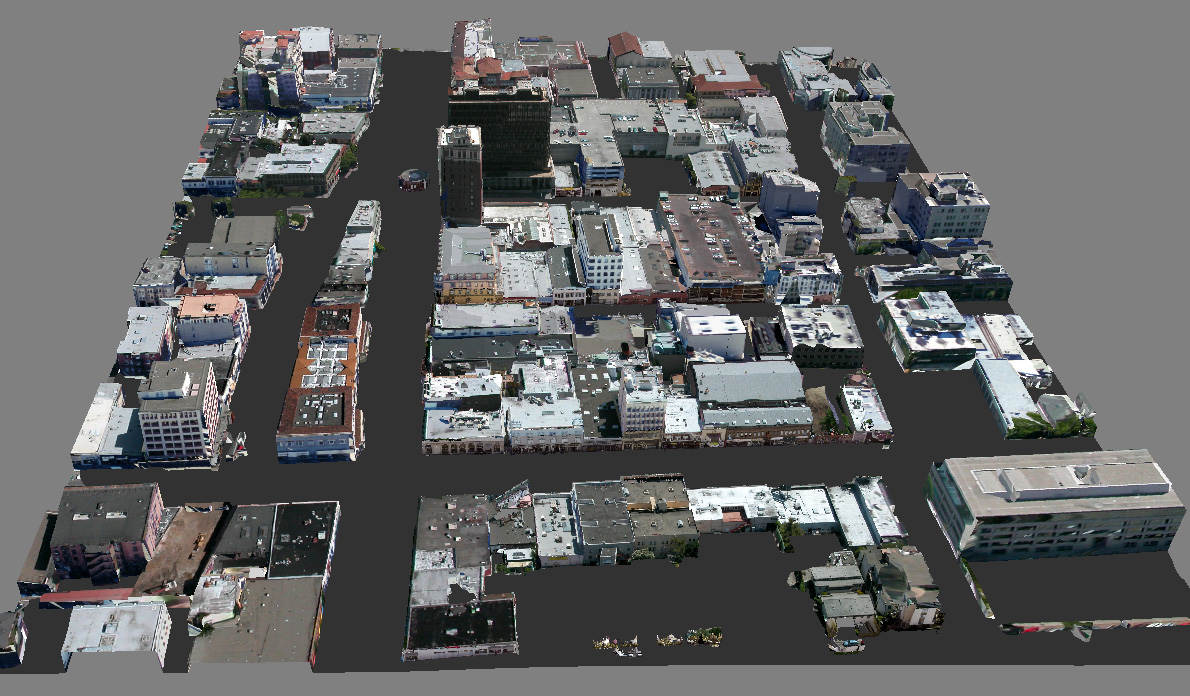
As described in the page you linked (http://www-video.eecs.berkeley.edu/~frueh/3d/), that is done by merging the street level data gathered from drive-thrus with aerial data gathered from fly-bys. You can see a picture on the same page where only street level data was used and what the result looks like.
-
Re:Picture of the actual 3D images?
-
Re:Picture of the actual 3D images?
-
This is (probably) not the way to go
One might argue that most innovation in software engineering, program analysis and verification in the past decade has been realized in the OO/formal semantics community. So for instance, since this exciting piece of work is implemented in a framework of OO-like interfaces, it is inamenable to crude pipe-based scripting languages. There has long been a debate between academics and designers of popular scripting languages like perl on which way to go (eg. http://www.ai.mit.edu/projects/dynlangs/ll1/). Although no one side has really won, one conclusion that stands is that scripting defines its own programming paradigm which should not be confused with anything else that comes close. Scripting languages MUST facilitate quick and dirty solutions that just work, or they're not scripting languages anymore. Usually, the more loaded a language gets with type information and rigid control constructs, the less capable it gets of letting you produce results without having to design and debug much.
-
Re:Microsoft Wants Your First Born
The truth is that they usually copy other research, tweak it up a bit (usually making it worse), and pretend that they invented it in the first place. Typical Microsoft... it must be something in the water up there.
In this case, the original is Tapestry, published at latest Apr 2001, followed by Pastry (hence the name) which was "done in part while visiting Microsoft Research, Cambridge, UK". Sounds to me like the main "innovative" part was providing a few computers. Meanwhile, the really new ideas (ala Chord) come from other places. -
1914 description of a rogue wave...
...from Jack London's short story, _Samuel_, in _The Strength of the Strong_. (Online here).
"Dud I say ut was a God-Almighty gale? Ut was worse nor thot. The devil himself must ha' hod a hond un the brewun' o' ut, ut was thot fearsome. I ha' looked on some sights, but I om no carun' tull look on the like o' thot again. No mon dared tull be un hus bunk. No, nor no mon on the decks. All honds of us stood on top the house an' held on an' watched. The three mates was on the poop, with two men ot the wheel, an' the only mon below was thot whusky- blighted captain snorun' drunk.
"An' then I see ut comun', a mile away, risun' above all the waves like an island un the sea - the buggest wave ever I looked upon. The three mates stood tulgether an' watched ut comun', a-prayun' like we thot she would no break un passun' us. But ut was no tull be. Ot the last, when she rose up like a mountain, curlun' above the stern an' blottun' out the sky, the mates scattered, the second an' third runnun' for the mizzen-shrouds an' climbun' up, but the first runnun' tull the wheel tull lend a hond. He was a brave men, thot Samuel Henan. He run straight un tull the face o' thot father o' all waves, no thunkun' on humself but thunkun' only o' the shup. The two men was lashed tull the wheel, but he would be ready tull hond un the case they was kult. An' then she took ut. We on the house could no see the poop for the thousand tons o' watter thot hod hut ut. Thot wave cleaned them out, took everythung along wuth ut - the two mates, climbun' up the mizzen-ruggun', Samuel Henan runnun' tull the wheel, the two men ot the wheel, aye, an' the wheel utself. We never saw aught o' them, for she broached tull what o' the wheel goun', an' two men o' us was drownded off the house, no tull mention the carpenter thot we pucked up ot the break o' the poop wuth every bone o' hus body broke tull he was like so much jelly." -
Re:P2P would be nice
This has already been done and suggested above. DIBS Distributed Internet Backup System.
-
DIBS
Distributed Internet Backup System: I backup your stuff, you backup mine. All encrypted.
-
Berkeley Press Release
Here is the link to the Berkeley press release and information on Berkeley astronomer Geoff Marcy.
And oh, looks like Slashdot is continuing to mirror Boing Boing. -
Berkeley Press Release
Here is the link to the Berkeley press release and information on Berkeley astronomer Geoff Marcy.
And oh, looks like Slashdot is continuing to mirror Boing Boing. -
seti@home
In a similar vein, the seti@home project is currently developing a new project called "Astropulse" to scan the skies for optical signals from ET. This is also designed to use GPU code to perform the signal analysis. (It would be interesting to see how this woud perform on a PS3, especially now the PS3 is rumoured to ship with Linux pre-installed)
-
seti@home
In a similar vein, the seti@home project is currently developing a new project called "Astropulse" to scan the skies for optical signals from ET. This is also designed to use GPU code to perform the signal analysis. (It would be interesting to see how this woud perform on a PS3, especially now the PS3 is rumoured to ship with Linux pre-installed)
-
Re:Nothing against SETI
-
What 3D Mapping Looks Like
To see what this might look like, check out this page from a Berkeley student working on 3D city modeling.