Slashdot Mirror
Domain: berkeley.edu
Stories and comments across the archive that link to berkeley.edu.
Comments · 3,539
-
Re:Major problems first; Slashdot censoring?
I'll start with the "flamebait" part and then go back to the top -
1. Because it is flamebait! But I'll bite anyway. It has been pointed out time and again that the technological boom of the 1990's and the resulting drop in crime and unemployment was a direct result of the Apollo program of the 1960's and 1970's. Here and Here are two sources.
2. "lethal radiation" - The dose of radiation an astronaut would receive on a 1.5 year Mars mission is about 52rem (using a conjunction trajectory). This would increase the chance of death attributed to radiation (cancer) of that astronaut on the order of 1%. [Zubrin, The Case for Mars]
3. "putting more than one person..." - Well we have, on this Earth, a place known as the New World. You might remember from history explorers found it by setting sail on small boats for years at a time. Think along the lines of Magellan and Columbus. I think you see where this goes. No cite necessary.
4. "Furthermore... why? Who gets fed?" - You get two for this one. First see #1 above. Second, I'll point you to the works of Thomas Malthus. We need more space to grow as a civilization, and as hard as we might try to kill each other we will run out of space eventually!
Q.E.D.
-
DMCA disease sweeps EuropeFor more information on why this is important news for people in other countries as well, just see the links below (some of them still in German, though):
The German parliament which has just adopted DMCA-style provisions to outlaw the circumvention of technical protection measures that control and curtail the fair use of intellectual property (and only needs the other House's assent for part of the new legislation) makes Germany the third country, following Denmark and Greece, to implement the highly controversial "monstrosity" known as the European Union Copyright Directive 2001/29/EC.
This move, allegedly a "propaganda victory" dubbed "lex Bertelsmann" (after the giant media conglomerate expected to line their corporate pockets under the new laws) in furious disapproval by tech-savvy parts of the news media, makes Germany one of the early adopters setting an unfortunate precedent for further European countries like the UK and France whose citizens, and notably developers like Linux kernel guru Alan Cox, will probably not be spared from similar legislation for much longer either.
Although open-source researchers, cyber-rights activists and even the ruling Social Democrats' very own IT experts as well as hardware manufacturers underlined the severe dangers and inconsistencies of this new and doubtful philosophy extending copyright law to reduce many of the general public's rights to insignificance, in a debate focusing only on academic exemptions from the publishers' power grab, the opposition even tried to tighten the government's bill, ignoring widespread experiences of Chilling Effects such as censorship and assaults on the Freedom to Tinker during the past four years under the EUCD's U.S. counterpart of draconian "bad law and bad policy", the flawed Digital Millennium Copyright Act, another overreaching implementation of the
-
Germany to adopt Yet Another Dreadful DMCA!Linux/GPL is becoming even more important than I had believed. Fortunately there are strong signs that it is making inroads in India, Europe, and Japan. If we can reach 30% in those areas, we're probably "safe". (...) But if the market penetration isn't sufficient to cause some chip makers to make chips that can be used with Linux (i.e., a non-palladium OS), then we may be in very bad trouble.
And this court decision is a long step into the nightmare. It's not as big a step as the legal right to disappear people, but it's another big one, and in the same direction.All hope abandon, as far as Europe is concerned...
While this article assumes that Wednesday's approval by the Committee on Legal Affairs makes adoption of Germany's "DMCA" bill in plenary session on Friday "a mere formality" (as even the opposition's sole regret seems to be that fair use rights should have been curtailed even further), many of you sure wish to recount some experiences of the Chilling Effects from Four Years under the DMCA to the Members of the German Parliament about to repeat most of the DMCA's mistakes in their attempt to implement yet another overreaching implementation of the 1996 WIPO Copyright Treaty, the highly controversial "monstrosity" known as European Copyright Directive 2001/29/EC.
-
Re:In the make you wonder department.For all that are wondering. I did some more reading and the nebula that's been illuminated is now 7 light years across (diameter) as of December 17th 2002. Now they're saying the nebula has always been there and it just being illuminated so the nebula is not traveling faster then the speed of the light...
Ya ok fair enough but the light has traveled 3.5 light years from the center in only a single year.
You are making the mistaken assumption that the hypernova is at the center of the nebula when, in fact, the portion of the nebula that we see is between us and the hypernova.
Think of it this way. Assume that that nebula is a flat sheet seven light years in diameter and 10 light years away from the hypernova and 1,000,000 light years away from us. (See the picture here) Light from the hypernova gets to the center of the nebula 10 years after the explosion and to us, 1,000,010 years after the nova.
Light from the explosion gets to the edge of the nebula sqrt(10^2+3.5^2)=10.6 years after the explosion, and to us 1,000,010.6 years after the explosion. So to us, it looks like the nebula expanded to a diameter of 7 light years in 0.6 years.
The more likely geometry is that the nebula is a shell around the hypernova. From the apparent speed at which the illuminated region expands we could determine the diameter of the shell.
-
Re:Offtopic but out of curiosity
The SETI@Home users stat page shows over 600,000 distinct users have returned at least one result in the last four weeks.
I'd say it's still pretty popular. -
WinNT Command Line Version 3.08
The WinNT command line version is now available.
Still no OS X version.
You can check check to see what's avaiable here: ftp://alien.ssl.berkeley.edu/pub/
-
WinNT Command Line Version 3.08
The WinNT command line version is now available.
Still no OS X version.
You can check check to see what's avaiable here: ftp://alien.ssl.berkeley.edu/pub/
-
Some computing-specific linksOf course there's far more to technology than just computing, but there are plenty of issues in computing to examine.
The UC Berkeley Computer Science Department teaches a somewhat similar class - CS 195: Social Implications of Computing. You might find some interesting reading material in the publications mentioned in their Fall 2002 Syllabus.
There's sure to be some fodder for discussion on the web pages of the Computer Professionals for Social Responsibility, Electronic Frontier Foundation, ACM SIGCAS: Special Interest Group on Computers and Society, ACM Computing & Public Policy, Computers, Freedom, & Privacy Conference, and The IEEE Society on Social Implications of Technology, to name just a few.
-
Some computing-specific linksOf course there's far more to technology than just computing, but there are plenty of issues in computing to examine.
The UC Berkeley Computer Science Department teaches a somewhat similar class - CS 195: Social Implications of Computing. You might find some interesting reading material in the publications mentioned in their Fall 2002 Syllabus.
There's sure to be some fodder for discussion on the web pages of the Computer Professionals for Social Responsibility, Electronic Frontier Foundation, ACM SIGCAS: Special Interest Group on Computers and Society, ACM Computing & Public Policy, Computers, Freedom, & Privacy Conference, and The IEEE Society on Social Implications of Technology, to name just a few.
-
Re:Linux/Solaris client is there, if you dig aroun
You can just FTP to ftp://alien.ssl.berkeley.edu/pub/ and see for yourself what's there.
When I checked, the only 3.08 versions available were the GUI versions for Windows and Mac OS 9 (not OS X), and the two command line versions mentioned above (x86 Linux and Sparc Solaris). The ones I personally care about, the command line versions for WinNT and OS X, were not there yet. -
Re:Linux/Solaris client is there, if you dig aroun
Is it safe to assume that the command line version for other platforms will take similar URLs? The presumed OSX version at ftp://alien.ssl.berkeley.edu/pub/setiathome-3.08.
p owerpc-apple-darwin1.2.tar, and the presumed WinNT version at http://wcarchive.cdrom.com/pub/setiathome/setiatho me-3.03.i386-winnt-cmdline.exe, both don't work yet. (I got these urls by hand editing the links on the Unix download page to replace 3.03 with 3.08, so I'm assuming that the new versions will be consistent with what was already there.) Maybe these links will work by the time you read this, but as of now (2:30 pm EST) they haven't been updated yet. -
Of Course It's SlashdottedAffected versions
Confirmed information leaking:
This issue affects all clients.
Confirmed remote exploitable:
setiathome-3.03.i386-pc-linux-gnu-gnulibc2.1
setiathome-3.03.i686-pc-linux-gnu-gnulibc2.1
setiathome-3.03.i386-pc-linux-gnulibc1-static
setiathome-3.03.i686-pc-linux-gnulibc1-static
setiathome-3.03.i386-winnt-cmdline.exe
i386-unknown-freebsd2.2.8 (Special thanks to Niels Heinen)
SETI@home.exe (v3.07 Screensaver)
Confirmed DoS-able using buffer overflow:
The main seti@home server at shserver2.ssl.berkeley.edu
Presumed vulnerable to buffer overflow:
All other clients.PATCHED VERSION
BACKGROUND INFORMATION
From "http://setiathome.berkeley.edu/"
"SETI@home is a scientific experiment that uses Internet-connected computers in the Search for Extraterrestrial Intelligence (SETI). You can participate by running a free program that downloads and analyzes radio telescope data. "
"The SETI@home program is a special kind of screensaver. Like other screensavers it starts up when you leave your computer unattended, and it shuts down as soon as you return to work. What it does in the interim is unique. While you are getting coffee, or having lunch or sleeping, your computer will be helping the Search for Extraterrestrial Intelligence by analyzing data specially captured by the world's largest radio telescope. "
"The client/screensaver is available for download only from this web page - we do not support SETI@home software obtained elsewhere. This software will upload and download data only from our data server here at Berkeley. The data server doesn't download any executable code to your computer. All in all, the screensaver is much safer than the browser you're running right now!"
There are currently over four million registered users of seti@home. Over half a million of these users are "active"; they have returned at least one result within the last four weeks.THE VULNERABILITIES
The seti@home clients use the HTTP protocol to download new workunits, user information and to register new users. The implementation leaves two security vulnerabilities:
1) All information is send in plaintext across the network. This information includes the processor type and the operating system of the machine seti@home is running on.
2) There is a bufferoverflow in the server responds handler. Sending an overly large string followed by a newline ('\n') character to the client will trigger this overflow. This has been tested with various versions of the client. All versions are presumed to have this flaw in some form.
3) A similar buffer overflow seems to affect the main seti@home server at shserver2.ssl.berkeley.edu. It closes the connection after receiving a too large string of bytes followed by a '\n'.THE TECHNIQUE
1) Sniffing the information exposed by the seti@home client is trivial and very usefull to a malicious person planning an attack on a network. A passive scan of machines on a network can be made using any packetsniffer to grab the information from the network.
2) All tested clients have similar buffer overflows, which allowed setting eip to an arbitrairy value which can lead to arbitrairy code execution. An attacker would have to reroute the connection the client tries to make to the seti@home webserver to a machine he or she controls. This can be done using various widely available spoofing tools. Seti@home also has the ability to use a HTTP-proxy, an attacker could also use the machine the PROXY runs on as a base for this attack. Routers can also be used as a base for this attack.
3) Exploitation of the bug in the server -
In the wild or not?The site is Slashdotted so I can't get through, but the write up contradicts Seti's official version which states that
- There was a potential buffer overrun in the networking code of the client that is fixed with version 3.08. Note that to exploit this vulnerability, a potential attacker would have to trick the client into contacting a fake server rather than the actual SETI@home server. To our knowledge,
- no SETI@home client has ever been attacked in this manner.
- an Exploit [sic.] was found in Seti@Home and
- there is code exploiting the hole actually running about in the wild.
-
Linux/Solaris client is there, if you dig aroundLooks like the links haven't shown up yet on the Unix download page, but the 3.08 client is available if you dig around a bit:
ftp://alien.ssl.berkeley.edu/pub/setiathome-3.08.
i 686-pc-linux-gnu.tarftp://alien.ssl.berkeley.edu/pub/setiathome-3.08.
s parc-sun-solaris2.6.tarCan't seem to find 'em on wcarchive.cdrom.com, the other mirror site -- anyone got a link?
-
Linux/Solaris client is there, if you dig aroundLooks like the links haven't shown up yet on the Unix download page, but the 3.08 client is available if you dig around a bit:
ftp://alien.ssl.berkeley.edu/pub/setiathome-3.08.
i 686-pc-linux-gnu.tarftp://alien.ssl.berkeley.edu/pub/setiathome-3.08.
s parc-sun-solaris2.6.tarCan't seem to find 'em on wcarchive.cdrom.com, the other mirror site -- anyone got a link?
-
Linux/Solaris client is there, if you dig aroundLooks like the links haven't shown up yet on the Unix download page, but the 3.08 client is available if you dig around a bit:
ftp://alien.ssl.berkeley.edu/pub/setiathome-3.08.
i 686-pc-linux-gnu.tarftp://alien.ssl.berkeley.edu/pub/setiathome-3.08.
s parc-sun-solaris2.6.tarCan't seem to find 'em on wcarchive.cdrom.com, the other mirror site -- anyone got a link?
-
congratsapros pos of slashdot, I would emphatically recommend setting up some sort of photo repository application *now*. and test it. make sure it easy to upload pictures with one hand, because once the baby comes, you'll no longer have the use of both hands. unless you are both orphans or live with your entire family, a lot of people will be *dying* to see pictures, and they will not stop asking you for them. it's very easy to set it up now, and it will well worth it, come november.
apros pos of parenthood in general:
- get sleep now
- go see movies now
- help your wife with keeping healthy. read about nutrition and excercise, and do it as a team.
- have a birth plan
- say goodbye to all your friends
- have a strategy for childcare. you probably wont be able to arrange specifics this far in advance, but you have to start narrowing it down.
- if you have any long-term non-family related tasks to do, DO THEM NOW. for example, forget about learning c# in 9 months.
- find a parents support group near you. there are millions of things that you will need to do that currently you have no idea how to do. if you're in the SF Bay Area (or don't mind filtering through local info), check out the berkeley parents network.
- have fun! don't sweat it too much. people have been doing this for a pretty long time with moderate success, and half the parents are in the bottom 50 percentile!
-
Re:If we're keeping score...and of course Microsoft shops comprise the majority of "shops" out there.
I beg to differ you idiot. Before posting so authoritatively why don't you do some homework? While its hard to find concrete evidence that shows which language has market dominance, there are some hints out there:
Doing a search for jobs here will show you that there are 4268 jobs with "Java" in their descriptions with only 366 jobs matching "C#" and 17 jobs matching ".NET"
This shows a graph of the languages in use on sourceforge.
Oh yeah clown? The only thing "stunning" here is your lunacy. Why don't you go take a look at the bookstore and search "Java Programming" then ".NET programming?" I get 601 books for
What bothers me even more than Microsoft's shitty products and nonexistant business ethics is that they have a slew of retarded users who can't provide even a shred of supporting evidence to back the claims they make. Its always stupid shit like "I use MS because no one ever got fired for it" or, "... because fonts look ugly in X". In this case you have an guy pulling shit out of ass that is not even true.
What in the hell was it in his post that prompted you to mod him up so much SlashdotXP?
-
Re:No, the 970 produces more heat!
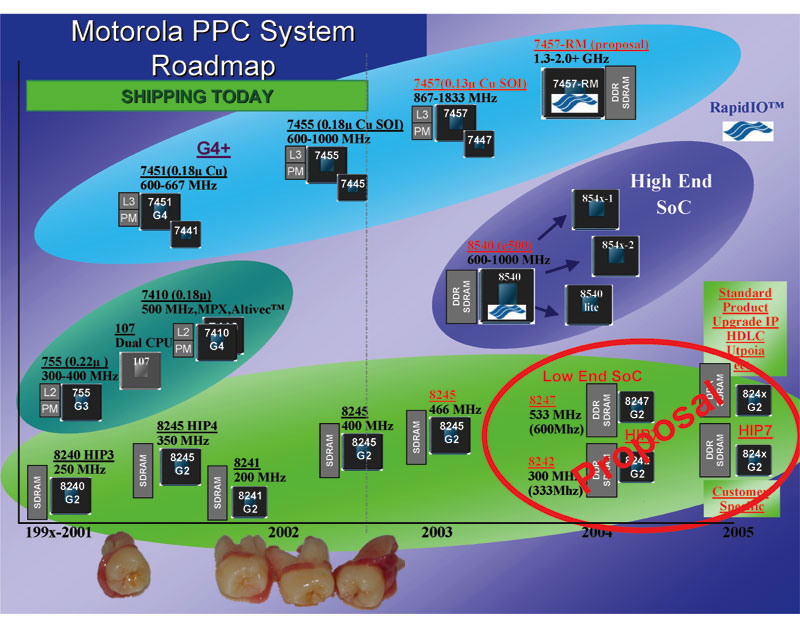
The 7457 is a cool looking chip for the PBs. It probably will end up in the 15" and 12" with the PPC 970 at 1.1v in the 17". The larger interior of the 17 would allow better heat dissipation.
The really interesting chip coming out of Moto next is the 7457-RM sometime next year. Its a G4 with a 200mhz bus on die Memory Controller and some other neat tidbits. Like all future Moto products there is some leaked info out there but not enough to really get much use.. -
Re:Already being worked on (link included)
Here is a functional link
But if it was just me I'd probably just use a number drill (very small drill bit) and a wire-wrap tool...
(Now the Karma question - is this a Funny, Informative, Troll? -
SlammerSecurity is the last nail in the coffin.
People aren't applying the patches in spite of clear warnings.
Even Microsoft's own servers got hit by Slammer. It has been quit common for Microsoft's security upgrades to break something else, fail to fix what they claim to fix, and/or introduce additional holes. The Slammer worm showed that even Microsoft knows that it's patches can be unhealthy for production systems. Other companies and software projects just don't have this kind of quality problem.Even if the patches worked, and even if it had been an old-style, slow worm, you can't patch fast enough. But it wasn't. Slammer reached saturation in 8.5 minutes. Most likely this story was a tidbit to draw fire away from the quarterly financial statement or from the DRM/Palladium stealth payload in Windows Server 2003 + Office 2003.
Sure folks may wish to run Microsoft products for ideological reasons, but there aren't any technical ones and now the market is changing. C*Os have figured out the OS X, RedHat, Mandrake, Debian, OpenBSD, etc. are much easier install and maintain than Windows Xp and far more flexible and secure -- both on the workstation and the server. Novell Netware should also be mentioned as excellent. C'mon when was the last time you heard of MS machine reaching an uptime of more than 200 days? That would be embarassingly short for QNX and Novell.
Microsoft has been to computing what Big Tobacco was to sports.
-
The Senses of Engineer
Tau Beta Pi, the Engineering Honor Society, has struggled with this question as well. What disciplines should be considered "engineering?" At last year's convention, we approved (pending ratification due on Tuesday) following the guidelines set forth in ABET's criteria for Engineering programs. ABET (Accreditation Board for Engineering and Technology) accredits four types of programs -- engineering, engineering technology, computer science, and applied math. 's move was to limit membership to those programs which fall in the domain of the first.
ABET recently added accreditation guidelines for Software Engineering, but as yet, no such programs have yet been accredited. (That is, their pop-up menu for "search by program" doesn't list Software Engineering.) ABET also accredits Computer Engineering, which is usually about hardware, though this includes some programs with "Computer Science" in their names (such as Berkeley's EECS program).
The requirements for Software Engineering are:
1. Curriculum
The curriculum must provide both breadth and depth across the range of engineering and computer science topics implied by the title and objectives of the program. The program must demonstrate that graduates have: the ability to analyze, design, verify, validate, implement, apply, and maintain software systems; the ability to appropriately apply discrete mathematics, probability and statistics, and relevant topics in computer science and supporting disciplines to complex software systems; and the ability to work in one or more significant application domains.
2. Faculty
The program shall demonstrate that those faculty teaching core software engineering material have practical software engineering experience.
This is the sense of "engineering" which is concerned with the profession of engineering -- who can legally say they're an engineer, which is what the Texas legislature is talking about. But the word "engineer" goes beyond accreditation and licensing. Are the only teachers in the world people who have a license to teach? Are you out of line by calling Hippocrates a physician and doctor because he didn't have an M.D.? Of course not.
The second sense of "engineer" is someone who integrates principles of math and science with real-world constraints in the design, creation, or maintenance of some in-context solution. Thus, studying the physical properties of electricity and building a circuit isn't engineering, it's science. But building such a circuit under performance, economic, and other constraints is engineering.
Algorithm development is thus mathematical engineering. When Edsgar Dijkstra first published a shortest path algorithm and provided a complexity bound (the first version was O(n^3) I've heard), mathematicians said "So what? Just list all possible paths and pick the shortest one." Which is, of course, impractical for any large system.
Software Engineers work with performance constraints, economic constraints, time constraints, constraints imposed by existing systems, security constraints, constraints of readability and maintainability, etc. The code you write for a homework assignment which is graded purely on its functional properties isn't (likely) an engineered program. But programs you download (especially large ones) have been engineered (or they suck).
Engineering doesn't have to be technical, though. City planners can be said to be Social Engineers. Some people claim the title of Financial Engineer. The folks at Kodak are Image Engineers. Gutenberg was one of the world's first Publishing Engineer.
"Engineering," like "guardian" has a legal definition and a common sense definition. Engineering, in English, is an approach and a mindset. -
Re:Sendmail.... Opps Hit submits too soonHere's the proofread formated version
This is just a really quick overview because there are a few things I would have to lookup again for postfix, and don't quite have time to write a fully detailed essay(good for postfix 1.11).
Main Configuration/Documenation
Most of the configuration is done with
Tables
Postfix supports a wide variety of Table types. sendmail uses "hash" I think.. But you can also have tables based around mysql or ldap, for example. I use LDAP almost exclusively. So my knowledge is very much specialized about that behemoth. Anyway, when I say specify a table this is done in the form
- TYPE:LOCATION
The Type is the type of table/format being used. The Location is simply one of several things
- For simple tables like gdbm or has it is the location where the table is on the disk,
- For mysql it's the location of a configuraiton file for the mysql table(i think)
- For ldap it's the name of the ldaptable and there are additional configuration variable to setup.
For backwards compatibility, hash:/etc/alias is normally setup as an alias database.
Virtual Stuff
Also note the following distinctions that I used, I hope this doesn't confuse anyone reading the other documentation.
- Virtual User -- an address in a fake domain that gets routed to other addresses these are done by creating virtual tables. The configuration variable virtual_maps is set to set space-delimited list of tables to use as virtual tables. So hash:/etc/.../virtualusers should get the map working(I think). Remeber the man pages are very good. See virtual(5) for more.
- Virtual Mailbox -- a user in a fake domain that gets routed to it's own mailbox, but has no associated user account on the machine. This gets more complex, however, as you have to set locations, gids, uids, transport(the method of delivery). See virtual(8)
Fallback Address or "Catchalls"
Catch-alls operate like in sendmail, add an entry to a virtual user table in the variable virtual_maps with the "key" @domain.com. However, since virtual mailboxes are done after virtual_maps they aren't very compatible with catchalls.
Configurable bounce errors
I'm not sure this there is a way to completely customize the return error, but adding an entry domain.com (not @domain.com) the actual data doesn't matter, just the entry is importent,so set it to "unknown" for readability. This creates a postfix-style virtual domain which should reject unknown users with the appropiate error. see virtual(5).
Delivery to a piped process
Yes you can. You have to edit the
cyrus unix - n n - - pipe
flags=R user=cyrus argv=/usr/sbin/cyrdeliver -e -m ${extension} ${user}
uucp unix - n n - - pipe
flags=Fqhu user=uucp argv=uux -r -n -z -a$sender - $nexthop!rmail ($recipient)Backup mail spooling
In postfix there is a transports map that has three fields: domain(key), transport(servic
-
Re:Sendmail.... Opps Hit submits too soonHere's the proofread formated version
This is just a really quick overview because there are a few things I would have to lookup again for postfix, and don't quite have time to write a fully detailed essay(good for postfix 1.11).
Main Configuration/Documenation
Most of the configuration is done with
Tables
Postfix supports a wide variety of Table types. sendmail uses "hash" I think.. But you can also have tables based around mysql or ldap, for example. I use LDAP almost exclusively. So my knowledge is very much specialized about that behemoth. Anyway, when I say specify a table this is done in the form
- TYPE:LOCATION
The Type is the type of table/format being used. The Location is simply one of several things
- For simple tables like gdbm or has it is the location where the table is on the disk,
- For mysql it's the location of a configuraiton file for the mysql table(i think)
- For ldap it's the name of the ldaptable and there are additional configuration variable to setup.
For backwards compatibility, hash:/etc/alias is normally setup as an alias database.
Virtual Stuff
Also note the following distinctions that I used, I hope this doesn't confuse anyone reading the other documentation.
- Virtual User -- an address in a fake domain that gets routed to other addresses these are done by creating virtual tables. The configuration variable virtual_maps is set to set space-delimited list of tables to use as virtual tables. So hash:/etc/.../virtualusers should get the map working(I think). Remeber the man pages are very good. See virtual(5) for more.
- Virtual Mailbox -- a user in a fake domain that gets routed to it's own mailbox, but has no associated user account on the machine. This gets more complex, however, as you have to set locations, gids, uids, transport(the method of delivery). See virtual(8)
Fallback Address or "Catchalls"
Catch-alls operate like in sendmail, add an entry to a virtual user table in the variable virtual_maps with the "key" @domain.com. However, since virtual mailboxes are done after virtual_maps they aren't very compatible with catchalls.
Configurable bounce errors
I'm not sure this there is a way to completely customize the return error, but adding an entry domain.com (not @domain.com) the actual data doesn't matter, just the entry is importent,so set it to "unknown" for readability. This creates a postfix-style virtual domain which should reject unknown users with the appropiate error. see virtual(5).
Delivery to a piped process
Yes you can. You have to edit the
cyrus unix - n n - - pipe
flags=R user=cyrus argv=/usr/sbin/cyrdeliver -e -m ${extension} ${user}
uucp unix - n n - - pipe
flags=Fqhu user=uucp argv=uux -r -n -z -a$sender - $nexthop!rmail ($recipient)Backup mail spooling
In postfix there is a transports map that has three fields: domain(key), transport(servic
-
Re:Sendmail.... Opps Hit submits too soonHere's the proofread formated version
This is just a really quick overview because there are a few things I would have to lookup again for postfix, and don't quite have time to write a fully detailed essay(good for postfix 1.11).
Main Configuration/Documenation
Most of the configuration is done with
Tables
Postfix supports a wide variety of Table types. sendmail uses "hash" I think.. But you can also have tables based around mysql or ldap, for example. I use LDAP almost exclusively. So my knowledge is very much specialized about that behemoth. Anyway, when I say specify a table this is done in the form
- TYPE:LOCATION
The Type is the type of table/format being used. The Location is simply one of several things
- For simple tables like gdbm or has it is the location where the table is on the disk,
- For mysql it's the location of a configuraiton file for the mysql table(i think)
- For ldap it's the name of the ldaptable and there are additional configuration variable to setup.
For backwards compatibility, hash:/etc/alias is normally setup as an alias database.
Virtual Stuff
Also note the following distinctions that I used, I hope this doesn't confuse anyone reading the other documentation.
- Virtual User -- an address in a fake domain that gets routed to other addresses these are done by creating virtual tables. The configuration variable virtual_maps is set to set space-delimited list of tables to use as virtual tables. So hash:/etc/.../virtualusers should get the map working(I think). Remeber the man pages are very good. See virtual(5) for more.
- Virtual Mailbox -- a user in a fake domain that gets routed to it's own mailbox, but has no associated user account on the machine. This gets more complex, however, as you have to set locations, gids, uids, transport(the method of delivery). See virtual(8)
Fallback Address or "Catchalls"
Catch-alls operate like in sendmail, add an entry to a virtual user table in the variable virtual_maps with the "key" @domain.com. However, since virtual mailboxes are done after virtual_maps they aren't very compatible with catchalls.
Configurable bounce errors
I'm not sure this there is a way to completely customize the return error, but adding an entry domain.com (not @domain.com) the actual data doesn't matter, just the entry is importent,so set it to "unknown" for readability. This creates a postfix-style virtual domain which should reject unknown users with the appropiate error. see virtual(5).
Delivery to a piped process
Yes you can. You have to edit the
cyrus unix - n n - - pipe
flags=R user=cyrus argv=/usr/sbin/cyrdeliver -e -m ${extension} ${user}
uucp unix - n n - - pipe
flags=Fqhu user=uucp argv=uux -r -n -z -a$sender - $nexthop!rmail ($recipient)Backup mail spooling
In postfix there is a transports map that has three fields: domain(key), transport(servic
-
Re:Sendmail....This is just a really quick overview because there are a few things I would have to lookup again for postfix, and don't quite have time to write a fully detailed essay(good for postfix 1.11).
Main Configuration/Documenation
Most of the configuration is done with
Tables
Postfix supports a wide variety of Table types. sendmail uses "hash" I think.. But you can also have tables based around mysql or ldap, for example. I use LDAP almost exclusively. So my knowledge is very much specialized about that behemoth. Anyway, when I say specify a table this is done in the form
- TYPE:LOCATION
The Type is the type of table/format being used. The Location is simply one of several things
- For simple tables like gdbm or has it is the location where the table is on the disk,
- For mysql it's the location of a configuraiton file for the mysql table(i think)
- For ldap it's the name of the ldaptable and there are additional configuration variable to setup.
For backwards compatibility, hash:/etc/alias is normally setup as an alias database.
Virtual Stuff
Also note the following distinctions that I used, I hope this doesn't confuse anyone reading the other documentation.
- Virtual User -- an address in a fake domain that gets routed to other addresses these are done by creating virtual tables. The configuration variable virtual_maps is set to set space-delimited list of tables to use as virtual tables. So hash:/etc/.../virtualusers should get the map working(I think). Remeber the man pages are very good. See virtual(5) for more.
- Virtual Mailbox -- a user in a fake domain that gets routed to it's own mailbox, but has no associated user account on the machine. This gets more complex, however, as you have to set locations, gids, uids, transport(the method of delivery). See virtual(8)
Fallback Address or "Catchalls"
Catch-alls operate like in sendmail, add an entry to a virtual user table in the variable virtual_maps with the "key" @domain.com. However, since virtual mailboxes are done after virtual_maps they aren't very compatible with catchalls.
Configurable bounce errors
I'm not sure this there is a way to completely customize the return error, but adding an entry domain.com (not @domain.com) the actually data doesn't matter,, just the entry so set it to unknown for readability. This creates a postfix-style virtual domain which should reject unknown users with the appropiate error. see virtual(5).
Delivery to a piped process
Yes you can. You have to edit the
cyrus unix - n n - - pipe
flags=R user=cyrus argv=/usr/sbin/cyrdeliver -e -m ${extension} ${user}
uucp unix - n n - - pipe
flags=Fqhu user=uucp argv=uux -r -n -z -a$sender - $nexthop!rmail ($recipient)Backup mail spooling
In postfix these is a transports map that has three fields: domain(key), transport(service to deliver), nexthop(next machine in chain). An entry has a form the actual data for the entry is in the form tra
-
Re:Sendmail....This is just a really quick overview because there are a few things I would have to lookup again for postfix, and don't quite have time to write a fully detailed essay(good for postfix 1.11).
Main Configuration/Documenation
Most of the configuration is done with
Tables
Postfix supports a wide variety of Table types. sendmail uses "hash" I think.. But you can also have tables based around mysql or ldap, for example. I use LDAP almost exclusively. So my knowledge is very much specialized about that behemoth. Anyway, when I say specify a table this is done in the form
- TYPE:LOCATION
The Type is the type of table/format being used. The Location is simply one of several things
- For simple tables like gdbm or has it is the location where the table is on the disk,
- For mysql it's the location of a configuraiton file for the mysql table(i think)
- For ldap it's the name of the ldaptable and there are additional configuration variable to setup.
For backwards compatibility, hash:/etc/alias is normally setup as an alias database.
Virtual Stuff
Also note the following distinctions that I used, I hope this doesn't confuse anyone reading the other documentation.
- Virtual User -- an address in a fake domain that gets routed to other addresses these are done by creating virtual tables. The configuration variable virtual_maps is set to set space-delimited list of tables to use as virtual tables. So hash:/etc/.../virtualusers should get the map working(I think). Remeber the man pages are very good. See virtual(5) for more.
- Virtual Mailbox -- a user in a fake domain that gets routed to it's own mailbox, but has no associated user account on the machine. This gets more complex, however, as you have to set locations, gids, uids, transport(the method of delivery). See virtual(8)
Fallback Address or "Catchalls"
Catch-alls operate like in sendmail, add an entry to a virtual user table in the variable virtual_maps with the "key" @domain.com. However, since virtual mailboxes are done after virtual_maps they aren't very compatible with catchalls.
Configurable bounce errors
I'm not sure this there is a way to completely customize the return error, but adding an entry domain.com (not @domain.com) the actually data doesn't matter,, just the entry so set it to unknown for readability. This creates a postfix-style virtual domain which should reject unknown users with the appropiate error. see virtual(5).
Delivery to a piped process
Yes you can. You have to edit the
cyrus unix - n n - - pipe
flags=R user=cyrus argv=/usr/sbin/cyrdeliver -e -m ${extension} ${user}
uucp unix - n n - - pipe
flags=Fqhu user=uucp argv=uux -r -n -z -a$sender - $nexthop!rmail ($recipient)Backup mail spooling
In postfix these is a transports map that has three fields: domain(key), transport(service to deliver), nexthop(next machine in chain). An entry has a form the actual data for the entry is in the form tra
-
Nah...
There's a basketball player named Michael Jordan? I would have thought that the
-
Re:Greedy Fingers
-
Re:Does this say anything about its size?The other reply has some good information, but he doesn't cover
Now that they have a measure of the weight, if they know anything about the density or the size, they've got the other value as well.
Actually, the Schwarzschild radius of a black hole is proportionate to its mass. A black hole with mass the same as the Sun would have a 3 km radius; so just do the math if you want to find the radius of this one.This page has some good info.
-
Re:Bloat
Templates are particulary useful and efficient for container classes like hash tables.
-
Re:Probably not a good idea
Why would you electrolyse water in the car?
You wouldn't. But that's exactly what the 'Hydrogen Boost' website is proposing. And what else do they sell on their website?
Fuel line magnets.
Yep. Scam artists.
The homebuilt guy is proposing the same thing, but he honestly just doesn't seem to understand the second law of thermodynamics. -
Been done before
I don't seen what the problem is. The Foundation for Law and Government did this in the 80s. I think they called it the Knight Industries Two Thousand. The prototype was known as the Knight Industries Roving Robot. I think that is the only good thing that came out of the 80s.
-
Been done before
I don't seen what the problem is. The Foundation for Law and Government did this in the 80s. I think they called it the Knight Industries Two Thousand. The prototype was known as the Knight Industries Roving Robot. I think that is the only good thing that came out of the 80s.
-
Perhaps not that hard?This is from Artificial Intelligence: A Modern Approach, by Stuart Russel and Peter Norvig, published 1995:
ALVINN (Autonomous Land Vehicle In a Neural Network)
The only problem is the training... the system is unable to drive on roads that it doesn't have training data for. I glanced quickly at the DARPA rules and didn't see anything that would invalidate a "build a similar course and train on it" approach. So take ALVINN, build lots of courses that sound like the sort that DARPA is planning, and train, train, train!References:
-
Why pound on this guy?
The average reaction is either "yeah this guy is right, we're all being poisoned" or "this guy is a nut, it's all in his head". Extremism is common in the world.
I think from reading through his web site, it's clear that:
1) This guy has spent a significant amount of time looking at interesting architectural experiments, and has done a lot to write these up in an accessible way to those who believe that there is something better possible than 2x4 stick built houses with gypsum board and vinyl flooring. Just look at his "simplicity and pavilion architecture" site.
2) Stress kills. No joke. Even if his primary problem is psychological, he suffers real physical problems from the stress caused by the psychological problems. Try living under continual stress conditions for a while (ie. barely able to pay your creditors, or on the run from the law, or being held as a POW or something), you'll see what I mean.
3) There really are toxic environmental issues that we should be aware of. For example, for the longest time Atrazine was a popular approved weedkiller. People thought DDT was a good idea at one point. People even though smoking was harmless at one point.
Pressure treated lumber IS dangerous, primarily for those who cut it, but leaching levels in the soil are measureable. That's why it's being phased out. Formaldehyde offgassing levels CAN be measured. No it's simply NOT true that standard forced air heaters exchange the air several times an hour, that would be WAY too expensive.
Take a look at the contents of a water resistant drywall spackling compound container some day. We had our bathroom done recently and I still can't be in that room for very long. I just hope when the swanstone goes up over it, it seals in the damn chemicals.
Often people claim that things are completely safe, but these claims are based on expected usage. All you have to do is put a piece of software in the hands of one of your users to know how easily people can do the unexpected...
Toxicology is about studying the levels of toxins that produce statistically unmeasureable effects. But LOTS of things confound statistics to make measuring effects difficult.
Oh and by the way there are major differences between the toxicity of volatile organic compounds and the toxicity of minerals like arsenic embedded in adobe. For one, you can't avoid VOC's by simply not licking your walls.
Does this guy have a real problem? Sure. What is it, biochemical or psychological? Are you all philosophical dualists or can we agree that psychological problems can have biochemical origins?
Anyway, I just want to thank this guy for putting together an interesting web site...to hell with the rest of you who feel they have to debunk his illness. -
Re:When are they going to make 2 cpu MBs?
Your cache percentages are way off, this is just splitting hairs but 64K starts at around
Cache Latency and Out of Order Execution
In any case having more cache is usefull. Also you will not really take advantage of large cache size untill you program specifically for it and most likely a specific problem set.
I also agree that is is not cost effective to make these kind of systems in mass, but it would be nice to have an off the shelf solution. -
Re:Or even better..
Using your logic:
Our race somehow muddled through millions of years without finding little green men.
That said, I run SETI@home myself. According to my SETI@home user profile, I've dedicated 1.788 years of CPU time so far and I've been a user for 3.694 years. So I'm certainly not against the program.
But to say that everybody's going to die anyway, so why bother is the most absurd thing I've ever heard. By that logic, we might as well shut down all the hospitals, and repeal all the laws on murder. After all, we're all going to go sometime.
It's kind of interesting. I've been using SETI@home for years now, and as far as I know, it was the only distributed computing application when I first started. For a long time, it certainly seemed the most worthy of my spare cycles. Now, however, there are apps for cancer research and other life and death ailments. It's got me thinking...
Which discovery would have the greatest impact on us? ET or a cure for cancer? Now, nobody supports space exploration, research, etc. more than I do. And I've put my money where my mouth is on this subject. But I've thought about this.
If today, while watching CNN, I saw breaking news, and it was a press conference where NASA or SETI or some other organization announced definitive proof of Extra Terrestrial Intelligence, how would it change life here on earth?
Well, most likely, the news media would immediately wet their pants, ask all kinds of stupid questions "is it likely that they're hostile?" "Could they support the terrorists?!?" etc.
But that wouldn't last long, because eventually the scientific community would be able to explain to all but the thickest skulled journalist that that they're 500 light years away, and that the message we received left their planet while Christopher Columbus was still alive. They'd also have to explain to them that it would take just as long for us to *respond* to their message, and that with a 1000 year delay, the very civilization that sent the message might not even be there any more.
So to make a long story short, if SETI finds ET, all it will do is make us *know* that ET is out there. It won't make any difference in our day to day lives what so ever. Basically what we are undertaking is the most expensive quest to find an answer to a trivia question ever. Because that's all we can hope to get out of this: trivia. Knowing that there's ET intelligence is no more useful than knowing that in another million years there will be another Hawaiian Island.
Now what about cancer research (just to name one example). Let's say that distributed computation does lead somehow (I'm nowhere nearly as well versed on how this works as I am SETI@home) to a cure for cancer... Millions of lives will be saved. Millions of people will be spared suffering. Drugs or treatment programs will come to market. This will effect economies. Our understanding of our own biology will be expanded, and that could lead to even *more* quality of life improvements. I'm sure there will be other benefits that I can't even think of.
Being the space buff that I am, finding ET would move me more emotionally. Wow, what a discovery. But it wouldn't actually *do* all that much. I have no illusions that it would. On the other hand, medical research is perhaps one of the most noble things that we can lend our proc cycles to. And it's been tempting me for several months now. I'd certainly recommend it to anyone else. -
Warchalking Berkeley, SF, Madison ... what else?I've got a list of (albeit mainly Berkeley and some SF) Wi-Fi hotspots, but lemme know if you find any more:
-
Re:Before you get to Step 3...
It's because of the close proximity of three very developed sources of technological innnovation, UC Berkeley, Stanford University, and Xerox Parc. Not to mention all of the other tech companies that have sprung up to support YOUR up and coming tech business. It's becuase it is a center for technological innovation, and the culture there is "supposed" to foster that. Whether it does now or not is another story.
Speaking as a resident of California, I can say that a lot of the residents choose to have their tax rates so high becuase they choose to protect the environment with those taxes. California has ALWAYS led the nation in progessive environmental legislation. If you've ever been here and seen some of the beautiful landscapes and natural sites we have, you'll understand. Politicians here fight tooth and nail to prove to the voters who is the more environmetally counsious without wasting tax resources. Don't get me wrong, there are plenty of things wrong with California, but to be honest I wouldn't want to live anywhere else, and I've been a few places in my time. The weather and the beauty is a BIG draw for people moving to California. It always has been and it always will be as long as we protect it. -
Re:GTA free - thats great but...
And also at UC, you can get all kinds of useful commercial software for free. Your $20k/year tuition is going to good use -- blanket software licenses.
-
Re:depressing just as much as inspiring
Smart dust? Tracking chips for all products, and then humans-the "little kid wandering more than 50 feet away from mommy"?
Well, there are non-dark uses for these technologies also. The UC Berkeley physical plant enginners are using smart dust technology to automate large parts of their electcial grid. I'm friends with one of the head engineers there, and he's estactic by the amount of work saved by these things. Tasks that used to take hours can now take minutes.
Here's one example:
Durng a power outage, for example, engineers can pull up the campus's power grid on one of six computer monitors at the control center, zoom in on the problem area, then click on it to view the electrical drawings for that spot. Using this information, field crews can reroute electricity and restore power -- in some cases remotely -- within minutes. In the past, Trent said, restoring power often took several hours. -
Re:depressing just as much as inspiring
I haven't read the article but since I just finished up at Berkeley, I know the research projects you are referring to. In particular I work peripherally on the SmartDust Project run bt Prof. Pister. He actually has referenced the issues of "the dark side" on that webpage. So it's not like the engineers and scientists working on this research don't know the implications of their work. Basically, Pister's philosophy is that the useage of these projects should be left up to the people (or the market if you like) in determining whether it is used for invasion of privacy or not. It's not up to HIM to stop his work based on the POSSIBILITY that these things can be used for nefarious purposes. Much like the scientists that synthesized chemicals that were the precursors for chemical weapons or the nuclear physicists who worked on fission, he is not out to be the moral authority deciding what is and is not used. That's why we have governments and such.
I agree with him to an extent, and it's the perogative of each and every researcher to decide what projects he or she wants to work on. For instance, I worked one summer at Raytheon. After the summer, I reflected on the work I was doing and decided that it didn't make me feel good knowing that my work would go towards the destruction of human life. I thought "If I agreed with each and every action that my governement undertakes while using this component, then I would have no problem creating it. But if I cannot make this claim, then I don't think I should use my abilities to create destruction." So that ended my work for defense contractors, and this was in 1999 mind you, before the current geopolitical situation.
Anyway, what I'm trying to say is that it's truly up to each and every one of us to decide how technology will be applied. We elect the officials (kinda, I suppose) and we can change things if we want to. We just have to have the WILL to act, and not stand by while other interests create a society that we disagree with. -
Re:Necessary, but stifling
Unfortunately, I don't see anything mentioning open source. However, I can point you to more info. For information on the Authentication Web Server that AirBears uses to authenticate users from a web page, look at http://www.net.berkeley.edu/kerberos/documents/AW
S AppSetup.html. Also, this is part of CalNet, which is our one-login setup that uses kerberos. For information on its architecture, look at https://calnet.berkeley.edu/architecture.html. Also, try e-mailing calnet-admin[at]uclink.berkeley.edu. Finally, you could try e-mailing the developers at airbears, their address is nsweb[at]berkeley.edu. Hope that helps. -
Re:Necessary, but stifling
Unfortunately, I don't see anything mentioning open source. However, I can point you to more info. For information on the Authentication Web Server that AirBears uses to authenticate users from a web page, look at http://www.net.berkeley.edu/kerberos/documents/AW
S AppSetup.html. Also, this is part of CalNet, which is our one-login setup that uses kerberos. For information on its architecture, look at https://calnet.berkeley.edu/architecture.html. Also, try e-mailing calnet-admin[at]uclink.berkeley.edu. Finally, you could try e-mailing the developers at airbears, their address is nsweb[at]berkeley.edu. Hope that helps. -
Re:Necessary, but stifling
Here at UC Berkeley, we have a thing called AirBears (http://airbears.berkeley.edu/). Before you can use the net, you have to login through a web page, which is a proxy to kerberos authentication. This is a pretty easy to use setup, and I'm pretty sure that the login is simple enough that even something like lynx or w3m could use it. The only problem is that there is more than one wireless net access service on campus, and they don't all use the same authentication method as AirBears.
-
Re:This is good but...I'm currently in Senegal (an American studying at Universite Gaston Berger), and am doing research on this exact topic.
The Internet is a fantastic tool, and yes, while there are many things that Senegal does need before it can advance in the world -- the Internet, while not the be-all-end-all solution, can do a lot of good.
Check out the draft of my paper here:
-
"Scooped, Again" says it betterAnother paper at the same Berkeley conference, Scooped, Again by four Harvard researchers, has much more to say about the overlapping set of problems being tackled by the P2P and Grid research communities.
The paper's title refers to the Web having been implemented by those outside the systems research community, who had elegant solutions to interesting problems but didn't pay enough attention to needs of users. The authors are afraid this might happen again if P2P researchers ignore the needs of Grid users. The third generation P2P infrastructures represented by systems such as Tapestry, Pastry, and Chord are amazing. For example, with one of these, you could implement a truly distributed DNS system that doesn't use hierarchy or centralization, and thus would be much more immune to DoS attacks than the current system. P2P researchers should heed the Call to Action at the end of this paper.
-
"Invitation Only"
I love how the IPTPS is invitation only, considering that most of the hackers who made P2P technologies as popular as they are today, wouldn't have a snowball's chance in hell in getting an invitation before they released. The concept of an invitation only P2P conference goes against all the ideas which ignited P2P development in the first place.
-
The Name is Log-Structured FilesystemsContrary to what other posters have said, the original questioner was not asking about disk scheduling algorithms such as SCAN (elevator) or C-SCAN. Rather, the system he was recalling was the Log-Structured Filesystem (LFS) from Berkeley. The original work was done in the early 90's. The basic ideas were as follows:
- Most disk activity is reads.
- If you have a lot of RAM, caches do a good job of taking care of the reads.
- The leftover writes drive the head crazy.
- It is therefore a Good Idea to do the writes whereever the head happens to be, and let the disk be scrambled.
The original work was done by Mendel Rosenblum, one of the founders of VMware and the most recent (2002) winner of the ACM SIGOPS Mark Weiser award.
The problem, as it turned out, was the cleaner. It put too much load on the disk. The original theory was that the cleaner would run overnight, but on a continuously loaded system there was never idle time to use to run it.
In 20/20 hindsight, the idea was clearly flawed. If you look at my list above, you'll see that you are getting rid of scrambled writes by giving up sequential reads. Since reads are cached, you're (on average) giving up 1 approximately sequential read to get 1 sequential write. But that's wrong because occasionally the cache misses, so instead you give uyp 1.1 (or 1.001) sequential reads to earn 1 sequential write. Worse, you also have to pay overhead to the cleaner.
I can argue strongly that the only reason LFS ever saw the light of day was that the benchmarks used to evaluate it wound up highlighting its strengths and hiding its weaknesses. I don't think that was intentional, but it's what happened.
The most recent LFS work was by Drew Roselli, in the late 90's. She identified a lot of the causes of slowdowns in the original system, and found ways to mitigate them. Even so, though, the system has never lived up to its promise.
BTW, don't confuse LFS with journaling filesystems such as ReiserFS, XFS, and ext3. LFS had some journaling aspects, but its focus was performance rather than crash-proofing. One can argue that LFS influenced journaling filesystems, but it's not the same.