Slashdot Mirror
Domain: berkeley.edu
Stories and comments across the archive that link to berkeley.edu.
Comments · 3,539
-
Re:I remember when my school did this...
As a current TA for the class mentioned above, I can only validate what a huge problem this is here at VT. We use a variety of methods in our analysis, one of which is MOSS from Berkeley.
This deparment has a near 100% conviction rate with the university's student run honor code and all cheaters are prosecuted fully. I agree with one poster below that one goal of a CS program is to develop people who can do things on their own. Working together has it's place, but cheating (generally as a form of laziness to get help when you don't understand something) when collaboration is not permitted is just plain old bad. -
Been done.This has been implemented several ways by several people. The best known is MOSS. I've implemented a script myself to do this and it was fairly successful, catching 5 or 6 pairs from a class of 75. Not all of the cheaters probably, but it was the worst of them.
The hard part is turning up the "sensitivity," so you get not just exact copies, but also people who have taken parts of a program or made some trivial modifications.
The problem is that it's hard to find info about these sytems for the very good reason that this is one instance where security by obscurity makes sense. If students know how the systems work, they can re-implement them and check to see if they'll be caught.
Greg
-
Moss
I wonder if this is anything like the MOSS (Measure Of Software Similarity) program developed at Berkeley in 1998?
The press release here.
You can also see the MOSS website here.
As a student at Rensselaer Polytechnic Institute I had a teacher run the entire classes code through MOSS for each assignment last semester, and aparently caught several people who had very similar code.
MOSS also has the ability to detect similarities in software strcuture as opposed to just checking for exact duplicates of code.
CS students who cut and paste each others code deserve to be caught in my opinion. -
Moss
I wonder if this is anything like the MOSS (Measure Of Software Similarity) program developed at Berkeley in 1998?
The press release here.
You can also see the MOSS website here.
As a student at Rensselaer Polytechnic Institute I had a teacher run the entire classes code through MOSS for each assignment last semester, and aparently caught several people who had very similar code.
MOSS also has the ability to detect similarities in software strcuture as opposed to just checking for exact duplicates of code.
CS students who cut and paste each others code deserve to be caught in my opinion. -
This is not news.
There are many programs out there for exactly the same purpose. For example, moss at berkeley lets you do this over the net.
-
Re:ZeoSync's Claims
Professor Smale isn't seen around the department much, probably thanks to his emeritus status, so I can't immediately verify anything. His recent work is in algorithms, not data compression, so I doubt he is associated with this.
-
The Nightmare
The nightmare scenario.. Three hours from when a widespread bug (like the recent XP one) and having millions of windows machines trashing everything they touch.
That is the future, and it will happen someday.
- Here's how:
Use the warhol worm spreading technique. Read it and be frightened. He claims 8 MINUTES from first infection to millions of infections.
I'm not quite as confident as he is in that number. But I'll definitely agree that 2 hours is more than enough time. (1 million vulnerable hosts, 5 scans/sec. Start with 1000 hosts, each second, 5000 probes, finding one vulnerable host. Thus, after 15 minutes, 2000 hosts, and doubling every 15 minutes.)
And, the more vulnerable hosts, the faster it spreads.
Now imagine a truly destructive payload. One which does not delete files, but corrupts them, starting with the fileservers. It restores datestamps to make it impossible to identify what files are corrupted.
Three hours from exploit to millions of computers corrupting thousands of files. Antivirus won't keep up, hell, warninsgs won't even reach most people until after its demolished their fileserver. With obfuscation techniques, the worm could survive 3 hours without being reverse-engineered.
It spreads so fast, there's no defense. It spreads so fast, you won't be aware its trashing all files until its already started. The only reason we've survived this long is that nobody really competent has worked on a worm.
Be afraid. Be very afraid. The only question is when it will occur, and whether you will be running Windows when the time comes. I hope you keep good backups.
-
Re:another tactic?
Maybe this is a crazy idea, but could we have them compute a block for distributed.net or SETI@home? Two birds, one boulder..
-
Re:ZeoTech Scientific Team fake?
Okay, the mysterious Dr. Wlodzimierz Holtzinski doesn't get a single hit on Google. Dr. Steve Smale hasn't release a paper in five years and is in his seventies. Retired, perhaps?
I'm still not impressed. -
Re:ZeoTech Scientific Team fake?
Okay, the mysterious Dr. Wlodzimierz Holtzinski doesn't get a single hit on Google. Dr. Steve Smale hasn't release a paper in five years and is in his seventies. Retired, perhaps?
I'm still not impressed. -
Pi is InterestingHere is one of the websites of one of the guys listed on the companies website: Steve Smale. Interesting site. Light on details, but there is contact information.
The press release is light on details. A quick search of the US Patent database for BinaryAccelerator and Zero Space Tuner turned up nothing. I thought even pending patents were there. The CEO seems to be a mortgage broker. Interesting line of research.
Anyways, I thought the breaktrough in data compression would be using a mathmatical algorithem to express Pi and in index to the digit that your random string begins and a count of the data. That truly would be random, if those guys can prove there is a mathmatical formula for Pi.
-
Where may matter more that kind of degree
Like many of the previous posts, I'd say that a CS degree has the most prestige and carrying power for your career. But I'll add that _where_ you get the degree may matter more than the kind of degree. Check out the classes available and required for the degree at the schools you're considering. There's a big difference between a degree at Berkeley and one at your local Junior College.
mahlen -
Communists choose Linux? I'm shocked!!!Richard M. Stallman, ubiquitously known as "RMS", is the Patron Saint of the "open source" movement. "Open Source" is a method of software distribution which implements a means of copy protection by not distributing the final program codes. Instead, the user must assemble this final "executive" code by hand, thus eliminating the need for the proprietary data which must be included in a company-distributed copy.
This is all fine and good, in theory, and the Open Source movement has garnered a vast following from across the untamed corners of the internet. In this essay, I will explore how Mr. Stallman came to embrace this movement.
RMS was born in Modesto, California and attended Berkeley University [berkeley.edu]. This shouldn't surprise anyone, since Berkeley is the Liberal Hive [russia.ru] of America and RMS is an admitted [stallman.org] communist [www.jkl.fi]. RMS began his bizarre lifestyle while attending Berkeley, where he occupied the attic of a clock tower. This eccentricity continues today and RMS will not travel without a grandfather clock and a spitoon [warmann.org].
RMS' penchant for thievery was evident from the very beginning. His attic "apartment" was filled with equipment stolen from the Berkeley computer labs. This was quite an achievement in the early '70s, when any computer equipment was the size of a refrigerator.
RMS and his hacker friends cut class regularly, opting to spend their time and parent's money constructing illegal electronics devices designed to covertly access phone lines. The group of pirates would hack into the phone company, and charge enormous phone bills to unsuspecting Republican professors.
It was during this period that Stallman met Steve Jobs. RMS' technical savvy was far exceeded by that of Jobs and, never one to like being second-best, this caused him to pursue software hacking. RMS' hacking ability was innate and he and Jobs formed an alliance which would later result in the birth of Apple Computer.
Jobs' technical accumen was matched only by his ability to sell. He designed the internal electronics and outer package design of the first Apple, which was financed by Nolan Bushnell. He set RMS on to the task of developing the computer's "operating system" - a sequence of low-level MS-DOS commands which tell the computer how to decode program codes.
Though a gifted "coder", Stallman was quite lazy and didn't fare so well with the new operating system. His sloppy design and bloated codes were barely useable on the first microcomputer. Jobs dumped Stallman and hired John Wozniack to rewrite the internal operating system codes for the Apple I.
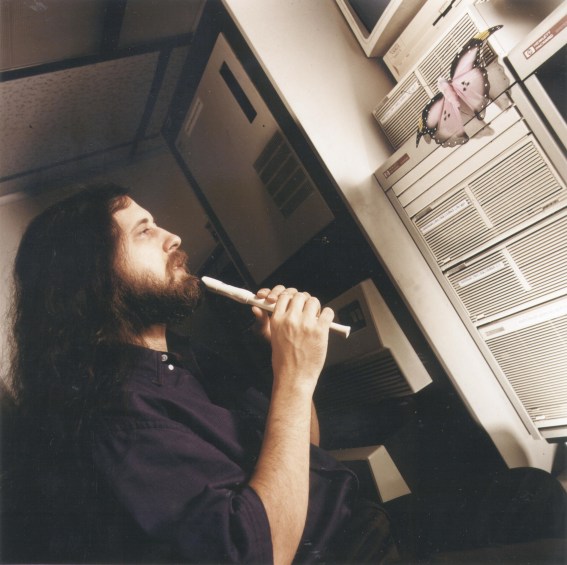
This situation didn't sit too well with RMS. Though he effectively dropped out of college, through non-attendance, he remained in the clock tower, unbeknownst to the faculty and administration of Berekely. His bizarre reclusiveness and tendency to "hack" only in the night kept him invisible to everyone, though rumors did circulate around campus about the "haunted clock-tower" and the deformed ghost that would occasionally appear, transluscent white, on top of the tower playing a magical flute [stallman.org].
Stallman grew sullen and withdrew into his own world in the clock tower. He watched as the joint Apple/Microsoft empire grew to become the computer industry and he vowed to topple it by undermining the livelyhood of his arch-rival Steve Jobs (and, by extension, Bill Gates) with his illegal offerings.
Stallman conspired with Linux Torvaledse, another Berkeley student, to create a hacker operating system which could be used to leverage the internet and wreak havoc on corporations everywhere. RMS even went so far as to use Microsoft's innovative GUI (Graphical User Implementation) which he had stolen from Microsoft's mainframe computer and given the hacker alias "X-Windows". Unfortunately, RMS was not able to acquire the latest Microsoft GUI codes and was thus forced to settle for an inferior version.
RMS' continued interest in communism provided him some insight as to how to spread his hacker tool across the internet. By stressing the free nature of the software, he would appeal to the welfare nature of the public.
This marketing scheme worked spectacularly. RMS' hacker tool is now installed on countless computers, hidden away in the dark bedrooms of LSD-using hacker teens [etext.org].
But Stallman didn't foresee the desire of the consuming public for Quality software, as opposed to his lean, second-rate offerings. Not even a price of 0.00 could turn the general public to installing this unwieldy hacker tool known as "Red Hat Linux".
Today, RMS and his following, consisting mostly of unpopular teens who gravitate toward the cult-like group of pirate hackers, continue to sing the praises of their "operating system". Neglecting to mention that it violates current DMCA legislation. This "operating system" is primarily used to trade illegal hacker "warez" and music videos.
Popular music stars like Metallica have called RMS and his hacker tool, "the single greatest threat to artistic expression in the history of man." And Bill Gates has noted, "They are all thieves. They spend their time stealing instead of innovating."
My hope is that this short essay has opened your eyes to the illegal Open Source movement and will give you pause when you may be enticed into downloading it, virus-like, into your unsuspecting computer.
-
Can we use this to catch pinkos?Richard M. Stallman, ubiquitously known as "RMS", is the Patron Saint of the "open source" movement. "Open Source" is a method of software distribution which implements a means of copy protection by not distributing the final program codes. Instead, the user must assemble this final "executive" code by hand, thus eliminating the need for the proprietary data which must be included in a company-distributed copy.
This is all fine and good, in theory, and the Open Source movement has garnered a vast following from across the untamed corners of the internet. In this essay, I will explore how Mr. Stallman came to embrace this movement.
RMS was born in Modesto, California and attended Berkeley University. This shouldn't surprise anyone, since Berkeley is the Liberal Hive of America and RMS is an admitted communist. RMS began his bizarre lifestyle while attending Berkeley, where he occupied the attic of a clock tower. This eccentricity continues today and RMS will not travel without a grandfather clock and a spitoon.
RMS' penchant for thievery was evident from the very beginning. His attic "apartment" was filled with equipment stolen from the Berkeley computer labs. This was quite an achievement in the early '70s, when any computer equipment was the size of a refrigerator.
RMS and his hacker friends cut class regularly, opting to spend their time and parent's money constructing illegal electronics devices designed to covertly access phone lines. The group of pirates would hack into the phone company, and charge enormous phone bills to unsuspecting Republican professors.
It was during this period that Stallman met Steve Jobs. RMS' technical savvy was far exceeded by that of Jobs and, never one to like being second-best, this caused him to pursue software hacking. RMS' hacking ability was innate and he and Jobs formed an alliance which would later result in the birth of Apple Computer.
Jobs' technical accumen was matched only by his ability to sell. He designed the internal electronics and outer package design of the first Apple, which was financed by Nolan Bushnell. He set RMS on to the task of developing the computer's "operating system" - a sequence of low-level MS-DOS commands which tell the computer how to decode program codes.
Though a gifted "coder", Stallman was quite lazy and didn't fare so well with the new operating system. His sloppy design and bloated codes were barely useable on the first microcomputer. Jobs dumped Stallman and hired John Wozniack to rewrite the internal operating system codes for the Apple I.
This situation didn't sit too well with RMS. Though he effectively dropped out of college, through non-attendance, he remained in the clock tower, unbeknownst to the faculty and administration of Berekely. His bizarre reclusiveness and tendency to "hack" only in the night kept him invisible to everyone, though rumors did circulate around campus about the "haunted clock-tower" and the deformed ghost that would occasionally appear, transluscent white, on top of the tower playing a magical flute.
Stallman grew sullen and withdrew into his own world in the clock tower. He watched as the joint Apple/Microsoft empire grew to become the computer industry and he vowed to topple it by undermining the livelyhood of his arch-rival Steve Jobs (and, by extension, Bill Gates) with his illegal offerings.
Stallman conspired with Linux Torvaledse, another Berkeley student, to create a hacker operating system which could be used to leverage the internet and wreak havoc on corporations everywhere. RMS even went so far as to use Microsoft's innovative GUI (Graphical User Implementation) which he had stolen from Microsoft's mainframe computer and given the hacker alias "X-Windows". Unfortunately, RMS was not able to acquire the latest Microsoft GUI codes and was thus forced to settle for an inferior version.
RMS' continued interest in communism provided him some insight as to how to spread his hacker tool across the internet. By stressing the free nature of the software, he would appeal to the welfare nature of the public.
This marketing scheme worked spectacularly. RMS' hacker tool is now installed on countless computers, hidden away in the dark bedrooms of LSD-using hacker teens.
But Stallman didn't foresee the desire of the consuming public for Quality software, as opposed to his lean, second-rate offerings. Not even a price of 0.00 could turn the general public to installing this unwieldy hacker tool known as "Red Hat Linux".
Today, RMS and his following, consisting mostly of unpopular teens who gravitate toward the cult-like group of pirate hackers, continue to sing the praises of their "operating system". Neglecting to mention that it violates current DMCA legislation. This "operating system" is primarily used to trade illegal hacker "warez" and music videos.
Popular music stars like Metallica have called RMS and his hacker tool, "the single greatest threat to artistic expression in the history of man." And Bill Gates has noted, "They are all thieves. They spend their time stealing instead of innovating."
My hope is that this short essay has opened your eyes to the illegal Open Source movement and will give you pause when you may be enticed into downloading it, virus-like, into your unsuspecting computer.
-
Lord of the PinkosRichard M. Stallman, ubiquitously known as "RMS", is the Patron Saint of the "open source" movement. "Open Source" is a method of software distribution which implements a means of copy protection by not distributing the final program codes. Instead, the user must assemble this final "executive" code by hand, thus eliminating the need for the proprietary data which must be included in a company-distributed copy.
This is all fine and good, in theory, and the Open Source movement has garnered a vast following from across the untamed corners of the internet. In this essay, I will explore how Mr. Stallman came to embrace this movement.
RMS was born in Modesto, California and attended Berkeley University. This shouldn't surprise anyone, since Berkeley is the Liberal Hive of America and RMS is an admitted communist. RMS began his bizarre lifestyle while attending Berkeley, where he occupied the attic of a clock tower. This eccentricity continues today and RMS will not travel without a grandfather clock and a spitoon.
RMS' penchant for thievery was evident from the very beginning. His attic "apartment" was filled with equipment stolen from the Berkeley computer labs. This was quite an achievement in the early '70s, when any computer equipment was the size of a refrigerator.
RMS and his hacker friends cut class regularly, opting to spend their time and parent's money constructing illegal electronics devices designed to covertly access phone lines. The group of pirates would hack into the phone company, and charge enormous phone bills to unsuspecting Republican professors.
It was during this period that Stallman met Steve Jobs. RMS' technical savvy was far exceeded by that of Jobs and, never one to like being second-best, this caused him to pursue software hacking. RMS' hacking ability was innate and he and Jobs formed an alliance which would later result in the birth of Apple Computer.
Jobs' technical accumen was matched only by his ability to sell. He designed the internal electronics and outer package design of the first Apple, which was financed by Nolan Bushnell. He set RMS on to the task of developing the computer's "operating system" - a sequence of low-level MS-DOS commands which tell the computer how to decode program codes.
Though a gifted "coder", Stallman was quite lazy and didn't fare so well with the new operating system. His sloppy design and bloated codes were barely useable on the first microcomputer. Jobs dumped Stallman and hired John Wozniack to rewrite the internal operating system codes for the Apple I.
This situation didn't sit too well with RMS. Though he effectively dropped out of college, through non-attendance, he remained in the clock tower, unbeknownst to the faculty and administration of Berekely. His bizarre reclusiveness and tendency to "hack" only in the night kept him invisible to everyone, though rumors did circulate around campus about the "haunted clock-tower" and the deformed ghost that would occasionally appear, transluscent white, on top of the tower playing a magical flute.
Stallman grew sullen and withdrew into his own world in the clock tower. He watched as the joint Apple/Microsoft empire grew to become the computer industry and he vowed to topple it by undermining the livelyhood of his arch-rival Steve Jobs (and, by extension, Bill Gates) with his illegal offerings.
Stallman conspired with Linux Torvaledse, another Berkeley student, to create a hacker operating system which could be used to leverage the internet and wreak havoc on corporations everywhere. RMS even went so far as to use Microsoft's innovative GUI (Graphical User Implementation) which he had stolen from Microsoft's mainframe computer and given the hacker alias "X-Windows". Unfortunately, RMS was not able to acquire the latest Microsoft GUI codes and was thus forced to settle for an inferior version.
RMS' continued interest in communism provided him some insight as to how to spread his hacker tool across the internet. By stressing the free nature of the software, he would appeal to the welfare nature of the public.
This marketing scheme worked spectacularly. RMS' hacker tool is now installed on countless computers, hidden away in the dark bedrooms of LSD-using hacker teens.
But Stallman didn't foresee the desire of the consuming public for Quality software, as opposed to his lean, second-rate offerings. Not even a price of 0.00 could turn the general public to installing this unwieldy hacker tool known as "Red Hat Linux".
Today, RMS and his following, consisting mostly of unpopular teens who gravitate toward the cult-like group of pirate hackers, continue to sing the praises of their "operating system". Neglecting to mention that it violates current DMCA legislation. This "operating system" is primarily used to trade illegal hacker "warez" and music videos.
Popular music stars like Metallica have called RMS and his hacker tool, "the single greatest threat to artistic expression in the history of man." And Bill Gates has noted, "They are all thieves. They spend their time stealing instead of innovating."
My hope is that this short essay has opened your eyes to the illegal Open Source movement and will give you pause when you may be enticed into downloading it, virus-like, into your unsuspecting computer.
-
OOP for Earthquake Engineering
You might want to check out the OpenSees Project - they've built an OO tool for structural analysis.
An API listing is available at:
http://opensees.berkeley.edu/OpenSees/api/contents
Have fun, Peter -
Implementation details
can be found in one of the researchers' papers, where it can be seen that the poster, editor, and many of the commentators here make incorrect assumptions. The user of the system must simply recognize which subset of images from a presented set belong to a previously chosen portfolio. The number of images in the portfolio is larger than the number of portfolio images in the presented set; this makes shoulder surfing ineffective unless it is done repeatedly. Also, identification of the portfolio images can be done by pressing keys, and can be hidden just as are conventional passwords. Each image is equivalent to an eight-byte number, but from this large set they have hand-selected 10,000 images for the current implementation, still leading to a very large number of possible passwords.
The weakest part of the system is what I would have thought was the obvious one: quoting from the paper,
In general, a weakness of this system is that the server needs to store the seeds of the portfolio images of each user in cleartext. Tricks similar to the hashed passwords in the
-
And here is the interesting URL
for the project itself
http://www.sims.berkeley.edu/~rachna/dejavu/
Which always seems to be missing. -
page at Berkeley
On the group's page they don't offer any code, but there's a screen shot, some research papers and links to other articles, and a link to Andrej Bauer's (of Forum 2000 fame) Gallery of Random Art.
-
Re:Why do worm writers stay free?
Well... think about it - which activity creates more money for law enforcement, traffic tickets or catching crackers? We already have technology that could control how traffic moves. But that would threaten the highway patrol 'industry' that's already in place. What a joke!
-
Re:seti is bunk"seti@home makes a lot of assumptions in order to make it's goals seems plausible. .
No. SETI researchers make no such assumptions. They certainly don't make many of the assumptions you've claimed they make. For example, you say that one of SETI's assumptions is that every planet that develops life will eventually develop an intelligent civilization. I know of no serious researchers who assume such a thing. In fact, the URL you listed to demonstrate this assumption says precisely the opposite.
no, i really think you need to reread this. they specifically say that a planet that spawns life will evolve intelligence 100% of the time. to me that's utter bunk. they plug rediculous values in drake's equation's variables.
You correctly claim that our own evolutionary history would indicate that intelligence such as ours is probably an unlikely development. But you incorrectly claim that "intelligence itself is not evolutionarily stable." We only have a very few examples of intelligence, and not enough to make such a statement. Sure, brains are expensive, but judging from the success of mammals, they're a valuable investment. The only way to know for sure would be to look at the evolutionary paths of thousands of worlds, and compare them.
this is what i meant by a some very well timed random events. without them, mammals would not have been given the opportunity to evolve. mammals didn't evolve brains because they could, they did it because they had to due to the particular ecological pressures present. had those ecological pressures NOT been present, there were much better mechanisms to spend "energy" on.
The rest of your review is based on several other unprovable assumptions:
- That the civilization will not invest the time or resources in contacting other worlds.
SETI always uses us (earth) as an example. so i'm doing the same. how much have we done to contact other worlds? what if all the other intelligences are ALSO just listening?
- That the energy requirements of a long-term project would be prohibitive.
how is that unprovable? we're looking for radio signals. we know what energy costs it takes to send multidirectional radio signals for huge distances (astronomical).
As to the first two, we don't know what energy technologies will be developed in the future, how committed a civilization might be to finding others, or how good a very advanced civilization would be at picking candidate planets to beam signals at.
yeah but come on, radio communications is a PRIMITIVE and energy INEFFICIENT technology. by the time future energy technologies are developed radio waves might not even be used.
- That most civilizations will self-destruct within a few centuries.
For the third, I would dispute your claim that "We have come close to wiping ourselves out several times already." [discussion of nuclear war's effect on our survival]
i admit my statement is a cynical one, however we have to admit things look pretty bleak! and self-destruction doesn't have to mean nuclear war! there's plague, nano-technology, chemical weapons, ecological disasters, and a score of destructive ways we'll develop in the next 50 years.
This is part of what makes SETI research so valuable. Finding out how common other intelligence in the universe is tells us a lot about our own situation. Even if we did a complete, thorough search of the entire EM spectrum for ten thousand years and came up with nothing, we'd still have learned something valuable. We'd have learned that successful, intelligent species are very few and far between, and that it was even more important that we not screw things up.
i suppose. or that they are not willing to talk to us. or that we missed a critical segment of the sky. or that our algorithm had a bug in it (remember when SETI was sending the same block to every computer for a few weeks?). or that we're the only ones stupid enough to use EM in the first place (what if all the other intelligent beings use ESP?)...
-
Re:Schools should switch to Linux, NOT BSD.While *BSD may be appropriate for weekend hackers and tinkerers, it is entirely inappropriate for any school computing solutions...
Dude, you *do* know that the "B" in "BSD" is a rather famous public school?
-
Mathematician with Asperger's
Fields medal winner Richard Borcherds believes he has Asperger's syndrome; see for example this article.
-
some good icelandic bits to start onYou might want to try the Prose Edda by Snorri Sturlson (c. 1200). Part one talks about Norse mythology, and the second part tells where some Norse idioms come from, mytholgically. Granted, I'm not familiar with any of these idioms ("why is gold called Silf's hair?"), but both parts are a good read.
For an ass-beating Icelandic saga, try Njal's Saga, a rich source for Icelandic history and a great read.
-tyriphobe
-
More Secure, but not?
In reading the posted article and in reviewing some literature concerning WEP security here: CS at Berkeley I was wondering if anyone out there had insight on the nature of the modifications that have been made.
Please excuse my naivety in the field, but from the Berkeley article I gather that not only is the similarity of the packet keys a weakness of WEP (as RSA indicates), but also the use of a 24-bit space for the initialization vectors used to generate the RC4 packet keys.
Now, is the 24-bit space limitation what RSA means by, "similarity of the packet keys", or are they referring to the fact that most boards start the IV at 0 and simply increment for each packet (the end result being numerous IV collisions)?
The reason I wonder is because theoretically, at least, one could construct a table of all IV + key stream combinations in a decryption table (~15Gb according to Berkeley) and thereby gain himself the key to the city, so to speak. So, while limiting the number of IV collisions would certainly make decryption more difficult and certainly more time consuming, it wouldn't make WEP entirely secure. In the event that someone be so determined to monitor WLAN activity for enough time to construct such a table, could users of WEP be exposed? -
Re:Christianity...
Wagner's "Der Ring Des Nibelungen" also influenced him
Indeed. It contains a ring lost in a river, a broken sword that the hero must reforge, and ultimately the departure of the gods from the world. (It is, of course, based on the Middle-German Nibelungenlied.)
Another interesting way to take this would be: Wagner and Schopenhauer begat Nietzsche (then Schopenhauer battled Wagner), Nietzsche became (like Tolkien 100 years later) a professor of philology, Nietzsche put together most of the ideas responsible for anything we've read in thinkers like Freud or Joseph Campbell. -
Re:Waste of a class? I think not.
The Simpsons, albeit a cartoon show
I think that this fragment of a quote pretty much sums up the entire point of the class. There always have been, and still are, some philosophers who write philosophical tomes which are quite clearly philosophy. But philosophy presented in the form of entertainment is no less worthy of consideration.
Consider, for example, "Candide" (by Voltaire) or "Zen and the Art of Motorcycle Maintenence". While they both take the form of a story, each is clearly a philosophical text as well. Likewise texts such as "Gulliver's Travels" and "Catch-22", while more focused on story, also contain plenty of social criticism, which is a form of philosophy.
Considering that "The Simpsons" is far more thoughtful than most of the rest of popular culture, I'm not at all surprised that someone decided to teach a class in it. Whether or not it lasts as part of the philosophical canon after it's off the air remains to be seen. It may not be good enough or philosophical enough to last, but I'm not surprised that it's being recognized in its time.
On a related note, Alan Moore (of "Watchmen" and "From Hell" fame, among other things) taught a class on comic books as literature at The University of California at Berkeley a few years back, and "Watchmen" is on the reading list for one Film/Rhetoric/English class there. This is another example of a "cartoon" that's being taken seriously. It has been known to happen -
Handy Link
I just stubled on this, maybe it'll help.
-
Medvedka Re:stick it in yakhont yawhore!
I took a little Russian in college (or rather, I took 13 credit hours worth and remember little
*similarly "vod" is water, so "vodka" is "little water that we all know and love"
-
Re:Interesting Cycle...
Troll Huh? Looks like some people missed out on their history lessons:
History of Colonial Georgia. Also, linking Georgia together with Australia comes the quote:
"After the American Revolution prevented further transportation of convicts to Georgia, the British Parliament authorized removal of the criminal underclasses to the remote colony of New South Wales. A Second penal colony was soon required to accommodate the increasing convict population, and in 1803 Van Diemen's Land (Tasmania) was established for that purpose. This distant island soon became the primary Australian penal colony."
Thanks. -
Re:Crypto is safe
The problem is that most of the canonical methods of generating One Time Pads are based on discrete log (in the form of the Diffie-Helman (sp?) key exchange), which can be solved by factoring.
Are you on drugs? Most canonical methods of generating One Time Pads are based on physical processes, like throwing dice, sampling a radioactive source or digitizing lava lamps
Using a pseudo-random generator to generate one time pads offers pseudo security. -
All about Digital Fountain
OK folks, here is the "real deal."
Digital Fountain's core technology is called "meta-content (tm)". The meta-content engine produces packets based on the original content, such that if the receiver receives enough packets (just slightly more than the size of the original content), the original content can be recreated. The neat part is that it doesn't matter which meta-content packets you get. If you need to receive 10 packets, you can get 5, miss 5, get another 5, and it works. Or you can get 1, miss 10, get 9, and it works as well. As long as you receive some 10 packets from the "fountain," you can recreate the original content.
Why is this cool? Several reasons. Digital Fountain claims that TCP connections with RTT of 200ms and 2% packet loss have a bandwidth limitation of 300kbps, no matter how fast the actual transport channel is. So you just go to town to full bandwidth with UDP to use up the entire channel, and use Digital Fountain technology so it doesn't matter which 2% of packets get lost, just as long as you transmit enough packets to make up for the packet loss.
OK, why else is this cool? Imagine a Digital Fountain continuously transmitting meta-data on a multicast address. If you want to receive a file, just listen to the multicast address. It doesn't matter when you start listening, just as long as you listen for enough packets to recreate the original file. Multicast file distribution.
Interestingly enough, Digital Fountain has also pioneered multicast on-demand streaming, but the real secret sauce there is something besides meta-content, but meta-content makes it easier.
As some people have mentioned, you can use UDP with FEC to achieve some error correction. But meta-content can handle long burst errors, whereas FEC is only appropriate for short, random errors. You can literally unplug the ethernet, wait a while, and plug it back in, and you're still good to go with Digital Fountain, as long as you listen long enough.
I should mention, DF has something called "Fair Layered Increase Decrease Protocol," or FLID, to keep their UDP burst from blowing away other TCP traffic on the network.
For more information on the basic Digital Fountain technology, see: A Digital Fountain Approach to Reliable Distribution of Bulk Data. -
Tornado codes
This technology (from the write-up anyway) uses some kind of proprietary technique to re-map the data into another domain and send the information required to reproduce it. It sounds kind of like sending a waveform as a series of Fourier coefficients rather than as actual data samples.
Actually, they use Tornado codes (or a proprietary update thereof), an erasure code. That is, they use forward error correction to encode streaming data or a software distribution over a single (or multiple) client-independent streams of multicast. After a client grabs enough packets, it can reconstruct the source file. -
Re:Early Usenet Fact
Actually, SETI does something similar (though with tapes much bigger than 9MB, 35GB to be exact) to get data from Puerto Rico to SETI@Home. Info is here.
Sorry about the AC post, but I've already moderated on this story. -
Already heading towards..
...Private companies owning parts of the human genome.
http://sunsite.berkeley.edu/biotech/iceland/about. html
There are other studies being carried out in South America and Africa under similar terms.
Question: How else do we fund this research?
Companies need to be able to get a return from their initial investment. -
Re:sorry!
Hi,
Neutrinos interact with matter only through the weak nuclear force (and probably the gravitational force; whether they have mass or not is still kind of open, although it seems increasingly more likely that they have a non-zero mass). You are correct that the neutrino reaction does not directly produce a gamma ray photon.
The collision of a neutrino with a chlorine atom changes one of the chlorine atom's neutrons into a proton (note: a weak nuclear reaction), thus transforming the Chlorine atom to an Argon atom (atomic numbers 17 and 18, respectively). The reaction also produces an electron (charge must be conserved).
The particular isotope of argon produced (Ar-37) is unstable to radioactive decay. In a few days it spontaneously reverts back to Chlorine-37, producing an anti-electron in the process:
Ar(37) -> Cl(37) + neutrino + e(+)
The anti-electron immediately finds its way to the nearest electron, and they annihilate, producing a pair of gamma rays, which lead to a cascade of optical photons, which are detected by the experiment.
Whew.
Note that Super-K (the Japanese experiment that was damaged recently) doesn't actually use this chlorine setup, it uses something similar using ultra-pure water as the reactant. Also, I believe the water-based detectors rely on the kinetic energy of the electron in the first reaction to produce cerenkov radiation, rather than a subsequent beta decay/annihilation of anti-electron.
Here are some links on neutrino detector experiments. Google has all these and more.
The Solar Neutrino Problem
Review of all experiments
Sudbury Neutrino Observatory uses deuterium (a/k/a heavy water)
Super-Kamiokande
AMANDA uses Antarctic Ice as the reactant.
I recommend the first link for a detailed overview of solar neutrinos.
enjoy,
Jason -
Total piracy of technology
This is nothing new - originally, Gibson invested in CNMAT, Zeta, and a couple contractors to develop an extension to MIDI called ZIPI. A horrendous name, but functionally it was much better than MIDI could ever be - and it ran over 10Base-T (late 80's, early 90's). There was a huge legal battle over ZIPI, due to some nasty contracts penned by Gibson and their lawyers, and much screwing of the developers of the technology ensued (this is where Henry Juszkiewicz issued his infamous quote "There is no right, there is no wrong. There's only who has more money for the better lawyers.").
After this bout of legal hell was completed, Gibson had their own internal engineers re-work ZIPI to work over 100Base-TX with an increased channel count and such, and named it GMICS (Gimmicks). This didn't catch on, because of the horrendous licensing agreement that companies had to sign to get access to the technical specification.
Now, this goes to MAGIC - the third re-munging of the ZIPI protocol, and essentially the same thing as GMICS, only with a much better licensing scheme. It's still non-optimal, it still can be done MUCH better, and it still has a LONG way to go in order to seriously compete with not only Yamaha's mLAN and the IEEE 61883.6 audio/MIDI protocol for FireWire.
For more info, check this link out:
Details of the accounts between Lynx Crowe (one of the developers of ZIPI) and Gibson. -
Re:Fermi's objection
> there should be evidence of colonization everywhere
Every single inhabitable planet we know of has already been inhabited... what more proof do you want?
Also, bringing life to a planet isn't as easy as simply flying a ship over. To make the colonies self-sufficient, you've got to design a diverse ecosystem specifically adapted to the destination planet and allow it to spread.. not an easy feat. If it's not diverse or self-sufficient, the first plague or late supply ship kills it off.
Besides commiting to travelling to another planet, you've got to have a reason. It's taken us over 4 million years to fill this planet up; At this rate per colonization, 1-10 million years is not neary enough time to expect to fill the whole galaxy. -
Re:SETI@Home
The real slashdot team has over 2,000 members. The one in your link only has about 550. This is the real team link.
-
SETI@Home
Don't forget to join the Slashdot SETI@Home Team!
Here is a link with the stats and stuff:
http://setiathome.ssl.berkeley.edu/cgi-bin/cgi?cmd =team_lookup&name=slashdot
-J -
No Books?
What about:
The Cuckoo's Egg (Cliff Stoll)
and my favorite
Underground?
The events in Cuckoo's Egg (according to Stoll) was the first real eye-opener for the US about the threat from international crackers/hackers, and the book made the whole issue understandable to laypeople. Underground documents the legal cases of many prominent figures in the scene (with a focus on Australia). -
For example: SETI@home data reuseWe here at SETI@home collected hundreds and hundreds of 35 GB DLTs worth of data, all staring at the hydrogen line. So with relatively little effort at all, we can construct a rather robust map of hydrogen in the sky above Arecibo Observatory.
Details at: http://setiathome.berkeley.edu/newsletters/newsle
t ter10.html- Matt Lebofsky - SETI@home
-
CommentsI am the researcher mentioned at the beginning of the article, and I hope to address some of the questions that have arisen here. Please note that while the quotes in the article are accurate, the views ascribed to me are sometimes misleading
What exactly is the agreement I have with the University?
Briefly, my agreement with the University allows me, as well as members of my group, to produce open source software so long as:
(1) all authors agree for the software to be open source,
(2) the funding source agrees with the code being open source, and
(3) no laws are broken (including aspects of patent law embodied in the Bayh-Dole act).Note that while this agreement permits my group to produce open source software, it does not require that we produce open source software. This is a blanket agreement covering all of my software written at the University.
Who funded this research?
The agreement covers all of my software development, regardless of source (though, as noted above, each source must be consulted). It was drawn up before I had any funding, as part of my employment agreement. Since then, my research has been funded from public sources (NIH, NSF, DOE, LBNL, and the University of California), and from a private charity (a Searle Scholarship).Some clarifications of my views, where the article was imprecise
- I believe it is desirable for authors to be allowed to produce open source software. At this point, I think it would be inappropriate for it to be required, as others have proposed. I currently have no problem with other scientists who readily distribute their software but not use open source licenses.
- I believe that prospective authors of open source should approach their Universities with a standard contract similar to mine. I do not presently support a movement to "force universities to allow 'open source' publishing," as the article states.
- I am not opposed to the Novartis/Syngenta agreement at Berkeley, as the article suggests. In fact, I have not studied that agreement carefully, and so I have no considered view of it. My impression is that much being said here about the agreement is incorrect.
- I feel that fixing bugs is only one of many benefits of open source, and probably not the primary benefit (as the article suggests)
- My agreement does not run counter to laws that allow the University to enter exclusive licensing agreements. The primary law governing such agreements is Bayh-Dole, which covers patents. My agreement only covers copyright. Moreover, my agreement has as a prerequisite permission from the funding source.
- I agree with Phil Green that many individuals have greater respect for software that they've paid for. No problem: have both an Open Source and a commercial license for the code (as is the case for important programs like HMMER).
- The University's default licensing agreement allows anyone to use the source code for non-commercial, research purposes. It's not nearly as bad as most posters here suggest. See it here (note: the original site is down; this is the google cache).
- It is instructive to actually read the U.S. patent code as modified by the Bayh-Dole act. As I understand it, the main point of this act is encourage intellectual property from federal funding to be developed, rather than left to sit on in the dust on a shelf.
- The University of California, Berkeley was quite helpful in arranging my open source agreement. I understand why their default license is different, and I appreciate their assistance in modifying their standard terms to accommodate my scientific goals. I was very happy with the University's response, and I think the agreement is eminently reasonable.
I welcome follow-up postings here and will try to answer further questions that arise.
Steven E. Brenner
http://compbio.berkeley.edu - I believe it is desirable for authors to be allowed to produce open source software. At this point, I think it would be inappropriate for it to be required, as others have proposed. I currently have no problem with other scientists who readily distribute their software but not use open source licenses.
-
PtolemyPtolemy is a good tool for modelling and simulation.
From their website:
"The Ptolemy project studies modeling, simulation, and design of concurrent, real-time, embedded systems. The focus is on assembly of concurrent components. The key underlying principle in the project is the use of well-defined models of computation that govern the interaction between components. A major problem area being addressed is the use of heterogeneous mixtures of models of computation." -
Re:octave and matlab and Ptolemy
$5 for MathCAD is a much better deal than my $100 for Matlab
nevertheless, outside the US where universities have less muscle to get good deals, student licenses are still expensive for the less-priviledged students. therefore, people go the GNU/Linux way.
Ptolemy is a good tool if you want to model and simulate systems. -
Re:shear quantity of data
Actually, perhaps this is more useful, (from the Seti Site)
http://setiathome.ssl.berkeley.edu/totals.html
Total
Users 3383619 1872
Results received 399604453
Total CPU time 799230.603 years
Floating Point
Operations 1.142642e+21 (29.64 TeraFLOPs/sec)
Average CPU time
per work unit 17 hr 31 min 13.7 sec -
Re:You have the answerTuring test time:
A program written in C++ can be written in Java. Both languages are complete.
However...
Java is not OO complete. There's a subtle difference there. No multiple inheritence, no operator overloading. Sure these features may be "dangerous", but let the programmer make the decision, not the language.
Poor floating point support. Check this paper.
Not to mention the virtual machine being inherently slow.
The fact that Java is proprietary language controlled by Sun.
These are the reasons to sway you from Java (if they are important in producing your application). Not some silly Java sucks argument. If you can live with the above. Go for it.
-
Sounds Cool
Reading through at +3, I see that most of the respondents have a pretty negative attitude towards this device. If it's real, then, wow...I mean, this is the sort of thing that webpads and the like need. Sure, a stylus is nice for most things, but if you need to write more than a little bit, you need a keyboard.
What's more, I think, is that one of the big size-limiting factors of making laptops much smaller than they are is the need for a keyboard. Imagine if you had a webpad style laptop that had a built-in mechanism for propping it up, and you'd just strap on the virtual keyboard doohickeys and away you'd go. By losing the keyboard, laptops could be almost half the size and a little bit lighter (admittedly, laptop keyboards don't weigh much, if you've ever taken a laptop apart, the keyboard weighs just a few ounces).
Also, I'd like to point out that when stuff like the "Smart Dust" project gets posted, people rave about how this would make for a great virtual keyboard, but when this shows up, most of the responses are along the lines of "well, even if it is real, it would suck." What the heck?
Furthermore, to all those people complaining about how they can't touch type and therefore it would be useless: maybe you should take a proper typing class or get a copy of tuxtype or mavis beacon or something. Touch typing is a valuable skill. At the very least it'll improve your ability to use vi/emacs/whatever. -
Re:just thinkSome of us do use our otherwise wasted idle-cycles for something useful:
Cancer drug research
Gene research
Protein folding
All of these distributed projects reach into medical research and are as such a bit more useful than searching for ET or cracking RC-5.
-
I have an IdeaOne word SETI.
Perfect for scrap heap computers and calculators. Still might need to port it...