Slashdot Mirror
Domain: bit-tech.net
Stories and comments across the archive that link to bit-tech.net.
Comments · 304
-
Re:What about HDRI?
I think you're confused about hdr. Max brightness will always be "all bits on". It's only paper white because that's the absolute max brightness your display can show!
You need an HDR display to view HDR images, otherwise you're just doing tonal mapping. The examples show in that wiki are not HDR images, they're tonal mapped images. Their dynamic range is exactly the dynamic range of all the other pictures you've seen today, 3 color channels, 256 bits per color channel. High dynamic range displays require brighter backlights to make the higher *dynamic range* possible, otherwise you're just increasing bits-per-pixel and reducing color banding. You'll never find an HDR display in anything powered with our current battery tech because of this.
For a realistic idea of an HDR display, here's an interesting review: http://www.bit-tech.net/hardware/2005/10/04/brightside_hdr_edr/5
-
Re:Turbo button?
http://www.bit-tech.net/news/industry/2009/07/24/asus-xtreme-design-an-explanation/1
Turbo Key
The ASUS Turbo Key is an exclusive feature that transforms the PC power button into a physical overclocking button. After completing the easy setup from the driver disc, the user is provided with the ability to boost performance levels with just a push of a buttonâ"presenting users with faster, more powerful performance without interrupting ongoing work or games!
-
Re:Emulation isn't necessarily a fair comparison
I believe the term you're looking for there is "physx", to pull a double entendre and being a pedant at the same time. Graphics performance matters, but I don't really want to sidetrack into that.
It's not the physical limitations of the processors that are at issue for higher performance. It has more to do with "Where can we get more gains"? Performance has been on a continual upward trend, and that hasn't changed. When we get down to 10nm, then we will be facing actual physics issues/limitations *ON SILICON*.There are other technologies in the works here (graphite). Even Intel is exploring this.
It has to do with at it's core, RISC vs CISC. There simply is no way around it until intel actually provides ARM processors. With their attempts to introduce x86 for android, it sounds like they have given up on the ARM route for consumers/entry level, even though they bought a license to ARM.
-
Re:We have ideas, we just can't exploit them
Apple was sued by Creative for $100M, Personal Audio LLC for $8M, and probably more I'm forgetting about. They actually tried to deflect one of the lawsuits by admitting the basic idea was invented in 1979. Apple's situation exactly demonstrates both major problems here. No real innovation, just refinement of existing ideas with a better look/feel. And they were only able to survive because they could shrug off a ridiculous $100M lawsuit from Creative and keep going.
-
Re:Follow the money
-
Re:DRM
http://www.bit-tech.net/news/gaming/2011/08/01/diablo-3-will-have-always-online-drm-microt/1
This site references an interview Blizzard gave PC Gamer. Starcraft 2 has a timeout for single player without internet. I didn't know that until I was on a ship for a month and it stopped letting me play. -
Re:Why hasn't it clicked yet?
Two things: firstly, you neglect to provide any source or figures for your claim that it's not reduced piracy. I can understand why you wouldn't provide figures - they're difficult to come by and when you do find them the source is usually biased, but simply omitting them and stating your opinion as fact doesn't make it so. There are plenty of respected sources arguing that DRM actually drives people to piracy.
Secondly, you completely ignored the "at a reasonable price" part of the sentence you highlighted. The fact is, in almost all cases it's as cheap if not cheaper for me to buy a physical CD/DVD/ebook/game burned to a disk or printed on paper from a bricks and mortar store (where its occupying valuable floorspace and requires dedicated retail staff, not to mention the logistics of delivery and the wholesale supply chain all contributing to the cost) than it is to buy a collection of bits over the internet. That doesn't represent good value, not even close. The fact that people are still buying so much music online, even when it represents a poor choice compared to the alternative, shows that people want to spend money, and there are plenty of again respected sources arguing that a drop in digital prices would do more to combat piracy than DRM and ridiculous restrictions on freedom and the internet and bought and paid for laws.
-
Re:Looks like AMD might be going under then
Do yourself a favor and visit GlobalFoundries latest news information. They are soon to be exploding and already have customers spoken for all but the new plant in New York that will be targeting the 22nm and below needs at 300mm wafer size.
http://www.bizjournals.com/albany/news/2011/07/12/globalfoundries-begins-installing.html
More News Here: http://www.globalfoundries.com/newsroom/
Tri-Gate competitor well under way. http://www.bit-tech.net/news/hardware/2011/07/12/global-foundries-tri-gate-competitor/1
-
Re:It's reverse psychology!
Parent AC is a troll, in case readers/mods don't spot it.
Some of those quotes are taken totally out of context. Some of them are true! Carmack also says Direct3D > OpenGL.
How about I choose some quotes from terjeber:
"I also have to do cross-platform stuff. In such cases I am on Linux primarily. Some times I wander into Solaris territory."
"Ruby/Rails". (His preferred web dev platform, ahead of
"Being religious about what platform you use is a sure sign that as an IT professional you are ready for replacement." -
Re:tackle the root of the problem, not the symptom
I know my sister gets serieus omgwtfbbq reactions when she mentions she's off to a lan party with some friends to play (among other things) Unreal Tournament.
THIS is a big part of the problem too. A story about this just showed up on Fark recently:
http://www.bit-tech.net/gaming/2011/06/20/fat-ugly-or-slutty/ is a very good read.
When I was first shown the offensive messages that my friend Jaspir received, I laughed. Their crudeness was so hilariously over-the-top that it was nothing short of ridiculous. I had been told many times by people I know and trust that online games are a wild and untamed jungle, with pictures of genitalia hiding around every corner. But it wasn’t until I was actually shown the messages that I really understood. Something finally clicked.I thought I was alone in this misunderstanding. I figured every gamer must have already known how horrible the world of multiplayer gaming was, and that I’d only missed it because I don’t play online all that much. I figured the lewd content and insults were accepted by everyone as a hazard of the hobby – it’s just trashtalk, right?
So, when my friends and I started Fat, Ugly or Slutty to collect examples of this rude banter we didn’t think it would shock anyone. We wanted to gather all this horribleness in one place and have a chuckle about how stupid and ridiculous it was; the FailBlog of gaming.
Some girls take that a bit more personal than others and if you start acting like that there's a good chance they won't come back.
-
Re:Reminds me of hardcards
The reason hardcards were a good idea is that you often needed both a slot for the hard drive controller and a place to put the drive. If you only had a single drive, you could put the drive on the controller card and not use up the extra space.
In this case, though, the SATA port just isn't fast enough to separate the controller and the drive. The only way to max out the speed of the SSDs is to put them on the PCIe bus. A Revo can already max out a 6GB/s SATA 3.0 link, so what's the point in separating them? The problem is that fast SSDs are expensive, so you can't get much storage out of a super-expensive card. The solution is to put an HD on the same controller as the SSDs to enable both the "HD is a slower backing store for the SSD" and "SSD is a huge cache for the HD" scenarios.
dom
-
Good, except for one.
I think I can agree with most of the games on this list. I definitely think that Myst deserves a big reward for how utterly innovative it was at the time (especially graphically!), and I'm glad to see that they're at least putting it on display for folks to play. I can see why they chose Fallout 3 over Myst. I have to wonder, though, how fun it can possibly be without spending several hours immersing oneself in it? My dad and I worked on that game over the course of several months, scratching notes, diagrams, and drawings in the provided(!) "journal." Man, those are some fond memories.
My only major beef, though, was the inclusion of Doom II. For starters, the original Doom was much more innovative for its time, and I had a LOT more fun playing it than I ever had with Doom II. The real travesty, however, is that Doom II beat out Deus Ex, of all things! Not only was Deus Ex a much more beautiful game, artistically (in terms of music, video, story, etc.), but there has yet to be another game that truly so masters the FPS-with-RPG elements that Deus Ex so deftly and artfully included. I think that this is truly one of the best games of all time, despite how dated the graphics were when it was released (although still prettier than Doom II, due to better hardware available). I'm REALLY hoping that the up-and-coming Deus Ex sequel isn't the hopeless disappointment that Deus Ex 2 (Invisible War) was.
Doom II was truly a good game, but I never thought it was nearly as fun as Doom 1, and it certainly can't hold a candle to Deus Ex.
Another article you may be interested in: 30 Games to Play Before You Die. It's a bit dated (2009) but at least they got the first game right.
-
Re:They are upset...
Why does everyone forget the second one right after? http://www.bit-tech.net/news/2007/09/04/sony_admits_to_microvault_rootkit_problem/1 I consider that one worse, as you know it was intentional.
-
Re:Mineral oil = nightmare
There's a good play-by-play report of a hobbyist's adventures in mineral oil cooling here. The first page is just an introduction, but contains links to all the juicy bits on successive pages.
Sorry, no goatse. -
Re:Use more bandwidth to enjoy media?
If you're interested in Blu-Ray level quality, streaming will be even worse than local ownership. Also, your NAS cost is bunk, ever heard of an external hard drive? While I'm at it, good luck suing for SaS.
-
Power Savings
It turns out you can save a lot of energy by having modern multi-core processors handle the same work-load as a single core because they can clock down and use lower voltages. Two cores running at 550MHz each use 40% less energy than one core running at 1GHz. Similar power savings can be made with 4 cores running at lower speeds and lower voltages on multithreaded workloads.
-
Why is TFA an image?
Well I guess if no-one is going to read the article anyway...
-
Funny, John Carmack thinks just the opposite
John Carmack is quoted as saying almost the exact opposite:
[ http://techreport.com/discussions.x/20580 ]
[ http://www.bit-tech.net/news/gaming/2011/03/11/carmack-directx-better-opengl/1 ]Eight days ago
[ http://games.slashdot.org/story/11/03/11/1832205/Doom-Creator-Says-Direct3D-Is-Now-Better-Than-OpenGL ]For the lazy clickers:
Speaking to bit-tech for a forthcoming Custom PC feature about the future of OpenGL in PC gaming, Carmack said 'I actually think that Direct3D is a rather better API today.' He also added that 'Microsoft had the courage to continue making significant incompatible changes to improve the API, while OpenGL has been held back by compatibility concerns. Direct3D handles multi-threading better, and newer versions manage state better.'In case you're unfamiliar with the mighty Carmack, he co-founded id Software in 1990, and had a large part in programming Wolfenstein 3D and the original Doom and Quake games. Since then, id has rigidly stuck by OpenGL for both Doom III and Quake 4, while many other cutting-edge PC game developers have moved entirely over to Direct3D.
Well, I did say, almost.
-AI
-
Re:Degraded Performance
TRIM doesn't work with RAID
-
Re:Meh. Missing features.
The information that the original poster was referring to is here: http://www.bit-tech.net/hardware/apple/2010/07/01/mac-ssd-performance-trim-in-osx/2 Even though the article is recent, the model that they tested in the Mid-2009 MB Air, not the current model. That means the controller chip is at least a 1.5 years old, and most likely is not one of the new super-modern SSD controllers. The bullet point is, "OS X needs TRIM", what you're really asking is "OS X shouldn't degrade performance of an SSD the more it's used". This apparently doesn't happen, though to be sure it'd need to be retested with a 3rd party SSD. But I certainly trust facts and figures rather than people making claims w/o anything other "well it needs TRIM". And OS X gives the users several options on where to store iTunes data, it's trivial to move that off to another partition. You can even move the entire user profile to another drive if you want to.
-
Re:Cool stuff
Unless you have an HDR screen, this would require an automatic tone mapping. The thing about automatic tone mapping is that you have to decide what intensity information to throw out since you only have 256 values that you can display. For instance, using a 14 bits per color channel canon DSLR sensor, if you want to look at the image on your screen, this means you'll have to thrown out 98.4% of your intensity values. It is extremely important which values you decide to throw out, especially considering there's usually a subject or subjects in a photo that you want to keep visible.
By the way, this 14bits gets you about +/- 2 stops...the camera they're talking about gives you 20 stops...that's an *incredible* amount of intensity information (giving the file size). Really this is more of a solution for filming a scene once and not having to worry about if you camera exposure is set correctly, which *is* extremely valuable.
Now, viewing HDR movies? Not in theaters with any sort of current projection technology with reasonable ticket prices. The projection bulbs would have to go up probably 20 times in brightness, keeping similar crappy projection theater black levels. And, how do you deal with the ambient light coming off of your now incredibly bright white screen and bouncing off of the audience? At home, do you really want a tv that bright? From this bit-tech review, "The light from the box was so bright, or indeed, was of such great contrast with the surrounding area, that it almost hurt to look at.".
-
is this the best use of die space & RAM bandwi
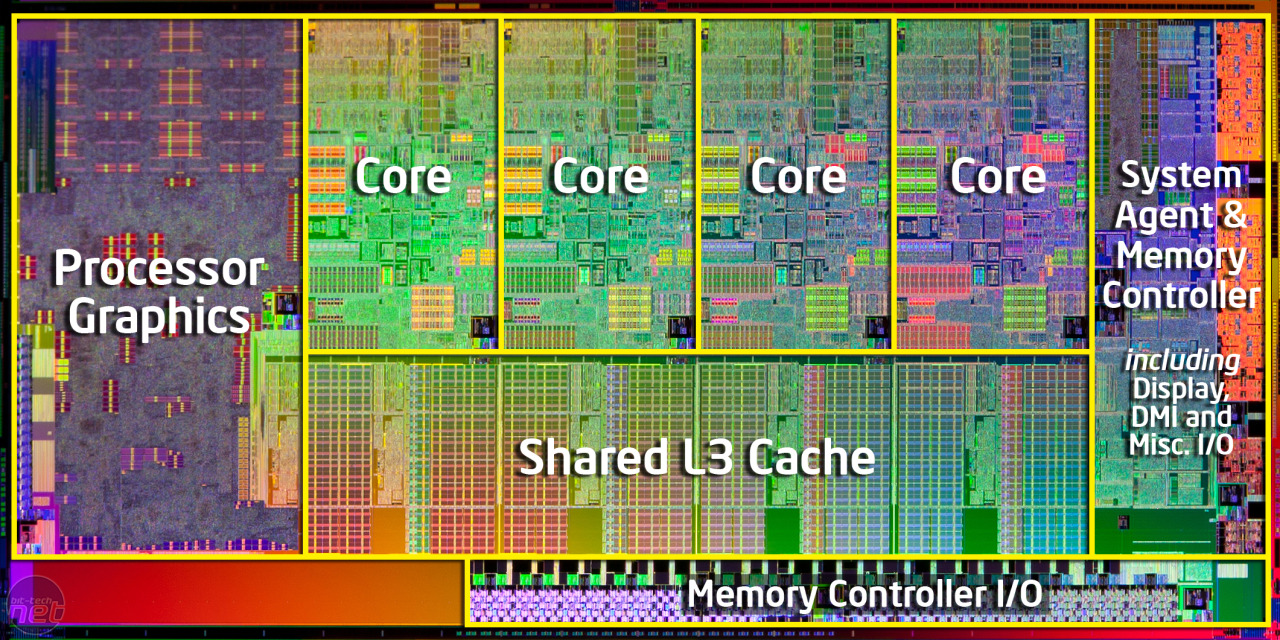
The GPU on sandy bridge consumes die area approximately equivalent to two CPU cores.
Unified memory architecture is an elegant thing, but it does require storing the framebuffer in main memory. At 1920x1080 with 32-bit color, the framebuffer is close to 64MiB. This will typically be refreshed at 60Hz, requiring 3.7GiB/s of memory bandwidth. That is quite a lot of bandwidth to be consuming 100% of the time. Incidentally, I recall that on my old SGI O2 R10k, it surprised me to find that algorithms touching only the CPU and memory ran a third slower at maximum resolution vs at 800x600. This was not a happy discovery given that the machine cost $19,995 and was meant to excel at graphics.
I realize that Intel GMA is not meant to excel at anything at all save for ripping some additional cash from my hand, but there's no need to integrate brain damaged graphics or wireless to achieve this. I would gladly pay for additional L3 cache or another CPU core or two.
-
Re:Additional Story Resources
Agreed! The more people read about these products the better informed. A couple more:
bit-tech: http://bit-tech.net/hardware/2011/01/03/intel-sandy-bridge-review/1
Neoseeker: http://neoseeker.com/Articles/Hardware/Reviews/Intel_i7_2600K_Intel_i5_2500K
-
Re:A lot like Windows after all
So then what is your excuse for this?
Fair point. Although it should be noted, on further digging, I don't think anyone actually uncovered any malicious behavior for these apps. The banks were rightfully concerned as they didn't produce the apps and they couldn't verify that they weren't malicious. Considering the nature of the service involved, it's judicious to assume that they were. But for all we know, they could have been simply charging $.99 to people who didn't know how to set a bookmark.
-
Re:A lot like Windows after all
The
So then what is your excuse for this?
-
Re:Always fascinating.
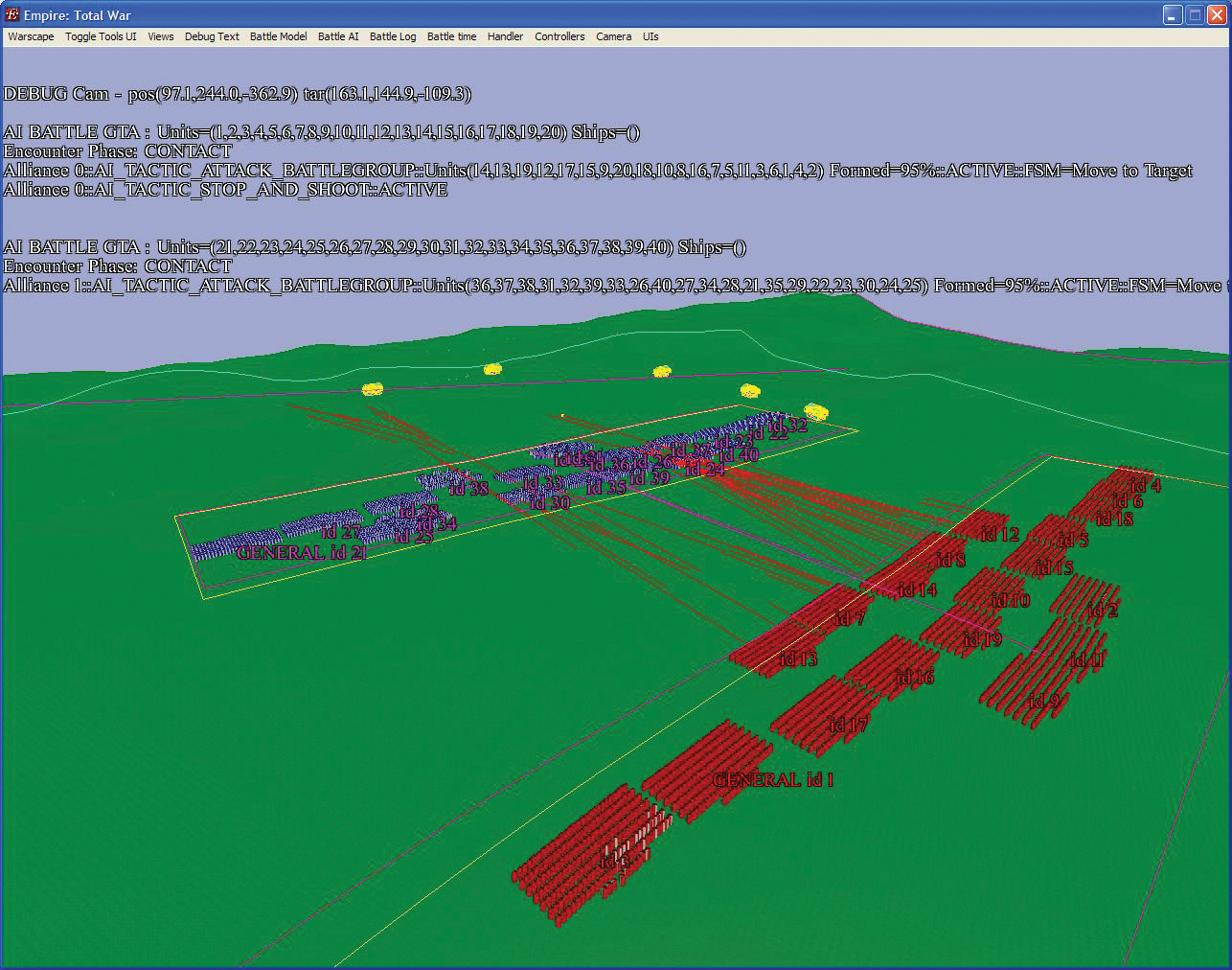
Ever consider you're just playing the wrong games? Read up on Total War's AI, which learns from your tactics and modifies its own (I'm not asserting that it's the first to do so). http://images.bit-tech.net/content_images/2009/03/how-ai-in-games-works/totalwarplan2.jpg
-
Not sure this guy understands the problem.
He's sped up links between chips from something like one-third c to c.
Architecturally that reduces inter-chip latency by 66%, which does indeed open up a new overall speed range for applications that are bandwidth-limited by interconnects. But in no sense does it imply a 1000-fold increase in overall performance. It's only a 3X improvement in bandwidth of the physical layer of the interconnect to which the speedup applies.
It may allow architectures that pack in more computing units, since light beams don't interfere physically or electrically the way wires do. And light can carry multiple channels in the same beam if multiple frequency or phase or polarization accesses can be added. Those will further improve bandwidth and possibly allow a further increase in the number of computing units, which could help get to the 1000X number.
BTW, didn't Intel have an announcement on optical interconnects just a while ago? Yes. They did.
-
Re:SSDs - when will TRIM come to OSX
http://www.bit-tech.net/hardware/apple/2010/07/01/mac-ssd-performance-trim-in-osx/7
Maybe it does not need it?
-
Re:Anderson's not weird. He's you
No it's not a bait and switch. M$ doesn't claim they incorporate a firewall. They advise you to use one. Due to monopoly abuse laws the may not be allowed to incorporate one, which is sad to say the least. Ad to that the problem that vendors like Dell and Asus are persuaded to stick cripleware like Norton on their systems instead of just enabling M$ Security Essentials.
I do not assume most people read any license txt. In fact the "Immortal Soul clause" indicated most people don't.
I am talking about the check they built into the Security Center: If you do not have an up to date virus scanner it will nag you sensless until you either enable one or tell it you will monitor it yourself -
Re:And now you can have a superior PC for $500 les
TRIM is not necessary for OSX; OSX doesn't have the huge performance hit which requires the use of TRIM on Windows. http://www.bit-tech.net/hardware/apple/2010/07/01/mac-ssd-performance-trim-in-osx/7
-
Good write ups, good card
http://www.pcper.com/article.php?aid=1034
http://www.hardocp.com/article/2010/11/09/nvidia_geforce_gtx_580_video_card_review
http://www.anandtech.com/show/4008/nvidias-geforce-gtx-580
http://www.legitreviews.com/article/1461/1/
http://www.techreport.com/articles.x/19934
http://www.bit-tech.net/hardware/graphics/2010/11/09/nvidia-geforce-gtx-580-review/1 -
EBay is filled with these thingsSome factory in China is pumping out cheapo Android pads in a variety of styles and selling them wholesale for $80 each. Usually they're called aPads or Eken books and I've seen a number of announcements (e.g. Next are flogging a 10" variant for £180) which are obviously based on these. Indeed ebay is full of the generic 7" and 10" aPad / eken tablets. If you're determined you'll be able to buy a 7" one for $100. Although I don't expect they are anything to write home about, they are a herald of things to come.
There will a some perfectly usable tablets in the $200-299 range before long and I expect they will fulfill most of the things the iPad is bought for but a fraction of the price.
-
Re:$1000 a PC?
"However, it's important to understand your bottleneck, and dedicate more money on it.... I could use an SSD with a cost around 150 Euros."
It's also important to remember to spend the right amount to alleviate those bottlenecks. An SSD makes a lot of sense in a laptop because SSDs are expensive per gigabyte but you're not typically using a laptop for huge files and SSDs use less power so the battery should last longer, but I've seen people put SSDs in their desktops to load games faster. I suppose the half second faster loading time might be worth it to a very few, but I believe the large majority might be better off spending that $150+ on something else and they're being suckered into buying SSDs based on unrealistic benchmarks.
Case in point: I went with a 15000rpm SCSI after reading how amazing they were years ago. Despite an access time nearly 3x as fast as an SATA drive I didn't really notice a huge difference. I'd imagine most SSD owners feel the same.
Don't get me wrong the time for SSDs will come soon, but some people that bought SSDs back in 2008 or before when the prices were $300+ for 32gb really got ripped off. -
Re:Volt is not a measurement of power
http://www.bit-tech.net/news/modding/2006/09/18/usb_hotplate_cooks_dinner/1
link to 2006 article
-
Review
£300, 7/10 and it needs an iPhone. I won't be getting one.
-
Cool electronics, shitty case mod
Building a binary-compatible Cray clone with an FPGA board: Awesome!
Putting it in a case that's...sorta roughly the same shape as a Cray-1: LAME!
Here's a MUCH better scale Cray-1 case mod housing two x86 PCs:
http://www.bit-tech.net/modding/case-mod/2010/07/28/cray-1-by-daryl-brach/7
-
Re:Wow!
Yes, "a chip" of that vintage. A 2 Mhz MOS microprocessor. Yet the Cray wasn't a single microprocessor. Getting a 50x speedup of a single MOS microprocessor on a single newer FPGA chip is one thing. Getting a 50x speedup from a wire-and-lead NAND array machine running at 80 MHz on a single FPGA isn't quite the same thing.
Not only were the data items 64 bits, but the vector registers could each be fed a 64-bit word each clock cycle. The four 64-bit instruction buffers could be completely filled with the 16-bit instructions every cycle. Instructions could be chained after decoding.
Good luck getting a 300 MHz FPGA to implement a 400 MHz machine of any design. Yes, maybe given sufficient time and patience he could top the 33 MHz he's already done, but the scale of speedup you're talking about for the 6502 is just not comparable to the what can be expected.
A new system could absolutely and easily outrun a Cray 1 by 50x or much, much more. The Cray XT5-HE installation known as Kraken XT5 hits 1028851 GFlops peak in Linpack. An NVidia GeForce GTX285 can peak at over 100 GFlops in some of the OpenCL benchmarks and runs at 1476 MHz for the processor clock and 648 MHz for the graphics clock all on one processor. Both ATI and NVidia offer cards with theoretical limits above a TFlops. My CPU I'm using to type this gets over 11,000 MIPS in the 7zip benchmark at bit-tech.
Yet you won't be getting anything like that onto the S3E. If you do, you should be running a department at Intel, AMD, NVidia, Fujitsu, Freescale, or Via rather than putting stuff on dev kit boards. I'm sure they'd be interested in how you accomplished it.
-
Re:different from microSD?
"- less than 15 needed for sufficient speeds [nope]"
SATA SDHC RAID spotted: " Impress were able to get a pretty impressive 111.4MB/s read and 55.2MB/s write when combining the device with six Transcend 8GB Class 6 SDHC cards."
While 55MB/s real world speed isn't the "up to 100MB/s" the article claims, that SATA SDHC RAID article is also 2 years old, modern SDHC cards could no doubt close the gap.
- easy to solder on board [nope]
That a feature or bug? I really don't like the idea of hard drives being soldered to motherboards
- wear leveling [nope]
- possibility to do TRIM [nope]
- encryption? [nope]
Article doesn't mention any of those features, I guess you're just assuming this will have all of those because other SSDs you've used had these features?
"- boot (in RAID) [nope]
- no drivers needed (in RAID) [nope]
If the manufacture raided several memory chips at the hardware level, yes you could boot in raid and no drivers would be needed
"- cheaper than the proposed solution (in RAID) [nope]"
Prices have not been announced
"- smaller than the proposed solution (in RAID) [nope]"
If a manufacture took several MicroSDHC cards apart and put them in raid they would be as small as this solution. -
Re:The Biggest Issue With Journalism
check out bit-tech.net
One of the few gaming sites I have found that rarely show bias for stuff... I rarely see a game out there that gets more than a 8, with the majority getting between a 4 and a 7
They also have some awesome down-to-earth write-ups of new CPU / GPU / RAM architecture. If I remember correctly the new i5 / i7 series architecture article was 12 pages and went into great lengths about it. (FYI 1 page is NOT just 2 paragraphs of content and 20 ads and 12 pictures)
i7 Architecture Dive -
Re:More Cores, More Power
"Someone hasn't seen the EVGA SR-2 mobo, yet."
Sad, someone will drop $600 on that board, drop another $2500 on two 6-core Xeon and be the big swinging dick on their forum for the next 3 or 4 years, until everyone's on 24 core cpus for $500, and eventually they'll start laughing at him for wasting 3 grand on just cpus and a motherboard.
Remember quad core cpus just came out 3 years ago and we're already on 12 cores. Does anyone doubt we'll be on 24 or more cores in 3 years? -
What happened to the rumours...
...of a re-release of all 5 Oddworld-games for Windows through steam, including Munch's Oddysee and Stranger's Wrath? Wikipedia links to http://www.bit-tech.net/news/gaming/2009/10/12/oddworld-games-being-ported-to-pc/1 and appearantly it was confirmed by Oddworld Inhabitants for early 2010.
-
Re:Wow, a pro Mac story
That is startling!
Having read through the original article, all of its comments, the linked article on TRIM and performance degradation and the score-over-3 comments herein, I'm surprised that nobody has pointed to this:
http://www.osxbook.com/software/hfsdebug/fragmentation.html
The description of the mechanisms HFS+ uses to avoid fragmentation are reminiscent of TRIM's operation from the drive's perspective and the garbage collection scheme used in Samsung's ARM controller, assuming bit-tech.net's description of these is accurate. It therefore comes as little surprise to read anecdotes from numerous users with both factory and third party ("fast" / "non-Apple firmware") SSDs where little performance drop is seen in OS X, along with a series of tests showing similar results and importantly, so far, no anecdotes or test results showing the opposite.
The absence of claims of degrading SSDs under OS X is a surprise and suggests that there really is a performance advantage with SSDs and HFS+ where TRIM is not in use. Adopting TRIM support might improve matters further, of course.
The bit-tech.net tests did still have numerous annoying omissions; this doesn't invalidate them but it does leave questions hanging. It would have been worthwhile partitioning most of the factory drive for NTFS and re-testing under Boot Camp. It would have been even more worthwhile getting one of the SSDs which showed the worst non-TRIM "dirty" performance under Windows and testing that under Mac OS X; if this wasn't possible on the Air hardware for some reason, they could've done it on the Macbook Pro they used as an HDD baseline in the first series of tests.
BTW, Singh's OS X Internals is a great book if you want to learn more about the innermost parts of the OS.
-
Re:Wow, a pro Mac story
That is startling!
Having read through the original article, all of its comments, the linked article on TRIM and performance degradation and the score-over-3 comments herein, I'm surprised that nobody has pointed to this:
http://www.osxbook.com/software/hfsdebug/fragmentation.html
The description of the mechanisms HFS+ uses to avoid fragmentation are reminiscent of TRIM's operation from the drive's perspective and the garbage collection scheme used in Samsung's ARM controller, assuming bit-tech.net's description of these is accurate. It therefore comes as little surprise to read anecdotes from numerous users with both factory and third party ("fast" / "non-Apple firmware") SSDs where little performance drop is seen in OS X, along with a series of tests showing similar results and importantly, so far, no anecdotes or test results showing the opposite.
The absence of claims of degrading SSDs under OS X is a surprise and suggests that there really is a performance advantage with SSDs and HFS+ where TRIM is not in use. Adopting TRIM support might improve matters further, of course.
The bit-tech.net tests did still have numerous annoying omissions; this doesn't invalidate them but it does leave questions hanging. It would have been worthwhile partitioning most of the factory drive for NTFS and re-testing under Boot Camp. It would have been even more worthwhile getting one of the SSDs which showed the worst non-TRIM "dirty" performance under Windows and testing that under Mac OS X; if this wasn't possible on the Air hardware for some reason, they could've done it on the Macbook Pro they used as an HDD baseline in the first series of tests.
BTW, Singh's OS X Internals is a great book if you want to learn more about the innermost parts of the OS.
-
Re:Wow, a pro Mac story
That is startling!
Having read through the original article, all of its comments, the linked article on TRIM and performance degradation and the score-over-3 comments herein, I'm surprised that nobody has pointed to this:
http://www.osxbook.com/software/hfsdebug/fragmentation.html
The description of the mechanisms HFS+ uses to avoid fragmentation are reminiscent of TRIM's operation from the drive's perspective and the garbage collection scheme used in Samsung's ARM controller, assuming bit-tech.net's description of these is accurate. It therefore comes as little surprise to read anecdotes from numerous users with both factory and third party ("fast" / "non-Apple firmware") SSDs where little performance drop is seen in OS X, along with a series of tests showing similar results and importantly, so far, no anecdotes or test results showing the opposite.
The absence of claims of degrading SSDs under OS X is a surprise and suggests that there really is a performance advantage with SSDs and HFS+ where TRIM is not in use. Adopting TRIM support might improve matters further, of course.
The bit-tech.net tests did still have numerous annoying omissions; this doesn't invalidate them but it does leave questions hanging. It would have been worthwhile partitioning most of the factory drive for NTFS and re-testing under Boot Camp. It would have been even more worthwhile getting one of the SSDs which showed the worst non-TRIM "dirty" performance under Windows and testing that under Mac OS X; if this wasn't possible on the Air hardware for some reason, they could've done it on the Macbook Pro they used as an HDD baseline in the first series of tests.
BTW, Singh's OS X Internals is a great book if you want to learn more about the innermost parts of the OS.
-
Re:Description is flawed
I suppose all of this is a mute because the LGA 1156 platform and LGA 1366 platform are being discontinued next year, so if you don't already have a i7 compatible motherboard you'd be buying a board that won't be compatible with any cpus made 7 months from now. I wouldn't buy a i7 cpu unless intel started selling them for $50, while AM3 boards available now are compatible with future 16-core cpus
First off, 3Q11 isn't 7 months away.
And it's all relative. By that time, 1366 will be three years old. I'll have had mine for over 2.5 years. Note that I bought my i7 system because my high-end AMD board, which was 16 months old at the time, was only AM2 and therefore couldn't support the newer AMD CPUs. I had to buy a new board whether I went with AMD or Intel. Even the article you linked states that guaranteeing motherboard support this early in the game is difficult, but AMD is usually good about maintaining socket compatibility. You may be able to slip a Zambezi into your current day Socket-AM3 motherboards. You and your current AM3 board might end up being just as screwed as me and my 1366 board.
Plus you're forgetting that the Phenom II X4 was designed to compete with the C2Q, not the i7. In an old review (can't find the link right now), the i7-920 at stock 2.66GHz still beat out a Phenom II 955BE overclocked to 3.7GHz by 27% on some compression benchmark. http://www.bit-tech.net/hardware/cpus/2010/04/27/amd-phenom-ii-x6-1090t-black-edition/6 shows similar results - in the 7-Zip/Mplayer test, the stock 2.8GHz i7-930 beats the 3.87GHz Phenom II X6 1090T Black Edition by over 20%. Yes, the AMD has 50% more cores (not taking into account HyperThreading) and 38% higher clockspeed, but the Intel is still 20% faster.
AMD's CPUs can be a great value, especially for gaming where the GPU is usually the bottleneck. However, Intel's CPUs are simply more powerful for a large number of tasks. Depending on what hardware you currently have, there may or may not be a significant difference in upgrade costs between the two brands. It's pretty safe to say that the Intel will probably cost more, but you'll probably also be getting more performance out of it.
-
Re:Description is flawed
I suppose all of this is a mute because the LGA 1156 platform and LGA 1366 platform are being discontinued next year, so if you don't already have a i7 compatible motherboard you'd be buying a board that won't be compatible with any cpus made 7 months from now. I wouldn't buy a i7 cpu unless intel started selling them for $50, while AM3 boards available now are compatible with future 16-core cpus
First off, 3Q11 isn't 7 months away.
And it's all relative. By that time, 1366 will be three years old. I'll have had mine for over 2.5 years. Note that I bought my i7 system because my high-end AMD board, which was 16 months old at the time, was only AM2 and therefore couldn't support the newer AMD CPUs. I had to buy a new board whether I went with AMD or Intel. Even the article you linked states that guaranteeing motherboard support this early in the game is difficult, but AMD is usually good about maintaining socket compatibility. You may be able to slip a Zambezi into your current day Socket-AM3 motherboards. You and your current AM3 board might end up being just as screwed as me and my 1366 board.
Plus you're forgetting that the Phenom II X4 was designed to compete with the C2Q, not the i7. In an old review (can't find the link right now), the i7-920 at stock 2.66GHz still beat out a Phenom II 955BE overclocked to 3.7GHz by 27% on some compression benchmark. http://www.bit-tech.net/hardware/cpus/2010/04/27/amd-phenom-ii-x6-1090t-black-edition/6 shows similar results - in the 7-Zip/Mplayer test, the stock 2.8GHz i7-930 beats the 3.87GHz Phenom II X6 1090T Black Edition by over 20%. Yes, the AMD has 50% more cores (not taking into account HyperThreading) and 38% higher clockspeed, but the Intel is still 20% faster.
AMD's CPUs can be a great value, especially for gaming where the GPU is usually the bottleneck. However, Intel's CPUs are simply more powerful for a large number of tasks. Depending on what hardware you currently have, there may or may not be a significant difference in upgrade costs between the two brands. It's pretty safe to say that the Intel will probably cost more, but you'll probably also be getting more performance out of it.
-
Description is flawed
"Surprisingly, even at stock speeds, the i7-875K offers better performance and power efficiency per dollar than just about any other desktop CPU out there."
-1, Inaccurate
The 2.8ghz i7-930 is $199 vs $342 for a 2.93ghz i7-875K, so almost double the price for 0.13ghz more. How did the author see that and think "better performance per dollar"? The article he linked to even shows the better performance per dollar in a chart, and btw techreport that chart is pretty piss poor, shoving $200 processors on a chart that goes to $1200 just clumps 90% of the processors in the $50 to $400 range. Learn how to make a chart: you should have left off under $50 (no processors under $50) and anything past $1000 (no processors over $1000). Because of your crappy chart the i7-875 is right next to the i7-930 despite the $142 difference.
The i7-930 is locked but it does reach 4ghz on air rather easily.
I suppose all of this is a mute because the LGA 1156 platform and LGA 1366 platform are being discontinued next year, so if you don't already have a i7 compatible motherboard you'd be buying a board that won't be compatible with any cpus made 7 months from now. I wouldn't buy a i7 cpu unless intel started selling them for $50, while AM3 boards available now are compatible with future 16-core cpus -
Re:How much is a lot?
You may be able to fit more drives than that using these http://www.newegg.com/Product/Product.aspx?Item=N82E16817121405&Tpk=supermicro%20cse-m35t-1b the pic is misleading as it's turned on it's side but it fits 5 drives where 3 would normally go. Hard to tell from the pic you linked but I think you could fit at least 3 of these in your case and gain *easy* access to the drives.
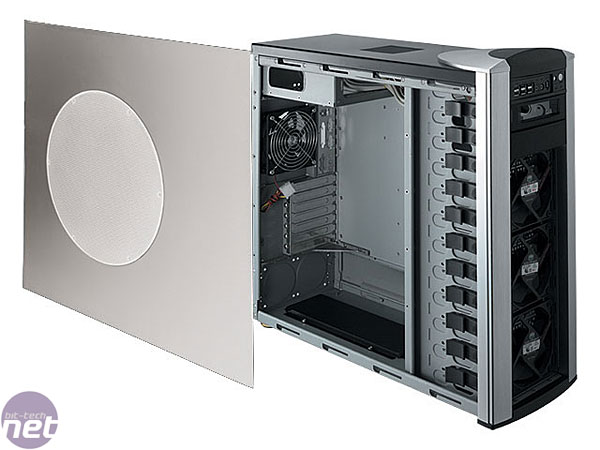
I use two full sized CoolerMaster Stacker cases on casters but I think they've discontinued it. The Centurian looks pretty close to it though but is maybe cheaper in construction, mine sure didn't cost $70! http://www.newegg.com/Product/Product.aspx?Item=N82E16811119152&Tpk=coolermaster Something like this http://images.bit-tech.net/content_images/2007/03/cm_stacker_mod_by_snakez_and_ediejo/page1-2.jpg but get the one with just the single PSU slot. I have two machines and one of them has room for two PSU - not needed. I've found that I need a pretty hefty UPS though, mine squeal like pigs on cold power-up!
-
Re:Annoying...
You seem to think that a bug in an operating system that misreports the size of storage devices is somehow fraud on the part of the device manufacturers.
You seem intent on rewriting history. Either you're an astroturfer or you're simply not old enough to remember the 1990s.
Hard drives had always been marketed in multiples of binary megabytes.
Then came along drive manufacturers that put in big numbers the size of the drive in "megabytes" with *little numbers* hidden in a corner of the box defining the size as a decimal multiple instead of a power of two. Thus if you bought an 8GB drive from a manufacturer that labeled it as a power of ten, and compared it to a drive that was labeled in powers of two, suddenly the latter drive was "smaller" when it really wasn't.
This first happened in the 1990's and I think it was Maxtor, but don't hold me to it because I haven't looked it up.
Seagate wasn't the first, but they were the first to be sued and lose:
The case is centered around the difference between a gigabyte at 1,000,000,000 bytes and a binary gigabyte at 1,073,741,824 bytes. This difference has been known for years and is common among all hard drive manufacturers. Hard drive manufacturers measure and advertise their GBs in base10 while most operating systems, including all versions of Windows and MacOS, measure their GBs in base2 the binary number system consisting of 1s and 0s that resides at the ground level of all computer functioning.
Megabyte for megabyte the difference is completely negligible, but with both Seagate and Western Digital joining Hitachi in the 1TB hard drive market, that minor size difference can add up quickly (just over 68.5GB on a 1TB drive; theres just under a 7% discrepancy between a base10 GB and a base2 GB)
http://www.bit-tech.net/news/bits/2007/10/26/seagate_lawsuit_concludes_settlement_announced/1
It's never been a bug in the OS. The OS has always been reporting the size correctly. The solution was not to change the definition in the direction of the fraud, but rather to hold the manufacturers to the correct standard.
This entire thing is because of fraud upon the ignorant consumer, and to spin it any other way means you're either a sucker or you're one of the spinners.
You pick.
--
BMO -
Bit-Tech
Or you could read the Bit-Tech system guide . (and/or any of the other similar guides from other tech sites)